 It's Ours

Contents
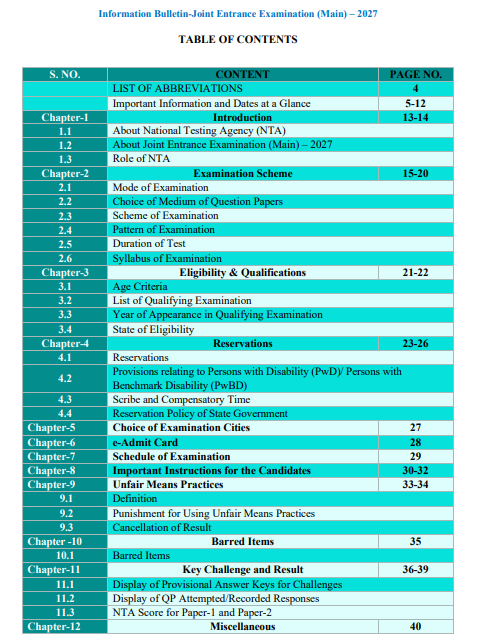
- 1 JEE MAIN 2027 INFORMATION BULLETIN
- 1.1 JEE Main 2027 Information Bulletin: Overview
- 1.2 JEE Main 2027 Information Bulletin
- 1.3 JEE Main 2027 Important Dates
- 1.4 What Is JEE Main 2027?
- 1.5 JEE Main 2027 Examination Mode
- 1.6 JEE Main 2027 Examination Languages
- 1.7 JEE Main 2027 Eligibility Criteria
- 1.8 JEE Main 2027 Age Limit
- 1.9 JEE Main 2027 Class 12 Passing Year Criteria
- 1.10 JEE Main 2027 Qualifying Examinations
- 1.11 JEE Main 2027 Subject Requirements for Admission
- 1.12 JEE Main 2027 State of Eligibility
- 1.13 JEE Main 2027 Application Fee
- 1.14 JEE Main 2027 Application Fee Payment Rules
- 1.15 JEE Main 2027 Registration and Application Process
- 1.16 JEE Main 2027 Two-Session Examination Policy
- 1.17 JEE Main 2027 Examination Pattern
- 1.18 JEE Main 2027 Paper 1 Pattern – B.E./B.Tech
- 1.19 JEE Main 2027 Paper 2A Pattern – B.Arch
- 1.20 JEE Main 2027 Paper 2B Pattern – B.Planning
- 1.21 JEE Main 2027 Examination Duration
- 1.22 JEE Main 2027 Examination Timings
- 1.23 JEE Main 2027 Marking Scheme
- 1.24 JEE Main 2027 Syllabus
- 1.25 JEE Main 2027 Tie-Breaking Rules
- 1.26 JEE Main 2027 Reservation Policy
- 1.27 JEE Main 2027 PwD/PwBD Provisions
- 1.28 JEE Main 2027 Scribe and Compensatory Time
- 1.29 JEE Main 2027 Examination City Selection
- 1.30 JEE Main 2027 Admit Card
- 1.31 JEE Main 2027 Important Examination-Day Instructions
- 1.32 JEE Main 2027 Barred Items
- 1.33 JEE Main 2027 Unfair Means Practices
- 1.34 JEE Main 2027 Answer Key and Response Sheet
- 1.35 JEE Main 2027 Question Paper and Recorded Responses
- 1.36 JEE Main 2027 NTA Score
- 1.37 JEE Main 2027 Result and Ranking
- 1.38 JEE Main 2027 Re-evaluation and Rechecking
- 1.39 JEE Main 2027 Admission Process
- 1.40 JEE Main 2027 JEE Advanced Eligibility
- 1.41 JEE Main 2027 Important Instructions for Candidates
- 1.42 JEE Main 2027 Official Website and Contact Details
- 1.43 JEE Main 2027 Latest Updates
- 1.44 Frequently Asked Questions (FAQs) About JEE Main 2027 Information Bulletin
- 1.45 Conclusion
JEE MAIN 2027 INFORMATION BULLETIN
The JEE Main 2027 Information Bulletin has been released by the National Testing Agency (NTA) for candidates appearing for the Joint Entrance Examination (Main) 2027. The bulletin contains the official guidelines for the examination, including important dates, eligibility criteria, registration requirements, application fees, examination pattern, marking scheme, reservation rules, examination-day instructions and result procedures.
JEE Main 2027 will be conducted in two sessions for the academic year 2027–28. Session 1 will be held in January 2027, and Session 2 will be held in April 2027. Candidates can appear in either one or both sessions, subject to the applicable registration requirements.
JEE Main is conducted for admission to undergraduate engineering programmes at participating NITs, IIITs, other Centrally Funded Technical Institutions and other participating institutions. It is also an eligibility examination for JEE Advanced, which is conducted for admission to IITs. The examination also includes separate papers for admission to B.Arch and B.Planning courses.
The JEE Main 2027 Information Bulletin is particularly important because it explains the rules candidates must follow before, during and after the examination. Students should understand the eligibility conditions, examination scheme, fee structure and other requirements before completing their applications.
In this article, candidates can find the complete details of the JEE Main 2027 Information Bulletin, explained in simple language, along with important dates, tables and official links.
JEE Main 2027 Information Bulletin: Overview
| Particulars | Details |
|---|---|
| Examination Name | Joint Entrance Examination (Main) 2027 |
| Common Name | JEE Main 2027 |
| Conducting Authority | National Testing Agency (NTA) |
| Ministry | Ministry of Education, Government of India |
| Academic Session | 2027–28 |
| Examination Sessions | Session 1 and Session 2 |
| Session 1 | January 2027 |
| Session 2 | April 2027 |
| Examination Papers | Paper 1, Paper 2A and Paper 2B |
| Paper 1 | B.E./B.Tech |
| Paper 2A | B.Arch |
| Paper 2B | B.Planning |
| Examination Mode | Computer-Based Test, except the Drawing Test in Paper 2A |
| Examination Languages | 13 languages |
| Session 1 Examination Dates | 20, 21, 22, 23, 24 and 28 January 2027 |
| Session 2 Examination Dates | 2, 3, 4, 5, 6 and 7 April 2027 |
| Official Website | https://jeemain.nta.nic.in/ |
| Information Bulletin | Available through the official JEE Main website |
JEE Main 2027 Information Bulletin
Candidates can access the JEE Main 2027 Information Bulletin through the official examination website.
Official website: https://jeemain.nta.nic.in/
NTA official website: https://nta.ac.in/
The bulletin contains the detailed instructions for both examination sessions. Candidates should refer to it for the official eligibility requirements, examination rules, application fee structure and other conditions applicable to JEE Main 2027.
Important: The bulletin provides the examination framework and schedule for both sessions. Candidates should distinguish these details from the separate notifications issued for specific application activities or subsequent examination updates.
JEE Main 2027 Important Dates
The Information Bulletin specifies the schedules for both January and April sessions. Candidates should keep track of the application deadlines, late application windows, correction facilities, city intimation dates and admit card dates.
JEE Main 2027 Session 1 Important Dates
| Event | Date |
|---|---|
| Online Application Begins | 24 October 2026 |
| Last Date to Submit Application | 22 November 2026 |
| Last Date for Fee Payment | 22 November 2026, up to 11:50 PM |
| Late Application Window | 23–26 November 2026 |
| Late Fee | ₹500 in addition to the applicable examination fee |
| Application Correction Window | 27–29 November 2026 |
| City Intimation Slip | 30 December 2026 |
| Admit Card Availability | 13 January 2027 |
| Examination Dates | 20, 21, 22, 23, 24 and 28 January 2027 |
| Question Paper and Answer Key | To be displayed on the NTA website |
JEE Main 2027 Session 2 Important Dates
| Event | Date |
|---|---|
| Online Application Begins | 5 January 2027 |
| Last Date to Submit Application | 3 February 2027 |
| Last Date for Fee Payment | 3 February 2027, up to 11:50 PM |
| Late Application Window | 4–7 February 2027 |
| Late Fee | ₹500 in addition to the applicable examination fee |
| Application Correction Window | 8–10 February 2027 |
| City Intimation Slip | 12 March 2027 |
| Admit Card Availability | 25 March 2027 |
| Examination Dates | 2, 3, 4, 5, 6 and 7 April 2027 |
| Question Paper and Answer Key | To be displayed on the NTA website |
The bulletin states that the late application window for each session carries an additional fee of ₹500, irrespective of the candidate’s category or regular examination fee.
Candidates should complete their applications within the relevant deadlines. The application form for Session 2 follows a separate schedule, even for candidates who have already registered for Session 1.
What Is JEE Main 2027?
The Joint Entrance Examination (Main) is a national-level entrance examination conducted by the National Testing Agency.
The examination serves different purposes depending on the paper selected by the candidate.
Paper 1 – B.E./B.Tech: Paper 1 is conducted for admission to undergraduate engineering programmes at NITs, IIITs, other Centrally Funded Technical Institutions and participating institutions or universities funded or recognised by state governments.
It also serves as an eligibility examination for JEE Advanced, which is conducted for admission to IITs. Candidates must satisfy the applicable JEE Advanced eligibility requirements in addition to qualifying through JEE Main.
Paper 2A – B.Arch: Paper 2A is conducted for candidates seeking admission to Bachelor of Architecture programmes.
Paper 2B – B.Planning: Paper 2B is conducted for candidates seeking admission to Bachelor of Planning programmes.
The NTA is responsible for registration, conducting the examination, processing answer keys, inviting challenges, preparing scores and declaring results. Admission and seat allocation are handled through the relevant admission authorities and participating institutions.
JEE Main 2027 Examination Mode
The examination mode depends on the paper selected by the candidate.
| Paper | Course | Examination Mode |
|---|---|---|
| Paper 1 | B.E./B.Tech | Computer-Based Test |
| Paper 2A | B.Arch | Computer-Based Test, except the Drawing Test |
| Paper 2B | B.Planning | Computer-Based Test |
For Paper 2A, the Drawing Test is conducted offline using pen and paper on an A4-size drawing sheet. The remaining applicable sections are conducted in computer-based mode.
Candidates applying for architecture should therefore prepare for both the computer-based sections and the offline drawing component.
JEE Main 2027 Examination Languages
JEE Main 2027 will be conducted in 13 languages.
| No. | Language |
|---|---|
| 1 | English |
| 2 | Hindi |
| 3 | Assamese |
| 4 | Bengali |
| 5 | Gujarati |
| 6 | Kannada |
| 7 | Malayalam |
| 8 | Marathi |
| 9 | Odia |
| 10 | Punjabi |
| 11 | Tamil |
| 12 | Telugu |
| 13 | Urdu |
Candidates should select their preferred examination language while completing the application form, subject to the options available for their selected examination city.
Candidates should enter their preferences carefully and review the application form before submitting it.
JEE Main 2027 Eligibility Criteria
Candidates must satisfy the applicable eligibility requirements before applying for JEE Main 2027.
The Information Bulletin specifies the age criteria, qualifying examinations, permitted years of Class 12 appearance and rules for determining the state of eligibility.
JEE Main 2027 Age Limit
According to the Information Bulletin, there is no age limit for appearing in JEE Main 2027.
Candidates who have passed their qualifying examination or are appearing for it in an eligible year can apply, subject to the other conditions specified in the bulletin.
However, the absence of an age limit for appearing in JEE Main does not automatically establish eligibility for admission to every participating institution. Candidates must also satisfy the admission criteria applicable to their chosen institutions and courses.
JEE Main 2027 Class 12 Passing Year Criteria
The bulletin specifies the following qualifying examination years.
| Class 12 Status | Eligibility for JEE Main 2027 |
|---|---|
| Passed Class 12 in 2025 | Eligible, subject to other conditions |
| Passed Class 12 in 2026 | Eligible, subject to other conditions |
| Appearing for Class 12 in 2027 | Eligible, subject to other conditions |
| Passed Class 12 in 2024 or earlier | Not eligible |
Candidates who passed Class 12 in 2025 or 2026, as well as those appearing in 2027, can apply for JEE Main 2027.
Candidates who passed Class 12 in 2024 or earlier are not eligible under the year-of-appearance rules specified in the bulletin.
The year of passing refers to the year in which the candidate was first declared to have passed the Class 12 or equivalent examination. An improvement examination does not change the year of the first pass.
For example, if a candidate first passed Class 12 in 2025 and later appeared for an improvement examination in 2026, the original passing year remains 2025.
Candidates appearing for their Class 12 board examinations in 2027 may enter their roll number, registration number or enrolment number in the relevant application fields, as applicable.
JEE Main 2027 Qualifying Examinations
The Information Bulletin lists the qualifying examinations accepted for appearing in JEE Main 2027.
These include:
- The final examination of the 10+2 system conducted by a recognised Central or State Board, such as CBSE or CISCE.
- Intermediate or two-year Pre-University examinations conducted by a recognised board or university.
- The final examination of the two-year course of the Joint Services Wing of the National Defence Academy.
- Senior Secondary School Examination conducted by the National Institute of Open Schooling, with a minimum of five subjects.
- Public school, board or university examinations in India or another country recognised as equivalent to the 10+2 system by the Association of Indian Universities.
- Higher Secondary Certificate Vocational Examination.
- A diploma of at least three years’ duration recognised by AICTE or a State Board of Technical Education.
- General Certificate of Education examinations at the Advanced Level conducted in London, Cambridge or Sri Lanka.
- High School Certificate Examination of Cambridge University or the International Baccalaureate Diploma of the International Baccalaureate Office, Geneva.
- Examinations conducted by the Board of Open Schooling and Skill Education, Sikkim.
Candidates who completed Class 12 or an equivalent examination outside India, or through a board not covered by the listed provisions, may need to produce an equivalence certificate from the Association of Indian Universities.
The bulletin also specifies that candidates whose Class 12 examination is not a public examination must have passed at least one public board or Pre-University examination earlier.
Important: Eligibility to appear for JEE Main and eligibility for admission to a particular institution are not necessarily identical. Candidates should verify the course-specific admission requirements of the institutions they intend to join.
JEE Main 2027 Subject Requirements for Admission
The subjects studied in Class 12 are important for admission to engineering, architecture and planning programmes.
Candidates should distinguish the examination eligibility rules from the academic subject requirements prescribed by admitting institutions.
For B.E./B.Tech: Mathematics and Physics are central subjects for engineering admission, along with the additional subject combinations prescribed by the relevant admission authorities.
For B.Arch: Mathematics, Physics and Chemistry are relevant to the prescribed academic requirements for architecture admission.
For B.Planning: Mathematics is a key subject requirement for planning admission.
Candidates should verify the precise qualifying subject combinations and marks requirements applicable to their selected institutions before applying for admission. Passing JEE Main alone does not guarantee that a candidate meets every institution’s academic admission requirements.
JEE Main 2027 State of Eligibility
The state of eligibility is generally determined by the state from which a candidate passed the Class 12 or equivalent qualifying examination.
It does not depend simply on the candidate’s native place, permanent residence or current residential address.
For example, if a candidate lives in Uttar Pradesh but passes Class 12 from an eligible institution in Delhi, the state code of eligibility will generally be Delhi.
If a candidate passes Class 12 in one state and later appears for an improvement examination in another state, the state in which the candidate first passed the qualifying examination determines the state of eligibility.
Candidates who passed or are appearing for Class 12 through NIOS or BOSSE should select the state according to the location of their study centre, as specified in the bulletin.
The bulletin also provides specific provisions for candidates who passed qualifying examinations in Nepal, Bhutan or other countries. Such candidates should follow the applicable instructions when entering their state-of-eligibility details.
JEE Main 2027 Application Fee
The application fee depends on the examination paper or combination of papers selected, the candidate’s category, gender and whether the examination centre is in India or outside India.
The fee is payable separately for each session in which the candidate wishes to appear.
JEE Main 2027 Application Fee for One Paper
The following fee applies when a candidate selects Paper 1, Paper 2A or Paper 2B individually.
| Candidate Category | Gender | Centres in India | Centres Outside India |
|---|---|---|---|
| General | Male | ₹1,000 | ₹5,000 |
| General | Female | ₹800 | ₹4,000 |
| Gen-EWS/OBC-NCL | Male | ₹900 | ₹4,500 |
| Gen-EWS/OBC-NCL | Female | ₹800 | ₹4,000 |
| SC/ST/PwD/PwBD | Male | ₹500 | ₹2,500 |
| SC/ST/PwD/PwBD | Female | ₹500 | ₹2,500 |
| Third Gender | — | ₹500 | ₹2,500 |
JEE Main 2027 Application Fee for Multiple Papers
The following fee applies to the combinations of two or more papers listed in the Information Bulletin.
| Candidate Category | Gender | Centres in India | Centres Outside India |
|---|---|---|---|
| General/Gen-EWS/OBC-NCL | Male | ₹2,000 | ₹10,000 |
| General/Gen-EWS/OBC-NCL | Female | ₹1,600 | ₹8,000 |
| SC/ST/PwD/PwBD | Male | ₹1,000 | ₹5,000 |
| SC/ST/PwD/PwBD | Female | ₹1,000 | ₹5,000 |
| Third Gender | — | ₹1,000 | ₹5,000 |
The multiple-paper fee applies to the combinations specified in the bulletin, including Paper 1 with Paper 2A, Paper 1 with Paper 2B, all three papers, and Paper 2A with Paper 2B.
Additional charges: Applicable payment gateway processing charges and Goods and Services Tax (GST) are payable in addition to the examination fee.
Late fee: Candidates submitting applications during the late application window must pay an additional ₹500 over and above the applicable examination fee. The late fee is uniform across categories.
JEE Main 2027 Application Fee Payment Rules
The examination fee can be paid online through the following methods:
- Credit Card
- Debit Card
- Net Banking
- UPI
The confirmation page is generated only after successful payment of the application fee.
If a candidate completes payment but the confirmation page is not generated, the candidate should verify the payment status with the concerned bank or payment gateway and follow the instructions in the Information Bulletin.
Candidates should not assume that an application has been successfully submitted merely because money was deducted from their account. The confirmation page is an important record of successful application submission.
JEE Main 2027 Registration and Application Process
The application process is conducted online through the official JEE Main website.
NTA has enabled registration through the MeriPehchaan National Single Sign-On platform for applicants’ convenience.
The application process involves registration, completing the application form, uploading the required documents, paying the fee and confirming successful submission.
Step 1: Complete Registration
Candidates must register through the official website and enter the required personal details.
After successful registration, the system generates an application number. Candidates must preserve this number because it is used for subsequent logins, application completion and future correspondence.
Candidates must also create a password for their account.
Step 2: Complete the Online Application Form
Candidates should log in using their application number and password to complete the remaining sections.
The form includes personal details, examination paper selection, examination city preferences, educational qualifications and other information requested by NTA.
Candidates should verify the information before proceeding.
Step 3: Upload the Required Photograph and Documents
The bulletin specifies the following document requirements.
| Document | Format | File Size |
|---|---|---|
| Recent Photograph | JPG/JPEG | 10 KB–200 KB |
| Signature | JPG/JPEG | 10 KB–100 KB |
| Class 10 Certificate/Marksheet | 50 KB–300 KB | |
| Disability/UDID Certificate, where applicable | 50 KB–300 KB | |
| Certificate of Physical Limitation to Write, where applicable | 50 KB–300 KB | |
| Non-Indian Passport for Foreign Nationals, including OCI candidates, where applicable | 50 KB–300 KB |
The photograph must be a recent, coloured passport-size photograph with approximately 80% face visibility, including the ears, without a mask, against a white background.
Candidates must also upload a live photograph during the application process. They should ensure that the camera or webcam is functioning and that the image has proper lighting and a white background.
The signature and supporting documents must be clear and legible.
Candidates must upload their own photograph, signature and certificates. Uploading someone else’s documents or submitting manipulated records can be treated as an unfair means practice.
Step 4: Pay the Application Fee
Candidates must pay the applicable examination fee using one of the permitted online payment methods.
The amount depends on the selected paper or paper combination, candidate category, gender and examination centre location.
Candidates should retain the payment confirmation for reference.
Step 5: Download the Confirmation Page
After successful fee payment, candidates should verify that the confirmation page has been generated.
The confirmation page is an important record of the submitted application.
Candidates should save a copy and retain their application number, login credentials and payment details securely.
JEE Main 2027 Two-Session Examination Policy
JEE Main 2027 will be conducted in two sessions to give candidates more than one opportunity to demonstrate their performance.
Candidates may appear in either Session 1 or Session 2, or in both sessions.
The two-session system provides several benefits:
- Candidates can improve their performance in the second session.
- Candidates gain experience from their first attempt and can prepare more effectively for the next attempt.
- Candidates who cannot appear in the first session for certain reasons may have another opportunity in the second session.
- Candidates do not have to appear in both sessions if they do not wish to do so.
For candidates who appear in both sessions, the best total NTA Score across the two sessions is considered for preparing the overall merit list and ranking. The best score is based on the total score, not the best individual subject scores from different sessions.
Candidates who have registered for Session 1 can apply for Session 2 using the same application number. Candidates wishing to appear only in Session 2 can register when the Session 2 application window opens.
JEE Main 2027 Examination Pattern
The examination pattern differs according to the selected paper.
Paper 1 is intended for engineering aspirants, Paper 2A is intended for architecture aspirants, and Paper 2B is intended for planning aspirants.
JEE Main 2027 Paper 1 Pattern – B.E./B.Tech
Paper 1 consists of Mathematics, Physics and Chemistry.
Each subject includes multiple-choice questions and numerical-value questions.
| Subject | Section A: MCQs | Section B: Numerical-Value Questions | Total Questions |
|---|---|---|---|
| Mathematics | 20 | 5 | 25 |
| Physics | 20 | 5 | 25 |
| Chemistry | 20 | 5 | 25 |
| Total | 60 | 15 | 75 |
Total questions: 75
Examination duration: 3 hours for candidates not eligible for compensatory time.
Examination mode: Computer-Based Test.
The numerical-value questions require candidates to enter a numerical answer rather than select an option from a list.
The detailed syllabus is available through the official JEE Main website.
JEE Main 2027 Paper 2A Pattern – B.Arch
Paper 2A is conducted for candidates seeking admission to Bachelor of Architecture programmes.
| Part | Subject | Number of Questions |
|---|---|---|
| Part I | Mathematics | 20 MCQs and 5 numerical-value questions |
| Part II | Aptitude Test | 50 |
| Part III | Drawing Test | 2 |
| Total | 77 |
Examination duration: 3 hours for candidates not eligible for compensatory time.
Examination mode: Computer-Based Test, except the Drawing Test, which is conducted offline.
The Drawing Test is attempted on an A4-size drawing sheet. Candidates should prepare for the drawing component in addition to the Mathematics and Aptitude sections.
JEE Main 2027 Paper 2B Pattern – B.Planning
Paper 2B is intended for admission to Bachelor of Planning programmes.
| Part | Subject | Number of Questions |
|---|---|---|
| Part I | Mathematics | 20 MCQs and 5 numerical-value questions |
| Part II | Aptitude Test | 50 |
| Part III | Planning-Based Questions | 25 |
| Total | 100 |
Examination duration: 3 hours for candidates not eligible for compensatory time.
Examination mode: Computer-Based Test.
Candidates selecting Paper 2B should prepare for all three parts, including the planning-based section.
JEE Main 2027 Examination Duration
The examination duration depends on the paper or paper combination selected.
| Examination Paper | Course | Duration |
|---|---|---|
| Paper 1 | B.E./B.Tech | 3 hours |
| Paper 2A | B.Arch | 3 hours |
| Paper 2B | B.Planning | 3 hours |
| Paper 2A and Paper 2B together | B.Arch and B.Planning | 3 hours 30 minutes |
The bulletin also specifies additional time for eligible candidates with disabilities who qualify for compensatory time under the applicable guidelines.
JEE Main 2027 Examination Timings
NTA has specified two shifts for the examination.
| Examination Duration | First Shift | Second Shift |
|---|---|---|
| 3 hours | 9:00 AM to 12:00 Noon | 3:00 PM to 6:00 PM |
| 3 hours 30 minutes | 9:00 AM to 12:30 PM | 3:00 PM to 6:30 PM |
All timings are in Indian Standard Time (IST).
Candidates must follow the examination date and shift printed on their admit card. The allotted examination centre and shift cannot be changed merely because a candidate prefers another location or time.
JEE Main 2027 Marking Scheme
The marking scheme determines how marks are awarded for correct, incorrect and unanswered questions.
For the applicable objective and numerical-value questions, the bulletin specifies the following general marking rules.
| Response | Marks |
|---|---|
| Correct Answer | +4 |
| Incorrect Answer | -1 |
| Unanswered Question | 0 |
| Question Marked for Review Without an Answer | 0 |
Negative marking applies to incorrect answers in both Section A and Section B of Paper 1 and the applicable Part I sections of Paper 2.
Candidates should therefore avoid random guessing without considering the possible loss of marks.
The bulletin also provides special provisions for questions that are found to be incorrect, have multiple correct options or are dropped after the answer-key challenge process. The applicable decision is made according to the official rules.
JEE Main 2027 Syllabus
The detailed syllabus for JEE Main 2027 is available through the official examination website.
Candidates should prepare according to the syllabus applicable to their selected paper.
For Paper 1, the subjects are Mathematics, Physics and Chemistry.
For Paper 2A, the examination includes Mathematics, Aptitude and Drawing.
For Paper 2B, the examination includes Mathematics, Aptitude and Planning-based questions.
Candidates should use the official syllabus and examination scheme while preparing their study plans. The Information Bulletin provides the examination framework, while the detailed subject-wise syllabus is available separately through NTA.
Official website: https://jeemain.nta.nic.in/
JEE Main 2027 Tie-Breaking Rules
When two or more candidates obtain the same total NTA Score, the inter-se merit is determined using the tie-breaking method specified in the Information Bulletin.
The tie-breaking rules differ according to the examination paper.
For Paper 1, the process considers subject-wise NTA Scores and other specified criteria in the order laid down by NTA.
For Paper 2A and Paper 2B, the applicable subject-wise and paper-specific criteria are used.
Candidates should refer to the official bulletin for the complete order of tie-breaking criteria applicable to their paper. A tie in total score does not necessarily mean that the candidates will receive identical ranks.
JEE Main 2027 Reservation Policy
The Information Bulletin describes the reservation provisions applicable to eligible Indian nationals.
The principal reservation categories and percentages are listed below.
| Category | Reservation |
|---|---|
| General-Economically Weaker Section (Gen-EWS) | 10% |
| Other Backward Classes – Non-Creamy Layer (OBC-NCL) | 27% |
| Scheduled Caste (SC) | 15% |
| Scheduled Tribe (ST) | 7.5% |
| Persons with Benchmark Disabilities (PwBD) | 5% horizontal reservation, as applicable |
Reservation benefits are subject to the applicable Government of India rules and the requirements of the admitting institution.
Candidates claiming Gen-EWS or OBC-NCL benefits must satisfy the prescribed conditions. OBC-NCL candidates must belong to the current Central List of OBCs; inclusion only in a state list does not automatically establish eligibility for Central reservation benefits.
Candidates claiming SC, ST, OBC-NCL or Gen-EWS reservation should ensure that their certificates are valid and issued by the competent authority in the prescribed format.
Important: Candidates should enter their category and disability details accurately. Incorrect claims or invalid certificates may affect their eligibility for reservation benefits during counselling and admission.
JEE Main 2027 PwD/PwBD Provisions
The bulletin provides specific provisions for candidates with disabilities, including applicable facilities and supporting documentation requirements.
Candidates claiming the relevant benefits should upload the prescribed disability or UDID certificate and provide the required details in the application form.
The applicable provisions may include accessible examination arrangements, assistive devices and compensatory time, depending on the candidate’s eligibility and the relevant guidelines.
Candidates should read the disability-related sections of the Information Bulletin carefully before submitting their applications.
JEE Main 2027 Scribe and Compensatory Time
Eligible candidates may receive the assistance of a scribe or reader and compensatory time according to the applicable guidelines.
The bulletin specifies that compensatory time for eligible candidates who are permitted to use a scribe or reader should not be less than 20 minutes per hour of examination.
Eligible candidates with benchmark disabilities who qualify for the scribe facility may be allowed a minimum of one additional hour for a three-hour examination, subject to the applicable provisions.
Candidates should follow the prescribed documentation and application requirements to claim these facilities.
A scribe assists the candidate in reading questions or entering answers according to the candidate’s directions. A scribe is not permitted to explain questions or suggest answers.
Candidates should not claim disability-related benefits unless they meet the applicable requirements.
JEE Main 2027 Examination City Selection
Candidates must select their examination city preferences while completing the online application form.
The allotment of an examination centre depends on the arrangements and allocation process followed by NTA.
The examination city intimation slip is scheduled for release on 30 December 2026 for Session 1 and 12 March 2027 for Session 2.
The city intimation slip informs candidates about the city allotted for the examination. It is different from the admit card, which provides the candidate’s examination-related details.
Candidates should check the official website for the city intimation slip and subsequently download the admit card when it becomes available.
JEE Main 2027 Admit Card
The Information Bulletin schedules the admit card availability as follows.
| Session | Admit Card Availability |
|---|---|
| Session 1 | 13 January 2027 |
| Session 2 | 25 March 2027 |
Candidates must download their admit cards from the official website and follow the instructions printed on them.
The admit card contains essential information about the candidate’s examination, including the allotted centre and shift.
Candidates should check their name, application details, examination date, shift and centre information carefully.
They must appear at the allotted examination centre at the specified time. Candidates are responsible for making their own travel arrangements.
JEE Main 2027 Important Examination-Day Instructions
Candidates must follow the instructions provided by NTA to ensure smooth and fair conduct of the examination.
Reach the examination centre on time: Candidates must report according to the date, shift and reporting time mentioned on their admit cards.
Carry the required documents: Candidates should carry the documents and identification required under the official examination instructions.
Follow identity verification requirements: Candidates should ensure that their Aadhaar or other relevant identification details are accurate and consistent with the documents submitted.
Follow invigilator instructions: Candidates must comply with the instructions given by the examination staff throughout the examination process.
Use only permitted materials: Candidates must not bring prohibited items into the examination centre.
Do not change the allotted centre or shift: Candidates must appear at the centre assigned by NTA.
Preserve examination records: Candidates should retain their application confirmation page and other important documents until the examination and admission processes are completed.
Candidates wearing objects of faith or customary or cultural dress should report at least two hours before the commencement of the examination to allow the required screening and verification.
JEE Main 2027 Barred Items
Candidates are not allowed to carry prohibited items into the examination centre.
The bulletin lists the following examples of barred items.
- Printed or written textual material and loose paper.
- Geometry boxes, pencil boxes, plastic pouches and writing pads.
- Pen drives, calculators, log tables, slide rules and electronic pens.
- Mobile phones, Bluetooth devices, earphones, microphones and pagers.
- Smartwatches, electronic watches and other electronic accessories.
- Wallets, goggles, smart glasses, handbags, belts and caps.
- Cameras and unauthorised electronic devices.
- Metallic objects and ornaments, subject to applicable screening rules.
- Opened or packed food items, except permitted items for eligible diabetic candidates.
- Non-transparent water bottles.
- Any other material that could be used for unfair means.
Permitted items: Transparent water bottles are allowed. Eligible diabetic candidates may carry permitted sugar tablets or whole unpacked fruits under the applicable instructions.
Candidates appearing for the Drawing Test in Paper 2A must bring their own geometry box set, pencils, erasers and colour pencils or crayons. Watercolours are not permitted on the drawing sheet.
NTA does not arrange storage facilities for candidates’ personal belongings at the examination centres. Candidates should avoid carrying unnecessary items.
JEE Main 2027 Unfair Means Practices
NTA treats examination malpractice seriously. Candidates must not engage in activities that provide an unfair advantage or compromise the integrity of the examination.
Examples of unfair means practices include:
- Using prohibited electronic devices or unauthorised materials.
- Impersonation or arranging for another person to take the examination.
- Communicating with other candidates during the examination.
- Copying answers or assisting other candidates in malpractice.
- Using another person’s login credentials or a fake identity.
- Forging or manipulating certificates, photographs, signatures, admit cards or scorecards.
- Attempting to hack the examination system or alter the examination timer.
- Taking photographs or screenshots of examination questions.
- Sharing or leaking digital copies of questions.
- Submitting multiple applications and appearing under multiple application numbers.
- Threatening examination staff or disrupting the examination.
The bulletin states that candidates found engaging in unfair means may face cancellation of their results, disqualification and debarment for up to three years, along with other applicable action.
Multiple application forms are not permitted. Candidates must submit only one application form for JEE Main 2027.
JEE Main 2027 Answer Key and Response Sheet
After the examination, NTA will publish the provisional answer key and provide an opportunity for candidates to challenge it.
Candidates should review the provisional answer key and their recorded responses carefully.
The bulletin specifies the following procedure.
Provisional answer key: NTA will display the provisional answer key on the official website and issue a public notice regarding the challenge window.
Challenge fee: Candidates must pay a non-refundable processing charge of ₹200 for each question challenged.
Challenge submission: Challenges must be submitted through the prescribed online facility within the specified period. Challenges submitted through other methods or without the required supporting evidence will not be considered.
Expert review: Subject experts will examine the challenges received.
Final answer key: NTA will publish the final answer key after reviewing the challenges.
Result preparation: The result will be prepared using the final answer key.
Candidates should note that the provisional answer key is not the final answer key. NTA’s decision on the challenges is final, and no further correspondence regarding answer-key challenges will be entertained after the result is declared.
JEE Main 2027 Question Paper and Recorded Responses
NTA will display the question paper attempted by the candidate and the recorded responses before the declaration of the result or NTA Score.
The response display is expected to remain available for a limited period, generally two to three days, as specified in the bulletin.
Candidates should download their response sheets and retain a copy for reference. The bulletin advises candidates to preserve a hard copy because the same records may not be provided again later.
The response sheet helps candidates review the answers recorded during the examination and compare them with the provisional answer key.
JEE Main 2027 NTA Score
The NTA Score is used to evaluate candidates’ performance in JEE Main.
For examinations conducted across multiple shifts, the raw marks obtained by candidates are converted into NTA Scores according to the prescribed procedure.
For Paper 1, candidates receive NTA Scores for Mathematics, Physics and Chemistry, along with an overall score.
For Paper 2A and Paper 2B, scores are prepared according to the relevant parts of the examination and the overall paper score.
The NTA Score is not the same as the percentage of marks obtained in the examination. It is a normalised score used for comparing performance across shifts where applicable.
JEE Main 2027 Result and Ranking
NTA will declare the results and scores through the official examination website.
For candidates appearing in both sessions, the best total NTA Score from Session 1 and Session 2 will be considered for preparing the overall merit list and ranking.
The best total score is considered rather than combining the best marks obtained in individual subjects across different sessions.
The final ranking process follows the rules specified in the Information Bulletin, including the applicable tie-breaking criteria.
Candidates should download their scorecards from the official website. NTA does not dispatch physical scorecards to candidates.
The Common Rank List and category ranks are prepared according to the prescribed rules. The final merit list is used in the applicable admission and counselling processes.
JEE Main 2027 Re-evaluation and Rechecking
The Information Bulletin states that there will be no re-evaluation or rechecking of the result.
Candidates should therefore review the provisional answer key and use the prescribed challenge facility during the permitted period if they identify an issue with a question or answer.
After the result or NTA Score is declared, NTA will not entertain requests for re-evaluation or rechecking.
Candidates should follow the official answer-key challenge procedure rather than wait until after the result to raise objections.
JEE Main 2027 Admission Process
Qualifying JEE Main does not automatically guarantee admission to an institution.
Admission depends on the eligibility criteria, rank, seat availability, candidate preferences and the rules of the admitting institution or counselling authority.
For participating NITs, IIITs and other institutions covered by the central seat allocation process, candidates should follow the announcements issued by the Joint Seat Allocation Authority (JoSAA) and Central Seat Allocation Board (CSAB), as applicable.
Candidates must provide the required documents during counselling and admission, including proof of identity, date of birth, qualifying examination, state of eligibility, category and disability status, wherever applicable.
Candidates claiming reservation benefits must produce valid certificates issued by the competent authority in the prescribed format.
Failure to provide the required documents may affect eligibility for admission.
NTA is responsible for conducting JEE Main and declaring its results. It is not the admission authority for participating institutions.
JEE Main 2027 JEE Advanced Eligibility
JEE Main Paper 1 also serves as the eligibility examination for JEE Advanced, which is conducted for admission to IITs.
According to the JEE Main 2027 Information Bulletin, candidates must be among the top 2,50,000 successful candidates, including all categories, in the B.E./B.Tech paper of JEE Main 2027 to meet this particular JEE Main qualification requirement for JEE Advanced.
However, candidates must also satisfy the other eligibility conditions specified for JEE Advanced 2027.
Qualifying through JEE Main alone does not guarantee eligibility for every candidate or admission to an IIT. Candidates should refer to the official JEE Advanced website for the complete requirements.
Official JEE Advanced website: https://jeeadv.ac.in/
JEE Main 2027 Important Instructions for Candidates
Candidates should keep the following points in mind throughout the application and examination process.
- Read the Information Bulletin carefully before applying.
- Submit the application online through the official JEE Main website only.
- Submit only one application form.
- Enter personal, academic, category and contact details accurately.
- Upload the required photograph, signature and certificates in the prescribed formats.
- Pay the applicable examination fee and confirm successful submission.
- Use the correction window only for fields permitted by NTA.
- Download the city intimation slip and admit card when available.
- Follow the examination-day instructions and avoid prohibited items.
- Download and preserve the recorded responses when they are displayed.
- Use the prescribed answer-key challenge facility within the permitted period.
- Download the scorecard from the official website after the result is declared.
- Check the admission requirements of the institutions to which you intend to apply.
JEE Main 2027 Official Website and Contact Details
Candidates should use the official NTA websites for registration, examination updates, the Information Bulletin and other announcements.
| Purpose | Details |
|---|---|
| JEE Main Official Website | https://jeemain.nta.nic.in/ |
| NTA Official Website | https://nta.ac.in/ |
| NTA Helpline Number 1 | 011-40759000 |
| NTA Helpline Number 2 | 011-69227700 |
| NTA Email Address | jeemain@nta.ac.in |
Candidates should include their name, application or registration number, postal address and contact number when sending an email query, as specified in the bulletin.
JEE Main 2027 Latest Updates
The following are the key details candidates should remember from the Information Bulletin.
- Session 1 application period: 24 October to 22 November 2026.
- Session 1 late application window: 23–26 November 2026, with an additional fee of ₹500.
- Session 1 correction window: 27–29 November 2026.
- Session 1 examination dates: 20, 21, 22, 23, 24 and 28 January 2027.
- Session 2 application period: 5 January to 3 February 2027.
- Session 2 late application window: 4–7 February 2027, with an additional fee of ₹500.
- Session 2 correction window: 8–10 February 2027.
- Session 2 examination dates: 2, 3, 4, 5, 6 and 7 April 2027.
- Age limit: No age limit for appearing in JEE Main 2027.
- Eligible Class 12 passing years: 2025 and 2026, or appearing in 2027.
- Examination papers: Paper 1 for B.E./B.Tech, Paper 2A for B.Arch and Paper 2B for B.Planning.
- Examination languages: 13 languages.
- Best score policy: The best total NTA Score is considered for candidates appearing in both sessions.
Candidates should refer to the official website for subsequent announcements and any updates to the examination schedule or application process.
Frequently Asked Questions (FAQs) About JEE Main 2027 Information Bulletin
1. Has the JEE Main 2027 Information Bulletin been released?
Yes. The JEE Main 2027 Information Bulletin is available through the official NTA JEE Main website. It contains the examination schedule, eligibility criteria, examination pattern, fee structure, reservation rules and other important instructions.
2. Where can I download the JEE Main 2027 Information Bulletin PDF?
Candidates can access the bulletin through the official website, https://jeemain.nta.nic.in/. They should use the official website to obtain the authentic document and check for subsequent updates.
3. What are the JEE Main 2027 examination dates?
Session 1 is scheduled for 20, 21, 22, 23, 24 and 28 January 2027. Session 2 is scheduled for 2, 3, 4, 5, 6 and 7 April 2027.
4. Is there an age limit for JEE Main 2027?
No. The Information Bulletin states that there is no age limit for appearing in JEE Main 2027. Candidates must still satisfy the applicable qualifying examination and other eligibility conditions.
5. Which Class 12 passing years are eligible for JEE Main 2027?
Candidates who passed Class 12 in 2025 or 2026, or who are appearing for Class 12 in 2027, are eligible under the year-of-appearance rules. Candidates who passed in 2024 or earlier are not eligible under these rules.
6. What is the application fee for JEE Main 2027?
The fee depends on the selected paper or paper combination, candidate category, gender and examination centre location. For a single paper at a centre in India, the listed fees range from ₹500 to ₹1,000 for male candidates in the specified categories and from ₹500 to ₹800 for female candidates. The full fee structure is provided in the article.
7. Is there a late fee for JEE Main 2027 registration?
Yes. Candidates applying during the late application window must pay an additional ₹500 over and above the applicable examination fee.
8. Can I appear for both JEE Main 2027 sessions?
Yes. Candidates can appear for Session 1, Session 2 or both. Candidates who appear in both sessions will have their best total NTA Score considered for the overall merit list and ranking.
9. What is the examination pattern for JEE Main 2027 Paper 1?
Paper 1 consists of Mathematics, Physics and Chemistry, with 25 questions in each subject, making a total of 75 questions. Each subject includes 20 multiple-choice questions and 5 numerical-value questions.
10. Is there negative marking in JEE Main 2027?
Yes. The bulletin specifies negative marking for incorrect answers in the applicable multiple-choice and numerical-value sections. Candidates should review the marking scheme before the examination.
11. How many languages are available for JEE Main 2027?
JEE Main 2027 will be conducted in 13 languages: English, Hindi, Assamese, Bengali, Gujarati, Kannada, Malayalam, Marathi, Odia, Punjabi, Tamil, Telugu and Urdu.
12. What is the difference between the city intimation slip and the admit card?
The city intimation slip informs candidates about the city allotted for their examination. The admit card provides the examination-related details needed to appear for the test, including the centre and shift information.
13. When will the JEE Main 2027 Session 1 admit card be available?
The Information Bulletin schedules the Session 1 admit card availability for 13 January 2027.
14. When will the JEE Main 2027 Session 2 admit card be available?
The Information Bulletin schedules the Session 2 admit card availability for 25 March 2027.
15. What is the JEE Main 2027 answer-key challenge fee?
The bulletin specifies a non-refundable processing charge of ₹200 per question challenged. Candidates must submit their challenges through the prescribed online facility within the permitted period.
16. Can candidates request re-evaluation of the JEE Main 2027 result?
No. The Information Bulletin states that there will be no re-evaluation or rechecking of the result. Candidates should use the prescribed answer-key challenge facility before the result is declared.
17. How is the best score calculated for candidates appearing in both sessions?
For candidates appearing in both sessions, the best total NTA Score is considered for preparing the overall merit list and ranking. The best individual subject scores from different sessions are not combined to calculate the overall score.
18. Does qualifying JEE Main guarantee admission to an NIT or IIT?
No. Qualifying JEE Main does not automatically guarantee admission. Admission depends on rank, eligibility, seat availability, candidate preferences and the applicable admission rules. IIT admission also requires candidates to qualify for JEE Advanced and meet its eligibility conditions.
19. What is the official website for JEE Main 2027?
The official website is https://jeemain.nta.nic.in/. Candidates can access application forms, the Information Bulletin and examination-related announcements through this portal.
20. How can candidates contact NTA for JEE Main 2027 queries?
Candidates can contact NTA at 011-40759000 or 011-69227700, or email jeemain@nta.ac.in. They should include the details requested in the Information Bulletin when sending an email query.
Conclusion
The JEE Main 2027 Information Bulletin is the primary reference for candidates preparing for the January and April examination sessions. It explains the eligibility criteria, application fees, examination pattern, marking scheme, reservation provisions, examination-day instructions, answer-key challenges and result procedures.
Candidates should carefully review the rules before applying, select the appropriate examination paper and ensure that all required information and documents are submitted correctly. They should also keep track of the important dates for both sessions and download their examination documents when available.
For the latest JEE Main 2027 updates, application information, examination schedules and other education-related announcements, stay connected with Manabadi.
Stay connected with Manabadi for more latest updates.