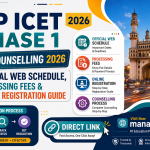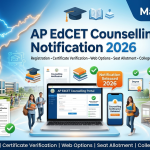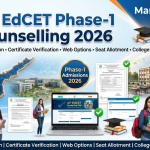
The official AP ECET 2026 portal is maintained by APSCHE/JNTU Anantapur, while the counselling/admissions process is handled through the AP Common Admissions Portal.
Important: The same registration process is applicable for all AP CET counselling admissions conducted by APSCHE.
How to Register on the APCFSS CAP Portal?
Step 1: Visit the official website
Step 2: Click on โNew Registrationโ
Step 3: Enter the required details
CET Hall Ticket Number / Diploma PIN
Year of Passing
Date of Birth
Registered Mobile Number
Aadhaar Number
Step 4: Complete Aadhaar e-KYC
Verify your identity using OTP authentication.
Step 5: Create your login
A User ID and Password will be generated and sent to your registered mobile number.
Step 6: Login to the Candidate Dashboard
Use the generated credentials to access your counselling dashboard.
What Can You Do After Login?
Candidates can:
Pay the counselling fee
Upload certificates
Check verification status
Exercise web options
Modify options before the deadline
Download the seat allotment order
Complete self-reporting
Track admission status
AP ECET Round 1 Seat Allotment 2026
AP ECET 2026 Phase 1 Seat Allotment is scheduled to be released on July 20, 2026.
Who Can Check the Result?
Candidates who have completed:
Registration
Certificate verification
Web option entry
through the APCFSS CAP portal.
Important: The AP ECET counselling process is being conducted through https://cap.apcfss.in/ for registration, certificate verification, web option entry, and seat allotment.
Report to the allotted college within the given dates
Carry all original certificates and photocopies
Pay the tuition fee (if applicable)
Failure to complete self-reporting or college reporting within the prescribed schedule may lead to cancellation of the allotted seat.
Important Note
Use only the official APCFSS CAP portal โ https://cap.apcfss.in/ for registration, login, web options, and seat allotment activities.
How to Check AP ECET 2026 Round 1 Seat Allotment Result
Follow these steps to check your allotment result:
Visit the official AP ECET counselling website.
Click on โPhase 1 Seat Allotment Result 2026โ.
Enter your Hall Ticket Number and Date of Birth.
Click on Submit / Login.
Your allotted college and branch details will appear on the screen.
Download the Seat Allotment Order and take a printout for admission purposes.
Candidates can log in using their AP ECET Hall ticket number and date of birth to view and download the allotment order.
AP ECET 2026 Reporting Dates
Event
Date
Phase 1 Seat Allotment Result
July 20, 2026
Self-Reporting & College Reporting
July 21 to July 25, 2026
Commencement of Classes
July 22, 2026
The counselling schedule indicates reporting from July 21โ25, 2026 and classwork from July 22, 2026.
What After Seat Allotment?
After downloading the allotment order, candidates must:
Complete online self-reporting through the portal.
Download the self-reporting acknowledgement.
Pay the tuition fee (if applicable).
Report physically to the allotted college with all original documents.
Submit the allotment order and complete the admission formalities.
Failure to report within the specified dates may result in cancellation of the allotted seat.
The AP ECET 2026 Results were officially declared on May 7, 2026, with rank cards made active on May 8, 2026, by JNTU Anantapur on behalf of APSCHE. With the rank cards now accessible, thousands of diploma holders and B.Sc (Mathematics) graduates are actively gearing up for the next crucial phase: Web Counselling. The comprehensive web counseling processโwhich includes the payment of processing fees combined with registration, online certificate verification, and option entryโis currently underway, running from 04-07-2026 to 14-07-2026. As of today, registration and fee payment are live, with only 2 days remaining before the window closes on July 8.
For diploma students in Andhra Pradesh, AP ECET is the exclusive gateway to B.Tech and B.Pharmacy lateral entry, allowing successful candidates to join directly in the second year of their chosen professional courses. Following the release of the final merit ranks, Manabadi provides a comprehensive roadmap for the 2026 admission cycle to help students navigate registration, document verification, and option entry efficiently.
APECET-2026 Admissions: First Phase Counseling Notification
Candidates seeking further details regarding the admission process can visit the official website at https://cap.apcfss.in. The notification was officially issued on 30-06-2026 from Mangalagiri by V. Padma Rao, the Joint Director & Convenor for APECET-2026 Admissions.
AP ECET 2026 First Phase Counselling Schedule
The Department of Higher Education, Andhra Pradesh has officially released the AP ECET 2026 First Phase Counselling Notification for Diploma holders in Engineering, Agriculture, and B.Sc. (Mathematics) degree holders seeking lateral entry admissions into B.E./B.Tech and B.Pharmacy courses for the 2026-27 academic year.
Activity
Dates
Online Registration & Processing Fee Payment
July 4 to July 8, 2026
Online Certificate Verification
July 6 to July 10, 2026
Web Option Entry
July 8 to July 13, 2026
Change of Web Options
July 14, 2026
First Phase Seat Allotment
July 20, 2026
Self-Reporting & Reporting at Allotted College
July 21 to July 25, 2026
Commencement of Classwork
July 22, 2026
Documents Required for AP ECET 2026 Counselling
Candidates participating in the AP ECET 2026 First Phase Counselling should keep all the required documents ready before completing the online registration and certificate verification process. The counselling authority has advised candidates to upload clear and valid scanned copies of the required certificates to avoid delays in verification.
General Documents Required
AP ECET 2026 Hall Ticket
AP ECET 2026 Rank Card
SSC Marks Memo
Diploma/Degree Marks Memo
Study Certificates (7th Class to Diploma or 9th Class to Degree for B.Sc. (Mathematics) candidates)
Caste Certificate (if applicable)
Minority Certificate (if applicable)
Transfer Certificate (TC)
Income Certificate issued on or after January 1, 2023 (for fee reimbursement)
EWS Certificate for the academic year 2026-27 (OC candidates claiming EWS reservation)
Candidates claiming reservation under any special category should produce the relevant original certificates during verification.
PWD (Persons with Benchmark Disability)
CAP (Children of Armed Personnel)
Sports & Games
Scouts & Guides
NCC (National Cadet Corps)
Anglo-Indian
Candidates are advised to upload all certificates carefully, as incomplete or unclear documents may delay the verification process.
AP ECET 2026 Online Certificate Verification Process
The AP ECET 2026 counselling authority has introduced an online certificate verification system for most candidates to simplify the admission process. Depending on the verification status of the uploaded documents, candidates are divided into different categories. While many candidates can complete the verification process online, some may still be required to visit a Help Line Centre (HLC) for corrections or special category verification.
Case 1: Certificates Verified Online โ No Changes Required
Candidates whose uploaded certificates are successfully verified through online web services and whose details are found to be correct do not need to visit any Help Line Centre. After paying the counselling processing fee, such candidates can directly proceed with exercising their web options according to the official counselling schedule.
Case 2: Certificates Verified Online โ Changes Required
If the certificates are verified online but candidates wish to make corrections to their personal, academic, or reservation details, they must visit the nearest Help Line Centre along with the original certificates and two sets of photocopies. After the corrections are verified and approved, candidates can proceed with web option entry.
Case 3: Certificates Verified but Candidate Not Eligible
Candidates whose certificates are verified online but whose eligibility is not confirmed must also visit the designated Help Line Centre with all original documents. Once the verification officers approve the documents and the candidate becomes eligible, web option entry can be completed through the candidate login portal.
Case 4: Special Category Candidates
Candidates belonging to PWD, CAP, NCC, Sports & Games, Scouts & Guides, and Anglo-Indian categories must attend physical certificate verification. These candidates are required to report to Government Polytechnic, Vijayawada, along with the necessary original certificates, as special category verification is not conducted online.
AP ECET 2026 New Registration Process
Candidates participating in AP ECET 2026 counselling must complete the online registration process through the counselling portal before certificate verification and web option entry.
Steps to Complete New Registration
Visit the AP ECET counselling portal.
Click on Candidate Login.
Select New Registration.
Enter the required details:
Diploma Board
Diploma PIN
Year of Passing
Date of Birth
Mobile Number
Alternate Mobile Number
Aadhaar Number
Accept the declaration and generate the OTP.
Complete Aadhaar e-KYC verification.
After successful OTP verification, the system will generate the Username and Password, which will be sent to the registered mobile number.
The generated login credentials can be used throughout the AP ECET counselling process for registration, certificate verification, web option entry, seat allotment, and self-reporting. Candidates are advised to keep these credentials safe until the admission process is completed.
AP ECET 2026 Candidate Login & Processing Fee Payment
After completing the new user registration, candidates must log in to the AP ECET 2026 counselling portal using the username and password received on their registered mobile number. Once logged in, candidates should carefully verify all their personal and academic details, upload the required certificates, and proceed with the online payment of the counselling processing fee.
If any information is incorrect, candidates should edit the details before making the payment. After successful payment, candidates are advised to download and print the payment receipt for future reference.
AP ECET 2026 Counselling Processing Fee
The counselling processing fee varies according to the candidate’s category.
Category
Processing Fee
OC / BC
โน1,200
SC / ST
โน600
The online processing fee payment window will remain open from July 4 to July 8, 2026, and candidates of all eligible ranks must complete the payment within the prescribed schedule.
AP ECET 2026 Online Certificate Verification
Most candidates can complete certificate verification completely online without visiting a Help Line Centre. During registration, candidates must upload clear scanned copies of all mandatory certificates in PDF format.
The counselling authorities will verify the uploaded documents online. If the certificates are found to be valid and clearly visible, the verification will be approved, allowing candidates to participate in web option entry according to the counselling schedule.
Certificates to be Uploaded
Candidates should upload the following documents during online registration:
SSC Marks Memo
Diploma or Degree Marks Memo
Study Certificates
Caste Certificate (if applicable)
Minority Certificate (if applicable)
Transfer Certificate (TC)
Income Certificate (issued on or after January 1, 2026)
Candidates must ensure that all uploaded documents are properly scanned and clearly readable. If any certificate is blurred, incomplete, or invalid, the verification officer may reject it and request a fresh upload. The re-upload facility is available only once, so candidates should exercise extra caution while uploading documents.
Special Category Certificate Verification
Candidates belonging to PWD, CAP, NCC, Sports & Games, Scouts & Guides, and Anglo-Indian categories must attend physical certificate verification, as these certificates are not verified online.
Special category verification will be conducted only at Government Polytechnic, Vijayawada, according to the official counselling schedule. Candidates must carry all original certificates along with two sets of photocopies while attending the verification process.
Candidates claiming reservation under the Sports & Games category are also required to submit the prescribed application forms (Form-1, Form-2, Form-3, or Form-4, as applicable) along with supporting documents during physical verification.
Important Note: There will be no special category certificate verification during the Final Phase of AP ECET 2026 Counselling. Therefore, eligible candidates must complete this verification during the First Phase itself to avail reservation benefits.
AP ECET 2026 Special Category Certificate Verification Schedule
The AP ECET 2026 counselling authority has announced a separate schedule for the physical verification of Special Category certificates. Candidates belonging to CAP, NCC, Sports & Games, PWD, Scouts & Guides, and Anglo-Indian categories must attend certificate verification at the designated Help Line Centre as per the notified dates.
The reporting time for all candidates is 9:00 AM.
Special Category Verification Schedule
Date
Category
Integrated Ranks Called
July 9, 2026
CAP
1 โ 20,000
NCC
1 โ 15,000
Sports & Games
1 โ 15,000
Anglo-Indian
All Ranks
July 10, 2026
CAP
20,001 โ Last Rank
NCC
15,001 โ Last Rank
Sports & Games
15,001 โ Last Rank
PWD
All Ranks
Scouts & Guides
All Ranks
After certificate verification, candidates should regularly check their candidate login to know whether their verification has been completed or whether any further action is required before web option entry.
Certificates Required for AP ECET 2026 Web Counselling
Before participating in AP ECET 2026 web counselling, candidates should keep all original certificates ready for verification and admission. Failure to produce any mandatory document may delay the counselling process.
Mandatory Certificates
Candidates should keep the following documents ready:
AP ECET 2026 Rank Card
AP ECET 2026 Hall Ticket
Diploma or Degree Marks Memo
Provisional Diploma or Degree Certificate
SSC Marks Memo (Date of Birth Proof)
Study Certificates (Class VII to Diploma or Class IX to Degree for B.Sc. Mathematics candidates)
Residence Certificate (for Private Study Candidates)
Parent’s 10-Year Residence Certificate (for Non-Local candidates, if applicable)
Employer Certificate (where applicable for Non-Local reservation)
Integrated Community Certificate (SC/ST/BC candidates)
Income Certificate issued on or after January 1, 2026 for fee reimbursement
EWS Certificate valid for 2026-27 (for eligible OC candidates)
Original certificates for Special Category candidates such as PWD, CAP, NCC, Sports & Games, Scouts & Guides, and Anglo-Indian.
Important Instructions for AP ECET 2026 Candidates
Candidates claiming reservation under any special category must produce the prescribed original certificates issued by the competent authorities during physical verification. PWD candidates should possess a valid disability certificate issued by the District Medical Board with at least 40% disability. CAP candidates must submit certificates issued by the Zilla Sainik Welfare Board, while NCC and Sports candidates should produce valid participation certificates issued by the competent authorities.
Candidates belonging to the Sports & Games category must also submit the prescribed application forms along with supporting documents during certificate verification. Those who have completed qualifying examinations from boards other than APSBTET should produce an equivalency certificate issued by SBTET, Andhra Pradesh. Candidates must satisfy the prescribed minimum qualifying marks to be eligible for admission through AP ECET 2026 counselling.
AP ECET 2026 Help Line Centres
The Department of Higher Education has established 14 Help Line Centres (HLCs) across Andhra Pradesh to assist candidates with certificate verification, correction of application details, and counselling-related services.
List of Help Line Centres
Government Polytechnic, Srikakulam
MRAGR Government Polytechnic, Vizianagaram
Government Polytechnic, Kancharapalem, Visakhapatnam
Andhra Polytechnic, Kakinada
S.M.V.M Polytechnic, Tanuku (West Godavari)
Government Polytechnic, Benz Circle, Vijayawada
Andhra Loyola Degree College, Vijayawada
MBTS Government Polytechnic, Nallapadu, Guntur
D.A. Government Polytechnic, Ongole
Government Polytechnic, Venkateswarapuram, Nellore
S.V. Government Polytechnic, Tirupati
Government Polytechnic for Women, Kadapa
Government Polytechnic, Anantapur
Sri G. Pulla Reddy Government Polytechnic, Kurnool
Candidates requiring corrections such as mobile number updates or other counselling-related changes should visit the nearest Help Line Centre along with valid supporting documents.
Why Manabadi is Your Trusted Partner
During the counselling days, servers often crash due to high traffic. Manabadi.co.in provides:
Fast Mirror Links: Quick access to fee payment and option entry pages.
College Predictor: Based on your Integrated Rank, we help you find which colleges you are likely to get into.
HLC List: Complete addresses and contact numbers of all Help Line Centres in Andhra Pradesh.
Final Pro-Tips for Students:
Check Verification Status: Every day after registering, check your “Verification Status” on the portal. If it says “Re-upload,” do it immediately.
Income Certificate: Ensure your income certificate is the latest one. This is vital for the Jagananna Vidya Deevena (Total Fee Reimbursement) scheme.
Branch Change: Remember, lateral entry usually allows you to join the same branch as your diploma. Some branches allow inter-disciplinary shifts; check the eligibility matrix on the official site.
For live updates, direct links, and the ECET College Predictor, stay tuned to Manabadi.co.in.
BITSAT Iteration 6 Result 2026 LIVE Update:BITSAT Iteration 6 results are LIVE. The result was released on August 10, 2026. Candidates allotted a seat in Iteration 6 must accept the offer and pay the required fee/advance fee by August 14, 2026, 5:00 PM.
BITSAT 2026 Iteration 6 result has been released for First Degree programmes including B.E., M.Sc. and B.Pharm. BITS Pilani published the Iteration 6 admission results on August 10, 2026. Candidates who participated in the admission process can now log in and check their seat allotment/admission status.
Next Stage: Fee payment/acceptance and further admission formalities
Candidates who have been allotted a programme in Iteration 6 must accept the offer and complete the required fee or advance-fee payment within the deadline.
What Should Candidates Do After Iteration 6?
Candidates should log in to the official BITS admission portal and check whether they have:
Received a programme offer
Been placed on the waitlist
Received an upgraded programme/campus allotment
Candidates who receive an offer should complete the prescribed payment process before 5 PM on August 14.
BITS Pilani’s official admission timeline also provides for reporting and admission formalities for candidates selected through Iteration 6.
Will There Be Another BITSAT Iteration?
BITS Pilani’s admission brochure states that the Institute reserves the right to conduct further iterations if the situation warrants it. Therefore, candidates who remain on the waitlist should continue monitoring the official BITS admission website for further announcements.
BITSAT 2026 Iteration 6: What Next?
Iteration 6 Result โ Accept Offer & Pay Fee โ Reporting/Admission Formalities โ Further Iteration, if announced
Candidates should regularly check the official BITS Pilani admission portal for any subsequent iteration or admission-related notification.
How to Check BITSAT 2026 Iteration 6 Result
Visit the official BITS admission website โ bitsadmission.com.
Click on the link โBITSAT 2026 Iteration 6 Result / Seat Allotmentโ.
Enter your Application Number and Password.
Click on Login.
Your Iteration 6 seat allotment status will be displayed on the screen.
Download and save the allotment result for future reference.
If a seat has been allotted, complete the required fee payment and reporting process within the prescribed schedule.
BITS Admission Test (BITSAT) is one of Indiaโs most competitive engineering entrance examinations conducted for admission into Integrated First-Degree programmes offered at BITS Pilani, BITS Goa, and BITS Hyderabad campuses. Every year, lakhs of students compete for admission into highly sought-after branches including Computer Science Engineering (CSE), Electronics & Communication, Electrical Engineering, Mechanical Engineering, and Biotechnology.
BITSAT 2026 Iteration 6 Result – Key Highlights
Particulars
Details
Exam Name
BITSAT 2026
Conducting Body
Birla Institute of Technology and Science (BITS)
Counselling Process
BITS Admission Counselling
Result Released
Iteration 6
Mode of Result
Online
Official Website
bitsadmission.com
Details Mentioned on the Allotment Result
The following information will be displayed:
Candidateโs name
Application number
Campus allotted (Pilani / Goa / Hyderabad)
Branch allotted
Allotment status (new allotment / upgraded / retained)
Waiting list status (if applicable)
Fee payment instructions
Reporting and admission deadlines
What Does the Result Mean?
1. Seat Allotted
If a seat has been allotted, the candidate must pay the required admission fee within the specified period to confirm the seat.
2. Upgraded Seat
Candidates who had accepted a seat in earlier iterations may receive an upgrade to a higher preference branch or campus.
3. Retained Seat
The previously allotted seat remains unchanged.
4. Waiting List
Candidates who are not allotted a seat will continue on the waiting list and may be considered in the next iteration based on seat availability.
What to Do After Seat Allotment?
Candidates who receive a seat allotment should:
Download the allotment letter.
Pay the admission fee before the deadline.
Keep all original documents ready.
Follow the reporting instructions issued by BITS.
Regularly check the official portal for further updates.
Documents Required
Candidates should keep the following documents ready:
BITSAT 2026 score card
Class 10 and Class 12 mark sheets
Transfer certificate
Migration certificate (if applicable)
Passport-size photographs
Government-issued photo ID
Category certificate (if applicable)
Important Note
Candidates are advised to rely only on the official BITS admission portal for accurate information regarding seat allotment, fee payment, and reporting procedures. Failure to complete the admission process within the prescribed deadline may result in cancellation of the allotted seat.
BITSAT 2026 Higher Score Rule
Candidates who appeared in both BITSAT Session 1 and Session 2 will automatically have their best score considered for admission. This rule benefits students attempting improvement in Session 2 and significantly impacts admission chances for top branches like CSE and Electronics.
BITSAT 2026 Counselling & Iteration Schedule
BITS Pilani conducts centralized online counselling through multiple rounds called Iterations. Qualified candidates must complete the First Degree Preference Form before participating in seat allotment.
Admission Event
Expected Date
Preference Form Last Date
June 1, 2026
Editing Window
June 3 to June 5, 2026
Iteration 1 Result
June 15, 2026
Fee Payment Deadline
June 22, 2026
Candidates can fill campus and branch preferences including:
BITS Pilani
BITS Goa
BITS Hyderabad
BITSAT 2026 Expected Cutoff Trends
The expected cutoff for top branches is likely to remain highly competitive this year. Computer Science Engineering at BITS Pilani is expected to require one of the highest scores, followed by Electronics and Electrical branches.
Trending searches among students include:
BITS Pilani CSE Cutoff 2026
BITS Goa Expected Cutoff
BITS Hyderabad Cutoff
BITSAT Safe Score 2026
BITSAT Marks vs Branch
BITSAT 2026 Tie-Breaking Policy
If multiple candidates secure identical scores, BITS Pilani applies the following tie-breaking criteria:
Higher marks in Mathematics/Biology
Higher Physics marks
Higher Chemistry marks
Better Class 12 aggregate marks
What After BITSAT Session 2 Result 2026?
After the declaration of results, candidates should immediately:
Submit preference form
Upload Class 12 marks
Participate in counselling
Track iteration results
Complete fee payment before deadlines
Failure to complete counselling formalities within the specified dates may result in cancellation of candidature.
Manabadi provides fast and accurate educational updates trusted by lakhs of students across India. Candidates can regularly check Manabadi for:
BITSAT Result Updates
Iteration Result Links
BITSAT Counselling News
Expected Cutoffs
Admission Notifications
Engineering Entrance Exam Updates
College Predictor & Rank Analysis
Students are advised to stay connected with Manabadi for real-time updates regarding BITSAT Session 2 Results 2026 and counselling announcements.
AP B.Sc Horticulture & Forestry 2026 Latest Update: Online registration for B.Sc. (Hons.) Horticulture and B.Sc. (Hons.) Forestry through AP EAPCET 2026 Bi.P.C. ranks has closed. The next major update is the YSRHU counselling/admission schedule, which is awaited.
AP B.Sc Forestry 2026: Registration Closed – What Next?
AP B.Sc. (Hons.) Horticulture and B.Sc. (Hons.) Forestry 2026 registration has now closed. Dr. Y.S.R. Horticultural University (YSRHU) invited applications from candidates who qualified AP EAPCET 2026 in the Bi.P.C. stream for admission to the 2026โ27 academic year.
With the registration window completed, candidates should now wait for the university to announce the next counselling/admission schedule.
The university will publish further updates, including counselling-related dates and admission instructions, on its official website. Candidates should therefore regularly check the Dr YSRHU admission notifications page rather than relying on unofficial counselling dates.
What Happens Next?
Registration closes โ Completed
Applications/ranks are processed โ Next stage
YSRHU counselling notification โ Awaited
Counselling / option selection โ To be announced
Seat allotment โ After counselling
College reporting & fee payment โ After allotment
Important for Candidates
Candidates should keep the following ready for the next stage:
AP EAPCET 2026 Rank Card
AP EAPCET Hall Ticket
SSC Certificate
Intermediate/10+2 Marks Memo
Study/Bonafide Certificates
Transfer Certificate
Caste Certificate, if applicable
EWS Certificate, if applicable
Income Certificate, if applicable
Local/Non-local supporting documents
Aadhaar/ID proof
Other certificates required under the YSRHU admission notification
The counselling date has not been officially confirmed yet. Candidates should wait for the YSRHU notification before making any assumptions about the counselling schedule.
Every year, thousands of Biology-Physics-Chemistry (BiPC) students who write AP EAPCET look beyond MBBS and B.Sc. Agriculture for career paths that combine science with fieldwork. One course that has been quietly gaining traction is B.Sc. (Hons.) Forestry, offered by Dr. Y.S.R. Horticultural University (YSRHU), Venkataramannagudem, West Godavari District, alongside its flagship Horticulture programme.
Forestry is drawing growing interest from BiPC candidates because India’s forest and environment sector is expanding rapidly – driven by afforestation missions, climate-change mitigation targets, wildlife and biodiversity conservation programmes, and a steady stream of Forest Department recruitment across states. It offers a distinct, fieldwork-heavy science career path that few other BiPC-linked courses provide in Andhra Pradesh.
A clear caution up front: As of the notification date (24-07-2026), YSRHU has not yet released a day-wise counselling schedule. The university has explicitly stated that all further details, including counselling dates, will be published only on its own website. Students must not rely on any third-party site for dates – only drysrhu.ap.gov.in.
AP B.Sc. Forestry 2026 Highlights
Particular
Details
Course Name
B.Sc. (Hons.) Forestry (companion notification also covers B.Sc. (Hons.) Horticulture)
University
Dr. Y.S.R. Horticultural University (YSRHU), Venkataramannagudem
Notification Ref. No.
3321792/Admissions/2026, dated 24-07-2026
Admission Routes
(1) AP EAPCET 2026 rank โ BiPC stream; NRI/Industry-sponsorship quotas are notified for Horticulture – applicability to Forestry seats should be confirmed in the brochure
B.Sc. (Hons.) Horticulture โ Industry Sponsorship Quota
Intermediate marks
Offline application
Important clarification: Categories 3 and 4 (NRI/NRI-sponsored and Industry Sponsorship quotas) are explicitly labelled “B.Sc. (Hons.) Horticulture” in the notification – Forestry is not named under these two quota categories. Candidates interested in Forestry through an NRI or industry-sponsored route should confirm directly with the university whether these quotas extend to Forestry seats as well, since the short notification text does not clarify this either way.
What is NOT yet confirmed
No counselling date-wise schedule has been released for Forestry as of 24-07-2026. The notification states: “All the details and updates including counselling dates will be displayed in the University website only. There is no issuance of personal communications.”
The exact counselling mechanism is not spelled out. Based on how YSRHU has run this process in recent past cycles (2025-26), admissions have historically involved a YSRHU-run online registration and allotment system, followed by in-person “manual counselling” rounds conducted directly at the university’s own Admn. Office in Venkataramannagudem – rather than the centralized AP EAPCET web-counselling portal used for Engineering/Pharmacy.
Seat numbers for 2026-27 are not in the notification itself. For reference, in the AY 2025-26 cycle, B.Sc. (Hons.) Forestry was reported to have 60 seats, with an additional 10% supernumerary seats allocated under the EWS category – these figures must be reconfirmed for 2026-27 from the current information brochure, as they can change year to year.
Admission Timeline So Far
AP EAPCET 2026 Result Declared (1 July 2026) โ YSRHU Admission Notification Released (24-07-2026) – applications invited for B.Sc. Forestry & B.Sc. Horticulture โ Online Registration Opens for EAPCET-rank category (exact dates awaited) โ Counselling / Allotment Process (schedule not yet released) โ Reporting at Allotted College โ Classes Begin, AY 2026-27
What is B.Sc. (Hons.) Forestry?
B.Sc. (Hons.) Forestry is a four-year, ICAR-pattern undergraduate honours programme that trains students in the science and management of forests, plantations, wildlife habitats, and natural resources. Unlike Horticulture, which centres on cultivated fruit, vegetable and ornamental crops, Forestry focuses on forest ecosystems, silviculture, wildlife conservation, forest products, and environmental management – making it attractive to BiPC students drawn to conservation and outdoor fieldwork.
Key structural features of the course:
Duration: 4 years, split into 8 semesters, following the ICAR Deans’ Committee credit framework used across State Agricultural/Horticultural Universities.
Practical learning: Substantial fieldwork in forest nurseries, plantations, and research/demonstration forest areas.
Field visits: Visits to forest divisions, wildlife sanctuaries, and forest research institutes as part of the curriculum.
Research exposure: Final-year students undertake project work and experiential learning under faculty guidance.
Core subject clusters: Silviculture, Forest Mensuration, Forest Ecology, Wildlife Science, Forest Products & Utilisation, and Agroforestry, alongside general science and natural-resource management subjects.
Admission Process (Step-by-Step)
Route: AP EAPCET Rank-Based Admission
Step 1: Qualify AP EAPCET 2026 (BiPC stream) โ Wait for YSRHU’s counselling schedule/registration link (to be published on drysrhu.ap.gov.in) โ Complete Online Registration on the notified portal โ Certificate Verification (mode to be notified) โ Option Entry / College Preference (mode to be notified – online option entry and/or in-person manual counselling, as per past practice) โ Seat Allotment โ Reporting at Allotted College
Note on NRI/Industry Sponsorship routes: As noted above, these two quota categories are explicitly named for Horticulture in the current notification. If YSRHU extends similar offline, marks-based quota routes to Forestry, this would be confirmed only in the information brochure – candidates should check this directly on drysrhu.ap.gov.in rather than assume.
AP B.Sc. (Hons.) Forestry 2026 Eligibility Criteria
Criteria
Requirement
Educational Qualification
Candidates must have passed the two-year Intermediate Examination (10+2) conducted by the Board of Intermediate Education, Andhra Pradesh (BIEAP) or any other examination recognized as equivalent by Dr. Y.S.R. Horticultural University with Bi.P.C. (Biology, Physics & Chemistry) or M.Bi.P.C. (Mathematics, Biology, Physics & Chemistry) subjects.
Admission Basis (Category-A / AP EAPCET Seats)
Admissions are based on the AP EAPCET 2026 Bi.P.C. Stream Rank. Selection is made strictly on merit, following the rule of reservation, Presidential Order (Local/Non-Local), and the university’s admission guidelines.
Admission Basis (NRI / Industry Sponsorship Quota)
Candidates must satisfy the prescribed educational qualifications. Admissions under the NRI and Industry Sponsorship categories are made as per the guidelines issued by Dr. YSRHU. For Industry Sponsorship seats, candidates should have secured at least 50% aggregate marks in Intermediate (Bi.P.C./M.Bi.P.C.).
Minimum Age
Candidates must have completed 17 years of age as on 31 December 2026.
Upper Age Limit (OC/EWS/BC)
22 years as on 31 December 2026.
Upper Age Limit (SC/ST)
25 years as on 31 December 2026.
Upper Age Limit (Persons with Disabilities – PwD)
27 years as on 31 December 2026.
Local / Non-Local Status
Admissions are governed by the Presidential Order. 85% of seats are reserved for Local Candidates, while 15% are treated as Unreserved (Open Competition) seats.
Reservation Policy
Reservations are applicable as per the Government of Andhra Pradesh norms for SC, ST, BC-A/B/C/D/E, EWS, along with applicable horizontal reservations.
Special Categories
Reservation is available for CAP (Children of Armed Personnel), NCC, Sports & Games, Persons with Disabilities (PwD), Women Candidates, and other special categories notified by the Government and University.
Farmers’ Quota Eligibility
Candidates applying under the 40% Farmers’ Quota must belong to an agriculturist family, possess at least one acre of agricultural land in the name of the candidate/parents, have studied for a minimum of four years in non-municipal schools, and submit the prescribed certificates issued by the competent authorities.
Note: Candidates should carefully verify the latest admission notification released by Dr. Y.S.R. Horticultural University (Dr. YSRHU) before applying, as eligibility conditions, reservation rules, and age limits are subject to Government and University notifications for the respective admission year.
AP B.Sc. (Hons.) Forestry Colleges (Official List)
Government (Constituent) College
S.No.
College Name
District
Region
Type
Total Intake
1
College of Horticulture, Venkataramannagudem (B.Sc. (Hons.) Forestry Programme)
West Godavari
AU
Government
60
Private (Affiliated) Colleges
S.No.
College Name
Status
โ
None
As per the latest Dr. YSRHU UG Prospectus, no private affiliated colleges offer B.Sc. (Hons.) Forestry under AP EAPCET counselling.
College Summary
Particulars
Count
Government (Constituent) Colleges
1
Private (Affiliated) Colleges
0
Total Colleges Offering B.Sc. (Hons.) Forestry
1
Government Seat Intake
60 Seats
Private Seat Intake
0 Seats
Overall Intake
60 Seats
Note: Admissions to the 60 B.Sc. (Hons.) Forestry seats are conducted exclusively by Dr. Y.S.R. Horticultural University (Dr. YSRHU) through AP EAPCET (Bi.P.C.) counselling. Any future affiliated Forestry colleges or changes in seat intake will be notified by the University in the admission brochure and counselling notification.
AP B.Sc. (Hons.) Forestry 2026 Official Seat Matrix
As per the official Dr. Y.S.R. Horticultural University (Dr. YSRHU) UG Information Brochure, the following is the seat matrix for B.Sc. (Hons.) Forestry admissions through AP EAPCET.
S.No.
College Name
District
Type
Total Intake
Category-A (AP EAPCET) Seats
Management Quota Seats
1
College of Horticulture, Venkataramannagudem (B.Sc. (Hons.) Forestry Programme)
West Godavari
Government
60
60
Nil
Seat Summary
Category
Seats
Government College Seats
60
Private College Seats
0
AP EAPCET (Category-A) Seats
60
Management Quota Seats
0
Total Intake
60
Category-wise Reservation
The 60 AP EAPCET seats are distributed according to the Government of Andhra Pradesh reservation policy, including:
Open Category (OC)
BC-A
BC-B
BC-C
BC-D
BC-E
Scheduled Caste (SC)
Scheduled Tribe (ST)
Economically Weaker Sections (EWS)
In addition, horizontal reservations are applicable for:
Women Candidates
Persons with Disabilities (PwD)
NCC
CAP (Children of Armed Personnel)
Sports & Games
Admissions are also subject to the 85% Local / 15% Unreserved (Open Competition) rule under the Presidential Order.
Important Note – Any revision in seat intake or reservation will be notified by Dr. Y.S.R. Horticultural University in the official admission brochure before the commencement of counselling.
B.Sc. (Hons.) Forestry is offered only at the College of Horticulture, Venkataramannagudem under Dr. YSRHU.
There are no private affiliated colleges and no management quota seats for this programme under AP EAPCET.
AP B.Sc. (Hons.) Forestry Fee Structure (2026)
Fee Head
Amount (2025-26)
Notes
Tuition Fee (AP EAPCET/Category-A Seats)
โน8,360 per semester
Applicable for students admitted through AP EAPCET in the Government constituent college.
Tuition Fee (NRI Quota)
โน1,14,125 per semester
Applicable only for NRI/NRI-sponsored admissions.
Other/Special Fee
โน17,048 (One-Time at Admission)
Includes university, registration, laboratory, library and other academic charges.
Hostel Establishment Charges
โน11,345 per semester
Applicable only for hostel residents.
Hostel Room Rent
โน2,300 per semester
Charged separately from hostel establishment charges.
Mess Advance
โน9,535 (Refundable Advance)
Adjusted against actual mess expenditure.
Caution Deposit
โน15,215 (Refundable)
Includes Library Deposit (โน2,840), Laboratory Deposit (โน2,840) and Hostel Deposit (โน9,535).
Scholarships
As per Eligibility
Eligible students can avail Jagananna Vidya Deevena, Jagananna Vasathi Deevena, ICAR Merit Scholarships and other Government scholarships.
Fee Reimbursement
Available
Applicable for eligible SC/ST/BC/EWS/Minority students as per Government of Andhra Pradesh norms.
Important Note – The University may revise the fee structure for the 2026 admission cycle. Candidates are advised to verify the latest fee notification before counselling and admission.
The above fee structure is based on the latest official Dr. Y.S.R. Horticultural University (2025-26) UG Prospectus and is applicable to the B.Sc. (Hons.) Forestry programme offered at the College of Horticulture, Venkataramannagudem.
Course Curriculum (Year-wise)
The B.Sc. (Hons.) Forestry curriculum broadly follows the ICAR Deans’ Committee framework applicable to Forestry education at State Agricultural/Horticultural Universities:
First Year
Foundation courses in Botany, Chemistry, Mathematics/Statistics or allied sciences
Introduction to Forestry
Principles of Soil Science
Environmental studies and natural resource basics
Communication skills and computer applications
Second Year
Silviculture โ principles and practices
Forest Botany and Dendrology
Forest Ecology
Soil and water conservation
Plant physiology and biochemistry
Third Year
Forest Mensuration and Biometry
Forest Management and Working Plans
Wildlife Science and Conservation
Forest Products and Utilisation (timber and non-timber)
Industrial Training / Internship with forest departments or research institutes
Comprehensive viva-voce and project work
The exact subject-wise syllabus and credit distribution for each semester is published by YSRHU in its official B.Sc. (Hons.) Forestry syllabus document, available for detailed subject-wise planning.
Specializations Covered
Silviculture
Forest Ecology and Biodiversity Conservation
Wildlife Science and Management
Forest Mensuration and Management
Agroforestry and Social Forestry
Forest Products and Utilisation (Timber & Non-Timber Forest Produce)
Soil and Water Conservation
Remote Sensing and GIS in Forestry
Environmental Impact Assessment
Forest Policy and Economics
Practical Training
Field Work: Fieldwork in forest nurseries, plantations, and demonstration forest plots.
Lab Work: Laboratory sessions in forest botany, soil science, and biochemistry.
Research Farms/Forests: Exposure to ongoing plantation trials and forestry research.
Nursery Management: Hands-on nursery-raising and forest species propagation practice.
Wildlife/Forest Exposure Visits: Visits to forest divisions, wildlife sanctuaries, and research institutes.
Internships: Structured final-year internship placements with forest departments, research institutes, or environmental organisations.
Career Opportunities
Government Jobs
Forest Range Officer (through state Forest Service exams)
Forest Officer / Forester (state Forest Department recruitment)
M.Sc. (Forestry) with specialisations such as Silviculture & Agroforestry, Forest Biology & Tree Improvement, Forest Products & Utilisation, or Wildlife Science – availability at YSRHU should be confirmed via the current course-offerings page, as Forestry PG programmes are newer than the well-established Horticulture PG offerings.
M.Sc. Wildlife Science / Environmental Science at other specialised institutions.
MBA in Forestry & Environment Management
Ph.D. (Forestry), where offered
Competitive exams: Indian Forest Service (IFS) via UPSC, State Forest Service exams, ICAR NET/SET
Salary Packages
Category
Approximate Range
Freshers (Private Sector)
โน3.5 LPA โ โน6 LPA
Government (Forest Beat Officer/Forest Range Officer/Forest Section Officer)
โน42,000 โ โน90,000 per month (as per State/Central Government pay scales, excluding allowances)
Experienced/Senior Forestry Professionals
โน7 LPA โ โน12 LPA
Research (JRF/SRF Roles)
โน37,000 โ โน42,000 per month (as per ICAR/ICFRE/University fellowship norms; revised fellowship rates may apply)
Environmental & Wildlife NGOs
โน4 LPA โ โน8 LPA
International Organisations (FAO, UNEP, WWF, IUCN, CIFOR, etc.)
โน10 LPA โ โน25 LPA+ (varies by country, project and experience)
โน4 LPA โ โน20 LPA+ (income depends on business scale and profitability)
Note: Salary packages vary depending on the employer, specialization, experience, qualifications, and location. Graduates who pursue M.Sc. Forestry, Ph.D., IFS preparation, GIS/Remote Sensing, Wildlife Management, or Environmental Consultancy generally receive significantly higher salary opportunities in both India and abroad.
Placements
Placement Cell: Placement support, where available, is coordinated through YSRHU’s affiliated colleges for eligible final-year students.
Recruiters: Likely recruiters include state Forest Departments, forest research institutes, timber and NTFP companies, and environmental consultancy firms – exact recruiter data specific to YSRHU’s Forestry batches was not available in official sources at the time of writing.
Internships: Structured final-year internships with forest departments and research institutes.
Industrial Exposure: Visits to forest divisions, plantations, and processing units.
Since B.Sc. Forestry is a comparatively newer and smaller-intake programme than Horticulture at YSRHU, candidates are advised to directly ask the university or affiliated college for placement statistics from recent batches rather than relying on generic estimates.
Why Choose B.Sc. Forestry?
Rising demand: Global and national focus on climate change, afforestation, carbon credits, and sustainable development is expanding forestry-linked careers.
Government jobs: A dedicated Forest Service and Forest Department cadre exists at both state and central levels.
Two-course flexibility: The 2026 notification lets BiPC students apply for both Forestry and Horticulture under one admission window.
Conservation-focused career: Suited to students passionate about nature, wildlife, and environmental conservation.
Diverse career paths: Spans government services, private industry, research, NGOs, and international organisations.
Scholarships
State Scholarships: Jagananna Vidya Deevena (tuition fee reimbursement) and Jagananna Vasathi Deevena (maintenance/hostel support) for eligible AP students.
Central Scholarships: Post-Matric Scholarship schemes for SC/ST/OBC/EWS/Minority students.
Fee Reimbursement: For SC, ST, BC, EWS, and Minority students, subject to income-ceiling norms.
EWS Supernumerary Seats: As reported in the previous cycle, an additional 10% supernumerary intake was allocated for EWS candidates in Forestry.
Merit Scholarships: Merit-based support, plus ICAR fellowships at PG/Ph.D. level where applicable.
Hostel Facilities
Hostel facilities (Boys’ and Girls’) are available at YSRHU’s constituent/affiliated campuses offering Forestry.
Library access with academic and reference material.
Wi-Fi/Internet connectivity on campus.
Sports facilities.
Laboratories for forest botany, soil science, and related practicals.
Research/demonstration forest areas accessible as part of coursework.
(Exact hostel availability may depend on the specific college where a Forestry seat is allotted โ confirm with the respective college.)
Documents Required for Admission/Counselling
AP EAPCET 2026 Hall Ticket & Rank Card
Intermediate (10+2) Marks Memo and Pass Certificate
SSC (10th) Marks Memo (date-of-birth proof)
Transfer Certificate (TC) from last attended institution
Study Certificates (for local status verification)
Aadhaar Card
Caste Certificate (for BC/SC/ST candidates)
Income Certificate (for EWS/fee-reimbursement applicants)
Residence/Nativity Certificate
Passport-size photographs
PH/NCC/Sports/CAP/Scouts & Guides certificates, if applicable
(Exact document checklist is listed in the official information brochure โ treat this as an indicative list.)
AP B.Sc. (Hons.) Forestry 2026 Reservation Policy
Category
Reservation (%)
Open Category (OC)
50.00% (after earmarking reservations for all reserved categories)
Backward Classes (BC-A)
7%
Backward Classes (BC-B)
10%
Backward Classes (BC-C)
1%
Backward Classes (BC-D)
7%
Backward Classes (BC-E)
4%
Scheduled Castes (SC)
15%
Scheduled Tribes (ST)
6%
Economically Weaker Sections (EWS)
10% (for eligible OC candidates as per Government norms)
CAP (Children of Armed Personnel)
2% Supernumerary
NCC
1% Supernumerary
Sports & Games
0.5% Supernumerary
Persons with Disabilities (PwD/PH)
5% Horizontal Reservation
Women Candidates
33โ % Horizontal Reservation in each category wherever applicable
Local / Non-Local
85% seats reserved for Local Candidates and 15% Unreserved (Open Competition) as per the Presidential Order
Important Note – Any revisions in reservation percentages or special category quotas will be notified by the Government of Andhra Pradesh and Dr. YSRHU before the commencement of counselling.
The reservation policy is implemented as per the latest Government of Andhra Pradesh and Dr. Y.S.R. Horticultural University admission guidelines.
Horizontal reservations (Women, CAP, NCC, Sports, PwD) are applied within the respective vertical reservation categories.
Since B.Sc. (Hons.) Forestry has only 60 seats, category-wise allotment may vary slightly due to roster implementation while still complying with Government reservation norms.
Frequently Asked Questions (FAQs)
1. Has YSRHU released the AP B.Sc. Forestry 2026 admission notification? Yes. YSRHU released Admission Notification Ref. No. 3321792/Admissions/2026 on 24-07-2026, inviting applications for B.Sc. (Hons.) Forestry and B.Sc. (Hons.) Horticulture for AY 2026-27.
2. Is NEET required for B.Sc. Forestry? No. AP EAPCET with a BiPC background is the applicable route.
3. Has the counselling schedule (dates) been released? No. As of the notification date, YSRHU has stated that counselling dates and all further updates will be displayed only on drysrhu.ap.gov.in, with no personal communication sent to candidates.
4. Are NRI and Industry Sponsorship quotas available for Forestry too? Not clearly. The 2026 notification explicitly names these two quotas under “B.Sc. (Hons.) Horticulture” only. Candidates interested in these routes for Forestry should confirm directly with YSRHU or check the information brochure, since this is not spelled out either way in the notification text.
5. Does AP B.Sc. Forestry counselling happen through cap.apcfss.in (the same portal as B.Tech/Pharmacy)? This is not confirmed for 2026. In past cycles, YSRHU has run its own registration and, at least for some phases, its own in-person manual counselling at its Admn. Office in Venkataramannagudem, separate from the centralized EAPCET web-counselling portal.
6. How many seats are available for B.Sc. Forestry? For AY 2025-26, 60 seats were reported, with an additional 10% supernumerary EWS allocation. This must be reconfirmed for 2026-27 in the current information brochure.
7. Which colleges offer B.Sc. Forestry in Andhra Pradesh? Through the YSRHU/EAPCET route, seats are offered at YSRHU and its affiliated colleges as per the current brochure. Separately, private university BESTIU (Sri Sathya Sai District) also runs an independent B.Sc. (Hons.) Forestry programme outside this admission process.
8. Can MPC students apply for B.Sc. Forestry? No. The EAPCET-rank route requires a BiPC (Biology, Physics, Chemistry) background at the Intermediate level.
9. What is the difference between B.Sc. Horticulture and B.Sc. Forestry? Horticulture focuses on cultivated fruit, vegetable, flower and plantation crops, while Forestry focuses on forest ecosystems, wildlife, silviculture, and natural-resource/forest-product management.
10. What is the starting salary after B.Sc. Forestry? Industry-wide estimates suggest entry-level packages roughly in the โน3.5โ6 LPA range for freshers, rising with experience; government Forest Officer/Range Officer roles follow state pay-scale norms.
11. Can I pursue M.Sc. after B.Sc. Forestry? Yes, options include M.Sc. Forestry, Wildlife Science, or Environmental Science, along with an MBA in Forestry & Environment Management, depending on where these are offered.
12. Is fee reimbursement available for B.Sc. Forestry? Eligible SC/ST/BC/EWS/Minority students can generally avail fee reimbursement under Government of AP schemes for the regular EAPCET-rank category, subject to income norms โ confirm current applicability in the brochure.
13. What is the last date to apply? This depends on the (as yet unreleased) counselling schedule for the EAPCET-rank category โ check drysrhu.ap.gov.in directly.
14. Is the YSRHU B.Sc. Forestry degree recognised? The curriculum follows the ICAR Deans’ Committee framework applicable to Forestry education at State Agricultural/Horticultural Universities.
15. What is the duration of the B.Sc. Forestry course? It is a 4-year (8-semester) honours programme.
16. What government exams can I write after B.Sc. Forestry? Graduates can pursue the Indian Forest Service (IFS) through UPSC, State Forest Service exams, and ICAR NET/SET, among others.
YSRHU has officially opened admissions for B.Sc. (Hons.) Forestry alongside B.Sc. (Hons.) Horticulture for 2026-27, through Notification Ref. No. 3321792/Admissions/2026 dated 24-07-2026, with selection through AP EAPCET 2026 ranks under the BiPC stream. What remains pending is the detailed counselling schedule, and it is unclear from the current notification whether the NRI and Industry Sponsorship quotas – explicitly named for Horticulture – also extend to Forestry seats.
For real-time updates on AP B.Sc. Forestry 2026-27 admissions, keep checking Manabadi.
AP B.Sc Horticulture & Forestry 2026 Latest Update: Online registration for B.Sc. (Hons.) Horticulture and B.Sc. (Hons.) Forestry through AP EAPCET 2026 Bi.P.C. ranks has closed. The next major update is the YSRHU counselling/admission schedule, which is awaited. Candidates should regularly check the official Dr YSR Horticultural University website for the counselling notification.
AP B.Sc Horticulture 2026: Registration Closed โ What Next?
AP B.Sc. (Hons.) Horticulture and B.Sc. (Hons.) Forestry 2026 registration has now closed. Dr. Y.S.R. Horticultural University (YSRHU) invited applications from candidates who qualified AP EAPCET 2026 in the Bi.P.C. stream for admission to the 2026โ27 academic year.
With the registration window completed, candidates should now wait for the university to announce the next counselling/admission schedule.
The university will publish further updates, including counselling-related dates and admission instructions, on its official website. Candidates should therefore regularly check the Dr YSRHU admission notifications page rather than relying on unofficial counselling dates.
What Happens Next?
Registration closes โ Completed
Applications/ranks are processed โ Next stage
YSRHU counselling notification โ Awaited
Counselling / option selection โ To be announced
Seat allotment โ After counselling
College reporting & fee payment โ After allotment
Important for Candidates
Candidates should keep the following ready for the next stage:
AP EAPCET 2026 Rank Card
AP EAPCET Hall Ticket
SSC Certificate
Intermediate/10+2 Marks Memo
Study/Bonafide Certificates
Transfer Certificate
Caste Certificate, if applicable
EWS Certificate, if applicable
Income Certificate, if applicable
Local/Non-local supporting documents
Aadhaar/ID proof
Other certificates required under the YSRHU admission notification
The counselling date has not been officially confirmed yet. Candidates should wait for the YSRHU notification before making any assumptions about the counselling schedule.
Every year, a large number of Biology-Physics-Chemistry (BiPC) students who write AP EAPCET begin exploring options beyond MBBS and B.Sc. Agriculture. One course that has steadily gained attention is the AP B.Sc. (Hons.) Horticulture programme offered by Dr. Y.S.R. Horticultural University (YSRHU), Venkataramannagudem, West Godavari District.
Horticulture is drawing thousands of BiPC candidates after AP EAPCET for a simple reason: Andhra Pradesh is one of India’s largest producers of mango, chillies, turmeric, oil palm, papaya and sweet orange, and the state government has been actively pushing horticulture-based employment, food processing, and export-oriented farming. This creates a steady pipeline of government and private-sector openings for horticulture graduates.
Manabadi brings together everything you need to know in one place. From the official counselling schedule, eligibility criteria, admission process, participating colleges, seat matrix, fee structure, and required documents to the course curriculum, placements, career opportunities, salary packages, scholarships, and future scope
YSRHU has officially opened admissions for 2026-27. As per Admission Notification Ref. No. 3321792/Admissions/2026, dated 24-07-2026, applications are invited for two Bi.P.C.-stream courses together – B.Sc. (Hons.) Horticulture and B.Sc. (Hons.) Forestry – through four distinct admission routes.
A clear caution up front: As of the notification date (24-07-2026), YSRHU has not yet released a day-wise counselling schedule. The university has explicitly stated that all further details, including counselling dates, will be published only on its own website. Students must not rely on any third-party site for dates – only drysrhu.ap.gov.in.
AP B.Sc. Horticulture 2026 Highlights
Particular
Details
Course Name
B.Sc. (Hons.) Horticulture (companion notification also covers B.Sc. (Hons.) Forestry)
University
Dr. Y.S.R. Horticultural University (YSRHU), Venkataramannagudem
Notification Ref. No.
3321792/Admissions/2026, dated 24-07-2026
Admission Routes
(1) AP EAPCET 2026 rank โ BiPC stream; (2) NRI/NRI-sponsored quota โ Intermediate marks; (3) Industry sponsorship quota โ Intermediate marks
Offline application (download form from university website)
4
B.Sc. (Hons.) Horticulture โ Industry Sponsorship Quota
Intermediate marks
Offline application (download form from university website)
For categories 3 and 4, candidates must download the application form and information brochure from drysrhu.ap.gov.in and submit it on or before the last date mentioned in the application, offline, directly to the university.
What is NOT yet confirmed
No counselling date-wise schedule (registration window, certificate verification, web/option entry, seat allotment, reporting) has been released for the EAPCET-rank categories as of 24-07-2026. The notification itself states: “All the details and updates including counselling dates will be displayed in the University website only. There is no issuance of personal communications.”
The exact counselling mechanism for EAPCET-rank seats is not spelled out in this notice. It only confirms selection is rank-based with online registration. Based on how YSRHU has run this process in recent past cycles, admissions have historically involved a YSRHU-run online registration and allotment system, followed by in-person “manual counselling” rounds conducted directly at the university’s own Admn. Office in Venkataramannagudem (multiple phases have been held in past years) – rather than going through the centralized AP EAPCET web-counselling portal used for Engineering/Pharmacy admissions.
A separate thread of information (from ANGRAU’s own BiPC-stream admission notices) suggests that in some years, a combined manual counselling for B.Sc. (Hons.) Horticulture seats across ANGRAU, SVVU, and Dr. YSRHU has been conducted by ANGRAU at Lam Farm, Guntur, using a common application (Form A). It is not clear from available information whether this applies to all YSRHU Horticulture seats, only specific quota seats, or whether this arrangement continues for 2026-27.
Admission Timeline So Far
AP EAPCET 2026 Result Declared โ YSRHU Admission Notification Released (24-07-2026) – applications invited for B.Sc. Horticulture & B.Sc. Forestry โ Online Registration Opens for EAPCET-rank categories โ Offline Application Window for NRI/Industry Sponsorship Quota (last date to be checked in the downloaded application form) โ Counselling / Allotment Process (schedule not yet released) โ Reporting at Allotted College โ Classes Begin, AY 2026-27
What is B.Sc. (Hons.) Horticulture?
B.Sc. (Hons.) Horticulture is a four-year, ICAR-pattern undergraduate honours programme offered by YSRHU. It is built specifically around the science of growing fruits, vegetables, flowers, spices, plantation crops and ornamental plants, and blends classroom learning with hands-on farm and laboratory work. The 2026 notification also invites applications for a companion course, B.Sc. (Hons.) Forestry, under the same Bi.P.C.-stream, EAPCET-rank route – students interested in forest science, wildlife, and natural-resource management now have this as a parallel option at YSRHU alongside Horticulture.
Key structural features of the Horticulture course:
Duration: 4 years, split into 8 semesters, following the ICAR Deans’ Committee credit framework.
Practical learning: A substantial share of coursework happens in nurseries, orchards, poly-houses, and departmental research farms.
Field visits: Regular visits to progressive farms, government horticulture research stations, and markets.
Research exposure: Final-year students undertake project work under faculty guidance.
Core subject clusters: Fruit Science, Vegetable Science, Floriculture, and Plantation crops, alongside general science, agri-business, and extension subjects.
Admission Process (Step-by-Step)
Route A: AP EAPCET Rank-Based Admission (Horticulture & Forestry)
Step 1: Qualify AP EAPCET 2026 (BiPC stream) โ Wait for YSRHU’s counselling schedule/registration link (to be published on drysrhu.ap.gov.in) โ Complete Online Registration on the notified portal โ Certificate Verification (mode to be notified) โ Option Entry / College Preference (mode to be notified – online option entry and/or in-person manual counselling, as per past practice) โ Seat Allotment โ Reporting at Allotted College
Route B: NRI / NRI-Sponsored Quota
Step 1: Download application form & information brochure from drysrhu.ap.gov.in โ Fill form based on Intermediate marks eligibility โ Submit offline on or before the last date specified in the application โ Selection & Admission Confirmation
Route C: Industry Sponsorship Quota
Same offline process as the NRI route – download form, apply based on Intermediate marks, submit by the notified last date directly to the university.
AP B.Sc. (Hons.) Horticulture 2026 Eligibility Criteria
Criteria
Requirement
Educational Qualification
Candidates must have passed the two-year Intermediate Examination (10+2) conducted by the Board of Intermediate Education, Andhra Pradesh (BIEAP) or any other examination recognized as equivalent by Dr. YSR Horticultural University/BIEAP with Bi.P.C. (Biology, Physics & Chemistry) or M.Bi.P.C. (Mathematics, Biology, Physics & Chemistry) subjects.
Admission Basis (Category-A / AP EAPCET Seats)
Selection is based on the AP EAPCET 2026 Bi.P.C. Stream Rank. Admissions are made according to merit, rule of reservation, Presidential Order (Local/Non-Local), and university guidelines. State Rank alone is considered.
Admission Basis (NRI / Industry Sponsorship Quota)
Candidates must satisfy the prescribed academic eligibility. Admissions are made as per the respective NRI or Industry Sponsorship guidelines notified by the University. For Industry Quota, candidates should have secured at least 50% marks in Intermediate (Bi.P.C./M.Bi.P.C.).
Minimum Age
17 years as on 31 December 2026.
Upper Age Limit (General/EWS/BC/OC)
22 years as on 31 December 2026.
Upper Age Limit (SC/ST)
25 years as on 31 December 2026.
Upper Age Limit (Persons with Disabilities)
27 years as on 31 December 2026.
Local / Non-Local Status
Admissions are governed by the Presidential Order. 85% of seats are reserved for Local Candidates, while 15% are treated as Unreserved (Open Competition) seats.
Reservation Policy
Reservations are applicable as per Government of Andhra Pradesh norms for SC, ST, BC-A/B/C/D/E, EWS, along with horizontal reservations for eligible categories.
Special Categories
Reservations/quotas are available for CAP (Children of Armed Personnel), NCC, Sports & Games, Persons with Disabilities (PwD), Women, and Farmers’ Quota (subject to eligibility conditions prescribed by the University).
Farmers’ Quota Eligibility
Candidates applying under the 40% Farmers’ Quota must belong to an agriculturist family, own at least one acre of agricultural land in the name of the candidate/parents, have studied for a minimum of four years in non-municipal schools, and submit the prescribed land ownership certificates and supporting documents.
AP B.Sc. (Hons.) Horticulture Colleges (Official List)
The following are the official constituent (Government) and affiliated (Private) colleges offering B.Sc. (Hons.) Horticulture under Dr. Y.S.R. Horticultural University (Dr. YSRHU) for admissions through AP EAPCET 2026.
Government (Constituent) Colleges
S.No.
College Name
District
Region
Type
Intake
1
College of Horticulture, Venkataramannagudem
West Godavari
AU
Government
130
2
College of Horticulture, Anantharajupeta
Annamayya
SVU
Government
70
3
College of Horticulture, Parvathipuram
Parvathipuram Manyam
AU
Government
50
4
College of Horticulture, Chinalataripi
SPSR Nellore
AU
Government
50
5
College of Horticulture, Pulivendula
YSR Kadapa
SVU
Government
60
Private (Affiliated) Colleges
S.No.
College Name
District
Region
Type
Total Intake
1
Sri Krishna Devaraya College of Horticultural Sciences
Anantapur
SVU
Private
60
2
J.C. Diwakar Reddy College of Horticulture
Anantapur
SVU
Private
60
3
Kadiri Babu Rao College of Horticulture
Prakasam
AU
Private
60
4
N.S. College of Horticultural Sciences
Prakasam
AU
Private
60
College Summary
Particulars
Count
Government (Constituent) Colleges
5
Private (Affiliated) Colleges
4
Total Colleges Offering B.Sc. (Hons.) Horticulture
9
Government College Intake
360 Seats
Private College Intake
240 Seats
Overall Intake
600 Seats
Note: Admissions to all the above colleges are conducted by Dr. Y.S.R. Horticultural University (Dr. YSRHU) through AP EAPCET (Bi.P.C.) counselling. Seat availability, intake, and college list are subject to revision by the University before the commencement of each admission cycle.
AP B.Sc. (Hons.) Horticulture 2026 Official Seat Matrix
S.No.
College Name
District
Type
Total Intake
Convenor (Category-A) Seats
Management Quota Seats
1
College of Horticulture, Venkataramannagudem
West Godavari
Government
130
130
โ
2
College of Horticulture, Anantharajupeta
Annamayya
Government
70
70
โ
3
College of Horticulture, Parvathipuram
Parvathipuram Manyam
Government
50
50
โ
4
College of Horticulture, Chinalataripi
SPSR Nellore
Government
50
50
โ
5
College of Horticulture, Pulivendula
YSR Kadapa
Government
60
60
โ
6
Sri Krishna Devaraya College of Horticultural Sciences
Anantapur
Private
60
42
18
7
J.C. Diwakar Reddy Horticultural College
Anantapur
Private
60
42
18
8
Kadiri Babu Rao College of Horticulture
Prakasam
Private
60
42
18
9
N.S. College of Horticultural Sciences
Prakasam
Private
60
42
18
Seat Summary
Category
Seats
Government Colleges
360
Private Colleges (Category-A / Convenor)
168
Private Colleges (Management Quota)
72
Total Category-A (AP EAPCET) Seats
528
Management Quota Seats
72
Grand Total Intake
600
Note: In addition to the above, 13 supernumerary seats are available under special categories in the constituent colleges, and 10% supernumerary EWS seats are created as per Government norms. The exact distribution is notified by the university during counselling.
Fee Structure
Using the official Dr. YSR Horticultural University 2025-26 fee structure (latest available where 2026 values are not separately notified):
Fee Head
Amount (2025-26)
Notes
Tuition Fee (EAPCET/Convener Category)
โน8,360 per semester
Applicable for constituent Dr. YSRHU colleges.
Tuition Fee (NRI/NRI-Sponsored Quota)
โน1,14,125 per semester
Tuition fee only; other university charges are payable separately.
Tuition Fee (Industry Sponsorship Quota)
Refer official fee notification
Fee varies according to the latest university notification.
Other/Special Fee
โน17,048 (one-time at admission)
Includes university and other academic charges.
Hostel Establishment Charges
โน11,345 per semester
Applicable for hostel residents.
Hostel Room Rent
โน2,300 per semester
Charged separately from establishment charges.
Mess Advance
โน9,535 (Refundable)
Paid at admission; adjusted against mess expenses.
Eligible students can avail Jagananna Vidya Deevena, Jagananna Vasathi Deevena, ICAR scholarships and other merit scholarships.
Fee Reimbursement
Available
Applicable for eligible SC/ST/BC/EWS/Minority students under Andhra Pradesh Government norms.
Note: For private affiliated colleges, the annual Convener Quota tuition fee ranges from โน38,700 to โน77,700, while Management Quota tuition fee ranges from โน77,400 to โน1,55,400, excluding hostel, mess, transport and other charges.
Course Curriculum (Year-wise)
The B.Sc. (Hons.) Horticulture curriculum at YSRHU follows the ICAR Deans’ Committee framework, broadly structured as:
First Year
Foundation courses in Botany, Chemistry, Mathematics/Statistics or allied sciences
Introduction to Horticulture
Principles of Soil Science
Rural sociology and agricultural extension basics
Communication skills and computer applications
Second Year
Fruit Science (Pomology) โ principles and practices
Vegetable Science โ production technology
Floriculture and Landscape Architecture โ basics
Soil fertility and nutrient management
Plant physiology and biochemistry
Third Year
Advanced Fruit Science
Advanced Vegetable Science
Plantation, Spices, Medicinal and Aromatic Crops
Post-Harvest Technology and Processing
Protected cultivation and precision horticulture
Agricultural economics and farm management
Fourth Year
RAWE (Rural Agricultural Work Experience) / Rural Horticultural Work Experience
The exact subject-wise syllabus and credit distribution for each semester is published by YSRHU in its official B.Sc. (Hons.) Horticulture syllabus document, available for detailed subject-wise planning.
Specializations Covered
Fruit Science
Vegetable Science
Floriculture & Landscape Architecture
Plantation, Spices, Medicinal & Aromatic Crops
Post-Harvest Technology and Management
Soil Science
Basics of Agricultural Engineering
Protected Cultivation (poly-houses, greenhouses)
Organic Farming
Precision Horticulture
Practical Training
Field Work: Regular fieldwork on university research farms and demonstration plots.
Lab Work: Laboratory sessions in plant physiology, soil science, plant pathology, and biochemistry.
Research Farms: Exposure to ongoing varietal trials and crop-improvement research.
Nursery Management: Hands-on nursery-raising, grafting, and propagation practice.
Greenhouses/Polyhouses: Training in protected cultivation techniques.
Internships: Structured final-year internship placements with agribusiness firms and government departments.
Career Opportunities
Government Jobs
Horticulture Officer
Agriculture Officer (allied departments)
Extension Officer
Seed Inspector
Food Inspector
Bank Agriculture Officer (IBPS specialist officer recruitment)
Forest Department roles (subject to eligibility; B.Sc. Forestry graduates especially)
FPO coordinator roles
ICAR and other research institute positions
State Horticulture/Agriculture Department roles
Private Sector
Seed companies
Commercial nurseries
Greenhouse and protected-cultivation companies
Landscape design and horticulture firms
Food processing companies
Export-oriented agribusiness firms
Cold storage and post-harvest management companies
Fertilizer and agri-input companies
Agri-tech startups
Other Paths
Research (Junior Research Fellow, and beyond after higher studies)
Teaching (after M.Sc./Ph.D.)
Entrepreneurship (own nursery, floriculture unit, export venture)
Higher Studies
M.Sc. (Horticulture) with specialisations in Fruit Science, Vegetable Science, Floriculture & Landscaping, Plantation/Spices/Medicinal & Aromatic Crops, or Post-Harvest Technology – offered at YSRHU’s College of Horticulture, Venkataramannagudem and College of Horticulture, Anantharajupeta.
MBA in Agribusiness Management
M.Tech in allied agricultural engineering fields
Ph.D. (Horticulture) at the same two YSRHU campuses
ICAR PG programmes through ICAR AIEEA-PG
Competitive exams: UPSC (Agriculture/allied services), State PSC, ICAR NET/SET
Salary Packages
Category
Approximate Range (2025-26)
Freshers (Private Sector)
โน2.5 LPA โ โน4 LPA
Government (Horticulture/Agriculture Officer)
โน35,000 โ โน1,12,400 per month (as per state pay scales; higher with promotions and allowances)
Research (JRF/SRF Roles)
โน31,000 โ โน45,000 per month (as per ICAR/UGC/University fellowship norms)
Abroad (Agri-Export/Plantation Roles)
โน10 LPA โ โน25 LPA+ (varies by country, company, and experience)
Startup/Own Nursery or Export Venture
โน3 LPA โ โน30 LPA+ (highly variable depending on business scale and profitability)
Placements
Category
Details
Placement Cell
Every constituent college has a dedicated Placement Cell headed by a faculty coordinator. The cell organizes campus interviews, career guidance, resume-building workshops, communication skills training, personality development sessions, and coaching for competitive exams such as IBPS and government recruitments.
Major Recruiters
Coromandel International, IFFCO, Nagarjuna Fertilizers & Chemicals Ltd. (NFCL), Bayer Crop Science, Syngenta India, UPL Ltd., BASF India, Corteva Agriscience, Mahyco Seeds, Advanta Seeds, JK Agri Genetics, Nuziveedu Seeds, Kaveri Seeds, Namdhari Seeds, Jain Irrigation Systems, Godrej Agrovet, ITC Agri Business Division, and other agri-input, seed, nursery, greenhouse, floriculture, and food-processing companies.
Government Recruiters
Andhra Pradesh Department of Horticulture, Andhra Pradesh Department of Agriculture, National Horticulture Board (NHB), ICAR Institutes, Krishi Vigyan Kendras (KVKs), AP State Seed Development Corporation, Agricultural Marketing Department, FPOs, and other central and state government organizations.
Internships
Students undergo structured internships during the final year in commercial farms, seed companies, nurseries, food-processing industries, export firms, greenhouse/polyhouse units, research stations, and government horticulture departments. Practical training forms an integral part of the curriculum.
Industrial Exposure
Industrial visits are organized to tissue culture laboratories, food-processing units, fruit processing industries, cold storage facilities, export houses, protected cultivation units, spice processing units, floriculture farms, and commercial horticulture enterprises to provide hands-on industry exposure.
Campus Recruitment
Campus placement drives are conducted periodically based on industry requirements. Recruitment opportunities vary by college, specialization, academic performance, and market demand. Students also receive notifications for off-campus placements, internships, and government job opportunities through the university placement cell.
Higher Education Opportunities
A significant number of graduates pursue M.Sc. (Horticulture), MBA (Agribusiness), Ph.D., ICAR JRF/SRF, Agricultural Research Service (ARS), and other higher education programs, leading to careers in research, academia, and public sector organizations.
Why Choose B.Sc. Horticulture (or Forestry)?
High demand: AP’s strong horticultural produce base (mango, chillies, turmeric, oil palm, papaya, sweet orange) sustains employment demand.
Government jobs: A dedicated Horticulture Officer and allied-post cadre exists at the state level; Forestry graduates have parallel opportunities in forest and wildlife departments.
Growing agriculture sector: Continued government push for horticulture-based livelihoods and exports.
Two-course flexibility: The 2026 notification lets BiPC students apply for both Horticulture and Forestry under one admission window.
State Scholarships: Jagananna Vidya Deevena (tuition fee reimbursement) and Jagananna Vasathi Deevena (maintenance/hostel support) for eligible AP students.
Central Scholarships: Post-Matric Scholarship schemes for SC/ST/OBC/EWS/Minority students.
Fee Reimbursement: For SC, ST, BC, EWS, and Minority students, subject to income-ceiling norms.
Merit Scholarships: Merit-based support, plus ICAR fellowships at PG/Ph.D. level.
(Note: NRI and Industry-sponsorship quota admissions generally fall outside standard AP fee-reimbursement schemes – confirm applicability in the information brochure.)
Hostel Facilities
Separate Boys’ Hostel and Girls’ Hostel at YSRHU’s constituent colleges.
Library access with academic and reference material.
Wi-Fi/Internet connectivity on campus.
Sports facilities.
Laboratories for plant science, soil science, biochemistry, and related practicals.
Research farms accessible as part of coursework.
Documents Required for Admission/Counselling
AP EAPCET 2026 Hall Ticket & Rank Card (for EAPCET-rank category)
Intermediate (10+2) Marks Memo and Pass Certificate
SSC (10th) Marks Memo (date-of-birth proof)
Transfer Certificate (TC) from last attended institution
Study Certificates (for local status verification)
Aadhaar Card
Caste Certificate (for BC/SC/ST candidates)
Income Certificate (for EWS/fee-reimbursement applicants)
Residence/Nativity Certificate
Passport-size photographs
PH/NCC/Sports/CAP/Scouts & Guides certificates, if applicable
For NRI/NRI-sponsored quota: proof of NRI sponsorship as specified in the brochure
For Industry Sponsorship quota: sponsorship documentation as specified in the brochure
Reservation Policy
Category
Reservation (%)
Open Category (OC)
50.00% (after earmarking reservations for all reserved categories)
Backward Classes (BC-A)
7%
Backward Classes (BC-B)
10%
Backward Classes (BC-C)
1%
Backward Classes (BC-D)
7%
Backward Classes (BC-E)
4%
Scheduled Castes (SC)
15%
Scheduled Tribes (ST)
6%
Economically Weaker Sections (EWS)
10% (for eligible OC candidates as per Government norms)
CAP (Children of Armed Personnel)
2% Supernumerary
NCC
1% Supernumerary
Sports & Games
0.5% Supernumerary
Persons with Disabilities (PwD/PH)
5% Horizontal Reservation
Women Candidates
33โ % Horizontal Reservation in each category wherever applicable
Local / Non-Local
85% seats reserved for Local Candidates and 15% Unreserved (Open Competition) as per the Presidential Order
Note
Reservations are implemented as per the latest Government of Andhra Pradesh and Dr. YSR Horticultural University admission guidelines.
Horizontal reservations (Women, CAP, NCC, Sports, PwD) are applied within the respective vertical reservation categories.
The university may revise reservation percentages if notified by the Government before the counselling process.
Frequently Asked Questions (FAQs)
1. Has YSRHU released the AP B.Sc. Horticulture 2026 admission notification? Yes. YSRHU released Admission Notification Ref. No. 3321792/Admissions/2026 on 24-07-2026, inviting applications for B.Sc. (Hons.) Horticulture and B.Sc. (Hons.) Forestry for AY 2026-27.
2. Is NEET required for B.Sc. Horticulture? No. AP EAPCET with a BiPC background is the applicable route for the main quota; NRI and Industry-sponsorship quotas are based on Intermediate marks instead.
3. Has the counselling schedule (dates) been released? No. As of the notification date, YSRHU has stated that counselling dates and all further updates will be displayed only on drysrhu.ap.gov.in, with no personal communication sent to candidates.
4. Does AP B.Sc. Horticulture counselling happen through cap.apcfss.in (the same portal as B.Tech/Pharmacy)? This is not confirmed for 2026. In past cycles, YSRHU has run its own registration and, at least for some phases, its own in-person manual counselling at its Admn. Office in Venkataramannagudem, separate from the centralized EAPCET web-counselling portal. Candidates should not assume any specific portal until YSRHU publishes the schedule.
5. Can I apply for both B.Sc. Horticulture and B.Sc. Forestry? Both are covered under the same 2026 notification and both use AP EAPCET 2026 ranks under the Bi.P.C. stream, so interested BiPC candidates can explore both options as per the brochure’s application process.
6. What is the NRI/NRI-sponsored quota? A separate admission category filled based on Intermediate marks (not EAPCET rank), through an offline application submitted directly to the university.
7. What is the Industry Sponsorship quota? Another separate, offline, marks-based admission category, distinct from the regular EAPCET-rank seats.
8. Where do I get the application form? The application form and information brochure must be downloaded from the official website, drysrhu.ap.gov.in.
9. Can MPC students apply for B.Sc. Horticulture? No. The EAPCET-rank route requires a BiPC (Biology, Physics, Chemistry) background at the Intermediate level.
10. Is hostel available for B.Sc. Horticulture students? Yes, separate boys’ and girls’ hostel facilities are available at YSRHU campuses, with mess and hostel fees charged separately.
11. What is the starting salary after B.Sc. Horticulture? Reported entry-level private-sector packages have ranged roughly โน2.5โ4 LPA, while government Horticulture/Agriculture Officer posts follow state pay-scale norms.
12. Can I pursue M.Sc. after B.Sc. Horticulture? Yes, graduates can pursue M.Sc. (Horticulture) with various specialisations at YSRHU.
13. Is fee reimbursement available for B.Sc. Horticulture? Yes, for the regular EAPCET-rank category, eligible SC/ST/BC/EWS/Minority students can avail fee reimbursement under Government of AP schemes; this generally does not apply to NRI/Industry-sponsorship quota seats.
14. What is the last date to apply? For the EAPCET-rank category, this depends on the (as yet unreleased) counselling schedule. For NRI and Industry Sponsorship quotas, the last date is mentioned within the downloadable application form itself โ candidates must check this directly.
15. How many seats are available for B.Sc. Horticulture in AP for 2026-27? Seat numbers are detailed in the information brochure accompanying the notification, not in the notification text itself โ candidates should download this brochure for current figures.
16. Is the YSRHU B.Sc. Horticulture degree ICAR-recognised? Yes, the curriculum follows the ICAR Deans’ Committee framework applicable to State Agricultural/Horticultural Universities.
17. What is the duration of the B.Sc. Horticulture course? It is a 4-year (8-semester) honours programme.
For the latest updates on AP B.Sc. Horticulture Admissions 2026, counselling notifications, seat allotment results, web options, cut-offs, college-wise information, and other higher education admissions, stay connected with Manabadi. We regularly provide timely, accurate, and student-friendly updates to help you complete your admission process with confidence.
Latest Update: CSAB Special Round 2 Seat Allotment Result 2026 will be released on August 12, 2026 at 5:00 PM. Candidates can check their allotted institute and branch through the official CSAB portal. After allotment, candidates must complete online reporting, fee payment and document upload from August 12 to August 14, 2026
Candidates allotted a seat in Round 2 must complete the required online reporting, willingness submission, document upload and fee payment within the prescribed deadline. Candidates should carefully follow the instructions displayed on their CSAB dashboard to avoid cancellation of the allotted seat.
Stay connected with Manabadi for the latest CSAB 2026 Round 2 result updates, direct link, reporting dates, documents required and admission instructions.
CSAB Round 2 Seat Allotment – Important Instructions
Candidates who get a seat should not stop after checking the allotment result.
They must:
Check allotment โ Download allotment letter โ Submit willingness โ Upload documents โ Pay applicable fee โ Complete verification โ Report physically to the allotted institute.
Failure to complete the required steps within the deadline may result in cancellation of the allotted seat.
What Is CSAB 2026?
JEE Main is over. JoSAA rounds are done. But seats still remain in NITs, IIITs, and GFTIs.
That is exactly where CSAB โ Central Seat Allocation Board steps in.
CSAB fills those leftover seats through its own special rounds. So even if JoSAA did not give you your dream college, CSAB gives you another real shot.
In 2026, CSAB is bigger than ever. The chairman of CSAB, Acharya V.M.S.R Murthy, officially confirmed that 114 institutes now participate – up from 105 last year. This brings approximately 48,000 seats to the table, compared to just 14,000 in 2025. That is a massive jump, and it directly benefits you.
Moreover, this year DASA (Direct Admission of Students Abroad) and CSAB Special Round run under one umbrella – a first-of-its-kind combined process.
For all CSAB 2026 updates, keep checking Manabadi.co.in – India’s most trusted education portal with real-time counselling alerts.
CSAB 2026 – Key Dates at a Glance
These are the confirmed official dates released by CSAB on csab.nic.in:
Event
Date
Category Restoration Process
July 22โ23, 2026
Registration + Fee Payment + Choice Filling Opens
July 28, 2026
Last Date to Register & Pay SREF
August 3, 2026 (10:00 AM)
Mock Allotment & Choice Locking Window
July 31 โ August 5, 2026
Choice Locking Deadline
August 5, 2026 (2:00 PM)
CSAB Special Round 1 Seat Allotment
August 6, 2026 (5:00 PM)
Round 1 Online Reporting Window
August 6โ10, 2026
CSAB Special Round 2 Seat Allotment
August 12, 2026 (5:00 PM)
Round 2 Online Reporting (Fresh Allottees)
August 12โ14, 2026
Physical Reporting at Allotted Institutes
August 13โ18, 2026
Important: Missing any single deadline can result in permanent seat cancellation with no refund. Track all dates on Manabadi for live alerts.
CSAB 2026 Rounds – Explained
CSAB 2026 runs through 4 distinct processes. Each one has different eligibility and document requirements. Therefore, you must identify which round applies to you first.
1.CSAB Special Rounds (SR1 & SR2)
These are the primary counselling rounds conducted after the completion of JoSAA to fill vacant seats in the NIT+ System, including NITs, IIITs, IIEST, SPAs, and GFTIs. The counselling is held in two phasesโSpecial Round 1 (SR1) and Special Round 2 (SR2)โand is based on JEE Main ranks.
2.CSAB NEUT
The CSAB NEUT (North Eastern States and Union Territories) counselling is conducted separately for eligible candidates from North-Eastern States and specified Union Territories under the Government’s NEUT scheme. It allocates seats in AICTE-approved technical institutions to students from regions that have limited access to technical education facilities.
3. CSAB Supernumerary Round
The CSAB Supernumerary Round is a dedicated counselling process for candidates from the Union Territories of Andaman & Nicobar Islands, Lakshadweep, Dadra & Nagar Haveli, and Daman & Diu. Through this round, supernumerary seats are offered at NIT Calicut, NIT Durgapur, and SVNIT Surat, based on JEE Main ranks.
4. CSAB SFTI Round (If Applicable)
This covers Self-Financed Technical Institutes. Note that CSAB SFTI was not conducted in 2025 due to insufficient participating institutes. Check csab.nic.in for 2026 updates.
WHO Can Apply for CSAB 2026? (Eligibility – All Types)
Not everyone needs to check all 9 eligibility types. Find yours quickly below.
You are eligible for CSAB Special Round 2026 if you are:
Type 1: Did not register for JoSAA at all, but hold a valid JEE Main 2026 rank
Type 2: Registered for JoSAA but received no seat
Type 3: Got a JoSAA seat but it was cancelled because you did not pay the Seat Acceptance Fee (SAF)
Type 4: Exited JoSAA counselling voluntarily
Type 5: Had a JoSAA IIT seat cancelled after document verification failure
Type 6: Got a seat in JoSAA NIT+ system, paid SAF + PAF, and want to upgrade
Type 7: Got allotted a JoSAA seat but withdrew it
Type 8: Got a JoSAA seat but failed document verification and were disqualified
Type 9: Got a NIT+ seat, paid SAF, but seat was cancelled due to non-payment of PAF
For CSAB NEUT Eligibility:
Valid JEE Main 2026 rank (Paper 1 for B.Tech, Paper 2 for B.Arch)
Passed Class 12 in 2024, 2025, or 2026
Secured at least 45% marks in Class 12 (50% aggregate for B.Arch candidates)
State Code of Eligibility from one of 12 designated North-Eastern states or specific UTs
For CSAB Supernumerary Eligibility:
Met all JoSAA/CSAB 2026 Special Round eligibility conditions
State Code of Eligibility from Dadra & Nagar Haveli, Daman & Diu, Lakshadweep, or Andaman & Nicobar Islands
CSAB DOCUMENTS REQUIRED 2026 – THE MASTER CHECKLIST
This is the section you came for. Below is the complete, category-wise document list you need for CSAB 2026.
Pro Tip from Manabadi: Prepare all documents in both physical (original + photocopies) and digital form (scanned PDFs/JPGs). You will need digital copies for online verification and originals for physical reporting.
Note: While documents such as Category (SC/ST/OBC-NCL/EWS) certificates, PwD certificates, and other reservation-related certificates must be submitted in the prescribed format (where applicable), the remaining documents may vary from one candidate to another. Requirements can differ depending on the school or board of education, university or college, state of residence, issuing authority, and the participating institute’s admission guidelines. Candidates are advised to carefully read the official CSAB admission brochure and the instructions issued by their allotted institute to ensure they carry all the necessary original documents and photocopies during reporting.
SECTION A โ Documents Required by ALL Candidates (Mandatory for Everyone)
Every single CSAB 2026 candidate – regardless of round or category – must have these documents ready:
#
Document
Purpose
Format Required
1
JEE Main 2026 Admit Card
Identity + Exam Proof
Original + Photocopy
2
JEE Main 2026 Scorecard / Rank Card
Rank Verification
Original + Photocopy
3
Class 10 Mark Sheet
Date of Birth Proof
Original + Photocopy
4
Class 10 Passing Certificate
Board Qualification Proof
Original + Photocopy
5
Class 12 Mark Sheet
Academic Eligibility Proof
Original + Photocopy
6
Class 12 Passing / Migration Certificate
Board Qualification Proof
Original + Photocopy
7
Passport-Size Photographs (6โ8 copies)
Must match JEE Main application photo exactly
Recent, identical photos
8
Valid Photo Identity Proof
Identity Verification
Original + Photocopy
Accepted Photo ID Proofs:
Aadhaar Card
Passport
Voter ID
Driving Licence
PAN Card (if other ID unavailable)
SECTION B – Documents for Reserved Category Candidates
If you belong to SC, ST, OBC-NCL, or EWS categories, these additional documents are mandatory:
Category
Document Required
Critical Note
SC (Scheduled Caste)
SC Caste Certificate
Issued by competent authority on official letterhead
ST (Scheduled Tribe)
ST Caste Certificate
Issued by competent authority on official letterhead
OBC-NCL
OBC-NCL Certificate
โ ๏ธ MUST be issued on or after April 1, 2026. Older certificates are REJECTED
EWS
EWS Certificate
โ ๏ธ MUST be issued on or after April 1, 2026. Older certificates are REJECTED
PwD (Person with Disability)
PwD Certificate from Competent Authority
Must specify disability percentage
Critical Warning: OBC-NCL and EWS certificates dated before April 1, 2026 will be rejected during document verification. Get a fresh certificate if yours is old. This is one of the most common reasons for seat cancellation.
SC/ST Certificate Format
OBC/NCL Certificate Format
GEN-EWS Certificate Format
SECTION C – Documents for CSAB NEUT Round Candidates
If you are applying through the NEUT (North-Eastern States & Union Territories) route, carry these in addition to Section A documents:
#
Document
Purpose
1
State/UT Domicile Certificate
Proof of belonging to eligible NE state or UT
2
Permanent Resident Certificate (PRC)
As applicable for your state
3
Category Certificate
If applying under a reserved category
SECTION D – Documents for CSAB Supernumerary Round Candidates
Candidates from Andaman & Nicobar, Lakshadweep, Daman & Diu, and Dadra & Nagar Haveli must carry:
#
Document
Purpose
1
All documents from Section A
Universal requirement
2
UT Domicile Certificate
Proof of UT eligibility
3
Permanent Resident Certificate (PRC)
Issued by competent UT authority
4
Category Certificate
If applicable
SECTION E – Additional Situation-Based Documents
Depending on your specific situation, you may also need:
Situation
Additional Document Needed
Appeared in Class 12 in 2024 or earlier
Year of passing certificate / gap certificate (if applicable)
Name mismatch between documents
Gazette notification / affidavit
Single parent
Self-declaration affidavit
Change of category from JoSAA
Original category certificate + written request email to CSAB before registration
Pharmacy course applicants
CSAB requires a separate login created through a pharmacy-specific link on csab.nic.in
HOW TO SUBMIT DOCUMENTS – Step-by-Step
CSAB 2026 uses a two-stage document verification process. Understanding this saves you from last-minute panic.
After receiving your seat allotment, you log in at csab.nic.in and upload scanned copies.
Follow these steps:
Step 1: Visit csab.nic.in. Do not use any third-party website for registration.
Step 2: Log in with your JEE Main 2026 Application Number + Password.
Step 3: Complete OTP verification via your registered mobile number.
Step 4: Review all auto-fetched details from the JEE Main / JoSAA database.
Step 5: Upload scanned documents as required.
Step 6: Pay the Special Round Enrollment Fee (SREF). This is mandatory before choice filling.
Step 7: Fill your choices of institutes and branches. Lock them before the deadline.
Important: If you do not lock your choices, your previously filled choices are treated as final. Always lock manually to stay in control.
Stage 2 – Physical Document Verification (At the Allotted Institute)
After seat confirmation, you must physically report to your allotted institute between August 13โ18, 2026.
Carry the following to the institute:
All original documents from the checklist above
At least 3 sets of self-attested photocopies of every document
Passport-size photographs (minimum 6 copies)
Any institute-specific documents mentioned in their admission letter
CSAB 2026 FEE STRUCTURE – Fully Explained
Many students get confused about CSAB fees. Here is a clear breakdown:
Special Round Enrollment Fee (SREF)
This is the first fee you pay during registration. It confirms your participation.
Category
SREF Amount
General / OBC-NCL / EWS
โน45,000
SC / ST / PwD
โน20,000
The SREF includes a non-refundable processing charge of approximately โน5,000.
If You Already Paid JoSAA Fees:
Your previously paid Seat Acceptance Fee (SAF) from JoSAA gets adjusted. You only pay the difference – usually โน5,000 as a participation top-up.
Institute Admission Fee-II (IAF-II):
After seat allotment, you pay a balance institute fee directly to your allotted college during physical reporting.
NEUT Round โ Seat Acceptance Fee (SAF):
For NEUT candidates, the SAF is approximately โน5,000 upon seat allotment.
Refund Warning: If you receive a CSAB seat and fail to report or withdraw within the permitted window, the entire deposited fee is forfeited. There is no refund.
CSAB vs JoSAA – Key Differences Students Miss
Many students treat CSAB as a continuation of JoSAA. It is not. Here are the critical differences:
Aspect
JoSAA
CSAB
Portal
josaa.nic.in
csab.nic.in
Registration
JoSAA registration
Fresh CSAB registration required
Choices
Filled on JoSAA portal
New choice list required โ JoSAA choices do NOT carry over
Institutes
IITs + NITs + IIITs + GFTIs
NITs + IIITs + GFTIs only (NO IITs)
Seat Count 2026
Limited
~48,000 across 114 institutes
DASA Integration
No
Yes โ DASA merged with CSAB Special 2026
Even if you used the same JEE Main login, you must register separately on csab.nic.in. Your JoSAA registration does not count for CSAB.
FLOAT, SLIDE, FREEZE – What Do These Mean?
After getting a CSAB seat allotment, you will face three options. Most students are confused about what to choose.
FREEZE – Accept the current allotted seat. No further upgrades. Your seat is confirmed.
FLOAT – Keep the current allotted seat but continue to seek a higher-preference seat in the next round. If a better seat comes, it replaces the current one automatically.
SLIDE – Seek a better branch within the same institute only. You stay in the same college but aim for a preferred department.
Manabadi Tip: Use FLOAT only if you genuinely prefer a higher-ranked choice. If you are happy with the current allotment, FREEZE it. Do not float unless you are ready to lose your current seat.
DOCUMENT SCAN SPECIFICATIONS โ Avoid Rejection
This section is rarely covered on other websites. Yet, wrong scan formats cause rejection during online verification.
Follow these technical requirements when scanning your documents:
Document Type
File Format
Maximum Size
Mark Sheets, Certificates
PDF or JPG
200 KB โ 500 KB
Photograph
JPG
20 KB โ 50 KB
Category Certificates
PDF or JPG
200 KB โ 500 KB
Identity Proof
PDF or JPG
200 KB โ 500 KB
Scanning Tips:
Scan in colour, not greyscale
Ensure all text is clearly legible
Do not rotate or crop out any seal or signature
Ensure the scanned file matches the document dimension (no stretching)
Keep a backup copy of all uploads on your phone and laptop
WHAT HAPPENS DURING DOCUMENT VERIFICATION โ STEP BY STEP
This process is completely online for CSAB Special Rounds. Here is exactly what happens:
Step 1 – Upload: You upload all required documents through the CSAB portal after seat allotment.
Step 2 – Review by DVO (Document Verification Officer): A CSAB official review each document online.
Step 3 – Query Raised (If Any): If something is wrong, the DVO raises a query. CSAB sends you an SMS and email with details.
Step 4 – Your Response Window: You MUST respond to the query using your login credentials within the specified deadline. Missing this deadline means your candidature gets marked as “Ineligible.”
Step 5 – Confirmation: If your documents pass verification, CSAB sends you an SMS + email confirming eligibility.
Step 6 – Physical Reporting: Finally, you visit your allotted institute with all originals for final verification and fee payment.
Always check your registered email and mobile number regularly during the CSAB counselling period. DVO queries are time-sensitive.
CATEGORY RESTORATION – A Process Most Students Miss
This is one of the most unique features of CSAB 2026. It runs between July 22โ23, 2026 – even before the main registration opens.
Who needs it? If your category was changed to “General” during JoSAA document verification – perhaps because you could not submit a valid OBC-NCL or EWS certificate at that time – you can restore your original category for CSAB.
How to do it: Send an email to CSAB before registering for the special rounds. Attach your valid, current category certificate. Once CSAB approves the restoration, proceed with regular CSAB registration.
This is a game-changer. Lower-category students who lost their reserved seat status in JoSAA can reclaim it for CSAB. This is not widely published on most websites.
JoSAA SEAT + CSAB โ WHAT HAPPENS TO YOUR OLD SEAT?
This is the biggest confusion area. Here is the clear answer:
Scenario 1 – You have a JoSAA seat and register for CSAB: Your JoSAA seat does NOT automatically cancel when you register for CSAB. It cancels only when CSAB allots you a new seat.
Scenario 2 – CSAB allots you a new seat: Your JoSAA seat is automatically and permanently cancelled. You cannot go back to it under any circumstances.
Scenario 3 – CSAB does NOT allot you a seat: Your JoSAA seat remains intact. You can continue with your JoSAA admission.
Scenario 4 – You withdraw from CSAB: You exit CSAB completely. Your original JoSAA seat situation (if any) applies per those rules.
So – registering for CSAB is relatively safe if you still have a JoSAA seat. However, once CSAB allots you a seat, there is no turning back.
TOP COLLEGES AVAILABLE IN CSAB 2026
CSAB 2026 now covers 114 institutes. Some of the top colleges where seats typically appear include:
Various GFTIs including IIEST Shibpur, SPAs (School of Planning and Architecture)
Additionally, 9 new GFTIs joined in 2026 – expanding opportunities further.
COMMON MISTAKES THAT COST STUDENTS THEIR SEAT
Based on past CSAB cycles, these are the most frequent errors that candidates make:
Using an expired OBC-NCL / EWS certificate – Any certificate before April 1, 2026, is invalid.
Not registering separately on csab.nic.in – JoSAA registration does NOT count for CSAB.
Forgetting to lock choices – Unlocked choices lead to exclusion from allotment.
Missing the DVO query deadline – Causes permanent ineligibility.
Not paying the SREF on time – Registration without fee payment is incomplete.
Skipping physical reporting – Even after online confirmation, physical reporting is mandatory.
Carrying photocopies without self-attestation – Always sign each photocopy with “Self-Attested” and your signature.
Having name mismatches – Your name across Class 10, Class 12, Aadhaar, and JEE Main must match. If they don’t, carry a gazette notification or affidavit.
FAQs – EVERY DOUBT ANSWERED
Q1. What documents are required for CSAB 2026?
You need your JEE Main 2026 scorecard, JEE Main admit card, Class 10 and 12 mark sheets, passing certificates, passport-size photographs, valid photo ID, and category certificates (if applicable). Full details are in the checklist above.
Q2. Is there a registration fee for CSAB 2026?
There is no initial registration fee. However, after registration, you must pay the Special Round Enrollment Fee (SREF) โ โน45,000 for General/OBC-NCL/EWS and approximately โน20,000 for SC/ST/PwD candidates. This is required before choice filling.
Q3. Can I participate in CSAB if I already have a JoSAA seat?
Yes, you can register for CSAB even if you hold a JoSAA seat. However, if CSAB allots you a new seat, your JoSAA seat is automatically and permanently cancelled. There is no going back.
Q4. Is CSAB registration separate from JoSAA?
Yes. Completely separate. Even though you use the same JEE Main login credentials, you must visit csab.nic.in and register fresh. Your JoSAA registration is NOT valid for CSAB.
Q5. When does CSAB 2026 registration start?
Registration, fee payment, and choice filling begin on July 28, 2026. The last date to register is August 3, 2026 at 10:00 AM.
Q6. What is the CSAB Special Round Enrollment Fee (SREF)?
For General/OBC-NCL/EWS candidates, it is โน45,000. For SC/ST/PwD candidates, it is approximately โน20,000. This includes a non-refundable processing component.
Q7. My OBC-NCL certificate is from 2025. Will it be accepted?
No. For CSAB 2026, OBC-NCL and EWS certificates must be issued on or after April 1, 2026. Get a fresh certificate before the process begins.
Q8. Can I get a refund if I don’t join after getting a CSAB seat?
If you receive a seat and do not join or fail to withdraw within the permitted window, the entire deposited fee is forfeited. Timely withdrawal avoids this loss.
Q9. Do I need to carry original documents for CSAB online verification?
For the online stage, you upload scanned copies through the portal. However, for physical reporting at your allotted institute, you must carry all original documents.
Q10. How many special rounds does CSAB conduct in 2026?
CSAB conducts exactly 2 Special Rounds in 2026 โ SR1 and SR2. Make your best choices in the first round itself.
Q11. What is the CSAB NEUT Round?
NEUT stands for North-Eastern States and Union Territories. It is a special round for students from the 12 northeastern states (Assam, Manipur, Arunachal Pradesh, Meghalaya, Mizoram, Sikkim, Tripura, Nagaland) and specific UTs (Andaman & Nicobar, Dadra & Nagar Haveli, Lakshadweep, Daman & Diu) to get seats in AICTE-approved technical institutes.
Q12. What is the CSAB Supernumerary Round?
This round is exclusively for candidates from four Union Territories โ Andaman & Nicobar Islands, Lakshadweep, Daman & Diu, and Dadra & Nagar Haveli. Seats are available only at NIT Durgapur, NIT Calicut, and SVNIT Surat.
Q13. What is category restoration in CSAB?
If your category was changed to “General” during JoSAA document verification, CSAB allows you to restore your original reserved category before the Special Rounds. This process runs from July 22โ23, 2026. Contact CSAB via email with your valid category certificate.
Q14. What does FLOAT vs FREEZE vs SLIDE mean in CSAB?
FREEZE confirms your current seat. FLOAT keeps your current seat while seeking a better one in Round 2. SLIDE seeks a better branch within the same institute. Choose carefully โ if FLOAT upgrades your seat, the previous seat is gone.
Q15. What is the last date to lock CSAB choices in 2026?
The choice locking deadline is August 5, 2026 at 2:00 PM. Candidates who do not lock their choices manually will have their last saved choices treated as final.
Q16. Can a candidate from Telangana or Andhra Pradesh apply for CSAB?
Yes. Any candidate with a valid JEE Main 2026 rank can apply for CSAB Special Rounds regardless of their home state, as long as they meet the standard eligibility criteria.
Q17. Will IIT seats be available through CSAB?
No. CSAB only fills seats in NITs, IIITs, GFTIs, IIEST, and SPAs. IIT seats are never part of CSAB. For IITs, JoSAA is the only route.
Q18. How many institutes participate in CSAB 2026?
A total of 114 institutes participate in CSAB 2026. This includes 105 institutes from last year plus 9 newly added GFTIs, offering approximately 48,000 seats.
Q19. Can I fill fewer choices in CSAB?
Technically yes, but it is not advisable. Fill as many choices as possible โ including ambitious, realistic, and safe options. More choices increase your chance of getting a better allotment.
Q20. What happens if I miss the CSAB physical reporting deadline?
Missing the physical reporting deadline results in your seat being cancelled. No refund is issued. Therefore, mark the reporting dates clearly โ August 13โ18, 2026 for most candidates.
Q21. Is the document verification for CSAB done online or offline?
For CSAB Special Rounds, the initial verification is online. You upload scanned documents. Physical verification happens only when you report to your allotted institute. For DASA candidates under CSAB 2026, document verification occurs before seat allotment.
Q22. What scan format should I use for documents?
Use JPG or PDF format. Mark sheets and certificates should be under 500 KB. Photographs should be under 50 KB. Scan clearly in colour without cutting any seal or signature.
Q23. What if there is a name mismatch in my documents?
If your name differs across Class 10, Class 12, Aadhaar, and JEE Main records, carry a Gazette Notification or Notarized Affidavit explaining the discrepancy. Institutes may reject your admission without this.
Q24. Can I change my choice list after locking it in CSAB?
No. Once you lock your choices on the CSAB portal, they cannot be changed. The locking action is final.
Q25. How do I pay the CSAB fee?
You can pay via Net Banking, Debit Card, Credit Card, or SBI e-Challan (offline bank payment). All payment options are available through the csab.nic.in portal.
Q26. Will I get SMS and email alerts during CSAB 2026?
Yes. CSAB sends notifications via your registered JEE Main mobile number and email. Additionally, you can get real-time alerts from Manabadi through WhatsApp and Telegram channels.
Q27. What is CSAB SFTI?
CSAB SFTI covers Self-Financed Technical Institutes. However, this round was not conducted in 2025. For 2026, confirm on csab.nic.in whether it will be held.
Q28. Where can I check CSAB seat allotment results?
All seat allotment results are published on csab.nic.in. Log in with your JEE Main application number and password to check your allotment status. You can also track results instantly on Manabadi.co.in.
Q29. Do I need a domicile certificate for CSAB Special Rounds?
For CSAB Special Rounds (general), a domicile certificate is not always mandatory. However, for CSAB NEUT and Supernumerary rounds, a domicile or Permanent Resident Certificate (PRC) from your state/UT is required.
Q30. Who is the authority for CSAB 2026?
CSAB operates under the National Institutes of Technology (NIT) system and is headquartered at NIT Tiruchirappalli, Tamil Nadu โ 620015. The official website is csab.nic.in.
FINAL CHECKLIST BEFORE YOU REPORT – Print This
Before you walk into your allotted institute for physical reporting, run through this checklist:
JEE Main 2026 Admit Card – Original + 3 photocopies
JEE Main 2026 Rank/Score Card – Original + 3 photocopies
Class 10 Mark Sheet – Original + 3 photocopies
Class 10 Passing Certificate – Original + 3 photocopies
Class 12 Mark Sheet – Original + 3 photocopies
Class 12 Passing Certificate – Original + 3 photocopies
Category Certificate (SC/ST/OBC-NCL/EWS/PwD – if applicable) – Original + 3 photocopies
OBC-NCL/EWS certificate dated after April 1, 2026 โ
Domicile/PRC Certificate (for NEUT/Supernumerary) – Original + 3 photocopies
Aadhaar Card / Photo ID – Original + 3 photocopies
Passport-size photographs – Minimum 6 copies identical to JEE Main application photo
CSAB seat allotment letter (printout)
Fee payment receipt(s) (SREF + IAF-II printout)
Affidavit for name mismatch (if applicable)
Sealed and self-attested photocopies of all documents
For the most current CSAB 2026 updates, seat matrices, cutoffs, and allotment results โ visit Manabadi.co.in, India’s most visited education portal. Stay connected via our WhatsApp Channel and Telegram for instant alerts.
Manabadi.co.in is India’s leading education portal providing accurate, timely information on results, counselling, entrance exams, and admissions. For the latest CSAB 2026 alerts, bookmark this page and join our WhatsApp Channel.
REGISTRATION ALERT: TG NEET UG 2026 MBBS/BDS registration closes today, August 12, at 6 PM. Candidates must complete registration and certificate uploading through the KNRUHS portal.
TG NEET UG Counselling 2026 Registration: Last Date Today
TG NEET UG Counselling 2026 registration process is closing today, August 12, 2026, at 6:00 PM. Kaloji Narayana Rao University of Health Sciences (KNRUHS) is conducting the registration process for MBBS and BDS admissions under Competent Authority Quota for the academic year 2026โ27.
Candidates who qualified NEET UG 2026 and are eligible for Telangana state counselling must complete online registration and upload their scanned original certificates before the deadline.
TG NEET UG 2026 Registration Deadline
Registration Started: August 5, 2026
Last Date:August 12, 2026
Last Time:6:00 PM
Courses: MBBS & BDS
Counselling Authority: KNRUHS
Registration Portal: tsmedadm.tsche.in
TG NEET UG 2026 Eligibility
Candidates must have qualified NEET UG 2026 with the prescribed category-wise qualifying percentile. The KNRUHS notification specifies a qualifying score of 213 for General/Unreserved/EWS candidates, 194 for General/EWS PwD candidates and 177 for SC/ST/BC and eligible PwD candidates of those categories.
What Candidates Must Do Today
Candidates should:
Complete online registration
Enter the required NEET UG and personal details
Upload scanned original certificates
Pay the prescribed application fee
Verify all entered information
Submit the application before 6 PM today
KNRUHS has also published subsequent notices relating to physical verification of certificates for CAP candidates and physical assessment of PwD candidates, so eligible candidates should regularly check the university website for further counselling updates.
Important: Candidates should not wait until the final minutes because the portal closes according to the prescribed server time.
Kaloji Narayana Rao University of Health Sciences (KNRUHS) has commenced the online registration process for Telangana NEET UG 2026 MBBS and BDS admissions under the Competent Authority Quota for the academic year 2026โ27. Eligible NEET UG qualified candidates from Telangana can now register online, upload the required certificates, and complete document verification within the prescribed schedule.
Important Highlights
Registration Starts:5 August 2026, 6:00 AM
Last Date to Apply:12 August 2026, 6:00 PM
Eligible Candidates: Approximately 38,021 Telangana NEET UG qualified candidates
Registration Fee:
โน3,200 โ SC/ST Candidates
โน4,000 โ All Other Categories
University Fee (for Selected Candidates): โน12,000
Reservation Policy
Admissions will be carried out according to the Telangana reservation policy:
SC: 15%
ST: 10%
BC: 29%
Women Reservation: 33% Horizontal Reservation across all categories
Special Category Reservations:
Persons with Disabilities (PwD): 5%
Children of Armed Personnel (CAP): 1%
Children of Police Martyrs: 0.25%
Singareni Employees Quota: 5% reservation in Government Medical College, Ramagundam, for eligible children of Singareni employees.
Important Instructions for Candidates
Telangana local area and domicile rules will be strictly followed.
Candidates must upload certificates issued by the Telangana Government wherever applicable.
KNRUHS advises applicants to complete the registration process using a desktop or laptop instead of a mobile phone to avoid technical issues.
Candidates should carefully verify all uploaded documents before final submission.
Discontinuation Bond
Candidates who discontinue the MBBS or BDS course after admission will be required to pay a โน20 lakh discontinuation bond as per the university guidelines. Applicants are advised to exercise caution while participating in counselling and selecting colleges.
NEET Counselling 2026: MCC Introduces Freeze & Float System
The Medical Counselling Committee (MCC) has introduced several important changes in the NEET UG 2026 All India Quota (AIQ) counselling process for MBBS, BDS, and B.Sc Nursing admissions. These reforms aim to make the counselling process more convenient, transparent, and student-friendly.
One of the biggest updates this year is the introduction of the Freeze & Float option, allowing candidates to upgrade their seats without physically reporting to the allotted college during the initial counselling rounds.
Key Highlights
Feature
Details
New Freeze & Float Option
Choose to accept your seat or wait for a better upgrade.
Online Document Verification
Upload documents through the MCC portal without visiting the allotted college.
One-Time Certificate Upload
Documents need not be submitted repeatedly in every counselling round.
Strict Rules After Round 3
Candidates allotted seats in Round 3 or those not upgraded after choosing Float must join the allotted college.
Security Deposit
Forfeited if a candidate leaves the allotted seat after the third round.
Digital Verification
Special verification introduced for NRI and PwD quota candidates.
AIQ Seat Rule
Unfilled AIQ seats will not be returned to State Quota after Round 2.
What is the Freeze & Float Option?
Freeze
Choose Freeze if you are satisfied with the allotted college and course. Your seat will be confirmed, and you can complete the admission process by joining the allotted institute.
Float
Choose Float if you wish to participate in the next counselling round for a better college or preferred course.
Under the new system:
There is no need to physically report to the allotted college.
Simply upload the required documents on the MCC portal.
The allotted college will verify your certificates online and provisionally confirm your admission.
If any document requires correction, candidates will receive an online notification.
Important Rules for Candidates
Candidates should carefully understand the revised counselling rules:
Candidates allotted a seat in Round 3 must join the allotted college.
Candidates selecting Float who do not receive an upgraded seat must also join the previously allotted institute.
Leaving the seat after the third round will:
Lead to forfeiture of the security deposit.
Make the candidate ineligible for further counselling during the current academic year.
Submission of fake certificates, false information, or multiple registrations may result in:
Cancellation of candidature.
Loss of security deposit.
Further disciplinary action by MCC.
NEET UG 2026 AIQ & State Quota Counselling Schedule
Counselling Phase
All India Quota (AIQ)
State Quota
Round 1 Counselling
4 August โ 17 August 2026
13 August โ 22 August 2026
Last Date to Join
22 August 2026
28 August 2026
Round 2 Counselling
24 August โ 2 September 2026
31 August โ 8 September 2026
Last Date to Join
8 September 2026
14 September 2026
Round 3 Counselling
10 September โ 18 September 2026
16 September โ 26 September 2026
Last Date to Join
26 September 2026
1 October 2026
Stray Vacancy Round
28 September โ 3 October 2026
3 October โ 5 October 2026
Final Admission Deadline
10 October 2026
10 October 2026
Commencement of Classes
8 September 2026
8 September 2026
What This Means for NEET Aspirants
The introduction of the Freeze & Float system is expected to reduce unnecessary travel, simplify document verification, and provide greater flexibility during counselling. However, candidates must carefully exercise the Float
KNRUHS Releases NEET UG 2026 Qualified Candidates List (NTA).
KNRUHS has published the Telangana NEET UG 2026 Rank-Wise Qualified Candidates List.
38,021 candidates have been included in the merit list.
The released PDF contains the Candidate Name, NEET Roll Number, All India Rank (AIR), Category, and NEET Score.
Online counselling registration notification will be issued separately by KNRUHS.
Eligible candidates should regularly visit the official website for counselling registration, certificate verification, web options, and seat allotment schedule.
Key Statistics and Numbers
Total Qualified Candidates:38,021 Telangana candidates qualified in NEET UG 2026 and are included in the rank-wise qualified list.
Admission Authority: Kaloji Narayana Rao University of Health Sciences (KNRUHS), Warangal.
Courses Covered: MBBS & BDS Admissions 2026-27.
Admission Quota: Competent Authority Quota.
Admission Basis: NEET UG 2026 Rank.
Medical Colleges:34 MBBS colleges (Government & Private combined) in Telangana.
Total MBBS Seats:Approximately 9,090 MBBS seats available across the state for the 2026-27 admission cycle.
NEET UG 2026 Qualifying Cut-Off Scores & Percentiles
General / EWS: 50th Percentile
OBC / SC / ST: 40th Percentile
General-PwBD: 45th Percentile
SC/ST/OBC-PwBD: 40th Percentile
(Admissions will be based on the NEET UG 2026 qualifying criteria prescribed by the National Testing Agency and applicable NMC regulations.)
Telangana NEET UG Counselling 2026 Highlights
Particular
Details
Exam Name
NEET UG 2026
Admission Name
Telangana NEET UG Counselling 2026
Conducting Authority
Kaloji Narayana Rao University of Health Sciences (KNRUHS), Warangal
Admission Through
NEET UG 2026 score/rank
Academic Year
2026-27
Courses Offered
MBBS, BDS
Total Colleges
65+ (36 government, 29 private, per 2025 data; estimated for 2026 pending fresh notification)
Total Seats
MBBS ~8,890 combined (govt + private, estimated, see Section 15 for the college-wise breakup); BDS ~1,290 (tentative)
Introduction: Telangana NEET UG Counselling is the centralised admission process through which NEET UG-qualified candidates are allotted MBBS and BDS seats in Telangana’s government, private, and minority medical and dental colleges. It is conducted entirely online by KNRUHS and follows a merit-cum-category-based seat allocation model.
Why counselling is conducted: Counselling exists because NEET UG only produces a national rank; it does not itself allocate seats. Each state runs its own counselling to fill the seats reserved for it under the state quota, applying local eligibility, reservation, and domicile rules that differ from the national process.
Difference between AIQ and State Quota: All India Quota seats amount to 15% and are managed by the Medical Counselling Committee (MCC) through mcc.nic.in, open to candidates from any state. The remaining 85% State Quota seats in government colleges, along with Category A private seats, are filled by KNRUHS strictly for candidates meeting Telangana’s local/domicile eligibility.
KNRUHS role: KNRUHS is the state health sciences university responsible for conducting counselling for admission into MBBS, BDS, and other health science courses in Telangana. It publishes all notifications, prepares the state merit list, conducts choice filling, and announces seat allotment results.
Eligibility of Telangana students: Students who meet Telangana’s defined local-candidate criteria (based on study history or parental domicile in the state) are eligible for the 85% state quota and Category A private seats.
Non-local candidates: Candidates without Telangana local status can still apply through Management Quota (Category B) and NRI Quota (Category C) seats in private colleges, subject to separate eligibility norms.
Telangana NEET UG Counselling 2026 Important Dates
2026 KNRUHS schedule has not been officially released yet. The table below uses the confirmed 2025 schedule as a reference.
Event
2025 Reference Date (Tentative for 2026)
Notification
Mid-July 2025
Registration
July 21 to August 7, 2025 (Round 1)
Certificate Upload
Concurrent with registration window
Verification
Post-registration, before merit list
Merit List
July 10, 2025 (provisional merit list release pattern)
Web Options
Round-wise, opened after each merit list/allotment cycle
Seat Allotment
August 13, 2025 (Round 1 result)
Self Reporting
Immediately after allotment result
Reporting at College
August 14 to 23, 2025 (Round 1 reporting)
Round 2
Around August 29, 2025
Mop Up
October 1, 2025, onward (choice filling)
Stray Vacancy
Result released November 20, 2025, with reporting by the same date
Counselling Process (Step-by-Step)
The process is completed in the following sequence, and every step must be completed within the given window, as no step is reopened once its deadline passes:
Registration – Candidate creates a login on tsmedadm.tsche.in using NEET roll number, score, and personal details.
Online Payment – Registration/processing fee is paid through the portal; the transaction is non-refundable once submitted.
Upload Certificates – Scanned copies of NEET, academic, category, and residence documents are uploaded in the prescribed format and size.
Document Verification – KNRUHS verifies uploaded documents; discrepancies are flagged for correction within a limited window.
Merit List – A provisional, followed by a final, Telangana State Merit List is published based on verified applications.
Web Options Entry – Only merit-listed candidates can log in and arrange preferred colleges/courses in order of priority.
Editing Options – Options can be reordered, added, or removed until the lock-in deadline; nothing can be changed after locking.
Seat Allotment – Seats are allotted based on rank, category, and locked option order.
Self Reporting – Allotted candidates confirm acceptance online within the specified window.
Reporting to College – Original documents are submitted at the allotted college for physical verification.
Final Admission – Admission is confirmed only after fee payment and document submission at the college is completed.
Telangana NEET UG Eligibility Criteria
Nationality: Candidates must be Indian Nationals, PIO, or OCI (OCI card issued before 04-03-2021).
Domicile: Candidates must satisfy Telangana’s local-candidate definition, generally based on study of qualifying examinations within the state or parental long-term residence/employment in Telangana.
Local Candidate Rules: Seats are reserved for AU/OU/SVU-region candidates as per the Presidential Order framework historically applied to undivided Andhra Pradesh regions, now adapted to Telangana’s local-area rules under state government orders.
Educational Qualification: Candidates must have passed Intermediate (10+2) or an equivalent examination with Physics, Chemistry, Biology/Biotechnology, and English.
Minimum Marks:
General (OC): Not less than 50% marks in science subjects; EWS candidates follow the same 50% norm.
OBC/BC: Not less than 40% marks in science subjects.
SC: Not less than 40% marks in science subjects.
ST: Not less than 40% marks in science subjects.
PWD (General): Not less than 45% marks in science subjects.
NEET Qualification: A valid, category-appropriate NEET UG 2026 qualifying score/percentile as declared by NTA is mandatory; this figure itself is set nationally, not by KNRUHS.
Age Limit: Candidates who do not complete 17 years of age by 31 December of the admission year are not eligible for admission (the exact cut-off date for 2026 will be confirmed in the fresh notification).
Telangana Local Status Rules: Determined through a combination of study certificates (7 years of study in Telangana immediately preceding the qualifying exam, in most interpretations) or parental domicile, as notified under the applicable state G.O.
Non-Local Candidates: Not eligible for the 85% state quota or Category A private seats, but can apply under Management Quota (Category B) and NRI Quota (Category C).
OCI Candidates: Eligible only if the OCI card was issued before 04-03-2021, per the applicable Government Order.
EWS Eligibility: Available for OC candidates meeting the Economically Weaker Section income and asset criteria as notified by the Government of India/Telangana, subject to a valid EWS certificate issued in the prescribed format and validity period.
Reservation Policy
Category
Reservation
Notes
SC
15% under Competent Authority Quota
As per applicable state G.O.
ST
10% under Competent Authority Quota, per G.O.Ms.No. 33, Tribal Welfare Department, dated 30-09-2022
BC-A
Sub-quota within overall BC reservation
Exact percentage to be confirmed from the 2026 KNRUHS notification
BC-B
Sub-quota within overall BC reservation
Same as above
BC-C
Sub-quota within overall BC reservation
Same as above
BC-D
Sub-quota within overall BC reservation
Same as above
BC-E
Sub-quota within overall BC reservation
Same as above
EWS
As per Government of India/Telangana EWS norms
Applicable to OC candidates only
PWD
Horizontal reservation across categories
Certified through UDID/authorised medical board
CAP
Refers to Competent Authority Quota (government seat pool)
Not a separate reservation category, but the seat pool itself
NCC
Horizontal reservation, limited seats
Subject to valid NCC certificate
Sports
Horizontal reservation, limited seats
Subject to state-recognised sports certificate
Women
No separate vertical reservation in MBBS/BDS state counselling under current norms
To be reconfirmed with 2026 notification
Minority
Muslim minority quota is available in 4 minority medical colleges in Telangana
Applicable only within designated minority institutions
Explanation of key categories: SC and ST reservations are vertical (apply across the full seat pool); BC sub-categories (A through E) are further vertical splits within the BC bracket; EWS is exclusively for OC candidates who are not otherwise covered by SC/ST/BC reservation; PWD, NCC, and Sports reservations are horizontal, meaning eligible candidates are first placed in their category/quota and then also considered for the horizontal reservation within it; minority reservation applies only inside minority-status private colleges and does not affect government college seat distribution.
Documents Required
Personal Documents
NEET Scorecard โ Downloaded PDF from the NTA NEET portal; must match the name spelling on all other certificates.
Admit Card โ Original NEET UG 2026 admit card, scanned in colour.
Aadhaar โ Self-attested photocopy; the number must match across all uploaded documents.
PAN (if applicable) โ Self-attested photocopy, only if held.
Passport (if applicable) โ Required only for OCI/PIO/NRI category applicants.
Passport Photos โ Recent colour photographs, typically 10 copies for physical reporting, per the format specified in the notification.
Signature โ Scanned signature on white background, matching the format size specified during upload.
Academic Documents
10th Certificate โ Used as age and identity proof.
Intermediate/12th Marks Memo & Pass Certificate โ Confirms subject combination and marks eligibility.
Transfer Certificate (TC) โ Issued by the last institution attended.
Study Certificates โ Required to establish local status, typically covering the qualifying years of study in Telangana.
Bonafide Certificate โ Issued by the institution confirming enrollment period, sometimes required alongside study certificates.
Residence Documents
Residence Certificate โ Issued by the Tahsildar/Revenue authority confirming address.
Local Status Certificate โ Confirms eligibility under Telangana’s local-candidate rules.
Nativity Certificate โ Establishes native place, sometimes required in addition to residence proof.
Category Certificates
Caste Certificate โ Issued by competent Revenue authority, required for SC/ST/BC candidates.
Income Certificate โ Required for BC/EWS candidates; validity period specified in the notification.
EWS Certificate โ Issued in the current financial year format prescribed by the government.
PWD Certificate โ Issued by an authorised medical board/UDID card.
Minority Certificate โ Required only for candidates applying under minority-college quota.
NCC Certificate โ Required only for candidates claiming NCC reservation.
Sports Certificate โ Required only for candidates claiming sports quota, issued by the competent sports authority.
CAP Certificate โ Not a separate certificate; CAP refers to the seat pool, not an individual eligibility document.
Other Documents
Gap Certificate โ Required if there is a break in academic years, self-declared and notarised.
Migration Certificate โ Required for candidates who studied their qualifying exam outside Telangana state board/university.
Character Certificate โ Issued by the last attended institution.
Medical Fitness Certificate โ Issued by a District Medical Board or Institutional Medical Board, confirming fitness for the medical course.
Registration Process
Registration โ Candidate visits tsmedadm.tsche.in and completes first-time registration using NEET roll number, mobile number, and email ID.
Fee Payment โ Registration fee is paid online through the payment gateway integrated into the portal (see Section 11 for the fee table).
Login โ On successful payment, a unique application number and login credentials are generated.
Password โ Candidate sets a secure password during first login; this is used for all subsequent sessions, including web options.
Uploading Documents โ All required documents are uploaded in the prescribed size and format (usually PDF/JPEG, within specified KB/MB limits).
Editing โ Uploaded details can be edited before final submission; once submitted, most fields are locked pending verification.
Final Submission โ Candidate reviews all entered details, accepts the declaration, and submits the application; the generated acknowledgment/application number must be saved for all future reference.
Registration Fee
2026 fee has not been officially notified. The table below is the confirmed 2025 fee structure, shown strictly as reference and marked tentative for 2026.
Category
2025 Fee (Tentative for 2026)
General (OC)
โน3,500
BC
โน3,500
SC
โน2,900
ST
โน2,900
Management Quota
Separate fee structure applies, notified separately for private college Category B counselling
NRI
Separate, generally higher processing fee applicable for Category C seats
Refund Policy: The registration/processing fee is generally non-refundable once submitted, regardless of whether the candidate proceeds to seat allotment. The separately-charged University Fee (payable at the time of downloading the allotment letter) may have its own refund/adjustment terms tied to the reporting and admission-cancellation timeline; students should read the fee-refund clause in the specific year’s notification carefully before assuming any refund eligibility.
Merit List
How Merit is prepared: KNRUHS prepares the Telangana State Merit List by ranking all registered, verified candidates according to their NEET UG score. Where NEET scores are tied, the university applies its own tie-breaking sequence to arrive at a distinct merit position for each candidate.
Tie-breaking rules: Historically, ties are resolved using a defined order of criteria such as higher marks in Biology, followed by Chemistry, then Physics, and finally by age (older candidates typically prioritised) – but the exact sequence must be confirmed against the year-specific KNRUHS merit list methodology note, since this can be revised.
State Rank: The overall merit position assigned to a candidate within the full pool of eligible applicants, independent of category.
Category Rank: A separate rank assigned within each reservation category (SC, ST, BC-A to E, EWS, etc.), used when allotting category-specific seats.
Downloading Merit List: Published as a PDF on the KNRUHS official website and accessible through the candidate login; candidates should verify their name, roll number, category, and marks carefully and report discrepancies within the grievance window specified in the notification.
Web Options Entry
Meaning of Web Options: Web options refer to the online exercise where merit-listed candidates arrange their preferred college-and-course combinations in order of priority ahead of seat allotment.
How to fill: Candidates log in with their credentials, browse the list of available colleges/courses (with live seat matrix), and add each preferred combination to their option list in the order they would accept it.
Locking Choices: Once satisfied with the order, candidates must actively lock their options before the deadline; unlocked option lists submitted after the window closes are not considered for allotment.
Editing: Options can be reordered, added, or deleted freely before locking; after locking, no further changes are permitted for that round.
Mistakes to avoid:
Leaving the option list unlocked, assuming it saves automatically.
Filling only a small number of choices, which reduces allotment chances in later rounds.
Ranking a less-preferred college above a more-preferred one by mistake.
Ignoring category-specific seat availability while planning the option order.
Choice Filling Strategy: Options should be filled in genuine order of preference rather than only “safe” choices, since a higher-preference seat can still be allotted if the rank permits; candidates should include a realistic mix of ambitious, moderate, and safe options rather than an overly narrow list.
Seat Allotment
How allotment happens: Seats are allotted strictly by matching the candidate’s merit/category rank against their locked option order and the live seat matrix; a candidate is allotted the highest-ranked option in their list for which their rank qualifies at the time of processing.
Download allotment letter: Once results are declared, eligible candidates log in to download the provisional allotment order/letter, which must be printed and carried for reporting.
Freeze: Refers to accepting the allotted seat as final and not participating in further rounds; this typically requires the highest confirmation fee/commitment and generally exits the candidate from subsequent rounds.
Float: Refers to accepting the current seat while remaining open to a better allotment in subsequent rounds; the seat is retained only if no upgrade is received, subject to the rules of that year’s counselling.
Self Reporting: An online confirmation step where the candidate acknowledges acceptance of the allotted seat within the counselling portal, ahead of physical reporting.
Reporting to College: Candidates must report in person to the allotted college within the specified window with original documents for verification, fee payment, and admission confirmation; failure to report by the deadline generally results in automatic cancellation of the allotted seat.
Telangana Medical Colleges List
This list uses the confirmed 2025 intake figures. All intake numbers below are per-year MBBS intake capacity, not total seats across the course duration.
Government Medical Colleges (36 colleges, 4,290 MBBS seats)
College Name
Annual Intake
Osmania Medical College, Hyderabad
250
Gandhi Medical College, Secunderabad
250
Kakatiya Medical College, Warangal
250
Government Medical College, Siddipet
175
Government Medical College, Mahabubnagar
175
Government Medical College, Ramagundam
150
Government Medical College, Nalgonda
150
Government Medical College, Suryapet
150
Government Medical College, Nagarkurnool
150
Government Medical College, Sangareddy
150
Government Medical College, Wanaparthy
150
Government Medical College, Bhadradri Kothagudem
150
Government Medical College, Mahabubabad
150
Government Medical College, Jagtial
150
Government Medical College, Nizamabad
120
RIMS, Adilabad
120
Government Medical College, Jayashankar Bhupalpally
100
Government Medical College, Rajanna Sircilla
100
Government Medical College, Nirmal
100
Government Medical College, Karimnagar
100
Government Medical College, Vikarabad
100
Government Medical College, Khammam
100
Government Medical College, Kamareddy
100
Government Medical College, Kumuram Bheem Asifabad
100
Government Medical College, Jangaon
100
Government Medical College, Mancherial
100
AIIMS Bibinagar
100
ESIC Medical College, Sanath Nagar
100
Government Medical College, Jogulumba Gadwal
50
Government Medical College, Mulugu
50
Government Medical College, Narayanpet
50
Government Medical College, Narsampet
50
Government Medical College, Quthbullapur
50
Government Medical College, Medak
50
State Medical College and Hospital, Yadadri
50
Government Medical College, Maheshwaram
50
Private Medical Colleges (29 colleges, ~4,600 MBBS seats – estimated)
College Name
District/Area
Annual Intake
R.V.M. Institute of Medical Sciences and Research Centre
Siddipet
250
Prathima Institute of Medical Sciences
Karimnagar
250
Chalmeda Anand Rao Institute of Medical Sciences
Karimnagar
200
Kamineni Institute of Medical Sciences
Narketpally
200
Mallareddy Medical College for Women
Hyderabad
200
Malla Reddy Institute of Medical Sciences
Hyderabad
200
Mamata Medical College
Khammam
200
Nova Institute of Medical Sciences and Research Centre
Ranga Reddy
150
Neelima Institute of Medical Sciences
Medchal
150
Arundathi Institute of Medical Sciences
Medchal
150
CMR Institute of Medical Science
Medchal Malkajgiri
150
Father Colombo Institute of Medical Sciences
Warangal
150
SVS Medical College
Mahbubnagar
150
Deccan College of Medical Sciences
Hyderabad
150
MNR Medical College & Hospital
Sangareddy
150
Bhaskar Medical College
Yenkapally
150
TRR Institute of Medical Sciences
Patancheru
150
Surabhi Institute of Medical Sciences
Siddipet
150
Mamata Academy of Medical Sciences
Bachupally
150
Dr. Patnam Mahender Reddy Institute of Medical Sciences
Chevella, Rangareddy
150
Ayaan Institute of Medical Sciences
Kanaka Mamidi, R.R. Dist
150
Maheshwara Medical College
Chitkul, Patancheru, Medak
150
Mahavir Institute of Medical Sciences
Vikarabad
150
Kamineni Academy of Medical Sciences & Research Center
Hyderabad
150
Apollo Institute of Medical Sciences and Research
Hyderabad
150
Shadan Institute of Medical Sciences
Peerancheru
150
Prathima Relief Institute of Medical Sciences
Warangal
150
Mediciti Institute of Medical Sciences
Ghanpur
150
Dr. VRK Womens Medical College
Aziznagar
100
Minority Medical Colleges
Telangana has designated minority-status medical colleges functioning within the private college pool (largely Muslim minority institutions). Minority quota is applicable in 4 minority medical colleges in Telangana. Exact names and college-wise intake for the minority category must be cross-verified against the KNRUHS minority-college notification, since minority status designation is separate from the general private college list above and isn’t always broken out identically across trackers.
Deemed Universities
Deemed-to-be-university medical colleges located in Telangana (where applicable) do not participate in KNRUHS state counselling. Admission to such institutions is conducted separately through the Medical Counselling Committee (MCC) at the national level, and students should apply for these directly through mcc.nic.in, not through tsmedadm.tsche.in.
District-wise Medical Colleges
District
Medical College(s)
Hyderabad
Osmania Medical College; Gandhi Medical College (Secunderabad); ESIC Medical College (Sanath Nagar); Government Medical College, Quthbullapur; Deccan College of Medical Sciences; Malla Reddy Institute of Medical Sciences; Apollo Institute of Medical Sciences and Research; Shadan Institute of Medical Sciences; Kamineni Academy of Medical Sciences & Research Center
Warangal
Kakatiya Medical College; Father Colombo Institute of Medical Sciences; Prathima Relief Institute of Medical Sciences
Nizamabad
Government Medical College, Nizamabad
Karimnagar
Government Medical College, Karimnagar; Prathima Institute of Medical Sciences; Chalmeda Anand Rao Institute of Medical Sciences
Khammam
Government Medical College, Khammam; Mamata Medical College
Mahabubnagar
Government Medical College, Mahabubnagar; SVS Medical College
Adilabad
RIMS, Adilabad
Nalgonda
Government Medical College, Nalgonda; Kamineni Institute of Medical Sciences (Narketpally)
Siddipet
Government Medical College, Siddipet; R.V.M. Institute of Medical Sciences and Research Centre; Surabhi Institute of Medical Sciences
Suryapet
Government Medical College, Suryapet
Sangareddy
Government Medical College, Sangareddy; MNR Medical College & Hospital
Ranga Reddy / Medchal-Malkajgiri
Nova Institute of Medical Sciences; Neelima Institute of Medical Sciences; Arundathi Institute of Medical Sciences; CMR Institute of Medical Science; Ayaan Institute of Medical Sciences; Mediciti Institute of Medical Sciences (Ghanpur); Mamata Academy of Medical Sciences (Bachupally); Dr. Patnam Mahender Reddy Institute of Medical Sciences (Chevella); Bhaskar Medical College (Yenkapally); Dr. VRK Womens Medical College (Aziznagar)
Medak
Government Medical College, Medak; Maheshwara Medical College (Chitkul, Patancheru); TRR Institute of Medical Sciences (Patancheru)
Vikarabad
Government Medical College, Vikarabad; Mahavir Institute of Medical Sciences
Nirmal
Government Medical College, Nirmal
Kamareddy
Government Medical College, Kamareddy
Kumuram Bheem Asifabad
Government Medical College, Kumuram Bheem Asifabad
Jangaon
Government Medical College, Jangaon
Mancherial
Government Medical College, Mancherial
Yadadri Bhuvanagiri
State Medical College and Hospital, Yadadri; AIIMS Bibinagar
Ramagundam (Peddapalli)
Government Medical College, Ramagundam
Bhadradri Kothagudem
Government Medical College, Bhadradri Kothagudem
Mahabubabad
Government Medical College, Mahabubabad
Jagtial
Government Medical College, Jagtial
Rajanna Sircilla
Government Medical College, Rajanna Sircilla
Jayashankar Bhupalpally
Government Medical College, Jayashankar Bhupalpally
Mulugu
Government Medical College, Mulugu
Narayanpet
Government Medical College, Narayanpet
Narsampet (Warangal district)
Government Medical College, Narsampet
Jogulumba Gadwal
Government Medical College, Jogulumba Gadwal
Nagarkurnool
Government Medical College, Nagarkurnool
Wanaparthy
Government Medical College, Wanaparthy
(Note: Maheshwaram, in Ranga Reddy district, hosts one government college – Government Medical College, Maheshwaram – merged into the Ranga Reddy/Medchal-Malkajgiri row above for the private cluster, but listed separately here for accuracy: Ranga Reddy (Maheshwaram) – Government Medical College, Maheshwaram.)
Since the 2026 KNRUHS seat matrix hasn’t been released yet – treat all seat figures as tentative/estimated until cross-checked against the year-specific official notification.
College-wise Seat Matrix
The government-vs-private split for state counselling is standard: government colleges reserve seats primarily for the state quota and All India Quota, while private colleges split seats across Competent Authority Quota (Category A/state quota share), Management Quota (Category B), and NRI Quota (Category C).
Ownership Type
Seat Category Split
Notes
Government colleges
85% State Quota (KNRUHS) + 15% All India Quota (MCC)
15% AIQ managed via mcc.nic.in
Private colleges
Category A (state quota share) + Category B (Management Quota) + Category C (NRI Quota)
85% of Management Quota Category B seats are reserved for local Telangana candidates per G.O.Ms.No.130 HM&FW (C1) Department, dated 27-09-2022, with the remaining 15% open to candidates from anywhere in the country
NRI Quota (Category C)
Open to NRI/foreign national candidates as notified
Foreign students and NRI candidates are eligible for admission under Management Quota Category C seats
Important: An exact college-wise breakup of Government Seats / Management Seats / NRI Seats / Total Seats for every individual college requires the official KNRUHS seat matrix PDF for that specific counselling year (published just before web options open). The aggregate intake figures in Section 15 represent total annual capacity per college; the internal category split (how many of those seats fall in Government/Management/NRI pools) varies college-by-college and must be pulled from that year’s published matrix rather than estimated – this is exactly the kind of number where publishing a wrong figure misleads a student’s choice-filling strategy, so it is intentionally left for verified sourcing rather than filled with a guess.
BDS
Government: Government Dental College & Hospital, Afzalganj, Hyderabad โ 100 seats
Private (partial list, ~13 colleges per available data):
College Name
District/Area
Intake
Kamineni Institute of Dental Sciences
Narketpally
100
Mamata Dental College
Khammam
100
MNR Dental College
Sangareddy
100
Meghana Institute of Dental Sciences
Nizamabad
100
Panineeya Mahavidyalaya Institute of Dental Sciences
Hyderabad
100
Sri Sai College of Dental Surgery
Vikarabad/Hyderabad
100
SVS Dental College
Mahbubnagar
100
Malla Reddy Institute of Dental Sciences
Hyderabad
100
Balaji Dental College
R.R. District
100
Malla Reddy Dental College for Women
Hyderabad
100
Army College of Dental Sciences
Secunderabad
40
Course-wise Seat Matrix
Course
Ownership
Colleges
Seats
MBBS
Government
36
4,290 (2025 reference)
MBBS
Private
29
~4,600 (2025 reference, estimated)
MBBS
Combined Total
65
~8,890 (estimated – conflicts with 7,878 and 11,582 figures cited elsewhere; confirm against current KNRUHS seat matrix)
BDS
Government
1
100
BDS
Private
~13 (11 confirmed by name)
~1,140โ1,290 (partial data, needs verification)
Both tables are built from 2025-cycle reference
Fee Structure
2026 fee has not been officially notified by KNRUHS. Figures below are the confirmed 2025-26 reference range, marked tentative for 2026, and shall be replaced once the official fee notification is out.
Category
Annual Fee Range (2025-26 Reference)
Government Colleges
Around โน10,000โโน15,000 per year, excluding hostel and mess charges
Private Category A (Convenor/State Quota)
โน60,000โโน1,25,000 per year (one source cites up to โน30,000โโน1.2 lakh annually)
Private Category B (Management Quota)
โน11.5 lakhโโน14.5 lakh per year
Private Category C (NRI Quota)
โน23 lakhโโน28 lakh per year (a separate source cites โน20 lakhโโน25 lakh per year – range flagged, not resolved)
Hostel Fee
Varies by college; government college hostels are markedly cheaper than private college hostels – see Section 30 for the dedicated table
Security Deposit
Charged separately at admission by individual colleges; amount and refund terms vary by institution and are not centrally fixed by KNRUHS
Miscellaneous Charges
Includes library fee, laboratory fee, examination fee, and student welfare fund contributions, all set individually by each college and not standardised across the state
Note: Total first-year cost in government colleges, including hostel, mess, and personal expenses, often ranges from โน80,000 to โน1.35 lakh depending on the specific college and student lifestyle – this is a useful “real cost” figure for students budgeting beyond tuition alone.
Previous Year’s Cutoffs (2025 Reference)
Government Colleges – Round 1 (State Quota, Marks):
College
General
OBC
SC
ST
Gandhi Medical College, Secunderabad
590
580
519
503
Osmania Medical College, Koti
585
575
517
505
ESIC Medical College, Sanathnagar
581
563
516
496
Kakatiya Medical College, Warangal
558
551
496
500
RIMS, Adilabad
548
542
487
485
GMC Quthbullapur
547
535
474
โ
GMC Nizamabad
543
541
493
478
GMC Jogulamba Gadwal
541
535
458
438
GMC Mahabubnagar
541
539
474
460
(These are marks, not ranks; the table above is the AIQ 15% list, which typically runs slightly tighter than the pure state-quota list โ flagged since the source blends both, and the desk should re-verify against the pure KNRUHS state-quota cutoff sheet before publishing as “state quota only.”)
Private Colleges (Category A): General category cutoff for 2025 ranged from 720 to 164 marks, while OBC/SC/ST ranged from 163 to 129 marks across the full spread of participating private colleges – top private colleges close much higher than this floor, and lower-preference colleges fill down to near the qualifying cutoff.
Category-wise pattern: General/EWS candidates need the highest marks, OBC next, followed by SC, with ST typically showing the widest admission window at the lower end of the private-college spread.
Round-wise: Round 1 always carries the tightest (highest) cutoffs since the strongest applicants lock seats first; Round 2, Mop-Up, and Stray Vacancy rounds progressively open up lower cutoffs as higher-rank candidates who already secured seats exit the pool.
AIQ Comparison: AIQ (All India Quota) cutoffs for premier Telangana government colleges are generally higher than State Quota cutoffs for the same college, since AIQ draws applicants from the entire country rather than only Telangana-domiciled candidates.
Expected Cutoff 2026
All figures below are projections built from 2025 trends and current-cycle competition estimates – explicitly not official.
Category
Expected Marks Range (2026, Estimated)
General
625+ for State Quota broadly; 680โ690+ for elite colleges like Gandhi and Osmania
EWS
Broadly tracks General, typically 5โ15 marks lower at the same college
OBC
560โ590+
SC
510โ530+ (indicative, tracks with ST at the lower band)
ST
Slightly below SC in most colleges, based on 2025 patterns
PWD
Category-specific PWD cutoffs run lower than the corresponding general-category cutoff, per the relaxed qualifying percentile rules
Important caveat: Students who do not meet Telangana’s 4-year study rule (uninterrupted study certificates from Class 9 through Class 12 within the state) are shifted out of the 85% State Quota into the more competitive Unreserved category, where the effective cutoff is significantly steeper – this single rule change can move a student’s realistic cutoff by 50+ marks and deserves a standalone warning box in the final article.
Seat Allotment PDF
Explain: The seat allotment PDF (also called the allotment order/letter) is the official document generated after each counselling round, confirming the specific college and course allotted to a candidate based on rank, category, and locked web options.
How to download: Candidates log in to the KNRUHS candidate portal using their application number and password, navigate to the allotment/results section, and download the PDF once results for that round are declared.
Details mentioned: Typically includes the candidate’s name, application number, NEET roll number, category, rank, allotted college name, allotted course (MBBS/BDS), quota under which the seat was allotted, and the reporting deadline for that round.
Errors: Common errors include mismatched name spelling, incorrect category shown, or a college/course allotment that doesn’t match the locked option order – these must be flagged immediately, since incorrect information carried onto a physical reporting document can delay or block admission confirmation.
Correction process: Candidates must raise the discrepancy through the grievance/helpdesk channel specified in that round’s notification (often a designated email ID or an in-portal grievance form) within the correction window; corrections after the window closes, or after physical reporting is completed, are generally not entertained.
Self-Reporting Process
Online Reporting – Candidate logs in to the KNRUHS portal after allotment and clicks the self-reporting/acceptance option to confirm they intend to join the allotted seat.
Fee Payment – The applicable online fee (registration-linked or a separate confirmation fee, depending on the year’s notification) is paid through the portal to lock in acceptance.
Confirmation – On successful payment, a confirmation receipt/acknowledgment is generated; this must be saved and carried, along with the allotment letter, for physical reporting at the college.
Note: Self-reporting online is a mandatory precursor to physical reporting – skipping it, even if the candidate intends to join, generally results in the seat being treated as unclaimed and released in the next round.
Physical Reporting
Reporting documents: Original NEET admit card and scorecard, 10th and Intermediate certificates, transfer certificate, category/income/local-status certificates (as applicable), Aadhaar, passport-size photographs, the downloaded allotment letter, and the self-reporting confirmation receipt – all originals plus one set of self-attested photocopies.
Last date: Specified round-wise in the counselling schedule; missing this deadline results in automatic cancellation of the allotted seat without further notice, since non-reporting within the given time cancels admission automatically, and the student additionally faces a penalty for blocking the seat.
Principal verification: The college principal or the designated admission committee physically verifies all original documents against the uploaded scanned copies before permitting fee payment.
Medical examination: Some colleges require a basic medical fitness check at the time of reporting, in addition to the medical fitness certificate already uploaded during registration – this is college-specific and should be confirmed with the individual institution.
Fee payment: The applicable tuition fee for the category/quota under which the seat was allotted is paid directly to the college at the time of physical reporting.
Admission confirmation: Admission is treated as final only after documents are verified, fees are paid, and the college issues an admission confirmation/enrollment number – verbal or provisional acceptance at any earlier stage does not count as confirmed admission.
Counselling Rounds
Round 1: The first and typically most competitive round; opens to all merit-listed candidates with full seat availability across the state.
Round 2: Conducted after Round 1 reporting concludes, filling seats vacated by non-reporting or upgrading candidates; a fresh choice-filling exercise is required even if a candidate already holds a seat.
Mop Up: A later round conducted to fill seats still vacant after Round 1 and Round 2, generally with relaxed eligibility for participation.
Stray Vacancy: The final round, used to fill any remaining vacant seats after Mop-Up; participation and reporting windows in this round are typically very short.
Special Stray (if conducted): Not conducted every year; used only in rare cases when seats remain vacant even after the standard Stray Vacancy round โ its conduct depends entirely on that year’s residual vacancy position and is not guaranteed.
Upgrade Rules
When a seat gets upgraded: A candidate who chose the “Float” option is automatically considered for a higher-preference seat in the next round if their rank and locked option order make them eligible for it.
When not upgraded: A candidate who chose “Freeze,” or who did not include any higher-preference option above their current allotment, will not be moved even if a better seat becomes technically available.
Resignation rules: A candidate wishing to exit an already-joined seat before a specified cutoff date can resign; resigning after that cutoff typically forfeits the seat without a refund and does not guarantee release from any pending service/fee obligations.
Free exit: Refers to a defined window (usually before a specific round) in which a candidate can withdraw from counselling entirely without penalty, provided they have not already reported and joined a college.
Forfeiture: If a candidate fails to report after being allotted a seat, or resigns after the free-exit window closes, the security deposit and/or a specified penalty amount is typically forfeited, per that year’s notification.
Penalty: Students who fail to report within the given time have their admission cancelled automatically and must also pay a penalty for blocking the seat – the exact penalty amount is notified each cycle and should be confirmed from the current year’s rules rather than assumed to be a fixed figure across years.
Security Deposit & Refund Rules
Refund timeline: Refunds, where applicable, are typically processed only after the counselling cycle concludes and are subject to the specific withdrawal stage at which the candidate exited (free exit vs. post-reporting resignation).
Forfeiture conditions: Security deposit and processing fees are generally forfeited if a candidate reports and joins a seat and then resigns after the free-exit deadline, or if a candidate fails to report within the stipulated window after accepting a seat online.
Withdrawal: Candidates withdrawing within the notified free-exit window generally retain eligibility for a refund of the security deposit (not the non-refundable registration fee); withdrawal after this window is treated as a late exit and is typically penalised.
(Exact refund percentages and timelines are notified year-specific by KNRUHS/DME and are not standard across cycles)
Telangana MBBS Colleges Comparison
College
Fees (Approx./Year)
Seats
Hospital Attached
Hostel
Ranking Position
Bond
Location
Osmania Medical College
~โน10,000โ15,000 (Govt)
250
Osmania General Hospital
Available (Govt)
Among top 3 govt colleges in Telangana
State service bond applicable
Hyderabad
Gandhi Medical College
~โน10,000โ15,000 (Govt)
250
Gandhi Hospital
Available (Govt)
Among top 3 govt colleges in Telangana
State service bond applicable
Secunderabad, Hyderabad
Kakatiya Medical College
~โน10,000โ15,000 (Govt)
250
MGM Hospital, Warangal
Available (Govt)
Highly preferred, ranks after Gandhi/Osmania
State service bond applicable
Warangal
AIIMS Bibinagar
Central AIIMS fee structure (separate from KNRUHS Govt fee)
100
AIIMS Bibinagar Hospital
Available
Among most preferred govt-sector seats
Central AIIMS bond norms apply, distinct from state bond
Yadadri Bhuvanagiri
ESIC Medical College, Sanath Nagar
Central ESIC fee structure
100
ESIC Hospital
Available
Strong closing ranks, comparable to Kakatiya
ESIC-specific service norms apply
Hyderabad
Chalmeda Anand Rao Institute of Medical Sciences
~โน11.5โ14.5 lakh (Cat B) / ~โน60kโ1.25 lakh (Cat A)
200
Attached teaching hospital
Available (Private)
Established private college, mid-tier preference
No state bond; private college terms apply
Karimnagar
Kamineni Institute of Medical Sciences
~โน11.5โ14.5 lakh (Cat B) / ~โน60kโ1.25 lakh (Cat A)
200
Attached teaching hospital
Available (Private)
Well-regarded private option
No state bond; private college terms apply
Narketpally, Nalgonda
Mamata Medical College
~โน11.5โ14.5 lakh (Cat B) / ~โน60kโ1.25 lakh (Cat A)
200
Attached teaching hospital
Available (Private)
Long-established, strong closing ranks among private colleges
No state bond; private college terms apply
Khammam
Bond Policy
Government Colleges: Students admitted to government medical colleges under the state quota are generally required to execute a service bond, committing to serve in government health facilities (often in rural/underserved postings) for a specified period after completing their MBBS and mandatory internship, as per the applicable Telangana medical education G.O.
Service Bond: The bond typically requires either completion of the specified service period in a government posting or payment of a prescribed penalty amount in lieu of service; exact duration and penalty figures are set by government order and revised periodically, so the current in-force amount must be confirmed from the latest G.O. rather than carried over from an older cycle.
Penalty: Candidates who neither serve the bond period nor pay the penalty amount can face legal/financial recovery action as specified in the bond agreement signed at the time of admission – this is a binding undertaking, not an optional formality, and students should read the exact bond terms before signing at reporting.
Hostel Facilities
Type
Availability
Boys
Girls
Approximate Fee (Annual)
Government College Hostel
Available in most government medical colleges
Yes
Yes
Significantly lower than private, generally bundled within the โน80,000โโน1.35 lakh total first-year cost estimate for government colleges
Private College Hostel
Available in most private medical colleges, often mandatory for outstation students
Yes
Yes
Considerably higher than government hostels; varies widely by college and room type (shared vs. single)
Scholarships
State Scholarships: Telangana operates fee reimbursement and scholarship schemes for eligible SC/ST/BC/EWS/minority students studying professional courses, subject to income and category eligibility criteria set by the respective welfare departments (SC/ST/BC/Minority Welfare) of the Telangana government.
Central Scholarships: Central government scholarship schemes, including those administered through the National Scholarship Portal, are available to eligible medical students meeting the respective scheme’s income, category, and academic criteria.
Fee Reimbursement: Telangana’s fee reimbursement scheme historically covers tuition fees for eligible SC/ST/BC/EWS/minority students in government and, in some cases, private colleges, subject to annual income ceilings notified by the state government โ students should verify current income limits and coverage extent for the applicable academic year, since these are revised periodically.
Minority Scholarships: Available through the state Minority Welfare Department and central minority scholarship schemes for eligible students from notified minority communities.
EWS Benefits: EWS candidates are eligible for the EWS reservation itself in admission; separate financial scholarship benefits for EWS students depend on specific scheme notifications and are not automatically bundled with EWS admission eligibility.
Important Instructions
Do’s
Register and upload documents well before the deadline, not on the last day.
Keep scanned copies of every document in the exact format and size specified.
Fill web options in genuine order of preference, including a realistic mix of ambitious and safe choices.
Lock web options only after a final review.
Save every acknowledgment, receipt, and allotment PDF generated at each stage.
Report physically within the given deadline if planning to join the allotted seat.
Don’ts
Don’t assume an unlocked option list is automatically saved for allotment.
Don’t upload provisional certificates where final certificates are required.
Don’t ignore small mismatches in name spelling across documents.
Don’t skip online self-reporting even if physical reporting is planned.
Don’t wait until the last day of any deadline, given possible portal load issues.
Common mistakes
Selecting the wrong category (e.g., missing the EWS or local-status option) during registration.
Filling too few options, reducing the chance of allotment in later rounds.
Missing the document correction window after an error is flagged.
Not understanding the Freeze vs. Float distinction before choosing one.
Deadlines
Every stage – registration, certificate upload, web options locking, self-reporting, and physical reporting – carries a hard deadline with no general extension guarantee; candidates should treat every date in the KNRUHS notification as final unless an official extension circular is published.
Frequently Asked Questions
Who conducts Telangana NEET counselling? It is conducted by Kaloji Narayana Rao University of Health Sciences (KNRUHS), Warangal.
Can Andhra Pradesh students participate in Telangana NEET counselling? Yes, AP-domiciled students can apply, but they are treated as non-local for the 85% state quota unless they separately meet Telangana’s local-candidate criteria; they remain eligible for Management and NRI quota seats in private colleges.
Is domicile mandatory for the state quota? Yes, meeting Telangana’s local-candidate definition is mandatory for the 85% state quota and Category A private seats; without it, a candidate competes only in the Unreserved/non-local pool.
What is Competent Authority Quota? It refers to the pool of government-college seats and the Category A share of private-college seats filled directly by KNRUHS under state counselling rules.
What is the difference between AIQ and State Quota? AIQ (15%) is managed nationally by the Medical Counselling Committee via mcc.nic.in and is open to candidates from any state, while the State Quota (85%) is managed by KNRUHS strictly for Telangana-eligible candidates.
How many rounds are conducted? Typically four: Round 1, Round 2, Mop-Up, and Stray Vacancy, with a Special Stray round conducted only if seats remain vacant after that.
Can I edit my web options after locking? No. Once options are locked for a round, no further edits are permitted for that round.
What happens if I don’t report after allotment? The seat is cancelled automatically, and a penalty applies for blocking the seat.
Is NEET compulsory for Telangana MBBS/BDS admission? Yes, qualifying NEET UG is mandatory for all MBBS/BDS admissions in India, including Telangana.
Can I participate in both AIQ and State Quota simultaneously? Yes, eligible candidates can register for both MCC’s AIQ counselling and KNRUHS’s state counselling in parallel, but need to manage both processes’ deadlines independently.
What are Category A, B, and C seats? Category A refers to the state-quota share in private colleges filled by KNRUHS at government-comparable fees; Category B is the Management Quota, filled at private-college rates; Category C is the NRI Quota, reserved for NRI/foreign-national eligible candidates at the highest fee bracket.
Can I upgrade my seat after allotment? Only if the “Float” option was chosen and a higher-preference option in the locked list becomes achievable in a later round.
What if I miss Round 1 registration? Candidates can generally still register in Round 2 or later rounds, subject to that round’s eligibility rules and seat availability, though the strongest colleges are typically filled by Round 1.
Is there a Stray Vacancy round? Yes, a Stray Vacancy round is conducted to fill any seats remaining vacant after Round 1, Round 2, and Mop-Up.
Are deemed universities included in KNRUHS counselling? No. Deemed-to-be-university medical colleges are admitted through MCC’s separate central counselling process, not through KNRUHS.
What is the minimum qualifying percentage for NEET eligibility? 50% in science subjects for OC/EWS, 40% for BC/SC/ST, and 45% for OC-PWD candidates.
Is the registration fee refundable? No, the registration/processing fee is non-refundable once paid, regardless of the counselling outcome.
What documents are mandatory for local-status certification? Study certificates covering the qualifying years of education in Telangana, or equivalent parental-domicile proof, along with a residence certificate.
What is the age limit for MBBS admission? Candidates must complete 17 years of age by 31 December of the admission year.
Can OCI candidates apply? Yes, if the OCI card was issued before 04-03-2021.
What is the fee difference between Category A and Category B in private colleges? Category A is close to government-level fees (roughly โน60,000โ1.25 lakh/year), while Category B (Management Quota) is significantly higher, around โน11.5โ14.5 lakh/year.
How much is the NRI quota fee? Roughly โน23โ28 lakh per year, making it the highest fee bracket among all quotas.
Do government colleges have NRI seats? No, NRI quota seats exist only in private medical colleges, not in government colleges.
What is the minority quota? A reservation applicable within 4 designated minority medical colleges in Telangana, separate from the general private-college seat pool.
Is there a service bond for government college admission? Yes, government college admission typically comes with a mandatory service bond or an equivalent penalty payment, as per the applicable state G.O.
What is the Free Exit option? A defined pre-reporting window in which a candidate can withdraw from counselling without penalty, before any seat is joined.
What happens if I resign after joining a college? Resignation after the free-exit window generally results in forfeiture of the security deposit and can attract an additional penalty, per that cycle’s rules.
Can I apply for Telangana counselling without a Telangana domicile? Yes, but only for Management Quota, NRI Quota, or the Unreserved/non-local category โ not for the 85% state quota.
What is the Singareni Collieries Employee Quota? A special-category reservation of 5% within the 127 state-quota seats at Ramagundam Government Medical College, applicable to eligible employee dependents.
How is the Telangana State Merit List different from the NEET All-India Rank? The state merit list re-ranks only Telangana-registered candidates using NEET marks and the university’s own tie-breaking rules, so a candidate’s state rank differs from their national AIR.
Can BDS and MBBS options be filled together? No, MBBS and BDS choice filling are conducted as separate exercises within the counselling portal.
What is the University Fee mentioned in some notifications? A separate one-time fee (โน12,000 in the 2025 cycle, per available reference data) payable online to download the allotment letter, distinct from the registration fee and the college tuition fee.
How many total MBBS seats does Telangana have? This figure genuinely conflicts across sources โ ranging from roughly 7,878 to 9,065 to 8,890 (estimated) depending on the year and whether central institutions are included; only the current year’s official KNRUHS/DME seat matrix should be treated as authoritative.
Are there separate counselling rounds for government and private colleges? No, government and private college seats (Category A) are filled together within the same KNRUHS counselling rounds; only Category B and C in private colleges may follow slightly different notification timing.
What if my category certificate has an error? It must be corrected and re-uploaded within the document verification/correction window specified in that round’s schedule; uncorrected errors can lead to rejection of the reserved-category claim.
The Telangana NEET UG Counselling 2026 process is one of the most important stages for candidates seeking admission to MBBS and BDS courses in Telangana. Completing every step correctly-from registration and document verification to web options entry, seat allotment, and college reportingโis essential for securing admission. Candidates should regularly monitor the official counselling schedule and keep all required documents ready to ensure a smooth admission process.
For the fastest and most reliable updates, keep visiting Manabadi throughout the counselling season. This page will be continuously updated with the latest KNRUHS notifications, registration links, merit lists, web options, seat allotment results, reporting instructions, participating colleges, fee details, seat matrices, cutoff information, and important announcements, making it your complete destination for Telangana NEET UG Counselling 2026.
REGISTRATION ALERT: UP NEET UG 2026 Round 1 registration and prescribed payment process closes today, August 12, at 5 PM. Candidates should complete registration and security-fee payment before the deadline.
UP NEET UG Counselling 2026 Registration: Last Date Today
UP NEET UG Counselling 2026 Round 1 registration is closing today, August 12, 2026. Candidates seeking admission to MBBS and BDS courses through Uttar Pradesh state counselling must complete the registration process and prescribed fee/payment requirements within the deadline.
The official UP NEET counselling portal is upneet.gov.in, where candidates can access UG registration, fee payment and counselling-related services.
UP NEET UG 2026 Registration Deadline
Round 1 Registration Started: August 7, 2026
Registration Last Date:August 12, 2026
Registration/Payment Deadline:5:00 PM
Courses: MBBS & BDS
Counselling Authority: Directorate General Medical Education & Training, Uttar Pradesh
Candidates who have qualified NEET UG 2026 and meet the applicable eligibility conditions can participate in UP state counselling. Candidates must complete the registration, fee payment and required security deposit within the notified deadline.
The counselling process will subsequently move towards merit list, choice filling, seat allotment and reporting, as per the schedule issued by the Uttar Pradesh counselling authority.
Candidates Should Complete These Steps Today
Visit the official UP NEET counselling portal
Complete UG registration
Enter NEET UG 2026 details
Upload required documents
Pay the registration fee
Pay the applicable security deposit
Submit the application
Download and save the registration/payment confirmation
Important: Candidates should complete the payment process before 5 PM today rather than waiting until the final minutes.
UP NEET UG 2026 State Counselling is currently underway.
The counselling is conducted by the Directorate General Medical Education and Training (DGME), Uttar Pradesh through the UP NEET portal. It is for admission to MBBS and BDS seats under the Uttar Pradesh state counselling process.
๐ด Current Round: Round 1
Registration & document upload: Started August 7, 2026
Registration deadline:August 12, 2026, 2:00 PM
Registration fee + security money: Can be deposited until August 12, 2026, 5:00 PM
Candidates who register must subsequently complete the choice-filling process as per the notified schedule.
The Round 1 seat allotment is scheduled after the choice-filling period
UP NEET UG 2026 Counselling – Important Dates
Counselling Event
Date / Time
Status
UP NEET UG 2026 Round 1 Registration Begins
August 7, 2026, 12:00 PM
Started
Document Upload
August 7โ12, 2026
Ongoing
Registration Last Date
August 12, 2026, 2:00 PM
Upcoming
Registration Fee & Security Money Payment Last Date
August 12, 2026, 5:00 PM
Upcoming
Choice Filling
As per Round 1 schedule
Upcoming
Choice Locking
As per notified schedule
Upcoming
Round 1 Seat Allotment
After choice filling
Upcoming
Reporting / Admission
After allotment
Upcoming
Round 2 Counselling
To be announced
Awaited
Round 3 / Mop-Up
To be announced
Awaited
Stray Vacancy Round
To be announced
Awaited
The currently available schedule confirms the August 7โ12 registration window; therefore, don’t insert unconfirmed dates for later rounds into the article.
UP NEET UG Medical Counselling 2026 โ Complete Overview
Uttar Pradesh NEET UG Medical Counselling 2026 is the centralised state-level admission process through which NEET UG 2026-qualified candidates are allotted MBBS and BDS seats in government, government-aided, private, minority, and autonomous state medical/dental colleges of Uttar Pradesh. The process is conducted entirely online by the Directorate General of Medical Education and Training, Uttar Pradesh (DGME UP), also referred to as DMET, Lucknow.
For the 2026-27 academic session, DGME UP started online registration for the First Round of Counselling for admission to First Year MBBS and BDS courses in Government/Private colleges on Friday, August 7, 2026, with the last date of registration fixed as August 12, 2026. This year’s cycle has run later than usual because NTA conducted a re-test of NEET UG 2026 on 21 June 2026 after the originally scheduled 3 May 2026 exam was cancelled over paper-leak allegations, compressing the entire national counselling calendar.
UP is one of India’s largest medical education states, with counselling covering 85% state quota seats in government colleges plus 100% of seats in private and minority colleges, while the Medical Counselling Committee (MCC) separately manages the remaining 15% All India Quota (AIQ) seats in government colleges.
Conducting Authority & Official Counselling Website
The UP NEET UG Medical Counselling is conducted by the Directorate General of Medical Education and Training, Uttar Pradesh (DGME UP), headquartered in Lucknow. The official website is dgme.up.gov.in, where candidates can register, check merit lists, and participate in Uttar Pradesh NEET UG counselling for MBBS/BDS admission.
The dedicated counselling portal for candidates is upneet.gov.in, where all registration, document upload, choice filling, and allotment-related activity takes place. Admissions to all government, private, and minority medical/dental colleges are conducted exclusively through the centralised online counselling process managed by DGME.
Manabadi advises candidates to rely only on these official DGME UP domains for dates, brochures, and merit lists, and to treat all third-party WhatsApp/Telegram forwards as unverified until confirmed on the official site.
Courses & Seats Covered โ MBBS, BDS, Government & Private
UP NEET UG Counselling 2026 covers admission to the following undergraduate medical and dental programmes:
MBBS (Bachelor of Medicine and Bachelor of Surgery) โ 5.5 years including a compulsory rotatory internship, offered in government, government-aided, autonomous state medical colleges (ASMCs), private non-minority, and private minority medical colleges.
BDS (Bachelor of Dental Surgery) โ 5 years including internship, offered in government and private dental colleges.
Based on the most recent confirmed figures (UP NEET counselling 2025), seat allotment was carried out for 6,428 MBBS and 2,251 BDS seats across 32 medical and 23 dental colleges in the state. Separately, other 2025 estimates put total state-participating MBBS seats even higher when counting all government, private and minority colleges together – around 6,578 government MBBS seats and 6,600 private MBBS seats for NEET UG 2025 across both AIQ and state quota combined.
Seat distribution by college type (2025 reference):
Government Medical Colleges: Includes state-run medical colleges, Autonomous State Medical Colleges (ASMCs), central university colleges (IMS-BHU Varanasi, JN Medical College AMU Aligarh), AIIMS Gorakhpur & AIIMS Rae Bareli, and ESIC medical colleges.
Private Non-Minority Medical Colleges: Seats split between State Quota and Management Quota.
Private Minority Medical Colleges: Seats reserved for the specified religious/linguistic minority community plus open seats.
2026 figures (tentative, subject to official DGME UP notification): Candidates should refer to the official seat matrix once released on upneet.gov.in before finalising their choice list, as seat numbers change annually with new medical college recognitions and NMC-approved seat increases.
UP Medical Colleges & Dental Colleges โ Complete List
Uttar Pradesh has one of the largest networks of medical colleges in India. As per the latest available figures, the state has around 48 government medical colleges, 41 private colleges, 2 AIIMS colleges, 2 ESIC colleges and 1 deemed university offering MBBS and postgraduate seats. A more detailed breakdown places this at 51 government medical colleges in total – including 45 state government colleges, 2 AIIMS (Gorakhpur and Rae Bareli), 2 ESIC medical colleges, and 2 central university colleges (IMS-BHU Varanasi and JNMC, AMU Aligarh) – offering around 5,825 MBBS seats.
Top Government Medical Colleges (State/Central):
King George’s Medical University (KGMU), Lucknow
Dr. Ram Manohar Lohia Institute of Medical Sciences (RMLIMS), Lucknow
Institute of Medical Sciences, Banaras Hindu University (IMS-BHU), Varanasi
Jawaharlal Nehru Medical College, Aligarh Muslim University (AMU)
GSVM Medical College, Kanpur
Moti Lal Nehru (MLN) Medical College, Prayagraj (Allahabad)
S.N. Medical College, Agra
L.L.R.M. Medical College, Meerut
Maharani Laxmi Bai (MLB) Medical College, Jhansi
Baba Raghav Das (BRD) Medical College, Gorakhpur
AIIMS Gorakhpur
AIIMS Rae Bareli
ESIC Medical College, Faizabad and ESIC Medical College, Noida
Government Institute of Medical Sciences (GIMS), Greater Noida
Numerous newly established Autonomous State Medical Colleges (ASMCs) across districts including Shahjahanpur, Shamli, Kushinagar, Mirzapur, Etah, Jalaun, Kannauj and others, opened to expand district-level medical education.
Top Private Medical Colleges (partial list):
Sharda University, Greater Noida
Shri Ram Murti Smarak Institute of Medical Sciences (SRMS), Bareilly
Rohilkhand Medical College, Bareilly
Subharti Medical College, Meerut
Era’s Lucknow Medical College, Lucknow
Hind Institute of Medical Sciences, Lucknow (Barabanki)
Rama Medical College Hospital and Research Centre, Hapur/Kanpur
Heritage Institute of Medical Sciences, Varanasi
K.D. Medical College Hospital & Research Centre, Mathura
Saraswati Institute of Medical Sciences, Hapur
Career Institute of Medical Sciences & Hospital, Lucknow
GS Medical College and Hospital, Hapur
Noida International Institute of Medical Sciences, Noida
Rajshree Medical Research Institute, Bareilly
Prasad Institute of Medical Sciences, Lucknow
Dental (BDS) Colleges: Include King George’s Medical University Dental Faculty, Babu Banarasi Das College of Dental Sciences, Saraswati Dental College, and other private dental institutions participating in state counselling โ spread across roughly 23 colleges as of the 2025 cycle.
Important Dates & Complete Counselling Schedule
DGME UP has so far released only the Round 1 registration schedule for 2026. The remaining dates (merit list, choice filling, allotment result) have not yet been officially notified as of this writing.
UP NEET UG Counselling 2026 โ Confirmed Dates:
Event
Date
Online Registration Start
August 07, 2026, from 12:00 PM
Last Date to Register
August 12, 2026, till 02:00 PM
Registration Fee & Security Money Deposit Window
August 07 to 12, 2026, till 05:00 PM
Round 1 Merit List
Will be notified later
Choice Filling/Locking
Will be notified later
Round 1 Seat Allotment Result
Will be notified later
Round 2 Registration/Dates
Will be announced later
Round 2 Seat Allotment Result
Will be announced later
Round 3/Mop-Up Round
Will be announced later
Stray Vacancy Round
Will be announced later
Reference – UP NEET UG Counselling 2025 Schedule (for pattern understanding only): In 2025, DGME UP’s Round 2 merit list was released around September 19, 2025, with choice filling closing around September 23, 2025 – giving a sense of typical gaps between rounds. The 2026 schedule is expected to broadly mirror this pattern but should be confirmed only via upneet.gov.in.
To be eligible for UP NEET UG Medical Counselling 2026, candidates must satisfy the following:
a) NEET UG Qualification: Candidate must have a valid NEET UG 2026 score card and must have qualified with the minimum percentile prescribed by NTA/NMC for their respective category (General/EWS, OBC, SC, ST, PwD).
b) Academic Eligibility: Class 12 must have been passed with Physics, Chemistry, Biology or Biotechnology and English as compulsory subjects, from a recognised board.
c) Age Criteria: As per NMC guidelines applicable to NEET UG 2026 (minimum 17 years as of admission year; upper age limit as per current NMC/Supreme Court directions).
d) Domicile Requirement (for 85% State Quota seats in Government Colleges): Candidates seeking the 85% state quota seats in government medical/dental colleges must hold Uttar Pradesh domicile. If a candidate has passed both High School and Intermediate from UP, a domicile certificate is not required. If one or both exams were passed from outside UP but the candidate is originally from UP, a domicile/residence certificate issued by the UP government must be submitted.
e) Registration Nodal Centre: At the time of registration, every candidate must select a nodal centre from a DGME-notified list โ examples include Dr. Ram Manohar Lohia Institute of Medical Sciences, Lucknow; S.N. Medical College, Agra; L.L.R.M. Medical College, Meerut; and Autonomous State Medical College, Shahjahanpur – for in-person or online document verification.
Candidates not meeting UP domicile requirements can still be considered for private/minority college seats and the AIQ 15% seats through MCC.
Who Can Apply Without UP Domicile?
Not every seat in Uttar Pradesh requires a domicile certificate. This is an important distinction that many candidates from outside UP overlook.
Private and Minority Colleges – No Domicile Required: For admission to private medical/dental colleges and minority institutions in UP, being a domicile of UP is NOT required – candidates from other Indian states are eligible. UP is one of the few large states where private medical college seats remain genuinely “open” to all-India applicants through the state counselling process. MBBSCouncil
AIQ (15%) Seats – No Domicile Required: The 15% All India Quota seats in government medical colleges, counselled separately by MCC (mcc.nic.in), do not require UP domicile – any NEET UG-qualified Indian candidate can apply for these seats regardless of home state.
85% State Quota Government Seats – Domicile Required: Only the 85% state quota seats in government/state-run colleges are restricted to candidates satisfying UP domicile conditions as detailed in Section 6.
Practical implication for non-UP candidates: Students from other states can register on upneet.gov.in specifically to compete for private/minority college seats and should select their college preferences (choice filling) accordingly, while separately registering with MCC for the 15% AIQ government seats.
Category-Wise Reservation & Eligibility Rules
Uttar Pradesh follows a well-defined vertical and horizontal reservation structure for its state quota seats.
A. Vertical Reservation (as per latest confirmed 2026 rules): SC (21%), ST (02%), OBC (27%), and EWS (10%) – applicable for UP-domicile candidates in the state quota. (Note: some earlier-year sources list SC at 21% and ST at 2%, matching UP’s specific state reservation policy, which differs from the central 15% SC/7.5% ST used in the AIQ.)
B. Horizontal Reservation: Freedom Fighter Dependents (02%), Ex-Servicemen (02%), PwD (05%), NCC Cadet (01%), and Women (20%) are applied horizontally across every vertical category.
C. Reservation in Private Minority Medical Colleges: 50% of seats are reserved for candidates belonging to that college’s specific religious minority, while the remaining 50% of seats are open to all candidates. For UP natives who converted to another religion, the minority certificate must be issued by a UP authority under the UP Prohibition of Conversion Act, 2021. Candidates from other states can also submit minority certificates issued by their respective state’s competent authority.
D. Certificate Validity Rule: Candidates claiming EWS and OBC-NCL reservation must submit valid certificates issued on or after July 1, 2026 (for the 2026 cycle). If a reservation certificate is invalid or not uploaded during document verification, the candidate will be considered under the Unreserved (UR) category. In the 2025 cycle, the corresponding cut-off date for OBC and EWS certificates was April 1, 2025 – confirming that DGME UP resets this validity date every counselling year, so candidates must check the exact 2026 date in the official brochure.
E. Horizontal reservation applies across all caste categories – meaning a woman candidate from SC category, for instance, can simultaneously avail SC vertical reservation and Women horizontal reservation.
UP NEET Counselling Seat Matrix & Quota System
The UP NEET UG seat matrix is published separately before every counselling round by DGME UP and typically changes round-to-round as vacant seats are added back.
Broad Quota Structure:
Government Medical Colleges: 85% State Quota (counselled by DGME UP) + 15% All India Quota (counselled by MCC)
Private Medical Colleges (Non-Minority): 100% counselled by DGME UP, internally split between State Quota and Management Quota
Private Minority Medical Colleges: 50% Minority Quota + 50% Open Quota, both counselled by DGME UP
Based on one detailed 2024 estimate: Uttar Pradesh had 85 medical colleges offering MBBS as of June 2024, of which 48 were government medical colleges and 37 were private (31 non-minority + 6 minority). Total MBBS seats stood at 12,275 – comprising 5,725 seats in government colleges (859 under AIQ 15% and 4,866 under state government quota), plus 6,550 seats in private colleges (3,275 under state quota and 3,275 under management quota). Notably, UP has no separate NRI quota seats – a distinctive feature compared to many other states.
Factors determining the seat matrix each round (as per official pattern):
Fresh NMC seat approvals/renewals for the academic year
Seats vacated by candidates who did not report/joined elsewhere
Category-wise vacancy carried forward from the previous round
Any court directions or NMC inspection outcomes affecting specific colleges
The seat matrix for 2026 will be published on upneet.gov.in ahead of choice filling for each round; candidates must always refer to the round-specific matrix rather than the previous year’s numbers while finalising their preference list.
Government Quota (State Quota – 85%): These are seats in state-run and state-affiliated government medical/dental colleges reserved for UP-domicile candidates, filled purely on state merit rank and category, at heavily subsidised government fee rates (see Section 25).
All India Quota (AIQ โ 15% of government seats): Counselled separately by MCC (mcc.nic.in), open to candidates from any state, following central reservation norms (SC 15%, ST 7.5%, OBC-NCL 27%, EWS 10%, PwD 5%). Candidates wanting to be considered for AIQ seats must register separately on the MCC portal in addition to UP state counselling.
State Quota in Private Colleges: A defined share of private college seats is allotted through the same DGME UP counselling process based on merit rank, at DGME-notified private-college fee rates.
Management Quota: The remaining share of private college seats, filled by the college management itself (though the fee structure and eligibility floor are still governed by DGME UP norms). Management quota admissions in UP typically open only after the state counselling rounds conclude and vacant seats remain.
NRI Quota: Uttar Pradesh does not have a separate NRI quota for MBBS seats – unlike many southern and western states. NRI/foreign national candidates seeking admission in UP private colleges generally do so through the Management Quota category, subject to eligibility certificates and equivalence approvals.
Minority Quota: Applicable only in private minority-status medical/dental colleges, where 50% of total seats are earmarked for the specified religious minority (see Section 8).
Manabadi recommends non-UP-domicile candidates targeting private college seats to clearly understand which quota (state quota vs management quota) each round of counselling covers, since management quota seat allotment and fee negotiation often happens directly with the college after DGME UP rounds close.
Registration Process – Step-by-Step
Candidates must complete registration strictly on the official portal, upneet.gov.in. The step-by-step process, as per official DGME UP instructions, is as follows:
Visit the official website: upneet.gov.in.
Click on the “Registration” link for UP NEET UG Counselling 2026.
Login using your NEET UG 2026 roll number and application number.
Verify auto-filled details – name, parents’ names, and date of birth are auto-generated from the NEET application form and cannot be edited on the counselling portal.
Enter the Captcha code as displayed and click Submit.
Fill in additional details – category, domicile status, choice of nodal centre for document verification, and contact details.
Upload scanned documents as specified in the official checklist (see Section 12).
Pay the non-refundable registration fee of โน2,000.
Pay the applicable security money/deposit based on the seat category you wish to be considered for (Government / Private Medical / Private Dental).
Complete online document verification or report to your chosen nodal centre as instructed.
Download and retain the registration confirmation receipt for future reference.
Candidates who registered in an earlier round of the same counselling year generally do not need to register again for subsequent rounds, unless specifically required – such as for the Stray Vacancy round, which requires fresh registration.
Documents Required for Registration & Admission
As per the latest official checklist, candidates must upload scanned copies during registration and carry originals at the time of admission:
NEET UG-2026 Admit Card and Score Card
High School (10th) Marksheet and Certificate
Intermediate (12th) Marksheet and Certificate
Domicile Certificate (if applicable)
Reservation/Caste Certificate (SC/ST/OBC/EWS/Freedom Fighter/Ex-Army/NCC/PwD) issued by competent UP authorities (if applicable)
Identity Proof (Aadhaar Card, Driving License, PAN Card, or Passport)
Online Registration Receipt and Security Money Deposit Receipt
Allotment Letter (at the admission stage)
Additional documents commonly required (based on established DGME practice):
Passport-size photographs (as per specified dimensions/format)
Transfer Certificate (TC) / Migration Certificate
Character Certificate from last attended institution
Medical fitness certificate (as prescribed)
Minority certificate (only for minority-quota applicants, see Section 8)
Gap year affidavit (if applicable)
Certificates for OBC/EWS must be dated on or after the specific cut-off notified for the 2026 cycle (Section 8); certificates issued before this date will not be accepted for reservation benefit, and the candidate will default to Unreserved category.
Manabadi advisory: Keep at least 3โ4 sets of self-attested photocopies and one original set ready before document verification, as nodal centres and colleges frequently ask for physical originals even where online verification has been introduced.
Registration Fee, Security Deposit & Other Charges
Non-Refundable Registration Fee: โน2,000, payable online during the registration window.
Refundable Security Deposit (paid as part of registration, based on 2025/2026 confirmed figures):
Seat Category Opted For
Security Deposit
Government Medical/Dental College seat only
โน30,000
Government + Private Medical (MBBS) seat
โน2,00,000
Government + Private Dental (BDS) seat
โน1,00,000
The security money is deposited as a CTS Bank Draft in the name of “Director General Medical Education & Training Uttar Pradesh” payable at Lucknow, though online payment gateways are also enabled through the portal for the online deposit component.
Refund Rule: If no seat is allotted, the security deposit is refunded to the source bank account; if admission is taken, it is refunded after admission is confirmed and the course is joined, subject to the free-exit and forfeiture rules explained in Section 23.
Stray Vacancy Round: Candidates who did not get a seat earlier can participate in the Stray Vacancy Round but must register afresh with a new โน2,000 fee and a fresh security deposit.
Manabadi advises candidates to pay the security deposit from their own or a parent’s bank account, since refunds are credited back only to the same account used for payment.
Document Verification Process & Important Rules
Document verification is a mandatory step before a candidate’s name appears on the DGME UP merit list.
Process:
At registration, the candidate selects one nodal centre from the official list (such as Dr. Ram Manohar Lohia Institute of Medical Sciences Lucknow, S.N. Medical College Agra, L.L.R.M. Medical College Meerut, or Autonomous State Medical College Shahjahanpur).
Scanned copies of all mandatory documents are uploaded on the portal within the stipulated window.
Verification officers cross-check uploaded documents against NEET application data and category certificates.
Discrepancies (name mismatch, unclear scans, invalid/expired reservation certificates) are flagged; candidates are typically given a limited window to re-upload corrected documents.
Once verified, the candidate’s record is marked eligible and included in the state merit list.
Important rules:
Documents not uploaded or found invalid at verification result in the candidate being pushed to the Unreserved category for that certificate type (Section 8).
Blurred, incomplete, or inconsistent scans can lead to queries or, if unresolved within the deadline, exclusion from that round’s merit list.
Name, date of birth, and parents’ names on the counselling portal are auto-populated from the NEET application and cannot be edited โ any error must be resolved through NTA/NEET correction channels, not the DGME portal.
Manabadi recommends uploading high-resolution, correctly oriented scans (as per the prescribed file size/format) well before the deadline to avoid last-minute rejection.
UP State Merit List โ Preparation & How to Check
The UP NEET UG State Merit List is prepared by DGME UP strictly on the basis of:
NEET UG 2026 score/rank (as the primary criterion)
Category claimed (General/EWS/OBC/SC/ST, plus horizontal categories)
Domicile status (for state-quota-eligible candidates)
Successful registration and document verification
Only candidates who have completed registration, paid fees/security deposit, and cleared document verification are included in the merit list. The date and time for release of the merit list has not yet been confirmed by DGME UP for 2026.
How to check the UP NEET UG Merit List once released:
Visit upneet.gov.in.
Click on the “Merit List” link for the relevant round (Round 1 / Round 2 / Round 3 / Stray Vacancy).
The merit list is typically published as a downloadable PDF, sorted by merit rank, along with a roll-number/application-number search facility.
Candidates should note their rank and cross-check their category classification for accuracy.
A separate merit list is prepared for MBBS and BDS courses, and typically a fresh/updated merit list is released before each subsequent round to account for newly verified or corrected candidate records.
Choice Filling โ Complete Step-by-Step Process
Once the merit list is published, eligible candidates must fill and lock their college/course preferences within the notified window.
Step-by-step process:
Login to upneet.gov.in using registered credentials.
Navigate to the “Choice Filling” section.
Browse the published seat matrix for the round (college-wise, course-wise, category-wise seat availability).
Add colleges/courses to your choice list in the order of your actual preference – there is generally no penalty for listing more choices, so candidates are advised to list as many colleges as possible.
Rearrange the order using up/down controls so the most-preferred option sits at the top.
Save the choice list at each stage (the portal usually allows editing until the lock deadline).
Preview the entire choice list carefully for errors.
Lock the choices before the deadline – without locking, the candidate will not be considered for seat allotment in that round.
Download/print the locked choice list confirmation for personal record.
Critical rule: Once locked, choices for that round generally cannot be edited. Candidates must therefore be completely certain before locking, since the allotment algorithm processes locked choices against the merit rank automatically.
Choice Filling Strategy – How to Arrange College Preferences
A well-planned choice list can be the difference between landing a preferred government seat and being pushed to an expensive private college. Manabadi recommends the following strategy:
List every college/course you would genuinely accept – including “backup” government and mid-tier private options โ even if you rank them low, since a wider list only improves your odds and carries no downside.
Order strictly by genuine preference, not just “reputation.” Factor in your own priorities: government fee subsidy vs. private infrastructure, location/distance from home, hostel availability, and specific NMC-recognition status of the college.
Use previous years’ closing ranks as a guide, not a guarantee – always leave margin, since cutoffs can shift with the difficulty level and number of registered candidates each year.
Don’t leave gaps by skipping “safe” colleges just because they seem less prestigious – a candidate who only lists top-tier colleges risks missing Round 1 allotment entirely and losing time in later, tighter rounds.
Cross-check bond and fee conditions for every government college choice before locking – a low-fee government seat with a heavy bond may not suit every candidate’s plans.
Sequence government before private if your rank realistically competes for government seats, since government fees are a fraction of private fees.
Keep NRI/management-quota private options as a genuine last resort, factoring in the much higher private tuition.
Because DGME UP re-opens the seat matrix and allows fresh/modified choice filling before Rounds 2 and 3, candidates who float can revise their preference list at each subsequent round based on updated vacancies.
Choice Locking: After choices are locked, they cannot be changed for that counselling round. Locking is a deliberate, separate action from merely saving choices – candidates must actively click “Lock” before the deadline for their preferences to be considered in the allotment run.
Modification Window: Before the lock deadline, candidates can add, remove, or reorder colleges as many times as needed. Once locked (or once the deadline passes without locking, if auto-lock applies), no further edits are possible for that round.
Common Choice-Filling Mistakes to Avoid (compiled from standard NEET counselling guidance applicable to state processes like UP’s):
Selecting Freeze instead of Float (or vice versa) without understanding the difference.
Uploading unclear or incorrect documents
Filling very few college choices
Arranging colleges in the wrong preference order
Ignoring tuition fees, hostel fees, or bond conditions before locking a government college choice
Missing the choice-locking deadline entirely
Making security-deposit payment from another person’s bank account, which can delay refund processing
Resigning after Round 2 or Round 3 without understanding the deposit forfeiture rulesUP NEET UG Counselling 2026: Registration, Dates, Eligibility, Choice Filling, Fees, Cutoff & Seat Allotment
Manabadi strongly advises candidates to complete their choice list at least a day before the deadline to avoid last-minute server load issues on the portal.
Seat Allotment Process โ How Seats Are Assigned
DGME UP’s seat allotment is a fully automated, merit-based process. The core algorithm works as follows:
Candidates are processed strictly in order of state merit rank (highest rank first).
For each candidate, the system checks their locked choice list, top preference first.
If a seat is available in that choice (matching the candidate’s category/domicile eligibility), it is provisionally allotted.
If the top choice is unavailable (already filled by a higher-ranked candidate), the system moves to the candidate’s next choice, and so on down the list.
This process repeats for every candidate on the merit list until all available seats for that round are exhausted or all candidates have been processed.
The round result (allotment list) is then published, showing each allotted candidate’s college, course, and category against which the seat was allotted.
Because allotment is choice-order-driven, a candidate’s actual result depends heavily on how accurately and comprehensively their choice list was filled – a genuinely achievable college left out of the list simply cannot be allotted, regardless of merit rank.
The seat matrix used in each round’s allotment run reflects fresh vacancies, so Round 2 and Round 3 allotments draw from an updated (usually reduced) pool compared to Round 1.
Round 1 โ Complete Process, Options & Reporting
Round 1 Process (2026, based on confirmed schedule so far):
Registration: August 7โ12, 2026
Document verification at nodal centres
Merit list release (date awaited)
Choice filling and locking (date awaited)
Round 1 allotment result publication (date awaited)
Download of allotment letter and deposit of applicable college-level fees
Reporting to the allotted college within the notified reporting window
Reporting Requirements: Allotted candidates must report physically (or complete online reporting where DGME UP has enabled it) to the allotted college with:
Original documents for physical verification
Allotment letter
Prescribed admission/tuition fee for the first year
Any college-specific joining formalities (medical fitness certificate, bond agreement signature for government seats, etc.)
Options after Round 1 Allotment: Candidates allotted a seat in Round 1 must choose one of:
Freeze: Accept the allotted seat and confirm it, not participating in further rounds.
Float: Accept the current allotment but remain open to upgrading to a higher preference in the next round.
Slide: Retain the current college but opt for an upgrade to a preferred course within that same college, if available.
Free Exit in Round 1: Candidates who do not wish to join their Round 1 allotted seat can generally exit without forfeiting their security deposit, provided the exit is completed within the notified Round 1 window (see Section 23 for detailed forfeiture rules).
Round 2 โ Complete Process & Upgradation Rules
Round 2 follows the same broad structure as Round 1 – fresh/updated seat matrix, opportunity for new registrations (for candidates who missed Round 1), fresh or continued choice filling, and a new allotment run.
Key differences from Round 1:
Candidates who chose Float in Round 1 are automatically considered for an upgrade in Round 2, based on their earlier locked choice list (or a revised one, if the portal allows modification).
The upgrade mechanism only moves a candidate to a higher preference from their choice list โ if no higher preference is available, the candidate retains their Round 1 seat; a candidate cannot be moved to a lower-preference seat through floating.
Candidates newly appearing on the Round 2 merit list (fresh registrants) compete directly for whatever seats remain vacant after Round 1.
Exit rules tighten substantially from Round 2 onward โ if a candidate is allotted a seat in Round 2 and does not join, or resigns after joining, the security deposit is liable to be forfeited, unlike the free exit available in Round 1.
Reporting: Candidates upgraded in Round 2 must report to their new college; those retaining their Round 1 seat (because they floated but got no upgrade) can typically confirm/freeze at their reporting stage.
Manabadi advises candidates opting to float into Round 2 to keep their original college’s provisional admission documents safe, since they may need to formally relieve from the Round 1 college before reporting to an upgraded Round 2 college.
Round 3/Mop-Up & Stray Vacancy Rounds
Round 3 (Mop-Up Round): Conducted after Round 2 to fill seats still vacant due to non-reporting, resignations, or newly added seats. Fresh registration is typically required for candidates who did not participate in Rounds 1 and 2. Candidates who join a seat in Round 3 generally cannot resign or participate in later counselling rounds – this round effectively carries a “no-exit” condition once joined.
Stray Vacancy Round: The final round, conducted to fill any seats that remain vacant even after Round 3/Mop-Up. Candidates who did not secure a seat in earlier rounds may participate here, but must register afresh with a new โน2,000 registration fee and a fresh security deposit. BDS candidates are eligible to be considered for MBBS seats in the Stray Vacancy Round too, provided they pay the applicable MBBS security deposit.
Key characteristics of these later rounds:
Seat matrix is typically smaller and skewed toward private/management-quota and less-preferred locations.
Cutoffs (in terms of rank) are generally more relaxed than Round 1/2, since higher-ranked candidates have usually already secured seats.
The penalty for vacating a seat after the Stray Vacancy Round is severe – the security deposit is forfeited and 50% of the deposited tuition fee is also forfeited.
Once the Stray Vacancy Round concludes, DGME UP officially closes the state counselling process for that academic year, after which any residual vacant seats may be filled directly by individual college managements under DGME-notified guidelines.
Freeze, Float, Upgrade, Exit & Resignation Rules
Understanding these options correctly is critical, as choosing the wrong one can permanently cost a candidate either a better seat or their security deposit.
Freeze: Candidate is satisfied with the allotted seat and confirms it, exiting all further rounds of counselling.
Float: Candidate accepts the current allotment but remains open to a better allotment (higher preference) in the next round. If not upgraded, the candidate retains their earlier seat and can then choose to Freeze at the next reporting stage.
Slide: Candidate keeps the same college but seeks a course upgrade within that same institution (relevant mainly where a college offers both MBBS and BDS, or multiple related courses).
Exit/Withdrawal Rules (round-wise, based on standard state-counselling practice applicable to UP):
Round 1: Generally free exit – if allotted a seat in Round 1 and the candidate chooses not to join, the security deposit is typically not forfeited, allowing exit without financial loss, provided it is done within the notified window.
Round 2 onward: Heavier penalties apply – if a candidate gets a Round 2 seat and either does not attend or resigns within the resignation period, the security deposit is forfeited.
Round 3/Stray Vacancy: If allotted a seat and the candidate does not report, the deposit is forfeited and the candidate is excluded from subsequent rounds; seats allotted in Round 3 generally cannot be surrendered/resigned at all once accepted.
Post Stray Vacancy Round: Vacating a seat attracts forfeiture of the full security deposit plus 50% of the deposited tuition fee.
Refund Timeline: Refunds are generally processed only after the entire counselling process, including the stray vacancy round, is completed, and the refund is credited to the same account/payment method used originally, typically within about 30 days of the official closure notification.
Seat Allotment Result, Reporting & Admission Process
Checking the Allotment Result:
Visit upneet.gov.in.
Navigate to the round-specific “Seat Allotment Result” or “Allotment Letter” section.
Login with registered credentials to view/download the personalised allotment letter.
Reporting & Admission Steps:
Download and print the allotment letter.
Report to the allotted college within the DGME-notified reporting window (physically, unless online reporting is specifically enabled for that round).
Submit original documents for physical verification by the college’s admission committee.
Pay the prescribed first-year tuition/admission fee as per the college’s DGME-approved fee structure.
For government college seats, sign the mandatory service bond agreement.
Complete hostel allotment formalities, if opted.
Receive the admission confirmation slip/ID card from the college.
Communicate the chosen willingness option (Freeze/Float/Slide) to the college as applicable.
Candidates who fail to report within the notified window without a valid, DGME-approved reason risk automatic cancellation of their allotted seat and, depending on the round, forfeiture of their security deposit.
Fees, Bond, Hostel & Other College Charges
Government College Fees (illustrative, based on top institutions): At King George’s Medical University (KGMU), Lucknow, the annual MBBS fee is approximately โน54,600 for General category students, with SC/ST/OBC students paying around โน45,600 per year; a refundable caution money of โน10,000 is charged, fully returned at course completion. Across UP’s government colleges more broadly, fees have been cited in the range of โน18,000 to โน85,000 per year, and separately as โน6,000 (AIIMS) to โน45,000 per year at state medical colleges – reflecting variation by institution type.
Private College Fees (2025-26 official notification, used as 2026 reference until the new fee order is issued): The Uttar Pradesh government finalised annual tuition fees for MBBS in private non-minority colleges for 2025-26 ranging from โน11,03,932 at Prasad Institute of Medical Sciences, Lucknow, to โน19,78,214 at Shri Ram Murti Smarak Institute of Medical Sciences, Bareilly, with several other colleges, including Noida International Institute of Medical Sciences and Rajshree Medical Research Institute, charging over โน17 lakh annually. Broadly, private medical college MBBS fees in UP typically range between โน13 lakh to โน18 lakh per year for general (non-minority) seats.
Hostel Charges (2025-26 official notification): MBBS students in private colleges pay โน1,73,250 per year for non-AC hostel accommodation and โน2,02,125 per year for AC rooms. Government college hostel fees are considerably lower and vary by institution.
Bond Policy: Uttar Pradesh imposes a two-year compulsory rural service bond on MBBS/BDS graduates from government colleges. If the bond is not served, the penalty is โน10 lakh for MBBS/BDS students (with separate, higher penalties for postgraduate courses – โน40 lakh for MD/MS/DNB and โน20 lakh for PG Diploma โ which is not directly relevant at the UG stage but shows the same policy framework continuing into PG).
Other Charges: Hostel fees and one-time refundable security deposits (โน1โ2 lakh) are additional to the annual tuition fee at private colleges; under no circumstances is the entire academic fee accepted as a lump-sum advance payment – the fee must be deposited annually, though colleges may charge less than the prescribed fee, never more.
Since UP NEET UG 2026 counselling cutoffs are not yet available, the following 2025 reference cutoffs should be used only to gauge relative competitiveness – not as a guarantee for 2026.
General Trend (2025 State Quota): The average UP NEET cutoff rank for general category candidates in government medical colleges was around 6,000โ8,000, with a rank near 7,000 typically sufficient for a government medical college seat.
Top Government Colleges (2025): For top government medical colleges like KGMU, Dr. RMLIMS Lucknow, and GSVM Kanpur, the General category cutoff usually remained between 550โ580 marks; mid-tier government colleges generally closed around 535โ550 marks, while newer Autonomous State Medical Colleges (ASMCs) closed between 519โ535 marks, depending on the counselling round.
KGMU Specific (2025, All-India/AIQ reference): Admission at KGMU in MBBS programmes in 2025 closed at AIR 300,273 across all categories (Round 4, AIQ), compared to AIR 289,756 in 2024 – note this AIQ figure differs sharply from state-quota closing ranks and should not be confused with them.
Private Colleges (2025): For private MBBS colleges in UP, the expected cutoff was around 460+ marks for General, 440+ for OBC, and roughly 350+ for SC/ST categories in the 2025 cycle.
2026 Expected Range (based on early estimates, unconfirmed): Based on previous-year trends, the expected NEET 2026 cutoff for government MBBS colleges in UP is likely around Rank 15,000โ32,000 for General category under State Quota, with top colleges like KGMU and RML possibly closing under Rank 5,000โ8,000. These figures are projections only and must be treated with caution until DGME UP publishes actual round-wise results.
Manabadi note: All cutoff figures above are round-dependent (Round 1 cutoffs are always tighter than Round 4/mop-up cutoffs for the same college) and category-dependent. Always check the exact round and category before comparing your own rank.
How to Choose a College Based on Your NEET Rank
While exact 2026 cutoffs are unavailable, candidates can use the following rank-bracket approach (based on 2025 reference data) to build a realistic choice list:
Rank under ~5,000โ8,000 (General, State Quota): Realistic shot at UP’s top-tier government colleges – KGMU Lucknow, RMLIMS Lucknow, IMS-BHU, GSVM Kanpur – subject to round and category.
Rank ~8,000โ20,000: Strong chance at well-established government colleges (SN Medical College Agra, LLRM Meerut, MLN Prayagraj, BRD Gorakhpur) and newer AIIMS/ASMC seats, particularly in later rounds.
Rank ~20,000โ35,000: Newer Autonomous State Medical Colleges and mid-tier government colleges become realistic, especially by Round 2/3 as vacancies open up.
Rank beyond ~35,000: Private medical colleges (state quota or management quota) become the primary realistic pathway, with fee levels as detailed in Section 25 factored into the decision.
General strategy tips:
Reserved-category candidates should compare their category-specific cutoff, not the general-category figure, since gaps of tens of thousands of ranks are common between categories at the same college.
Always check the specific round’s closing rank for a college – Round 1 and Round 4/mop-up cutoffs for the same college can differ by a large margin.
Factor in bond obligations alongside rank feasibility – a “reachable” government seat with a heavy service bond may not always be the best fit for every candidate’s career plans.
NRI, OCI, Minority, PwD & Special Category Counselling
NRI/OCI Candidates: As noted in Section 10, Uttar Pradesh has no dedicated NRI quota. NRI, OCI, and foreign national candidates seeking admission in UP typically apply through the Management Quota route in private colleges, subject to submitting equivalence certificates for their qualifying examination and NEET UG eligibility as per NMC norms.
Minority Candidates: Candidates seeking minority-quota seats in private minority medical/dental colleges must submit a valid minority certificate (see Section 8) confirming their religious/linguistic minority status, issued by the competent authority of their home state.
PwD (Persons with Disability) Candidates: A 5% horizontal reservation is available for PwD candidates across all vertical categories. PwD candidates must undergo the mandated disability assessment/certification process (typically at designated medical boards) as per NMC/state guidelines, and must ensure their certificate meets the current validity and format requirements before document verification.
Ex-Servicemen & Freedom Fighter Dependents: 2% horizontal reservation each is available for Ex-Servicemen dependents and Freedom Fighter dependents, requiring appropriate service/dependent certificates from competent authorities.
NCC Cadets: 1% horizontal reservation is available for NCC cadets, subject to submission of the requisite NCC certificate.
Women Candidates: A notable 20% horizontal reservation applies for women candidates across categories in the UP state quota โ one of the more generous women’s reservation provisions among Indian states’ medical counselling systems.
All special category candidates should verify the exact certificate format, issuing authority, and validity window specified in the 2026 information bulletin, since these details are updated annually.
Common Mistakes, Refund/Withdrawal Rules & Important Deadlines
Most Common Mistakes Candidates Make:
Relying on unofficial WhatsApp/Telegram forwards for dates instead of upneet.gov.in.
Missing the registration or security-deposit deadline due to last-minute payment gateway issues.
Uploading blurred or mismatched documents, leading to rejection at verification.
Filling too few choices, or arranging them poorly, thereby wasting a good merit rank.
Confusing Freeze/Float/Slide options and losing an upgrade opportunity or, worse, losing the current seat.
Not understanding round-wise exit/forfeiture rules before resigning a seat (Section 23).
Paying the security deposit from someone else’s bank account, delaying eventual refund.
Ignoring the bond obligation attached to government college seats before locking that choice.
Assuming private-college seats require UP domicile (they do not โ Section 7).
Not registering separately for MCC’s 15% AIQ counselling while also pursuing UP state counselling.
Refund/Withdrawal Summary:
Round 1: Generally free exit, deposit safe.
Round 2 onward: Deposit forfeited on non-joining/resignation.
Round 3/Mop-Up: No exit permitted after joining; forfeiture on non-reporting.
Stray Vacancy Round: Strictest – forfeiture of full security deposit plus 50% of deposited tuition fee if the seat is vacated after this round.
All eligible refunds are processed only after the entire counselling cycle (including Stray Vacancy Round) concludes, credited to the original payment source.
Deadlines to Track for 2026 (confirmed so far):
Registration: August 7โ12, 2026 (till 2:00 PM)
Fee/Security Deposit: August 7โ12, 2026 (till 5:00 PM)
Complete Counselling Checklist
Pre-Counselling Checklist:
NEET UG 2026 Admit Card & Score Card downloaded and saved
Class 10 & 12 marksheets/certificates ready (scanned + original)
Domicile certificate ready (if claiming UP state quota)
Category/reservation certificate issued within the valid date window
Identity proof (Aadhaar/PAN/Passport/DL) ready
Passport-size photographs in prescribed format
Bank account details ready for security deposit payment (preferably own/parent’s account)
Nodal centre choice decided
Registered separately with MCC for AIQ 15% seats, if eligible/interested
Realistic college choice list drafted in advance, based on rank-bracket strategy (Section 27)
Frequently Asked Questions:
Q1. What is the official website for UP NEET UG Counselling 2026? The official website is upneet.gov.in, managed by DGME UP (also accessible via dgme.up.gov.in).
Q2. When did UP NEET UG 2026 Round 1 registration start? Registration started on August 7, 2026, from 12:00 PM, with the last date being August 12, 2026, till 2:00 PM.
Q3. Is UP domicile compulsory for all seats? No – only for the 85% state quota seats in government colleges. Private and minority college seats, plus 15% AIQ government seats, do not require UP domicile.
Q4. What is the registration/security fee? Non-refundable registration fee of โน2,000, plus a refundable security deposit of โน30,000 (Government), โน2,00,000 (Private Medical), or โน1,00,000 (Private Dental) depending on the seat category selected.
Q5. What is the bond policy for MBBS in UP government colleges? A two-year compulsory rural service bond applies, with a โน10 lakh penalty for non-compliance.
Q6. Is there an NRI quota in UP? No – Uttar Pradesh does not have a separate NRI quota; NRI candidates typically apply through the Management Quota in private colleges.
Q7. How many rounds does UP NEET UG counselling have? Typically four stages: Round 1, Round 2, Round 3 (Mop-Up), and the Stray Vacancy Round.
Q8. Where can I check the seat matrix and merit list? Both are published exclusively on upneet.gov.in ahead of each round.
Final Guide Note from Manabadi
UP NEET UG Medical Counselling 2026 is currently in its early registration phase, with several key dates – merit list, choice filling, and Round 1 allotment result – still awaited from DGME UP.
Manabadi will continue tracking official notifications on upneet.gov.in and update this guide as the schedule, seat matrix, and cutoffs are officially released. Candidates are strongly advised to bookmark this page, check it daily during the counselling window, and treat every date, fee figure, and seat number in this guide as subject to official confirmation until the DGME UP information bulletin for 2026-27 is fully published.
REGISTRATION ALERT: AP NEET UG 2026 MBBS/BDS regular registration closes today, August 12, at 9 PM. A late-fee registration window is available from August 13 to August 14.
AP NEET UG Counselling 2026 Registration: Last Date Today
AP NEET UG Counselling 2026 registration is closing today, August 12, 2026. Dr. NTR University of Health Sciences (Dr NTRUHS) has invited online applications from NEET UG 2026 qualified candidates for admission to MBBS and BDS courses under Competent Authority Quota for the academic year 2026โ27.
Candidates seeking admission to government medical and dental colleges, eligible seats in private medical and dental colleges and MBBS seats at Sri Padmavathi Medical College for Women, Tirupati, must complete the online application process within the prescribed deadline.
AP NEET UG 2026 Registration Deadline
Registration Started: August 5, 2026
Regular Registration Last Date:August 12, 2026
Last Time:9:00 PM
Late Fee Registration: August 13 to August 14, 2026
Late Fee Registration Last Date:August 14, 2026, up to 1:00 PM
AP NEET UG 2026 โ Important Update
Candidates who have not yet registered should complete the application, fee payment and mandatory certificate uploading before the regular deadline today. Candidates who miss the regular deadline can still check the late-fee window notified by Dr NTRUHS.
The counselling registration is for MBBS and BDS admissions under Competent Authority Quota. Candidates are required to upload the prescribed scanned certificates and complete the application carefully.
Dr. NTR University of Health Sciences Invites Applications for MBBS & BDS Admissions 2026โ27
Dr. NTR University of Health Sciences (Dr. NTR UHS), Vijayawada, has invited online applications from NEET UG 2026 qualified candidates for admission into MBBS and BDS courses under the Competent Authority Quota for the academic year 2026โ27.
Candidates seeking admission to Government, Private Medical and Dental Colleges affiliated to Dr. NTR UHS, as well as Sri Padmavathi Medical College for Women (SVIMS), Tirupati, must complete the online registration and upload the required scanned original certificates within the prescribed schedule.
Important Dates
Event
Date & Time
Online Application Starts
05 August 2026 โ 5:00 PM
Last Date to Apply
12 August 2026 โ 9:00 PM
Application with Late Fee Starts
13 August 2026 โ 7:00 AM
Last Date with Late Fee
14 August 2026 โ 1:00 PM
Eligible Candidates
NEET UG 2026 qualified candidates meeting the prescribed cutoff.
Candidates seeking admission under the Competent Authority Quota.
Participating Institutions
Government Medical Colleges affiliated to Dr. NTR UHS
Private Medical Colleges affiliated to Dr. NTR UHS
Dental Colleges affiliated to Dr. NTR UHS
Sri Padmavathi Medical College for Women (SVIMS), Tirupati
The Andhra Pradesh NEET UG 2026 Rank-Wise Qualified List was released by Dr. NTR University of Health Sciences on July 31, 2026, highlighting that 33,221 candidates qualified out of 60,186 applicants from the state, competing for 7,515 MBBS seats across 38 medical colleges.
Counselling 2026: MCC Introduces Freeze & Float System
The Medical Counselling Committee (MCC) has introduced several important changes in the NEET UG 2026 All India Quota (AIQ) counselling process for MBBS, BDS, and B.Sc Nursing admissions. These reforms aim to make the counselling process more convenient, transparent, and student-friendly.
One of the biggest updates this year is the introduction of the Freeze & Float option, allowing candidates to upgrade their seats without physically reporting to the allotted college during the initial counselling rounds.
Key Highlights
Feature
Details
New Freeze & Float Option
Choose to accept your seat or wait for a better upgrade.
Online Document Verification
Upload documents through the MCC portal without visiting the allotted college.
One-Time Certificate Upload
Documents need not be submitted repeatedly in every counselling round.
Strict Rules After Round 3
Candidates allotted seats in Round 3 or those not upgraded after choosing Float must join the allotted college.
Security Deposit
Forfeited if a candidate leaves the allotted seat after the third round.
Digital Verification
Special verification introduced for NRI and PwD quota candidates.
AIQ Seat Rule
Unfilled AIQ seats will not be returned to State Quota after Round 2.
What is the Freeze & Float Option?
Freeze
Choose Freeze if you are satisfied with the allotted college and course. Your seat will be confirmed, and you can complete the admission process by joining the allotted institute.
Float
Choose Float if you wish to participate in the next counselling round for a better college or preferred course.
Under the new system:
There is no need to physically report to the allotted college.
Simply upload the required documents on the MCC portal.
The allotted college will verify your certificates online and provisionally confirm your admission.
If any document requires correction, candidates will receive an online notification.
Important Rules for Candidates
Candidates should carefully understand the revised counselling rules:
Candidates allotted a seat in Round 3 must join the allotted college.
Candidates selecting Float who do not receive an upgraded seat must also join the previously allotted institute.
Leaving the seat after the third round will:
Lead to forfeiture of the security deposit.
Make the candidate ineligible for further counselling during the current academic year.
Submission of fake certificates, false information, or multiple registrations may result in:
Cancellation of candidature.
Loss of security deposit.
Further disciplinary action by MCC.
NEET UG 2026 AIQ & State Quota Counselling Schedule
Counselling Phase
All India Quota (AIQ)
State Quota
Round 1 Counselling
4 August โ 17 August 2026
13 August โ 22 August 2026
Last Date to Join
22 August 2026
28 August 2026
Round 2 Counselling
24 August โ 2 September 2026
31 August โ 8 September 2026
Last Date to Join
8 September 2026
14 September 2026
Round 3 Counselling
10 September โ 18 September 2026
16 September โ 26 September 2026
Last Date to Join
26 September 2026
1 October 2026
Stray Vacancy Round
28 September โ 3 October 2026
3 October โ 5 October 2026
Final Admission Deadline
10 October 2026
10 October 2026
Commencement of Classes
8 September 2026
8 September 2026
What This Means for NEET Aspirants
The introduction of the Freeze & Float system is expected to reduce unnecessary travel, simplify document verification, and provide greater flexibility during counselling. However, candidates must carefully exercise the Float
Key Statistics and Numbers
Total AP Applicants: 60,186 candidates appeared for the exam in the state.
Total Qualified Candidates: 33,221 candidates successfully achieved the eligibility cut-off.
Total Available Seats: 7,515 MBBS seats across 38 medical colleges in Andhra Pradesh.
Government Seats: 3,565 seats available across 18 government medical institutions.
Private/Management Seats: 3,950 seats available across 20 private medical institutions.
Qualifying Cut-Off Scores & Percentiles
UR / EWS: 45th to 50th percentile range (approximate qualifying score details managed via official roll number PDFs).
PwBD Sub-categories: 40thโ45th percentile depending on unreserved or reserved overlaps.
Latest Update Box
Key Policy Change in Andhra Pradesh State Quota Counselling
New Option System: The state government has made a major change to the MBBS and BDS counseling process. Scrapping Old Rules: The previous system of giving web options only once for all medical seats has been cancelled. Phase-by-Phase Selection: Candidates can now give fresh web options before every single phase of counseling.
Important Guidelines
College Selection: Candidates can choose their preferred colleges for MBBS and BDS seats dynamically at the start of each phase. Sliding Rules: The sliding process will strictly follow National Medical Commission (NMC) guidelines. Re-selection Restriction: If a candidate is allotted a seat in a college but fails to join, they cannot select that same college again in subsequent counseling phases.
Discover more
Colleges & Universities
Health Education & Medical Training
teaching
Reason for the Update
The Problem: Since the 2020-21 academic year, the single-option system worked smoothly. However, because the NMC approved new medical colleges and increased seats midway through recent counseling, students under the old rule could not opt for these new seats in later rounds. Legal Disputes: This restriction led to multiple writ petitions being filed in the High Court. Interstate Alignment: Following Telanganaโs decision to update its rules to allow options in every phase, this state government decided to implement the exact same student-friendly system.
Next Steps
Increased Transparency: The government states that these new rules will bring transparency to the admission process and give students a fair chance at newly approved seats. Schedule Release: Detailed guidelines and the complete counseling schedule based on these modified rules will be officially announced very soon.
Latest Update:AP NEET UG Counselling 2026 notification is awaited from the conducting authority.
AP NEET UG Counselling 2026 is the gateway for students seeking admission into MBBS and BDS courses under the 85% State Quota in Andhra Pradesh. The counselling process, conducted by the designated state authority, includes online registration, certificate verification, merit list publication, web options entry, seat allotment, and college reporting across multiple rounds. Candidates who have qualified NEET UG 2026 should stay informed about every stage of the admission process to avoid missing important deadlines.
Manabadi provides timely and verified updates on AP NEET UG Counselling 2026, including official notifications, registration dates, merit lists, web options, seat allotment results, cut-offs, and counselling schedules, helping aspirants complete the admission process smoothly.
Important Announcement
โ ๏ธ Candidates must independently verify domicile/local-status documentation requirements early, since AP’s local-vs-non-local rules materially affect seat eligibility and are among the most common causes of last-minute admission problems.
AP NEET UG Counselling 2026 Highlights
Particular
Details
Exam Name
NEET UG 2026
Admission Name
AP NEET UG Counselling 2026
Conducting Authority
Dr. NTR University of Health Sciences (Dr. NTRUHS)
7,515 MBBS seats across 38 colleges participating in state counselling.
Total BDS Seats
Not consistently confirmed across available sources
What is AP NEET UG Counselling?
AP NEET UG Counselling is the centralised admission process for MBBS and BDS seats in Andhra Pradesh’s government, private, and minority medical/dental colleges, conducted after NEET UG results are declared.
Purpose: It exists to allocate the state’s share of medical seats to eligible candidates based on merit, domicile, and reservation category, since NEET UG alone only produces a national score/rank without assigning any seat.
Who conducts counselling: The process is conducted by Dr. NTR University of Health Sciences.
Role of Dr. NTRUHS: The university publishes notifications, prepares the state merit list, manages the online counselling portal, conducts choice filling, and announces round-wise seat allotment results for MBBS/BDS admissions across the state.
NEET qualification requirement: A valid NEET UG 2026 qualifying percentile is mandatory – 50th percentile for General/EWS and 40th percentile for SC/ST/BC candidates, as set nationally by NTA.
State quota vs AIQ: 15% of government college seats go to the All-India Quota (AIQ), managed by MCC, while the remaining 85% state quota seats in government colleges, along with the state-quota share in private colleges, are filled by the state counselling authority for AP-domicile-eligible candidates.
Important Dates
2026 schedule not yet released. Table below uses confirmed 2025 reference dates, marked tentative for 2026.
Event
2025 Reference Date (Tentative for 2026)
Notification
July 2025
Registration
July 23 to July 29, 2025 (with late fee window till July 31, 2025)
Fee Payment
Concurrent with registration
Upload Certificates
Concurrent with registration window
Merit List
Mock merit list around September 2025; provisional/final merit list issued closer to counselling rounds
Web Options
Round-specific โ e.g., Phase 3 web options opened August 19, 2025, closing August 22, 2025 (5 PM) for one round
Editing Web Options
Within the locking window of each round
Seat Allotment
MQ Phase 1 allotment released August 30, 2025 (one reference round)
Self Reporting
Immediately following allotment result
Physical Reporting
Within about a week of allotment (e.g., September 6, 2025, 4 PM for one round)
Round 2
Following Round 1 reporting completion
Mop-Up
After Round 2, for residual vacancies
Stray Vacancy
Extends into later months for BDS/MQ special rounds โ one BDS special round ran choice filling until December 13, 2024, in the previous cycle.
Note: Multiple distinct sub-schedules exist across Convenor/Category A, Management Quota (Category B), and NRI Quota (Category C) rounds, and these don’t always run on identical dates – the final 2026 article must clearly separate these threads rather than presenting one merged date list, since conflating them is a common source of student confusion.
Complete Counselling Process
Registration โ Candidate registers online on the official portal using NEET roll number and personal details.
Fee Payment โ Registration/counselling fee is paid online.
Upload Certificates โ Scanned documents are uploaded in the prescribed format.
Document Verification โ The university verifies uploaded documents against eligibility norms.
Merit List โ Provisional and final AP State Merit Lists are published.
Web Options โ Merit-listed candidates arrange college/course preferences online.
Edit Web Options โ Options can be reordered or changed until the lock-in deadline.
Seat Allotment โ Seats are allotted based on rank, category, local status, and locked preferences.
Download Allotment Order โ Candidates download the provisional allotment letter from their login.
Reporting at College โ Original documents are submitted physically at the allotted college.
Admission Confirmation โ Admission is finalised only after fee payment and document verification at the college.
Eligibility Criteria
Nationality: Candidate must be an Indian Citizen, Person of Indian Origin (PIO), or Overseas Citizen of India (OCI).
Andhra Pradesh Local Status: Determined by study history within the state or parental domicile, per the applicable local-candidate rules.
Non-Local Eligibility: Non-local candidates are eligible only for the 15% unreserved seat pool, while local candidates are eligible for both the 85% local seats and the 15% unreserved pool.
Educational Qualification: Pass in Intermediate (10+2) or equivalent with Physics, Chemistry, Biology/Biotechnology, and English.
Intermediate Subjects: PCB (Physics, Chemistry, Biology) is mandatory as the core subject combination.
Minimum Marks:
General (OC/EWS): 50th percentile, translating to roughly 720โ162 marks band for the 2025 cycle.
BC: 40th percentile, roughly 161โ127 marks band.
SC: 40th percentile, same band as BC.
ST: 40th percentile, same band as BC.
PWD (General): 45th percentile.
NEET Qualification: A valid category-appropriate NEET UG 2026 qualifying score/percentile as declared by NTA.
Age Limit: Minimum age criteria align with national NEET UG eligibility norms; exact cut-off date to be confirmed in the 2026 state notification.
OCI Candidates: Eligible subject to the applicable OCI card issuance-date condition specified in the notification (commonly aligned with the national cut-off used across states).
EWS Eligibility: Available to OC candidates meeting the Economically Weaker Section income/asset criteria, subject to a valid current-year EWS certificate.
AP Local & Non-Local Rules
Who is a Local Candidate: A candidate who meets the state’s defined study-history or residence criteria establishing genuine long-term connection to Andhra Pradesh.
4-Year Rule: A candidate who has studied any part of their qualifying education outside Andhra Pradesh can still claim local status by demonstrating a minimum period (commonly cited as 4 years) of residence within the state.
7-Year Rule: Alternatively, local status can be established through 7 consecutive years of study within Andhra Pradesh, immediately preceding the qualifying examination.
AP Domicile Rules: Broadly modelled on the historical local-area classification framework (AU/SVU-region-style rules inherited from undivided Andhra Pradesh), now applied specifically to residual Andhra Pradesh post-bifurcation.
Telangana Candidates Eligibility: Candidates domiciled in Telangana are generally treated as non-local for AP’s 85% local quota and can compete only in the 15% unreserved pool for state-quota government seats, while remaining eligible for Management and NRI quota seats in private colleges.
Other State Candidates: Andhra Pradesh is described as an open state for MBBS/BDS admission, allowing students from other states to apply – primarily through Category B/C private seats and the 15% unreserved government pool.
OCI Eligibility: OCI candidates are eligible under the nationality norms, subject to the applicable card-issuance condition.
(These local-status rules are complex, frequently litigated/amended, and materially change a candidate’s effective competition pool – this section deserves a prominent “verify with the current G.O.” disclaimer in the final article.)
Reservation Policy
Category
Reservation
Notes
SC
~15%
Applicable to the 85% state-quota seat pool
ST
~6%
BC-A
~7%
BC-B
~10%
BC-C
~1%
BC-D
~7%
BC-E
Percentage not confirmed in available sourcing
To be verified from the current KNRUHS-equivalent AP notification
EWS
As per Government of India/AP EWS norms
Applicable to OC candidates only; EWS seats are not converted to other categories if unfilled.
CAP
Refers to the Competent Authority Quota seat pool itself (government + Category A private), plus a horizontal reservation stream for CAP personnel in some readings
Terminology varies by source; verify exact usage in the current notification
NCC
Horizontal reservation, limited seats
Subject to valid NCC certificate
Sports
Horizontal reservation, limited seats
Subject to valid state-recognised sports certificate
Women
33% horizontal reservation for female candidates, applicable across all categories.
PWD
Minimum 40% benchmark disability, verified through mandatory Medical Board assessment.
Minority
Applicable within designated minority-status private colleges
Separate from the general private-college seat pool
Explanation of key mechanics: If reserved-category seats remain unfilled, unfilled ST seats convert to SC, unfilled SC seats convert to BC, and unfilled BC seats convert to General (Unreserved) – but EWS seats are never converted and remain unfilled if unclaimed. Within private colleges, the 50% government-quota share (Category A) follows the same reservation rules as government colleges, while the remaining Management Quota (35%) and NRI Quota (15%) seats are open without reservation.
Documents Required
Personal Documents
NEET Admit Card โ Original, scanned in colour.
NEET Rank Card โ Downloaded from the NTA portal.
Aadhaar โ Self-attested photocopy, matching across all documents.
Passport Size Photos โ Recent, in the specified format and count.
Signature โ Scanned on white background, matching upload specifications.
Academic Documents
SSC Marks Memo โ 10th-standard certificate, used for age/identity proof.
Intermediate Marks Memo โ Confirms subject combination and marks eligibility.
Transfer Certificate โ From the last institution attended.
Study Certificates โ Establishing local status per Section 8’s rules.
Bonafide Certificate โ Supporting proof of enrolment period, where required.
Local Status
Residence Certificate โ Issued by the Revenue authority.
Study Certificate โ Confirming years of study within Andhra Pradesh.
Nativity Certificate โ Establishing native place, where required in addition to residence proof.
Category Certificates
Caste Certificate โ For SC/ST/BC claims, issued by competent authority.
Income Certificate โ For BC/EWS eligibility, within the validity period specified.
EWS Certificate โ Must be for the current financial year.
CAP Certificate โ Where applicable to the CAP reservation stream.
NCC Certificate โ For NCC quota claims.
Sports Certificate โ For sports quota claims, issued by the competent sports authority.
PWD Certificate โ Issued following mandatory Medical Board verification.
Minority Certificate โ Required only for minority-college quota claims.
Other Documents
Gap Certificate โ Required for any break in academic years.
Migration Certificate โ Required for candidates whose qualifying exam was from outside the AP board/university system.
Character Certificate โ From the last attended institution.
Medical Fitness Certificate โ Confirming fitness for medical study.
Registration Process
Online Registration โ Candidate registers on the official portal using NEET roll number, personal, and educational details.
Fee Payment โ Registration fee is paid online via the payment gateway.
Login โ Credentials are generated post-payment for subsequent access.
Upload Certificates โ All required documents are uploaded in the prescribed format.
Edit Application โ Details can be reviewed and corrected before final submission, and again during any officially notified correction window.
Final Submission โ Application is submitted, and the acknowledgment/application number is generated and must be retained.
Registration Fee
2026 fee not yet notified. Table below shows the most recent confirmed reference figure.
Category
Fee (Reference)
General
โน6,000 (non-refundable counselling fee, per official reference documentation)
BC
Same fee structure as General in most cycles; verify against current notification
SC
Category-specific concession may apply; not separately confirmed in available sourcing
ST
Category-specific concession may apply; not separately confirmed in available sourcing
Late Fee
Additional penalty fee applies for late registration within the extended window, exact amount notified per cycle
Refund Policy
The counselling fee is explicitly non-refundable.
Additional University Fee (separate from registration fee): Category-B candidates are required to submit university fee as demand drafts (โน16,000 + โน9,000 per one reference cycle), while Category-C candidates pay an additional balance amount โ these figures are cycle-specific and should be re-verified from the current year’s fee notification rather than treated as fixed.
Refund Timeline: Refund of security money for eligible candidates commences only after the completion of all counselling rounds.
Merit List
State Merit: The AP State Merit List ranks all registered, verified candidates by NEET UG score, specific to Andhra Pradesh-registered applicants.
Category Merit: A separate rank is assigned within each reservation category (SC, ST, BC-A to E, EWS) for category-specific seat allotment.
Tie-Breaking: Standard tie-breaking criteria (higher marks in Biology, then Chemistry, then Physics, followed by age) are typically applied where NEET scores are equal โ exact sequence should be confirmed against the current year’s merit list methodology note.
Downloading Merit List: Published as a PDF on the official counselling portal and accessible via candidate login; discrepancies must be reported within the grievance window specified in the notification.
Web Options Entry
What are Web Options: The online exercise where merit-listed candidates arrange their preferred college-and-course combinations in priority order ahead of seat allotment.
How to fill: Candidates log in, browse available colleges/courses with the live seat matrix, and build an ordered preference list.
Editing Options: Freely editable before locking; no changes permitted after the lock-in deadline for that round.
Locking Choices: Must be actively locked before the deadline โ an unlocked list is not considered for allotment.
Choice Filling Strategy: Options should reflect genuine preference order, including a realistic mix of ambitious, moderate, and safe choices rather than an overly narrow list, since a higher-preference seat can still be allotted if rank permits.
Common Mistakes:
Leaving the option list unlocked.
Filling too few options, reducing chances in later rounds.
Misjudging local-vs-non-local eligibility for a specific college/quota before including it.
Ignoring quota-specific seat availability (Category A vs B vs C) while planning.
Seat Allotment
Seat Allocation Process: Seats are allotted by matching the candidate’s merit/category rank and local status against their locked option order and the live seat matrix.
Download Allotment Order: Available for download from the candidate login once results for that round are declared.
Self Reporting: An online confirmation step, required before physical reporting, acknowledging acceptance of the allotted seat.
Reporting to College: Physical document verification, fee payment, and admission confirmation at the allotted institution within the specified deadline.
Upgradation: Candidates who select the equivalent of a “Float” option remain eligible for a higher-preference seat in a subsequent round if their rank and locked preferences permit it; those who freeze their seat exit further rounds.
AP Medical Colleges List
Government Medical Colleges (Representative List)
College Name
District
Andhra Medical College
Visakhapatnam
Guntur Medical College
Guntur
Rangaraya Medical College
Kakinada
Kurnool Medical College
Kurnool
S.V. Medical College
Tirupati
Sri Padmavathi Medical College for Women (SVIMS)
Tirupati
A.C. Subba Reddy (ACSR) Government Medical College
Nellore
Government Medical College, Anantapur
Anantapur
Government Medical College, Kadapa (RIMS Kadapa)
Kadapa
Government Medical College, Vizianagaram
Vizianagaram
Government Medical College, Eluru
Eluru
Government Medical College, Rajahmundry
Rajahmundry
Government Medical College, Machilipatnam
Machilipatnam
Government Medical College, Nandyal (RIMS Nandyal)
Nandyal
YSR Government Medical College, Pulivendula
Pulivendula
Government Medical College, Paderu
Paderu
Government Medical College, Markapur
Markapur
Government Medical College, Adoni
Adoni
Government Medical College, Madanapalle
Madanapalle
Government Medical College, Ongole (earlier RIMS Ongole)
Ongole, Prakasam district
Government Medical College, Srikakulam
Srikakulam
AIIMS Mangalagiri
Vijayawada (Mangalagiri) – filled via MCC AIQ, not state counselling
(Several more government colleges – including Amalapuram, Pithapuram, Parvathipuram, and Narasapuram โ were planned/added under the state’s expansion drive targeting one government medical college per parliamentary constituency; the complete, current list shall be pulled f, since this list is actively growing year-on-year.)
Private Medical Colleges (Representative List )
Dr. Pinnamaneni Siddhartha Institute of Medical Sciences and Research Foundation, Chinoutpalli/Gannavaram
GITAM Institute of Medical Sciences and Research, Visakhapatnam
NRI Medical College, Chinakakani, Guntur
Apollo Institute of Medical Sciences, Murukambattu, Chittoor
Konaseema Institute of Medical Sciences, Amalapuram
Katuri Medical College, Guntur
Maharajah’s Institute of Medical Sciences, Vizianagaram
Santhiram Medical College, Nandyal
Fathima Institute of Medical Sciences, Kadapa
Narayana Medical College, Nellore
Alluri Sitarama Raju Academy of Medical Sciences, Eluru
P.E.S. Institute of Medical Sciences, Kuppam
Vishwabharathi Medical College, Kurnool
(A total of 19 private medical colleges offer MBBS in Andhra Pradesh – the list above covers the more commonly cited institutions; 5-6 additional private colleges remain to be confirmed by name against the current NMC-approved list.)
Minority Medical Colleges
Designated minority-status private colleges exist within the private-college pool above; specific minority designation for each institution should be confirmed against the official minority-institution notification before publishing.
Government Dental Colleges
At least one government dental college operates in Andhra Pradesh (commonly cited as Government Dental College, Vijayawada/Hyderabad-adjacent region historically, now within AP post-bifurcation) – exact current name and location need direct verification from DME AP.
Private Dental Colleges
Multiple private dental colleges operate across AP (commonly including institutions in Vijayawada, Vinukonda, and other districts) – exact count and names need verification from the current-year BDS seat matrix.
District-wise Medical Colleges
District
Medical College(s)
Visakhapatnam
Andhra Medical College; GITAM Institute of Medical Sciences and Research
Vijayawada (Krishna district region)
AIIMS Mangalagiri
Guntur
Guntur Medical College; NRI Medical College (Chinakakani); Katuri Medical College
Nellore
ACSR Government Medical College; Narayana Medical College
Kurnool
Kurnool Medical College; Vishwabharathi Medical College
Kadapa (YSR Kadapa)
Government Medical College, Kadapa (RIMS Kadapa); Fathima Institute of Medical Sciences
Anantapur
Government Medical College, Anantapur
Rajahmundry (East/West Godavari region)
Government Medical College, Rajahmundry
Kakinada
Rangaraya Medical College
Eluru
Government Medical College, Eluru; Alluri Sitarama Raju Academy of Medical Sciences
Ongole (Prakasam)
Government Medical College, Ongole
Srikakulam
Government Medical College, Srikakulam
Vizianagaram
Government Medical College, Vizianagaram; Maharajah’s Institute of Medical Sciences
Chittoor
Apollo Institute of Medical Sciences (Murukambattu); P.E.S. Institute of Medical Sciences (Kuppam)
Tirupati
S.V. Medical College; Sri Padmavathi Medical College for Women (SVIMS)
Nandyal
Government Medical College, Nandyal (RIMS Nandyal); Santhiram Medical College
Bapatla
No confirmed standalone medical college found
Anakapalle
No confirmed standalone medical college found
Krishna district (Machilipatnam)
Government Medical College, Machilipatnam
Amalapuram (Konaseema)
Konaseema Institute of Medical Sciences; new government college planned
Pulivendula
YSR Government Medical College, Pulivendula
Paderu
Government Medical College, Paderu
Markapur
Government Medical College, Markapur
Adoni
Government Medical College, Adoni
Madanapalle
Government Medical College, Madanapalle
(Bapatla and Anakapalle are recently carved-out districts under AP’s 2022 district reorganisation – no standalone medical college was confirmed for either, since new districts sometimes host colleges under an older district’s name in existing databases.)
College-wise Details
College Name
District
Ownership
Year Established
Intake
Affiliated University
Hospital
Fees (Category A, Approx.)
Andhra Medical College
Visakhapatnam
Government
Historic institution (colonial-era origin)
Not confirmed in available sourcing
Dr. NTR UHS / current AP university
King George Hospital
โน15,000โโน30,000/year
ACSR Government Medical College
Nellore
Government
2014, enhanced intake in 2019
175
Dr. NTR University of Health Sciences
Government Medical Hospital, Nellore (attached DSR Hospital)
โน15,000โโน30,000/year
Government Medical College, Ongole
Prakasam
Government
Formerly RIMS Ongole
120
Dr. NTR University of Health Sciences
Government General Hospital, ~500 beds
โน27,000โโน30,000/year
College-wise Seat Matrix
Category
Meaning
Applicable To
Category A
State-quota-fee seats, merit + local-status based
Government colleges (85% state quota share) and private colleges (government-quota share)
Category B
Management Quota
Private colleges only
Category C
NRI Quota
Private colleges only
Government
Full seat pool in government colleges (85% state + 15% AIQ)
Government colleges
Private
Combined Category A/B/C pool
Private colleges
Minority
Reservation within designated minority-status private colleges
Minority private colleges
Total Intake
~7,090 MBBS seats across 38 colleges (2025-26 reference figure, NMC Final UG Seat Matrix dated 03-12-2025)
Combined
Note: 22 state government colleges contribute roughly 4,090 seats, and 16 private NMC-approved colleges contribute roughly 3,000 seats, within these 7,090 totals – AIIMS Mangalagiri and other central institutions are excluded from this state-pool figure since they’re filled entirely through MCC AIQ.
MBBS Seat Matrix
College Type
Colleges
Seats (2025-26 Reference)
Government
18
3,565
Private
20
3,950
Minority
Subset within private pool
Not separately confirmed; verify against minority-institution notification
Combined Total
~38
7,515
Fee Structure
Category
Annual Fee (2025-26 Reference, Tentative for 2026)
Government MBBS
โน11,000โโน61,000/year, with most established colleges around โน15,000โโน30,000/year
Private Category A (Convenor Quota)
โน10,000โโน1,20,000/year
Private Category B (Management Quota)
Around โน12,00,000โโน13,20,000/year
Private Category C (NRI Quota)
โน20,00,000/year, potentially rising up to โน39,60,000/year depending on the college (verify directly with the college/current notification)
Dental Fees
Not reliably confirmed across sources; needs direct sourcing from the BDS-specific fee notification
Hostel Fee
โน70,000โโน1,50,000/year
Miscellaneous Charges
Mess charges typically โน3,000โโน4,500/month, in addition to tuition and hostel; library, laboratory, and examination fees are set individually by each college and not centrally standardised
Previous Year Cutoffs (NEET UG 2025 โ AP State Counselling)
Important framing note for this section: AP does not publish a consolidated “cutoff rank” table the way EAPCET/ECET does. Closing ranks exist only inside the phase-wise, category-wise allotment PDFs on drntr.uhsap.in. Any college-wise number quoted below without a direct PDF citation should be treated as indicative, not final.
What is confirmed (official/national-level):
NEET UG 2025 qualifying percentile cutoffs, set by NTA nationally and applicable as the eligibility floor for AP counselling too: General/EWS 50th percentile, BC/SC/ST 40th percentile, PWD (General) 45th percentile.
AP counselling in 2025 was conducted by NTRUHS at drntr.uhsap.in, with Phase-I CQ (Competent Authority Quota) MBBS allotment released August 2025, and MQ (Management Quota) running through at least Phase-III in November 2025.
Government Colleges (2025): Needing a General-category AIR in the range of roughly 15,000โ50,000 for a seat at a good AP government college, with ST closing ranks reported around 450โ490 marks by one source.
Private Colleges (Category A/B/C): No reliable college-wise cutoff found in this pass; would need the MQ/NRI phase PDFs specifically.
Download Seat Allotment Order
Once a candidate is allotted a seat in any round, the provisional Seat Allotment Order becomes downloadable from the candidate’s own login on drntr.uhsap.in – it is not emailed automatically.
Login: Candidate signs in using the registration ID/roll number and password created at registration.
Download PDF: The order is generated as a PDF carrying rank, category, allotted college, course, and quota (CQ/MQ/NRI). In the 2025 cycle, downloading the Phase-I order required payment of a university fee before the PDF unlocked. This fee figure and payment gateway should be re-confirmed each phase, since it isn’t fixed across categories/quotas.
Verify Details: Candidates must cross-check name, category, rank, and allotted college against their application before reporting โ any mismatch must be flagged to the college/university immediately, as corrections aren’t possible after physical reporting.
Self Reporting
Step-by-step: Login โ view allotment โ choose Freeze/Float/Slide option where applicable โ complete self-reporting within the window specified in that round’s notification.
Online Reporting: A mandatory acknowledgment step confirming the candidate accepts (or intends to upgrade from) the allotted seat; skipping this typically cancels the allotment.
Fee Payment: Where applicable, a partial/token fee or the full first-year fee may need to be paid online at this stage โ exact amount and stage (online vs. at college) varies by category (CQ/MQ/NRI) and must be pulled from the current phase’s notification, not assumed from a prior cycle.
Confirmation: A confirmation receipt/reference number is generated; candidates should retain it for the physical reporting stage.
Reporting at College
Documents: Original certificates plus self-attested copies (see Section 10’s document list), the downloaded Seat Allotment Order, and the online application printout.
Admission Fee: Balance/full fee payable directly to the college as per its notified fee structure (Section 22).
Verification: The college principal verifies category, local status, and eligibility documents on the spot; discrepancies can lead to cancellation even after allotment, as NTRUHS explicitly cautioned for the 2025 CQ Phase-I round.
Medical Examination: A basic medical fitness check is typically required as part of admission formalities at most colleges.
Final Admission: Confirmed only after fee payment and successful document verification โ until then the seat remains provisional.
Counselling Rounds
Round
What Happens
Round 1 (CQ Phase-I)
First main allotment based on merit list and web options; largest number of seats filled here
Round 2
Filled from candidates who floated/didn’t report in Round 1, plus fresh option entries
Mop-Up
Conducted after Round 2 for residual vacancies; often opens fresh registration for candidates who missed earlier rounds
Stray Vacancy
For seats still vacant after Mop-Up, typically with a compressed timeline
Special Stray (if conducted)
Not held every year โ only when seats remain vacant after the regular Stray round; in 2024-25 a BDS-specific special round ran choice filling as late as December
Upgrade Rules
Upgradation: A candidate who selects “Float” remains in the pool for a better seat in the next round if rank and preferences allow.
Free Exit: Generally permitted only up to a specific round (commonly before the final/Mop-Up stage) without penalty โ exact cutoff round for AP needs confirmation from the current brochure, as this detail wasn’t reliably found in this pass.
Exit Rules: After the free-exit window closes, withdrawing typically forfeits the seat and may attract penalty.
Resignation: Candidates already admitted can resign, but this is distinct from a pre-admission “float,” and usually involves a different (often stricter) fee-forfeiture process.
Penalty: Discontinuing after confirmed admission can trigger the โน3 lakh + 18% GST penalty structure noted in Section 31 below โ should be reconfirmed as counselling-stage vs. post-admission specific, since the source describing it referred to course discontinuation broadly, not counselling-round exit.
Seat Cancellation: University-initiated cancellation (document fraud, ineligibility) is separate from candidate-initiated exit and doesn’t entitle the candidate to any refund.
Refund Rules
Security Deposit: Some phases require a deposit/university fee at the allotment-download stage.
Refund Timeline: Refund of security money for eligible candidates begins only after all counselling rounds are complete โ it isn’t processed round-by-round.
Forfeiture: The โน6,000 counselling/registration fee is explicitly non-refundable regardless of outcome.
Bond Policy
Government Colleges: Andhra Pradesh currently has no mandatory service bond for MBBS (UG) students โ unlike states such as Punjab, Gujarat, or Tamil Nadu, AP does not require compulsory rural/government service after graduation.
Service Bond: None applicable at the UG level in AP, per the above.
Penalty: If a student discontinues the course after admission, AP imposes a discontinuation penalty of โน3 lakh plus 18% GST, along with recovery of any stipend paid – this is a course-discontinuation penalty, not a service-bond penalty, and the two shouldn’t be conflated in the article.
Hostel Facilities
Government Colleges: Most government medical colleges have attached hostels; allotment is usually separate from the counselling process itself and handled by the college after reporting.
Private Colleges: Hostel facilities and quality vary significantly by institution; some mandate hostel stay for the first year.
Approximate Hostel Fees: โน70,000โโน1,50,000/year, โ this is a general medical-college reference figure, not AP-specific or college-specific.
Scholarships
Important flag before drafting this section: the most prominent AP scholarship schemes for professional courses – Jagananna Vidya Deevena (full fee reimbursement) and Jagananna Vasathi Deevena (maintenance/hostel allowance) โ were flagship programmes of the previous state government. Andhra Pradesh has since had a change of government, and scheme names, eligibility, and even continuation are the kind of thing that gets revised or rebranded after a change in administration. Every scheme name and amount below needs a fresh check against the current state government’s active scheme list before publishing.
State Scholarships: Historically, Jagananna Vidya Deevena covered full tuition fee reimbursement (paid directly to the college) for eligible students in professional courses including MBBS, with Jagananna Vasathi Deevena providing a separate maintenance allowance credited to the mother’s/guardian’s account.
Central Scholarships: Central government schemes (e.g., National Means-cum-Merit, AICTE/central post-matric scholarships for SC/ST/OBC/EWS/minority students) may apply depending on category and income criteria; these run independently of the state scheme.
Fee Reimbursement: Under the historical scheme structure, reimbursement required registration on the state’s welfare/education portal, biometric authentication, and quarterly verification.
EWS Benefits: Typically tied to the same income-ceiling criteria used for EWS reservation eligibility rather than a separate scholarship track.
Minority Scholarships: Available through both state minority welfare schemes and central minority scholarship portals for eligible students in minority-designated institutions.
Category A vs Category B vs Category C Seats
Category A
Category B
Category C
Explain
Convenor/Government-quota seats – merit + local-status based
Management Quota – college-managed, still counselling-linked
NRI Quota – for NRI/OCI-sponsored candidates
Eligibility
AP local/non-local candidates’ rules
Broader eligibility, often open to candidates nationally, subject to college norms
NRI sponsorship/OCI eligibility
Fees
Government-college-equivalent low fee
โน12โ13.5 lakh/year approx.
โน20โ39.6 lakh/year approx., wide spread.
Admission Process
Through NTRUHS merit-based web options
Through counselling authority but with college-specific quota rules
85% state quota (govt) + Category-A share of private colleges
35% of private college seats (of the 50% private-college share, per college-wise breakdown)
15% of private college seats
AIQ vs AP State Quota
#
AIQ (All India Quota)
AP State Quota
Conducting Authority
Medical Counselling Committee (MCC), nationally
NTRUHS/YSRUHS, Vijayawada
Eligibility
Any NEET UG qualified candidate, nationwide
AP local/non-local eligible candidates
Registration
Separate registration on mcc.nic.in
Separate registration on drntr.uhsap.in
Reservation
Central reservation norms (SC/ST/OBC/EWS/PWD) apply uniformly across India
AP-specific reservation percentages.
Fees
Fee as fixed by respective college/state for AIQ seats
AP-notified fee structure.
Seat Matrix
15% of government college seats nationally
85% of government college seats within AP + private college quota shares
A candidate can register for both AIQ and AP state counselling simultaneously, as they draw from separate seat pools – but must independently track both timelines, since they don’t run on identical schedules.
Common Mistakes During Counselling
Wrong Certificates: Uploading expired income/caste certificates, or documents in the wrong format/size specified by the portal.
Wrong Web Options: Locking too few choices, or including colleges the candidate isn’t actually eligible for under their local status/category.
Missing Deadlines: Not locking options before the round closes, or missing the physical reporting deadline (seats can lapse even after allotment).
Incorrect Category: Applying under a category the candidate doesn’t currently hold a valid certificate for, risking cancellation at verification.
Reporting Delays: Arriving after the college’s cutoff time on the reporting deadline, which some colleges treat as a no-show.
Important Instructions
Do’s: Register early, keep all documents in the prescribed scanned format ready before registration opens, lock web options well before the deadline, track both AIQ and state timelines if applicable.
Don’ts: Don’t leave options unlocked, don’t assume local status without checking the 4-year/7-year rule , don’t skip self-reporting even if planning to float.
Important Deadlines: To be filled from the live timeline once the 2026 schedule is notified.
Glossary
Term
Meaning
AIQ
All India Quota โ 15% of government seats filled by MCC nationally
State Quota
85% of government college seats filled by the state counselling authority
Category A
Convenor/government-quota seats in private colleges
Category B
Management Quota seats in private colleges
Category C
NRI Quota seats in private colleges
Competent Authority Quota (CQ)
The main merit-based government-seat allotment stream
Management Quota
College-managed private seat pool, Category B
NRI Quota
Seats reserved for NRI-sponsored/OCI candidates, Category C
Web Options
Ranked preference list of college-course combinations submitted by candidates
Merit Position
A candidate’s rank within the AP state merit list
Mop-Up Round
Round conducted after Round 2 to fill residual vacancies
Stray Vacancy Round
Final round for seats still vacant after Mop-Up
Upgradation
Moving to a higher-preference seat in a later round via Float
Freeze
Locking in the current seat, exiting further rounds
Float
Retaining eligibility for a better seat in the next round
Self Reporting
Online confirmation of seat acceptance before physical reporting
AP NEET UG Counselling 2026 โ Frequently Asked Questions
Who conducts AP NEET UG Counselling? The state health sciences university based in Vijayawada conducts it โ referenced as Dr. NTRUHS in older sources and Dr. YSR University of Health Sciences (YSRUHS) in more recent 2025-26 sources. Confirm the current official name before publishing, as this varies across sources.
Is Dr. NTRUHS the official authority for AP NEET counselling? Yes, historically โ though recent official communications refer to the university as Dr. YSR University of Health Sciences (YSRUHS). Both names refer to the same institution at Vijayawada.
What is the official website for AP NEET UG Counselling? drntr.uhsap.in is the counselling portal used for registration, merit list access, web options, and seat allotment.
Can Telangana students apply for AP NEET UG Counselling? Yes, but Telangana-domiciled candidates are generally treated as non-local for AP’s 85% local quota and can compete only in the 15% unreserved government-quota pool, while remaining eligible for Management and NRI quota seats in private colleges.
Is domicile mandatory for AP NEET UG Counselling? Domicile/local status isn’t mandatory to apply, but it materially affects which seat pool a candidate can compete in โ local candidates can access both the 85% local seats and the 15% unreserved pool, while non-local candidates are restricted to the 15% unreserved pool.
Is Andhra Pradesh an open state or closed state for MBBS admission? AP is described as an open state, meaning candidates from other states can apply โ primarily through Management Quota, NRI Quota, and the 15% unreserved government pool.
What is the 4-year rule for AP local status? A candidate who studied part of their qualifying education outside AP can still claim local status by showing a minimum period (commonly 4 years) of residence within the state.
What is the 7-year rule for AP local status? Local status can also be established through 7 consecutive years of study within Andhra Pradesh immediately preceding the qualifying exam.
What is the minimum NEET UG percentile required for AP counselling? Per NTA’s national norms: 50th percentile for General/EWS, 40th percentile for SC/ST/BC, and 45th percentile for PWD (General) candidates.
Are OCI/PIO candidates eligible for AP NEET UG Counselling? Yes, subject to the applicable OCI card issuance-date condition specified in the notification โ this is commonly aligned with national cut-offs used across states.
What subjects are required at the Intermediate level for eligibility? Physics, Chemistry, Biology/Biotechnology, and English, with PCB as the mandatory core combination.
Can I apply for AIQ and AP counselling at the same time? Yes โ AIQ (via MCC) and AP state counselling (via NTRUHS/YSRUHS) draw from separate seat pools and require separate registrations, so a candidate can pursue both, but must track both timelines independently since they don’t run on identical schedules.
How do I register for AP NEET UG Counselling 2026? Registration is entirely online on drntr.uhsap.in using the NEET roll number and personal/educational details, followed by fee payment and document upload. (2026 registration dates not yet notified.)
What is the registration fee for AP NEET UG Counselling? The most recent confirmed reference figure is โน6,000 (non-refundable). 2026 fee not yet notified โ treat as tentative.
Is the AP NEET UG counselling registration fee refundable? No โ the counselling fee is explicitly non-refundable, regardless of outcome.
What documents are required for AP NEET UG Counselling? NEET admit card and rank card, Aadhaar, SSC and Intermediate marks memos, transfer certificate, local-status proof (residence/study/nativity certificate), category certificates as applicable, and a medical fitness certificate โ full list in Section 10.
Can I edit or correct my application after submission? Details can be reviewed and corrected before final submission, and again during any officially notified correction window.
When will the AP NEET UG 2026 merit list be released? Not yet announced. In the 2025 cycle, the provisional merit list was released in early July, close to NEET UG result declaration โ treat 2026 dates as tentative until officially notified.
How are tie-breaks resolved in the merit list? Typically by higher marks in Biology, then Chemistry, then Physics, followed by age โ though this should be confirmed against the current year’s merit list methodology note.
What are web options in AP NEET UG Counselling? The online exercise where merit-listed candidates arrange their preferred college-and-course combinations in priority order before seat allotment.
Can I change my web options after submitting them? Yes, options are freely editable before the round’s lock-in deadline; no changes are permitted once locked.
What happens if I don’t lock my web options? An unlocked option list is not considered for that round’s seat allotment.
How many web options can I fill? In the 2025 cycle, male candidates could enter up to 34 choices and female candidates up to 35 โ this may be revised for 2026 and should be reconfirmed against the current notification.
How are seats allotted in AP NEET UG Counselling? Based on matching the candidate’s merit/category rank and local status against their locked option order and the live seat matrix for that round.
How many counselling rounds are conducted? Typically three main online rounds (Round 1/CQ Phase-I, Round 2, and further phases), followed by a Mop-Up round, a Stray Vacancy round, and occasionally a Special Stray round if seats remain vacant.
Is there a Mop-Up round in AP NEET UG Counselling? Yes, conducted after Round 2 to fill residual vacancies, sometimes reopening registration for candidates who missed earlier rounds.
Is there a Stray Vacancy round? Yes, for seats still vacant after the Mop-Up round, usually run on a compressed timeline; a Special Stray round is held only if seats remain unfilled even after that.
What is the difference between Freeze and Float in seat allotment? Freeze locks in the current seat and exits the candidate from further rounds; Float retains eligibility for a better seat in a subsequent round based on rank and locked preferences.
What happens if I don’t report after being allotted a seat? The allotment typically lapses, and the seat is treated as vacant for the next round โ self-reporting and physical reporting deadlines must both be met.
What is self-reporting and is it mandatory? An online confirmation step acknowledging acceptance of the allotted seat, required before physical reporting โ skipping it typically cancels the allotment even if you intend to float.
Can I resign after taking admission? Yes, but resignation after confirmed admission is treated differently from a pre-admission float, and involves a stricter fee-forfeiture process โ exact terms should be verified from the current brochure.
Is there a service bond for MBBS in Andhra Pradesh? No โ AP currently has no mandatory service bond for MBBS (UG) students, unlike several other states.
What is the penalty for discontinuing MBBS in AP? A discontinuation penalty of โน3 lakh plus 18% GST, along with recovery of any stipend paid, applies if a student discontinues the course after admission.
What is the refund policy for the counselling fee? The counselling/registration fee itself is non-refundable. Refund of any security deposit for eligible candidates begins only after all counselling rounds are completed.
What is the fee difference between Category A, B, and C seats? Category A (Convenor/government-quota) carries the lowest fees, close to government-college rates; Category B (Management Quota) is significantly higher, roughly โน12โ13.5 lakh/year in recent reference data; Category C (NRI Quota) is highest, roughly โน20โ39.6 lakh/year, with a notably wide spread across sources that should be verified per college.
Are scholarships available for MBBS students in AP? Historically, state schemes covering full fee reimbursement and maintenance allowances have existed for eligible students โ but scheme names and continuity should be reconfirmed against the current state government’s active programmes before publishing, since these were tied to the previous administration.
Is EWS reservation applicable in AP NEET UG Counselling? Yes, for OC candidates meeting the Economically Weaker Section income/asset criteria with a valid current-year EWS certificate; EWS seats are not converted to other categories if they remain unfilled.
How many medical colleges participate in AP state counselling? Approximately 38 colleges per 2025-26 reference data (roughly 22 government and 16 private) โ this figure varies slightly across sources and should be checked against the current-year NMC/DME AP seat matrix.
What was the NEET cutoff for AP government medical colleges in 2025? Reliable official college-wise closing ranks aren’t published as a single summary table โ only computable from the round-wise allotment PDFs. Aggregator estimates cite a General-category AIR range roughly in the tens of thousands, but these are unverified and shouldn’t be quoted as official.
When will the AP NEET UG Counselling 2026 schedule be released? Not yet announced as of this draft โ expected a few weeks after NEET UG 2026 results are declared, following the pattern of prior cycles.
AP NEET UG Counselling 2026 is the gateway for students seeking admission into MBBS and BDS courses under the 85% State Quota in Andhra Pradesh. The counselling process, conducted by the designated state authority, includes online registration, certificate verification, merit list publication, web options entry, seat allotment, and college reporting across multiple rounds. Candidates who have qualified NEET UG 2026 should stay informed about every stage of the admission process to avoid missing important deadlines.
Manabadi provides timely and verified updates on AP NEET UG Counselling 2026, including official notifications, registration dates, merit lists, web options, seat allotment results, cut-offs, and counselling schedules, helping aspirants complete the admission process smoothly.
REGISTRATION ALERT: Gujarat NEET UG 2026 MBBS/BDS online registration closes today, August 12, at 4 PM. PIN purchase closes earlier at 12 Noon, while document verification continues up to August 13.
Gujarat NEET UG Counselling 2026 Registration: Last Date Today
Gujarat NEET UG Counselling 2026 registration for MBBS and BDS admissions is closing today, August 12, 2026. The Admission Committee for Professional Undergraduate Medical Educational Courses (ACPUGMEC) is conducting the state counselling process for eligible NEET UG 2026 candidates.
Gujarat NEET UG 2026 Registration Deadline
Online PIN Purchase: July 31 to August 12, 2026, 12:00 Noon
Online Registration: July 31 to August 12, 2026, 4:00 PM
Document Verification: August 3 to August 13, 2026, 4:00 PM
Courses: MBBS & BDS
Counselling Authority: ACPUGMEC
Gujarat NEET UG 2026 โ Important Update
Candidates who wish to participate in Gujarat state counselling should complete the online registration before 4 PM today. Candidates must also ensure that the required PIN purchase and registration formalities are completed within the prescribed schedule.
Important: The deadline for PIN purchase is earlier than the online registration deadline. Therefore, candidates should not wait until 4 PM if they still need to purchase the PIN.
The document verification process continues beyond the registration deadline and is scheduled up to August 13, 2026, at 4 PM.
What is happening now?
PIN purchase: Open from July 31 to August 12, 2026
Online registration: Open from July 31 to August 12, 2026
Document verification:August 3 to August 13, 2026
Merit list: Awaited
Choice filling: Not started yet
Round 1 seat allotment: Not announced yet
Candidates who want to participate should complete PIN purchase and registration before August 12.
The official ACPUGMEC website currently has the UG admission section active.
Important Dates – Gujarat NEET UG 2026
Event
Date
Status
PIN Purchase Begins
July 31, 2026
Started
Online Registration Begins
July 31, 2026
Started
Document Verification Begins
August 3, 2026
Started
PIN Purchase Last Date
August 12, 2026
Upcoming
Registration Last Date
August 12, 2026
Upcoming
Document Verification Last Date
August 13, 2026
Upcoming
Provisional Merit List
To be announced
Awaited
Final Merit List
To be announced
Awaited
Round 1 Choice Filling
To be announced
Awaited
Round 1 Seat Allotment
To be announced
Awaited
Fee Payment & Reporting
To be announced
Awaited
What is Gujarat NEET UG Medical Counselling? It is the centralised admission process for MBBS, BDS, and other undergraduate medical/paramedical courses in Gujarat, conducted on the basis of NEET UG 2026 scores.
Who conducts the counselling?
The Admission Committee for Professional Undergraduate Medical Educational Courses (ACPUGMEC), Gandhinagar
Courses covered:
MBBS
BDS
BAMS, BHMS, BUMS – counselling for these is announced separately by ACPUGMEC and does not run on the same schedule as MBBS/BDS
BNYS – included only if separately notified for that year
Official counselling authority: ACPUGMEC, Gandhinagar
Counselling mode: Online registration and choice filling, with mandatory physical document verification at designated help centres – this is a distinctive feature of the Gujarat process compared to several other states.
Admission through: NEET UG 2026 score, All India Rank, and Gujarat Merit Rank
Quick Highlights
Particular
Details
State
Gujarat
Counselling Authority
ACPUGMEC (Admission Committee for Professional Undergraduate Medical Educational Courses)
Gujarat domicile/local eligibility certificate, as specified by ACPUGMEC
NEET UG 2026 qualifying percentile met: 50th (General/EWS), 45th (General/EWS-PwD), 40th (SC/ST/SEBC and their PwD sub-categories)
Class 12 (HSC) passed with Physics, Chemistry, Biology/Biotechnology, English
Minimum age 17 years as of December 31, 2026
Children of All India Services officers and Government of India employees serving in Gujarat may also be eligible under applicable rules, even without standard domicile
Non-Gujarat Candidates
Question
Answer
Who is eligible?
Only NEET UG 2026 qualified candidates; domicile is not required for AIQ, Management, or NRI quota routes
Can they apply to state quota?
No – Gujarat is a closed state; state quota (Open/SC/ST/SEBC/EWS pool) is restricted to domicile holders
Which quota can they participate in?
15% AIQ (via MCC), Management Quota, and NRI Quota in eligible private colleges
Private Colleges
Non-domicile candidates can compete only for Management/NRI seats, not the general State Quota
Management Quota
Open to eligible NEET-qualified candidates regardless of domicile, subject to individual college norms
NRI Quota
Requires valid NRI sponsor documentation; open to all-India/foreign-resident-sponsored candidates
Types of Seats Available
Seat Type
Explanation
15% All India Quota (AIQ)
Central pool allotted by MCC; open to candidates from any state
85% State Quota
Allotted by ACPUGMEC; restricted to Gujarat-domicile candidates
Government Quota
Seats in fully state-owned colleges – lowest fee slab
Management Quota
Seats in private/GMERS colleges at a higher fee slab, filled via merit within the counselling process
NRI Quota
Reserved for NRI-sponsored candidates in select private colleges
Self-Financed Colleges
Private colleges operating without state subsidy, offering State Quota (General), Management, and NRI seats
Candidates visit medadmgujarat.org, click “Log-in for Under-Graduate Medical/Dental/Ayurvedic & Homoeopathy Admission,” then “Purchase PIN” under Online Services. A high-speed/broadband connection is recommended to avoid transaction failure
Registration
The 14-digit PIN generated after payment is used to complete the online registration form – entering email, phone number, NEET roll number, and uploading photograph, signature, and thumb impression
Login
Registration ID/PIN combination used for all future logins
Candidate Profile
Personal, academic, category, and domicile details completed online
Document Upload
Scanned documents uploaded as part of the registration form
Verification
Candidates must report physically to a designated help centre with original documents and photocopies within the notified window
For the 2026 cycle: online PIN purchase and registration ran July 31 to August 12, 2026, with document verification and photocopy submission at help centres running August 3 to 13, 2026, up to 4:00 PM.
Registration Fee & Security Deposit
Component
Amount
PIN Cost (non-refundable)
โน1,000
Security Deposit (refundable)
โน10,000
Total Payable at Registration
โน11,000
NRI Processing Fee
Demand Draft of โน10,000 (non-refundable), payable to “ACPUGMEC” at Gandhinagar, submitted at the time of document verification
Refund Rules:
PIN cost is non-refundable under all circumstances
Security deposit of โน10,000 is refundable if the candidate is not allotted a seat, or exits within the permitted window as per ACPUGMEC rules
Refund is processed only after the relevant round/counselling cycle concludes, to the original payment source
Documents Required
Mandatory Documents
NEET UG 2026 Scorecard
NEET UG 2026 Admit Card
Class 10 Marksheet and Certificate
Class 12 (HSC) Marksheet and Certificate
Aadhaar Card
Passport-size Photographs
Signature (scanned, for upload)
Thumb impression (scanned, for upload – a Gujarat-specific requirement at registration)
Additional Documents
Domicile Certificate (Gujarat residence proof)
School Leaving Certificate
Category Certificate (SC/ST/SEBC), where applicable
EWS Certificate, where applicable
PwD Certificate from a competent medical board, where applicable
Prepared from NEET UG 2026 score and All India Rank, converted into a Gujarat-specific merit position for domicile candidates
Category Merit
Separate rank list prepared within each reservation category (Open, SC, ST, SEBC, EWS, PwD)
Merit Preparation
Based strictly on NEET score; no additional weightage given to Class 12 marks
Tie-Breaking Criteria
Standard NTA tie-break order applied first (higher Biology marks, then Chemistry, then fewer incorrect attempts, then older age) before Gujarat assigns the final merit position
Choice Filling Guide
Question
Answer
How many colleges can be filled?
Candidates can generally select multiple course-college-quota combinations, arranged by branch, institute type, and seat type; no universal fixed cap, but this should be confirmed in the year’s brochure
Editing choices
Permitted any number of times before the round-specific locking deadline
Locking choices
Candidate must actively save and lock the choice list before the deadline
Auto-lock
Reliance on auto-lock is discouraged; manual locking is strongly recommended
Preference order
Choices should be arranged by genuine preference across branch (MBBS/BDS), institute type (Government/GMERS/Private), and seat type (Open/Management/NRI)
College priority
Government and GMERS colleges are typically prioritised ahead of private options by fee-conscious candidates, but final order should reflect the candidate’s actual goals
Common Mistakes Students Make (Choice Filling):
Filling too few choices, reducing allotment chances
Ignoring Management Quota options that could still secure a seat at a preferred college
Uploading incorrect or mismatched documents
Missing the physical document verification window
Not checking the published merit list before choice filling opens
Missing the reporting deadline after allotment
Arranging colleges in the wrong preference order relative to actual priorities
Seat Allotment Process
Seat allotment depends on:
NEET UG 2026 Rank (AIR)
Gujarat Merit Rank
Category (Open/SC/ST/SEBC/EWS/PwD)
Reservation applicable to the candidate
Choices filled and their locked order
Seat availability in that specific round
Counselling Rounds
Round 1
Eligibility: All candidates who completed registration, PIN purchase, and document verification
Free Exit: Permitted within a specified window, as per ACPUGMEC rules for that cycle
Rules: Choices must be locked before the round deadline; allotted candidates must report within the reporting window
Round 2
Fresh registration: Permitted for new candidates
Upgrade: Permitted for candidates already allotted a seat in Round 1
Eligibility: Both new and existing registrants, per ACPUGMEC notification
Round 3 / Mop-Up Round
Who can participate? Registered candidates from earlier rounds, plus fresh registrants where permitted; vacant seats from Rounds 1 and 2 are added to the pool
Stray Vacancy Round
Eligibility: Candidates who registered within the cycle and remain eligible under ACPUGMEC rules
Admission rules: Often conducted with tighter reporting timelines; candidates debarred for earlier non-joining are typically excluded
Reporting Process
Step
Detail
Reporting to allotted college
Within the window specified in the allotment letter
Original document verification
Conducted at the college on reporting
Fee payment
Balance admission fee paid at the college
Medical fitness
Basic fitness check per institutional norms
Admission confirmation
Completed only after successful verification, fee payment, and (for government/GMERS seats) signing of the service bond
Upgradation, Withdrawal & Resignation Rules
Action
Explanation
Upgrade
Candidate retains current seat while remaining eligible for a better allotment in subsequent rounds
Withdrawal
Permitted within the Free Exit window specified for that round
Resignation
Giving up an allotted seat after joining/reporting; subject to round-specific rules and possible penalty
Security Deposit Refund
Refunded if no seat is allotted, or exit occurs within the Free Exit window; forfeited on non-joining after that window
Penalties
May include deposit forfeiture and/or debarment from further rounds, depending on ACPUGMEC’s cycle-specific rules
Bond Policy
Aspect
Government / GMERS Medical Colleges
Private Medical Colleges (Management/NRI)
Service Bond
1 year of compulsory rural service after MBBS
Not applicable in the same form
Penalty for Non-Service
โน20 lakh
Not applicable
Discontinuation Penalty
โน5 lakh (for dropping out mid-course)
Fee-completion affidavit from parents may apply instead of a bond
MYSY/Kanya Kelavani Scheme Beneficiaries
Same โน20 lakh bond terms apply
–
Stipend During Rural Service
Applicable as per state health department norms (amount notified separately)
Not applicable
PG-Level Reference (post-MBBS)
3-year government service bond, โน45,000โ50,000/month stipend during PG, โน50 lakh penalty on breach (for later reference only)
–
Gujarat is generally categorised as a stricter-than-average bond state at the MBBS level (1-year service but a comparatively high โน20 lakh penalty), positioned alongside West Bengal in penalty severity, though the duration itself is shorter than states like Rajasthan or Uttar Pradesh (2 years).
Gujarat Medical Colleges List
Government Medical Colleges (State-Owned)
College
City
B.J. Medical College
Ahmedabad
Government Medical College
Surat
Medical College, Baroda
Vadodara
M.P. Shah Government Medical College
Jamnagar
Government Medical College
Bhavnagar
P.D.U. Government Medical College
Rajkot
Additional state government colleges
Across other districts of Gujarat
GMERS Medical Colleges (Semi-Government Society)
Multiple GMERS Medical Colleges functioning on a “no-profit, no-loss” self-financed basis across districts including Gandhinagar, Vadodara, Sola (Ahmedabad), Junagadh, Patan, Himmatnagar, Valsad, Dharpur, Porbandar, and others – offering a distinct, higher fee slab than fully state-owned colleges
Municipal Medical Colleges
Colleges affiliated with municipal corporations in major cities such as Ahmedabad and Surat, functioning alongside state and GMERS institutions
Central Government Institutions
College
City
Admission Route
AIIMS
Rajkot
MCC (not ACPUGMEC)
ESIC Medical College
Ahmedabad
ACPUGMEC/state process, per applicable quota
Private Medical Colleges
A network of 17 private medical colleges spread across Ahmedabad, Surat, Vadodara, and other cities, offering State Quota (General), Management Quota, and NRI Quota seats
Dental Colleges
Includes Ahmedabad Dental College, Jamnagar Dental College, AMC Dental College (Ahmedabad), U.K. Dental College (Surat), Government Dental College (Gandhinagar), and additional private dental colleges, cumulatively offering upward of 1,250 BDS seats across categories.
Complete Seat Matrix (2026 – Figures Pending Final Confirmation)
Segment
Approx. Seats (2026, source-dependent)
Total MBBS Seats
~7,100โ7,525
Government Colleges (State + GMERS + AIIMS + ESIC combined)
~4,200โ4,325
Private Colleges
~2,900
AIQ
~285โ293
Gujarat State Quota (GQ)
~5,664 (one recent estimate)
Management Quota
~335โ380
NRI Quota
~770โ838
Important note: As of the most recent official update, ACPUGMEC had not yet released the confirmed 2026-27 seat matrix, revised tuition fee structure, or round-wise counselling calendar; the intake and fee data currently hosted on the portal relate to the 2025-26 session and should be used only as a planning reference until the final 2026-27 matrix is published.
Reference – 2025 BDS Seat Matrix (illustrative):
Category
Seats
AIQ
36
MQ
87
NRI
148
Open
403
SC
69
ST
148
SEBC
266
EWS
98
Total
1,255
Fee Structure
College Type
Approx. Annual Tuition Fee
Government Medical Colleges
Lower slab, subsidised by the state (exact figure confirmed only in the official 2026-27 notification)
GMERS Colleges
Higher than fully state-owned colleges, since GMERS is self-financed on a no-profit, no-loss basis
Municipal Colleges
Comparable to GMERS slab in most cases
Private Colleges (State Quota General)
Mid-to-high slab, college-specific
Management Quota
Significantly higher than State Quota (General)
NRI Quota
Highest slab, often fixed in a higher INR bracket or USD-equivalent, college-specific
Additional components (college-specific, not included in tuition):
Hostel Fee
Security Deposit
Miscellaneous Charges (exam, library, lab fees)
Approximate Total Annual Cost = Tuition + Hostel + Miscellaneous (varies significantly by college; must be verified from each college’s individual fee notification)
Previous Year’s Cutoff (2026 Trend Reference)
Category
Approx. NEET Score Range
General/EWS (AIQ + State Quota)
720 to 137
SC/ST/OBC(SEBC)
136 to 107
Segment
Cutoff Behaviour
Government Colleges
Highest cutoffs; competitive across all categories
GMERS
Moderately competitive, generally below fully state-owned colleges
Private Colleges (State Quota)
Lower than government/GMERS
Management Quota
Lowest among all โ often close to the basic qualifying percentile
Last Round Closing Rank: Typically drops substantially by the Stray Vacancy round, especially for private/Management Quota seats โ exact closing ranks are published round-wise by ACPUGMEC and should be checked in official result PDFs.
Gujarat Medical Colleges Comparison
College
Fees (Approx.)
Seats
Bond
Hostel
Ranking (Indicative)
B.J. Medical College, Ahmedabad
Government slab
High intake
1-year, โน20L
Available
Top-ranked in state
Medical College, Baroda
Government slab
High intake
1-year, โน20L
Available
Highly reputed
Government Medical College, Surat
Government slab
High intake
1-year, โน20L
Available
Strong reputation
M.P. Shah Medical College, Jamnagar
Government slab
Moderate-high
1-year, โน20L
Available
Well-regarded
GMERS colleges (various)
Higher than govt. slab
Moderate
1-year, โน20L
Available
Growing reputation
Private colleges (various)
Private slab
Moderate-high
Fee-completion affidavit, not service bond
Available
Varies by college
Best Medical Colleges in Gujarat
Top Government Colleges
B.J. Medical College, Ahmedabad – largest and most established, strong clinical exposure
Medical College, Baroda (Vadodara) – reputed faculty and infrastructure
Government Medical College, Surat – strong academic standards
M.P. Shah Government Medical College, Jamnagar – well-known for postgraduate opportunities
P.D.U. Government Medical College, Rajkot – solid clinical training base
Top GMERS Colleges
GMERS Medical College, Gandhinagar and other GMERS institutions – chosen for a balance of quality and moderate fee compared to private colleges
Top Private Colleges
Leading private institutions across Ahmedabad, Surat, and Vadodara – chosen for infrastructure and availability of Management/NRI quota routes for non-domicile or higher-fee-tolerant candidates
Reasons to choose each: Government colleges are preferred for lowest fees and highest reputation; GMERS colleges suit candidates who miss the government cutoff but want moderate fees; private colleges (Management/NRI) suit candidates prioritising seat certainty over fee level.
Counselling Schedule (2026)
Stage
Date/Status
NEET UG 2026 Result
Declared July 16, 2026
Online PIN Purchase and Registration
July 31 โ August 12, 2026
Document Verification (at Help Centres)
August 3 โ 13, 2026, up to 4:00 PM
Merit List
To be announced (pending, as of the last official update)
Choice Filling
To follow merit list publication (dates pending)
Seat Allotment
To follow choice filling (dates pending)
Reporting
Per each round’s allotment letter
This schedule will be updated by Manabadi as soon as ACPUGMEC releases the confirmed round-wise counselling calendar.
Can students from other states apply? Yes, for AIQ (via MCC), Management Quota, and NRI Quota – not for the general State Quota, which is domicile-restricted.
Is Gujarat an open state? No, it is a closed state for the 85% state quota.
What is Government Quota? Seats in state-owned/GMERS colleges filled at the lowest fee slab, restricted to domicile holders.
What is Management Quota? Higher-fee seats in private/GMERS colleges, filled through merit within the same counselling process; open to eligible candidates regardless of domicile.
Can I participate after AIQ? Yes, candidates not allotted (or seeking a better option) can participate in Gujarat state counselling if domicile-eligible or eligible for Management/NRI quota.
Can I upgrade my seat? Yes, within the rules specified for each round.
What happens if I don’t report? The seat is cancelled and the security deposit may be forfeited.
Is fresh registration allowed in Round 2? Yes.
Can I change my college after allotment? Only via the formal upgrade process in a subsequent round, not by informal request.
Will my security deposit be refunded? Yes, โน10,000 is refunded if no seat is allotted or exit occurs within the Free Exit window; otherwise it may be forfeited.
What is the PIN cost? โน1,000, non-refundable.
Is document verification mandatory even after online registration? Yes – Gujarat requires mandatory physical verification at a help centre; this is not optional.
What is the minimum age for MBBS admission? 17 years as of December 31, 2026.
Is there a bond for government college seats? Yes, 1 year of rural service with a โน20 lakh penalty for non-compliance.
Is there a bond for private college seats? Generally no; a fee-completion affidavit from parents may be required instead.
What is the discontinuation penalty if I drop out mid-course? โน5 lakh, applicable to government/GMERS seat holders.
Do MYSY/Kanya Kelavani scholarship beneficiaries have different bond terms? No, the same โน20 lakh bond terms apply to them.
What documents are mandatory at verification? NEET scorecard, admit card, Class 10/12 certificates, Aadhaar, domicile certificate, category certificate (if applicable), photographs, and signature/thumb-impression proof.
How many counselling rounds are there? Typically Round 1, Round 2, Round 3/Mop-Up, and Stray Vacancy.
Can NRI candidates apply directly online? Yes, followed by submission of a โน10,000 non-refundable demand draft at the time of document verification.
Is BAMS/BHMS counselling part of this same schedule? No, it is announced and conducted separately by ACPUGMEC.
What is the tie-breaking rule for equal NEET scores? Higher Biology marks, then Chemistry marks, then fewer incorrect attempts, then older age.
Is AIIMS Rajkot part of Gujarat state counselling? No, it is filled entirely through MCC.
Can PwD candidates get relaxed eligibility marks? Yes, a relaxed qualifying percentile and aggregate applies.
Where can I check the latest official schedule? medadmgujarat.org.
Common Mistakes to Avoid
Filling too few choices, reducing overall allotment chances
Ignoring Management Quota options that could still secure a preferred college
Uploading incorrect, mismatched, or expired documents
Missing the mandatory physical document verification window
Not checking the merit list carefully before choice filling
Missing reporting deadlines after seat allotment
Arranging colleges in the wrong preference order relative to actual priorities
Underestimating the bond obligation before accepting a government/GMERS seat
Expert Choice Filling Strategy
Candidate Profile
Strategy
High-rank candidates
Prioritise top government colleges (B.J. Medical College, Medical College Baroda, GMC Surat) in preferred order; still add 2โ3 backup government/GMERS choices
Mid-rank candidates
Mix strong government colleges with GMERS options; avoid filling only top-tier “dream” colleges
Borderline government seat aspirants
Add a realistic spread of GMERS and lower-cutoff government colleges alongside aspirational choices, rather than risking a zero-allotment round
Candidates considering private or Management Quota
Compare Management Quota fee slabs against private State Quota fees before locking; factor in that Management/NRI seats generally have the lowest cutoffs
Non-domicile candidates applying under eligible quotas
Focus choice-filling entirely on Management/NRI quota seats and AIQ, since general State Quota (Open/SC/ST/SEBC/EWS) is not accessible
Final Summary
Who should apply:
Gujarat-domicile NEET UG 2026 qualified candidates seeking MBBS/BDS admission through the state quota
Non-domicile candidates only for Management/NRI quota seats in eligible private colleges, or for AIQ via MCC
Important dates to remember:
NEET UG 2026 result declared July 16, 2026
Registration and PIN purchase: July 31 โ August 12, 2026
Document verification: August 3 โ 13, 2026
Documents to keep ready: NEET scorecard and admit card, Class 10 and 12 marksheets, Aadhaar, domicile certificate, category certificate (if applicable), photographs, signature, and thumb impression scan
Advice: Candidates are strongly advised to read the official ACPUGMEC Information Booklet carefully once released, since Gujarat’s PIN-based registration and mandatory document verification process differs meaningfully from several other states.
Reminder: This Manabadi page will be updated as soon as ACPUGMEC releases the confirmed 2026-27 seat matrix, revised fee structure, and round-wise counselling calendar. Candidates should regularly check medadmgujarat.org for the latest official updates.
Getting a NEET rank is only half the job. The other half is paperwork. Every year, thousands of students lose a seat. Not because of low marks. Because of one missing document.
This guide fixes that problem. It lists every document you need for NEET counselling. This covers MCC counselling and state quota counselling. It covers MBBS, BDS, and AYUSH admissions. Nothing is left out.
We verified every entry against official MCC notices and state counselling authority guidelines. We also checked format rules. This means stamp paper value, number of copies, and who must sign.
Bookmark this page. Use it before every counselling round.
What Is NEET Counselling Document Verification?
NEET counselling has two tracks. One is the All-India Quota (AIQ), run by the Medical Counselling Committee (MCC). The other is State Quota, run by each state’s own DME or counselling board.
Both tracks require document verification.This happens after seat allotment. You upload scanned documents online first. Then you carry originals to the college for physical checking.
Skip a document, and your seat can be cancelled. This is why a checklist matters more than most students realise.
Why Document Errors Cost Seats
Colleges reject applications for small reasons. A photograph that doesn’t match. A category certificate past its validity date. A missing self-attestation. These mistakes are common and completely avoidable.
The safest approach is simple. Prepare every document early. Make extra copies. Keep everything in one folder, sorted and labelled.
Complete List of Documents Required for NEET Counselling
Below is the master list. It applies to both AIQ and state quota counselling, unless marked otherwise.
S.No
Document
Mandatory For
Copies Needed
1
NEET UG Admit Card (original)
All candidates
1 original + 2 photocopies
2
NEET UG Rank Letter / Scorecard
All candidates
1 original + 2 photocopies
3
Class 10 certificate/marksheet (proof of DOB)
All candidates
1 original + 2 photocopies
4
Class 12 marksheet and passing certificate
All candidates
1 original + 2 photocopies
5
Provisional Seat Allotment Letter
All candidates
1 printout per round
6
Valid photo ID proof
All candidates
1 original + 2 photocopies
7
Passport-size photographs
All candidates
8โ12 copies
8
Transfer Certificate (TC)
All candidates
1 original + 1 photocopy
9
Migration Certificate
Candidates from a different board/state
1 original + 1 photocopy
10
Category certificate (SC/ST/OBC-NCL)
Reserved category candidates
1 original + 2 photocopies
11
EWS certificate
EWS candidates
1 original + 2 photocopies
12
PwBD/disability certificate
PwBD candidates
1 original + 2 photocopies
13
Domicile/residence certificate
State quota candidates
1 original + 2 photocopies
14
Gap year affidavit
Candidates with an academic gap
1 notarised original
15
Anti-ragging affidavit (student + parent)
All candidates, at college reporting
2 notarised originals
16
Medical fitness certificate
Most colleges, at reporting
1 original
17
Rural service bond (where applicable)
Government college candidates
1 notarised original
18
Aadhaar card
All candidates
1 original + 1 photocopy
19
Character certificate
Some state authorities
1 original
20
Income certificate
EWS/fee-concession candidates
1 original + 1 photocopy
21
NRI/OCI documents (where applicable)
NRI quota candidates
As specified below
22
Undertaking/self-declaration
Some state authorities
1 signed original
Now let’s break each of these down. We cover the format, the issuing authority, and exactly how to present it.
Core Identity and Eligibility Documents
These are non-negotiable. Every NEET candidate needs these, no matter which quota or state.
NEET UG Admit Card
This is your proof that you sat the exam. It carries your roll number, photograph, and exam centre details. The NEET admit card is proof that the candidate appeared for the NEET examination. It is an important document for NEET counselling as it contains essential details such as the candidate’s roll number, photograph, and examination centre details.
How to present it: Carry the original printed admit card. Also carry two self-attested photocopies. Do not laminate it – some verification desks reject laminated documents because they can’t stamp them.
NEET UG Scorecard / Rank Letter
This shows your marks, percentile, and All India Rank. The NEET scorecard is issued by the National Testing Agency (NTA) and indicates the candidate’s score and rank in the NEET exam. The NEET UG counselling is conducted based on this scorecard.
How to present it: Download and print the scorecard from the NTA portal in colour. Keep two photocopies along with the original.
Class 10 Certificate
This proves your date of birth. The class 10 certificate serves as the proof of Date of Birth (DOB) of the candidate. This class 10 document for NEET counselling is essential for verifying the candidate’s age eligibility criteria set by the MCC and state counselling authorities.
For Illustration Purposes Only –10th certificate Varies from School to School
If your Class 10 certificate doesn’t show your date of birth clearly, carry a separate birth certificate from the municipal corporation as backup.
Class 12 Marksheet and Passing Certificate
This is your qualifying exam proof. The class 12-mark sheet is another important document required for NEET counselling. It indicates the candidate’s scores in the qualifying examination (Physics, Chemistry, Biology, and English) and is used to determine the candidate’s eligibility and rank during MCC NEET 2026 counselling.
For Illustration Purposes Only –12th certificate Varies from School to School
How to present it: Carry the original marksheet-cum-certificate.If your board issues these as two separate documents, carry both. Two self-attested photocopies of each.
Provisional Seat Allotment Letter
This confirms which college and course you’ve been allotted. Allotment Letter: This letter will be issued by the Medical Counselling Committee (MCC). Print a fresh copy after every round – the letter changes with each round of counselling, so an old printout will not be accepted at the reporting desk.
Valid Photo Identity Proof
Any government-issued photo ID works. Any government-issued identity proof for verification purposes is mandatory for NEET counselling to ensure the candidate’s identity during counselling. Acceptable options include Aadhaar card, PAN card, passport, voter ID, or driving licence.
Tip:Use the same ID you used during NEET registration. A mismatch between registration ID and counselling ID can trigger extra scrutiny.
Passport-Size Photographs
Carry more than you think you need. Different rounds, different colleges, and different forms all ask for fresh copies. Students should ideally carry 8โ12 recent passport-size photographs with a white background and clear visibility.
Specifications:White background, taken within the last six months, same photo as used in your NEET application form. Avoid photos with spectacles glare, shadows, or a coloured backdrop.
Transfer Certificate (TC)
Your school issues this when you leave. A transfer certificate issued by the candidate’s previous school indicating that the candidate has left the institution is mandatory during the NEET counselling.
For Illustration Purposes Only –Transfer certificate Varies from School to School
Carry the original plus one photocopy.If your TC is with another college because you took admission somewhere else temporarily, request it back well before your reporting date – this can take a week or more.
Migration Certificate
Needed if you studied under a different education board than the one issuing your admission. As one detailed state-specific guide explains, a migration certificate is required if your Class 12 was completed under any board other than the state board โ including CBSE, ICSE or any state board outside the state – regardless of whether your school was physically located in that state. Candidates who completed Class 12 under the same state board typically don’t need one.
For Illustration Purposes Only –Migration certificate Varies from School to School
How to present it: Original plus one photocopy. Apply for this at your board’s regional office at least three to four weeks before counselling begins – issuance delays are common in peak season.
Reservation and Category Documents
These apply only if you’re claiming a specific quota. Carry them only if relevant to your category, but keep them ready in advance since certificates can take weeks to issue.
SC / ST / OBC-NCL Category Certificate
The category certificate issued by a competent authority (such as an SC/ST/OBC certificate) is required during the Physical document verification process of NEET counselling. It serves as proof that the candidate falls under the specified category as mentioned by him/her during the NEET application form process. It validates the candidate’s eligibility for reservation benefits during NEET counselling.
Certificate Format are subject to Change accordingly
Important for OBC candidates: The certificate must explicitly mention “Non-Creamy Layer” status, and it must be current. Most authorities require the certificate to be issued or renewed within the current financial year.
Certificate Format are subject to Change accordingly
EWS (Economically Weaker Section) Certificate
Candidates who apply under the EWS quota need to provide the EWS certificate during the NEET counselling. This EWS certificate in NEET is mandatory to avail of the reservation benefit and fee concessions or scholarships.
Certificate Format are subject to Change accordingly
This certificate has a limited validity, usually one financial year. If yours has expired, get it renewed before counselling begins – this is one of the most common reasons EWS seats get cancelled at the reporting stage.
PwBD (Person with Benchmark Disability) Certificate
Candidates who belong to the Physically handicapped category or have applied under the PwBD category must provide the PwBD certificate in NEET. It serves as proof that the candidate belongs to a PH category.
Certificate Format are subject to Change accordingly
This certificate must be issued by an MCC-authorised disability assessment board, not any general hospital. Carry the original certificate issued specifically for NEET, along with the disability assessment video if one was recorded during your application.
Domicile / Residence Certificate
Required almost exclusively for state quota seats. Domicile certificates are mainly required for state quota counselling. They are usually not required for 15% All India Quota counselling conducted through MCC.
Andhra Pradesh Domicile Certificate – for Illustration Purposes Only – Varies from state to state
Some states also accept study certificates in place of a domicile certificate. For example, study certificates from Class 9 to Intermediate can be used, and if the candidate did not study in any educational institution, a residence certificate covering four years immediately preceding the qualifying examination is required instead.
Income Certificate
Required mainly for EWS candidates and for anyone applying for a state fee-concession scheme. This must be current and issued by the competent revenue authority – usually the Tehsildar or equivalent – and must fall within the income ceiling notified for that quota.
Certificate Format are subject to Change accordingly
Affidavits and Undertakings
These are legal declarations. Get the format right, because a small paperwork error here is one of the most common reasons for rejection at reporting.
Gap Year Affidavit
If there’s a break between Class 12 and your NEET admission, you need this. If your Class 12 passing and admission have been separated by a period of one or more years, then a self-declared gap affidavit is required. The reasons for the gap (e.g., NEET preparation) and an assurance that no illegal activities were involved should be included in it. Format: โน10/20 non-judicial stamp paper, properly notarised.
Gap Year Affidavit – IllustrationPurposes only
A sample structure that is widely accepted states: “From [Year] to [Year], I was preparing for the NEET medical entrance exam and was not enrolled in any other degree program.”
How to present it:One notarised original. Get it notarised by a registered public notary, not just a self-signed declaration – most colleges will reject an un-notarised affidavit.
Anti-Ragging Affidavit
This is mandatory at almost every institution, government or private. Anti-Ragging Affidavits: Two separate affidavits (one signed by the student, one by the parent) on non-judicial stamp paper, duly notarized.
Anti-Ragging Affidavits– For Sample Purposes Only
Most institutions today also require you to register on the UGC anti-ragging portal and print the online-generated affidavit. Carry both the online-generated copy and the notarised physical copy, since colleges vary in which they insist on.
Rural Service Bond
Common at government medical colleges. Almost all government colleges (and many private ones) require you to sign a rural service bond. This is a legal document (often on โน500 or โน1000 stamp paper) promising you will serve in rural areas for X years or pay a penalty.
Check your specific college’s bond value and duration before reporting day – this varies significantly by state and by college type.
Genuineness Undertaking
Some state counselling authorities require a joint undertaking from the candidate and parent. This declares that all submitted certificates are genuine. As one Telangana-specific breakdown notes, this includes an undertaking declaring all certificates are genuine, admission may be cancelled if found fake, abiding by university rules, and not entering legal litigation if seat is cancelled for these reasons – with signatures of parent, candidate, and Aadhaar number included.
Medical and Fitness Documents
Medical Fitness Certificate
Required by most colleges at the reporting stage, not at the online verification stage. You cannot use a generic clinic letterhead. Download the official medical fitness format from the MCC/State website, take it to a registered MBBS/MD doctor, get checked (eyesight, general health), and have them sign and stamp it with their registration number.
Certificate Format are subject to Change accordingly
How to present it: One original, on the prescribed format only. Get this done close to your reporting date – certificates older than a few months are sometimes rejected.
Documents for NRI, OCI, and Foreign National Candidates
NRI quota documentation is stricter and revised frequently by MCC. As per the most recent official notice, the updated and mandatory list is:
Document
Details
NEET-UG Admit Card and Score Card
Mandatory base document
Valid Passport of the NRI relative
Proof of NRI status
Visa / Residence Permit / Work Permit
Proof of NRI status of the parent/relative
OCI card / PIO card
If applicable
NRI Certificate
Issued by the Competent Authority (Embassy / Indian Consulate)
Submission process: MCC accepts these documents only through a dedicated email window during each round, not through the regular upload portal. Students applying for NRI status can send the required NRI certificates through email till a specified cutoff time. MCC has advised the candidates to send all the documents in a single mail only, in the provided format. A critical rule to remember: candidates should send their documents afresh for each round for them to be shown NRI choices, as documents sent in an earlier round will not be considered for the next.
Additional supporting papers commonly required include a self-declaration or sponsorship affidavit, proof of relationship between the sponsor and candidate, and a recent utility bill or bank statement as address proof abroad.
MCC (All India Quota) Specific Document Checklist
MCC counselling is fully online for registration and choice-filling, but physical verification happens at the reporting college. Here’s what to keep ready:
NEET UG admit card and scorecard
Class 10 and Class 12 certificates
Valid photo ID proof
Category/EWS/PwBD certificate, if applicable
Provisional allotment letter for the specific round
8 recent passport-size photographs
Transfer certificate
Migration certificate
Incomplete or incorrect documents may result in disqualification at verification or counselling stages. Double-check the MCC information bulletin for your specific round before you travel to the reporting centre.
State Quota Document Checklist
State quota counselling adds documents on top of the MCC list, because states verify local eligibility separately. The two most consistently required extras are:
Domicile certificate – proves you meet the state’s residency requirement for the 85% state quota seats.
Study certificates – some states ask for proof of continuous study within the state from Class 9 or Class 10 onward, especially if you don’t have a domicile certificate.
State requirements differ meaningfully. For example, the Rajasthan Domicile Certificate is the single most important document for Rajasthan’s state quota counselling, and without a valid one, students cannot claim eligibility for the 85% state quota seats. Always check your specific state counselling authority’s bulletin, since fee structures, bond values, and extra affidavits vary by state.
How Many Copies of Each Document Should You Carry?
This is one of the most searched, and most misunderstood, parts of NEET counselling. A safe general rule:
Two self-attested photocopies of every core academic and identity document
One original of every certificate, kept separately in a folder so it doesn’t get creased or misplaced
8 to 12 passport photographs, because multiple stages – online upload, physical verification, ID card, hostel form โ each consume a few
Most counselling authorities and medical colleges ask students to submit self-attested photocopies along with original documents. Some authorities specifically confirm this practice in writing: candidates must carry their original documents along with two sets of self-attested photocopies to the document verification centre on their allotted date.
Step-by-Step Document Verification Process
Understanding how verification actually works helps you avoid last-minute panic.
Upload stage: You scan and upload documents on the MCC or state portal during registration. Students have to upload the list of documents required for NEET UG Counselling on the official website of MCC, following all the essential guidelines, before proceeding to the next step.
Choice filling: Once documents are accepted, you fill your college and course preferences.
Seat allotment: Based on your rank, category, and choices, a seat is allotted and a provisional letter is generated.
Physical reporting: You visit the allotted college with all original documents and photocopies.
On-site verification: The counselling authorities verify the authenticity of the NEET counselling documents submitted by cross-checking them with the originals.
Return of originals: After verification, the originals are returned to the candidates, and the photocopies of the NEET counselling documents are retained by the authorities for record-keeping.
Confirmation: Based on the documents, rank, and preferences filled by the candidate, seats are allotted in respective medical or dental colleges and admission is given.
Common Mistakes That Delay or Cancel Admission
Carrying photocopies but forgetting the originals
An expired category or EWS certificate
A gap affidavit that isn’t notarised
Photograph mismatch with the NEET application photo
Missing migration certificate for out-of-state or out-of-board candidates
Submitting NRI documents from a previous round instead of resubmitting fresh
Arriving without spare passport photographs
Quick Preparation Checklist Before Reporting Day
Organise every document in a labelled folder, in the order listed on your college’s checklist
Make at least two self-attested photocopy sets of each document
Confirm every category or income certificate is within its validity window
Print a fresh allotment letter for the current round
Carry 10+ passport photographs
Get affidavits notarised in advance, not on the morning of reporting
Keep a spare pen, a stapler, and a few paperclips – verification desks rarely have enough for everyone
Frequently Asked Questions
What are the main documents required for NEET counselling? NEET Admit Card, NEET Scorecard, Allotment Letter, Class 10 & 12 certificates, valid ID proof, photographs, and nationality proof are mandatory.
Are original documents compulsory during NEET UG counselling? Yes, original documents must be produced at college reporting; photocopies alone are not accepted.
Which category certificates are required for NEET counselling? SC/ST/OBC-NCL/EWS candidates need valid category certificates, while PwBD candidates must submit an MCC-authorised disability certificate.
Is a domicile certificate needed for MCC (All India Quota) counselling? No. Domicile certificates are mainly required for state quota counselling and are usually not required for the 15% All India Quota counselling conducted through MCC.
What happens if my documents are incomplete during counselling? Incomplete documentation can lead to your candidature being rejected at the verification stage, or your allotted seat being cancelled. Incomplete or incorrect documents may result in disqualification at verification or counselling stages.
Do expired certificates get accepted during counselling? No. Expired certificates may not be accepted during counselling verification, and students should renew category certificates before registration begins.
How many passport-size photographs should I carry for NEET counselling? Students should ideally carry 8โ12 recent passport-size photographs with a white background and clear visibility.
Is a migration certificate compulsory for every NEET candidate? No. It’s needed only if you studied under a board different from the one governing your admission state, or a different state board altogether. Candidates who studied under the same state board for Class 12 typically don’t need one.
What documents do NRI quota candidates need for NEET counselling? NRI candidates need the NEET-UG admit card and score card, proof of NRI status of the parent or relative โ including a valid passport, visa or work permit, OCI/PIO card if applicable โ and an NRI certificate issued by the competent authority such as an embassy or Indian consulate.
Is a gap certificate needed if I took a drop year for NEET preparation? Yes, in most cases. If your Class 12 passing and admission have been separated by a period of one or more years, then a self-declared gap affidavit is required, explaining the reasons for the gap and confirming no unlawful activity occurred during that time.
Do I need an anti-ragging affidavit for NEET counselling? Yes. Two separate anti-ragging affidavits are required โ one signed by the student and one by the parent โ both on non-judicial stamp paper and duly notarised.
Where can I check the exact document list for my specific state’s NEET counselling? Always check your state’s official DME or counselling board portal, since exact formats, bond values, and additional certificates vary by state.
This article is based on official MCC notices and state counselling authority guidelines available as of the current admission cycle. Since document requirements can be revised by MCC or individual state authorities before or during each counselling round, always cross-check the latest official information bulletin on mcc.nic.in or your state’s counselling portal before reporting.