 It's Ours
Contents
- 1 NIFT Exam 2027 Registration Started
- 1.1 NIFT Exam 2027 UG and PG Registration
- 1.2 NIFT Exam 2027 Overview:
- 1.3 NIFT Exam 2027 Registration Steps:
- 1.4 NIFT Exam 2027 Application Fee Structure:
- 1.5 NIFT Exam 2027 Dates:
- 1.6 NIFT 2027 Eligibility Criteria
- 1.7 B.Des Eligibility
- 1.8 B.FTech Eligibility
- 1.9 Postgraduate Programmes
- 1.10 NIFT 2027 Exam Pattern
- 1.11 B.Des and M.Des
- 1.12 B.FTech, M.FTech and MFM
- 1.13 NIFT 2027 Marking Scheme
- 1.14 NIFT 2027 Syllabus
- 1.15 Creative Ability Test (CAT) Syllabus
- 1.16 General Ability Test (GAT) Syllabus
- 1.17 Quantitative Ability
- 1.18 Communication Ability and English
- 1.19 Analytical and Logical Ability
- 1.20 General Knowledge and Current Affairs
- 1.21 Case Study Preparation:
- 1.22 NIFT 2027 Stage 2: Situation Test
- 1.23 Important Areas
- 1.24 NIFT Campuses and Admissions
- 1.25 NIFT 2027 Preparation Strategy
- 1.26 Phase 1: Foundation and Basics
- 1.27 Phase 2: Speed and Creative Application
- 1.28 Phase 3: Mock Tests and Revision
- 1.29 NIFT 2027 Recommended Books
- 1.30 CAT Preparation Books
- 1.31 GAT Preparation Books
- 1.32 NIFT 2027 Preparation Tips
- 1.33 Manabadi
- 1.34 Conclusion
NIFT Exam 2027 Registration Started
NIFT Exam 2027 UG and PG Registration
NIFT Exam 2027 Latest Update: The NIFT 2027 registration has officially started. The National Testing Agency (NTA) activated the application link on October 16, 2026. You can submit your application form directly on the Official NTA NIFTEE Portal. applications once live on the NTA NIFT Portal.
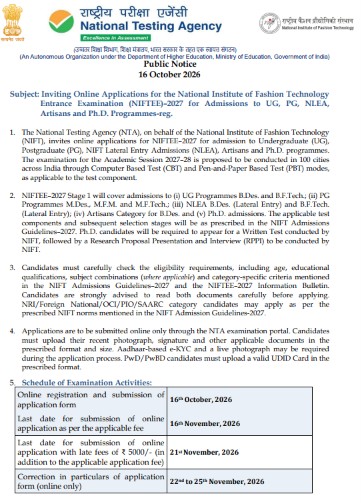
Aspirants can check the latest NIFT 2027 exam date, application form, eligibility criteria, syllabus, exam pattern, admit card, result, counselling, and admission details through the official NIFT admission portal. Students looking for NIFT 2027 latest updates, NIFT entrance exam preparation, NIFT application form, NIFT counselling dates and NIFT admission process can follow Manabadi for timely education and entrance exam updates.
Manabadi provides the latest and reliable updates on NIFT 2027, including the NIFT application form, exam date, eligibility, syllabus, exam pattern, admit card, answer key, result, counselling and admission process. Students can also find important updates on National Institute of Fashion Technology admissions, entrance exams, seat allotment, courses, colleges and career opportunities. As a trusted education portal for AP, Telangana and national-level entrance exams, Manabadi helps students stay updated with official announcements, important dates and admission-related information in one place.
Candidates preparing for NIFT 2027 should know the expected application schedule, eligibility criteria, examination pattern, syllabus, participating NIFT campuses and Stage 2 selection process.
NIFT Exam 2027 Overview:
| Particulars | Details |
|---|---|
| Exam | NIFT Entrance Exam 2027 |
| Conducting Authority | National Testing Agency (NTA) |
| Stage 1 Exam Date | January 10, 2027 |
| Application Period | October 16 to November 16, 2026 (With out Late Fee) Until November 21 (With Late Fee Rs 5000) |
| Nift Correction Window | November 22 to 25, 2026 |
| Stage 1 Result | March 2027 |
| Stage 2 | April–May 2027 |
| Final Result | June 2027 |
| Major Programmes | B.Des, B.FTech, M.Des, M.FTech, MFM |
| Exam Components | GAT, CAT, Situation Test/Interview |
NIFT Exam 2027 Registration Steps:
- Sign Up: Go to the NTA NIFTEE Portal and click on the application link to generate your login credentials.
- Fill Details: Log in to complete your personal information, choose your preferred exam centres, and pick your target courses.
- Upload Documents: Upload clear, scanned copies of your passport-sized photo and signature.
- Make Payment: Securely pay the application fee online through the payment gateway.
- Save Receipt: Download and preserve the generated confirmation page for your records.
NIFT Exam 2027 Application Fee Structure:
The fee varies depending on your chosen programmes and category:
| Category | Fee (1 Programme) | Fee (2 Programmes) |
|---|---|---|
| General / OBC-NCL / Gen-EWS | ₹2,000 | ₹3,000 |
| SC / ST / PwD | ₹500 | ₹750 |
NIFT Exam 2027 Dates:
The following schedule is based on the information available in the source material. Candidates should check the official NIFT/NTA notification for the final schedule.
| Event | Date |
|---|---|
| NIFT 2027 Application 2026 | October 16 to November 16, 2026 (Without Late Fee) Until November 21, 2026 (With Late Fee Rs 5000) |
| NIFT 2027 Correction Window | November 22 to 25, 2026 |
| Stage 1 Entrance Exam | January 10, 2027 |
| Stage 1 Result | March 2027 |
| Stage 2 Situation Test/Interview | April–May 2027 |
| Final Result | June 2027 |
The application period is described as expected, while January 10, 2027 is identified in the supplied information as the Stage 1 examination date.
NIFT 2027 Eligibility Criteria
The eligibility requirements vary according to the programme selected by the candidate.
B.Des Eligibility
Candidates applying for the Bachelor of Design (B.Des) programme should have passed Class 12 (10+2) from a recognized board.
The supplied information states that candidates should be under 24 years of age as of August 1, 2027. A five-year age relaxation is mentioned for SC, ST and PwD candidates.
Candidates from different streams can apply for B.Des, subject to the prescribed eligibility conditions.
B.FTech Eligibility
For Bachelor of Fashion Technology (B.FTech), candidates should have passed Class 12 with Physics and Mathematics as compulsory subjects.
Postgraduate Programmes
For postgraduate programmes such as:
- M.Des
- M.FTech
- MFM
candidates require a relevant undergraduate degree from a recognized university, as specified for the respective programme.
NIFT 2027 Exam Pattern
The NIFT entrance examination includes different components depending on the programme.
The General Ability Test (GAT) is conducted as a computer-based test, while the Creative Ability Test (CAT) is conducted in an offline, pen-and-paper format according to the supplied information.
B.Des and M.Des
The selection process includes:
- Creative Ability Test (CAT)
- General Ability Test (GAT)
- Stage 2 Situation Test/Interview, as applicable
B.FTech, M.FTech and MFM
The examination primarily includes the General Ability Test (GAT), followed by an interview where applicable.
NIFT 2027 Marking Scheme
The source information states that objective sections of the GAT include negative marking of 0.25 marks, or 25% of the allotted marks, for an incorrect answer.
The Creative Ability Test (CAT) does not have negative marking according to the supplied information.
Candidates should check the official examination notification for the final marking scheme applicable to their programme.
NIFT 2027 Syllabus
The NIFT syllabus is broadly divided into Creative Ability Test (CAT) and General Ability Test (GAT) components. The topics vary depending on the programme.
Creative Ability Test (CAT) Syllabus
The CAT is primarily relevant to B.Des and M.Des candidates. It evaluates creative thinking, visualization and design-related abilities through drawing-based tasks.
Important areas mentioned in the source material include:
- Drawing fundamentals
- One-point, two-point and three-point perspective
- Human figure sketching
- Light and shade
- Object drawing
- Design and composition
- Elements and principles of design
- Colour harmony
- Colour terminology
- Texture application
- Visual storytelling
- Storyboarding
- Sequential drawing
- Comic-strip concepts
- Character expressions
- Product redesign
- Futuristic solutions
- Poster design
- Visual communication
Candidates should focus on both drawing accuracy and the ability to communicate ideas visually.
General Ability Test (GAT) Syllabus
The GAT is applicable across the NIFT programmes mentioned in the supplied information.
Major sections include:
Quantitative Ability
Topics include:
- Percentages
- Ratios and proportions
- Profit and loss
- Averages
- Time, speed and distance
- Simple and compound interest
- Basic algebra
The source describes the mathematics level broadly around Class 9–10 concepts.
Communication Ability and English
Important areas include:
- Synonyms
- Antonyms
- Idioms and phrases
- Error spotting
- Sentence correction
- Reading comprehension
- Vocabulary
- Grammar
- Inference-based questions
Analytical and Logical Ability
Candidates can prepare topics such as:
- Number series
- Alphabet series
- Coding-decoding
- Blood relations
- Seating arrangements
- Direction sense
- Logical puzzles
- Pattern recognition
General Knowledge and Current Affairs
The GAT preparation also includes:
- Static General Knowledge
- National events
- International events
- Fashion industry updates
- Textile-related topics
- Famous designers
- Indian crafts
- Indian heritage
Candidates interested in fashion and design programmes can particularly follow developments related to the fashion and textile industries.
Case Study Preparation:
The source material mentions case-study preparation for B.FTech, MFM and M.FTech candidates.
Areas include:
- Situation-based business problems
- Market scenarios
- Brand management
- Analytical decision-making
NIFT 2027 Stage 2: Situation Test
Shortlisted B.Des candidates may have to appear for the Situation Test as part of Stage 2.
The Situation Test is a practical activity that evaluates a candidate’s ability to work with materials and create a three-dimensional model based on a given theme or task.
Important Areas
Candidates may need to demonstrate:
- Model-making skills
- Space visualization
- Material handling
- Colour coordination
- Structural understanding
- Neatness and finishing
- Creative interpretation of a theme
The supplied information also mentions a short written explanation in English describing the concept and thought process behind the model.
NIFT Campuses and Admissions
NIFT has campuses across different parts of India, including locations such as Delhi, Mumbai, Bengaluru and Hyderabad.
The source material indicates that NIFT admissions are primarily conducted across the NIFT campuses for programmes such as:
- B.Des
- B.FTech
- M.Des
- M.FTech
- MFM
The supplied information also notes that certain other participating design institutes or state universities may accept NIFT scores during centralized counselling. Candidates should verify the participating institutions and admission rules in the official counselling information for NIFT 2027.
NIFT 2027 Preparation Strategy
Candidates can divide their preparation into three broad phases.
Phase 1: Foundation and Basics
During the initial stage, candidates can focus on building fundamentals.
For CAT preparation:
- Practice lines and shapes
- Learn perspective drawing
- Practice one-, two- and three-point perspectives
- Draw everyday objects
- Work on light and shadow
For GAT preparation:
- Revise basic arithmetic
- Practice percentages and ratios
- Improve vocabulary
- Solve basic reasoning questions
- Begin regular reading for general awareness
Phase 2: Speed and Creative Application
Candidates can then move towards more advanced practice.
For CAT:
- Practice human figures
- Work on gestures and expressions
- Practice textures
- Develop storyboards
- Attempt product redesign exercises
- Practice creative visual communication
For GAT:
- Practice logical reasoning
- Solve seating arrangements and series
- Improve reading speed
- Practice comprehension
- Follow fashion and textile-related current affairs
Phase 3: Mock Tests and Revision
In the final preparation phase, candidates can concentrate on:
- Full-length mock tests
- Previous-year question papers
- Time management
- CAT drawing practice
- GAT speed practice
- Current-affairs revision
- Situation Test preparation
Candidates preparing for the Situation Test can also practice creating simple three-dimensional models using materials such as cardboard and wire.
NIFT 2027 Recommended Books
The supplied information lists several reference books for CAT and GAT preparation.
CAT Preparation Books
- NIFT Entrance Exam Guide – RPH Editorial Board
- NIFT/NID/IIFT Entrance Exam Guide – Surendra Kavimandan
- Arihant’s NIFT/NID/IIFT Entrance Examination – Dharmendra Mittal
GAT Preparation Books
- Quantitative Aptitude for Competitive Examinations – R.S. Aggarwal
- A Modern Approach to Verbal & Non-Verbal Reasoning – R.S. Aggarwal
- Objective General English – S.P. Bakshi
- Manorama Year Book / Competition Success Review for general awareness preparation
NIFT 2027 Preparation Tips
Candidates should maintain regular practice rather than preparing only during the final weeks.
For CAT, consistent drawing practice can help candidates improve perspective, proportion, visualization and speed.
For GAT, candidates can combine mathematics, reasoning, English and general-awareness preparation in their daily study schedule.
Candidates should also solve mock papers under timed conditions to become familiar with examination pressure and improve time management.
Manabadi
Manabadi is an education and career information portal providing updates related to entrance examinations, results, hall tickets, answer keys, counselling, admissions, recruitment notifications and other important academic opportunities across Andhra Pradesh, Telangana and India.
Conclusion
The NIFT Exam 2027 is an important entrance examination for students seeking admission to fashion, design, technology and management programmes. According to the information provided, the Stage 1 examination is scheduled for January 10, 2027, while the application process is expected during November–December 2026.
Candidates should understand the eligibility requirements for their chosen programme and prepare separately for the GAT, CAT and Stage 2 requirements wherever applicable. Since dates and admission rules can be updated, candidates should verify the final notification and programme-specific requirements before applying.