 It's Ours
The AP EAPCET 2026 Engineering Colleges List helps candidates shortlist suitable engineering colleges during AP EAPCET 2026 Counselling. Before entering Web Options, candidates should compare colleges based on Previous-Year Cutoff Ranks, Fee Structure, Placement Records, College-wise Seat Matrix, Branch-wise Seat Availability, NAAC/NBA Accreditation, Infrastructure, Available Branches, and Seat Intake. Considering these factors can help candidates make informed counselling decisions.
Government, university, and private engineering colleges across Andhra Pradesh offer diverse academic programmes, infrastructure, facilities, and career opportunities. Candidates should review Seat Intake, Placement Statistics, Fee Structure, Previous-Year Cutoff Trends, College-wise Seat Availability, Branch-wise Vacancies, and Seat Allotment Trends to identify suitable colleges and branches. This comparison can help candidates develop an effective Web Options Entry Strategy based on their AP EAPCET rank and preferences.
Candidates can also use the AP EAPCET 2026 College Predictor and Counselling Simulator to assess their admission chances based on their AP EAPCET 2026 rank, reservation category, gender, local area status, previous-year cutoff ranks, college-wise seat matrix, branch-wise seat availability, and seat allotment trends. These tools help candidates compare colleges and branches, evaluate fee structures, analyze cutoff trends, shortlist preferred options, and make better-informed counselling decisions.
Candidates can visit Manabadi for the latest updates on AP EAPCET 2026 Counselling, Engineering Colleges List, Web Options, Certificate Verification, Seat Allotment Results, College-wise Seat Matrix, Branch-wise Seat Availability, College Predictor, Counselling Simulator, Cutoff Ranks, Fee Structure, and other important AP EAPCET 2026 admission updates.
Contents
- 0.1 AP EAPCET 2026 Private Universities Convener Fee: ₹47,000 Temporary Fee, 13,610 Seats Across 11 Universities
- 0.2 AP EAPCET 2026 Private Universities Fee Highlights
- 0.3 Why Is There Confusion Over the Fee?
- 0.4 AP EAPCET 2026 Private Universities Seat Distribution
- 0.5 Universities with the Highest Convener Seats
- 0.6 High Demand for Emerging Tech Courses
- 1 Minimum Fee of Rs. 47,000 for Engineering Colleges
- 1.1 AP Engineering Colleges Fee Revision 2026
- 1.2 Engineering College Minimum Fee Revised
- 1.3 Around 140 Colleges to Benefit
- 1.4 APAFRC to Finalize New Fee Structure
- 1.5 Justice V.R.K. Krupasagar Likely to Head APAFRC
- 1.6 2. Premium Private Universities (Modern Infrastructure)
- 1.7 3. Top Private Autonomous Colleges (The Popular Choice)
- 1.8 4. Branch-Wise Placement Analysis:
- 1.9 5. Factors to Consider Beyond the “Highest Salary”
- 1.10 6. Important Note on Fee Reimbursement
- 2 7. AP EAPCET 2026 Engineering College Fee Structure Trends
AP EAPCET 2026 Private Universities Convener Fee: ₹47,000 Temporary Fee, 13,610 Seats Across 11 Universities
Engineering admissions for AP EAPCET 2026 have begun amid uncertainty over the convener quota fee structure in newly established private universities. Although the Andhra Pradesh Government has permitted admissions under the convener quota, the final tuition fee has not yet been approved. To avoid delaying the counselling process, the government has temporarily fixed an annual base fee of ₹47,000 until the Andhra Pradesh Higher Education Fee Regulatory and Monitoring Commission (APHERMC) finalizes the course-wise fee structure.
Students and parents faced inconvenience during the first day of web options, as the AP EAPCET counselling portal remained inaccessible until late at night, delaying the option-entry process. The government has clarified that if the final fee determined by APHERMC is higher than ₹47,000, candidates may have to pay the difference later. This uncertainty has created confusion among thousands of aspirants seeking admission into the newly established private universities.
AP EAPCET 2026 Private Universities Fee Highlights
| Particulars | Details |
|---|---|
| Admission Process | AP EAPCET 2026 Engineering Counselling |
| Universities Covered | 11 Private Universities |
| Total Convener Quota Seats | 13,610 |
| Convener Quota | 35% Seats |
| Temporary Annual Fee | ₹47,000 |
| Final Fee Status | Yet to be finalized |
| Fee Fixing Authority | APHERMC |
| Counselling Status | Web Options Started |
| Student Concern | Final fee not announced |
Why Is There Confusion Over the Fee?
The Andhra Pradesh Government has permitted admissions into the newly established private universities under the 35% convener quota. However, the final tuition fee has not yet been approved by APHERMC. Since engineering counselling could not be delayed further, the government introduced a temporary annual fee of ₹47,000.
Students and parents are now waiting for the final fee notification, as they may have to pay any additional amount if the approved fee exceeds the temporary amount.
AP EAPCET 2026 Private Universities Seat Distribution
| University | Convener Quota Seats |
|---|---|
| VVIT University, Nambur | 2,240 |
| Aditya University | 1,849 |
| VIT-AP University | 1,814 |
| Annamacharya University | 1,554 |
| Mohan Babu University | 1,519 |
| SRM University-AP | 1,450 |
| Godavari Global University | 1,324 |
| Bharatiya Engineering Science and Technology Innovation University | 1,134 |
| Centurion University | 273 |
| Apollo University | 273 |
| Sri City International University | 180 |
| Total Seats | 13,610 |
Universities with the Highest Convener Seats
| Rank | University | Seats |
|---|---|---|
| 1 | VVIT University | 2,240 |
| 2 | Aditya University | 1,849 |
| 3 | VIT-AP University | 1,814 |
| 4 | Annamacharya University | 1,554 |
| 5 | Mohan Babu University | 1,519 |
High Demand for Emerging Tech Courses
When looking at the seat distribution across these 11 private universities, there is a clear prioritization of modern, technology-driven courses.
The highest number of seats are allocated to high-demand programs such as Computer Science, Artificial Intelligence (AI), Data Science, and Cyber Security. Conversely, there is a noticeably lower seat availability for traditional engineering branches like Civil, Mechanical, and Electrical engineering, reflecting current industry trends and student preferences.
Minimum Fee of Rs. 47,000 for Engineering Colleges
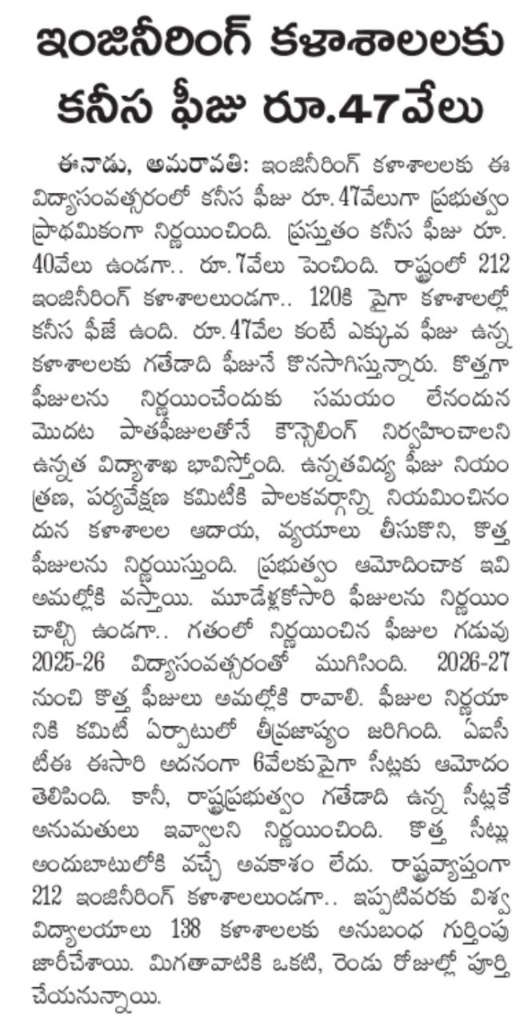
The government has preliminarily decided to fix the minimum tuition fee for engineering colleges at ₹47,000 for the 2026–27 academic year. The current minimum fee of ₹40,000 has been increased by ₹7,000. Out of the 212 engineering colleges in the state, more than 120 colleges currently charge the minimum fee. For colleges charging more than ₹47,000, the previous academic year’s fee structure is expected to continue until the revised fee structure is approved.
As there is insufficient time to finalize the revised fee structure, the Higher Education Department is planning to conduct the initial phase of counselling using the existing fee structure. Since the governing body has now been appointed to the Higher Education Regulatory and Monitoring Commission (HERMC), it will determine the revised fee structure after reviewing the income and expenditure of the colleges. The revised fees will come into effect after receiving approval from the State Government.
Engineering college tuition fees are required to be revised once every three years. The previous fee structure remained valid until the 2025–26 academic year, and the revised fees are scheduled to come into effect from the 2026–27 academic year. However, the delay in constituting the fee-fixation committee has postponed the revision process.
This year, AICTE approved more than 6,000 additional engineering seats. However, the State Government has reportedly decided to permit only the number of seats that existed during the previous academic year. As a result, the newly sanctioned seats are unlikely to be included in the current admission process. Out of the 212 engineering colleges in the state, universities have issued affiliation certificates to 138 colleges so far, while the affiliation process for the remaining colleges is expected to be completed within the next one or two days.
AP Engineering Colleges Fee Revision 2026
The Andhra Pradesh Government has proposed a revision of the engineering college fee structure for the 2026–27 academic year. According to reports, the minimum annual tuition fee has been increased from ₹40,000 to ₹47,000, providing relief to several engineering colleges operating with the existing minimum fee.
Engineering College Minimum Fee Revised
The revised minimum fee marks the latest change in the state’s engineering fee structure:
- 2014–19 (TDP Government): Minimum fee increased to ₹45,000
- 2019–24 (YSRCP Government): Minimum fee reduced to ₹35,000
- Current Proposal (2026–27): Minimum fee fixed at ₹47,000
Around 140 Colleges to Benefit
Nearly 140 engineering colleges in Andhra Pradesh currently charge the minimum annual tuition fee of ₹40,000. These institutions are expected to benefit from the revised fee of ₹47,000. However, all other engineering colleges will continue with last year’s approved fee structure until a comprehensive fee revision is completed.
APAFRC to Finalize New Fee Structure
The Andhra Pradesh Admission and Fee Regulatory Committee (APAFRC) will examine the income, expenditure, infrastructure, faculty, and other financial details of engineering colleges over the next two to three months before finalizing the revised fee structure.
Once approved, the new fee structure will remain valid for three academic years, beginning with the 2026–27 academic year.
Justice V.R.K. Krupasagar Likely to Head APAFRC
According to sources, Justice V.R.K. Krupasagar is likely to be appointed as the Chairman of the Andhra Pradesh Admission and Fee Regulatory Committee (APAFRC). Official orders appointing the Chairman, Secretary, and other committee members are expected to be issued shortly.
After the new APAFRC is formally constituted, it will submit its final recommendations on the revised engineering college fee structure to the state government, following which the official fee revision orders are expected to be issued.
| College Name | Location | Annual Tuition Fee (Approx) | Highest Package (2026) |
| AU College of Engineering (AUCE) | Visakhapatnam | ₹10,000 – ₹15,000 | ₹12.0 LPA |
| JNTUK College of Engineering | Kakinada | ₹10,000 – ₹45,000 | ₹47.0 LPA |
| SVU College of Engineering (SVUCE) | Tirupati | ₹10,000 – ₹40,000 | ₹18.0 LPA |
| JNTUA College of Engineering | Anantapur | ₹10,000 – ₹40,000 | ₹12.5 LPA |
Insight: JNTU Kakinada has consistently recorded massive “outlier” packages (like ₹47 LPA) due to students cracking off-campus or high-end product roles. However, the average package usually sits around ₹4.5 LPA to ₹6 LPA.
2. Premium Private Universities (Modern Infrastructure)
These institutions charge higher fees but offer state-of-the-art labs, international exposure, and dedicated placement cells that bring in top-tier tech giants.
| University Name | Location | Total 4-Year Fee (Approx) | Highest Package (2026) |
| SRM University AP | Amaravathi | ₹10.0 L – ₹16.0 L | ₹55.0 LPA |
| KL University (KLEF) | Vijayawada | ₹9.5 L – ₹11.5 L | ₹53.0 LPA |
| VIT-AP University | Amaravathi | ₹7.5 L – ₹9.0 L | ₹34.0 LPA |
| GITAM School of Technology | Visakhapatnam | ₹10.0 L – ₹14.0 L | ₹46.0 LPA |
- Placement Highlights: These universities often host “Super Dream” recruitment drives where companies like Amazon, Microsoft, and Adobe offer packages exceeding ₹30 LPA.
3. Top Private Autonomous Colleges (The Popular Choice)
For most students, autonomous colleges affiliated with JNTU or AU offer the perfect balance of discipline and industry-ready placements.
| College Name | Location | Annual Fee (Approx) | Highest Package (2026) |
| GVP College of Engineering | Visakhapatnam | ₹76,000 – ₹1,00,000 | ₹24.0 LPA |
| VR Siddhartha (VRSEC) | Vijayawada | ₹65,000 – ₹90,000 | ₹48.2 LPA |
| GMR Institute of Technology | Rajam | ₹66,000 – ₹85,000 | ₹19.0 LPA |
| SRKR Engineering College | Bhimavaram | ₹75,000 – ₹95,000 | ₹22.0 LPA |
| RVR & JC College | Guntur | ₹70,000 – ₹1,10,000 | ₹18.0 LPA |
4. Branch-Wise Placement Analysis:
Not all branches are created equal when it comes to the “High Salary” tag. For 2026, the trends are clear:
- CSE & Specialized AI Branches: These branches command 80% of the high-paying jobs. The highest packages (₹40 LPA+) are almost exclusively offered to Computer Science or AI/ML students.
- ECE (Electronics): Remains strong. Many core companies like Texas Instruments and Qualcomm offer high packages (₹15–25 LPA) to ECE students with strong VLSI or Embedded Systems knowledge.
- Core Branches (Mech/Civil/EEE): While the average salary is lower (₹3.5–5 LPA), top students in Mechanical and Electrical engineering still secure roles in companies like L&T or PSUs with packages around ₹8–12 LPA.
5. Factors to Consider Beyond the “Highest Salary”
While the ₹50 LPA+ figures look attractive on brochures, Manabadi advises students to look at two other critical numbers:
- The Median Salary: This is the salary that the “middle” student gets. If a college has a highest package of ₹50 LPA but a median of ₹4 LPA, it means only 1 or 2 students got the high package, while most are at the lower end.
- Placement Percentage: Always check how many eligible students actually got placed. Top colleges like GVP and VRS usually maintain a 90%+ placement record.
- Location Advantage: Colleges in Visakhapatnam, Vijayawada, and Guntur have a proximity advantage to local IT hubs and industrial zones, making internships easier.
6. Important Note on Fee Reimbursement
If you are eligible for JVD, the “Fee” column becomes less relevant as the government covers the tuition. However, you must still pay for:
- Hostel Fees: Range from ₹60,000 to ₹1,20,000 per year.
- University Fees/Exam Fees: Usually ₹5,000 to ₹10,000 per year.
- Transportation: If you are a day scholar.
7. AP EAPCET 2026 Engineering College Fee Structure Trends
Engineering college fees vary depending on:
- Government or private status
- Autonomous recognition
- Infrastructure quality
- Branch demand
- Placement performance
General Fee Trends:
| College Type | Fee Trend |
|---|---|
| Government Colleges | Lower fees |
| Private Colleges | Moderate fees |
| Autonomous Colleges | Higher fees |
| Premium Institutions | Premium fee structure |
Students should carefully compare fee structures before web options entry.
Conclusion
Choosing the right college in AP EAPCET 2026 is about balancing your rank with your financial comfort and career goals. If you have a top rank (under 5,000), AUCE or JNTUK offer the best ROI. If you are looking for modern campus life and high-end tech placements and can afford the premium, SRM or KL University are excellent choices.
The AP EAPCET 2026 Engineering Colleges list with fee details and highest salary packages is extremely important for students preparing for counselling in Andhra Pradesh.Candidates should carefully compare tuition fees, placement records, branch demand, infrastructure, and internship opportunities before selecting colleges.