 It's Ours
LATEST UPDATE :
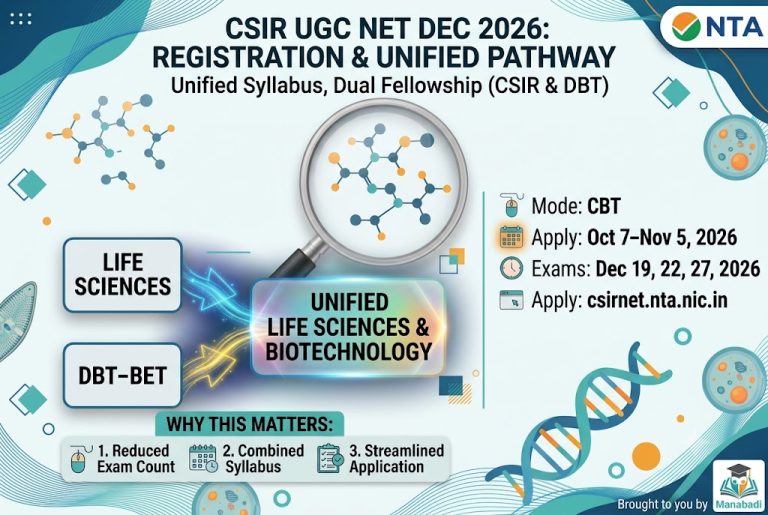
Online applications for CSIR-UGC NET December 2026 are open at csirnet.nta.nic.in until November 5, 2026. The computer-based examination will take place between December 19 and 27, 2026 across designated test centers.
New Delhi: In a landmark restructuring of national-level fellowship examinations, the National Testing Agency (NTA) has officially merged the Department of Biotechnology – Biotechnology Eligibility Test (DBT-BET) with the Joint CSIR-UGC NET examination.
Starting from the December 2026 cycle, both streams have been integrated into a single unified discipline titled Life Sciences & Biotechnology (LS & BT). This major policy decision aims to eliminate duplicate exams, streamline fellowship allocations, and create a single-window evaluation framework for biological sciences and biotechnology research aspirants in India.
Contents
- 1 CSIR-UGC NET December 2026: Key Details & Important Dates
- 2 Revised Exam Pattern & Marking Scheme
- 3 Key Additions to Consider
- 4 2. How the Merged Fellowship Tagging Works
- 5 3. Subject Code & Medium of Examination
- 6 4. Direct Helpdesk & Contact Information
- 7 Comparative Analysis: What Changes for Candidates?
- 8 Detailed Syllabus Integration
- 9 Eligibility Criteria & Age Limits
- 10 Fellowship Structure & Monthly Stipends
- 11 Category-Wise Application Fees
- 12 Step-by-Step Online Application Guide
- 13 Frequently Asked Questions (FAQs)
- 13.1 1. Why have CSIR NET Life Sciences and DBT-BET been merged?
- 13.2 2. Do I need to fill separate application forms for CSIR JRF and DBT Fellowship?
- 13.3 3. Has the syllabus changed after the merger?
- 13.4 4. How will the fellowships be funded and disbursed?
- 13.5 5. What is the examination pattern for the merged paper?
- 13.6 6. Can final-year Master’s degree students apply?
- 14 Conclusion
CSIR-UGC NET December 2026: Key Details & Important Dates
| Field | Details |
| Exam Name | CSIR-UGC NET December 2026 |
| Conducting Body | National Testing Agency (NTA) |
| Target Streams | Chemical Sciences, Earth Sciences, Life Sciences, Mathematical Sciences, Physical Sciences |
| Application Deadline | November 5, 2026 (till 11:50 PM) |
| Correction Window | November 10 – 12, 2026 |
| Exam Dates | December 19 – 27, 2026 |
| Official Website | csirnet.nta.nic.in |
Revised Exam Pattern & Marking Scheme
The integrated LS & BT paper consists of 145 Multiple Choice Questions (MCQs) carrying a total of 200 marks. Candidates must select and answer 75 questions across three distinct sections.
| Section | Total Questions | Maximum Questions to Attempt | Marks per Correct Answer | Negative Marking (25%) | Total Sectional Weightage |
| Part A (General Aptitude) | 20 | 15 | +2 | -0.50 | 30 Marks |
| Part B (Core Concepts & Subject MCQs) | 50 | 35 | +2 | -0.50 | 70 Marks |
| Part C (Analytical & Applied Sciences) | 75 | 25 | +4 | -1.00 | 100 Marks |
| Total | 145 | 75 | — | — | 200 Marks |
Note: A uniform 25% negative marking penalty applies to incorrect answers across all three sections.
Key Additions to Consider
- Preparation Strategy & Unit-wise Blueprint: Since the syllabus has merged classical biology with engineering/applied concepts, aspirants need concrete study guidance on how to allocate time across topics.
- Merit List & Tagging Mechanism: Explain how the single exam decides who gets CSIR JRF vs. DBT Category I/II fellowships.
- Important Rules for “Result Awaited” (RA) Candidates: Clarify specific document requirements (e.g., Attestation Form) for final-year students.
- Exam Day & CBT Guidelines: Essential operational instructions for candidates appearing for the computer-based test.
- Helpdesk & Official Support Contacts: NTA contact details for technical or fee payment issues.
1. Preparation Strategy & Section-wise Strategy for the Integrated Syllabus
Strategic Guidance for the Unified LS & BT Paper
The merger requires a balanced preparation plan to handle both conceptual biology and process-driven biotechnology:
- For Classical Biology Backgrounds (B.Sc./M.Sc. Botany, Zoology, Life Sciences):
- Prioritize numerical practice in Bioprocess Kinetics (Monod model, dilution rates, yield coefficients).
- Focus on tool-based units: rDNA techniques, CRISPR-Cas system applications, and next-generation sequencing (NGS) platforms.
- For Biotechnology Backgrounds (B.Tech/M.Sc. Biotech):
- Strengthen concepts in Plant & Animal System Physiology and Ecology & Evolution, which are heavily weighted in Part B and Part C.
- Review key classical genetics principles and Mendelian mapping techniques.
- Part C Tactic (Analytical Section):
- Since you only need to attempt 25 out of 75 questions, select questions strictly based on high-confidence units to avoid the -1.00 negative marking penalty.
2. How the Merged Fellowship Tagging Works
Understanding Fellowship Tagging & Merit List Generation
Following the conduct of the examination, NTA will compile a unified raw score and percentile rank list. The allocations will function as follows:
CSIR JRF Tagging: Awarded to top rankers across all biological streams based on CSIR’s total sanctioned seats.
DBT Category-I Fellowship: Awarded to candidates qualifying under DBT’s specific cut-offs, enabling registration for Ph.D. with a DBT stipend in any recognized university/institute in India.
DBT Category-II Eligibility: Enables candidates to be eligible for selection in DBT-sponsored research projects with a stipend equivalent to JRF/SRF.
Assistant Professorship / Ph.D. Admission Only: Qualified candidates not securing a fellowship will be eligible for Assistant Professorship and Ph.D. admissions as per UGC norms.
3. Subject Code & Medium of Examination
Exam Medium & Choice of Language
Test Medium: The question paper will be bilingual (English and Hindi).
Discrepancy Rule: In case of any translation ambiguity or variation between the Hindi and English versions of a question, the English version will be treated as final and authoritative.
Subject Code for LS & BT: Candidates registering under the merged paper must select Subject Code: 03 (Life Sciences & Biotechnology) during the online application process.
4. Direct Helpdesk & Contact Information
NTA Helpdesk & Query Resolution
In case of technical errors during application filling, image upload issues, or fee payment failure, candidates can reach out to NTA through official channels:
Helpline Number: 011-40759000 / 011-69227700
Official Email: csirnet@nta.ac.in
Official Website:csirnet.nta.nic.in
Comparative Analysis: What Changes for Candidates?
| Feature | Pre-December 2026 Framework | New Unified Framework (Dec 2026 Onward) |
| Exams Conducted | Two separate exams (CSIR NET Life Sciences & DBT-BET) | One single exam for both fellowship streams. |
| Application Fee | Separate registration fees for NTA and Regional DBT Portals | Single application fee payable on csirnet.nta.nic.in. |
| Syllabus Focus | CSIR focused on classical biology; DBT focused on applied engineering | Hybrid syllabus combining foundational biology with bioprocess engineering. |
| Fellowship Ranks | Dual merit lists created independently | Single Merit List with tagged category eligibility (CSIR JRF vs. DBT Fellowship). |
Detailed Syllabus Integration
The unified syllabus requires cross-disciplinary preparation. Classical Life Sciences students must cover applied biotechnology domains, while Biotechnology graduates must strengthen foundational biological concepts.
1. New Additions for Classical Life Sciences Students:
- Bioprocess Engineering: Fermentation kinetics (batch, fed-batch, continuous), bioreactor design principles, scale-up dynamics, and downstream processing.
- Recombinant DNA Tools: CRISPR-Cas9 applications, RNA interference (RNAi), baculovirus & mammalian expression vectors, high-throughput sequencing technologies.
- Industrial & Microbial Biotech: Recombinant protein expression, bio-monitored bio-factories, and industrial enzyme kinetics.
2. Expanded Modules for Biotechnology Students:
- System Physiology: Advanced plant and animal physiological responses, neurobiology, and endocrine mechanisms.
- Ecology & Evolutionary Biology: Population ecology, community dynamics, macroevolution, and molecular phylogenetics.
- Bioinformatics & OMICS: Structural bio-modeling, biological database algorithms, sequence alignment strategies, and structural genomics.
Eligibility Criteria & Age Limits
- Educational Qualification: M.Sc. or equivalent degree, B.S. (4-year duration), B.E./B.Tech, B.Pharm, MBBS, or Integrated BS-MS/M.Sc. in Life Sciences, Biotechnology, Biochemistry, Microbiology, or related biological streams.
- Minimum Marks: Minimum 55% aggregate marks for General/General-EWS/OBC-NCL candidates, and 50% aggregate marks for SC/ST/Third Gender/PwD candidates.
- Result Awaited (RA) Category: Final-year Master’s degree students or bachelor degree holders awaiting final results are eligible to apply provisionally.
- Age Limit (as of December 1, 2026):
- Junior Research Fellowship (JRF): Upper age limit is 30 years (Relaxation: 5 years for SC/ST/PwD/Third Gender/Women candidates; 3 years for OBC-NCL).
- Assistant Professorship / Ph.D. Admission: No upper age limit.
Fellowship Structure & Monthly Stipends
While the examination is unified, funding agencies will disburse monthly stipends through their respective administrative channels:
- CSIR JRF Scheme:
- JRF Stipend (Years 1–2): ₹37,000 per month + applicable HRA.
- SRF Stipend (Years 3–5): ₹42,000 per month + applicable HRA (upon satisfactory progress assessment).
- Annual Contingency: ₹20,000 per annum.
- DBT Fellowship Scheme:
- Candidates merit-listed under the Department of Biotechnology quota will receive equivalent stipend funds directly transferred via DBT’s institutional fellowship portal.
Category-Wise Application Fees
- General / Unreserved: ₹1,150
- OBC-NCL / General-EWS: ₹600
- SC / ST / PwD / Third Gender: ₹325
Step-by-Step Online Application Guide
- Visit the NTA portal at
csirnet.nta.nic.in. - Click on “CSIR-UGC NET December 2026 Registration”.
- Fill in basic personal details, email ID, and mobile number to generate a unique Application Number.
- Complete the main application form by selecting “Life Sciences & Biotechnology” as your target subject.
- Upload scanned clear copies of photograph, signature, and qualifying degree/category certificates.
- Pay the prescribed application fee via net banking, UPI, or credit/debit cards.
- Save, submit, and print the confirmation page for record-keeping.
Frequently Asked Questions (FAQs)
1. Why have CSIR NET Life Sciences and DBT-BET been merged?
The National Testing Agency (NTA) merged the two examinations to create a unified single-window evaluation system for life sciences and biotechnology aspirants. This eliminates duplicate exams, reduces administrative costs, and streamlines candidate evaluation for research fellowships and assistant professorships across India.
2. Do I need to fill separate application forms for CSIR JRF and DBT Fellowship?
No. Candidates only need to register once for the Life Sciences & Biotechnology (LS & BT) paper on the official NTA portal (csirnet.nta.nic.in). Candidates can select their preferences for JRF, Assistant Professorship, or both during the online submission process.
3. Has the syllabus changed after the merger?
Yes. The unified syllabus integrates classical biological sciences (such as cell biology, genetics, ecology, and plant/animal physiology) with core biotechnology subjects, including Bioprocess Engineering, Recombinant DNA Technology, Bioinformatics, and Applied Immunology.
4. How will the fellowships be funded and disbursed?
While the examination and merit list generation are handled by NTA, the funding mechanisms remain separate:
- CSIR JRF: Awarded and funded directly by the Council of Scientific and Industrial Research.
- DBT Fellowship: Awarded and funded directly by the Department of Biotechnology (DBT) to candidates qualifying under the biotechnology merit criteria.
5. What is the examination pattern for the merged paper?
The exam is a 3-hour Computer-Based Test (CBT) consisting of 145 Multiple Choice Questions (MCQs) for a total of 200 marks. Candidates must attempt 75 questions across three parts:
- Part A: 15 out of 20 questions (General Aptitude – 30 Marks)
- Part B: 35 out of 50 questions (Core Subject – 70 Marks)
- Part C: 25 out of 75 questions (Analytical/Applied – 100 Marks)
6. Can final-year Master’s degree students apply?
Yes. Students currently pursuing their Master’s degree or awaiting their final results are eligible to apply under the “Result Awaited” (RA) category.
Conclusion
The structural merger of DBT-BET into the CSIR-UGC NET December 2026 examination as Life Sciences & Biotechnology (LS & BT) marks a major reform in Indian higher education and research recruitment. By unifying exam administration while preserving distinct funding avenues from CSIR and DBT, the NTA has simplified the career pathway for thousands of research aspirants.
Aspirants are strongly recommended to review the updated hybrid syllabus, adjust their preparation strategy to cover both theoretical and applied modules, and complete their online applications at csirnet.nta.nic.in before the deadline on November 5, 2026.