 It's Ours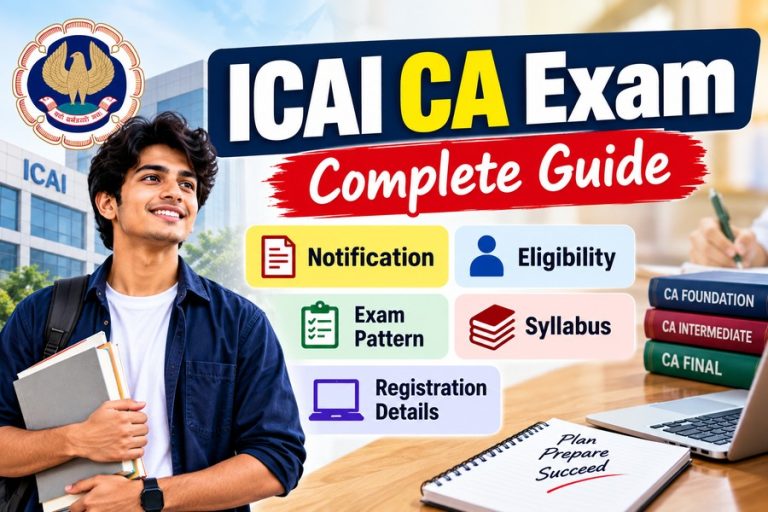
The Institute of Chartered Accountants of India (ICAI) conducts the Chartered Accountancy (CA) examination, one of the most prestigious professional qualifications in the country. Under the ICAI New Scheme of Education and Training, the CA course roadmap has been streamlined to enhance practical learning, reduce the total course duration to approximately 3.5 to 4 years, and align with global financial standards.
This guide provides an end-to-end overview of the ICAI CA course structure, eligibility criteria, exam pattern, syllabus, passing criteria, and step-by-step registration details.
Contents
- 1 1. CA Course Structure Overview
- 2 2. CA Foundation Level
- 3 3. CA Intermediate Level
- 4 4. Practical Training (Articleship)
- 5 5. CA Final Level
- 6 6. Passing Criteria & Exemption Rules
- 7 7. Step-by-Step Online Registration Process
- 8 8. Key Preparation Guidelines
- 9 Frequently Asked Questions (FAQs)
- 9.1 1. Can I register for the CA course directly after Class 12?
- 9.2 2. Do graduates need to appear for the CA Foundation exam?
- 9.3 3. What is the duration of Articleship (Practical Training) under the New Scheme?
- 9.4 4. How many times a year are CA exams conducted?
- 9.5 5. Is there negative marking in CA examinations?
- 9.6 6. What are the passing and exemption rules for CA exams?
- 10 Conclusion
1. CA Course Structure Overview
The CA program consists of three progressive exam levels and a mandatory practical training phase:
- CA Foundation (Entry Level)
- CA Intermediate (Second Level)
- Practical Training / Articleship (2 Years)
- CA Final (Final Qualification Level)
2. CA Foundation Level
Eligibility Criteria:
- Provisional Registration: Students can register provisionally after passing Class 10.
- Exam Qualification: Candidates must pass Class 12 (10+2) from a recognized board.
- Study Period: A mandatory 4-month study period is required after registration before appearing for the exam.
- Exam Frequency: Conducted three times a year (January, May/June, and September).
Exam Pattern & Marking Scheme:
The Foundation level consists of 4 Papers (400 Marks total):
| Paper | Subject Name | Type of Questions | Duration | Marks |
| Paper 1 | Accounting | Descriptive / Subjective | 3 Hours | 100 |
| Paper 2 | Business Laws | Descriptive / Subjective | 3 Hours | 100 |
| Paper 3 | Quantitative Aptitude (Business Maths, Logical Reasoning & Statistics) | Objective (MCQs) | 2 Hours | 100 |
| Paper 4 | Business Economics | Objective (MCQs) | 2 Hours | 100 |
- Negative Marking: Objective papers (Papers 3 & 4) carry a penalty of 0.25 marks for every incorrect answer.
3. CA Intermediate Level
Entry Routes:
- Foundation Route: Pass the CA Foundation Examination with prescribed aggregate marks.
- Direct Entry Route:
- Commerce Graduates / Postgraduates with a minimum of 55% aggregate marks.
- Non-Commerce Graduates / Postgraduates with a minimum of 60% aggregate marks.
- Candidates who have passed the Intermediate level of ICSI (CS) or ICMAI (CMA).
Exam Pattern (6 Papers across 2 Groups):
Under the New Scheme, the CA Intermediate level is rationalized into 6 papers:
Group 1:
- Paper 1: Advanced Accounting (100 Marks)
- Paper 2: Corporate and Other Laws (100 Marks)
- Paper 3: Taxation (Direct Tax & Indirect Tax) (100 Marks)
Group 2:
- Paper 4: Cost and Management Accounting (100 Marks)
- Paper 5: Auditing and Ethics (100 Marks)
- Paper 6: Financial Management & Strategic Management (100 Marks)
Assessment Format: All papers in CA Intermediate follow a 30% Case-based MCQs (Objective) and 70% Descriptive evaluation scheme. There is no negative marking for MCQs in the Intermediate level.
4. Practical Training (Articleship)
- Duration: Reduced from 3 years to 2 years under the New Scheme.
- Prerequisite: Candidates must pass Both Groups of CA Intermediate before commencing practical training.
- Mandatory Courses: ICITSS (Information Technology and Soft Skills Training) must be completed prior to starting Articleship.
5. CA Final Level
The final milestone before earning the CA designation involves 6 papers split into 2 groups, alongside the completion of mandatory Self-Paced Online Modules (SPOM).
Exam Pattern:
Group 1:
- Paper 1: Financial Reporting (100 Marks)
- Paper 2: Advanced Financial Management (AFM) (100 Marks)
- Paper 3: Advanced Auditing, Assurance and Professional Ethics (100 Marks)
Group 2:
- Paper 4: Direct Tax Laws & International Taxation (100 Marks)
- Paper 5: Indirect Tax Laws (100 Marks)
- Paper 6: Integrated Business Solutions (Multi-Disciplinary Case Study) (100 Marks)
Exam Frequency: Conducted twice a year (May/June and November/December).
6. Passing Criteria & Exemption Rules
Across all levels (Foundation, Intermediate, and Final), candidates must satisfy two conditions to clear a group or level:
- Paper-wise Minimum: A minimum of 40% marks in each individual paper.
- Aggregate Minimum: A minimum of 50% marks in aggregate across all papers in the group/level.
- Exemption Rule: Scoring 60% or higher in any paper grants a permanent exemption for that paper in subsequent attempts under the New Scheme rules.
7. Step-by-Step Online Registration Process
- Visit Official Portal: Go to the ICAI Self Service Portal (SSP) at
eservices.icai.org. - User Sign Up: Register as a new user by entering basic credentials (email, mobile number, and personal details).
- Select Course Level: Choose the appropriate level (Foundation or Direct Entry Intermediate).
- Document Upload: Upload scanned copies of required documents:
- Class 10 & Class 12 Marksheets / Graduation Certificates.
- Passport-size Photograph and Signature.
- Valid Proof of Identity (Aadhaar / Passport / Voter ID).
- Payment of Fees: Complete the online registration fee payment via net banking, credit/debit card, or UPI.
- Confirmation & Study Material: Upon successful payment, a Student Registration Number (SRN) is generated. Study materials can then be ordered via the ICAI Centralized Distribution System (CDS) portal using coupons issued.
8. Key Preparation Guidelines
- Prioritize Official ICAI Material: The ICAI Board of Studies (BoS) study modules form the official benchmark for questions.
- Solve Mock Test Papers (MTPs): Practice Revision Test Papers (RTPs) and full-length MTPs published by ICAI before every exam window.
- Time Allocation: Focus on conceptual clarity in early months and dedicate the final 4-6 weeks exclusively to revision and answer writing practice.
Frequently Asked Questions (FAQs)
1. Can I register for the CA course directly after Class 12?
Yes. Students who pass Class 12 (10+2) can register directly for the CA Foundation level. After registering, a mandatory 4-month study period must be completed before appearing for the Foundation examination.
2. Do graduates need to appear for the CA Foundation exam?
No. Commerce graduates/postgraduates with at least 55% marks and Non-Commerce graduates/postgraduates with at least 60% marks can bypass Foundation and enroll directly into CA Intermediate via the Direct Entry Route. Candidates who passed the Intermediate level of ICSI (CS) or ICMAI (CMA) are also eligible for direct entry.
3. What is the duration of Articleship (Practical Training) under the New Scheme?
Under the ICAI New Scheme, practical training (Articleship) has been reduced from 3 years to 2 years. Candidates can start Articleship only after clearing both groups of CA Intermediate and completing the mandatory ICITSS (IT and Soft Skills) training.
4. How many times a year are CA exams conducted?
- CA Foundation & CA Intermediate: Conducted 3 times a year (January, May/June, and September).
- CA Final: Conducted 2 times a year (May and November).
5. Is there negative marking in CA examinations?
- CA Foundation: Objective papers (Paper 3 & Paper 4) carry a penalty of 0.25 marks for each wrong answer.
- CA Intermediate & CA Final: Papers consist of 30% case-based MCQs and 70% descriptive questions. There is no negative marking for MCQs at these levels.
6. What are the passing and exemption rules for CA exams?
To pass any level or group, a candidate must secure a minimum of 40% marks in each individual paper and an aggregate of 50% marks across all papers in that group. Scoring 60% or more in a paper grants a permanent exemption for that paper in future attempts.
Conclusion
Pursuing the Chartered Accountancy (CA) designation opens doors to high-level careers in financial auditing, taxation, corporate finance, and strategic consulting. The ICAI New Scheme of Education and Training has modernized the curriculum, reduced the total course duration to around 3.5 to 4 years, and aligned practical training with global standards.