 It's Ours
Contents
- 1 MBBS CQ Phase-III Non-Reported Candidates List – Official PDF
- 2 AP NEET UG 2026 Counselling – Colleges Covered
- 3 Important Rule for Candidates Who Do Not Join
- 4 Original Certificate Verification
- 5 Counselling 2026: MCC Introduces Freeze & Float System
- 6 Key Statistics and Numbers
- 7 Qualifying Cut-Off Scores & Percentiles
- 8 Key Policy Change in Andhra Pradesh State Quota Counselling
- 9 Important Guidelines
- 10 Reason for the Update
- 10.1 What is AP NEET UG Counselling?
- 10.2 Complete Counselling Process
- 10.3 Eligibility Criteria
- 10.4 AP Local & Non-Local Rules
- 10.5 Reservation Policy
- 10.6 Documents Required
- 10.7 Registration Process
- 10.8 Registration Fee
- 10.9 Merit List
- 10.10 Web Options Entry
- 10.11 Seat Allotment
- 10.12 AP Medical Colleges List
- 10.13 District-wise Medical Colleges
- 10.14 College-wise Details
- 10.15 College-wise Seat Matrix
- 10.16 MBBS Seat Matrix
- 10.17 Fee Structure
- 10.18 Previous Year Cutoffs (NEET UG 2025 — AP State Counselling)
- 10.19 Download Seat Allotment Order
- 10.20 Self Reporting
- 11 Reporting at College
MBBS CQ Phase-III Non-Reported Candidates List – Official PDF
Also, checkout NEET Counselling Complete Documents Required.
Latest Update: For MBBS CQ, the important new development today is the release of the Phase-III non-reported candidates list. Candidates who received a Phase-III CQ seat should check the list for their status.
Current AP NEET UG Status
MBBS CQ: Phase-III allotment & reporting completed → non-reported candidates list released on 21 October.
MBBS MQ: Phase-III allotment released → reporting deadline is 21 October.
BDS CQ: Phase-III counselling process underway after Phase-I/II Free Exit status.
BDS MQ: Phase-II allotment completed; further MQ registration/counselling activity notified.
AP NEET UG 2026–27: MBBS & BDS Counselling Latest Status
AP NEET UG Phase-III counselling is now at the post-allotment stage. The major Phase-III activities for MBBS have been completed, and NTRUHS has now released the list of MBBS CQ candidates who did not report after Phase-III allotment.
MBBS – Competent Authority Quota (CQ)
- Phase-III/Mop-Up web options: Completed on 16 October 2026.
- Phase-III final result and college-wise allotment: Released on 17 October 2026.
- The reporting process for Phase-III CQ allotment has been completed.
- Latest: NTRUHS has now released the list of candidates who did not report after Phase-III on 21 October 2026.
- Candidates who participated in Phase-III should check the latest non-reported candidates list to verify their status.
MBBS – Management Quota (MQ)
The Phase-III college-wise allotments were released on 19 October 2026. NTRUHS has also issued a fresh Management Quota registration notification. The Phase-III MQ reporting deadline is 21 October 2026, so this stage is at/near its closing point today.
BDS – Competent Authority Quota (CQ)
For BDS CQ, NTRUHS has already released the list of candidates who were not admitted/availed Free Exit after Phase-I and Phase-II counselling on 19 October 2026. The Phase-III web-options notification was released on 18 October, so BDS CQ has moved into its next counselling stage.
BDS – Management Quota (MQ)
The Phase-II college-wise allotments were released on 18 October 2026. The university has subsequently issued a fresh MBBS/BDS Management Quota registration notification on 19 October.
Stay connected with Manabadi for more latest updates on AP NEET UG counselling.
AP NEET UG 2026 Counselling – Colleges Covered
The counselling covers eligible Competent Authority Quota seats in Government and Private Medical Colleges affiliated to Dr. NTRUHS.
The notified colleges include 11 Government Medical Colleges and 11 Private Medical Colleges in the AU region, 7 Government Medical Colleges and 9 Private Medical Colleges in the SVU region, and Siddhartha Medical College, Vijayawada, under the State-Wide Institution category.
Government Medical Colleges – AU Region
| Code | Medical College | CQ Seats |
|---|---|---|
| AMCV | Andhra Medical College, Visakhapatnam | 213 |
| GMCE | Dr Yellapragada Subba Rao Government Medical College, Eluru | 64 |
| GMCG | Guntur Medical College, Guntur | 213 |
| GMCM | Sri Pingali Venkaiah Government Medical College, Machilipatnam | 64 |
| GMCO | Government Medical College, Ongole | 128 |
| GMCR | Government Medical College, Rajamahendravaram | 64 |
| GMCS | Government Medical College, Srikakulam | 170 |
| GMCV | Government Medical College, Vizianagaram | 64 |
| RMCK | Rangaraya Medical College, Kakinada | 213 |
| GMCP | Government Medical College, Paderu | 43 |
| GMPD | Government Medical College, Piduguralla | 22 |
Private Medical Colleges – AU Region
| Code | Medical College | CQ Seats |
|---|---|---|
| ASRA | Alluri Seetharama Raju Academy of Medical Sciences, Eluru | 125 |
| GEMS | Great Eastern Medical School and Hospital, Srikakulam | 125 |
| GSLR | GSL Medical College, Rajahmundry | 125 |
| KATR | Katuri Medical College and Hospital, Guntur | 100 |
| KONA | Konaseema Institute of Medical Sciences and Research Foundation, Amalapuram | 125 |
| MAHA | Maharaja Institute of Medical Sciences, Vizianagaram | 100 |
| NIMR | Nimra Institute of Medical Sciences, Vijayawada | 100 |
| NRIM | NRI Medical College, Chinnakakani | 100 |
| NRVP | NRI Institute of Medical Sciences, Visakhapatnam | 125 |
| PSIM | Dr. Pinnamaneni Siddhartha Institute of Medical Sciences | 75 |
| GVPT | Gayathri Vidhya Parishad Institute of Health Care and Medical Technology, Visakhapatnam | 100 |
NIMR – Nimra Institute of Medical Sciences is listed as a Private Minority medical college.
Government Medical Colleges – SVU Region
| Code | Medical College | CQ Seats |
|---|---|---|
| ACSR | ACSR Government Medical College, Nellore | 170 |
| GMCA | Government Medical College, Anantapur | 170 |
| GMCK | Government Medical College, Kadapa | 213 |
| GMCN | Government Medical College, Nandyala | 64 |
| KMCK | Kurnool Medical College, Kurnool | 213 |
| PADT | Sri Padmavathi Medical College for Women, Tirupati | 126 |
| SVMC | Sri Venkateswara Medical College, Tirupati | 204 |
Private Medical Colleges – SVU Region
| Code | Medical College | CQ Seats |
|---|---|---|
| APLC | Apollo Institute of Medical Sciences and Research, Chittoor | 75 |
| BMCT | Sri Balaji Medical College Hospital & Research Institute, Renigunta, Tirupati | 75 |
| FIMS | Fathima Institute of Medical Sciences, Kadapa | 50 |
| NARN | Narayana Medical College, Nellore | 125 |
| PESK | P.E.S. Institute of Medical Sciences and Research, Kuppam | 75 |
| SRMC | Santhiram Medical College, Nandyal | 125 |
| VMCK | Viswabharathi Medical College, Kurnool | 125 |
| AGMC | Anna Gowri Medical College & Hospital, Tirupati District | 75 |
| RVSC | RVS Institute of Medical Sciences, Chittoor | 25 |
FIMS – Fathima Institute of Medical Sciences is listed as a Private Minority medical college.
State-Wide Institution
| Code | Medical College | Status | CQ Seats |
|---|---|---|---|
| SMCV | Siddhartha Medical College, Vijayawada | Government | 213 |
Special Category Seats
The Phase-I counselling also includes eligible seats under special categories such as:
- PwBD – Persons with Benchmark Disabilities
- PMC
- CAP
- Bharat Scouts & Guides
- Anglo-Indian
Candidates eligible for these categories must exercise their web options along with their other college preferences after checking the applicable seat matrix.
The University has clarified that NCC and Sports & Games category seats will be filled later, after receiving the final list of eligible candidates from the concerned departments.
Important Rule for Candidates Who Do Not Join
Candidates must pay close attention to the joining rules.
If a candidate is allotted a seat in Phase-I but does not join/report at the allotted college within the prescribed schedule, the candidate will not be eligible to opt for the same college in subsequent phases of counselling.
Candidates who join their Phase-I allotted seat are eligible for upgradation/sliding to a better college up to Phase-III (Mop-Up) Round, subject to the applicable counselling rules.
Original Certificate Verification
Final verification of all original certificates will take place at the college where the candidate takes admission.
If the candidate is found ineligible or any discrepancy is identified in the certificates, the provisional allotment can be cancelled without further notice, and action may be taken according to University regulations.
Candidates should therefore ensure that all information provided during registration and counselling is correct and that they carry the required original documents when reporting.
Counselling 2026: MCC Introduces Freeze & Float System
The Medical Counselling Committee (MCC) has introduced several important changes in the NEET UG 2026 All India Quota (AIQ) counselling process for MBBS, BDS, and B.Sc Nursing admissions. These reforms aim to make the counselling process more convenient, transparent, and student-friendly.
One of the biggest updates this year is the introduction of the Freeze & Float option, allowing candidates to upgrade their seats without physically reporting to the allotted college during the initial counselling rounds.
Key Highlights
| Feature | Details |
|---|---|
| New Freeze & Float Option | Choose to accept your seat or wait for a better upgrade. |
| Online Document Verification | Upload documents through the MCC portal without visiting the allotted college. |
| One-Time Certificate Upload | Documents need not be submitted repeatedly in every counselling round. |
| Strict Rules After Round 3 | Candidates allotted seats in Round 3 or those not upgraded after choosing Float must join the allotted college. |
| Security Deposit | Forfeited if a candidate leaves the allotted seat after the third round. |
| Digital Verification | Special verification introduced for NRI and PwD quota candidates. |
| AIQ Seat Rule | Unfilled AIQ seats will not be returned to State Quota after Round 2. |
What is the Freeze & Float Option?
Freeze
Choose Freeze if you are satisfied with the allotted college and course. Your seat will be confirmed, and you can complete the admission process by joining the allotted institute.
Float
Choose Float if you wish to participate in the next counselling round for a better college or preferred course.
Under the new system:
- There is no need to physically report to the allotted college.
- Simply upload the required documents on the MCC portal.
- The allotted college will verify your certificates online and provisionally confirm your admission.
- If any document requires correction, candidates will receive an online notification.
Important Rules for Candidates
Candidates should carefully understand the revised counselling rules:
- Candidates allotted a seat in Round 3 must join the allotted college.
- Candidates selecting Float who do not receive an upgraded seat must also join the previously allotted institute.
- Leaving the seat after the third round will:
- Lead to forfeiture of the security deposit.
- Make the candidate ineligible for further counselling during the current academic year.
- Submission of fake certificates, false information, or multiple registrations may result in:
- Cancellation of candidature.
- Loss of security deposit.
- Further disciplinary action by MCC.
What This Means for NEET Aspirants
The introduction of the Freeze & Float system is expected to reduce unnecessary travel, simplify document verification, and provide greater flexibility during counselling. However, candidates must carefully exercise the Float
Key Statistics and Numbers
- Total AP Applicants: 60,186 candidates appeared for the exam in the state.
- Total Qualified Candidates: 33,221 candidates successfully achieved the eligibility cut-off.
- Total Available Seats: 7,515 MBBS seats across 38 medical colleges in Andhra Pradesh.
- Government Seats: 3,565 seats available across 18 government medical institutions.
- Private/Management Seats: 3,950 seats available across 20 private medical institutions.
Qualifying Cut-Off Scores & Percentiles
- UR / EWS: 45th to 50th percentile range (approximate qualifying score details managed via official roll number PDFs).
- OBC / SC / ST: 40th percentile threshold for respective reserved categories.
- PwBD Sub-categories: 40th–45th percentile depending on unreserved or reserved overlaps.
Key Policy Change in Andhra Pradesh State Quota Counselling
New Option System: The state government has made a major change to the MBBS and BDS counseling process.
Scrapping Old Rules: The previous system of giving web options only once for all medical seats has been cancelled.
Phase-by-Phase Selection: Candidates can now give fresh web options before every single phase of counseling.
Important Guidelines
College Selection: Candidates can choose their preferred colleges for MBBS and BDS seats dynamically at the start of each phase.
Sliding Rules: The sliding process will strictly follow National Medical Commission (NMC) guidelines.
Re-selection Restriction: If a candidate is allotted a seat in a college but fails to join, they cannot select that same college again in subsequent counseling phases.
Discover more
Colleges & Universities
Health Education & Medical Training
teaching
Reason for the Update
The Problem: Since the 2020-21 academic year, the single-option system worked smoothly. However, because the NMC approved new medical colleges and increased seats midway through recent counseling, students under the old rule could not opt for these new seats in later rounds.
Legal Disputes: This restriction led to multiple writ petitions being filed in the High Court.
Interstate Alignment: Following Telangana’s decision to update its rules to allow options in every phase, this state government decided to implement the exact same student-friendly system.
Increased Transparency: The government states that these new rules will bring transparency to the admission process and give students a fair chance at newly approved seats.
What is AP NEET UG Counselling?
AP NEET UG Counselling is the centralised admission process for MBBS and BDS seats in Andhra Pradesh’s government, private, and minority medical/dental colleges, conducted after NEET UG results are declared.
Purpose: It exists to allocate the state’s share of medical seats to eligible candidates based on merit, domicile, and reservation category, since NEET UG alone only produces a national score/rank without assigning any seat.
Who conducts counselling: The process is conducted by Dr. NTR University of Health Sciences.
Role of Dr. NTRUHS: The university publishes notifications, prepares the state merit list, manages the online counselling portal, conducts choice filling, and announces round-wise seat allotment results for MBBS/BDS admissions across the state.
NEET qualification requirement: A valid NEET UG 2026 qualifying percentile is mandatory – 50th percentile for General/EWS and 40th percentile for SC/ST/BC candidates, as set nationally by NTA.
State quota vs AIQ: 15% of government college seats go to the All-India Quota (AIQ), managed by MCC, while the remaining 85% state quota seats in government colleges, along with the state-quota share in private colleges, are filled by the state counselling authority for AP-domicile-eligible candidates.
Complete Counselling Process
- Registration — Candidate registers online on the official portal using NEET roll number and personal details.
- Fee Payment — Registration/counselling fee is paid online.
- Upload Certificates — Scanned documents are uploaded in the prescribed format.
- Document Verification — The university verifies uploaded documents against eligibility norms.
- Merit List — Provisional and final AP State Merit Lists are published.
- Web Options — Merit-listed candidates arrange college/course preferences online.
- Edit Web Options — Options can be reordered or changed until the lock-in deadline.
- Seat Allotment — Seats are allotted based on rank, category, local status, and locked preferences.
- Download Allotment Order — Candidates download the provisional allotment letter from their login.
- Online Self Reporting — Candidates confirm seat acceptance online.
- Reporting at College — Original documents are submitted physically at the allotted college.
- Admission Confirmation — Admission is finalised only after fee payment and document verification at the college.
Eligibility Criteria
Nationality: Candidate must be an Indian Citizen, Person of Indian Origin (PIO), or Overseas Citizen of India (OCI).
Andhra Pradesh Local Status: Determined by study history within the state or parental domicile, per the applicable local-candidate rules.
Non-Local Eligibility: Non-local candidates are eligible only for the 15% unreserved seat pool, while local candidates are eligible for both the 85% local seats and the 15% unreserved pool.
Educational Qualification: Pass in Intermediate (10+2) or equivalent with Physics, Chemistry, Biology/Biotechnology, and English.
Intermediate Subjects: PCB (Physics, Chemistry, Biology) is mandatory as the core subject combination.
Minimum Marks:
- General (OC/EWS): 50th percentile, translating to roughly 720–162 marks band for the 2025 cycle.
- BC: 40th percentile, roughly 161–127 marks band.
- SC: 40th percentile, same band as BC.
- ST: 40th percentile, same band as BC.
- PWD (General): 45th percentile.
NEET Qualification: A valid category-appropriate NEET UG 2026 qualifying score/percentile as declared by NTA.
Age Limit: Minimum age criteria align with national NEET UG eligibility norms; exact cut-off date to be confirmed in the 2026 state notification.
OCI Candidates: Eligible subject to the applicable OCI card issuance-date condition specified in the notification (commonly aligned with the national cut-off used across states).
EWS Eligibility: Available to OC candidates meeting the Economically Weaker Section income/asset criteria, subject to a valid current-year EWS certificate.
AP Local & Non-Local Rules
Who is a Local Candidate: A candidate who meets the state’s defined study-history or residence criteria establishing genuine long-term connection to Andhra Pradesh.
4-Year Rule: A candidate who has studied any part of their qualifying education outside Andhra Pradesh can still claim local status by demonstrating a minimum period (commonly cited as 4 years) of residence within the state.
7-Year Rule: Alternatively, local status can be established through 7 consecutive years of study within Andhra Pradesh, immediately preceding the qualifying examination.
AP Domicile Rules: Broadly modelled on the historical local-area classification framework (AU/SVU-region-style rules inherited from undivided Andhra Pradesh), now applied specifically to residual Andhra Pradesh post-bifurcation.
Telangana Candidates Eligibility: Candidates domiciled in Telangana are generally treated as non-local for AP’s 85% local quota and can compete only in the 15% unreserved pool for state-quota government seats, while remaining eligible for Management and NRI quota seats in private colleges.
Other State Candidates: Andhra Pradesh is described as an open state for MBBS/BDS admission, allowing students from other states to apply – primarily through Category B/C private seats and the 15% unreserved government pool.
OCI Eligibility: OCI candidates are eligible under the nationality norms, subject to the applicable card-issuance condition.
(These local-status rules are complex, frequently litigated/amended, and materially change a candidate’s effective competition pool – this section deserves a prominent “verify with the current G.O.” disclaimer in the final article.)
Reservation Policy
| Category | Reservation | Notes |
|---|---|---|
| SC | ~15% | Applicable to the 85% state-quota seat pool |
| ST | ~6% | |
| BC-A | ~7% | |
| BC-B | ~10% | |
| BC-C | ~1% | |
| BC-D | ~7% | |
| BC-E | Percentage not confirmed in available sourcing | To be verified from the current KNRUHS-equivalent AP notification |
| EWS | As per Government of India/AP EWS norms | Applicable to OC candidates only; EWS seats are not converted to other categories if unfilled. |
| CAP | Refers to the Competent Authority Quota seat pool itself (government + Category A private), plus a horizontal reservation stream for CAP personnel in some readings | Terminology varies by source; verify exact usage in the current notification |
| NCC | Horizontal reservation, limited seats | Subject to valid NCC certificate |
| Sports | Horizontal reservation, limited seats | Subject to valid state-recognised sports certificate |
| Women | 33% horizontal reservation for female candidates, applicable across all categories. | |
| PWD | Minimum 40% benchmark disability, verified through mandatory Medical Board assessment. | |
| Minority | Applicable within designated minority-status private colleges | Separate from the general private-college seat pool |
Explanation of key mechanics: If reserved-category seats remain unfilled, unfilled ST seats convert to SC, unfilled SC seats convert to BC, and unfilled BC seats convert to General (Unreserved) – but EWS seats are never converted and remain unfilled if unclaimed. Within private colleges, the 50% government-quota share (Category A) follows the same reservation rules as government colleges, while the remaining Management Quota (35%) and NRI Quota (15%) seats are open without reservation.
Documents Required
Personal Documents
- NEET Admit Card — Original, scanned in colour.
- NEET Rank Card — Downloaded from the NTA portal.
- Aadhaar — Self-attested photocopy, matching across all documents.
- Passport Size Photos — Recent, in the specified format and count.
- Signature — Scanned on white background, matching upload specifications.
Academic Documents
- SSC Marks Memo — 10th-standard certificate, used for age/identity proof.
- Intermediate Marks Memo — Confirms subject combination and marks eligibility.
- Transfer Certificate — From the last institution attended.
- Study Certificates — Establishing local status per Section 8’s rules.
- Bonafide Certificate — Supporting proof of enrolment period, where required.
Local Status
- Residence Certificate — Issued by the Revenue authority.
- Study Certificate — Confirming years of study within Andhra Pradesh.
- Nativity Certificate — Establishing native place, where required in addition to residence proof.
Category Certificates
- Caste Certificate — For SC/ST/BC claims, issued by competent authority.
- Income Certificate — For BC/EWS eligibility, within the validity period specified.
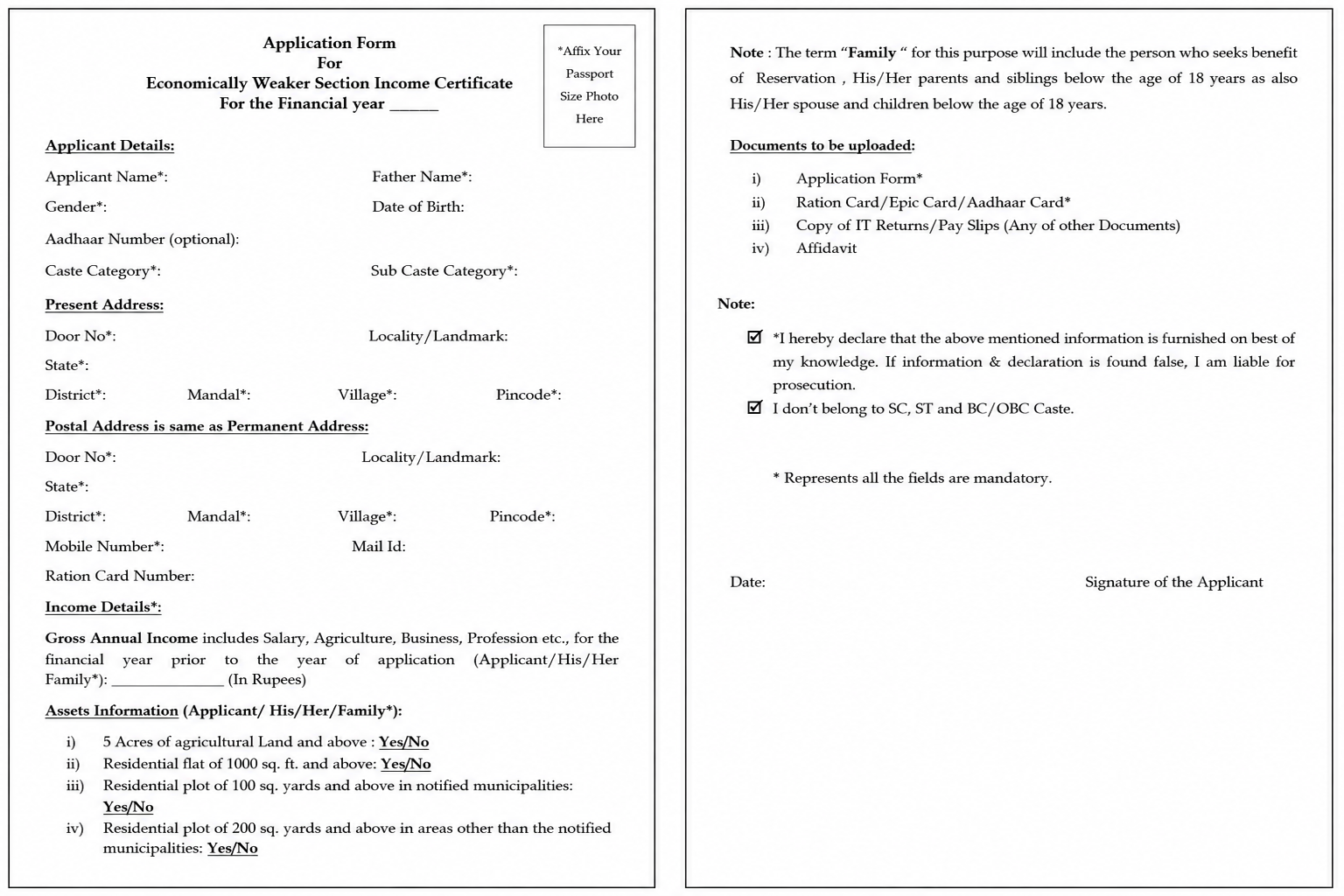
- EWS Certificate — Must be for the current financial year.
- CAP Certificate — Where applicable to the CAP reservation stream.
- NCC Certificate — For NCC quota claims.
- Sports Certificate — For sports quota claims, issued by the competent sports authority.
- PWD Certificate — Issued following mandatory Medical Board verification.
- Minority Certificate — Required only for minority-college quota claims.
Other Documents
- Gap Certificate — Required for any break in academic years.
- Migration Certificate — Required for candidates whose qualifying exam was from outside the AP board/university system.
- Character Certificate — From the last attended institution.
- Medical Fitness Certificate — Confirming fitness for medical study.
Registration Process
- Online Registration — Candidate registers on the official portal using NEET roll number, personal, and educational details.
- Fee Payment — Registration fee is paid online via the payment gateway.
- Login — Credentials are generated post-payment for subsequent access.
- Upload Certificates — All required documents are uploaded in the prescribed format.
- Edit Application — Details can be reviewed and corrected before final submission, and again during any officially notified correction window.
- Final Submission — Application is submitted, and the acknowledgment/application number is generated and must be retained.
Registration Fee
| Category | Fee (Reference) |
|---|---|
| General | ₹6,000 (non-refundable counselling fee, per official reference documentation) |
| BC | Same fee structure as General in most cycles; verify against current notification |
| SC | Category-specific concession may apply; not separately confirmed in available sourcing |
| ST | Category-specific concession may apply; not separately confirmed in available sourcing |
| Late Fee | Additional penalty fee applies for late registration within the extended window, exact amount notified per cycle |
| Refund Policy | The counselling fee is explicitly non-refundable. |
Additional University Fee (separate from registration fee): Category-B candidates are required to submit university fee as demand drafts (₹16,000 + ₹9,000 per one reference cycle), while Category-C candidates pay an additional balance amount — these figures are cycle-specific and should be re-verified from the current year’s fee notification rather than treated as fixed.
Refund Timeline: Refund of security money for eligible candidates commences only after the completion of all counselling rounds.
Merit List
State Merit: The AP State Merit List ranks all registered, verified candidates by NEET UG score, specific to Andhra Pradesh-registered applicants.
Category Merit: A separate rank is assigned within each reservation category (SC, ST, BC-A to E, EWS) for category-specific seat allotment.
Tie-Breaking: Standard tie-breaking criteria (higher marks in Biology, then Chemistry, then Physics, followed by age) are typically applied where NEET scores are equal — exact sequence should be confirmed against the current year’s merit list methodology note.
Downloading Merit List: Published as a PDF on the official counselling portal and accessible via candidate login; discrepancies must be reported within the grievance window specified in the notification.
Web Options Entry
What are Web Options: The online exercise where merit-listed candidates arrange their preferred college-and-course combinations in priority order ahead of seat allotment.
How to fill: Candidates log in, browse available colleges/courses with the live seat matrix, and build an ordered preference list.
Editing Options: Freely editable before locking; no changes permitted after the lock-in deadline for that round.
Locking Choices: Must be actively locked before the deadline — an unlocked list is not considered for allotment.
Choice Filling Strategy: Options should reflect genuine preference order, including a realistic mix of ambitious, moderate, and safe choices rather than an overly narrow list, since a higher-preference seat can still be allotted if rank permits.
Common Mistakes:
- Leaving the option list unlocked.
- Filling too few options, reducing chances in later rounds.
- Misjudging local-vs-non-local eligibility for a specific college/quota before including it.
- Ignoring quota-specific seat availability (Category A vs B vs C) while planning.
Seat Allotment
Seat Allocation Process: Seats are allotted by matching the candidate’s merit/category rank and local status against their locked option order and the live seat matrix.
Download Allotment Order: Available for download from the candidate login once results for that round are declared.
Self Reporting: An online confirmation step, required before physical reporting, acknowledging acceptance of the allotted seat.
Reporting to College: Physical document verification, fee payment, and admission confirmation at the allotted institution within the specified deadline.
Upgradation: Candidates who select the equivalent of a “Float” option remain eligible for a higher-preference seat in a subsequent round if their rank and locked preferences permit it; those who freeze their seat exit further rounds.
AP Medical Colleges List
Government Medical Colleges (Representative List)
| College Name | District |
|---|---|
| Andhra Medical College | Visakhapatnam |
| Guntur Medical College | Guntur |
| Rangaraya Medical College | Kakinada |
| Kurnool Medical College | Kurnool |
| S.V. Medical College | Tirupati |
| Sri Padmavathi Medical College for Women (SVIMS) | Tirupati |
| A.C. Subba Reddy (ACSR) Government Medical College | Nellore |
| Government Medical College, Anantapur | Anantapur |
| Government Medical College, Kadapa (RIMS Kadapa) | Kadapa |
| Government Medical College, Vizianagaram | Vizianagaram |
| Government Medical College, Eluru | Eluru |
| Government Medical College, Rajahmundry | Rajahmundry |
| Government Medical College, Machilipatnam | Machilipatnam |
| Government Medical College, Nandyal (RIMS Nandyal) | Nandyal |
| YSR Government Medical College, Pulivendula | Pulivendula |
| Government Medical College, Paderu | Paderu |
| Government Medical College, Markapur | Markapur |
| Government Medical College, Adoni | Adoni |
| Government Medical College, Madanapalle | Madanapalle |
| Government Medical College, Ongole (earlier RIMS Ongole) | Ongole, Prakasam district |
| Government Medical College, Srikakulam | Srikakulam |
| AIIMS Mangalagiri | Vijayawada (Mangalagiri) – filled via MCC AIQ, not state counselling |
(Several more government colleges – including Amalapuram, Pithapuram, Parvathipuram, and Narasapuram — were planned/added under the state’s expansion drive targeting one government medical college per parliamentary constituency; the complete, current list shall be pulled f, since this list is actively growing year-on-year.)
Private Medical Colleges (Representative List )
- Dr. Pinnamaneni Siddhartha Institute of Medical Sciences and Research Foundation, Chinoutpalli/Gannavaram
- GITAM Institute of Medical Sciences and Research, Visakhapatnam
- NRI Medical College, Chinakakani, Guntur
- Apollo Institute of Medical Sciences, Murukambattu, Chittoor
- Konaseema Institute of Medical Sciences, Amalapuram
- Katuri Medical College, Guntur
- Maharajah’s Institute of Medical Sciences, Vizianagaram
- Santhiram Medical College, Nandyal
- Fathima Institute of Medical Sciences, Kadapa
- Narayana Medical College, Nellore
- Alluri Sitarama Raju Academy of Medical Sciences, Eluru
- P.E.S. Institute of Medical Sciences, Kuppam
- Vishwabharathi Medical College, Kurnool
(A total of 19 private medical colleges offer MBBS in Andhra Pradesh – the list above covers the more commonly cited institutions; 5-6 additional private colleges remain to be confirmed by name against the current NMC-approved list.)
Minority Medical Colleges
Designated minority-status private colleges exist within the private-college pool above; specific minority designation for each institution should be confirmed against the official minority-institution notification before publishing.
Government Dental Colleges
At least one government dental college operates in Andhra Pradesh (commonly cited as Government Dental College, Vijayawada/Hyderabad-adjacent region historically, now within AP post-bifurcation) – exact current name and location need direct verification from DME AP.
Private Dental Colleges
Multiple private dental colleges operate across AP (commonly including institutions in Vijayawada, Vinukonda, and other districts) – exact count and names need verification from the current-year BDS seat matrix.
District-wise Medical Colleges
| District | Medical College(s) |
|---|---|
| Visakhapatnam | Andhra Medical College; GITAM Institute of Medical Sciences and Research |
| Vijayawada (Krishna district region) | AIIMS Mangalagiri |
| Guntur | Guntur Medical College; NRI Medical College (Chinakakani); Katuri Medical College |
| Nellore | ACSR Government Medical College; Narayana Medical College |
| Kurnool | Kurnool Medical College; Vishwabharathi Medical College |
| Kadapa (YSR Kadapa) | Government Medical College, Kadapa (RIMS Kadapa); Fathima Institute of Medical Sciences |
| Anantapur | Government Medical College, Anantapur |
| Rajahmundry (East/West Godavari region) | Government Medical College, Rajahmundry |
| Kakinada | Rangaraya Medical College |
| Eluru | Government Medical College, Eluru; Alluri Sitarama Raju Academy of Medical Sciences |
| Ongole (Prakasam) | Government Medical College, Ongole |
| Srikakulam | Government Medical College, Srikakulam |
| Vizianagaram | Government Medical College, Vizianagaram; Maharajah’s Institute of Medical Sciences |
| Chittoor | Apollo Institute of Medical Sciences (Murukambattu); P.E.S. Institute of Medical Sciences (Kuppam) |
| Tirupati | S.V. Medical College; Sri Padmavathi Medical College for Women (SVIMS) |
| Nandyal | Government Medical College, Nandyal (RIMS Nandyal); Santhiram Medical College |
| Bapatla | No confirmed standalone medical college found |
| Anakapalle | No confirmed standalone medical college found |
| Krishna district (Machilipatnam) | Government Medical College, Machilipatnam |
| Amalapuram (Konaseema) | Konaseema Institute of Medical Sciences; new government college planned |
| Pulivendula | YSR Government Medical College, Pulivendula |
| Paderu | Government Medical College, Paderu |
| Markapur | Government Medical College, Markapur |
| Adoni | Government Medical College, Adoni |
| Madanapalle | Government Medical College, Madanapalle |
(Bapatla and Anakapalle are recently carved-out districts under AP’s 2022 district reorganisation – no standalone medical college was confirmed for either, since new districts sometimes host colleges under an older district’s name in existing databases.)
College-wise Details
| College Name | District | Ownership | Year Established | Intake | Affiliated University | Hospital | Fees (Category A, Approx.) |
|---|---|---|---|---|---|---|---|
| Andhra Medical College | Visakhapatnam | Government | Historic institution (colonial-era origin) | Not confirmed in available sourcing | Dr. NTR UHS / current AP university | King George Hospital | ₹15,000–₹30,000/year |
| ACSR Government Medical College | Nellore | Government | 2014, enhanced intake in 2019 | 175 | Dr. NTR University of Health Sciences | Government Medical Hospital, Nellore (attached DSR Hospital) | ₹15,000–₹30,000/year |
| Government Medical College, Ongole | Prakasam | Government | Formerly RIMS Ongole | 120 | Dr. NTR University of Health Sciences | Government General Hospital, ~500 beds | ₹27,000–₹30,000/year |
College-wise Seat Matrix
| Category | Meaning | Applicable To |
|---|---|---|
| Category A | State-quota-fee seats, merit + local-status based | Government colleges (85% state quota share) and private colleges (government-quota share) |
| Category B | Management Quota | Private colleges only |
| Category C | NRI Quota | Private colleges only |
| Government | Full seat pool in government colleges (85% state + 15% AIQ) | Government colleges |
| Private | Combined Category A/B/C pool | Private colleges |
| Minority | Reservation within designated minority-status private colleges | Minority private colleges |
| Total Intake | ~7,090 MBBS seats across 38 colleges (2025-26 reference figure, NMC Final UG Seat Matrix dated 03-12-2025) | Combined |
Note: 22 state government colleges contribute roughly 4,090 seats, and 16 private NMC-approved colleges contribute roughly 3,000 seats, within these 7,090 totals – AIIMS Mangalagiri and other central institutions are excluded from this state-pool figure since they’re filled entirely through MCC AIQ.
MBBS Seat Matrix
| College Type | Colleges | Seats (2025-26 Reference) |
|---|---|---|
| Government | 18 | 3,565 |
| Private | 20 | 3,950 |
| Minority | Subset within private pool | Not separately confirmed; verify against minority-institution notification |
| Combined Total | ~38 | 7,515 |
Fee Structure
| Category | Annual Fee (2025-26 Reference, Tentative for 2026) |
|---|---|
| Government MBBS | ₹11,000–₹61,000/year, with most established colleges around ₹15,000–₹30,000/year |
| Private Category A (Convenor Quota) | ₹10,000–₹1,20,000/year |
| Private Category B (Management Quota) | Around ₹12,00,000–₹13,20,000/year |
| Private Category C (NRI Quota) | ₹20,00,000/year, potentially rising up to ₹39,60,000/year depending on the college (verify directly with the college/current notification) |
| Dental Fees | Not reliably confirmed across sources; needs direct sourcing from the BDS-specific fee notification |
| Hostel Fee | ₹70,000–₹1,50,000/year |
| Miscellaneous Charges | Mess charges typically ₹3,000–₹4,500/month, in addition to tuition and hostel; library, laboratory, and examination fees are set individually by each college and not centrally standardised |
Previous Year Cutoffs (NEET UG 2025 — AP State Counselling)
Important framing note for this section: AP does not publish a consolidated “cutoff rank” table the way EAPCET/ECET does. Closing ranks exist only inside the phase-wise, category-wise allotment PDFs on drntr.uhsap.in. Any college-wise number quoted below without a direct PDF citation should be treated as indicative, not final.
What is confirmed (official/national-level):
- NEET UG 2025 qualifying percentile cutoffs, set by NTA nationally and applicable as the eligibility floor for AP counselling too: General/EWS 50th percentile, BC/SC/ST 40th percentile, PWD (General) 45th percentile.
- AP counselling in 2025 was conducted by NTRUHS at drntr.uhsap.in, with Phase-I CQ (Competent Authority Quota) MBBS allotment released August 2025, and MQ (Management Quota) running through at least Phase-III in November 2025.
Government Colleges (2025): Needing a General-category AIR in the range of roughly 15,000–50,000 for a seat at a good AP government college, with ST closing ranks reported around 450–490 marks by one source.
Private Colleges (Category A/B/C): No reliable college-wise cutoff found in this pass; would need the MQ/NRI phase PDFs specifically.
Download Seat Allotment Order
Once a candidate is allotted a seat in any round, the provisional Seat Allotment Order becomes downloadable from the candidate’s own login on drntr.uhsap.in – it is not emailed automatically.
- Login: Candidate signs in using the registration ID/roll number and password created at registration.
- Download PDF: The order is generated as a PDF carrying rank, category, allotted college, course, and quota (CQ/MQ/NRI). In the 2025 cycle, downloading the Phase-I order required payment of a university fee before the PDF unlocked. This fee figure and payment gateway should be re-confirmed each phase, since it isn’t fixed across categories/quotas.
- Verify Details: Candidates must cross-check name, category, rank, and allotted college against their application before reporting — any mismatch must be flagged to the college/university immediately, as corrections aren’t possible after physical reporting.
Self Reporting
- Step-by-step: Login → view allotment → choose Freeze/Float/Slide option where applicable → complete self-reporting within the window specified in that round’s notification.
- Online Reporting: A mandatory acknowledgment step confirming the candidate accepts (or intends to upgrade from) the allotted seat; skipping this typically cancels the allotment.
- Fee Payment: Where applicable, a partial/token fee or the full first-year fee may need to be paid online at this stage — exact amount and stage (online vs. at college) varies by category (CQ/MQ/NRI) and must be pulled from the current phase’s notification, not assumed from a prior cycle.
- Confirmation: A confirmation receipt/reference number is generated; candidates should retain it for the physical reporting stage.
Reporting at College
- Documents: Original certificates plus self-attested copies (see Section 10’s document list), the downloaded Seat Allotment Order, and the online application printout.
- Admission Fee: Balance/full fee payable directly to the college as per its notified fee structure (Section 22).
- Verification: The college principal verifies category, local status, and eligibility documents on the spot; discrepancies can lead to cancellation even after allotment, as NTRUHS explicitly cautioned for the 2025 CQ Phase-I round.
- Medical Examination: A basic medical fitness check is typically required as part of admission formalities at most colleges.
- Final Admission: Confirmed only after fee payment and successful document verification — until then the seat remains provisional.
Counselling Rounds
| Round | What Happens |
|---|---|
| Round 1 (CQ Phase-I) | First main allotment based on merit list and web options; largest number of seats filled here |
| Round 2 | Filled from candidates who floated/didn’t report in Round 1, plus fresh option entries |
| Mop-Up | Conducted after Round 2 for residual vacancies; often opens fresh registration for candidates who missed earlier rounds |
| Stray Vacancy | For seats still vacant after Mop-Up, typically with a compressed timeline |
| Special Stray (if conducted) | Not held every year — only when seats remain vacant after the regular Stray round; in 2024-25 a BDS-specific special round ran choice filling as late as December |
Upgrade Rules
- Upgradation: A candidate who selects “Float” remains in the pool for a better seat in the next round if rank and preferences allow.
- Free Exit: Generally permitted only up to a specific round (commonly before the final/Mop-Up stage) without penalty — exact cutoff round for AP needs confirmation from the current brochure, as this detail wasn’t reliably found in this pass.
- Exit Rules: After the free-exit window closes, withdrawing typically forfeits the seat and may attract penalty.
- Resignation: Candidates already admitted can resign, but this is distinct from a pre-admission “float,” and usually involves a different (often stricter) fee-forfeiture process.
- Penalty: Discontinuing after confirmed admission can trigger the ₹3 lakh + 18% GST penalty structure noted in Section 31 below — should be reconfirmed as counselling-stage vs. post-admission specific, since the source describing it referred to course discontinuation broadly, not counselling-round exit.
- Seat Cancellation: University-initiated cancellation (document fraud, ineligibility) is separate from candidate-initiated exit and doesn’t entitle the candidate to any refund.
Refund Rules
- Security Deposit: Some phases require a deposit/university fee at the allotment-download stage.
- Refund Timeline: Refund of security money for eligible candidates begins only after all counselling rounds are complete — it isn’t processed round-by-round.
- Forfeiture: The ₹6,000 counselling/registration fee is explicitly non-refundable regardless of outcome.
Bond Policy
- Government Colleges: Andhra Pradesh currently has no mandatory service bond for MBBS (UG) students — unlike states such as Punjab, Gujarat, or Tamil Nadu, AP does not require compulsory rural/government service after graduation.
- Service Bond: None applicable at the UG level in AP, per the above.
- Penalty: If a student discontinues the course after admission, AP imposes a discontinuation penalty of ₹3 lakh plus 18% GST, along with recovery of any stipend paid – this is a course-discontinuation penalty, not a service-bond penalty, and the two shouldn’t be conflated in the article.
Hostel Facilities
- Government Colleges: Most government medical colleges have attached hostels; allotment is usually separate from the counselling process itself and handled by the college after reporting.
- Private Colleges: Hostel facilities and quality vary significantly by institution; some mandate hostel stay for the first year.
- Approximate Hostel Fees: ₹70,000–₹1,50,000/year, — this is a general medical-college reference figure, not AP-specific or college-specific.
Scholarships
Important flag before drafting this section: the most prominent AP scholarship schemes for professional courses – Jagananna Vidya Deevena (full fee reimbursement) and Jagananna Vasathi Deevena (maintenance/hostel allowance) — were flagship programmes of the previous state government. Andhra Pradesh has since had a change of government, and scheme names, eligibility, and even continuation are the kind of thing that gets revised or rebranded after a change in administration. Every scheme name and amount below needs a fresh check against the current state government’s active scheme list before publishing.
- State Scholarships: Historically, Jagananna Vidya Deevena covered full tuition fee reimbursement (paid directly to the college) for eligible students in professional courses including MBBS, with Jagananna Vasathi Deevena providing a separate maintenance allowance credited to the mother’s/guardian’s account.
- Central Scholarships: Central government schemes (e.g., National Means-cum-Merit, AICTE/central post-matric scholarships for SC/ST/OBC/EWS/minority students) may apply depending on category and income criteria; these run independently of the state scheme.
- Fee Reimbursement: Under the historical scheme structure, reimbursement required registration on the state’s welfare/education portal, biometric authentication, and quarterly verification.
- EWS Benefits: Typically tied to the same income-ceiling criteria used for EWS reservation eligibility rather than a separate scholarship track.
- Minority Scholarships: Available through both state minority welfare schemes and central minority scholarship portals for eligible students in minority-designated institutions.
Category A vs Category B vs Category C Seats
| Category A | Category B | Category C | |
|---|---|---|---|
| Explain | Convenor/Government-quota seats – merit + local-status based | Management Quota – college-managed, still counselling-linked | NRI Quota – for NRI/OCI-sponsored candidates |
| Eligibility | AP local/non-local candidates’ rules | Broader eligibility, often open to candidates nationally, subject to college norms | NRI sponsorship/OCI eligibility |
| Fees | Government-college-equivalent low fee | ₹12–13.5 lakh/year approx. | ₹20–39.6 lakh/year approx., wide spread. |
| Admission Process | Through NTRUHS merit-based web options | Through counselling authority but with college-specific quota rules | Through counselling authority, NRI-specific document verification (sponsorship affidavit, OCI card, etc.) |
| Differences | Cheapest, most competitive on rank | Mid-cost, private college only | Highest cost, private college only, smaller pool |
| Seat Distribution | 85% state quota (govt) + Category-A share of private colleges | 35% of private college seats (of the 50% private-college share, per college-wise breakdown) | 15% of private college seats |
AIQ vs AP State Quota
| # | AIQ (All India Quota) | AP State Quota |
|---|---|---|
| Conducting Authority | Medical Counselling Committee (MCC), nationally | NTRUHS/YSRUHS, Vijayawada |
| Eligibility | Any NEET UG qualified candidate, nationwide | AP local/non-local eligible candidates |
| Registration | Separate registration on mcc.nic.in | Separate registration on drntr.uhsap.in |
| Reservation | Central reservation norms (SC/ST/OBC/EWS/PWD) apply uniformly across India | AP-specific reservation percentages. |
| Fees | Fee as fixed by respective college/state for AIQ seats | AP-notified fee structure. |
| Seat Matrix | 15% of government college seats nationally | 85% of government college seats within AP + private college quota shares |
A candidate can register for both AIQ and AP state counselling simultaneously, as they draw from separate seat pools – but must independently track both timelines, since they don’t run on identical schedules.
Common Mistakes During Counselling
- Wrong Certificates: Uploading expired income/caste certificates, or documents in the wrong format/size specified by the portal.
- Wrong Web Options: Locking too few choices, or including colleges the candidate isn’t actually eligible for under their local status/category.
- Missing Deadlines: Not locking options before the round closes, or missing the physical reporting deadline (seats can lapse even after allotment).
- Incorrect Category: Applying under a category the candidate doesn’t currently hold a valid certificate for, risking cancellation at verification.
- Reporting Delays: Arriving after the college’s cutoff time on the reporting deadline, which some colleges treat as a no-show.
Important Instructions
- Do’s: Register early, keep all documents in the prescribed scanned format ready before registration opens, lock web options well before the deadline, track both AIQ and state timelines if applicable.
- Don’ts: Don’t leave options unlocked, don’t assume local status without checking the 4-year/7-year rule , don’t skip self-reporting even if planning to float.
- Important Deadlines: To be filled from the live timeline once the 2026 schedule is notified.
Glossary
| Term | Meaning |
|---|---|
| AIQ | All India Quota — 15% of government seats filled by MCC nationally |
| State Quota | 85% of government college seats filled by the state counselling authority |
| Category A | Convenor/government-quota seats in private colleges |
| Category B | Management Quota seats in private colleges |
| Category C | NRI Quota seats in private colleges |
| Competent Authority Quota (CQ) | The main merit-based government-seat allotment stream |
| Management Quota | College-managed private seat pool, Category B |
| NRI Quota | Seats reserved for NRI-sponsored/OCI candidates, Category C |
| Web Options | Ranked preference list of college-course combinations submitted by candidates |
| Merit Position | A candidate’s rank within the AP state merit list |
| Mop-Up Round | Round conducted after Round 2 to fill residual vacancies |
| Stray Vacancy Round | Final round for seats still vacant after Mop-Up |
| Upgradation | Moving to a higher-preference seat in a later round via Float |
| Freeze | Locking in the current seat, exiting further rounds |
| Float | Retaining eligibility for a better seat in the next round |
| Self Reporting | Online confirmation of seat acceptance before physical reporting |
AP NEET UG Counselling 2026 — Frequently Asked Questions
- Who conducts AP NEET UG Counselling?
The state health sciences university based in Vijayawada conducts it — referenced as Dr. NTRUHS in older sources and Dr. YSR University of Health Sciences (YSRUHS) in more recent 2025-26 sources. Confirm the current official name before publishing, as this varies across sources. - Is Dr. NTRUHS the official authority for AP NEET counselling?
Yes, historically — though recent official communications refer to the university as Dr. YSR University of Health Sciences (YSRUHS). Both names refer to the same institution at Vijayawada. - What is the official website for AP NEET UG Counselling?
drntr.uhsap.in is the counselling portal used for registration, merit list access, web options, and seat allotment. - Can Telangana students apply for AP NEET UG Counselling?
Yes, but Telangana-domiciled candidates are generally treated as non-local for AP’s 85% local quota and can compete only in the 15% unreserved government-quota pool, while remaining eligible for Management and NRI quota seats in private colleges. - Is domicile mandatory for AP NEET UG Counselling?
Domicile/local status isn’t mandatory to apply, but it materially affects which seat pool a candidate can compete in — local candidates can access both the 85% local seats and the 15% unreserved pool, while non-local candidates are restricted to the 15% unreserved pool. - Is Andhra Pradesh an open state or closed state for MBBS admission?
AP is described as an open state, meaning candidates from other states can apply — primarily through Management Quota, NRI Quota, and the 15% unreserved government pool. - What is the 4-year rule for AP local status?
A candidate who studied part of their qualifying education outside AP can still claim local status by showing a minimum period (commonly 4 years) of residence within the state. - What is the 7-year rule for AP local status?
Local status can also be established through 7 consecutive years of study within Andhra Pradesh immediately preceding the qualifying exam. - What is the minimum NEET UG percentile required for AP counselling?
Per NTA’s national norms: 50th percentile for General/EWS, 40th percentile for SC/ST/BC, and 45th percentile for PWD (General) candidates. - Are OCI/PIO candidates eligible for AP NEET UG Counselling?
Yes, subject to the applicable OCI card issuance-date condition specified in the notification — this is commonly aligned with national cut-offs used across states. - What subjects are required at the Intermediate level for eligibility?
Physics, Chemistry, Biology/Biotechnology, and English, with PCB as the mandatory core combination. - Can I apply for AIQ and AP counselling at the same time?
Yes — AIQ (via MCC) and AP state counselling (via NTRUHS/YSRUHS) draw from separate seat pools and require separate registrations, so a candidate can pursue both, but must track both timelines independently since they don’t run on identical schedules. - How do I register for AP NEET UG Counselling 2026?
Registration is entirely online on drntr.uhsap.in using the NEET roll number and personal/educational details, followed by fee payment and document upload. (2026 registration dates not yet notified.) - What is the registration fee for AP NEET UG Counselling?
The most recent confirmed reference figure is ₹6,000 (non-refundable). 2026 fee not yet notified — treat as tentative. - Is the AP NEET UG counselling registration fee refundable?
No — the counselling fee is explicitly non-refundable, regardless of outcome. - What documents are required for AP NEET UG Counselling?
NEET admit card and rank card, Aadhaar, SSC and Intermediate marks memos, transfer certificate, local-status proof (residence/study/nativity certificate), category certificates as applicable, and a medical fitness certificate — full list in Section 10. - Can I edit or correct my application after submission?
Details can be reviewed and corrected before final submission, and again during any officially notified correction window. - When will the AP NEET UG 2026 merit list be released?
Not yet announced. In the 2025 cycle, the provisional merit list was released in early July, close to NEET UG result declaration — treat 2026 dates as tentative until officially notified. - How are tie-breaks resolved in the merit list?
Typically by higher marks in Biology, then Chemistry, then Physics, followed by age — though this should be confirmed against the current year’s merit list methodology note. - What are web options in AP NEET UG Counselling?
The online exercise where merit-listed candidates arrange their preferred college-and-course combinations in priority order before seat allotment. - Can I change my web options after submitting them?
Yes, options are freely editable before the round’s lock-in deadline; no changes are permitted once locked. - What happens if I don’t lock my web options?
An unlocked option list is not considered for that round’s seat allotment. - How many web options can I fill?
In the 2025 cycle, male candidates could enter up to 34 choices and female candidates up to 35 — this may be revised for 2026 and should be reconfirmed against the current notification. - How are seats allotted in AP NEET UG Counselling?
Based on matching the candidate’s merit/category rank and local status against their locked option order and the live seat matrix for that round. - How many counselling rounds are conducted?
Typically three main online rounds (Round 1/CQ Phase-I, Round 2, and further phases), followed by a Mop-Up round, a Stray Vacancy round, and occasionally a Special Stray round if seats remain vacant. - Is there a Mop-Up round in AP NEET UG Counselling?
Yes, conducted after Round 2 to fill residual vacancies, sometimes reopening registration for candidates who missed earlier rounds. - Is there a Stray Vacancy round?
Yes, for seats still vacant after the Mop-Up round, usually run on a compressed timeline; a Special Stray round is held only if seats remain unfilled even after that. - What is the difference between Freeze and Float in seat allotment?
Freeze locks in the current seat and exits the candidate from further rounds; Float retains eligibility for a better seat in a subsequent round based on rank and locked preferences. - What happens if I don’t report after being allotted a seat?
The allotment typically lapses, and the seat is treated as vacant for the next round — self-reporting and physical reporting deadlines must both be met. - What is self-reporting and is it mandatory?
An online confirmation step acknowledging acceptance of the allotted seat, required before physical reporting — skipping it typically cancels the allotment even if you intend to float. - Can I resign after taking admission?
Yes, but resignation after confirmed admission is treated differently from a pre-admission float, and involves a stricter fee-forfeiture process — exact terms should be verified from the current brochure. - Is there a service bond for MBBS in Andhra Pradesh?
No — AP currently has no mandatory service bond for MBBS (UG) students, unlike several other states. - What is the penalty for discontinuing MBBS in AP?
A discontinuation penalty of ₹3 lakh plus 18% GST, along with recovery of any stipend paid, applies if a student discontinues the course after admission. - What is the refund policy for the counselling fee?
The counselling/registration fee itself is non-refundable. Refund of any security deposit for eligible candidates begins only after all counselling rounds are completed. - What is the fee difference between Category A, B, and C seats?
Category A (Convenor/government-quota) carries the lowest fees, close to government-college rates; Category B (Management Quota) is significantly higher, roughly ₹12–13.5 lakh/year in recent reference data; Category C (NRI Quota) is highest, roughly ₹20–39.6 lakh/year, with a notably wide spread across sources that should be verified per college. - Are scholarships available for MBBS students in AP?
Historically, state schemes covering full fee reimbursement and maintenance allowances have existed for eligible students — but scheme names and continuity should be reconfirmed against the current state government’s active programmes before publishing, since these were tied to the previous administration. - Is EWS reservation applicable in AP NEET UG Counselling?
Yes, for OC candidates meeting the Economically Weaker Section income/asset criteria with a valid current-year EWS certificate; EWS seats are not converted to other categories if they remain unfilled. - How many medical colleges participate in AP state counselling?
Approximately 38 colleges per 2025-26 reference data (roughly 22 government and 16 private) — this figure varies slightly across sources and should be checked against the current-year NMC/DME AP seat matrix. - What was the NEET cutoff for AP government medical colleges in 2025?
Reliable official college-wise closing ranks aren’t published as a single summary table — only computable from the round-wise allotment PDFs. Aggregator estimates cite a General-category AIR range roughly in the tens of thousands, but these are unverified and shouldn’t be quoted as official. - When will the AP NEET UG Counselling 2026 schedule be released?
Not yet announced as of this draft — expected a few weeks after NEET UG 2026 results are declared, following the pattern of prior cycles.
AP NEET UG Counselling 2026 is the gateway for students seeking admission into MBBS and BDS courses under the 85% State Quota in Andhra Pradesh. The counselling process, conducted by the designated state authority, includes online registration, certificate verification, merit list publication, web options entry, seat allotment, and college reporting across multiple rounds. Candidates who have qualified NEET UG 2026 should stay informed about every stage of the admission process to avoid missing important deadlines.
Manabadi provides timely and verified updates on AP NEET UG Counselling 2026, including official notifications, registration dates, merit lists, web options, seat allotment results, cut-offs, and counselling schedules, helping aspirants complete the admission process smoothly.