 It's Ours
Contents
- 1 TG EAPCET Provisional Seat Allotment
- 2 Important Dates for TG EAPCET 2026 Counseling
- 3 TG EAPCET 2026 Phase 1 Seat Allotment: 79,891 B.Tech Seats Allotted, 90.70% Seats Filled
- 4 TG EAPCET 2026 Phase 1 Seat Allotment Highlights
- 5 CSE and Allied Branches Continue to Dominate
- 6 Branch-wise Seat Allotment Statistics
- 7 Institution-wise Seat Filling Status
- 8 Category-wise Highlights
- 9 Why Did 8,619 Candidates Not Get a Seat
- 10 What Should Candidates Do After Seat Allotment
- 11 Physical Reporting and Phase 2 Counselling
- 12 TG EAPCET 2026 Phase 1 Seat Allotment Analysis
- 13 TG EAPCET 2026 Phase 1 Seat Allotment Released Today
- 14 What is TG EAPCET 2026 Provisional Seat Allotment
- 15 Know Your Allotment Order
- 16 Lessons from the TG EAPCET 2026 Mock Seat Allotment
- 17 Why is TG EAPCET 2026 Provisional Seat Allotment Conducted
- 18 Objectives of TG EAPCET 2026 Provisional Seat Allotment
- 19 How Does the Seat Allotment Process Work
- 20 What to Do After Allotment: Step-by-Step
- 21 Multi-Phase Progression: Rules for Sliding to Phase 2
- 22 Difference Between Mock Allotment and Provisional Allotment
- 23 Tuition Fee Payment Process
- 24 Tuition Fee Details
- 25 What is Online Self Reporting
- 26 Can Candidates Participate in the Next Counselling Phase After Phase 1 Seat Allotment
- 27 Why Do Some Candidates Not Receive a Seat in TG EAPCET 2026 Phase 1 Allotment?
TG EAPCET Provisional Seat Allotment
The TG EAPCET 2026 Phase 1 Provisional Seat Allotment has been released by the Telangana Council of Higher Education (TGCHE) for admission into Engineering, Agriculture, and Pharmacy programmes offered by participating colleges across Telangana. Following the completion of Certificate Verification, Web Options Entry, Option Editing, and Freezing of Web Options, candidates who participated in the Phase 1 Counselling can now check their Provisional Seat Allotment Result by logging into the official counselling portal using their Hall Ticket Number, Password, and Date of Birth.
The Phase 1 Provisional Seat Allotment informs candidates about their allotted college, course, and branch based on their TG EAPCET Rank, Reservation Category, Local Area Status, Web Options exercised, and Seat Availability. Candidates who have been allotted a seat should download the Provisional Seat Allotment Order, verify all the details carefully, and complete Online Tuition Fee Payment (if applicable), Online Self-Reporting, and Reporting at the Allotted College within the prescribed schedule to confirm their admission. Candidates who wish to seek a better college or branch can participate in the TG EAPCET 2026 Phase 2 Counselling as per the official counselling schedule while following the guidelines issued by TGCHE.
Important Dates for TG EAPCET 2026 Counseling
| Event | Date / Deadline |
| Mock Seat Allotment Release | July 4, 2026 |
| Deadline to Edit/Freeze Web Options | July 7, 2026 |
| Provisional Seat Allotment Results (Phase 1) | On or before July 10, 2026 |
| Online Fee Payment and Self-Reporting | July 10 to July 14, 2026 |
TG EAPCET 2026 Phase 1 Seat Allotment: 79,891 B.Tech Seats Allotted, 90.70% Seats Filled
The Telangana Council of Higher Education (TGCHE) has successfully completed the TG EAPCET 2026 Phase 1 Seat Allotment for Engineering admissions. According to the official counselling statistics, 79,891 candidates have secured B.Tech seats under the Convenor Quota, achieving an overall 90.70% seat occupancy across participating engineering colleges in Telangana.
A total of 88,053 seats (including EWS quota seats) were available across 175 engineering colleges, while 88,510 candidates exercised their final Web Options during the first phase of counselling.
TG EAPCET 2026 Phase 1 Seat Allotment Highlights
- Total Engineering Colleges: 175
- Total Available Seats: 88,053
- Candidates Attended Certificate Verification: 89,450
- Candidates Exercised Web Options: 88,510
- Candidates Allotted Seats: 79,891
- Overall Seat Filling Percentage: 90.70%
- Vacant Seats after Phase 1: 8,162
- 100% Seats Filled: 87 Colleges
- EWS Category Seat Allotments: 6,335
CSE and Allied Branches Continue to Dominate
As expected, Computer Science Engineering (CSE) and its allied branches remained the top choice among candidates during the TG EAPCET 2026 Phase 1 Counselling.
Across 17 CSE and IT-related branches, there were 62,509 seats, of which 58,376 seats were filled, resulting in an impressive 93% occupancy. Only 4,133 seats remained vacant in these highly preferred branches.
Officials observed that compared to the previous year, slightly more seats remained vacant in Computer Science-related branches, while the seat occupancy in Mechanical, Civil, and Electronics & Communication Engineering (ECE) improved.
Branch-wise Seat Allotment Statistics
| Branch | Total Seats | Filled Seats | Filled (%) |
|---|---|---|---|
| Computer Science Engineering (CSE) | 29,519 | 27,990 | 95% |
| Information Technology (IT) | 4,076 | 3,701 | 91% |
| CSE (Artificial Intelligence & Machine Learning) | 14,610 | 13,732 | 94% |
| CSE (Data Science) | 8,017 | 7,395 | 92% |
| CSE (Cyber Security) | 1,831 | 1,785 | 97% |
| Artificial Intelligence & Machine Learning | 1,270 | 1,155 | 91% |
| Artificial Intelligence & Data Science | 1,234 | 1,094 | 89% |
| Electronics & Communication Engineering (ECE) | 11,725 | 10,593 | 90% |
| Electrical & Electronics Engineering (EEE) | 4,810 | 3,592 | 75% |
| Civil Engineering | 3,621 | 2,920 | 81% |
| Mechanical Engineering | 3,343 | 2,579 | 77% |
Institution-wise Seat Filling Status
| Institution Type | Colleges | Total Seats | Filled Seats | Vacant Seats | Filled (%) |
| Government Engineering College | 1 | 196 | 56 | 140 | 28.60% |
| University Colleges | 21 | 6,363 | 5,303 | 1,060 | 83.30% |
| Private Universities | 2 | 1,367 | 1,366 | 1 | 99.90% |
| Private Engineering Colleges | 152 | 80,127 | 73,166 | 6,961 | 91.30% |
| Total | 175 | 88,053 | 79,891 | 8,162 | 90.70% |
Category-wise Highlights
- 6,335 candidates secured admission under the EWS Reservation.
- BC-B category recorded the highest allotments among BC categories with 6,723 seats.
- OC Category: 16,053 seat allotments.
- SC-1: 369 candidates.
- SC-2: 7,778 candidates.
- SC-3: 5,313 candidates.
Why Did 8,619 Candidates Not Get a Seat
According to counselling officials, 8,619 candidates were not allotted any seat despite participating in counselling. The primary reasons include:
- Exercising a limited number of Web Options.
- Selecting only high-demand colleges and branches.
- Having ranks lower than the closing ranks of their preferred options.
Candidates are advised to submit a balanced list of Web Options during the TG EAPCET 2026 Phase 2 Counselling to improve their chances of securing admission.
What Should Candidates Do After Seat Allotment
Candidates who have secured a seat in TG EAPCET 2026 Phase 1 Counselling should:
- Download the Phase 1 Provisional Seat Allotment Order.
- Verify the allotted college, branch, tuition fee, and reporting instructions.
- Complete Online Tuition Fee Payment on or before the prescribed deadline.
- Complete Online Self-Reporting through the counselling portal.
- Preserve the payment receipt and self-reporting acknowledgement for future reference.
Important: Failure to complete Tuition Fee Payment and Online Self-Reporting within the prescribed schedule will result in the cancellation of the allotted seat.
Physical Reporting and Phase 2 Counselling
According to the admissions committee, candidates should not report physically to their allotted colleges immediately. Those who wish to secure a better college or branch can participate in the TG EAPCET 2026 Phase 2 Counselling by exercising fresh Web Options. Physical reporting at the allotted college should be done according to the official counselling schedule after the subsequent counselling phases, as notified by TGCHE.
TG EAPCET 2026 Phase 1 Seat Allotment Analysis
The TG EAPCET 2026 Phase 1 Seat Allotment reflects continued strong demand for Computer Science Engineering (CSE) and emerging specializations such as Artificial Intelligence, Artificial Intelligence & Machine Learning, Data Science, and Cyber Security. At the same time, traditional branches like Civil, Mechanical, and Electrical Engineering have shown a modest improvement in seat occupancy compared to previous years.
Candidates participating in the upcoming counselling rounds should carefully analyze the Cutoff Ranks, Seat Availability, and previous allotment trends before exercising their Web Options to maximize their admission opportunities.
TG EAPCET 2026 Phase 1 Seat Allotment Released Today
The TG EAPCET 2026 Phase 1 Provisional Seat Allotment has been released by the Telangana Council of Higher Education (TGCHE). Candidates who participated in the Phase 1 Counselling can now check their Seat Allotment Result by logging into the official counselling portal using their Hall Ticket Number, Password, and Date of Birth. Earlier, a Mock Seat Allotment was conducted on July 4, allowing candidates to assess their admission chances and modify their Web Options before the final allotment.
Following the Mock Seat Allotment, candidates extensively modified their Web Options, with the option editing facility concluding on July 8. According to official counselling data, 89,785 candidates registered for the counselling process, and 88,053 candidates successfully exercised their final Web Options.
Candidates submitted a massive 55,14,891 Web Options across various engineering colleges and branches, reflecting strong competition for admissions. Under the Convenor Quota, 88,053 seats are available across 175 participating engineering colleges in Telangana. During the Mock Counselling, 79,313 seats were provisionally allotted, indicating strong demand for top colleges and branches.
As in previous years, Computer Science Engineering (CSE) and its allied specializations, including Artificial Intelligence (AI), Artificial Intelligence & Machine Learning (AI & ML), Data Science, and Cyber Security, remained the most preferred choices among candidates.
Candidates who have been allotted a seat in the TG EAPCET 2026 Phase 1 Provisional Seat Allotment should download their Provisional Seat Allotment Order, verify the allotted college, branch, tuition fee details, and reporting instructions, and complete Online Tuition Fee Payment (if applicable), Online Self-Reporting, and Reporting at the Allotted College within the prescribed schedule to confirm their admission. Candidates who wish to secure a better college or branch can participate in the TG EAPCET 2026 Phase 2 Counselling by exercising fresh Web Options as per the official counselling schedule.
What is TG EAPCET 2026 Provisional Seat Allotment
The TG EAPCET 2026 Provisional Seat Allotment is the official allocation of a college and branch to a candidate after the Telangana Council of Higher Education (TGCHE) processes all eligible applicants based on their TG EAPCET Rank, Reservation Category, Local Area Status, Web Options exercised, and Seat Availability. It is referred to as “provisional” because the allotted seat is confirmed only after the candidate completes all the prescribed admission formalities, including Tuition Fee Payment (if applicable), Online Self-Reporting, and Reporting at the Allotted College within the specified schedule.
Unlike the Mock Seat Allotment, which is conducted only to help candidates understand their admission chances and modify their Web Options, the Provisional Seat Allotment is the actual seat allocation issued by the counselling authority. Once a seat is allotted, candidates must download the Seat Allotment Order, verify the allotment details, and complete the required admission process within the notified deadlines. Failure to complete the prescribed formalities may result in the cancellation of the allotted seat.
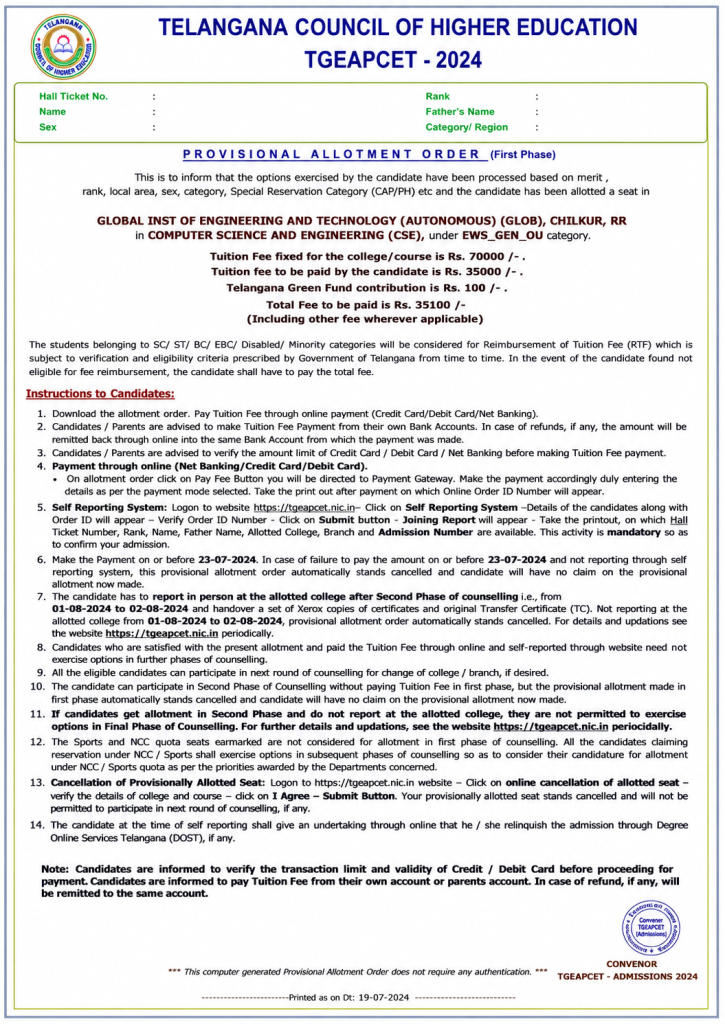
Know Your Allotment Order
Check the sample allotment order to understand the details printed on the document, including college name, allotted branch, tuition fee, reporting instructions, and other important information.
Lessons from the TG EAPCET 2026 Mock Seat Allotment
The TG EAPCET 2026 Mock Seat Allotment provided valuable insights into the counselling process and highlighted the importance of exercising Web Options strategically. During the mock allotment, 79,313 seats were provisionally allotted. However, 8,740 candidates did not receive any seat, even though thousands of seats remained vacant across various participating colleges.
The primary reason for this was that many candidates restricted their Web Options to only a few highly competitive colleges and branches, particularly Computer Science Engineering (CSE) and its allied specializations. As a result, the counselling software could not find a suitable seat matching their preferences, TG EAPCET Rank, Reservation Category, and Local Area Status.
The final Provisional Seat Allotment follows the same computerized allotment process. The system checks each candidate’s Web Options in the order of preference and allots the first available seat that matches the candidate’s rank, reservation category, local area status, and seat availability. Candidates who include a balanced mix of top, moderate, and safe college choices generally have a better chance of securing a seat during the counselling process.
Why is TG EAPCET 2026 Provisional Seat Allotment Conducted
The TG EAPCET 2026 Provisional Seat Allotment is conducted to ensure a fair, transparent, and merit-based admission process for Engineering, Agriculture, and Pharmacy courses offered by participating colleges across Telangana. The computerized counselling system allocates seats strictly based on the candidate’s TG EAPCET Rank, Reservation Category, Local Area Status, Web Options exercised, and Seat Availability, while implementing all reservation policies prescribed by the Government of Telangana.
The Provisional Seat Allotment serves as the official first phase of admissions and helps candidates secure seats in their preferred colleges and branches. It also enables the counselling authority to efficiently utilize the available seat matrix across all participating institutions before subsequent counselling phases.
Objectives of TG EAPCET 2026 Provisional Seat Allotment
- To allot seats strictly based on the candidate’s TG EAPCET Rank and merit.
- To implement Reservation Policies for SC, ST, BC, EWS, Women, NCC, CAP, PH (PwD), and other eligible categories.
- To allot colleges and branches according to the Web Options exercised by candidates.
- To ensure fair and transparent allocation of seats across all participating colleges.
- To maximize the utilization of available seats during the Phase 1 Counselling process.
- To provide eligible candidates an opportunity to secure admission in the first phase while allowing them to participate in subsequent counselling phases for a better college or branch, subject to the counselling guidelines.
- To maintain a fully computerized and merit-based admission process with equal opportunity for all eligible candidates.
How Does the Seat Allotment Process Work
The TG EAPCET counselling software follows a completely automated and merit-based process while allotting seats.
The system first starts with the candidate holding Rank 1 and continues sequentially until all eligible candidates are processed. For every candidate, the software checks the web options entered in order of priority. If the first preferred college and branch have a vacant seat under the candidate’s eligible category, that seat is allotted immediately.
If the first option is unavailable, the software checks the second preference, then the third, and continues until an available seat is found. Reservation rules, local area reservations, gender reservations, and category-specific seat availability are simultaneously considered before finalizing the allotment.
Candidates who enter only a limited number of options may not receive any seat even if vacancies remain elsewhere. Therefore, entering a larger number of realistic web options significantly improves the chances of securing admission.
What to Do After Allotment: Step-by-Step
If you are successfully allocated a seat on July 10, you must execute the following online workflow to lock your option.
1.Download the Allotment Order:Available on or before July 10.
Log into the TG EAPCET Candidate Portal. Access your dashboard to view the specific institution, branch, and tuition fee details assigned to your profile. Save and print the PDF copy.
2.Pay the Tuition Fee online:Deadline: July 14, 2026.
Clear the tuition amount indicated on your document via Net Banking, Credit, or Debit card. If you are eligible for the Reimbursement of Tuition Fee (RTF) or full state scholarships, your payable amount may display as zero (0).
3.Perform Online Self-Reporting:Deadline: July 14, 2026.
Even if your tuition fee balance shows zero, you must manually click the “Self-Report” button on the portal. This step registers your virtual acceptance into the central database.
4.Download the Joining Report:Immediate upon Self-Reporting.
Once self-reporting is processed, download your unique computer-generated Joining Report containing your official admission number. Keep this safe for your final campus arrival.
Multi-Phase Progression: Rules for Sliding to Phase 2
Accepting a Phase 1 seat does not lock you out of future opportunities. In fact, keeping your Phase 1 seat as a safety net is highly recommended.
- The Safe Play (Accept & Float): If you complete your online fee payment and self-reporting, your Phase 1 seat is held as an absolute backup. You are completely free to participate in Phase 2 web options. If you get a better college option in Phase 2, your Phase 1 choice automatically deletes and transfers its funds. If you get nothing new in Phase 2, you retain your original Phase 1 seat safely.
- The Risky Move (Ignore Allotment): If you ignore your allotment order or fail to complete the self-reporting dashboard by July 14, your seat is permanently lost. While you can still enter Phase 2, you will enter the round with zero backup options.
Crucial Reminder: Candidates are NOT required to visit their assigned college campus physically during Phase 1. Physical document verification and final campus reporting will occur only after the final counseling phase concludes. At that point, you must present your online Allotment Order, Joining Report, and two sets of xeroxed copies of your original academic and income certificates directly to the college administration.
Difference Between Mock Allotment and Provisional Allotment
Many candidates confuse the mock allotment with the provisional allotment, although both serve different purposes.
The Mock Seat Allotment is only a practice allocation released before the final allotment. Its purpose is to help candidates understand the possible seat they may receive and to allow them to modify their web options before the final locking date.
The Provisional Seat Allotment, on the other hand, is the official seat allotment generated after web options are frozen. Candidates receiving a seat must complete fee payment and self-reporting to retain their admission.
Tuition Fee Payment Process
After downloading the allotment order, candidates are required to pay the prescribed tuition fee through the online payment gateway within the notified schedule. The tuition fee must be paid before completing the online self-reporting process. Failure to pay the required fee within the stipulated time may lead to cancellation of the allotted seat.
Tuition Fee Details
Candidates are required to pay the following prescribed tuition fee at the time of seat confirmation:
- SC/ST Candidates: ₹5,000
- All Other Categories: ₹10,000
Note: The above payment is applicable only to candidates whose actual tuition fee is higher than the prescribed amount. If the tuition fee payable is more than ₹5,000 (for SC/ST candidates) or ₹10,000 (for other categories), candidates need to pay only the prescribed amount during counselling. The remaining balance amount, if any, will be adjusted or refunded after the candidate reports to the allotted college, as per the counselling guidelines.
What is Online Self Reporting
Online Self Reporting is the final confirmation submitted by the candidate after fee payment. By clicking the Self Report option available on the counselling portal, the candidate confirms acceptance of the allotted seat.
After successful self-reporting, the portal generates a Joining Report, which should be downloaded and preserved carefully. This document will be required during admission and future reporting at the allotted college.
It is important to note that online self-reporting is not the same as physically reporting to the college. It simply confirms that the candidate intends to retain the allotted seat in the counselling system.
Can Candidates Participate in the Next Counselling Phase After Phase 1 Seat Allotment
Yes. Candidates who receive a seat in the TG EAPCET 2026 Phase 1 Provisional Seat Allotment can still participate in the Second Phase Counselling if they wish to secure a better college or branch.
Candidates who are satisfied with their Phase 1 allotment should complete the required admission formalities, including Tuition Fee Payment (if applicable) and Online Self-Reporting, within the prescribed schedule. By completing these formalities, the Phase 1 allotted seat remains protected, allowing candidates to participate in the next counselling phase for a possible upgrade, subject to the official counselling guidelines.
During the Second Phase Counselling:
- If a better college or branch is allotted, the previously allotted seat is automatically cancelled, and the new allotment becomes valid.
- If no better seat is allotted, the candidate retains the Phase 1 allotted seat, provided all required admission formalities were completed.
- Candidates who do not complete Tuition Fee Payment and Self-Reporting within the prescribed schedule may lose their Phase 1 allotted seat and participate in the next counselling phase without any confirmed seat as a backup.
Therefore, candidates are advised to complete all Phase 1 admission formalities even if they intend to participate in the Second Phase Counselling, ensuring they retain a confirmed seat while seeking a better allotment.
Why Do Some Candidates Not Receive a Seat in TG EAPCET 2026 Phase 1 Allotment?
Receiving “No Seat Allotted” in the TG EAPCET 2026 Phase 1 Provisional Seat Allotment does not necessarily indicate poor performance or a low TG EAPCET Rank. In many cases, candidates do not receive a seat because they restrict their Web Options to only a few highly competitive colleges and branches, particularly popular courses such as Computer Science Engineering (CSE) and its allied specializations.
During the computerized allotment process, the counselling system checks each candidate’s Web Options in the order of preference. If all the preferred colleges and branches are filled by higher-ranked candidates or no seat is available under the candidate’s Reservation Category and Local Area Status, the system cannot allot an alternative seat if sufficient options have not been entered.
To improve their chances of securing admission, counselling experts recommend exercising a wide range of realistic Web Options, including a balanced mix of dream, moderate, and safe colleges. Candidates who are not allotted a seat in Phase 1 can also participate in the TG EAPCET 2026 Second Phase Counselling by submitting fresh Web Options, subject to the official counselling schedule.