



Home Blog

AP EAPCET BiPC Notification 2026 OUT: Registration, Dates, Courses, Documents & Complete Admission Process

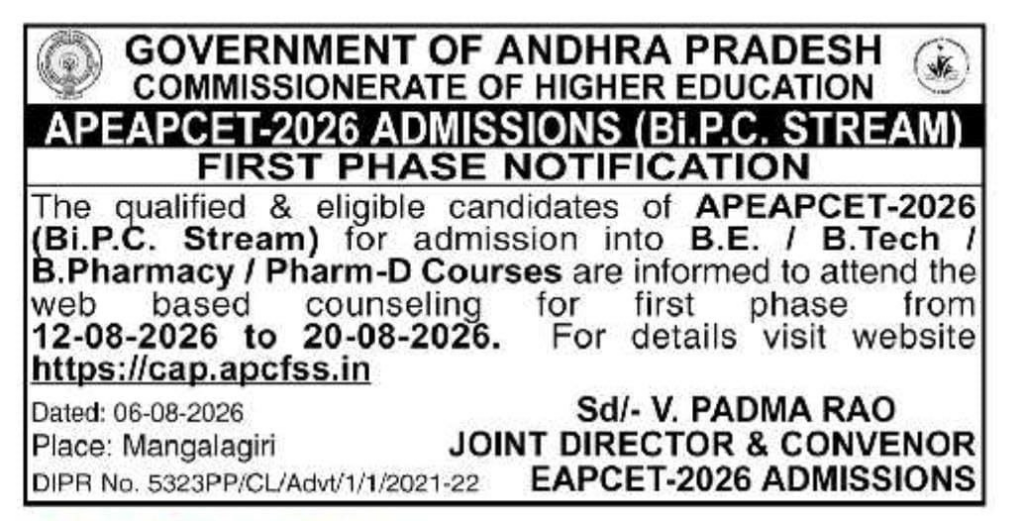
The Government of Andhra Pradesh, Commissionerate of Higher Education, has issued the AP EAPCET 2026 Bi.P.C. Phase 1 Counselling Notification for eligible candidates seeking admission to B.E., B.Tech, B.Pharmacy, and Pharm.D courses. The first phase of web counselling is scheduled from August 12 to August 20, 2026. The notification was issued on August 6, 2026, in Mangalagiri by V. Padma Rao, Joint Director & Convenor of EAPCET-2026 Admissions.

As per the AP EAPCET 2026 Bi.P.C. Phase 1 Counselling Schedule, Online Processing Fee Payment and Registration will be conducted from August 12 to 17, 2026, followed by Online Verification of Uploaded Certificates from August 13 to 18, 2026. Candidates can exercise Web Options from August 14 to 19, 2026, with the Web Options Change Facility on August 20, 2026. The Phase 1 Seat Allotment Result is scheduled to be released on August 23, 2026, followed by Online Self-Reporting and College Reporting from August 24 to 27, 2026. Class work is scheduled to commence on August 24, 2026.

Candidates who qualified in the AP EAPCET 2026 Bi.P.C. stream should keep all original certificates and required documents ready before beginning the counselling process. Preparing the necessary documents in advance can help candidates complete Registration, Certificate Verification, Web Options Entry, Seat Allotment, and College Reporting smoothly and avoid last-minute delays.

Recently, ANGRAU released an admission notification, which led to confusion among students regarding the commencement of AP EAPCET Bi.P.C. Counselling 2026. However, the ANGRAU notification relates to preliminary registration and university-level admission activities and should not be confused with the centralized AP EAPCET Bi.P.C. Counselling. Candidates should clearly understand the difference between university-level registration and the official centralized counselling process conducted by the AP EAPCET admissions authority.

This article provides detailed information on AP EAPCET Bi.P.C. Counselling 2026, including the official notification, counselling schedule, registration process, processing fee payment, certificate verification, Web Options, required documents, participating colleges, courses offered, ANGRAU registration clarification, B.Sc. Nursing admission details, and seat allotment process. Candidates can use this information to understand the counselling procedure and complete the admission process within the prescribed deadlines.

AP EAPCET BiPC Counselling 2026 Highlights

ParticularDetails
Counselling NameAP EAPCET BiPC Counselling 2026
Conducting AuthorityAndhra Pradesh State Council of Higher Education (APSCHE)
Mode of CounsellingOnline
Notification StatusAugust 12, 2026
StreamBiPC
Official Websitecets.apsche.ap.gov.in

AP EAPCET BiPC Counselling Notification 2026 Expected Date

The Telangana EAPCET 2026 Bi.P.C Stream Counselling will begin from August 12, 2026, as decided by the EAPCET Admissions Committee under the chairmanship of Higher Education Commissioner Narayana Bharat Gupta.

The committee finalized the complete counselling schedule for candidates seeking admission into Agriculture, Pharmacy, and other Bi.P.C stream professional courses in Telangana.

First Phase Web Counselling Schedule

ActivityDates
Online Payment of Processing Fee cum Registration12.08.2026 to 17.08.2026
Online Verification of uploaded Certificates at notified Help Line centers (HLCs)13.08.2026 to 18.08.2026
Exercising the Web-Options by the registered and eligible Candidates14.08.2026 to 19.08.2026
Date of changing of options20.08.2026
Allotment of Seats23.08.2026
Self-Reporting and Reporting at college24.08.2026 to 27.08.2026
Commencement of class work24.08.2026

Courses Offered Through AP EAPCET BiPC Counselling

Admissions through AP EAPCET BiPC counselling are expected for the following courses:

  • B.Pharmacy
  • Pharm.D
  • B.Sc (Hons.) Agriculture
  • B.Sc (Hons.) Horticulture
  • Bachelor of Fisheries Science (B.F.Sc.)
  • B.Tech Biotechnology
  • B.Tech Food Technology

Different universities may conduct admissions for certain Agriculture-related programmes, while APSCHE coordinates the centralized counselling process.

Counselling Registration Fee

Candidates will have to pay the online processing fee before participating in counselling.

CategoryRegistration Fee
OC / BC₹1,200
SC / ST₹600

The fee must be paid online using the candidate’s AP EAPCET Hall Ticket Number and Date of Birth.

Documents Required for AP EAPCET BiPC Counselling

Candidates should keep the following original certificates along with scanned copies ready before the counselling begins:

  • AP EAPCET Rank Card
  • AP EAPCET Hall Ticket
  • Intermediate Marks Memo
  • SSC Marks Memo/Certificate
  • Study Certificates from Class VI to Intermediate
  • Transfer Certificate (TC)
  • Community Certificate (if applicable)
  • Income Certificate (issued on or after January 1, 2026)
  • Aadhaar Card
  • EWS Certificate (if applicable)
  • PH/NCC/CAP/Sports Certificates (if applicable)

Keeping scanned copies prepared in advance will help candidates complete online registration smoothly.

Why Has ANGRAU Released a Notification Before APSCHE?

One of the biggest questions among students is why ANGRAU released its admission notification before APSCHE announced the AP EAPCET BiPC counselling schedule.

The answer is simple.

The ANGRAU notification is not the AP EAPCET BiPC counselling notification.

Instead, it is a preliminary registration and eligibility verification process, mainly intended for Agriculture aspirants, especially those applying under the Farmer Quota.

During this stage, candidates only need to:

  • Register their AP EAPCET rank.
  • Upload Farmer Quota documents.
  • Submit Form-I and Form-II.
  • Upload land ownership records.
  • Complete eligibility verification.

No web options, college selection, or seat allotment takes place during this stage.

What Happens After ANGRAU Registration?

Once the preliminary verification process is completed, APSCHE will release the official AP EAPCET BiPC Counselling Notification.

Only after APSCHE releases the notification will candidates be able to:

  • Register for counselling
  • Pay the processing fee
  • Attend certificate verification
  • Exercise web options
  • Participate in seat allotment

Therefore, students should not mistake the ANGRAU notification as the beginning of centralized counselling.

Expected AP EAPCET BiPC Counselling Process

The admission process is expected to move forward in the following order:

Step 1: ANGRAU Registration

Agriculture aspirants complete profile registration and submit Farmer Quota documents (where applicable).

Step 2: APSCHE Counselling Notification

The official counselling notification is released with the complete admission schedule.

Step 3: Online Registration

Eligible candidates complete counselling registration and pay the processing fee.

Step 4: Certificate Verification

Certificates are verified online or at designated centres, as notified by APSCHE.

Step 5: Web Options Entry

Candidates select their preferred colleges and courses.

Step 6: Seat Allotment

Seats are allotted based on AP EAPCET rank, reservation policy, eligibility, and web options.

Step 7: Reporting to College

Candidates report to their allotted college to complete admission formalities.

What Should Students Do Right Now?

With the official AP EAPCET BiPC Counselling Notification expected soon, candidates should utilize this time to prepare all the required documents and complete any preliminary registrations.

Agriculture Aspirants

Candidates planning to pursue B.Sc. (Hons.) Agriculture, Horticulture, Fisheries, Biotechnology, or Food Technology should complete the initial registration process announced by ANGRAU, especially if they are applying under the Farmer Quota. Ensure that all required certificates, including Form-I, Form-II, land ownership records, and rural study certificates, are uploaded within the stipulated time.

Pharmacy & Pharm.D Aspirants

Candidates interested in B.Pharmacy and Pharm.D courses do not have to register through ANGRAU. They should wait for the official APSCHE AP EAPCET BiPC Counselling Notification, which will announce the schedule for registration, certificate verification, web options, and seat allotment.

Is AP EAPCET BiPC Score Valid for B.Sc. Nursing?

One of the biggest misconceptions among students is that AP EAPCET BiPC counselling includes B.Sc. Nursing admissions.

It does not.

From the 2026-27 academic year, admission to the 4-year B.Sc. Nursing programme in Andhra Pradesh is based only on NEET-UG qualification. Candidates applying under both Government (Convener) and Management Quotas must qualify in NEET-UG. AP EAPCET BiPC ranks are not considered for B.Sc. Nursing admissions.

B.Sc. Nursing Admissions Follow a Separate Process

Students aspiring for B.Sc. Nursing should note that the admission process is conducted separately from AP EAPCET BiPC counselling.

The admission process generally includes:

  • Release of a separate notification by Dr. NTR University of Health Sciences (Dr. NTRUHS).
  • Online application through the university admission portal.
  • Preparation of a state merit list based entirely on NEET-UG scores.
  • Separate counselling and seat allotment process.

Important Instructions for AP EAPCET BiPC Candidates

Before the counselling begins, candidates are advised to:

  • Keep all original certificates and scanned copies ready.
  • Verify that income, caste, and other reservation certificates are valid.
  • Complete the ANGRAU registration if applying for Agriculture and Farmer Quota.
  • Regularly visit the APSCHE counselling portal for official updates.
  • Prepare a list of preferred colleges and courses before web option entry.
  • Carefully verify all uploaded documents to avoid rejection during certificate verification.

Frequently Asked Questions (FAQs)

1. Has AP EAPCET BiPC Counselling 2026 started?

No. The official AP EAPCET BiPC Counselling Notification is yet to be released by APSCHE. Candidates should wait for the official schedule regarding registration, certificate verification, web options, and seat allotment.

2. Why did ANGRAU release its notification before APSCHE?

ANGRAU released a preliminary registration notification for Agriculture admissions, mainly to verify Farmer Quota and other eligibility documents. It is not the centralized AP EAPCET BiPC counselling notification.

3. Can Pharmacy candidates register through ANGRAU?

No. Pharmacy and Pharm.D candidates should wait for the official APSCHE counselling notification, which will handle admissions for these courses.

4. Is AP EAPCET rank valid for B.Sc. Nursing?

No. B.Sc. Nursing admissions in Andhra Pradesh are based on NEET-UG qualification, and AP EAPCET BiPC ranks are not considered.

5. Which courses are covered under AP EAPCET BiPC Counselling?

The counselling includes admissions to courses such as:

  • B.Pharmacy
  • Pharm.D
  • B.Sc. (Hons.) Agriculture
  • B.Sc. (Hons.) Horticulture
  • Bachelor of Fisheries Science
  • B.Tech Biotechnology
  • B.Tech Food Technology

Conclusion

The AP EAPCET BiPC Counselling Notification 2026 is expected to be released shortly. Until then, candidates should keep all required documents ready and understand the difference between the ongoing ANGRAU preliminary registration and the official APSCHE counselling process.

Agriculture aspirants should complete the required registration and document submission through ANGRAU, while Pharmacy candidates should wait for the APSCHE notification. Students interested in B.Sc. Nursing must remember that admissions are conducted separately through Dr. NTRUHS based on NEET-UG scores and are not part of AP EAPCET BiPC counselling. Staying informed and completing each step on time will help candidates participate smoothly in the admission process
AILET 2027: Exam Dates, Registration, Eligibility, Syllabus, Application Form at manabadi

0

The All India Law Entrance Test (AILET) 2027 is a national-level law entrance examination conducted by National Law University Delhi (NLU Delhi) for admission to its B.A. LL.B. (Hons.), LL.M., and Ph.D. programmes for the 2027–28 academic year. Unlike CLAT, AILET scores are accepted only by NLU Delhi, making it the exclusive entrance examination for admission to its law programmes.

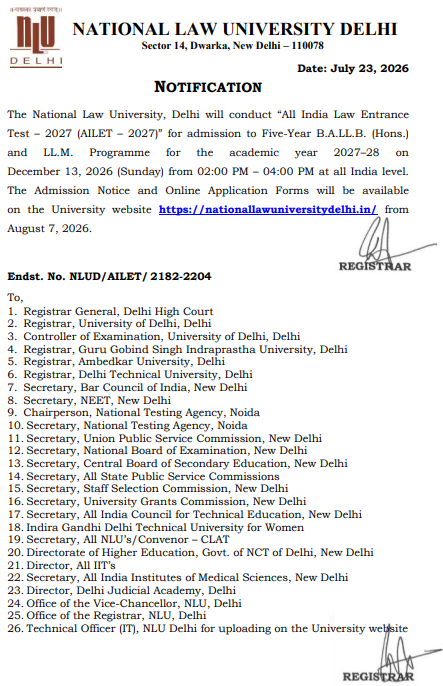
NLU Delhi has officially announced the AILET 2027 examination date, and the exam is scheduled to be held on December 13, 2026 (Sunday). The AILET 2027 Online Application Process is scheduled to begin on August 7, 2026. Eligible candidates can submit their applications through the official NLU Delhi admission portal.

Candidates planning to appear for AILET 2027 should carefully check the eligibility criteria, application process, exam pattern, syllabus, important dates, and admission guidelines before submitting the application form. Candidates should also keep their personal, academic, and supporting documents ready to complete the application process smoothly and avoid unnecessary delays.

Candidates should ensure that all personal and academic details are entered correctly while filling out the AILET 2027 Application Form. After submission, candidates should carefully verify all details and retain a copy of the submitted application form and fee payment confirmation for future reference. Candidates are also advised to regularly check official NLU Delhi updates for any changes, revised schedules, or additional admission instructions.

What is AILET?

AILET (All India Law Entrance Test) is a national-level, offline entrance examination conducted every year by the National Law University, Delhi (NLU Delhi) for admission to its flagship law programmes. Unlike most of India’s other National Law Universities, NLU Delhi does not accept CLAT (Common Law Admission Test) scores — AILET is its sole gateway for admission, which is what makes the exam so keenly watched among law aspirants.

AILET is used to select candidates for three programmes at NLU Delhi:

  • B.A. LL.B. (Hons.) — the flagship five-year undergraduate law programme
  • LL.M. — the one-year postgraduate law programme
  • Ph.D. in Law — the university’s doctoral research programme

Because NLU Delhi is consistently ranked among the top law schools in India, AILET is one of the most competitive law entrance exams in the country, with tens of thousands of candidates competing for a limited number of seats each year.

AILET 2027 Overview

ParticularsDetails
Full FormAll India Law Entrance Test
Conducted ByNational Law University, Delhi (NLU Delhi)
Exam LevelNational
Notification Release DateJuly 23, 2026
Application Start DateAugust 7, 2026
Exam DateDecember 13, 2026 (Sunday)
Exam Timing2:00 PM – 4:00 PM
Exam ModeOffline (Pen and Paper / OMR-based)
Courses OfferedB.A. LL.B. (Hons.), LL.M., Ph.D.
Academic Session2027–28
Official Websitenationallawuniversitydelhi.in

AILET 2027 Important Dates

EventDate
Notification releasedJuly 23, 2026
Online application beginsAugust 7, 2026
Last date to applyTo be notified
Admit card releaseLate November 2026
AILET 2027 exam dateDecember 13, 2026
Provisional answer key release1–2 days after the exam
Last date to raise objectionsTo be notified
Result / merit list declarationDecember 20–21, 2026
Counselling and seat allotmentLate December 2026 onwards

NOTE: Candidates are advised to bookmark the official NLU Delhi website, as exact deadlines for the application closing date and answer key challenge window will be added once notified.

AILET 2027 Eligibility Criteria

Eligibility for AILET 2027 depends on the programme you’re applying for. There is no upper age limit for any of the three courses.

B.A. LL.B. (Hons.) – Undergraduate Eligibility

  • Must have passed Class 12 (10+2) or an equivalent examination.
  • Minimum 45% aggregate marks for General/OBC candidates; 40% for SC/ST/PwD candidates.
  • Candidates appearing for Class 12 board exams in March/April 2027 can also apply provisionally.

LL.M. – Postgraduate Eligibility

  • Must hold an LL.B. or an equivalent law degree.
  • Minimum 50% aggregate marks for General/OBC candidates; 45% for SC/ST/PwD candidates.
  • Final-year LL.B. students can apply provisionally.

Ph.D. – Doctoral Eligibility

  • Must hold a Master’s degree in Law or an equivalent qualification.
  • Minimum 55% aggregate marks for General/OBC candidates; 50% for SC/ST/PwD candidates.
  • Candidates with a valid UGC-JRF/NET qualification and Foreign Nationals are exempt from the entrance test for Ph.D. admission.

AILET 2027 Application Process – How to Apply

The AILET 2027 application process is entirely online and involves four broad stages:

Step 1: Registration

  • Create an account on the NLU Delhi admission portal using a valid mobile number and email ID.

Step 2: Filling the Application Form

  • Enter personal details, academic qualifications, and select up to three preferred exam centre locations.

Step 3: Document Upload

  • Upload scanned copies of your passport-size photograph, signature, and category/reservation certificates (if applicable) in the specified format and size.

Step 4: Fee Payment

  • Pay the application fee online via the payment gateway on the portal and download the confirmation page for future reference.

AILET 2027 Application Fee

CategoryApplication Fee
General / OBC / EWS / Foreign Nationals₹3,500
SC / ST / PwD₹1,500
SC/ST candidates from BPL familiesNil (fee exempted)

AILET 2027 Exam Pattern

The AILET 2027 exam pattern for the B.A. LL.B. (Hons.) programme is expected to remain unchanged from recent years, following NLU Delhi’s revised three-section format (Legal Aptitude and Mathematics sections have been discontinued in recent cycles):

SectionNumber of Questions
English Language50
General Knowledge & Current Affairs30
Logical Reasoning70
Total150
  • Duration: 120 minutes (2 hours)
  • Question Type: Objective, Multiple Choice Questions (MCQs)
  • Marking Scheme: +1 mark for every correct answer; −0.25 mark negative marking for every incorrect answer; no penalty for unattempted questions
  • Logical Reasoning carries the highest weightage and also acts as the first tie-breaker if two candidates score equally, making it a critical section to focus on
  • The LL.M. entrance test is a 100-mark MCQ paper based on core law subjects, while the Ph.D. entrance test also consists of 100 MCQs across two sections

AILET 2027 Syllabus

  • English Language: Reading comprehension, vocabulary, grammar, para-jumbles, and error correction
  • General Knowledge & Current Affairs: National and international current affairs, static GK, legal and constitutional developments in the news
  • Logical Reasoning: Critical reasoning, analytical reasoning, syllogisms, assumptions, arguments, inferences, and pattern-based questions (legal principles may appear within reasoning questions, but no prior legal knowledge is required)

AILET 2027 Admit Card

  • The AILET 2027 admit card is expected to be released in late November 2026, roughly two weeks before the exam.
  • Candidates must log in to the candidate portal using their registered credentials to download and print the hall ticket.
  • A valid government photo ID (Aadhaar Card, Passport, or Voter ID) must be carried to the exam centre along with the printed admit card.

AILET 2027 Answer Key, Result & Merit List

  • NLU Delhi releases a provisional answer key within a day or two of the exam, allowing candidates to cross-check their responses.
  • Candidates can raise objections/challenges against the provisional key within the specified window.
  • The final result and merit list are expected to be declared around December 20–21, 2026.

AILET 2027 Counselling and Seat Allotment

  • Shortlisted candidates must register for counselling and upload final mark sheets to lock their seat allotment.
  • Seat allotment typically happens over multiple rounds/merit lists as seats are vacated and filled.
  • Based on recent cycles, NLU Delhi offers around 120 seats in B.A. LL.B. (Hons.) and 81 seats in LL.M., with reservations for SC, ST, OBC, EWS, PwD, and supernumerary seats for female candidates, Kashmiri migrants, Foreign Nationals, and OCI/PIO candidates (exact seat matrix for 2027 will be confirmed in the official notification).

Why AILET Matters

Since NLU Delhi does not accept CLAT scores, AILET remains the only route into one of India’s most prestigious law schools, known for its strong placement record in litigation, corporate law, judiciary services, and legal research. Given the limited seats and high competition, early and structured preparation — with special focus on Logical Reasoning — is key to cracking AILET 2027.

FAQs

1. When will AILET 2027 be conducted

AILET 2027 will be held on December 13, 2026 (Sunday), from 2:00 PM to 4:00 PM.

2. When does the AILET 2027 application process start

Online applications begin on August 7, 2026, on the official NLU Delhi website.

3. Does NLU Delhi accept CLAT scores

No. NLU Delhi conducts its own entrance exam, AILET, and does not accept CLAT scores for admission.

4. What is the AILET 2027 application fee

₹3,500 for General/OBC/EWS/Foreign Nationals and ₹1,500 for SC/ST/PwD candidates; SC/ST candidates from BPL families are exempted.

5. Is there negative marking in AILET 2027

Yes, 0.25 marks are deducted for every incorrect answer.

Conclusion

With the AILET 2027 notification now officially out, aspirants have a clear timeline to plan their preparation and application around — applications open on August 7, 2026, and the exam falls on December 13, 2026. Since AILET remains the only entrance route into NLU Delhi’s B.A. LL.B. (Hons.), LL.M., and Ph.D. programmes, candidates should use the coming months to strengthen their English, General Knowledge, and Logical Reasoning skills, keep eligibility and document requirements ready well in advance, and regularly track the official NLU Delhi website for updates on the application deadline, admit card, and answer key. Staying organised with these dates and requirements will give applicants the best possible shot at securing a seat in one of India’s most sought-after law schools.

TG CPGET Counselling 2026: Notification Out, Dates, Registration, Web Options, Seat Allotment at Manabadi

TG CPGET Counselling Notification Out

TG CPGET Registration Link Active

The TG CPGET Counselling Notification 2026 has been released, and the registration process will be conducted from August 24 to August 31, 2026.

The TG CPGET Counselling 2026 is the centralized admission process for candidates seeking admission to various Postgraduate (PG) programmes offered by universities and affiliated colleges across Telangana. The counselling is conducted by Osmania University on behalf of the Telangana State Council of Higher Education (TGCHE).

The counselling process includes Online Registration, Certificate Verification, Web Options Entry, Seat Allotment, and Reporting at the Allotted College. Candidates who qualify in TG CPGET 2026 must complete all counselling formalities within the prescribed schedule to secure admission to their preferred M.A., M.Sc., M.Com., M.Ed., M.P.Ed., and other PG programmes.

TG CPGET Counselling Dates:

TG CPGET Counselling Notification Release DateAugust 24, 2026
TG CPGET Counselling Registration DatesAugust 24 to August 31, 2026
Verification of Details and CorrectionsSeptember 5, 2026
Web options EntrySeptember 8 To September 10, 2026
Edit Web OptionsSeptember 11, 2026
TG CPGET Phase 1 Seat AllotmentSeptember 14, 2026
College Reporting DatesSeptember 18, 2026
TG Cpget Phase 2 Registrations BeginsSeptember 19,2026

TG CPGET 2026 Overview

FeatureDetails
Exam NameTelangana State Common Post Graduate Entrance Tests (TG CPGET)
Conducting AuthorityKakatiya University on behalf of TGCHE
Exam LevelState Level (Telangana)
Courses OfferedM.A., M.Sc., M.Com., P.G. Diploma, 5-Year Integrated Courses
Result DateAugust 5, 2026
Counselling StartMid-August 2026 (Expected)
Counselling ModeOnline (Web-based counselling)
Official Websitecpget.tgche.ac.in
Counselling Fees₹200 (General/OBC) | ₹150 (SC/ST)
Seat Reservation85% seats reserved for local Telangana candidates
Participating Universities8 State Universities (OU, KU, TU, MGU, PU, SU, JNTUH, TG Women’s Univ)

The TG CPGET 2026 Web Counselling is the mandatory state-level online seat allocation process for admission to postgraduate programmes across major public universities in Telangana. Managed by Kakatiya University on behalf of the Telangana State Council of Higher Education (TGCHE), the counselling process matches candidates based on their CPGET ranks and eligibility with their preferred colleges and courses.

Candidates should regularly check the Manabadi Website for confirmed information on registration dates, certificate verification, Web Options, seat allotment, and the reporting schedule. Candidates participating in the TG CPGET 2026 Phase 1 Counselling should complete all required counselling activities within the prescribed schedule to secure admission to their preferred PG course and college.

24 నుంచి సీపీగెట్ కౌన్సెలింగ్

Counselling will be conducted from the 24th of this month to secure admissions into MA, MCom, MSc, and other courses across the state through Common PG Entrance Test (CPGET) ranks. The first phase counselling schedule was released on Friday by the Admissions Convenor, Prof. I. Panduranga Reddy. A total of 42,526 candidates passed the CPGET.

Eligibility Criteria

1. Academic Requirements

  • General & OBC Categories: Minimum 40% aggregate marks or equivalent CGPA in your graduation degree.
  • SC/ST Categories: No minimum percentage; a simple pass grade in your qualifying degree is sufficient.
  • M.Ed. & M.P.Ed. Courses: Higher requirement of 55% marks for general categories and 50% for SC/ST/OBC.
  • Final Year Students: Eligible to apply if final-year graduation results are presented during final college admission reporting.

2. Exam Performance & Demographics

  • Entrance Cutoff: General, EWS, and OBC candidates must score at least 25% marks in the CPGET paper. There is no minimum score restriction for SC/ST candidates.
  • Age Limit: There is no upper age limit to sit for the entrance examination.
  • Nationality & Domicile: Candidates must be Indian nationals. Local residents of Telangana and Andhra Pradesh receive an 85% seat reservation quota.

Courses Offered & Specific Requirements

TG CPGET opens entry to postgraduate degrees (M.A., M.Sc., M.Com., P.G. Diploma, and 5-Year Integrated Courses) across 8 state universities. Specific background requirements apply for specialized subjects:

  • M.Sc. Chemistry: Requires Chemistry as an optional subject in your B.Sc.
  • M.Sc. Physics: Requires both Physics and Mathematics at the undergraduate level.
  • M.Com: Requires a completed B.Com degree with corresponding qualifying marks.

Step-by-Step TG CPGET Counselling Process

The TG CPGET 2026 web counselling process consists of five main sequential steps managed online via the official portal:

Step 1: Online Registration & Fee Payment

  1. Visit the official portal (cpget.tgche.ac.in or designated Manabadi admission updates link).
  2. Click on the “Fee Payment for Certificate Verification” link.
  3. Sign in using your CPGET hall ticket number and rank.
  4. Pay the required processing fee online (₹200 for General/OBC, ₹150 for SC/ST).

Step 2: Online Certificate Verification

  1. Upload scanned copies of your academic and category certificates directly to the portal.
  2. Special reservation categories (such as NCC, CAP, or PwD) must visit designated physical helpline centers for verification.
  3. Await online status approval from the verification team before proceeding.

Step 3: Web Option Entry (Choice Filling)

  1. Log in to the web choices dashboard using your generated credentials.
  2. Select your preferred universities and PG courses from the list of available seats.
  3. Arrange choices in strict order of priority. Ensure you finalize choices carefully, as they cannot be altered after the locking deadline.

Step 4: Seat Allotment

  1. Check the automated seat distribution result published on the official portal on the scheduled notification date.
  2. Allocation is calculated based on entrance rank, candidate category, and web preference choices.
  3. Download the Provisional Seat Allotment Order and joining report if a seat is allocated.

Step 5: Reporting to the Allotted College

  1. Pay the required tuition/admission fee online to confirm your seat.
  2. Physically report to the assigned university or college before the specified deadline.
  3. Submit original certificates, including your mandatory Transfer Certificate (TC), to complete admission.

Mandatory Documents Checklist

Candidates must keep the following documents and certificates ready for their decentralised verification slot:

  • Entrance Exam Records: TG CPGET 2026 Rank Card and Hall Ticket.
  • Academic Certificates: Degree provisional or original certificate along with consolidated undergraduate mark sheets.
  • Schooling Records: 10th and 12th standard pass certificates and mark sheets.
  • Identity & Photos: A valid government ID proof and 8 copies of recent passport-size photographs.
  • Mandatory College Leaving Record: Original Transfer Certificate (TC) from your last institution.
  • Reservation Documents: Latest Community, Income, and EWS certificates issued by an authorized MRO/Tahsildar (if claiming reservation).
  • Residence Proof: Local or non-local status certificate to claim the 85% regional state quota.

Required Documents for Counselling

Here is the complete checklist of required documents for TG CPGET 2026 counselling and document verification:

1. Entrance Exam Records

  • TG CPGET 2026 Rank Card
  • TG CPGET 2026 Hall Ticket

2. Academic Certificates

  • Undergraduate Degree Certificate: Provisional or original copy.
  • Memorandum of Marks: Consolidated Memorandum of Marks (CMM) or year-wise degree mark sheets.
  • Intermediate (Class 12): Mark sheet and pass certificate.
  • SSC (Class 10): Mark sheet or an equivalent certificate to establish your date of birth.

3. Study and Identity Proofs

  • Study/Bonafide Certificates: From Class 9 to Graduation, required to establish your local candidate status.
  • Transfer Certificate (TC): Original TC from your last attended undergraduate college (mandatory for final admission).
  • Identity Proof: Aadhaar Card or any valid government-issued photo identity proof.

4. Category and Reservation Documents (If Applicable)

  • Community / Caste Certificate: Issued by a competent authority (such as an MRO/Tahsildar).
  • Income Certificate: Latest certificate issued on or after January 1, 2026 (necessary if claiming fee reimbursement).
  • EWS Certificate: Economically Weaker Section certificate for the current financial year.
  • Special Category Certificates: For candidates claiming seats under NCC, CAP (Children of Armed Personnel), Sports, or PwD (Persons with Disabilities) quotas.

Crucial Instructions for Verification

  • Document Uploading: Ensure all scanned files are completely clear and legible before uploading them online to avoid rejection.
  • Physical Copies: Keep three sets of photocopies of all the documents listed above alongside the physical originals.
  • Special Category Reporting: Candidates claiming special categories (NCC, CAP, PwD, or Sports) must visit the physical helpline center (usually at Osmania University) for in-person physical verification, even after successfully uploading their documents online.

Here is the concluding section, including frequently asked questions (FAQs), fully formatted in Markdown to seamlessly paste at the end of your article.

Core Features of TG CPGET Counselling

  • Centralised Admission: A single, unified window gives you access to multiple campus choices, eliminating the need to apply to universities individually.
  • Rank-Based Merit: High exam ranks secure top preference choices in accordance with category reservation rules (OC, EWS, BC, SC, ST).
  • Web Option Flexibility: Candidates can submit, rearrange, and clear as many college and course preferences as desired until the option locking window closes.
  • Multi-Phase Allocation: The process includes Phase 1, Phase 2, and a final Spot Admission round to fill remaining vacant university seats.

Frequently Asked Questions (FAQs)

1: When will the TG CPGET 2026 counselling and web options begin

Following the declaration of results on August 5, 2026, the Phase 1 web counselling registration and choice filling are expected to commence between mid-August and early September 2026. Candidates should monitor the official portal regularly for exact timeline updates.

2: What is the counselling registration fee for TG CPGET 2026

The online processing and verification fee is ₹250 for General and OBC candidates, and ₹200 for SC, ST, and PH (Physically Handicapped) candidates.

3: Do I need to visit a helpline centre physically for document verification

For most general candidates, uploading scanned certificates online is sufficient. However, candidates claiming special category reservations (such as NCC, CAP, PwD, or Sports) are mandatorily required to visit designated physical helpline centres (like Osmania University or Kakatiya University) for in-person authentication.

4: Can I change my college and course preferences after submitting my web options

You can add, delete, and rearrange your web options as many times as you like while the web options window is active. However, once the final locking deadline passes, your choices are frozen and cannot be altered.

5: What should I do after a seat is allotted to me

If you are allocated a seat, you must log in to the portal, download your Provisional Seat Allotment Order, and pay the requisite admission fee online. Finally, you must report physically to the allotted college with all original documents (including your Transfer Certificate) before the specified deadline to secure your admission.

6: Is there any specific reservation for local students

Yes. 85% of the total available seats in the participating universities are reserved for local candidates of Telangana (and applicable Andhra Pradesh regions). You must provide valid study/bonafide certificates from Class 9 to Graduation to claim this local status.

Conclusion

The TG CPGET 2026 counselling process is your final gateway to securing a postgraduate seat in some of Telangana’s most prestigious state universities. Because the seat allotment relies heavily on your entrance rank and the strategic order of your web options, it is crucial to research your preferred colleges beforehand.

Make sure to prepare all your physical documents—especially your Transfer Certificate (TC), rank card, and necessary category certificates—well in advance to avoid last-minute hurdles during the decentralised verification phase. Keep a close watch on the official TG CPGET admission portal for exact phase-wise schedules, and complete your registration and choice filling before the deadlines close.

AP EAPCET Final Phase Seat Allotment OUT: Vacant Seats, Pharmacy Seat Vacancy, Complete Details at Manabadi

AP EAPCET Final Phase Seat Allotment

The AP EAPCET 2026 Final Phase Seat Allotment Result was released on August 26, 2026. Candidates who participated in the final phase can now check their seat allotment result online using their login credentials. Candidates who have been allotted a seat should carefully follow the tuition fee payment, online self-reporting, and college reporting instructions within the specified deadlines to confirm their admission.

The AP EAPCET 2026 Final Phase Counselling was conducted for eligible candidates seeking admission to B.E./B.Tech, B.Pharmacy, and Pharm.D courses under the M.P.C. Stream across Andhra Pradesh. The Final Phase Counselling offered an additional opportunity to candidates who did not secure a seat in the previous phase, did not participate in earlier counselling, or wanted to seek admission to their preferred college or branch.

As per the revised AP EAPCET 2026 Final Phase Notification, the counselling process was scheduled from August 17 to August 22, 2026. Processing Fee Payment cum Registration was conducted from August 17 to 20, Online Certificate Verification from August 17 to 21, and Web Options Entry from August 17 to 22, 2026.

Candidates were required to complete Processing Fee Payment cum Registration, Online Certificate Verification, and Web Options Entry within the prescribed deadlines. Before exercising Web Options, candidates were advised to consider important factors such as Previous-Year Cutoff Ranks, Reservation Policy, Branch-wise Seat Availability, College-wise Seat Matrix, Fee Structure, College-wise Vacancies, Seat Intake, Branch Availability, Placement Records, and Seat Allotment Trends. Considering these factors can help candidates prepare an effective preference list and make informed counselling decisions.

Candidates can visit Manabadi for the latest updates on AP EAPCET 2026 Final Phase Seat Allotment Result, Counselling, Registration, Certificate Verification, Web Options, College-wise Vacancies, Cutoff Ranks, Seat Matrix, Branch-wise Seat Availability, College Predictor, Counselling Simulator, Tuition Fee Payment, Self-Reporting, and College Reporting.

AP EAPCET Engineering Stream Vacant Seats After After Final Phase Seat Allotment:

Overview

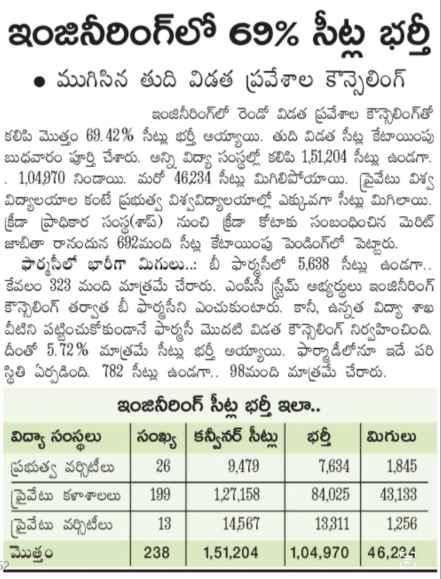
The final phase of engineering admission counseling has concluded, resulting in 69.42% of the total available seats being filled. Out of 1,51,204 available convener seats, 1,04,970 seats were filled, leaving 46,234 seats vacant.

Notably, government universities experienced a higher percentage of vacant seats compared to private universities. Additionally, the allotment of seats for 692 candidates under the sports quota is currently pending as the merit list from the Sports Authority (SAP) is awaited.

Engineering Seats Breakdown

Type of InstitutionNumber of CollegesConvener Seats AvailableSeats FilledVacant Seats
Government Universities269,4797,6341,845
Private Colleges1991,27,15884,02543,133
Private Universities1314,56713,3111,256
Total2381,51,2041,04,97046,234

Major Crisis in Pharmacy Admissions

Pharmacy courses faced a severe lack of student interest, resulting in massive vacancies:

  • B.Pharmacy: Out of 5,638 available seats, only 323 students joined, filling a mere 5.72% of the total seats.
  • Pharma-D: Out of 782 available seats, only 98 students joined.

Reason for Vacant Pharmacy Seats

The primary reason highlighted for this steep decline is a counseling schedule mismatch by the Higher Education Department. Typically, MPC (Mathematics, Physics, Chemistry) stream students consider B.Pharmacy as an alternative only after the engineering counseling concludes. However, the department conducted the first phase of pharmacy counseling while the engineering counseling process was still active, leading to students skipping the pharmacy selection.

AP EAPCET 2026 Final Phase Revised Counselling Schedule

The complete details and important dates for the AP EAPCET 2026 (MPC Stream) Final Phase Counselling are as follows:

ActivityDates
Online Payment of Processing Fee cum Registration and Online Certificate Verification17.08.2026 to 20.08.2026
Online Verification of Uploaded Certificates at Notified Help Line Centers17.08.2026 to 21.08.2026
Exercising the Web Options by the Registered and Eligible Candidates17.08.2026 to 22.08.2026
Change of Options for the Candidates23.08.2026
Allotment of Seats26.08.2026
Self-Reporting & Reporting at College27.08.2026 to 31.08.2026

What is AP EAPCET 2026 Final Phase Counselling?

The AP EAPCET 2026 Final Phase Counselling is the final stage of the web-based counselling process and offers an additional opportunity for eligible candidates to secure admission into B.E./B.Tech, B.Pharmacy, and Pharm.D courses under the M.P.C. Stream. It is meant for candidates who were not allotted a seat in previous counselling phases, wish to seek admission to a preferred college or branch, or did not participate in earlier counselling.

Key Points to Remember

  • Processing Fee Payment cum Registration: Eligible candidates must complete Processing Fee Payment cum Registration as per the prescribed Final Phase schedule.
  • Online Certificate Verification: Candidates must complete Online Certificate Verification within the specified dates, wherever applicable.
  • Web Options Entry: Candidates must exercise their Web Options carefully based on their preferred colleges and branches, seat availability, and previous-year cutoff trends.
  • Final Opportunity: The Final Phase provides a last opportunity through the regular web counselling process for eligible candidates to seek admission or a preferred college/branch, subject to seat availability and applicable counselling rules.
  • Follow Official Updates: Candidates should regularly check the APSCHE Counselling Portal for the latest Final Phase Counselling Dates, Web Options, Seat Allotment, and Notifications.
  • Plan Web Options Carefully: Use previous-year cutoff ranks, branch-wise seat availability, college-wise vacancy details, and college preferences to prepare a well-balanced Web Options Preference List.

Key Fact: The AP EAPCET 2026 Final Phase Web Counselling Process, comprising Processing Fee Payment cum Registration, Online Certificate Verification, and Option Entry, will be conducted from August 14 to August 21, 2026, as per the Final Phase Notification.

Over View

AspectDetails
Round TypeFinal opportunity for seat allotment & upgrade
EligibilityUnallotted, betterment seekers, Phase 1 missers
Registration Fee (OC/BC)₹1,200
Registration Fee (SC/ST)₹600
Web OptionsMust be exercised afresh; Phase 1 options discarded
Betterment RiskPrevious seat cancelled if new seat allotted
Fee ReimbursementApplies if eligible and certificates verified
Physical ReportingMandatory to confirm seat
Official Portalcap.apcfss.in

Eligibility Criteria

Not everyone enters Final Phase with the same status. You are eligible to participate if you fall into any of these categories:

Eligible Candidates

  1. No Seat Allotted: You filled options in Phase 1 but did not get a seat
  2. Seat Upgradation: You accepted your Phase 1 seat via online self-reporting but want to try for a better college or branch
  3. Missed Phase 1: You completely missed Phase 1 registration, payment, or certificate verification
  4. Seat Cancelled/Rejected: You were allotted a seat in Phase 1 but failed to self-report, or you intentionally rejected the allocation

Category-wise Eligibility

CategoryEligibility Status
OC / EWSMust have secured minimum 25% marks (40 out of 160)
OBCMust have secured minimum 25% marks (40 out of 160)
SC / STAdmissions subject to availability of seats under reserved categories

Step-by-Step 2nd Phase Process

Step 1: Registration & Fee Payment

Eligible candidates must:

  • Visit the Official AP EAPCET Counselling Portal at cap.apcfss.in
  • Log in using your Hall Ticket Number and Date of Birth
  • Pay the processing fee:
    • OC / BC Candidates: ₹1,200
    • SC / ST Candidates: ₹600
  • Complete basic registration and save the transaction ID for future reference

Step 2: Certificate Verification

For candidates who did NOT participate in Phase 1:

  • Book a slot for certificate verification
  • Visit a designated Help Line Centre (HLC) with original documents
  • Carry 2 sets of photocopies along with originals

For candidates who already verified in Phase 1:

  • No fresh verification is required
  • Proceed directly to web options entry

Essential Documents Required:

  • AP EAPCET 2026 Rank Card & Hall Ticket
  • SSC (Class 10) & Intermediate (Class 12) Marks Memos
  • Transfer Certificate (TC)
  • Study Certificates (Class 6 to Intermediate)
  • Income Certificate (if applicable)
  • Caste Certificate (if applicable)
  • Aadhaar Card

Step 3: Web Options Entry (Choice Filling)

Critical Rule: Your Phase 1 options are completely wiped out. You must enter a fresh list of choices from scratch .

How to Exercise Web Options:

  1. Login: After verification, you will receive credentials to log in
  2. Plan Your Options: Download the manual option form from the official site
  3. Enter Choices: Select preferred colleges and courses in descending order of priority
  4. Save Frequently: Click “Save” regularly to prevent data loss
  5. Freeze Only When Ready: Do not freeze until you are 100% certain

Expert Tips for Web Options:

  • Never fill fewer than 30 options
  • List “Dream Colleges” first, followed by “Realistic Colleges,” and finally 5 “Safety Colleges
  • Use previous years’ cutoff data to assess your chances
  • Check the “Last Rank” tool to see if your rank is within the 20% margin of a college’s closing rank

Step 4: The “Vacated Seat” Rule

Important: If you are allotted a new seat in Phase 2, your Phase 1 seat is automatically cancelled and instantly transferred to the next meritorious student. You cannot reclaim your Phase 1 seat under any circumstances.

Step 5: Seat Allotment

The system processes allotments via automated algorithms using:

  • AP EAPCET merit rank
  • Reservation category
  • Local area status
  • Web option preferences

The higher rank always gets their choice filled first, making the sequential ordering of your options highly critical .

Step 6: Self-Reporting & College Joining

Securing your final seat requires completing two mandatory actions:

  1. Online Self-Reporting: Log into the official portal and click “Accept my Allotment.” This generates a Joining Report.
  2. Physical Campus Reporting: Visit the final campus with:
    • Printed allotment letter
    • Online acknowledgement/joining report
    • Original certificates
    • Tuition fee payment receipt

Failure to complete either action by the deadline will result in automatic seat cancellation .

Reservation & Fee Policies

Local vs. Non-Local Seat Allocation (85:15 Rule)

Seat distribution strictly adheres to presidential orders defining regional boundaries:

  • 85% Local Quota: Reserved for candidates belonging to Andhra University (AU) region or Sri Venkateswara University (SVU) region
  • 15% Unreserved Quota: Open to both local and non-local candidates

Category-wise Reservations

CategoryReservation Quota
Backward Classes (BC)29% (Split A to E)
Scheduled Castes (SC)15%
Scheduled Tribes (ST)6%
EWS / PWD / CAP10% / 3% / 2%

Fee Reimbursement Rules

If you qualify for government fee reimbursement schemes (Jagananna Amma Vodi or Vidya Deevena), your tuition fee waiver carries over to your final Phase college automatically. Qualification depends on providing a valid Income Certificate (typically issued after Jan 1 of the current fiscal year) or a valid Rice Card during certificate verification.

AP EAPCET 2026 Rank Card Download Guide

To access your rank card for preparing counselling options:

  1. Visit the official AP EAPCET portal: cap.apcfss.in
  2. Click on the “AP EAPCET 2026 Results” or “Download Rank Card” link
  3. Enter your Registration NumberHall Ticket Number, and Date of Birth
  4. Click on “Submit” to view and download the rank card
  5. Take a printout for future admission and counselling purposes

Frequently Asked Questions (FAQs)

1. Who is eligible for AP EAPCET Final Phase Counselling?

Candidates who did not get a seat in Phase 1, those who want to upgrade their seat, candidates who missed Phase 1 registration, and those whose Phase 1 seat was cancelled are eligible.

2. Can I use my Phase 1 web options for Final Phase?

No. Your Phase 1 options are completely wiped out. You must enter a fresh list of choices from scratch.

3. What happens if I get a better seat in final Phase?

If you are allotted a new seat, your Phase 1 seat is automatically cancelled and transferred to the next candidate. You cannot reclaim your Phase 1 seat.

4. Is certificate verification required for FInal Phase?

If you participated in Phase 1 and your certificates are already verified, you can directly fill web options. New candidates must complete verification at HLCs.

5. Do I need to pay the processing fee again for Final Phase?

Yes, all candidates participating in Final Phase must pay the processing fee again, regardless of whether they paid in Phase 1.

6. What documents are required for certificate verification?

You need AP EAPCET Rank Card, Hall Ticket, SSC & Intermediate Marks Memos, Transfer Certificate, Study Certificates, Income/Caste Certificates (if applicable), and Aadhaar Card.

7. Is physical reporting mandatory after seat allotment?

Yes, both online self-reporting AND physical campus reporting are mandatory. Failing either cancels your seat.

8. When will the Final Phase seat allotment result be declared?

The exact date will be notified on the official portal. Candidates should check cap.apcfss.in regularly for updates.

9. Can I change my web options after freezing?

No, once you freeze your options, you cannot edit them until the designated “Change of Options” window opens.

10. Am I eligible for fee reimbursement in Final Phase?

Yes, if you qualify for government fee reimbursement schemes, your waiver carries over to your Final Phase college, subject to valid income certificate verification.

11. What is the “Vacated Seat” rule?

If you participate for betterment and get a new seat, your previous allotment is automatically cancelled. You cannot choose to keep your old seat once a new one is allotted.

12. Can candidates who didn’t register in Phase 1 apply?

Yes, candidates who missed Phase 1 registration, payment, or certificate verification can apply in Final Phase.

13. What is the AP EAPCET 2026 cutoff for engineering?

The cutoff varies by college and category. Check the official portal for branch-wise and category-wise cutoff ranks after each allotment.

14. How many options should I fill in Final Phase?

Fill at least 30-40 options including dream, realistic, and safety colleges. Never fill fewer than 30 options.

Final Advice:

  • Keep all original documents ready and scanned copies uploaded
  • Bookmark the official AP EAPCET Counselling Portal and check it daily
  • Plan your web options strategically based on your rank and category
  • Complete all steps within deadlines without waiting for the last moment
  • If you’re a betterment candidate, weigh the risk carefully before participating

Conclusion

The AP EAPCET Final Phase Counselling 2026 is a critical opportunity for engineering, pharmacy, and agriculture aspirants to secure admission or upgrade to a better college and branch. This round is designed to fill vacant seats and give candidates a second chance to join the academic year 2026-27.

Stay connected with Manabadi for the latest AP EAPCET 2026 Final Phase counselling updates, allotment results, and admission guides!

GATE 2027 Exam Dates Revised: Registration to Begin, Latest Updates at Manabadi

0

The Gate Registration has not yet been started as of Now. Candidates can click the above link and visit the official website to complete the registration process, once it starts The Latest updates related to the GATE will be available on Manabadi.

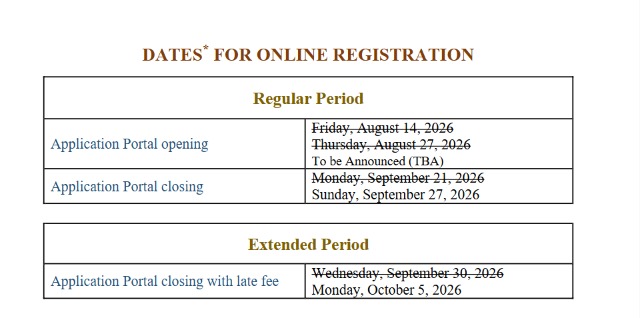
The Graduate Aptitude Test in Engineering (GATE) 2027 is being conducted by the Indian Institute of Technology Madras (IIT Madras). IIT Madras has revised the GATE 2027 registration schedule, with the GOAPS application portal opening on August 27, 2026, instead of the earlier announced date of August 14, 2026.

As per the revised GATE 2027 schedule, candidates can submit their applications without a late fee until September 27, 2026. The extended registration window with a late fee will remain open until October 5, 2026. Candidates are advised to complete the application process within the specified deadlines to avoid paying the additional late fee.

The GATE 2027 examination dates remain unchanged. The exam will be conducted on February 6, 7, 13, 14, 20, and 21, 2027. The GATE 2027 Results are scheduled to be announced on March 19, 2027.

GATE 2027 Registration Date Revised

The registration opening date to be announced Soon. The regular registration deadline is September 27, 2026.

Candidates who miss the regular deadline can submit their applications with a late fee until October 5, 2026.

GATE 2027 Important Dates

EventRevised Date
GOAPS Registration BeginsTo be Announced
Regular Registration EndsSeptember 27, 2026
Extended Registration with Late Fee EndsOctober 5, 2026
Application Rectification BeginsOctober 14, 2026
Application Rectification EndsOctober 21, 2026
City Allotment NotificationJanuary 4, 2027
Admit Card DownloadTo Be Announced
GATE 2027 ExaminationFebruary 6, 7, 13, 14, 20 & 21, 2027
GATE 2027 ResultMarch 19, 2027

The official GATE 2027 schedule states that all dates are subject to change.

Is the GATE 2027 Exam Date Changed?

No. The latest update is mainly regarding the registration schedule. IIT Madras has not changed the currently announced GATE 2027 examination dates.

The examination is scheduled to be held over three weekends:

  • February 6 & 7, 2027
  • February 13 & 14, 2027
  • February 20 & 21, 2027

Other Important GATE 2027 Updates

Apart from the registration-date revision, IIT Madras has also announced several changes for GATE 2027.

New Robotics & Automation Paper

A new Robotics & Automation (RA) test paper has been introduced for GATE 2027. IIT Madras has also made updates to the BT syllabus, two-paper combinations, Textile Engineering & Fibre Science (TF), and sectional paper codes for XE, XH and XL.

DigiLocker Mandatory

Registration through DigiLocker is mandatory for all Indian nationals. Candidates are advised to create or update their verified DigiLocker account before starting the GATE 2027 application process.

Latest GATE 2027 Registration Update

Candidates should therefore not wait for August 14 as mentioned in earlier schedules. The official revised schedule states that the GATE 2027 GOAPS registration portal will open on August 27, 2026.

The regular application window will remain open until September 27, 2026, while applications with a late fee can be submitted until October 5, 2026.

This page will be updated with the latest official information on the GATE 2027 application form, registration, exam dates, admit card, answer key, result and other important announcements.

GATE 2027 Overview

ParticularDetail
Exam NameGraduate Aptitude Test in Engineering (GATE) 2027
Conducting InstituteIIT Madras
Exam ModeComputer-Based Test (CBT)
Exam Duration3 hours
Total Marks100
Number of Papers30 papers plus the newly introduced Robotics and Automation (RA) paper
SectionsGeneral Aptitude (15 marks) + Subject-Specific/Core Discipline (85 marks)
Question TypesMCQ, MSQ (Multiple Select Questions), NAT (Numerical Answer Type)
LanguageEnglish
Application ModeOnline only, via GOAPS portal
PurposeAdmission to M.Tech/M.E./Ph.D. programs at IITs, NITs, IIITs, GFTIs; also used for PSU recruitment

What’s New in GATE 2027 – Official Syllabus and Paper Changes

This year brings some genuinely important structural changes that GATE 2026 aspirants did not have to deal with. As per the official GATE 2027 notification released by IIT Madras:

1. A brand-new test paper has been introduced: Robotics and Automation (RA)
This is a significant addition, reflecting the growing academic and industry focus on robotics, automation, and intelligent systems. Candidates interested in this emerging field now have a dedicated GATE paper rather than having to approach it through a related discipline like Mechanical or Instrumentation Engineering.

2. Changes to the Textile Engineering & Fibre Science (TF) paper
IIT Madras has specifically flagged updates to the TF paper structure. Candidates who previously appeared for or prepared using older TF paper patterns should not assume continuity — the updated structure needs to be checked directly against the official syllabus document.

3. Changes to XE, XH, and XL sectional paper codes
The multi-disciplinary papers — XE (Engineering Sciences), XH (Humanities and Social Sciences), and XL (Life Sciences) — have had their internal sectional codes revised. Since these papers work on a “choose your sections” format, any change in section coding directly affects how candidates select their optional sections during registration. This is not a cosmetic change — candidates choosing XE, XH, or XL must re-check the updated section list before filling the application form.

4. Syllabi for GATE 2027 test papers have been revised across the board
IIT Madras has explicitly stated that syllabi have been revised for GATE 2027, and has advised all candidates to check the updated syllabus rather than relying on GATE 2026 or earlier syllabus documents. This is a broad, exam-wide revision — not limited to just the new or restructured papers mentioned above.

Important flag for accuracy: The scale of syllabus revision (i.e., which specific topics were added, removed, or reworded within each of the 30+ subject papers) has not been detailed in a single consolidated public summary as of now. The only fully reliable source for the exact topic-by-topic changes is the official syllabus PDF for each paper, published on the GATE 2027 website. Students should download and compare the specific paper’s syllabus directly rather than relying on “not much has changed” claims circulating on some non-official sites — this year’s notification explicitly says otherwise.

GATE 2027 Eligibility Criteria

  • Candidates currently in the 3rd year or higher of any undergraduate degree program in Engineering, Technology, Architecture, Science, Commerce, Arts, or Humanities are eligible to appear.
  • Candidates who have already completed a government-approved degree program in the above disciplines are also eligible.
  • There is no upper age limit to appear for GATE.
  • Candidates pursuing or holding a professional society examination qualification recognized as equivalent to a B.E./B.Tech/B.Arch by MHRD/UPSC/AICTE are also eligible.

GATE 2027 Application Fee

Application fee figures for GATE 2027 are being reported with some variation across different education portals right now — this is common before the fine print of the official fee notification is fully standardized across all reporting sites. Based on the most consistently repeated figures:

CategoryRegular WindowExtended/Late Window
Female / SC / ST / PwD candidates₹900–₹1,000 per paper₹1,400–₹1,500 per paper
General / OBC / EWS candidates₹1,800–₹2,000 per paper₹2,300–₹2,500 per paper

Flag: Since exact figures differ slightly between sources (some cite ₹900/₹1,800, others ₹1,000/₹2,000), the binding number is whatever appears on the official GOAPS portal at the time of registration. This should be confirmed directly from gate2027.iitm.ac.in or the GOAPS application portal before publishing a single fixed figure, or the article should present both figures with a note that the official portal is the final word.

Fees for a second optional paper (candidates can choose up to two papers) are charged additionally per the same category-wise structure. All modification requests after submission (changing exam city, adding a second paper, etc.) attract separate charges as specified during the correction window.

GATE 2026 Paper-wise Eligibility Criteria

Degree/ProgramQualifying Degree/ExaminationDescription of Eligible Candidates
B.E. / B.Tech. / B. Pharm.Bachelor’s degree in Engineering / Technology (4 years after 10+2 or 3 years after B.Sc. / Diploma in Engineering / Technology)Currently in the 3rd year or higher or already completed
B. Arch.Bachelor’s degree in Architecture (5-year course) / Naval Architecture (4-year course) / Planning (4-year course)Currently in the 3rd year or higher or already completed
B.Sc. (Research) / B.S.Bachelor’s degree in Science (Post-Diploma/4 years after 10+2)Currently in the 3rd year or higher or already completed
Pharm. D. (after 10+2)6 years degree program, consisting of internship or residency training, during third year onwardsCurrently in the 3rd/4th/5th/6th year or already completed
M.B.B.S. / B.D.S.Degree holders of M.B.B.S./B.D.S. and those who are in the 5th/6th/7th semester or higher semester of such programme5th/6th/7th or higher semester or already completed
M. Sc. / M.A. / MCA or equivalentMaster’s degree in any branch of Arts/Science/Mathematics/Statistics/Computer Applications or equivalentCurrently in the first year or higher or already completed
Int. M.E./ M.Tech. (Post-B.Sc.)Post-B.Sc Integrated Master’s degree programs in Engineering/ Technology (4-year program)Currently in the 1st/2nd/3rd/4th year or already completed
Int. M.E./ M.Tech./ M.Pharm or Dual Degree (after Diploma or 10+2)Integrated Master’s degree program or Dual Degree program in Engineering/Technology (5-year program)Currently in the 3rd/4th/5th year or already completed
B.Sc. / B.A. / B.ComBachelor degree in any branch of Science / Arts / Commerce (3-year program)Currently in the 3rd year or already completed
Int. M.Sc. / Int. B.S. / M.S.Integrated M.Sc. or 5-year integrated B.S.-M.S. programCurrently in the 3rd year or higher or already completed
Professional Society Examinations (equivalent to B.E. / B.Tech. / B.Arch.)B.E./B.Tech./B.Arch. equivalent examinations of Professional Societies, recognized by MoE/UPSC/AICTE (e.g. AMIE by the Institution of Engineers-India, AMICE by the Institute of Civil Engineers-India, and so on)Completed Section A or equivalent of such professional courses
B.Sc. (Agriculture, Horticulture, Forestry)4-years B.Sc programCurrently in the 3rd/4th year or already completed

How to Apply for GATE 2027 – Step by Step

  1. Visit the official GATE 2027 website / GOAPS portal.
  2. Register as a new user with a valid email ID and mobile number to generate your Enrollment ID and password.
  3. Log in and fill in personal details, academic qualification details, and communication address.
  4. Upload your scanned photograph, signature, and category certificate (if applicable — SC/ST/PwD candidates must upload proof to avail the fee concession at this stage; OBC-NCL/EWS certificates are needed only at the counselling stage).
  5. Select your GATE paper (and optionally a second paper, if eligible under the allowed combinations).
  6. Choose your preferred examination cities.
  7. Pay the application fee online via net banking, debit/credit card, or UPI.
  8. Review the complete application carefully and submit.
  9. Download and save the confirmation page/receipt.

GATE 2027 Exam Pattern

  • Total Duration: 3 hours
  • Total Marks: 100
  • General Aptitude: 15 marks (compulsory across all papers)
  • Subject-Specific Section: 85 marks
  • Question Types: MCQ (Multiple Choice Questions), MSQ (Multiple Select Questions), and NAT (Numerical Answer Type)
  • Negative Marking: Applicable for MCQs only (typically 1/3 mark deducted for 1-mark MCQs and 2/3 for 2-mark MCQs); no negative marking for MSQ or NAT questions
  • For most papers, the standard section/question format applies; papers like AR, CY, DA, EY, GE, GG, MA, PH, ST, XH, and XL follow a distinct format specific to their discipline — candidates should check their specific paper’s structure in the official brochure.

What Happens After the Exam

  • Answer Key Release: Published on GOAPS shortly after the exam, along with a facility to raise objections (a fee applies per question challenged).
  • Result Declaration: March 19, 2027, as per the current official schedule.
  • Score Validity: GATE scores are typically valid for 3 years from the date of result declaration.
  • Counselling: Admission to IITs happens through COAP (Common Offer Acceptance Portal); admission to NITs, IIITs, and other GFTIs happens through CCMT (Centralized Counselling for M.Tech/M.Arch/M.Plan). Both open after results and cutoffs are announced.

Frequently Asked Questions

1. Who is conducting GATE 2027?
IIT Madras is the organizing institute for GATE 2027.

2. When does GATE 2027 registration begin?
Registration begins on August 27, 2026, through the GOAPS portal.

3. What is the last date to apply without a late fee?
September 27, 2026.

4. What is the last date to apply with a late fee?
October 5, 2026.

5. When is the application correction window?
October 14 to 21, 2026.

6. When will GATE 2027 city allotment be announced?
January 4, 2027.

7. What are the GATE 2027 exam dates?
February 6, 7, 13, 14, 20, and 21, 2027 — spread across three weekends.

8. When will GATE 2027 results be declared?
March 19, 2027.

9. Is there a new paper introduced in GATE 2027?
Yes — Robotics and Automation (RA) has been newly introduced as a GATE test paper for 2027.

10. Has the GATE 2027 syllabus changed?
Yes. IIT Madras has officially confirmed that syllabi for GATE 2027 test papers have been revised, and candidates are advised to check the updated syllabus rather than relying on previous years’ documents.

11. What changes have been made to the XE, XH, and XL papers?
The sectional paper codes within these multi-disciplinary papers have been revised for GATE 2027. Candidates choosing these papers must check the updated section list before selecting their optional sections during application.

12. Has the Textile Engineering & Fibre Science (TF) paper changed?
Yes, specific changes have been made to the TF paper structure for GATE 2027, as officially flagged by IIT Madras.

13. How many total papers will GATE 2027 have?
30 established papers plus the newly added Robotics and Automation (RA) paper.

14. What is the eligibility criteria for GATE 2027?
Candidates in the 3rd year or higher of a qualifying undergraduate degree program, or those who have already completed such a degree, in Engineering, Technology, Architecture, Science, Commerce, Arts, or Humanities are eligible. There is no upper age limit.

15. What is the GATE 2027 application fee?
Fee figures reported range between ₹900–₹1,000 per paper for Female/SC/ST/PwD candidates and ₹1,800–₹2,000 per paper for General/OBC/EWS candidates during the regular window, rising during the late window. Candidates should confirm the exact figure on the official GOAPS portal at the time of registration.

16. Can candidates apply for two papers in GATE 2027?
Yes, candidates can choose up to two papers based on the officially permitted paper combinations, with fees charged separately for each.

17. What is the exam pattern for GATE 2027?
A 3-hour, 100-mark computer-based test with a 15-mark General Aptitude section and an 85-mark subject-specific section, comprising MCQ, MSQ, and NAT-type questions.

18. Is there negative marking in GATE 2027?
Yes, for MCQs only — there is no negative marking for MSQ or NAT questions.

19. How is GATE 2027 counselling conducted?
Admission to IITs is through COAP (Common Offer Acceptance Portal); admission to NITs, IIITs, and other GFTIs is through CCMT (Centralized Counselling for M.Tech/M.Arch/M.Plan), both of which open after results are declared.

20. How long is a GATE score valid?
GATE scores are typically valid for 3 years from the date of result declaration.

21. Where can candidates download the official GATE 2027 syllabus?
On the official GATE 2027 website, under the syllabus section for each individual paper — this is the only fully reliable source given this year’s confirmed revisions.

With the GATE 2027 registration dates and exam schedule now officially available, candidates should begin their preparation early and keep track of all upcoming deadlines through the GOAPS portal. Make sure to complete the application process within the prescribed dates and regularly check for any updates related to syllabus changes, new papers, admit card release, answer key, and result announcements.

For real-time GATE 2027 updates, official notifications, important dates, preparation tips, and direct links, bookmark this Manabadi page and visit it regularly so that you never miss any important announcement related to GATE 2027.

TG LAWCET Phase 2 Seat Allotment Results 2026 Today: Check Provisional Selection List

TG LAWCET Phase 2 Seat Allotment Results

The TG LAWCET Phase 2 Provisional Seat Allotment Result 2026 is scheduled to be released today, August 29, 2026. Candidates who took part in the second and final phase of Telangana LAWCET counselling can check their provisional seat allotment through the official TG LAWCET admissions portal.

The Telangana Council of Higher Education (TGCHE) has already completed the Phase 2 registration, web option entry and editing process. Candidates are now waiting for the allotment result, which will show the law college and course allotted to them based on their rank, choices, eligibility and available seats.

Candidates should keep their login details ready and check the official counselling portal today for the allotment order. After the result is released, candidates who get a seat should follow the instructions for self-reporting, fee payment and joining the allotted college within the given time.

TG LAWCET Phase 2 Counselling 2026 Overview

ParticularsDetails
Counselling NameTG LAWCET Phase 2 Counselling 2026
Conducting AuthorityTelangana Council of Higher Education (TGCHE)
Exam NameTG LAWCET 2026
Courses Offered3-Year LL.B and 5-Year Integrated LL.B
Mode of CounsellingOnline
PhaseSecond Phase
Eligible CandidatesUnallotted candidates, fresh applicants, and candidates seeking better options
Registration ModeOnline
Official Websitehttps://lawcetadm.tgche.ac.in

TG LAWCET Phase 2 Counselling 2026 Important Dates

EventDate
Phase 2 Online Registration, Fee Payment & Certificate UploadAugust 19–22, 2026
Display of Verified Eligible Candidates ListAugust 23, 2026
Phase 2 Web Options EntryAugust 23–25, 2026
Editing of Web OptionsAugust 26, 2026
Phase 2 Provisional Seat AllotmentAugust 29, 2026
Reporting at Allotted CollegeAugust 31–September 5, 2026

Who Can Apply for TG LAWCET Phase 2 Counselling?

The following candidates are eligible to participate:

  • Candidates who did not receive any seat during Phase 1.
  • Candidates who skipped Phase 1 counselling.
  • Candidates who did not report to the allotted college.
  • Candidates seeking admission into a better college through upgradation.
  • Fresh eligible candidates who satisfy the counselling requirements.

TG LAWCET Phase 2 Registration Fee

Candidates must pay the counselling processing fee during online registration.

CategoryFee
OC / BC Candidates₹800
SC / ST Candidates₹500

TG LAWCET Phase 2 Web Options Process

After completing the Phase 2 registration and certificate verification, eligible candidates must participate in the Web Options Entry process. This is one of the most important stages of TG LAWCET Phase 2 Counselling because the college seat allotment is based mainly on the options entered by the candidate.

What is Web Options Entry?

Web Options Entry is the process where candidates log in to the official TG LAWCET counselling portal and select the law colleges in which they wish to secure admission. Candidates can prioritize colleges according to their preferences, and the seat allotment will be made based on:

  • TG LAWCET rank
  • Category (OC/BC/SC/ST/EWS, etc.)
  • Reservation rules
  • Availability of seats
  • Order of web options entered

Step 1: Login to the Counselling Portal

Candidates must log in using their:

  • TG LAWCET Hall Ticket Number
  • Registration Number
  • Date of Birth
  • Password (if applicable)

Once logged in, the web options page will be available during the scheduled dates.

Step 2: View the List of Available Colleges

The portal displays all participating law colleges offering admissions through TG LAWCET.

Candidates can view:

  • College Name
  • District
  • Courses Offered (3-Year LLB / 5-Year Integrated LLB)
  • Available Categories
  • Seat Availability (if displayed)

It is advisable to check previous years’ closing ranks before selecting colleges.

Step 3: Select Preferred Colleges

Candidates should carefully choose the colleges where they are willing to study.

While selecting colleges, consider:

  • College reputation
  • NAAC accreditation
  • Placement opportunities
  • Faculty
  • Infrastructure
  • Hostel facilities
  • Distance from home
  • Previous year cut-offs

Choose only those colleges that you are genuinely willing to join.

Step 4: Arrange Colleges in Priority Order

After selecting colleges, arrange them in the order of preference.

For example:

PreferenceCollege
Option 1University College of Law, Osmania University
Option 2Kakatiya University College of Law
Option 3Padala Rama Reddy Law College
Option 4Sultan-Ul-Uloom College of Law
Option 5Mahatma Gandhi Law College

Important: The system first tries to allot your highest possible preference based on your rank and seat availability. Therefore, place your dream college at the top.

Step 5: Select Maximum Number of Colleges

Candidates are strongly advised to choose as many colleges as possible instead of limiting themselves to only a few options.

This increases the chances of getting a seat during allotment.

For example:

  • Choosing only 5 colleges may reduce allotment chances.
  • Choosing 30–50 eligible colleges gives the system more opportunities to allot a seat according to your rank.

Step 6: Save the Options

After entering the preferences:

  • Click Save
  • Review the complete list carefully
  • Check the order of preferences
  • Make changes if required before the deadline

Saving regularly helps prevent data loss due to internet or power issues.

Step 7: Freeze (Lock) the Options

Before the web options deadline:

  • Verify all selected colleges
  • Confirm the preference order
  • Lock or freeze the options (if the portal requires it)

Once the web options period ends, no further changes are allowed.

Important Instructions for Phase 2 Candidates

Fresh Web Options are Mandatory

Even if a candidate participated in TG LAWCET Phase 1 Counselling, they must submit fresh web options to be considered in Phase 2.

The Phase 1 web options are not automatically carried forward.

Candidates who fail to exercise fresh web options during Phase 2 will not be considered for seat allotment, even if they completed registration and certificate verification.

Tips to Improve Seat Allotment Chances

  • Fill the maximum possible number of eligible colleges.
  • Arrange colleges in your genuine order of preference.
  • Do not skip good colleges assuming you may not get them.
  • Verify all options before the deadline.
  • Save changes frequently while entering options.
  • Keep a printed or PDF copy of your final web options for future reference.
  • Avoid waiting until the last day, as heavy website traffic may cause login or submission issues.

Documents Required for TG LAWCET Phase 2 Counselling 2026

Fresh candidates should upload scanned copies of the following documents:

  • TG LAWCET 2026 Rank Card
  • TG LAWCET Hall Ticket / Admit Card
  • SSC (Class 10) Marks Memo
  • Intermediate (Class 12) Marks Memo
  • Degree Certificates (For 3-Year LL.B Candidates)
  • Transfer Certificate (TC)
  • Study Certificates
  • Caste Certificate (If Applicable)
  • Income Certificate (If Applicable)
  • Residence Certificate (If Required)
  • Aadhaar Card
  • Passport Size Photograph

Ensure that all uploaded documents are clear and in the prescribed format.

TG LAWCET Phase 2 Seat Allotment

The seat allotment will be prepared based on:

  • TG LAWCET 2026 Rank
  • Category Reservation
  • Local Area Reservation
  • Availability of Seats
  • College Preferences Submitted During Web Options

Candidates who receive a seat allotment must:

  • Download the Provisional Allotment Letter
  • Complete Self-Reporting
  • Report to the Allotted College within the specified dates
  • Submit Original Documents for Final Admission

Failure to report within the stipulated period may lead to cancellation of the allotted seat.

List of Law Colleges Participating in TG LAWCET Counselling 2026

The following colleges participate in TG LAWCET 2026 Counselling for admission into 3-Year LL.B. and/or 5-Year Integrated LL.B. programmes. The exact course availability and seat intake may vary by college.

S.No.College NameLocation
1University College of Law, Osmania UniversityHyderabad
2Post Graduate College of Law, Osmania UniversityBasheerbagh, Hyderabad
3University College of Law, Kakatiya UniversityWarangal
4University College of Law, Palamuru UniversityMahabubnagar
5Adarsha Law CollegeWarangal
6Ananntha Law CollegeKukatpally, Hyderabad
7Aurora’s Legal Service AcademyBandlaguda, Hyderabad
8Aurora’s Legal Sciences InstituteMarriguda
9Bhaskar Law CollegeMoinabad, Ranga Reddy
10Dr. B.R. Ambedkar College of LawChikkadpally, Hyderabad
11K.V. Ranga Reddy Law CollegeHyderabad
12Keshav Memorial College of LawHyderabad
13Mahatma Gandhi Law CollegeHyderabad
14Manair College of LawKarimnagar
15Marwadi Siksha Samithi Law CollegeHyderabad
16Padala Rama Reddy Law CollegeHyderabad
17Pendekanti Law CollegeHyderabad
18Ponugoti Madhava Rao Law CollegeKhammam
19Sultan-ul-Uloom College of LawBanjara Hills, Hyderabad
20Viswa Bharathi College of LawHyderabad
21Vinayaka Law CollegeHyderabad
22Justice Kumarayya College of LawKarimnagar
23Mahatma Gandhi College of Law (Hons. Programmes, where applicable)Hyderabad
24Adarsha Law College (Hons. Programmes, where applicable)Warangal

Government Law Colleges

  • University College of Law, Osmania University
  • Post Graduate College of Law, Osmania University
  • University College of Law, Kakatiya University
  • University College of Law, Palamuru University

Popular Private Law Colleges

  • Pendekanti Law College
  • Padala Rama Reddy Law College
  • Mahatma Gandhi Law College
  • Sultan-ul-Uloom College of Law
  • Aurora’s Legal Service Academy
  • Ananntha Law College
  • Bhaskar Law College
  • K.V. Ranga Reddy Law College
  • Keshav Memorial College of Law
  • Justice Kumarayya College of Law
  • Manair College of Law
  • Marwadi Siksha Samithi Law College
  • Ponugoti Madhava Rao Law College
  • Viswa Bharathi College of Law
  • Vinayaka Law College

Important Instructions for Candidates

  • Complete registration before the last date.
  • Keep all certificates ready for verification.
  • Exercise fresh web options carefully.
  • Choose multiple colleges to maximize allotment chances.
  • Regularly check the official counselling portal for updates.
  • Download the allotment order immediately after release.
  • Complete reporting within the prescribed schedule.

Conclusion

The TG LAWCET Phase 2 Provisional Seat Allotment Result 2026 is scheduled to be released today, August 29, 2026. Candidates should keep their login details ready and regularly check the official counselling portal for the result link.

Once the seat allotment result is released, candidates who are allotted a seat should download their allotment order and carefully follow the instructions for self-reporting, fee payment and joining the allotted college within the given schedule.

Stay connected with Manabadi for the latest updates on TG LAWCET Phase 2 Seat Allotment Result 2026, college reporting and admission process.

CAT Exam Pattern 2026: Section-Wise Questions, Marks, Time Limit and Marking Scheme

1. Introduction

The CAT Exam Pattern 2026 is an important aspect for candidates preparing for the Common Admission Test and seeking admission to the Indian Institutes of Management (IIMs) and other leading management institutes. The CAT 2026 notification was released on July 25, 2026, and the examination is scheduled to be conducted on November 29, 2026. The registration process began on August 3, 2026, and candidates can apply until September 15, 2026.

The CAT 2026 Exam Pattern comprises three sections: Verbal Ability and Reading Comprehension (VARC), Data Interpretation and Logical Reasoning (DILR), and Quantitative Aptitude (QA). The examination is conducted in Computer-Based Test (CBT) mode and has a total duration of 120 minutes, with 40 minutes allotted to each section. The current structure consists of 68 questions carrying 204 marks.

Candidates searching for CAT Exam Pattern 2026, CAT 2026 Exam Pattern, CAT 2026 Marking Scheme, CAT 2026 Total Questions, CAT 2026 Exam Duration, and CAT 2026 Section-Wise Questions can find the complete examination structure, marking scheme, sectional timing, question types and important rules in this article.

2. CAT Exam Pattern 2026 Overview

ParticularDetails
Exam NameCommon Admission Test (CAT) 2026
Conducting BodyIndian Institutes of Management (IIMs)
Conducting IIMIIM Indore
Exam ModeComputer-Based Test (CBT)
Exam DateNovember 29, 2026
Total Questions68
Total Marks204
Total Duration120 minutes
Number of Sections3
Time Per Section40 minutes
Section 1VARC – 24 Questions
Section 2DILR – 22 Questions
Section 3QA – 22 Questions
Correct Answer+3 marks
Wrong MCQ Answer-1 mark
Wrong TITA AnswerNo negative marking
MediumEnglish
PwD Extended Duration160 minutes in total

3. CAT 2026 Section-Wise Exam Pattern

The CAT 2026 question paper consists of three sections. Candidates have to attempt the sections in a fixed sequence and cannot freely move between sections.

3.1 Verbal Ability and Reading Comprehension (VARC)

The first section of the CAT 2026 question paper is Verbal Ability and Reading Comprehension (VARC).

It contains 24 questions and candidates receive 40 minutes to complete this section. The section carries a maximum of 72 marks.

The VARC section generally focuses on reading comprehension and verbal ability skills.

The major areas include:

  • Reading Comprehension (RC)
  • Para Jumbles
  • Para Summary
  • Odd Sentence Out
  • Sentence-based verbal reasoning
  • Reading and interpretation
  • Logical understanding of passages

Recent CAT patterns have featured 16 Reading Comprehension questions across four passages and 8 Verbal Ability questions, although the exact composition may vary.

Candidates should give special importance to Reading Comprehension because it forms a substantial portion of the VARC section.

3.2 Data Interpretation and Logical Reasoning (DILR)

The second section is Data Interpretation and Logical Reasoning (DILR).

The section contains 22 questions, with 40 minutes available to candidates. It carries a maximum of 66 marks.

DILR generally tests a candidate’s ability to interpret information, identify relationships, analyse data and solve logical problems.

Important areas include:

  • Tables
  • Charts and graphs
  • Caselets
  • Data comparison
  • Arrangements
  • Seating arrangements
  • Puzzles
  • Games and tournaments
  • Venn diagrams
  • Logical conditions
  • Missing data
  • Data-based reasoning

DILR is generally presented in sets, with several questions connected to the same information.

Candidates should learn to identify the most manageable sets quickly because spending too much time on one difficult set can affect the overall sectional score.

3.3 Quantitative Aptitude (QA)

The third and final section is Quantitative Aptitude (QA).

The QA section consists of 22 questions and carries 66 marks. Candidates receive 40 minutes to complete this section.

The section mainly tests mathematical concepts and problem-solving ability.

Important topics include:

  • Arithmetic
  • Algebra
  • Geometry
  • Number Systems
  • Mensuration
  • Modern Mathematics
  • Percentages
  • Profit and Loss
  • Ratio and Proportion
  • Averages
  • Time, Speed and Distance
  • Time and Work
  • Equations
  • Functions

Arithmetic and Algebra are particularly important areas for CAT preparation, while Geometry and Number Systems should also be covered thoroughly.

4. CAT 2026 Section-Wise Question Distribution

The section-wise distribution of the CAT 2026 Exam Pattern is given below.

SectionQuestionsMaximum MarksTime
VARC247240 minutes
DILR226640 minutes
QA226640 minutes
Total68204120 minutes

Each question carries 3 marks for a correct answer, making the maximum possible raw score 204 marks.

5. CAT 2026 Question Types

The CAT 2026 question paper includes two broad types of questions.

5.1 Multiple-Choice Questions (MCQs)

MCQs provide candidates with multiple answer choices. Candidates have to select the most appropriate answer.

For an MCQ:

  • Correct answer: +3 marks
  • Wrong answer: -1 mark
  • Unattempted: 0 marks

Therefore, candidates should avoid making random guesses in MCQs when they have no reasonable basis for selecting an option.

5.2 Type-In-The-Answer (TITA) Questions

TITA questions, also known as Type in the Answer questions, do not provide conventional answer choices.

Candidates have to enter their answer using the examination interface.

For TITA questions:

  • Correct answer: +3 marks
  • Wrong answer: 0 marks
  • Unattempted: 0 marks
  • No negative marking

The exact number of TITA questions can vary by section and examination slot, so candidates should not rely on a fixed MCQ-to-TITA distribution.

6. CAT 2026 Marking Scheme

The CAT 2026 marking scheme is designed to reward correct responses while penalising incorrect MCQ responses.

ResponseMCQTITA
Correct Answer+3+3
Incorrect Answer-10
Unattempted00

6.1 Correct Answer

A candidate receives 3 marks for every correctly answered question, irrespective of whether it is an MCQ or TITA question.

6.2 Incorrect MCQ Answer

An incorrect MCQ response results in a negative marking of 1 mark.

Therefore, candidates should consider accuracy while attempting MCQs.

6.3 Incorrect TITA Answer

There is no negative marking for an incorrect TITA response.

This makes TITA questions different from MCQs in terms of attempt strategy.

7. CAT 2026 Sectional Time Limit

One of the most important features of the CAT Exam Pattern 2026 is the strict sectional time limit.

Candidates receive:

  • 40 minutes for VARC
  • 40 minutes for DILR
  • 40 minutes for QA

The total examination duration is therefore 120 minutes.

7.1 Fixed Section Order

Candidates must follow the prescribed section order:

VARC → DILR → QA

Candidates cannot select which section they want to attempt first.

7.2 No Section Switching

Candidates cannot switch freely between sections.

Once the allotted 40 minutes for a section are over, the examination system moves the candidate to the next section.

7.3 No Backtracking

After moving to the next section, candidates cannot return to the previous section.

Therefore, time management within every section is extremely important.

8. CAT 2026 PwD Examination Timing

Candidates eligible for applicable PwD accommodations receive additional examination time.

The extended timing is approximately 53 minutes and 20 seconds per section, resulting in a total examination duration of 160 minutes.

CategoryTime Per SectionTotal Time
Regular Candidates40 minutes120 minutes
Eligible PwD Candidates53 minutes 20 seconds160 minutes

Candidates seeking accommodations should carefully follow the requirements specified in the official CAT notification and application process.

9. CAT 2026 Important Exam Dates

The important dates for the CAT 2026 examination are given below.

EventDate
CAT 2026 Notification ReleaseJuly 26, 2026
CAT 2026 Registration StartsAugust 3, 2026, 10:00 AM
CAT 2026 Registration Last DateSeptember 15, 2026, 5:00 PM
Form Correction WindowSeptember 24–27, 2026 (expected)
CAT 2026 Admit CardNovember 4, 2026 onwards
CAT 2026 Exam DateNovember 29, 2026
CAT 2026 Answer KeyExpected in December 2026
CAT 2026 ResultExpected in December 2026

The July 26, 2026 notification release, August 3 registration start, September 15 application deadline, and November 29 examination date have been reported following the official CAT 2026 announcement. Later answer-key and result dates should be treated as tentative until officially announced.

10. CAT 2026 Examination Sessions

The CAT 2026 examination is scheduled to be conducted in three sessions on November 29, 2026.

The reported session timings are:

SessionExam Timing
Slot 18:30 AM – 10:30 AM
Slot 212:30 PM – 2:30 PM
Slot 34:30 PM – 6:30 PM

Candidates should check the CAT 2026 Admit Card for their exact examination centre, reporting time and session details.

11. CAT 2026 Computer-Based Test Features

The examination is conducted through a computer-based testing system.

11.1 On-Screen Calculator

A basic on-screen calculator is available during the examination.

Candidates should not carry or use a physical calculator unless specifically permitted by the examination authorities.

11.2 On-Screen Question Interface

Candidates answer questions using the computer-based examination interface. TITA questions require the answer to be entered directly into the provided response field.

11.3 Section Timer

A timer displays the remaining time for the active section.

Once the sectional timer reaches zero, the system automatically moves the candidate to the next section.

12. CAT 2026 Rough Work and Examination Centre Rules

Candidates may need to perform calculations and logical working during the examination.

The test centre provides the permitted material for rough work according to the examination instructions.

Candidates should:

  • Follow the instructions given by the invigilator.
  • Use only the material permitted at the test centre.
  • Return examination-centre materials as instructed.
  • Avoid carrying prohibited electronic devices.
  • Follow identity verification and security procedures.

Candidates should read the instructions on the CAT admit card carefully before appearing for the examination.

13. CAT 2026 Syllabus and Important Topics

The CAT syllabus 2026 broadly covers three areas corresponding to the three sections of the examination.

13.1 VARC Important Topics

Important VARC areas include:

  • Reading Comprehension
  • Para Jumbles
  • Para Summary
  • Odd Sentence Out
  • Verbal reasoning
  • Sentence interpretation
  • Vocabulary and contextual understanding

13.2 DILR Important Topics

Important DILR areas include:

  • Data Interpretation
  • Tables
  • Graphs
  • Charts
  • Caselets
  • Arrangements
  • Puzzles
  • Games and tournaments
  • Logical conditions
  • Venn diagrams

13.3 QA Important Topics

Important QA areas include:

  • Arithmetic
  • Algebra
  • Geometry
  • Number Systems
  • Mensuration
  • Percentages
  • Profit and Loss
  • Ratio and Proportion
  • Averages
  • Time and Work
  • Time, Speed and Distance
  • Equations

The exact topic-wise weightage is not permanently fixed, so candidates should prepare across the complete syllabus rather than depending on a predicted question distribution.

14. How to Prepare According to the CAT 2026 Exam Pattern

Understanding the paper pattern is only the first step. Candidates should design their preparation around the 40-minute sectional restriction.

14.1 Prepare VARC with Regular Reading

Candidates should develop a habit of reading editorials, essays, articles and other analytical material.

Regular reading improves comprehension speed and helps candidates understand complex passages.

14.2 Practise DILR Sets

DILR preparation should focus on solving complete sets rather than only individual questions.

Candidates should practise different types of:

  • Tables
  • Charts
  • Arrangements
  • Puzzles
  • Games
  • Caselets

14.3 Strengthen QA Fundamentals

Candidates should first build strong conceptual understanding in Arithmetic and Algebra, followed by Geometry, Number Systems and other areas.

14.4 Take Full-Length Mock Tests

Mock tests are particularly important because CAT has strict sectional timing.

Candidates should analyse:

  • Number of attempts
  • Accuracy
  • Time spent per question
  • Questions left unanswered
  • Section-wise performance
  • Mistakes and weak topics

Mock-test analysis is as important as taking the mock test itself.

15. CAT 2026 Time Management Strategy

The CAT examination provides approximately 1.76 minutes per question on average, but candidates should not attempt to divide the time equally among all questions.

15.1 VARC Strategy

Candidates should avoid spending excessive time on one difficult Reading Comprehension question.

Read strategically, identify the central idea and eliminate incorrect options carefully.

15.2 DILR Strategy

Set selection is critical.

Candidates should first identify sets that appear manageable and avoid getting trapped in a highly time-consuming puzzle.

15.3 QA Strategy

Candidates should quickly identify questions based on familiar concepts.

Do not spend several minutes on a single difficult calculation when easier questions remain.

16. Important Rules Candidates Should Remember

The following points are particularly important for the CAT 2026 Exam Pattern:

  1. The examination has 68 questions.
  2. The maximum marks are 204.
  3. The total examination duration is 120 minutes.
  4. Each section receives 40 minutes.
  5. The section order is VARC → DILR → QA.
  6. Candidates cannot return to a completed section.
  7. Correct answers carry +3 marks.
  8. Wrong MCQs carry -1 mark.
  9. TITA questions have no negative marking for incorrect answers.
  10. A basic on-screen calculator is available.
  11. The examination is conducted in computer-based mode.
  12. Eligible PwD candidates receive extended examination time.

17. CAT 2026 Exam Pattern: Quick Comparison

FeatureCAT 2026
Total Questions68
Total Marks204
Duration120 minutes
Sections3
VARC24 Questions
DILR22 Questions
QA22 Questions
Sectional Time40 minutes
Correct Answer+3
Wrong MCQ-1
Wrong TITA0
Exam ModeCBT
Exam DateNovember 29, 2026

18. Conclusion

The CAT Exam Pattern 2026 is structured around 68 questions, 204 marks and 120 minutes, divided equally into three 40-minute sections: VARC, DILR and QA. The fixed sectional timing makes time management and question selection extremely important.

Candidates should understand the difference between MCQs and TITA questions, remember the +3/-1 marking scheme, practise under the 40-minute sectional limit, and regularly take mock examinations.With the CAT 2026 exam scheduled for November 29, 2026, aspirants should use the available preparation time to strengthen fundamentals, improve accuracy, practise sectional tests and analyse full-length mock tests.

For the latest CAT 2026 notification, registration, admit card, exam date, answer key, result and other MBA entrance exam updates, candidates should regularly check the official CAT website and reliable education portals such as Manabadi.

AP Degree Counselling Notification 2026: Certificate Verification, Dates, Seat Allotment and Process at Manabadi

The Andhra Pradesh Online Admissions Module for Degree Colleges (OAMDC) is the centralized admission platform for undergraduate admissions across Andhra Pradesh. Managed by APSCHE, it facilitates admissions to various courses such as B.A., B.Sc., B.Com., BBA, BCA, BFA, and 5-Year Integrated PG Programmes. The system covers around 4.92 lakh undergraduate seats across 1,336 degree colleges, with admissions primarily based on Class 12/Intermediate marks.

The Commissionerate of Higher Education, Government of Andhra Pradesh, has announced the AP OAMDC 2026-27 Online Degree Admission Process. The centralized counselling system aims to ensure transparent, fair, and merit-based admissions across Government, Private Aided, Private Unaided, and University Constituent Colleges in Andhra Pradesh.

Candidates who have passed AP Intermediate or an equivalent examination recognized by the concerned board are eligible to participate in the AP OAMDC 2026-27 admission process. Before applying, candidates should keep their Intermediate Marks Memo, Academic Certificates, Personal Details, Aadhaar Card, Caste Certificate, Income Certificate, and other required documents ready for the admission process.

As per the announced schedule, Online Registration and Processing Fee Payment is scheduled to begin on August 5, 2026. Candidates should carefully follow the official schedule for Certificate Verification, Web Options Entry, Seat Allotment, and College Reporting. Completing each counselling activity within the prescribed deadlines and keeping the required documents ready can help candidates complete the AP OAMDC 2026-27 admission process smoothly.

Overview

Feature / EventDetails
Counselling PlatformAP Online Admissions Module for Degree Colleges (OAMDC) 2026
Conducting BodyAndhra Pradesh State Council of Higher Education (APSCHE)
Admission BasisPurely merit-based on Class 12 / Intermediate Marks (No Entrance Exam)
Notification04.08.2026
Eligible CoursesBA, B.Sc, B.Com, BBA, BCA, BFA, B.Voc, and 5-Year Integrated PG Programmes
Scope of AdmissionsApproximately 4.92 lakh seats across 1,336 Degree Colleges in Andhra Pradesh
Registration & Fee PaymentAugust 5 – August 11, 2026
Seat AllotmentAugust 26, 2026
College Reporting & Commencement of ClassesAugust 27 – August 29, 2026

AP Degree Admissions 2026-27: Phase-I Schedule

ActivityDates
Notification04.08.2026
Registration of Students05.08.2026 to 11.08.2026
Special Category Certificate Verification (at 3 Centres)12.08.2026 & 13.08.2026
Opening of HLCs for Verification of Certificates, etc.06.08.2026 to 20.08.2026
Exercise of Web Options15.08.2026 to 19.08.2026
Change of Web Options20.08.2026
Allotment of Seats26.08.2026
Reporting of Students to Allotted Colleges27.08.2026 to 29.08.2026
Commencement of Classes27.08.2026

AP Degree Online Admissions 2026-27: Eligibility Criteria

The Commissionerate of Higher Education (CHE), Government of Andhra Pradesh, has officially launched the Online Degree Admission Process (OAMDC) 2026-27 for admissions into undergraduate degree courses offered by government, aided, private aided, and private unaided colleges across the state.

The centralized web counselling process ensures transparent and merit-based admissions into a wide range of undergraduate programs, including:

  • B.A. (Bachelor of Arts)
  • B.Sc. (Bachelor of Science)
  • B.Com. (Bachelor of Commerce)
  • BBA (Bachelor of Business Administration)
  • 5-Year Integrated Postgraduate (PG) Programmes

Eligibility for AP Degree Admissions 2026

Candidates wishing to participate in the counselling process must satisfy the following eligibility conditions:

  • Candidates must have passed the Intermediate (10+2) examination or any equivalent qualifying examination with the prescribed pass percentage.
  • Applicants must fulfill the local or non-local status requirements as specified in G.O.Ms. No. 38, Higher Education (EC) Department, dated June 30, 2026.
  • As per the admission policy, 85% of the available seats are reserved for local candidates belonging to the Andhra University (AU) and Sri Venkateswara University (SVU) local areas.
  • The remaining 15% of seats are unreserved, allowing both local and non-local candidates to compete. This category also includes candidates (or whose parents) who have resided in Andhra Pradesh for a continuous or aggregate period of 10 years, excluding the duration spent outside the state for education or employment.

Important Note

Candidates should remember that registration, payment of the processing fee, qualifying in the Intermediate examination, or exercising web options does not guarantee admission. Seat allotment will be carried out strictly on the basis of merit, reservation policy, seat availability, and the admission rules prescribed by the Government of Andhra Pradesh.

AP Degree Admissions 2026: Application Submission Process

As per G.O.Ms. No. 45, Higher Education (CE) Department, dated July 16, 2025, candidates seeking admission into undergraduate programmes such as B.A., B.Com., B.Sc., BBA, and other degree courses must submit their applications through the Common Admissions Portal (CAP).

Applicants can choose either of the following application submission methods:

1. Online Application through CAP

Candidates may register and submit their applications directly through the Common Admissions Portal (CAP) by selecting their preferred degree colleges and courses in the desired order of preference.

2. Physical Application at the Preferred College

Candidates may also submit a physical application at their preferred Degree College. After receiving the application, the Principal of the respective college will verify the details, upload the application into the CAP portal, and issue an acknowledgement receipt to the candidate.

Aadhaar Authentication is Mandatory

Irrespective of the application mode chosen, Aadhaar-based authentication is compulsory for all applicants. Applications will be considered valid only after successful Aadhaar verification.

Preference Rule for Dual Applications

Candidates should note that if they submit both an online application through CAP and a physical application at a Degree College, the preferences mentioned in the physical application will automatically be treated as the first preference during the merit-based seat allotment process.

Students are advised to submit only one application with carefully selected college and course preferences to avoid any confusion during the counselling and seat allotment process.

Original Certificates/Documents to be Uploaded During Registration (PDF Format Only)

Candidates must upload the following documents in PDF format while completing the registration process:

  1. Proof of Date of Birth
    • SSC Certificate or equivalent memo.
  2. Intermediate Marks Memo
    • Memorandum of Marks of Intermediate or its equivalent examination.
  3. Study Certificates
    • Study Certificates from Class 6 to Intermediate.
  4. EWS Certificate (If Applicable)
    • Valid EWS Certificate for the year 2026-27 issued through Mee Seva or Grama Sachivalayam (for OC candidates claiming EWS reservation).
  5. Residence Certificate (If Applicable)
    • Residence Certificate for a period of 7 years preceding the qualifying examination (Intermediate or equivalent) in cases where the candidate has no institutionalized education.
  6. Andhra Pradesh Residence Certificate (For Non-Local Candidates)
    • Residence Certificate of the candidate/father/mother for a period of 10 years, excluding the period of employment outside Andhra Pradesh, issued by the Tahsildar.
  7. Integrated Community Certificate
    • BC/SC/ST Community Certificate issued by the competent authority.
  8. Income Certificate / White Ration Card (For Fee Reimbursement)
    • Income Certificate of parents issued on or after 01.01.2023, or
    • White Ration Card (the candidate’s name and either parent’s name must be reflected in the card).
  9. Certificates for Reservation Categories (If Applicable)
    • PWD (Persons with Disabilities): Certificate issued by the District Medical Board.
    • CAP (Children of Armed Personnel): Certificates issued by the Zilla Sainik Welfare Board, including the Discharge Book and Identity Card for verification. Children of Ex-Servicemen and In-Service personnel domiciled in Andhra Pradesh are eligible under this category.
    • NCC & Sports: Original certificates issued by the competent authorities. Candidates must have represented the State of Andhra Pradesh.
    • Extracurricular Activities: Relevant certificates issued by the competent authority for candidates claiming reservation under this category.

Verification of Certificates for Special Category Candidates

All candidates claiming reservation under PWD, CAP, NCC, Sports, or Extra-Curricular Activities must attend physical certificate verification at the designated Help Line Centres (HLCs).

Verification Schedule

  • Mode: Physical Certificate Verification
  • Dates: 12.08.2026 & 13.08.2026
  • Time: 10:00 AM to 3:00 PM

Help Line Centres (HLCs)

  1. Dr. V. S. Krishna Government Degree College (A), Visakhapatnam
  2. SRR & CVR Government Degree College (A), Vijayawada
  3. SV University, Tirupati

Important Instructions

  • Candidates must carry all original certificates related to their claimed reservation category.
  • Applicable categories include:
    • PWD (Persons with Disabilities)
    • CAP (Children of Armed Personnel)
    • NCC
    • Sports
    • Extra-Curricular Activities
  • Certificates must be issued by the competent authority.
  • Candidates who fail to attend the physical verification at the scheduled Help Line Centre will not be eligible to claim reservation benefits under the respective special category.

Prerequisites Before Payment of Registration Fee

Before paying the registration fee, candidates should keep the following details ready:

  • Aadhaar-linked Mobile Number (to receive User ID, Password, OTP, and other admission-related information)
  • Alternative Mobile Number (Father’s or Mother’s)
  • Valid Email ID

Registration Fee Payment Process

Eligible candidates must pay the prescribed processing fee through the Common Admissions Portal (CAP) before completing the registration process.

Payment Modes

Candidates can pay the registration fee using any of the following methods:

  • Credit Card
  • Debit Card
  • Net Banking
  • UPI

Steps to Pay the Registration Fee

  1. Visit the CAP Registration Portal.
  2. Click on the “Pay Processing Fee” option.
  3. Enter the required registration details.
  4. Click on “Proceed to Payment.”
  5. Complete the payment using your preferred payment method.
  6. Save the payment acknowledgement/receipt for future reference.

Important Note

  • After clicking “Proceed to Payment,” candidates will be redirected to the payment gateway.
  • Transaction charges, if applicable, will be charged as per the selected payment mode.
  • Due to network or banking issues, payment confirmation may sometimes be delayed even though the amount is debited.
  • In such cases, candidates may be required to make the payment again. If a duplicate payment occurs, the excess amount will generally be refunded to the original payment account within 7 working days from the date of payment.
  • If the excess amount is not refunded within seven working days, candidates should contact the nearest Help Line Centre (HLC) for further assistance regarding the refund.

Registration Process and Certificate Verification

After completing the application process, candidates must follow the certificate verification procedure before participating in web options. The admission process is carried out as follows:

Registration and Certificate Verification

  • After successfully filling the application form and paying the prescribed processing fee, the Application Number will be sent to the registered mobile number and email ID provided during registration.
  • Candidates whose certificates are successfully verified through web services can directly proceed with web options entry as per the counselling schedule.
  • If the uploaded certificate details are incomplete or invalid, an SMS notification will be sent requesting the candidate to attend certificate verification.
  • Candidates can also visit a Help Line Centre (HLC) between 06.08.2026 and 18.08.2026 for certificate verification or clarification, if required.
  • By entering the Application Number, Date of Birth, and One-Time Password (OTP), candidates can access and exercise their web options.
  • Candidates claiming reservation under PWD, CAP, NCC, Sports, or Extra-Curricular Activities must attend physical certificate verification at the designated Help Line Centre on the scheduled dates notified for Degree Admissions 2026-27.

Important Instructions

  • Candidates must complete the online application and exercise web options to be considered for seat allotment.
  • There are 27 Help Line Centres (HLCs) established across Andhra Pradesh to assist candidates during the admission process.
  • Candidates whose certificates are successfully verified online are NOT required to visit any Help Line Centre. They can directly proceed with web options after reviewing and confirming their verified details.
  • For issues such as non-receipt of Login ID, Application Number, or correction of application details, candidates should contact the nearest Help Line Centre with valid supporting documents.
  • A detailed Instruction Manual for Web Options Entry is available on the Common Admissions Portal (CAP) for candidates to follow during the counselling process.

AP Degree Admissions 2026: Step-by-Step Counselling Process

Step 1: Student Registration

  1. Visit the Common Admissions Portal (CAP/OAMDC).
  2. Click on “Registration / Fee Payment.”
  3. Enter your Intermediate Hall Ticket Number, Date of Birth, and Aadhaar-linked Mobile Number.
  4. Provide an alternative mobile number (Father/Mother) and a valid email ID.
  5. Verify the entered details and proceed to registration.

Step 2: Payment of Processing Fee

  1. Click on “Pay Processing Fee.”
  2. The applicable fee will be displayed based on your category.
  3. Pay the fee using any of the following methods:
    • Credit Card
    • Debit Card
    • Net Banking
    • UPI
  4. After successful payment, save the payment receipt.
  5. Your Application Number, Login ID, and Password will be sent to your registered mobile number and email ID.

Step 3: Online Application Submission

  1. Log in using your Application Number/Login ID and Password.
  2. Fill in your personal details.
  3. Enter your educational qualifications.
  4. Provide communication and address details.
  5. Upload all the required certificates in PDF format.
  6. Complete Aadhaar authentication.
  7. Verify all the information carefully.
  8. Submit the application.

Step 4: Certificate Verification

  1. After submitting the application, the uploaded certificates will be verified through online web services.
  2. If all certificates are successfully verified, no further action is required.
  3. If any certificate is incomplete, invalid, or requires clarification, an SMS will be sent to the registered mobile number.
  4. Visit the designated Help Line Centre (HLC) with the original certificates if instructed.
  5. Candidates claiming PWD, CAP, NCC, Sports, or Extra-Curricular reservations must attend physical certificate verification on the scheduled dates.

Step 5: Exercise Web Options

  1. Log in to the CAP portal during the web options schedule.
  2. Select your preferred Degree Colleges.
  3. Choose your preferred courses/programmes.
  4. Arrange the colleges and courses in the order of your preference.
  5. Save the web options.
  6. Review all the selected options carefully.
  7. Submit and lock the web options before the deadline.

Step 6: Change Web Options (If Required)

  1. Log in on the scheduled web options modification date.
  2. Add, remove, or rearrange your selected colleges and courses.
  3. Save the modified preferences.
  4. Submit the final web options before the portal closes.

Step 7: Seat Allotment

  1. Log in to the CAP portal on the seat allotment date.
  2. Check whether a seat has been allotted.
  3. Download the Provisional Seat Allotment Order.
  4. Read the reporting instructions carefully.

Step 8: Online Self-Reporting

  1. Accept the allotted seat through the CAP portal.
  2. Complete the online self-reporting process.
  3. Download the self-reporting acknowledgement.

Step 9: Reporting to the Allotted College

  1. Visit the allotted college within the prescribed reporting dates.
  2. Carry all original certificates and required documents.
  3. Submit the necessary documents for verification.
  4. Complete the admission formalities at the college.
  5. Confirm your admission and collect the admission acknowledgement.

Step 10: Commencement of Classes

  1. Report to the allotted college on the commencement date.
  2. Attend the orientation (if conducted).
  3. Begin your first semester/classes as per the academic schedule.

Frequently Asked Questions (FAQs) – AP Degree Admissions 2026

1. When does the AP Degree Admissions 2026 registration begin

The online registration and processing fee payment for Phase-I begin on August 5, 2026 through the Common Admissions Portal (CAP).

2. Who is eligible to apply for AP Degree Admissions 2026

Candidates who have passed Intermediate (10+2) or an equivalent examination from a recognized board are eligible to apply, subject to the eligibility conditions prescribed by the Commissionerate of Higher Education, Andhra Pradesh.

3. Is Aadhaar mandatory for registration

Yes. Aadhaar-based authentication is compulsory for all candidates during the registration process.

4. Do I need to visit a Help Line Centre (HLC)

No. Candidates whose certificates are successfully verified online do not need to visit an HLC. Only candidates whose certificates require verification or those claiming special category reservations (PWD, CAP, NCC, Sports, etc.) must attend physical verification.

5. Can I change my web options after submitting them

Yes. Candidates can modify or rearrange their web options on the scheduled Web Options Change date announced in the counselling schedule.

6. How will seats be allotted

Seats will be allotted based on:

  • Candidate’s merit/rank
  • Reservation policy
  • Local area rules
  • Availability of seats
  • Web options exercised by the candidate

7. Does registration guarantee admission

No. Registration, certificate verification, or exercising web options does not guarantee a seat. Final allotment depends on merit, reservation rules, and seat availability.

8. What should I do after seat allotment

  1. Download the Provisional Allotment Order.
  2. Complete online self-reporting.
  3. Report to the allotted college with original certificates within the specified dates to confirm admission.

Conclusion

The AP Degree Admissions 2026 process has been designed to provide a transparent, centralized, and merit-based admission system for undergraduate courses across Andhra Pradesh. Students should carefully complete each stage—from registration and fee payment to certificate verification, web options entry, and college reporting—within the prescribed schedule to avoid missing any important deadlines.

Candidates are advised to keep all required documents ready, verify their application details before submission, and regularly check the official counselling portal for the latest announcements regarding seat allotment and further admission procedures.

For the latest AP Degree Admission Notifications, Counselling Schedule, Web Options, Seat Allotment Results, College-wise Cut-offs, and Admission Updates, stay connected with Manabadi, your trusted education portal for timely and accurate educational information.

AP Degree First Phase 2026: Registration, Dates, Certificate Verification, Seat Allotment at Manabadi

AP Degree First Phase Web options for degree admissions last date extended up to 27-08-2026.

The Andhra Pradesh State Council of Higher Education (APSCHE) has commenced Phase 1 Registration for AP Degree Admissions (OAMDC) 2026 for undergraduate courses such as B.A., B.Com., B.Sc., BBA, BCA, B.Voc., and other eligible UG programmes. Candidates who have passed Intermediate (10+2) or an equivalent qualification can apply through the OAMDC portal.

The AP Degree Admissions 2026-27 process is primarily merit-based, with admissions largely based on Intermediate/Class 12 marks. Candidates must complete Registration, Certificate Verification, and Web Options Entry within the prescribed schedule to participate in the Phase 1 Seat Allotment Process.

As per the latest update, the AP Degree First Phase Web Options last date has been extended to August 27, 2026. Candidates can make Web Options Changes on August 28, 2026. The Phase 1 Seat Allotment is scheduled for September 2, 2026, followed by College Reporting from September 3 to 7, 2026. The schedules for Phase 2 and Phase 3 are expected to be announced in September 2026.

Candidates should carefully select their preferred colleges and courses while exercising Web Options. They should keep important documents such as the Intermediate Marks Memo, Aadhaar Card, Transfer Certificate, Study Certificates, Caste Certificate, and Income Certificate ready. Candidates are advised to regularly check the official OAMDC/APSCHE portal for the latest updates and complete all admission and counselling activities within the prescribed deadlines.

Overview

Particulars / EventDetails & Schedule (2026)
Admission Process NameAP Degree Online Admissions Module for Degree Colleges (OAMDC) – Phase 1
Conducting AuthorityAndhra Pradesh State Council of Higher Education (APSCHE)
Official Admission Portalcap.apcfss.in (Common Admissions Portal – CAP)
Selection BasisMerit-based admission strictly on Class 12 (Intermediate) marks (No Entrance Exam)
Application Processing Fee₹400 (OC/General), ₹300 (BC), ₹200 (SC/ST)
Online Registration & Fee PaymentAugust 5 to August 11, 2026
Special Category Certificate Verification (PH, NCC & Sports)August 12 to August 13, 2026
Phase 1 Seat Allotment ResultSeptember 2, 2026

AP Degree Admissions 2026-27: Phase-I Schedule

ActivityDates
Notification04.08.2026
Registration of Students05.08.2026 to 11.08.2026
Special Category Certificate Verification (at 3 Centres)12.08.2026 & 13.08.2026
Opening of HLCs for Verification of Certificates, etc.06.08.2026 to 20.08.2026
Exercise of Web Options15.08.2026 to 27.08.2026
Change of Web Options28.08.2026
Allotment of Seats2.09.2026
Reporting of Students to Allotted Colleges3.09.2026 to 7.09.2026
Commencement of Classes3.09.2026

AP Degree Admissions (OAMDC) 2026

The Commissionerate of Higher Education (CHE), Government of Andhra Pradesh, has officially launched the Online Degree Admission Process (OAMDC) 2026-27 for admissions into undergraduate degree courses offered by Government, Aided, Private Aided, and Private Unaided Degree Colleges across Andhra Pradesh.

The admission process is conducted through a centralized online counselling system, ensuring transparent, merit-based, and hassle-free admissions for eligible Intermediate (10+2) passed students. Candidates can apply online, upload certificates, exercise web options, and secure admission to participating colleges through a single online portal.

Courses Offered Through AP OAMDC 2026

Admissions will be conducted for various undergraduate programmes, including:

  • Bachelor of Arts (B.A.)
  • Bachelor of Science (B.Sc.)
  • Bachelor of Commerce (B.Com.)
  • Bachelor of Business Administration (BBA)
  • Bachelor of Computer Applications (BCA)
  • Bachelor of Vocation (B.Voc.)
  • 5-Year Integrated Postgraduate (PG) Programmes
  • Other UG courses offered by participating degree colleges

AP Degree Admission Eligibility Criteria 2026

Candidates must satisfy the following eligibility conditions to participate in AP Degree (OAMDC) Counselling 2026:

Educational Qualification

  • Candidates should have passed the Intermediate (10+2) examination conducted by the Board of Intermediate Education, Andhra Pradesh, or any equivalent examination recognized by the competent authority.
  • Candidates must have secured the minimum qualifying marks prescribed for the respective course.

Local / Non-Local Status

Applicants must satisfy the Local or Non-Local status requirements as per G.O.Ms. No. 38, Higher Education (EC) Department, dated June 30, 2026.

AP Degree Admission Reservation Policy 2026

The seat allotment will follow the reservation policy prescribed by the Government of Andhra Pradesh.

  • 85% of the available seats are reserved for Local Candidates belonging to the Andhra University (AU) and Sri Venkateswara University (SVU) local areas.
  • 15% of the seats are treated as Unreserved (Non-Local) Seats, where both local and non-local candidates are eligible to compete.

The unreserved category also includes candidates (or whose parents) who have resided in Andhra Pradesh continuously or cumulatively for at least 10 years, excluding the period spent outside the state for education or employment.

Documents Required for AP Degree (OAMDC) Registration 2026

Candidates must upload the following original certificates/documents in PDF format only while completing the AP Degree (OAMDC) 2026 online registration process.

DocumentDetails
SSC Certificate / Date of Birth ProofSSC Certificate or equivalent marks memo as proof of Date of Birth.
Intermediate Marks MemoMemorandum of Marks of Intermediate (10+2) or equivalent qualifying examination.
Study CertificatesStudy Certificates from Class 6 to Intermediate.
EWS Certificate (If Applicable)Valid EWS Certificate for 2026-27 issued through Mee Seva/Grama Sachivalayam for OC candidates claiming EWS reservation.
Residence Certificate (If Applicable)Residence Certificate for 7 years preceding the qualifying examination (for candidates without institutionalized education).
AP Residence Certificate (Non-Local Candidates)Residence Certificate of the candidate/father/mother for 10 years (excluding employment outside Andhra Pradesh) issued by the Tahsildar.
Integrated Community CertificateBC/SC/ST Community Certificate issued by the competent authority.
Income Certificate / White Ration CardIncome Certificate issued on or after 01-01-2023, or White Ration Card containing the candidate’s and either parent’s name (required for fee reimbursement).
PWD Certificate (If Applicable)Certificate issued by the District Medical Board for Persons with Disabilities.
CAP Certificate (If Applicable)Certificates issued by the Zilla Sainik Welfare Board, including the Discharge Book and Identity Card. Applicable to children of Ex-Servicemen/In-Service personnel domiciled in Andhra Pradesh.
NCC / Sports Certificates (If Applicable)Original certificates issued by the competent authority. Candidates must have represented the State of Andhra Pradesh.
Extracurricular Activity Certificates (If Applicable)Relevant certificates issued by the competent authority for candidates claiming reservation under this category.

Important Instructions

  • Upload all documents in PDF format only.
  • Ensure that all scanned copies are clear, readable, and complete.
  • The information provided during registration must exactly match the details available in the uploaded certificates.
  • Candidates claiming reservation, fee reimbursement, or special category benefits must upload the relevant supporting documents; otherwise, such claims may not be considered during seat allotment.
  • Keep all original certificates ready, as they may be required during verification or at the time of reporting to the allotted college.

Special Category Certificate Verification for AP Degree (OAMDC) 2026

Candidates claiming reservation under PWD, CAP, NCC, Sports, or Extra-Curricular Activities must attend physical certificate verification at the designated Help Line Centres (HLCs). Only candidates whose certificates are successfully verified will be considered for reservation under the respective special category during seat allotment.

Special Category Certificate Verification Schedule

ParticularsDetails
Mode of VerificationPhysical Certificate Verification
Verification DatesAugust 12 & August 13, 2026
Verification Time10:00 AM to 3:00 PM

Help Line Centres (HLCs)

Candidates can attend certificate verification at any one of the following Help Line Centres:

  • Dr. V. S. Krishna Government Degree College (A), Visakhapatnam
  • SRR & CVR Government Degree College (A), Vijayawada
  • Sri Venkateswara University (SVU), Tirupati

Categories Eligible for Special Certificate Verification

Physical verification is mandatory for candidates claiming reservation under the following categories:

  • Persons with Disabilities (PWD)
  • Children of Armed Personnel (CAP)
  • National Cadet Corps (NCC)
  • Sports Quota
  • Extra-Curricular Activities

Important Instructions for Special Category Candidates

  • Carry all original certificates related to the claimed reservation category.
  • Certificates must be issued by the competent authority.
  • Reach the Help Line Centre well before the reporting time.
  • Candidates who do not attend the physical certificate verification within the scheduled dates will not be considered for reservation benefits under the respective special category.

Prerequisites Before Paying the Registration Fee

Before proceeding with the registration fee payment, candidates should keep the following details ready:

  • Aadhaar-linked Mobile Number (to receive User ID, Password, OTP, and counselling updates)
  • Alternative Mobile Number (Father’s or Mother’s)
  • Valid Email ID

AP Degree (OAMDC) Registration Fee Payment Process

Candidates must pay the prescribed processing fee online through the Common Admissions Portal (CAP) before completing the registration process.

Payment Modes Available

Candidates can make the payment using any of the following online payment methods:

  • Credit Card
  • Debit Card
  • Net Banking
  • UPI

How to Pay AP Degree Registration Fee 2026

Follow the steps below to complete the processing fee payment:

Step 1: Visit the Common Admissions Portal (CAP).

Step 2: Click on the “Pay Processing Fee” option.

Step 3: Enter the required registration details.

Step 4: Verify the entered information and click “Proceed to Payment.”

Step 5: Choose your preferred payment method (Credit Card, Debit Card, Net Banking, or UPI).

Step 6: Complete the payment successfully.

Step 7: Download and save the Payment Acknowledgement/Receipt for future reference.

Important Instructions Regarding Fee Payment

  • After clicking “Proceed to Payment,” candidates will be redirected to the secure payment gateway.
  • Applicable bank or transaction charges will be levied based on the selected payment method.
  • Due to network or banking issues, payment confirmation may sometimes be delayed even if the amount has been debited from the account.
  • If the payment is unsuccessful, candidates may have to make the payment again to complete the registration process.
  • In case of duplicate payment, the excess amount will generally be refunded to the original payment account within seven (7) working days.
  • If the refund is not credited within seven working days, candidates should immediately contact the nearest Help Line Centre (HLC) for assistance regarding the refund process.

Registration and Certificate Verification

  • After successfully filling the application form and paying the prescribed processing fee, the Application Number will be sent to the registered mobile number and email ID provided during registration.
  • Candidates whose certificates are successfully verified through web services can directly proceed with web options entry as per the counselling schedule.
  • If the uploaded certificate details are incomplete or invalid, an SMS notification will be sent requesting the candidate to attend certificate verification.
  • Candidates can also visit a Help Line Centre (HLC) between 06.08.2026 and 18.08.2026 for certificate verification or clarification, if required.
  • By entering the Application Number, Date of Birth, and One-Time Password (OTP), candidates can access and exercise their web options.
  • Candidates claiming reservation under PWD, CAP, NCC, Sports, or Extra-Curricular Activities must attend physical certificate verification at the designated Help Line Centre on the scheduled dates notified for Degree Admissions 2026-27.

Important Instructions

  • Candidates must complete the online application and exercise web options to be considered for seat allotment.
  • There are 27 Help Line Centres (HLCs) established across Andhra Pradesh to assist candidates during the admission process.
  • Candidates whose certificates are successfully verified online are NOT required to visit any Help Line Centre. They can directly proceed with web options after reviewing and confirming their verified details.
  • For issues such as non-receipt of Login ID, Application Number, or correction of application details, candidates should contact the nearest Help Line Centre with valid supporting documents.
  • A detailed Instruction Manual for Web Options Entry is available on the Common Admissions Portal (CAP) for candidates to follow during the counselling process.

AP Degree Admissions (OAMDC) 2026: Step-by-Step Counselling Process with Important Dates

Candidates participating in the AP Degree (OAMDC) 2026 Phase-1 Counselling should complete each stage of the admission process within the scheduled dates announced by APSCHE. Below is the complete step-by-step counselling process along with the corresponding dates.

Step 1: Read the Official Notification (04 August 2026)

Date: 04 August 2026

  • Read the AP Degree (OAMDC) 2026 Notification carefully.
  • Check eligibility criteria, participating colleges, courses offered, fee details, reservation rules, and counselling schedule.
  • Keep all required documents ready before registration begins.

Step 2: Online Registration & Processing Fee Payment (05 August to 11 August 2026)

Dates: 05 August – 11 August 2026

During this period, candidates should:

  • Visit the Common Admissions Portal (CAP/OAMDC).
  • Click on Registration / Fee Payment.
  • Enter the Intermediate Hall Ticket Number, Date of Birth, and Aadhaar-linked Mobile Number.
  • Provide an alternate mobile number and valid email ID.
  • Pay the prescribed processing fee.
  • Download and save the payment receipt.
  • Receive the Application Number, Login ID, and Password via SMS and Email.

Step 3: Submit the Online Application (05 August to 11 August 2026)

Dates: 05 August – 11 August 2026

After fee payment:

  • Log in using the Application Number and Password.
  • Fill in personal and academic details.
  • Enter communication and address information.
  • Upload all required certificates in PDF format.
  • Complete Aadhaar authentication.
  • Verify all details carefully.
  • Submit the application successfully.

Step 4: Certificate Verification (06 August to 20 August 2026)

Dates: 06 August – 20 August 2026

During this stage:

  • Uploaded certificates will be verified through online web services.
  • Candidates whose certificates are verified successfully need not visit any Help Line Centre.
  • If any discrepancy is found, candidates will receive an SMS and should visit the designated Help Line Centre (HLC) with original certificates.

Step 5: Special Category Certificate Verification (12 August & 13 August 2026)

Dates: 12 August & 13 August 2026

Candidates claiming reservation under the following categories must attend physical certificate verification:

  • PWD
  • CAP
  • NCC
  • Sports
  • Extra-Curricular Activities

Candidates must carry all original certificates to the designated Help Line Centre for verification.

Step 6: Exercise Web Options (15 August to 19 August 2026)

Dates: 15 August – 19 August 2026

Candidates should:

  • Log in to the CAP portal.
  • Select preferred degree colleges.
  • Choose preferred courses.
  • Arrange colleges and courses in the order of preference.
  • Save and review the options carefully.
  • Submit and lock the web options before the deadline.

Step 7: Change/Edit Web Options (20 August 2026)

Date: 20 August 2026

If required, candidates can:

  • Add new colleges or courses.
  • Delete unwanted options.
  • Change the priority order of selected colleges and courses.
  • Save and submit the final web options before the portal closes.

Step 8: Seat Allotment (26 August 2026)

Date: 26 August 2026

Candidates should:

  • Log in to the CAP portal.
  • Check the Phase-1 Seat Allotment Result.
  • Download the Provisional Seat Allotment Order.
  • Read all reporting instructions carefully.

Step 9: Self-Reporting & Reporting to the Allotted College (27 August to 29 August 2026)

Dates: 27 August – 29 August 2026

After seat allotment:

  • Accept the allotted seat through the CAP portal.
  • Complete the online self-reporting process.
  • Download the Self-Reporting Acknowledgement.
  • Visit the allotted college with all original certificates.
  • Complete document verification and admission formalities.
  • Confirm your admission by reporting within the stipulated dates.

Step 10: Commencement of Classes (27 August 2026)

Date: 27 August 2026

Students who have completed the admission process should:

  • Report to the allotted college.
  • Attend the orientation programme (if conducted).
  • Begin the first semester classes as per the academic calendar.