 It's Ours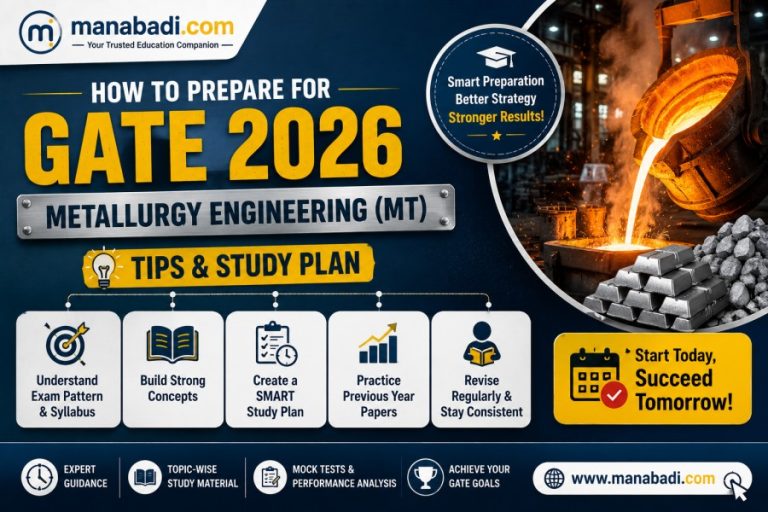
The GATE 2027 Metallurgical Engineering (paper code: MT) exam is tentatively scheduled for February 13, 2027, during the afternoon shift (2:30 PM to 5:30 PM). The broader examination window will span across the weekends of February 6–14, 2027.Metallurgy remains one of GATE’s lower-competition, high-opportunity papers – opening doors to MTech seats at IITs and NITs, core PSU jobs at SAIL and NMDC, and India’s growing steel, EV-materials, and aerospace-alloys sectors. This guide breaks down everything from exam pattern and marking scheme to syllabus, cutoffs, top institutes, and a realistic study plan – so you know exactly what to expect and how to prepare for it.
Why trust Manabadi for this? Manabadi has been one of India’s most relied-upon education portals for over 15 years, helping lakhs of students every month with verified results, exam updates, and exam-preparation guidance they can act on with confidence. Every detail in this guide – exam dates, marking scheme, cutoffs, and syllabus – is cross-checked against official sources.
Contents
What is GATE MT?
GATE (Graduate Aptitude Test in Engineering) is a national-level exam, jointly conducted by the IITs and IISc Bangalore on behalf of the National Coordination Board. It tests a candidate’s understanding of undergraduate-level engineering/science subjects, and the score is used for admission to M.Tech/M.S./Ph.D. programs at IITs, NITs, IIITs, and other GFTIs, as well as for recruitment into core PSUs like SAIL, NMDC, Hindustan Copper, BARC, and DRDO. Metallurgical Engineering carries the paper code MT.
For the 2026 cycle, GATE was conducted by IIT Guwahati. The exam was held over four days – 7, 8, 14, and 15 February 2026 – with the MT paper specifically scheduled on 14 February 2026, 2:30 PM to 5:30 PM.
Exam Mode and Duration
- Mode: Computer Based Test (CBT), conducted online at designated test centres
- Duration: 3 hours (180 minutes)
- Number of questions: 65
- Total marks: 100
- Question types: Multiple Choice Questions (MCQ), Multiple Select Questions (MSQ), and Numerical Answer Type (NAT) questions
Exam Pattern (Section-Wise)
| Section | Weightage |
| General Aptitude | 15% (~15 marks) |
| Engineering Mathematics | ~15% |
| Core Metallurgical Engineering subjects | ~85% combined (includes the subjects below) |
Within the core 85%, the broad distribution (based on recent-year trends) looks like this:
| Core Area | Approx. Weightage |
| Physical Metallurgy | ~20% |
| Mechanical Metallurgy | ~15% |
| Manufacturing Processes | ~10% |
| Metallurgical Thermodynamics | ~10% |
| Transport Phenomena & Rate Processes | ~10% |
| Mineral Processing & Extractive Metallurgy | ~5% |
| Engineering Mathematics | ~15% |
| General Aptitude | ~15% |
Marking Scheme
- MCQs: Carry 1 or 2 marks each. Negative marking applies – for 1-mark MCQs, 1/3 mark is deducted for a wrong answer; for 2-mark MCQs, 2/3 mark is deducted.
- MSQs (Multiple Select Questions): One or more options can be correct. No negative marking, but partial marking is not awarded either – you need to select all correct options.
- NAT (Numerical Answer Type): You type in a numerical value (no options given). No negative marking, but precision is critical since there’s no scope for guessing.
Marks vs Score vs Rank
This is where most students get confused, so here’s the clear breakdown:
- Marks: Your raw score out of 100, based on what you answered correctly/incorrectly.
- GATE Score: A normalized score out of 1000, calculated using a formula that accounts for difficulty variation when a paper is held across multiple sessions/shifts (MT is usually a single-session paper, so normalization impact is minimal compared to papers like CSE or ME).
- AIR (All India Rank): Your relative position among all candidates who appeared for that specific paper.
As a rough reference (based on recent-year MT trends, since competition in MT is comparatively low — around 3,000–4,000 candidates appear each year):
| Marks (out of 100) | Approx. Rank Range |
| 70+ | Top 50–100 (strong shot at IIT Bombay/Madras/Kharagpur) |
| 55–70 | Roughly 100–400 (good NITs, mid-tier IITs) |
| 40–55 | Roughly 400–1200 (newer IITs, several NITs) |
| Below 40 (near qualifying cutoff) | 1200+ |
These ranges are indicative only – actual rank depends heavily on that year’s paper difficulty and number of candidates, so treat this as a directional guide, not a guarantee.
GATE MT Cutoff Trends (Qualifying Marks, Out of 100)
| Year | General | OBC-NCL/EWS | SC/ST/PwD |
| 2025 | 40 | 35.6–36 | 26.6 |
| 2024 | 41 | 36.9 | 27.3 |
| 2023 | 47.5 | 42.7 | 31.6 |
Note the difference between qualifying cutoff (minimum marks just to get a valid scorecard) and admission cutoff (the much higher score actually needed to get a seat at a specific institute — set later by COAP/CCMT and individual institutes). Clearing the qualifying cutoff does not guarantee an admission seat.
Participating / Top Institutes for M.Tech in Metallurgy
Admission to IITs happens through COAP (Common Offer Acceptance Portal), and to NITs/IIITs/GFTIs through CCMT (Centralized Counselling for M.Tech). Leading institutes offering M.Tech/Metallurgy-Materials specializations through GATE MT include:
- IIT Bombay, IIT Madras, IIT Kharagpur, IIT Kanpur, IIT (ISM) Dhanbad — the traditional strongholds for Metallurgical and Materials Engineering
- IIT Roorkee, IIT (BHU) Varanasi, IIT Guwahati, IIT Hyderabad
- NIT Rourkela, NIT Trichy, NIT Warangal, NIT Jamshedpur — strong NIT options
- IISc Bangalore (for select Materials Engineering research programs)
PSUs that recruit through the GATE MT score include SAIL, NMDC, Hindustan Copper Limited, BARC, DRDO, and several state mining/metals corporations, typically through a GATE-score shortlist followed by an interview/GD round.
GATE MT Syllabus in Detail
The syllabus is divided into three broad parts: General Aptitude, Engineering Mathematics, and seven Core Metallurgy sections.
1. Engineering Mathematics
Linear algebra, calculus, differential equations, complex variables, probability and statistics, and numerical methods.
2. Metallurgical Thermodynamics
Laws of thermodynamics, thermodynamic functions and relations, phase equilibria, solution thermodynamics, Ellingham diagrams, chemical potential, and basic electrochemistry.
3. Transport Phenomena and Rate Processes
Momentum transfer (viscosity, Bernoulli’s equation, flow through pipes), heat transfer (conduction, convection, Fourier’s law, radiation, Stefan-Boltzmann law), mass transfer (Fick’s laws, mass transfer coefficients), dimensional analysis, and basic chemical kinetics (rate laws, oxidation kinetics, heterogeneous reactions).
4. Mineral Processing and Extractive Metallurgy
Comminution and sizing, mineral beneficiation techniques, roasting, smelting, refining, pyrometallurgy, hydrometallurgy, and electrometallurgy. Iron and steel making in detail — coke making, blast furnace ironmaking, alternative iron-making routes (COREX, MIDREX), primary steel making (basic oxygen furnace, process dynamics, oxidation reactions), secondary steelmaking, and casting.
5. Physical Metallurgy
Crystal structures of metals, alloys, ionic/covalent solids and polymers; X-ray diffraction and Bragg’s law; optical metallography and SEM imaging principles; crystal imperfections (point, line, surface defects); diffusion; phase diagrams (especially the Fe-C/Fe-Fe3C diagram); phase transformations; TTT and CCT diagrams; heat treatment of steels; electronic, magnetic, and optical properties of materials; and corrosion fundamentals and prevention.
6. Mechanical Metallurgy
Elastic and plastic deformation behaviour, stress-strain relationships, dislocation theory and strengthening mechanisms, fracture mechanics, fatigue (low-cycle and high-cycle, crack growth), and high-temperature deformation/creep and stress rupture behaviour.
7. Manufacturing Processes
Metal casting (solidification, casting defects), metal forming processes (rolling, forging, extrusion, wire drawing), welding metallurgy, and powder metallurgy (powder production, compaction, sintering).
8. General Aptitude
Verbal ability, reading comprehension, numerical ability, data interpretation, and logical reasoning — common across all 30 GATE papers.
Preparation Trips:
- Start with the official syllabus, not assumptions. Download the latest GATE MT syllabus PDF from the conducting institute’s website and break it into a topic-subtopic checklist before you plan anything.
- Prioritize the high-weightage zones. Physical Metallurgy, Mechanical Metallurgy, and Metallurgical Thermodynamics together account for the largest chunk of marks – give them proportionally more time than low-weightage areas like Mineral Processing.
- Don’t skip General Aptitude and Engineering Mathematics. Together they make up roughly 30% of the paper and are often the most scoring, low-effort-to-master sections – many candidates lose easy marks here simply by under-preparing.
- Master phase diagrams cold. The Fe-C diagram, TTT/CCT diagrams, and related transformations are tested almost every year, often as MSQs that require precise, detailed knowledge – practice drawing and labelling them from memory.
- Treat NAT questions as calculation drills. Thermodynamics, transport phenomena, and mechanical metallurgy numericals carry no negative marking but demand precision – daily numerical practice using a basic calculator (the same type allowed in the exam) builds speed and accuracy.
- Solve previous year question papers (PYQs) extensively. MT has a noticeably repetitive question pattern across years – analysing 8–10 years of PYQs will reveal recurring themes (Ellingham diagrams, dislocation theory, blast furnace reactions, etc.).
- Make concise, topic-wise short notes as you study, so revision in the final month doesn’t mean re-reading entire textbooks.
- Take regular mock tests under timed conditions to build exam-day stamina and sectional time management – 65 questions in 180 minutes leaves little room for getting stuck.
- Revise daily, not just before the exam. A rolling revision cycle (review what you studied a week ago, alongside new topics) retains concepts far better than last-minute cramming.
- Look after your health. Long study hours without breaks, sleep, or physical activity reduce retention and increase exam-day fatigue – don’t sacrifice basic wellbeing for extra hours that won’t actually help.
Study Plans for Different Types of Students
Study Plan A – For Final-Year B.Tech Students (Balancing College + GATE), ~8-10 Months
You have time, but also competing academic commitments, so consistency matters more than intensity.
- Months 1–4 (Foundation): Cover one core subject at a time alongside college classes – start with Physical Metallurgy and Metallurgical Thermodynamics since they’re foundational to other topics. Spend 2-3 hours daily on GATE prep alongside coursework. Make short notes as you go.
- Months 5–7 (Build-up): Move through Mechanical Metallurgy, Manufacturing Processes, Transport Phenomena, and Extractive Metallurgy. Start solving topic-wise PYQs after finishing each subject, not at the end.
- Month 8 (Integration): Cover Engineering Mathematics and General Aptitude fully if not already done. Begin full-length mock tests once a week.
- Months 9–10 (Revision & Mocks): Increase mock test frequency to 2-3 per week. Revise weak areas identified from mock test analysis. Do a final pass of formula sheets and phase diagrams in the last 2 weeks.
Study Plan B – For Working Professionals or Repeat Candidates (Limited Daily Hours), ~5-6 Months
You have less time per day but likely a stronger base if you’ve attempted before; the priority is high-yield, focused preparation.
- Weeks 1–4: Diagnostic test first to identify weak areas. Then prioritize the highest-weightage topics only — Physical Metallurgy, Mechanical Metallurgy, Thermodynamics – using 1.5-2 focused hours daily (early morning or late evening), no distractions.
- Weeks 5–10: Cover remaining core subjects (Manufacturing, Transport Phenomena, Extractive Metallurgy) using concise standard references, not exhaustive textbooks. Do PYQs immediately after each topic to lock in retention.
- Weeks 11–16: Engineering Mathematics + General Aptitude in parallel with revision of earlier topics (don’t leave these for the very end). Start weekly mock tests.
- Weeks 17–20 (Last month): Daily revision using your own notes only (not textbooks at this stage), 2-3 mock tests per week, and error-log review – track repeated mistakes and close those gaps specifically.
Study Plan C – For Dedicated/Drop-Year Aspirants (Full-Time Prep), ~10-12 Months from Scratch
You have the most time, so this plan builds maximum depth, plus a long, structured revision runway.
- Months 1–3 (Deep Foundation): Study each core subject thoroughly from standard textbooks (e.g., Avner’s “Introduction to Physical Metallurgy,” Dieter’s “Mechanical Metallurgy”) alongside class notes/standard GATE prep material. 6-8 hours daily split between new topics and basic problem-solving.
- Months 4–6 (Subject Completion + Practice): Finish all remaining core areas, including Extractive Metallurgy and Manufacturing Processes. Start subject-wise tests after each topic and maintain an error log from day one.
- Months 7–8 (Mathematics, Aptitude & Integration): Dedicate focused blocks to Engineering Mathematics and General Aptitude. Begin sectional mock tests, then move to full-length mocks twice a week.
- Months 9–10 (Intensive Mock Phase): 3-4 full-length mock tests weekly under strict, timed conditions. Deep-dive analysis after every mock – not just the score, but why each mistake happened.
- Months 11–12 (Final Revision): Pure revision – your own notes, formula sheets, PYQs (10+ years), and quick-recall flashcards for phase diagrams and reaction mechanisms. Taper mock frequency slightly in the final week to avoid burnout and focus on rest and confidence-building going into exam day.
Cracking GATE Metallurgical Engineering isn’t about studying the most hours – it’s about studying the right topics, in the right order, with consistent revision and disciplined mock-test practice. With comparatively lower competition than papers like CSE or ME, a focused 6–10-month plan built around Physical Metallurgy, Mechanical Metallurgy, Thermodynamics, and strong numerical practice can realistically take you to a top IIT/NIT seat or a core PSU career. Pick the study plan that matches your situation, stay consistent, and track your progress through regular mock tests rather than guesswork.
For more GATE updates, results, cutoffs, and branch-wise preparation guides, keep checking back with Manabadi – we’ll continue tracking every official notification, so you always have fast, accurate, and exam-ready information in one place.