



Home Blog Page 9

TS Inter 1st Year Economics Study Material Chapter 2 Theories of Consumer Behaviour

Long Answer Questions


Question 1.Describe the law of diminishing marginal utility, its limitations and importance?[Mar. ’16]


Answer:


Hermann Heinrich Gossen was the first economist to explain the law of diminishing marginal utility in 1854. It is also known as Gossen’s ‘first law’. In 1890, Marshall in his principles of economics developed and popularised this analysis. This law explains the functional relationship between the stock of commodity and the marginal utility of commodity.


According to Marshall, “The additional benefit which a person derives from a given increase of his stock of a thing diminishes with every increase in stock that he already has”.
“As a consumer increases the consumption of any one commodity, keeping constant the consumption of all other commodities, the marginal utility of the variable commodity must eventually decline”. Kenneth E.Boulding.
The law says that as we gone consuming a commodity, satisfaction that derives from its additional units goes on diminishing.


Assumptions :
1) Rationality :
Consumer is a rational man which means he always tries to get maximum satisfaction.
2) Cardinal Measurement of Utility :
Utility is a cardinal concept i.e., utility can be measured and compared numerically.
3) Utilities are Independent :
It implies that utility of any commodity depends on its own quantity.
4) Homogeneous :
Units of the commodity are similar in quantity, size, taste and colour etc.
5) No Time Lag :
There should not be any time lag between the consumption of one unit and other unit.
6) Constant Marginal Utility Unit :
It is assumed that the marginal utility of money remains constant.
7) Total & marginal utility :
Total utility: Total satisfaction obtained by the consumer from the consumption of a given quantity of commodity.
TUn = f(Qn)
Where, TUn = Total utility of n commodity,
f = functional relationship,
Qn = Quantity of n commodity.
Marginal utility :
Marginal utility is the addition made to the total utility by consum¬ing one more unit of the commodity.
It can be explained as :
MUn = TUn – TUn-1
MUn = Marginal utility of nth unit
TUn = Total utility of nth unit
TUn-1 = Total utility of n – 1 units.
MU may also be expressed as follows.
Marginal utility is the additional utility derived from the consumption of an extra unit of commodity.
MU = ΔTUΔC
Where, ∆TU = Change in total utility
∆C = Change in no. of units consumed.


Explanation of the law :
The law of diminishing marginal utility explains the relation between the quantity of goods consumed and its marginal utility. If a person goes on increasing his stock of a thing, the marginal utility derived from an additional unit declines. We show this tendency with an imaginary table given below.

Unit of X applesTotal utilityMarginal utility
14040 – 0 = 40
27070 – 40 = 30
39090 – 70 = 20
4100100 – 90 = 10
5100100 – 100 = 0
69090 – 100 = -10

In the table, let us suppose that one is fond of apples. As he consumes one apple after another he derives less and less satisfaction. The first unit is consumed with utmost pleasure. For the second, the intensity of his desire diminishes. The third will be still less and so on. The total utility increases until the consumption of fourth unit of good but at diminishing rate. Fifth unit of apple gives him maximum total utility. But, marginal utility becomes zero. Further consumption of sixth unit TU diminishes and MU becomes negative.
The relationship between total utility and marginal utility is explained in the following three ways :
1.When total utility increases at diminishing rate, marginal utility falls.
2.When total utility is maximum, marginal utility becomes zero.
3.When total utility decreases, marginal utility becomes negative.
This can be shown in the following diagram.
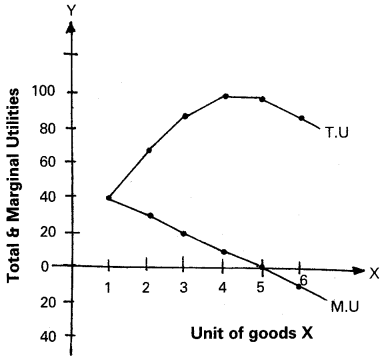
In the diagram, on ‘X’ axis measures units of apples and on Y axis measures total utility and marginal utility. TU curve represents total utility and MU curve represents marginal utility. TU curve is maximum at 5th unit where MU curve will become zero. TU curve slopes downwards from 6th unit, while MU become negative.


Limitations or Exceptions :


1) Hobbies :
This law does not operate in the case of hobbies like collection of stamps, old paintings, coins etc. Greater the collections of a person, greater is his satisfaction. Marginal utility will not diminish.
2) Drunkers :
It is pointed out that the consumption of liquor is not subject to the law of diminishing marginal utility. The more a person drinks liquor, the more he likes it.
3) Miser :
This law does not apply to money. The more money a person has the greater is the desire to acquire still more of it.
4) Further, this law does not hold good if there is any change in income tastes and preferences of the consumer.


Importance of the Law :


The importance of the law of diminishing marginal utility is as follows :
1.The law of diminishing marginal utility is the basic law of consumption and it is the basis for the law of demand, the law of equimarginal utility etc.
2.The changes in design, pattern and packing of goods will be brought by the producers by keeping this law in view.
3.The law explains the theory of value that the price of a good falls, when supply increases. Because with the increase in the stock of a good, its marginal utility diminishes.
4.Diamond-water paradox can be explained with the help of this law. Due to relative scarcity, diamonds possess high exchange value and less use value. Similarly, water is relatively abundant and so it posseses low exchange value but more use value.
5.This law helps the government while formulating taxation policies. The principle of progressive taxation is based on the law of diminishing marginal utility. This law is more useful in the policies of redistribution of income and wealth in favour of the poor people.

Question 2.Discuss the consumer’s equilibrium with the help of law of equimarginal utility?


Answer:


Law of equimarginal utility is an important law of consumption. It is called as “Gossen’s Second Law”, as its formulation is associated with the name of H.H. Gossen.

According to Marshall, “If a person has a thing which can be put to several uses, he will distribute it among these uses in such a way that it has the same marginal utility in all uses. If it had a greater marginal utility in one use than in another, he would gain by taking away some of it from the second and applying it to the first”.

According to this law the consumer has to distribute his money income on different uses in such a manner that the last rupee spent on each commodity gives him the same marginal utility. Equalisation of marginal utility in different uses will maximise his total satisfaction. Hence, this law is known as the “Law of equimarginal utility”.

The fundamental condition for consumer’s equilibrium can be explained in the following way.
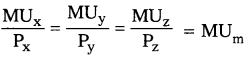
Where, MUx, MUy, MUz, MUm = Marginal utilities of commodities x, y, z, money (m), and Px, Py, Pz = Prices of x, y, z goods.
This law can be explained with the help of a table. Suppose the consumer is prepared to spend his money income is ₹ 26/- on two goods say X and Y. Market prices of two goods are ₹4/- & ₹ 5/- respectively. Now the marginal utilities of good X, good Y are shown below.
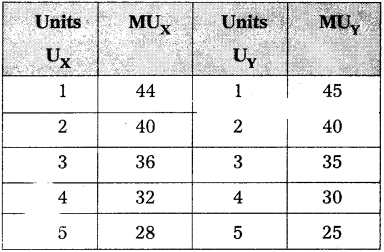
For explaining consumer’s maximum satisfaction and consequent equilibrium position we need to reconstruct the above table by dividing marginal utilities of X by its price ₹ 4/- and marginal utility of Y by ₹ 5/-. This is shown in the following table.
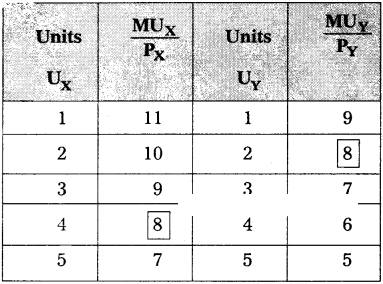

In the table it is clear that when consumer purchases 4 units of goods X & 2 units of good Y. Therefore, Consumer will be in equilibrium when he is spending (4 × 4 = 16 + 2 × 5 = 10) ₹ 26/- on them.


Assumptions of the law :


The law of equimarginal utility depends on the following assumptions.
1.This law is based on cardinal measurement of utility.
2.Consumer is a rational man always aiming at maximum satisfaction.
3.The marginal utility of money remains constant.
4.Consumer’s income is limited and he is proposed to spent the entire amount on different goods.
5.The price of goods are unchanged.
6.Utility derived from one commodity is independent of the utility of the other commodity.


Limitations of the law :


The law of equimarginal utility has been subject to certain limitations which are as given below :
1.The law assumes that consumer is a rational man and always tries to get maximum satisfaction. But, in real life, several obstacles may obstruct rational behaviour.
2.This law is not applicable when goods are indivisible.
3.The law is based on unrealistic assumptions like cardinal measurement of utility and marginal utility of money remains constant. In real world, MU of money does not remain constant.
4.This law will not be applicable to complementary goods.
5.Another limitations of this law is that there is no fixed accounting period for the consumer in which he can buy and consume goods.


Importance of the Law :


The law of equimarginal utility is of great practical importance in economics.
1) Basis of Consumer Expenditure :
The expenditure pattern of every consumer is based on this law.
2) Basis for Savings and Consumption :
A prudent consumer will try to distribute his limited means between present and future consumption so as to have equal marginal utility in each. This is how the law guides us.
3) In the Field of Production :
To the businessman and the manufacturer the law is of special importance. He works towards the most economical combination of the factors of production. For this he will substitute one factor for another till their marginal productivities are the same.
4) Its application to Exchange :
In all our exchanges, this law works. Exchange is nothing but substitution of one thing for another.
5) Price Determination :
This principle has an important bearing on the determina¬tion of value and price.
6) Public Finance :
Public expenditure of a government conforms to this law. Taxes are also levied in such a manner that the marginal sacrifice of each tax payer is equal.

Question 3.Illustrate the consumer’s equilibrium using indifference curve analysis. [Mar. 17, 16]?


Answer:


A consumer is said to be in equilibrium with given his tastes, prices of the two goods and income on the purchase of two goods in such a way so as to get the maximum satisfaction


I. Assumptions :


The analysis of consumers equilibrium is based on the following assumptions :
1.Consumer has an indifference map showing his scale of preferences which remains the same throughout the analysis.
2.Money income is given and constant.
3.Prices of the two goods are given and constant.
4.The consumer is rational and thus maximizes his satisfaction.
5.There is no change in tastes, preferences and habits of the consumer.
6.There is a perfect competition in the goods market.


II. Conditions of Equilibrium :


There are two conditions that must be satisfied for the consumer to be in equilibrium. These are : i) At the point of equilibrium, the budget / price line must be tangent to the indifference curve at its minimum point, ii) At the point of equilibrium, the consumer’s MRSxy and the price ratio must be equal, i.e. MRSXY = Px/Py.
This can be shown in the following diagram.
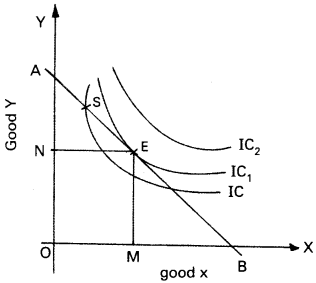
In the diagram ‘AB’ is consumer’s budget or price line. IC, IC1, IC2 are indifference curves. In the diagram the consumer is equilibrium at OM of x and ON of y. At point E the price line touches to ‘O’ IC1. At point ‘S’ consumer will be on lower indifference curve IC and will be an getting lesser satisfaction than at E on IC. IC2 is beyond the capacity of consumer. So it is outside to the budget line.

Short Answer Questions


Question 1.


Explain the concept of utility analysis. What are its shortcomings?


Answer:


The concept of utility was introduced in economic thought by Jevans in 1871. In a general sense, utility is the want satisfying power’ of a commodity or service. In economic sense, utility is a psychological phenomenon. It is a feeling of satisfaction, a consumer derives from the consumption of a commodity. Utility has nothing to do with usefulness. Utility and usefulness are different. A commodity may satisfy a human want but it may not be useful. For example, wine is harmful to health but satisfies the want of a drunkard. Whether the good is useful or not, if it satisfies a human want we can say that it possesses utility.
Utility is a subjective concept. It differs from person to person, from time to time and place to place. As regards to the measurement of utility, there are two different approaches :

  1. Cardinal utility and
  2. Ordinal utility. Let us introduce then in brief.
    Shortcomings of Utility Analysis :
    The following are the main defects pointed out on utility analysis.
    1.Cardinal measurement is not possible.
    2.Assumption of rational consumer is not correct.
    3.Wrong assumption of independent utilities. Utility of a good depends on other goods also.
    4.Assumption of constant marginal utility of money is wrong.
    5.One commodity model is unrealistic.
    6.Income effect, price effect and substitution effect are not clearly brought out.
    7.This analysis fails to explain the demand for indivisible goods.

Question 2.Explain the concepts of Cardinal Utility, Ordinal Utility, Total Utility and Marginal Utility?


Answer:


The concept of utility was introduced in economic thought by Jevans in 1871. In a general sense, utility is the ‘want satisfying power’ of a commodity or service. In economic sense, utility is a psychological phenomenon.


1) Cardinal utility :


Utility is cardinal in the sense that utility is measurable in terms of units called utils. According to the concept of cardinal utility, the utility derived from the consumption of a good can be expressed in terms of numbers such as 1, 2, 3, 4 and so on. For example, a person can say that he derives utility equal to 10 utils from the consumption of one unit of commodity A and 5 utils from the consumption of one unit of commodity B. He can compare different commodities and express which commodity gives him more util¬ity or satisfaction and by how much. Alfred Marshall followed this approach. The law of diminishing marginal utility and the law of equi-marginal utility are based on cardinal utility approach.


2) Ordinal utility :


Utility is ordinal in the sense that utilities derived from the consumption of commodities cannot be measured quantitatively but can be compared by giving ranks. It means that the utilities obtained by the consumer from different commodities can be arranged in a serial order such as 1st, 2nd, 3rd, 4th etc. These numbers tell us that the second number is more than the first number. But, it is not possible to tell how much, because they are not measurable. J.R. Hicks and R.J.D. Allen have used the ordinal approach. The indifference curve analysis is based on ordinal utility approach.


3) Total Utility and Marginal Utility :


a) Total Utility : Total utility is the total amount of satisfaction which a person gets from the consumption of all units of the commodity. Let us assume that a consumer con-sumed 3 apples and first apple gave him 20 utils of utility, second one 15 utils and the third one 10 utils of utility. By adding these utilities we get the total utility, ie., 20 + 15 + 10 = 45. When the quantity of consumption increases total utility also increases but at a diminishing rate. The total utility is a function of total quantity.
TUn = f(Qn)
Where TUn = Total utility of n commodity,
f = functional relationship, and
Qn = Quantity of n commodity.


b) Marginal Utility :
Marginal utility is the addition made to the total utility by consuming one more unit of the commodity. Let us assume that one apple gives 20 utils of utility and 2 apples gives 35 utils of utility. It means that the additional utility from the second apple is 15 utils i.e., 35 – 20 = 15. This is called marginal utility. It can be expressed
MUn = TUn – TUn-1
where, MUn = Marginal utility of nth unit, TUn = Total utility of nth units, and
TUn-1 = Total utility of n – 1 units.
In the example, marginal utility of the second unit is equal to
MU2 = TU2 – TU1 = 35 – 20 = 15
Marginal utility can also be expressed in the following way :

By adding all the marginal utilities of different units of the commodity, we get total utility.

Question 3.Define the law of diminishing Marginal Utility. State its assumptions?


Answer:


The law of diminishing marginal utility was originally explained by Hermann Heinrich Gossen in 1854. Jevans called it as Gossen’s first law. But Alfred Marshall popularised this law and analysed it in a scientific manner.
Definitions of the law :
“The additional benefit which a person derives from a given increase of his stock of a thing diminishes with every increase in stock that he already has” – Alfred Marshall.
Assumptions :
The law is based on the following assumptions :
1) Rationality :
The consumer is a rational human being in the sense that he seeks to maximize his satisfaction.
2) Cardinal Measurement of Utility :
Utility is a cardinal concept, i.e. utility is measurable quantitatively. It can be measured in cardinal numbers.
3) Independent Utility :
The utility of any commodity depends on its own quantity, i.e. utility of goods are independent.
4) Constant Marginal Utility of Money :
The marginal utility of money remains constant.
5) Homogeneous Goods :
Goods are homogeneous in the sense that they are alike both quantitatively and qualitatively.
6) Uniform Size of Goods :
Goods should be of suitable size, i.e. neither too big nor too small. They should be identical.
7) No Time Lag :
There is no time lag between the consumption of one unit to another unit.
8) Divisible Commodity :
Commodity is divisible.
9) No Change in Consumer Behaviour :
The income, tastes and preference of the consumer should remain constant.
10) Full Knowledge of the Market :

Question 3.Define the law of diminishing Marginal Utility. State its assumptions?


Answer:


The law of diminishing marginal utility was originally explained by Hermann Heinrich Gossen in 1854. Jevans called it as Gossen’s first law. But Alfred Marshall popularised this law and analysed it in a scientific manner.
Definitions of the law :
“The additional benefit which a person derives from a given increase of his stock of a thing diminishes with every increase in stock that he already has” – Alfred Marshall.
Assumptions :
The law is based on the following assumptions :
1) Rationality :
The consumer is a rational human being in the sense that he seeks to maximize his satisfaction.
2) Cardinal Measurement of Utility :
Utility is a cardinal concept, i.e. utility is measurable quantitatively. It can be measured in cardinal numbers.
3) Independent Utility :
The utility of any commodity depends on its own quantity, i.e. utility of goods are independent.
4) Constant Marginal Utility of Money :
The marginal utility of money remains constant.
5) Homogeneous Goods :
Goods are homogeneous in the sense that they are alike both quantitatively and qualitatively.
6) Uniform Size of Goods :
Goods should be of suitable size, i.e. neither too big nor too small. They should be identical.
7) No Time Lag :
There is no time lag between the consumption of one unit to another unit.
8) Divisible Commodity :
Commodity is divisible.
9) No Change in Consumer Behaviour :
The income, tastes and preference of the consumer should remain constant.
10) Full Knowledge of the Market :

Question 5.


Explain the concept of law ofequi-marginal utility. Point out its assumptions?


Answer:


This is an important law of consumption and was derived from the law of diminishing marginal utility. It is known by various names such as the law of equi-marginal utility, the law of substitution, the law of maximum satisfaction etc. It is also called as Gossen’s Second Law as its formulation is associated with the name of H.H. Gossen. The law of diminishing marginal utility explains the consumer’s behaviour, consuming only one good. But in actual life, consumer buys a certain combination of goods with his limited income and maximises utility. The law of equimarginal utility explains the same.
Definition of the Law :
“If a person has a thing which can be put to several uses, he will distribute it among these uses in such a way that it has the same marginal utility in all. If it has a greater marginal utility in one use than in another, he would gain by taking away some of it from the second and applying it to the first.” – Alfred Marshall.
Assumptions of the Law :
The law of equimarginal utility depends on the following assumptions :
1.Cardinal measurement of utility is assumed.
2.Rationality on the part of the consumer so as to get maximum satisfaction and to attain equilibrium is also assumed.
3.Marginal utility of money remains constant.
4.The income of the consumer is given and remains constant and he spends entire amount on different goods.
5.The prices of goods are given and constant.
6.Utilities are independent.

Question 6.Discuss the limitations and importance of law of equimarginal utility?


Answer:


Definition of the Law :
“If a person has a thing which can be put to several uses, he will distribute it among these uses in such a way that it has the same marginal utility in all. If it has a greater marginal utility in one use than in another, he would gain by taking away some of it from the second and applying it to the first.” -Alfred Marshall.


Limitations of the Law of EquiMarginal Utility :


The equimarginal principle is subject to certain limitations which may be set forth hereunder :
1.The law is based upon the assumption of rationality on part of the consumer. But in real life, several obstacles may obstruct rational behaviour.
2.This law works out fully only if the goods are divisible. If goods happen to be large and indivisible, it is not possible to equate the marginal utility of money spent on them.
3.Non availability of certain goods prevents the consumers from maximizing their satisfaction out of their expenditure. Therefore, the law fails to work.
4.Prices of goods often fluctuate in the market with the result that their utilities also keep changing from time to time. This prevents the working of the law.
5.The law of maximum satisfaction will not be applicable to complementary goods.
6.Another limitation of this law is that there is no fixed accounting period for the consumer in which he can buy and consume goods.
7.Cardinal measurement of utility, marginal utility of money remaining constant etc., are not realistic assumptions. They are not valid.
8.It is assumed that the consumer has a perfect knowledge. But this is not correct.
Importance of the Law :
The law of equimarginal utility is of great practical importance in economics.
1) Basis of Consumer Expenditure :
The expenditure pattern of every consumer is based on this law.
2) Basis for Savings and Consumption :
A prudent consumer will try to distribute his limited means between present and future consumption so as to have equal marginal utility in each. This is how the law guides us.
3) In the Field of Production :
To the businessman and the manufacturer the law is of special importance. He works towards the most economical combination of the factors of production. For this he will substitute one factor for another till their marginal productivities are the same.
4) Its application to Exchange :
In all our exchanges, this law works. Exchange is nothing but substitution of one thing for another.
5) Price Determination :
This principle has an important bearing on the determina¬tion of value and price.
6) Public Finance :
Public expenditure of a government conforms to this law. Taxes are also levied in such a manner that the marginal sacrifice of each tax payer is equal.


Question 7.What is an indifference curve? What are its assumptions?


Answer:


Indifference curve :
An indifference curve represents satisfaction of a consumer from two commodities. An IC curve can be defined as the locus of points each representing a different combination of two goods yielding the same level of satisfaction.
Assumptions :
1) Rationality :
It is assumed that the consumer tries to obtain maximum satisfaction from his expenditure.
2) Scale of preference :
Consumer is able to arrange the available combinations of goods according to scale of preference.
3) Ordinal utility :
It assumes ordinal utility approach. So utility is in measurable only ordinal terms i.e., 1st, 2nd, 3rd etc.
4) Diminishing marginal rate of substitution :
It is the rate at which a consumer is willing to substitute commodity to another. So that this satisfaction remains the same.
5) Consistency :
Consumer’s choices have to be consistent. It means if consumer prefers A to B and B to C his choice reflects his rationality.
6) Completeness :
The consumer’s scale of preferences is to complete that he is able to choose any one of the two combinations of commodities presented to him.


Question 8.Explain the concept of indifference curve. Discuss its properties?


Answer:


An indifference curve can be defined as the locus of points each representing a different combination of two goods yielding the same utility or level of satisfaction. Therefore, a consumer is indifferent between any two combinations of goods when it comes to making a choice between them. It is also called iso – utility curve or equal utility curve.
Indifference Schedule :
An indifference curve is drawn on the basis of an ‘indifference schedule’. It may be defined as a schedule of various combinations of two goods which yields same level of satisfaction.

CombinationsCommodity XCommodity Y
11+15
22+11
33+8
44+6
55+5

The table shows five combination of two goods, X and Y, which give the same utility. The consumer’s satisfaction from 1st combination (1 unit of X + 15 units of Y) is the same as that of other combina- o tion i.e., 2nd, 3rd, 4th and 5th. Since all combinations yield the same level of satisfac- g tion, the consumer is indifferent among these combinations.
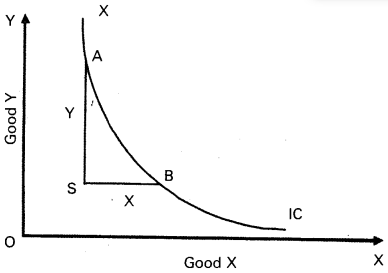


Indifference Curve :


Basing on the indifference schedule, we can draw an indifference curve.
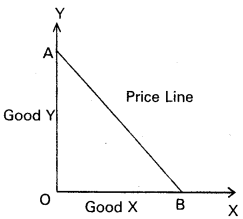

In the above figure, good X is measured on the OX-axis. Good Y is measured on OY – axis. Consumer’s utility at point a on the IC with 1 unit of good X and 15 units of good Y, is equal to the utility at point b with 2 units of X and 11 units of Y or at point C with 3X and 8Y and so on. These combinations give him the same level of satisfaction. If we join the points a, b, c, d and e, we get an indifference curve (TC) and utility as all points on this curve are same. Hence, the consumer is indifferent regarding the combinations.
When the consumer moves from A to B on IC, he gives up AS of Y (∆Y) for SB of X (∆X).


Properties of Indifference Curves :
Indifference curves have the following basic properties :
1) An indifference curve is negatively sloped towards down. It implies that when the amount of one good in combination is increased, the amount of other good is reduced. This is essential if the level of satisfaction is to remain the same on an indifference curve. It is neither positively sloped towards up nor horizontal.
2) Indifference curves are always convex to the origin. The convexity rule implies diminishing marginal rate of substitution. Indifference curves cannot be concave to the origin.
3) Indifference curves can never intersect each other. If two IC curves intersect, it would imply that an indifference curve indicates two different levels of satisfaction. It is not proper.
4) A higher indifference curve represents a higher level of satisfaction than a lower indifference curve. In other words, an IC to the right represents more satisfaction. This is because of combinations lying on a higher IC contain more of either one or both goods. Similarly, an indifference curve to the left represents less satisfaction.

Question 9.How do you define Budget line of the consumer?


Answer:


The budget line or price line shows all possible combinations of two goods that a consumer can buy with the given income and prices of the two goods.
The concept of budget / price line will be shown in the following example. Suppose that a consumer has ₹ 150 (income) to buy two goods namely X and Y. Whose prices are ₹ 15 and ₹ 30 each. With the given information now we can draw the budget or price line as shown in the diagram.In the diagram AB’ is the ‘budget or price line’.
The slope of the line AB represents the ratio of the prices of X and Y in such a manner that 10 of X will be equal to 5 of Y.

Very Short Answer Questions


Question 1.Define Utility?


Answer:

The want satisfying power or capacity of a commodity or service is known as utility. It is the basis of consumer’s demand for a commodity.


Question 2.Explain Cardinal utility. [Mar. 17]?


Answer:


Alfred Marshall developed cardinal utility analysis. According to this analysis, the utilities derived from consumption of different commodities can be measured in terms of arbitary units called utils. 1, 2, 3, 4 are called cardinal numbers.


Question 3.Explain Ordinal utility?


Answer:


This was developed by J.R. Hicks, Allen. Utility is subjective and measurement of utility in numerical terms is not possible. We can observe the preference for one good more than for another. Ordinal numbers such as 1st, 2nd, 3rd etc. The ordinal numbers are ranked.


Question 4.Explain Total utility?


Answer:


Total utility is the total amount of utility which a consumer derives from a given stock of a commodity.
TUn = f(Qn)


Question 5.


Define Marginal utility?


Answer:


Marginal utility is the additional utility obtained from the consumption of additional unit of the commodity.
MUn = TUn – TU(n-1)
(or)
MU = ΔTUΔQ

Question 6.


What is Price Line / budget line?


Answer:


It shows all possible combinations of two goods that a consumer can buy, with the given income and prices of the two goods.


Question 7.


Explain law of diminishing marginal utility?


Answer:


The law of diminishing marginal utility is based on the fact that though human wants are unlimited, but any particular want is satisfiable. This law analyses consumers’ behaviour in case of a single good. If a person goes on consuming more and more units of a commodity, the additional utility he derives from the additional units of the commodity goes on diminishing. This phenomenon of human behaviour is explained by this law. The law of diminishing marginal utility explains the relationship between the quantity of goods consumed and the utility derived.


Question 8.Explain law of equi-marginal utility?


Answer:


The law states that a consumer having a fixed income and facing given market prices of goods will achieve maximum satisfaction when the marginal utility of the last rupee spent on each good is exactly the same as the marginal utility of the last rupee spent on any other good. Equalisation of marginal utilities will maximize the consumer’s satisfaction and consumer attains equilibrium. The fundamental condition for consumer’s maximum satisfaction and equilibrium of the consumer.


Question 9.What is scale of preference?


Answer:


Guides the consumer in his purchases


Question 10.Explain Marginal rate of substitution?


Answer:


The additional amount of one product required to compensate a consumer for a small decrease in the quantity of another, per unit of the decrease.
This can be explained with the help of table.
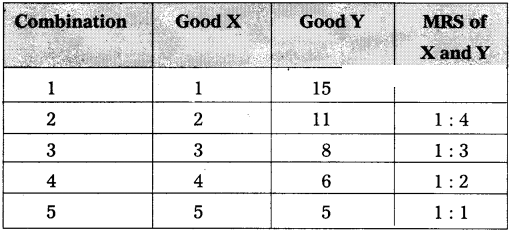
By the table, the consumer is ready to sacrifice 4 units of Y to get 1 more unit of X. The MRSX for diminishes.

Question 11.Draw the indifference map?


Answer:


A set of indifference curves drawn for different income levels is called indifference map
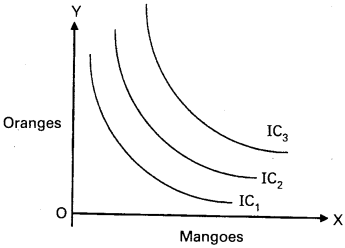
From the above diagram it is clear that an indifference map of IC1, IC2, IC3. Each curve shows a certain level of satisfaction to the consumer.

Question 12.Explain the relationship between total utility and marginal utility?


Answer:


The relationship between total utility and marginal utility is explained in three ways.
They are :

  1. When total utility increases at a diminishing rate, marginal utility falls.
  2. When total utility is maximum, marginal utility becomes zero.
  3. When total utility decreases, marginal utility becomes negative.

Question 13.Write in brief, about the properties of indifference curves?


Answer:


It represents the satisfaction of a consumer from two goods of various combinations. It is drawn and the assumption that for all possible combinations of the two goods on an indifference curve, the satisfaction level remains the same.

TS Inter 1st Year Study Material Textbook Solutions PDF Download: Telangana Board Intermediate I Year Books at manabadi.co.in

The Telangana State Board of Intermediate Education (TSBIE) plays a crucial role in shaping the academic future of Intermediate students. For Class 11 (Inter 1st Year) students, having the right study material is essential to build strong fundamentals for competitive exams and higher education. To support students, manabadi.co.in provides easy access to TS Inter 1st Year Textbook Solutions PDF downloads for all subjects.

In this article, you will find complete details about TS Inter 1st Year textbooks, subject-wise solutions, benefits of PDFs, exam preparation tips, and how to download Intermediate I Year books online.

Subjects Covered in TS SCERT Inter 1st Year Textbook Solutions

TS Inter provides solutions for all major Intermediate subjects, including Mathematics, Physics, Chemistry, Biology, Economics, Commerce, Accountancy, History, Political Science, and Languages. Both Telugu and English medium students can access subject-wise solutions according to their curriculum needs.

Subject NameSolutions
MathematicsMathematics Inter 1st Year Textbook Solutions
PhysicsPhysics Inter 1st Year Textbook Solutions
ChemistryChemistry Inter 1st Year Textbook Solutions
BiologyBiology Inter 1st Year Textbook Solutions
BotanyBotany Inter 1st Year Textbook Solutions
ZoologyZoology Inter 1st Year Textbook Solutions
EconomicsEconomics Inter 1st Year Textbook Solutions
CommerceCommerce Inter 1st Year Textbook Solutions
AccountancyAccountancy Inter 1st Year Textbook Solutions
HistoryHistory Inter 1st Year Textbook Solutions
Political SciencePolitical Science Inter 1st Year Textbook Solutions
EnglishEnglish Inter 1st Year Textbook Solutions

About TS Inter 1st Year (Intermediate I Year)

The TS Intermediate 1st Year course is the foundation stage after Class 10 and is offered in different streams such as:

  • MPC (Maths, Physics, Chemistry)
  • BiPC (Biology, Physics, Chemistry)
  • MEC (Maths, Economics, Commerce)
  • CEC (Civics, Economics, Commerce)
  • HEC (History, Economics, Commerce)
  • Vocational Courses

The syllabus is designed by TSBIE to prepare students for board exams as well as entrance tests like TS EAPCET, NEET, JEE, CA Foundation, and other competitive exams.

Importance of TS Inter 1st Year Textbook Solutions

Textbook solutions are an essential learning resource for students aiming to score high marks. The TS Inter 1st Year Textbook Solutions PDFs available at manabadi.co.in help students in the following ways:

  • Clear explanation of concepts in simple language
  • Step-by-step answers as per board exam pattern
  • Helpful for self-study and revision
  • Improves answer-writing skills
  • Useful for exam-oriented preparation

By regularly practicing textbook solutions, students can gain confidence and accuracy in answering questions.

TS Inter 1st Year Subjects – Stream Wise

Science Stream (MPC & BiPC)

  • Mathematics IA
  • Mathematics IB
  • Physics
  • Chemistry
  • Botany
  • Zoology
  • English

Commerce & Arts Stream

  • Economics
  • Commerce
  • Civics
  • History
  • Sociology
  • Logic
  • Public Administration
  • English

All subject-wise Intermediate I Year textbook solutions PDFs are prepared according to the latest TSBIE syllabus.

TS Inter 1st Year Maths Textbook Solutions PDF

Mathematics is a scoring subject for MPC and MEC students. The TS Inter 1st Year Maths syllabus is divided into Maths IA and Maths IB.

Topics Covered:

  • Sets and Functions
  • Mathematical Induction
  • Trigonometric Functions
  • Complex Numbers
  • Permutations and Combinations
  • Straight Lines
  • Circles

The Maths solutions PDFs at manabadi.co.in provide detailed step-by-step answers, making problem-solving easier for students.

TS Inter 1st Year Physics Textbook Solutions PDF

Physics requires conceptual clarity and numerical practice. The Physics textbook solutions help students understand theories, laws, and numerical problems.

Key Units:

  • Physical World and Measurement
  • Laws of Motion
  • Work, Energy, and Power
  • Motion of System of Particles
  • Oscillations and Waves

These solutions are ideal for board exams and entrance test preparation.

TS Inter 1st Year Chemistry Textbook Solutions PDF

Chemistry is divided into Physical, Organic, and Inorganic Chemistry. Proper explanations are essential to understand reactions and formulas.

Important Chapters:

  • Atomic Structure
  • Chemical Bonding
  • States of Matter
  • Thermodynamics
  • Organic Chemistry – Basic Principles

The solutions PDFs provide clear reaction mechanisms and solved numerical problems.

TS Inter 1st Year Biology Textbook Solutions PDF

BiPC students can download Botany and Zoology solutions in PDF format.

Botany Topics:

  • Living World
  • Plant Kingdom
  • Morphology of Flowering Plants

Zoology Topics:

  • Animal Kingdom
  • Structural Organisation in Animals
  • Human Physiology

These solutions help in understanding diagrams, definitions, and long-answer questions.

TS Inter 1st Year Commerce, Economics & Arts Subjects Solutions

For MEC, CEC, and HEC students, textbook solutions are available for:

  • Economics (Micro Economics basics)
  • Commerce (Business fundamentals)
  • Civics (Political Science concepts)
  • History (Indian and World History)
  • Sociology & Logic

The content is written in a student-friendly manner, ensuring conceptual clarity and exam readiness.

TS Inter 1st Year English Textbook Solutions PDF

English is a compulsory subject for all streams. The English textbook solutions include:

  • Prose explanations
  • Poetry summaries
  • Grammar answers
  • Short and long questions

These PDFs help improve language skills and writing techniques.

How to Download TS Inter 1st Year Textbook Solutions PDF from manabadi.co.in

Follow these simple steps:

  1. Visit manabadi.co.in
  2. Search for “TS Inter 1st Year Textbook Solutions”
  3. Select your stream and subject
  4. Click on the PDF download link
  5. Save the file for offline use

The website provides latest and updated study material for Telangana Intermediate students.

Exam Preparation Tips for TS Inter 1st Year Students

  • Read textbooks thoroughly before referring to solutions
  • Practice numerical problems daily
  • Prepare short notes for revision
  • Solve previous years’ question papers
  • Focus on weak subjects
  • Follow a proper study timetable

Using textbook solutions along with regular practice can significantly improve exam performance.

TS Inter 1st Year Economics Study Material Chapter 1 Introduction to Economics

Long Answer Questions


Question 1.Examine the wealth and welfare definitions of Economics?


Answer:


Wealth Definition :


Adam Smith was the first person to give a precise definition of Economics and separate this study from other social sciences. Adam Smith is considered as ‘Father of Economics’. He defined it in his famous book Wealth of Nations’, as “An enquiry into the nature and causes of wealth of nations”. Most of the economists in the 19th century held this view.
J.B. Say states that “The aim of political economy is to show the way in which wealth is produced, distributed and consumed”. The other economists who supported this definition are J.B. Say, J.S. Mill, Walker and others.


The main features of Wealth definition :


1.Acquisition of wealth is considered as the main objective of human activity.
2.Wealth means material things.
3.Human beings are guided by self-interest, whose objective is to accumulate more and more wealth.
4.Economics deals with the activities of wealth production, consumption, preservation and increasing.
Criticism :
The Wealth definition was severely criticised by many writers due to its defects.
1.Economists like Carlyle and Ruskin pointed out that economics must discuss ordinary man’s activities. So they called it as a ‘Dismal Science’.
2.In Adam Smith’s definition, wealth was considered to consist of only material things and services are not included. Due to this the scope of economics is limited.
3.Marshall pointed out wealth is only a means to an end but not an end in itself.
4.This definition concentrated mainly on the production side and neglected distribution side.
Welfare definition :
Alfred Marshall tried to remedy the defects of wealth definition in 1890. He shifted emphasis from production of wealth to distribution of wealth.
According to Marshall, “Political Economy or Economics is a study of mankind in the ordinary business of life. It examines that part of individual and social action which is most closely connected with the attainment and with the use of material requisites of well-being. Thus, Economics is on one side, a study of wealth and on the other and more important side, a part of study of man”.
Edwin Cannan defined it as “The aim of political economy is the explanation of the general causes on which the material welfare of human beings depends”.
In the words of Pigou, “The range of enquiry becomes restricted to that part of social welfare that can be brought directly or indirectly into relation with the measuring rod of money”.


The main features of Welfare definition :


1.Economics as a social science is concerned with man’s ordinary business of life.
2.Economics studies only economic aspects of human life and it has no concern with the social, political and religious aspects of human life. It examines that part of individual and social action which is closely connected with acquisition and use of material wealth for promotion of human welfare.
3.According to Marshall, the activities which contribute to material welfare are considered as economic activities.
4.He gave primary importance to man and his welfare and to wealth as means for the promotion of human welfare.


Criticism :


1.Robbins criticised Marshalls economics as a ’social science’ rather than a human science, which includes the study of actions of every human being.
2.Marshalls definition mainly concentrated on the welfare derived from material things only. But non – materialistic goods which are also very important for the well being of the people. Hence, it is incomplete.
3.Critics pointed out that quantitative measurement of welfare is not possible. Welfare is a subjective concept and relative concept and changes according to time, place and persons.
4.According to Marshall, economics deals with those activities which will promote human welfare. But production of alcohol and drugs do not promote human welfare. Hence, the scope of economics is limited.
5.Another important criticism is that it is not concerned with the fundamental problem of scarcity of resources. According to Robbins the economic problem arises due to unlimited wants and limited resources. These factors are ignored in this definition.

Question 2.Critically examine the scarcity definition of economics?


Answer:


Marshall’s Welfare definition until the publication of Lionel Robbins’ book “An Essay on the Nature and Significance of Economic Science” in 1932. Robbins’ definition brought out the logical inconsistencies and inadequacies of the earlier definitions and formulated his own definition of economics. He has given a more scientific definition of economics. In the words of Robbins, “Economics is the science which studies human behavior as a relationship between ends and scarce means which have alternative uses”.


I. Main Features:


1) Human Wants are Unlimited :
The fulfillment of one want gives rise to a number of new wants.
2) Means are Scarce :
The means of a person by which his wants may be satisfied are limited. It leads to economic problems as all wants cannot be satisfied by these limited means.
3) Alternative Uses of Scarce Means :
Resources are not only scare but also have multiple uses. For example electricity can be used in homes and also in industries. A piece of land can be used to produce rice or wheat. If a scarce factor is used for the satisfaction of one want, less of it will be available for other wants. Hence, man has to make a decision regarding the alternative uses of resources.
4) Man has therefore to choose between wants. Problem of choice arises.
II. Superiority of Robbins’ Definition :
Robbins’ definition is superior to the earlier definitions in more than one way. The reasons are given below :
1.It is non-classificatory, as it includes all human activities whether they promote human welfare or not.
2.This is a universally accepted definition. It is applicable to all types of societies, because the scarcity of resources is felt by individuals as well as societies.
3.Robbins’ definition of economics is neutral between ends. Being a positive science it does not pass any value judgments regarding ends.
III. Criticism :
Some followers of Marshall like Durban, Fraser, Beveridge and Wootton have criticised Robbins’ definition by saying that it lacks human touch and that it is personal, neutral and devoid of any normative or ethical element. He does not seek to make economics a study of human welfare. Some of them criticized as “barren scholasticism” while others accused him of “behaviourism”.
1.Even though Robbins criticized Marshall’s welfare definition, he has introduced the welfare concept indirectly in his definition. Therefore, the criticism of welfare definition is equally applicable to it.
2.Another criticism of Robbins’ definition is that this definition does not distinguish between ‘ends’ and ‘means’.
3.Scarcity definition has been criticized by economists as to say “economics is neutral between ends”. But economics cannot be neutral between ends.
4.Robbins made economics a positive science. As per Macfie, “economics is fundamentally a normative science, not merely positive science like chemistry”.
5.Robbins’ definition is not applicable to a dynamic society where changes take place and the problem of scarcity of resources can be overcome with the passage of time.
6.Mrs. Joan Robbinson took serious objection to scarcity of resources. How best you utilize them is more important than the idle resources.
7.Robbins’ scarcity definition neglects the more important problems of growth and stability.

Question 3.Explain the nature and scope of Economics?


Answer:


The nature of economics took a definite shape with the writings of Adam Smith, known as Father of Economics, made a beginning in defining economics and its scope with the publication of his famous book on the wealth of nations. Then a number of economists defined economics and its subject matter in different ways.
The scope of any science explains what the science is concerned with. In economics, traditional economic theory is divided into various branches like consmption, production, exchange, distribution, income, employment, planning and development; where as modem economic theory is divided into two branches viz. micro economics and macro economics.


Economics not only explains things as they are, but also elucidates with what it ought to be. For example, economics discuses the existing level of wages, prices and tax rates in the economy and also suggest how they ought to be. Economics is thus, both a positive and normative science.
Traditional economics is basically concerned with consumption, productio, exchange distribution, income, employment, planning and development.

  1. Consumption :
    Consumption can be defined as ‘extracting utility from goods and services’. Consumption is the act of using final goods and services to satisfy current wants. Consumption is the basis for production, exchange, distribution.
  2. Production :
    In the economics production is the process of conversion of raw materials into final goods by adding form, place and time utility to the raw materials. The factors which participate in production are called factors of production. They are land, labour, capital and organization.
  3. Exchange :
    It is concerned with exchange of a good. A good may be exchanged for another good or for money. Before the evolution of money when barter system was in practice, goods were exchanged for goods. There were many problems in barter system. With the introduction of money, value of every good is expressed in terms of money and can be exchanged for money.
  4. Distribution :
    Distribution is another important activity in economics. It explains how goods and services are distributed amongst the various factors of production which are responsible for the production. Each factor of production gets its reward. Various theories are there to determine the factor prices.
  5. Income :
    Individuals earn income by participating in various economic activities. The activities are related to production of material goods or the services. Income is a continuous flow. Various concepts of national income and the measuring methods of national income are discussed as part of macro economics for analysing economic growth and development.
  6. Employment :
    The level of employment in an economy depends on the demand for consumption goods and demand for investment goods. Full employment means employment of all those who are able and willing to work at.the prevailing wage rates.
  7. Planning and Economic Development :
    Economic planning is essential for proper and efficient utilization of the available resources. By economic planning we mean achieving the various predetermined targets systematically in a specific period of time. Economic planning is the method by which an optimum allocation of scarce resources amongst the various sectors is made in order to acheive speedy development of the economy and improve the welfare of the people.

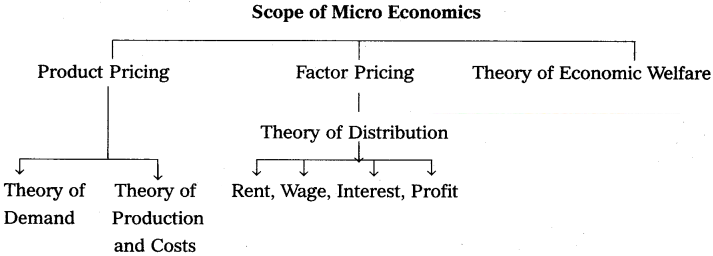
Question 4.Explain the concepts and scope of Micro Economics and Macro Economics?


Answer:


Modem economic theory divided it into two branches, namely (i) Micro Economics (ii) Macro Economics. Ragnar Frisch was the first economist to use the words “Micro and Macro” in economic theory in 1930.
Micro Economics :
The term “Micro Economics” is derived from the Greek word MIKROS’ which means small. Thus, micro economics is the theory of small. It was developed by classical economists like Adam Smith, J.B. Say, J.S. Mill, Ricardo, Marshall etc. It studies about individual units or behaviour of that particular units like individual income, price, demand etc. Micro Economics is also known as partial analysis. It mainly,’ concentrates on the determination of prices of commodities and factors of production. It is also known as “Price theory”. According to K.E. Boulding, “Micro Economics is the study of particular firms, particular households, individual prices, wages, incomes individual industries and particular commodities”.
Shapiro says “Micro Economics has got relation with small segments of the society.

Macro Economics :
The term Macro Economics is derived from the Greek word ‘MAKROS’ which means large. Thus, Macro Economics is the study of economic system as a whole. It was developed by J.M. Keynes. It studies aggregates in the economy like national income, total consumption, total saving and total employment etc. It is also known as Income and Employment theory.


According to Boulding “Macro Economics studies national income not individual income, general price level instead of individual prices and national output instead of individual output”. Macro Economics also studies the economic problems like poverty, unemployment, economic growth, development etc. It also deals with the theory of distribution.

The difference between Micro Economics and Macro Economics :
Micro and Macro Economics are interrelated to each other. Inspite of close relationship between the two branches of economics, fundamentally they differ from each other.

Micro EconomicsMacro Economics
1. The word micro derived from the Greek word ‘Mikros’ means “small”.1. The word macro derived from the Greek word ‘Makros’ which means “large”.
2. Micro Economics is the study of individual units of the economy.2. Macro Economics is the study of economy as a whole.
3. It is known as ‘Price theory’.3. It is known as ‘Income and Employment theory’.
4. Micro Economics explains price de-termination in both commodity and factor markets.4. Macro Economics deals with national income, total employment, general price level and economic growth etc.
5. Micro Economics is based on price mechanism which depends on demand and supply.5. Macro Economics based on aggregate demand and aggregate supply.

Question 5.Explain the different types of goods?


Answer:


Goods are the articles and services which satisfy a human want like books, pens, cell phones etc. Hence, all tangible things that satisfy human wants are called goods. Goods can be divided into two types : free goods and economic goods.

  1. Free Goods :
    Goods which are freely supplied by the nature and without prices are known as free goods. The supply of these goods is always abundantly greater than their demand and therefore, do not have any price. Free goods possess only value in use, but no exchange value. Examples are air, water and sunshine. Now-a-days, some of these also became economic goods due to several reasons and these goods are priced.
  2. Economic goods :
    An economic good is any physical object, natural or man made or service rendered that can be commanded a price in a market. They always fall short of the demand for them. These economic goods have both value in use and value in exchange such as pens, books, laptops, etc. Economic goods possess three important characteristics i.e., utility, scarcity, and transferability. Economic goods are also divided into three types, i.e. consumer, product, and intermediary.
  3. Consumer Goods :
    A consumer good is an economic good or commodity purchased by households for final consumption. Thus, consumer goods are those goods which directly satisfy human wants. For example fruits, milk, pens, clothes, etc.
  4. Producer or Capital Goods :
    Goods which are used in the production of other goods are called producer or capital goods. They satisfy human wants indirectly. For example machines, buildings etc. are capital goods. A good can be classified into consumer good or capital good depending on the nature of its use. For example, when paddy is used for food it becomes a consumer good and when used as seed in cultivation, it becomes a capital good.
  5. Intermediary Goods :
    Goods which are under the process of production and semi finished goods are known as intermediary goods. Examples are cement, bricks and steel used as intermediary goods in construction work. The goods which are not yet finished and under different stages of production are known as intermediary goods.

Short Answer Questions


Question 1.Examine the welfare definition of economics?


Answer:


Alfred Marshall raised economics to a dignified status by advancing a new definition in 1890. He shifted emphasis from production of wealth to distribution of wealth (welfare). In the words of Marshall, “political economy or economics is a study of mankind in the ordinary business of life; it examines that part of individual and social action which is most closely connected with the attainment and with the use of the material requisites of well – being. Thus, it is on the one side, a study of wealth and on the other and more important side, a part of the study of man”.


I. Important Features of Welfare Definition :


1.Marshall used the term “Economics” for “Political economy” to make it similar to physics. He assumed that economics must be a science even though it deals with the ever changing forces of human nature.
2.Economics studies only economic aspects of human life and it has no concern with the political, social and religious aspects of life. It examines that part of individual and social action which is closely connected with acquisition and use of material wealth which promotes human welfare.
3.Marshall’s definitions considered those human activities which increased welfare.
4.This definition has given importance to man and his welfare and recognised wealth as a mean for the promotion of human welfare.


II. Criticism:


Marshall’s definition is not free from critics. Robbins in his “Essay on the Nature and Significance of Economic Science” finds fault with the welfare definition of economics.
1.Economics is a human science rather than a social science. The fundamental laws of economics apply to all human beings and therefore, economics should be treated as a human science and not as a social science.
2.Lionel Robbins criticized it as classificatory. It distinguishes between materialistic and non materialistic goods and not given any importance to non-materialistic goods which are also very important. Therefore, it is incomplete.
3.Another serious objection is about the quantitative measurement of welfare. Welfare is a subjective concept and changes according to time, place and persons.
4.Marshall includes only those activities which promote human welfare. But the production of alcohol and drugs do not promote human welfare. Yet economics deals with the production and consumption of those goods.
5.Robbins has taken serious objection for not considering ‘scarcity of resources’. According to Robbins’ economic problem arises due to limited resources which are to be used to satisfy unlimited wants.

Question 2.Explain the scarcity definition of economics?


Answer:


Marshall’s welfare definition until the publication of Lionel Robbins’ book “An Essay on the Nature and Significance of Economic Science” in 1932. Robbins’ definition brought out the logical inconsistencies and inadequacies of the earlier definitions and formulated his own definition of economics. He has given a more scientific definition of economics. In the words of Robbins, “Economics is the science which studies human behavior as a relationship between ends and scarce means which have alternative uses.”


I. Main Features :

  1. Human Wants are Unlimited :
    The fulfillment of one want gives rise to a number of new wants.
  2. Means are Scarce :
    The means of a person by which his wants may be satisfied are limited. It leads to economic problems as all wants cannot be satisfied by these limited means.
  3. Alternative Uses of Scarce Means :
    Resources are not only scarce but also have multiple uses. For example, electricity can be used in homes and also in industries. A piece of land can be used to produce rice or wheat. If a scarce factor is used for the satisfaction of one want, less of it will be available for other wants. Hence, man has to make a decision regarding the alternative uses of resources.
  4. Man has, therefore, to choose between wants. Problem of choice arises.
    II. Superiority of Robbins’ Definition :
    Robbins’ definition is superior to the earlier definition in more than one way. The reasons are given below :
    1.It is non-classificatory, as it includes all human activities whether they promote human welfare or not.
    2.This is universally accepted definition. It is applicable to all types of societies, because the scarcity of resources is felt by individuals as well as by societies.
    3.Robbins’ definition of economics is neutral between ends. Being a positive science it does not pass any value judgements regarding ends.

Question 3.Explain the growth definition of economics?


Answer:


In the words of Samuelson, “Economics is the study how people and society choose, with or without the use of money, to employ scarce and productive resources which could have alternative uses, to produce various commodities over time and distribute them for consumption, now and in the future, among various people and groups in the society. It analyses the benefits of improving patterns of resource allocation”.

  1. Important Points:
    Some of the important points in Samuelsons’ definition are :
    1.His definition like Robbins agreed that resources are not only limited but also have several uses.
    2.Samuelson’s definition is dynamic in nature as it considers both the present and future consumption, production and distribution.
    3.Growth definition deals with the problem of choice in a dynamic society. Hence, this definition broadened the scope of economomics.
    4.Samuelson’s definition is superior to that of Robbins’ because he shifted the emphasis from the scarcity of resources to income, output and employment and later to the problems of economic growth.
    Samuelson’s definition appears to be the most acceptable at the moment.

Question 4.Explain the fundamental problems of an economy?


Answer:


Fundamental Problems of an Economy
There are certain fundamental problems in any type of economy with which economists are concerned. The following are the basic economic problems. These are interrelated and interdependent.
1.What type of goods are to be produced and in what quantities?
2.How to produce these goods?
3.For whom to produce these goods and services?
4.How efficient the productive resources are in use? Whether available resources are fully utilized?
5.Is the economy growing or static over a period of time?


Question 5.What is Micro Economics? What is its importance?


Answer:


The term ‘Micro Economics’ is derived from the Greek word ‘MIKROS’ which means ‘small’. Thus, Micro Economics deals with individual units like individual demand, price, supply etc. It was popularised by Marshall It is also called as ‘Price Theory’ because it explains pricing in product market as well as factor market.

Importance :
1.Micro Economics provides the basis for understanding the working of the economy as a whole.
2.This study is useful to the government to frame suitable policies to active economic growth and stability.
3.This study is applicable to the field of international trade in the determination of exchange rates.
4.Micro Economics provides an analytical tool for evaluating the economic policies of the government.
5.It can be used to examine the condition of economic welfare and it suggests ways and means to bring about maximum social welfare.

Question 6.Explain the concept of Macro Economics, and its Importance?


Answer:


The term Macro Economics is derived from the Greek word ‘MAKROS’ which means large. It was developed by J.M. Keynes. Macro Economics deals with economic system as a whole like national income, aggregate demand, aggregate supply, general price level etc. It is also known as Income and Employment’ theory.

Importance :
1.Macro Economics study is more useful to the government for formulation and execution of policies for achievement of maximum social benefit.
2.It helps in understanding the problems of unemployment, poverty, inflation etc, and suggests how to solve them.
3.It gives us a picture of the working of the economy as a whole.
4.The study of Macro Economics is helpful in analysing the causes of business cycles and in providing remedies.
5.Macro Economics includes economic growth and suggests how developing countries can use their resources to maximise their growth.
6.Macro Economic study is useful for making international comparisons in terms of average national income.

Question 7.Distinguish between Microeconomics and Macroeconomics?


Answer:

MicroeconomicsMacroeconomics
1. The word mikro derived from the Greek word “micros” means “small”.1. The word makro derived from the Greek word “macros” means “large”.
2. Microeconomics is the study of individual units of the economy.2. Macroeconomics is the study of economy as a whole.
3. It is known as ‘price theory’.3. It is known as ‘income and employment theory’.
4. It explains price determination in both commodity and factor markets.4. It deals with national income, total employment, aggregate savings and investment, general price level and economic development etc.
5. It is based on price mechanism which depends on demand and supply.5. It is based oh aggregate demand and aggregate supply.
6. It is based on partial equilibrium analysis which explains the equilibrium of an individual unit.6. It is based on general equilibrium analysis which explains the simultaneous equilibrium in all the sectors of the economy.
7. It is a static analysis without time element.7. It is a dynamic analysis with time element.

Question 8.Explain the differences between free goods and Economic goods?


Answer:


Differences between Microeconomics and Macroeconomics

Free GoodsEconomic Goods
1. free goods are nature’s gift.1. Economic goods are man made.
2. Their supply is abundant.2. Supply is always less than their demand.
3. They do not have price.3. These goods have prices.
4. There is no cost of production.4. These goods have cost of production.
5. They have value in use and do not have value in exchange.5. These goods have value in use and also value in exchange.
6. Their values are included in national income.6. Their values are included in national income.

Question 9.What is utility? What are its types?


Answer:


The want satisfying capacity of a commodity at a point of time is known as utility. Types of Utility:
1) Form Utility :
Form utilities are created by changing the shape, size and colour etc., of a commodity so as to increase its want satisfying power.
Ex : Conversion of a wooden log into a chair.
2) Place Utility :
By changing the place some goods acquire utility.
Ex : Sand on the sea shore has no utility. If it is brought out and transported to market, it gains utility. This is place utility.
3) Time Utility :
Time utilities are created by storage facility.
Ex : Business men store food grains in the stock points in the off season and releases them to markets to meet high demand and obtain super normal profits.
4) Service Utility :
Services also have the capacity to satisfy human wants.
Ex: Services of Lawyer, Teacher, Doctor etc. These services directly satisfy human wants. Hence, they are called as service utilities.

Question 10.Analyse the characteristics of wants. [Mar. 17]


Answer:


Human wants are starting point of all economic activities. They depend on social and economic conditions of individuals.
Characteristic features of wants :
1) Unlimited wants :
Human wants are unlimited. There is no end to human wants. When one want is satisfied another want takes its place. Wants differ from person to person, time to time and place to place.
2) A Particular Want is Satiable :
Although a man cannnot satisfy all his wants, a particular want can be satisfied completely in a period of time.
Ex : If a person is thirsty he can satisfy it by drinking a glass of water.
3) Competition :
Human wants are unlimited. But the means to satisfy therr are limited of scarce. Therefore, they complete with each other in priority of satisfaction.
4) Complementary :
To satisfy a particular want we need a group of commodities at the same time.
Ex : Writing need is satisfied only when we have pen, ink and paper together.
5) Substitution :
Most of our wants can be satisfied by different ways.
Ex : If we feel hungry, we can eat rice or fruits satisfy this want.
6) Recurring :
Many wants appear again and again though they are satisfied at one point of time.
7) Habits :
Wants change into habits, which cannnot be given up easily.
Ex : Smoking cigarettes for joke results into a habit if it is not controlled.
8) Wants vary with time, place and person :
Wants go on changing with the passage of time. They are changing from time to time, place to place and person to person. Human wants are divided into
1.Necessities,
2.Comforts and
3.Luxuries.

Very Short Answer Questions
Question 1.
Explain the wealth definition.
Answer:
Wealth means stock of assets held by an individual or institution that yields has the potential for yielding income in some form. Wwalth includes money, shares of companies, land etc. Wealth has three properties. 1. Utility 2. scarcity 3. Transferability.

Question 2.
What is Micro Economics?
Answer:
The word Micro’ is derived from Greek word ‘Mikros’ which means ‘small’. It was devel-oped by Marshall. It is the study of the individual units like individual demand, price, supply etc.
Question 3.
What is Macro Economics?
Answer:
The word Macro’ is derived from Greek work ‘Makros’ which means ‘Large’. It was developed by J.M. Keynes. It studies aggregates or economy as a whole like national income, employment, general price level etc. It is also called “Income and Employment” theory.
Question 4.
What is Positive Economics?
Answer:
A positive science is defined as a body of systematised knowledge concerning ‘what it is’. The classical school economists were of the opinion that economics is purely a positive science which had no right to comment upon the rightness or wrongness of economic policy. Here, economists cannot give any final judgement on any matter.
Question 5.
What is Normative Economics?
Answer:
Normative economics may be defined as a body of systematised knowledge relating to the object of “what ought to be’ and concerned with the ideal as distinguished from the actual. Historical school of Germany has introduced this in Economics.
Question 6.
What are Free goods?
Answer:
Anything which satisfy human want is known as good. Goods which are freely supplied by the nature and without prices are known as free goods. The supply of these goods is always abundantly greater thatn their demand. Hence, they do not command price. Free goods possess only value-in-use, no value-in-exchage. For example, air, water, sunshine.
Question 7.
Explain Economic goods.
nswer:
Economic goods are man made, they have cost of production and price. They are limited in supply. They have both value in use and value in exchange. Ex : Pen, Book etc.

Question 8.Explain the Consumer Goods?


Answer:


Consumer good is an economic good or commodity purchased by households for final consumption. Thus, consumer goods are those goods which directly satisfy human wants. For Ex : Fruits, Milk, Pen, Clothes etc. Consumer goods are divided into two types.
a) Perishable goods – Which loose their value in single use, Ex : Milk, fruits etc.
b) Durable goods – Which yields service over time. Ex : TVs & Computers.


Question 9.Explain the Capital Goods?


Answer:


Goods which are used in the production of other goods are called producer or capital goods. They satisfy human wants indirectly. Ex : Machines, tools, buildings etc.


Question 10.What are single use and durable use goods?


Answer:


Single use capital Goods :
There goods are used only once in the production process. For Example : Raw materials coal and Electricity.
Durable use capital Goods :
These goods are used for long time in the process of production. Machines, tools etc., are the durable capital Goods.


Question 11.


What is Wealth?


Answer:


Wealth means stock of assets held by an individual or institution that has the potential for yielding income in some form. Wealth includes money, shares of companies, land etc. Wealth has three properties. 1. Utility 2. Scarcity 3. Transferability.

TS Inter 1st Year Political Science Study Material Chapter 12 Forms of Governments

Long Answer Questions

Question 1.What is Unitary form of Government? Explain its features?


Answer:


In the Unitary Government the entire power of the government is vesed with the central government only.
A.V Dicey :
‘Unitary government is one in which the central power habitually exercises the supreme Legislature authority’.
Herman Finer :
Unitary government is one in which all powers and authorities are lodged with a centre whose will and agents are legally omnipotent over the whole area’.
J.W. Gamer :
Unitary government is one in which the whole power of the government is conferred by the constitution upon a single central organ from which the local governments derive their authority7′.
Features of Unitary Government:
a) Centralization of powers :
In unitary system, all powers are centralized in the hands of the central government and only centre is the reservoir of all state powers.
b) Provincial governments :
In unitary states, local/provincial governments are created and given power by the central governments. A provincial government directs their powers always derived from the central government. Ex. England.
c) Flexible constitution :
The central government alone has the power to amend the constitution and in this sense the constitution of a unitary state is always flexible like England.
d) Simple uniform administration :
The existence of an all-powerful government exercising power over all the people and places leads to the existence of simple, state and strong administration or the whole state.
e) Single citizenship :
In a unitary government, there is only single citizenship – the citizenship of the whole country. No provincial citizenship is given to its people.

Question 2.What is Federal Government? Examine its Characteristics?


Answer:


The term, federation is derived from Latin word ’Foedus’ meaning treaty or agreement. A federal polity comes into existence, either as a result of centripetal or centrifugal forces. The instrument by which a federation is brought about by the nature of a treaty or agreement between independent states and the new units of government, national or central which they agree to create. A new federal state is thus created to which sovereign states surrender their sovereignty and agree to become its component parts, for example, United States of America, Australia, India, Canada, etc.


Definitions of Federal Government :
Several political scholars have defined federation in different ways. Some definitions are the following.
Montesquieu :
Federation is a convention by which several parties agree to become members of larger on which they intend to establish’.
Herman Finer :
‘Federal states are one in which part of the authority and powers are vested in the local areas while another part is vested in a central institution deliberately constituted by an association of the local areas’.
A.V. Dicey :
‘A federal state is a political set-up intended to reconcile national unity and powers with the maintenance of state sights’.
J. W. Gamer :
‘Federal government is a system in which the totally of government power is divided and distributed between the centre and the states by the national constitution’.
K. C. Wheare :
A Federal government is a method of dividing power. So that the regional and central government independent’.
Features of Federal Government:
a) Written Constitution :

For a federal government the constitution must almost necessarily be a written constitution which determines the relation between the central and provincial/regional governments.
b) Rigid Constitution :
The natural corollary of the supremacy of the constitution and it being a written document, is that it should not be altered either by the central Legislatures.or by Regional Legislatures under their ordinary law-making procedure.
c) Division of powers :
In a federal political system, there is an essential feature of distribution of powers between central and regional governments under the constitution. Major sectors are vested with union/central and National and Provincial important things are vested with regional governments. For example, external affairs, exports and ports and education, agriculture health are exercised by union and state governments respectively.
d) Bicameralism :
Bicameralism is another important character of the federal government. In federal government, there should be Two-Chambers, representing people and states such as House of people and House states respectively.
e) Dual citizenship :
In a federal political system, constitution provides for dual citizenship to the citizens. Accordingly, the citizens have membership in both the centre and states simultaneously.
f) Independent Judiciary :
In a federal political system, independence of judiciary and intensity of judicial system is another important feature. Independence of judiciary will safeguard the minimum rights of people against the acts of Legislature and administrative authorities.

Question 3.What is presidential form of Government? Discuss its features?


Answer:


Under the presidential system, the Legislature and executive are two distinct departments of the government. There is more or less a separation between the two. The head of the state, the president, is real executive both as a Matter of law and fact and such power is the result of a direct grant from the constituent authority effected through express promises of the constitution.


Features of the Presidential Government :
a) President as Head of the state and government :

In a presidential government, president serves as the head of the state and government. He enjoys all the executive powers in practice. He implements the decisions and programmes of the government with the help of secretaries.
b) Separation of Legislature from the Executive :
In this form of government executive and Legislature are separate and independent of each other and do not interfere in the jurisdiction of each other.
c) Election/Head of the state and government :
Presidential executive, is not hereditary or nominated by the Legislature, but is elected by the people.
d) Impeachment of the President :
The removal by the impeachment is provided according to constitution, in case he is held guilty of violating, the oath of office. Usually, the power of impeachment is given to the legislature.
e) Checks and balances :
In a presidential government, there is another important feature that is, the principle of ‘checks and balances’. In presidential system, every organ enjoys autonomy and exercise powers independently. At the same time, every organ acts as a check against the excessive authority of the other organ. The legislature must give its consent to all decisions of the president and president must give his approval to the all decisions of the legislature. At the same time, judiciary reviews all constitutional cases and interprets them.

Question 4.What is Parliamentary form of government?


Answer:


In a parliamentary system a clear distinction is made between the head of the state and the head of the Government here, the head of the state King or Queen in Britain or President of India, possesses nominal or titular authority whereas real authority rests with the government of which Prime Minister is the head. Example : Australia, Canada, Japan etc.
Parliamentary form of government as a system in which the real executive, the cabinet, is immediately and legally responsible to the Legislature for its political policies and acts, ultimately responsible to the electorate.


Features of Parliamentary Governments :
a) Nominal and Real executives :

In parliamentary form of government there should be two kinds Of executive in the Political system one of them, National Executive is the Head of the state and other one is real executive, Head of the government is president and Head of the government is the Prime Ministers.
b) Co-ordination between the Legislature and executive :
Another important feature among, is that, there is a close relationship and co-ordination between legislature and executive bodies of the government. The executive members are selected from the Legislature and so executive remained as responsible for the Legislature for all its acts.
c) Significant role of the prime minister :
In parliamentary form of government, the prime minister holds the real executive authority. He holds the government as comer stone. He has the authority to from the council of ministers and also has right to reshuffle and dissolve the government.
d) Collective responsibility :
The most important feature of the parliamentary government works on the principle of collective responsibility. It means the ministers enjoy the office only as long as they have confidence of the parliament.
e) Individual responsibility :
In a parliamentary government, every minister is individually responsible to the Legislature for the efficient conduct of his department or office. In case there is any lapse in the administration, the ministers are personal answerable to parliament.
f) Dissolution of Lower House :
The head of the state can dissolve the lower house on the recommendation of the prime minister. If deadlock rises between cabinet and Legislature they can appeal to the electorate through elections.
g) Effective opposition :
In a parliamentary form of government opposition party is considered as soul of the democracy. If the ruling party loses its confidence in the Legislature, opposition party is the alternative to form a government and it works against ruling party through questioning the acts.

Short Answer Questions


Question 1.Write a note on merits and demerits of Unitary form of Government?


Answer:


Merits of Unitary Government:
a) Powerful Administration :

In unitary government, all the powers of the government are vested in the hands of central government. It helps to take decisions fast and work timely and to maintain internal peace, laws and order.
b) Simple and less Expressive :
The unitary system of government easy and less in expressive for administration.
c) Flexible in Administration :
The administration of a unitary state is flexible and can easily adapt itself to the changing social needs and environment. Because it can amend the constitution as and when required.
d) Suitable for small states :
unitary form of government as it is simple and less expressive suitable for smalls states.
e) Quick decisions :
It can be very useful in meeting emergencies. Being a unitary governments, is provincial in nature and can take all necessary decisions quickly and implement with full force.
f) National integration :
In unitary government, there is a simple citizenship which shows no discrimination among its people and helps to national unity integrity and solidarity among its people.


Demerits of the Unitary Government:
a) Fascist Powers :

In unitary government, all powers are vested with single government and there is a scope for Fascist or dictatorial attitude.
b) Centralization of administration :
In unitary government, all powers are concen-trated with the single government and no scope for distribution of powers between union and provincial government and it leads to more burden on the central government to manage whole nation.
c) Unsuitable for Larger States :
unitary governments are suitable for smaller states whereas it is not suitable for larger state which has vast land larger population. Because such states have multi religions, racial and cultural people and unitary government cannot tackle with such society.
d) Neglect of local initiatives :
In unitary governments with centralization of powers and with sanctioning of limited powers to provincial governments, it discourages local governments from making their own policies.
e) Scope for growth of inefficiency :
In unitary government, with centralization of powers, each and every aspect of the society should be administered by the single administrative unit and it leads to inefficiency in providing provisions for its people.

Question 2.Explain the merits and demerits of Parliamentary form of Government?


Answer:


Merits of Parliamentary Government:
a) Harmony and co-ordination between Legislature and executive :

In a parliamentary government, it secures co-operation and co-ordination from the Legislature because it was formed with the single majority party from Legislature. It enacts laws and implementing laws through taking confidence of legislators.
b) A Scrub on Autocracy :
Parliamentary government effectively checks the despotic attitude of the majority party in the lower house of the Legislature. Legislators prevent the government from the making mistakes against public interest through its questioning and a vote of no-confidence in the other motions.
c) Governmentally Able and Experienced :
In a parliamentary government, Government should be consisted with the top leaders of the majority party. Able and experienced people from the party have a hold on the party and government.
d) Responsible Government :
In a parliamentary from a government, council of ministers along with prime minister hold the offices and enjoys the powers and acts on the collective responsibility to the Legislature. In a parliamentary system, opposition party controls the ruling party through its vigilance in the outside of the Legislature.
e) Flexible Government :
Flexibility is another merit of the parliamentary from of a government, according to Bagehot, under this government; the people can choose a ruler for the occasion who may be especially qualified to successfully pilot the ship of the state through motional crisis.
f) Alternative to Government :
Parliamentary system is in the real sense a government by criticism. The majority from the government the majority continues the opposition. The opposition must criticises the government. The lapses of the government are its opportunities and ruling party lost confidence opposition party is ready to hold the office.


Demerits of the Parliamentary Government:
a) Unstable Government :

The government has no fixed life. It remains in office only so long as it can retain parliamentary majority which is sentient to the vagaries of the represent actives.
b) Violation of the theory of separation of powers :
In a parliamentary of government, there is a combination of executive and Legislature functions in the same set of individuals lead to tramp while the same men may be at one members of the Legislature and the executive, their functions in the two roles are distinct but in political experience, they worked in no distinction.
c) Executive becomes Autocratic / tyranny of majority :
When the executive is confident of support by majority members in the Legislation, at is likely to become autocratic. The opposition feels helpless in correcting the erratic behaviour of the government because all decisions taken on the basis of voting.
d) Unsuitable for emergencies :
A national crisis cannot meet with promptness in parliamentary government because much of tis time wasted in discussions. Get emergency needs prompt action, while taking decisions, be fear of the opposition and the masses at large.
e) Bureaucratic Dictatorship :
In a parliamentary government, bureaucracy becomes unduly important. The ministers being amateurs heavily rely on bureaucratise for everything.
f) National Interests ignored :
In a parliamentary government, political parties often gnore the interests of the nation for the sake of interest of the party in power. All national aspects are divided in the interest of the party only.
Despite all there defects, parliamentary government is very popular. It is considered more democratic and a true reflection of the public opinion.


Question 3.Discuss the merits and demerits of Federal form of Government?


Answer:


a) Scope for unity in diversity :
The federal government, there is scope for achieving unity in diversity. It is very essential to the multireligions, multicultural and multilinguistic societies.
b) Against Dictatorship :
In the federal political system, there is a scope for preventing the rise of a single despotism, check the growth of bureaucratic authority and conserves the political liberties of people.
c) Less-burden on the centre :
In federal political system, there is distribution of powers between centre and state governments, according to the constitution and each discharges its duties accordingly. So, it decreases the burden upon the central govemment while executing its functions.
d) Scope for New Political experiments :
In a federal political system, regional gov-ernments will introduce new policies / and programmes and make experiments for the development of socio-economic spheres of the society.
e) Suitable for larger states :
Federation is said to be the only form of government which is suitable for vast or larger area states. Larger states can be administered with the constitutional distribution of powers between central and state governments.
f) Leads to efficient Administration :
In a federal form of governments, powers and functions are transferred to the local / state governments. As a result, with the limited subjects, centre can work efficiently and it has scope for concentrating on all important national interests.


Demerits of Federal Government:


a) Weak central government :
Federal government is a weak government due to dis-tribution of powers between the centre and state governments. Regional or provincial governments demand the centre for their regional cause.
b) Lack of uniform laws :
In a federal government, there is a chance to adopt different laws by federal and state governments. Laws passed by the various provincial governments are complex in nature. It leads to controversy between federal and state governments, or among state governments.
c) Controversies and dispute :
In federal political system, there is a distribution of subjects between centre and state governments. When it comes to the concurrent list, centre and state governments try to escape from their duties and subjects remain unimplemented or unfulfilled.
d) Expensive mechanism :
In federal political system, there are two sets of govern-ments, i.e., federal government at centre level and provincial government at regional level. It is more expensive to establish infrastructure of administrative units and re-cruitment and maintenance of bureaucracy.
e) Fear of Disintegration :
In federal political system, federal state itself is formed through treaty of federation or confederation. There is no certainity of sustainability of federation which stands upon the willingness of the provinces / states. For examples U.S.A. experienced such fear in 1882, USSR disintegrated and several states like Latin America, Balkan states faced such problems.

Question 4.Distinguish between unitary and Federal form of Government?


Answer:


Distinction between Unitary and Federal Governments :

Unitary GovernmentFederal Government
1. May or may not be written constitution.1. There will be written constitution.
2. It has Flexible constitution.2. It has rigid constitution.
3. There is only one Government for the entire country.3. There will be two types of governments, i.e., union level and provincial level.
4. Centralization of powers.4. Decentralization of powers between centre and state governments.
5. Government is not as much Democratic form of government.5. It is purely Democratic government which all governments take their part in Decision-making.

TS Intermediate 1st Year Political Science Study Material: Telangana Inter I Yr Textbook Solutions at manabadi.co.in

TS Inter 1st Year Political Science is a crucial subject for students of the Telangana State Board, offering a deep understanding of political systems, governance, and civic responsibilities. To excel in exams, it is essential to have reliable study material and textbook solutions that simplify complex concepts and provide clear explanations. Our TS Inter 1st Year Political Science Study Material is designed to help students grasp every chapter of the Telangana Board syllabus effectively.

TS Inter 1st Year Political Science Study Material – Telangana Board Textbook Solutions

This study material covers all important topics such as the Indian Constitution, Fundamental Rights and Duties, Democracy, State and Government, Political Theories, and Public Administration. Each chapter is explained in a simple, easy-to-understand language, ensuring that students can follow the concepts without difficulty. Alongside explanations, our Telangana Board Political Science textbook solutions include step-by-step answers, multiple-choice questions (MCQs), and previous years’ exam questions to help students prepare thoroughly.

By using this study material, students can improve their exam preparation, time management, and conceptual clarity. The solutions are carefully structured to match the Telangana State Board exam pattern, helping students score better in both theory and objective sections. Additionally, our resources are updated according to the latest syllabus, ensuring that learners have access to the most relevant and accurate content.

Whether you are preparing for Inter 1st Year exams or seeking a strong foundation in political science, this study material is an essential guide. It is suitable for students who prefer self-study, as well as those looking for additional support beyond classroom teaching.

Explore our TS Inter 1st Year Political Science Textbook Solutions today to gain confidence, strengthen your knowledge, and achieve excellent results in Telangana Board exams.

TS Inter 1st Year Political Science Study Material in English Medium

TS Inter 1st Year Political Science Study Material Chapter 11 Organs of Government

Long Answer Questions


Question 1.Explain the structure of Bicameralism and the functions of the Legislature?


Answer:


Legislature may be Bicameral or Unicameral. In Bicameralism there are two houses, namely, lower and upper house or first chamber and second chamber. The lower house represents the will of the people. The upper house represents the interests of the states.
Ex’s in India Rajyasabha is the upper house and Loksabha is the lower house.
The members of the upper house are elected from the component states. These members represent their respective states in the central government. The people directly elect the members of the lower house .through universal adult franchise.


Functions of the legislature :


The basic function of the legislature is to enact laws as per the will of the people. The legislature in modern times is discharging certain administrative and judicial duties besides forming the laws. The functions of the legislature also depend upon the form of the government. The role of the legislature is limited ina presidential form of government. But, it has an extensive role in the parliamentary government. The functions fo the legislature can be analysed under different heads like : Legislative functions, Executive functions, Financial functions, Judicial functions, Constitutional functions and other functions.

  1. Legislative functions :
    To frame the laws is the basic function of the legislature. It is the important duty of the legislature to pass laws as per the will of the people. The legislature has powers to frame new laws and also to change, revise or cancel the laws which are outdated. The legislature not only makes laws but also conducts detailed discussions and consultations on different subjects. The legislature discusses extensively every bill before it becomes law.
  2. Functions to control executive :
    In the parliamentary government, the council of ministers is responsible to the legislature. The legislature exercises control on the council of ministers in dealing with the problems cropping up in the country, and their solutions through different resolutions and questions. It can also pull down the government through a no confidence motion if such a need arises.
  3. Financial functions :
    The financial functions of the legislature are of much importance in democratic countries. The legislature has to approve the income and expenditure under different heads shown in the budget. The legislature can decide the amount of expenditure under different heads. Levying new taxes or abolishing already existing taxes can be taken up with the consent of the legislature only.
  4. Judicial functions :
    The legislature, especially the upper house performs some judicial functions. The House of Lords in England functions as the highest court of justice. In U.S.A. and India, the legislature has to try impeachment cases against the president or the Justices of Supreme Court and High Courts. Some times the legislature conducts enquiry through separate committees on the allegations against the government. The legislature has the authority to punish anybody who commits breach of privileges of members and those who violate the rules of the house.
  5. Constitutional functions :
    The legislature has the right to amend the constitution besides framing the laws. It can amend the constitution as per the needs and requirements of the country which change from time to time.
  6. Other functions :
    Besides the above functions, the legislature has some more functions like, accepting or rejecting the ordinances declared by the government; electing the speaker, appointing necessary committees to enquire into the lapses of the government and to formulate rules and procedures of the legislative business.

Question 2.What is Executive? What are its functions?


Answer:


Of the three organs of government, the Executive occupies the most important place. Very often it is referred to as the government. It refers to that branch of government which executes or enforces the laws of the state those are framed by the legislature that is why the executive is identified with government in modem times. Broadly

speaking, the executive has three parts :


1.The Head of the state
2.The Council of ministers and
3.The Employees.


Functions of the Executive :
Defence and Foreign affairs :
The executive takes suitable decisions and implements them in case of any threat to the national independence and sovereignty and protects the country from foreign aggression. The duties of the executive include establishing embassies in others countries, recognising newly formed states and concluding treaties and alliances with the foreign countries.
Administrative functions :
The entire administration is carried on in the name of the executive. In this context, its functions include appointment of the officers in highest ranks allotting their duties, providing training, giving directions to different administrative departments, changing the rules and regulations from time to time, to protect law and order, to appoint and advise the council of ministers in parliamentary system, to create new departments or reorganise the existing ones or abolish them altogether as deemed necessary.
Legislative functions :
The executive prepares the draft bills to be presented to the legislature and gets them enacted. In the parliamentary government as the members are directly associated with the legislature the ministers present the draft bills to the legislature and get its acceptance. After acceptance by the legislature, the draft bills can become acts with the assent of the chief executive. In the presidential government, the president sends to the legislature for its acceptance certain messages embodying the various legislative measures considered necessary by him. All the bills passed by the legislature can become acts only with the assent of the president. When the legislature does not meet, the executive can issue ordinances.
Financial functions :
It is the duty of the executive to prepare the annual budget containing income and expenditure of the government and gets the approval of the legislature. The legislature cannot levy new taxes without the consent of the executive. Levy or abolition of taxes, provision of capital funds, reduction of prices etc. come under the domain of executive responsibility.
Judicial functions :
The executive has the certain functions like : To implement the judgements of the courts of law, to reduce or cancel the punishment, to appoint the Judges, to appoint special courts for the enquiry of certain special problems etc. In some of the democratic countries the chief executive appoints judges of the highest courts of justice.
Welfare functions :
It is the Prime duty of the executive in the modern times to undertake welfare measures. The executive has to work for the planned development and contribute for the improvement of the standards of living.

Question 3.Discuss Judiciary and its Functions?


Answer:


The Judiciary is the third important organ of the government. Legislature enacts the laws. The executive implements them. But it is the judiciary which decides the constitutional validity of these laws both in theory and practice. The judiciary keeps the democratic government within the constitutional limits. The judiciary also has to protect the law abiding citizens and punish the criminals. It consists of the judges and magistrates charged with the duty of administering justice. In brief, it is the branch of the government which settles disputes and administers justice.


Functions of the Judiciary :
Dispensing Justice :


It has to solve the disputes between the citizens, the citizens and the government and different governments. It punishes the criminals after due trial.
Protection of Civil rights :
The courts of law protect the fundamental rights given to the citizens by the constitution. The citizens can approach the court of law when their fundamental rights are violated. The courts issue writs for enforcement of these rights. The citizens can obtain stay orders from courts in advance when they apprehend violation of their rights. In order to protect the rights of the individuals, the courts of law can issue writs like Habeas Corpus, Mandamus, Prohibition etc.
Constitutional protection :
The Judiciary safeguards the constitution in the democratic countries. The Judiciary annuls the unconstitutional decisions of the legislature and the executive. By interpreting the constitution and laws it reviews the laws of the legislature and the actions of the executive and strikes down unconstitutional measures. This authority of the judiciary is called as ‘Judicial Review’.
Protection of equilibrium in federal system :
Judiciary plays a key role in the federal system. The courts of law solve the disputes between the provinces and the central government and also between one province and another. It supervises to see that neither the disputes between the central and provincial governments that arise due to matters relating to the division and distribution of powers.
Advisory functions :
The highest court of justice provides advice to the head of the State on request. For instance in India, the President takes the advice of the Supreme Court on certain problems of constitutional applications. Appellate Jurisdiction: The highest court of justice has to provide justice on the appeals made against the judgements of the lower courts. At times, it ratifies the judgements given in the lower courts and some other times, such judgements are reversed.
Protection of records :
The judiciary has to preserve all the cases along with their judgements. These records will help lawyers and judges in the trial of similar cases in future.
Providing service regulations :
The courts of justice prescribe service regulations of employees working in courts of law.
Functioning as the Head of State :
In some countries and under certain conditions, as identified in India, the Chief Justice of the Supreme Court can function as acting Head of the State when there is no Vice-President in office.

Short Answer Questions


Question 1.What are the reasons for the decline of the significance of legislature?


Answer:


The political thinkers opine that the legislature, which has wide powers theoretically, is losing its significance gradually in the democratic countries. There are many reasons for this.
1.The executive acquired a lot of constitutional and legal powers to achieve comprehensive Socio-economic development.
2.The legislature has to depend on the executive as it does not possess even the fundamental capacity to understand the novel measures introduced in the administrative system due to advancement of science and technology.
3.Since the highest political offices are filled in through direct elections, the government gained importance by directly influencing the people. It could develop direct relations with the people lessening the importance of the legislature.
4.Another reason for the reduction of the importance of the legislature is delegated legislation. The legislature, passess a law in a skeleton form and delegates power to the executive to fill in the details of it in the shape of rules and regulations. This is called ‘delegated legislation’. This power is used by the executive to implement plans and welfare schemes.
5.Other reasons the political thinkers are worried about the fact that the significance of the legislature is further reduced due to certain reasons like lack of a powerful opposition, less duration of the sessions of the parliament, the irresponsible behaviour of the ruling party and also the misbehaviour of the legislators.

Question 2.Discuss the reasons for the growth of importance of the Executive?


Answer:


In recent years, several factors have led to a steady increase in the powers, functions, prominence and prestige of the Executive organ all over the world. The factors are as follows :

  1. Concept of welfare state :
    As a result of the advent of the concept of welfare state, the functions of the modem state are gradually increasing. The present state is called upon to look after multifarious activities like labour welfare, education, social security, health, production, distribution etc., which promote the welfare of the people. Hence, the executive requires vast powers to cope with the problems of the modern welfare state.
  2. Delegated legislation :
    Today the legislative organ is overburdened with work. As a result, it passes laws in a skeleton farm only and empowers the executive to make detailed bye-laws, rules and regulations. This is known as delegated legislation. This has led to the growth of executive importance.
  3. Party system :
    The present representative system is under the control of the political parties. Parties have provided leadership to the executive and reduced the legislatures to the level of registering bodies. Now, it is the executive organ which performs most of the legislative functions by extra constitutional methods.
  4. Economic planning :
    For the planned economic development, the government interferes in’ all economic, aspects. As a result the executive branch is becoming more prominent.

Question 3.Discuss Judicial Review?


Answer:


Judicial Review means reviewing the laws made by the legislatures. The laws of the legislatures (parliament, assemblies, Councils, Parishades etc.,) must not be unconstitutional. The courts of law can nullify all laws which are unconstitutional. This is the Judicial Review. The Judicial Review is not limited only to laws. It is applicable to all the activities of the executive at different levels of central, state and local government institutions. Every State will have a constitution. It is its basic law and all the laws must be within the limits of the constitution. The constitution provides the courts of law with the right to see that all laws and activities conform to the constitution. Judicial Review is not found in all the countries.


The Judicial Review first originated in United States of America in the context of the judgement given by the Supreme Court in the Marbury-Madison dispute in the beginning of the nineteenth century. The courts of law follow different theories, principles and views in reviewing the constitutional viability of the laws. The Judicial Review is based on the following theories which can be studied in detail in higher classes.


1.Theory of the efficiency of law.
2.Theory of separation of powers.
3.Theory of constitutional dynamism.
4.Theory of activity.
5.Theory of decision by experience.
6.Theory of constitutional development.

Question 4.Write brief note on Rule of Law?


Answer:


Rule of law is a unique feature of British constitution. It at first originated in England later many states like India and the United States have adopted this feature. Rule of law is purely based on the principle of common law. It denotes that law should be general in form. It should be uniformly applicable to all the citizens living in a state. There should not be different types of law for various sections of the community. In other words the government must treat all the citizens equally as per the law.


The governance and administration in a particular state should be carried on in accordance with the laws. A.V Dicey in his “Law of the constitutions” (1885) gave a precise explanation of the rule of law. According to him, rule of law stands for equality before the law. This implies equal subjection of all classes including the officials or common man. Law makes no discrimination between individuals. A.V Dicey says that “Every official from Prime Minister to the attender, all are equal before the law”.


Therefore, Rule of law is helpful to all the citizens in protecting their responsibilities in a more effective manner. The constitution of India too recognizes the Rule of law as a basic feature of India constitution. The Supreme Court of India time and again declared Rule of law as a basic Structure of Indian Constitution. Articles 14 to 21 of the Indian Constitution have incorporated the spirit of this concept. However, the scope of this concept is gradually shrinking owing to the over burdening of legislative work with enormous functions. On the whole, the cardinal virtue of Rule of law is that “All are equal before law and no one must arbitrarily be punished” constitutes the core value of any democratic system in the world.


Question 5.What is Judicial Activism?


Answer:


According to the idea of judicial activism judges should use their powers to correct injustices, especially when the other branches a Government do not act to do so. The courts play an active role in shaping social policy on such issues as civil rights, political unfairness protection of individual rights and public morality.
Judicial activism is policy making function of judiciary in competition with poilcy making by the legislative and executive. This element is associated with the doctrine of judicial review. The essence of true judicial activism lies in rendering decisions by the judiciary which are in tune with the temper and tempo of the times.


Behind every judicial decision, judicial activism and judicial restraint are the two aspects that describe the philosophy and motivation. The concept of judicial activism is the polar opposite of judicial restraint. Judicial activism refers to a theory of judgement that takes into account the spirit of the law and the changing times, whereas judicial restraint relies on a strict interpretation of the law and the importance of legal precedent.
Judicial activism is a dynamic process of judicial outlook in a changing society. Arthur Schlesinger jr. introduced the term ‘Judicial activism’ in 1947. According to Black’s Law Dictionary, “Judicial activism is a judicial philosophy which motivates judges to depart from traditional precedents in favour of progressive and new social policies”.

Very Short Answer Questions


Question 1.How many organs of government are there? What are they?


Answer:


The powers of Government are separated among these three organs – legislature, executive and judiciary. They are inter-related and sometimes independent of each other. Political philosophers like Cicero, Jean Bodin and John Locke wrote treatises on the inter-relationship of three organs of government.

Question 2.What is meant by the theory of separation of powers?


Answer:


Montesquieu stated that concentration of powers in one person or a body of persons would result in despotism and negate individual liberty. He suggested separation of powers among the three organs of government in a balanced manner. Every organ must check the misuse of powers of other organs. Then only individuals enjoy their liberties without fear from the governmental interference.


Question 3.What is meant by Plural Executive?


Answer:


Among various types of Executive, Plural Executive is one. If the executive powers are exercised by a body of persons having co-equal authority, it is called “Plural Executive”. The Swiss Federal Council and the President in the former U.S.S.R. are the examples of Plural Executives. This Plural Executive combines the merits of both the parliamentary and the presidential executives, avoiding their defects.


Question 4.What is independence of the Judiciary?


Answer:


Independence of judiciary implies an opportunity to the judges to perform their duties without fear or favour and act impartially. The judges should have no relation with the legislature and the executive. Both the organs should not interfere in the functioning of the judiciary. It should be protected from political pressure and influence. Otherwise, the very purpose of judiciary stands defeated.


Question 5.What is Judicial Review?


Answer:


It is the power of a court to enquire whether a law passed by legislature or executive order or other official action is in accordance with the constitution or not If a law, or order or action is against the constitution then the court declares it as “Unconstitutional” and “Invalid”. The Judicial Review power originated in the USA in 1803. The American Supreme God Court and the Indian Supreme Court are some of the courts having this power.

Question 6.Senate?

Answer:


Senate is the Upper House of United States Congress, which is a small group of elected people who decide the laws of the country. It consists of 100 members. Every U.S. state elects two people to represent them in the U.S. Senate. These people are called senators.


Question 7.


Council of States?


Answer:


Council of States is the Upper House of Indian Parliament. It is also known as the Rajya Sabha. It consists of 250 members out of them 238 members are elected by the members of state legislative assemblies through the system of proportional representation by means of single transferable vote. The remaining 12 members are nominated by the President of India from the fields of Arts, Literature, Social Service, Cooperative Movement, Science and Technology. It is a permanent house and it can never be dissolved. Each member shall remain in office for a period of 6 years. For every 2 years 1/3 of its members shall retire.


Question 8.House of lords?


Answer:


The House of Lords, also known as The House of peers, is the upper House of the parliament of the United Kingdom. Membership is granted by appointment or else by heredity. Like the House of common, it meets in the palace of West Minister. Currently, there are 300 members in the House of Lords members of whom 240 are Elected members and 60 appointed. Independent members upto 12 Church of England Bishops may sit in the House as ex officio Lords spiritual. Elected members will serve a single non-renewable term of 15 years.


Question 9.


Independent Judiciary?


Answer:


Independence of Judiciary implies an opportunity to the Judges to perform their duties without fear or favour and act impartially. The Judges should have no relation with the Legislature and the Executive. Both the organs should not interfere in the functioning of the Judiciary. It should be protected from political pressure and influence. Otherwise the very purpose of Judiciary stands defeated.


Question 10.Parliamentary Executive?


Answer:


A parliamentary System of government means that the Executive branch of government has the direct or indirect support of the parliament. This support is usually shown by a vote of confidence. The Relationship between the executive and the Legislature in a parliamentary system is called Responsible government. According to this system, there is a President who is the formal Head of the State, and the Prime Minister and the council of ministers, which run the government.


Question 11.What is Uni-bicameralism?


Answer:


In government, the first organ is the Legislature, it may be unicameral or Bicameral. Unicameralism is derived from two Latin words namely uni, which means one, and camera, which means, the chamber is the practice of having one Legislative or parliamentary chamber. Thus, a unicameral parliament of the unicameral legislature is a legislature that consists of one chamber or house.
Ex.: Armenia, Bulgaria, Denmark, Sweden etc.

Question 12.What is Bi-bicameralism?


Answer:


‘Bi’ means two and Cameral means house or chamber. If a Legislature consists of two houses or chambers, it is called a Bi-cameral legislature, and such an arrangement is called Bi-cameralism. The bi-cameral legislature is necessary for a federal government as the second chamber gives representation to the states. In the Bi-cameral setup, the upper house is less powerful than the lower house.
Ex.: Rajya Sabha and Lok Sabha in India, Senate and House of Representatives in America.

TS Inter 1st Year Maths 1A Trigonometric Ratios upto Transformations Solutions Exercise 6(d)

0

I.
Question 1.
Simplify
(i) sin2θ1+cos2θ

Answer:
TS Inter 1st Year Maths 1A Solutions Chapter 6 Trigonometric Ratios upto Transformations Ex 6(d) 1

(ii) 3cosθ+cos3θ3sinθsin3θ
Answer:
TS Inter 1st Year Maths 1A Solutions Chapter 6 Trigonometric Ratios upto Transformations Ex 6(d) 2

Question 2.
Evaluate the following
(i) 6sin 20° – 8 sin3 20°

Answer:
2(3 sin 20° – 4sin3 20°) (Formula)
= 2.sin (3 × 20°) = 2 sin 60°
= 232 = √3

(ii) cos272° – sin254°
Answer:
cos272° – sin254°
= sin218° – cos236°
TS Inter 1st Year Maths 1A Solutions Chapter 6 Trigonometric Ratios upto Transformations Ex 6(d) 3

(iii) sin242° – sin212°
Answer:
sin242° – sin212° (Formula)
sin (42° + 12°) sin (42° – 12°)
= sin 54° sin 30°
= (5+14)12=5+18

Question 3.
(i) Express sin4θsinθ in terms of cos3 θ and cos θ.

Answer:
sin4θ = sin (3θ + θ) = sin 3θ cos θ +cos 3θ sin θ
= (3 sin θ – i sin 3θ) cos θ + (4 cos 3θ – 3 cos θ) sin θ
= 3 sin θ cos θ – 4 sin 3θ cos θ + 4 cos 3θ sin θ – 3 cos θ sin θ
= 4 cos 3θ sin θ – 4 sin 3θ cos θ
= sin θ(1 cos 3θ – 4 sin 2θ cos θ)
= sin θ [4 cos 3θ – 4 sin 2θ cos θ]
sin4θsinθ=sinθ(4cos3θ4sin2θcosθ)sinθ
= 4 cos 3θ – 4 sin 2θ cos θ
= 4 cos 3θ – 4 (1- cos 2θ) cos θ
= 8 cos 3θ – 4 cos θ

(ii) Express cos6 A + sin6 A in terms of sin 2A.
Answer:
cos6A + sin6A = (cos2A + sin2A)3
= (cos2A + sin2A)3 – 3 cos2A sin2A (cos2A + sin2 A)
= 1 – 3 cos2A sin2A ……………(1)
= 1 – 34 (4 cos2 A sin2 A)
= 1 – 34sin22A

(iii) Express 1cosθ+sinθ1+cosθ+sinθ in terms of tan θ2
Answer:
TS Inter 1st Year Maths 1A Solutions Chapter 6 Trigonometric Ratios upto Transformations Ex 6(d) 4

Question 4.
(i) If sin α = 35, where π2 < α < π, evaluate cos 3α and tan 2α. (March 2015-T.S)

Answer:
since π2 < α < π, a lies in second quadrant and given sin α = 35 we have cos α = –45
cos 3α = 4 cos3 α – 3 cos α
TS Inter 1st Year Maths 1A Solutions Chapter 6 Trigonometric Ratios upto Transformations Ex 6(d) 5

(ii) If cos A = 725 and 3π2 < A < 2π, then find the value of cot A2.
Answer:
TS Inter 1st Year Maths 1A Solutions Chapter 6 Trigonometric Ratios upto Transformations Ex 6(d) 6

(iii) If 0 < θ < π8, show that 2+2+2+2cos4θ = 2cos(θ/2)
Answer:
TS Inter 1st Year Maths 1A Solutions Chapter 6 Trigonometric Ratios upto Transformations Ex 6(d) 7

Question 5.
Find the extreme values of
(i) cos 2x + cos2x

Answer:
cos 2x + cos2x = 2 cos2 x – 1 + cos2 x
= 3 cos2 x – 1
and 0 ≤ cos2 x ≤ 1
⇒ 0 ≤ 3 cos2 x ≤ 3
⇒ -1 ≤ 3 cos2 x – 1 ≤ 2
Maximum value = 2
and minimum value = -1
(or) cos 2x + cos2 x = cos 2x + (1+cos2x2)
We have -1 < cos 2x ≤ 1
⇒ -3 ≤ 3 cos 2x ≤ 3
⇒ -2 ≤ 3 cos 2x + 1 ≤ 4
⇒ -1 ≤ 3cos2x+12 ≤ 2
Maximum value = 2
Minimum value = -1
TS Inter 1st Year Maths 1A Solutions Chapter 6 Trigonometric Ratios upto Transformations Ex 6(d) 8

(ii) 3sin2x + 5 cos2x
Answer:
3sin2x + 5 cos2x
TS Inter 1st Year Maths 1A Solutions Chapter 6 Trigonometric Ratios upto Transformations Ex 6(d) 9

Question 7.
Find the periods for the following functions
(i) cos4x

Answer:
TS Inter 1st Year Maths 1A Solutions Chapter 6 Trigonometric Ratios upto Transformations Ex 6(d) 10

(ii) 2sin(πx4) + 3cos(πx3)
Answer:
TS Inter 1st Year Maths 1A Solutions Chapter 6 Trigonometric Ratios upto Transformations Ex 6(d) 11

(iii) sin2x + 2 cos2x
Answer:
Let f(x) = sin2x + 2cos2x
TS Inter 1st Year Maths 1A Solutions Chapter 6 Trigonometric Ratios upto Transformations Ex 6(d) 12

(iv) 2sin(π4 + x)cos x
Answer:
TS Inter 1st Year Maths 1A Solutions Chapter 6 Trigonometric Ratios upto Transformations Ex 6(d) 13
Period of f(x) is LCM of [π, π] = π

(v) 5sinx+3cosx4sin2x+5cosx
Answer:
TS Inter 1st Year Maths 1A Solutions Chapter 6 Trigonometric Ratios upto Transformations Ex 6(d) 14

II.
Question 1.
(i) If 0 < A < (π4), and cos A = 45, find the values of sin 2A and cos 2A.

Answer:
TS Inter 1st Year Maths 1A Solutions Chapter 6 Trigonometric Ratios upto Transformations Ex 6(d) 15

(ii) For what values of A in the first quadrant, the expression cot3A3cotA3cot2A1 is positive?
Answer:
cot3A3cotA3cot2A1 > 0
⇒ cot3A – 3 cot A > 0
⇒ cot A (cot2 A – 3) > 0
⇒ cot A > 0 or cot2 A > 3
⇒ cot A > √3
TS Inter 1st Year Maths 1A Solutions Chapter 6 Trigonometric Ratios upto Transformations Ex 6(d) 16

(iii) Prove that cos3A+sin3AcosAsinA = 1 + 2 sin 2A
Answer:
TS Inter 1st Year Maths 1A Solutions Chapter 6 Trigonometric Ratios upto Transformations Ex 6(d) 17

Question 2.
(i) Prove that cot(π4 – θ) = cos2θ1sin2θ and hence find the value of cot 15°.

Answer:
TS Inter 1st Year Maths 1A Solutions Chapter 6 Trigonometric Ratios upto Transformations Ex 6(d) 18

(ii) If θ lies in third quadrant and sin θ = –45, find the values of cosec(θ2) and tan(θ2).
Answer:
Given θ lies in third quadrant.
TS Inter 1st Year Maths 1A Solutions Chapter 6 Trigonometric Ratios upto Transformations Ex 6(d) 19

(iii) If 450° < θ < 540° and sin θ = 1213, then calculate sin(θ2) and cos(θ2).
Answer:
TS Inter 1st Year Maths 1A Solutions Chapter 6 Trigonometric Ratios upto Transformations Ex 6(d) 20

(iv) Prove that 1cos290+13sin250=43
Answer:
TS Inter 1st Year Maths 1A Solutions Chapter 6 Trigonometric Ratios upto Transformations Ex 6(d) 21

TS Inter 1st Year Maths 1A Trigonometric Ratios upto Transformations Solutions Exercise 6(b)

I.
Question 1.
Find the periods for the given 1 – 5 functions.
(i) cos (3x + 5) + 7

Answer:
Let f(x) = cos (3x + 5) + 7
We have period of cos x is 2π ∀ x ∈ R
∴ f (x) is periodic and period of f is = 2π|3|=2π3
(or) f (x + p) = f(x)
⇒ cos (3x + 3p + 5) + 7 = cos (2π+ 3x + 5) + 7
3x + 3p + 5 = 2π + 3x + 5
⇒ 3x = 2π
⇒ x = 2π3

Question 2.
tan x

Answer:
The function tan x is periodic with period π
∴ f(x) = tan 5x is periodic and its period is
π|5|=π5

Question 3.
cos(4x+95) (Mar. ’14)

Answer:
The function f(x) = cos x ∀ x ∈ R has the period 2π
∴ f(x) = cos(4x+95) is periodic and period of f is 2π45=5π2

Question 4.
|sin x|

Answer:
The function sin x has period 2π ∀ x ∈ R
But f(x) = |sin x| is periodic and its period is π
[∵ f(x + π) = |sin(x + π)| = |-sin x| = sinx]

Question 5.
tan (x + 4x + 9x + …. + n2x) (n any positive integer) (March 2015-A.P&T.S)

Answer:
tan [1 + 22 + 32 + ……… + n2) x
= tan[n(n+1)(2n+1)6]x
Period = 6πn(n+1)(2n+1)

Question 6.
Find a sine function whose period is 23.

Answer:
2πk=23 ⇒ 3π = |k| ∴ sin kx = sin (3n x)

Question 7.
Find a cosine function whose period is 7. (March 2013)

Answer:
f(x) = cos[2π7 .x] (2πk = 7 ⇒ 2π7 = k)

II. Sketch the graph of the following functions
Question 1.
tan x between 0 and π4.

Answer:
TS Inter 1st Year Maths 1A Solutions Chapter 6 Trigonometric Ratios upto Transformations Ex 6(b) 1

Question 2.
cos 2x in the interval [0, π]

Answer:
TS Inter 1st Year Maths 1A Solutions Chapter 6 Trigonometric Ratios upto Transformations Ex 6(b) 2

Question 3.
sin 2x in the interval (0, π).

Answer:
TS Inter 1st Year Maths 1A Solutions Chapter 6 Trigonometric Ratios upto Transformations Ex 6(b) 3

Question 4.
sin x in the interval [-π, +π]. (May 2014)

Answer:
TS Inter 1st Year Maths 1A Solutions Chapter 6 Trigonometric Ratios upto Transformations Ex 6(b) 4

Question 5.
cos2x in [0, π].

Answer:
TS Inter 1st Year Maths 1A Solutions Chapter 6 Trigonometric Ratios upto Transformations Ex 6(b) 5

Question 6.
Sketch the region enclosed by y = sin x, y = cos x and X – axis in the interval [0, π].

Answer:
y = sin x
TS Inter 1st Year Maths 1A Solutions Chapter 6 Trigonometric Ratios upto Transformations Ex 6(b) 6

TS Inter 1st Year Maths 1A Trigonometric Ratios upto Transformations Solutions Exercise 6(a)

0

I.
Question 1.
Convert the following into simplest form
(i) tan (θ – 14π)

Answer:
tan (θ – 14π) = tan [- (14π – θ)]
= – tan (14π – θ)
= – tan [ 2(7π) – θ)
= – tan (-θ) = tan θ

(ii) cot (21π2 – θ)
Answer:
cot (21π2 – θ) = cot[10π + (π2 – θ)]
= cot (π2 – θ) = tan θ

(iii) cosec (5π + θ)
Answer:
cosec (5π + θ) = cosec [4π + (π + θ)]
= cosec(π + θ) = – cosec θ

(iv) sec (4π – θ)
Answer:
sec (4π – θ) = sec [2(2π) – θ]
= sec (- θ) = sec θ

Question 2.
Find the values of each of the following
(i) sin (-405°)

Answer:
sin (-405°) = -sin 405° = -sin (360°+45°)
= – sin 45° = 12

(ii) cos (7π2)
Answer:
cos (7π2) = cos 7π2 = cos (630°)
= cos (360 + 270°) = cos 270°
= cos (180 + 90) = -cos 90 = 0
(or) cos (7π2) = 0 (∵ cos(2n + 1)π2 = 0)

(iii) sec (2100°)
Sol. sec (2100°) = sec [5 × 360° + 300°]
= sec 300° = sec (360° – 60°)
= sec 60° = 2

(iv) cot (-315°)
Answer:
cot (-315°) = – cot 315° = – cot (270 + 45°)
= cot 45° = 1

Question 3.
Evaluate
(i) cos2 45° + cos2 135° + cos2 225° + cos2 315°

Answer:
cos 45° = 12, cos 135° = cos (180 – 45°)
= – cos 45° = 12

cos 225° = cos (180 + 45°)
= – cos 45° = –12

cos 315° = cos(360 – 45°)
= cos 45° = 12

∴ cos2 45° + cos2 135° + cos2 225° + cos2 315°
= 12+12+12+12 = 2

(ii) sin22π3 + cos25π6 – tan23π4

Answer:
TS Inter 1st Year Maths 1A Solutions Chapter 6 Trigonometric Ratios upto Transformations Ex 6(a) 1

(iii) cos 225° – sin 225° + tan 495° – cot 495°
Answer:
cot (180 + 45) – sIn (180 + 45) + tan (360 + 135) – cot (360 + 135)
= – cot 45° + sin 45° + tan 135 – cot 135°
= – cos 45° + sin 45° +tan(180 – 45) – cot(180 – 45)
= – cos 45° + sin 45° – tan 45° + cot 45°
= 12+12 – 1 + 1 = 0

(iv) (cos θ – sin θ) if
(a) θ = 7π4
(b) θ = 11π4
Answer:
TS Inter 1st Year Maths 1A Solutions Chapter 6 Trigonometric Ratios upto Transformations Ex 6(a) 2

Question 4.
(i) If sin θ = –13 and 0 does not lie in the third 3 quadrant, find the values of (a) cos θ and (b) cot θ. (March 2013)

Answer:
sin θ = –13 and sin θ is negative and does not lie in third quadrant,
⇒ θ lies in fourth quadrant. In IVth quadrant cos θ is positive and cot θ is negative.
a) cos θ = 1sin2θ=119=223
b) cot θ = cosθsinθ = -2√2

(ii) If cos θ = t (0 < t < 1) and θ does not lie in the first quadrant, find the values of a) sin θ b) tan θ
Answer:
cos θ = t, (0 < t < 1)
⇒ cos θ is positive and 0 does not lie in first quadrant
⇒ θ lies in IVth quadrant
a) sin θ = 1cos2θ=1t2
b) tan θ = sinθcosθ=1t2t

(iii) Find the value of sin 330°. cos 120° + cos 210°. sin 300°
Answer:
sin 330° cos 120° + cos 210° sin 300°
= sin (360 – 30) cos (180 – 60) + cos ( 180 + 30) sin (360 – 60)
= (-sin 30°) (-cos 60°) + (-cos 30°) (- sin 60°)
= sin 30 cos 60 + cos 30 sin 60 = sin (30 + 60)
= sin 90° = 1

(iv) If cosec θ + cot θ = 13, find cos θ and determine the quadrant in which θ lies.
Answer:
we have coses2θ – cot2 θ = 1
⇒ (cosec θ + cot θ) (cosec θ – cot θ) = 1
TS Inter 1st Year Maths 1A Solutions Chapter 6 Trigonometric Ratios upto Transformations Ex 6(a) 3
∴ sin θ is positive and cos θ is negative,
⇒ θ lies in IInd quadrant.

Question 5.
(i) If sin α + cosec α= 2, find the value of sinn α + cosecn α; n ∈ Z.

Answer:
Given sin α + cosec α = 2
Squaring both sides
sin2 α = cosec2 α + 2 = 4
⇒ sin α + cosec α = 2
cubing on both sides
sin3 α + cosec3 α + 3 sin α cosec α (sin α + cosec α) = 8
sin3 α + cosec3 α + 3 (2) = 8
⇒ sin3 α + cosec3 α = 2
In the same way sinn α + cosecn α = 2 (n ∈ z)

(ii) If sec θ + tan θ = 5, find the quadrant in which θ lies and find the value of sin θ
Answer:
We have sec2 θ – tan2 θ = 1
⇒ (sec θ + tan θ) (sec θ – tan θ) = 1
Also given sec θ + tan θ = 5 ………….(2)

Adding (1) and (2)
TS Inter 1st Year Maths 1A Solutions Chapter 6 Trigonometric Ratios upto Transformations Ex 6(a) 4
tan θ is +ve, sec θ is + ve
⇒ θ lies is first quadrant.

II.
Question 1.
Prove that
(i) cos(πA)cot(π2+A)cos(A)tan(π+A)tan(3π2+A)sin(2πA) = cos A

Answer:
TS Inter 1st Year Maths 1A Solutions Chapter 6 Trigonometric Ratios upto Transformations Ex 6(a) 5

(ii) sin(3πA)cos(Aπ2)tan(3π2A)cosec(13π2+A)sec(3π+A)cot(Aπ2)
Answer:
TS Inter 1st Year Maths 1A Solutions Chapter 6 Trigonometric Ratios upto Transformations Ex 6(a) 6

(iii) sin 780°. sin 480° + cos 240°. cos 300° = 12
Answer:
sin [2 × 360 + 60] sin [360 + 120] + cos [180 + 60] cos [360-60]
= sin 60 sin 120 – cos 60 cos 60
= sin 60 sin 60 – cos 60. cos 60
= 32321212=3414=12

(iv) sin1505cos300+7tan225tan135+3sin210 = -2
Answer:
TS Inter 1st Year Maths 1A Solutions Chapter 6 Trigonometric Ratios upto Transformations Ex 6(a) 7

(v) cot(π20). cot(3π20). cot(5π20). cot(7π20). cot(9π20) = 1
Answer:
cot(π20). cot(3π20). cot(5π20). cot(7π20). cot(9π20)
= cot 9°. cot 27°. cot 45°. cot 63°. cot 81°
= cot 9°. cot 27°. 1.cot (90 – 27) . cot (90 -9)
= cot 9°. cot 27°. 1. tan 27°. tan 9°
= 1

Question 2.
(i) Simplify sin(11π3)tan(35π6)sec(7π3)cot(5π4)cosec(7π4)cos(17π6)

Answer:
TS Inter 1st Year Maths 1A Solutions Chapter 6 Trigonometric Ratios upto Transformations Ex 6(a) 8

(ii) If tan 20 ° = p, prove that
tan610+tan700tan560tan470=1p21+p2
Answer:
Given that tan 20° = p then
TS Inter 1st Year Maths 1A Solutions Chapter 6 Trigonometric Ratios upto Transformations Ex 6(a) 9

(iii) If α, β are complementary angles such that b sin α = a, then find the value of (sin α cos β – cos α sin β)
Answer:
Given α, β are complementary angles α + β = 90°
⇒ β = 90° – α
∴ sin α cos β – cos α sin β
= sin (α – β)
= sin[α – (90 – α)]
= sin [2α – 90°]
= -sin[90 – 2α]
= -cos 2α
= -(1 – 2sin2α) = -1 + 2sin2α
= -1 + 2(a2b2)
= 2a2b2b2

Question 3.
(i) If cos A = cos B = – 12, A does not lie in the second quadrant and B does not lie in third quadrant, then find the value of 4sinB3tanAtanB+sinA

Answer:
cos A = –12 and A does not lie in second quadrant
⇒ A lies in third quadrant
cos B = –12 and B does not lie in third quadrant
⇒ B lies in second quadrant
cos A = –12 and A lie in third quadrant
⇒ A = 240°
cos B = –12 and B lies in second quadrant.
⇒ B = 120°
TS Inter 1st Year Maths 1A Solutions Chapter 6 Trigonometric Ratios upto Transformations Ex 6(a) 10

(ii) If 8 tan A = -15 and 25 sin B = -7 and neither A nor B is in the fourth quadrant, then show that sin A cos B + cos A sin B = 304425
Answer:
8 tan A = -15 25 sin B = -7
⇒ tan A = 158 ⇒ sin B = 725
Given neither A nor B is in the fourth quadrant, clearly A is in second quadrant and B is in third quadrant,
sin A cos B + cos A sin B
TS Inter 1st Year Maths 1A Solutions Chapter 6 Trigonometric Ratios upto Transformations Ex 6(a) 11

TS Inter 1st Year Maths 1A Study Material Pdf Download | TS Intermediate Maths 1A Solutions

TS Inter 1st Year Maths 1A Functions Solutions

TS Inter 1st Year Maths 1A Mathematical Induction Solutions


Chapter 3 Matrices Ex 3(e)
Chapter 3 Matrices Ex 3(f)
Chapter 3 Matrices Ex 3(g)
Chapter 3 Matrices Ex 3(h)
Chapter 3 Matrices Ex 3(i)

TS Inter 1st Year Maths 1A Addition of Vectors Solutions

Chapter 4 Addition of Vectors Ex 4(a)
Chapter 4 Addition of Vectors Ex 4(b)

TS Inter 1st Year Maths 1A Products of Vectors Solutions

TS Inter 1st Year Maths 1A Trigonometric Ratios upto Transformations Solutions

TS Inter 1st Year Maths 1A Trigonometric Equations Solutions

Chapter 7 Trigonometric Equations Ex 7(a)

TS Inter 1st Year Maths 1A Inverse Trigonometric Functions Solutions

Chapter 8 Inverse Trigonometric Functions Ex 8(a)

TS Inter 1st Year Maths 1A Hyperbolic Functions Solutions

Chapter 9 Hyperbolic Functions Ex 9(a)

TS Inter 1st Year Maths 1A Properties of Triangles Solutions

Chapter 10 Properties of Triangles Ex 10(a)
Chapter 10 Properties of Triangles Ex 10(b)