






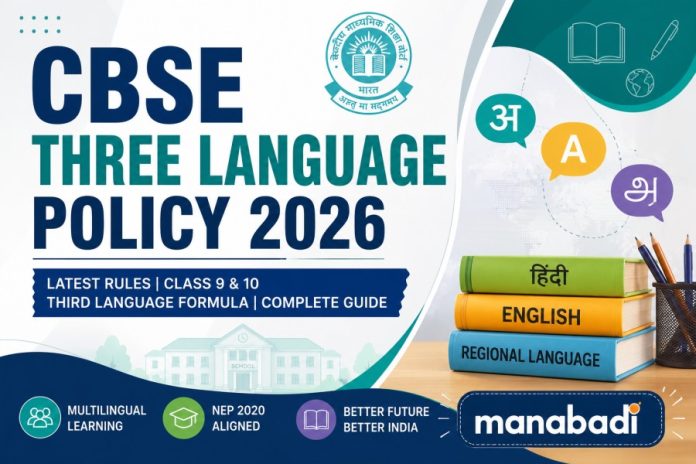
CBSE Issues Guidelines on the Three-Language Policy
CBSE has rolled out one of the biggest curriculum changes in recent years – a mandatory three-language study rule for Class 9, tied to the National Education Policy 2020 and the National Curriculum Framework for School Education (NCF-SE) 2023. Since April 2026, the Board has issued a series of circulars and clarifications, and the rule has already been relaxed once after pushback from parents and students.
Manabadi.co.in brings you the complete, updated picture – what’s confirmed, what’s changed, and what your school still needs to tell you.
Confidence note: This policy has changed multiple times between April and July 2026. This article reflects the most recent CBSE circular (Acad-49/2026) as of July 15, 2026. Always cross-check with your own school’s official communication, since implementation details like the exact R3 language offered can vary school to school.
What Is the CBSE Three-Language Formula?
Under the CBSE secondary school curriculum, language subjects are now organised into three levels – R1, R2 and R3, where R1 is the student’s main language, R2 is a different language, and R3, the third language, was made compulsory starting Class 6 from the 2026-27 academic session, with the plan being to extend it fully up to Class 10 by 2030–31. The languages chosen as R1 and R2 must be different from each other and cannot be offered simultaneously at more than one level.
The rule was first formalised for Class 9 through CBSE Circular Acad-33/2026, dated May 15, 2026, which stated that from July 1, 2026, Class 9 students would need to study three languages (R1, R2, R3), with at least two being native Indian languages.
Timeline: How the Policy Evolved
| Date | Development |
|---|---|
| April 9, 2026 | Circular Acad-17/2026 directed schools to implement R3 from Class VI for the 2026–27 session, with compliance required within 7 days |
| May 15, 2026 | Circular Acad-33/2026 formally introduced the three-language rule for Class 9, effective July 1, 2026 |
| May 15, 2026 | CBSE clarified that a foreign language could only be taken as a third or fourth language, after two native Indian languages |
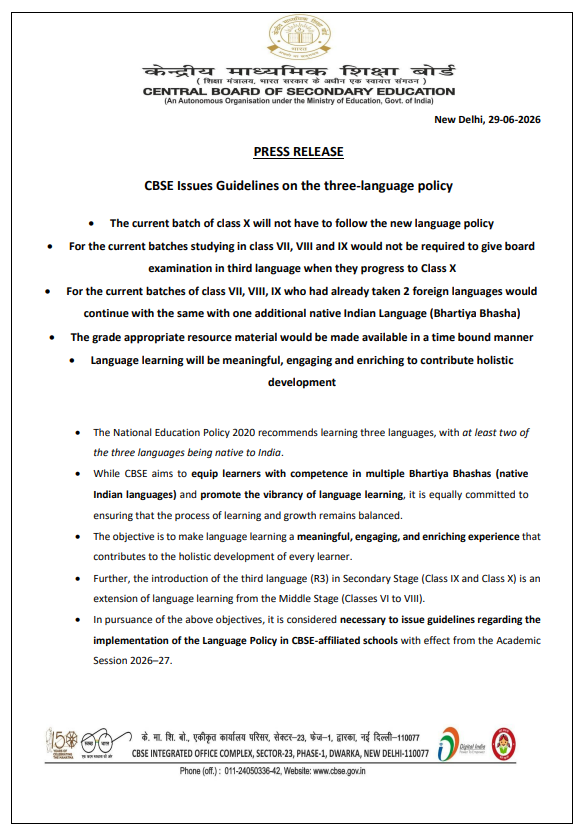
| June 29, 2026 | CBSE relaxed the rule, fully exempting the existing Class 10 batch and giving Class 9 students a one-time option to continue with two foreign languages plus one Indian language |
| Mid-July 2026 | Circular Acad-49/2026 clarified that R3 assessment is internal and school-based, but passing it is mandatory to receive the pass certificate, applicable to Class IX (2026-27) and Class X (2027-28) |
(Tentative/expected: further clarifications may follow as schools begin implementation. Confirm current status with your school before publishing time-sensitive claims.)
Batch-Wise Breakdown: Who Needs to Do What
This is the part causing the most confusion, so here it is broken down by exactly which students are affected.
A. Students currently in Class 10 (2026-27 batch)
No change for this batch – they continue with the old two-language system, and no third language is required.
B. Students currently in Class 9 (2026-27 batch)
Every Class 9 student must study three languages, with at least two being Bhartiya Bhashas, subject to the relaxation noted below. As a one-time concession, students already in Class 9 during 2026-27 may continue with two non-native (foreign) languages and add one Indian language as the third. These students will not be required to give a board exam in the third language when they reach Class 10 – but they must still clear the internal R3 assessment (see below).
C. Students in Class 7 or 8 (2026-27 batch)
These students will transition to the three-language framework when they reach Class 9 and 10, also requiring two Bhartiya Bhashas. Those already studying two non-native languages get the same one-time relaxation as the current Class 9 batch – they may continue both and simply add one Bhartiya Bhasha as the third.
D. Students in Class 6 (2026-27 batch)
Out of the three languages, two must be Bhartiya Bhashas for this batch and all batches going forward – no relaxation applies here, since this is the first cohort under the fully implemented framework. When this batch reaches Class 10, they will be the first required to sit a CBSE Board examination in R3.
R3 Assessment: Will It Affect Board Results?
This is the single biggest worry among parents, so here’s the confirmed answer:
- There will be no CBSE Board Examination for the third language (R3) when these batches reach Class 10.
- R3 will instead be assessed entirely through internal, school-based assessment.
- Clearing this internal assessment is mandatory for students to receive their Class 9/Class 10 pass certificate — so while it won’t add board-exam pressure, it cannot be skipped.
- Performance in R3 will still be reflected on the CBSE Class 10 certificate, even though it isn’t board-examined.
- Safety net for students who don’t clear it the first time: CBSE has directed schools to give a reassessment opportunity to any student who fails to clear the R3 assessment in Class X, and this must be completed before the Class X Board result is declared. The school is responsible for conducting this reassessment.
Which Languages Can Be Chosen?
CBSE has clarified that language options include the two official languages of India — Hindi and English — along with 42 other languages, covering all scheduled languages listed in the 8th Schedule of the Constitution as well as additional regional and foreign languages. Common examples schools may offer include:
- Bhartiya Bhashas (native Indian languages): Hindi, Sanskrit, Marathi, Bengali, Punjabi, Gujarati, Odia, Assamese, Tamil, Telugu, Kannada, Malayalam, and other scheduled languages.
- Non-native/foreign languages: English, French, German, Arabic, Spanish, and similar options.
A common myth is that Sanskrit is compulsory for everyone. This is incorrect — CBSE has not made Sanskrit compulsory for all students; it is simply one of the Indian language options schools may choose to offer under the new framework.
Three Common Situations Explained
CBSE itself flagged these three scenarios for Class 9 students to remove confusion:
Situation 1 – You already study two Bhartiya Bhashas (e.g., Hindi and Tamil):
You can choose any third language – another Bhartiya Bhasha or a non-native language such as English or French.
Situation 2 – You study one Bhartiya Bhasha and one non-native language (e.g., Tamil and English):
You must add another Bhartiya Bhasha as your third language (R3) to meet the two-Indian-language requirement.
Situation 3 – You study two non-native languages (e.g., English and French):
As a special one-time relaxation for students already in Class IX during 2026-27, you may continue with both non-native languages and simply add one Bhartiya Bhasha as your third language.
Who Is Exempt from the Bhartiya Bhasha Requirement?
CBSE has specified three formal exemption categories:
- Children with Special Needs (CwSN): Continue to receive exemptions and relaxations under the provisions of the Rights of Persons with Disabilities (RPwD) Act, 2016.
- CBSE schools located outside India: All CBSE-affiliated schools operating outside India are fully exempt from the mandatory requirement of teaching a Bhartiya Bhasha as R3.
- Students returning to India after studying abroad: Students who completed part of their education overseas and subsequently return to India are also exempt from the Bhartiya Bhasha requirement.
Additionally, students whose families relocate from one state to another may continue with the language combination they had already chosen during middle school, rather than being forced to restart with a new combination.
A Related Change: Two-Level Maths and Science for Class 9
Alongside the language update, CBSE also announced a two-level system for Mathematics and Science for Class 9 starting the 2026-27 session – a mandatory standard level and an optional advanced level. All students will sit a common 80-mark paper, while those choosing the advanced option can additionally attempt a paper testing deeper conceptual and higher-order thinking skills. The first Class 10 board exam under this new structure is expected in 2028. This isn’t a language rule, but since it launches in the same academic session, students and parents are frequently asking about both together.
What Schools Are Required to Do
- Schools must ensure at least two of R1, R2, R3 are native Indian languages and update their R3 offering on the OASIS portal.
- Class VI R3 textbooks in 19 scheduled languages were to be made available to schools before July 1, 2026, supplemented with additional local or state-level literary material chosen by the school.
- Dedicated R3 textbooks for Class 6 in 22 scheduled Bhartiya Bhashas have been prepared by NCERT and are available on ncert.nic.in.
- Schools facing a shortage of qualified native-language teachers may, as an interim measure, engage existing teachers from other subjects, retired teachers, postgraduates, or share resources through Sahodaya clusters (inter-school collaboration).
- CBSE has stated that no student will be disadvantaged due to this transition, and the focus is meant to be on meaningful language learning rather than exam pressure.
Frequently Asked Questions
Q1. Is the CBSE three-language rule compulsory for Class 9 from 2026-27?
Yes. From July 1, 2026, Class 9 students are required to study three languages, with at least two being Indian languages.
Q2. Will the third language (R3) be part of the Class 10 board exam?
No. CBSE has clarified that R3 will not be included in the Class 10 board examination, though it is internally assessed and must be passed for the certificate.
Q3. Is the current Class 10 batch affected?
No. Students already in Class 10 during 2026-27 continue with the old two-language system and don’t need to take a third language.
Q4. Can Class 9 students continue with two foreign languages?
As a one-time relaxation, yes. Students already in Class 9 during 2026-27 may continue with two non-native languages and simply add one Indian language as their third.
Q5. Is Sanskrit compulsory under this policy?
No. Sanskrit is one of several Indian language options a school may offer – it is not mandated for every student.
Q6. How will R3 be graded?
Entirely through internal school-based assessment – there is no CBSE board paper for it.
Q7. What happens if a student doesn’t clear the R3 internal assessment?
Clearing R3 is required to receive the pass certificate for Class IX (2026-27) and Class X (2027-28) batches. However, CBSE has directed schools to offer a reassessment before the Class X Board result is declared, so students get another chance.
Q8. Is this a rollback of the original policy?
CBSE has denied this characterization. A senior Ministry of Education source described it as a clarification rather than backtracking, stating there was insufficient clarity initially.
Q9. Where can students check their school’s exact R3 language options?
Directly with the school administration – schools are required to update their chosen R3 languages on the CBSE OASIS portal, and official language lists are available at cbseacademic.nic.in.
Q10. Are any students exempt from studying a Bhartiya Bhasha?
Yes – Children with Special Needs (under the RPwD Act, 2016), CBSE schools located outside India, and students returning to India after studying abroad are exempt from the mandatory Bhartiya Bhasha requirement.
Q11. What if a student’s family relocates to another state mid-year?
Students whose parents/guardians relocate to another state may continue with the same language combination they had chosen during middle school, without being forced to switch.
For the latest updates on CBSE exam schedules, board results, and counselling processes, keep following Manabadi.co.in – your trusted source for accurate, verified education news.
Contents
- 1 CBSE Issues Guidelines on the Three-Language Policy
- 1.1 Timeline: How the Policy Evolved
- 1.2 Batch-Wise Breakdown: Who Needs to Do What
- 1.3 R3 Assessment: Will It Affect Board Results?
- 1.4 Which Languages Can Be Chosen?
- 1.5 Three Common Situations Explained
- 1.6 Who Is Exempt from the Bhartiya Bhasha Requirement?
- 1.7 A Related Change: Two-Level Maths and Science for Class 9
- 1.8 What Schools Are Required to Do
- 1.9 Frequently Asked Questions