BITSAT Iteration 9 Result 2026 LIVE Update: Birla Institute of Technology and Science (BITS) Pilani has released the BITSAT 2026 Iteration 9 Result for admission to its First-Degree programmes, including B.E., M.Sc. and B.Pharm. The Iteration 8 admission assignment was announced on August 27, 2026. Candidates who submitted the BITS admission preference form can now check their admission status through the official BITS admission portal.
Candidates who have been allotted a seat in Iteration 8 must accept the admission offer and complete the required fee payment within the specified deadline. The deadline for accepting the offer along with payment of the applicable fee/advance fee is August 29, 2026, up to 5:00 PM.
BITSAT Iteration 8 2026 – Important Dates
Event
Date
Iteration 9 Result / Admission Assignment
August 27, 2026
Offer Acceptance & Fee/Advance Fee Payment
August 29, 2026, up to 5:00 PM
Reporting at Respective Campus
August 30, 2026
What After BITSAT Iteration 9 Result?
Candidates who receive an admission offer in Iteration 8 should complete the following steps:
Log in to the official BITSAT admission portal.
Check the Iteration 9 admission status and allotted programme/campus.
Accept the admission offer within the prescribed deadline.
Pay the required balance fee/advance fee by August 29, 2026, up to 5:00 PM.
Complete the required admission formalities as instructed by BITS Pilani.
Report to the respective BITS campus on August 30, 2026.
BITSAT 2026 Iteration 9 Admission
The Iteration 9 result applies to BITS Pilani’s First Degree programmes, including B.E., M.Sc. and B.Pharm. programmes offered at the Pilani, Goa and Hyderabad campuses.
Candidates selected from the waiting list in Iteration 8 must ensure that the required fee payment is completed within the deadline. Failure to complete the required admission process within the specified timeline may affect the admission offer.
How to Check BITSAT Iteration 9 Result 2026?
Visit the official BITS Pilani admission website.
Open the BITSAT 2026 First Degree admission portal.
Log in using your application credentials.
Check the Iteration 9 admission status.
View the allotted programme and campus.
If allotted a seat, complete the fee payment and admission formalities within the deadline.
BITSAT Iteration 9 – Next Steps
According to the official BITS Pilani schedule, August 29, 2026 is the deadline for Iteration 9 fee payment, while candidates selected in Iteration 9 are scheduled to report to their respective campuses on August 29, 2026. The schedule is subject to change, and candidates are advised to follow the official BITS admission website for any further notifications.
Candidates who have received an Iteration 9 offer should complete the fee payment and reporting requirements within the specified deadlines to secure their admission.
BITSAT 2026 Iteration 9 Result – Key Highlights
Particulars
Details
Exam Name
BITSAT 2026
Conducting Body
Birla Institute of Technology and Science (BITS)
Counselling Process
BITS Admission Counselling
Result Released
Iteration 9
Mode of Result
Online
Official Website
bitsadmission.com
Details Mentioned on the Allotment Result
The following information will be displayed:
Candidate’s name
Application number
Campus allotted (Pilani / Goa / Hyderabad)
Branch allotted
Allotment status (new allotment / upgraded / retained)
Waiting list status (if applicable)
Fee payment instructions
Reporting and admission deadlines
What Does the Result Mean?
1. Seat Allotted
If a seat has been allotted, the candidate must pay the required admission fee within the specified period to confirm the seat.
2. Upgraded Seat
Candidates who had accepted a seat in earlier iterations may receive an upgrade to a higher preference branch or campus.
3. Retained Seat
The previously allotted seat remains unchanged.
4. Waiting List
Candidates who are not allotted a seat will continue on the waiting list and may be considered in the next iteration based on seat availability.
What to Do After Seat Allotment?
Candidates who receive a seat allotment should:
Download the allotment letter.
Pay the admission fee before the deadline.
Keep all original documents ready.
Follow the reporting instructions issued by BITS.
Regularly check the official portal for further updates.
Documents Required
Candidates should keep the following documents ready:
BITSAT 2026 score card
Class 10 and Class 12 mark sheets
Transfer certificate
Migration certificate (if applicable)
Passport-size photographs
Government-issued photo ID
Category certificate (if applicable)
Important Note
Candidates are advised to rely only on the official BITS admission portal for accurate information regarding seat allotment, fee payment, and reporting procedures. Failure to complete the admission process within the prescribed deadline may result in cancellation of the allotted seat.
BITSAT 2026 Higher Score Rule
Candidates who appeared in both BITSAT Session 1 and Session 2 will automatically have their best score considered for admission. This rule benefits students attempting improvement in Session 2 and significantly impacts admission chances for top branches like CSE and Electronics.
BITSAT 2026 Counselling & Iteration Schedule
BITS Pilani conducts centralized online counselling through multiple rounds called Iterations. Qualified candidates must complete the First Degree Preference Form before participating in seat allotment.
Admission Event
Expected Date
Preference Form Last Date
June 1, 2026
Editing Window
June 3 to June 5, 2026
Iteration 1 Result
June 15, 2026
Fee Payment Deadline
June 22, 2026
Candidates can fill campus and branch preferences including:
BITS Pilani
BITS Goa
BITS Hyderabad
BITSAT 2026 Expected Cutoff Trends
The expected cutoff for top branches is likely to remain highly competitive this year. Computer Science Engineering at BITS Pilani is expected to require one of the highest scores, followed by Electronics and Electrical branches.
Trending searches among students include:
BITS Pilani CSE Cutoff 2026
BITS Goa Expected Cutoff
BITS Hyderabad Cutoff
BITSAT Safe Score 2026
BITSAT Marks vs Branch
BITSAT 2026 Tie-Breaking Policy
If multiple candidates secure identical scores, BITS Pilani applies the following tie-breaking criteria:
Higher marks in Mathematics/Biology
Higher Physics marks
Higher Chemistry marks
Better Class 12 aggregate marks
What After BITSAT Seat Allotment Result 2026?
After the declaration of results, candidates should immediately:
Submit preference form
Upload Class 12 marks
Participate in counselling
Track iteration results
Complete fee payment before deadlines
Failure to complete counselling formalities within the specified dates may result in cancellation of candidature.
Manabadi provides fast and accurate educational updates trusted by lakhs of students across India. Candidates can regularly check Manabadi for:
BITSAT Result Updates
Iteration Result Links
BITSAT Counselling News
Expected Cutoffs
Admission Notifications
Engineering Entrance Exam Updates
College Predictor & Rank Analysis
Students are advised to stay connected with Manabadi for real-time updates regarding BITSAT Session 2 Results 2026 and counselling announcements.
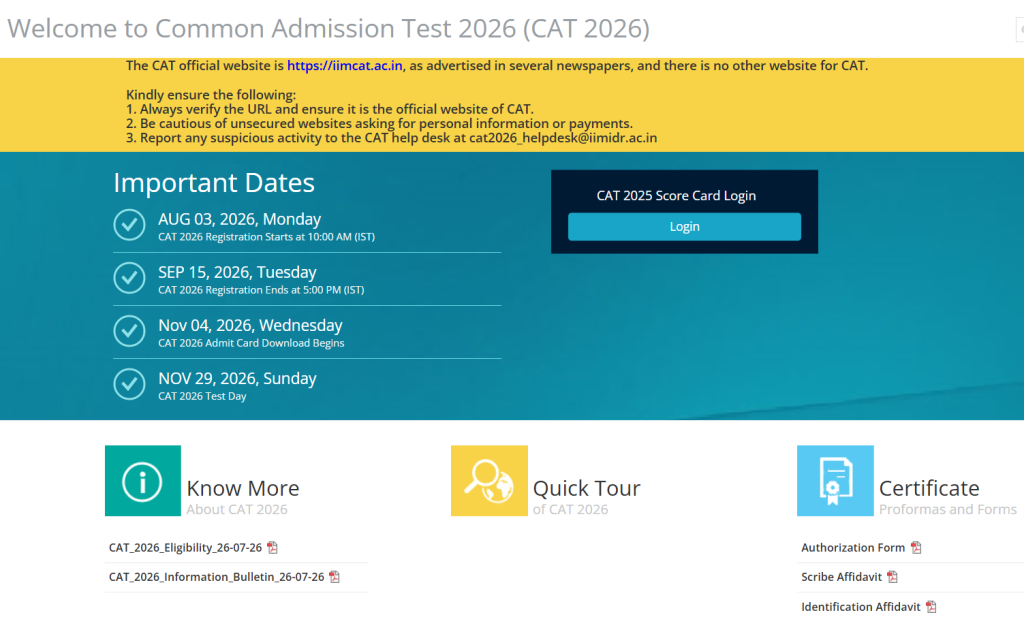
CAT 2026 Registration is now LIVE. The Indian Institute of Management Indore has opened the online application process for the Common Admission Test (CAT) 2026. Candidates seeking admission to postgraduate, fellow and doctoral programmes offered by the IIMs and other participating institutions can apply through the official CAT website. Registration opened on August 3, 2026 at 10:00 AM and will remain open until September 15, 2026 at 5:00 PM. The CAT 2026 examination will be conducted on November 29, 2026.
Candidates are advised to complete the application well before the deadline and carefully verify all details before final submission.
CAT 2026 Registration – Overview
Particulars
Details
Exam Name
Common Admission Test (CAT) 2026
Conducting Authority
Indian Institutes of Management (IIMs)
Exam Level
National Level
Application Mode
Online
Registration Status
LIVE
Official Website
iimcat.ac.in
Exam Mode
Computer-Based Test
Purpose
Admission to IIM and participating management programmes
Registration Fee
₹2,700 (General/EWS/NC-OBC); ₹1,350 (SC/ST/PwBD)
CAT 2026 Registration Dates
CAT 2026 registration is currently open. The application window opened on August 3, 2026 at 10:00 AM and closes on September 15, 2026 at 5:00 PM. The CAT 2026 exam is scheduled for November 29, 2026.
Candidates should carefully note the registration deadline because applications submitted after the closing date will not ordinarily be accepted. In the previous CAT cycle, registration was conducted online and the application window had a specified closing time.
Event
CAT 2026 Date
CAT 2026 Notification
Released
Registration Begins
August 3, 2026, 10:00 AM
Last Date to Apply
September 15, 2026, 5:00 PM
Admit Card Release
November 4, 2026
CAT 2026 Exam
November 29, 2026
Answer Key
To Be Announced
Result
Expected in January 2027
CAT 2026 Eligibility Criteria
Candidates should check the detailed CAT 2026 notification before applying. In general, candidates seeking admission through CAT are required to meet the prescribed academic qualification and category-specific eligibility requirements.
Candidates who have completed a bachelor’s degree with the minimum qualifying marks prescribed by the IIMs can apply, subject to the conditions specified in the official CAT notification. Candidates in the final year of their bachelor’s degree may also be eligible to apply, subject to the applicable rules.
Merely meeting the minimum eligibility criteria does not guarantee shortlisting or admission. Each IIM may follow its own admission and selection criteria, including academic performance, CAT score, work experience, and performance in subsequent selection stages.
CAT 2026 Application Form
The CAT 2026 application form is available online through the official CAT website. Candidates must first register using their name, email ID and mobile number and complete OTP verification. They can then log in and fill out the detailed application form.
The application process generally involves entering personal details, academic information, work experience, programme preferences, test-city preferences and other required information before completing the fee payment.
Candidates should ensure that all information entered in the application form is accurate. The official CAT registration guide has historically included sections covering personal details, academic qualifications, work experience, programmes, test-city preferences and payment.
How to Register for CAT 2026
Candidates can follow these steps to complete CAT 2026 registration:
Step 1: Visit the official CAT website.
Step 2: Click on the CAT 2026 Registration link.
Step 3: Complete the initial registration using the required personal details, email ID and mobile number.
Step 4: Generate the login credentials and log in to the CAT application portal.
Step 5: Enter personal and communication details.
Step 6: Provide Class 10, Class 12 and graduation or equivalent academic details.
Step 7: Enter work experience details, wherever applicable.
Step 8: Select the required IIM programmes and other preferences available in the application form.
Step 9: Select preferred CAT test cities in the order specified in the application portal.
Step 10: Upload the required photograph, signature and applicable category/disability certificates in the prescribed format.
Step 11: Review the complete application form carefully.
Step 12: Pay the CAT 2026 application fee through the available online payment method.
Step 13: Submit the application form and save the confirmation page or application details for future reference.
CAT 2026 Application Fee
The CAT 2026 application fee has been revised. Candidates belonging to the General, EWS and NC-OBC categories have to pay ₹2,700, while SC, ST and PwBD candidates have to pay ₹1,350. The fee is payable once, irrespective of the number of IIM programmes selected, and is non-refundable.
Candidates should complete the fee payment through the official CAT application portal after reviewing the form.
Documents Required for CAT 2026 Registration
Candidates should keep the required documents and information ready before starting the application process. These may include:
Valid email ID
Active mobile number
Recent passport-size photograph
Scanned signature
Class 10 certificate/marks details
Class 12 or equivalent qualification details
Graduation marksheets/certificates or current academic details
Category certificate, if applicable
PwD certificate, if applicable
Academic and personal details
Work experience details, if applicable
Payment method for the application fee
Candidates should follow the document size, format and upload specifications mentioned in the CAT 2026 registration guide.
CAT 2026 Exam Pattern
CAT is conducted as a computer-based test. The examination includes questions from major areas of management aptitude, including:
Verbal Ability and Reading Comprehension (VARC)
Data Interpretation and Logical Reasoning (DILR)
Quantitative Ability (QA)
CAT 2026 will be conducted as a computer-based test in three sessions on November 29, 2026. The three sections are VARC, DILR and QA.
CAT 2026 Test Cities
Candidates can select five preferred test cities while filling out the CAT 2026 application form. One city will be allotted subject to availability. If none of the selected cities is available, a nearby test centre may be allotted.
The final test centre allotted to a candidate will be mentioned on the CAT admit card. The CAT authorities may modify the test-centre arrangements depending on administrative requirements.
CAT 2026 Admit Card
Candidates who successfully submit their applications will be able to download the CAT 2026 admit card from November 4, 2026 through the official website.
The admit card will contain important details such as:
Candidate’s name
Photograph
Registration number
Examination date
Test session
Test centre
Examination instructions
Candidates must download and carefully check the admit card before the examination.
CAT 2026 Result
After the examination, the CAT 2026 result and scorecard will be released online. Candidates will be able to access their results by logging in with their CAT credentials.
The CAT score is used by the IIMs as part of their admission process. However, each IIM independently determines its selection criteria, and obtaining a CAT score does not automatically guarantee admission.
CAT 2026 Admission Process
The admission process after CAT may include multiple stages depending on the IIM and programme. Candidates shortlisted by individual IIMs may be required to participate in further selection stages such as:
Written Ability Test (WAT)
Group Discussion (GD)
Personal Interview (PI)
Academic performance assessment
Work experience assessment
Other institute-specific criteria
Candidates should check the admission policy of each IIM separately because the selection process and weightage can differ between institutes.
CAT 2026 Registration – Important Instructions
Candidates should keep the following points in mind while applying:
Apply only through the official CAT website.
Enter personal and academic details carefully.
Use an active email ID and mobile number throughout the admission process.
Check category information carefully before submitting the application.
Upload documents in the prescribed format and size.
Select test cities carefully.
Verify the complete application form before payment and final submission.
Save the registration confirmation and payment details.
Keep a copy of the submitted application for future reference.
Planning to appear for CAT 2026? Bookmark this page. We will continuously update it with the application link, correction window, admit card, answer key, response sheet, result, cut-offs, and counselling-related updates.
The wait is over for lakhs of MBA aspirants across India. The Common Admission Test (CAT) 2026 – the gateway exam to India’s 21 IIMs and hundreds of top B-schools – is expected to open registrations from August 3rd. If you’re targeting an MBA seat for the 2027–29 batch, this is the exam you need to crack.
At Manabadi, we’re tracking every update on CAT 2026 in real time – from the notification release to the final scorecard – so you don’t miss a single deadline. Here’s your complete, zero-confusion guide to CAT 2026.
How to Register for CAT 2026?
Candidates who wish to appear for the Common Admission Test (CAT) 2026 must complete the online registration process through the official CAT website within the prescribed deadline. Before applying, applicants should keep their valid email ID, mobile number, academic details, work experience (if applicable), passport-size photograph, signature, and category certificate (if applicable) ready.
Steps to Register for CAT 2026
Step 1: Visit the official CAT 2026 website.
Step 2: Click on “New Candidate Registration” on the homepage.
Step 3: Enter your Name, Date of Birth, Email ID, Mobile Number, and Nationality to create your account.
Step 4: Verify the OTP sent to your registered mobile number and email ID.
Step 5: Log in using the User ID and Password generated after successful registration.
Step 6: Fill in the CAT 2026 Application Form by providing your personal details, academic qualifications, work experience, and communication address.
Step 7: Select your preferred MBA programmes, IIMs, and test city preferences carefully.
Step 8: Upload the required documents, including:
Recent passport-size photograph
Signature
Category/PwD certificate (if applicable)
Step 9: Pay the prescribed CAT 2026 Application Fee using Credit Card, Debit Card, Net Banking, UPI, or other available online payment methods.
Step 10: Review all the entered details carefully, click on “Submit”, and download the confirmation page for future reference.
Important Points to Remember
Register only through the official CAT website.
Use an active email ID and mobile number, as all communication will be sent through them.
Ensure that all uploaded documents meet the specified size and format requirements.
Verify your personal and academic details before final submission, as corrections may not be allowed later.
Save a copy of the application form and payment receipt until the admission process is completed.
CAT 2026 Overview
Particular
Details
Exam Name
Common Admission Test (CAT) 2026
Conducting Body
Indian Institute of Management (IIM), on rotational basis
Conducting IIM
IIM Indore
Exam Level
National
Purpose
Admission to MBA/PGP/PGDM programs for 2027–29 batch
The Common Admission Test, popularly known as CAT, is a national-level entrance exam conducted once a year by the Indian Institutes of Management. It evaluates a candidate’s verbal ability, logical reasoning, data interpretation, and quantitative aptitude to determine eligibility for postgraduate management programs. CAT is widely regarded as one of the most competitive entrance exams in India, with lakhs of graduates and working professionals appearing every year for a limited number of seats at premier institutes.
Why is CAT Conducted?
CAT is conducted to:
Provide a standardized, merit-based platform to shortlist candidates for MBA/PGP admissions at IIMs
Allow IIMs to assess a candidate’s readiness for a rigorous management curriculum through analytical, quantitative, and verbal skills
Serve as an admission benchmark for numerous non-IIM institutes, extending its relevance beyond the IIM system
Maintain a transparent, computer-based, centrally conducted evaluation process across the country
Which Colleges Accept CAT Scores?
CAT scores are accepted by:
All 21 IIMs, including IIM Ahmedabad, Bangalore, Calcutta, Lucknow, Kozhikode, Indore, and others
Top non-IIM institutes such as FMS Delhi, SPJIMR Mumbai, MDI Gurgaon, IIFT, GLIM, IMI New Delhi, and IIT management programs (like SJMSOM IIT Bombay, DMS IIT Delhi)
90+ additional B-schools across India that use CAT percentile as an admission criterion (93 non-IIM institutions accepted CAT scores in the 2025 cycle)
Note: The complete, updated list of participating institutes for CAT 2026 will be published in the official notification – always cross-check with iimcat.ac.in before finalizing your college choices.
What Courses Can You Get Through CAT?
A valid CAT score opens doors to:
Full-time MBA/PGP programs at IIMs and other B-schools
PGDM (Post Graduate Diploma in Management) at non-IIM institutes
Executive MBA (EMBA) programs at select IIMs
Fellow Programme in Management (FPM) – the doctoral-level research program offered by IIMs
CAT 2026 Important Dates
Event
Date
Notification Release
26 July 2026
Registration Starts
3 August 2026 (10:00 AM)
Registration Ends
15 September 2026 (5:00 PM)
Application Correction
To be announced
Admit Card
4 November 2026
CAT Exam
29 November 2026
Result
Expected January 2027
All dates are expected/tentative based on previous years’ patterns and will be confirmed once IIM releases the official CAT 2026 notification. Manabadi will update this table the moment the notification is out – bookmark this page.
CAT 2026 Eligibility Criteria
To apply for CAT 2026, candidates must meet the following criteria:
Hold a Bachelor’s degree with a minimum of 50% aggregate marks (45% for SC/ST/PwD candidates) from a recognized university
No upper age limit to appear for the exam
Final-year undergraduate students are eligible to apply, provided they submit proof of degree completion at the time of admission
Candidates of any nationality, including NRI, PIO, and OCI candidates, may apply and appear for the exam within India
CAT 2026 Application Fee
Category
Expected Fee
General / NC-OBC / EWS
₹2,500 – ₹2,600
SC / ST / PwD
₹1,250 – ₹1,300
The fee must be paid online only (net banking, credit/debit card, or UPI)
The application fee is non-refundable once paid
The exact fee structure will be confirmed in the official CAT 2026 notification
Documents Required for CAT 2026 Application
Keep these documents ready before you begin registration:
A recent passport-size photograph (as per specified format and size)
A scanned signature
Category certificate (SC/ST/OBC-NC/EWS/PwD), if applicable
Academic mark sheets and certificates (10th, 12th, and graduation)
A valid, active email ID and mobile number for OTP verification and all future communication
Work experience certificate, if applicable (optional field)
How to Apply for CAT 2026
Follow these steps to complete your CAT 2026 registration:
Enter your name, date of birth, mobile number, email ID, and nationality
Verify your email and set a password
Log in and fill in personal details, academic qualifications, and work experience (if any)
Upload your scanned photograph and signature in the prescribed format
Select up to 5–6 preferred test cities in order of preference
Choose the IIMs and other participating institutes you wish to apply to
Pay the application fee through the available online payment modes
Review your form carefully, submit it, and download/print the confirmation page for future reference
Top Colleges Accepting CAT 2026 Scores
S.No.
Institute
Location
Flagship Course
1
IIM Ahmedabad
Ahmedabad
MBA (PGP)
2
IIM Bangalore
Bengaluru
MBA
3
IIM Calcutta
Kolkata
MBA
4
IIM Lucknow
Lucknow
MBA
5
IIM Kozhikode
Kozhikode
MBA
6
IIM Indore
Indore
MBA
7
IIM Mumbai
Mumbai
MBA
8
IIM Shillong
Shillong
MBA
9
IIM Udaipur
Udaipur
MBA
10
IIM Raipur
Raipur
MBA
11
IIM Ranchi
Ranchi
MBA
12
IIM Rohtak
Rohtak
MBA
13
IIM Trichy
Tiruchirappalli
MBA
14
IIM Kashipur
Kashipur
MBA
15
IIM Visakhapatnam
Visakhapatnam
MBA
16
IIM Nagpur
Nagpur
MBA
17
IIM Bodh Gaya
Bodh Gaya
MBA
18
IIM Jammu
Jammu
MBA
19
IIM Sambalpur
Sambalpur
MBA
20
IIM Sirmaur
Sirmaur
MBA
21
IIM Amritsar
Amritsar
MBA
22
IIM Jammu
Srinagar Campus
MBA
23
Faculty of Management Studies (FMS), Delhi University
New Delhi
MBA
24
SPJIMR
Mumbai
PGDM
25
MDI Gurgaon
Gurugram
PGDM
26
IIT Delhi (DMS)
New Delhi
MBA
27
IIT Bombay (SJMSOM)
Mumbai
MBA
28
IIT Kharagpur (VGSoM)
Kharagpur
MBA
29
IIT Madras (DoMS)
Chennai
MBA
30
IIT Roorkee (DoMS)
Roorkee
MBA
31
IMI New Delhi
New Delhi
PGDM
32
IMT Ghaziabad
Ghaziabad
PGDM
33
Great Lakes Institute of Management
Chennai
PGDM
34
Goa Institute of Management (GIM)
Goa
PGDM
35
TAPMI
Manipal
MBA/PGDM
36
FORE School of Management
New Delhi
PGDM
37
K J Somaiya Institute of Management
Mumbai
MBA
38
BIM Trichy
Tiruchirappalli
MBA
39
LIBA Chennai
Chennai
PGDM
40
XIM University
Bhubaneswar
MBA
Note: Apart from the institutions listed above, more than 1,000 MBA/PGDM colleges across India accept CAT scores for admission. Candidates should check the admission criteria and cut-offs of individual institutes before applying.
Courses Offered Through CAT 2026
S.No.
Course
1
Master of Business Administration (MBA)
2
Post Graduate Programme in Management (PGP)
3
Post Graduate Diploma in Management (PGDM)
4
MBA in Finance
5
MBA in Marketing
6
MBA in Human Resource Management
7
MBA in Operations Management
8
MBA in Business Analytics
9
MBA in Information Technology
10
MBA in International Business
11
MBA in Supply Chain Management
12
MBA in Digital Business
13
MBA in Healthcare Management
14
MBA in Agri-Business Management
15
MBA in Retail Management
16
MBA in Entrepreneurship
17
MBA in General Management
18
MBA in Strategy
19
MBA in Economics & Public Policy
20
MBA in Sustainability Management
21
MBA in Data Science & Artificial Intelligence
22
Executive MBA (at select institutes with separate eligibility)
23
Fellow Programme in Management (FPM) (at select institutes through additional selection criteria)
Note: The exact programmes offered vary by institute. While CAT is the primary entrance exam for admissions, individual institutes may have additional selection stages such as Written Ability Test (WAT), Group Discussion (GD), Personal Interview (PI), or profile-based evaluation.
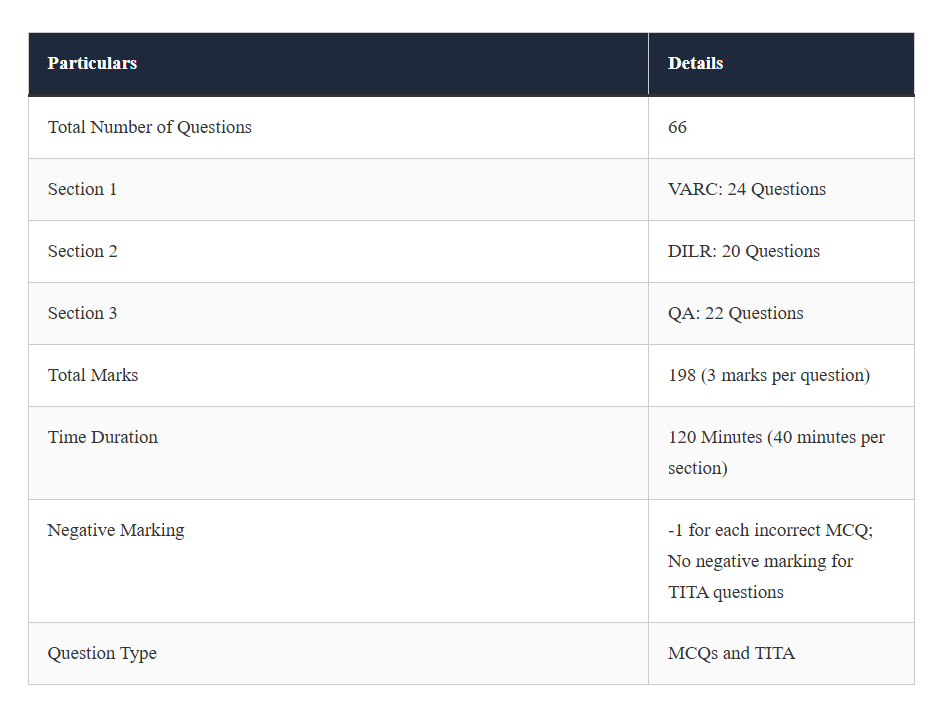
CAT 2026 Exam Pattern
Section
Number of Questions
Verbal Ability & Reading Comprehension (VARC)
24
Data Interpretation & Logical Reasoning (DILR)
20
Quantitative Aptitude (QA)
22
Total
66 Questions / 198 Marks
Key pattern details:
Duration: 120 minutes total, with a 40-minute sectional time limit for each section
Marking scheme: +3 for every correct answer, -1 for every incorrect MCQ answer
No negative marking on Non-MCQ (TITA – Type In The Answer) questions
No switching between sections is allowed once the sectional time begins
Modern Math (Permutation & Combination, Probability)
Ratio and Proportion
Is CAT Difficult?
Yes – CAT is widely regarded as one of the toughest MBA entrance exams in India, not necessarily because of question complexity, but due to the sheer scale of competition. With 2.5 to 3 lakh candidates appearing every year for a limited number of IIM seats, the pressure to score a high percentile is intense. For perspective, only 12 candidates scored a 100 percentile in CAT 2025 out of nearly 2.6 lakh test-takers – underlining just how competitive the exam really is.
CAT Score vs Percentile
It’s important to understand the difference:
Score: The raw marks a candidate earns based on correct and incorrect attempts, out of a total of 204 marks
Percentile: A relative ranking that shows how a candidate performed compared to all other test-takers, normalized across different exam slots to account for difficulty variation
IIMs shortlist candidates based on percentile, not raw score, since percentile accounts for slot-wise difficulty differences and provides a fairer, standardized comparison across the entire candidate pool.
What Happens After the CAT Exam?
Once the exam is over:
The provisional answer key is typically released a few days after the exam
Candidates can raise objections during a specified challenge window
The final answer key is released after reviewing objections
Results are declared, usually in the third or fourth week of December
Shortlisted candidates receive calls for the next stage — Written Ability Test (WAT), Group Discussion (GD), and/or Personal Interview (PI) — from respective IIMs and B-schools
IIM Admission and Selection Process
The IIM selection process typically unfolds in three phases:
Phase 1 — CAT Exam & Shortlisting: Candidates are shortlisted based on their CAT percentile, sectional cutoffs, and academic profile.
Phase 2 — WAT/GD/PI Rounds: Shortlisted candidates are called for a Written Ability Test, Group Discussion, and/or Personal Interview, depending on the specific IIM’s process.
Phase 3 — Final Selection: Final admission offers are based on a composite score combining CAT percentile, academic performance (10th, 12th, graduation), work experience, and WAT/GD/PI performance, weighted according to each IIM’s individual criteria.
Expected CAT 2026 Cut-Offs
(To be updated closer to result declaration; historically, cutoffs vary by IIM and category)
Top IIMs (A, B, C, L): Generally require 95+ percentile for General category shortlisting
New/Younger IIMs: Cutoffs are typically lower, ranging from 80–90 percentile
Reserved categories (SC/ST/OBC-NC/EWS/PwD): Relaxed percentile cutoffs as per IIM-specific reservation policies
Sectional cutoffs also apply — a strong overall percentile alone does not guarantee a shortlist if sectional performance is weak
Note: Exact CAT 2026 cutoffs will depend on difficulty level, number of applicants, and seat matrix – these will be updated post-results.
CAT 2026 Preparation Strategy
Start with understanding the syllabus and exam pattern thoroughly before diving into practice
Dedicate focused time to your weakest section while maintaining strength in stronger areas
Practice previous years’ CAT papers and take regular sectional and full-length mock tests
Work on speed and accuracy simultaneously – CAT rewards efficient time management under the 40-minute sectional limit
Read newspapers/editorials daily to strengthen VARC comprehension and vocabulary
Revise quant formulas and shortcuts regularly to reduce calculation time
Analyze every mock test thoroughly to identify and fix recurring mistakes
Best Books for CAT Preparation
Quantitative Aptitude: “Quantitative Aptitude for CAT” by Arun Sharma
Verbal Ability & Reading Comprehension: “How to Prepare for Verbal Ability and Reading Comprehension for CAT” by Arun Sharma & Meenakshi Upadhyay
Data Interpretation & Logical Reasoning: “How to Prepare for Data Interpretation for CAT” by Arun Sharma
General Practice: NCERT Mathematics (Class 8–10) for concept-building, plus official CAT previous years’ question papers
CAT 2026 Admit Card
The CAT 2026 admit card is expected to be released around the second week of November 2026
Candidates can download it by logging into their account on iimcat.ac.in using their registered ID and password
The admit card will contain essential details: candidate’s name, roll number, exam date, time slot, and allotted test venue
It is mandatory to carry the admit card (along with a valid photo ID) to the exam center on exam day
CAT 2026 Result and Scorecard
Results are expected to be declared in the third to fourth week of December 2026
Candidates can check their result and download the scorecard by logging into the official CAT website
The scorecard will display sectional scores, sectional percentiles, and overall percentile
The scorecard is typically valid for one academic year and is required during the admission process at various institutes
Career Opportunities After MBA
An MBA earned through CAT opens up career paths across:
Consulting (Management/Strategy Consulting)
Banking & Financial Services
Marketing & Brand Management
Human Resources
Operations & Supply Chain Management
Product Management (especially in tech companies)
Entrepreneurship and Startups
General Management roles across industries
Salary After MBA Through CAT
(Indicative figures based on recent placement trends – verify against latest official placement reports)
Top IIMs (A, B, C): Average placement packages often range between ₹25–35+ LPA
Mid-tier IIMs: Average packages typically range between ₹15–25 LPA
Newer IIMs and top non-IIM B-schools: Average packages generally range between ₹8–18 LPA
Note: These are broad indicative ranges – exact figures vary each year and should be sourced from each institute’s official placement report before publishing specific numbers.
CAT vs Other MBA Entrance Exams
Parameter
CAT
XAT
GMAT
MAT
Conducted By
IIMs
XLRI
GMAC
AIMA
Accepted By
21 IIMs + 90+ B-schools
XLRI, XIMB & others
Global B-schools + Indian institutes
600+ Indian B-schools
Frequency
Once a year
Once a year
Multiple times a year
Multiple times a year
Difficulty Level
High
High
Moderate–High
Moderate
Validity
1 year
1 year
5 years
1 year
Frequently Asked Questions (FAQ)
1. When will CAT 2026 registration start? CAT 2026 registration is set to begin on August 3, 2026.
2. What is the expected CAT 2026 exam date? The exam is going to be conducted on November 29, 2026.
3. Which IIM will conduct CAT 2026? IIM Indore is going to conduct CAT 2026, though this is unconfirmed until the official notification is released.
4. What is the eligibility criteria for CAT 2026? A Bachelor’s degree with a minimum of 50% aggregate marks (45% for SC/ST/PwD) is required.
5. Can final-year students apply for CAT 2026? Yes, final-year undergraduate students can apply, subject to submitting proof of degree completion later.
6. Is there an age limit for CAT? No, there is no upper age limit to appear for CAT.
7. What is the CAT 2026 application fee? The fee is expected to be around ₹2,500–2,600 for General/EWS/NC-OBC and ₹1,250–1,300 for SC/ST/PwD candidates.
8. How many sections are there in CAT? CAT has three sections: VARC, DILR, and QA.
9. What is the CAT 2026 marking scheme? +3 marks for every correct answer and -1 for every incorrect MCQ answer; no negative marking on TITA questions.
10. How much time is given for each section in CAT? Each section has a sectional time limit of 40 minutes, with no switching allowed between sections.
11. Can I switch between sections during the CAT exam? No, section switching is not permitted.
12. How many IIMs accept CAT scores? All 21 IIMs accept CAT scores for their MBA/PGP admissions.
13. Do non-IIM institutes accept CAT scores? Yes, over 90 non-IIM B-schools accept CAT scores, including FMS Delhi, SPJIMR, MDI Gurgaon, and IIFT.
14. What is a good percentile in CAT? A percentile of 95+ is generally considered competitive for top IIMs, though requirements vary by institute and category.
15. When will the CAT 2026 admit card be released? The admit card is expected to be released in the second week of November 2026.
16. When will CAT 2026 results be declared? Results are expected in the third to fourth week of December 2026.
17. What is the CAT 2026 correction window? A correction window is expected to open in the fourth week of September 2026 for limited edits.
18. How many test cities can I choose during registration? Candidates can typically select up to 5–6 preferred test cities in order of preference.
19. Is work experience mandatory for CAT? No, work experience is not mandatory, though it may be considered as an additional weightage criterion by some IIMs during final selection.
20. What documents are required for CAT registration? A photograph, signature, category certificate (if applicable), academic mark sheets, and valid contact details.
21. What happens after the CAT exam? The provisional answer key is released, followed by an objection window, final answer key, and then results.
22. What is the IIM selection process after CAT? It typically includes CAT-based shortlisting, followed by WAT/GD/PI rounds, and final selection based on a composite score.
23. Can NRI or foreign nationals apply for CAT? Yes, candidates of any nationality, including NRI/PIO/OCI, can apply and appear for the exam in India.
24. Is CAT tougher than other MBA entrance exams? CAT is generally considered on par with or tougher than exams like XAT and MAT due to its scale of competition and sectional time constraints.
25. How long is the CAT scorecard valid? The CAT scorecard is typically valid for one academic year.
People Also Ask
Is CAT 2026 notification out? Yes.
How many attempts are allowed for CAT? There’s no restriction on the number of attempts; candidates can appear as many times as they wish.
What is the CAT exam full form? Common Admission Test.
Which is the toughest section in CAT? This varies by candidate, but DILR is often cited as the most time-intensive section.
Can I apply for CAT without a Bachelor’s degree? No, a Bachelor’s degree (or final-year status with proof of pending completion) is mandatory.
With CAT 2026 registrations opening soon, now is the time for MBA aspirants to start preparing their documents, revising the syllabus, and mapping out a study strategy.
Manabadi will continue to track every official update – from the notification release to the final scorecard – so bookmark this page and check back regularly for verified, accurate CAT 2026 information sourced directly from iimcat.ac.in.
Stay tuned to Manabadi for the latest updates on CAT 2026 registration, admit card, results, and IIM admission processes.
The Common Admission Test (CAT) is one of India’s most important management entrance examinations. CAT scores are accepted by a large number of MBA and PGDM institutes across the country, including the IIMs, IIT management departments, central universities and leading private business schools. Current 2026 listings show well over 1,300 CAT-accepting management colleges.
For MBA aspirants, choosing the right college involves more than simply looking at the institute’s brand name. Course fees, placement opportunities, location, CAT cutoff, specialisation, alumni network and return on investment (ROI) are all important factors.
Manabadi is a popular education-focused platform that provides students with the latest updates on entrance exams, results, hall tickets, counselling, admissions, scholarships, and government job notifications.
Some premier B-schools charge more than ₹20 lakh for a two-year programme, while institutions such as FMS Delhi, DSE and UBS Chandigarh offer management education at a much lower cost.
1.Top 50 CAT Colleges in India: Fees and Highest Placement Packages
The following table brings together the approximate two-year programme fees, locations and highest placement packages for 50 prominent CAT-participating management institutes.
S.No
College Name
Locality / City
Approx. 2-Year Programme Fee
Highest Placement Package
1
IIM Ahmedabad
Vastrapur, Ahmedabad
₹24,00,000 – ₹25,00,000
₹2.20 Cr (International) / ₹1.45 Cr
2
IIM Bangalore
Bannerghatta Road, Bengaluru
₹24,50,000
₹1.15 Cr
3
IIM Calcutta
Joka, Kolkata
₹25,00,000+
₹1.45 Cr
4
FMS, Delhi University
North Campus, New Delhi
₹2,00,000 – ₹2,50,000
₹1.10 Cr
5
SPJIMR
Andheri West, Mumbai
₹20,00,000 – ₹24,00,000
₹75,00,000
6
MDI Gurugram
Sukhrali, Gurugram
₹25,00,000 – ₹27,00,000
₹65,00,000
7
IIM Lucknow
Prabandh Nagar, Lucknow
₹20,75,000
₹1 Cr
8
IIM Kozhikode
Kunnamangalam, Kozhikode
₹20,50,000
₹81,00,000
9
SJMSOM, IIT Bombay
Powai, Mumbai
₹15,15,000
₹72,00,000
10
DMS, IIT Delhi
Hauz Khas, New Delhi
₹11,00,000 – ₹12,00,000
₹41,00,000
11
IIM Indore
Rau, Indore
₹21,00,000
₹1.14 Cr
12
JBIMS
Churchgate, Mumbai
₹6,00,000 – ₹8,50,000
₹45,00,000
13
IIM Mumbai
Powai, Mumbai
₹21,00,000 – ₹25,50,000
₹71,40,000
14
IIFT Delhi
Qutub Institutional Area, New Delhi
₹22,00,000
₹85,40,000
15
VGSoM, IIT Kharagpur
Kharagpur, West Bengal
₹12,50,000
₹43,30,000
16
IIM Trichy
Thuvakudi, Tiruchirappalli
₹19,50,000
₹41,60,000
17
IIM Udaipur
Balicha, Udaipur
₹20,40,000
₹46,00,000
18
IIM Raipur
Atal Nagar, Raipur
₹18,00,000
₹67,60,000
19
IIM Ranchi
Dhurwa, Ranchi
₹17,50,000
₹67,00,000
20
IIM Rohtak
Sunaria, Rohtak
₹17,90,000
₹48,20,000
21
IIM Shillong
Nongthymmai, Shillong
₹15,00,000 – ₹18,50,000
₹71,30,000
22
IMT Ghaziabad
Raj Nagar, Ghaziabad
₹21,00,000 – ₹21,50,000
₹41,50,000
23
IMI Delhi
Qutub Institutional Area, New Delhi
₹20,00,000 – ₹21,00,000
₹50,00,000
24
DoMS, IIT Madras
Adyar, Chennai
₹8,00,000 – ₹10,00,000
₹30,60,000
25
XIM University (XIMB)
Xavier Square, Bhubaneswar
₹20,00,000 – ₹22,00,000
₹71,50,000
26
Goa Institute of Management (GIM)
Sanquelim, Goa
₹19,50,000 – ₹21,45,000
₹35,00,000
27
TAPMI
Manipal, Karnataka
₹17,00,000 – ₹18,50,000
₹32,00,000
28
Great Lakes Institute of Management
Manamai, Chennai
₹19,00,000 – ₹21,00,000
₹34,00,000
29
MICA
Shela, Ahmedabad
₹23,00,000 – ₹25,00,000
₹36,00,000
30
IRMA
Anand, Gujarat
₹16,00,000 – ₹17,50,000
₹27,80,000
31
FORE School of Management
Qutub Institutional Area, New Delhi
₹17,00,000 – ₹18,00,000
₹30,00,000
32
K J Somaiya Institute of Management
Vidyavihar, Mumbai
₹19,00,000 – ₹20,00,000
₹28,25,000
33
L.N. Welingkar (WeSchool)
Matunga, Mumbai
₹14,00,000
₹25,50,000
34
BIMTECH
Knowledge Park III, Greater Noida
₹14,00,000 – ₹16,00,000
₹24,40,000
35
IIM Kashipur
Kashipur, Uttarakhand
₹17,30,000
₹37,00,000
36
IIM Amritsar
Amritsar, Punjab
₹17,50,000
₹40,00,000
37
IIM Nagpur
MIHAN, Nagpur
₹18,00,000
₹64,00,000
38
IIM Visakhapatnam
Gambheeram, Visakhapatnam
₹17,85,000
₹43,25,000
39
IIM Bodh Gaya
Bodh Gaya, Bihar
₹16,50,000
₹48,50,000
40
IIM Sirmaur
Paonta Sahib, Himachal Pradesh
₹16,00,000
₹64,00,000
41
IIM Jammu
Jagti, Jammu
₹17,15,000
₹64,00,000
42
DoMS, IIT Roorkee
Roorkee, Uttarakhand
₹9,00,000 – ₹10,50,000
₹28,00,000
43
IME, IIT Kanpur
Kalyanpur, Kanpur
₹4,00,000 – ₹5,00,000
₹24,00,000
44
UBS, Panjab University
Sector 14, Chandigarh
₹2,50,000 – ₹4,60,000
₹58,50,000
45
Department of Commerce, DSE
North Campus, New Delhi
₹40,000 – ₹60,000
₹32,00,000
46
LIBA
Nungambakkam, Chennai
₹16,00,000 – ₹17,00,000
₹21,00,000
47
IFMR Graduate School of Business
Sri City, Andhra Pradesh
₹14,50,000
₹22,90,000
48
IBS Hyderabad
Donthanapally, Hyderabad
₹16,00,000 – ₹17,01,000
₹58,20,000
49
Nirma University
S-G Highway, Ahmedabad
₹12,00,000 – ₹14,50,000
₹30,00,000
50
NIBM Pune
NIBM Post Office, Pune
₹14,00,000 – ₹16,00,000
₹23,50,000
Note: Fees and placement figures are indicative and may vary by programme, academic year and placement batch. Hostel, mess, deposits and other charges may be additional.
Top CAT-Accepting Colleges in Hyderabad:
Hyderabad also has several management institutes where CAT scores can be considered for admission.
College
Location
Approx. Programme Fee
School of Management Studies, University of Hyderabad
Gachibowli, Hyderabad
₹5.21 Lakhs
IMT Hyderabad
Cherlapally, Hyderabad
₹14.77 Lakhs
Institute of Public Enterprise (IPE)
Shamirpet, Hyderabad
₹8.15 Lakhs
Woxsen University
Sadashivpet, Hyderabad
₹12.2–12.7 Lakhs
IBS Hyderabad
Donthanapally, Hyderabad
₹16–17.01 Lakhs
Students should verify the exact admission route and programme-specific CAT eligibility before applying because acceptance of CAT scores can vary by course and admission cycle.
Highest Package vs Average Package: Which Matters More?
One of the biggest mistakes students make while comparing MBA colleges is looking only at the highest placement package.
A highest package may represent an exceptional offer received by one student or a very small number of students. It can also include international offers or specialised roles such as investment banking, consulting, technology or quantitative finance.
For example, current 2026 listings show very high individual packages at several leading institutes, but they also separately report average packages. IIM Ahmedabad, IIM Calcutta, IIM Bangalore and FMS Delhi, for instance, have substantially different average and highest-package figures.
Therefore, students should compare:
Average CTC
Median CTC
Placement percentage
Number and quality of recruiters
Sector-wise placements
Internship opportunities
Total programme cost
Alumni network
Career progression
The median package can be particularly useful because it gives a better idea of the middle point of the placement distribution and is less influenced by a few exceptionally high salaries.
2. Why Are IIM and Private B-School Fees So High?
Many premier management institutes charge ₹20 lakh or more for their two-year programmes. The overall cost can include academic fees, residential facilities, infrastructure, student activities and other institutional expenses.
Private business schools may also invest heavily in corporate relations, international exposure, specialised faculty, technology infrastructure and campus facilities.
Current 2026 college listings demonstrate the wide variation in both fees and placement outcomes. For example, FMS Delhi is listed with a total MBA fee of about ₹2.43 lakh, while several IIM and private B-school programmes have fees exceeding ₹20 lakh.
However, higher fees do not automatically guarantee higher ROI.
3. High-ROI CAT Colleges
Students who want to minimise their education-loan burden can consider colleges with relatively low fees and strong placement outcomes.
College
Approx. 2-Year Fee
Indicative Placement Potential
Department of Commerce, DSE
₹40,000–60,000
High
FMS, Delhi University
₹2–2.5 Lakhs
Very High
UBS, Panjab University
₹2.5–4.6 Lakhs
Strong
IME, IIT Kanpur
₹4–5 Lakhs
Strong
School of Management Studies, University of Hyderabad
₹5.21 Lakhs
Moderate–Strong
JBIMS, Mumbai
₹6–8.5 Lakhs
Very High
DoMS, IIT Madras
₹8–10 Lakhs
Strong
DoMS, IIT Delhi
₹11–12 Lakhs
Very Strong
For example, current listings report FMS Delhi at roughly ₹2.43 lakh in total MBA fees and an average placement figure above ₹45 lakh, although students should verify the latest official placement report and fee structure before making a decision.
4. FMS Delhi: One of India’s Major High-ROI Choices
Faculty of Management Studies (FMS) Delhi is particularly attractive to students looking for a combination of low fees and strong placement opportunities.
Its comparatively low programme fee means that students may have a significantly lower financial burden than at many premium private B-schools. At the same time, the institute has a strong reputation among recruiters.
The major challenge is admission competition. Candidates need a strong CAT performance and must also satisfy the institute’s admission criteria.
5. IIT Management Departments: Another Alternative
Several IITs also offer management programmes that accept CAT scores.
Some notable options include:
DMS IIT Delhi
SJMSOM IIT Bombay
DoMS IIT Madras
VGSoM IIT Kharagpur
IME IIT Kanpur
DoMS IIT Roorkee
These institutes can be particularly attractive to students who want a combination of technical ecosystem, management education, industry exposure and comparatively lower fees than some private B-schools.
6. How Can Students Finance a High-Fee MBA?
Students admitted to an expensive management programme can explore education loans, scholarships and institute-level financial assistance.
Before taking a loan, students should compare:
Interest rate
Collateral requirement
Loan processing charges
Moratorium period
Repayment period
Interest accumulation during the study period
Whether hostel and other expenses are covered
Students should also check the institute’s official scholarship and need-based financial-assistance policies.
It is important not to assume that every student will automatically qualify for a collateral-free loan or complete tuition-fee waiver. Eligibility depends on the lender, institute, programme and applicant’s financial profile.
7. How to Select the Best CAT College?
A good CAT college shortlist should not be based only on the highest package.
Students can use the following checklist:
Check your expected CAT percentile.
Identify colleges where your percentile is competitive.
Compare the total two-year cost.
Check average and median placement packages.
Examine the placement report and recruiter list.
Consider your preferred specialisation.
Compare location and living expenses.
Check scholarship and financial-aid options.
Calculate potential ROI.
Keep a mix of ambitious, realistic and safer options. CAT College Selection Based on Budget Budget Below ₹5 Lakhs
Students looking for affordable options can consider institutes such as:
FMS Delhi
DSE
UBS Chandigarh
IME IIT Kanpur Budget of ₹5–12 Lakhs
Options include:
University of Hyderabad
JBIMS
DoMS IIT Madras
DoMS IIT Delhi
DoMS IIT Roorkee Budget Above ₹12 Lakhs
Students can consider a wider range of institutions, including:
IIMs
IIT Bombay
IIT Kharagpur
IIM Mumbai
IIFT
SPJIMR
MDI
XIMB
MICA
TAPMI
GIM
IMT Ghaziabad
The final choice should depend on the candidate’s CAT percentile, profile, career goals and financial situation.
8. FAQs
How many colleges accept CAT scores?
More than 1,300 management colleges are currently listed as accepting CAT scores, although the exact number can vary depending on the database, programme and admission year.
Which CAT college has the lowest fees among the top institutes?
DSE and FMS Delhi are among the prominent low-fee options. FMS Delhi’s current listed MBA fee is around ₹2.43 lakh, while DSE’s fee can be substantially lower depending on the programme and applicable charges.
Is the highest package the most important placement figure?
No. Students should primarily look at average and median CTC, placement percentage, recruiter quality and role distribution. The highest package may be an exceptional individual offer.
Is an IIM always better than a low-fee college?
Not necessarily. The best choice depends on the candidate’s career goals, CAT percentile, programme, placement outcomes and financial situation. A lower-fee college with strong placements can sometimes provide a better ROI.
Which colleges are good for high ROI?
FMS Delhi, DSE, UBS Chandigarh, JBIMS and selected IIT management departments are examples of institutes that can offer strong ROI because their fees are comparatively lower.
Should students take an education loan for an MBA?
An education loan can make a high-quality MBA financially accessible, but students should compare the total borrowing cost with realistic placement outcomes before taking a large loan.
9.Conclusion
CAT gives students access to a wide range of management institutes across India, from the country’s premier IIMs and IIT management departments to affordable university-based B-schools.
The highest placement package can look impressive, but it should never be the only factor used to select a college. A better approach is to compare fees, average salary, median salary, placement percentage, career opportunities and ROI.
For students with a limited budget, institutes such as FMS Delhi, DSE, UBS Chandigarh, IIT Kanpur and other affordable management schools can be excellent alternatives to high-fee programmes.
Ultimately, the best CAT college is not necessarily the college with the highest package or the highest fee. It is the institute that provides the right balance of education quality, career opportunities, affordability and long-term return on investment.
The CAT Exam Hall Ticket 2026 is expected to be released on November 4, 2026, at 5:00 PM. Candidates who successfully complete the CAT 2026 registration process can download their CAT Admit Card 2026 online through the official Indian Institutes of Management (IIM) CAT website.
The CAT 2026 exam is scheduled to be conducted on November 29, 2026. The admit card is an important document that contains details such as the candidate’s name, registration number, photograph, signature, exam centre, test slot and important instructions.
Candidates are advised to download and print the hall ticket well before the examination date to avoid last-minute technical issues.
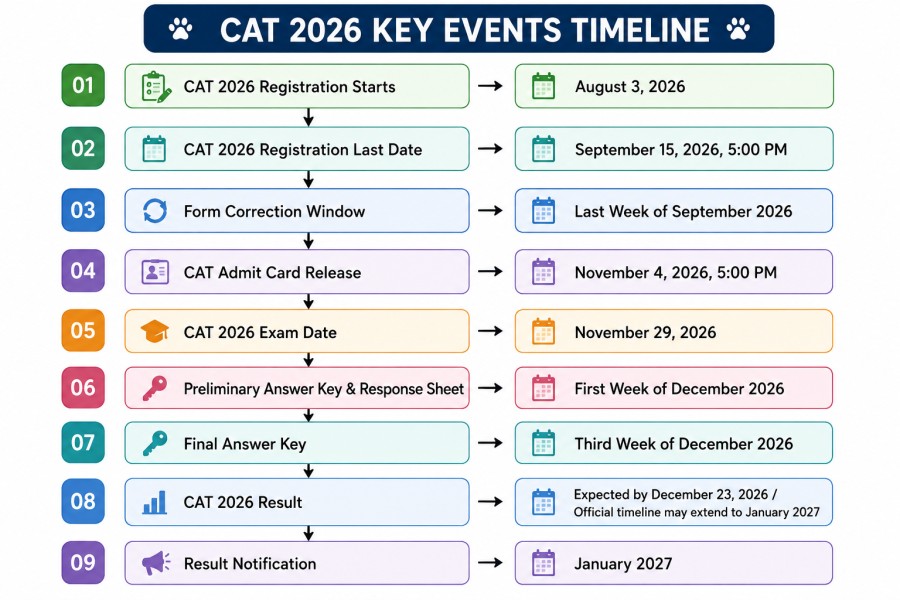
1. CAT Admit Card 2026: Important Dates
Event
Expected Date
CAT 2026 Registration Starts
August 3, 2026
CAT 2026 Registration Last Date
September 15, 2026, 5:00 PM
Form Correction Window
Last Week of September 2026
CAT Admit Card Release
November 4, 2026, 5:00 PM
CAT 2026 Exam Date
November 29, 2026
Preliminary Answer Key & Response Sheet
First Week of December 2026
Final Answer Key
Third Week of December 2026
CAT 2026 Result
Expected by December 23, 2026 / Official timeline may extend to January 2027
2. CAT Hall Ticket 2026 Download Link
The CAT 2026 Admit Card will be made available through the official CAT examination portal.
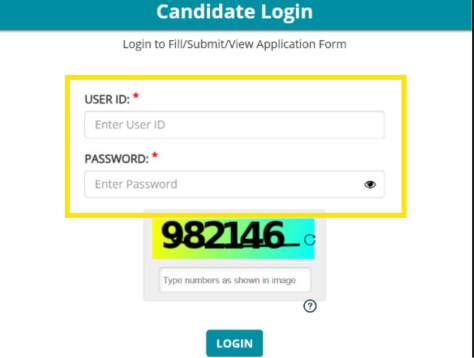
Candidates need to log in using the User ID and password generated during CAT 2026 registration.
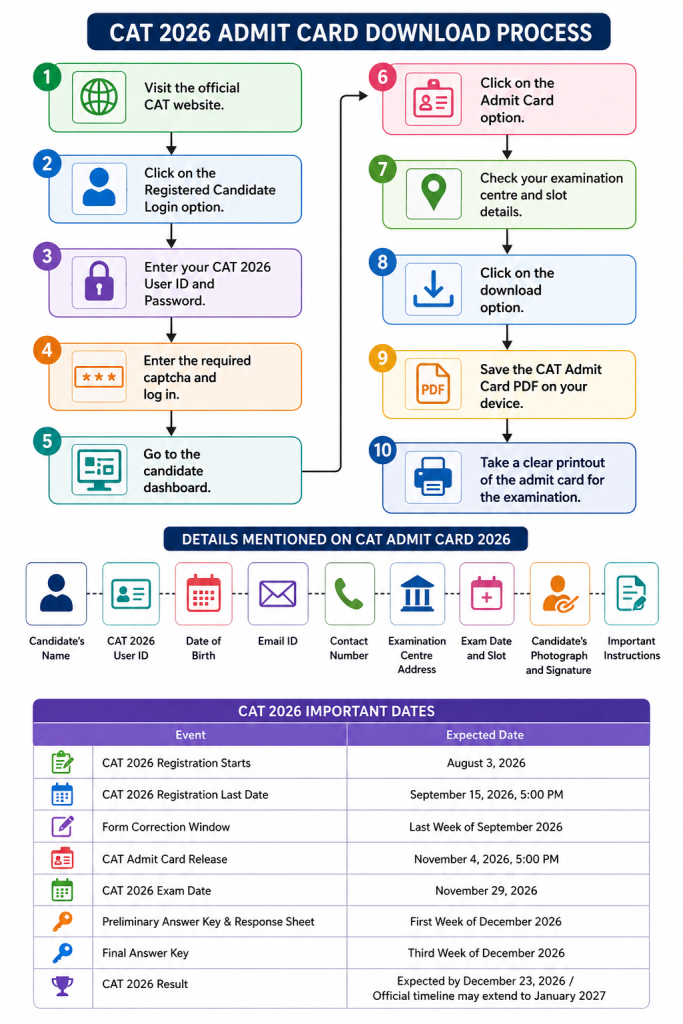
3. How to Download CAT Admit Card 2026?
Candidates can follow the steps below to download their CAT Exam Hall Ticket:
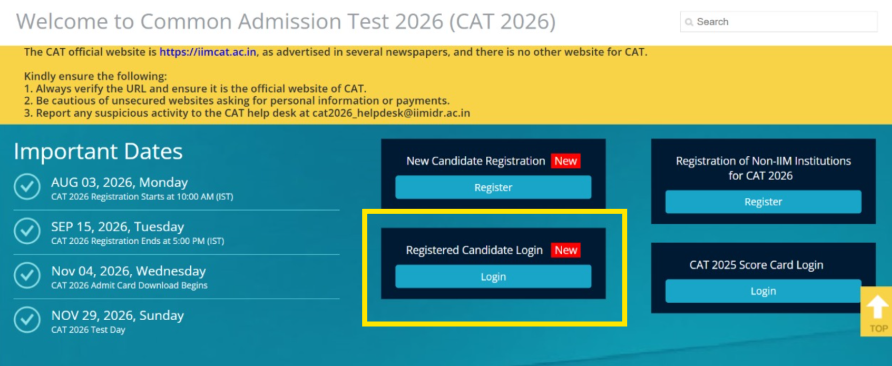
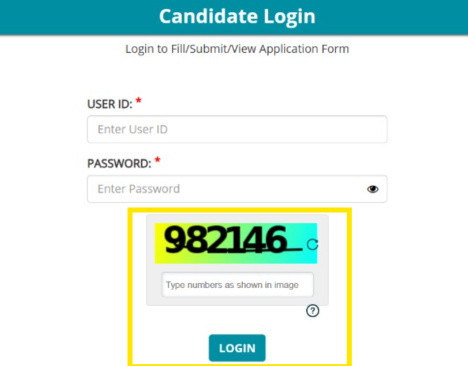
Click on the Registered Candidate Login option.
Enter your CAT 2026 User ID and Password.
Enter the required captcha and log in.
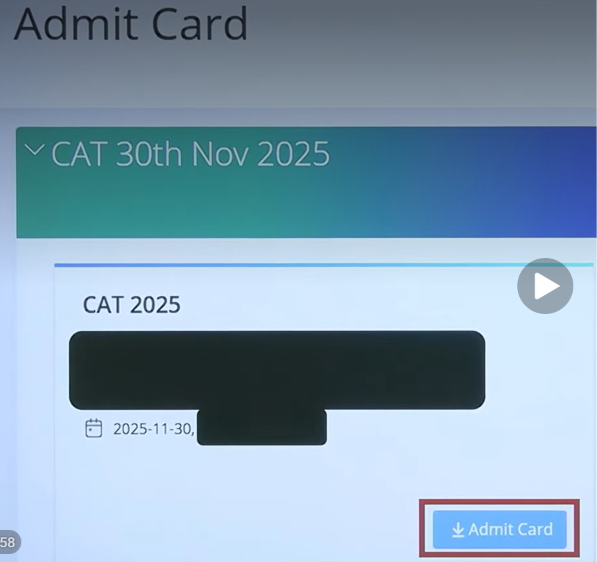
Go to the candidate dashboard.
Click on the Admit Card option
Check your examination centre and slot details.
Click on the download option.
Save the CAT Admit Card PDF on your device.
Take a clear printout of the admit card for the examination.
After downloading the hall ticket, candidates should carefully verify all the information printed on it.
4.Details Present on Cat Admit Card 2026:
Candidate’s name CAT registration number Candidate photograph Candidate signature Examination date Examination slot Test centre name and address Important examination instructions Examination centre/location details Other candidate-specific information
Candidates should immediately check for discrepancies in their name, photograph, signature or examination centre details.
5.CAT 2026 Exam Pattern
The CAT examination is expected to have three major sections: VARC, DILR and QA. The examination duration is expected to be 120 minutes, with 40 minutes allotted to each section.
Section
Expected Questions
Duration
VARC (Verbal Ability and Reading Comprehension)
24
40 Minutes
DILR ((Data Interpretation and Logical Reasoning)
22
40 Minutes
QA (Quantitative Aptitude)
22
40 Minutes
Total
68
120 Minutes
Candidates cannot freely switch between sections during the examination.
For MCQs, candidates generally receive 3 marks for a correct answer and a 1-mark deduction for an incorrect answer. TITA or non-MCQ questions carry 3 marks for a correct answer and generally have no negative marking.
6.CAT 2026 Exam Day Instructions
Candidates should carefully follow all instructions mentioned on the admit card.
Before leaving for the examination centre, candidates should:
Download and print the CAT admit card. Check the examination centre address carefully. Verify the examination date and slot. Carry the required valid photo ID proof. Ensure that the photograph and signature on the admit card are clearly visible. Reach the examination centre well before the reporting time. Follow all instructions provided by the examination authorities.
Candidates should avoid waiting until the last day to download or print the admit card.
7.What to Check After Downloading CAT Admit Card?
After downloading the CAT Hall Ticket 2026, candidates should verify:
Name: Make sure the spelling matches the registration details and valid ID proof.
Photograph and Signature: Check whether both are clearly visible and properly printed.
Registration Number: Ensure that the registration number matches the details used during the CAT application process.
Exam Centre: Carefully verify the complete examination centre address and location.
Exam Date and Slot: Confirm that the date and allotted test slot are correct.
8. CAT 2026 Answer Key and Response Sheet
After the examination, the CAT 2026 preliminary answer key and individual response sheet are expected to be released in the first week of December 2026.
Candidates will be able to compare their recorded responses with the answers provided by the examination authority. A short objection window is expected to be provided after the release of the preliminary answer key.
The final answer key is expected to be released later in December.
9.CAT 2026 Result
The CAT 2026 result is expected to be announced in December 2026, with December 23, 2026 being an expected result date based on recent timelines. However, candidates should rely on the official CAT website for the confirmed result date because the official timeline may extend into the first week of January 2027.
The CAT scorecard will include sectional scaled scores, sectional percentiles, overall scaled score and overall percentile.
10. CAT 2026 Registration Fee
The CAT 2026 registration fee is expected to be:
Category
Registration Fee
General / EWS / NC-OBC
₹2,700
SC / ST / PwD
₹1,350
The registration fee is payable online and is non-refundable.
11. CAT 2026 Eligibility
Candidates applying for CAT 2026 are generally required to have a bachelor’s degree with at least 50% marks or equivalent CGPA. The minimum requirement is generally 45% for SC, ST and PwD candidates.
Final-year graduation students may also apply, subject to the eligibility conditions prescribed by the CAT authorities.
There is no prescribed upper age limit for appearing in CAT, and there is no restriction on the number of attempts.
12.What Happens After CAT 2026?
After the CAT examination and result declaration, participating IIMs will begin their respective admission and shortlisting processes.
Candidates shortlisted by individual IIMs may have to participate in further selection stages such as:
Written Ability Test (WAT) Personal Interview (PI) Other institute-specific selection components
The final admission decision is made independently by the respective IIMs based on their admission policies.
13.CAT Hall Ticket 2026: Important Points
Candidates should remember these important points:
CAT Admit Card 2026 is expected on November 4, 2026, at 5:00 PM. The CAT examination is scheduled for November 29, 2026. Download the admit card only through the official CAT portal. Check the examination centre details immediately after downloading. Carry a printed copy of the admit card and the required valid ID proof. Do not wait until the last moment to download or print the hall ticket. Keep the admit card safely until the completion of the admission process.
CAT aspirants should regularly check the official IIM CAT website for the confirmed admit card release date, examination instructions and any changes to the CAT 2026 schedule.
🔴 TG NEET UG 2026 LATEST UPDATE – Final MERIT LIST & Seat Matrix OUT, Notication for Web-options entry
The TG Neet Counselling round 1 web option entry started from August 29 (6:00 AM) and will continue until September 1, 2026 (12:00 PM)
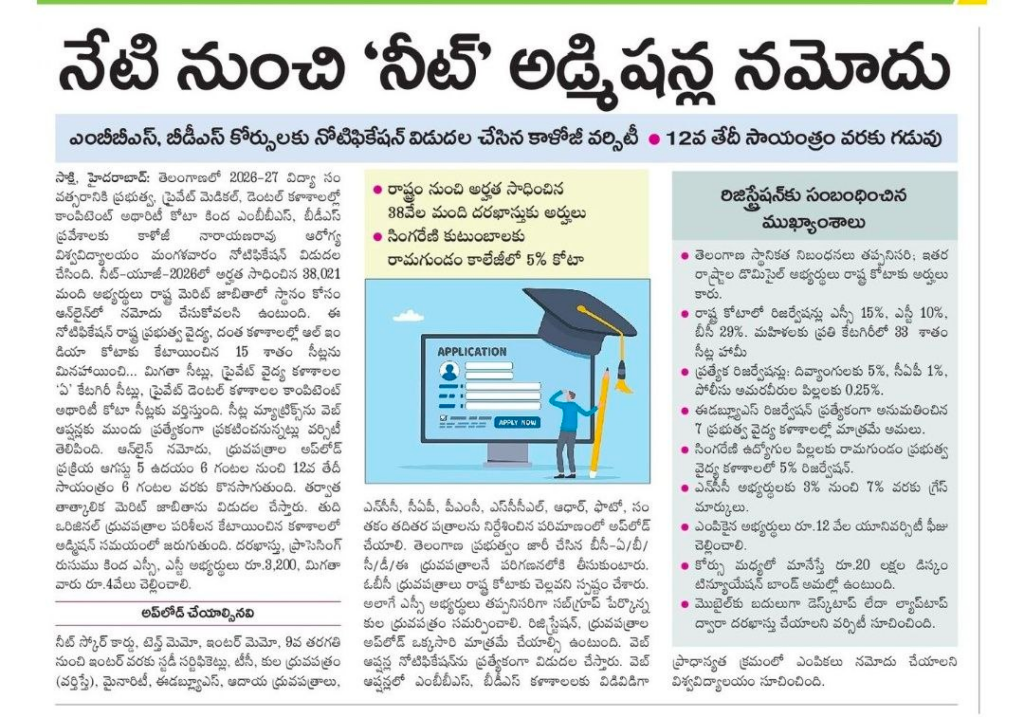
The Kaloji Narayana Rao University of Health Sciences (KNRUHS) has released the Final Merit List & Seat Matrix of Candidates for admission to MBBS and BDS courses under Competent Authority Quota for the Academic Year 2026-27. Telangana has a total of approximately 10,250 MBBS seats available for the 2026 NEET UG counselling process. Candidates who uploaded certificates at the time of online registration whose names are in the final merit list of UG Medical Admissions on the KNRUHS website on 28.08.2026 are eligible to exercise web – options through online from computer with internet connection.
The provisional merit list is prepared based on the candidates’ NEET UG 2026 performance and eligibility under the Telangana state counselling process. Candidates who applied for KNRUHS MBBS/BDS admissions under the Competent Authority Quota can now check their names, NEET details and provisional state merit position in the official list.
The provisional merit list is an important stage before the commencement of the web-options and seat-allotment process. Candidates should carefully verify the details mentioned against their names and wait for the University to announce the subsequent counselling schedule.
KNRUHS MBBS BDS Final Merit List 2026: Highlights
Particular
Details
Conducting Authority
Kaloji Narayana Rao University of Health Sciences (KNRUHS)
Admission Courses
MBBS and BDS
Academic Year
2026-27
Quota
Competent Authority Quota
Entrance Exam
NEET UG 2026
Merit List Status
Released
Merit List Type
Final Merit List
Release Date
August 28, 2026
State
Telangana
Official Website
KNRUHS
Next Stage
Counselling / Web Options / Seat Allotment schedule to be announced
KNRUHS has been publishing the MBBS/BDS admission notifications and related updates through its official notification portal. The University had earlier issued the notification for registration, followed by certificate verification and a reopening of registration for eligible candidates.
KNRUHS MBBS BDS Merit List 2026 Released
The KNRUHS MBBS BDS Final Merit List 2026 is now available for candidates who registered for admission under the Competent Authority Quota. The list contains the candidates considered for the Telangana state counselling process based on their eligibility and NEET UG 2026 credentials.
The University has titled the notification “KNRUHS – MBBS BDS Admissions under Competent Authority Quota for the AY 2026-27 – Final Merit List of Candidates.” The official PDF is hosted on the KNRUHS website.
What Details Are Mentioned in the KNRUHS Final Merit List?
Candidates can use the merit list to verify their admission-related details, including:
NEET UG 2026 application/registration details
NEET UG 2026 rank/score-related information
Candidate name
Gender
Category
Final merit position
Other details used by KNRUHS for preparation of the state merit list
Candidates should check the PDF carefully and ensure that the information displayed against their name is correct.
How to Check KNRUHS MBBS BDS Final Merit List 2026?
Candidates can follow these steps to check the provisional merit list:
Visit the official KNRUHS website.
Go to the Admissions/Notifications section.
Find the notification titled “MBBS BDS Admissions under Competent Authority Quota for the AY 2026-27 – Final Merit List of Candidates.”
Open the provisional merit list PDF.
Use the Ctrl + F option on a computer or the PDF search option on a mobile device.
Enter your name or NEET application number.
Check your provisional merit position and other details.
Download/save the PDF for future reference.
The official KNRUHS notification page lists the MBBS/BDS Competent Authority Quota notifications, including the registration notification, certificate-verification notification and reopening-of-registration notification.
TG Neet Counselling Seat Matrix Highlights:
Telangana has a total of approximately 10,250 MBBS seats available for the 2026 NEET UG counselling process.
Key Seat Matrix Highlights
Total MBBS Seats: Approximately 10,250 seats across government and private medical colleges.
Seat Increase: The state added 810 new MBBS seats compared to the previous year (110 new government seats and 700 new private seats).
Top Government Colleges: Major institutions like Osmania Medical College offer 250 seats, while Gandhi Medical College and Kakatiya Medical College offer 200 seats each.
Quota Division: 15% of government college seats fall under the All India Quota (AIQ) managed by MCC, and 85% fall under the Kaloji Narayana Rao University of Health Sciences (KNRUHS) State Quota.
Candidate Ratio: Eligible state candidates decreased by 8.56%, improving the overall seat-to-candidate ratio and boosting admission prospects.
TG Neet Counselling Web-Option Entry:
Candidates who uploaded certificates at the time of online registration whose names are in the final merit list of UG Medical Admissions on the KNRUHS website on 28.08.2026 are eligible to exercise web – options through online from computer with internet connection.
For Telangana NEET counselling, candidates must complete web option entry on the official portals tsmedadm.tsche.in for the Competent Authority Quota or tspvtmedadm.tsche.in for the Management Quota.
Steps for Web Option Entry
Visit the Portal: Go to the official KNRUHS linked admission website (tsmedadm.tsche.in).
Login: Enter your NEET Roll Number, All India Rank, and Registration/Id Number.
Select Choices: Choose your preferred medical or dental colleges and courses from the available list.
Save and Print: Reorder or modify your options before the final deadline, then save and print a copy of your submitted choices.
KNRUHS MBBS BDS Counselling 2026
After the merit-list stage, KNRUHS is expected to proceed with the counselling process for eligible candidates. The counselling process will determine admissions based on factors such as:
NEET UG 2026 merit/rank
Candidate eligibility
Category and applicable reservations
Local area/status requirements wherever applicable
Availability of seats
Candidate’s web-option preferences
Applicable KNRUHS admission rules and government regulations
Candidates should wait for the official web-options notification and seat matrix before making their college preferences.
Important: Merit List Does Not Guarantee MBBS/BDS Admission
Candidates whose names appear in the provisional merit list should note that merit-list inclusion does not guarantee a seat.
Actual admission will depend on the candidate’s eligibility, merit position, category, available seats, options exercised during counselling and the applicable admission rules. Candidates must also complete the required counselling and reporting formalities within the deadlines prescribed by KNRUHS.
What Candidates Should Do Now?
Candidates are advised to:
Download and save the provisional merit list.
Search for their name/application number in the PDF.
Verify their merit position and category.
Check whether their personal and NEET-related details are correct.
Keep all original certificates and documents ready.
Monitor KNRUHS for the counselling notification.
Check the seat matrix once released.
Carefully exercise web options when the option-entry window opens.
Follow the reporting and fee-payment instructions after seat allotment.
KNRUHS MBBS BDS Admissions 2026: Previous Updates
KNRUHS initially issued the notification for MBBS/BDS admissions under Competent Authority Quota for AY 2026-27 in August 2026. The University subsequently conducted the admission-related verification process and later issued a notification reopening registration.
The University had also issued notifications for physical verification of certificates of candidates registered under the CAP quota and physical assessment of candidates who applied under the PwD category as part of the admission process.
The latest development is the release of the provisional merit list on August 24, 2026.
Telangana MBBS Fees 2026-29: No Fee Hike for Private Medical Colleges
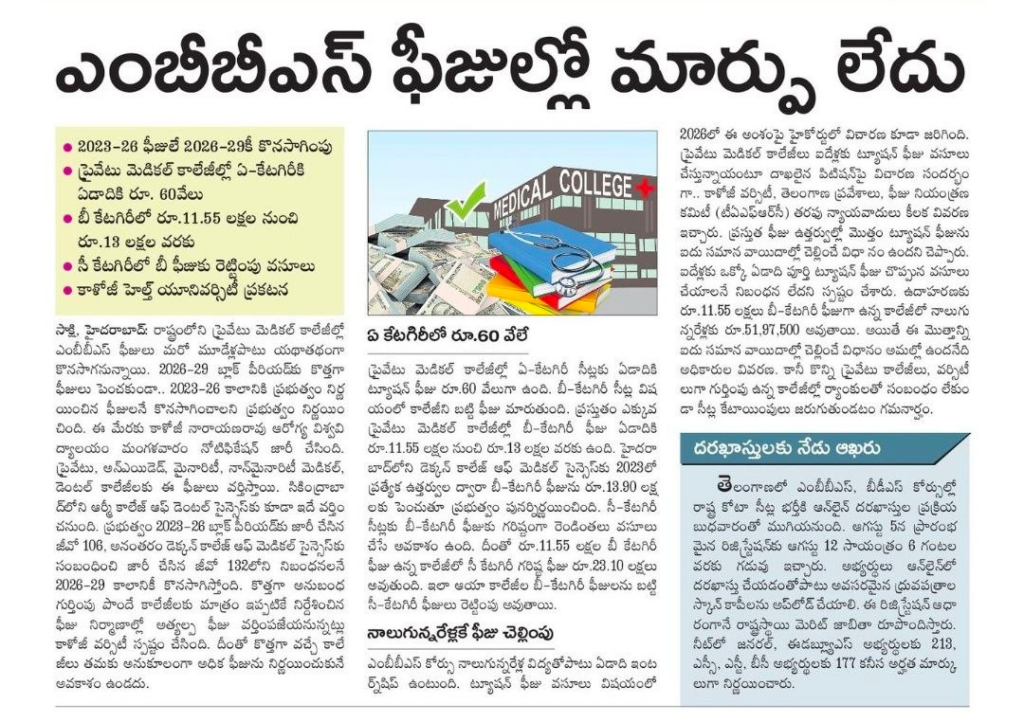
Big Update for Telangana NEET UG 2026 aspirants: There will be no increase in MBBS tuition fees for the 2026-29 block period in private medical colleges in Telangana. The fee structure applicable during the previous 2023-26 block period will continue for 2026-29, providing clarity to students and parents participating in the current Telangana NEET UG counselling.
The fee structure applies to eligible private unaided minority and non-minority medical and dental colleges in Telangana, as per the applicable government and KNRUHS orders.
Telangana MBBS Fee Structure 2026-29
Category-A / Convenor Quota: The tuition fee for Category-A seats in private medical colleges remains ₹60,000 per year.
Category-B / Management Quota: The annual tuition fee for Category-B MBBS seats ranges from approximately ₹11.55 lakh to ₹13 lakh, depending on the college.
Deccan College of Medical Sciences: The applicable Category-B fee for Deccan College of Medical Sciences is higher, with the fee fixed at ₹13.90 lakh per year under the relevant orders.
Category-C / NRI Quota: For NRI-category seats, the fee can be charged up to twice the applicable Category-B fee of the respective college.
For example, if the Category-B fee of a college is ₹11.55 lakh per year, the maximum Category-C/NRI fee can be ₹23.10 lakh per year, subject to the applicable regulations.
MBBS Fee Collection Over 4.5 Years
The MBBS academic course consists of 4.5 years of study followed by a one-year internship. In connection with the fee-collection issue, KNRUHS has clarified the applicable method of collecting tuition fees.
The total tuition fee applicable for the 4.5-year academic period is divided into five equal annual instalments. Therefore, students should not interpret the five instalments as payment for five full academic years of MBBS tuition.
For example, where the applicable Category-B fee is ₹11.55 lakh per year, the total tuition fee for 4.5 years works out to ₹51,97,500, which is collected in five equal instalments of ₹10,39,500 each.
What About Newly Recognised Medical Colleges?
Newly recognised private medical colleges will not have complete freedom to fix arbitrary tuition fees. Their applicable fee will be determined within the prescribed fee structure and corresponding fee brackets under the relevant government orders.
Students and parents should therefore verify the official fee applicable to the particular college and seat category before making any payment.
TG NEET UG 2026 Eligibility
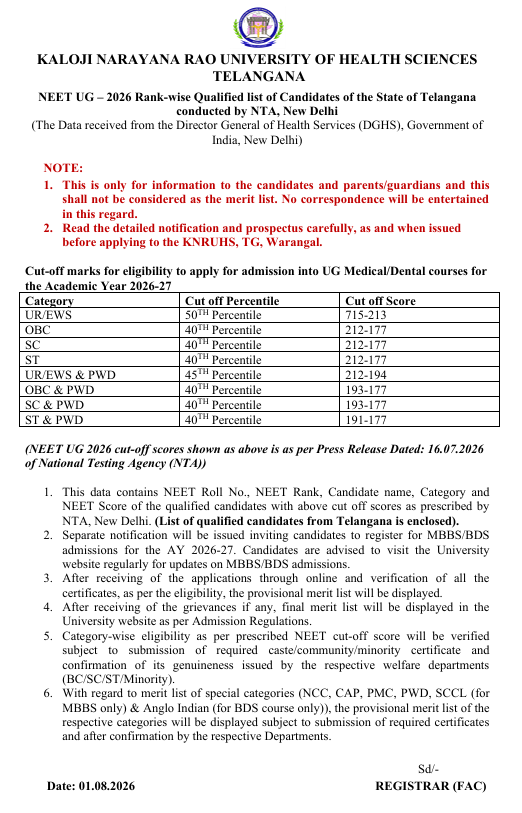
Candidates must have qualified NEET UG 2026 with the prescribed category-wise qualifying percentile. The KNRUHS notification specifies a qualifying score of 213 for General/Unreserved/EWS candidates, 194 for General/EWS PwD candidates and 177 for SC/ST/BC and eligible PwD candidates of those categories.
What Candidates Must Do Today
Candidates should:
Complete online registration
Enter the required NEET UG and personal details
Upload scanned original certificates
Pay the prescribed application fee
Verify all entered information
Submit the application before 6 PM today
KNRUHS has also published subsequent notices relating to physical verification of certificates for CAP candidates and physical assessment of PwD candidates, so eligible candidates should regularly check the university website for further counselling updates.
Important: Candidates should not wait until the final minutes because the portal closes according to the prescribed server time.
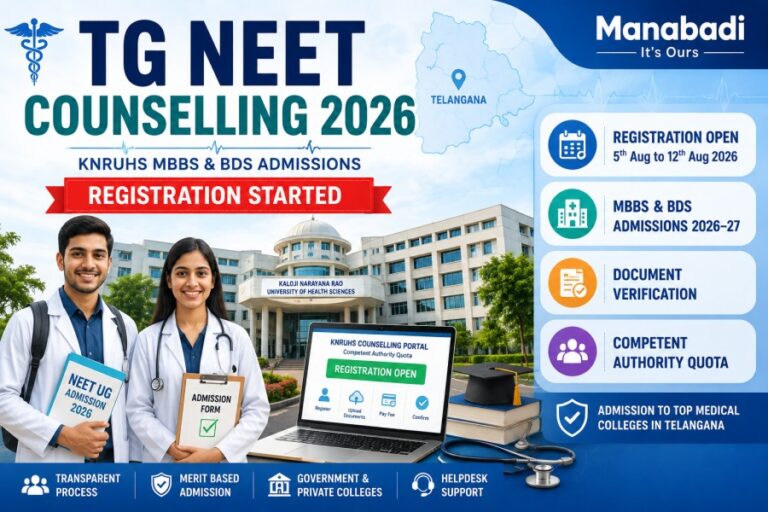
Kaloji Narayana Rao University of Health Sciences (KNRUHS) has commenced the online registration process for Telangana NEET UG 2026 MBBS and BDS admissions under the Competent Authority Quota for the academic year 2026–27. Eligible NEET UG qualified candidates from Telangana can now register online, upload the required certificates, and complete document verification within the prescribed schedule.
Reservation Policy
Admissions will be carried out according to the Telangana reservation policy:
SC: 15%
ST: 10%
BC: 29%
Women Reservation: 33% Horizontal Reservation across all categories
Special Category Reservations:
Persons with Disabilities (PwD): 5%
Children of Armed Personnel (CAP): 1%
Children of Police Martyrs: 0.25%
Singareni Employees Quota: 5% reservation in Government Medical College, Ramagundam, for eligible children of Singareni employees.
Important Instructions for Candidates
Telangana local area and domicile rules will be strictly followed.
Candidates must upload certificates issued by the Telangana Government wherever applicable.
KNRUHS advises applicants to complete the registration process using a desktop or laptop instead of a mobile phone to avoid technical issues.
Candidates should carefully verify all uploaded documents before final submission.
Discontinuation Bond
Candidates who discontinue the MBBS or BDS course after admission will be required to pay a ₹20 lakh discontinuation bond as per the university guidelines. Applicants are advised to exercise caution while participating in counselling and selecting colleges.
NEET Counselling 2026: MCC Introduces Freeze & Float System
The Medical Counselling Committee (MCC) has introduced several important changes in the NEET UG 2026 All India Quota (AIQ) counselling process for MBBS, BDS, and B.Sc Nursing admissions. These reforms aim to make the counselling process more convenient, transparent, and student-friendly.
One of the biggest updates this year is the introduction of the Freeze & Float option, allowing candidates to upgrade their seats without physically reporting to the allotted college during the initial counselling rounds.
Key Highlights
Feature
Details
New Freeze & Float Option
Choose to accept your seat or wait for a better upgrade.
Online Document Verification
Upload documents through the MCC portal without visiting the allotted college.
One-Time Certificate Upload
Documents need not be submitted repeatedly in every counselling round.
Strict Rules After Round 3
Candidates allotted seats in Round 3 or those not upgraded after choosing Float must join the allotted college.
Security Deposit
Forfeited if a candidate leaves the allotted seat after the third round.
Digital Verification
Special verification introduced for NRI and PwD quota candidates.
AIQ Seat Rule
Unfilled AIQ seats will not be returned to State Quota after Round 2.
What is the Freeze & Float Option?
Freeze
Choose Freeze if you are satisfied with the allotted college and course. Your seat will be confirmed, and you can complete the admission process by joining the allotted institute.
Float
Choose Float if you wish to participate in the next counselling round for a better college or preferred course.
Under the new system:
There is no need to physically report to the allotted college.
Simply upload the required documents on the MCC portal.
The allotted college will verify your certificates online and provisionally confirm your admission.
If any document requires correction, candidates will receive an online notification.
Important Rules for Candidates
Candidates should carefully understand the revised counselling rules:
Candidates allotted a seat in Round 3 must join the allotted college.
Candidates selecting Float who do not receive an upgraded seat must also join the previously allotted institute.
Leaving the seat after the third round will:
Lead to forfeiture of the security deposit.
Make the candidate ineligible for further counselling during the current academic year.
Submission of fake certificates, false information, or multiple registrations may result in:
Cancellation of candidature.
Loss of security deposit.
Further disciplinary action by MCC.
NEET UG 2026 AIQ & State Quota Counselling Schedule
Counselling Phase
All India Quota (AIQ)
State Quota
Round 1 Counselling
4 August – 17 August 2026
13 August – 22 August 2026
Last Date to Join
22 August 2026
28 August 2026
Round 2 Counselling
24 August – 2 September 2026
31 August – 8 September 2026
Last Date to Join
8 September 2026
14 September 2026
Round 3 Counselling
10 September – 18 September 2026
16 September – 26 September 2026
Last Date to Join
26 September 2026
1 October 2026
Stray Vacancy Round
28 September – 3 October 2026
3 October – 5 October 2026
Final Admission Deadline
10 October 2026
10 October 2026
Commencement of Classes
8 September 2026
8 September 2026
What This Means for NEET Aspirants
The introduction of the Freeze & Float system is expected to reduce unnecessary travel, simplify document verification, and provide greater flexibility during counselling. However, candidates must carefully exercise the Float
KNRUHS Releases NEET UG 2026 Qualified Candidates List (NTA).
KNRUHS has published the Telangana NEET UG 2026 Rank-Wise Qualified Candidates List.
38,021 candidates have been included in the merit list.
The released PDF contains the Candidate Name, NEET Roll Number, All India Rank (AIR), Category, and NEET Score.
Online counselling registration notification will be issued separately by KNRUHS.
Eligible candidates should regularly visit the official website for counselling registration, certificate verification, web options, and seat allotment schedule.
Key Statistics and Numbers
Total Qualified Candidates:38,021 Telangana candidates qualified in NEET UG 2026 and are included in the rank-wise qualified list.
Admission Authority: Kaloji Narayana Rao University of Health Sciences (KNRUHS), Warangal.
Courses Covered: MBBS & BDS Admissions 2026-27.
Admission Quota: Competent Authority Quota.
Admission Basis: NEET UG 2026 Rank.
Medical Colleges:34 MBBS colleges (Government & Private combined) in Telangana.
Total MBBS Seats:Approximately 9,090 MBBS seats available across the state for the 2026-27 admission cycle.
NEET UG 2026 Qualifying Cut-Off Scores & Percentiles
General / EWS: 50th Percentile
OBC / SC / ST: 40th Percentile
General-PwBD: 45th Percentile
SC/ST/OBC-PwBD: 40th Percentile
(Admissions will be based on the NEET UG 2026 qualifying criteria prescribed by the National Testing Agency and applicable NMC regulations.)
Telangana NEET UG Counselling 2026 Highlights
Particular
Details
Exam Name
NEET UG 2026
Admission Name
Telangana NEET UG Counselling 2026
Conducting Authority
Kaloji Narayana Rao University of Health Sciences (KNRUHS), Warangal
Admission Through
NEET UG 2026 score/rank
Academic Year
2026-27
Courses Offered
MBBS, BDS
Total Colleges
65+ (36 government, 29 private, per 2025 data; estimated for 2026 pending fresh notification)
Total Seats
MBBS ~8,890 combined (govt + private, estimated, see Section 15 for the college-wise breakup); BDS ~1,290 (tentative)
Introduction: Telangana NEET UG Counselling is the centralised admission process through which NEET UG-qualified candidates are allotted MBBS and BDS seats in Telangana’s government, private, and minority medical and dental colleges. It is conducted entirely online by KNRUHS and follows a merit-cum-category-based seat allocation model.
Why counselling is conducted: Counselling exists because NEET UG only produces a national rank; it does not itself allocate seats. Each state runs its own counselling to fill the seats reserved for it under the state quota, applying local eligibility, reservation, and domicile rules that differ from the national process.
Difference between AIQ and State Quota: All India Quota seats amount to 15% and are managed by the Medical Counselling Committee (MCC) through mcc.nic.in, open to candidates from any state. The remaining 85% State Quota seats in government colleges, along with Category A private seats, are filled by KNRUHS strictly for candidates meeting Telangana’s local/domicile eligibility.
KNRUHS role: KNRUHS is the state health sciences university responsible for conducting counselling for admission into MBBS, BDS, and other health science courses in Telangana. It publishes all notifications, prepares the state merit list, conducts choice filling, and announces seat allotment results.
Eligibility of Telangana students: Students who meet Telangana’s defined local-candidate criteria (based on study history or parental domicile in the state) are eligible for the 85% state quota and Category A private seats.
Non-local candidates: Candidates without Telangana local status can still apply through Management Quota (Category B) and NRI Quota (Category C) seats in private colleges, subject to separate eligibility norms.
Telangana NEET UG Counselling 2026 Important Dates
2026 KNRUHS schedule has not been officially released yet. The table below uses the confirmed 2025 schedule as a reference.
Event
2025 Reference Date (Tentative for 2026)
Notification
Mid-July 2025
Registration
July 21 to August 7, 2025 (Round 1)
Certificate Upload
Concurrent with registration window
Verification
Post-registration, before merit list
Merit List
July 10, 2025 (provisional merit list release pattern)
Web Options
Round-wise, opened after each merit list/allotment cycle
Seat Allotment
August 13, 2025 (Round 1 result)
Self Reporting
Immediately after allotment result
Reporting at College
August 14 to 23, 2025 (Round 1 reporting)
Round 2
Around August 29, 2025
Mop Up
October 1, 2025, onward (choice filling)
Stray Vacancy
Result released November 20, 2025, with reporting by the same date
Counselling Process (Step-by-Step)
The process is completed in the following sequence, and every step must be completed within the given window, as no step is reopened once its deadline passes:
Registration – Candidate creates a login on tsmedadm.tsche.in using NEET roll number, score, and personal details.
Online Payment – Registration/processing fee is paid through the portal; the transaction is non-refundable once submitted.
Upload Certificates – Scanned copies of NEET, academic, category, and residence documents are uploaded in the prescribed format and size.
Document Verification – KNRUHS verifies uploaded documents; discrepancies are flagged for correction within a limited window.
Merit List – A provisional, followed by a final, Telangana State Merit List is published based on verified applications.
Web Options Entry – Only merit-listed candidates can log in and arrange preferred colleges/courses in order of priority.
Editing Options – Options can be reordered, added, or removed until the lock-in deadline; nothing can be changed after locking.
Seat Allotment – Seats are allotted based on rank, category, and locked option order.
Self Reporting – Allotted candidates confirm acceptance online within the specified window.
Reporting to College – Original documents are submitted at the allotted college for physical verification.
Final Admission – Admission is confirmed only after fee payment and document submission at the college is completed.
Telangana NEET UG Eligibility Criteria
Nationality: Candidates must be Indian Nationals, PIO, or OCI (OCI card issued before 04-03-2021).
Domicile: Candidates must satisfy Telangana’s local-candidate definition, generally based on study of qualifying examinations within the state or parental long-term residence/employment in Telangana.
Local Candidate Rules: Seats are reserved for AU/OU/SVU-region candidates as per the Presidential Order framework historically applied to undivided Andhra Pradesh regions, now adapted to Telangana’s local-area rules under state government orders.
Educational Qualification: Candidates must have passed Intermediate (10+2) or an equivalent examination with Physics, Chemistry, Biology/Biotechnology, and English.
Minimum Marks:
General (OC): Not less than 50% marks in science subjects; EWS candidates follow the same 50% norm.
OBC/BC: Not less than 40% marks in science subjects.
SC: Not less than 40% marks in science subjects.
ST: Not less than 40% marks in science subjects.
PWD (General): Not less than 45% marks in science subjects.
NEET Qualification: A valid, category-appropriate NEET UG 2026 qualifying score/percentile as declared by NTA is mandatory; this figure itself is set nationally, not by KNRUHS.
Age Limit: Candidates who do not complete 17 years of age by 31 December of the admission year are not eligible for admission (the exact cut-off date for 2026 will be confirmed in the fresh notification).
Telangana Local Status Rules: Determined through a combination of study certificates (7 years of study in Telangana immediately preceding the qualifying exam, in most interpretations) or parental domicile, as notified under the applicable state G.O.
Non-Local Candidates: Not eligible for the 85% state quota or Category A private seats, but can apply under Management Quota (Category B) and NRI Quota (Category C).
OCI Candidates: Eligible only if the OCI card was issued before 04-03-2021, per the applicable Government Order.
EWS Eligibility: Available for OC candidates meeting the Economically Weaker Section income and asset criteria as notified by the Government of India/Telangana, subject to a valid EWS certificate issued in the prescribed format and validity period.
Reservation Policy
Category
Reservation
Notes
SC
15% under Competent Authority Quota
As per applicable state G.O.
ST
10% under Competent Authority Quota, per G.O.Ms.No. 33, Tribal Welfare Department, dated 30-09-2022
BC-A
Sub-quota within overall BC reservation
Exact percentage to be confirmed from the 2026 KNRUHS notification
BC-B
Sub-quota within overall BC reservation
Same as above
BC-C
Sub-quota within overall BC reservation
Same as above
BC-D
Sub-quota within overall BC reservation
Same as above
BC-E
Sub-quota within overall BC reservation
Same as above
EWS
As per Government of India/Telangana EWS norms
Applicable to OC candidates only
PWD
Horizontal reservation across categories
Certified through UDID/authorised medical board
CAP
Refers to Competent Authority Quota (government seat pool)
Not a separate reservation category, but the seat pool itself
NCC
Horizontal reservation, limited seats
Subject to valid NCC certificate
Sports
Horizontal reservation, limited seats
Subject to state-recognised sports certificate
Women
No separate vertical reservation in MBBS/BDS state counselling under current norms
To be reconfirmed with 2026 notification
Minority
Muslim minority quota is available in 4 minority medical colleges in Telangana
Applicable only within designated minority institutions
Explanation of key categories: SC and ST reservations are vertical (apply across the full seat pool); BC sub-categories (A through E) are further vertical splits within the BC bracket; EWS is exclusively for OC candidates who are not otherwise covered by SC/ST/BC reservation; PWD, NCC, and Sports reservations are horizontal, meaning eligible candidates are first placed in their category/quota and then also considered for the horizontal reservation within it; minority reservation applies only inside minority-status private colleges and does not affect government college seat distribution.
Documents Required
Personal Documents
NEET Scorecard — Downloaded PDF from the NTA NEET portal; must match the name spelling on all other certificates.
Admit Card — Original NEET UG 2026 admit card, scanned in colour.
Aadhaar — Self-attested photocopy; the number must match across all uploaded documents.
PAN (if applicable) — Self-attested photocopy, only if held.
Passport (if applicable) — Required only for OCI/PIO/NRI category applicants.
Passport Photos — Recent colour photographs, typically 10 copies for physical reporting, per the format specified in the notification.
Signature — Scanned signature on white background, matching the format size specified during upload.
Academic Documents
10th Certificate — Used as age and identity proof.
Intermediate/12th Marks Memo & Pass Certificate — Confirms subject combination and marks eligibility.
Transfer Certificate (TC) — Issued by the last institution attended.
Study Certificates — Required to establish local status, typically covering the qualifying years of study in Telangana.
Bonafide Certificate — Issued by the institution confirming enrollment period, sometimes required alongside study certificates.
Residence Documents
Residence Certificate — Issued by the Tahsildar/Revenue authority confirming address.
Local Status Certificate — Confirms eligibility under Telangana’s local-candidate rules.
Nativity Certificate — Establishes native place, sometimes required in addition to residence proof.
Category Certificates
Caste Certificate — Issued by competent Revenue authority, required for SC/ST/BC candidates.
Income Certificate — Required for BC/EWS candidates; validity period specified in the notification.
EWS Certificate — Issued in the current financial year format prescribed by the government.
PWD Certificate — Issued by an authorised medical board/UDID card.
Minority Certificate — Required only for candidates applying under minority-college quota.
NCC Certificate — Required only for candidates claiming NCC reservation.
Sports Certificate — Required only for candidates claiming sports quota, issued by the competent sports authority.
CAP Certificate — Not a separate certificate; CAP refers to the seat pool, not an individual eligibility document.
Other Documents
Gap Certificate — Required if there is a break in academic years, self-declared and notarised.
Migration Certificate — Required for candidates who studied their qualifying exam outside Telangana state board/university.
Character Certificate — Issued by the last attended institution.
Medical Fitness Certificate — Issued by a District Medical Board or Institutional Medical Board, confirming fitness for the medical course.
Registration Process
Registration — Candidate visits tsmedadm.tsche.in and completes first-time registration using NEET roll number, mobile number, and email ID.
Fee Payment — Registration fee is paid online through the payment gateway integrated into the portal (see Section 11 for the fee table).
Login — On successful payment, a unique application number and login credentials are generated.
Password — Candidate sets a secure password during first login; this is used for all subsequent sessions, including web options.
Uploading Documents — All required documents are uploaded in the prescribed size and format (usually PDF/JPEG, within specified KB/MB limits).
Editing — Uploaded details can be edited before final submission; once submitted, most fields are locked pending verification.
Final Submission — Candidate reviews all entered details, accepts the declaration, and submits the application; the generated acknowledgment/application number must be saved for all future reference.
Registration Fee
2026 fee has not been officially notified. The table below is the confirmed 2025 fee structure, shown strictly as reference and marked tentative for 2026.
Category
2025 Fee (Tentative for 2026)
General (OC)
₹3,500
BC
₹3,500
SC
₹2,900
ST
₹2,900
Management Quota
Separate fee structure applies, notified separately for private college Category B counselling
NRI
Separate, generally higher processing fee applicable for Category C seats
Refund Policy: The registration/processing fee is generally non-refundable once submitted, regardless of whether the candidate proceeds to seat allotment. The separately-charged University Fee (payable at the time of downloading the allotment letter) may have its own refund/adjustment terms tied to the reporting and admission-cancellation timeline; students should read the fee-refund clause in the specific year’s notification carefully before assuming any refund eligibility.
Merit List
How Merit is prepared: KNRUHS prepares the Telangana State Merit List by ranking all registered, verified candidates according to their NEET UG score. Where NEET scores are tied, the university applies its own tie-breaking sequence to arrive at a distinct merit position for each candidate.
Tie-breaking rules: Historically, ties are resolved using a defined order of criteria such as higher marks in Biology, followed by Chemistry, then Physics, and finally by age (older candidates typically prioritised) – but the exact sequence must be confirmed against the year-specific KNRUHS merit list methodology note, since this can be revised.
State Rank: The overall merit position assigned to a candidate within the full pool of eligible applicants, independent of category.
Category Rank: A separate rank assigned within each reservation category (SC, ST, BC-A to E, EWS, etc.), used when allotting category-specific seats.
Downloading Merit List: Published as a PDF on the KNRUHS official website and accessible through the candidate login; candidates should verify their name, roll number, category, and marks carefully and report discrepancies within the grievance window specified in the notification.
Web Options Entry
Meaning of Web Options: Web options refer to the online exercise where merit-listed candidates arrange their preferred college-and-course combinations in order of priority ahead of seat allotment.
How to fill: Candidates log in with their credentials, browse the list of available colleges/courses (with live seat matrix), and add each preferred combination to their option list in the order they would accept it.
Locking Choices: Once satisfied with the order, candidates must actively lock their options before the deadline; unlocked option lists submitted after the window closes are not considered for allotment.
Editing: Options can be reordered, added, or deleted freely before locking; after locking, no further changes are permitted for that round.
Mistakes to avoid:
Leaving the option list unlocked, assuming it saves automatically.
Filling only a small number of choices, which reduces allotment chances in later rounds.
Ranking a less-preferred college above a more-preferred one by mistake.
Ignoring category-specific seat availability while planning the option order.
Choice Filling Strategy: Options should be filled in genuine order of preference rather than only “safe” choices, since a higher-preference seat can still be allotted if the rank permits; candidates should include a realistic mix of ambitious, moderate, and safe options rather than an overly narrow list.
Seat Allotment
How allotment happens: Seats are allotted strictly by matching the candidate’s merit/category rank against their locked option order and the live seat matrix; a candidate is allotted the highest-ranked option in their list for which their rank qualifies at the time of processing.
Download allotment letter: Once results are declared, eligible candidates log in to download the provisional allotment order/letter, which must be printed and carried for reporting.
Freeze: Refers to accepting the allotted seat as final and not participating in further rounds; this typically requires the highest confirmation fee/commitment and generally exits the candidate from subsequent rounds.
Float: Refers to accepting the current seat while remaining open to a better allotment in subsequent rounds; the seat is retained only if no upgrade is received, subject to the rules of that year’s counselling.
Self Reporting: An online confirmation step where the candidate acknowledges acceptance of the allotted seat within the counselling portal, ahead of physical reporting.
Reporting to College: Candidates must report in person to the allotted college within the specified window with original documents for verification, fee payment, and admission confirmation; failure to report by the deadline generally results in automatic cancellation of the allotted seat.
Telangana Medical Colleges List
This list uses the confirmed 2025 intake figures. All intake numbers below are per-year MBBS intake capacity, not total seats across the course duration.
Government Medical Colleges (36 colleges, 4,290 MBBS seats)
College Name
Annual Intake
Osmania Medical College, Hyderabad
250
Gandhi Medical College, Secunderabad
250
Kakatiya Medical College, Warangal
250
Government Medical College, Siddipet
175
Government Medical College, Mahabubnagar
175
Government Medical College, Ramagundam
150
Government Medical College, Nalgonda
150
Government Medical College, Suryapet
150
Government Medical College, Nagarkurnool
150
Government Medical College, Sangareddy
150
Government Medical College, Wanaparthy
150
Government Medical College, Bhadradri Kothagudem
150
Government Medical College, Mahabubabad
150
Government Medical College, Jagtial
150
Government Medical College, Nizamabad
120
RIMS, Adilabad
120
Government Medical College, Jayashankar Bhupalpally
100
Government Medical College, Rajanna Sircilla
100
Government Medical College, Nirmal
100
Government Medical College, Karimnagar
100
Government Medical College, Vikarabad
100
Government Medical College, Khammam
100
Government Medical College, Kamareddy
100
Government Medical College, Kumuram Bheem Asifabad
100
Government Medical College, Jangaon
100
Government Medical College, Mancherial
100
AIIMS Bibinagar
100
ESIC Medical College, Sanath Nagar
100
Government Medical College, Jogulumba Gadwal
50
Government Medical College, Mulugu
50
Government Medical College, Narayanpet
50
Government Medical College, Narsampet
50
Government Medical College, Quthbullapur
50
Government Medical College, Medak
50
State Medical College and Hospital, Yadadri
50
Government Medical College, Maheshwaram
50
Private Medical Colleges (29 colleges, ~4,600 MBBS seats – estimated)
College Name
District/Area
Annual Intake
R.V.M. Institute of Medical Sciences and Research Centre
Siddipet
250
Prathima Institute of Medical Sciences
Karimnagar
250
Chalmeda Anand Rao Institute of Medical Sciences
Karimnagar
200
Kamineni Institute of Medical Sciences
Narketpally
200
Mallareddy Medical College for Women
Hyderabad
200
Malla Reddy Institute of Medical Sciences
Hyderabad
200
Mamata Medical College
Khammam
200
Nova Institute of Medical Sciences and Research Centre
Ranga Reddy
150
Neelima Institute of Medical Sciences
Medchal
150
Arundathi Institute of Medical Sciences
Medchal
150
CMR Institute of Medical Science
Medchal Malkajgiri
150
Father Colombo Institute of Medical Sciences
Warangal
150
SVS Medical College
Mahbubnagar
150
Deccan College of Medical Sciences
Hyderabad
150
MNR Medical College & Hospital
Sangareddy
150
Bhaskar Medical College
Yenkapally
150
TRR Institute of Medical Sciences
Patancheru
150
Surabhi Institute of Medical Sciences
Siddipet
150
Mamata Academy of Medical Sciences
Bachupally
150
Dr. Patnam Mahender Reddy Institute of Medical Sciences
Chevella, Rangareddy
150
Ayaan Institute of Medical Sciences
Kanaka Mamidi, R.R. Dist
150
Maheshwara Medical College
Chitkul, Patancheru, Medak
150
Mahavir Institute of Medical Sciences
Vikarabad
150
Kamineni Academy of Medical Sciences & Research Center
Hyderabad
150
Apollo Institute of Medical Sciences and Research
Hyderabad
150
Shadan Institute of Medical Sciences
Peerancheru
150
Prathima Relief Institute of Medical Sciences
Warangal
150
Mediciti Institute of Medical Sciences
Ghanpur
150
Dr. VRK Womens Medical College
Aziznagar
100
Minority Medical Colleges
Telangana has designated minority-status medical colleges functioning within the private college pool (largely Muslim minority institutions). Minority quota is applicable in 4 minority medical colleges in Telangana. Exact names and college-wise intake for the minority category must be cross-verified against the KNRUHS minority-college notification, since minority status designation is separate from the general private college list above and isn’t always broken out identically across trackers.
Deemed Universities
Deemed-to-be-university medical colleges located in Telangana (where applicable) do not participate in KNRUHS state counselling. Admission to such institutions is conducted separately through the Medical Counselling Committee (MCC) at the national level, and students should apply for these directly through mcc.nic.in, not through tsmedadm.tsche.in.
District-wise Medical Colleges
District
Medical College(s)
Hyderabad
Osmania Medical College; Gandhi Medical College (Secunderabad); ESIC Medical College (Sanath Nagar); Government Medical College, Quthbullapur; Deccan College of Medical Sciences; Malla Reddy Institute of Medical Sciences; Apollo Institute of Medical Sciences and Research; Shadan Institute of Medical Sciences; Kamineni Academy of Medical Sciences & Research Center
Warangal
Kakatiya Medical College; Father Colombo Institute of Medical Sciences; Prathima Relief Institute of Medical Sciences
Nizamabad
Government Medical College, Nizamabad
Karimnagar
Government Medical College, Karimnagar; Prathima Institute of Medical Sciences; Chalmeda Anand Rao Institute of Medical Sciences
Khammam
Government Medical College, Khammam; Mamata Medical College
Mahabubnagar
Government Medical College, Mahabubnagar; SVS Medical College
Adilabad
RIMS, Adilabad
Nalgonda
Government Medical College, Nalgonda; Kamineni Institute of Medical Sciences (Narketpally)
Siddipet
Government Medical College, Siddipet; R.V.M. Institute of Medical Sciences and Research Centre; Surabhi Institute of Medical Sciences
Suryapet
Government Medical College, Suryapet
Sangareddy
Government Medical College, Sangareddy; MNR Medical College & Hospital
Ranga Reddy / Medchal-Malkajgiri
Nova Institute of Medical Sciences; Neelima Institute of Medical Sciences; Arundathi Institute of Medical Sciences; CMR Institute of Medical Science; Ayaan Institute of Medical Sciences; Mediciti Institute of Medical Sciences (Ghanpur); Mamata Academy of Medical Sciences (Bachupally); Dr. Patnam Mahender Reddy Institute of Medical Sciences (Chevella); Bhaskar Medical College (Yenkapally); Dr. VRK Womens Medical College (Aziznagar)
Medak
Government Medical College, Medak; Maheshwara Medical College (Chitkul, Patancheru); TRR Institute of Medical Sciences (Patancheru)
Vikarabad
Government Medical College, Vikarabad; Mahavir Institute of Medical Sciences
Nirmal
Government Medical College, Nirmal
Kamareddy
Government Medical College, Kamareddy
Kumuram Bheem Asifabad
Government Medical College, Kumuram Bheem Asifabad
Jangaon
Government Medical College, Jangaon
Mancherial
Government Medical College, Mancherial
Yadadri Bhuvanagiri
State Medical College and Hospital, Yadadri; AIIMS Bibinagar
Ramagundam (Peddapalli)
Government Medical College, Ramagundam
Bhadradri Kothagudem
Government Medical College, Bhadradri Kothagudem
Mahabubabad
Government Medical College, Mahabubabad
Jagtial
Government Medical College, Jagtial
Rajanna Sircilla
Government Medical College, Rajanna Sircilla
Jayashankar Bhupalpally
Government Medical College, Jayashankar Bhupalpally
Mulugu
Government Medical College, Mulugu
Narayanpet
Government Medical College, Narayanpet
Narsampet (Warangal district)
Government Medical College, Narsampet
Jogulumba Gadwal
Government Medical College, Jogulumba Gadwal
Nagarkurnool
Government Medical College, Nagarkurnool
Wanaparthy
Government Medical College, Wanaparthy
(Note: Maheshwaram, in Ranga Reddy district, hosts one government college – Government Medical College, Maheshwaram – merged into the Ranga Reddy/Medchal-Malkajgiri row above for the private cluster, but listed separately here for accuracy: Ranga Reddy (Maheshwaram) – Government Medical College, Maheshwaram.)
Since the 2026 KNRUHS seat matrix hasn’t been released yet – treat all seat figures as tentative/estimated until cross-checked against the year-specific official notification.
College-wise Seat Matrix
The government-vs-private split for state counselling is standard: government colleges reserve seats primarily for the state quota and All India Quota, while private colleges split seats across Competent Authority Quota (Category A/state quota share), Management Quota (Category B), and NRI Quota (Category C).
Ownership Type
Seat Category Split
Notes
Government colleges
85% State Quota (KNRUHS) + 15% All India Quota (MCC)
15% AIQ managed via mcc.nic.in
Private colleges
Category A (state quota share) + Category B (Management Quota) + Category C (NRI Quota)
85% of Management Quota Category B seats are reserved for local Telangana candidates per G.O.Ms.No.130 HM&FW (C1) Department, dated 27-09-2022, with the remaining 15% open to candidates from anywhere in the country
NRI Quota (Category C)
Open to NRI/foreign national candidates as notified
Foreign students and NRI candidates are eligible for admission under Management Quota Category C seats
Important: An exact college-wise breakup of Government Seats / Management Seats / NRI Seats / Total Seats for every individual college requires the official KNRUHS seat matrix PDF for that specific counselling year (published just before web options open). The aggregate intake figures in Section 15 represent total annual capacity per college; the internal category split (how many of those seats fall in Government/Management/NRI pools) varies college-by-college and must be pulled from that year’s published matrix rather than estimated – this is exactly the kind of number where publishing a wrong figure misleads a student’s choice-filling strategy, so it is intentionally left for verified sourcing rather than filled with a guess.
BDS
Government: Government Dental College & Hospital, Afzalganj, Hyderabad — 100 seats
Private (partial list, ~13 colleges per available data):
College Name
District/Area
Intake
Kamineni Institute of Dental Sciences
Narketpally
100
Mamata Dental College
Khammam
100
MNR Dental College
Sangareddy
100
Meghana Institute of Dental Sciences
Nizamabad
100
Panineeya Mahavidyalaya Institute of Dental Sciences
Hyderabad
100
Sri Sai College of Dental Surgery
Vikarabad/Hyderabad
100
SVS Dental College
Mahbubnagar
100
Malla Reddy Institute of Dental Sciences
Hyderabad
100
Balaji Dental College
R.R. District
100
Malla Reddy Dental College for Women
Hyderabad
100
Army College of Dental Sciences
Secunderabad
40
Course-wise Seat Matrix
Course
Ownership
Colleges
Seats
MBBS
Government
36
4,290 (2025 reference)
MBBS
Private
29
~4,600 (2025 reference, estimated)
MBBS
Combined Total
65
~8,890 (estimated – conflicts with 7,878 and 11,582 figures cited elsewhere; confirm against current KNRUHS seat matrix)
BDS
Government
1
100
BDS
Private
~13 (11 confirmed by name)
~1,140–1,290 (partial data, needs verification)
Both tables are built from 2025-cycle reference
Fee Structure
2026 fee has not been officially notified by KNRUHS. Figures below are the confirmed 2025-26 reference range, marked tentative for 2026, and shall be replaced once the official fee notification is out.
Category
Annual Fee Range (2025-26 Reference)
Government Colleges
Around ₹10,000–₹15,000 per year, excluding hostel and mess charges
Private Category A (Convenor/State Quota)
₹60,000–₹1,25,000 per year (one source cites up to ₹30,000–₹1.2 lakh annually)
Private Category B (Management Quota)
₹11.5 lakh–₹14.5 lakh per year
Private Category C (NRI Quota)
₹23 lakh–₹28 lakh per year (a separate source cites ₹20 lakh–₹25 lakh per year – range flagged, not resolved)
Hostel Fee
Varies by college; government college hostels are markedly cheaper than private college hostels – see Section 30 for the dedicated table
Security Deposit
Charged separately at admission by individual colleges; amount and refund terms vary by institution and are not centrally fixed by KNRUHS
Miscellaneous Charges
Includes library fee, laboratory fee, examination fee, and student welfare fund contributions, all set individually by each college and not standardised across the state
Note: Total first-year cost in government colleges, including hostel, mess, and personal expenses, often ranges from ₹80,000 to ₹1.35 lakh depending on the specific college and student lifestyle – this is a useful “real cost” figure for students budgeting beyond tuition alone.
Previous Year’s Cutoffs (2025 Reference)
Government Colleges – Round 1 (State Quota, Marks):
College
General
OBC
SC
ST
Gandhi Medical College, Secunderabad
590
580
519
503
Osmania Medical College, Koti
585
575
517
505
ESIC Medical College, Sanathnagar
581
563
516
496
Kakatiya Medical College, Warangal
558
551
496
500
RIMS, Adilabad
548
542
487
485
GMC Quthbullapur
547
535
474
—
GMC Nizamabad
543
541
493
478
GMC Jogulamba Gadwal
541
535
458
438
GMC Mahabubnagar
541
539
474
460
(These are marks, not ranks; the table above is the AIQ 15% list, which typically runs slightly tighter than the pure state-quota list — flagged since the source blends both, and the desk should re-verify against the pure KNRUHS state-quota cutoff sheet before publishing as “state quota only.”)
Private Colleges (Category A): General category cutoff for 2025 ranged from 720 to 164 marks, while OBC/SC/ST ranged from 163 to 129 marks across the full spread of participating private colleges – top private colleges close much higher than this floor, and lower-preference colleges fill down to near the qualifying cutoff.
Category-wise pattern: General/EWS candidates need the highest marks, OBC next, followed by SC, with ST typically showing the widest admission window at the lower end of the private-college spread.
Round-wise: Round 1 always carries the tightest (highest) cutoffs since the strongest applicants lock seats first; Round 2, Mop-Up, and Stray Vacancy rounds progressively open up lower cutoffs as higher-rank candidates who already secured seats exit the pool.
AIQ Comparison: AIQ (All India Quota) cutoffs for premier Telangana government colleges are generally higher than State Quota cutoffs for the same college, since AIQ draws applicants from the entire country rather than only Telangana-domiciled candidates.
Expected Cutoff 2026
All figures below are projections built from 2025 trends and current-cycle competition estimates – explicitly not official.
Category
Expected Marks Range (2026, Estimated)
General
625+ for State Quota broadly; 680–690+ for elite colleges like Gandhi and Osmania
EWS
Broadly tracks General, typically 5–15 marks lower at the same college
OBC
560–590+
SC
510–530+ (indicative, tracks with ST at the lower band)
ST
Slightly below SC in most colleges, based on 2025 patterns
PWD
Category-specific PWD cutoffs run lower than the corresponding general-category cutoff, per the relaxed qualifying percentile rules
Important caveat: Students who do not meet Telangana’s 4-year study rule (uninterrupted study certificates from Class 9 through Class 12 within the state) are shifted out of the 85% State Quota into the more competitive Unreserved category, where the effective cutoff is significantly steeper – this single rule change can move a student’s realistic cutoff by 50+ marks and deserves a standalone warning box in the final article.
Seat Allotment PDF
Explain: The seat allotment PDF (also called the allotment order/letter) is the official document generated after each counselling round, confirming the specific college and course allotted to a candidate based on rank, category, and locked web options.
How to download: Candidates log in to the KNRUHS candidate portal using their application number and password, navigate to the allotment/results section, and download the PDF once results for that round are declared.
Details mentioned: Typically includes the candidate’s name, application number, NEET roll number, category, rank, allotted college name, allotted course (MBBS/BDS), quota under which the seat was allotted, and the reporting deadline for that round.
Errors: Common errors include mismatched name spelling, incorrect category shown, or a college/course allotment that doesn’t match the locked option order – these must be flagged immediately, since incorrect information carried onto a physical reporting document can delay or block admission confirmation.
Correction process: Candidates must raise the discrepancy through the grievance/helpdesk channel specified in that round’s notification (often a designated email ID or an in-portal grievance form) within the correction window; corrections after the window closes, or after physical reporting is completed, are generally not entertained.
Self-Reporting Process
Online Reporting – Candidate logs in to the KNRUHS portal after allotment and clicks the self-reporting/acceptance option to confirm they intend to join the allotted seat.
Fee Payment – The applicable online fee (registration-linked or a separate confirmation fee, depending on the year’s notification) is paid through the portal to lock in acceptance.
Confirmation – On successful payment, a confirmation receipt/acknowledgment is generated; this must be saved and carried, along with the allotment letter, for physical reporting at the college.
Note: Self-reporting online is a mandatory precursor to physical reporting – skipping it, even if the candidate intends to join, generally results in the seat being treated as unclaimed and released in the next round.
Physical Reporting
Reporting documents: Original NEET admit card and scorecard, 10th and Intermediate certificates, transfer certificate, category/income/local-status certificates (as applicable), Aadhaar, passport-size photographs, the downloaded allotment letter, and the self-reporting confirmation receipt – all originals plus one set of self-attested photocopies.
Last date: Specified round-wise in the counselling schedule; missing this deadline results in automatic cancellation of the allotted seat without further notice, since non-reporting within the given time cancels admission automatically, and the student additionally faces a penalty for blocking the seat.
Principal verification: The college principal or the designated admission committee physically verifies all original documents against the uploaded scanned copies before permitting fee payment.
Medical examination: Some colleges require a basic medical fitness check at the time of reporting, in addition to the medical fitness certificate already uploaded during registration – this is college-specific and should be confirmed with the individual institution.
Fee payment: The applicable tuition fee for the category/quota under which the seat was allotted is paid directly to the college at the time of physical reporting.
Admission confirmation: Admission is treated as final only after documents are verified, fees are paid, and the college issues an admission confirmation/enrollment number – verbal or provisional acceptance at any earlier stage does not count as confirmed admission.
Counselling Rounds
Round 1: The first and typically most competitive round; opens to all merit-listed candidates with full seat availability across the state.
Round 2: Conducted after Round 1 reporting concludes, filling seats vacated by non-reporting or upgrading candidates; a fresh choice-filling exercise is required even if a candidate already holds a seat.
Mop Up: A later round conducted to fill seats still vacant after Round 1 and Round 2, generally with relaxed eligibility for participation.
Stray Vacancy: The final round, used to fill any remaining vacant seats after Mop-Up; participation and reporting windows in this round are typically very short.
Special Stray (if conducted): Not conducted every year; used only in rare cases when seats remain vacant even after the standard Stray Vacancy round — its conduct depends entirely on that year’s residual vacancy position and is not guaranteed.
Upgrade Rules
When a seat gets upgraded: A candidate who chose the “Float” option is automatically considered for a higher-preference seat in the next round if their rank and locked option order make them eligible for it.
When not upgraded: A candidate who chose “Freeze,” or who did not include any higher-preference option above their current allotment, will not be moved even if a better seat becomes technically available.
Resignation rules: A candidate wishing to exit an already-joined seat before a specified cutoff date can resign; resigning after that cutoff typically forfeits the seat without a refund and does not guarantee release from any pending service/fee obligations.
Free exit: Refers to a defined window (usually before a specific round) in which a candidate can withdraw from counselling entirely without penalty, provided they have not already reported and joined a college.
Forfeiture: If a candidate fails to report after being allotted a seat, or resigns after the free-exit window closes, the security deposit and/or a specified penalty amount is typically forfeited, per that year’s notification.
Penalty: Students who fail to report within the given time have their admission cancelled automatically and must also pay a penalty for blocking the seat – the exact penalty amount is notified each cycle and should be confirmed from the current year’s rules rather than assumed to be a fixed figure across years.
Security Deposit & Refund Rules
Refund timeline: Refunds, where applicable, are typically processed only after the counselling cycle concludes and are subject to the specific withdrawal stage at which the candidate exited (free exit vs. post-reporting resignation).
Forfeiture conditions: Security deposit and processing fees are generally forfeited if a candidate reports and joins a seat and then resigns after the free-exit deadline, or if a candidate fails to report within the stipulated window after accepting a seat online.
Withdrawal: Candidates withdrawing within the notified free-exit window generally retain eligibility for a refund of the security deposit (not the non-refundable registration fee); withdrawal after this window is treated as a late exit and is typically penalised.
(Exact refund percentages and timelines are notified year-specific by KNRUHS/DME and are not standard across cycles)
Telangana MBBS Colleges Comparison
College
Fees (Approx./Year)
Seats
Hospital Attached
Hostel
Ranking Position
Bond
Location
Osmania Medical College
~₹10,000–15,000 (Govt)
250
Osmania General Hospital
Available (Govt)
Among top 3 govt colleges in Telangana
State service bond applicable
Hyderabad
Gandhi Medical College
~₹10,000–15,000 (Govt)
250
Gandhi Hospital
Available (Govt)
Among top 3 govt colleges in Telangana
State service bond applicable
Secunderabad, Hyderabad
Kakatiya Medical College
~₹10,000–15,000 (Govt)
250
MGM Hospital, Warangal
Available (Govt)
Highly preferred, ranks after Gandhi/Osmania
State service bond applicable
Warangal
AIIMS Bibinagar
Central AIIMS fee structure (separate from KNRUHS Govt fee)
100
AIIMS Bibinagar Hospital
Available
Among most preferred govt-sector seats
Central AIIMS bond norms apply, distinct from state bond
Yadadri Bhuvanagiri
ESIC Medical College, Sanath Nagar
Central ESIC fee structure
100
ESIC Hospital
Available
Strong closing ranks, comparable to Kakatiya
ESIC-specific service norms apply
Hyderabad
Chalmeda Anand Rao Institute of Medical Sciences
~₹11.5–14.5 lakh (Cat B) / ~₹60k–1.25 lakh (Cat A)
200
Attached teaching hospital
Available (Private)
Established private college, mid-tier preference
No state bond; private college terms apply
Karimnagar
Kamineni Institute of Medical Sciences
~₹11.5–14.5 lakh (Cat B) / ~₹60k–1.25 lakh (Cat A)
200
Attached teaching hospital
Available (Private)
Well-regarded private option
No state bond; private college terms apply
Narketpally, Nalgonda
Mamata Medical College
~₹11.5–14.5 lakh (Cat B) / ~₹60k–1.25 lakh (Cat A)
200
Attached teaching hospital
Available (Private)
Long-established, strong closing ranks among private colleges
No state bond; private college terms apply
Khammam
Bond Policy
Government Colleges: Students admitted to government medical colleges under the state quota are generally required to execute a service bond, committing to serve in government health facilities (often in rural/underserved postings) for a specified period after completing their MBBS and mandatory internship, as per the applicable Telangana medical education G.O.
Service Bond: The bond typically requires either completion of the specified service period in a government posting or payment of a prescribed penalty amount in lieu of service; exact duration and penalty figures are set by government order and revised periodically, so the current in-force amount must be confirmed from the latest G.O. rather than carried over from an older cycle.
Penalty: Candidates who neither serve the bond period nor pay the penalty amount can face legal/financial recovery action as specified in the bond agreement signed at the time of admission – this is a binding undertaking, not an optional formality, and students should read the exact bond terms before signing at reporting.
Hostel Facilities
Type
Availability
Boys
Girls
Approximate Fee (Annual)
Government College Hostel
Available in most government medical colleges
Yes
Yes
Significantly lower than private, generally bundled within the ₹80,000–₹1.35 lakh total first-year cost estimate for government colleges
Private College Hostel
Available in most private medical colleges, often mandatory for outstation students
Yes
Yes
Considerably higher than government hostels; varies widely by college and room type (shared vs. single)
Scholarships
State Scholarships: Telangana operates fee reimbursement and scholarship schemes for eligible SC/ST/BC/EWS/minority students studying professional courses, subject to income and category eligibility criteria set by the respective welfare departments (SC/ST/BC/Minority Welfare) of the Telangana government.
Central Scholarships: Central government scholarship schemes, including those administered through the National Scholarship Portal, are available to eligible medical students meeting the respective scheme’s income, category, and academic criteria.
Fee Reimbursement: Telangana’s fee reimbursement scheme historically covers tuition fees for eligible SC/ST/BC/EWS/minority students in government and, in some cases, private colleges, subject to annual income ceilings notified by the state government — students should verify current income limits and coverage extent for the applicable academic year, since these are revised periodically.
Minority Scholarships: Available through the state Minority Welfare Department and central minority scholarship schemes for eligible students from notified minority communities.
EWS Benefits: EWS candidates are eligible for the EWS reservation itself in admission; separate financial scholarship benefits for EWS students depend on specific scheme notifications and are not automatically bundled with EWS admission eligibility.
Important Instructions
Do’s
Register and upload documents well before the deadline, not on the last day.
Keep scanned copies of every document in the exact format and size specified.
Fill web options in genuine order of preference, including a realistic mix of ambitious and safe choices.
Lock web options only after a final review.
Save every acknowledgment, receipt, and allotment PDF generated at each stage.
Report physically within the given deadline if planning to join the allotted seat.
Don’ts
Don’t assume an unlocked option list is automatically saved for allotment.
Don’t upload provisional certificates where final certificates are required.
Don’t ignore small mismatches in name spelling across documents.
Don’t skip online self-reporting even if physical reporting is planned.
Don’t wait until the last day of any deadline, given possible portal load issues.
Common mistakes
Selecting the wrong category (e.g., missing the EWS or local-status option) during registration.
Filling too few options, reducing the chance of allotment in later rounds.
Missing the document correction window after an error is flagged.
Not understanding the Freeze vs. Float distinction before choosing one.
Deadlines
Every stage – registration, certificate upload, web options locking, self-reporting, and physical reporting – carries a hard deadline with no general extension guarantee; candidates should treat every date in the KNRUHS notification as final unless an official extension circular is published.
Frequently Asked Questions
Who conducts Telangana NEET counselling? It is conducted by Kaloji Narayana Rao University of Health Sciences (KNRUHS), Warangal.
Can Andhra Pradesh students participate in Telangana NEET counselling? Yes, AP-domiciled students can apply, but they are treated as non-local for the 85% state quota unless they separately meet Telangana’s local-candidate criteria; they remain eligible for Management and NRI quota seats in private colleges.
Is domicile mandatory for the state quota? Yes, meeting Telangana’s local-candidate definition is mandatory for the 85% state quota and Category A private seats; without it, a candidate competes only in the Unreserved/non-local pool.
What is Competent Authority Quota? It refers to the pool of government-college seats and the Category A share of private-college seats filled directly by KNRUHS under state counselling rules.
What is the difference between AIQ and State Quota? AIQ (15%) is managed nationally by the Medical Counselling Committee via mcc.nic.in and is open to candidates from any state, while the State Quota (85%) is managed by KNRUHS strictly for Telangana-eligible candidates.
How many rounds are conducted? Typically four: Round 1, Round 2, Mop-Up, and Stray Vacancy, with a Special Stray round conducted only if seats remain vacant after that.
Can I edit my web options after locking? No. Once options are locked for a round, no further edits are permitted for that round.
What happens if I don’t report after allotment? The seat is cancelled automatically, and a penalty applies for blocking the seat.
Is NEET compulsory for Telangana MBBS/BDS admission? Yes, qualifying NEET UG is mandatory for all MBBS/BDS admissions in India, including Telangana.
Can I participate in both AIQ and State Quota simultaneously? Yes, eligible candidates can register for both MCC’s AIQ counselling and KNRUHS’s state counselling in parallel, but need to manage both processes’ deadlines independently.
What are Category A, B, and C seats? Category A refers to the state-quota share in private colleges filled by KNRUHS at government-comparable fees; Category B is the Management Quota, filled at private-college rates; Category C is the NRI Quota, reserved for NRI/foreign-national eligible candidates at the highest fee bracket.
Can I upgrade my seat after allotment? Only if the “Float” option was chosen and a higher-preference option in the locked list becomes achievable in a later round.
What if I miss Round 1 registration? Candidates can generally still register in Round 2 or later rounds, subject to that round’s eligibility rules and seat availability, though the strongest colleges are typically filled by Round 1.
Is there a Stray Vacancy round? Yes, a Stray Vacancy round is conducted to fill any seats remaining vacant after Round 1, Round 2, and Mop-Up.
Are deemed universities included in KNRUHS counselling? No. Deemed-to-be-university medical colleges are admitted through MCC’s separate central counselling process, not through KNRUHS.
What is the minimum qualifying percentage for NEET eligibility? 50% in science subjects for OC/EWS, 40% for BC/SC/ST, and 45% for OC-PWD candidates.
Is the registration fee refundable? No, the registration/processing fee is non-refundable once paid, regardless of the counselling outcome.
What documents are mandatory for local-status certification? Study certificates covering the qualifying years of education in Telangana, or equivalent parental-domicile proof, along with a residence certificate.
What is the age limit for MBBS admission? Candidates must complete 17 years of age by 31 December of the admission year.
Can OCI candidates apply? Yes, if the OCI card was issued before 04-03-2021.
What is the fee difference between Category A and Category B in private colleges? Category A is close to government-level fees (roughly ₹60,000–1.25 lakh/year), while Category B (Management Quota) is significantly higher, around ₹11.5–14.5 lakh/year.
How much is the NRI quota fee? Roughly ₹23–28 lakh per year, making it the highest fee bracket among all quotas.
Do government colleges have NRI seats? No, NRI quota seats exist only in private medical colleges, not in government colleges.
What is the minority quota? A reservation applicable within 4 designated minority medical colleges in Telangana, separate from the general private-college seat pool.
Is there a service bond for government college admission? Yes, government college admission typically comes with a mandatory service bond or an equivalent penalty payment, as per the applicable state G.O.
What is the Free Exit option? A defined pre-reporting window in which a candidate can withdraw from counselling without penalty, before any seat is joined.
What happens if I resign after joining a college? Resignation after the free-exit window generally results in forfeiture of the security deposit and can attract an additional penalty, per that cycle’s rules.
Can I apply for Telangana counselling without a Telangana domicile? Yes, but only for Management Quota, NRI Quota, or the Unreserved/non-local category — not for the 85% state quota.
What is the Singareni Collieries Employee Quota? A special-category reservation of 5% within the 127 state-quota seats at Ramagundam Government Medical College, applicable to eligible employee dependents.
How is the Telangana State Merit List different from the NEET All-India Rank? The state merit list re-ranks only Telangana-registered candidates using NEET marks and the university’s own tie-breaking rules, so a candidate’s state rank differs from their national AIR.
Can BDS and MBBS options be filled together? No, MBBS and BDS choice filling are conducted as separate exercises within the counselling portal.
What is the University Fee mentioned in some notifications? A separate one-time fee (₹12,000 in the 2025 cycle, per available reference data) payable online to download the allotment letter, distinct from the registration fee and the college tuition fee.
How many total MBBS seats does Telangana have? This figure genuinely conflicts across sources — ranging from roughly 7,878 to 9,065 to 8,890 (estimated) depending on the year and whether central institutions are included; only the current year’s official KNRUHS/DME seat matrix should be treated as authoritative.
Are there separate counselling rounds for government and private colleges? No, government and private college seats (Category A) are filled together within the same KNRUHS counselling rounds; only Category B and C in private colleges may follow slightly different notification timing.
What if my category certificate has an error? It must be corrected and re-uploaded within the document verification/correction window specified in that round’s schedule; uncorrected errors can lead to rejection of the reserved-category claim.
The Telangana NEET UG Counselling 2026 process is one of the most important stages for candidates seeking admission to MBBS and BDS courses in Telangana. Completing every step correctly-from registration and document verification to web options entry, seat allotment, and college reporting—is essential for securing admission. Candidates should regularly monitor the official counselling schedule and keep all required documents ready to ensure a smooth admission process.
For the fastest and most reliable updates, keep visiting Manabadi throughout the counselling season. This page will be continuously updated with the latest KNRUHS notifications, registration links, merit lists, web options, seat allotment results, reporting instructions, participating colleges, fee details, seat matrices, cutoff information, and important announcements, making it your complete destination for Telangana NEET UG Counselling 2026.
KCET Round 2 choice selection and fee payment has been closed on August 27, 2026. KCET Round 2 College Reporting last date is August 28, 2026
Candidates can check the round 2 final result and updates through Manabadi website.
Important Round 2 Dates:
Choice Selection and Fee Payment: August 25 to August 27, 2026
Last Date for Admission/Reporting to Allotted College:August 28, 2026
KCET Counselling Round 2 Final Seat Allotment Result: Released on August 25, 2026
Second Mock Allotment Result: Released on August 17, 2026.
Option Modification Window: Extended until August 20, 2026 (up to 9:00 AM).
Provisional Seat Allotment Result: Released on August 23,2026
How to Modify Options
Go to the official KEA Website .
Navigate to the UGCET/UGNEET admission section.
Log in using your Application Number and Date of Birth / password.
Access the Round 2 Option Entry link to add or reorder preferences based on your mock results.
Save and submit your final choices before the deadline. [
KCET Round 2 Dates Out
The Karnataka Examinations Authority (KEA) has officially commenced the KCET 2026 Round 2 counselling process as of August 7, 2026, with the publication of the vacant seat matrix and the activation of the choice filling link.
KCET 2026 Round 2 Official Schedule
Counselling Event
Official Date / Timeline
Release of Round 2 Vacant Seat Matrix
August 7, 2026
Round 2 Option Entry / Choice Filling Window
August 7 to August 13, 2026
Provisional Round 2 Seat Allotment Result
August 19, 2026
Final Round 2 Seat Allotment Result
Late August 2026
Choice Selection, Fee Payment & Reporting
September 2026
Essential Instructions for Round 2 Participation
Compulsory Portal Login: According to KEA guidelines, if you did not secure any seat during Round 1, you must actively log into the candidate portal during this Round 2 window to remain eligible for consideration. Failure to log in will exclude your profile from the allotment process. Modifying Web Options: If you selected Choice 2 (accept and upgrade) or Choice 3 (reject and upgrade) during Round 1, the portal will allow you to modify, delete, or re-arrange your existing choices based on the newly updated vacancy matrix. Where to Access: All option entries must be completed via the official KEA state portal at cetonline.karnataka.gov.in using your registered Application Number and password.
KCET Counselling 2026, KEA Counselling Registration 2026, KCET Option Entry 2026, KCET Seat Allotment 2026, KCET Counselling Dates 2026, KEA Verification Slip, KCET Mock Allotment, Karnataka Engineering Admissions 2026, and KCET College Choice Filling are among the top trending search terms on Google following the declaration of KCET Results 2026.
The Karnataka Examinations Authority (KEA) is set to commence the KCET Counselling 2026 process for admissions into Engineering, Pharmacy, Architecture, Agriculture, Veterinary, and other professional courses offered by colleges across Karnataka. Candidates who qualified in the Karnataka Common Entrance Test (KCET) 2026 must complete registration, document verification, option entry, seat allotment, and reporting procedures within the prescribed schedule to secure admission.
The counselling process is one of the most important stages after the declaration of KCET results. A good rank alone does not guarantee admission. Students must understand the complete counselling process, option entry strategy, document verification requirements, seat allotment rules, and post-allotment choices to maximize their chances of securing a preferred college and branch.
Manabadi is one of India’s most trusted educational portals providing timely updates on entrance examinations, admissions, counselling schedules, answer keys, hall tickets, results, recruitments, and university notifications.
Millions of students rely on Manabadi every year for accurate educational updates related to KCET, JEE Main, NEET, JoSAA, COMEDK, TS EAPCET, AP EAPCET, ICET, PG entrance examinations, and various state-level counselling processes.
Candidates participating in KCET Counselling 2026 can regularly visit Manabadi for the latest counselling dates, option entry schedules, mock allotment updates, cutoff trends, college predictors, and seat allotment results.
KCET 2026 Verification Slip Released – Key Highlights
KEA has released the KCET (UGCET) 2026 Verification Slip for eligible candidates.
Candidates can download the Verification Slip by logging into the KEA portal using their Registration Number, Password, and Captcha Code.
The Verification Slip is a mandatory document required for the upcoming Option Entry (Choice Filling) process.
Candidates must carefully verify all personal, academic, and reservation-related details mentioned on the slip.
The Secret Key printed on the Verification Slip is essential for accessing the Option Entry portal.
Ensure that the Verification Status shows that your documents have been successfully verified.
Check whether your Category, Income, Caste, and Special Reservation claims have been correctly reflected.
Any discrepancy in the Verification Slip should be reported to KEA immediately before the counselling process begins.
Option Entry for KCET 2026 counselling is expected to begin soon after the official Seat Matrix is released.
Candidates are advised to download and keep multiple copies of the Verification Slip for future counselling stages.
KCET Counselling 2026 Overview
Particulars
Details
Examination Name
Karnataka Common Entrance Test (KCET) 2026
Conducting Authority
Karnataka Examinations Authority (KEA)
Admission Level
State Level
Result Declaration
June 2026
Counselling Authority
KEA
Registration Mode
Online
Document Verification
Offline/KEA Verification Centres
Option Entry Mode
Online
Seat Allotment
Online
Mock Allotment
Available
Admission Courses
Engineering, Pharmacy, Architecture, Agriculture & Professional Courses
The Karnataka Examinations Authority (KEA) has postponed the Common Entrance Test (CET) counselling schedule by three days. The choice-filling and counselling process was originally scheduled to commence on June 10, 2026. However, a delay in receiving the final seat matrix from the Higher Education Department forced the authority to push back the timeline.
Key Details of the Delay
Draft Status: KEA recently issued a draft seat matrix for engineering courses, featuring 1,59,151 seats across 227 engineering colleges. The window for stakeholders to submit objections or suggestions regarding this draft closed on June 9, 2026.
The Cause: The counselling cannot proceed until the Higher Education Department compiles the final approved data from individual colleges and hands it over to KEA.
Next Steps: Once the finalized seat matrix is submitted, KEA requires time to upload and verify the data on the official portal before students can securely fill their college and course preferences.
Candidates are advised to regularly monitor updates and check the revised schedule on the official KEA Portal.
What is KCET Counselling 2026?
KCET Counselling is the centralized admission process conducted by KEA for allocating seats in government, aided, and private colleges across Karnataka.
After the declaration of KCET results, candidates are allotted seats based on:
KCET Rank
Category
Reservation Benefits
College Preferences
Branch Preferences
Seat Availability
KEA conducts counselling through a transparent online system that allows candidates to submit their preferred colleges and branches through option entry.
Seats are then allotted according to merit and preferences.
KCET Counselling Registration Process 2026
Registration is the first step in the counselling process.
Candidates must:
Step 1
Visit the KEA official website.
Step 2
Login using:
Application Number
Password
Step 3
Verify personal details.
Step 4
Complete counselling registration.
Step 5
Submit required information.
Step 6
Download acknowledgement.
Candidates who fail to register will not be eligible for counselling participation.
Document Verification Process
Document verification is one of the most critical stages.
During verification, KEA validates:
Academic qualifications
Category claims
Reservation certificates
Karnataka study eligibility
Once verification is completed successfully, candidates receive:
Verification Slip
Secret Key
These documents are essential for option entry.
Without verification, candidates cannot participate in seat allotment.
Documents Required for KCET Counselling 2026
Candidates should keep original documents along with self-attested photocopies.
Mandatory Documents
KCET 2026 Admit Card
KCET 2026 Rank Card
SSLC/10th Marks Card
2nd PUC/Class 12 Marks Card
Study Certificate
Aadhaar Card
Passport Size Photographs
Reservation Documents
If applicable:
Caste Certificate
Income Certificate
Rural Study Certificate
Kannada Medium Certificate
Article 371(J) Certificate
Hyderabad-Karnataka Reservation Certificate
Failure to produce required documents may result in cancellation of candidature.
Certificate Formats:
Rural Study Certificate (KCET)
Required to claim the 15% Rural Quota in KCET.
Candidate must have studied 1st to 10th standard (10 years) in rural areas of Karnataka.
Certificate must be issued by the Head of the Institution.
It must be counter-signed by the Block Education Officer (BEO).
General Merit candidates should satisfy Non-Creamy Layer/Income criteria.
The certificate must be submitted during KCET application and document verification.
Kannada Medium Certificate (KCET)
Required to claim the 5% Kannada Medium reservation quota in KCET and certain Karnataka Government recruitments.
Candidate must have studied in Kannada medium from Class 1 to Class 10 (10 years) in recognized Karnataka schools.
If studied in multiple schools, a separate certificate from each school is required.
The certificate must be issued by the Headmaster/Principal of the school.
It must be counter-signed by the Block Education Officer (BEO) to be valid.
The certificate includes the student’s details, classes studied in Kannada medium, and academic years.
It must be submitted during KCET application and document verification.
Keep the original certificate safely for verification purposes.
Provides special reservation benefits in KCET for students from the Kalyana Karnataka region.
Helps candidates secure admissions with lower cutoff ranks compared to General Merit.
Increases chances of getting seats in top engineering and medical colleges.
Enables admission under government quota fees, reducing education costs significantly.
Reservation Benefits
8% reservation in educational institutions across Karnataka.
70% reservation in local institutions located within the Kalyana Karnataka region.
Reserved seats are available only to eligible 371(j) candidates.
Eligible Districts
Candidates belonging to the following districts can claim the benefit:
Bidar
Kalaburagi
Yadgir
Raichur
Koppal
Ballari
Vijayanagara
Required Documents
Eligibility Certificate (Annexure-A) issued by the Assistant Commissioner.
Certificate must contain a valid RD Number.
Study Certificate (Annexure-C) issued by the institution and countersigned by the BEO.
SSLC and PUC marks cards, domicile/residence proof, Aadhaar, and photographs.
Application Process
Apply through the Nadakacheri Portal or at a Nadakacheri/Spandana Center.
Obtain the certificate before KCET registration closes.
Enter the correct RD Number in the KCET application.
Important Verification Points
Candidate’s and parents’ names must match across all documents.
The certificate must be issued in the candidate’s name.
KEA verifies claims digitally using the RD database; invalid claims are rejected automatically.
Why Only These Districts?
These districts were part of the former Hyderabad State under the Nizam and remained educationally and economically backward.
The Dr. D.M. Nanjundappa Committee identified the region as one of Karnataka’s most underdeveloped areas.
To address regional imbalance, Parliament introduced Article 371(j) through a Constitutional Amendment in 2013.
The provision aims to improve educational and employment opportunities for people from the Kalyana Karnataka region.
Key Takeaway
The Article 371(j) Certificate is one of the most valuable reservation documents in KCET, offering substantial seat reservation, lower cutoffs, and better access to professional colleges for eligible students from the Kalyana Karnataka region.
KCET SC/ST Caste Certificate (Form-D)
Why is it Required?
Required for SC/ST reservation benefits in KCET.
Only Karnataka-issued Form-D certificates are accepted.
Central government or other state SC/ST certificates are not valid for KCET reservation.
Important Requirements
Must be issued by the Jurisdictional Tahsildar in Karnataka.
Certificate must be in Form-D format.
Must contain a valid RD (Revenue Department) Number.
Certificate should be issued in the candidate’s name.
Form-D caste certificates generally have lifetime validity unless cancelled or modified.
KEA Verification
Enter the RD Number in the KCET application.
KEA verifies caste details online through the Revenue Department database.
40% qualifying marks in PUC/12th PCM/PCB subjects (compared to 50% for General category).
Eligible for tuition fee concessions/exemptions based on family income criteria.
Income-Based Fee Benefits
Family income up to ₹2.5 lakh per year may qualify for full or partial tuition fee exemption.
A separate Income Certificate with RD Number is required for fee concessions and SNQ benefits.
How to Obtain/Update Form-D
Apply through the Nadakacheri Portal.
Select SC/ST Form-D Caste Certificate service.
Upload required documents and pay the prescribed fee.
Download the digitally signed certificate with a valid RD Number after approval.
Key Takeaway
A valid Form-D caste certificate with an RD Number is essential for SC/ST candidates to claim reservation benefits, fee concessions, and relaxed eligibility criteria in KCET.
KCET Category-1 (Cat-1) Caste Certificate
Why is it Required?
Required to claim Category-1 reservation benefits in KCET.
Only Karnataka-issued Form-E certificates are accepted.
Central OBC certificates or certificates from other states are not valid.
Important Requirements
Must be issued by the Jurisdictional Tahsildar in Karnataka.
Certificate must be in Form-E format.
Must contain a valid RD (Revenue Department) Number.
Certificate should be issued in the candidate’s name and match SSLC records.
Form-E certificates generally have lifetime validity, subject to RD verification.
KEA Verification
Enter the RD Number in the KCET application.
KEA verifies Category-1 status online through the Revenue Department database.
Benefits for Category-1 Candidates
Reservation benefits under Category-1 quota.
Reduced KCET application fee (₹250).
40% qualifying marks in PUC/12th PCM/PCB subjects (compared to 45% for General category).
Income & Fee Concession
No income limit for claiming Category-1 reservation seats.
For tuition fee concessions, annual family income should be ₹2.5 lakh or below.
Income details must be verified through a valid Income Certificate.
How to Obtain Form-E
Apply through the Nadakacheri Portal.
Select Category-1 Caste Certificate (Form-E).
Upload required documents and pay the prescribed fee.
Download the digitally signed certificate with a valid RD Number after approval.
Key Takeaway
A valid Form-E certificate with an RD Number is essential for Category-1 candidates to claim reservation benefits, application fee concessions, and eligibility relaxations in KCET.
KCET OBC (2A, 2B, 3A, 3B) Caste Certificate
Why is it Required?
Required to claim reservation benefits under 2A, 2B, 3A, and 3B categories in KCET.
Only Karnataka-issued Form-F (Caste-cum-Income Certificate) is accepted.
Central OBC-NCL certificates and certificates from other states are not valid for KCET state quota admissions.
Important Requirements
Must be issued by the Jurisdictional Tahsildar in Karnataka.
Certificate must be in Form-F format.
Must contain a valid RD (Revenue Department) Number.
Certificate should be issued in the candidate’s name and match SSLC records.
KEA Verification
Enter the RD Number in the KCET application.
KEA verifies reservation claims online through the Revenue Department database.
Income & Reservation Eligibility
Annual family income must be ₹8 lakh or below to claim reservation under 2A, 2B, 3A, or 3B categories.
The income portion of Form-F is generally valid for 5 years and should be valid at the time of application.
Benefits for OBC Candidates
Reservation benefits under their respective category (2A/2B/3A/3B).
Eligibility for SNQ (Supernumerary Quota) seats, subject to income and rank conditions.
Reduced tuition fees under eligible quota schemes.
How to Obtain/Renew Form-F
Apply through the Nadakacheri Portal.
Select Caste & Income Certificate (Form-F).
Upload required documents and pay the prescribed fee.
Download the digitally signed certificate with a valid RD Number after approval.
Key Takeaway
A valid Form-F Caste-cum-Income Certificate with an RD Number is essential for OBC candidates (2A, 2B, 3A, 3B) to claim reservation benefits, fee concessions, and SNQ eligibility in KCET. Invalid, expired, or non-Karnataka certificates will not be accepted.
What is Verification Slip?
Verification Slip is an official document issued after successful document verification.
The slip contains:
Candidate Details
Verified Category
Reservation Status
Eligibility Status
Secret Key
Candidates must carefully verify all details before proceeding.
What is Secret Key in KCET Counselling?
The Secret Key is a unique alphanumeric password generated by KEA.
It is used for:
Option Entry
Choice Modification
Choice Locking
Students must never share their Secret Key with anyone.
Anyone possessing the Secret Key can modify counselling preferences.
KCET Option Entry 2026 Explained
Option Entry is the most important stage of counselling.
Candidates must select:
Colleges
Branches
Course Preferences
according to their interests.
The software allocates seats based on the order of preferences submitted by candidates.
How toFill Option Entry in KCET 2026:
Step 1
Login using:
CET Number
Secret Key
Step 2
Access Option Entry Portal.
Step 3
Select preferred colleges.
Step 4
Select preferred branches.
Step 5
Arrange options in priority order.
Step 6
Save preferences.
Step 7
Lock options before deadline.
Golden Rule of Option Entry in KCET 2026
KEA software always checks options from top to bottom.
For example:
RVCE CSE
PESU CSE
BMSCE CSE
MSRIT CSE
If your rank is sufficient for Option 3, then Option 4 will never be considered.
Therefore, candidates should always arrange options according to genuine preference.
Can Candidates Enter Unlimited Optionsin Choice filling of KCET 2026
Yes.
There is no upper limit.
Students are encouraged to enter:
Dream Colleges
Moderate Options
Safe Backup Options
Adding more options increases chances of seat allotment.
What is Mock Allotmentin KCET counselling 2026
Mock Allotment is a trial seat allocation conducted before final allotment.
It helps candidates understand:
Expected Seat
Competition Level
Realistic College Chances
Mock allotment does not guarantee final admission.
Candidates can modify choices after mock allotment.
Benefits of Mock Allotmentin KCET Counselling 2026
Understand admission possibilities
Rearrange options strategically
Add safer colleges
Remove unrealistic choices
Improve final allotment chances
KCET Counselling 2026 Seat Allotment Process
After option entry closes, KEA conducts seat allocation.
Seat allotment depends on:
KCET Rank
Category
Reservation
Option Priority
Seat Availability
The system automatically allocates the highest possible preference available according to rank.
The Four Choices After Seat Allotment in KCET Counselling 2026
After receiving a seat, candidates must select one of four options.
Choice 1 – Accept and Freeze
Select this option if you are fully satisfied.
You must:
Pay fees
Download allotment order
Report to college
Further participation is not allowed.
Choice 2 – Accept and Upgrade
Select if you want a better seat in future rounds.
Benefits:
Current seat remains safe
Upgrade opportunity available
Choice 3 – Reject and Continue
Reject current seat.
Participate in next round.
No guarantee of a better seat.
Choice 4 – Reject and Exit
Exit counselling completely.
Used by candidates joining through:
JoSAA
COMEDK
Private Universities
Other Counselling Processes
Common Mistakes During KCET Counselling
Thousands of students lose better seats every year due to avoidable mistakes.
Mistake 1
Not entering enough options.
Mistake 2
Improper preference ordering.
Mistake 3
Ignoring mock allotment results.
Mistake 4
Missing verification deadlines.
Mistake 5
Sharing Secret Key.
Mistake 6
Failing to lock choices.
KCET Counselling Strategy for Better Admission
Students should follow a balanced strategy:
Dream Choices
Top colleges with higher cutoffs.
Realistic Choices
Colleges matching previous year cutoffs.
Safe Choices
Colleges likely available at your rank.
This three-layer approach improves admission chances significantly.
Top Engineering Colleges Participating Through KCET
Some of the most sought-after institutions include:
RV College of Engineering
BMS College of Engineering
PES University
MS Ramaiah Institute of Technology
Bangalore Institute of Technology
Dayananda Sagar College of Engineering
Siddaganga Institute of Technology
NIE Mysore
JSS Science and Technology University
CMR Institute of Technology
Admission depends on branch-wise cutoffs and category-wise ranks.
KCET Counselling 2026 Cutoff Factors
Cutoffs are influenced by:
Number of Applicants
Difficulty Level
Seat Availability
Reservation Policies
Branch Demand
College Popularity
Computer Science, Artificial Intelligence, Data Science, and Electronics branches are expected to witness the highest competition.
Why KCET Counselling is Important?
Your counselling strategy determines your final admission.
A student with a moderate rank but proper option entry strategy can often secure a better college than a student with a slightly better rank but poor preference planning.
Therefore, candidates should carefully understand:
Registration
Verification
Option Entry
Mock Allotment
Seat Allotment
Reporting Process
before participating.
Frequently Asked Questions (FAQs)
Is KCET Counselling 2026 Started?
The counselling notification is expected soon from KEA.
Is Document Verification Mandatory?
Yes. Without verification, candidates cannot participate in option entry.
Can I Modify Options After Submission?
Yes. Candidates can modify options before the final deadline.
Is Mock Allotment Final?
No. It is only a simulation.
What Happens If I Forget My Secret Key?
Candidates must contact KEA immediately for assistance.
Can I Participate After Accepting a Seat?
Yes, if you choose “Accept and Upgrade.”
Is There Any Limit on Option Entry?
No. Candidates can enter unlimited options.
Conclusion
KCET Counselling 2026 is the gateway to securing admission into Karnataka’s leading engineering and professional colleges. Candidates should complete registration, document verification, option entry, and seat allotment procedures carefully while following a strategic approach during preference filling. Understanding the counselling rules, seat allotment choices, and option entry process can significantly improve admission prospects. Students are advised to regularly visit Manabadi and the official KEA portal for the latest counselling schedules, cutoff updates, mock allotment results, and seat allotment notifications.
The Comedk Counseling engineering round 4 result will be out on september 1, 2026
The Comedk Counselling Engineering Round 4 Choice Filling will start closed on August 28, 2026 (4:00 PM).
Round 4 Result Highlights & Schedule
Round 4 Schedule Out:
Choice Filling Start: August 26, 2026 (Opens at 4:00 PM).
Choice Filling Ends: August 28, 2026 (at 4:00 PM)
Seat Allotment Result: September 1, 2026
Fee Payment & Decision Making: September 1 to September 3, 2026
Last Date to Report to College: September 8, 2026, by 3:00 PM
How to Complete Choice Filling:
Official COMEDK Website.
Log in using your Application Number/User ID and Password.
Navigate to the Choice Filling section.
Add and reorder your preferred colleges and courses based on the round-four seat matrix.
Review your choices carefully and submit and lock them before the August 28 deadline.
Architecture Counselling Status
The COMEDK Architecture Round 2 (Kalyana Karnataka Region – KKR seats) choice filling runs from August 18 (5:00 PM) to August 19, 2026 (4:00 PM). Seat allotment results and fee payment options are active from August 20 to August 21, 2026.
Round 2 (KKR Seats) Schedule
Choice Filling: August 18 (5:00 PM) to August 19, 2026 (4:00 PM)
Seat Allotment & Fee Payment: August 20 (3:00 PM) to August 21, 2026 (2:00 PM)
College Reporting: August 20 (3:00 PM) to August 24, 2026 (3:00 PM)
Seat Cancellation Window: August 20 (3:00 PM) to August 24, 2026 (5:00 PM)
Key Guidelines
Eligibility: This specific Round 2 block applies strictly to Article 371(J) KKR reserved category seats.
Action Steps: Log into the official COMEDK portal to check allotments and complete decisions.
Reporting: Candidates who select “Accept and Freeze” must report physically to their designated college by August 24, 2026.
Candidates who receive a seat must carefully check the allotment and complete the applicable decision-making and fee-payment process within the prescribed deadline. Candidates allotted a seat should also complete reporting at the allotted college within the specified reporting window.
Important Dates
COMEDK UGET Architecture Counselling 2026
Date & Time
Choice Filling – Mock Round
August 7, 4:00 PM – August 9, 2:00 PM
Mock Allotment
August 10, 2:00 PM
Round 1 Edit Choice Filling
August 10, 2:00 PM – August 11, 2:00 PM
Round 1 Seat Allotment / Decision & Fee Payment
August 12, 2:00 PM – August 14, 4:00 PM
Reporting to Allotted College
August 12, 2:00 PM – August 17, 12:00 PM
Round 1 Seat Cancellation
August 12, 2:00 PM – August 17, 3:00 PM
Important: Candidates should check with their allotted college regarding the exact reporting timings, particularly on Saturdays and public holidays.
COMEDK UGET Architecture Round 1 Seat Allotment: What Next?
Once the COMEDK Architecture Round 1 allotment is announced, candidates should immediately log in and check their allotted college and course.
If You Receive a Seat
Candidates should:
Log in to the COMEDK counselling portal.
Check the allotted college and course.
Carefully review the allotment details.
Complete the applicable decision-making process.
Pay the prescribed fee within the deadline.
Download/save the allotment and payment documents.
Report to the allotted college within the prescribed reporting period.
Complete admission and document-verification formalities as instructed by the college.
Round 1 Deadline
The Round 1 allotment, decision-making and fee-payment window is scheduled to remain open until August 14, 2026 at 4:00 PM.
Candidates allotted seats should not wait until the final hours to complete the process.
College Reporting
As per the schedule, reporting to the allotted college begins from August 12 at 2:00 PM and continues until August 17 at 12:00 noon.
Candidates should contact their allotted college to confirm the exact reporting procedure and timings.
Important Dates for Round 3 (Engineering)
The COMEDK UGET Round 3 Choice Filling FromAugust 14, 2026, on the official counseling portal. Fee Payment and Seat Acceptance is completed on August 18, 2026.
Manabadi will update the direct result link and the Round 2 cutoff PDF immediately after the results are announced.
Steps to Check Result:
Visit the official COMEDK counselling portal.
Click on the “Round 3 Seat Allotment Result 2026” link.
Enter your Application Number/User ID and Password.
Complete the security verification (if prompted) and click Login.
Your seat allotment status, allotted college, and branch will appear on the screen.
Download and print the Seat Allotment Letter for future admission and reporting formalities.
Choose the required seat acceptance option, pay the counselling fee (if applicable), and follow the reporting schedule announced by COMEDK.
The Consortium of Medical, Engineering and Dental Colleges of Karnataka (COMEDK) has released the revised provisional engineering seat matrix and fee structure for Round 1 counselling on July 7, 2026.
Here are the latest updates:
Revised Seat Matrix Released: COMEDK has published the updated Round 1 engineering seat matrix and fee structure.
Total Seats Available: A total of 24,626 engineering seats are available across participating colleges.
20,814 General Merit (GM) seats
3,812 Kalyana Karnataka Region (KKR) quota seats
New Colleges Added: Two new engineering colleges have been included in the counselling process this year.
Document Verification Completed: Registration, document upload, and online verification for General Merit candidates have concluded. Only verified candidates can participate in the next stage.
Choice Filling Underway: Eligible candidates can now fill and prioritize their preferred colleges and courses. A mock allotment will be released before the final choice locking, allowing candidates to modify their preferences.
B.Arch Counselling: The registration schedule for Architecture (B.Arch) counselling will be announced separately.
Candidates are advised to regularly check the official COMEDK counselling portal for updates on mock allotment, final choice locking, and Round 1 seat allotment.
COMEDK Counselling 2026 Registration Process
COMEDK UGET 2026 Counselling Registrationfor COMEDK Counselling Round 1 is officially underway. Candidates can register, pay fees, and upload documents from May 30 to June 12th, 2026. Access the centralized counselling portal through the COMEDK Official Website.
Candidates who qualify in COMEDK UGET 2026 must register separately for counselling through the official website. Students are required to log in using their application credentials and complete the counselling registration form carefully.
After registration, candidates must pay the non-refundable counselling fee online. Only registered candidates will be eligible to participate in choice filling and seat allotment rounds.
Documents Required for COMEDK Counselling 2026
Candidates must upload scanned copies of original documents during online verification. The required documents include:
COMEDK UGET 2026 Rank Card
COMEDK Admit Card / TAT
Class 10 Marks Memo
Class 12 / PUC Marks Card
Aadhaar Card or Valid Photo ID
Passport Size Photograph
Category Certificate (if applicable)
Minority Certificate (if applicable)
Candidates are advised to upload clear and valid documents to avoid rejection during verification.
Eligibility Criteria for COMEDK Counselling 2026
Students must satisfy the following eligibility requirements:
Must possess a valid COMEDK UGET 2026 Rank
General category candidates should secure minimum 45% aggregate marks in Class 12
Karnataka SC/ST/OBC candidates require minimum 40% aggregate marks
Physics and Mathematics are compulsory subjects
Chemistry/Biology/Biotechnology/Computer Science/Electronics should be studied as optional subjects.
The Candidate needs to qualify an Aptitude Test in Architecture conducted eitherby the Council of Architecture (NATA) or NTA (i.e. JEE Paper 2A) for admission to theArchitecture degree programme” and there is no separate entrance test conductedby COMEDK for admission to Architecture course.
Similarly, for the course B. Plan the candidates should qualify JEE paper 2B.
COMEDK Counselling Fee Structure 2026:
As mentioned in COMEDK UGET Counselling 2026 Notification, which was released on May 29th
Upper limit of the tuition fee and other fees etc., for the academic year 2026-27 is provided here under: 1) ₹3,02,000/- Slab 1 2) ₹2,15,000/- Slab 2
The tuition fee along with the “Other fees” (maximum of ₹20,000) will be collected by COMEDK during the counseling. There is a cap on the skill lab fees that will be collected by individual colleges apart from the University fees.
COMEDK Choice Filling 2026
After successful verification, candidates can proceed with choice filling. Students can enter nearly 300 college and branch combinations according to their preferences.
Candidates are advised to prioritize colleges and branches carefully based on:
Previous year cutoff trends
College placements
Branch demand
Campus facilities
Location preferences
Top participating colleges include:
RV College of Engineering (RVCE)
BMS College of Engineering (BMSCE)
MS Ramaiah Institute of Technology (MSRIT)
Dayananda Sagar College of Engineering
Bangalore Institute of Technology
NIE Mysore
Siddaganga Institute of Technology
COMEDK Mock Allotment 2026
Before actual seat allotment, COMEDK releases a Mock Allotment Result. This helps candidates understand their probable seat allotment based on currently entered choices.
Students can modify, reorder, add, or delete choices after mock allotment before final locking.
Mock allotment plays an important role in helping students optimize their college preferences strategically.
COMEDK Seat Allotment 2026
Seat allotment is conducted online based on:
COMEDK Rank
Category
Availability of seats
Candidate preferences
After allotment, candidates must select one of the following options:
Freeze
Accept the allotted seat and exit further counselling rounds.
Float
Accept the allotted seat but remain eligible for higher preference upgrades.
Reject & Upgrade
Reject the current allotment while participating in the next round.
Reject & Withdraw
Exit the counselling process completely.
Candidates who accept seats must pay the required tuition fee within the stipulated deadline.
COMEDK Counselling 2026 Important Features
Entire counselling conducted online
Multiple seat allotment rounds
Mock allotment available
Upgradation option available
Choice editing before final lock
Engineering admissions across Karnataka private colleges
Top Colleges Participating in COMEDK Counselling 2026
College Name
Popular Branches
RV College of Engineering
CSE, ECE, ISE
BMS College of Engineering
CSE, AIML, ECE
MS Ramaiah Institute of Technology
CSE, EEE, Mechanical
Dayananda Sagar College
CSE, Data Science
Bangalore Institute of Technology
CSE, ECE
NIE Mysore
Mechanical, Civil, CSE
COMEDK Counselling 2026 Cutoff Trends
Cutoff ranks vary every year depending on:
Number of applicants
Difficulty level of exam
Seat availability
Branch demand
Reservation categories
Highly demanded branches like Computer Science Engineering (CSE), Artificial Intelligence, Data Science, and Electronics usually close at lower ranks in top colleges.
Students are advised to analyze previous year opening and closing ranks before choice filling.
Why COMEDK Counselling is Important for Engineering Aspirants
COMEDK counselling offers admission opportunities into some of Karnataka’s top private engineering institutions known for placements, infrastructure, industry exposure, and academic excellence.
Many students who could not secure seats through JEE Main or state counselling consider COMEDK as one of the best alternative pathways for engineering admissions.
COMEDK Counselling 2026 Latest Updates
Students are advised to regularly monitor the official COMEDK portal and Manabadi for:
Counselling registration dates
Choice filling schedule
Mock allotment result
Seat allotment result
Cutoff ranks
Fee payment deadlines
Reporting instructions
Document verification updates
Candidates should complete every counselling stage carefully to avoid disqualification or seat cancellation.
AIIMS Bsc Nursing Counselling Round 2 Seat acceptance and Reporting last date is August 29, 2026. Candidates should complete the document Verification and Fee Deposit by August 29, 2026
The AIIMS BSc Nursing Round 2 seat allotment result can be checked on the AIIMS Exams Official Website.
Navigate to the “Academic Courses” section.
Select “Undergraduate Courses”
Click on the BSc Nursing (Hons) course dashboard and open the result link for Round 2 seat allocation.
Round 2 Important Dates
Result Declaration: August 22, 2026
Seat Acceptance & Reporting: August 24 (11:00 AM) to August 29, 2026
Documents Needed: Offer letter, seat allocation letter, admit card, 10th/12th mark sheets, and category certificates (if applicable). No Fresh Choice Filling: Choices submitted during Round 1 apply automatically for Round 2.
Mandatory Reporting: Failing to accept or report for the allotted seat within the window leads to cancellation.
AIIMS Bsc Counselling Round 2 College Reporting Dates:
For AIIMS BSc Nursing Round 2 counselling, online seat acceptance and physical college reporting are active from August 24 (11:00 AM) through August 29, 2026 (up to 5:00 PM). Shortlisted candidates must log in to the AIIMS Exams Website to accept their seat, pay fees, and report physically to the assigned AIIMS campus.
Key Dates for Round 2
Result Declaration: August 22, 2026
Online Seat Acceptance & Physical Reporting: August 24 to August 29, 2026 (ending at 5:00 PM)
Daily Reporting Hours: Monday to Friday up to 4:00 PM; Saturday up to 12:00 PM
Steps to Complete Reporting
Online Login: Access your candidate profile on the official AIIMS Exam Portal.
Seat Acceptance: Choose the option to accept the allotted seat and pay any required fees online.
Download Documents: Save and print your provisional allocation letter and acceptance slip.
Physical Reporting: Travel to your designated AIIMS institute in person before the August 29 deadline.
Document Handover: Submit original academic and category certificates, photocopies, and security fee deposit proofs for verification.
Candidates who participated in the online seat allocation process can check their allotted AIIMS institute and seat category through the Round 1 allotment result.
Candidates allotted a seat in Round 1 must now complete the prescribed online seat acceptance and reporting/document submission process by August 17, 2026.
Candidates who were allotted a seat and selected Option 2, subject to the prescribed conditions, can participate in Round 2. Candidates who were considered in Round 1 but did not receive a seat will also be considered for Round 2.
Round 1 Result: Released on August 10, 2026 Online Seat Acceptance: August 11–17, 2026 Reporting & Document Submission: August 11–17, 2026 Round 2 Seat Allocation: August 22, 2026
Important Dates
Event
Date
AIIMS BSc Nursing 2026 Result/Merit List
July 4, 2026
Round 1 Choice Filling
July 31, 2026 – August 6, 2026
Choice Filling Last Time
August 6, 2026 – 5:00 PM
Round 1 Seat Allotment Result
August 10, 2026
Round 1 Online Seat Acceptance
August 11–17, 2026
Reporting & Document Submission
August 11–17, 2026
Round 2 Seat Allocation
August 22, 2026
Round 2 Online Seat Acceptance
August 24–29, 2026
Round 2 Reporting & Document Submission
August 24–29, 2026
AIIMS BSc Nursing Round 1 Result 2026: Details Mentioned
The AIIMS BSc Nursing Round 1 allotment result contains important candidate and seat-allocation details, including:
Candidate Roll Number
Overall Rank
Category
PWBD status, wherever applicable
Allotted AIIMS Institute
Allotted Seat Category
Candidates should carefully verify all the details mentioned against their counselling application and rank.
AIIMS BSc Nursing Round 1 Result: What to Do After Seat Allotment?
Candidates who have received a seat in AIIMS BSc Nursing Round 1 should not stop after checking the allotment result. They must complete the prescribed admission formalities within the deadline.
If a Seat Is Allotted
Candidates should:
Check the allotted AIIMS institute and seat category.
Log in to the AIIMS online seat allocation portal.
Exercise the applicable seat acceptance option.
Complete the required online acceptance formalities.
Report to the allotted AIIMS institute within the prescribed period.
Submit the required original documents/certificates for verification.
Complete the applicable security deposit/admission formalities.
Keep the allotment and acceptance documents safely for future reference.
The deadline for Round 1 seat acceptance, reporting and document submission is August 17, 2026. Candidates should not wait until the final day to complete the process.
Want an Upgrade?
Candidates allotted a seat in Round 1 who select the applicable Option 2, and meet the prescribed conditions, can participate in Round 2.
Candidates who were considered in Round 1 but did not receive any seat will also be considered for Round 2.
However, candidates who were eligible for Round 1 but did not register or did not submit choices will not become eligible for Round 2 and can instead participate in the Open Round, subject to the applicable rules.
Note: The above schedule is only an expected timeline prepared by analysing the 2025 AIIMS BSc Nursing counselling process. The official 2026 counselling dates are yet to be announced.
Registration Fee
The counselling registration will be conducted online after the official notification. The application fee paid during the entrance examination was as follows:
Category
Registration Fee
General
₹2,000
OBC (NCL)
₹2,000
EWS
₹1,600
SC
₹1,600
ST
₹1,600
PwBD
Exempted
Payment Mode: Debit Card, Credit Card, Net Banking and other online payment methods.
AIIMS BSc Nursing 2025 Qualifying Cutoff Rank
The following qualifying ranks from the 2025 admission process will help candidates estimate the level of competition for 2026 admissions.
Category
Qualifying Rank (2025)
General (UR)
16,016
EWS
15,999
OBC (NCL)
20,575
SC
26,164
ST
26,007
UR-PwBD
8,858
EWS-PwBD
13,030
OBC-PwBD
20,189
SC-PwBD
23,565
AIIMS New Delhi 2025 Round 1 Closing Rank
Admission to AIIMS New Delhi remains the most competitive among all participating institutes.
Category
Opening Rank
Closing Rank
General (UR)
2
95
EWS
155
306
OBC
107
383
SC
657
2,303
ST
1,282
4,982
Counselling Process
Once the counselling notification is released, eligible candidates whose names appear in the merit list will be required to complete the following steps:
Online Registration
Choice Filling and Choice Locking
Mock Seat Allocation
Round-wise Seat Allotment
Seat Acceptance
Document Verification
Reporting to the Allotted AIIMS Campus
Failure to complete any of these steps within the prescribed timeline may result in cancellation of the allotted seat.
Documents Required for Counselling
Candidates should keep the following original documents ready before counselling begins:
AIIMS BSc Nursing 2026 Scorecard
AIIMS Admit Card
Class 10 Certificate
Class 12 Mark Sheet and Passing Certificate
Category Certificate (if applicable)
PwBD Certificate (if applicable)
Government Photo Identity Proof
Passport-size Photographs
Migration/Transfer Certificate (if required)
What Should Candidates Do Now?
Since the counselling schedule has not yet been announced, candidates should regularly visit the official AIIMS examinations portal and keep all required documents ready. They should also shortlist their preferred AIIMS institutes in advance so that they can complete the choice filling process quickly once the counselling portal is activated.
Latest Update
The AIIMS BSc (Hons) Nursing Counselling 2026 has not officially started. Only the entrance examination result has been declared. The complete counselling schedule, registration dates, choice filling process, seat allotment and reporting schedule will be announced soon by AIIMS New Delhi through the official examinations portal. Candidates are advised to rely only on official notifications and avoid unverified counselling dates circulating on various websites.
AP Special TET Application Started on August 25, 2026 and will continue until September 24, 2026. Candidates can check the latest updates related to the of AP Special TET Notification at Manabadi
The Andhra Pradesh Government has officially released the AP Special TET Notification 2026 on August 24, 2026, for candidates aspiring to become teachers in primary and upper primary schools across the state. This online exam is meant exclusively for in-service teachers appointed before 2011 to fulfill mandatory TET qualification requirements pursuant to Supreme Court directions.
Candidates should carefully note the important dates announced in the AP TET Notification 2026.
Event
Date
Notification Release
August 24, 2026
Online Application Starts
August 25, 2026
Last Date for Application
September 24, 2026
AP TET Examination
11 October to 21 October 2026
AP Special TET 2026 Application Process
The application process for AP Special TET 2026 will be conducted completely online.
Steps to Apply Online
Visit the official AP TET website.
Complete the fee payment through the online payment gateway.
Register using basic details.
Fill in personal, educational, and communication information.
Upload required documents and photograph.
Verify all details carefully.
Submit the application form.
Download and print the confirmation page for future reference.
Candidates are advised to complete the application process well before the last date to avoid server-related issues.
AP Special TET Exam Fee:
The application fee for the AP Special TET 2026 is ₹1,000 per paper.
Fee Structure Breakdowns
Single Paper (Paper I or Paper II): ₹1,000.
Multiple Papers: Candidates holding both D.El.Ed and B.Ed qualifications who wish to take both Paper I and Paper II must pay ₹1,000 for each paper separately (totaling ₹2,000).
Category Relaxations: There are no fee relaxations; the fee remains uniform for all categories of candidates.
Payment Timeline & Process
Payment Window: Online fee payment is active from 25 August 2026 to 24 September 2026.
Payment Modes: The amount can be paid online via the payment gateway using credit cards, debit cards, net banking, or UPI.
Journal Number: Upon successful payment, a unique Journal Number is issued. You must use this specific number to proceed and complete your online application form on the AP TET Portal.
AP Special TET Eligibility Criteria 2026
The AP Special TET 2026 is intended exclusively for current in-service teachers (Regular and Minimum Time Scale) serving in Government, Local Body, APREIS, Welfare Societies, AP Model Schools, and Private Aided institutions who lack a TET qualification. Passing it fulfills the mandatory requirement for job retention or promotions but cannot be used for direct recruitment.
General Conditions
Nationality: Must be an Indian citizen.
Age Limit: Minimum age is 18 years; there is no upper age limit.
Application Scope: Allows existing Secondary Grade Teachers (SGTs) and School Assistants (SAs) to appear for Paper 1A/1B and Paper 2A/2B in their respective subjects.
For Paper-I (Classes I to V):
Meant for teachers handling Classes I to V (Primary Level).
For Paper-II (Classes VI to VIII)
Meant for teachers handling Classes VI to VIII (Upper Primary Level).
AP Special TET 2026 Application Form
The AP TET 2026 application process is completely online. Candidates must first pay the examination fee through the online payment gateway and then proceed to submit their application form.
Focuses on Child Development and Pedagogy, Language-I, Language-II, Mathematics, and Environmental Studies.
Paper-II
For candidates intending to teach Classes VI to VIII.
Includes Child Development and Pedagogy, Languages, and subject-specific content such as Mathematics, Science, or Social Studies.
The exam will be conducted in objective multiple-choice question (MCQ) format.
AP Special TET 2026 Examination Schedule
The AP Special TET 2026 examinations will be conducted from October 11 to October 21, 2026 in two sessions every day.
Session Timings
Session-I
9:30 AM to 12:00 Noon
Session-II
2:30 PM to 5:00 PM
Candidates should report to their examination centers well before the reporting time mentioned on their hall tickets.
AP Special TET Hall Ticket 2026
The AP Special TET 2026 official schedule for downloading hall tickets has not been finalized yet. Because the application registration window is active from 25 August to 24 September 2026, the hall tickets will only be released after registration closes.
Candidates can access their admit cards by logging into the official website using their registration details.
Details Mentioned on Hall Ticket
Candidate Name
Registration Number
Roll Number
Exam Date
Exam Session
Examination Centre Details
Photograph and Signature
Important Instructions
Candidates must carry a printed copy of the hall ticket along with a valid photo identity proof to the examination center.
Qualified candidates will become eligible for teacher recruitment processes conducted by the Andhra Pradesh Government and other recognized educational institutions.
AP Special TET 2026 Help Desk Details
To assist candidates during the application and examination process, the Directorate of School Education has established a dedicated help desk.
Candidates facing issues related to registration, fee payment, hall tickets, or examination procedures can contact:
8121947387
8125046997
7995649286
7995789286
9398810958
6281704160
Help Desk Timings
Working Days Only
10:00 AM to 5:30 PM
Documents Available on Official Website
The following resources are available for download:
AP Special TET 2026 Notification
Information Bulletin
Detailed Syllabus
Examination Schedule
Candidate Instructions
Application Guidelines
Important Notifications
Candidates are strongly advised to read the Information Bulletin thoroughly before submitting their applications.
Preparation Tips for AP Special TET 2026
To improve their chances of success, candidates should:
Study the latest AP TET syllabus thoroughly.
Practice previous year question papers.
Attempt online mock tests regularly.
Focus on Child Development and Pedagogy concepts.
Improve time management skills.
Revise important topics frequently.
Consistent preparation and proper understanding of the exam pattern can significantly improve performance in the AP TET examination.
AP EAPCET BIPC Phase 1 Result has been released August 28, 2026. Students can check AP EAPCET BIPC Phase 1 Seat Allotment by clicking on the above link. Students can check the latest updates on the Manabadi Portal. AP EAPCET BIPC Phase 1 College Reporting Dates according to the offical Schedule is from August 28 to August 31
Web Options for Pharm D Courses of Apollo University are Not Considered, as Apollo University is not taking Pharm D Admissions for the year 2026 in Andhra Pradesh
The AP EAPCET 2026 BiPC Phase 1 counselling is for admissions to Pharmacy, Biotechnology and related courses. Candidates must complete registration, fee payment, document verification and web options through the official AP EAPCET Admissions Portal.
To check your AP EAPCET BiPC Phase 1 seat allotment, visit the official admissions portal at cap.apcfss.in and log in using your hall ticket number and date of birth.
AP EAMCET BiPC Phase 1 Seat Allotment – Technical Glitch
Technical issues were reported while checking the AP EAMCET BiPC Phase 1 seat allotment result.
For some students, the website initially showed “Seat Not Allotted” or did not display any result.
However, after refreshing/checking again 2–4 hours later, the actual seat allotment was displayed.
Therefore, if your result initially showed “Seat Not Allotted”, but later shows a college/course allotment, it may have been due to a technical glitch during the initial release.
Some candidates may have experienced a blank result/no information initially and may need to check again.
Important: If the result is still showing “Seat Not Allotted” even after checking again today and since yesterday evening, and no seat allotment has appeared, then it is more likely that no seat has been allotted in Phase 1.
Students should refresh and recheck the official counselling portal before concluding that they were not allotted a seat.
The key point is: Initial “Not Allotted” ≠ necessarily final result if the portal was experiencing technical issues. The result appearing after a few hours should be considered.
AP EAPCET BIPC Phase 1 Seat AllotmentOverview
93.67% (nearly 94%) of the available seats under the EAPCET BiPC stream (Engineering, B.Pharmacy, and Pharma-D) have been filled.
Seat allotments were officially released on Friday.
Seat Allotment Breakdown
Total Available Seats: 13,052
Total Filled Seats: 12,226
BiPC Engineering: Out of 491 available seats, 487 have been filled.
B.Pharmacy: Out of 10,958 available seats, 10,142 have been filled.
Counseling Statistics
Qualified Candidates: 60,005 students qualified in the EAPCET BiPC stream.
Registrations: 23,614 students registered for the admission counseling.
Web Options: 21,793 students successfully locked their web options for seat selection.
If you need any specific data points analyzed further or want this formatted differently, please let me know.
Steps to Check Seat Allotment
Go to the official website: cap.apcfss.in .
Click on the link for BiPC Round 1 Seat Allotment Result or Download Allotment Order.
Enter your Hall Ticket Number and Date of Birth (or application details if prompted).
Click Submit to view your assigned college and course on the screen.
Download and print your Provisional Allotment Letter and bank fee challan for further admission steps.
Important Dates (Phase 1)
Seat Allotment Release: August 28, 2026 (after 6:00 PM)
Online Self-Reporting & College Joining: August 28 to August 31, 2026
AP EAPCET Bipc Phase 1 Counselling Important Dates
Counselling Activity
Date
Registration & Fee Payment
Aug 12–20, 2026
Document Verification
Aug 13–20, 2026
Web Options Entry
Aug 14–23, 2026
Change of Saved Options
Aug 24, 2026
Seat Allotment
Aug 28, 2026
Self/College Reporting
Aug 28–31, 2026
How to Register for APEAPCET 2026 Bi.P.C Counselling?
Candidates who are eligible for APEAPCET 2026 Bi.P.C counselling can complete the registration process online through the official counselling portal. The registration and processing fee payment window is scheduled from August 12 to August 17, 2026.
Candidates can follow the steps below:
Step 1: Visit the Official Counselling Website
Go tocap.apcfss.in and open the APEAPCET Bi.P.C counselling section.
Step 2: Select New Registration
Click on Candidate Login and select the New Registration option.
Step 3: Enter Candidate Details
Select the EAPCET Bi.P.C stream and enter the required details, including:
Intermediate Board
Intermediate Hall Ticket Number
Mobile Number
Aadhaar Number
Date of Birth
Step 4: Complete OTP Verification
Generate the OTP and complete the verification using the registered mobile number.
Step 5: Create Login Credentials
After successful registration, candidates will receive their login credentials. Use these credentials to access the candidate portal.
Step 6: Verify Application Details
Log in and carefully check the personal, academic and other details displayed in the application.
Step 7: Upload Certificates
Upload the required certificates/documents in the prescribed format. Candidates should make sure that the certificates are clear, correct and readable before submitting them.
Step 8: Pay the Processing Fee
Pay the applicable processing fee online:
Category
Processing Fee
OC/BC
₹1,250
SC/ST
₹650
Step 9: Check Payment Status
After payment, check the payment status through the candidate portal. If the payment is successful, save or download the payment receipt for future reference.
Step 10: Complete Registration
After completing the required details, document upload and fee payment, candidates should confirm that their registration has been successfully submitted.
Important Note
Candidates should keep their registered mobile number active throughout the counselling process because OTPs and important counselling-related information will be sent to the registered mobile number.
After registration, candidates should monitor the portal for certificate verification status and proceed to the web options entry process according to the counselling schedule.
APEAPCET 2026 Fee Payment Failure: What Candidates Should Do
Pay Again if Payment Fails: If a network delay causes the transaction to fail, candidates must make a fresh payment to complete registration.
Check Payment Status: Log in to the counselling portal and click the “Payment Invoice” link to verify the payment status.
If Money Is Debited: If your bank account is debited but the website disconnects before showing the receipt, immediately check the Payment Invoice.
“Payment Details Blank” Message: If the invoice shows “Payment Details Blank,” it means the system did not receive the payment. Candidates must make a new payment transaction.
Automatic Refund: Any amount debited from a failed transaction will be automatically refunded to the original bank account.
Refund Timeline: The refund will be credited within 7 working days from the transaction date.
Single Successful Payment: The portal will retain only one successful processing fee payment. Any excess debited amounts will be cleared/refunded automatically.
APEAPCET 2026 Bi.P.C Counselling – Important Details
Special-category verification is scheduled during First Phase; candidates should not miss their date
Certificate Verification & Upload
Point
Details
Online Verification
Candidates whose certificates are successfully verified and whose data is correct can proceed to web options
Physical Verification
Required for applicable special-category candidates and candidates facing verification/data issues
Upload Mistakes
Wrong or unclear certificates can create verification problems
Re-upload
Only one re-upload opportunity is mentioned
Income Certificate
For fee reimbursement, certificate should be issued on/after January 1, 2023
Physical Verification Documents
Originals + required Xerox copies
Web Options & Seat Allotment
Stage
Important Information
Web Options
August 14–19
Final Option Changes
August 20
Preference Preparation
Download college/branch list and prepare preferences beforehand
Options
Enter as many suitable options as possible
OTP
Keep registered mobile active; never share OTP
Seat Allotment
August 23 after 6 PM
Allotment Based On
Merit rank, web options, category/reservation and seat availability
After Allotment
Download allotment order
Reporting
Online Self-Reporting + Physical College Reporting, both compulsory
⭐ Most Important Points for Students
BC/SC/ST → Integrated Community Certificate is compulsory.
OBC Certificate is NOT accepted for the applicable AP reservation claim.
EWS → 2026–27 valid EWS Certificate.
Special-category candidates must attend physical verification on the scheduled date.
Certificate upload must be clear and correct because the re-upload opportunity is limited to one time.
After seat allotment, students must complete both self-reporting and college reporting.
Vocational + Bridge Course students are not eligible for B.Pharmacy and Pharm-D.
Eligibility for AP EAPCET Phase 1 Counselling 2026:
Candidates must have at least 45% marks in the qualifying group subjects for OC candidates and 40% for BC/SC/ST candidates. Candidates must also satisfy the prescribed local/non-local requirements. For Engineering and Pharmacy courses.
candidates should be 16 years old by December 31, 2026, while Pharm-D candidates should be 17 years old by that date.
Documents Required:
Key point: Candidates should complete each counselling stage within the specified deadline and keep all original documents ready for verification.
The AP EAPCET BiPC Counselling 2026 process includes online registration, certificate verification, web options and seat allotment for eligible candidates seeking admission to agriculture, pharmacy and other BiPC-stream courses in Andhra Pradesh.
During the counselling process, Help Line Centres (HLCs) play an important role in assisting students who face problems with certificate verification, eligibility status, payment or special-category verification.
Candidates should understand when they need to visit an HLC and when the counselling process can be completed online.
What is an HLC in AP EAPCET BiPC Counselling?
A Help Line Centre (HLC) is an officially designated physical centre established to assist candidates during the AP EAPCET counselling process.
These centres help students resolve counselling-related issues and, wherever required, facilitate physical document verification.
While many candidates can complete the general counselling and verification process online, students with special reservation claims or unresolved verification issues may be asked to visit a designated HLC.
Important HLC Rule :
Most candidates do not have to physically visit an HLC. Their uploaded certificates are verified online.
However, candidates who need corrections, are found ineligible for web options, or belong to special categories may need to attend an HLC.
Special-category candidates such as PwD, CAP, NCC, Scouts & Guides, Sports & Games and Anglo-Indian candidates must attend physical certificate verification at Government Polytechnic, Vijayawada, near Benz Circle.
AP EAPCET Phase 1 Counselling Processing Fee:
OC/BC: ₹1,250
SC/ST: ₹650
The fee can be paid online through the AP EAPCET admissions portal during the registration period.
What to Do If APEAPCET 2026 Counselling Fee Payment Fails?
Candidates who face an issue while paying the APEAPCET 2026 Bi.P.C counselling processing fee should not make another payment immediately, especially if the amount has already been debited from their bank account.
Candidates can follow these steps:
Check the Payment Status: After making the payment, log in to the counselling portal and check the payment status through the available Payment Status/Payment Invoice option.
If Money Is Not Deducted: If the transaction has failed and no amount has been debited from the bank account, candidates can attempt the payment again.
If Money Is Deducted: If the amount is debited but the payment is shown as unsuccessful or the status is unclear, candidates should first check the transaction status before making another payment.
Refund for Failed Transactions: If the transaction is unsuccessful, the notification states that the debited amount will be refunded as per the applicable process.
Confirm Successful Payment: Candidates should ensure that the processing-fee payment is successfully reflected in the counselling portal before proceeding with the remaining registration process.
Important: Candidates should keep the payment receipt or transaction details safely for future reference.
AP EAPCET BiPC Counselling 2026 HLC Locations
The designated Help Line Centres are located at government polytechnics and colleges in different parts of Andhra Pradesh.
Some of the locations include:
Candidates should verify the latest official HLC list, centre address and reporting instructions before travelling to any centre, as the designated centres and schedules may be updated by the counselling authorities.
AP EAPCET BiPC Counselling 2026: Key Points
Particular
Details
Counselling
AP EAPCET BiPC Counselling 2026
HLC
Help Line Centre
Purpose
Counselling assistance and physical verification wherever required
General Verification
May be completed online for eligible candidates
Special Categories
NCC, Sports, CAP, PwD
HLC Locations
Multiple government colleges/polytechnics across Andhra Pradesh
Important Step
Check online verification status before visiting
Documents
Original certificates and required photocopies
AP EAPCET Phase 1 Web Options & Seat Allotment:
Candidates can enter web options from August 14 to 19 and make final changes on August 20. Students are advised to prepare their college and branch preferences beforehand and enter as many suitable options as possible.
The seat allotment will be released on August 23 after 6 PM. Allotment depends on the candidate’s merit rank, options exercised and applicable category/quota.
Important Warning:
Candidates who receive a seat must complete both self-reporting and physical reporting at the allotted college within the specified dates. Completing only one of these steps is not sufficient to retain the seat. Failure to report through both modes can result in cancellation of the allotment.
Special Note: Intermediate Vocational candidates who completed the Bridge Course are eligible for specified engineering courses but are not eligible for B.Pharmacy and Pharm-D through this counselling. https://chatgpt.com/backend-api/sentinel/frame.html?sv=20260423af3c
Conclusion
AP EAPCET BiPC Counselling 2026 candidates should carefully monitor their certificate verification and counselling status. A Help Line Centre (HLC) becomes particularly important when candidates face verification problems or need physical verification for special reservation categories.
Candidates should check their online status first and visit an HLC only when instructed or when physical verification is required. Before travelling, students should also confirm the latest HLC details, address, reporting time and required documents through the official counselling notification.