






The Andhra Pradesh Engineering, Agriculture and Pharmacy Common Entrance Test (AP EAPCET) is a state-level entrance exam conducted for admission into Engineering, Agriculture, and Pharmacy courses offered by universities and colleges in Andhra Pradesh. To score well in AP EAPCET, candidates must have a clear understanding of the latest syllabus and exam pattern.

AP EAPCET 2026 Syllabus for Engineering
AP EAPCET 2026 Agriculture and Pharmacy
AP EAPCET 2026 Complete Preparation Guide
Syllabus Overview
The AP EAPCET syllabus is based on the Class 11 and 12 curriculum prescribed by the Board of Intermediate Education Andhra Pradesh. The exam has two streams: Engineering (MPC) and Agriculture & Pharmacy (BiPC). Understanding syllabus structure and weightage allows students to focus on high scoring chapters and prepare strategically.
Exam Pattern
• Engineering: Mathematics (80), Physics (40), Chemistry (40)
• Agriculture & Pharmacy: Biology (80), Physics (40), Chemistry (40)
• Total questions: 160 | Duration: 3 hours | No negative marking
Previous Year Question Trends (2021—2025)
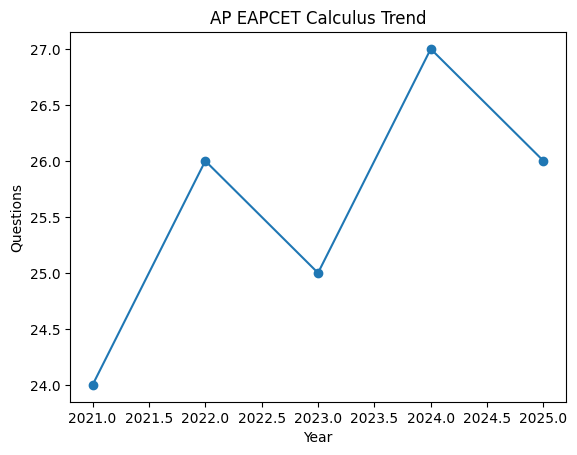
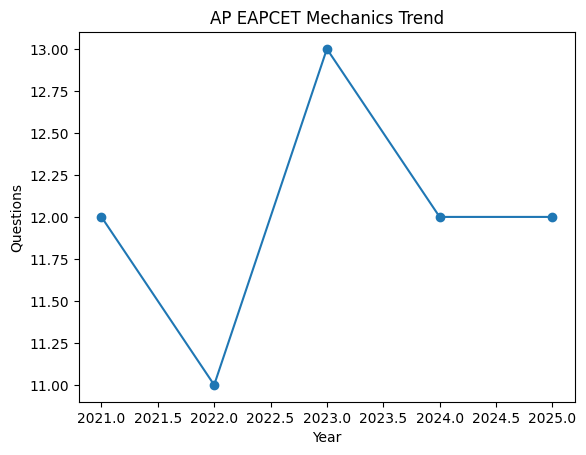
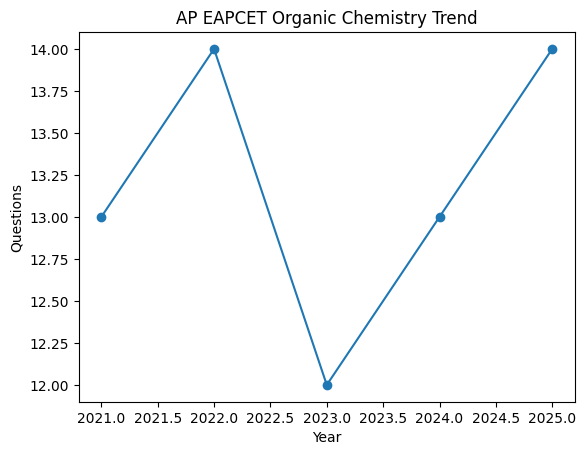
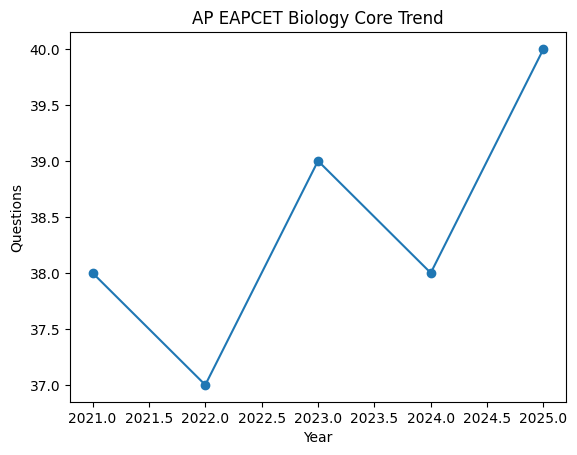
Analysis of previous papers shows consistent dominance of Calculus in Mathematics, Mechanics in Physics, Organic Chemistry in Chemistry, and core Biology topics in the BiPC stream. Students should prioritize these areas.
12 Week Structured Study Timetable
• Weeks 1–2: Build foundations in Algebra, Atomic Structure, and Basic Mechanics.
• Weeks 3–4: Cover Trigonometry, Organic Chemistry basics, and advanced Mechanics.
• Weeks 5–6: Focus on Calculus and Electricity; Biology students emphasize Human Physiology.
• Weeks 7–8: Complete advanced topics and first full syllabus revision.
• Weeks 9–10: Intensive mock tests and weak area improvement.
• Weeks 11–12: Final revision and full-length practice exams.
Recommended Books
• Mathematics: NCERT + RD Sharma Objective + Arihant AP EAPCET Guide
• Physics: NCERT + HC Verma + Arihant Objective Physics
• Chemistry: NCERT + OP Tandon + Arihant Objective Chemistry
• Biology: NCERT + Trueman’s Biology + Arihant Objective Biology
Final Preparation Strategy
Successful preparation requires disciplined execution, consistent revision, and regular mock testing. Students should prioritize high weightage chapters, track mistakes carefully, and focus on accuracy before speed. With structured planning and sustained effort, significant rank improvement is achievable.
MATHEMATICS
ALGEBRA
a) Functions: Types of functions – Definitions – Inverse functions & Theorems – Domain, Range and Inverse.
b) Mathematical Induction: Principles of Mathematical Induction & Theorems – Applications of Mathematical Induction – Problems on divisibility.
c) Matrices: Types of matrices – Scalar multiple of a matrix and multiplication of matrices – Transpose of a matrix – Determinants – properties of determinants – Adjoint and Inverse of a matrix – Consistency and inconsistency of system of simultaneous equations – Rank of a matrix – Solution of simultaneous linear equations.
d) Complex Numbers: Complex number as an ordered pair of real numbers- fundamental operations – Representation of complex numbers in the form a+ib – Modulus and amplitude of complex numbers–Illustrations – Geometrical and Polar Representation of complex numbers in Argand plane-Argand diagram.
e) De Moivre’s Theorem: De Moivre’s theorem- Integral and Rational indices – nth roots of unity- Geometrical Interpretations–Illustrations.
f) Quadratic Expressions: Quadratic expressions, equations in one variable – Sign of quadratic expressions – Change in signs – Maximum and minimum values – Quadratic Inequations.
g) Theory of Equations: The relation between the roots and coefficients in an equation – Solving an equations when two or more roots of it are connected by certain relation – Equation with real coefficients, occurrence of complex roots in conjugate pairs and its consequences, Transformation of equations- Reciprocal equations.
h) Permutations and Combinations: Fundamental Principle of counting – linear and circular permutations- Permutations of ‘n’ dissimilar things taken ‘r’ at a time – Permutations when repetitions are allowed – Circular permutations – Permutations with constraint repetitions – Combinations-definitions, certain theorems.
i) Binomial Theorem: Binomial theorem for positive integral index, Binomial theorem for rational Index – Approximations using Binomial theorem
j) Partial fractions: Partial fractions of f(x)/g(x) when g(x) contains non –repeated linear factors – Partial fractions of f(x)/g(x) where both f(x) and g(x) are polynomials and when g(x) contains repeated and/or non-repeated linear factors – Partial fractions of f(x)/g(x) when g(x) contains irreducible factors, Partial fractions of f(x)/g(x) when f(x)/g(x) is an improper fraction, conversion of f(x)/g(x) in power series of x.
TRIGONOMETRY
a) Trigonometric Ratios upto Transformations: Trigonometric ratios – Variation – Graphs and Periodicity of Trigonometric functions – Trigonometric ratios of Compound angles – Trigonometric ratios of multiple and sub- multiple angles – Sum and Product transformations.
b) Trigonometric Equations: General solutions of Trigonometric Equations – Simple Trigonometric Equations – Solutions.
c) Inverse Trigonometric Functions: To reduce a Trigonometric function into a bijective function – Graphs of Inverse Trigonometric functions – Properties of Inverse Trigonometric functions.
d) Hyperbolic Functions: Definitions of Hyperbolic Functions – Graphs – Definitions of Inverse Hyperbolic Functions – Graphs – Addition formulae of Hyperbolic Functions.
e) Properties of Triangles: Relation between sides and angles of a Triangle – Sine, Cosine, Tangent and Projection rules- Half angle formulae and areas of a triangle – Incircle and Excircles of a Triangle.
VECTOR ALGEBRA
a) Addition of Vectors: Vectors as a triad of real numbers – Some Basic Concepts – Classification of vectors – Addition of vectors – Scalar multiplication – Angle between two non- zero vectors – Linear combination of vectors – Components of a vector in three dimensions – Vector equations of line and plane including the Cartesian equivalent form of line.
b) Product of Vectors: Scalar or dot product of two vectors – Geometrical Interpretations – orthogonal projections – Properties of dot product – Expression of dot product in (i, j, k) system – Angle between two vectors – Geometrical Vector methods – Vector equations of plane in normal form-Angle between two planes- Vector product of two vectors and properties- Vector product in (i, j, k) system- Vector Areas – Scalar triple product – Vector equation of a plane – different forms, skew lines, shortest distance – plane, condition for coplanarity etc. – vector triple product – results.
MEASURES OF DISPERSION AND PROBABILITY
a)Measures of Dispersion – Range – Mean deviation – Variance and standard deviation of ungrouped/grouped data, coefficient of variation and analysis of frequency distributions with equal means and unequal means but different variances.
b)Probability: Random experiments and events – Classical definition of probability, Axiomatic approach and addition theorem of probability – Independent and dependent events – conditional probability- multiplication theorem and Baye’s theorem.
c) Random Variables and Probability Distributions: Random Variables – Theoretical discrete distributions – mean and variance of discrete random variable – Binomial and Poisson Distributions.
COORDINATE GEOMETRY
a) Locus: Definition of locus –Illustrations-To find equations of locus-Problems connected to it.
b) Transformation of Axes: Transformation of Axes – Rules, derivations and illustrations – translation of axes – Rotation of Axes – Derivations – Illustrations.
c) The Straight Line: Revision of fundamental results – Straight line – Normal form – Illustrations – Straight line – Symmetric form – Straight line – Reduction into various forms – Intersection of two Straight Lines – Family of straight lines – Concurrent lines – Condition for Concurrent lines – Angle between two lines – Length of perpendicular from a point to a Line – Distance between two parallel lines – Concurrent lines – properties related to a triangle.
d) Pair of Straight lines: Equations of pair of lines passing through origin – angle between a pair of lines – Condition for perpendicular and coincident lines, bisectors of angles – Pair of bisectors of angles – Pair of lines – second degree general equation – Conditions for parallel lines – distance between them, Point of intersection of pair of lines – Homogenising a second degree equation with a first degree equation in x and y.
e) Circle : Equation of circle -standard form-centre and radius – Equation of a circle with a given line segment as diameter & equation of circle through three non collinear points – parametric equations of a circle – Position of a point in the plane of a circle – power of a point-definition of tangent-length of tangent – Position of a straight line in the plane of a circle-conditions for a line to be tangent – chord joining two points on a circle – equation of the tangent at a point on the circle- point of contact-equation of normal-Chord of contact-pole and polar-conjugate points and conjugate lines- equation of chord with given middle point, Relative positions of two circles- circles touching each other externally, internally common tangents –centers of similitude- equation of pair of tangents from an external point.
f) System of circles: Angle between two intersecting circles –condition for orthogonality – Radical axis of two circles- properties- Common chord and common tangent of two circles – radical centre – Intersection of a line and a Circle.
g) Parabola: Conic sections – Conic – Parabola- equation of parabola in standard form – Definitions of Chord, Focal Chord, Double Ordinate, latus rectum – different forms of parabola- parametric equations, parabola and point in the plane – Equations of tangent and normal at a point on the parabola (Cartesian and Parametric)- conditions for straight line to be a tangent.
h) Ellipse: Equation of ellipse in standard form- Parametric equations, various forms of ellipse – Equation of tangent and normal at a point on the ellipse (Cartesian and parametric)- condition for a straight line to be a tangent – auxiliary circles, eccentric angles, director circle.
i) Hyperbola: Equation of hyperbola in standard form- rectangular hyperbola – various forms of hyperbola – auxiliary circle, Parametric equations – Equations of tangent and normal at a point on the hyperbola (Cartesian and parametric) – conditions for a straight line to be tangent- Asymptotes – Director circle of a hyperbola.
j) Three Dimensional Coordinates: Coordinates – Section formulae – Centroid of a triangle and tetrahedron.
k) Direction Cosines and Direction Ratios: Direction Cosines –Direction Ratios.
l) Plane: Cartesian equation of a Plane –Simple Illustrations – angle between two planes.
CALCULUS
a) Limits and Continuity: Intervals and neighbourhoods – Limits – Standard Limits–Continuity.
b) Differentiation: Derivative of a function – Elementary Properties – Trigonometric, Inverse Trigonometric, Hyperbolic, Inverse Hyperbolic Functions – Derivatives – Methods of Differentiation – Second Order Derivatives.
c) Applications of Derivatives: Errors & Approximations – Geometrical Interpretation of a derivative – Equations of tangents and normal to a curve – Lengths of Tangent, Normal, Subtangent and subnormal – Angles between two curves and condition for orthogonality of curves – Derivative as a rate of change – Rolle’s theorem and Lagrange’s Mean value theorem – Increasing and decreasing functions – Maxima and Minima.
d)Integration: Integration as the inverse process of differentiation- Standard forms -properties of integrals – Method of substitution- integration of Algebraic, exponential, logarithmic, trigonometric and inverse trigonometric functions – Integration by parts – Integration by the method of substitution – Integration of algebraic and trigonometric functions – Integration by parts – Integration of exponential, logarithmic and inverse trigonometric functions – Integration – Partial fractions method – Reduction formulae.
e) Definite Integrals: Definite Integral as the limit of sum, Interpretation of Definite Integral as an area. Fundamental theorem of Integral Calculus. Properties, Reduction formulae, Application of Definite integral to areas.
f)Differential equations: Formation of differential equation-Degree and order of an ordinary differential equation – Solution of a differential equation – Solving differential equation by
i) Variables separable method, ii) Homogeneous differential equation, iii) Non Homogeneous differential equation iv) Linear differential equations
PHYSICS
1. PHYSICAL WORLD: What is physics? Scope and excitement of physics. Physics, technology and society, Fundamental forces in nature, Nature of physical laws
2. UNITS AND MEASUREMENTS: The international system of units, Measurement of Length, Measurement of Large Distances, Estimation of Very Small Distances, Size of a Molecule, Range of Lengths, Measurement of Mass, Range of Masses, Measurement of time, Accuracy, precision of instruments and errors in measurement, Systematic errors, random errors, least count error, Absolute Error, Relative Error and Percentage Error, Combination of Errors, Significant figures, Rules for Arithmetic Operations with Significant Figures, Rounding off the Uncertain Digits, Rules for Determining the Uncertainty in the Results of Arithmetic Calculations, Dimensions of Physical Quantities, Dimensional Formulae and dimensional equations, Dimensional Analysis and its Applications, Checking the Dimensional Consistency of Equations, Deducing Relation among the Physical Quantities.
3. MOTION IN A STRAIGHT LINE: Position, path length and displacement, average velocity and average speed, instantaneous velocity and speed, acceleration, kinematic equations for uniformly accelerated motion, relative velocity.
4. MOTION IN A PLANE: Scalars and vectors, position and displacement vectors, equality of vectors, multiplication of vectors by real numbers, addition and subtraction of vectors – graphical method, resolution of vectors, vector addition – analytical method, motion in a plane, position vector and displacement, velocity, acceleration, motion in a plane with constant acceleration, relative velocity in two dimensions, projectile motion, equation of path of a projectile, time of maximum height, maximum height of a projectile, horizontal range of projectile, uniform circular motion.
5. LAWS OF MOTION: Aristotle’s fallacy, The Law of inertia, Newton’s first law of motion, Newton’s second law of motion- momentum, impulse, Newton’s third law of motion, conservation of momentum, Equilibrium of a particle, Common forces in mechanics, friction, types of friction, static, kinetic and rolling frictions, Circular motion, Motion of a car on a level road, Motion of a car on a banked road, solving problems in mechanics.
6. WORK, ENERGY AND POWER: The Scalar Product, Notions of work and kinetic energy, The work-energy theorem, Work, Kinetic energy, Work done by a variable force, The work-energy theorem for a variable force, The concept of Potential Energy, The conservation of Mechanical Energy, The Potential Energy of a spring, Various forms of energy, Heat, Chemical Energy, Electrical Energy, The Equivalence of Mass and Energy, Nuclear Energy, The Principle of Conservation of Energy, Power, Collisions, Elastic and Inelastic Collisions, Collisions in one dimension, Coefficient of Restitution and its determination, Collisions in Two Dimensions.
7. SYSTEM OF PARTICLES AND ROTATIONAL MOTION: Rigid body motion, Centre of mass, Centre of Gravity, Motion of centre of mass, Linear momentum of a system of particles, Vector product of two vectors, Angular velocity and its relation with linear velocity, Angular acceleration, Kinematics of rotational motion about a fixed axis, Moment of force (Torque), Angular momentum of particle, Torque and angular momentum for a system of a particles – conservation of angular momentum, Equilibrium of a rigid body, Principle of moments, Moment of inertia, Dynamics of rotational motion about a fixed axis, Angular momentum in case of rotation about a fixed axis – conservation of angular momentum, Rolling motion, Kinetic Energy of Rolling Motion.
8. OSCILLATIONS: Periodic and oscillatory motions, Period and frequency, Displacement, Simple harmonic motion (S.H.M.), Simple harmonic motion and uniform circular motion, Velocity and acceleration in simple harmonic motion, Force law for Simple harmonic Motion, Energy in simple harmonic motion, some systems executing Simple Harmonic Motion, Oscillations due to a spring, The Simple Pendulum, damped simple harmonic motion, Forced oscillations and resonance.
9. GRAVITATION: Kepler’s laws Law of Orbits, Law of Areas, Law of Periods, Universal law of gravitation, central forces, the gravitational constant, Acceleration due to gravity of the earth, Acceleration due to gravity below and above the surface of earth, Gravitational potential energy, Escape speed, Earth satellites, Energy of an orbiting satellite, Geostationary and polar satellites, Weightlessness.
10. MECHANICAL PROPERTIES OF SOLIDS: Elastic behavior of solids, Stress and strain, Hooke’s law, Stress-strain curve, Elastic moduli, Young’s Modulus, Determination of Young’s Modulus of the Material of a Wire, Shear Modulus, Bulk Modulus, Poisson’s ratio, Elastic potential energy in a stretched wire, Applications of elastic behavior of materials.
11. MECHANICAL PROPERTIES OF FLUIDS: Pressure, Pascal’s Law, Variation of Pressure with Depth, Atmospheric Pressure and Gauge Pressure, Hydraulic Machines, Archimedes’ Principle, Streamline flow, Bernoulli’s principle, Speed of Efflux, Torricelli’s Law, Venturi- meter, Blood Flow and Heart Attack, Dynamic Lift, Viscosity, Variation of Viscosity of fluids with temperature, Stokes’ Law, Reynolds number, Critical Velocity, Surface tension and Surface Energy, Angle of Contact, Drops and Bubbles, Capillary Rise, Detergents and Surface Tension.
12. THERMAL PROPERTIES OF MATTER: Temperature and heat, Measurement of temperature, Ideal-gas equation and absolute temperature, Thermal expansion, Specific heatcapacity, Calorimetry, Change of state, Triple Point, Regelation, Latent Heat, Heat transfer –Conduction, convection and radiation, Black body Radiation, Greenhouse Effect, Newton’s law of cooling and its experimental verification.
13. THERMODYNAMICS: Thermal equilibrium, Zeroth law of thermodynamics, Heat, Internal Energy and work, First law of thermodynamics, Specific heat capacity, Specific heat capacity of water, Thermodynamic state variables and equation of State, Thermodynamic processes, Quasi- static process, Isothermal Process, Adiabatic Process, Isochoric Process, Isobaric process, Cyclic process, Heat engines , Refrigerators and heat pumps, Second law of thermodynamics, Reversible and irreversible processes, Carnot engine, Carnot’s theorem.
14. KINETIC THEORY: Molecular nature of matter, Behaviour of gases, Boyle’s Law, Charles’ Law, Kinetic theory of an ideal gas, Pressure of an Ideal Gas, Kinetic interpretation of temperature, Law of equipartition of energy, Specific heat capacity, Monatomic Gases, Diatomic Gases, Polyatomic Gases, Specific Heat Capacity of Solids, Specific Heat Capacity of Water, Mean free path.
15. WAVES: Transverse and longitudinal waves, wave displacement relation in a progressive wave, amplitude and phase, wavelength and angular wave number, period, angular frequency and frequency, the speed of a travelling wave, speed of a transverse wave on stretched string, speed of a longitudinal wave (speed of sound), the principle of superposition of waves, reflection of waves, standing waves and normal modes, beats, Doppler effect – source moving & Observer stationary, observer moving and source stationary, both observer and source are moving, applications of Doppler effect.
16. RAY OPTICS AND OPTICAL INSTRUMENTS: Reflection of Light by Spherical Mirrors, Sign convention, Focal length of spherical mirror, Mirror equation, refraction, total internal reflection, total internal reflection in nature and its technological applications, refraction at spherical surfaces and by lenses, power of a lens, combination of thin lenses in contact, refraction through a prism, dispersion by a prism, natural phenomena due to sunlight – Rainbow, Scattering of light, optical instruments, the eye, the simple and compound microscopes, refracting telescope and Cassegrain reflecting telescope.
17. WAVE OPTICS: Huygens principle, refraction and reflection of plane waves using Huygens principle: Refraction of a plane wave, Refraction in a rarer medium (at the denser medium boundary), reflection of a plane wave by a plane surface, the Doppler effect, coherent and incoherent addition of waves, interference of light waves and Young‘s experiment, Diffraction, Single slit, seeing the single slit diffraction pattern resolving power of optical instruments, Determination of resolving power of eye, the validity of ray optics, Polarization: Polarization by scattering, Polarisation by reflection.
18. ELECTRIC CHARGES AND FIELDS: Electric charge, conductors and insulators, charging by induction, basic properties of electric charges, additivity of charges, conservation of charge, quantization of charge, Coulomb’s law, forces between multiple charges, electric field, electric field due to a system of charges, physical significance of electric field, electric field lines, electric flux, electric dipole, the field of an electric dipole for points on the axial line and on the equatorial plane, physical significance of dipoles, dipole in a uniform external field, continuous charge distribution, Gauss’s law, Applications of Gauss’s Law: Field due to an infinitely long straight uniformly charged wire, field due to uniformly charged infinite plane sheet , field due to uniformly charged thin spherical shell.
19. ELECTROSTATIC POTENTIAL AND CAPACITANCE: Electrostatic potential, potential due to a point charge, potential due to an electric dipole, potential due to a system of charges, equipotential surfaces, relation between field and potential, potential energy of a system of charges, potential energy in an external field, potential energy of a single charge, potential energy of a system of two charges in an external field, potential energy of a dipole in an external field, electrostatics of conductors, dielectrics and polarisation, electric displacement, capacitors and capacitance, the parallel plate capacitor, effect of dielectric on capacitance, combination of capacitors, capacitors in series, capacitors in parallel, energy stored in a capacitor, Van de Graaff generator.
20. CURRENT ELECTRICITY: Electric current, electric current in conductors, Ohm’s law, drift of electrons and the origin of resistivity, mobility, limitations of Ohm’s law, resistivity of various materials, colour code of resistors, Temperature dependence of resistivity, electrical energy, power. Combination of Resistors, Series and Parallel, Cells, EMF, internal resistance, cells in series and in parallel, Kirchhoff’s rules, Wheatstone Bridge, Meter Bridge, Potentiometer.
21. MOVING CHARGES AND MAGNETISM: Magnetic force, sources and fields, magnetic field, Lorentz force, magnetic force on a current carrying conductor, motion in a magnetic field, helical motion of charged particles, motion in combined electric and magnetic fields, , velocity selector, cyclotron, magnetic field due to a current element, Biot – Savart’s law, Magnetic field on the axis of a circular current loop, Ampere’s circuital law, the solenoid and the toroid, force between two parallel current carrying conductors, the ampere (UNIT), torque on current loop, magnetic dipole, torque on a rectangular current loop in a uniform magnetic field, circular current loop as a magnetic dipole, the magnetic dipole moment of a revolving electron, the Moving Coil Galvanometer; conversion into ammeter and voltmeter.
22. MAGNETISM AND MATTER: The bar magnet, the magnetic field lines, bar magnet as an equivalent solenoid, The dipole in a uniform magnetic field, the electrostatic analog, Magnetism and Gauss’s Law, The Earth’s magnetism, magnetic declination and dip, magnetization and magnetic intensity, magnetic properties of materials – Diamagnetism, Paramagnetism and Ferromagnetism, permanent magnets and electromagnets.
23. ELECTROMAGNETIC INDUCTION: The experiments of Faraday and Henry, magnetic flux, Faraday’s Law of induction, Lenz’s law and conservation of energy, motional electromotive force, energy consideration – a quantitative study, Eddy currents, inductance, mutual inductance, self-inductance, AC generator.
24. ALTERNATING CURRENT: AC voltage applied to a resistor, representation of AC current and voltage by rotating vectors – Phasors, AC voltage applied to an inductor, AC voltage applied to a capacitor, AC voltage applied to a series LCR circuit, Phasor – diagram solution, analytical solution, resonance, sharpness of resonance, Power in AC circuit: The power factor, Wattless current LC oscillations, transformers.
25. ELECTROMAGNETIC WAVES: Displacement Current, Maxwell’s equations, electromagnetic waves, sources of electromagnetic waves, nature of electromagnetic waves, electromagnetic spectrum: radio waves, microwaves, infrared waves, visible rays, ultraviolet rays, X-rays, gamma rays.
26. DUAL NATURE OF RADIATION AND MATTER: Electron emission, Photoelectric Effect, Hertz’s observations, Hallwachs and Lenard’s observations, experimental study of photoelectric effect, effect of intensity of light on photocurrent, effect of potential on photoelectric current, effect of frequency of incident radiation on stopping potential, Photoelectric effect and Wave theory of Light, Einstein’s Photoelectric equation, Energy Quantum of Radiation, particle nature of light, the photon, wave nature of matter, photocell, Davisson and Germer Experiment
27. ATOMS: Alpha particle scattering and Rutherford’s nuclear model of atom, alpha particle trajectory, electron orbits, atomic spectra, spectral series, Bohr model of the hydrogen atom, energy levels, Franck – Hertz experiment, the line spectra of the hydrogen atom, de Broglie’s explanation of Bohr’s second postulate of quantization.
28. NUCLEI: Atomic masses and composition of nucleus, discovery of neutron, size of the nucleus, Mass – Energy, Nuclear Binding Energy, The Binding energy per Nucleon and its variation with Mass Number, Nuclear Force, Radioactivity – Law of radioactive decay, half-life and mean life of a Radioactive material, Alpha decay, Beta decay and Gamma decay, Nuclear Energy, Fission, Nuclear reactor, nuclear fusion, energy generation in stars, controlled thermonuclear fusion.
29. SEMICONDUCTOR ELECTRONICS: MATERIALS, DEVICES AND SIMPLE
CIRCUITS: Classification of metals, conductors, and semiconductors on the basis of conductivity and energy bands, Band theory of solids, Intrinsic semiconductor, Extrinsic semiconductor, p-type semiconductor, n-type semiconductor, p-n junction, forward bias, reverse bias, Semiconductordiode, Application of junction diode as a rectifier, Zener Diode, Zener Diode as a voltage regulator, Optoelectronic junction devices, Photodiode, light emitting diode, solar cell. Junction transistor, structure and action, Basic transistor circuit configurations and transistor characteristics, transistor
as a switch and as an amplifier (CE – Configuration), Feedback amplifier and transistor oscillator, Digital Electronics and Logic gates, NOT, OR, AND, NAND and NOR Gates, Integrated circuits.
30. COMMUNICATION SYSTEMS: Elements of a Communication system, basic terminology used in electronic communication systems, bandwidth of signals, bandwidth of transmission medium, propagation of electromagnetic waves, ground waves, sky waves, space wave, modulation and its necessity, size of the antenna or aerial, effective power radiated by an antenna, mixing up of signals from different transmitters, amplitude modulation, production of amplitude modulated wave, detection of amplitude modulated wave.
CHEMISTRY
1.ATOMIC STRUCTURE
2.CLASSIFICATION OF ELEMENTS AND PERIODICITY IN PROPERTIES
3.CHEMICAL BONDING AND MOLECULAR STRUCTURE
4.STATES OF MATTER: GASES AND LIQUIDS
5.STOICHIOMETRY
6.THERMODYNAMICS
7.CHEMICAL EQUILIBRIUM AND ACIDS-BASES
8.HYDROGEN AND ITS COMPOUNDS
9.THE s-BLOCK ELEMENTS (ALKALI AND ALKALINE EARTH METALS
10.p- BLOCK ELEMENTS GROUP 13 (BORON FAMILY)
11.p-BLOCK ELEMENTS – GROUP 14 (CARBON FAMILY)
12.Environmental Chemistry
13.ORGANIC CHEMISTRY
14.SOLID STATE
15.SOLUTIONS
16.ELECTROCHEMISTRY AND CHEMICAL KINETICS
17.SURFACE CHEMISTRY
18.GENERAL PRINCIPLES OF METALLURGY
19.p-BLOCK ELEMENTS
20.d AND f BLOCK ELEMENTS & COORDINATION COMPOUNDS
21.POLYMERS
22.BIOMOLECULES
23.CHEMISTRY IN EVERYDAYLIFE
24.HALO ALKANES AND HALO ARENES
25.ORGANIC COMPOUNDS CONTAINING C, H AND O
26.ORGANIC COMPOUNDS CONTAINING NITROGEN
BOTANY
1.DIVERSITY IN THE LIVING WORLD
2.STRUCTURAL ORGANISATION IN PLANTS- MORPHOLOGY
3.REPRODUCTION IN PLANTS
4.PLANT SYSTEMATICS
5.CELL STRUCTURE AND FUNCTION
6.INTERNAL ORGANISATION OF PLANTS
7.PLANT ECOLOGY
8.PLANT PHYSIOLOGY
9.MICROBIOLOGY
10.GENETICS
11.MOLECULAR BIOLOGY
12.BIOTECHNOLOGY
13.PLANTS, MICROBES & HUMAN WELFARE
ZOOLOGY
1.Diversity of Living World
2.STRUCTURAL ORGANIZATION IN ANIMALS
3.ANIMAL DIVERSITY-I: INVERTEBRATE PHYLA
4.ANIMAL DIVERSITY-II: PHYLUM: CHORDATA
5.LOCOMOTION & REPRODUCTION IN PROTOZOA
6.BIOLOGY IN HUMAN WELFARE
7.Type Study Periplaneta Americana
8.ECOLOGY & ENVIRONMENT
9,HUMAN ANATOMY AND PHYSIOLOGY
10.HUMAN REPRODUCTION
11.GENETICS
12.ORGANIC EVOLUTION
13.APPLIED BIOLOGY