I. Question 1. Find the determinants of the following matrices.
(i) [211−5]
Answer: Let A = [211−5] then determinant A = det A = |A| = 2(-5) – 1(1) = -10 – 1 = -11
(ii) [4−652]
Answer: Let A = [4−652] then det A = 4(2) – 5(-6) = 8 + 30 = 38
(iii) [i00−i] Answer: Let A = [i00−i] then det A = i(-1) – 0 = -i2 = 1 (∵ i2 = -1)
(iv) ⎡⎣⎢011101110⎤⎦⎥ Answer:
(v) ∣∣∣∣12−34−17246∣∣∣∣ Answer: Let A = ⎡⎣⎢12−34−17246⎤⎦⎥ Then det A = 1∣∣∣−1746∣∣∣ – 4∣∣∣−2−346∣∣∣ + 2∣∣∣2−3−17∣∣∣ = 1(-6 – 28) – 4(12 + 12)+ 2(14 – 3) = 1 (- 34) – 4(24) + 2(11) = -34 – 96 + 22 = -108
(vi) ⎡⎣⎢241−1−32411⎤⎦⎥ Answer: Let A = ⎡⎣⎢241−1−32411⎤⎦⎥ Then det A = 2∣∣∣−3211∣∣∣ + 1∣∣∣4111∣∣∣ + 4∣∣∣41−32∣∣∣ = 2(- 3 – 2)+ 1(4 – 1) + 4(8 + 3) = 2(-5) + 3 + 4(11) = – 10 + 3 + 44 = 37
(vii) ⎡⎣⎢1422−14−37−6⎤⎦⎥ Answer: Let A = ⎡⎣⎢1422−14−37−6⎤⎦⎥ Then det A = 1∣∣∣−147−6∣∣∣ – 2∣∣∣427−6∣∣∣ – 3∣∣∣42−14∣∣∣ = 1(6 – 28) – 2(- 24 – 14) – 3(16 + 2) = -22 + 76 – 54 = 0 [Note : Since R1 and R2 are proportional, we have det A = 0.]
(viii) ⎡⎣⎢ahghbfgfc⎤⎦⎥ Answer: Let A = ⎡⎣⎢ahghbfgfc⎤⎦⎥ Then det A = a∣∣∣bffc∣∣∣ – h∣∣∣hgfc∣∣∣ – g∣∣∣hgbf∣∣∣ = a(bc – f2) – h(ch – fg) + g(fh – bg) = abc – af2 – ch2 + fgh + fgh – bg2 = abc + 2fgh – af2 – bg2 – ch2
(x) ⎡⎣⎢122232223242324252⎤⎦⎥ Answer: Let A = ⎡⎣⎢122232223242324252⎤⎦⎥=⎡⎣⎢149491691625⎤⎦⎥ Then det A = 1(225 – 256) – 4(100 – 144) + 9(64 – 81) = -31 + 176 – 153 = -8
Question 2. If A = ⎡⎣⎢12503−604x⎤⎦⎥ and det A = 45 then find x.
Answer: det A = 45 ⇒ ∣∣∣∣12503−604x∣∣∣∣ = 45 ⇒ 1(3x + 24) = 45 ⇒ 3x = 21 ⇒ x = 7
II. Question 1. Show that ∣∣∣∣bccaabb+cc+aa+b111∣∣∣∣ = (a – b)(b – c)(c – a).
Answer: Operating R2 – R1, R3 – R1, on the given determinant LHS = ∣∣∣∣∣bcc(a−b)b(a−c)b+ca−ba−c100∣∣∣∣∣ = (a – b)(a – c)∣∣∣∣bccbb+c11100∣∣∣∣ = (a – b)(a – c)(1)(c – b) = (a – b)(b – c)(c – a) (exponding on 3rd column) = RHS
Question 2. Show that ∣∣∣∣b+ca+bac+ab+cba+bc+ac∣∣∣∣ = a2 + b2 + c2 – 3abc (Mar. 2008; May 2007)
Answer: = (a + b + c) [(c – b) (c – a) – (a – b) (b – a)] = (a + b + c) [c2 – bc – ac + ab + a2 – 2ab + b2] = (a + b + c) [a2 + b2 + c2 – ab – bc – ca] = a2 + b2 + c2 – 3abc
Question 3. Show that ∣∣∣∣y+zyzxz+xzxyx+y∣∣∣∣ = 4xyz. Answer: R1 – (R2 + R3) on the given determinant gives = 2[z(xy) – y(-xz)] = 2[2xyz] = 4xyz = RHS
Question 4. If ∣∣∣∣∣abca2b2c21+a31+b31+c3∣∣∣∣∣ = 0 and ∣∣∣∣∣abca2b2c2111∣∣∣∣∣ ≠ 0, then show that abc = -1. (Mar. ’14)
Answer: ⇒ abc + 1 = 0 ⇒ abc = -1
Question 5. Without expanding the determinant, prove that (i) ∣∣∣∣∣abca2b2c2bccaab∣∣∣∣∣=∣∣∣∣∣111a2b2c2a3b3c3∣∣∣∣∣
Answer:
(ii) ∣∣∣∣axx21byy21czz21∣∣∣∣=∣∣∣∣axyzbyzxczxy∣∣∣∣ Answer:
(iii) ∣∣∣∣111bccaabb+cc+aa+b∣∣∣∣=∣∣∣∣∣111abca2b2c2∣∣∣∣∣ (Board Model Paper) Answer: (∵ R2 – R1; R3 – R1) = (b – a) (c2 – a2) – (c – a) (b2 – a2) = (b – a) (c – a) (c + a) – (c – a) (b – a) (b + a) = (b – a) (c – a) (c + a – b – a) = (b – a) (c – a) (c – b) = (a – b) (b – c) (c – a) LHS = RHS
Question 6. If Δ1 = ∣∣∣∣∣a21+b1+c1b1b2+c1c3c1a1a2+b2+c2b22+c2c3c2a1a3+b3+c3b2b3+c3c23∣∣∣∣∣ and Δ2 = ∣∣∣∣a1a2a3b1b2b3c1c2c3∣∣∣∣, then find the value of Δ1Δ2.
Answer:
Question 7. If Δ1 = ∣∣∣∣1cosαcosβcosα1cosγcosβcosγ1∣∣∣∣ and Δ2 = ∣∣∣∣0cosαcosβcosα0cosγcosβcosγ0∣∣∣∣ and Δ1 = Δ2 then show that cos2α + cos2β + cos2γ = 1.
Answer: Given ∣∣∣∣1cosαcosβcosα1cosγcosβcosγ1∣∣∣∣ = (1 – cos2γ) – cos α (cos α – cos β cos γ) + cos β (cos α cos γ – cos β) = 1 – cos2γ – cos2α + cos β cos α cos γ + cos α cos β cos γ – cos2β = 1 – (cos2α + cos2β + cos2γ) + 2 cos α cos β cos γ
Δ2 = ∣∣∣∣0cosαcosβcosα0cosγcosβcosγ0∣∣∣∣ = – cos α (0 – cos γ cos β) + cos β (cos α cos γ) = cos α cos β cos γ + cos α cos β cos γ = 2cos α cos β cos γ Also given Δ1 = Δ2 ⇒ 1 – (cos2α + cos2β + cos2γ) + 2 cos α cos β cos γ = 2 cos α cos β cos γ ⇒ 1 – (cos2α + cos2β + cos2γ) = 0 ∴ cos2α + cos2β + cos2γ = 1
III. Question 1. Show that ∣∣∣∣a+b+2cccab+c+2aabbc+a+2b∣∣∣∣ = 2(a + b + c)3
Answer:
Question 2. Show that ∣∣∣∣abcbcacab∣∣∣∣2 = ∣∣∣∣∣2bc−a2c2b2c22ac−b2a2b2a22ab−c2∣∣∣∣∣ = (a3 + b3 + c3 – 3abc)2. (May 2014, Mar. 01′)
Answer: Let Δ = ∣∣∣∣abcbcacab∣∣∣∣ = a(bc – a2) – b(b2 – ac) + c(ab – c2) = abc – a3 – b3 + abc + abc – c3 = – (a3 + b3 + c3 – 3abc) ⇒ Δ2 = (a3 + b3 + c3 – 3abc)2 …………..(1) From (1) and (2) the result is proved.
Question 3. Show that ∣∣∣∣a2+2a2a+132a+1a+23111∣∣∣∣ = (a – 1)3. (March 2007)
Answer: Apply operations R1 – R2 and R2 – R3 we get
Question 4. Show that ∣∣∣∣∣aa2a3bb2b3cc2c3∣∣∣∣∣ = abc(a – b)(b – c)(c – a)
Answer: LHS = abc∣∣∣∣1aa21bb21cc2∣∣∣∣ = abc∣∣∣∣0a−ba2−b20b−cb2−c21cc2∣∣∣∣ (Use operations C1 – C2, C2 – C3) = abc [(a – b) (b2 – c2) – (b – c) (a2 – b2)] = abc [(a – b) (b – c) (b + c) – (b – c) (a – b) (a + b)] = abc (a – b) (b – c) [b + c – a – b] = abc (a – b) (b – c) (c – a)
Question 5. Show that ∣∣∣∣−2aa+bc+aa+b−2bc+bc+ab+c−2c∣∣∣∣ = 4(a + b)(b + c)(c + a)
Answer: = 0 (∵ R1 & R3 are similar) ∴ (a + b) is a factor of Δ. Similarly putting b + c = 0 and c + a = 0 we shall find that b + c and c + a are also factors of Δ. ∵ Δ is a 3rd degree expression in a, b, c.
Let Δ = k (a + b) (b + c) (c + a) Where k ≠ 0 is a scalar. Put a = 1, b = 1, c = 1 then = k(1 + 1) (1 + 1) (1 + 1) = 8k -2(4 – 4) – 2(-4 – 4) + 2(4 + 4) = 8k ⇒ -16 + 16 = 8k ⇒ k = 4 Δ = 4(a + b) (b + c) (c + a) Here ∣∣∣∣−2aa+bc+aa+b−2bc+bc+ab+c−2c∣∣∣∣ = 4(a + b)(b + c)(c + a)
Question 6. Show that ∣∣∣∣a−bb−cc−ab−cc−aa−bc−aa−bb−c∣∣∣∣ = 0 Answer: R1 + (R2 + R3) given ∣∣∣∣0b−cc−a0c−aa−b0a−bb−c∣∣∣∣ = 0 (∵ If one row or column elements of a square matrix are zeroes then the value of the determinant of that matrix is equal to zero) = RHS.
Question 7. Show that ∣∣∣∣∣111abca2−bcb2−cac2−ab∣∣∣∣∣ = 0
Answer: Make operations R2 – R1, R3 – R1 then the given determinant.
Question 8. Show that ∣∣∣∣xaaaxaaax∣∣∣∣ = (x + 2a)(x – a)2.
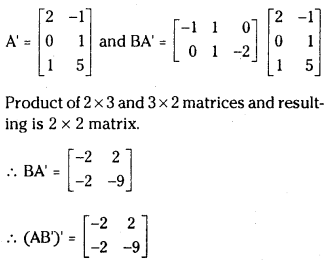
Question 1. If A = [2−10115] and B = [−10110−2] then find (AB’)’
Answer: We have (AB)’ = B’A’ and (AB’)’ = (B’)’ A’ = BA’ (∵ (B )’ = B)
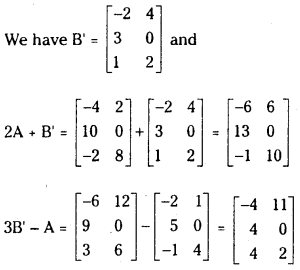
Question 2. If A = ⎡⎣⎢−25−1104⎤⎦⎥ and B = [−243012] then find 2A + B’ and 3B’ – A.
Answer:
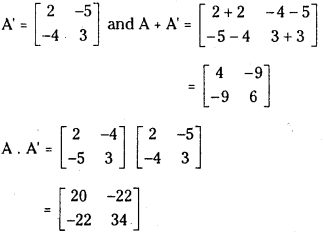
Question 3. If A = [2−5−43] then find A + A’ and A. A’ (May 2007) (Board Model Paper)
Answer:
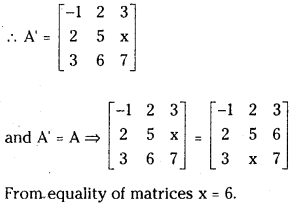
Question 4. If A = ⎡⎣⎢−12325x367⎤⎦⎥ is a symmetric matrix then find x.
Answer: A matrix ‘A’ is said to be symmetric if A’ = A
Question 5. If A = ⎡⎣⎢0−2−120x1−20⎤⎦⎥ is a skew symmetric matrix, find x. (May 2014, 11)
Answer: A matrix A is said to be skew symmetric if A’ = – A ⎡⎣⎢021−20−2−1x0⎤⎦⎥=⎡⎣⎢021−20−x−120⎤⎦⎥ from equality of matrix x = 2
Question 6. Is ⎡⎣⎢0−1−410−7470⎤⎦⎥ a symmetric or skew symmetric?
Answer: Let A = ⎡⎣⎢0−1−410−7470⎤⎦⎥ then A is symmetric if A’ = A and skew symmetric if A’ = – A i.e., A’ = ⎡⎣⎢014−107−4−70⎤⎦⎥=⎡⎣⎢0−1−410−7470⎤⎦⎥ = -A ∴ The matrix A is a skew symmetric matrix.
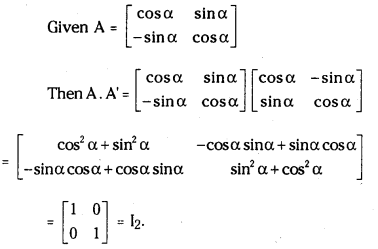
II. Question 1. If A = [cosα−sinαsinαcosα], show that A . A’ = A’ . A = I2. (March 2007)
Answer:
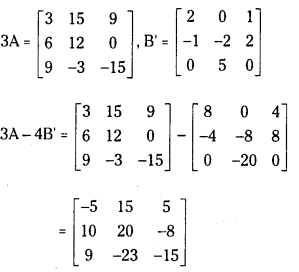
Question 2. If A = ⎡⎣⎢12354−130−5⎤⎦⎥ and B = ⎡⎣⎢201−1−22050⎤⎦⎥, then find 3A – 4B’.
Answer:
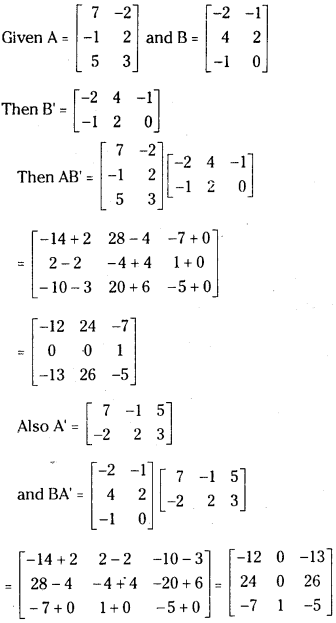
Question 3. If A = ⎡⎣⎢7−15−223⎤⎦⎥ and B = ⎡⎣⎢−24−1−120⎤⎦⎥ then find AB’ and BA’.
Answer:
Question 4. For any square matrix A; show that A A’ is symmetric. (March 2015-A.P)
Answer: By definition a matrix is said to be symmetric if A’ = A. ∴(A A’)’ = (A’)’ A’ = A A’ [(∵ (AB)’ = B’A’ and (A’)’ = A] Hence AA’ is a symmetric matrix.
Differentiate fibrous roots from adventitious roots. [Mar. – 2020]?
Answer:
1) Adventitious roots : The roots that arise from plant parts other than radicle. Ex: Climbing roots, Velamen roots, Respiratory roots etc.
2) Fibrous roots : Large number of roots which originate from the base of the stem after the loss of short lived primary root. Ex: Monocot plants.
Question 2.
Define modification. Mention how root is modified in banyan tree and mangrove plants ?
Answer:
1) Modification : A permanent morphological change in a plant organ to perform a special function depending upon environment.
2) In banyan tree, roots are modified as prop roots (pillar roots) to give additional support for branches.
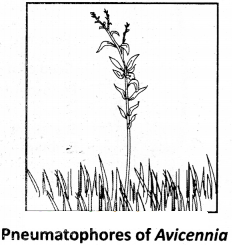
While in mangrove plants (Rhizophora and Avicennia) pneumatophores or respiratory roots come out of the ground and grow vertically upwards to get oxygen for respiration.
Question 3.
What type of specialized roots are found in epiphytic plants ? What is their function ?
Answer:
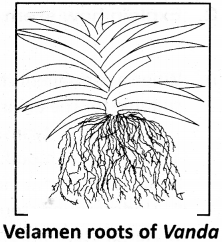
1. Velamen roots are found in epiphytic plants like Vanda. 2. They absorb moisture from the atmosphere.
Question 4.
How does the sucker of Chrysanthemum differ from the stolon of jasmine?
Answer:
Sucker of Chrysanthemum is the lateral branch arises from the basal and underground portion of stem. It grows obliquely upward giving rise to leafy shoot.
Stolon of jasmine is an obliquely downward growing slender lateral branch that arises from the base of the main axis and produces adventitious roots on touching the ground.
Question 5.
What is meant by pulvinus leaf base? In members of which Angiospermic family do you find them? [Mar. ’14 – A.P. ; Mar. ’14]?
Answer:
The swollen leaf base is called pulvinus leaf base.
It is found in some members of leguminaceae family.
Question 6.
Define venation. How do dicots differ from monocots with respect to venation? [Mar. ’15 – A.P.]
Answer:
The arrangement of veins and the veinlets in the lamina of leaf is termed as venation.
Leaves of dicots have reticulate venation, whereas, leaves of monocots possess parallel venation.
Question 7.
How is a pinnately compound leaf is different from a palmately compound leaf? Explain with one example, each.?
Answer:
Pinnately compound leaf: It consists of a number of leaflets on a common axis called rachis. Ex: Neem.
Palmately compound leaf: If consists of leaflets attached at a common point, i.e., at the tip of the petiole. Ex: Bombax ceiba (silk cotton).
Question 8.
Which organ is modified to trap insects in insectivorous plants? Give two examples. [Mar. 2019, ’13]?
Answer:
Leaves are modified to trap insects in insectivorous plants.
Example : Nepenthes (Pitcher plant), Dionea (Venus fly-trap).
Question 9.
Differentiate between Racemose and Cymose inflorescences. [Mar. ’15 – T.S.]?
Answer:
Racemose inflorescence: The main axis (Peduncle) continues to grow and produce flowers in an acropetal succession.
Cymose inflorescence: The main axis ends in a flower due to limited growth and flowers are borne in basipetal succession.
Question 10.
What is the morphology of cup like structure in Cyathium? In which family it is found? [Mar. – 2018, Mar. ’15 – A.P.]
Answer:
In Cyathium, involucre of bracts form cup like structure.
It is found in family Euphorbiaceae.
Question 11.
What type of inflorescence is found in fig trees ? Why does the insect B/astophaga visits the inflorescence of fig tree?
Answer:
Hypanthodium is found in fig trees.
The insect Blastophaga visits for pollination and lays its eggs in the gall flowers.
Question 12.
Differentiate actinomorphic from zygomorphic flower. [May ’14]?
Answer:
1. Actinomorphic flower : A flower that can be divided into two equal radial halves in any radial plane passing through the centre Ex: Hibiscus.’
2. Zygomorphic flower : A flower that can be divided into two similar halves only in one particular vertical plane Ex: Bean.
Question 13.
How do the petals in pea plant are arranged? What is such type of arrangement called?
Answer:
In pea plant there are five petals. The largest (standard) petal overlaps the two lateral (wings) petals that inturn overlap the two smallest anterior petals (keel).
This arrangement is called vexillary or papilionaceous.
Question 14.
What is meant by Epipetalous condition ? Give an example. [May ’17, Mar. ’17 – A.P.]?
Answer:
Epipetalous condition : A condition in which stamens attached to the petals.
Ex: Brinjal, Datura.
Question 15.
Differentiate between apocarpous and syncarpous ovary. [Mar. – 2018]?
Answer:
1) Apocarpous ovary : More than one carpel is present in gynoecium and they are free. Eg : Lotus and Rose
2) Syncarpous condition : Carpels are fused. Eg: Mustard and Tomato.
Question 16.
Define placentation. What type of placentation is found in Dianthus? [Mar. – 2020, Mar. 15 – T.S.]
Answer:
The arrangement of ovules within the ovary is known as placentation.
In Dianthus, free central placentation is present.
Question 17.
What is meant by parthenocarpic fruit? How is it useful?
Answer:
A fruit formed without fertilization of the ovary is called parthenocarpic fruit.
They are without seeds. Ex: Banana.
Question 18.
What is the type of fruit found in mango? How does it differ from that of coconut?
Answer:
The type of fruit found in mango is drupe. In which the pericarp is well differentiated into an outer thin epicarp, a middle fleshy edible mesocarp and an inner stony hard endocarp.
In coconut, also fruit is a drupe in which the mesocarp is fibrous.
Question 19.
Why certain fruits are called false fruits ? Name two examples of plants having false fruits.?
Answer:
Certain fruits that develop from floral parts other than the ovary called false fruits.
Ex: Apple (Thalamus) Cashew (Pedicel) Strawberry (Thalamus.)
Question 20.
Name any two plants having single seeded dry fruits.?
Answer:
Dry indehiscent fruits are single seeded.
Coryza (caryopsis) and Tridax (Cypsela).
Question 21.
Define schizocarpic dry fruits. Give an example?
Answer:
The dry fruits which split into one Seeded bits called mericarps are known as Schizocarpic dry fruits.
Ex: Acacia, Castor.
Question 22.
Define mericarp. In which plant you find it?
Answer:
One seeded bits formed after splitting of Schizocarpic dry fruits are called mericarp.
Ex: Acacia, Castor.
Question 23.
What are aggregate fruits? Give two examples.?
Answer:
Bunch of fruitlets developed from multicarpellary, apocarpous ovary are called aggregate fruits.
Ex: Custard apple (Annona squamosa), Strawberry.
Question 24.
Name a plant that has single fruit developing from the entire inflorescence. What is such a fruit called?
Answer:
Single fruit that develops from an entire inflorescence is called composite fruit. Ex: Pineapple, Jack fruit.
Short Answer Type Questions
Question 1.
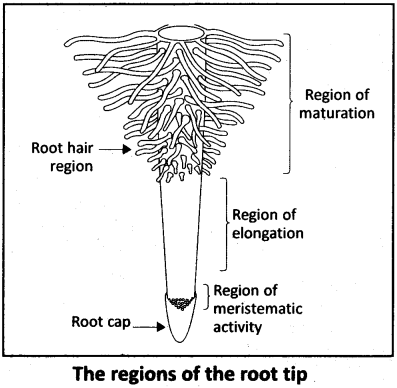
Explain different regions of root with neat labeled diagram.?
Answer:
Root has four regions. They are a) Root cap b) Region of rheristematic activity c) Region of elongation d) Region of maturation.
a) Root cap : The tip of the root is covered by a thimble-like structure called the root cap. It gives protection to the root tip as it penetrates into the soil.
b) Region of meristematic activity : Above the root cap, region of meristematic activity is present. It has meristematic cells. These cells are small, thin walled with dense protoplasm. They divide repeatedly.
c) Region of elongation : Above the region of meristematic activity, region of elongation is present. The new cells formed grows and elongates. It is responsible for growth of length.
d) Region of maturation : Behind the region of elongation region of maturation is present. Depending upon the function young cells differentiates into permanent cells. As it matures, it is called region of maturation.
From this region, some of the epidermal cells forms unicellular root hairs. The main function of root hairs is absorption of water from the soil. They are short lived.
Question 2.
Justify the statement: “Underground parts of plants are not always roots”?
Answer:
Normally roots are underground whereas stems are aerial. But in some plants stem grow below the soil. They are called underground stems. They are rhizome corm, stem tuber and bulb.
These underground parts of the plants can be recognised as stem due to presence of nodes, internodes, scale leaves, axillary buds and terminal buds. They can be even identified by their anatomical structures.
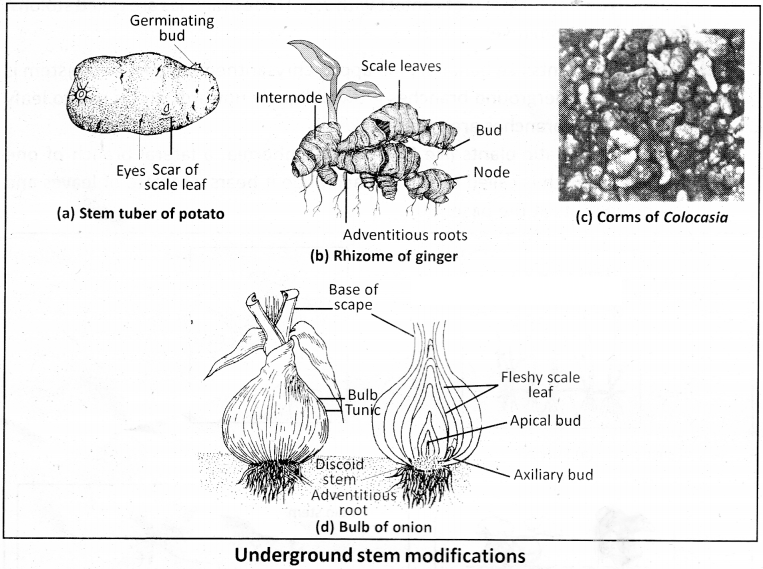
For example, stem tubers (Potato), these are underground branches which store food at the tip and becomes tuberous. The tuber is covered by brown coloured layer. It bears many ‘eye’ like structures. These eyes represent the nodes. Each eye has leaf scar and axillary bud. Scar represents the position of scale leaf. Eye help in vegetative propagation.
Question 3.
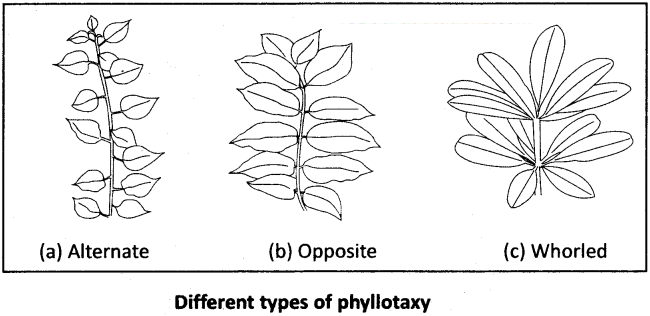
Explain with examples different types of phyllotaxy?
Answer:
The mode of arrangement of leaves on the stem and branches is called phyllotaxy. It is three types. They are a) Alternate phyllotaxy : In this type only one leaf arises at each node in alternate manner. Eg : Hibiscus, rosa-sinensis (china rose), mustard, sunflower.
b) Opposite phyllotaxy : In this type, a pair of leaves arise at each node and lie opposite to each other. Eg : Calotropis, Guava.
c) Whorl phyllotaxy : In this type, more than two leaves arise at a node and form a whorl. Eg : Nerium, Alstonia.
Question 4.
How do leaf modifications help plants?
Answer:
The main function of leaf is photosynthesis and transpiration. In some plants leaves change in their structure to perform new function other than photosynthesis. This is called leaf modification.
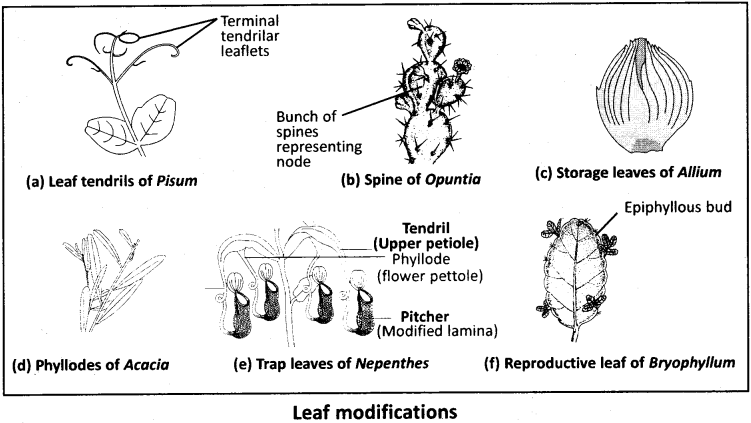
1. Tendrils : In weak stemmed plant, the entire leaf or any part of the leaf is modified into tendrils. They provide mechanical support and help in climbing. Eg: Pea.
2. Spine : In some plants, leaves are modified into sharp pointed spines. They help in reducing the rate of transpiration in xerophytic plants and also for defence. Eg: Cacti.
3. Storage leaves : The fleshy leaves of onion and garlic store food materials.
4. Phyllode : In some plants such as Australian acacia, the leaves are pinnately compound in which the leaflets are small and short lived. The petioles of these plants expand into green structure performing photosynthesis. These are called phyllode.
5. Insectivorous leaves : In plants growing in nitrogen deficient soils, leaves are modified to trap insects for their nitrogen requirement. Eg : Nepenthes (Pitcher plant) Dionea (Venus fly trap)
6. Vegetative propagation : In some plants leaves produce buds called epiphyllous buds. They help in vegetative propagation. Eg : Bryophyllum.
Question 5.
Describe any two special types of inflorescences?
Answer:
(Note : Write any two of the following �� Verticellaster, Cyathium and Hypanthodium are special types of inflorescence.
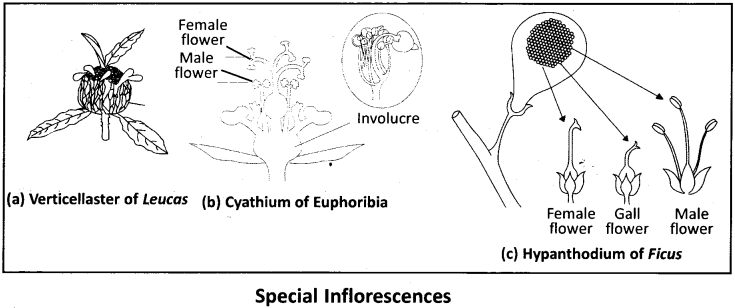
Verticellaster:
It is a special type of inflorescence found in the family Lamiaceae (Labiatae).
In this type, flowers arise in the axil of leaves arranged opposite to each other at every node.
In the axil of leaf, the flowers are developed initially in dichasial cyme and later in monochasial scorpoid cyme.
Flowers are crowded round the node like a false whorl (verticel). Hence it is called ‘Verticellaster’. Eg: Leucas and Leonotis.
Cyathium :
This is a single flower like special inflorescence found in family Euphorbiaceae.
The inflorescence is covered by a deep cup like involucre of bracts.
At the centre of this cup there is a single female flower represented by tricarpellary syncarpous ovary.
Surrounding this female flower many male flowers are arranged in monochasial cyme.
Male flowers are represented by single stalked stamen. Male and female flowers are achlamydeous arranged in centrifugal manner. Eg: Euphorbia, Poinsettia.
Hypanthodium :
It is fruit like inflorescence.
In this peduncle is modified into a deep cup like fleshy structure with an apical opening.
The male flowers located near the opening and the female flowers are at the bottom while in between them the sterile female flowers called gall flowers are present.
Pollination in these plants takes place by an insect called Blastophaga which lay its eggs in the gall flowers. After fertilisation the whole inflorescence becomes into a fig fruit.
Question 6.
Describe the arrangement of floral members in relation to their insertion on thalamus.?
Answer:
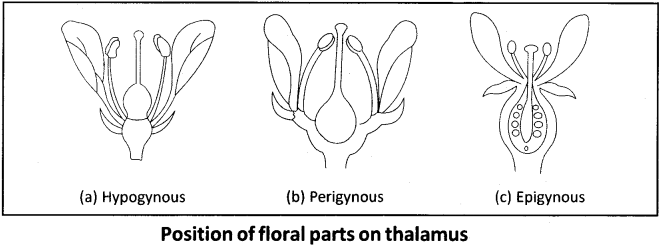
Depending upon the arrangement of floral members in relation to their insertion on thalamus, flowers are divided into three types. They are 1) Hypogynous : Thalamus is conical. The gynoecium occupies the highest position. The remaining floral members like calyx, corolla and androecium are at the base of the gynoecium. In this the ovary is called “Superior”. Ex : Hibiscus, Datura, Mustard, Brinjal etc.
2) Perigynous : Thalamus is concave or saucer shaped. Gynoecium is situated at the centre. The remaining floral members like calyx, corolla and androecium are arranged along the margin, almost at the same level. In this, the ovary is said to be half inferior or half superior. Ex: Tephrosia, plum, rose, peach etc.
3) Epigynous flower : In this, thalamus is deep cup like structure, inside it gynoecium is present. The walls of the thalamus and ovary are fused. The remaining floral members are arranged along the margins of the thalamus, i.e. above the level of ovary. So, the ovary is called inferior. Ex : Tridax, guava, cucumber, ray floret of sunflower.
Question 7.
“The flowers of many angiospermic plants which show sepals and petals, differ with respect to the arrangement of sepals and petals in respective whorls’. Explain?
Answer:
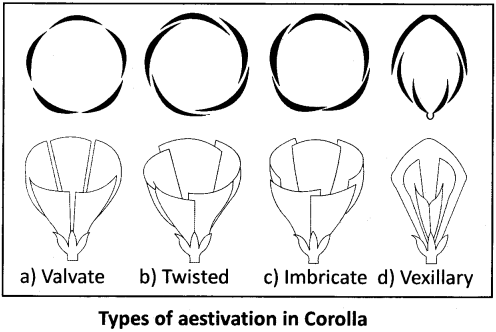
The arrangement of sepals and petals in floral bud is known as aestivation. It is of different types.
1) Valvate aestivation : When sepals or petals in a whorl just touch one another at the margin without overlapping is called valvate aestivation. Eg : Calotropis.
2) Twisted aestivation : When sepals or petals margin in a whorl overlap one another it is said to be twisted aestivation. Eg: Corolla of hibiscus, cotton, lady’s finger etc.
3) Imbricate aestivation : If the margins of sepals or petals overlap one another but not in any particular direction is called imbricate aestivation. Eg : Cassia, gulmohur.
4) Vexillary or Papilionaceous aestivation : In this, there are five petals. The largest petal towards posterior side is called Vexillum or Standard Petal. It overlaps the two lateral petals called Alae or wing petal. These overlap the two smallest petals called keel petals towards anterior side, which are boat shaped. Ex : Bean, Pea.
Question 8.
Describe any four types of placentations found in flowering plants.?
Answer:
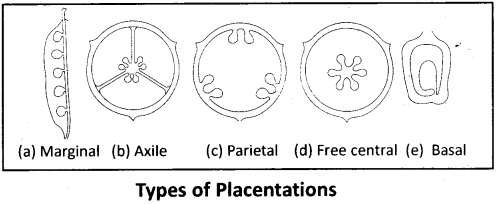
The arrangement of ovules within the ovary is known as placentation. They are Marginal placentation: Placenta forms a ridge along the ventral suture of the ovary. Ovules are borne on this ridge forming two rows. Eg: Pea
Axial placentation : When the placenta is axial and ovules are attached to it in multilocular ovary, it is called axile placentation. Eg: China rose, rose, tomato and lemon.
Parietal placentation : Ovules born on the inner wall of the ovary or on a parietal part, it is called parietal placentation. Ovary is one chambered but it becomes two chambered due to the formation of the false septum. Eg: Mustard and Argemone. Free central placentation : When the ovules are borne on the central axis without septa, it is known as free central placentation. Eg : Dianthus, primrose.
Basal placentation : Single ovule is attached to placenta at the base of the ovary. It is called Basal placentation. Eg : Sunflower, marigold.
Question 9.
Describe in brief fleshy fruits by you studied.?
Answer:
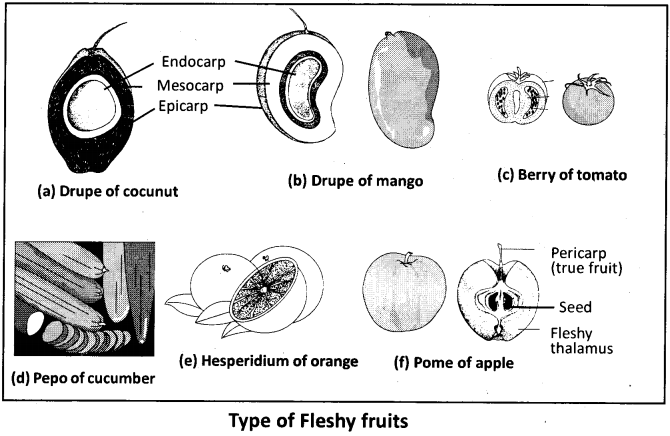
In fruits where pericarp becomes fleshy at the time of ripening are called fleshy fruits. Pericarp can be divided into three layers namely outer epicarp, middle mesocarp and inner endocarp. Basing upon the nature of pericarp, fleshy fruits are divided into five types. They are
1) Drupe : It is one seeded fleshy fruit developed from monocarpellary, superior ovary. The fruit is characterised by stony endocarp. So it is known as Drupe.
In Mango, the outer epicarp is thin, middle mesocarp is fleshy and edible. The inner endocarp is hard stony. In coconut, the outer epicarp is thin, middle mesocarp is fibrous and inner endocarp is hard stony. The edible part is the endosperm of seed (Copra).
2) Berry : It is a fleshy fruit having one or more seeds. In this, epicarp is thin. Mesocarp and endocarp are fused to form pulp. Seeds are hard. These fruits develop from bi to multicarpellary syncarpous gynoecium: Eg : Guava, grapes, tomato.
3) Pome : It is a fleshy fruit developed from inferior ovary of bi or multicarpellary syncarpous gynoecium. It is surrounded by fleshy thalamus. The endocarp is cartilagenous. Eg: Apple.
4) Pepo : It is developed from tricarpellary syncarpous unilocular inferior ovary. The epicarp is like a rind., the mesocarp is fleshy and the endocarp is smooth. Eg : Cucumber.
5) Hesperidium : It is developed from multicarpellary syncarpous, multilocular and superior ovary. In this epicarp is leathery with many volatile oil glands. Mesocarp is papery and endocarp has many chambers filled with juicy hairs. Eg : Citrus.
Question 10.
Describe with examples the various dry fruits studied by you?
Answer:
When the fruit wall or pericarp is dry or non-fleshy they are called dry fruits. They are of three types (i) Dry dehiscent (ii) Dry indehiscent (iii) Schizocarpic. i) Dry dehiscent : The dry fruit which break open and liberate the seeds are called dry dehiscent fruits. They are of different types.
a) Legume : The fruits which break dorsiventrally into two halves liberating the seeds are called legumes. It is a characteristic fruit of family fabaceae. Eg : Pea, bean etc.
b) Capsule : It is a dry fruit which liberates seeds in different ways at maturity. Eg : Cotton, Datura.
ii) Dry indehiscent fruits : These dry fruits are normally one seeded and never dehisce even at maturity. The seeds are liberated only after the disintegration of the pericarp. They are of following types.
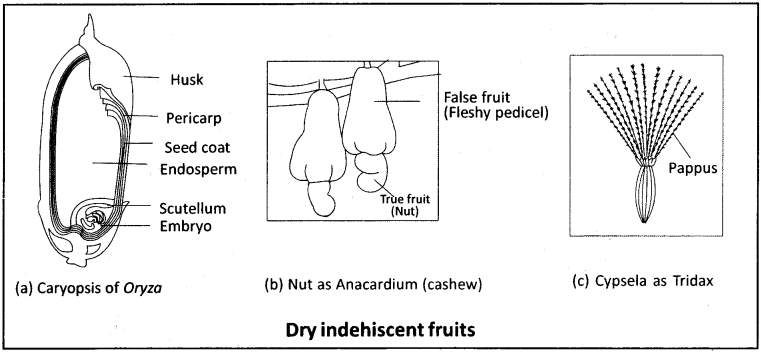
1) Caryopsis : In this the pericarp and seed coat fuse together. It is a characteristic, . fruit of family poaceae. Ex: Grass, Rice.
2) Nut : This single seeded dry fruit has a stony pericarp. The pericarp and seed coat remains free. Eg : Cashew.
3) Cypsela : The single seeded fruit characterized by persistent pappus like calyx. Eg: Tridax.
iii) Schizocarpic fruits : The fruit which split into one-seeded bits called mericarps are called schizocarpic fruits. Eg: Acacia, Castor.
Long Answer Type Questions
Question 1.
Define root. Mention the types of root systems. Explain how root is modified [Mar. 17 A.P & T.S ; Mar. 15 – A.P & T.S ; Mar. 13]?
Answer:
The part of the plant body present below the soil is called root. It is developed from radicle. There are two types of root sytems.
Tap root system
Fibrous root system
In some plants root is modified to perform new function suitable for the environment. It is called root modification. They are 1) Storage roots : The roots which store food materials are called storage roots or tuberous roots. In biennial plants, the tap root is modified into storage roots. Depending upon the shape, they are a) Spindle shape (fusiform) Eg: Radish b) Cone shape (Conical) Eg: Carrot c) Top shape (Napiform) Eg: Beetroot Adventitious roots of sweet potato and fibrous roots in Asparagus store food materials.
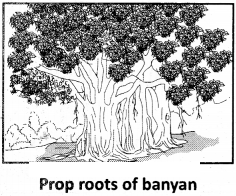
2) Prop roots or Pillar roots : In plants like banyan trees, branches are large and heavy. From the branches roots arise, they hang in air for sometime and later fixes into the soil. They are called prop roots or pillars roots. They act like pillars and gives support.
3) Stilt roots : In plants like maize and sugarcane roofs arise from the lower nodes of the stem. They are called stilt roots. They give support to plant.
4) Pneumatophores or Respiratory roots : The Mangrove plants which grow in swampy areas suffer from lack of oxygen as the soils are water lodged. In these plants root comes out of soil and grow vertically upwards. These roots are called respiratory roots or pneumatophores as they take oxygen from air for respiration.
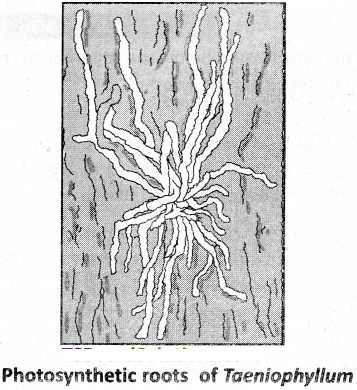
5) Photosynthetic roots : In Taeniophyllum (epiphyte) the stem and leaves are absent. The roots become green and perform photosynethsis. Such roots are called photosynthetic roots.
6) Velamen roots or Epiphytic roots : The plants which grow on the branches of big trees for sunlight are called epiphytes. They have roots which hang freely in the air. They absorb moisture from the atmosphere. These roots are called velamen roots or epiphytic roots. Eg : Vanda.
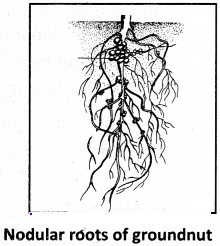
7) Nodular roots : In members of Fabaceae, the roots show small nodule like structures. Hence it is called nodular roots. In the nodule, Rhizobium bacteria is present. It fixes atmospheric nitrogen into soil. Plant and Rhizobium show symbiotic association.
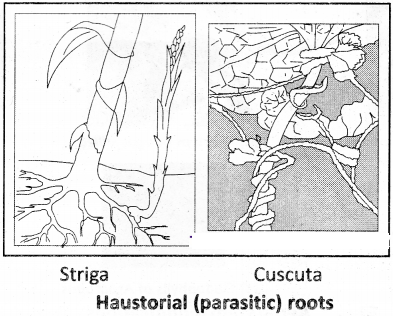
8) Parasitic roots or Kaustoria : The plants which depend upon the other plants completely or incompletely for their food and water are called Parasites. They produce parastic roots. They are 1) Complete parasites 2) Partial parasites. a) Complete parasitic piamts : These are leafless. So the haustorial root enters into both xylem and phloem to obtain both water and food from the host plant. Ex : Cuscuta, Rafflesia.
b) Partial parasitic plants : These plants bear leaves. So they can prepare food by photosynthesis. The haustorial roots penetrate only into the xylem tissue of the host to absorb water.
Question 2.
Explain how stem is modified variously to perform different functions. [Mar. 2020, 2019, 14, May 2017 ’14]?
Answer:
When a permanent change occurs in the structure of stems to perform new functions suitable for the environment, it is called ‘stem modification’.
It is of three types. They are I. Aerial stem modification II. Sub aerial stem modification III. Underground stem modification
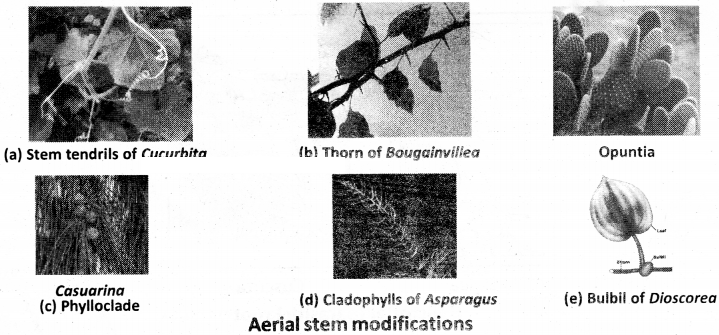
I. Aerial stem modification : Modification of aerial stems, vegetative buds and reproductive buds of a plant is called aerial stem modification. a) Tendril : Wiry delicate organ useful for climbing are called tendril. Axillary bud modified into tendril in gourds (cucumber, pumpkin, watermelon) or terminal bud in grapevines.
b) Thorn : A woody pointed structure meant for protection are called thorns. Axillary bud modified into thorn. Eg : Bougainvillea. Terminal bud modified into thorn. Eg : Carissa.
c) Hook : It is a woody, curved structure which helps in climbing. Ex : Artabotry.
d) Phylloclade : Leaf like stem performing photosynthesis are called phylloclade. In order to reduce transpiration the leaves are modified into scales, spines etc. Ex : In Opuntia, fleshy green flattened stem In Euphorbia, fleshy green cylindrical stem In Casuarina green needle like stem. Cladode or Cladophyll is a phylloclade of limited growth. Ex : Asparagus.
e) Bulbils : Buds which show vegetative propagation are called bulbils. Vegetative buds in Dioscorea, Floral buds in Agave.
II. Sub aerial stem modification : In some weak stemmed plants the stem remains partly aerial and partly underground. These are specialised for vegetative propagation. There are four types.
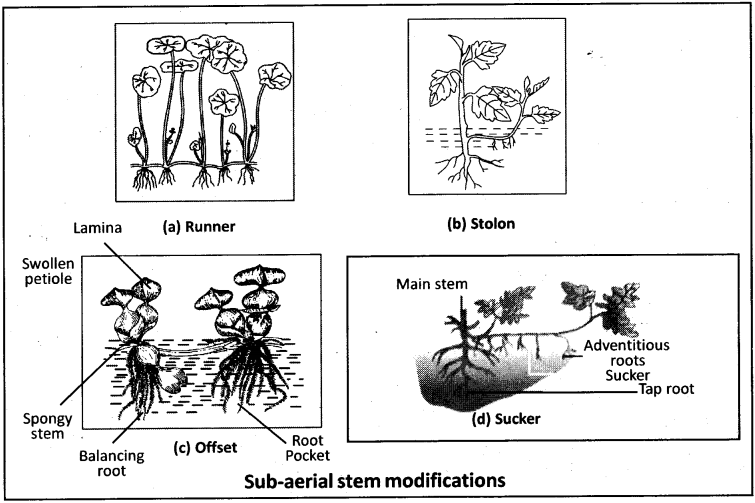
a) Runner: Underground stems in some grasses and strawberry and sub-aerial stems in oxalis spread to new nitches and form new plants when older parts die.
b) Stolon : In some plants slender branches arises grow obliquely downwards, produce roots at the point of contact with soil. These branches are called stolons. Ex : Nerium, Jasmine etc.
c) Suckers : In plants like banana, pine apple, chrysanthemum part of the stem is in the soil. Underground branches grow obliquely upwards giving rise to leafy shoots. These branches are called suckers.
d) Offset : In aquatic plants like Pistia and Eichhornia, a lateral branch of one internode length is called offset. At each node it bears a rosette of leaves and balancing roots at the base.
III. Underground stem modification : Functions of the underground stems are storage of food materials, perennation through unfavourable seasons and vegetative reproduction. So these are called multipurpose stem modification.
a) Rhizome : It is an underground stem which grows horizontally. It is branched. Ex: Zingiber (ginger).
b) Corm : It is an underground stem which grows vertically. It is unbranched contractile roots present. Ex : Amorphaphallus (Zaminkand) and colocasia.
c) Stem tuber : The swollen tip of an underground branch is called stem tuber. It bears many eyes. These eyes represent the nodes. Ex ; Potato.
d) Bulb : It is a small reduced underground stem. Food is stored in the leaf bases. Ex: Onion.
Question 3.
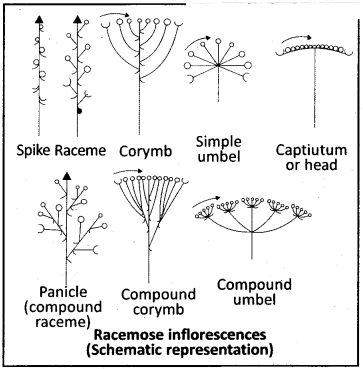
Explain different types of racemose inflorescences.?
Answer:
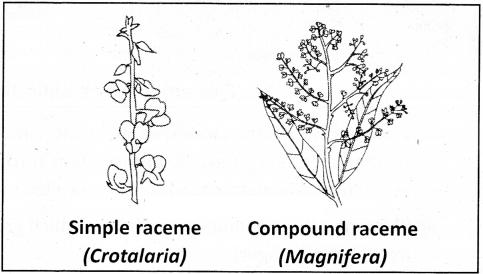
Types of racemose inflorescence. 1) Simple Raceme : Peduncle is unbranched, grows indefinitely on its numerous pedicillate, bracteate flowers are arranged in accropetal manner. Ex: Crotalaria.
2) Compound Raceme : Peduncle is branched. Each branch resembles a simple raceme. Ex: Mangifera. It is also called Panicle.
3) Simple Corymb : Peduncle is unbranched and grows indefinitely. On it numerous pedicillate, bracteate flowers are arranged in accropetal manner. The lower flowers have long pedicels and upper flowers have shorter pedicels. Thus all the flowers are brought more or less to the same height. Eg: Cassia.
4) Compound Corymb : Peduncle is branched and each branch is produced into a simple corymb. Eg: Cauliflower.
5) Simple Umbel : The peduncle is condensed and unbranched. Many bracteate and pedicellate flowers arise at the tip. At the base of flowers, all the bracts form a whorl called ‘involucre’. Ex: Onion.
6) Compound Umbel : Peduncle is branched. Each branch produces a simple umbel at its tip. Ex : Carrot.
7) Simple Spike : Peduncle is unbranched. On it bracteate, sessile flowers are arranged, accropetally. Ex : Achyranthes.
8) Compound Spike : Peduncle is branched. Each branch is similar to simple spike. Ex: Grass (Poaceae family).
9) Simple Spadix : Peduncle is unbranched. On it sessile, unisexual and neuter flowers are arranged in acropetal succession. It is protected by modified bract called ‘Spathe’. Ex: Colocasia.
10) Compound Spadix : Peduncle is branched. Each branch is similar to simple spadix. Ex: Musa, Cocos.
11) Head inflorescence : Unisexual and bisexual sessile flowers are arranged centripetally on a condensed peduncle. Such an arrangement of flowers is called Head inflorescence. Ex: Tridax, Sunflower (Asteraceae family).
Intext Question Answers
Question 1.
In which plant, the underground stem grows horizontally in soil and helps in perennation?
Answer:
Zingiber (ginger) Curcuma (turmeric)
Question 2.
Needle like phylloclades are found in which plant?
Answer:
Casuarina
Question 3.
Why do plants like Nepenthes trap insects?
Answer:
For their nitrogen requirement
Question 4.
What is the characteristic inflorescence found in members of Asteraceae?
Answer:
Head inflorescence
Question 5.
Can you name a plant that has least number of flowers in its inflorescence?
Answer:
Single flower in Hibiscus and Datura
Question 6.
Which family shows naked flowers?
Answer:
Euphorbiaceae family
Question 7.
In which flowers of the fig trees does the insect Blastophaga lay its eggs?
Answer:
Gall flowers (Sterile female flowers)
Question 8.
What type of symmetry is shown by the flowers of Canna?
Answer:
Asymmetry (irregular)
Question 9.
On which side of the flower do the flowers of pea have the keel petals?
Answer:
Anterior side
Question 10.
What is the ratio of overlapping margins of petals to overlapped ones in imbricate aestivation?
Answer:
1 : 1
Question 11.
How many ovules are found attached in basal placentation?
Answer:
One ovule
Question 12.
Which part of the flower in cashew plant forms the false fruit?
Answer:
Pedicel
Question 13.
Which plant has hard, stony endocarp and fleshy edible mesocarp?
Answer:
Mango
Question 14.
What is the morphology of ’spathe’ in Spadix inflorescence?
Answer:
Bract
Question 15.
What is the type of fruit known as if it develops from apocarpous ovary of a single flower?
Gymnosperm – Sporophyte (Micro and mega sporangia) – Micro and megaspore
Angiosperm – Sporophyte (Anthers and ovule) – Spore mother cells
Question 3.
Differentiate between syngamy and triple fusion.?
Answer:
1) Syngamy : One of the two male gametes released from pollen tube fuses with the egg cell to form a diploid zygote. This is also called true or real fertilisation.
2) Triple fusion : One of the two male gametes released from pollen tube fuses with the diploid secondary nucleus to produce the triploid Primary Endosperm Nucleus (PEN).
Question 4.
Differentiate between antheridium and archegonium.?
Answer:
The antheridium is male sex organ whereas archegonium is female sex organ.
Antheridium produces many antherozoids (sperms), while archegonium produces an egg cell.
Question 5.
What are the two stages found in the gametophyte of mosses? Mention the structures from which these two stages develop?
Answer:
Protonema and Gametophore.
Protonema develops directly from the spore and adult gametophore develops from protenema.
Question 6.
Name the stored food materials found in Phaeophyceae and Rhodophyceae. [May ’14]?
Answer:
The stored food materials found in Phaeophyceae are laminarin or mannitol.
The stored food material found in Rhodophyceae is floridian starch.
Question 7.
Name the pigments responsible for brown colour of Phaeophyceae and red colour of Rhodophyceae.?
Answer:
The brown colour of Phaeophyceae depends upon the amount of xanthophyll pigment, fucoxanthin present in it.
The red colour of Rhodophyceae is due to red pigment r – phycoerythrin.
Question 8.
Name different methods of vegetative reproduction in Bryophytes. [Mar. 15 – A.P.]?
Answer:
Fragmentation, gemmae and budding.
Question 9.
Name the integumented megasporangium found in Gymnosperms. How many female gametophytes are generally formed inside the megasporangium?
Answer:
Ovule
One female gametophyte with 2 or more archegonia is formed inside the megasporangium.
Question 10.
Name the Gymnosperms which contain mycorrhiza and corolloid roots respectively.?
Answer:
Pinus contains mycorrhizal roots.
Cycas, contains corolloid robts.
Question 11.
Mention the ploidy of any four of the following.?
a) Protonemal cell of a moss b) Primary endosperm nucleus in a dicot c) Leaf cell of a moss d) Prothallus of a fern e) Gemma cell in Marchantia f) Meristem cell of monocot g) Ovum of a liverwort h) Zygote of a fern.
Answer:
a) Haploid b) Triploid c) Haploid d) Haploid e) Haploid f) Diploid g) Haploid h) Diploid
Question 12.
Name the four classes of Pteridophyta with one example each.?
Answer:
Cl : Psilopsida Ex : Psilotum Cl: Lycopsida Ex : Selaginello, Lycopodium Cl : Sphenopsida Ex : Equisetum Cl : Pteropsida Ex : Dryopteris, Pteris, Adiantum
Question 13.
What are the first organisms to colonise rocks? Give the generic name of the moss which provides peat.?
Answer:
Mosses and lichens are the first organisms to colonise rocks
Sphagnum, (a moss) provides peat.
Question 14.
Mention the fern characters found in Cycas.?
Answer:
Fern characters found in Cycas are
Young leaves exhibit circinate vernation.
Presence of ramenta.
Male gametes are multiciliated.
Archegonia are present in the female gametophyte.
Question 15.
Why are Bryophytes called the amphibians of the plant kingdom?
Answer:
Bryophytes are called the amphibians of the plant kingdom because these plants live in moist soil and are dependent on water for sexual reproduction.
Question 16.
Name an algae which show? a) Haplo-diplontic and b) Diplontic types of life cycles.
Answer:
a) Ectocarpus and Kelps (Laminaria) – haplo-diplontic life cycle. b) Fucus – diplontic life cycle.
Question 17.
Give examples for unicellular, colonial and filamentous algae.?
Answer:
Unicellular algae Ex : Chlamydomonas. Colonial algae Ex : Volvox Filamentous algae Ex : Spirogyra, Ulothrix.
Short Answer Type Questions
Question 1.
Differentiate between red algae and brown algae. [Mar. ’14]?
Answer:
Red algae
Brown algae
a) Members of Rhodophyceae are commonly called red algae.
a) Members of Phaeophyceae are commonly called brown algae.
b) They possess chlorophyll a, d, and phycoerythrin.
b) They posses chlorophyll a, c, carotenoids, and xanthophyll.
c) Red colour is due to Phycoerythrin pigment.
c) Brown colour is due to xanthophyll pigment.
d) Reserve food material is in the form of Floridean starch.
d) Reserve food material is in the form of mannitol (or) laminaria.
Question 2.
Differentiate between liverworts and mosses.?
Answer:
Liverworts
Mosses
1) They have a thallus-like dorsoventrally flattened body.
1) These are differentiated into stem-like and leaf-like structures.
2) Rhizoids unicellular.
2) Rhizoids multicelluar and branched.
3) Sporangium is differentiated into foot, seta and capsule. In some cases foot and seta may be absent.
3) Sporangium is differentiated into foot, seta and capsule.
4) Sporangium does not synthesise its food.
4) The sporangium synthesise its own food.
5) Elaters in the capsule help in spore dispersal.
5) Peristomial teeth help in spore dispersal.
6) Columella lacking
6) Columella is found.
7) Protonema and gametophore are absent.
7) Gametophyte has two stages. They are 1) Protonema 2) Gametophore.
Question 3.
What is meant by homosporous and heterosporous pteridophytes? Give two examples.?
Answer:
The plants which produce only one kind of spores are called homosporous Ex: Psilotum, Lycopodium. The plants which produce two kinds of spores, macro or megaspores and microspores are called heterosporous Ex: Selaginella, Salvinia.
Question 4.
What is heterospory? Briefly comment on its significance. Give two examples.?
Answer:
Producing two types of spores is called heterospory 1) Microspores 2) Megaspores.
Significance : In heterosporous plants, the megaspores and microspores germinate and give rise to female and male gametophyte respectively. Male gametes are transferred to the egg of female archegonium. The female gametophytes retain on the parent sporophyte for variable period. The development of zygotes into young embryos takes place within the female gametophytes. This event is a precursor to the seed habit. It is considered as an important step in evolution. Example : Selaginella and salvinia.
Question 5.
Write a note on economic importance of Algae and Bryophytes. [March 2019]?
Answer:
Economic importance of Algae :
About 50% of carbon fixation is done by algae by photosynthesis. Thus by photosynthesis 02 is released into environment.
Algae are primary producers for all aquatic animals in food cycle.
Many species of Porphyra, Laminaria and Sargassum are among the 70 species of marine algae used as food.
Brown algae and Red algae produce large amounts of hydrocolloids (water holding substances) & algin (brown algae) and carrageen (red algae) which are used commercially.
Agar obtained from Gelidium and Gracilaria is used to grow microbes and preparations of ice-creams and jellies.
Iodine is extracted from kelps like Laminaria.
Chlorella and Spirullina are unicellular algae used as food supplements even by space travellers.
Economic importance of bryophytes (mosses) :
Mosses provide food for herbaceous mammals, birds and other animals.
Sphagum provides peat used as fuel, because of its water holding capacity, they are used as packing material for trans-shipment of living material.
Mosses along with lichens are the first organisms to colonise rocks and hence they have great ecological importance.
They decompose rock making it suitable for the growth of higher plants, hence, they play important role in plant succession.
Mosses form dense mats on the soil, they reduce the impact of falling rain and prevent soil erosion.
Question 6.
How would you distinguish Monocots from Dicots?
Answer:
Monocots
Dicots
1) Monocot seeds have one cotyledon.
1) Dicot seeds have two cotyledons.
2) Adventitious root system is present.
2) Tap root system is present.
3) Leaves show parallel venation
3) Leaves show reticulate venation.
4) Sheathing leaf base is present.
4) Sheathing leaf base is absent.
5) Leaves are isobilateral.
5) Leaves are dorsiventral.
6) Secondary growth is absent.
6) Secondary growth takes place.
Question 7.
Give a brief account of prothallus. [Mar. – 2020]?
Answer:
Haploid spores give rise to gametophytic prothallus in pteridophytes.
Prothallus is small, thin, green and autotrophic thallus like structure.
Prothallus grows in cool, damp, shady places as it requires water for fertilization.
Prothallus bears sex organs. The male sex organs are called antheridia and the female sex organs are called archegonia.
These sex organs are multicellular, jacketed and sessile.
Antheridia produce male gametes called antherozoids. Archegonia has egg cell which is a female gamete.
Antherozoids require water to reach egg.
Zygote develops into embryo within the female gamete. This event is a precursor to the seed habit. It in considered as an important step in evolution.
Question 8.
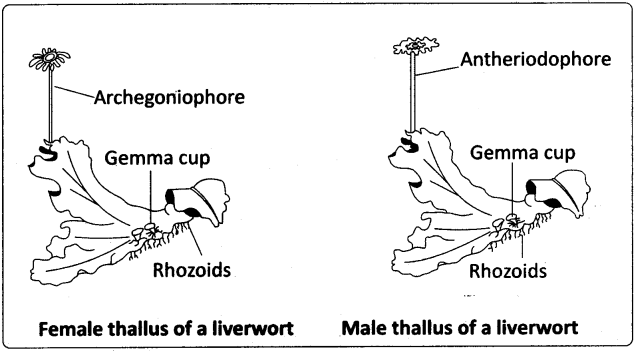
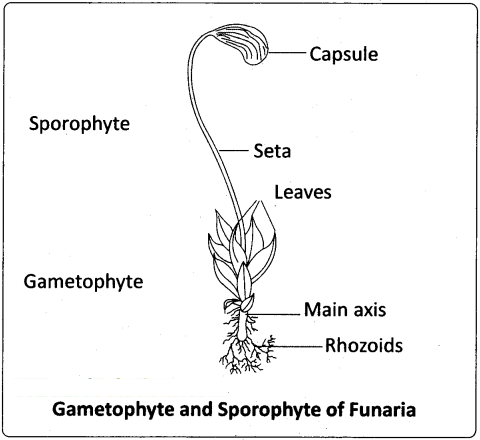
Draw labelled diagrams of a) Female thallus and male thallus of a liverwort b) Gametophyte and sporophyte of Funaria.
Answer:
a)
b)
Long Answer Type Questions
Question 1.
Name three groups of plants that bear archegonia. Briefly describe the life cycle of any one of them.?
Answer:
Bryophytes, pteridophytes and gymnosperms bear archegonia.
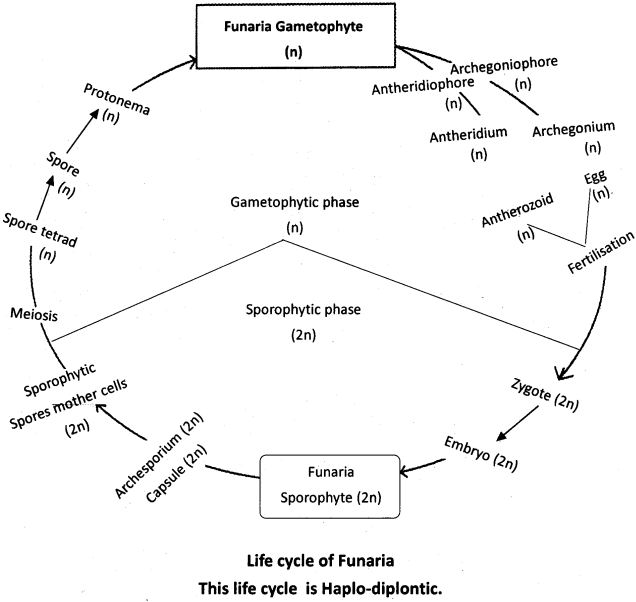
Life cycle of a Moss plant:
The gametophyte is a dominant phase.
Moss plant is a haploid gametophore.
It produces gametangia on separate branches of the same plant and hence monoecious.
The club shaped antheridia or antheridial branches produce biflagellate male gametes called “antherozoids”.
The flask shaped archegonia on archegonial branches produce eggs (female gamete) in their venter.
Antherozoids liberated swim in water to reach egg in the venter.
Union of one male gamete (antherozoid) and egg unite results in diploid zygote. This is called fertilization.
Zyeote is the first cell for sporophytic generation. Zygote develops into embryo. Embryo is retained within the archegonium.
It develops into semi parasitic sporophyte consisting of foot, seta and capsule.
The spore mother cells in the spore sac of the capsule undergo meiosis and forms a number of haploid spores of one kind. Hence Funaria is homosporous.
Spore is the first cell for gametophytic generation under favourable conditions, the spore liberated germinates to give rise to filamentous protonema.
The buds arising from the aerial branches of protonema develop into independent gametophores.
Question 2.
Describe the important characteristics of Gymnosperms.?
Answer:
The important characters of Gymnosperms are :
All gymnosperms are perennial, growing as woody trees or bushy shrubs.
Vascular tissues are arranged into vascular bundles.
Flowers are absent, however, microsporophylls and megasporophyll usually aggregate to form distinct cones or strobili called male cones and female cones respectively.
Gymnosperms are heterosporous: Gymnosperms produce two types of spores- Microspores and megaspores. Microspores are produced in Microsporangium. They are called pollen grain. Megaspores are produced in Megasporangia. The megasporangia are integumented and are called ovules.
Ovules are borne on megasporophyll and have three layered integument with an opening called micropyle.
Pollination is indirect.
Fertilization is affected by pollen tube produced by the male gametophyte. It is called siphonogamy.
Endosperm is formed before fertilization. That means female gametophyte is considered as endosperm. It is haploid.
Seeds are naked i.e., without any seed coat.
Question 3.
Give the salient features of pteridophytes?
Answer:
The main plant body of pteridophyte is sporophyte. It is differentiated into true roots, stem and leaves.
Vascular tissues are present. So pteridophytes are commonly called vascular cryptogams.
Roots are adventitious.
Stem is underground rhizome.
The leaves of pteridophytes are small (microphyllous) as in selaginella or large fronds (macrophyllous) as in ferns.
Ferns show circinate vernation and the petioles are covered with brown multicellular hairs called ramenta.
The stele may be protostele or siphonostele or solenostel6.
One of the important characters of pteridophyte is that the sprophyte has become the dominant part of the life cycle while the gametophyte is reduced.
Gametophyte is small and inconspicuous and it is produced from haploid spores known as prothallus.
The asexual generation or the sporophyte may be homosporous (all spores are similar) or heterosporous (two different types of spores) i.e., microspores or megaspores.
Prothallus (gametophytes) are monoecicus or dioecious.
Sex organs are Antheridia and Archegonia.
Male gametes are Antherozoids formed from Antheridia. Antherozoids are uninucleate, spirally coiled, biflagellate or multiflagellate structures.
Union of male gamete and female gamete results in diploid zygote.
Zygote develops into Embryo stage.
True fruit and seeds are not formed at any stage.
Question 4.
Give an account of plant life cycles and alternation of generations?
Answer:
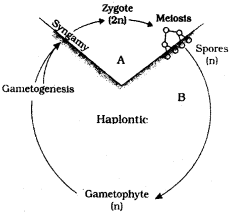
Plant life cycles : 1) Haplontic type of life cycle :
The dominant phase is gametophyte. It is photosynthetic free living.
Sporophytic generation is represented by zygote.
Zygote is a resting stage not a free living sporophyte.
Thus the life cycle having only free living gametophyte without free living sporophyte is called Haplontic type of life cycle. Ex :Algae like chlamydomonas, Volvox, Spirogyra etc.
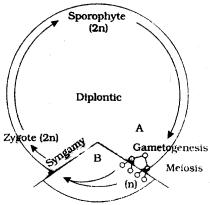
2) Diplontic type of life cycle :
The dominant phase is sporophyte. It is photosynthetic independent plant.
Gametophytic generation is represented by gametes.
Thus the life cycle having only independent sporophyte without gametophyte is called Diplontic type of life cycle.
The life cycle having only independent sporophyte with few celled or many celled staged gametophyte is called diplo-haplontic type of life cycle. Ex: Pteridophytes and seed-bearing plants.
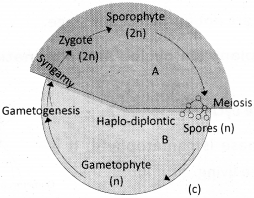
3) Haplo-diplontic type of life cycle :
The dominant phase is gametophytic generation. It is independent.
Sporophytic generation is photosynthetic dependent on gametophytic generation.
The life cycle having both dominant gametophytic generation and dependent sporophytic generation is called Haplo-diplontic type.
Alternation of generations:
In the life cycle of an organism two phases are present. They are Gametophytic phase and Sporophytic phase.
Haploid spore is the first cell for gametophytic generation.
Haploid spore divides mitotically and forms haploid gametophyte.
Gametophyte shows sexual reproduction. It forms male and female gametes.
The fusion of male and female gametes results in diploid zygote.
Diploid zygote is the first cell for sporophytic generation.
Diploid zygote divides mitotically and forms diploid sporophyte.
Diploid sporophyte shows asexual reproduction. It undergoes meiosis and forms haploid spores.
Thus during the life cycle of plants gamete producing haploid gametophyte alternates with spore producing diploid sporophyte. This is known as alternation of generation.
Question 5.
Both Gymnosperms and Angiosperms bear seeds, then why are they classified separately?
Answer:
Even though both Gymnosperms and Angiosperms bear seeds, they are classified separately because of nature of seeds.
In Gymnopserms:
The plant bears ovules which are not covered by any ovary wall. They remain exposed.
Pollination is direct.
Seeds formed are not covered by seed-coat. They are naked seeded plants.
Female gametophyte is considered as Endosperm as it is nutritive in function.
Endosperm is formed before fertilisation.
It is haploid.
Poly embryonic condition is present.
In Angiosperms:
The plant bears ovules which are present inside the ovary. They are not exposed.
Pollination is indirect.
Seeds formed are covered by seed – coat. They are closed seeded plants.
Endosperm is formed after double fertilisation and triple fusion.
Endosperm is triploid.
Single embryo is present.
Intext Question Answers
Question 1.
How far does SelagineJIa, one of the few living members of Lycopodiales (Pteridophytes) fall short of seed habit.?
Answer:
Selaginella is heterosporous. It produces two kinds of spores. They are macrospores and microspores. Macrospores germinate and give rise to female gametophyte whereas Microspores give rise to male gametophyte. Fusion of male gamete with the egg present in the archegonium results in the formation of Zygote. The development of zygotes into young embryos takes place with the female gametophyte. This is the precusor to the seed habit.
Question 2.
Each plant or group of plants has some phylogenetic significance in the relation of evolution. Cycas, one of few living members of Gymnosperms is called as the “relic of past”. Can you establish a phylogenetic relationship of Cycas with any other group of plants that justifies the above statement?
Answer:
Cycas, one of Gymnosperms shows close resemblance with fern (pteridophyte) on one hand and angiosperms on the other hand. Thus occupying a position intermediate between the two.
Certain primitive characters in cycas are similar to ferns. They are
Stem when young is underground and subterranean.
Leaf bases are persistent on the stem.
Young leaves show circinate vernation.
The sporophylls are leaf-like.
Ramenta are present.
Xylem consists of tracheids only and there are no vessels.
Phloem lacks companion cells.
Microsporangia occur in sori on the abaxial side of microsporophyll.
Archegonia are still retained in the female gametophyte.
Sperms are multiciliate.
Question 3.
The male and female reproductive organs of several pteridophytes and Gymnosperms are comparable to floral structures of angiosperms. Make an attempt to compare the various reproductive parts of Pteridophytes and Gymnosperms with reproductive structures of Angiosperms.?
Answer:
Reproductive structures of Pteridophytes are strobili or cone.
Reproductive structures of Gymnosperms are strobili or cone.
Reproductive structures of Angiosperms are flowers.
Cone is not differentiated as male cone and female cone.
Male cone and female cone are present.
Flowers may be unisexual as male flowers and female flowers. (or) Flowers may be bisexual.
Mostly homosporous Sporophylls bear sporangia which produce spores. Some are heterosporous Microsporophyll bearing Microsporangia produce Microspores. Macrosporophyll-bearing Macrosporangia produce Macrospores.
The male cone bearing Microsporophyll and Microsporangia are called microsporangiate or male strobili. (This is similar to male flower) They produce Microspores.The female cone bearing Megasporophyll and Megasporophyll with ovule or integumented mega-sporangia are called megasporangiate or female strobili (This is similar to female flower)
The male sex organs are called stamen or Microsprophyll.Anther represents microsporangium.Pollengrains represent microspores.Female sex organ carpels represent Megasporophyll. Carpel is with ovule or integumented Megasporangia.
Question 4.
The plant body in higher plants is well differentiated and well developed. Roots are organs used for the purpose of absorption. What are the equivalent of roots in the less developed lower plants?
Answer:
Rhizoids. They are unicellular or multicellular hair-like structures that penetrate the moist soil and absorb the water for the plants.
Explain how the term Botany has emerged. [Mar. – 2009]?
Answer:
The term Botany had its origin in the Greek language ‘Bous’ refers to cattle and ‘Bouskein’to cattle feed.’
In course of time, Bouskein was transformed into Botane and later into Botany.
Question 2.
Name the books written by Parasara and mention the important aspects discussed in those books. [Mar. ’20. ’17]?
Answer:
Krishi Parasaram and Vrikshayurveda were the books written by Parasara. (1300 B.C.)
Krishi Parasaram the oldest book dealt with agriculture and weeds;, while Vrikshayurveda is about different types of forests, external and internal characters of plants including medicinal plants.
Question 3.
Who is popularly known as “Father of Botany”? What was the book written by him?
Answer:
Theophrastus is popularly known as Father of Botany.
Historia plantarum was the book written by him.
Question 4.
Who are Herbalists? What are the books written by them?
Answer:
Herbalists are botanists of Renaissance period of 16th and 17th centuries who identified and described medicinal plants living in natural surroundings.
The books written by them are called Herbais.
Question 5.
What was the contribution of Carolus Von Linnaeus’for the development of plant taxonomy?
Answer:
Carolus Von Linnaeus, the Sweedish Botanist popularised the Binomial Nomenclature System.
He also proposed the sexual system of classification.
Question 6.
Why is Mendel considered as the Father of Genetics?
Answer:
Mendel (1866) proposed the laws of inheritance based on his hybridization experiments on pea plant.
He marked the beginning of Genetics. Hence he is popular as the Father of Genetics.
Question 7.
Who discovered the cell and what was the book written by him? [Mar. ’14]
Answer:
Robert Hooke (1665) discovered the cell.
Micrographia was the book written by him.
Question 8.
What is Palaeobotany? What is its use? [May ’17, Mar. ’15 – T.S. : Mar. ’13]
Answer:
Palaeobotany is the study of fossil plants.
It helps in understanding the course of evolution in plants.
Question 9.
Name the branches of Botany which deal with the chlorophyllous autotrophic thallophytes and non-chlorophyllous heterotrophic thallophytes?
Answer:
The study of chlorophyllous autotrophic thallophytes (Algae) is Phycology.
The study of non-chlorophyllous heterotrophic thallophytes (Fungi) is Mycology.
Question 10.
What are the groups of plants that live as symbionts in lichens ? Name the study of lichens.?
Answer:
Algal members (Phycobionts) and fungal members (Mycobionts) live as symbionts in lichens.
The study of lichens is called Lichenology.
Question 11.
Which group of plants is called vascular cryptogams? Name the branch of Botany which deals with them. [Mar. – 2018]?
Answer:
Pteridophytes are called vascular cryptogams.
The branch which deals with pteridophytes is called Pteridology.
Question 12.
Which group of plants is called amphibians of plant kingdom? Name the branch of Botany which deals with them.?
Answer:
Bryophytes are called amphibians of plant kingdom.
The branch which deals with bryophytes is called Bryology.
Short Answer Type Questions
Question 1.
Explain in brief the scope of Botany in relation to agriculture, horticulture and medicine?
Answer:
Agriculture, horticulture and medicine have recorded great progress through experiments in hybridization and genetic engineering.
New techniques of plant breeding are useful to develop hybrid varieties in crop plants like rice, wheat, maize, sugarcane etc.
The role of minerals in plant nutrition and the importance of hormones in plant growth helped in the development of agriculture.
Antibiotics like penicillin are obtained from fungi.
There are many plants like Arnica, Cinchona, Neem, Datura, Digitalis, Rauwolfia, Withania, Ocimum, Belladona, Aloe etc., which have medicinal values.
Using genetic engineering technique, cloned DNA s are produced which prepare hormoneslike insulin, interferon and vaccines.
Question 2.
Explain the scope of Botany taking plant physiology as example?
Answer:
The efforts made in plant physiology have helped the development of agriculture.
It provided the knowledge about role of minerals in plant nutrition and importance of hormones in plant growth.
Auxins at low concentration can form roots, so it is applied in agriculture and horticulture.
Gibberelins induce seed germination.
Cytokinins are used to enhance the shelf life period of leafy vegetables like spinach, lettuce etc.
Abscisic acid is used for delaying the sprouting of potato tubers under storage.
Ethylene accelerates the ripening of fruits like apple, banana, watermelons etc.
Question 3.
What are the different branches of Botany that deal with morphology of plants? Give their salient features?
Answer:
Morphology deals with the study and description of different organs of a plant. It is a fundamental requisite for classification of plants. It can be divided into two parts. a) External Morphology : It is the study and description of external characters of plant organs like root, stem, leaf, flower, fruit and seeds etc.
b) Internal Morphology : It is the study of internal structure of different plant organs. It has two branches.
1) Histology : It is the study of different tissues present in the plant body.
ii) Anatomy : It deals with the study of gross internal details of plant organs like root, stem, leaf, flower etc.
Long Answer Type Questions
Question 1.
Give a comprehensive account on the scope of Botany in different fields giving an example for each.?
Answer:
Man has been using plants for various purposes like food, clothes and shelter.
The global population is increasing rapidly. So to meet the demands of food and other challenges man depends on plants.
The problem of increasing population can be solved by increasing the crop production through “Green Revolution”.
Biotechnology is based upon the principles of molecular genetics, microbiology and biochemistry.
Biotechnology is applied for the production of medicine, chemicals, food, biofertilizers, biopesticides, disease resistant and pest resistant crops.
Agriculture, forestry, horticulture, floriculture have recorded great progress through experiments in hybridisation and genetic engineering.
New techniques of plant breeding are useful to develop hybrid varieties in crop plants like rice, wheat, maize, sugarcane etc.
Plant Taxonomy helps to study the diversity of plant kingdom by dividing plants into groups.
Plant pathology helped in prevention and eradication of several plant diseases.
Plant physiology helped the development of agriculture by providing knowledge about the role of minerals in plant nutrition and importance of hormones in plant growth.
Algae like spirulina and chlorella are good source of single celled proteins and vitamins.
Fungi like penicillin are good source for antibiotic.
Plants having medicinal value are Arnica, Cinchona, Neem, Datura, Rauwolfia, Withania, Ocimum, Belladona etc.
Plant fossils produce fuels like coal, coke, gasoline, petrol etc.
Recently bio-diesel is produced from jatropa and other petro plants belonging to the family Euphorbiaceae. Experiments in tissue and organ culture have made it possible to produce large number of plants within a short duration of time.
Industries like cloth mills, paper mills, sugar mills could be developed due to Botany.
Commercially important products like timber, fibres, beverages like coffee and tea, condiments, rubber, gums, resins, dyes, and essential and aromatic oils are obtained from plants.
Green plants reduce pollution, control greenhouse effect.
The hazardous effect of frequent use of chemical fertilizers have been reduced by using biofertilizers like Azolla, Nostoc, Anabaena, Rhizobium etc.
The Algae like Chlorella is used as food for astronauts in space research programmes.
Sand-binding plants help to check soil erosion and also control floods.
Several seaweeds are used in the extraction of iodine, agar-agar, etc.
In Diatoms, the cell walls form two thin overlapping shells, epitheca over hypotheca which fit together as in a soap box.
The walls are embedded with silica and are indestructible. The cell walls left behind by diatoms in their habitat and accumulate over billions of years as diatomaceous earth or kieselguhr.
Question 2.
How are Viroids different from Viruses?
Answer:
Viruses
Viroids
1) It is a nucleoprotein particle.
1) It is a free RNA particle.
2) Nucleic acid can be DNA or RNA.
2) Viroid is formed only by RNA.
3) Viruses infect all types of living organisms.
3) Viroids infect only plants.
Question 3.
What do the terms phycobiont and mycobiont signify? [Mar. ’17, A.P. : Mar. ’13]?
Answer:
1) Phycobiont : The group of Algae that live as symbionts in lichens.
2) Mycobiont : The group of fungi that live as symbionts in lichens.
Question 4.
What do the terms ‘algal bloom’ and ‘red tides’ signify?
Answer:
1. Algal bloom : Excessive growth of algae mostly cyanophyceae members due to the enrichment of excessive nutrients in a water body. t
2. Red tides : Sea appears red due to the rapid multiplication of a dinoflagellate, Gonyaulax Red tides in Meditarrenian sea.
Question 5.
State two economically important uses of heterotrophic bacteria?
Answer:
They help in making curd from milk.
They are helpful in nitrogen fixation in roots of leguminous plants.
Question 6.
What is the principle underlying the use of cyanobacteria in agricultural fields for crop improvement? [Mar. 2019, ’15 A.P]?
Answer:
Cyanobacteria Eg : Nostoc, Anabaena, can fix atmospheric nitrogen in specialised cells called heterocysts.
They improve soil fertility by adding organic matter. ,
Question 7.
Plants are autotrophic. Name some plants which are partially heterotrophic?
Answer:
Insectivorous plants are partially heterotrophic. Eg : Bladderwort and Venus fly trap.
Parasitic plant, cuscuta is also partially heterotrophic.
Question 8.
Who proposed five kingdom classification ? How many kingdoms of this classification contain eukaryotes?
Answer:
R.H. Whittaker (1969) proposed Five Kingdom Classification.
Four kingdoms namely Protista, Fungi, Plantae and Animalia, consists of eukaryotes, while kingdom Monera consists of Prokaryotes.
Question 9.
Give the main criteria used for classification by Whittaker. [Mar. – 2020, 2018 • Mar. 15 – T.S.]?
Answer:
The main criteria for five kingdom classification of Whittaker are cell structure, thallus organisation, mode of nutrition, reproduction and phylogenetic relationships.
Question 10.
Name two diseases caused by Mycoplasmas. [May ’14]?
Answer:
Witches broom in plants.
Pleuropheumonia in cattle.
Mycoplasmal urethritis in humans.
Question 11.
What are slime moulds? Explain what is meant by plasmodium with reference to slime moulds.?
Answer:
1. Slime moulds are saprophytic protists.
2. Plasmodium : An aggregation formed by a slime mould under suitable conditions, which may grow and spread over several feet.
Short Answer Type Questions
Question 1.
What are the characteristic features of Euglenoids?
Answer:
Euglenoids:
These are unicellular, flagellate, fresh water organisms found in stagnant water.
Cell wall is absent.
The body is covered by thin flexible pellicle.
They bear two flagella, usually one long and one short. They swim actively by flagella.
The anterior part of the cell bears an invagination consisting of cytostome (cell mouth), cytopharynx (gullet) and reservoir.
A photosynthetic stigma or eye spot is present in the reservoir.
Chloroplast is present. The pigments in it are identical to those present in higher plants. Performs photosynthesis.
In the absence of sunlight they behave like heterotrophs depending on smaller organisms for food.,
Reproduction is by longitudinal binary fission Palmella stage is found in Euglena.
Question 2.
What are the advantages and disadvantages of two kingdom classification?
Answer:
a) Two kingdom classification with Plantae and Animalia was developed during cinnaeues tissue, that included all plants and animals respectively.
Advantages
Disadvantages
1) Organisms were easily classified into plants and animals and was easy to understand.
1) But a large number of organisms did not fall into either of the two categories. This system did not distinguish between the eukaryotes and prokeryotes; unicellular and multicellular organisms and photo-synthetic and non photosynthetic organisms.
2) All cell wall containing organisms were included in plantae kingdom. So Bacteria, Algae, Fungi, Bryophytes, Pteridophytes, gymno- sperms and angiosperms were placed under plants.
2) This placed together groups which widely differed in other character- sties prokeryotic bacteria and Blue green algae were brought together and placed with other groups which are eukaryotic. It also grouped together the unicellular (eg.: Chlamydomonas) and multicellular, (eg : spirogyra) ones. This systems did not differentiate between the heterographic group, fungi and the autotrophic green plants. Fungi consists of chitin in their cell wall, while green plants have cellulosic cell walls.
Question 3.
Give the salient features and importance of Chrysophytes. [Mar. – 2018, Mar. ’15 – A.P. : Mar. ’13]?
Answer:
This group includes diatoms and desmids (golden algae).
They are green, microscopic, float in water currents.
In diatoms the cell walls form two thin overlapping shells, epitheca and . hypotheca which fit together as in a soap box.
The cell walls are embedded with silica which are indestructible. They pile at the bottom of water reservoir to form diatomaceous earth.
Diatoms are divided into two types based oh symmetry. i) CentraIe diatoms are radially symmetrical. ii) Pennales are bilaterally symmetrical.
Asexual reproduction is by binary fission and sexual reproduction is by the formation of gametes.
Question 4.
Give a brief account of Dinoflagellates. [Mar. 2019, ’17 – A.P, Mar. ’15 – T.S]?
Answer:
Dinoflagellates are marine. They appear as yellow, green, brown, blue or red depending upon the pigments present in the cells.
Cell wall is made up of cellulose plates.
Two flagella are present. One lies longitudinally and the other lies transversely in the furrow between the wall plates.
Flagella produce spinning movements. So these are called whirling whips.
Nucleus is called Mesokaryon as chromosomes are condensed without histones.
Example : Nostoc shows bioluminescence. Gonyaulax make the sea appear red.
Question 5.
Write the role of fungi in our daily life. [Mar. ’14]?
Answer:
Mushroom and toadstools are edible fungus.
Unicellular fungi like yeast are used to make beer and bread.
Fungi like Rhizopus commonly grow on stale bread, pickles, jams, cheese, on moist food stuff and spoils them. They are called moulds.
Fungi causes diseases in plants and animals. Eg : Wheat rust is caused by puccinia. Late blight of potato by phytopthora.
Orange rot, Red rot in sugarcane are caused by fungus.
White spots on mustard leaves are due to parasitic fungus. (Albugo)
Some fungi are the source of antibiotics and peninllium.
Long Answer type Questions
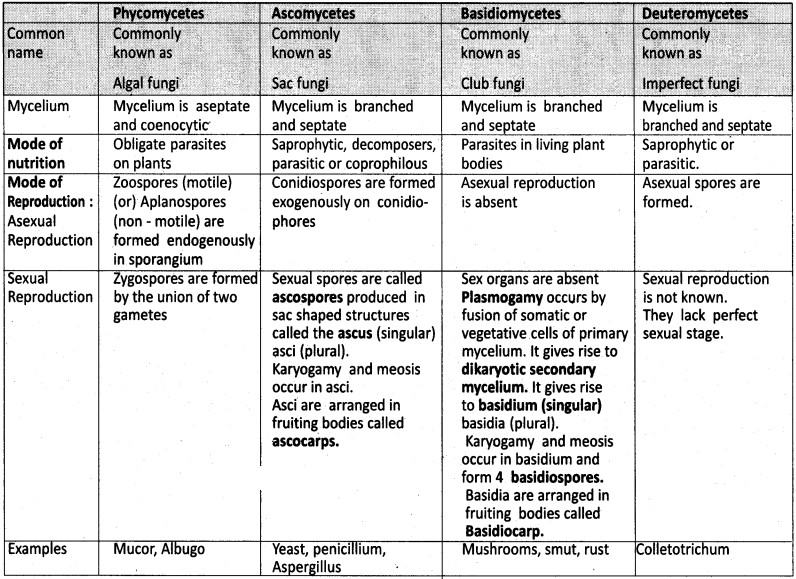
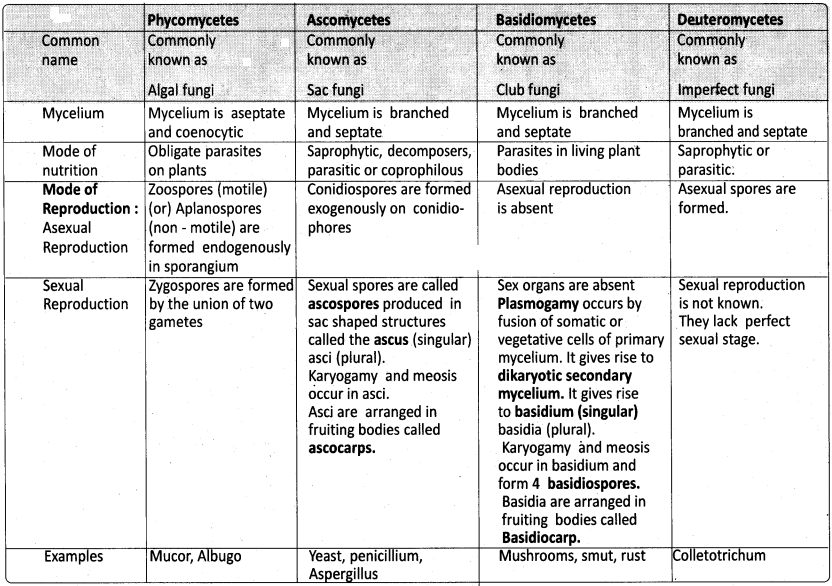
Question 1.
Give the salient features and comparative account of different classes of Fungi studied by you.?
Answer:
Question 2.
Describe briefly different groups of Monerans you have studied?
Answer:
Kingdom Monera includes all prokarytes like Archebacteria, Eubacteria, Mycoplasma and Actinomycetes.
Archebacteria :
These are different type of bacteria as they have a different cell wall structure. They can survive in extreme conditions like salty areas (halophiles), hot springs (thermacidophiles) and marshy areas (methanogens).
The cell wall does not contain peptidoglycan as in bacteria but contain pseudomurein.
The cell membrane contains branched lipid which is responsible for their survival in extreme conditions.
Methanogens live in the guts of several ruminant animals like cowand buffaloes and help in their digestion.
They help in the production of,biogas such as methane from the dungs of the animals.
Eubacteria:
They occur everywhere even in extreme habitats.
They live as parasites, and symbionts also.
Basing on the shape bacteria are grouped under four categories. They are 1) Spherical coccus 2) Rod shaped Bacillus 3) Comma, shaped Vibrium 4) Spiral shape Spirillum
In Bacteria, cell wall consists of peptidoglycan also called murein or ‘ mucopeptide.
Infolding of cell membrane called mesosomes responsible for respiration.
Cell organelles are absent except ribosome.
As it is prokaryotic, the genetic material DNA is naked without nuclear membrane.
It shows autotrophic and heterotrophic nutrition.
Excessive growth of cyanobacteria due to nutrients present in sewage causes Algal blooms.
Rapid growth of red dinoflagellate like Gonyaulax make sea appear red or red tides in Mediterianian sea.
Chemo autotrophic bacteria oxidise various inorganic substances.
Chemo heterotrophs are saprophytes which grow on dead organic matter and parasite which causes diseases.
Asexual reproduction is mainly by binary fission or by spores during unfavourable condition. Sexual reproduction is done by transfer of genetic material from one bacteria to other.
Mycoplasma :
Mycoplasma are the smallest living cells and can survive without oxygen.
They do not have any cell wall.
Mostly they are pathogenic in plants and animals. They cause witches broom in plants, pleuropneumonia in cattle and mycoplasmal urethritis in humans.
Actinomycetes :
These are branched filamentous bacteria.
Cell wall contains mycolic acid.
Most of them are saprophytic and decomposers. Mycobacterium and Corynebacteriurn are parasites.
Antibiotics are produced from the genus Streptomyces.
Question 3.
Enumerate the salient features of different groups of protista.?
Answer:
Kingdom Protista includes unicellular, aquatic, eukaryotes. It includes Chrysophytes, Dinoflagellates, Euglenoids, Slime moulds and Protozoans. 1. Chrysophytes:
It includes diatoms and desmids (golden algae).
They are green, microscopic, float in water currents.
In Diatoms the cell walls form two thin overlapping shells, epitheca and hypotheca which fit together as soap box.
The cell walls are embedded with silica which are indestructible. They pile at the bottom of water reservoir to form diatomaceous earth.
Diatoms are divided into two types based on symmetry. i) Centrale diatoms are radially symmetrical. ii) Pennales are bilaterally symmetrical.
Asexual reproduction is by binary fission and sexual reproduction is by the formation of gametes.
2. Dinoflagellates:
Dinoflagellates are marine. They appear as yellow, green, brown, blue or red depending upon the pigments present in the cells.
Cell wall is made up of cellulose plates.
Two flagella are present. One lies longitudinally and the other lies transversely in the furrow between the wall plates.
Flagella produce spinning movements. So these are called whirling whips.
Nucleus is called Mesokaryon as chromosomes are condensed without histones.
Example : Nostoc shows bioluminescence. Gonyaulax make the sea appear red.
3. Euglenoids :
These are unicellular, flagellate, fresh water organisms found in stagnant water.
Cell wall is absent.
The body is covered by thin flexible pellicle.
They bear two flagella, usually one long and one short. They swim actively by flagella.
The anterior part of the cell bears an invagination consisting of Cytostome (cell mouth), Cytopharynx (gullet) and reservoir.
A photosynthetic stigma on eye spot is present inthe reservoir.
Chloroplast is present. The pigments in it are identical to those present in higher plants. Performs photosynthesis.
In the absence of sunlight they behave like heterotrophs depending on smaller organisms for food.
Reproduction is by longitudinal binary fission Palmella stage is found in Euglena.
4. Slime moulds:
They show saprophytic nutrition.
Slime moulds are multinucleated protoplasm surrounded by plasma membrane.
They are aquatic; move along with decaying twigs.
Under favourable Conditions they aggregate to form plasmodium. They may spread upto several feet.
Under unfavourable conditions, plasmodium differentiates and forms fruiting bodies which bear spores at their tips. These spores are wind dispersed and can survive for many years.
5. Protozoans: All protozoans are heterotrophs and live as parasites. The four major groups of protozoans are given below. i) Amoeboid protozoans:
These organisms live in fresh water, sea water or moist soil.
They have locomotory organ called pseudopodia or false feet.
Marine forms have silica shells on their surface. Example: Amoeba.
ii) Flagellated protozoans:
These members are either free-living or parasitic.
They have flagella.
They cause diseases like sleeping sickness. Example : Trypanosoma.
iii) Ciliated protozoans:
These are aquatic and actively moving organisms because of cilia.
They have a cavity that opens to outside of the cell surface. Example : Paramecium.
iv) Sporozoans : It includes diverse organisms that have an infectious sporelike stage in their life cycle. Example : Plasmodium.
InText Question Answers
Question 1.
State two economically important uses of? a) Heterotrophic bacteria. b) Archaebacteria.
Answer:
a) Use of heterotrophic bacteria :
They help in making curd from milk.
They convert dead plants and animals into simpler substances and make them available to plants.
b) Use of archaebacteria : 1) They live in the guts of several ruminant animals such as cow and buffaloes and help in their digestion.
Question 2.
Give a comparative account of the classes of Kingdom Fungi on the basis of the following i) Mode of nutrition ii) Mode of reproduction?
Answer:
Question 3.
Give a brief account of viruses with respect to their structure and nature of genetic material. Also name four common viral diseases?
Answer:
Viruses are acellular, ultramicroscopic, nucleoprotein particles.
Viruses are obligate parasites. They are inert outside the host cell.
Viruses contain nucleic acid and protein.
The protein part forms a coat called capsid. It is made up of small sub units called capsomeres.
The nucleic acid which is genetic material may be DNA or RNA.
No virus contains both DNA and RNA.
Tobacco Mosaic Virus (TMV) and Human Immuno Virus (HIV) are examples for virus having RNA.
Bacteriophages contain DNA as genetic material.
Four common Viral Diseases : 1) AIDS, 2) Influenza 3) Small pox 4) Mumps.
Question 4.
Organise a discussion in your class on the topic. Are viruses living or non-living?
Answer:
The main points to be discussed in class : a) Viruses can be regarded as living organisms because
They are formed by macromolecules which occur in living beings.
Presence of genetic material
Ability to multiply or reproduce
Occurrence of mutations
Infectivity and host specificity
Occurrence of antigenic property
Viruses are killed by autoclaving and ultraviolet rays.
Viruses are responsible for infectious diseases like common cold, influenza, chicken pox, mumps etc.
b) Viruses can be regarded as non-living organisms because
Protoplasm absents
Ability to get crystallized & TMV
Inability to live independently
High specific gravity which is found only in non-living objects
Absence of respiration
Absence of storing energy system
Absence of growth and division.
Question 5.
Suppose you accidentally find an old preserved permanent slide without a label and in your effort to identify it, you place the slide under microscope and observe the following features? a) unicellular body b) well defined nucleus c) biflagellate condition – one flagellum lying longitudinally and the other transversely. What would you identify it as ? Can you name the kingdom it belongs to?
Answer:
It is identified as Dinoflagellates. It belongs to kingdom : Protista.
Question 6.
Polluted water bodies have usually high abundance of plants like IMostoc and Oscillatoria. Give reasons.?
Answer:
Polluted water bodies have excessive growth of plants like Nostoc and Oscillatonia because of the excessive nutrients present in it. It results in algal booms.
Question 7.
Cyanobacteria and heterotrophic bacteria have been clubbed together in Eubacteria of kingdom Monera as per the five kingdom classification, even though the two are vastly different from each other. Is this grouping of the two types of taxa in the same kingdom justified? If so why?
Answer:
Yes. because both are unicellular prokaryotic organisms.
Question 8.
What observable features in Trypanosoma would make you classify under the kingdom Protista?
Answer:
They are aquatic, single-celled eukaryotes.
Question 9.
At a stage of their life cycle, ascomycetous fungi produce fruiting bodies like cleistothecium, perithecium or apothecium. How are these three types of fruiting bodies differ from each other?
Answer:
The fruiting bodies are produced in Fungi.
Ascomycetes are called Ascocarp.
The globose ascocarp without opening is called cleistothecium.
The flask-shaped ascocarp with an apical opening is called perithecium.
The cup or saucer-shaped ascocarp is called apothecium.
ICBN stands for International Code for Botanical Nomenclature.
Question 2.
What is flora?
Aswer:
Flora is the actual account of habitat, distribution and systematic listing of plants of a given area.
It provides the index to the plant species found in a particular area.
Question 3.
Define Metabolism. What is the difference between anabolism and catabolism?
Aswer:
Metabolism refers to the sum total of all the chemical reactions occurring in the body of a living organism.
The constructive metabolic process in which complex molecules are formed from simpler molecules is called anabolism. The destructive metabolic process in which complex molecules are broken down into simpler molecules is called catabolism.
Question 4.
Which is the largest botanical garden in the world? Name a few well known botanical gardens in India?
Answer:
Royal Botanical Garden (RBG) at Kew, England is the largest botanical garden in the world.
Indian Botanical Garden, Howrah and National Botanical Research Institute, Lucknow are well known botanical gardens in India.
Question 5.
Define the terms couplet and lead in taxonomic key. [Mar. – 2018, Mar. 15, A.P.]?
Answer:
1) Couplet : A pair of contrasting characters that represents the choice made between two opposite options.
2) Lead : Each statement in the taxonomic key.
Question 6.
What is meant by manuals and monographs? [May ’17, May ’14]?
Answer:
Manuals are recorded descriptions useful in providing information for identification of names of species found in an area.
Monographs contain information on any one taxon.
Question 7.
What is systematics?
Answer:
Systematics is the study of different kinds of organisms, their diversities and also the relationship among them.
Systematics includes identification, nomenclature and classification. It takes into account evolutionary relationships between organisms.
Question 8.
Why are living organisms classified?
Answer:
Classification is the process by which anything is grouped into convenient categories based on some easily observable characters.
It is a device to study all the living organisms with ease.
Question 9.
What is the basic unit of classification? Define it. [Mar. ’20, ’17; Mar. 14, 13]?
Answer:
Species is the basic unit of classification.
Species can be defined as a group of individual organisms with fundamental similarities. Eg : Solanum tuberosum (Potato)
Question 10.
Give the scientific name of Mango. Identify the generic name and specific epithet.?
Answer:
The scientificname of Mango is Mangifera indica.
Mangifera is generic name and indica is specific epithet.
Question 11.
What is growth? What is the difference between the growth in living organisms and growth in non-living objects?
Answer:
Growth may be defined as permanent and irreversible increase in size overtime.
The growth in living organisms is from inside and by cell divisions. Whereas in non-living objects growth is due to accumulation of material on the surface.
Short Answer Type Questions
Question 1.
What is meant by identification and nomenclature? How is a key helpful in the identification and classification of an organism?
Answer:
Determining whether a collected plant is entirely new or already known is called identification. Providing a correct scientific name to an identified plant is called nomenclature.
Correct identification can be done by directly comparing the characters of the plant with an authentic herbarium specimen or indirectly with the help of key in floras.
Key or taxonomic key is an artificial analytic device having a list of statements with dichotomatic table of alternate characteristics which is used in identifying organisms.
Usually a couplet or two contrasting characters are used. The one present in the organism is chosen while the other is rejected.
Taxonomic key is helpful in the identification and classification of an organism based on.the similarities and dissimilarities.
Each statement in the key is called a lead.
Separate taxonomic keys are required for each taxonomic category such as family, genus and Species for identification purpose.
Question 2.
What are taxonomical aids? Give the importance of herbaria and museums.?
Answer:
Herbarium, Botanical gardens, Zoological parks and Museums are taxonomical aids.
Herbarium:
Herbarium is a store house of collected plant specimen.
Plants identification can be done directly comparing the characters with an authentic herbarium specimen.
Plant specimens that are collected are dried, pressed and preserved on the sheets.
These sheets are arranged according to the system of classification.
These sheets provide the information about the date, place of collection, English name, local name and scientific name, family name even the collector’s name etc.
Herbaria serves as a quick referred system in taxonomic studies.
Royal Botanical garden at Kew, England has largest herbarium. It is an international centre for plant identification.
Nowadays herbarium is preserved as Digital herbarium. The digital images of the herbarium specimens and the related information is preserved and published on internet for wider use.
This digital herbarium is intended to take advantage of internet and digital photography technologies to provide online facility.
Museum : Generally in schools and colleges biological museums are present. In these museums, they preserve the plants and animals specimens collected for study and reference. Specimens are preserved in the containers or jars in preservative solutions or they may be preserved as dry specimens.
Question 3.
Define a taxon. Give some examples of taxa at different hierarchial levels.?
Answer:
Any system of classification is made up of different units such as species, genus, family, order, class, division, kingdom which are arranged in a hierarchial sequence. Irrespective of its rank in the sequence every unit is called Taxon.
Hierarchy is the arrangement of organism in a definite sequence. The following is the taxonomical categories showing hierarchial arrangement in ascending order.
Examples of Taxa at different hierarchial levels :
Kingdom
Plant kingdom
Plant kingdom
Division
Spermatophyta
Spermatophyta
Class
Dicotyledonae
Monocotyledonae
Order
Sapindales
Poales
Family
Anacardiaceae
Poaceae
Genus
Mangifera
Triticum
Species
Indica
Vulgare
Common name
Mango
Wheat
Question 4.
How are botanical gardens useful in conserving biodiversity? Define the terms Flora, Manuals, Monographs and Catalogues.?
Answer:
Plants found in botanical gardens can be regarded as live specimens. Plants are grown in these gardens for identification purposes. Each plant is labelled indicating its botanical name and its family. Botanical gardens are useful in knowing our bioresources and their diversity.
Flora : Flora is a book containing the details of the habitat and distribution of plants of a particular area. Every district in each state has its own flora.
Manuals : These are small books useful in providing information for identification of names of species found in an area. It specially designed for ready reference.
Monograph : They contain information on any one taxon.
Catalogues : Books which help in correct identification of plants.
Question 5.
Explain binomial nomenclature.?
Answer:
Every plant should have only one correct scientific name.
Every scientific plant name has two components. They are the generic name and the specific,epithet. This system of providing a name with two components is called Binomial nomenclature.
Scientific name should be in Latin or Latin derivative.
Both the words’ when handwritten they must be underlined or printed in italics to indicate their Latin origin.
The generic name will be in the noun form and always begins with capital letter. The specific name will be in the adjective form and starts with small letter. For example, Solanum tuberosum is the name of the potato plant in which “Solanum” is the genus and “tuberosum” is the species.
The author’s name may be given in abbreviated form at the end of the scientific name.
For example : Mangifera indica Linn. It indicates that the species was first described by Linnaeus.
Long Answer Type Questions
Question 1.
What is meant by living? Give a detailed account of any four defining features of life forms?
Answer:
Organisms which are self replicating, evolving and self regulating, having interactive systems, capable of responding to external stimuli are said to be living.
The defining features of life forms are 1. Metabolism : All living organisms are made of chemicals. These chemicals undergo various chemical reactions. The sum total of all the chemical reactions occurring in the body of a living organism is called metabolism. Cellular organisation of the body required for metabolism is the defining feature of life forms.
2. Consciousness : Response to external stimuli is called irritability. Plants repond to external factors like light, water/temperature, other organisms, pollutants etc. All organisms are aware of their surroundings. This is called consciousness. Consciousness is the defining property of living organisms/Human being is the only one who is aware of himself that means has self consciousness.
3. Interactions : Properties of tissues are not present in the constituent cells but arise as a result of interactions among the constituent cells. Similarly properties of cellular organelles are not present in the molecular constituents of the organelle but arise as a result of interactions among the molecular components comprising the organelle. Such underlying molecular interactions are also apparent in macromolecules such as starch. These interactions result in emergent properties at a higher level of organisation.
4. Genetic material : All living organisms present, past and future are linked to one another by the sharing of common genetic material.
Question 2.
Define the following terms with examples, (i) Class (ii) Family (iii) Order (iv) Genus (v) Division.?
Answer:
i) Class : Class includes related orders. For example, in plant kingdom orders like Malvales, Rosales, Polemoniales etc., are included in the class : Dicotyledonae.
ii) Family : Family is a group in which different genera of common characters are put together. Families are characterised on the basis of both vegetative and reproductive features of plant species. For example, three different genera Solanuim, Nicotiana, and Datura are placed in the family Solonaceae.
iii) Order : Different families with similar characters are put into an order. The similar characters are less in number as compared to different genera included in a family. Plant families like Convolvulaceae, Solanaceae are included in the order Polemoniales mainly based on floral characters.
iv) Genus : Genus is a group of different species with related characters. For example, potato and brinjal are two different species but belong to the genus-Solanum.
v) Division : Different classes with similarities are grouped into division. Classes like Dicotyledonae and Monocotyledonae with a few similar characters are assigned to a higher category called division : Spermatophyta.
In the case of animals related classes are included in a phylum.
InText Question Answers
Question 1.
Some of the properties of tissues are not constituents of their cells. Give two examples to support the statement?
Answer:
Vascular tissues like xylem and phloem help in conduction of water, mineral salts and organic substances from one place to other.
Sclerenchyma tissue gives mechanical support to the plant body.
Question 2.
What do we learn from identification of individuals and populations?
Answer:
From the identification of individuals and population we learn their correct scientific names and the description of the organisms.
Identification is useful in agriculture, forestry to know our bioresources and their diversity.
Identification helps to determine whether a collected organism is entirely new or already known.
Question 3.
Given below is the scientific name of Mango. Identify the correctly written name, (i) Mangifera Indica (ii) Mangifera indica?
Answer:
Mangifera indica.
Question 4.
Can you identify the correct sequence of taxonomical categories ?
a) Species, Order, Division, Kingdom. b) Genus, Species, Order, Kingdom. c) Species, Genus, Order, Phylum.
Answer:
a) Species, Order, Division, Kingdom.
Question 5.
Define the following terms? (i) Species (ii) Class (iii) Family (iv) Order (v) Genus.
Answer:
Species : Species is the basic unit of classification. All those plants which are identical in all respects are regarded as species.
Class : Class includes related orders. For example, in plant kingdom orders like Malvales, Rosales, Polemoniales etc., are included in the class : Dicotyledonae.
Family : Family is a group in which different genera of comfhon characters are put together. Families are characterised on the basis of both vegetative and reproductive features of plant species. For example, three different genera Solanum, Nicotiana, and Datura are placed in the family Solonaceae.
Order : Different families with similar characters are put into an order. The similar characters are less in number as compared to different genera included in a family. Plant families like Convolvulaceae, Solanaceae are included in the order Polemoniales mainly based on floral characters.
Genus : Genus is a group of different species with related characters. For example: Potato and brinjal are two different species but belong to the Genus : Solanum.
Question 6.
Illustrate the taxonomical hierarchy with suitable examples of a plant?
Answer:
Flierarchy of categories is the arrangement of organisms in a definite sequence of categories. Descending order starts from kingdom to species. Ascending order starts from species to kingdom. This hierarchial system of classification was introduced by Linnaeus. The hierarchy includes seven categories – kingdom, division, or phylum, class, order, family, genus and species.
Question 7.
What are the distinctive characteristics exhibited by living organisms? Describe them in brief.?
Answer:
The distinctive characters exhibited by living organisms are Growth, reproduction, irritability, metabolism, ability to self replicate, self organise, interaction and emergence.
Growth : Living organisms grow by cell division. In animals growth is seen up to a certain age. However, cell division occurs in certain tissue to replace lost cells. In plants growth is present throughout the life.
Reproduction : Production of progeny is referred on reproduction. Progeny are more or less similar to parents. Reproduction may be vegetative, asexual and sexual methods.
Irritability : Response to stimuli is called irritability. Plants respond to external factors like light, water temperature etc. All organisms are aware of their surroundings and this is called consciousness.
Metabolism : The sum total of all the chemical reactions occurring in the body of the living organism is called Metabolism.
Interaction and emergence : Properties of cellular organelles are not present in the molecular constituents but as a result of interactions they emerge properties at next higher level of organisation.
Question 8.
Answer:
Life forms exhibit ‘unity in diversity’ : Discuss with your teacher.
Question 9.
List out the principles followed to provide scientific names for newly found organism?
Answer:
Every plant should have only one correct scientific name.
Every scientific plant name has two components. They are the generic name and the specific epithet. This system of providing a name with two components is called Binomial nomenclature.
Scientific name should be in Latin or Latin derivative.
Both the words, when hand written they must be underlined or printed in italics to indicate their Latin origin.
The generic name will be in the noun form and always begins with capital letter. The specific name will be in the adjective form and starts with small letter. For example, Solanum tuberosum is the name of the potato plant in which “Solanum” is the genus and “tuberosum” is the species.
The author’s name may be given in abbreviated form at the end of the scientific name.
For example : Mangifera indica Linn. It indicates that the species was first described by Linnaeus.
Answer: Let S(n) be the given statement 12 + 22 + 32 + …………. + n2 = n(n+1)(2n+1)/6 Since 12 = 1(1+1)(2+1)/6 ⇒ 1 = 1; the statement is true for n = 1 Suppose the statement is true for n = k then (12 + 22 + 32 + ………….. + k2) + k(k+1)(2k+1)/6 We have to prove that the statement is true for n = k + 1 also then (12 + 22 + 32 + …………… + k2) + (k + 1)2 ∴ The statement is true for n = k + 1 also. ∴ By the principle of Finite Mathematical Induction S(n) is true for all n ∈ N. i.e., 12 + 22 + 32 + ……….. + n2 = n(n+1)(2n+1)/6, ∀ n ∈ N
Question 2. 2.3 + 3.4 + 4.5 + ………………. upto n terms = n(n2+6n+11)/3 (March 13, May 06)
Answer: Let S(n) be the statement. The nth term of 2.3 + 3.4 + 4.5 + …………… is (n + 1) (n + 2) ∴ 2 . 3 + 3 . 4 + 4 . 5 + …………….. + (n + 1) (n + 2) = n(n2+6n+11)/3 Now S(1) = 2 . 3 = 1(12+6+11)/3 = 6 ∴ The statement is true for n = 1. Suppose that the statement is true for n = k, then 2.3 + 3.4 + 4.5 + …………….. + (k + 1) (k + 2) = k(k2+6k+11)/3 Adding (k + 1) th term of L.H.S both sides S(k + 1) = 2.3 + 3.4 + 4.5 + ……………. + k (k + 1) (k + 2) + (k + 2) (k + 3) ∴ S(k + 1) = 1/3 (k + 1) [k2 + 2k + 1 + 6 (k + 1) + 11] = 1/3 (k + 1) [(k + 1)2 + 6(k + 1) + 11] ∴ The statement is true for n = k + 1 So by the principle of Finite Mathematical Induction S(n) is true ∀ n ∈ N ∴ 2 . 3 + 3 . 4 + 4 . 5 + ……………. + (n + 1) (n + 2) = n(n2+6n+11)/3
Answer: Let Sn be the statement 1/1⋅3+1/3⋅5+1/5⋅7 + ……………. + 1/(2n−1)(2n+1) Then S(1) = 1/1⋅3=1/2(1)+1=1/3 ∴ S(1) is true. Suppose the statement is true for n = k, then S(K) = 1/1⋅3+1/3⋅5+1/5⋅7+….+1(2k−1)(2k+1) = k/2k+1 We have to show that the statement is true for n = k + 1 also, The statement S(n) is true for n = k + 1 ∴ By the principle of Mathematical Induction S(n) is true for all n ∈ N. ∴ 1/1⋅3+1/3⋅5+1/5⋅7 + ……………. + 1/(2n−1)(2n+1) = n/2n+1
Answer: 4, 8, 12, are in A.P. and nth term of A.P. is = a + (n – 1) d = 4 + (n – 1) 4 = 4n Let S(n) be the statement 43 + 83 + 123 + ……………… + (4n)3 = 16n2 (n + 1)2 Let n = 1, then S(1) = 43 = 16 (1 + 1)2 = 64 ∴ The statement is true for n = 1 also. Suppose the statement is true for n = k then 43 + 83 + 123+ ……………… + (4k)3 = 16k2 (k + 1)2 We have to prove that the result is true for n = k + 1 also. Adding (k + 1) th term = [4 (k + 1)]3 = [4k + 4]3 both sides 43 + 83 + 123 + ……………….. + (4k)3 + (4k + 4)3 = 16k3 (k + 1)2 + [4 (k + 1)]3 = 16 (k + 1)2 [k2 + 4k + 4] = 16 (k + 1)2 (k + 2)2 = 16 (k + 1)2 [(k + 1) + 1]2 Hence the result is true for n = k + 1. ∴ By the principle of Mathematical Induction S(n) is true ∀ n ∈ N. ∴ 43 + 83 + 123 + ……………….. + (4n)3 = 16n2 (n + 1)2
Question 5. a + (a + d) + (a + 2d) + ……………… upto n terms = n/2 [2a + (n – 1) d]
Answer: Let S(n) be the statement a + (a + d) + (a + 2d) + + [a + (n – 1) d] = n/2 [2a + (n – 1) d] Now S(1) is a = 1/2 [2a + 0 (d)] = a ∴ S(1) is true. Assume that the statement is true for n = k ∴ S(k) = a + (a + d) + (a + 2d) + ……………….. + [a + (k – 1) d] = k/2 [2a + (k – 1) d] We have to prove that the statement is true for n = k + 1 also. Adding a + kd both sides a + (a + d) + ……………. + [a + (k – 1) d] + [a + kd] ∴ The statement is true for n = k + 1 also ∴ By the principle of Mathematical Induction. S(n) is true for all n ∈ N ∴ a + (a + d) + (a + 2d) + + [a + (n – 1) d] = n/2 [2a + (n -1) d]
Question 6. a + ar + ar2 + ………………… + n terms = a(rn−1)/r−1, r ≠ 1 (March 2011)
Answer: Let S(n) be the statement a + ar + ar2 + ………….. + arn – 1 = (rn−1)/r−1, r ≠ 1 Then S(1) = a = a(r1−1)/r−1 = a ∴ The result is true for n = 1 Suppose the statement is true for n = k then a + ar + ar2 + …………… + ar = a(rk−1)/r−1, r ≠ 1 We have to prove that the result is true for n = k + 1 also. Adding ark both sides (a + ar + ar2 + ………….. + ark – 1 + ark) ∴ The statement is true for n = k + 1 also ∴ By the principle of Mathematical Induction p(n) is true for all n ∈ N a + ar + ar2 + ………………… + n terms = a(rn−1)/r−1, r ≠ 1
Answer: Let S(n) be the statement 2 + 7 + 12 + ………. + (5n – 3) = n(5n−1)/2 = 1(5−1)/2 = 2, Since S(1) = 2, S(1) is true. Suppose the statement is true for n k then (2 + 7 + 12 + ………….. + (5k – 3) = k(5k−1)/2 We have to show that S(n) is true for n = k + 1 also. Adding (k + 1)th term 5 (k + 1) – 3 = 5k + 2 both sides [2 + 7 + 12 + ……. + 5k – 3)] + (5k + 2) ∴ S(n) is true for n = k + 1 also ∴ By the principal of Mathematical Induction S(n) is true ∀ n ∈ N ∴ 2 + 7 + 12 + …………… + (5n – 3) = n(5n−1)/2.
∴ S(n) is true for n = 1 Suppose Sn is true for n = k then (1 + 3/1)(1 + 5/4)(1 + 7/9)……(1 + 2k+1/k2) = (k + 1)2 ………………. (1) We have to prove that the statement is true for n = k + 1 also (k + 1) th term is
= k2 + 4k + 4 = (k + 2)2 ∴ S(n) is true for n = k + 1 also ∴ By the principal of Mathematical Induction S(n) is true for ∀ n ∈ N
Question 9. (2n + 1) < (n + 3)2
Answer: Let S(n) be the statement When n = 1, then 9 < 16 ∴ S(n) is true for n = 1 Suppose S(n) is true for n = k then(2k + 7) < (k + 3)2 …………….. (1) We have to prove that the result is true for n = k + 1 i.e., 2(k + 1) + 7 < (k + 4)2 ∴ 2 (k + 1) + 7 = 2k + 2 + 7 = (2k + 7) + 2 < (k + 3)2 + 2 (From (1)) = k2 + 6k + 9 + 2 = k2 + 6k + 11 < (k2 + 6k + 11) + (2k + 5) = k2 + 8k + 16 = (k + 4)2 ∴ S(n) is true for n = k + 1 also By principle of Mathematical Induction S(n) is true ∀ n ∈ N
Question 10. 12 + 22 + ……………. + n2 > n3/3
Answer: Let S(n) be the statement When n = 1, then 1 > 1/3 ∴ S(n) is true for n = 1 Assume S(n) to be true for n = k then 12 + 22 + ……………. + k2 > k3/3 We have to prove that the result is true for n = k + 1 also.
∴ S(n) is true for n = k + 1 also ∴ By principle of Mathematical Induction. S(n) is true ∀ n ∈ N
Question 11. 4n – 3n – 1 is divisible by 9
Answer: Let S(n) be the statement, 4n – 3n – 1 is divisible by 9 For n = 1, 4 – 3 – 1 = 0 is divisible by 9 ∴ Statement S(n) is true for n = 1. Suppose the statement S(n) is true for n = k Then 4k – 3k – 1 is divisible by 9. ∴ 4k – 3k – 1 = 9t for t ∈ N ……………. (1) We have to show that statement is true for n = k + 1 also. From (1), 4k = 9t + 3k + 1 ∴ 4k + 1 – 3 (k + 1) – 1 = 4 . 4k – 3 (k + 1) – 1 = 4 (9t + 3k + 1) – 3k – 3 – 1 = 4 (9t) + 9k = 9 (4t + k) divisible by 9 (∵ 4t + k is an integer) Hence, S(n) is true for n = k + 1 also. ∴ 4k + 1 – 3 (k + 1) – 1 is divisible by 9 ∴ The statement is true for n = k + 1 ∴ By the principle of Mathematical Induction. S(n) is true for all n e K ∴ 4n – 3n – 1 is divisible by 9
Question 12. 3.52n + 1 + 23n + 1 is divisible by 17 (May 2012, 2008)
Answer: Let Sn be the statement 3.52n + 1 + 23n + 1 is divisible by 17 S(1) is 3 . 52(1) + 1 + 23 (1) + 1 = 3 . 53 + 24 = 3 (125) + 16 = 375 + 16 = 391 is divisible by 17 Hence, S(n) is true for n = 1. Suppose that the statement is true for n = k, then 3.52k + 1 + 23k + 1 is divisible by 17 and 3.52k + 1 + 23k + 1 = 17t for t ∈ N then we have to show that the result is true for n = k + 1 also Consider 3.52(k + 1) + 1 + 23(k + 1) + 1 = 3.52k + 1 . 52 + 23(k + 1) . 2 = (17t – 23k + 1) 52 + 23k + 3 . 2 = 17t (25) – 23k (50) + 23k (16) = 17 t (25) + 23k (16 – 50) = 17 t (25) – 34 23k = 17 [25t – 23k + 1 25t – 23k + 1 is an integer. ∴ 3.52(k + 1) + 1 + 23 (k + 1) + 1 is divisible by 17. ∴ The statement S(n) is true for n = k + 1 also. ∴ By the principle of Mathematical induction S(n) is true for ∀n ∈ N ∴ 3.52n + 1 + 23n + 1 is divisible by 17
Answer: The nth term of the given series is n (n + 1) (n + 2) and let Sn be the statement. 1.2.3 + 2.3.4 + 3.4.5 + ……………. + n (n + 1) (n + 2) = n(n+1)(n+2)(n+3)/4 For n = 1 S(1) = 1.2.3 = 6 = 1(1+1)(1+2)(1+3)/4 = 2(3)(4)/4 = 6 ∴ S(n) is true for n = 1 Let S(n) is true for n = k then 1.2.3 + 2.3.4 + 3.4.5 + ……………. + k (k + 1) (k + 2) = k(k+1)(k+2)(k+3)/4 …………….. (1) We have to prove that the result is true for n = k + 1 also. Adding (k + 1) th term, (k + 1) (k + 2) (k + 3) both sides we get 1.2.3 + 2.3.4 + 3.4.5 + ……………. + k(k + 1)(k + 2) + (k + 1) (k + 2) (k + 3) ∴ S(n) is true for n = k + 1 also. Hence by the principle of Mathematical Induction. S(n) is true for ∀n ∈ N ∴ 1.2.3 + 2.3.4 + 3.4.5 + ……………. + n (n + 1) (n + 2) = n(n+1)(n+2)(n+3)4
Information can be expressed through verbal (description) and non verbal (diagrams) modes. Some of the non-verbal modes are :
Pie-charts,
Bar graphs,
Tree diagrams,
Flow charts and
Tables.
The process of changing a text from Verbal to Non-verbal mode or vice versa is called Information Transfer. This is a very useful and important skill for students. Acquiring this skill enables the students make notes quickly, understand various texts effectively and present ideas clearly and briefly.
Non-verbal expressions are remarkable for their brevity, clarity, simplicity, accessibility and provision for comparative, contrastive and analytical studies.
1. PIE-CHARTS
A pie-chart is a circle divided into parts. Each part represents a particular thing. And eah part is in proportion to the ratio of that thing to its total. Studying the given pie chart slowly helps one understand the information given there. Then the information can be presented in verbal mode. Once the mode of representing the given information in the form of a pie-chart is understood, verbal text can be transferred into a pie-chart.
In a pie charl; the information is presented in the form of a circle. The circle is divided into sections called sectors. The contribution of each unit in the chart is represented in percentages.
Example 1 : The following pie chart depicts the results of a survey regarding distribution of different Blood Groups in a college. Blood Groups in a College
From the figure we can see that 35% of the students of a college have 0 Group of Blood and these students form the largest group. The next largest group comprises students with B Group of Blood. 30% of students belong to this category. 25% of students have AB Group of Blood. Finally, we see that only 10% of students have A Group of Blood. Thus, from the piechart we can conclude that while many students have O Group of Blood. Very few have A Group.
Example 2 : The following piechart depicts the favourite subject of students in a class. We can see from the figure that five subjects have been taken into consideration – Economics, Civics, Commerce, English and 2nd Language. Students who like Economics form the largest group. A quarter of the students of the class i.e 25% expressed preference for this subject. 20% of the students like English and the same percentage i.e 20% of the students like Commerce. Next in popularity is Civics, liked by 18% of the class. Finally, trailing closely behind Civics, comes 2nd Language, which is the favourite subject of 17% of the students. Favourite Subjects of Students
Exercises and Activities
Question 1.
The following paragraph gives the information about the most widely spoken languages in India. Convert the passage into a pie chart.
Hindi is the most widely spoken language in India. The fact that 44% of Indians speak Hindi across India justifies its title as our National Language. 9% of Indians speak Bengali followed by Marathi which is spoken by 8%. Telugu comes next in the list with 7%, Tamil and Gujarati account for 6% and 5% respectively. All other languages together share the remaining percentage.
Answer:
Pie chart showing languages spoken in India
Hindi – 44% Bengali – 9% Marathi – 8% Telugu – 7% Tamil – 6% Gujarathi – 5% All other languages – 21%
Question 2.
Read the following paragraph and convert the information into a pie chart.
There are seven continents in the world. Asia is the largest continent with an area of 30% followed by Antarctica with 28%. North America occupies 17% of the land on the earth. South America stands fourth in the list with 12% of land. Africa and Australia are the fifth and sixth largest ones with their respective shares of 6% and 5%. Europe is the last in the list which occupies 2% of the land only.
Answer:
Areas of Continents
Continents Asia – 30% Antarctica – 28% North America – 17% South America – 12% Africa – 6% Australia – 5% Europe – 2%
Question 3.
Observe the pie chart given below. It contains information about the mode of transport used by students of a certain junior college. Write a small paragraph. Mode of Transport of Students
Answer:
Mode of Transport of Students The given pie chart presents the mode of transport used by students of a particular junior college. A major part of them 40% – use the public transport, i.e. bus. A half of the share of bus, that is 20% of them travel by autorickshaws. Two wheelers and cars carry 15% each of the students. Just 10% of them use the cleanest and the healthiest mode – walking.
Question 4.
The pie chart given below shows how people spend their time on smart phones. Convert the information into a paragraph. Time spent on Smart. Phones
Answer:
Time spent on Smart Phones Time spent on smart phones is presented in the given pie chart. The lion’s share, i.e. 35% of the time goes to games. Social networking follows games with its share of 29% of the time. Utilities Consume 20% time. The share of music and videos is 8%. Others take 5% time. News comes last with just 3% time.
2. BAR BRAPHS
A bar graph is a diagram in which values of variables are shown by the length of rectangular columns with equal width. It is another visual representation of data. It helps to compare the values presented in a group. The bars can be plotted vertically or horizontally. A vertical bar chart is sometimes called a column bar chart.
Example 1 : Given below is the iar graph that shows the cost of certain vegetables over a period of 4 months. Let us now make a detailed analysis.
The bar graph given below shows the cost of carrots and potatoes over a period of four months – January, February, March and April. Carrots were more costly than potatoes during all the months. In January carrots cost Rs. 35 a kilo, while potatoes cost a little less, at Rs. 30 a kilo. The cost of carrots increased to Rs. 40 in February, while there was a sharp fall in the cost of potatoes.
There was a sharp rise in the cost of both the vegetables after that and in March the cost of carrots was Rs. 50 per kilo while that of potatoes was Rs. 40. In April once again there was a steep increase in the cost of carrots but the cost of potatoes remained the same as in March. Thus we observe that the cost of carrots kept increasing over the months but that of potatoes fluctuating. COST OF VEGETABLES (in Rs per kg)
Example 2 : The following bar graph represents the favourite sports of various group of students studying in a college. Students of four sections HEC, CEC, BPC and MPC were asked about their preferences in sports. The number of students in each section varied. Three sports were considered – football, cricket and kabaddi. HEC students expressed great interest in cricket. 50 out of 85 students, i.e. more than half liked cricket. Very few in that section, just 5, were fond , of football. 30 liked kabaddi.
In the CEC section, consisting of 100 students, an equal number of students, i.e. 40 liked kabaddi and cricket. 20 liked football. With regard to the science sections, cricket was more popular among BPC students. An equal number in both the sections, 30, were fond of football. The figures for kabaddi too were more or less the same. The BPC section consisted of 88 students while MPC students were 75 in number. On the whole, one can conclude that cricket is the most popular sport in the college, followed by kabaddi. FAVOURITE SPORTS OF STUDENTS
Exercises And Activities
Question 1.
The passage below represents the data of improvement of English language skills due to Internet usage. Present it in a bar graph.
Internet plays an important role in improving Reading skills. 94% participants in this study agreed that they improved their Reading skills by using Internet while 91% opined that they improved Translation skills. Internet usage helped 87% of participants in enhancing their vocabulary skills. 80% of participants unanimously agreed that they improved their Writing skills, Speaking skills and Grammar.
Answer:
Bar Graph Showing Skills due to Internet Usage
The following passage shows the favourite sports of the students of a school. Represent the data in a bar graph.
Question 2.
Cricket is the most favourite sport of the students which is liked by 80 students. Tennis falls behind Cricket with a slight difference. It is the favourite of 75 students. Swimming and Football are liked by 40 and 45 students respectively while Badminton is the favourite of 30 students. Hockey is the least favouring sport of the students which is liked by 20 students only.
Answer:
Bar Graph Showing Favourite Sport of Students
Question 3.
Analyse the bar graph given below and write about it in a paragraph. MARKS OF STUDENTS?
Answer:
The bar chart presents marks of three students in three subjects. Meena scored 70 in Telugu, 65 in Maths and in English just 50. Mala scored 65 in Maths, 50 in Telugu and only 40 in English. Megha secured 70 each in English and Maths but scored 60 in Telugu.
Question 4.
The given below bar graph shows how much dietary fibre is found in certain fruits. Convert the information into a paragraph?
Answer:
Fibre Content in Fruits The given bar graph presents the details of fibre content in various fruits. The guava stands tall with six (6) grams of dietary fibre per a serving of one cup. Next comes the pear with five (5) grams per unit. The third in the order is the apple with four (4) grams per a cup. The banana and the orange have almost the same quantity of dietary fibre – three (3) grams per cup.
3. TREE DIAGRAMS
A tree diagram is another way of representing information. It has a branching tree-like structure. It shows how its components are related to one another. It helps us understand the relevant information in a short time.
Example 1 : There are three types of muscle in the human body. They are smooth, cardiac and skeletal muscles. Smooth muscles are controlled by involuntary responses. Examples of smooth muscles are muscles in the digestive tract and blood vessels. The second type of muscle is cardiac muscle. It is also an involuntary muscle. Muscles that cover the heart are examples of cardiac muscles. The third type of muscle is the skeletal muscle. It is controlled by voluntary response. All the muscles attached to the bones such as biceps, deltoid are examples of skeletal muscles.
The above paragraph can be depicted in the form of a tree diagram as follows.
Example 2 : A man who managed a popular hotel was asked the secret of his success. He said that only when customers were happy with the dining experience would they keep returning to the hotel. Dining would be a pleasant experience only if the food served was of a high standard. Good service too was equally important. He elaborated that food should be tasty and fresh. Service should be prompt and courteous. Given below is a tree diagram representing the man’s views.
Exercises And Activities
Question 1.
Read the following paragraph and transfer the information into a tree diagram?
The oldest musical instrument in the world is the drum, made initially in one of the three ways. First, frame drums were made by stretching the skin over bowl-shaped frames. Next, rattle drums were made by filling gourds or skins with dried grains, shells, or rocks. Finally, tubular drums were made from hollowed logs or bones covered with skins. Both frame and tubular drums were struck with the hand or with beaters to produce sounds. In contrast, rattle drums were shaken or scraped to make rhythmic sounds. For thousands of years, drums have been used to transmit messages to call soldiers to battle and make music.
Answer:
Tree Diagram showing Types of Drums
Question 2.
Read the following paragraph and transfer the information into a tree diagram?
There are so many species of animals that we find living on the earth. Scientists grouped these animals into different classes based on certain similarities they share. Animals are divided into vertebrates, ones with backbones and invertebrates, those without backbones. The vertebrates are basically divided into five classes. They are commonly known as mammals, birds, fish, reptiles and amphibians. Arachnids and insects are the two commonly known classes in the invertebrates group.
Answer:
Tree Diagram showing Species of Animals
Question 3.
The following tree diagram depicts the classification of Vitamins. Present the information in a paragraph?
Answer:
Classification of Vitamins The given tree diagram presents the classification of vitamins. Vitamins are broadly of two types. They are : 1) Soluble vitamins in water and 2) Soluble in fats. Vitamin B and Vitamin C fall in the category of ‘Soluble in water’. Vitamins A, D, E and K (four) belong to the group of vitamins soluble in fat and Vitamin B is sub-divided into Bl, B2, B3, B6 and B12 (five) types.
Question 4.
Study the following tree diagram and write it in a paragraph?
Answer:
Types of Oils The given tree diagram explains the types of oils. Based on the source, oils are of three categories. They are : 1) Oils from nuts, 2) Oils from vegetation (plants / flowers) and 3) Oils from minerals. Examples are 1) groundnut oil, 2) oils from flowers and 3) oils from the crust of the earth. Groundnut oil is used in cooking. Oils from flowers go into the making of soap, medicines and perfumes (scents). Mineral oil fuels machines and automobiles.
4. FLOW CHARTS
We draw flow charts when we present information in the form of a process. For instance, we construct flow charts to put the information of the industrial production from raw product to finished product in a logical order in successive steps. Flow charts are simple to construct and easy to understand. Each step in the sequence is written in a diagram shape. These successive stages or steps are linked by connecting directional arrows. They guide readers to understand flow charts logically and follow the process from beginning to end. In these flow charts we find elongated circles, rectangles and diamond shaped diagrams.
Example 1 : Describe how the following passage is presented in a flow chart. The passage shows the time table for children in a boarding school. You are supposed to wake up at 5 am every day and lights – out time is 9.30 pm. Siesta time is between 1 and 2 in the afternoon. Assembly begins at 8 am sharp in the school hall. You have to report to your House Prefect by 7.30 am on all school days. You may play any game between 4 and 6 pm. You must not be late for study time which is between 6 and 8 in the evening. School timings are from 8.30 am to 3.30 pm with an hour-long lunch break at 1 pm. These details are shown in a flow chart.
Time table of children in a boarding school
Example 2 : Read the following paragraph and transfer the information into a flow chart.
Rayon is a man-made fiber. It is a reconstituted natural fiber – cellulose. Rayon is made by dissolving cellulose in a solution of sodium hydroxide or caustic soda. The cellulose is obtained from shredded wood pulp. The dissolved cellulose is formed into threads by forcing it through a spinneret in a dilute sulphuric acid setting bath. The threads are drawn from the setting bath, wound on a reel, washed, dried on a heated roller, and finally wound onto a bobbin.
Process of Making Rayon
Exercises And Activities
Question 1.
The following paragraph describes how clothes are washed?
Draw a flow chart based on the information given. First, fill a bucket half full with water. Then, add a spoonful of washing powder. Stir vigorously till the power mixes with water and forms foam. Put the unwashed clothes into it. Wait for fifteen minutes. Take out clothes and scrub with a brush to remove stains. Now, rinse the clothes with clean water.
Wring out the clothes gently by twisting and compressing them. This removes excess water from the clothes. This saves the time of drying. Now dry the washed clothes by putting them on the clothes line. Collect the washed and dried clothes later.
Answer:
How to wash clothes
Question 2.
Convert the following paragraph into a flow chart?
Silver occurs in the ores of several metals. The frothing process of extracting silver accounts for about 75% of all silver recovered. Here the ore is ground to a powder, placed in large vats containing a water suspension of frothing agents, and thoroughly agitated by air jets. Depending on the agents used, either the silver-bearing ore or the gangue adhering to the bubbles of the foam is skimmed off and washed. The final refining is done using electrolysis.
Answer:
Flow Chart depicting Frothing Process of Extracting Silver
Question 3.
The following flow chart describes how paper is manufactured in a paper mill. Write the details in a paragraph. Manufacture of paper?
Answer:
The given flow chart describes the process of manufacturing paper. First, the raw materials like wood, grass, bamboo and rags are procured. Secondly they are cut into pieces, immersed in water and made into pulp. Then the pulp is mixed with lime for whitening. Later, the pulp is boiled and passed through wire meshes. At this stage, we obtain wet paper. Finally, it is passed over heated rollers. Then we get the end product, in the form of thin sheets of paper.
Question 4.
Draw a flow chart based on the information given below?
The following process is the description of how a post office transfers a letter from a sender to a receiver. First, the sender posts the letter in a post box. Next, the box is opened. Then the contents in it are sorted out. Then they are kept in a bag and the bag is tied. The destination is written on the bag. The bags are sent to the district post office. The district post office sends the bags to the destination village / town post offices. The destination post office receives the letters. The received letters are arranged and sorted out. The post man delivers the letters to the addressees.
Answer:
Flow Chart depicting the Process of Delivering Letters
5. TABLES
We can also represent information in the form of a table. Example 1 : Given below are the marks secured by Aravind, Akash and Ramesh in their half-yearly examinations of class X.
Name of the Subject
Aravind
Akash
Ramesh
Telugu
81
80
81
Hindi
97
97
97
English
60
88
99
Mathematics
99
97
100
Science
68
91
98
Social Studies
95
98
93
After reading the information given in the table we can write a paragraph like this.
In this table, the marks secured by 3 students are compared. While all the three students scored equal marks in Hindi, there is a slight variation of marks in Mathematics and Social Studies. However, there is a great variation of marks in English. From the table it can be concluded that Aravind needs to concentrate more on English and Science, whereas Akash needs to focus on Telugu and English. Ramesh, who scored the highest marks among the three, needs to focus on Telugu.
Example 2 : The following table shows the number of gold medals won by 8 participating countries in the XII South Asian games 2016. First read the data given in the table.
Rank
Nation
No. of gold medals won
1
India
188
2
Sri Lanka
25
3
Pakistan
12
4
Afghanistan
7
5
Bangladesh
4
6
Nepal
3
7
Maldives
0
8
Bhutan
0
Now read the paragraph given below.
The above table gives the information of the number of gold medals won by 8 participating countries in the XII South Asian games 2016. India secured the first rank with 188 gold metals. It was far ahead of the other countries. Sri Lanka was ranked 2, securing only 25 gold medals. Pakistan got only 12 gold medals and was ranked 3. With 7 golds, Afghanistan is in the 4th place. Bangladesh won 4 golds while Nepal secured just 3 golds. Maldives and Bhutan which stood at the bottom of the table got no gold medals. This table shows the commendable performance of India in the XII South Asian Games.
Exercises And Activities
Question 1.
Read the following paragraph and transfer the information into a table?
A reading test assesses reading comprehension by employing multiple testing techniques, represented by eight main types of questions. Question types, such as Multiple-Choice, Matching, Diagram Labelling, Summary Completion, Sentence Completion, Short Answer Questions with percentage, i.e., 37.50%, 18.13%, 16.25%, 10%, 9.36%, and 8.76%, take place respectively. The number of questions for each of these questions types is variable. Basic English grammar, cloze summary, percentages are although with lower portions and are also considered in the reading test.
Answer:
Table Showing Types of Questions in Reading & Tests
S.No.
Type of Questions
Percentage
1.
Multiple-Choice
37.50
2.
Matching
18.13
3.
Diagram Labelling
16.25
4.
Summary Completion
10.00
5.
Sentence Completion
09.36
6.
Short Answer Questions
08.76
7.
Basic English Grammar
Negligible
8.
Cloze Summary
Negligible
Question 2.
Convert the following paragraph into a table?
There are many elements in the earth’s crust. Oxygen occupies 46%; Silicon 28%; Aluminum 8%; Iron 5%; Calcium 3.6%; Sodium 2.8%; Potassium 2.6%; Magnesium 2%; certain other elements occupy 2% of the earth’s crust. This is what we mean by the abundance of elements in the earth’s crust.
Answer:
Table Showing Elements in Earth’s Crust
Sl.No.
Name of the Element
Percentage
1.
Oxygen
46
2.
Silicon
28
3.
Aluminum
08
4.
Iron
05
5.
Calcium
3.6
6.
Sodium
2.8
7.
Potassium
2.6
8.
Magnesium
02
9.
Other elements
02
Question 3.
Study the table below showing a few Asian countries with their capitals and currencies. Write a paragraph containing all the information in the table?
Country
Capital
Currency
Afghanistan
Kabul
Afgani
China ‘
Beijing
Yuan
Japan
Tokyo
Yen
Saudi Arabia
Riyadh
Riyal
Singapore
Singapore
Singapore dollar
Answer:
The table presents the capitals and their currencies of 5 Asian countries. Kabul is the capital of Afghanistan and their currency is Afgani. China’s capital is Beijing and their currency is Yuan. With Yen as their currency Japan administers the country from Tokyo, the capital city. Saudi Arabia’s capital is Riyadh and their currency is Riyal. Finally Singapore has as its capital Singapore city and their currency is Singapore dollar.
Question 4.
Look at the following table. It gives information about nutrients (in gms) present in 100 ml. of milk. Present the information in the form of a paragraph?
Nutrition information about Milk
Per 100 ml approximately
Energy (kcal)
78.0
Fat (g)
5.0
Carbohydrates (g)
4.4
As sugar (g)
0.0
Protein (g)
2.3
Calcium (mg)
8.9
Minerals (g)
0.8
Note : k stands for thousand; g stands grammes.
Answer:
The given table provides us information about tire nutrition value of milk. 100 ml of milk gives us 78 kcals of energy. Fat is 5.0 gms. Carbohydrates are 4.4 gms. Sugar Nil. Proteins 2.3 gms. Calcium 8.9 mg. and Minerals 0.8 grams.