Home Blog Page 16

TS Inter 1st Year English Grammar Syllables

0

Q.No. 19 (4 × 1 = 4 Marks)

A syllable is the next higher unit to a speech sound and forms a word or part of a word. It contains one (and only one) vowel sound (not letter). The number of consonant sounds in a syllable may be ‘Zero to Seven’.

A word may have one syllable or more.

  • Words with one syllable each are called monosyllabic words.
  • Words with two syllables each are called disyllabic words.
  • Words with three syllables each are called trisyllabic words.
  • Words with more than three syllables each are called polysyllabic words.

The, number of vowel sounds in a word gives us the number of syllables in that word. By noticing the vowel symbols in the phonetic transcript of a given word, we can arrive at the number of syllables in that word. Look at the following examples :

pen / pen only one vowel sound – one syllable – monosyllabic paper / peips (r) / two vowel sounds – two syllables – disyllabic gravity / graeviti / three vowel sounds – three syllables – trisyllabic.

discovery / dɪˈskʌvɚɹi / four vowel sounds – four syllables – poly (tetra) syllabic, organization / ˌɔːrɡənəˈzeɪʃən / five vowel sounds – five syllables – poly (penta) syllabic.

There are, however, certain words in which the number of vowel sounds is not equal to the number of syllables. Look at the following examples :
brittle / ˈbɹɪtl̩ / only ong vowel sound – but two syllables
prism / pnzm / only one vowel sound – but two syllables
mutton / mAtn / only one vowel sound – but two syllables

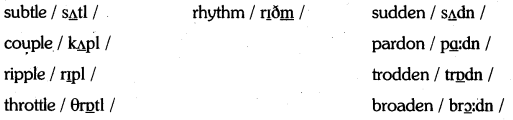
The reason for this variation is that the consonant sounds / l /, / m / and / n / help form a syllable. These sounds in such words are, therefore, called syllabic consonants.
Examine some more examples of this kind :


Careful observation of phonetic transcription or correct pronunciation of words will help students find out the number of syllables in a given word.

Exercise – A

In the following table four categories of words are given. Read them aloud paying attention to the syllabic division.

S.No.Words with one syllableWords with two syllablesWords with three syllablesWords with four or more syllables
1.lifeen-gagete-le-phonein-sti-tu-tion
2.pensuf-ferpo-ta-toclas-si-fi-cation
3.twoteach-erba-che-lore-du-ca-tion
4.trymat-teram-bu-lancecom-pe-ti-tion
5.hatspi-derin-va-lidmath-e-ma-tics
6.quiteto-daycom-pu-tercon-gra-tu-late
7.lightan-swercon-tem-platein-tel-li-gence
8.flyeng-lishde-scrip-tiveci-vi-li-za-tion
9.fewfa-therre-pre-senthe-li-co-pter
10.betdon-keyre-mem-berob-serv-a-to-ry

Exercise – B

Read the words in the table and write the number of syllables in the columns. Look up the words in a dictionary to check your answers. The first one has been done for you.

WordNumber of SyllablesWordNumber of SyllablesWordNumber of Syllables
Sunday2apology4examine3
question2history3bun1
fixation3manager3student2
college2paper2instrumental4
grammar2but1monday2
immoral3glass1doctor2
time1policy3intelligent4
feather2food1example3
near1present2bright1
go1phone1syllabus3
ugly2property3agitation4
create2persistent3criticism3
application4ant1resolution4
complain2particular4mother2
cricketer3bachelor3beautiful3
sorry2anaesthesia5discussion3
fate1honour2fan1
employee3amplification5fight1

Mention the number of syllables in the following words.

Exercise – 1

i) misery
ii) direction
iii) remember
iv) information
v) encourage
vi) excellent


Answer:


i) 3 trisyllabic
ii) 3 – trisyllabic
iii) 3 – trisyllabic
iv) 4 – polysyllabic
v) 3 – trisyllabic
vi) 3 – trisyllabic

Exercise – 2

i) person
ii) weakness
iii) dark
iv) thought
v) fact
vi) discipline


Answer:


i) 2 – disyllabic
ii) 2 – disyllabic
iii) 1 – monosyllabic
iv) 1 – monosyllabic
v) 1 – monosyllabic
vi) 3 – trisyllabic

Exercise – 3

i) lawyer
ii) literacy
iii) square
iv) harbinger
v) adamant
vi) muse


Answer:


i) 2 – disyllabic
ii) 4 – polysyllabic
iii) 1 – monosyllabic
iv) 3 – trisyllabic
v) 3 – trisyllabic
vi) 1 – monosyllabic

Exercise – 4

i) before
ii) doctor
iii) mother
iv) imagination
v) essence
vi) quarter


Answer:


i) 2 – disyllabic
ii) 2 – disyllabic
iii) 2 – disyllabic
iv) 5 – polysyllabic
v) 2 – disyllabic
vi) 2 – disyllabic

Exercise – 5

i) glance
ii) propel
iii) silence
iv) realize
v) excitement
vi) climax


Answers:


i) 1 – monosyllabic
ii) 2 – dissyllabic
iii) 2 – disyllabic
iv) 2 – disyllabic / 3 – tnsyllabic
v) 3 – trisyllabic
vi) 2 – disyllabic

Exercise – 6

i) understand
ii) decision
iii) shout
iv) supremely
v) encouragement
vi) flashlight


Answer:


i) 3 – trisyllabic
ii) 3 – trisyllabic
iii) 1 – monosyllabic
iv) 3 – trisyllabic
v) 4 – polysyllabic
vi) 2 – disyllabic

Exercise – 7

i) pension
ii) source
iii) confer
iv) captivate
v) modest
vi) contribution


Answer:


i) 2 – disyllabic
ii) 1 – monosyllabic
iii) 2 – disyllabic
iv) 3 – trisyllabic
v) 2 – disyllabic
vi) 4 – polysyllabic

Exercise – 8

1) popular
ii) today
iii) side
iv) plant
v) rainwater
vi) condition


Answer:


i) 3 – trisyllabic
ii) 2 – disyllabic
iii) 1 – monosyllabic
iv) 1 – monosyllabic
v) 3 – trisyllabic
vi) 3- trisyllabic

Exercise – 9

i) punctual
ii) increase
iii) room
iv) mantelpiece
v) breakfast
vi) gracious


Answer:


i) 2 – disyllabic
ii) 2 – disyllabic
iii) 1 – monosyllabic
iv) 3 – trisyllabic
v) 2 – disyllabic
vi) 2 – disyllabic

Exercise – 10

i) particular
ii) handful
iii) apearance
iv) often
v) apartment
vi) idea


Answer:


i) 4 – polysyllabic
ii) 2 – disyllabic
iii) 3 – trisyllabic
iv) 2 – disyllabic
v) 3 – trisyllabic
vi) 2 – disyllabic

TS Inter 1st Year Maths 1A Solutions Chapter 1 Functions Ex 1(c)

TS Inter 1st Year Maths 1A Functions Solutions Exercise 1(c)
I.
Question 1.
Find the domains of the following real valued functions. (May 2014, Mar. 14)
(i) f(x) = 1/(x2−1)(x+3)
Answer:
Domain of f is the value of all real x for which (x2 – 1) (x + 3) ≠ 0
⇔ (x + 1) (x – 1) (x + 3) ≠ 0
⇔ x ≠ – 1, 1, -3
∴ Domain of f is, R – {-1, 1, – 3}
(ii) f(x) = 2x2−5x+7/(x−1)(x−2)(x−3)
Answer:
Here (x – 1) (x – 2) (x – 3) + 0
⇔ x ≠ 1, x ≠ 2, x ≠ 3.
Domain of f is, R – {1, 2, 3}
(iii) f(x) = 1/log(2−x)
Answer:
f(x) = 1/log(2−x) ∈ R
⇔ log (2 – x) ≠ 0 and 2 – x > 0
⇔ 2 – x ≠ 1 and 2 > x
⇔ x ≠ 1 and x < 2
⇔ x ∈ (-∞, 1) U (1, 2)
(or) x ∈ (-∞, 2) – {1}
Domain of f = x ∈ {∞, 2} – {1}

(iv) f(x) = |x – 3|
Answer:
f(x) = |x – 3| ∈ R
⇔ x ∈ R
∴ Domain of f = R
(v) f(x) = √4x−x2. (May 2005)
Answer:
f(x) = √4x−x2 ∈ R
⇔ 4x – x2 ≥ 0
⇔ x(4 – x) ≥ 0
⇔ x ∈ [0, 4]
∴ Domain of f = [0, 4]
(vi) f(x) = 1/√1−x2
Answer:
f(x) = 1/√1−x22 0 ⇔ (1 – x)(1 – x) > 0 ⇔ x ∈ (-1, 1) ∴ Domain of f = {x/x ∈ (-1, 1)} (vii) f(x) = 3x/x+1
Answer:
f(x) = 3x/x+1 ∈ R
⇔ 3x ∈ R, ∀ x ∈ R and x + 1 ≠ 0
⇔ x ≠ – 1
∴ Domain of f = R – {-1}
(viii) f(x) = √x2−25 (May 2012)
Answer:
f(x) = √x2−25 ∈ R
⇔ x2 – 25 ≥ 0
⇔ (x + 5)(x – 5) ≥ 0
⇔ x ∈ (-∞, -5] ∪ [5, ∞)
⇔ x ∈ R – (-5, 5)
∴ Domain of f is R – (-5, 5)

(ix) f(x) = √x−[x]
Answer:
f(x) = √x−[x] ∈ R
⇔ x – [x] ≥ 0
⇔ x ≥ [x]
⇔ x ∈ R
∴ Domain of f is R
(x) f(x) = √[x]−x
Answer:
f(x) = √[x]−x ∈ R
⇔ [x] – x ≥ 0
⇔ [x] ≥ x
⇔ x ≤ [x]
⇔ x ∈ z
∴ Domain of f is Z (Set of injection)

Question 2.
Find the ranges of the following real valued functions,
(i) log |4 – x2|

Answer:
Let y = f(x) = log |4 – x2| ∈ R
⇔ 4 – x2 ≠ 0 ⇒ x ≠ ± 2
y = log|4 – x2|
⇒ |4 – x2| = ey
ey > 0 ∀ y ∈ R
∴ Range of f is R.
(ii) √[x]−x
Answer:
Let y = f(x) = √[x]−x ∈ R
⇔ [x] – x > 0
⇔ [x] ≥ x ⇔ x ≤ [x]
∴ Domain of f is z
Then Range of f is {0}
∴ The Range of f = [1, ∞]
(iii) sinπ[x]/1+[x]2
Answer:
Let y = f(x) = sinπ[x]/1+[x]2 ∈ R
⇔ x ∈ R
∴ Domain of f is R
For x ∈ R, [x] is an integer and sin n [x]= 0 ∀ n ∈ R Range of f is {0}
(iv) x2−4/x−2
Answer:
Let y = f(x) = x2−4/x−2 = (x + 2) ⇔ x – 2 ≠ 0
∴ Domain of f is R – {2}
Then y = x + 2 ∴ x ≠ 2, we have y ≠ 4
∴ Range of f is R – {4}.
(v) √9+x2
Answer:
Let y = √9+x2 f(x) ∈ R
Domain of f is R.
When x = 0, f (0) = √9 = ± 3, But when f(0) = 3,
For all values of x e R – {0}, f (x) > 3
Range of f = {3, ∞).

Question 3.
If f and g are real valued functions defined by f(x) – 2x – 1 and g(x) = x2, then find
(i) (3f – 2g)(x)

Answer:
(3f – 2g) (x) = 3 f(x) – 2 g(x)= 3 (2x – 1) – 2(x2)
= -2x2 + 6x – 3

(ii) (fg) (x)
Answer:
(fg)(x) = f(x) g(x) = (2x – 1)(x2) = 2x3 – x2

(iii) (√f/g)(x)
Answer:
√f(x)/g(x)=√2x−1/x2

(iv) (f + g + 2)(x)
Answer:
(f + g + 2) (x) = f(x) + g(x) + 2
= 2x – 1 + x2 + 2
= x2 + 2x + 1 = (x + 1)2

Question 4.
If f = {(1, 2), (2, -3), (3, -1)}, then find
(i) 2f
(ii) 2 + f
(iii) f2
(iv) √f
[May 2012, May 2008]

Answer:
Given f = {(1, 2), (2, -3), (3, -1)} we have f(1) = 2, f(2) = -3 and f(3) = -1
(i) 2f = {(1, 2 x 2), (2, 2 (-3), (3, 2(-1))}
= {(1. 4). (2, – 6). (3, -2)}
(ii) 2 + f = {(1, 2+2), (2, 2+(-3), (3, 2+(-1))}
= {(1, 4), (2, -1), (3. 1)}

(iii) f2 = {(1, 22), (2, (-3)2), (3, (-1)2)]
= {(1, 4), (2, 9), (3, 1)}

(iv) √f = {(1, √2)| (∵ √-3 and √-1 are not real)

II.

Question 1.
Find the domains of the following real valued functions
(i) f(x)= √x2−3x+2

Answer:
f(x) = √x2−3x+2 ∈ R
Domain of f is x2 -3x + 2 > 0
⇒ (x – 2) (x – 1) > 0
⇒ x ∈ [-∞, 1] u [2, ∞]
∴ Domain of f = R – [1, 2]

(ii) f (x) = log (x2 – 4x + 3)
Answer:
f(x) = log (x2 – 4x + 3) ∈ R
⇔ x2 – 4x + 3 > 0
⇔ (x – 3) (x – 1) > 0
x ∈ (-∞, 1) ∪ (3, ∞)
Domain f = R – (1, 3)

(iii) f(x) = √2+x+√2−x/x
Answer:
f(x) = √2+x+√2−x/x ∈ R
⇔ 2 + x > 0 2 – x > 0, x ≠ 0
⇔ x > -2, x < 2 x ≠ 0 ⇔ -2 < x < 2, x ≠ 0 Domain of f is [-2, 2] – {0} (iv) f(x) = 1/3√x−2 log (4−x)10 Answer: f(x) = 1/3√x−2log(4−x)10 ∈ R ⇔ 4 – x > 0, 4 – x ≠ 1 and x – 2 ≠ 0
⇔ x < 4, x ≠ 3, x ≠ 2 Domain of f is [-∞, 4] – {2, 3} (v) f(x) = √4−x2/[x]+2 Answer: f(x) = √4−x2/[x]+2 ∈ R ⇔ 4 – x > 0, [x] + 2 > 0 or
4 – x2 < 0 and [x] > + 2 < 0 When 4 – x2 > 0, and [x] + 2 > 0
we have (2 – x) (2 + x) > 0 and [x] > – 2
⇔ x ∈ [-2, 2] and x ∈ [-1, ∞)
⇔ x ∈ [-1, 2] …………….(1)
When 4 – x2 < 0, and [x] + 2 < 0 ⇔ (2 + x) (2 – x) < 0 and [x] + 2 < 0 ⇔ x ∈ [-∞, -2] ∪ [2, ∞] and [x] < – 2 ⇔ x ∈ [- ∞, -2] ∪ [2, ∞] and x ∈ (- ∞,-2) ⇔ x ∈ [-∞, -2] ………………(2) ∴ from (1) and (2) ∴ Domain of f is [-∞, -2] ∪ {-1, 2} (vi) f(x) = √log0.3(x−x2) Answer: f(x) = √log0.3(x−x2) ∈ R ⇔ log0.3 (x – x2) > 0 .
⇒ x – x2 < (0.3) 0 ⇒ x – x2 < 1 ⇒ -x2 + x < 1 ⇒ -x2 + x – 1 < 0 ⇒ x2 – x + 1 > 0
This is true for all x ∈ R …..(1)
and x – x2 > 0
⇒ x2 – x < 0
⇒ x (x – 1) < 0
⇒ x ∈ (0, 1) ……….(2)
∴ Domain of f is R n (0, 1) = (0, 1)
∴ Domain of f = (0, 1)
(vii) f(x) = 1/x+|x|
Answer:
f(x) = 1/x+|x| ∈ R
⇔ x + |x| ≠ 0 ⇒ x ∈ (0, ∞)
(∵ |x| = x if x ≥ 0
= -x if x < 0)
∴ Domain of f = (0, ∞)

Question 2.
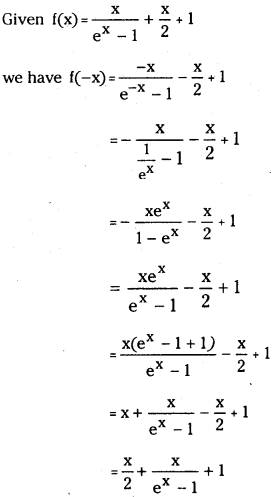
Prove that the real valued function f(x) = x/ex−1 + x/2 + 1 is an even function on R – {0} –

Answer:
f (x) ∈ R, ex – 1 ≠ 0
⇒ ex ≠ 1 ⇒ x ≠ 0

Since f(-x) = f(x), the function f is even function on R – {0}.

Question 3.
Find the domain and range of the following functions.
(i) f(x) = tanπ[x]/1+sinπ[x]+[x2]

Answer:
f(x) = tanπ[x]/1+sinπ[x]+[x2] ∈ R
⇔ x ∈ R; since [x] is an integar so that tan π [x] and sin π [x] are zero. ∀ x ∈ R
Domain of f is R and Range = {0}
(ii) f(x) = x/2−3x
Answer:
f(x) = x/2−3x ∈ R
⇔ 2 – 3x ≠ 0 ⇒ x ≠ 2/3
∴ Domain of f = R – {2/3}
Let y = f(x) = x/2−3x
⇒ 2y – 3xy = x
⇒ 2y = x(1 + 3y)
⇒ x = 2y/1+3y
∴ x ∈ R – {2/3}, 1 + 3y ≠ 0
⇒ y ≠ −1/3
∴ Range of f = R – {−1/3}
(iii) f(x) = |x| + |1 + x|
Answer:
f(x) ∈ R ⇔ x ∈ R
Domain of f = R
∴ |x| = x if x > 0
= – x if x < 0 |1 + x| = 1 + x if 1 + x > 0 ie., x > -1
= – (1 + x) if 1 + x < 0 ie., x < – 1
For x = 0, f(0) = 1,
x= 1, f(1) = |1| + |1 + 1| = 3
x = 2, f(2) = |2| + |1 + 2| = 2 + 3 = 5
x = -2, f(-2) = |-2| + |1 +(-2)| = 2 + 1 = 3
x = -1, f(-1) = |-1| + |1 + (-1)| = 1

TS Inter 1st Year English Grammar Odd Sound Out

0

Q.No. 18 (4 × 1 = 4 Marks)

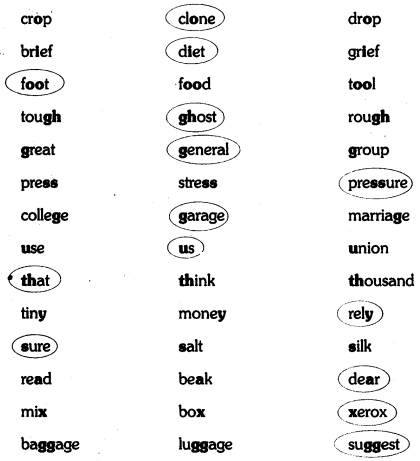
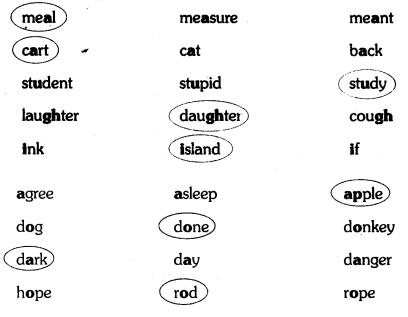
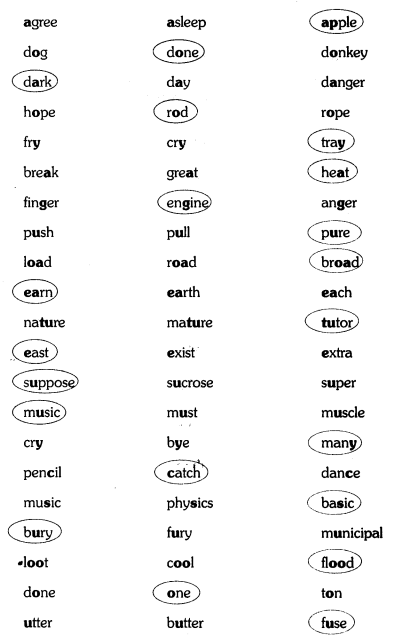
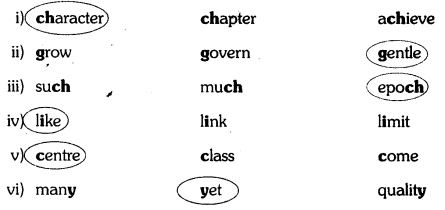
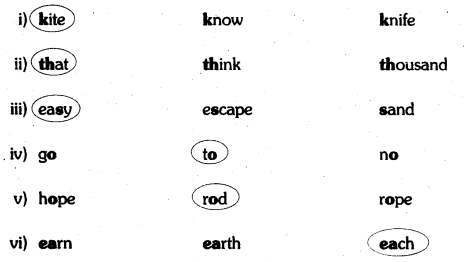
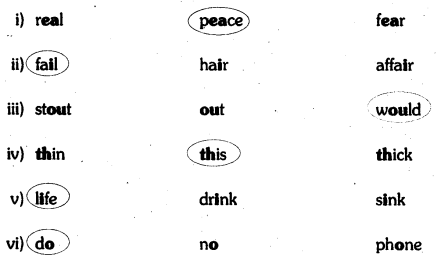
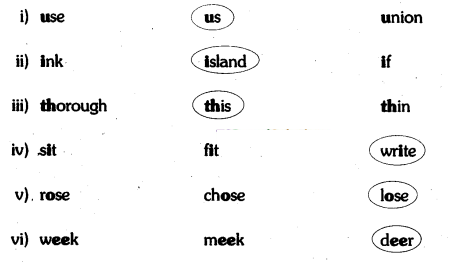
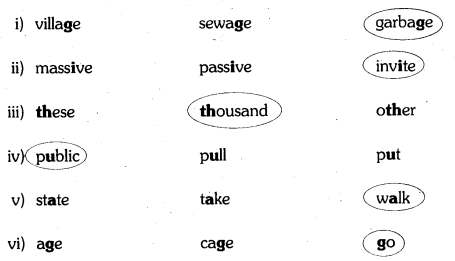
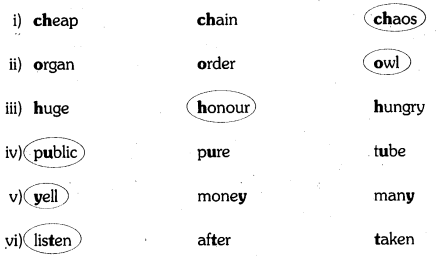
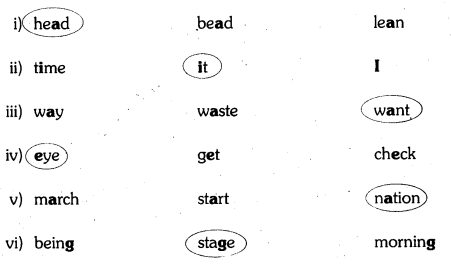
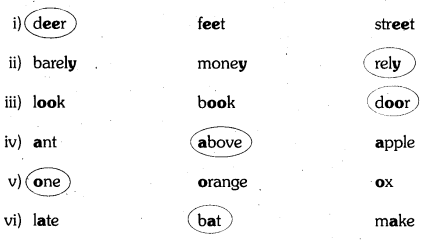
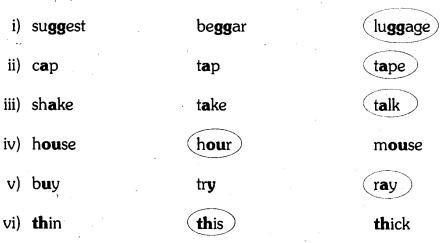
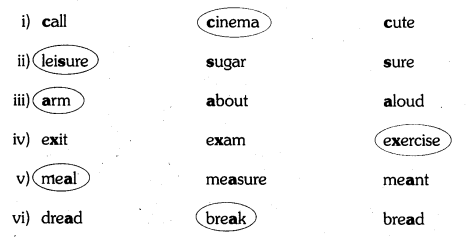
A set of three words are given. One or two letters which are common in all the three words are underlined. The underlined letter stands for one sound in two of the given words and for a different sound in the other word. The word with a different sound is to be written as the response.

The pronunciation of English words is quite tricky and confusing. Some vowels and consonants are pronounced differently in different places. Learning all these varieties is necessary to master pronunciation. It is possible only with practice.

Look at the following words. Circle the word that sounds different with regards to the sound of the bold letters.


Circle the words that sound different with regard to the sound of the bold letters.

Exercise -1

Exercise – 2

Exercise – 3

Exercise – 4

Exercise – 5

Exercise – 6

Exercise – 7

Exercise – 8

Exercise – 9

Exercise – 10

TS Inter 1st Year English Grammar Phonetic Transcription 

0

Q.No. 17 (4 × 1 = 4 Marks)

Meaningful speech sounds are the basic raw material for any language. These sounds are represented by symbols in writing. We refer to these symbols as ‘alphabet’.

Most of the Indian languages have a fixed relationship between the sounds and their symbols. In other words, one symbol always stands for one sound and vice versa. Therefore we find absolutely no problem while reading or writing Indian languages once we learn the alphabet of that language.

The same is not the case with English. One letter may stand for many sounds. Example Q as / k / in car, as / s / in century as /t/ in change. One sound is also represented by various letters. Ex : / f / is represented by ‘ph’ in philosophy, by ‘f in fan, by ‘gh’ in rough. This results in a lot of problems for the learners, particularly for foreign learners in writing the spelling and pronouncing the written words.

A way out of this problem is a set of forty four symbols, called phonetic symbols. Each of these symbols stands for one sourid only. Learning these symbols arms us with the necessary weapons to war against the problems in pronounciation and spelling.

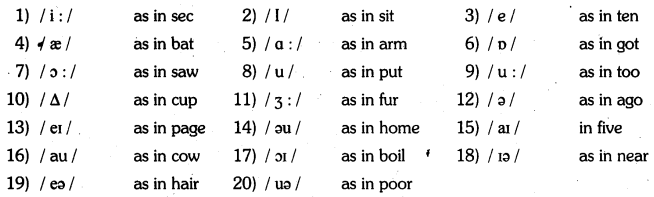
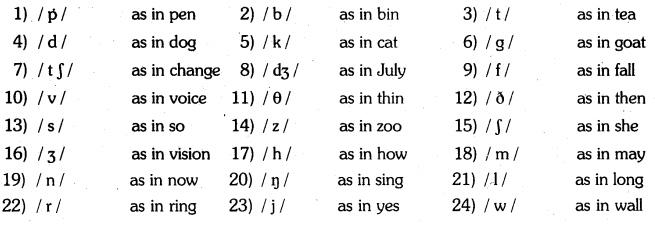
Study the following forty four phonetic symbols carefully and learn to identify and use them. Phonetic symbols are always placed between two Slant lines.

Vowels

Consonants

Writing the symbols that represent the sounds in a word is called phonetic transcript. In many examinations phonetic transcription is given and the examinee is asked to write the spelling of those words.

Exercises

Exercise – A

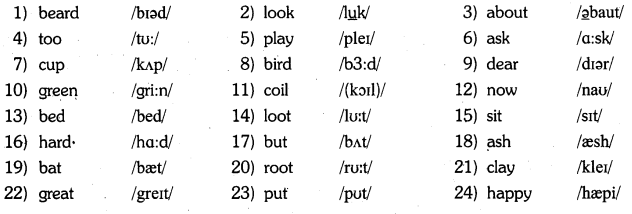
Read the words and fill in the spaces with the appropriate vowel symbol. The first one is done for you. If necessary, don’t hesitate to use a dictionary.

Exercise – B

Read the words according to the vowel symbols mentioned.

/ɪ//i://u//u://ɒ//ɔ:/
bitbeatwoodwooedpotport
fitfeetlookflukewadward
richreachshouldshoedcodcord
filledfieldsootsuitdondawn

Exercise – C

Go through the words and identify the sounds the end with. The first one is done for you.

Word/t/ /d/ /id/Word/s/ /z/ /iz/
rounded/id/rounds/z/
packed/t/packs/s/
wished/t/wishes/iz/
matched/t/matches/iz/
flogged/d/flogs/z/
played/d/plays/z/
planted/id/plants/s/
worked/t/works/s/

Exercise-D

Read the following words. You will notice that in some words the letters ‘th’ are pronounced as /θ/ and in some others, as /ð/ and in some others, as 161. Write the sound you noticed. The first one is done for you.
the /ð/ this /ð/ through /θ/ then /ð/
thus /ð/ thought /θ/ thick /θ/ mother /ð/

Exercise – E

We get confused with the sounds /w/ and /v/. The sound /w/ is pronounced with rounded lips. The sound /v/ is pronounced with the articulation of front upper teeth and lower lip and with more force.
Now, pronounce the words aloud.
wheel   ventilator
worst    verse
wet      veto

Exercise – F

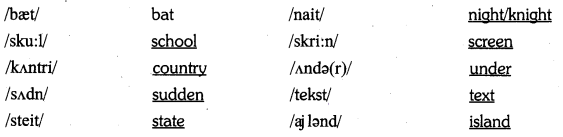
Read the following transcriptions and write the words in ordinary spelling. The first one is done for you.

Exercise – G

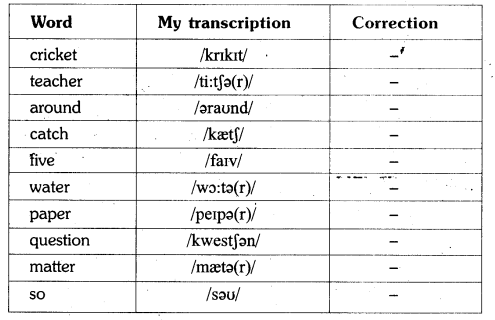
Pronounce the following words and transcribe them in the column my transcription Later, consult a dictionary and make necessary corrections.

Exercise – H

Words with short vowels are entirely different from their long counterparts. Understanding the difference is vital for pronunciation. Read the words in the following table and write a few more words from your text.

/ɪ//i://ɪ//i://ɪ//i:/         ‘/ɪ//i:/
knitneathidheedrimreambidbead
killkeelridreadlidleaddindean
sitseatkinkeenbinbean/beenfillfeel
gritgreethitheatgridgreedchitcheat

Write the following transcriptions using ordinary English spelling.

Exercise – 1


Answer:


i) purpose
ii) accomplish
iii) beautiful
iv) question
v) faith
vi) miserable

Exercise – 2


Answer:


i) speak
ii) constantly
iii) attention
iv) unfortunate
v) want
vi) individual

Exercise – 3


Answer:


i) transgression
ii) nervy
iii) harbinger
iv) recognize
v) strive
vi) pesticide

Exercise – 4


Answers:


i) provide
ii) literate
iii) frustration
iv) imagination
v) fear
vi) adamant

Exercise – 5


Answer:


i) stretch
ii) incredible
iii) plant
iv) condition
v) hospital
vi) entire

Exercise – 6


Answer:


i) education
ii) husband
iii) pension
iv) recently
v) mountain
vi) close

Exercise – 7


Answer:


i) desperate
ii) lull
iii) impelled
iv) resistance
v) pride
vi) faint

Exercise – 8


Answer:


i) success
ii) effort
iii) excitement
iv) worry
v) previous
vi) athletic

Exercise – 9


Answer:


i) acquaint
ii) attic
iii) horizontal
iv) gridiron
v) curb
vi) vengeance

Exercise – 10


Answer:


i) emphatic
ii) appearance
iii) mention
iv) gentleman
v) tremble
vi) sleep

TS Inter 1st Year English Grammar Silent Letters 

0

Q.No. 16 (8 × 1/2 = 4 Marks)

Silent letters are a peculiar feature of English spelling. Letters are used in writing but the corresponding sounds are not uttered in pronunciation. This poses problems to learners both in spelling and pronunciation. A study says that 60% of the English words have silent letters !

Careful observation of both the spelling and pronunciation is the only way out to overcome this problem. There are, however, some generalizations about silent letters that will help learners understand this feature to some extent.

In the Intermediate Public Examination, normally, the words that appear in the prescribed selections with a silent consonant letter are set under this question.

Some Guidelines :

  • ‘b’ before word final ‘t’ is silent – doubt debt.
  • ‘b’ in final ‘mb’ clusters is also silent.
    comb
    womb
    tomb
  • ‘g’ before word final ‘n’ is silent.
    sign
    resign
    foreign
    campaign
    reign
    sovereign
  • ‘g’ in most ‘ough’, ‘augh’ combinations is silent.
    (But in some words with ‘augh’ it may sound as /f/ as in ‘laughter),
    though
    taught
    through
    benign
    thorough
  • ‘h’ in word beginning position (not always) is silent.
    honest
    honour
  • ‘k’ in word beginning followed by ‘n’ is silent.
    knowledge
    know
    knit
    knee
    knave
    knuckle
  • ‘l’ before word final’m’ is silent.
    calm
    palm (but in realm and film – T is not silent)
  • Word final ‘n’ preceded by ‘m’ is silent,
    condemn
    column
    autumn
  • ‘p’ in word beginning position followed by ‘s’ is silent.
    ’psychology
    psalm
    pseudo
  • ‘p’ in words like receipt is also silent.
  • ‘r’ followed by a consonant letter is silent,
    world
    card
  • ‘f is silent in clusters like ‘astle’, ‘isten’, ‘istle’ as in
    castle
    whistle
    listen
  • ‘W’ is silent in words like
    Write
    wrap
    know
    fawn
    lawn

(These guiding principles are by no way exhaustive. They help the learner to a great extent in identifying the silent letters. About vowels – the problem is not this simple or unambiguous. So no generalisation is given here.)

TEXTUAL EXAMPLES

Silent letter – Example words

b – lamb, bomb, tomb, climb, dumb, subtle, plumber, womb, crumb, thumb
c – muscle, blackguard, yacht, indict, scene
d – Wednesday, handkerchief, handbag, handsome, adjourn, adjective, judge
g – gnaw, gnome, phlegm, foreign, resign, campaign, align, sovereign
h – honour, heir, ghost, night, rhyme, rhythm, when, where, hour
k – know, knee, knock, knot, kneel, knowledge
t – talk, folk, salmon, colonel, calf, calm, half, walk, baulk
m – mnemonic . . .
n – hymn, solemn, damn, autumn, column
p – recepit, psychic, pneumonia, psyche
q(u) – lacquer
r – girl, bird, card, teacher, leader, curd, world
s – isle, aisle, viscount, island
t – thistle, fasten, mortgage, soften, watch, tsunami
w – whole, sword, two, who, wrist, wrong
y – prayer, mayor
z – rendezvous
gh – sigh, high, daughter, naughty, caught, brought, bought, night, haughty

Exercise -1

QuestionI.

Underline the silent letters in the following words?

1) knell
2) consign
3) thorough
4) yellow
5) often
6) delight
7) benign
8) almond
9) yolk
10) limb
11) pseudonym
12) cupboard
13) Indict
14) climb
15) half
16) bouquet
17) wreath
18) dumb
19) depot
20) answer
21) aisle
22) exhibition
23) night
24) condemn
25) pneumonia
26) design
27) christmas
28) reign
29) palm
30) debut

31) precis
32) whistle
33) poignant
34) knead
35) castle
36) subtle
37) feign
38) debt
39) knight
40) knack
41) debris
42) comb
43) succumb
44) fight
45) deign
46) chalk
47) folk
48) bustle
49) align
50) malign
51) honest
52) lodge
53) pawn
54) doubt
55) bridge
56) coup
57) rapport
58) ghost
59) through
60) listen


Answer:


1) knell
2) consign
3) thorough
4) yellow
5) often
6) delight
7) benign
8) almond
9) yolk
10) limb

11) pseudonym
12) cupboard
13) Indict
14) climb
15) half
16) bouquet
17) wreath
18) dumb
19) depot
20) answer
21) aisle
22) exhibition
23) night
24) condemn
25) pneumonia
26) design
27) christmas
28) reign
29) palm
30) debut
31) precis
32) whistle
33) poignant
34) knead
35) castle
36) subtle
37) feign
38) debt
39) knight
40) knack
41) debris
42) comb
43) succumb
44) fight
45) deign
46) chalk
47) folk
48) bustle
49) align

50) malign
51) honest
52) lodge
53) pawn
54) doubt
55) bridge
56) coup
57) rapport
58) ghost
59) through
60) listen

QuestionII.

Identify the silent consonant letters in the following words?

Exercise – 1

i) bright
ii) scene
iii) hour
iv) neighbour
v) wrong
vi) knell
vii) wreath
viii) palm
ix) limb
x) design


Answer:


i) bright – gh
ii) scene – c
iii) hour – h – r
iv) neighbour – g, h, r
v) wrong – w
vi) knell – k
vii) wreath – w
viii) palm – l
ix) limb – b
x) design – g

Exercise – 2

i) chalk
ii) knock
iii) depot
iv) teacher
v) often
vi) thought
vii) honest
viii) almond
ix) know
x) talk


Answer:


i) chalk – 1
ii) knock – k
iii) depot – t
iv) teacher – r
v) often – t
vi) thought – gh
vii) honest – h
viii) almond – l
ix) know – k, w
x) talk – l

Exercise – 3

i) lodge
ii) castle
iii) feign
iv) laugh
v) debut
vi) malign
vii) talk
viii) psyche
ix) lighten
x) muscle


Answer:


i) lodge – d
ii) castle – l
iii) feign – g
iv) laugh – …
v) debut – t
vi) malign – g
vii) talk – l
viii) psyche – p
ix) lighten – gh
x) muscle – c

Exercise – 4

i) yolk
ii) would
iii) pneumonia
iv) consign
v) drawing
vi) what
vii) knead
viii) doubt
ix) island
x) aisle


Answer:


i) yolk – l
ii) would – l
iii) pneumonia – p
iv) consign – g
v) drawing – w
vi) what – h
vii) knead – k
viii) doubt – b
ix) island – s
x) aisle – s

Exercise – 5

i) thorough
ii) who
iii) benign
iv) receipt
v) rhythm
vi) diversity
vii) nursery
viii) column
ix) curd
x) kneel


Answer:


i) thorough – gh
ii) who – w
iii) benign – g
iv) receipt – p
v) rhythm – h
vi) diversity – r
vii) nursery – r
viii) column – n
ix) curd – r
x) kneel – k

Exercise – 6

i) bustle
ii) although
iii) parliament
iv) fight
v) knee
vi) brought
vii) bomb
viii) could
ix) hymn
x) which


Answers:


i) bustle – t
ii) although – gh
iii) parliament – r, i
iv) fight – gh
v) knee – k
vi) brought – gh
vii) bomb – b
viii) could – l
ix) hymn – n
x) which – h

Exercise – 7

i) align
ii) ghost
iii) leader
iv) straight
v) calf
vi) plumber
vii) wrap
viii) thistle
ix) attempt
x) burden


Answer:


i) align – g
ii) ghost – h
iii) leader – r
iv) straight – gh
v) calf – l
vi) plumber – b, r
vii) wrap – w
viii) thistle – t
ix) attempt – t
x) burden – r

Exercise – 8

i) through
ii) sovereign
iii) slightly
iv) tsunami
v) watch
vi) tomb
vii) caught
viii) naughty
ix) half
x) leopard


Answer:


i) through – gh
ii) sovereign – g
iii) slightly – gh
iv) tsunami – t
v) watch – t
vi) tomb – b
vii) caught – gh
viii) naughty – gh
ix) half – l
x) leopard – o, r

Exercise – 9

i) wrist
ii) daughter
iii) receipt
iv) solemn
v) hatter
vi) mnemonic
vii) 4umb
viii) damn
ix) should
x) folk


Answer:


i) wrist – w
ii) daughter – gh
iii) receipt – p
iv) solemn – n
v) hatter – r
vi) mnemonic – m
vii) dumb – b
viii) damn – n
ix) should – l
x) folk – l

Exercise – 10

i) knock
ii) autumn
iii) cupboard
iv) tight
v) walk
vi) sword
vii) subtle
viii) psalm
ix) handsome
x) gnaw


Answer:


i) knock – k
ii) autumn – n
iii) cupboard – p
iv) tight – gh
v) walk – l
vi) sword – w, r
vii) subtle – b
viii) psalm – p, l
ix) handsome – d
x) gnaw – g, w

TS Inter 2nd Year Study Material Textbook Solutions PDF Download: Telangana Board Intermediate II Year Books at Manabadi.co.in

The Telangana State Board of Intermediate Education (TSBIE) plays a vital role in shaping the academic foundation of students pursuing Intermediate education in Telangana. Students appearing for TS Inter 2nd Year (Intermediate II Year) examinations often search for textbook solutions PDFs to strengthen their preparation. To meet this demand, Manabadi.co.in provides easy access to TS Inter 2nd Year textbook solutions PDF downloads for all major subjects.

In this article, we will cover everything you need to know about TS Inter 2nd Year books, subject-wise solutions, benefits of using solutions PDFs, download steps, and exam preparation tips.

Subjects Covered in TS Inter 2nd Year Textbook Solutions

TS Inter provides solutions for all major Intermediate subjects, including Mathematics, Physics, Chemistry, Biology, Economics, Commerce, Accountancy, History, Political Science, and Languages. Both Telugu and English medium students can access subject-wise solutions according to their curriculum needs.

Subject NameSolutions
MathematicsMathematics Inter 2nd Year Textbook Solutions
PhysicsPhysics Inter 2nd Year Textbook Solutions
ChemistryChemistry Inter 2nd Year Textbook Solutions
BiologyBiology Inter 2nd Year Textbook Solutions
EconomicsEconomics Inter 2nd Year Textbook Solutions
CommerceCommerce Inter 2nd Year Textbook Solutions
AccountancyAccountancy Inter 2nd Year Textbook Solutions
HistoryHistory Inter 2nd Year Textbook Solutions
Political SciencePolitical Science Inter 2nd Year Textbook Solutions
EnglishEnglish Inter 2nd Year Textbook Solutions

About TS Inter 2nd Year (Intermediate II Year)

TS Inter 2nd Year is the final stage of Intermediate education in Telangana. It is a crucial academic year as students’ results influence admissions into professional courses like Engineering, Medicine, Degree, Pharmacy, Agriculture, and other higher education programs.

The syllabus is prescribed by TSBIE, and textbooks are designed to build conceptual clarity, problem-solving ability, and exam-oriented understanding.

TS Inter 2nd Year Textbook Solutions PDF at Manabadi.co.in

Manabadi.co.in is one of the most trusted educational portals in Telangana and Andhra Pradesh. It offers free and easy access to TS Inter 2nd Year study materials, including:

  • Subject-wise textbook solutions
  • Chapter-wise PDFs
  • Updated syllabus-based content
  • Exam preparation resources

All solutions available on Manabadi are prepared by subject experts following the latest TSBIE syllabus.

Subjects Covered – TS Inter 2nd Year Solutions PDF

1. TS Inter 2nd Year Mathematics Solutions

  • Mathematics IIA
  • Mathematics IIB
    Includes:
  • Algebra
  • Calculus
  • Vectors
  • Probability
  • Integral Calculus

Step-by-step solutions help students understand complex problems clearly.

2. TS Inter 2nd Year Physics Solutions

Covers:

  • Electrostatics
  • Current Electricity
  • Magnetism
  • Optics
  • Modern Physics

Physics solutions explain derivations, numerical problems, and theory-based questions in a simple manner.

3. TS Inter 2nd Year Chemistry Solutions

Includes:

  • Physical Chemistry
  • Organic Chemistry
  • Inorganic Chemistry

Detailed explanations of reactions, equations, and conceptual topics are provided.

4. TS Inter 2nd Year Biology Solutions

Covers:

  • Botany
  • Zoology

These solutions are useful for medical aspirants preparing for NEET along with board exams.

5. TS Inter 2nd Year English Solutions

Includes:

  • Prose
  • Poetry
  • Supplementary Readers
  • Grammar exercises

English solutions help students improve writing skills and exam presentation.

6. TS Inter 2nd Year Commerce Solutions

  • Accountancy
  • Economics
  • Business Studies

Well-structured answers make it easier for commerce students to score high marks.

7. TS Inter 2nd Year Humanities & Vocational Subjects

  • History
  • Civics
  • Sociology
  • Psychology
  • Vocational course subjects

These solutions focus on clarity, definitions, and exam-oriented answers.

How to Download TS Inter 2nd Year Textbook Solutions PDF from Manabadi.co.in

Follow these simple steps to download PDFs:

  1. Visit the official website manabadi.co.in
  2. Search for “TS Inter 2nd Year Textbook Solutions”
  3. Select your subject and chapter
  4. Click on PDF Download
  5. Save the file to your device for offline study

All PDFs are student-friendly and printable.

Benefits of Using TS Inter 2nd Year Solutions PDFs

Free Access
Students can download solutions without any cost.
Chapter-wise Learning
Each chapter is explained separately for easy understanding.
Board Exam Oriented
Answers are prepared according to TSBIE exam pattern.
Time-Saving
Quick revision becomes easy before exams.
Concept Clarity
Helps students strengthen weak areas.

TS Inter 2nd Year Exam Preparation Tips

Here are some effective tips to score high marks:

  • Study textbooks thoroughly before referring to solutions
  • Practice numerical problems daily
  • Revise important derivations and formulas
  • Solve previous year question papers
  • Maintain short notes for quick revision
  • Use Manabadi solutions for self-evaluation

Frequently Asked Questions (FAQs)

Q1. Are TS Inter 2nd Year textbook solutions free on Manabadi?
Yes, all solutions PDFs are available for free.
Q2. Are these solutions based on the latest syllabus?
Yes, they strictly follow the latest TSBIE syllabus.
Q3. Can I download PDFs on mobile?
Yes, PDFs are mobile and tablet-friendly.
Q4. Do these solutions help for competitive exams?
Yes, especially for Physics, Chemistry, Maths, and Biology.

TS Inter 1st Year Maths 1A Solutions Chapter 1 Functions Ex 1(a)

TS Inter 1st Year Maths 1A Functions Solutions Exercise 1(a)
I.
Question 1.
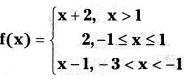
If the function f is defined by

then find the values of
(i) f(3)
(ii) f(0)
(iii) f(-1.5)
(iv) f(2) + f(- 2)
(v) f(- 5)
Answer:
(i) f(3), For x > 1; f(x) = x + 2
f(3) = 3 + 2 = 5
(ii) f(0), For – 1 ≤ x ≤ 1; f(0) = 2
(iii) f(-1.5), For – 3 < x < – 1; f(x) = x – 1
∴ f(-1.5) = -1.5- 1 = – 2.5
(iv) f(2) + f(-2); For x > 1, f(x) = x + 2
∴ f(2) = 2 + 2 = 4
For – 3 < x < – 1;
f(x) = x – 1
f(-2) = -2 – 1 = -3
f(2) + f (-2) = 4 – 3 = 1
(v) f(-5); is not defined such domain of ‘f’ is {x / x > – 3].
Question 2.
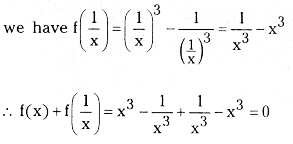
If f : R {0} → R defined by f(x) = x3 – 1/x3, then show that f(x) + f(1/x) = 0.
Answer:
Given f(x) = x3 – 1/x3

Question 3.
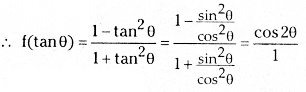
If f: R → R defined by f(x) = 1−x2/1+x2, then show that f(tan θ) = cos 2θ
Answer:
Given f(x) = 1−x2/1+x2 ∀ x ∈ R

= cos 2θ
Question 4.
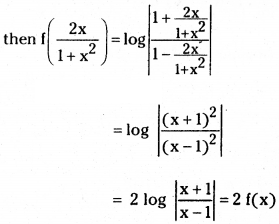
If f: R – (±1) → R is defined by f(x) = log∣1+x/1−x∣, then show that f(2x/1+x2) = 2f(x).
Answer:
Given f: R – (±1) → R defined by f(x) = log∣1+x/1−x∣

Question 5.
If A = (-2, -1, 0, 1, 2) and f : A → B is a surjection defined by f(x) = x2 + x + 1, then find B. (May 2014)
Answer:
A = {-2,-1,0,1,2} and f: A → B is a surjection and f(x) = x2 + x + 1;
∴ f(-2) = (-2)2 + (-2) + 1=3,
f(-1) = (-1)2 + (-1) + 1 = 1
f(0) = 02 + 0 + 1 = 1
f(1) =12 + 1 + 1 = 3
f(2) = 22 + 2 + 1 = 7
∴ B = f(A) = (1, 3, 7)
Question 6.
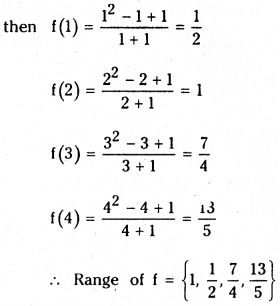
If A = {1, 2, 3, 4} and f: A → R is a function defined by f(x) = x2−x+1/x+1, then find the range of f.
Answer:
Given A = {1, 2, 3, 4} and f(x) = x2−x+1/x+1

Question 7.
If f (x + y) = f (xy) ∀ x, y ∈ R, then prove that f is a constant function.
Answer:
Given f (x + y) = f(x y) ∀ x, y ∈ R Suppose x = y = 0 then
f(0 + 0) = f(0 x 0)
⇒ f(0) = f(0) ………………..(1)
Suppose x = 1, y = 0 then then f (1 + 0) = f(1 x 0)
⇒ f(D = f (0) ……………(2)
Suppose x = 1, y = 1 then f (1 + 1) = f(1 x 1)
⇒ f(2) = f(1) …………….. (3)
f(0) = f(1) = f(2)
= f(0) = f(2)
Similarly f(3) = f(0), f(4) = f(0) …………. f(n) = f(0)
∴ f is a constant function.

II.
Question 1.
If A = {x / – 1 ≤ x ≤ 11, f(x) = x2, g(x) = x3 Which of the following are surjections
(i) f : A → A
(ii) g : A → A.
Answer:
i) Given A {x / – 1 ≤ x ≤ 1}, f(x) = x2
and f : A → A
Suppose y ∈ A
then x2 = y ⇒ x = ± √y
If x = √y and if y = – 1 then x = √-1 ∈ A
f : A → A is not a surjection.
ii) Given A = {x/-1 ≤ x ≤ 1), g(x) = x3
and g : A → A
Suppose ye A then x2 = y ⇒ x = y√3 ∈ A
If y = -1 then x = -1 ∈ A
y = 0 then x = 0 ∈ A
y = 1 then x = 1 ∈ A
g : A → A is a surjection.
Question 2.
Which of the following are injections or surjections or Bisections ? Justify your answers.
i) f : R → R defined by f(x) = 2x+1/3
Answer:
Given f(x) = 2x+1/3
Let a1, a2 ∈ R
∴ f(a1) = f(a2)
⇒ 2a1+1/3=2a2+1/3
⇒ 2a1 + 1 = 2a2 + 1
⇒ a1 = a2
f(a1) = f(a2) ⇒ a1 = a2 ∀ a1, a2 ∈ R
f(x) = 2x+1/3 is an injection.

Suppose y ∈ R (codomain of f) then
y = 2x+1/3 ⇒ x = 3y−1/2
Then f(x) = f(3y−1/2)=2(3y−1)/2+1/3 = y
f is a surjection f: R → R defined by f(x) = 2x+1/3 is a bijection.

ii) f : R → (0, ∞) defined by f(x) = 2x
Answer:
Let a1, a2 ∈ R then f(a1) = f(a2)
⇒ 2a1 = 2a2
⇒ a1 = a2 ∀ a1, a2 ∈ R
f(x) = 2x, f: R → (0, ∞) is injection.
Let y ∈ (0, ∞) and y = 2x ⇒ x = log2 y
then f(x) = 2x = 2 log2y = y
∴ f is a surjection.
Since f is injection and surjection, f is a bijection.
iii) f : (0, ∞) → R defined by f(x) = logex.
Answer:
Let x1, x2 ∈ (0, ∞)and = logex. then f(x1) = f(x2)
⇒ logex1 = logex2 ⇒ x1 = x2
∴ f(x1) = f(x2)
x1 = x2 and f is injection.

Let y ∈ R then y = logex ⇒ x = ey
f(x) = logex = logeey = y and f is a surjection.
Since f is both injective and surjective, f is a bijection.

iv) f : [0, ∞) → [0, ∞) defined by f(x) = x2
Answer:
Let x1, x1 ∈ [0, ∞) given f(x) = x2
f(x1) = f(x2)
⇒ x1 = x2
x1 = x2 (∵ x1, x2 > 0)
f(x) = x2,
∴ f: [0, ∞) → [0, ∞) is an injection.

Let y ∈ [0, ∞)then y = x2 ⇒ x = √y (∵ y > 0)
f(x) = x2 = (√y)2 = y
and f is a surjection
∴ f is a bijection.

v) f : R → [0, ∞) defined by f(x) = x2
Answer:
Let x1 x2 ∈ R and f(x) = x2
∴ f(x1) = f(x2)
⇒ x12 = x22
⇒ x1 = ±x2 (∵ x1, x2 ∈ R)
f is not an injection
Let y ∈ [0, ∞] then y = x2 ⇒ x = ±√y
where y ∈ [0, ∞] then f(x) = x2 = (√y )2 = y.
∴ f is a surjection.
Since f is not injective and only surjective, we say that f is not a bijection.

vi) f : R → R defined by f(x) = x2
Answer:
Let x1 x2 ∈ R then f(x1) = f(x2)
⇒ x12 = x22
⇒ x1 = ± x2 (∵ x1, x2 ∈ R)
f(x) is not an injection.
Let y ∈ R then y = x2
⇒ x = ±√y
For elements that belong to (-∞, 0).
codomain R of f has no pre-image in f.
∴ f is not a surjection.
Hence f is not a bijection.

Question 3.
If g = 1(1,1), (2, 3), (3, 5), (4, 7)) is a function from A = {1, 2, 3, 4} to B = {1, 3, 5, 7}. If this is given by the formula g(x) = ax + b then find a and b.
Answer:
A = {1, 2, 3, 4}, B = {1, 3, 5, 7}
g = {(1, 1), (2, 3), (3, 5), (4, 7)}
∵ g(1) = 1, g(2) = 3, g(3) = 5, g(4) = 7
Hence for an element a ∈ A f ∃ b ∈ B such that g : A → B is a function.
Given g(x) = ax + b ∀ x ∈ A
g(1) = a + b = 1
g(2) = 2a + b = 3
solving a = 2, b = -1
Question 4.
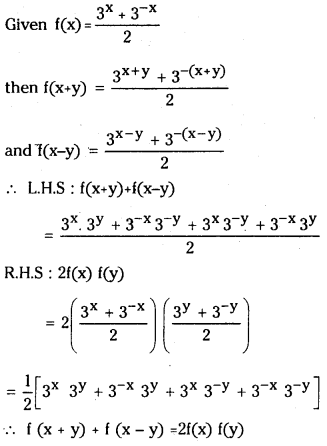
If the function f : R → R defined by f(x) = 3x+3−x/2, then show that f (x+y) + f (x-y) = 2 f(x) f(y).
Answer:

Question 5.
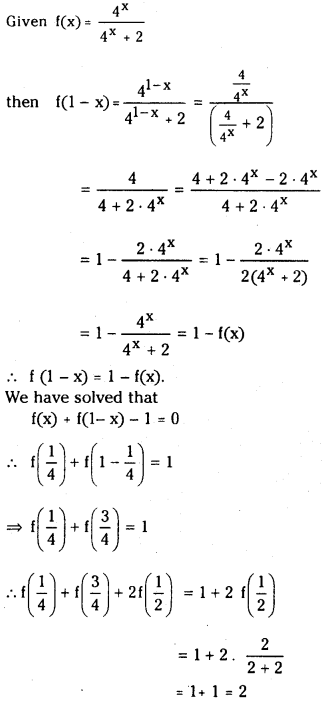
If the function f : R → R defined by f(x) = 4x/4x+2, then show that f (1 – x) = 1 – f(x) and hence reduce the value of f(14) + 2f(12) + f(34).
Answer:

Question 6.
If the function f : {-1, 1} → {0, 2} defined by f(x) = ax + b is a subjection, then find a and b.
Answer:
Since f: {-1, 1} → {0, 2} and f(x) = ax + b is a surjection.
Given f (-1) = 0, f (1) = 2 (or) f (-1) = 2, f (1)=0
Case I : f (-1) = 0, f (1) = 2
∴ – a + b = 0, a + b = 2
Solving b =1 , a = 1

Case II : f (-1) = 2, and f (1) = 0
then – a + b = 2 and a + b = 0
Solving b = 1, a = -1
Hence a = + 1 and b = 1
Question 7.
If f(x) = cos (log x), then show that f(1/x) f(1/y) – (1/2)[f(x/y) + f(x/y)] = 0
Answer:
Given f(x) = cos(log x)
then f(1/x) = cos(log(1/x))
= cos(-log x) = cos(log x) (∵ log 1 = 0)
Similarly f(1/x) = cos(log y)
f(x/y) = cos(log(xy)) = cos(log x – log y)
f(x/y) = cos (log xy) = cos [log x + log y]
f(x/y) + f(x y) = cos(log x – log y) + cos (log x + log y)
= 2 cos (log x) cos (log y) (∵ cos (A – B) + cos (A + B))
= 2 cos A cos B
f(1/x) f(1/y) – (1/2)[f(x/y) + f(x/y)] = cos (log x) cos (log y) – 1/2 [2cos (log x) cos (logy)]
= 0

TS Inter 1st Year Maths 1A Solutions Chapter 1 Functions Ex 1(b)

TS Inter 1st Year Maths 1A Functions Solutions Exercise 1(b)

I.

Question 1.
If f(x) = ex, and g(x) = logex, then show that fog = gof and find f-1 and g-1.

Answer:
Given f(x) = ex and g(x) = logex
Now (fog) (x) = f[g(x)] = f [logex]
= elogex = x
(gof) (x) = g [f(x)] = g [ex] = logeex = x
fog = gof
given f(x) = ex = y
then x = f-1 (y) and y = ex ⇒ x = logey
f-1(y) = logey ⇒ f-1 (x) = logex
similarly y = g(x) = logex
then x = g-1 (y) and y = logex
⇒ x = ey
g-1 (y) = ey ⇒ g-1(x) = ex

Question 2.
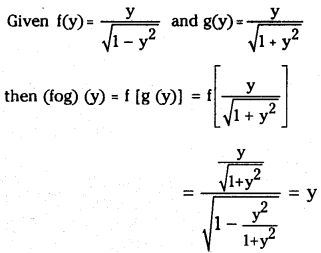
If f(y) = y/√1−y2, g(y) = y/√1+y2 then show that (fog)(y) = y.

Answer:

∴ (fog) (y) = y

Question 3. If R → R; g : R → R are defined by . f(x) = 2x2 + 3 and g(x) = 3x – 2, then find
(i) (fog) (x)
(ii) (gof) (x)
(iii) (fof)(0)
(iv) go (fof) (3)

Answer:
f; R → R; g : R → R and
f(x) = 2x2 + 3, g(x) = 3x – 2 then
(i) (fog) (x) = f [g (x)] = f (3x – 2)
= 2 [(3x – 2)2] + 3 (∵ f (x) = 2x2 + 3)
= 2 [9x2 – 12x + 4] + 3
= 18x2 – 24x + 11
(ii) (gof) (x) = g [f (x)] = g (2x2 + 3)
= 3 (2x2 + 3) -2 = 6x2 + 7

iii) (fof) (0) = f [f (0)] = f [3] = 2(3)2 + 3 = 21

iv) go (fof) (3)
= go [f (f (3))] (v f (x) = 2x2 + 3)
= go [f (2(3)2 + 3)]
= go [f (21)]
= g [2 (21)2 + 3]
= g [2 (441) + 3]
= g [885]
= 3 (885) – 2 = 2653 (∵ g(x) = 3x – 2)

Question 4.
If f:R → R, g:R → R are defined by f(x) = 3x – 1, g(x) = x2 + 1, then find
(i) (fof) (x2 + 1)
(ii) (fog) (2) (March 2012)
(iii) (gof)(2a – 3)

Answer:
Given f: R → R and g : R → R defined by f (x) = 3x – 1, g (x) = x2 + 1
(i)(fof) (x2 + 1 ) = f [f (x2 + 1)]
= f [3 (x2 + 1) – 1]
⇒ f [3x2 + 2] (∵ f (x) = 3x – 1)
= 3 (3×2 + 2) – 1 = 9×2 + 5

(ii) (fog) (2) = f [g (2)] = f [22 + 1] = f [5]
= 3(5) – 1 = 14

(iii) (gof ) (2a – 3)
=g[f(2a – 3)]
= g[3(2a – 3) – 1] (∵ f(x) = 3x- 1)
= g [6a – 10]
= (6a – 10)2 + 1 (∵ g(x)=x2 + 1)
= 36a2 – 120a + 101

Question 5.
If f(x) = 1/x, g(x) = √x ∀ x ∈ (0, ∞) then find (gof)(x).

Answer:
(gof)(x) = g[f(x)] = g[1/x]
= 1/√x (∵ g(x) = x)

Question 6.
f(x) = 2x – 1, g(x) = x+1/2 ∀ x ∈ R, find (gof)(x).

Answer:
(gof)(x) = g[f(x)] = g(2x – 1)
= 2x−1+1/2 = x (∵ g(x) = 2x−1+1/2)

Question 7.
If f(x) = 2, g(x) = x2, h(x) = 2x ∀ x ∈ R, then find [fo(goh) (x)].

Answer:
fo(goh)= fog [h(x)]
= fog [2x]
= f [g(2x)]
= f [ (2x)2 ] = f (4x2) = 2
fo(goh) = 2

Question 8.
Find the inverse of the following functions.
(i) a, b ∈ R, f: R → R, defined by f(x) = ax + b, (a ≠ 0).

Answer:
a, b ∈ R, f : R → R and f(x) = ax + b
⇒ y = ax + b = f(x)
⇒ x = f-1(y)
= y−b/a
∴ f-1(x) = x−b/a
(ii) f: R → (0, ∞) defined by 5x (March 2011)
Answer:
f: R→ (0, ∞) and f(x) = 5x
Let y = f (x) = 5x ⇒ x = f-1(y)
and x = log5y
∴ f-1(y) = log5y ⇒ f-1(x) = log5x

(iii) f : (0, ∞) → R defined by f(x) = log2x
Answer:
Gii’en f: (0, ∞) → R defined by f(x) = log2x
Let y = f (x) = log2x then x = f1 (y)
y = log2x ⇒ x = 2y
∴ f-1(y) = 2y ⇒ f-1(x) = 2x

Question 9.
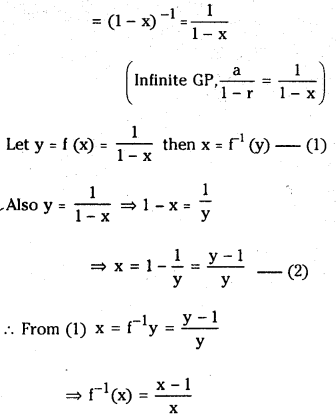
If f(x) = 1 + x + x2 + ………….. for |x| < 1, then show that f-1(x) = x−1/x

Answer:
Given f(x) = 1 + x + x2 + ………. for |x| < 1

Question 10.
If f : [1, ∞] → [1, ∞] defined by f(x) = 2x(x – 1), then find f-1(x)

Answer:
Given f : [1, ∞] → [1, ∞] defined by f(x) = 2x(x – 1)
Let y = f(x) then x = f-1(y)
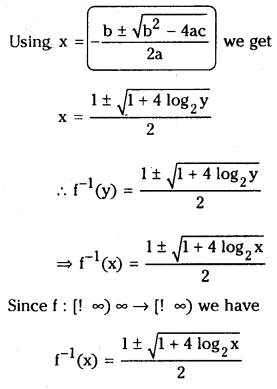
Also y = 2x(x – 1) ⇒ x(x – 1) = log2y
⇒ x2 – x – log2y = 0

II.

Question 1.
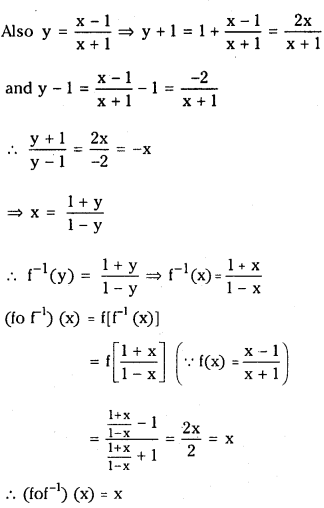
If f(x) = x−1/x+1, x ≠ ±1, then verify (fof-1)(x) = x

Answer:
Given f(x) = x−1/x+1, (x ≠ ±1)
and Let y = f(x) ⇒ x = f-1(x)

Question 2.
If A = (1, 2, 3), B = (α, β, γ), C = (p, q, r) and f : A → B, g : B → C are defined by f = {(1, α), (2, γ), (3, β)}, g = {(α, q), (β, r), (γ, p)}
then show that f and g are bijective functions and (gof)-1 = f-1og-1.

Answer:
Given A = {1, 2, 3}, B = (α, β, γ), c = {p, q, r) and f : A → B, g : B → C defined by f ={(1, α) (2, γ), (3, β)}and g = {(a, q), (β, r), (γ, p)}
From the definitions of f and g f (1) = α, f (2) = γ, f (3) = β and g (α) = q, g (β) = r, g (γ) = p
Distinct elements of A have distinct imagine in B. Hence f is an Injection. Also, range of f = (a, y, P) and f is a surjection.
∴ f is abijection = B similarly distinct elements of B have distinct images in c and g is an Injection.
Also range of ‘g’ = {q, γ, p} = C;
∴ g is a surjection.
Hence g is a bijection.
∴ f and g are bijective functions.
Also gof = {(1, q), (2, r), (3, p)}
and (gof-1) = {(q, 1), (r, 2), (p, 3)} …………….(1)
f-1 = {(α, 1), (γ, 2), (β, 3)}
and g-1 = {(q, α), (r, β), (p, γ)}
∴ f-1og-1 ={(q, 1), (r, 2), (p, 3)} ………………(2)
∴ From (1) and (2), (gof-1) = f-1og-1

Question 3.
If f:R → R; g:R → R defined by f(x) = 3x – 2, g(x) = x2 + 1, then find
(i) (gof-1) (2)
(ii)(gof)(x – 1) (March 2008, May 2006)

Answer:
Given f: R → R, g : R → R defined by f(x) = 3x – 2, g(x) = x2 + 1
et y = f (x) then x = f-1 (y)
y = 3x – 2 ⇒ 3x = y + 2
⇒ x = y+2/3
∴ f-1(y) = 3+2/3 ⇒ f-1(x) = x+2/3
∴ (i)(gof-1) (2) = g[f-1(2)] = g[4/3]
= (4/3)2 + 1 = 16/9 + 1 = 25/9
(ii)(gof) (x – 1) = g [f (x – 1)
= g [3 (x – 1) – 2] = g [3x – 5]
= (3x – 5)2 + 1
= 9x2 – 30x + 26
(∵ g(x) = x2 + 1)

Question 4.
Let f = {(1, a), (2, c), (4, d), (3, b)} and g-1 = {(2, a) (4, b), (1, c), (3, d)} then show that (gof)-1 = f-1o g-1

Answer:
Given f = {(1, a), (2, c), (4, d), (3, b)} and g-1 = {(2, a), (4, b), (1, c), (3, d)}
∴ g = {(a, 2), (b, 4), (c, 1), (d, 3)} gof = {(1, 2), (2, 1), (4, 3), (3, 4)}
∴ (gof)-1 = {(2, 1), (1, 2), (3, 4), (4, 3)}
f-1 = {(a, 1) (c, 2), (d, 4), (b, 3)}
g-1 = {(2, a), (4, b), (1, c), (3, d)}
f(x) = 3x – 2, g(x) = x2 + 1
Let y = f (x) then x = f” (y)
∴ f-1o g-1 = {(2, 1), (1, 2), (4, 3), (3, 4)}
(gof)-1 = f-1o g-1

Question 5.
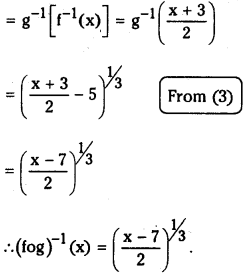
Let f:R → R; g:R → R be defined by f(x) = 2x – 3, g(x) = x3 + 5 then find (fog)-1(x)

Answer:
We have from the formula
(fog)-1(x) = (g-1of-1) …………..(1)
where f: R → R and g : R → R are defined by
f(x) = 2x – 3 and g(x) = x3 + 5
Let y = f(x) = 2x – 3 : Then x = f-1(y)
and 2x – 3 = y ⇒ x = y+3/2
f-1(x)x+3/2 ………..(2)

Let y = g(x) = x3 + 5. Then x = g-1(y) and x3 + 5 = y
⇒ x = (y – 5)1/3
g-1(y) = (y – 5)1/3
g-1(x) = (x – 5)1/3 ……….(3)

From (1), (g-1of-1)(x)

Question 6.
Let f(x) = x2,g(z) = 2x. Then solve the equation (fog) (x) = (gof) (x)

Answer:
Given f(x) = x2 and g(x) = 2x
(fog) (x) = f [g(x)] = f [2x] = (2x)2 = 22x ……………(1)
and (gof)(x) = g[f(x)] = g[x2] = 2x2
∴ from (1) and (2), 22x = 2x2
⇒ x2 – 2x = 0
⇒ x(x – 2) =0
⇒ x = 0, 2

Question 7.
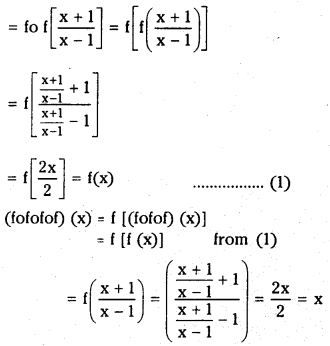
If f(x) = x+1/x−1,(x ≠ ±1),then find(fofof)(x) and (fofofof) (z)

Answer:
Given f(x) = x+1/x−1, (x ≠ ± 1)
then (fofof) (x) = fof(f(x)]

TS Inter 1st Year English Grammar Correction of Errors in Sentences

0

Q.No. 14 (4 × 1 = 4 Marks)

Exercises

I. Correct the underlined parts of the following sentences :

1. Your informations are wrong.
2. He has bought expensive furnitures.
3. Children should learn the alphabets with joy.
4. He has deep knowledges of various fields.
5. The sceneries of Darjeeling are very beautiful.
6. Keep your surrounding clean.
7. We must express thank to those who help us.
8. Economics are an interesting subject.
9. Athletics are an interesting sport.
10. The news of the earthquake have spread like wildfire.
11. Measles are an infectious disease.
12. Ocean sands are not used for construction.
13. C.V. Raman’s knowledges of all branches of physics are amazing.
14. There is a scarcity of man-servants nowadays.
15. Many passer-bys observed the accident.
16. Mouses have spoiled the crop.
17. There are five womans in the team.
18. My cousin brother is a doctor.
19. We should wash our foots before coming into the house.
20. He has many sheeps.

21. One of my classmates are an army officer.
22. One should respect her teachers.
23. Every men are responsible for this situation.
24. His both sons are lawyers.
25. The principal and the chairman has attended the meeting.
26. Each of them were given a gift.
27. Student’s must avail the opportunities.
28. The two players blamed one another for their defeat.
29. All Indians must respect each other.
30. Yourself are responsible for your future.
31. There are no less than ten employed persons in their village.
32. He and me are brothers.
33. As there are only few students, I can interact with them easily.
34. My all friends are very active.
35. Gandhi is more truthful than any political leader.
36. This is taller than many buildings in Hyderabad.
37. Raghu is my older brother.
38. The streets of Hyderabad are wider than Warangal.
39. Suma is an popular anchor.
40. I waited for a hour.
41. Sun rises in east.
42. Onions cost Rs. 20 kilogram.
43. They are staying in the same flat for the last many years.
44. How long are you waiting here ?
45. He is interested to do a job.
46. They have moved to the new house last week.
47. He is having many imported clothes.
48. As soon as I opened the doors, the birds flu away.
49. If I will stand on my own legs, my parents will feel happy.

50. If you consult me, I would have advised you what to do.
51. He is visiting the library daily.
52. He walks very fastly.
53. We don’t , hardly believe it.
54. They don’t do anything careful.
55. She scarce attends classes.
56. He is walking very slow.
57. The property was divided between the four brothers.
58. I prefer fruits than sweets.
59. He is afraid with darkness.
60. We entered into the hall to watch the play.
61. Beside being a poet, Tagore is also a short story writer.
62. The shops will be open between 10 a.m. to 8 p.m.
63. Either you must take up a job or start a business.
64. Neither she drinks tea nor coffee.
65. Sheela is as proud like a peacock.
66. They asked me that where SBI was.
67. They asked me what was my name.
68. This article is made with cotton.
69. We look forward to meet the minister.
70. I know them for the last many years.
71. Why is she hating classical music ?
72. It is raining since yesterday.
73. I am good in English.
74. If cleanliness will be maintained, we will be healthy.
75. We had seen them two weeks ago.
76. The river has overflown its bank in many places.
77. He has hanged his coat on a nail.
78. All banks are open from 10.30 a.m. and 4 p.m.
79. He is not an expert in grammar, isn’t it ?
80. Children are fond for chocolates.


Answer:


1. Your informations is wrong.
2. He has bought expensive furniture.
3. Children should learn the alphabet with joy.
4. He has deep knowledge of various fields.
5. The scenery of Darjeeling are very beautiful.
6. Keep your surroundings clean.
7. We must express thanks to those who help us.
8. Economics is an interesting subject.
9. Athletics is an interesting sport.
10. The news of the earthquake has spread like wildfire.

11. Measles is an infectious disease.
12. Ocean sands is not used for construction.
13. C.V. Raman’s knowledge of all branches of physics are amazing.
14. There is a scarcity of men-servants nowadays.
15. Many passer-by observed the accident.
16. Mice have spoiled the crop.
17. There are five womens in the team.
18. My cousin is a doctor.
19. We should wash our feet before coming into the house.
20. He has many sheep.
21. One of my classmates is an army officer.
22. One should respect one’s teachers.
23. Every men is responsible for this situation.
24. Both his sons are lawyers.
25. The principal and the chairman have attended the meeting.
26. Each of them was given a gift.
27. Student’s must avail themselves of the opportunities.
28. The two players blamed each another for their defeat.
29. All Indians must respect one other.
30. You are responsible for your future.
31. There are no fewer than ten employed persons in their village.
32. He and I are brothers.
33. As there are only a few students, I can interact with them easily.
34. All my friends are very active.
35. Gandhi is more truthful than any other political leader.
36. This is taller than many other buildings in Hyderabad.
37. Raghu is my elder brother.
38. The streets of Hyderabad are wider than those of Warangal.

39. Suma is a popular anchor.
40. I waited for an hour.
41. The sun rises in east.
42. Onions cost Rs. 20 a kilogram.
43. They have been staying in the same flat for the last many years.
44. How long have you been waiting here ?
45. He is interested in doing a job.
46. They moved to the new house last week.
47. He has many imported clothes.
48. As soon as I opened the doors, the birds flew away.
49. If I stand on my own legs, my parents will feel happy.
50. If you had consulted me, I would have advised you what to do.
51. He visits the library daily.
52. He walks very fast.
53. We don’t beleive it/. We hardly believe it.
54. They don’t do anything careful.
55. She scarcely attends classes.
56. He is walking very slowly.
57. The property was divided among the four brothers.
58. I prefer fruits to sweets.
59. He is afraid of darkness.
60. We entered the the hall to watch the play.
61. Besides being a poet, Tagore is also a short story writer.
62. The shops will be open between 10 a.m. and 8 p.m.
63. You must either take up a job or start a business.
64. She drinks neither tea nor coffee.

65. Sheela is as proud as a peacock.
66. They asked me where SBI was.
67. They asked me what my name was.
68. This article is made of cotton.
69. We look forward to meetimg the minister.
70. I have know them for the last many years.
71. Why does she hate classical music ?
72. It has been raining since yesterday.
73. I am good at English.
74. If cleanliness is maintained, we will be healthy.
75. We saw them two weeks ago.
76. The river has overflowed its bank in many places.
77. He has hung his coat on a nail.
78. All banks are open from 10.30 a.m. to 4 p.m.
79. He is not an expert in grammar, is he ?
80. Children are fond of chocolates.

II. Correct the following sentences :

1. Very good morning.
2. What is your good name ?
3. Why you are late today ?
4. The staff meeting has been pre-poned.
5. 1 will report it to the concerned teacher.
6. We go home by walk.
7. Where you come from ?
8. 1 do not know what is your name.
9. He went to the back-side of the house.
10. Please bring your luggages here.
11. This road is more shorter than that.
12. We often chit-chat with our friends.
13. Please shut the TV.
14. I and my wife went to a movie.
15. Mohan and myself will come.
16. I’m having a scooter.
17. This costed me a lot.

18. I doubt that he will succeed.
19. We are living in Bengaluru since 2015.
20. We have a lot of furnitures in our house.


Answer:


1. Good morning.
2. What is your name ?
3. Why are late today ?
4. The staff meeting has been advanced.
5. I will report it to the teacher concerned.
6. We go home on foot.
7. Where are you coming from ?
8. 1 do not know what your name is.
9. He went to the back of the house.
10. Please bring your luggage here.
11. This road is shorter than that.
12. We often chat with our friends.
13. Please switch of the TV.
14. My wife and I went to a movie.
15. Mohan and I will come.
16. 1 have a scooter.
17. This cost me a lot.
18. I doubt if he will succeed.
19. We have been living in Bengaluru since 2015.
20. We have a lot of furniture in our house.

III. Rewrite the following sentences after correcting the errors :

1. Can you read the Urdu alphabets ?
2. The police is investigating the case.
3. Here is your glasses.
4. Look at the man in the blue jean.
5. Have you seen the table of content of this textbook ?
6. Mumps are a kind of disease.
7. There were a series of programmes to mark the occasion.
8. She bought a toothpaste.
9. This box has twelve dozens of apples.
10. The athlete ran a four-miles race.

11. I received five thousands rupees from the manager.
12. Most male deers have horns.
13. Eight hundred rupees are too much for a pen.
14. A black and white dog are following me.
15. A black and a white dog is following me.
16. Many a man were cheated in this way.
17. I lost my all belongings.
18. Neither he nor his wife have arrived yet.
19. More than one person are working here.
20. The first inning is over.


Answer:


1. Can you read the Urdu alphabet ?
2. The police are investigating the case.
3. Here are your glasses.
4. Look at the man in the blue jeans.
5. Have you seen the table of contents of this textbook ?
6. Mumps is a kind of disease.
7. There was a series of programmes to mark the occasion.
8. She bought a tube of toothpaste.
9. This box has twelve dozen of apples.
10. The athlete ran a four-mile race.
11. I received five thousand rupees from the manager.
12. Most male deer have horns.
13. Eight hundred rupees is too much for a pen.
14. A black and white dog is following me.
15. A black and a white dog are following me.
16. Many a man was cheated in this way.
17. I lost all my belongings.
18. Neither he nor his wife has arrived yet.
19. More than one person is working here.
20. The first innings is over.

IV. Rewrite the following sentences after correcting the errors :

1. It is myself.
2. She and me are twins.
3. Each of these girls have wide eyes.
4. Neither of these cars are worth the money.
5. Both didn’t attend the meeting.
6. We all didn’t go.
7. Sharma plays cricket better than me.
8. Any one of these two boys are sent for training.
9. I haven’t got some pens.
10. If I were him. I wouldn’t have played the game.
11. Only they who have admit passes will be allowed in.
12. Drink water which tastes better.
13. Every woman raised their voice.
14. Sheila and Nancy like one another.
15. My neighbour that works in a bank has gone to Mumbai.
16. My three sisters like each other.
17. Divide the pieces of bread between him and me.
18. Shrika is senior than Srihan.
19. These all mangoes are ripe.

20. There are no less than ten thousand books in this library..
21. She is worst than her cousin.
22. This picture is the best of the two.


Answer:


1. It is I.
2. She and I are twins.
3. Each of these girls has wide eyes.
4. Neither of these cars is worth the money.
5. Neither attend the meeting.
6. None of us went.
7. Sharma plays cricket better than I.
8. Either of these two boys is sent for training.
9. I haven’t got any pens.
10. If I were he, I wouldn’t have played the game.
11. Only those who have admit passes will be allowed in.
12. Drink water that tastes better.
13. Every woman raised her voice.
14. Sheila and Nancy like each other.
15. My neighbour who works in a bank has gone to Mumbai.
16. My three sisters like one other.
17. Divide the pieces of bread between he and I.
18. Shrika is senior to Srihan.
19. All these mangoes are ripe.
20. There are no fewer than ten thousand books in this library.
21. She is worse than her cousin.
22. This picture is the better of the two.

V. Rewrite the following sentences after correcting the errors.

1. I need an advice from an expert.
2. He is more better than she.
3. This is the most best book I have read.
4. Virat Kohli is better than any cricketer in India.
5. This is strongest of any other metals.
6. She has been helping the poors.
7. The two first chapters are very interesting.
8. I am hopeless about his success.
9. She was not smart early.
10. This is a worth reading novel.
11. He hasn’t written much stories.
12. Open your book at six page.
13. This is a best book.
14. Ooty is cool than Thirupathi.
15. I paid him rupees hundred.


Answer:


1. I need a piece of advice from an expert.
2. He is better than she.
3. This is the best book I have read.
4. Virat Kohli is better than any other cricketer in India.
5. This the strongest of all metals.
6. She has been helping the poor.
7. The first two chapters are very interesting.
8. I have no hope of his success.
9. She was not smart earlier.
10. This is a novel worth reading.
11. He hasn’t written many stories.
12. Open your book at page six.
13. This is a very good book.
14. Ooty is cooler than Thirupathi.
15. I paid him a hundred rupees.

VI. Rewrite the following sentences after correcting the errors.

1. Sania Mirza is more popular than any tennis player.
2. Of the two this is the best article.
3. Our apartment is on third floor.
4. When Rome was burning, Nero is playing on the flute.
5. She enjoys to sing patriotic songs.
6. Why you were absent yesterday ?
7. She scarce blames others.
8. This is different to others.
9. She resembles to her mother.
10. I was prevented to do my work.
11. Would you mind to open the door ?


Answer:


1. Sania Mirza is more popular than any other tennis player.
2. Of the two this is the better article.
3. Our apartment is on the third floor.
4. When Rome was burning, Nero was playing on the flute.
5. She enjoys singing patriotic songs.
6. Why were you absent yesterday ?
7. She scarcely blames others.
8. This is different from others.
9. She resembles her mother.
10. I was prevented from doing my work.
11. Would you mind opening the door ?

VII. Rewrite the following sentences after correcting the errors.

1. My brother is working in tribal area.
2. I have an urgent business.
3. Kaleshwaram Project is built on Godavari.
4. Moon is very bright today.
5. I shall be visiting UK next month.
6. Himalayas form the northern boundary of India.
7. We should love the nature.
8. The Calcutta is a big city.
9. I have read Ramayana thrice.
10. David goes to the church every Sunday.
11. The gold is a precious metal.
12. He can play sitar well.
13. Lion is the king of beasts.
14. I had the lunch at noon.
15. I met my friend at college.


Answer:


1. My brother is working in a tribal area.
2. I have (some) urgent business.
3. Kaleshwaram Project is built on the Godavari.
4. The Moon is very bright today.
5. I shall be visiting the UK next month.
6. The Himalayas form the northern boundary of India.
7. We should love nature.
8. Calcutta is a big city.
9. I have read the Ramayana thrice.
10. David goes to church every Sunday.
11. Gold is a precious metal.
12. He can play the sitar well.
13. The Lion is the king of beasts.
14. I had lunch at noon.
15. I met my friend at the college.

VIII. Rewrite the following sentences after correcting the errors.

1. One of my friends have gone to the UAE.
2. Each of the girls were given the medals.
3. Everyone of the workers have stayed away from work.
4. Neither of the participants were able to win the match.
5. Age and experience bring wisdom to man.
6. Bread and butter are my favourite breakfast.
7. Where you are going ?
8. When vou will come here again ?
9. He asked me if I am going to Dubai.
10. I asked her if she is learning dance.
11. You are married, isn’t it ?
12. I like skating, do I ?
13. As I was ill so I could not go.
14. Both Hari as well as Krishna came to see me.
15. She said that she saw him last night.
16. The train left before I arrived.
17. I had been to Vijayawada yesterday.
18. I took my supper.
19. He knows to swim.

20. She cut her pencil.
21. I said to him to go.
22. He gave a speech.
23. He made a lecture.
24. My tooth is painting.
25. He made a goal.


Answers:


1. One of my friend has gone to the UAE.
2. Each of the girls was given the medals.
3. Everyone of the workers has stayed away from work.
4. Neither of the participants was able to win the match.
5. Age and experience brings wisdom to man.
6. Bread and butter is my favourite breakfast.
7. Where are you going ?
8. When will you come here again ?
9. He asked me if I was going to Dubai.
10. I asked her if she was learning dance.
11. You are married, aren’t you ?
12. I like skating, don’t I ?
13. As I was ill I could not go. (OR)
I was ill so I could not go.
14. Both Hari and Krishna came to see me. (OR)
Hari as well as Krishna came to see me.
15. She said that she had seen him last night.
16. The train had left before I arrived.
17. I went to Vijayawada yesterday.
18. I had my supper.
19. He knows how to swim.
20. She sharpened her pencil.

21. I told him to go.
22. He made a speech.
23. He gave a lecture.
24. My tooth is aching.
25. He scored a goal.

IX. Rewrite the following sentences after correcting the errors.

1. I am too glad to see you.
2. This coffee is very hot to drink.
3. She is very much sorry.
4. You are leaving back your bag.
5. You can lift it by and by.
6. We scarcely see a lion.
7. He behaved cowardly.
8. Sarojini Naidu was called as the Nightingale of India.
9. She works very hardly.
10. He speaks English very good.
11. His version is somewhat true.
12. She speaks the truth always.
13. He comes to me often.
14. Most likely the shops will remain closed tomorrow.
15. The whole India is proud of his achievement.


Answer:


1. I am very glad to see you.
2. This coffee is too hot to drink.
3. She is very sorry.
4. You are leaving behind your bag.
5. You can lift it little and little.
6. We rarely see a lion.
7. He behaved in a cowardly manner.
8. Sarojini Naidu was called the Nightingale of India.
9. She works very hard.
10. He speaks English very well.
11. His version is partly true.
12. She always speaks the truth.
13. He often comes to me.
14. Most probably the shops will remain closed tomorrow.
15. The whole of India is proud of his achievement.

X. Rewrite the following sentences after correcting the errors.

1. I have ordered for three dishes.
2. He entered into the hall.
3. She has married with her cousin.
4. We are awaiting for the train.
5. He has been suffering with Corona.
6. She covered her head by a shawl.
7. They waited three hours.
8. I enquired her where her husband was.
9. He went for riding.
10. She is called with different names.
11. Sion the document with ink.
12. This is a comfortable house to live.
13. I filled water in the bucket.
14. I shall explain them this.
15. I travelled by my Principal’s car.
16. She was accused for stealing a gold ring.
17. He congratulated me for my success.
18. She got down the bus at Mancherial.
19. I don’t agree for your proposal.
20. This is the road to go.

21. Though he is fat, but he runs fast.
22. Scarcely had he gone than the phone rang.
23. No sooner had he gone when the officer came.
24. She is not only beautiful but intelligent.
25. I doubt that he will get through the exam.
26. He was handsome but everyone admired him.
27. You are not right nor wrong.
28. Wait while I come.
29. Unless you do not try, you will never succeed.
30. City life is tense and village life is relaxed.


Answers:


1. I have ordered three dishes.
2. He entered the hall.
3. She has married her cousin.
4. We are awaiting the train./We are waiting for the train.
5. He has been suffering from Corona.
6. She covered her head with a shawl.
7. They waited for three hours.
8. I enquired of her where her husband was.
9. He went riding. OR He went for a ride.
10. She is called by different names.
11. Sign the document in ink.
12. This is a comfortable house to live in.
13. I filled the bucket with water.
14. I shall explain this to them.
15. I travelled in my Principal’s car.
16. She was accused of stealing a gold ring.
17. He congratulated me on my success.
18. She got down from the bus at Mancherial.
19. I don’t agree to your proposal.
20. This is the road to go by.

21. Though he is fat, he runs fast.
22. Scarcely had he gone when the phone rang.
23. No sooner had he gone than the officer came.
24. She is not only beautiful but also intelligent.
25. I doubt whether he will get through the exam.
26. He was handsome and everyone admired him.
27. You are neither right nor wrong.
28. Wait till I come.
29. Unless you try, you will never succeed.
30. City life is tense but village life is relaxed.

XI. Rewrite the following sentences after correcting the errors.

1. A bouquet of yellow roses lend colour and fragrance.
2. Here is the keys.
3. Two miles are too far to walk.
4. If I was a bird, I would fly.
5. I wish it was Sunday.
6. All the staff are here.
7. The captain with his men were killed.
8. It is a two days programme.
9. Neither he came nor he wrote.
10. One of my friend is here.
11. He enioyed at the party.
12. He is in class tenth.
13. He gave his examination.
14. Columbus invented America.
15. Edison discovered electric bulb.
16. Never I have seen such a mess.
17. Should I cut this word ?
18. He asked a help.
19. They insisted to pay.
20. Choose the best of the two options.

21. He went to foreign.
22. I asked a question to him.
23. We are doing Yoga every day.
24. All the roads are covered by snow.
25. He does not care for my words.


Answers:


1. A bouquet of yellow roses lends colour and fragrance.
2. Here are the keys.
3. Two miles is too far to walk.
4. If I were a bird, I would fly.
5. I wish it were Sunday.
6. All these staff is here.
7. The captain with his men was killed.
8. It is a two day programme.
9. Neither did he come nor did he write.
10. One of my friends is here.
11. He enjoyed himself at the party.
12. He is in class ten.
13. He took his examination.
14. Columbus discovered America.
15. Edison invented electric bulb.
16. Never have I seen such a mess.
17. Should I erase this word ?
18. He asked for help.
19. They insisted on paying.
20. Choose, the better of the two options.
21. He went abroad.
22. I, asked him a question.
23. We do Yoga every day.
24. All the roads are covered with snow.
25. He pays no attention to what I say.

XII. Rewrite the following sentences after correcting the errors.

1. We elected Ram as President.
2. Did you went to school yesterday ?
3. She explained me the matter.
4. Are you really interested with English grammar ?
5. Bring me half glass water.
6. Every Sunday we go to the church.
7. He plays tennis, isn’t he ?
8. I returned back from London.
9. A bend in the road is not an end of the road.
10. I must change my cloths at once.


Answers:


1. We elected Ram President.
2. Did you go to school yesterday ?
3. She explained the matter to me.
4. Are you really interested in English Grammar ?
5. Bring me half a glass water.
6. Every Sunday we go to church.
7. He plays tennis, doesn’t he ?
8. I returned from London.
9. A bend in the road is not the end of the road.
10. I must change my clothes at once.

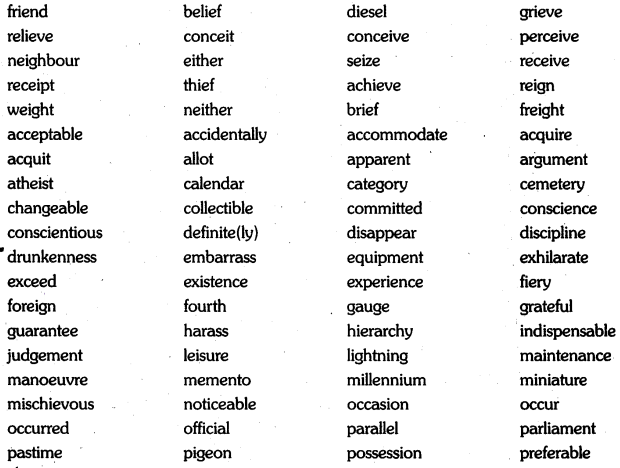
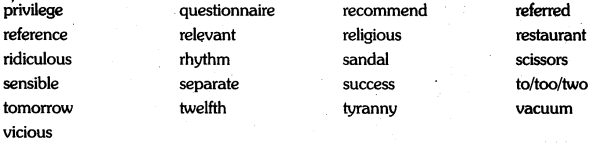
TS Inter 1st Year English Grammar Spelling: Missing Letters

0

Q.No. 15 (8 × 1/2- 4 Marks)

English spelling poses problems to learners. This is because of a) no one letter-one sound relationship b) silent letters and c) words borrowed from other languages and so on.

Though there are some rules and generalizations that MAY HELP improve one’s spelling, it is always good to develop a keen eye to the spelling of the words one comes across and to practise writing words as many times as possible, that too correctly.

  • In the Intermediate Public Examination, usually the spelling of the words used in the selected lessons is tested.
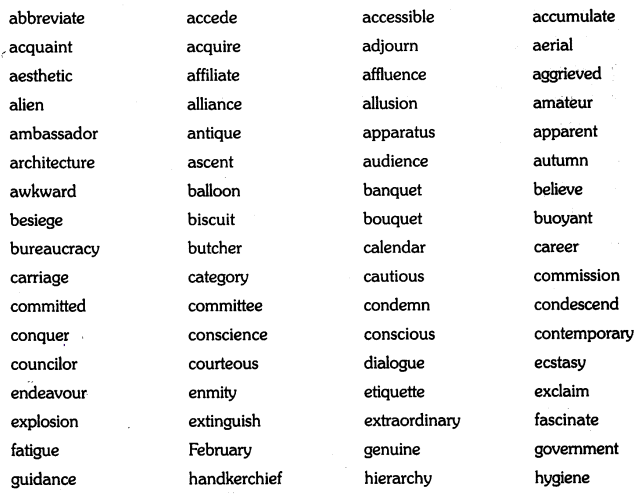
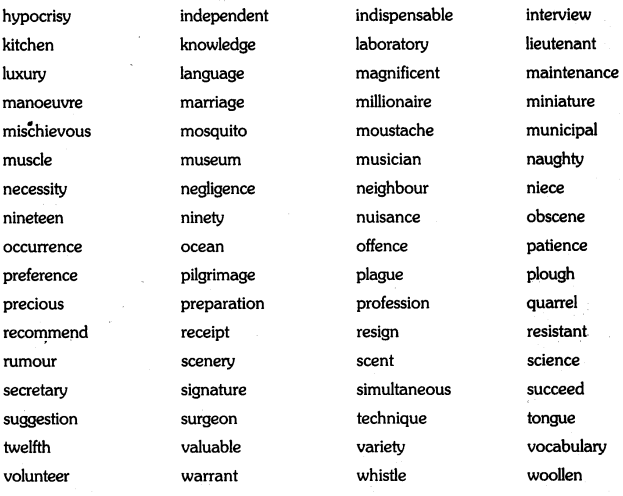
  • The words that have vowel clusters (as in rec£jve, entertain etc.) or the words that have doubled consonants (as in possible, success etc.) are generally set in the question paper.
  • Careful observation of the spelling of commonly used but typically spelt words (like height, tuition etc.) will go a long way in helping the student improve spelling to a great extent.

Examples of some commonly misspelled words :


1. For adjectives that end in a consonant +y, ‘-y’ changes to ‘-ily’.
easy-easily
happy-happily
angry-angrily
Exceptions
shy-shyly
sly-slyly
coy-coyly

2. For adjectives that end in a consonant +le the ‘-le’ changes to ‘-ly’ after the consonant,
probable-probably
sensible-sensibly
idle-idly
noble-nobly
For adjectives that end in – ic, we add -ally.
tragic-tragically
automatic-automatically
Exception
public-publicly
The doubling of final consonants.
When a one syllable word ends with one vowel and consonant we double the final consonant before adding a suffix that begins with a vowel.
bat-batting
dub-dubbing
sad-sadder
dig-digger
travel-travelled
confer-conferred

3. Spelling of regular verbs.
The past tense and past participle are the same in regular verbs.
i) We simply add – ed to the base form of the verb.
clear-cleared
walk-walked
visit-visited

ii) If the word ends in -e, we add -d.
like-liked
smile-smiled
hope-hoped

iii) For verbs ending in y preceded by two consonants, we change y to i before adding the suffix – ed.
hurry-hurried
reply-replied
try-tried

iv) For the verbs that end in a consonant, the final consonant is doubled when a suffix with an initial vowel letter is added.
rob-robbed
mop-mopped
drop-dropped

4. For ‘ie’ and ‘ei’
The general rule is that ‘i’ comes before ‘e’.
chief
grief
relieve
But after ‘c’ ‘e’ comes before ‘i’.
receive
conceit
deceive
Note the exceptions
neighbour
weight
eight
weigh
seize
height

Here is a list of commonly misspelled words.

Exercise – A

Question1.

Fill in the blanks with either “ei” or “ie”

1. n _ _ ther
2. br _ _ f
3. sh _ _ ld
4. cr _ _ d
5. tr _ _ d
6. fr _ _ nd
7. th _ _ f
8. gr _ _ f
9. l _ _ sure
10. c _ _ ling
11. s _ _ ze


Answer:


1. n e i ther
2. br i e f
3. sh o u ld
4. cr e e d / cr i e d
5. tr i e d
6. fr i e nd
7. th i e f
8. gr i e f
9. l e i sure
10. c e i ling
11. s e i ze

Exercise – B

Question2.

Correct the following misspelled words.

1. foregn
2. lugage
3. liesure
4. knowlege
5. twelth
6. tomorow
7. gurantee
8. momonto
9. ilegal
10. restaurent


Answer:


1. foreign
2. luggage
3. leisure
4. knowledge
5. twelfth
6. tomorrow
7. guarantee
8. memento
9. illegal
10. restaurant

Exercise – C

1. Please ……………………….. (wait / weight) for me.

2. I went to market to ……………………….. (buy / bye) a toothbrush.

3. He may not ……………………….. (loose / lose) the match.
4. When Chief Justice came to our state, people from different walks of life went to ……………………….. (meat / meet) him.
5. Ahmad cut the paper into many a ……………………….. (piece / peace).
6. The letters on the board cannot be ……………………….. (scene / seen) clearly.
7. – My friend has a ……………………….. (stationery / stationary) shop.
8. It was a pretty ……………………….. (sight / cite).


Answer:


1. wait
2. buy
3. lose
4. meet
5. piece
6. seen
7. stationery
8. sight

Supply the missing letters in the following words.

Exercise – 1

i) sch _ _ l
ii) enc _ _ raging
iii) app _ _ rance
iv) exce _ _ ent
v) sp _ _ k
vi) a _ _ ention
vii) p _ _ pie
viii) kno _ _ edge
ix) di _ _ ipline
x) a _ _ ord


Answers:


i) sch o o l
ii) enc o u raging
iii) app e q rance
iv) exe l l ent
v) sp e a k
vi) a t t ention
vii) p e o ple
viii) kno w l edge
ix) di s c ipline
x) a f f ord

Exercise – 2

i) tea _ _ er
ii) gl _ _ my
iii) le _ _ on
iv) re _ _ect
v) f _ _ thful
vi) infl _ _ nce
vii) le _ _ ers
viii) pl _ _ sant
ix) su _ _ est
x) si _ _ le


Answer:


i) tea c h er
ii) gl o o my
iii) le s s on
iv) re s p ect
v) f a i thful
vi) infl u e nce
vii) le a d ers
viii) pl e a sant
ix) su g g est
x) si m p le

Exercise – 3

i) childh _ _ d
ii) p _ _ ce
iii) frus _ _ ation
iv) ha _ _ en
v) gra _ _ ar
vi) col _ _ r
vii) ang _ _ sh
viii) li _ _ten
ix) obed _ _ nt
x) mu _ _ le


Answer:


i) child o o d
ii) p i e ce
iii) frs t r ation
iv) ha p p en
v) gra m m ar
vi) col o u r
vii) ang u i sh
viii) li g h ten
ix) obed i e nt
x) mu s c le

Exercise – 4

i) g _ _de
ii) ma _ _ er
iii) mar _ _ es
iv) fi _ _ ing
v) ye _ _ow
vi) h _ _ lithly
vii) sq _ _ re
viii) lau _ _ed
ix) su _ _ect
x) hi _ _ly


Answer:


i) g u i de
ii) ma n n er/ ma t t er/ ma d d er/ma p p er
iii) mar b l es / mar c h es
iv) fi b b ing
v) ye l l ow
vi) h e a lthy
vii) sq u a re
viii) lau g h ed
ix) su s p ect
x) hi g h ly

Exercise – 5

i) hi _ _ top
ii) ba _ _ an
iiii) r _ _ tine
iv) conc _ _ ve
v) m _ _ ntain
vi) mi _ _ ion
vii) in _ _ edible
viii) mons _ _ n
ix) ca _ _ y
x) reco _ _ ition


Answer:


i) hi l l top
ii) ba n y an
iii) r o u tine
iv) con e i ve
v) m o u ntain
vi) mi s s ion / mi l l ion
vii) in c r edible
viii) mons o o n
ix) ca r r y
x) reco g n ition

Exercise – 6

i) sa _ _ ling
ii) rup _ _ s
iii) hu _ _ and
iv) res _ _ rces
v) s _ _ rce
vi) su _ _ icient
vii) ma _ _ ive
viii) vi _ _ age
ix) init _ _ tive
x) a _ _ roval


Answer:


i) sa p p ling
ii) rup e e s
iii) hu s b and
iv) res o u rces
v) s o u rce
vi) su f f icient
viii) ma s s ive
ix) init i a tive
x) a p p roval

Exercise – 7

i) pers _ _ de
ii) flu _ _ er
iii) p _ _ nce
iv) ex _ _ ode
v) a _ _ empt
vi) br _ _th
vii) hu _ _ red
viii) pa _ _ ive
ix) co _ _ apse
x) thr _ _ ten


Answer:


i) per u a de
ii) flu t t er
iii) p o u nce
iv) ex p l ode
v) a t t empt
vi) br e a th
vii) hu n d red
viii) pa s s ive
ix) co l l apse
x) thr e a ten

Exercise – 8

i) thr _ _ gh
ii) sli _ _ tly
iii) gr _ _ nd
iv) wo _ _ y
v) sp _ _ d
vi) ang _ _ sh
vii) prev _ _ us
viii) mi _ _ t
ix) rec _ _ ve
x) p _ _ ce


Answer:


i) thr o u gh
ii) sli g h tly
iii) gr o u nd
iv) wo r r y
v) sp e e d
vi) ang u i sh
vii) prev i o us
viii) mi g h t
ix) rec e i ve
x) p i e ce / p e a ce

Exercise – 9

i) cro _ _ ed
ii) em _ _ atic
iii) tr _ _ ble
iv) consc _ _ us
v) pl _ _ sant
vi) dr _ _ dful
vii) chi _ _ ey
viii) pu _ _ le
ix) incr _ _ se
x) de _ _ ive / de _ _ ive


Answer:


i) cro p p ed / cro w n ed
ii) em p h atic
iii) tr o u ble
iv) cons i o us
v) pl e a sant
vi) dr e a dful
vii) chi m n ey
viii) pu z z le
ix) incr e a se
x) de p r ive / de c e ive

Exercise – 10

i) app _ _ r
ii) wo _ _ le
iii) tre _ _le
iv) con _ _ ary
v) cr _ _ m
vi) com _ _ ain
vii) f _ _ lt
viii) req _ _ st
ix) enc _ _ nter
x) acq _ _ int


Answer:


i) app e a r
ii) wo b b le
iii) tre m b le
iv) con t r ary
v) cr e a m
vi) com p l ain
vii) f a u lt
viii) req u e st
ix) enc o u nter
x) acq u a int