TS 9th Class English Guide Unit 7A The Trial
PRE-READING (Motivation/Picture Interaction):
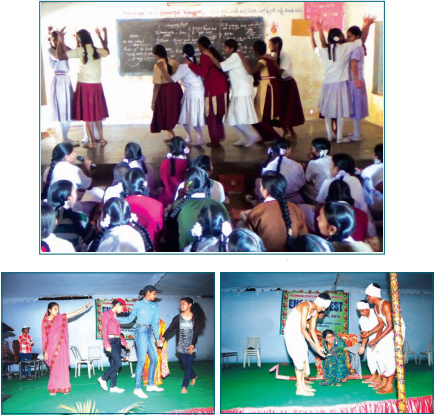
Look at the following pictures and discuss the
Questions that follow
Question 1.
What arc the pictures about?
Answer:
The pictures are about skits/plays performed by children
Question 2.
What are the children doing in the pictures?
Answer:
The children in the pictures are taking part in skits/plays
Question 3.
Can you guess the themes of each skit/play?
Answer:
The theme of the skit in the first picture is classroom unity.
The theme of the skit in the second picture is about the importance of our tradition and culture. The theme of the skit in the third picture is about the care and concern of old parents
Question 4.
Have you ever taken part in any skit/play ? If so, share your experience?
Answer:
Yes, I have taken part in the skit The Clever Tenali Ramalinga. I played the role of Tenali Ramalinga. While performing I was engrossed in the character and unable to come out from the wit and wisdom of Tenali Ramalinga. At that moment I decided to be humorous and gain knowledge without any lethargy
ORAL DISCOURSE :
Question.
Skit - Perform a skit/play on any theme?
Answer:
Everyone is Powerful in His Own Way
Characters: Elephant, Woodpecker, Gnat, He-sparrow and she-sparrow.
He-sparrow : Hey dear! I found a nice tree to build our nest in.
She-sparrow : So nice dear! When will the nest be ready?
He-sparrow : A couple of days the nest is ready.
************
Woodpecker : Hi friend! Is your nest ready? When is the house warming? What are we going to have for dinner?
He-sparrow : Did we not share our happiness with our friends previously?
Woodpecker : Of course, we would like to know when that would be.
She-sparrow : Dont you how we treat our near and dear whenever we are happy?
He-sparrow : When the time comes we will certainly do that, shant we? [looking at the she sparrow]
She-sparrow : [with a face hidden in a twig] You always make fun of me!
Woodpecker : Of course. Take your own time. But dont forget to invite us whenever you are happy. Take care!
************
She-sparrow : My eggs ! My nest! My eggs are stolen. My nest is spoiled! My dear has not slept till it is built. We wanted to invite all our friends when my eggs hatch out. Now my eggs are gone. My young ones had died before they opened their eyes.
Woodpecker : Dont worry my sister. I think the elephant made all this nonsense.
He-sparrow : Is it ? Well teach him a lesson!
************
Woodpecker : Dear friend, oh! dear friend.
Frog : [croaking] Who is that ? Is it my friend woodpecker?
Woodpecker : Yes. Its me!
Frog : What can I do for you?
Woodpecker : I came here seeking your advice. You know my friends- the Sparrows?
Frog : Yes. I know them. What happened to them?
Woodpecker : The rascal elephant has spoiled their nest. It has eaten away all the eggs. My sister she- sparrow is so sad. She is not eating anything.
Frog : Croak.. .croak. We will teach the idiot elephant a lesson. Ill tell you a plan. Come, [whispers something in the woodpeckers ears]
************
[the elephant is seen sleeping]
Gnat : Mmmm. mmmm.
Elephant : Oh! What melody ! Im not able to open my eyes. Ill sleep for some more time.
Woodpecker : [enters suddenly] Ill teach him a lesson, [pierces its beak into the eyes of the elephant]
Elephant : Oh ! Im dead ! Im dead.
Woodpecker : You get what you deserve. Intelligence is not yours alone. Small creatures can make a mountain shake. Know that everyone is powerful in his own way
I. Answer the following
Questions
Question 1.
Joan said, "If you leave the door of the cage open, the bird will fly out." Why did DEstivet say that it was a confession ?
Answer:
When Joan said these words about her escapade (escape) from the prison, she told them as a matter of referring to natural law as in the case of bird in a cage. She may also have told them as a matter of incident that actually had happened. This need not have confession in it, but all that she was doing was admitting a fact and asserting her wish to face it but not repenting over (on) it. When a person confesses, there is repentance on his deed. But DEstivet took it for confession. He missed the angle of freedom and truth.
Question 2.
Why did Joan say, "I will swear no more" ?
Answer:
Joan told the court that she would tell the truth as far as that case was concerned. She would not tell anything beyond the case, even it were true. As the court of law and God, she was honouring both. She also stated that God does not allow the whole truth to be told. The « people in the court didnt understand the truth, they didnt understand. At the end she told that she was weary of this argument. So, she would swear no more
Question 3.
Who are the people who tried to save Joan in the trial ? How do you know it ?
Answer:
We have some instances that show people trying to save Joan from punishment. Cauchon warned her against the punishment, at the same time he took pity on her and suggested her to give answers that save her from punishment. Ladvenu argued against the use of torture to get the truth from her. The Inquisitor also was personally willing to use torture
When Joan called Courcelles a rare noodle, he tried to pacify Courcelles. In the final part, Cauchon hopefully leaned forward expecting a positive statement from Joan. When, she gave an un¬guarded daring statement, Cauchon sank back in his chair with heavy sigh) the Inquisitor pursed the lips and frowned and Ladvenu shook his head pitifully. From this we know that Cauchon, the Inquisitor and Ladvenu wanted to save Joan in the trial
Question 4.
Joan expressed her helplessness to tell the whole truth. Why ? What was the old saying she mentioned in this context ?
Answer:
Joan expressed her helplessness to tell the whole trtith. The reason is : God does not allow the whole truth to be told. Also, there is an old saying that he who tells the whole truth is sure to be hanged
Question 5.
Why was the doctor forbidden to bleed Joan ?
Answer:
According to the laws of the English, only witches could receive the punishment of burning at stakes. There Was a belief that if a witch bleeds, its witchery leaves her. Since the English wanted to kill as a witch; and they believed that Joan should not bleed, if she had to die as a witch, they did not allow the doctor to bleed Joan
Question 6.
Courcelles said that Joan should be tortured. What reasons did he give to support his argument ?
Answer:
Courcelles said that Joan should be tortured as it was customary to torture the accused and Joan refused to take the oath as she was a heretic. He strongly spoke against departing from the usual practice
Question 7.
Why did Joan regret having worn the surcoat ?
Answer:
Joan wore her cloth of gold surcoat in the battle, which is not ordinary as she was a woman. A Burgundian had pulled her backwards off her horse. Perhaps she had turned against the soldier. This act might have been led to the imprisonment of Joan. But the use of the word fool cannot be taken for her regret, as there was no proof of her regret in other parts of the play. Perhaps she was ridiculing their argument
Question 8.
Joan and Courcelles catted each other names. What were they ?
Answer:
Joan called Courcelles a rare noodle and Courcelles called her a heretic
II. Tick (?) the statements that are true
Question 1.
Joan tried to escape from prison only once?
Answer:
?
Question 2.
Joan said that she would not hesitate to lie if she was tortured/
Answer:
?
Question 3.
Joan liked to be in the hands of the English rather than the Church?
Answer:
?
Question 4.
Cauchon tried to have Joan executed?
Answer:
?
Question 5.
Joan became ill because she ate carp?
Answer:
?
QuestionIII.
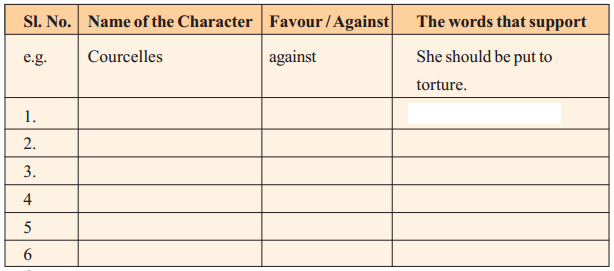
Some characters in the play are in favour of Joan and some are against. Identify the characters who are in favour of or against Joan and then complete the following table?
Answer:
| Name of the Character |
favour /Against |
The words that support |
| e.g. : Courcelles |
against |
She should be put to torture |
| 1. Inquisitor |
for for |
1. It must not be applied wantonly.
2. You stand in or eat peril |
| 2. Courcelles |
against |
1. The torture is customary.
2. This woman is a heretic |
| 3. DEstivet |
against |
1. That is a confession of heresy.
2. How I am reviled in the execution of my duty by this woman ? |
| 4. Brother Ladvenn |
for |
1. We should proceed mercifully.
2. Do you want to torture the girl for mere pleasure of it ? |
| 5. Cauchon |
for |
1. You are doing yourself no good by these pert answer |
| 6. The Chaplain |
against |
1. If you are so clever at womans work why do you not stay at home and do it ? |
The sentences given in the box are only examples. There are some other dialogues against or in favour of Joan
Vocabulary:
QuestionI.
There is a word, confession in the story which means declaration of guilt. The word is related to church. Find any three words related to church from the story and write their meanings?
- ________________________
- ________________________
- ________________________
Answer:
- heresy : belief against principles of Church
- the Gospels : four books on life and teachings of Jesus
- Clergy : a priest or minister of Church
QuestionII.
The Inquisitor in the story says, Lets not be moved by the rough side of a shepherd lasss tongue.
Here a shepherd lasss tongue means that Joan speaks whatever comes to her mind without any etiquette.
There are some idioms with tongue in column-A. Match them with their meanings given in Column-B. Use these idioms in your own sentences?
| A |
B |
| 1. sharp tongue ( ) |
a) if you give someone a tongue lashing, you speak to them angrily because they have done something wrong |
| 2. a slip of the tongue ( ) |
b) an outspoken or harsh manner; a critical manner of |
| 3. a tongue lashing ( ) |
c) speaking to struggle not to say something that you really want to say |
| 4. bite ones tongue ( ) |
d) you think you know it and that you will be able to remember it very soon |
| 5. be on the tip of the tongue ( ) |
e) a mistake you make when speaking, such as using the wrong word |
Answer:
- b
- e
- a
- c
- d
Writing own sentences using the above idioms :
- sharp tongue : He speaks in a harsh manner. He is known for his out spokenness. He has a sharp tongue
- a slip of the tongue : Whenever he is present, I dont want to mention the marks I got. But I have a slip of the tongue. I mention my marks
- a tongue lashing : My father gave me a tongue lashing yesterday as my grades were low in the examination
- bite my tongue : I have no control over my tongue. I use certain words in the officerss presence and then bite my tongue
- be on the tip of the tongue : Last week I saw a film. Its on my tip of the tongue. But I am not able to tell you its name
Grammar:
Read the following sentences
- If you leave the door of the cage open, the bird will fly out
- If Joan were alive today, how would people receive her
- If I had not worn my cloth of gold surcoat in battle like a fool, that Burgundian soldier would never have pulled me backwards off ,my horse
- What is the meaning of each sentence
- What are the two parts in each sentence
- What is the role of If
Types of If Clauses
- Sentence (1) means there is a possibility of the bird flying out when we leave the door of the cage open
- In sentence (2) the speaker is not thinking about a real situation. He is only imagining the future happening ( because Joan is not alive today.). There is no possibility of future happening. (People receiving her.)
- In sentence (3) the speaker talks about something that might have happened in the past, but it didnt.
Let us identify the verb and tense elements in each of these sentences both in If- clause and in the Main clause.
| |
If - clause |
Main clause |
| Sentence (1) |
leave |
will fly |
| Sentence (2) |
were |
would receive |
| Sentence (3) |
had worn |
would have pulled |
QuestionI.
Now, pick out a few sentences from the play containing If- clauses and say which type they belong to?
Answer:
- If you cannot fly like a witch, how is it that you are still alive
- Why would anybody leave a prison if they could get out
- If you leave the door of the cage open, the bird will fly out
- If you are in the hands of church, and (if) you wilfully take yourself out of its hands, you are deserting the Church
- If you tear me limb from limb . you will get nothing out of me .
- If you hurt me I will say anything like to stop the pain
- If the accused will confess voluntarily, then its use cannot be justifie.d
- If I had not worn my cloth of gold surcoat, that Burgundian soldier would never have pulled me..
- If you are so clever at womans work, why do you not stay at home and do it
The above sentences from the lesson have If clauses. These sentences are analysed in the box below. But before that there is one more conditional which is called Zero conditional or type (0) conditional.
e.g. : Type (1) If you drop the glass, it will break into pieces.
Type (0) If you drop the glass, it breaks into pieces.
They are sentences where "can, may, shall, could, might, should" are used in the place of will. Such use does not make any difference in the type of conditional. It would slightly change the meaning of the sentence
| If - clause |
Main clause |
Explanation |
| 1. If you cannot fly like a witch |
how is it that you are still alive |
the use of can in If clause; simple in the Main clause. It is a variant type (1) |
| 2. If could get out |
Why would anybody leave a prison |
Variant type (2) with could in if clause, e.g. : It is type 2 clause. |
| 3. If you leave the door of the cage open |
the bird will fly out |
type(1) |
| 4. If you are in the hands of Church and (if) you wilfully take yourself out of its hands |
you are deserting the Church |
type (0) |
| 5. If you tear me limb from limb, . |
you will get nothing out of me . |
type (1) |
| 6. If you hurt me |
I will say anything to stop the pain |
type (1) |
| 7. If the accused will confess voluntarily |
then its use cannot be justified. |
It is type with some variation. We find Will in if claus |
| 8. If I had not worn my cloth of gold surcoat, |
that Burgundian soldier would never have pulled me. |
type 3 |
| 9. If you are so clever at womans work, |
why do you not stay at home and do it ? |
type (0) |
II. Complete the following sentences using possible main clauses
Question 1.
If I were asked to stay at home and do only household chores, ______________?
Answer:
I would not follow that instruction
Question 2.
If I had attended the function, ______________?
Answer:
I would have met you
Question 3.
If Raju comes to school every day, ______________?
Answer:
he will improve a lot
Question 4.
If Lalit had helped him do his homework, ______________?
Answer:
he would have completed it
Question 5.
If I were the class teacher of class-IX, ______________?
Answer:
I would make it compulsory for everyone to participate in English Club programmes
QuestionIII.
Editing
Read the following passage. Every numbered sentence has an error. Identify and edit it?
- It was eleven oclock on the night
- The servants went to the bedroom and look in. Ramalinga and his wife were not asLeep. Ramalinga knew that the servants were near
- He said loud to his wife, "There are many thieves in the town. You have a lot of jewefs.
- We must kept them safe. I have a pIan
- We shall put all the jewels in an box. Then well drop the box in the well. Nobody will Look there for the jewels."
Answer:
- It was eleven oclock in the night
- The servants went to the bedroom and looked in. Ramalinga and his wife were not asleep. Ramalinga knew that the servants were near
- He said loudly to his wife, "There are many thieves in the town. You have a lot of jewels
- We must keep them safe. I have a plan
- We shall put all the jewels in a box. Then well drop the box in the well. Then well drop the box in the well. Nobody will look there for the jewels."
Writing:
Read the following statements
- Joan challenged the place of women
- Her actions attacked the power structure of medieval society
- By making the king in charge of everything, she took power away from the feudal lords
- By saying she got information directly from God, she challenged the power of church
QuestionI.
The above actions of Joan tell us about the character of Joan.Now write a character sketch of Joan of Arc.
Clues :
Concern for women; her nature; her behaviour; relations with people; commitment to work; love for Nation; sentiments?
Tips to write a character sketch:
- Physical description: looks, clothing, etc
- Quote an interesting conversation with somebody to show her attitude. Describe his/her attitudes, likes and dislikes
- Notice what other people say about the character and what they do to her
- Tell about any interesting relationships with family or friends, whether people like the character and how they would describe her. What other characters think about him/ her
- The setting
- The strengths and weaknesses
Answer:
Joan is a young French peasant girl. She rose to the status of a national heroine by virtue of her strong convictions and belief in God. She is polite but outspoken and doesnt hesitate to
Question authority. She was prepared to face any consequence to uphold truth, equality and sincerity
Joan wears a black suit worn by pages. She dresses her hair like a young man.
During the Hundred Years War, the French Army suffered a number of losses to the English. At that time, Joan claimed that the voices of saints had told her that she has called on by the God to help her country. She brought the renewed confidence by lifting the siege of Orleans in nine days and got the city of Reins back. She was then captured by the British and presented before the court.
During her trial, she
Questioned the undue authority of the Church. When her feet were chained, she asked: And why must I be chained by the feet to a log of wood? Are you afraid that I will fly away? She boldly declares in the court, But you will not talk sense to me. I am reasonable if you will be reasonable.
Though she knew her life was in danger, she was remarkably bold and expressed her opinions without any fear. She was burnt at stake (alive). But her name remained in history. Nearly after 500 years she was beatified and canonized as a saint by the Church
QuestionII.
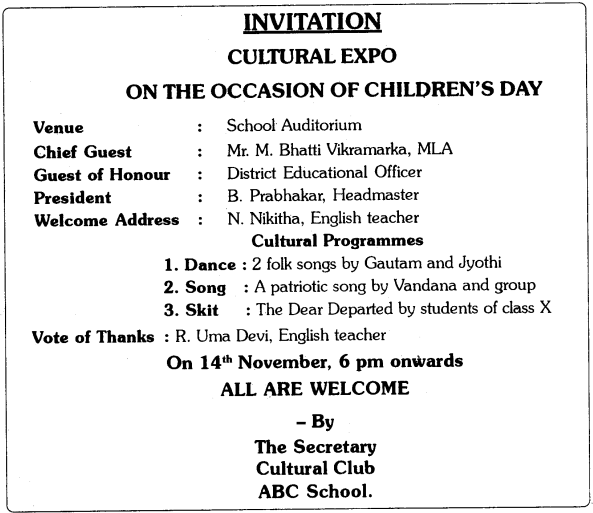
Your school is going to organise a cultural expo on the eve of Childrens Day. Now, prepare an invitation for the programme. (Observe all the features of an invitation)?
Answer:
 Study Skills:
SPEAK FOR SAFETY
Joan fought for her rights. Here is how children can secure their right to safety and dignity. Here is a conversation that Fatima had with her friends mother
Fatima : Khala, I want to tell you something.
Friends mother : What is it beti?
Fatima : It is about this uncle. He is my mamus friend. He was at my mamus wedding last week. He took me into his room saying that he had got a gift for me. He tried to hug me. When I told him that I will tell my mother about him he said my mother will end up scolding me for going to his " room.
Friends mother : Oh! Thank you for trusting me and telling me about this Fatima. Can I talk to your mother about this if you are scared to do so yourself?
Fatima : I dont know. I think she will say it is my fault.
Friends mother : But its not your fault! You did not break any rules. Everyone has to know
about him. Otherwise he will go on troubling you and other children.
Fatima : Everyone at home respects this friend a lot. No one will believe me. They will blame me and try to make me feel ashamed.
Friends mother : There is no shame in any part of our body. Shame or respect comes from the way we behave. That man needs to feel ashamed, not you. You did not break any rule. He needs to stop such behaviour and start following safety rules. Otherwise, one day he will land up with a police case against him.
Fatima : Khala, does that mean Ill have to go to the police station?
Friends mother : According to the POCSO Act, 2012 no child has to go to the Police Station to report abuse. The parents/caregivers go to the police station and file and FIR. By the way, the police have to register the FIR, other wise they can be punished. The police meet the child wherever he/she feels comfortable and talk to the child in the presence of the caregivers.
Fatima : Thank you Khala for offering your help. I feel much better after talking to you about this. You can talk to my mother
Listening:
Listen to a compering and answer the
Questions
Compering
Good evening, ladies and gentlemen. Welcome to the " T.S. Cultural Mela Week". Well, there are melodious music, colourful decoration of the dais and the lighting of ceremonial flame, but it has nothing to do with the Hollywood Film Festival. Boys and girls from different districts of T.S. have gathered here to inaugurate the Mela tonight. Ladies and gentlemen, if you want to announce anything, any time, you just come on right up and let us know
We are wrapping up with an interesting play, Rani Bhagmathi by our Govt. School students
Perhaps you know, Bhagmati was a native of Chichlam, now it is called Shahalibanda, which is 10 miles away from Golconda in Hyderabad. Mohammad Quli Qutub Shah, the fifth sultan of former Qutub Shahi Dynasty fell in love with her
The Sultan wanted to give something worthy to her ladylove
He built a new city. He named it Bhagyanagar. In the year 1591 he laid the foundation stone of the new city. Under direct supervision of his Prime Minister, Mir Momin, the new city was built with the grandeur of heaven. He named the city Bhagyanagar after Bhagmati. Now we are calling it Hyderabad
After they got married, she changed her name to Hyder Mahal and that is how the city was named Hyderabad. Mohammed Quli Qutub Shah of the Shahi Dynasty named it Hyderabad. Ladies and gentlemen, put your hands together to declare the Mela open
Answer the following
Questions.
Question 1.
What is the compering about?
Answer:
The compering is about the inauguration of T.S. Cultural Mela Week
Question 2.
What did the Sultan give Bhagmati as a token of his love?
Answer:
He built a new city. He named it Bhagyanagar after Bhagmati. It was the gift of the Sultan to Bhagmati as a token of his love
Question 3.
How did Hyderabad get its name?
Answer:
Quli Qutub Shah, the fifth Sultan of the Shahi Dynasty fell in love with Bhagmati. He wanted to give something worthy to her ladylove. So he built a new city. He* named it after Bhagmati. He named the city, Bhagyanagar. After they got married, Bhagmati changed her name to Hyder Mahal and that is how the city was named Hyderabad by Quli Qutub Shah
The Trial Summary in English
The present act is an extract from George Bemand Shaws "Saint Joan" which he wrote in 1914. "Saint Joan" is considered to be one of his master pieces. He wrote more than 50 plays in his literary career
Joan of Arc was a French peasant girl. She was born in 1942. She claimed that the Voices of Saints had told her she was called on by God to help her country. This French national heroine took to the field of battle during the Hundred Years War (1337 -1453)
During the war the desperate French Army suffered a number of losses to the English. But John brought renewed confidence by lifting the siege of Or leans in nine days and taking back the city of Reims. She was captured by the English soon
Joan of Arc had been caught in the war by the British. She was imprisoned and presented before the court
In the court, there are six characters - the Inquisitor, DEstivet, Courcelles, Brother Ladvenu, Cauchon and the Chaplain. The Inquisistor was an elderly man. DEstivets full name is Canon John DEstivet. He was the chief prosecutor. Courcelles was the Canon of Paris. He was a young priest and helped to frame sixty-four charges against Joan. Brother Martin Ladvenu was a young Monk and he acted as Joans confessor. Cauchon was an academic theologian and represented the "considered wisdom of the church". The chaplain was a clergyman
The whole lesson is the Trial of Joan. The Inquisitor ordered the accused to be brought in. She was brought in chained to a log of wood and was asked to sit down on a stool meant for her
Joan looked unwell as she ate some stale carp. Cauchon said that he was sorry for that.
Joan expressed her feelings that the English were trying to bum her as a witch. They sent a doctor to cure her but the doctor was not allowed to bleed her on the belief that if she was bled, her witchery would leave her. The doctor only called her by filthy names. Joan wanted to be in the hands of the Church and not in the hands of the English. She
Questioned the validity of chaining her by feet to a log of wood. She said that she would not fly away if not bound in chains
In the court, the next point of argument between DEstivet, Courcelles and Joan was Joans escapade from the prison by jumping from the tower. DEstivet called it heresy. Joan said that it was not heresy but it was natural act just like a bird would fly away from an open cage
Another interesting point in this scene was that the Inquisitor made a remark that she had not sworn on the Gospels, hence the proceedings had not been formally opened. So all the arguments took place before that had no validity and cannot be considered and there was no chance of
Questioning her before such swearing
When asked to tell the court the truth, Joan was adamant in her statement that she would tell them everything that concerned the trial. It had a hidden meaning that she would not tell them anything else even if it were to be true. She justified her statement by saying that God doesnt allow the whole truth to be told
Then Courcelles proposed that she should be put to the torture. The Inquisitor expressed his objection to such use of torture. The use of torture should not be customary and wanton. Ladvenu and the Inquisitor opposed the use of torture but Courcelles argued in favour of it
Cauchon decisively said that every effort was made to save her body and soul by doctors and preachers. But, she didnt give in. It was now the Executioners duty (to bum her alive)
Finally, Joan called Courcelles rare noodle and provocatively asked him to do what was done in a previous similar case. The Inquisitor tried to reconcile Courcelles by calling Joan a shepherd lass. Joan affirmed that she was as good as any lady in Rouen
Finally, the Inquisitor told Joan that her life was in Peril. Joan said that she knew that and was ready to face it. She said she was in court because a Burgundian soldier pulled her gold surcoat
At her last moments, Cauchon asked her whether she would submit her case to the inspired interpretation of the Church Militant, Joan replied that she was a faithful child of the Church and would obey it, so long it does not command anything impossible
At the age 19, in the year 1431, she was tried for heresy and then burned at the stake as a witch. Surprisingly after 500 years, in 1909 she was beatified even more that, in 1920 she was canonised as a saint
About the Dramatist:
George Bernard Shaw was born on July 26, 1856 in Dublin, Ireland. In the early 1900s, Shaw wrote several plays. These plays were about political themes and issues concerning poverty and womens rights. He wrote "Man and Superman" (1902), John Bulls Other Island" (1904) and "Major Barbara" (1905). In 1914 he wrote "Saint Joan", which is considered to be one of his masterpieces. He won the Nobel Prize for literature in 1925. Shaw wrote over 50 plays during his literary career. Right until the time of his death on November 2, 1950, Shaw remained committed to the socialist cause
Glossary:
Bishop (n) : a clergy man who supervises a number of local churches
call on (phr.v) : ask somebody to do something
aid (v) : help
siege (n) : capture
castle : fort
inquisitor (n) : officer of the inquisition
judicial (adj) : legal
scribe (n) : a person who copies a document
the accused (n) : a person on trial
Executioner : a person who executes criminals
page (n) : a youth being trained for the medieval rank of knight and in the personal service of a knight; a youth attendant
carp : fish
witch : a woman having magical powers
filthy (adj) : dirty
moat (n) : a deep channel around a castle
confession (n) : a statement of admitting crime or mistake
heresy (n) : (here) a belief which is against the principles of Christianity
assuredly : certainly
revile : criticise
indignant : showing anger
pert (adj) : showing lack of respect
proceedings (n) : a series of actions
Gospels : the first four books of the Bible / "The New Testament"
concern : worry
torture (v) : causing severe pain
weary (adj) : tired
obdurate : adamant; stubborn
shewn (v) : British variant of shown
wantonly (adv) : acting cruelly or violently / deliberately or unprovokingly
customary : in vogue
bewildered (adj) : confused
exhort (v) : insist
implore (v) : plead
noodle (n) : head (used as a slang)
"thou : you, "thy : your, "dost : do, "nay : no (*old and poetic English words)
lass (n) : girl
thrust (v) : push suddenly
depart (v) : deviate
mutter (v) : speak in a quiet voice
surcoat (n) : the outer coat or garment worn over armour, in particular a short sleeveless garment worn as part of insignia of an order of kinghood;
trifles (n) : things of little value or importance
solemn (adj) : serious
at stake (idm) : in danger of being lost
Imputed (v) : attributed bad quality to somebody
beatify (v) : declare a dead person holy
canonise (v) : stale somebody a saint
saint : a religious holy person
Militant (n) : radical, rebel