TS 9th Class English Guide Unit 4C Cant Climb Trees Any More
Questions and Answers:
Answer the following
Questions
Question 1.
What is your opinion about the theme of the story?
Answer:
The short story, Cant Climb Trees Any More reflects the nostalgic love and attachment of a person for his childhood environment arid youthful memories. The theme of the story has universal appeal. Everyone in this world is fond of his/her childhood environment and youthful memories. Visiting ones childhood environment gives pleasure to anybody
Question 2.
The middle-aged man remembers his joyous days of youth. What are the different words/phrases used in the story (for example, dark dancing eyes; swift and sweet of limbs) to show the characteristics of the youth?
Answer:
The following words/phrases are used in the story to show the characteristics of the youth
- swing
- going round and round
- lively eyes
- long black hair
- climb over the Wall
- flying trapeze
- climb the jack fruit tree
- marbles Id won
- old coins Id collected
- a bit of a crow
- sprang up
- swift and sweet of limb
- crawling along the projecting branch
- ran breathlessly
- outstretched hand
- my youth
- quickened his steps
- moved briskly
- sprightliness in his step
- dark dancing eyes
- melon sweet lips
- lissom limbs
Question 3.
A blessing rests on the house where the shadow of a tree falls/ And so the present owners must also be receiving the trees blessings. What does the narrators grandmother mean by this statement?
Answer:
According to the grandmother, the tree gives protection by giving shade. It is just like God. Its shade is as cool as the blessings of God. It helps man in several ways as God helps. She feels it is precious and just like a mother
Question 4.
Are the grandmother and Chief Seattle expressing the same feelings about trees and nature? Why ?
Answer:
Yes. The grandmother in the story Cant Climb Trees Any More and Chief Seattle in his speech What Is Man Without the Beasts? express the same feelings about trees and nature
According to the grandmother, the tree gives protection by giving shade. It is just like God. Its shade is as cool as the blessings of God. It helps man in several ways as God helps. She feels it is precious and just like a mother.
Chief Seattle also feels that things like water, wind, trees and land in nature are very precious and sacred. They are created by God and equal to God. He treats nature as a mother.
Both the grandmother and Chief Seattle express their worshipping attitude towards trees and nature while expressing their opinions
Project Work:
Look at the picture. Our water resources are getting polluted every day. If we do not care enough to prevent pollution and save water, there ts going to be an acute scarcity of drinking water
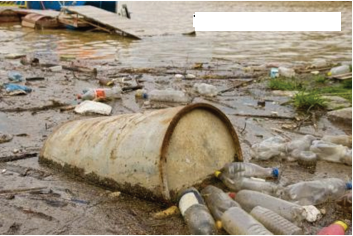 I. Visit five houses in your locality and collect the following information
Question1.
Number of members in the family?
Answer:
- adults
- children
Question2.
The average quantity of water used in the household (in litres)?
Answer:
- for drinking and cooking food
- for washing clothes and cleaning the house
- for cattle
- for gardening
Question3.
The average quantity of drinking water wasted in the household (in litres)?
Answer:
- for drinking and cooking food
- for washing clothes and cleaning the house
- for cattle
- for gardening
Question4.
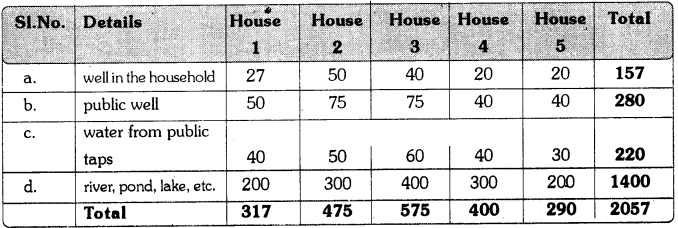
What are the water sources for the household and what is the average quantity of water used from these sources?
Answer:
- well in the household
- public well
- water from public taps
- river, pond, lake, etc
Question5.
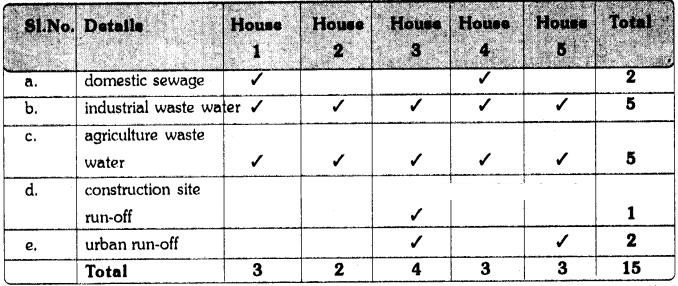
Does the ground water in the locality get polluted? If so, the sources?
Answer:
- domestic sewage
- industrial wastewater
- agricultural wastewater
- construction site runToff
- urban run-off
Consolidated Sheets of the data collected from five houses
- Number of members in the family
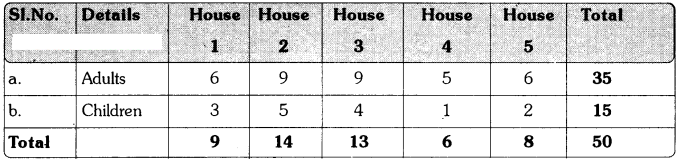
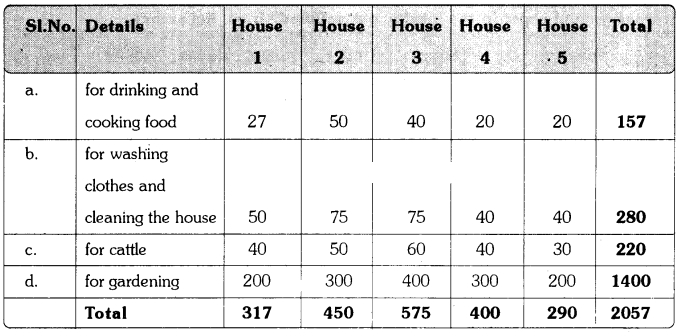
- The average quantity of water used in the household (in litres)
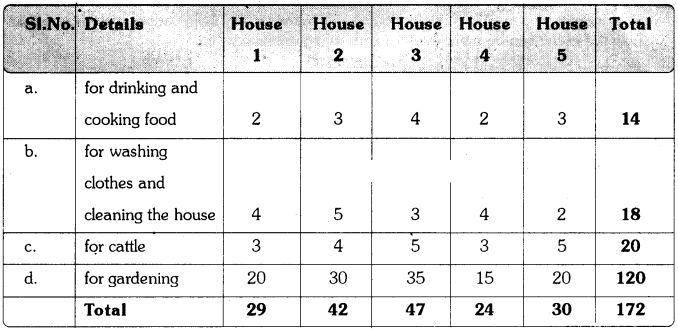
- The average quantity of drinking water wasted in the household (in litres)
- What are the water sources for the household and what is the average quantity of water used from these sources
- Does ground water In the locality If get polluted? If so, the sources
QuestionII.
Work in three groups and make reports as suggested below. Present all the reports before the whole class?
Group A
The quantity of water used by the households in the locality from various water sources and how the usage can be minimised for conserving drinking water.
Group B
The water sources in the locality, how the water gets polluted and how it can be prevented.
Group C
What measures that can be taken for conserving water and preventing pollution of water
Answer:
Group A:
This is a briefing of our survey on water conservation and wastage. Now I am presenting the details of the quantity of water used by the households in the locality from various water sources and how the usage can be minimised for conserving drinking-water. The local water sources for the household are wells in the houses, public wells, public water taps, rivers, ponds and lakes. The average quantity of water used by 5 families from various water sources is 2057 liters per day. Each family uses more than 25 liters of water for drinking purpose. We can minimize the conservation of drinking water by using it properly and by reducing wastage
The following are the ways of minimizing of water use:
- Improving irrigation system performance
- Using of improved technologies
- Efficient water management practices
- Reducing losses from dams, lakes, ponds, water tanks etc
- Improving soil structure
Group B:
The details I am going to present are about the water sources in the locality, how the water gets polluted and how it can be prevented. The local water sources for the household are wells in the houses, public wells, public water taps, rivers, ponds and lakes. The water gets polluted mainly ffom domestic sewage and industrial waste water. The other reasons are agricultural waste water, construction site run-off and urban run-off. Water pollution can be prevented by following personal health and hygiene in household. Industries should arrange and plan the proper utilization of industrial waste water
Even though water is more precious than gold, a lot of our fresh water is being polluted with toxic chemicals or poisons that are being dumped and drained into our water systems. Some of these chemicals are common household items like chlorine bleach, paint thinner and the very poisonoils mercury that comes out of broken thermometers. Other toxic chemicals that pollute our water include pesticides which are chemicals designed to kill insects, and petroleum products like gasoline and oil. Tons of these chemicals are dumped and washed into our water every year. This water pollution not only damages the animals, birds and fish that depend on clean, healthy water, but it is also harming our fresh water supply and making people
Group C:
Here are 5 ways you can prevent water pollution at home:
- Use less water :
This might sound simplistic, but decreasing your water consumption is one of the keys to minimizing water pollution. By reducing the amount of water you use, you will reduce the amount of water that flows into sewage treatment systems. You can decrease your water consumption by taking a shower instead of a bath, letting it mellow if its yellow (i.e. dont flush the toilet every time you urinate), turning the water off while youre brushing your teeth, and using natural landscaping so you dont have to water your lawn
- Use environmentally friendly household products :
Dont use household products that contain chemicals. Instead, use green products, like biodegradable soap and all-natural toiletries. To clean your house, stop using bleach and chemical cleaners and use vinegar instead
- Apply natural pesticides and fertilizers :
The use of chemical pesticides and fertilizers leads to water pollution because contaminated water seeps into ground water and runs off into nearby water sources. Natural pesticides that you can use include insecticidal soap and pyrethrum. Natural fertilizers include wood ash, grass clippings, and animal manure
- Dont litter : Avoid littering in rivers, lakes, and oceans. If youre really feeling motivated, gather a group of friends and family members to clean up litter on the beach and near other bodies of water. Make sure that you dispose of the litter in an appropriate waste disposal area
- Dispose of toxic products with care : Make sure to dispose of toxic products, such as paints, solvents, and polishes, in the proper area. Dont pour them down your drain. Better yet, avoid toxic products altogether and use environmentally friendly products instead
- As you can see, there are a variety of things that ordinary citizens can do to prevent water pollution. It is everyones responsibility to take the steps necessary to lessen water pollution and prevent it from causing further damage to our delicate ecosystems
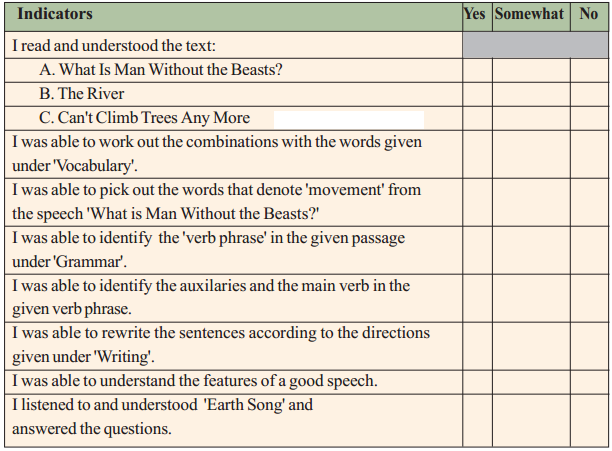
Self Assessment:
How well have I understood this unit?
Read and tick (?) in the appropriate box.
Cant Climb Trees Any More Summary in English
The short story Cant Climb Trees Any More is a wonderful narration of Ruskin Bond. It expresses the nostalgic love of a man lor his childhood environment and his memories in youth
A middle-aged man returned to his home town after twenty-five years. He came to the gate of a house. He started looking at the iliouse, the garden and the tree at the side of the house casting its shade on the wall. A girl about twelve or thirteen from inside the compound asked him what he was looking at. The man told the girl that he was looking at the house. He used to live in that house twenty five years ago as a boy and as a young man. The girl asked him whether he came back to buy the house again. But the middle-aged man told her that he just wanted to see it again
The girl invited and allowed him to see the house more closely. Both sat on a stone bench under the mango tree in the garden. They talked to each other. He enjoyed the fragrance of the mango tree in blossom. He remembered many things of his youth at the place. He told her that the jackfruit tree was his favourite place and he used to climb the tree. He told her that he used to keep the marbles he had won and the coins he had collected in the hollow of the tree. He told her that he kept an Iron Cross of his Grandfather in the hollow of the tree twehty-five years ago and forgot when he left the house as he was busy and so excited at the time, packing and saying good bye to people and thinking about the ship he was going to sail on
The girl became curious and asked him whether he would climb and look into the hollow whether the Iron Cross had been there. But he said that he could not climb trees any more. Then the girl climbed the tree very curiously. To her great surprise she found the Iron Cross there. She ran breathlessly towards him and gave the rusty medal (Iron Cross) to him
He took the medal and turned it over on his palm. On seeing this, the girl thought that the man came to see Whether the Iron Cross had been still in the tree. But the man told the girl that he could not know why he really came to, the place. But he said that it Was his youth (unforgettable nostalgic love for his home and environment) that brought him there. But the girl could not understand the meaning of the words of the man
He gave the Iron Cross to the girl and started walking to go on his way. The girl walked with him to the gate and stood there gazing after him as he walked away. When he reached the turning of the road, he looked back and waved his hand to the girl and rrioved fast towards the bus stop. While returning from the place he heard a loud cry of his nostalgic love for the childhood environment and memories in his heart
About the Author:
Ruskin Bond was born in Kasauli, Himachal Pradesh, in 1934. He wrote a number of short stories, essays, novels, and many books for children. The Room on the Roof was his first novel, written when he was seventeen. It received the John Llewellyn Rhys Memorial Prize in 1957. In 1992, he received the Sahitya Akademi Award for his short story collection, Our Trees Still Grow in Dehra, given by the Sahitya Akademi, Indias National Academy of Literature. He was awarded the Padma Shri in 1999 for contributions to childrens literature
Glossary:
verge (n) : a piece of grass at the edge of a path, road etc
casting (v) : making a shadow
turnstile (n) : a mechanical gate consisting of revolving horizontal arms fixed to a vertical post, allowing only one person at a time to pass through
dizzy (adj) : having a sensation of spinning around and losing ones balance
hollyhock (n) : a tall garden plant with large showy flowers
disembodied (adj) : (of a sound) lacking any obvious physical source
framed (adj) : settled in certain place
colonel (n) : an officer of high rank in the army
brigadier (n) : an officer of higher rank than a colonel in the army
burst out (phr.v) : began suddenly
tip (n) : the end
witty (adj) : clever or amusing
remark (n) : opinion or comment
offence (n) : the act of insulting somebody
appraising (v) : examining ; considering
taking in (phr.v) : absorbing
mind (v) : to be worried
club (n) : a place where people go and enjoy music and dance
trapeze (n) : a swing used by circus acrobats
muttered (v) : said in a quiet voice that is difficult to hear
slithered (v) : moved to the ground
shattering (v) : breaking into small pieces
pruning (adj) : trimmed
bougainviliaea (n) : an ornamental shrubby climbing plant widely cultivated in the tropics, with bright coloured flowers
blossom (n) : a mass of flowers on a fruit tree
fragrance (n) : a pleasant smell
drenched (v) : made completely wet
chiming (n) : ringing
twitter (n) : a series of short high sounds
cranking (v) : making something move
budgerigar (n) : a small bird belonging to the parrot family
hollow (n) : a hole
treasures (n) : a collection of valuable / memorable things
gaze (n) : a long steady look at something
sprang (v) : moved suddenly in a particular direction
swift and sweet of limb : (here) (climbed the tree fast like a bird
crawling (v) : moving forward on hands and knees
projecting (adj) : targeted
eddy (n) : (pi. eddies) a circular movement of dust (here)
outstretched (ad]) : spread out as far as possible
briskly (adv) : quick or busy
sprightliness (n) : liveliness and energy in action
lissome (adj) : slim; graceful
course (v) : (of liquid) flow