TS 9th Class English Guide Unit 4A What is Man without the Beasts ?
PRE-READING (Motivation/Picture Interaction) :
Look at the picture and answer the
Questions that follow
-1.png)
Question 1.
What do you think the picture is about ?
Answer:
I think the picture is about killing elephants to rob them of their valuable tusks. Some irresponsible people do like this. They dont hesitate "to destroy nature for personal gains
Question 2.
What can you do to save nature ?
Answer:
I can be kind to animals and plants to save nature. I plant trees and love animals. I try to protect their lives
ORAL ACTIVITY:
Question.
Speech - "The selfishness of human beings destroys the environment." Give suitable examples to substantiate your opinion?
Answer:
Respected Principal, worthy teachers and my friends.
Today I, Gautam of IX B, have got the opportunity to share with you my views on the topic The selfishness of human beings destroys the environment. I hope you all will agree that although the quality of life has improved over the past decades due to new technological advances the damages made to the earth weigh more. Damages included increase in pollution and change in climatic patterns. Irreversible damage to earth can include depletion of natural resources
As technology advances more factories are built. These factories dispose waste materials into natural water, which could be harmful to aquatic life. Emissions from the factories and automobiles pollute the air, which we breathe. Nuclear waste and radiation from power plants are harmful to our health
There can be drastic changes in the climatic pattern due to the increase in the carbon dioxide released into the atmosphere, which is the main cause of global warming. Global warming would increase the temperature of earth and make it inhospitable. We are cutting more and more trees for furniture and wood. Trees purify the atmosphere by absorbing the carbon dioxide from the atmosphere and releasing the oxygen. Furthermore the roots of tree hold the soil and prevent floods
Resources of petroleum, oil and minerals are not endless. There is shortage of water all over the world. Once depleted of these resources our life would be difficult. Killing elephants for their teeth and other species for their furs disrupts the food chain. For example killing of carnivorous animals would cause increase in the number of herbivores, which would consume more plants. We also depend on plants for food. So there can be shortage of vegetables and cereals for us
In conclusion, I can say that the selfishness of the human beings harms the environment. Human beings as well as their dear planet, the Earth have been badly suffered by what caused by humans themselves. I hope that humans are soon aware of those problems so that they can have suitable policies in order to not only improve their lives but also keep and maintain the earth fresh and green.
Thank you.
Answer the following
Questions:
Question 1.
Why does Chief Seattle say that the Earth is sacred to his people?
Answer:
Seattle says that the Earth is sacred to his people because
- he believes that the shining water that moves in streams and rivers is not just water but the blood of their ancestors
- He feels that each ghostly reflection in the clear water of the lakes tells of events in the life of his people
- He listens to the voice of his ancestors in the waters murmur
Question 2.
The speaker says, "I am a savage." Who do you think is a savage, the Red Indian or the White? Why?
Answer:
I think the speaker Seattle is a savage according to his speech. Savage means a person who is simple but not developed. As Seattle belongs to a tribal community, he addressed himself (the Red Indian) as a savage
Question 3.
Why does the Chief say The destiny is a mystery to us?
Answer:
The destiny means future. The Chief Seattle says that it is certain that they leave their lands.
In future the white people will destroy the Nature on their lands. They will slaughter the buffalo, they will tame the wild horses, many people go to the secret corners of the forest and the ripe hills are blotted by talking wires. Thickets and eagles will disappear. The people of Seattle do not understand all these things. So the destiny (what the white people will do in future), is a mystery to them
Question 4.
"What is man with the beasts? If all the beasts were gone, man would die from a great loneliness of the spirit." Why?
Answer:
These are the most thought-provoking words from the speech of Chief Seattle. He says that the life of man is meaningless and impossible with the beasts as tfiey are an integral part of human life. He says that whatever happens to the beasts, the same soon happens to man as all things are connected. This means man would die soon after the death of the beasts
Question 5.
Is man the sole owner of the Earth? Pick out sentences from the speech to justify your answer?
Answer:
No. Man is not the sole owner of the Earth because man is a part of the Earth. He cannot really own earth. The Earth owns man as its part
The following sentences justify the same thing
- The Earth does not belong to man - man belongs to the Earth
- All things are connected like the blood which unites one family
Question 6.
Why does the speaker say that if we spit on the ground, we spit on ourselves?
Answer:
The speaker says that the Earth is our mother. Whatever befalls the Earth befalls the sons of tiie earth. So if men spit on the ground, it means that they spit on themselves.
Question 7.
"All belong to the same family." The speaker says this to mean?
- all animals belong to one family
- all animals, and plants belong to the same family
- everything on the earth belongs to one family
Answer:
- everything on the earth belongs to one family
Question 8.
In his speech Chief Seattle asks the audience a number of Questions. He also creates vivid pictures in the minds of the audience. What are the other features of the speech? List them?
Answer:
The other features of the speech are:
- He used suitable exarpples to convince the audience
- He used short sentences
- He used simple, catchy and colloquial language
- He expressed his thoughts using various language structures
- He used some phrases repeatedly to stress the importance of things
Vocabulary:
QuestionI.
Read the following expression.
The warmth of the land
The word warmth here suggests love, care, affection, intimacy, etc.
I. Which of the following words can be used to work out new combinatiohs with the word warmth?
friendship, love, honesty, relationship, hatred, freedom?
Answer:
New combinations with the word warmth
the warmth of love
the warmth of relationship
Some more combinations with the word warmth
the warmth of friendship
the warmth of the welcome
the warmth of affection
the warmth of breast
the warmth of body
the warmth of the sun
the warmth of the earth
the warmth of embrace
the warmth of grace
the warmth of heart
the warmth of home
the warmth of night
the warmth of day
the warmth of fire
the warmth of blood
Own Sentences :
warmth of love : The love between a mother and a child lasts and endures which depicts the warmth of love.
warmth of relationship : Nowadays the human relationships became weak as there was a lack of warmth of relationships.
warmth of friendship : Please accept this gift as a token of warmth of our friendship.
warmth of the welcome : They were touched by the warmth of the welcome
Question 1.
Why do you think certain combinations are not possible
Are there any other expressions of this kind in the reading material?
Answer:
Yes. there are other expressions of this kind in the reading material. They are : the freshness of air; the sparkle of water; the body heat of the pony; the blood of our ancestors; the ashes of our grandfathers
Question 2.
Work out new combinations and use them in your own sentences.
Answer:
- the pain of the suppressed
If only every one feels the pain of the suppressed, the planet will be a better place to live on
- the mood of the listeners
Some speakers do not at all take into consideration the mood of the listeners and go on speaking
- the depth of their feeling
Can you measure the depth of their feeling
In the speech you can see a few words suggesting movement. For example, in the sentence The sap which courses through the trees carries the memories of the red man the word course means flow or move rapidly
QuestionII.
Pick out from the speech other words that denote movement. If necessary, refer to a dictionary and use them in your own sentences?
Answer:
carry, move, passing, go, walk
moves : And yet, Prabhakar made no move to call for help.
Carry : Tom always carries the ball.
go : If you go fast, you will catch the bus
- The holiday weekend passed pleasantly
- His mother was very ill and she recently passed away.
walks : She walks briskly to catch me
Some more words that denote movement:
-1.png) Grammar:
Grammar:
The Verb Phrase (Predicate):
Read the following sentences taken from the text.
- We are a part of the Earth
- You must teach your children that the around beneath their feet is the ashes of our grand-fathers
- What is the relationship of the above underlined parts with the first part of the sentences
- What type of word do you see at the beginning of the underlined part
- Which is the most important word in it
You have learnt earlier that a sentence contains the subject and the predicate. The under-lined parts of the sentences given above are predicates. The important word in a predicate is the verb.
As you can see, each of these predicates has at least one verb (sentences 1 and 2). In the second sentence must is the helping (auxiliary) verb and teach is the main verb
QuestionI.
List oil the verb phrases in the following passage. Identify the main verbs.
Look at the river. It has very little water in it. Once it was flowing well. Now it is dying. Cant you hear the cries of the dying river? The water in it is polluted. Do you get its stink? You cannot drink it. You cannot give this water even to animals. Animals will not go near it. We must make the river live forever. We must make the river our own companion?
Answers:
List of Verb Phrases
look (main verb)
was flowing (flowing - main verb)
cant hear (hear - main verb)
do get (get - main verb)
cannot give (give - main verb)
must make (make - main verb)
has (main verb)
is dying (dying - main verb)
is (main verb)
cannot drink (drink - main verb)
will not go (go - main verb)
QuestionII.
Analyze the verb phrases you have already identified and list the main verbs and the auxiliary verbs in each of them.
e.g: We have been living here for hundreds of years.
have been - auxiliaries
living - main verb?
Answers:
- Look at the river.
look - Main Verb
- It has very little water in it.
has - Main Verb
- Once it flowing well.
was - Auxiliary Verb
flowing - Main Verb
- Now it is dying
is - Auxiliary Verb
dying - Main Verb
- Cant you hear the cries of the dying river?
can - Auxiliary Verb
hear - Main Verb
- The water in it is polluted.
is - Main Verb
- Do you get its stink?
do - Auxiliary Verb
get - Main Verb
- You cannot drink it.
can - Auxiliary Verb
drink - Main Verb
- You cannot give this water even to animals.
can - Auxiliary Verb
give - Main Verb
- Animals will not go near it.
will - Auxiliary Verb
go - Main Verb
- We must make the river live forever.
must - Auxiliary Verb
make - Main Verb
- We must make the river our own companion.
must - Auxiliary Verb
make - Main Verb
Writing:
I. Read the last part of the speech of Chief Seattle once again
Are all the sentences of the same length? Obviously, not. The speech contains long sen-tences (But in your . over the red man), short ones ( Where is the thicket?) and even frag-ments (Gone). Why do writers vary the length of the sentences? Again, why do they use different types of structures (sometimes statements,
Questions, exclamations, fragments, etc.)
Good writers vary their sentences to make them interesting.
Sentence length can influence the mood of the piece. If youre concerned that your writing is either too choppy or too flowery, review it with an eye toward sentence length
- Is it varied
- Does it fit the mood youre trying to convey
Do you heavily favour short, simple sentences, or does the piece contain too many para-graph-long sentences?
To make your texts more interesting, you should use sentences of varying lengths with a variety of structuresRead the following text.
Dogs are our great companions, arent they? Any idea when the friendship between man and dogs began? Maybe, thousands of years back. Who knows! What is important is that they are mans best friends for obvious reasons. Dogs, as such, need to be walked. Walks keep their owners healthy; and the owners can talk to their dogs. They never tell secrets. Dogs dont care what their owners observe while walking or what they watch on TV. As long as dogs are taken care of, they are happy
What are the features of this write-up?
In this the variety in sentences has been obtained in a number of ways:
- Using different sentence types (statements,
Questions, exclamations, etc.)
- Using elements such as tags, connectives (and, as such, etc.)
Read the following write-up.
You must have heard about the Hussain Sagar Lake. It is in Hyderabad. It is one of the largest man-made lakes. Hyderabad and Secunderabad are twin cities of the State. The lake connects these cities. It was originally constructed to supply drinking water. Now it is not used as a drinking water source. People say, "This is sad. There is plenty of water. Nobody can drink it" The lake faces a few threats. The main threat is encroachment by both private and public agencies. The lake also faces the problem of pollution. One of the locals said: Oh, sometimes it stinks horribly." This is due to the continuous discharge of domestic wastes and industrial chemicals. Hence it is our duty to save the Hussain Sagar Lake
Exercise:
I. Rewrite the sentences according to the directions given in the brackets
Question 1.
The lake connects these cities. (Change into a Question)?
Answer:
Does the lake connect these cities
Question 2.
It is in Hyderabad. It is one of the largest man- made lakes. (Combine the two sentences using and)?
Answer:
It is in Hyderabad and one of the largest man-made lakes
Question 3.
Hyderabad and Secunderabad are twin cities of the State. The lake connects these cities.
(Begin the sentence with The lake . and connect the two sentences.)?
Answer:
The lake connects Hyderabad and Secunderabad, the twin cities of the State
Question 4.
It was originally constructed to supply drinking water. Now it is not used as a drinking water source. (Connect using though)?
Answer:
Though it was originally constructed to supply drinking water, now it is not used as a drinking water source
Question 5.
"This is sad, . ?" (Complete the sentence with a Question tag.)?
Answer:
This is sad, isnt it
Question 6.
"Oh, sometimes it stinks horribly." (Rewrite the sentence beginning with How .....)?
Answer:
How horribly it sometimes stinks!
Question.
Read the speech made by Chief Seattle once again and reflect on the following features?
- The beginning and ending of the speech
- The arguments and the building up of arguments in a sequential manner
- The emotive and argumentative language used
- The variety of sentences used
- Mental images created
Answer:
- The speech begins with a
Question that has no valid answer. And the speech ends with a paradox packed with sarcasm
- The arguments are developed gradually and in a logical and powerful sequence
- The language used is filled with emotions and rhetoric
- A wide variety of sentences add force and interest to the argument
- A good number of mental images employed in the speech serve a very valuable purpose
Question II.
Prepare a speech that you would like to make on The World Environment Day. You can make use of the following hints?
- The threats to animal and plant life
- The pollution of air, water and earth and the consequences
- The need to preserve our environment for ourselves and for the future generations
Answer :
A Speech on the World Environment Day
At first, I wish a very warm good morning to aft of you present at this meeting. I welcome all the students of our school, the principal, the staff and others with much pleasure to participate here. Today we are gathering here to celebrate the World Environment Day. At first, I am going to say something about the World Environment Day
The World Environment Day is celebrated on 5th June every year. Its aim is to raise global awareness about our environment. Do you know when the World Environment Day began? In the year 1972, the United Nations Conference on the Human environment was held from 5th June to 16th June. After that, every year on 5th June, it has been hosted by different countries of the world with different themes
A constantly changing physical environment requires organisms to adapt to new temperatures, climates, and atmospheric conditions. Living things must also deal with unexpected events such as volcanic eruptions, earthquakes, meteor strikes, fires, and hurricanes. In recent evolutionary history, threats facing many organisms have been driven primarily by the effects of a single species: humans
One of the greatest problems that the world is facing today is that of environmental pollution, increasing with every passing year and causing grave and irreparable damage to the earth. Environmental pollution consists of five basic types of pollution, namely, air, water, soil, noise and light
Everyone knows the importance of our Nature. It consists of all the living beings on Earth, which are mutually dependent on one other. But due to the pollution caused by human beings, many species are becoming extinct and the global climate is also changing at a very fast rate. Its influencing our health and also going to give a long term effect on our future. We know that millions of people in the earth depend on forest for their livelihood. Every living being is dependent on trees. Only the tree can make their food itself. But, we people are degrading the forest very much
We need to preserve our environment as the environment is the most important resource for life. We get water, power and oxygen from the Environment. It helps to clear pollution and is a large habitat for animals.We get lots of resources from th?re but if we use too much and it doesnt come from sustainable forests we may run out of resources
I will not make it a lengthy speech. I want to say one thing on this great day that try to plant trees as much as you can, because we depend on them fully. Try to plant at least one tree on any special occasion like your birthday, anniversary etc
At last, I want to thank all of you once again for having given me an opportunity to make a speech at this meeting
Thank you all
Study Skills:
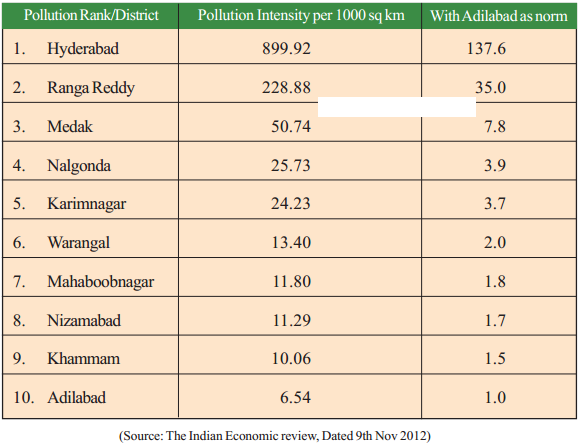
Study the following table, which shows the ranking of districts in Telangana in terms of industrial pollution intensity
Answer the following
Questions
Question 1.
Which district tops the list in pollution intensify?
Answer:
Hyderabad district tops the list in pollution intensity
Question 2.
Which region of Telangana State has the least pollution intensify?
Answer:
Adilabad district (North region) of Telangana has the least pollution intensity
Question 3.
What percentage of land is affected by industrial pollution in Hyderabad ?
Answer:
89.9 percent of land of every 1000 sq km is affected by industrial pollution in Hyderabad
Question 4.
What percentage of land is not affected by industrial pollution in Karimnagar district ?
Answer:
97.58 percent of land of every 1000 sq km is not affected by industrial pollution in Karimnagar district
Question 5.
What are the comparisons that you can make related to the Hyderabad and other districts in terms of pollution intensify ?
Answer:
In Telangana State, Hyderabad has the highest pollution intensity. Ranga Reddy district is also highly affected by industrial pollution. Medak, Nalgonda and Karimnagar districts stand in third, fourth and fifth places respectively. When compared to the above districts, the pollution intensity in Warangal, Mahaboobnagar, Nizamabad and Khammam is not alarming. Adilabad district is least affected by industrial pollution
QuestionII.
Write an analytical report on the pollution intensity in Telangana?
Answer:
This is to report the levels of industrial pollution intensity in Tglangana. This Region com-prising of Hyderabad and Ramchandrapuram industrial zones, had the highest share of pollution intensity. In this region there are 10 districts. The least industrial pollution intensity is recorded in Adilabad. It has the least intensity not only in Telangana region but also in the whole state. Disposal of hazardous wastes emitting from industries is causing severe indus¬trial pollution intensity in this region. The findings show that the maximum pollution intensity is in Hyderabad and Rangareddy districts
Listening:
I. Listen to the Earth Song and answer the following
Questions
Earth Song
What about sunrise
What about rain
What about all the things
That you said we were ta gain.
What about killing fields
Is there a time
What about all the things
That you said was yours and mine.
Did you ever stop to notice
All the blood weve shed before
Did you ever stop to notice
The crying Earth the weeping shores?
What have we done to the world
Look what weve done
What about all the peace
That you pledge your only son.
What about flowering fields
Is there a time
What about all the dreams
That you said was yours and mine.
Did you ever stop to notice
Ail the children dead from war
Did you ever stop to notice
The crying Earth the weeping shores
- Michael Jackson
I. Answer the following
Questions
Question 1.
How does Michael Jackson respond to mans attack on Nature?
Answer:
In his song Michael Jackson wanted us to listen to "the voice of the planet." He responded against "mans mismanagement of the Earth." The lyrics explored themes of deforestation, pollution and war, along with wildlife concerns
Question 2.
What is the mood of the song? Indicate by putting a tick ( /).
a. Sadness b. anger c. anguish d. joy?
Answer:
- anguish (Jackson seems to be anguished in his song and appeals the people of the world to save Mother Earth.)
Lets Know about the Earth Song:
Michael Jackson said that the inspiration for "Earth Song" came to him while he was staying in a hotel in Austria and his heart became heavy with the plight of Mother Earth. It was Jacksons belief that the Earth could feel pain from her wounds, so he wanted to write a song coming from "the voice of the planet." His "Earth Song" became the rallying cry against "mans mismanage¬ment of the Earth." The lyrics explored themes of deforestation, pollution and war, along with wildlife concerns such as over-fishing and elephant poaching
"Earth Song" reflects Jacksons passion for the planet, and it is an urgent plea to look around at the world to see what can be done before it is too late. The lyrics begin reflective: "What about sunrise/What about rain/What about all the things/That you said we were to gain?" The lyrics grow more urgent with the rising crescendo of the song, where Jackson employs the call-and-response chant "What about us?" in between stronger lyrics that demand, "What about crying whales/Were ravaging the seas/What about forest trails/Burnt despite our pleas."
Though Jackson died in 2009, he left the world a powerful message of hope and change through "Earth Song." "Thats why I write these kinds of songs. You know, to give some sense of awareness and awakening and hope to people. I love the planet." Jackson said. "The planet is sick. Like a fever. If we dont fix it now, its at the point of noreturn. This is our last chance to fix this problem that we have. Or its like a runaway train. And the time has come; this is it."
This song centred around the destruction and rebirth of Earth and went on to receive a Grammy nomination in 1997. The song was a top five hit in most European countries. Jackson went on to receive recognition from various animal and environmental organizations
If you want to watch the video of this song, type the fine in your internet URL:
http://www.youtube.com/watch?v=VqeADZgjtpY
Oral Activity:
Discuss the following in groups
- Why do writers often write about these things (things like earth)
- In what ways does nature influence man
- Can it shape ones personality
Note :
Study the following paragraphs to understand and respond orally on the
Questions given above
Question 1.
Why do writers often write about these things (things like earth)?
Answer:
Writers often write about the things like the Earth and Nature when they feel concern over the mismanagement of man and make their appeal to the world to stop the damage to them.
Things like the Earth and Nature are an integral part of everybodys life. If they are destroyed, man on Earth also will be destroyed. So writing on such things usually catch the attention of the world. The writers who love Nature often attempt to write about these things. Great poets like William Wordsworth, RB. Shelly wrote poems on Nature subjects
Question 2.
In what ways does Nature Influence man?
Answer:
Human beings live in the realm of Nature; they are constantly surrounded by it and inter¬act with it. The most intimate part of Nature in relation to man is the biosphere, the thin envelope embracing the earth, its soil coyer, and everything else that is alive. Our environment, although outside us, has within us not only its image, as something both actually and imaginatively reflected, but also its material energy and information channels and processes. This presence of nature in an ideal, materialised, energy and information form in mans Self is so organic that when these external natural principles disappear, man himself disappears from life. If we lose natures image, we lose our life
Man is constantly aware of the influence of Nature in the form of the air he breathes, the water he drinks, the food he eats, and the flow of energy and information. And many of his troubles are a response to the natural processes and changes in the weather, intensified irradiation of cosmic energy, and the magnetic storms that rage around the earth. In short, we are connected with Nature by "blood" ties and we cannot live outside nature. Nowhere does Nature affect humanity in exactly the same way. Its influence varies
Depending on where human beings happen to be on the Earths surface, it assigns them varying quantities of light, warmth, water, precipitation, flora and fauna. Human history offers any number of examples of how environmental conditions and the relief of our planet have promoted or retarded human development.
At any given moment a person comes under the influence of both subterranean processes and the cosmic environment. In a very subtle way he reflects in himself, in his functions the slightest oscillations occurring in nature
The human organism has developed receptors that utilise cosmic energy or protect them¬selves from it, if it is harmful. It may be said, if we think of human beings as a high-grade biological substance, that they are accumulators of intense energy drives of the whole universe.
We are only a response to the vibrations of the elemental forces of outer space, which bring us into unity with their oscillations. Every beat of the organic pulse of our existence is coordinated with the pulse of the cosmic heart. Cosmic rhythms exert a substantial influence on the energy processes in the human organism, which also has its own rhythmic beat
Literary elements : The essential techniques used in literature (e.g., characterization, setting,plot, theme).
Literary devices : Tools used by the author to enliven and provide voice to the writing (e.g.,dialogue, alliteration).
Metaphor : The comparison of two unlike things in which no words of comparison (like or as)are used (e.g., That new kid in class is really a squirrel.).
Narrative : A story, actual or fictional, expressed orally or in .writing.
Personification : An object or abstract idea given human qualities or human form (e.g., Flowers danced about the lawn.).
Satire : A literary tone used to ridicule or make fun of human vice or weakness.
Simile : A comparison of two unlike things in which a word of comparison (like or as) is used(e.g., She eats like a bird.).
Metaphor vs. Simile : A metaphor is direct relationship where one thing is another (e.g. "Julietis the sun").
A simile, on the other hand, is indirect and usually only likened to be similar to something else. Similes usually use "like" or "as" (e.g. "Your eyes are like the ocean")
What is Man without the Beasts? Summary in English
In 1854 Chief Seattle, elderly chief of the Suquamish Indians, gave a speech on the occa¬sion of the arrival of the first American territorial Governor, Isaac Stevens. The Great White Chief of Washington, the Governor asked Seattle and his people to sell their lands to the govern- fnent and go to the places reserved for them by the government
Seattle knows what will happen to his people if he and his people refuse to sell their lands to the Washington Government. But he expresses his unwillingness to sell their lands to the Washington government by giving this speech which is remarkable and thought-provoking
He expresses his unwillingness by saying that all things on their lands are very sacred to his people. They carry the memory and experience of his people. The flowers, birds, animals, trees and rivers are a part of their family. He feels that the water streams in the rivers are full of the blood of their ancestors
Seattle asks the white people to remember the preciousness of the air on their lands. He says that every living creature has the same breath on their lands. The wind on his lands is sweetened by the meadows flowers.
Seattle points out that the white men do not understand the value of the beasts. They kill the beasts. He says if all the beasts were gone, man would die from a great loneliness of the spirit. For whatever happens to the beasts, soon happens to man. All things are connected. So he asks the white men not to kill the beasts on their lands
Seattle asks the white men to teach their children to respect their lands as the ashes of their grandfathers. He asks them to teach their children to respect Earth as the mother. He says that if men spit upon the ground, they spit upon themselves.
He wishes that the white and the red people should live in peace. He believes that Gods compassion is equal for the red man and the white man. The Earth is precious to God also. God does notlike people who harm the Earth created by Him
About the Speaker:
Chief Seattle (1786 - 1866) was the leader of Dewanish and other Pacific Northwest tribes. The city of Seattle, Washington, bears his name. In 1854, Chief Seattle reluctantly agreed to sell tribal lands to the United States Government and to move to Government established reservations. Though the authenticity of the speech has been challenged, most agree that it contains the substance and perspective of Chief Seattles attitude towards Nature and the White race
Glossary:
resonate (v) : continue to have a powerful effect or value
course (v) : (of liquid) flow
Great Chief : Governor / President
ancestors (n) : persons in ones family who lived a long time ago
ghostly (adj) : looking or sounding like a ghost
canoe (n) : a small light narrow boat, pointed at both ends and moved using a paddle
henceforth (adv) : starting from a particular time and at all times in the future
precious (adj) : valuable and dear
numb (adj) : unfeeling; without sensation
meadow (n) : field; grazing land; a field covered in grass
savage (n) : a member of a people regarded as primitive and uncivilized
prairie (n) : (in North America) a large open area of grassland
smoking iron horse : a smoking pipe made of iron in the shape of a horse
befall (v) : happen to somebody
strand (n) : a single piece of thread, wire, hair etc.
compassion (n) : a strong feeling of sympathy and sadness for the suffering and bad luck of others and a desire to help them
perish (v) : die especially in an accident or by being killed, or to be destroyed
heap contempt : do something against; show the feeling that somebody is worthless
dominion (n) : control over a country or people: the British dominion
blotted (v) : kept from being seen; concealed
talking wires (n) : telephone wires
thicket (n) : an area of trees and bushes growing closely together