



Home Blog Page 10

TS Inter 1st Year Botany Study Material Chapter 10 Biomolecules

Very Short Answer Type Questions

Question 1.


Medicines are either man made (i.e., synthetic) or obtained from living organisms like plants, bacteria, animals etc. and hence the latter are called natural products. Sometimes natural products are chemically altered by man to reduce toxicity or side effects. Write against each of the following whether they were initially obtained as a natural product or as a synthetic chemical. [ Mar. ’20]?
a. Penicillin b. Sulfonamide c. Vitamin C d. Growth Hormone


Answer:


a. Penicillin-Natural product
b. Sulfonamide-Synthetic chemical
c. Vitaminc-Natural product
d. Growth Hormone-Natural product


Question 2.


Select an appropriate chemical bond among ester bond, glycosidic bond, peptide bond and hydrogen bond and write against each of the following?
a. Polysaccharide
b. Protein
c. Fat d. Water


Answer:


a. Polysaccharide – Glycosidic bond
b. Protein – Peptide bond
c. Fat – Ester bond
d. Water – Hydrogen bond


Question 3.


Give one example for each of aminoacids, sugars, nucleotides and fatty acids. [Mar. ’13]


Answer:


1.Amino acid – Eg: Glycine
2.Sugars – Eg : Glucose
3.Nucleotide – Eg: Adenylic acid
4.Fatty acids – Eg : Palmitic acid


Question 4.


Explain the Zwitterionic form of an amino acid. [Mar. ’14]


Answer:


1) 
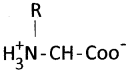
is a zwitterionic form a neutral form due to equal positive and negative charges.
2) Amino acid contains both acidic (carboxylic acid) and basic (amino group) centres and hence shows both positive and negative charge.


Question 5.


What constituents of DNA are linked by glylosidic bond?


Answer:


1.Nitrogen base and pentose (deoxy ribose) sugar, linked by glylosidic bond.
2.This bond is formed by dehydration.


Question 6.


Glycine and Alanine are different with respect to one substituent on the α – carbon. What are the other common substituent groups?


Answer:


1.– H and – CH3 are substituent groups respectively in Glycine and Alanine – at α – carbon.
2.Both as them contain – H, – COOH and – NH2 substituent groups in common.


Question 7.


Starch, Cellulose, Glycogen, Chitin are polysaccharides found among the following. Choose the one appropriate and write against each. [Mar. – 2018 m Mar. 17 – A.P & T.S ; Mar. ’15 – T.S]
a. Cotton fibre ………..
b. Exoskeleton of cockroach ……………
c. Liver ………………
d. Peeled potato …………..


Answer:


a. Cotton fibre – Cellulose
b. Exoskeleton of cockroach – Chitin
c. Liver – Glycogen
d. Peeled potato – Starch

Short Answer Questions

Question 1.


Explain briefly the metabolic basis for ‘living’?


Answer:

  1. Metabolic pathways can lead to a more complex structure from a simpler structure. For example, formation of sucrose from water and CO2 in mesophyll. They are called biosynthetic or anabolic pathways.
  2. Some metabolic pathways may lead to a simpler structure from a complex structure. For example, glucose becomes lactic acid in our skeletal muscle. They are called as degradative or catabolic pathways.
  3. Anabolic pathways, consume energy. For instance, assembly of a protein from amino acids requires energy input.
  4. Catabolic pathways lead to the release of energy. For instance, the glycolytic pathway leading to the formation of lactic acid from glucose and releases energy. It consists of 10 metabolic steps.
  5. Living organisms have learned to trap the energy liberated during degradation and store it in the form of chemical bonds. This stored bond is utilized as and when biosynthetic, osmotic and mechanical work is performed.
  6. The most important form of energy currency in living systems is the bond energy in a chemical called Adenosine Triphosphate (ATP).

Question 2.


Is rubber a primary metabolite or a secondary metabolite? Write four sentences about rubber?


Answer:

  1. Rubber is a secondary metabolite.
  2. Metabolic products that do not have identifiable functions in the host organisms are called secondary metabolites.
  3. Rubber is produced from latex of Hevea and Ficus elastica.
  4. Latex is produced in special type of tissues called laticiferous tissues.
  5. Tyres of vehicles are made from volcanization rubber.

Question 3.


Schematically represent primary, secondary and tertiary structures of a hypothetical polymer using protein as an example?


Answer:

Primary structureSecondary structureTertiary structure
1. Proteins are made of amino acids which have carboxyl (- COOH) and amino (- NH2). The -COOH end of an amino acid is joined to – NH2 end of the other amino acid. Many amino are joined by peptide bonds which held them together in a particular sequence and constitute the primary structure of proteins. This structure does not make a protein functional.1. Afunctional protein has 3 – dimentional configuration. It has one or more polypeptide chains. The sequence of amino acids determines where the chain will bend through and the formation of H-bonds peptide chains assume may be in the form of twisted helix or pleated sheet.1. When individual peptide chains of secondary structure of protein are further coiled and folded into sphere like shapes with the H-bonds between NH2 and COOH groups. Various other kinds of bonds cross linking on chain to another. They form tertiary structure.
2. It is linear sequence of amino acids2. Have α helices and β- sheets held in place of amino acids2. Final folding and twisting of poly peptide

Question 4.


Nucleic acid exhibits secondary structure, justify with example. [Mar. ’15 – T.S.]


Answer:

  1. Nucleic acid exhibits a wide variety of secondary structures.
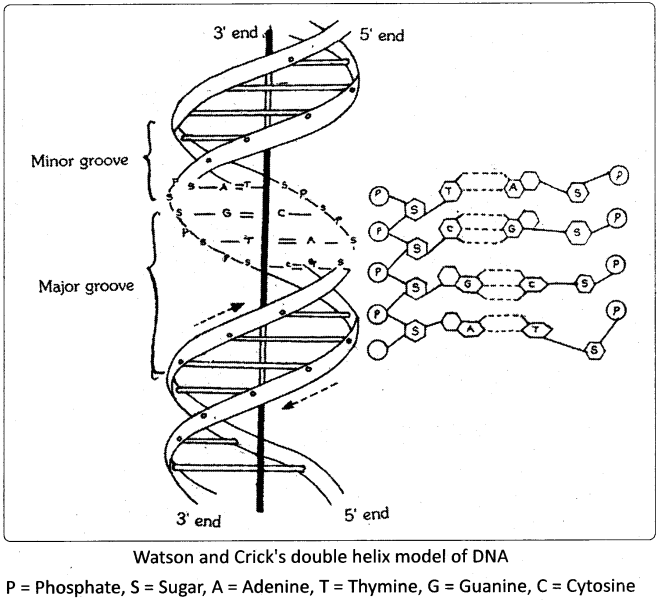
  2. For example, one of the secondary structures exhibited by DNA is a famous Watson-Crick Model.
  3. According to this model, DNA exists as a double helix. The two strands of polynucleotides are anti parallel i.e., run in the opposite direction.
  4. The backbone is formed by the sugar – phosphate sugar chain.
  5. The nitrogen bases are projected more or less perpendicular to the back bone but face inside. Adenine (A) and Guanine (G) of one strand pairs with Thymine (T) and Cytosine (C) respectively, on the other strand. Each step is represented by a pair.
  6. Coiling occurs at an angle of 360°. At each step turn is 36°. One full turn of the helical strand involves 10 base pairs.
  7. The length of each turn is 34A.
  8. The distance between two steps is 3.4A.
  9. This form of DNA with above features is called B – DNA.
Question 5.


Comment on the statement “living state is a non-equilibrium steady-state to be able to perform work.”?


Answer:

  1. A living organism consists of tens and thousands of chemical compounds called metabolites or biomolecules.
  2. Biomolecules are present at concentrations characteristic of each of them. For examples, the blood concentration of glucose in a normal healthy individual to 4.5 to 5.0 mm, while that of hormones would be nanograms / ml.
  3. All living organisms exist in a steady state characterized by concentrations of each of these biomolecules, that are in a metabolic flux.
  4. Any chemical or physical process moves spontaneously to equilibrium. The steady state is a non-equilibrium state. As per the physics, the systems at equilibrium cannot perform work.
  5. Living organisms work continuously, they can not afford to reach equilibrium. Hence the living state is a non-equilibrium steady – state to be able to perform work.
  6. Living process is a constant effort to present falling into equilibrium, which is acheived by energy input.
  7. Metabolism provides a mechanism for the production of energy. Hence the living state and metabolism are synonymous.
  8. Thus, without metabolism there can not be a living state.

Question 6.


Dynamic state of body constituents is a more realistic concept than the fixed concentrations of body constituents at any point of time – Elaborate?


Answer:

  1. Living organisms like simple bacterial cell, a protozoan, a plant or an animal contain thousands of organic compounds, the biomolecules.
  2. The biomolecules are present in certain concentration, and ore expressed as mols/cell or mols/litre etc.,
  3. All the biomolecules have a turn over. It means that they are constantly being changed into some other biomolecules and are also made from some other biomolecules. This breaking and making is through chemical reactions that are called metabolism.
  4. Each of the metabolic reactions results in the transformation of biomolecules. For example, removal of CO2 from amino acids making an amino acid into an amine.
  5. Majority of these metabolic reactions do not occur in isolation, but are always linked to some other reactions. It means, metabolites are converted into each other in a series of linked reactions called metabolic pathways.
  6. The metabolic pathways are either linear or circular, they may criss – cross each other. Flow of metabolites through the pathway has a definite rate and direction.
  7. The metabolite flow is called the dynamic state of body constituents. Interlinked metabolic traffic is very smooth and without a single reported mishap for healthy conditions.
  8. Every chemical reaction in a metabolic pathway is a catalysed reaction. There is no uncatalysed metabolic conversion in living systems.
  9. Proteins with catalytic power are named as enzymes. They hasten the rate of a given metabolic conversion.

Long Answer Type Questions

Question 1.


What are secondary metabolites? Enlist them indicating their usefulness to man?


Answer:


Metabolic products that do not have identifiable functions in the host organism are called secondary metabolites. Secondary metabolites are alkaloides, flavonoides, rubber, essential oils, antibiotics, coloured pigments, scents, gums, spices etc. Many of these secondary metabolites are useful to man.

  1. Pigments – Eg : Carotenoids, Anthocyanins etc.
  2. Alkaloids – Eg : Morphine, Codeine etc.
  3. Terpenoids – Eg: Monoterpenes, Diterpenes etc.
  4. Essential oils – Eg : Lemon, grass oil etc.
  5. Toxins – Eg : Abrin, Ricin
  6. Drugs – Eg : Vinblastin, Curcumin etc.
  7. Polymeric substances – Eg : Rubber, gums, cellulose etc.

Question 2.


What are the processes used to analyse elemental composition, organic constituents and inorganic constituents of living tissue? What are the inferences on the most abundant constituents of living tissue? Support the inferences with appropriate data?


Answer:


To analyse elemental composition, organic constituents and inorganic constituents of living tissue one has to perform chemical analysis.

Analyse Organic Compounds:

  1. Take any living tissue (a vegetable or a piece of liver etc) and grind it in trichloro acetic acid (Cl3C COOH) using a motor and a pestle.
  2. We obtain a thick slurry.
  3. If we were to strain this slurry through a cheese cloth or cotton, we would obtain two fractions. One is called the filtrate or acid soluble pool and the other is retentate or acid insoluble fraction.
  4. To identify a particular compound, one has to use various separation technique and separate an organic compound from the rest.
  5. Analytical techniques when applied to the compound gives us the molecular formula and probable structure of the compound.
  6. All the carbon compounds that we get from living tissues can be called biomolecules.

Analyse inorganic compounds:

  1. One weighs a small amount of a living tissue (say a leaf or liver and this is called wet weight) and dry it.
  2. All the water evaporates.
  3. The remaining material gives dry weight.
  4. Now if the tissue is fully burnt, all the carbon compounds are oxidised to gaseous form and are removed.
  5. The remaining is called ash.
  6. This ash contains inorganic elements like calcium, magnesium etc.
  7. Inorganic elements are also in acid solution fraction.

Elemental analysis:
Elemental analysis gives elemental composition of living tissues in the form of hydrogen, oxygen chlorine, carbon etc.

Analysis of compounds gives an idea of the kind of organic and inorganic compounds.

Question 3.


Nucleic acids exhibit secondary structure. Describe through Watson – Crick Model?


Answer:

  1. Nucleic acid exhibits a wide variety of secondary structures.
  2. For example, one of the secondary structures exhibited by DNA is a famous Watson-Crick Model.
  3. According to this model, DNA exists as a double helix. The two strands of polynucleotides are anti parallel i.e., run in the opposite direction.
  4. The backbone is formed by the sugar – phosphate sugar chain.
  5. The nitrogen bases are projected more or less perpendicular to the back bone but face inside. Adenine (A) and Guanine (G) of one strand pairs with Thymine (T) and Cytosine (C) respectively, on the other strand. Each step is represented by a pair.
  6. Coiling occurs at an angle of 360°. At each step turn is 36°. One full turn of the helical strand involves 10 base pairs.
  7. The length of each turn is 34A.
  8. The distance between two steps is 3.4A.
  9. This form of DNA with above features is called B – DNA.

Question 4.


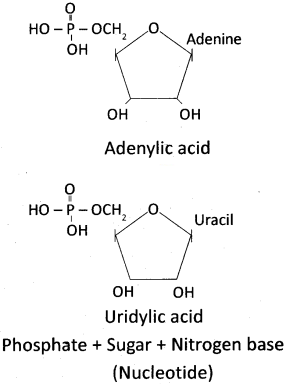
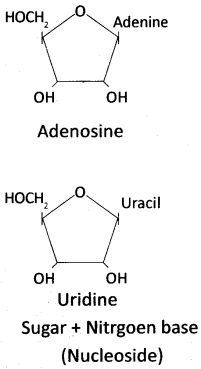
What is the difference between a nucleotide and nucleoside ? Give two examples of each with their structure?


Answer:

NucleotideNucleoside
1. Nucleotide is made up of nitrogen base sugar and phosphoric acid.1. Nucleoside is made up of nitrogen base and sugar.
2. Nucleotide of RNA is called ribonucleotide and nucleotide of DNA is called deoxyribo nucleotide2. Nucleoside with ribose sugar is called riboside of ribo-nucleoside. Nucleoside with deoxyribose sugar is called deoxyribonucleoside.
3. Example : Adenylic acid, guanylic acid, cytidyolic acid, thymidylic acid, uridylic acid, AMP
3. Example : Adeniosine, guanosine, cytidine, thymidine and uridine
Question 5.


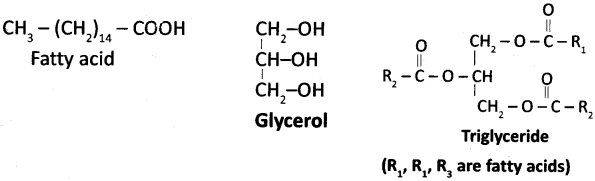
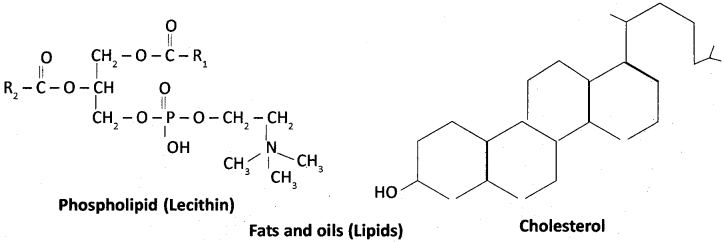
Describe various forms of lipid using a few examples.?


Answer:

  • Lipids are water insoluble.
  • Lipids could be simple fatty acids.
  • A fatty acid has a carboxyl group attached to an R-group.
    The R – group could be methyl (-CH3) or ethyl (- C2H5) or higher number of – CH2 groups (1 carbon to 19 carbons). For example, palmitic acid has 16 carbons including carboxyl carbon.
  • Arachidonic acid has 20 carbons including carboxyl carbon.
  • Fatty acids could be saturated (without double bond) or unsaturated (with one or more C = C double bonds)
  • Simple lipid is glycerol which is trihydroxy propane.
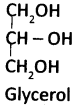
  • Many lipids have both glycerol and fatty acids. Here the fatty acids are found esterified with glycerol. They are then called monoglycerides, diglycerides and triglycerides.
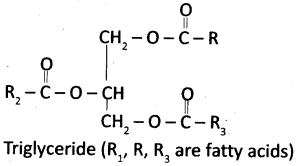
  • These are also called fats and oils based on melting point.
  • Oils have lower melting point (Eg. Gingely oil) and hence remain as oil in winters.
  • Some lipids have phosphorous and a phosphorylated organic compound in them. These are called phospholipids. They are found in cell membrane. One example is Lecithin.
  • Some tissues especially the neural tissues have lipids with more complex structures.
  • If a phosphate group is also found esterified to the sugar, they are called nucleotides. Example of nucleotides are adenylic acid, thymidylic acid, guanylic acid, uridylic acid and cytidylic acid.

Intext Question Answers

Question 1.


What are macro molecules? Give examples?


Answer:


Macro molecules are large sized biomolecules that have high molecular weight, lower solubility and complex molecular structure. It occurs in collaidal state. Macro molecules are formed by polymerisation of large number of micro molecules. They belong to four classes of organic compounds – carbohydrates, lipids, proteins and nucleic acids.

Question 2.


Illustrate a glycosidic, peptide, and a phospho-diester bond?


Answer:


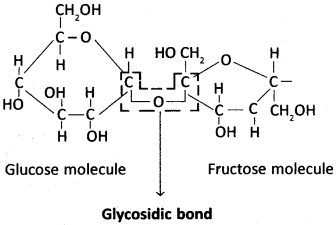
Glycosidic bond :
In a polysaccharide, the individual monosaccharides are linked by means of glycosidic bond. This bond is formed by dehydration. This bond is formed between two carbon atoms of two adjacent monosaccharides.
Peptide bond :
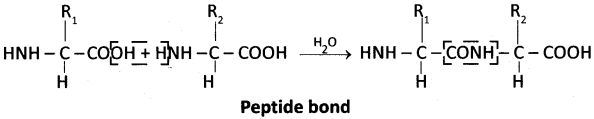
In a polypeptide or a protein amino acids are linked by peptide bonds. These bonds are formed by the reaction between carbocyl group (- COOH) of one amino acid with the amino group (-NH2) of the next amino acid, with the elimination of water.
Phospho-diester bond :
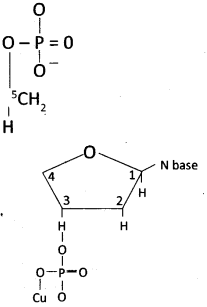
In a nucleic acid a phosphate moiecty links the 3′ – carbon of one sugar of one nucleotide to the 5′ carbon of sugar of the succeeding nucleotide. The bond between the phosphate and hydroxyl group of sugar is an ester bond. As there is one such ester bond on either side, it is called phospho-diester bond.
5′ carbon end
Question 3.


What is meant by tertiary structure of proteins?


Answer:


When a long protein chain of secondary structure is folded upon itself like a hollow woolen ball, it give rise to tertiary structure.

Tertiary structure is necessary for many biological activities of protein.

This gives us a 3 – dimension view of a protein.

Question 4.


Find and write down structures of 10 interesting small molecular weight biomolecules. Find if there is any industry which manufactures the compounds by isolation. Find out who are the buyers.


Answer:
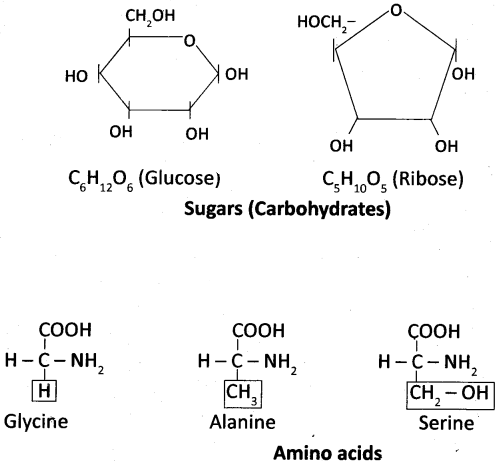


Question 5.


Proteins have primary structure. If you are given a method to know which amino acid is at either of the two termini (ends) of a protein, can you connect this information to purify or homogeneity of a protein?


Answer:


The primary sturcture of protein is based on the number type and order of amino acid present in the chain. A protein has a linear structure in which the left end of line represents the first and the right end represents the last amino acid. The number of amino acid in between the two ends determine the purity or homogeneity of proteins.

Question 6.


Find out and make a list of proteins used as therapeutic agents. Find other applications of proteins (Eg : Cosmetics etc.)?


Answer:


Proteins used as therapeutic agents are thrombin, fibrinogen, enkephalins, antigens, antibodies, streptokinase, protein tyrosine kinase, diastase, renin, insulin, oxytocin, vasopressin, etc.

Other applications :
Proteins are also used in cosmetics, dairy industries, textile industries, research techniques etc.

Question 7.


Explain the composition of triglyceride?


Answer:


The components of triglyceride are single molecule of glycerol and 3 fatty acids. In glycerol 3 carbon atoms are present along with 30 n groups. Fatty acids consists of long chain hydrocarbon with a carboxylic group at one end. Both of them form ester bond. This bond is saturated when single bonded carbons are present and unsaturated when double bonded carbon atoms are present.
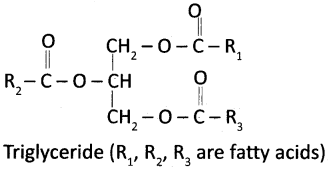
Question 8.


Can you describe what happens when milk is converted into curd or yoghurt, based on your Understanding of proteins?


Answer:


Milk is converted into curd or yughurt due to denaturation of proteins. The configuration of protein is lost. In denaturation disruption of bonds that maintains secondary and tertiary structure leads to the conversion of globular proteins into fibrous proteins. This involves a change in physical, chemical and biological properties of protein molecules.

Question 9.


Can you attempt building models of biomolecules using commercially availalble atomic models (Ball and Stick models)?


Answer:


Yes, models of biomolecules can be prepared using commercially available atomic models. Ball and stick models and space filling models are 3D models which serve to display the structure of chemical products and substances or biomolecules.

With ball and stick models, the centers of the atoms are connected by straight lines which represents covalent bonds. Double and triple bonds are often represented by springs.

The bond angles and bond lengths reflects the actual relationship. While the space occupied by the atoms is either not represented at all or only denoted essentially by the relative sizes of the sphere.

Question 10.


Attempt titrating an amino acid against a weak base and discover the number of dissociating (ionizable) functional groups in the amino acid?


Answer:


The existence of different ionic forms of amino acids can be easily understood by the titration curves. The number of dissociating functional group is one in case of neutral and basic amino acids and two in case of acidic amino acids.

Question 11.


Draw the structure of the amino acid, alanine?


Answer:
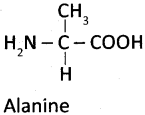

Question 12.


What are gums made of? Is Fevicol different?


Answer:


Gums are secondary metabolites. It is made up of compounds present in plant, fungi and microbial cells. Yes, Fevicol is different from gum. It is synthetic resin made by polymerisation manufactured by esterification of organic compounds.

Question 13.


Find out a qualitative test for proteins, fats and oils, amino acids and test any fruit juice, saliva, sweat and urine for them.?


Answer:


Biuret test for protein :
The biuret test is a chemical test used for determining the presence of peptide bonds, in a positive test, a copper II ion (Cu2+ ion) is reduced to copper I (Cu+) which forms a complex with the nitrogen and carbon of peptide bonds in an alkaline solution. A violet colour indicates the presence of protein.

Ninhydrin test for amino acid :
Ninhydrin is a chemical used to detect ammonia or primary and secondary amines. When reacting with these free amines, a deep blue or purple colour known as Ruhemann’s purple is evolved. Most of the amino acids are hydrolyzed and reacted with ninhydrin except proline (a secondary amine).

Solubility test for fats and oils :
A positive solubility test for fats is that the fat dissolves in lighter fluid and not in water. In this test, 5 drops of fat or oi! are added in two test tubes containing 10 drops of lighter fluid and 10 drops of cold water respectively.

Fruit juice :
Fruit juice contains sugar. So it cannot be tested by the above mentioned test.

Saliva :
Saliva contains proteins, mineral salts, amylase etc. So.it can be tested for proteins and amino acids.

Sweat :
Sweat contains NaCl salts.

Urine :
Urine contains proteins. So it can be tested for proteins.

Question 14.


Find out how much cellulose is made by all the plants in the biosphere and compare it with how much of paper is manufactured by man and hence what is the consumption of plant material by man annually. What a loss of vegetation?


Answer:


About 100 billion tonnes of cellulose is prepared per year by the plants of the world. The increase in industrialization increased the use of paper. Due to this reason vegetation is being lost to a great extent.

Question 15.


All life forms exhibit “Unity in diversity” – Give reasons?


Answer:


There is a wide diversity of all living organisms but their chemical composition and metabolic reactions appear to be similar. The most abundant chemical in all life forms in water. Living organisms contain more carbon, hydrogen, and oxygen than animate matter.
TS Inter 1st Year Botany Study Material Chapter 9 The Unit of Life

Very Short Answer Type Questions

Question 1.


What is the significance of vacuole in a plant cell?


Answer:


1.In plant cell, vacuole plays an important role in osmoregulation.
2.In some plant cells vacuolar sap contains pigments like anthocyanin, which impart colour to the plant parts.


Question 2.


What does S refer in a 70S & and 80S ribosome?


Answer:


1.S refers sedimentation coefficient (expressed in Svedburg unit)
2.It is indirectly a measure of density and size.


Question 3.


Mention a single membrane bound organelle which is rich in hydrolytic enzymes?


Answer:


1.Lysosomes.
2.They contain hydrolases capable of digesting carbohydrates, proteins, lipids and nucleic acids.


Question 4.


What are gas vacuoles? State their functions?


Answer:


Gas vacuoles are inclusion bodies in cytoplasm of Blue green, purple and green photosynthetic bacteria. They are filled with air and help the bacteria to float on the surface of water.


Question 5.


What is the function of a polysome?


Answer:


1.In prokaryotes, several ribosomes may attach to single m RNA and form a chain called polysome.
2.The ribosomes of a polysome translate the m RNA into proteins.


Question 6.


What is the feature of a metacentric chromosome? [Mar. – 2018]


Answer:


1.The metacentric chromosome has middle centromere.
2.Hence this chromosome consists of two equal arms.


Question 7.


What is referred to as Satellite Chromosome?


Answer:


1.Satellite Chromosome: Chromosome with non-staining secondary constriction at a constant location.
2.This gives the appearance of a small fragment called the satellite.


Question 8.


What are microbodies? What do they contain?


Answer:


1.Peroxysomes and glyoxysomes are called microbodies.
2.Glyoxysomes contain the enzymes of glyoxylate cycle which convert stored lipid into carbohydrates. Peroxysomes contain enzymes which convert fatty acids into carbohydrates


Question 9.


What is middle lamella made of? What is its functional significance? Answer:
1.Middle lamella is made of calcium pectate.
2.It holds or glues the different neighbouring cells together.


Question 10.


What is osmosis?


Answer:


1.Movement of water by diffusion across the membrane is called Osmosis.
2.In this process, water moves from higher concentration to lower concentration across the plasma membrane.


Question 11.


Which part of the bacterial cell is targeted in gram staining?


Answer:


1.Chemical composition of cell envelop.
2.Bacteria that take up gram stain are called Gram positive and that do not are called Gram negative.


Question 12.


Which of the following is not correct?


a) Robert Brown discovered the cell.
b) Schieiden and Schwann formulated the cell theory.
c) Virchow explained that cells are formed from pre-existing cells.
d) A unicellular organism carries out its life activities within a single cell,


Answer:


a) Robert Brown discovered the cell – not correct.


Question 13.


New cells generate from
a) bacterial fermentation
c) pre-existing cells


Answer:


c) Pre-existing cells


Question 14.


Match the following. [Mar. – 2019]
a) Cristae i) Flat membranous sacs in stroma
b) Cisternae ii) Infoldings in mitochondria
c) Thylakoids iii) Disc-shaped sacs in Golgi apparatus


Answer:


a) — ii b) — iii c) — i


Question 15.


Which of the following is correct?


a) Cells of all living organisms have a nucleus.
b) Both animal and plant cells have a well defined cell wall.
c) In prokaryotes, there are no membrane bound organelles.
d) Cells are formed de novo from abiotic materials.


Answer:


a) In prokaryotes, there are no membrane bound organelles – correct.

Short Answer Type Questions


Question 1.


Discuss briefly the role of nucleolus in the cells actively involved in protein synthesis?


Answer:


1.A spherical body present in nuclear matrix, the nucleoplasm is called as , nucleolus (plu. Nucleoli). It is not a membrane bound structure.
2.In some nucleus one or more nucleoli may be presents
3.It is a site for active synthesis of ribosomal RNA.
4.rRNA make cell organelles ribosomes, the sites of protein synthesis, several ribosomes may attach with a mRNA to form a chain, referred to be polyribosomes (polysome.) The ribosomes of a polysome translate the mRNA into proteins.
5.Larger and more numerous nucleoli are present in cells actively carrying out protein synthesis.


Question 2.


Explain the association of carbohydrate to the plasma membrane and its significance?


Answer:


1.The lipid component of the plasma membrane mainly cpnsists of phospho-glycerides.
2.Biochemical investigations clearly revealed that the cell membranes also possess carbohydrates.
3.Carbohydrates present outside the plasma membrane and are attached to extrinsic proteins, integral protein and also hydrophilic (polar) heads of the lipids. They may be glycoproteins or glycolipids.


Question 3.


Comment on the cartwheel structure of centriole?


Answer:


1.Centrosome is an organelle usually containing two cylindrical structures called centrioles.
2.They are surrounded by amorphous pericentriolar materials.
3.Both the centrioles in a centrosome lie perpendicular to each other in which each has an organisation like the cartwheel.
4.They are made up of nine evenly spaced peripheral fibrils of tubulin.
5.Each of the peripheral fibril is a triplet. The adjacent triplets are also linked.
6.The central part of the centriole is also proteinaceous and called the hub, which is connected with tubules of the peripheral triplets by radial spokes made of protein.
7.The centrioles form the basal body of the cilia or flagella, and the spindle fibres that give rise to spindle apparatus during cell division in animal cells.


Question 4.


Briefly describe the cell theory?


Answer:


1.Cell theory was proposed by M.J. Sehleiden, a German botanist and T. Schwann, a British zoologist.
2.The cell theory states that
a) Cell is the structural unit of all organisms.
b) Cell is the functional unit of all organisms.
c) R.Virchow proposed that new cells arise from pre-existing cells (Omnis cellula- e-cellula) or from the parent cell.


Question 5.


Differentiate between Rough Endoplasmic Reticulum (RER) and Smooth Endoplasmic Reticulum (SER). [Mar. 17 -A.P.]


Answer:

Rough Endoplasmic Reticulum (RER)Smooth Endoplasmic Reticulum (SER)
1. The endoplasmic reticulum bearing ribosomes on their surface is called rough endoplasmic reticulum (RER)1. The endoplasmic reticulum which does not bear ribosomes is called smooth endoplasmic reticulum (SER)
2. RER is frequently observed in the cells actively involved in protein synthesis and secretion2. SER is the major site for synthesis of lipid. In animal cells, lipid-like steroidal hormones are synthesized in SER

Question 6.


Give the biochemical composition of plasma membrane. How are lipid molecules arranged in the membrane?


Answer:


The biochemical composition of plasma membrane is lipids, proteins and carbohydrates. In the membrane lipids are arranged in bilayer. Within the membrane lipids are arranged with the polar (hydrophilic) head towards the outer side. This ensures that the non-polar tail of saturated hydrocarbons is protected from the aqueous environment.
Fluid Mosaic Model was proposed by Singer and Nicolson. It is most widely accepted model. They described the cell membrane as “Protein ice bergs in a sea of lipids”. According to this model lipids are quasi-fluid in nature. This enables lateral movement of proteins within the overall bilayer.


Question 7.


What are plasmids? Describe their role in bacteria?


Answer:


1.Small circular DNA molecules found outside genomic DNA in many Bacteria are called plasmids.
2.The plasmid DNA confers certain unique phenotypic characters such as resistance to antibiotics in bacteria.
3.Plasmid DNA is also useful to monitor bacterial transformation with foreign DNA.


Question 8.


What are histones? What are their functions?


Answer:


1.Basic proteins associated with DNA in eukaryotes are called Histones.
2.A typical nucleosome contains 200 bt of DNA double helix wrapped (2 turns) around a core of histone octamer having 2 copies each of 4 types of histone proteins (H2A, H2B, H3and H4). HI histone molecule lies outside the nucleosome core and seals the 2 turns of DNA by binding at the point where DNA enters and leaves the core.
3.The association between negatively charged DNA and positively charged histones allows for a meaningful DNA packaging inside the nucleus.


Question 9.


What is Cytoskeleton? What functions is it involved in?


Answer:


1.An elaborate network of filamentous proteinaceous structures present in the cytoplasm is collectively referred to as cytoskeleton.
2.Eukaryotic cells contain three major components of cytoskeleton – namely micro filaments, intermediate filaments and microtubules.
3.The cytoskeleton in a cell is involved in many functions such as mechanical support, maintenance of cell shape, cell motility, intracelluar transport, signalling across the cell and karyokinesis (movement of chromosomes during cell division).


Question 10.


What is endomembrane system? What cell organelles are not included in it? Why?


Answer:


1.Each of the membranous organelles is distinct in terms of its structure and function.
2.Many of these membranous organelles are together considered as endomembrane system because their functions are co-ordinated.
3.The endomembrane system includes endoplasmic reticulum (ER), golgi complex, lysosomes and vacuoles.
4.Since the functions of mitochondria, chloroplast and peroxisomes are not co¬ordinated with the above components, these are not considered as part of the endomembrane system.


Question 11.


Distinguish between active transport and passive transport?


Answer:


The molecules that moves across the membrane without any requirement of energy is called passive transport. A few ions or molecules are transported across the membrane through its carrier proteins against their concentration gradient, i.e., from lower to the higher concentration. Such a transport is an energy-dependent process, in which ATP is utilised and it is called active transport. Eg : Na+/K+ pump.


Question 12.


What are mesosomes? What do they help in plasma?


Answer:


1.Plasma membrane infoldings in some bacteria are called mesosomes.
2.These special membranous extensions are in the form of vesicles, tubules and lamellae.
3.Mesosomes help in cell wall formation, DNA replication and its distribution to daughter cells.
4.They also help in respiration, secretion, processes, to increase the surface area of the plasma membrane (helps in absorption of nutrients) and enzymatic content.


Question 13.


What are nucleosomes? What are they made of? [Mar. – 2019, May 17 ; Mar. 14]


Answer:


Chromatin appears as beads on string. The beads are known as nucleosomes. Typical nucleosome contains 200 bp of DNA double helix wrapped (two turns) around a core of histone octamer having two copies of each of four types of histone proteins viz., H2A, H2B, H3 and H4.


Question 14.


How do neutral solutes move across the plasma membrane? Can the polar molecules also move across it in the same way? If not, then how are these transported across the membrane?


Answer:


1.Neutral solutes move across the plasma membrane by means of diffusion along
the concentration gradient. It moves from higher to lower concentration.
2.No, the polar molecule cannot move across it in the same way.
3.Polar molecules require a carrier protein of the membrane to facilitate their transport across the membrane.
4.Some ions or molecules are transported across the membrane against their concentration gradient, which is an energy dependent process. It is called active transport. In active transport ATP is utilised.


Question 15.


Name two cell-organelles that are double membrane bound. What are the characteristics of these two organelles? State their functions and draw labelled diagrams of both.


Answer:


Chloroplast is the cell organelle which contains chlorophyll pigment.
1.Chloroplasts are double membrane bound structure.
2.If the two membrane, the inner membrane is relatively less permeable.
3.The inner space of chloroplast is filled with a colourless matrix called stroma.
4.Flattened sacs called thylakoid are present in stroma
5.They lakoids are arranged as a pile of coins called grana
img1
6.Theylakoids enclose space called lumen
7.Lumen contain pigments
Function:
1.Stroma contains enzymes required for the synthesis of carbohydrate and proteins
2.Chloroplasts are photosyathetic in funciton.
Mitochondria is also called the power houses of cell [Mar. ’15 – A.P.]
1.Mitochondria are double membrane bourd structure.
2.Mitochondria is sausage shae or chlirdroca;
3.Eact mitochondria is a double membrane bound structure with outer and inner membrane.
Structure of Mitochondrion (Longitudinal Section)
img2
4.Outer membrane is smooth. Inner membrane divide the lumen into outer compartment and inner compartment.
5.Inner compartment is filled with matrix.
6.Inner membrane forms a number of infoldings called cristae towards matrix.
Function:
1.Mitochondria are the sites of aerobic respiration. They produce cellular energy in the form of ATP. hence they are called power houses of the cell.
2.Matrix possess single circular DNA molecule, a few RNA molecules, ribosome (70S) required for protein synthesis.


Question 16.


What are the characteristics of a prokaryotic cell?


Answer:


1.Prokaryotic cell organisation is fundamentally similar.
2.Prokaryote shows a wide variety of shapes and functions.
3.All prokaryotic cells have cell wall surrounding the cell membrane.
4.The fluid matrix filling the cell is the cytoplasm.
5.There is no well defined nucleus.
6.The genetic material is basically naked, that means not enveloped by a nuclear membrane.
7.In addition to the genomic DNA (circular DNA), many bacteria have small circular DNA outside the genomic DNA. These smaller DNAs are called plasmids.
8.No organelles like in eukaryotes are found except in ribosomes.
9.A specialized differentiated form of cell membrane called mesosome is the characteristic of prokaryotic cell.
10.It is essentially an infolding of the cell membrane.


Question 17.


Multicellular organisms have division of labour. Explain?


Answer:


1.Multicellular organisms have numerous cells.
2.The cells in multicellular organisms originate by the division of single celled zygote.
3.Newly formed cells are specialised to perform specific function and a division of labour is established between these cells which co-exist in the body.
4.Specialization of cells into tissues, organs and organ system is advantageous for multicellular organisms.
5.Different functions are carried out by different groups of cells in an organism. This is known as division of labour.


Question 18.


Cell is the basic unit of life. Discuss in brief?


Answer:


1.All life begins as a singe cell.
2.Cell is a unit of structure and function. The unicellular organisms complete their entire life cycle as a single cell.
3.In multicellular organisms cells are grouped into tissues, tissues into organs and organs into organ system. So cell is a basic unit of every small or complex organism.
4.Each cell is made up of several organelles just like the one carried by different organ system. Thus all the life activities of an organism are present in miniature form in each and every cell of its body.


Question 19.


What are nuclear pores? State their function?


Answer:


At a number of places, the nuclear envelope is interrupted by minute pores which are formed by the fusion of its two membranes. These are called nuclear pores. A nuclear pore has complex structure.
Function :
The nuclear pores are the passage through which movement of RNA and protein molecules takes place in both directions between the nucleus and the cytoplasm.


Question 20.


Both lysosomes and vacuoles are endomembrane structures, yet they differ in terms of their functions. Comment?


Answer:


1.Both lysosomes and vacuoles are endomembrane structures. Yet they differ in terms of their function because they contain different materials.
2.The isolated lysosomal vesicles have been found to be very rich in almost all types of hydrolytic enzymes such as lipase, protease, carbohydrates. These enzymes are capable of digesting carbohydrate, proteins, lipids and nuclic acids.
3.Vacuoles contain water sap, excretory products etc. In Amoeba, conctratile vacuole is important for excretion. In plants it plays an important role in osmoregulation.
4.Thus though lysosomes and vacuoles are endomembrane, they are not similar in structure and function.


Question 21.


Briefly give the contribution of the following scientists in formulating the cell theory.
a) Rudolf Virchow
b) Schleiden and Schwann


Answer:


a) Rudolf Virchow :
First explained that cells divide and new cells are formed from pre-existing cells (Omnis cellula-e cellula). He modified the hypothesis of Schleiden and Schwann to give the cell theory. Cell theory is
1.All living organisms are composed of cells and products of cells.
2.All cells arise from pre-existing cells.
b) Schleiden and Schwann :
Schleiden, a German botanist, examined a large number of plants and observed that all plants are composed of different kinds of cells which form the tissues of the plant.
Schwann, a British zoologist, studied different types of animal cells and reported that cells had a thin outer layer which is today known as plasma membrane. He also concluded, based on his studies on plant tissue, that the presence of cell wall is a unique character of plant cells.
On the basis of this Schwann proposed the hyothesis that the bodies of animals and plants are composed of cells and products of cells.


Question 22.


Is extra genomic DNA present in prokaryotes and eukaryotes? If Yes, indicate their location in both the types of organisms?


Answer:


1.Yes.
2.In prokaryotes, in addition to the genomic DNA (single chromosome / circular DNA) many bacteria have small circular DNA outside the genomic DNA. These smaller DNAs are called plasmids.
3.In Eukaryotes extra genomic DNA is present in mitochondria and chloroplast. Nucleolus has little amount of DNA.


Question 23.


Structure and function are correctable in living organisms. Can you justify this by taking plasma membrane as an example?


Answer:


1.The structure of plasma membrane is similar in all organisms – ranging from unicellular prokaryotes to multicellular eukaryotes.
2.Plasma membrane in all organisms is made of lipid bilayer. The polar (hydrophilic) heads of lipids are faced towards outside and hydrophilic tails are faced towards inside.
3.The function of plasma membrane as semi permeable membrane is also similar in all living organisms.
4.Neutral solutes and solvents like water move across the plasma membrane passively according to their concentration gradient.
5.Polar molecules like ions move across the plasma membrane with the help of carrier proteins against their concentration gradiant. It is called active transprot.

Long Answer Type Questions


Question 1.


What structural and functional attributes must a cell have to be called a living cell?


Answer:


The cell which have nucleus is called living cell. It was first observed by Robert Brown.
The cell in which nucleus is absent is called dead cell.
The nucleus controls and regulates the function of all the cell organelles. It is therefore, referred to as dynamic centre of the cell or master control of the cell or cell brain.
Nucleus involves in heriditary.
Nucleus plays an important role in reproduction in unicellular organisms.
Cytoplasm is a semi fluid matrix. It occupies the volume of the cell.
Cytoplasm is the main area of cellular activities in both the plant and animal cell.
Various chemical reactions occur in it to keep the cell in the living state.


Cell organelles :
The cytoplasm shows several membrane bound structures called cell organelles which perform different functions and keep the cell in a dynamic state. Cell organelles are endoplasmic reticulum (ER), the Golgi complex, lysosomes, mitochondria, plastids, microhadies and vacuoles.
In prokaryotic cell membrane bound cell organelles are absent.
Ribosomes are considered as smallest cell organelle in the cells. Ribosomes are not bounded by a definite unit membrane within the cell; Ribosomes are called protein factories as they are important in protein synthesis.


Question 2.


Eukaryotic cells have organelles which may?


a. Not be bound by a membrane
b. Bound by a single membrane
c. Bound by a double membrane
Group the various sub-cellular organelles into these three categories.


Answer:


Eukaryotic cells have organelles which may
a) Not be bound by a membrane are Ribosomes.
b) Bound by a single membrane are lysosomes, vacuoles, microbodies (Peroxysomes and Glyoxysomes)
c) Bound by a double membrane are Endoplasmic reticulu,, Golgi bodies, mitochondria, chloroplast, nucleus.


Question 3.


The genomic content of the nucleus is constant for a given species whereas the extra chromosomal DNA is found to be variable among the members of a population. Explain.


Answer:


1.For a given species the genomic content of the nucleus is constant to maintain specificity and stability.
2.Some bacteria have extra chromosomal DNA called plasmids.
3.They can exist independently in the cytoplasm or may be integrated with the chromosome.
4.The plasmids can render bacteria drug resistance, give them new metabolic pathways and make them pathogenic.
5.The presence of DNA in the chloroplast and mitochondria helps in self duplication.
6.Hence both chloroplast and mitochondria are called semi-autonomous organelles.


Question 4.


Justify the statement. “Mitochondria are power houses of the cell”?


Answer:


1.Mitochondria occur in aii eukaryotic cells.
2.Mitochondria possess double membrane envelope. Two unit membranes are separated by perimitochosidriaf space.
3.Outer membrane is smooth. Inner membrane shows invaginations called cristae. The inner space is filled with fluid matrix.
4.Matrix consists of 70S ribosomes, circular DNA and RNA. The matrix also comprises respiratory enzymes.
5.Many stalked particles present on the surface of cristae are called F0- Fx particles.
6.Krebs cycle of respiration occurs in the matrix and electron transport takes place in cristae.
7.Mitochondria are concerned with cellular respiration. Food materials are oxidised and potential energy is converted into kinetic energy. It is stored in the form of adenosine triphosphate (ATP). So mitochondria are called power houses of the cell.
Img3


Question 5.


Is there a species specific or region specific type of plastids? How does one distinguish one from the other?


Answer:


Plastids bear specific pigments, thus imparting specific colours to the part of the plant which possesses them. Based on the type of pigments plastids can be classified into chloroplasts, chromoplasts and leucoplasts.
Chloroplasts :
They contain chlorophyll and carotenoid pigments which are responsible for photosynthesis.
Chromoplasts :
In chromoplasts fat soluble carotenoid pigments like carotene, xanthophylls and others are present. This gives the part of the plant a yellow, orange or red colour.
Leucoplasts :
They are colourless plastids of varied shapes and sizes with stored nutrients.
a) Amyloplasts store carbohydrates (starch) Eg. Potato
b) Elaioplasts store oils and fats
c) Aleutoplasts store proteins.

Question 6.


Write the functions of the following?


a. Centromere
b. Cell wall
c. Smooth ER
d. Golgi Apparatus
e. Centrioles


Answer:


a) Centromere :
Every chrpmosome has centromere. On the sides of centromere disc-shaped structures called kinetochores are present. These are the sites of implementation of the microtubules of spindle fibres. During anaphase (cell division) based on the position of centromere, chromosomes exhibit V, L, J and I shapes during their movement towards opposite poles.
b) Cell wall functions :
1.The cell wall protects the protoplast.
2.It gives a definite shape to the cejls and provides mechanical strength.
3.Cell wall is permeable in nature and allows the substances to pass through.
c) Smooth ER:
1.Smooth ER is the major site for synthesis of lipid.
2.In animal cells, lipid like steroidal hormones are synthesized in SER.
d) Golgi Apparatus functions are:
1.It performs the function of packaging materials to be delivered either to the intra-cellular targets or secreted outside the cell.
2.Number of proteins synthesised by ribosomes are modified in the cisternal of golgi apparatus before they are released.
3.It is an important site of formation of glycoproteins and glycolipids.
4.In plants Golgi complex involves in the synthesis of cell wall materials.
5.It plays an important role in “cell plate formation” during cell division.
e) Centriole function :
1.It forms the basal body of cilia or flagella.
2.It forms spindle fibres that give rise to spindle apparatus during cell division in animal cells.

Question 7.


Are the different types of plastids interchangeable? If yes, give examples where they are getting converted from one type to another?


Answer:


Yes, plastids are interchangeable.
During various stages of growth, the plastids change their colour from one type to other.
For instance, in potato when tubers are exposed to air, leucoplasts convert into chloroplasts.
In tomato and chillies, the Ovaries contain leucoplasts, which change into chloroplasts after fertilisation and in ripe condition, the chloroplasts are transformed into chromoplasts.
Chloroplasts can be seen in the petals which are green initially but later become coloured.


Question 8.


Describe the structure of the following with the help of labelled diagrams?


i) Nucleus
ii) Centrosome


Answer:


i) Nucleus:
1.Nucleus was first described by Robert Brown.
2.The nucleus consists of highly extended and elaborate nucleo protein fibres called chromatin, nuclear matrix and spherical bodies called nucleoli.
3.The nuclear envelope, consists of two membranes with a space between called the perinuclear space.
4.Outer membrane is continuous with the endoplasmic reticulum and also bears ribosomes on it.
5.At a number of places the nuclear envelope is interrupted by minute pores, which are formed by the fusion of its two membranes.
6.Nuclear pore establishes a contact between nucleoplasm and cytoplasm.
7.The nuclear matrix or the nucleoplasm contains nucleolus and chromatin.
8.Nucleoli are spherical structures present in the nucleoplasm.
9.The content of nucleolus is continuous with the rest of the nucleoplasm as it is not membrane bound structure.
10.Nucleolus is a site for active ribosomal RNA synthesis. Numerous nucleoli carry out protein synthesis.
Img4
ii) Centrosome :
1.Centrosome is an organelle usually containing two cylindrical structures called centrioles.
2.They are surrounded by amorphous pericentricular materials.
3.Both the centrioles in the centrosome lie perpendicular to each other in which each has an organisation like cartwheel.
4.They are made up of nine evenly spaced peripheral fibrils of tubulin.
5.Each of the peripheral fibril is a triplet.
6.The adjacent triplet are also linked.
7.The hub of centriole is connected with tubules of the peripheral triplets by radial spokes made of protein.
Img5


Question 9.


What is a centromere? How does the position of centromere form the basis of classification of chromosomes? Support your answer with a diagram showing the position of centromere on different types of chromosomes.


Answer:


1.The region of the chromosome where two chromatids are held together at a point along their length is called primary contriction or centromere.
2.Two disc like structures present on either side of the centromere are known as kinetochores.
3.On the basis of centromere position monocentric chromosomes are 4 types :

  1. Metacentric :
    Centromere is present in the middle point of the chromosome. Both arms are equal in length. Chromosome appears in V shape during anaphase.
  2. Submetacentric :
    Centromere is slightly away from the middle point of chromosome and both arms are unequal in length. Chromosome appears in ‘L’ shape during anaphase.
  3. Acrocentric :
    Centromere is present towards one side. One arm is very long and the other arm is very short. Chromosome appears in ‘J’ shape during anaphase.
  4. Telocentric :
    Centromere is present at the end of the arm. Only one arm is present. Chromosome appears in T shape during anaphase.
    Img6

Intext Question Answers


Question 1.


What is a mesosome in a prokaryotic cell? Mention the functions that it performs?


Answer:


1.Plasma membrane is made up of lipids and protein.
2.Mesosome is a special membranous structure which is formed by the extensions of plasma membrane into the cell.
3.These extensions are in the form of vesicles, tubules and lamellae.
4.They help in cell wall formation, DNA replication and its distribution to daughter cells.
5.They also help in respiration, secretion processes to increase the surface area of plasma membrane and enzymatic content.


Question 2.


How do neutral solutes move across the plasma membrane? Can the polar molecules also move across it in the same way? If not, then how are these transported across the membrane?


Answer:


1.Neutral solute may move across the membrane by the process of simple diffusion along the concentration gradient i.e., from higher concentration to lower concentration.
2.Polar molecules require carrier proteins of the membrane to facilitate their transport across the membrane.
In active transport, a few ions or molecules (eg., Na+/ K+ pump) are transported across the membrane by carrier proteins against their concentration gradient (i.e. from lower to higher concentration) with the utilization of ATP.


Question 3.


What are the characteristics of a prokaryotic cell?


Answer:


1.Prokaryotic cell organisation is fundamentally similar.
2.Prokaryote shows a wide variety of shapes and functions.
3.All prokaryotic cells have cell wall surrounding the cell membrane.
4.The fluid matrix filling the cell is the cytoplasm.
5.There is no well defined nucleus.
6.The genetic material is basically naked, that means not enveloped by a nuclear membrane.
7.In addition to the genomic DNA (circular DNA) many bacteria have small circular DNA outside the genomic DNA. These smaller DNAs are called plasmids.
8.No organelles like in eukaryotes are found except in ribosomes.
9.A specialized differentiated form of cell membrane called mesosome is the characteristic of prokaryotic cell.
10.It is essentially an infolding of the cell membrane.


Question 4.


Multicellular organisms have division of labour. Explain?


Answer:


1.Multicellular organisms have numerous cells.
2.The cells in multicellular organisms originate by the division of single celled zygote.
3.Newly formed cells are specialised to perform specific function and a division of labour is established between these cells which co-exist in the body.
4.Specialization of cells into tissues, organs and organ system is advantageous for multicellular organisms.
5.Different functions are carried out by different groups of cells in an organism. This is known as division of labour.


Question 5.


Cell is the basic unit of life. Discuss in brief?


Answer:


1.Cell is a unit of structure and function. The unicellular organisms complete their entire life cycle as a single cell.
2.In multicellular organisms cells are grouped into tissues, tissues into organs and organs into organ system. So cell is a basic unit of every small or complex organism.
3.Each cell is made up of several organelles just like the one carried by different organ system. Thus all the life activities of an organism are present in miniature form in each and every cell of its body.


Question 6.


What are nuclear pores ? State their function?


Answer:


At a number of places the nuclear envelope is interrupted by minute pores which are formed by the fusion of its two membranes. These are called nuclear pores. A nuclear pore has complex structure.
Function :
The nuclear pores are the passage through which movement of RNA and protein molecules takes place in both directions between the nucleus and the cytoplasm.


Question 7.


Both lysosomes and vacuoles are endomembrane structures, yet they differ in terms of their functions. Comment?


Answer:


1.Both lysosomes and vacuoles are endomembrane structures. Yet they differ in terms of their function because they contain different materials.
2.The isolated lysosomal vesicles have been found to be very rich in almost all types of hydrolytic enzymes such as lipase, protease, carbohydrates. These enzymes are capable of digesting carbohydrate, protein^, lipids and nuclic acids.
3.Vacuoles contain water sap, excretory products etc. In Amoeba, conctratile vacuole is important for excretion. In plants it plays an important role in osmoregulation,
4.Thus though lysosomes and vacuoles are endomembrane, they are not similar in structure and function.


Question 8.


What is a centromere? How does the position of centromere form the basis of classification of chromosomes? Support your answer with a diagram showing the position of centromere on different types of chromosomes.


Answer:


1) On the basis of centromere position monocentric chromosomes are 4 types :

  1. Metacentric :
    Centromere is present in the middle point of the chromosome. Both arms are equal in length. Chromosome appears in V shape during anaphase.
  2. Submetacentric :
    Centromere is slightly away from the middle point of the chromosome and both arms are unequal in length. Chromosome appears in ‘L’ shape during anaphase.
  3. Acrocentric :
    Centromere is present towards one side. One arm is very long and the other arm is very short. Chromosome appears in ‘J’ shape during anaphase.
  4. Telocentric :
    Centromere is present at the end of the arm. Only one arm is present. Chromosome appears in ‘I’ shape during anaphase.

TS Inter 1st Year Maths 1A Matrices Solutions Exercise 3(f)

I.
Find the rank of each of the following matrices.

Question 1.
[1000]

Answer:
Let A = [1000] and det A = 1
∴ ρ(A) = Rank of the matrix A = 1.

Question 2.
[1001]

Answer:
Let A = [1001] and det A = 1 ≠ 0.
∴ ρ(A) = 2

Question 3.
[1010]

Answer:
Let A = [1010] and det A = 0
∴ ρ(A) = 1

Question 4.
[1110]

Answer:
Let A = [1110] and det A = -1 ≠ 0.

Question 5.
[120143]

Answer:
Let A = [120143]
The determinant of a submatrix of order 2 × 2 of A = 1243 = 3 + 8 = 11 ≠ 0
∴ ρ(A) = 2

Question 6.
[123463]

Answer:
Let A = [123463]
The determinant of a submatrix order 2 × 2 of A is = 1234 = -2 ≠ 0

II.
Question 1.
100010001

Answer:
Let A = 100010001 and det A = 1(1 – 0) = 1 ≠ 0
∴ ρ(A) = 3

Question 2.
120431102

Answer:
Let A = 120431102
and det A = 1(6) – 4(4) – 1(2)
= 6 – 16 – 12 = -12 ≠ 0
∴ ρ(A) = 3

Question 3.
120231342 (March 2015 T.S)

Answer:
Let A = 120231342
and det A = 1(6 – 4) – 2(4) + 3(2)
= 2 – 8 + 6 = 0
The determinant of submatrix of order 2 × 2 of A = 2334 = 8 – 9 = – 1 ≠ 0
Hence ρ(A) = 2

Question 4.
111111111

Answer:
Let A = 111111111 and
det A = 1(0) – 1(0) + 1(0) = 0
The determinant of submatrix of order 2 × 2 of A is 1111 = 0
Hence ρ(A) = 1

Question 5.
132243012125

Answer:
Consider 3 × 3 submatrix of above matrix
|A| = 132243012
= 1(8 – 3) – 2(9 + 8)
= 5 – 34 = -29 ≠ 0
∴ ρ(A) = 3

Question 6.
042101123251

Answer:
Let A = 042101123251 and
Consider a submatrix B of order 3 × 3 of above matrix ‘A’.
Then |B| = 042101123
= -1(12 – 4) + 1(4)
= -8 + 4 = -4
Hence ρ(A) = 3

TS Inter 1st Year Maths 1A Matrices Solutions Exercise 3(e)

0

TS Inter 1st Year Maths 1A Matrices Solutions Exercise 3(e)

I.
Question 1.
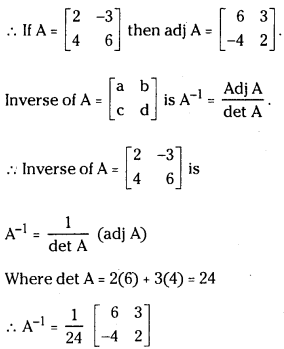
Find the adjoint and inverse of the following matrices. (March 2002)

i) [2436]
Answer:
If A = [acbd] then adj A = [dcba]
TS Inter 1st Year Maths 1A Solutions Chapter 3 Matrices Ex 3(e) 1

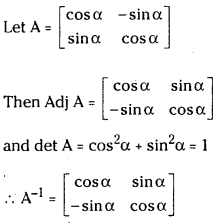
ii) [cosαsinαsinαcosα]
Answer:
TS Inter 1st Year Maths 1A Solutions Chapter 3 Matrices Ex 3(e) 2

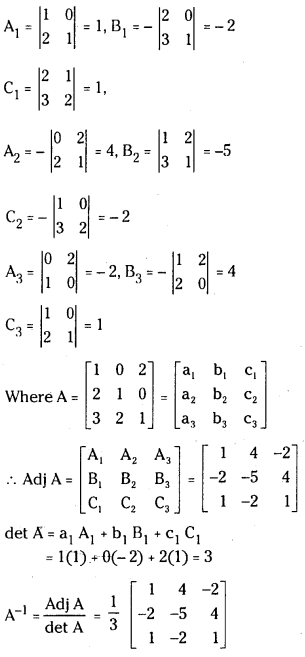
iii) Find the adjoint and inverse of the matrix 123012201.
Answer:
Find cofactors of elements in the matrix as
TS Inter 1st Year Maths 1A Solutions Chapter 3 Matrices Ex 3(e) 3

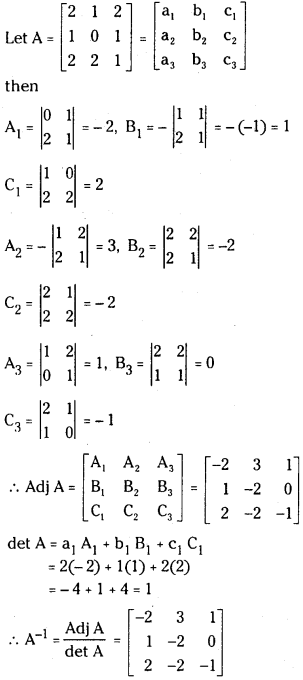
iv) 212102211
Answer:
TS Inter 1st Year Maths 1A Solutions Chapter 3 Matrices Ex 3(e) 4

Question 2.
If A = [a+ibc+idc+idaib], a2 + b2 + c2 + d2 = 1

Answer:
det A = (a + ib) (a – ib) – (c + id) (- c + id)
= (a2 – i2 b2) – (- c2 + i2d2)
= a2 + b2 + c2 + d2 (∵ i2 = -1)
= 1
Adj A = [aibcidcida+ib]
A-1 = AdjAdetA=[aibcidcida+ib]

Question 3.
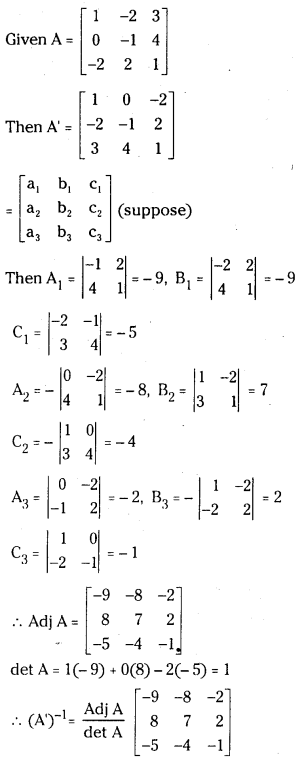
If A = 102212341, then find (A’)-1. (Board Model Paper)

Answer:
TS Inter 1st Year Maths 1A Solutions Chapter 3 Matrices Ex 3(e) 5

Question 4.
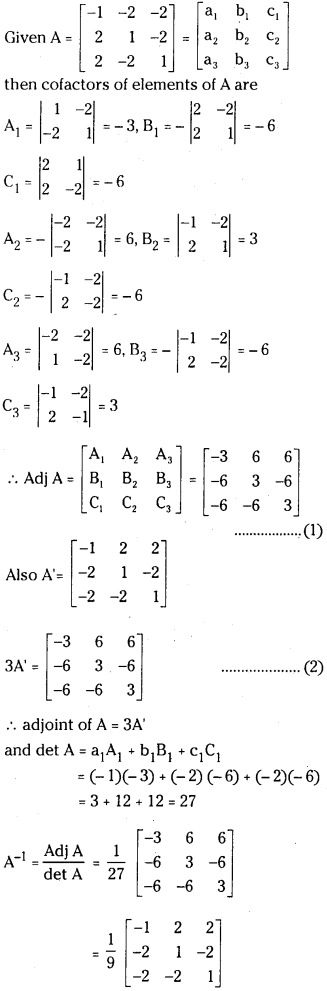
If A = 122212221, then show that the adjoint of A = 3A, find A-1

Answer:
TS Inter 1st Year Maths 1A Solutions Chapter 3 Matrices Ex 3(e) 6

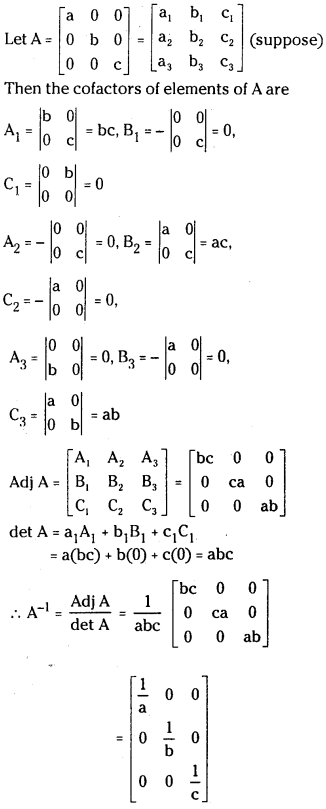
Question 5.
If abc ≠ 0; find the inverse of a000b000c (May 2006)

Answer:
TS Inter 1st Year Maths 1A Solutions Chapter 3 Matrices Ex 3(e) 7

II.
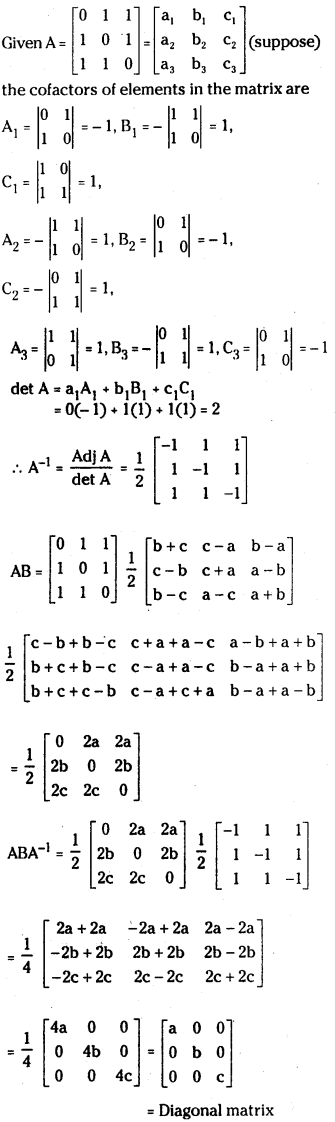
Question 1.
If A = b+ccbbccac+aacbaaba+b and B = 12b+ccbbccac+aacbaaba+b, then show that ABA-1 is a diagonal matrix.

Answer:
TS Inter 1st Year Maths 1A Solutions Chapter 3 Matrices Ex 3(e) 8

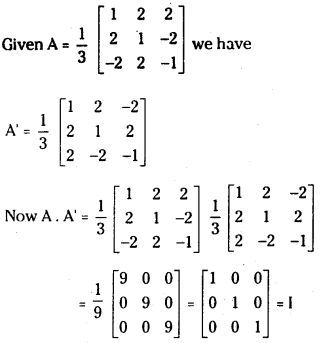
Question 2.
If 3A = 122212221, then show that A-I = A’.

Answer:
TS Inter 1st Year Maths 1A Solutions Chapter 3 Matrices Ex 3(e) 9
∴ A.A’ = I and by definition A’ = A-1
similarly A’.A = I

Question 3.
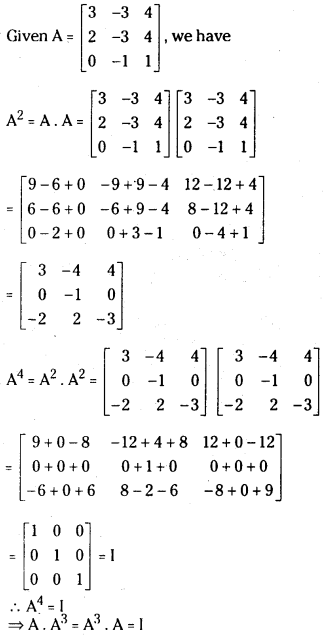
If A = 320331441, then show that A-1 = A3

Answer:
TS Inter 1st Year Maths 1A Solutions Chapter 3 Matrices Ex 3(e) 10
So, the multiplicative inverse of A exists and it is A3.
∴ A-1 = A3

Question 4.
If AB = I or BA = I, then prove that A is invertible and B = A-1.
Answer:
Given AB = I
⇒ |AB| = |I|
⇒ |A| |B| = 1
⇒ |A| ≠ 0
∴ A is a non-singular matrix.
Also BA = I
⇒ |B| |A| = |I|
⇒ |A| |B| = 1
⇒ |A| *0
∴ A is a non-singular matrix.
⇒ A is invertible
⇒ A-1 exists AB = I
⇒ A-1 AB = A-1I
⇒ (A-1 A) B = A-1I
⇒ IB = A-1I
⇒ B = A-1.

TS Inter 1st Year Botany Study Material Chapter 6 Modes of Reproduction

Very Short Answer Type Questions

Question 1.


What is the dominant phase in the life cycle of an angiosperm?


Answer:

  1. Multicellular diploid sporophytic stage is the dominant phase in the life cycle of an angiosperm.
  2. Sporophyte produces haploid spores via meiosis and a few called gametophytes.

Question 2.


What is meant by heterospory? Mention the two types of spores developed in an angiospermic plant?


Answer:

  1. Heterospory : A condition in which a plant produces two types of spores.
  2. They are microspores (Pollen grains) and megaspores (embryosac mother cells).

Question 3.


Mention the modes of reproductive in Algae and Fungi.?


Answer:

  1. Algae (Chlamydomonas) reproduce asexually by motile zoospores, vegetatively by fragmentation and sexually by motile gametes.
  2. Fungi (Rhizopus) reproduce asexually by non-motile spores and conidia, vegetatively by fragmentation and sexually by gametes.

Question 4.


How do Liverworts reproduce vegetatively?


Answer:

  1. Liverworts reproduce vegetatively by specialised structure called gemmae.
  2. They also show vegetative reproduction via. fragmentation.

Question 5.


Mention any two characteristics of bacteria and yeast that enable them to reproduce asexually?


Answer:

  1. Both bacteria and yeast are single celled organisms, in which cell division itself is asexual reproduction.
  2. Bacteria reproduce by binary fission, while yeast reproduce by budding.

Question 6.


Why do we refer to offspring formed by asexual method of reproduction as clones?


Answer:

  1. Offspring formed by asexual vegetative method and that do not involve two parents are called clones.
  2. Clones of a plant are morphologically and genetically identical.

Question 7.


Between an annual and a perennial plant, which one has a shorter juvenile phase ? Give one reason.


Answer:

  1. Annual plant has a shorter juvenile or vegetative phase.
  2. Annuals like maize, wheat and rice have vegetative phase less than a year and that ends after flowering.

Question 8.


Rearrange the following events of sexual reproduction in the sequence in which they occur in a flowering plant: embryogenesis, fertilisation, gametogenesis, pollination.?


Answer:


Pollination Gametogenesis Fertilisation Embryogenesis.

Question 9.


Is there a relationship between the size of an organism and its life span?


Answer:

  1. There is no absolute relationship between life span and size of an organism.
  2. Osmunda (Royal fern), a herbaceous plant lives for 100 + years. In general, plants that complete the life cycle (Wolffia) in short time are smaller as compared to plants, with long life span.

Question 10.


Give reasons as to why cell division can or cannot be a type of reproduction in multicellular organisms.?


Answer:

  1. In muiiicelluiar organisms, often cell division (mitosis) leads to growth .
  2. But cell division (meiosis) in sex organs is responsible for reproduction via gamete formation.

Question 11.


Which of the following are monoecious and dioecious organisms?
a) Date palm b) Coconut c) Chara d) Marchantia


Answer:


a) Date palm – Dioecious
b) Coconut – Monoecious
c) Chara – Monoecious
d) Marchantia – Dioecious

Question 12.


Match the following given in column A with the vegetative propagules given in column B.?

Column AColumn B
i) Bryophylluma) offset
ii) Agaveb) eyes
iii) Potatoc) leaf buds
iv) Water hyacinthd) fragmentation
v) Charae) sucker
vi) Menthaf) bulbils

Answer:


i) c ii) f iii) b iv) a v) d vi) e

Question 13.


What do the following parts of a flower develop into after fertilisation?
a) Ovary b) Stamens c) Ovules d) Calyx


Answer:


a) Ovary – fruit
b) Stamens – drops away
c) Ovule – seed
d) Calyx – withers away or drops away

Question 14.


Define vivipary with an example.?


Answer:

  1. Vivipary of germination of seeds inside the fruit while still attached to the parent plant.
  2. In mangrove plants like Rhizophore, it is a strategy to lower the environmental stess and ensuring successful establishment of plantlet.

Short Answer Type Questions

Question 1.


In haploid organisms that undergo sexual reproduction. Name the stage in the life cycle where meiosis occurs. Give reasons for your answer.?


Answer:

  1. Heploid organisms like chlamydomonas, chara etc., produce gametes (naploid) by mitotic division that fuse to form diploid zygote.
  2. In any haploid organism meiosis occurs after fertilization, in diploid cell.
  3. Meiotic division is meant for conservation of specific chromosome number of each species.
  4. In Fungi, Algae and Bryophytes having haploid plant body and haplontic life cycle meiosis occurs in zygote to restore the haploid chromosome number and to continue the life cycle.

Question 2.


The number of taxa exhibiting asexual reproduction is drastically reduced in higher plants (angiosperms) when compared to the lower groups of plants. Analyse the possible reasons to this situation.?


Answer:

  1. In multicellular or colonial forms of algae, moulds and mushrooms vegetative reproduction by fragmentation is prime method of reproduction,
  2. Few taxa of angiosperms produce negetative propagules like runness, stolons, suckers etc., and most of species shifted to sexual reproduction.
  3. Vegetative reproduction does not involve two parents, formation of gametes and fertilization.
  4. Even the algae and fungi shift to sexual method of reproduction just before the onset of adverse conditions. In general, zygote formed by sexual reproduction is thick walled, resistant to dessication and damage.
  5. Further sexual reproduction brings about genetic recombination and variation. So, angiospermings have sexual mode of reproduction predominantly.

Question 3.


Is it possible to consider vegetative propagation’observed in plants like Bryophyllum, water hyacinth and ginger as a type of asexual reproduction? Give two / three reasons?


Answer:


a) Yes, reproductive leaves in Bryophyllurrt, offsets in water hyacinth and rhizome in ginger are vegetative propagules.

In asexual reproduction, a single individual (parent) is capable of producing offspring. Hence, the offspring produced are identical to each other and are also exact copies (clones) of their parent.

b) In production of vegetative propagules, there is no involvement of two parents, formation of gamete and fertilization.

Question 4.


“Fertilisation is not an obligatory event for fruit production in certain plants.” Explain the statement?


Answer:


In some plants parthenocarpy is observed. Parthenocarpy means development of fruits without fertilisation. They are seedless. The development of an embryo from unfertilised egg cell is known as parthenogenesis. It is a form of asexual reproduction. Hence fertilisation is not an obligatory event for fruit production in certain plants. Eg : Guava, pineapple etc.

Question 5.


List the changes observed in angiosperm flower subsequent to pollination and fertilisation. [Mar. ’17 – A.P. : Mar. ’14, ’13]?


Answer:


Changes taking place in the angiospermic flower after fertilization are called post-fertilization changes.

  1. Sepals, petals, stamens, styles and stigma fall off.
  2. After fertilization ovary develops into fruit. It stores food materials.
  3. Fertilized ovules develop into seeds.
  4. Zygote changes into – Embryo
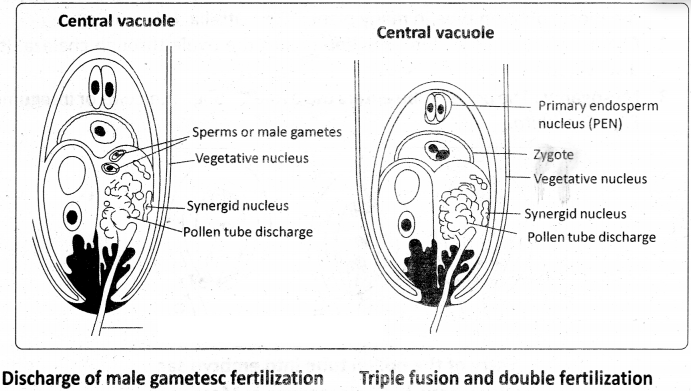
  5. Synergids & Antipodals – Degenerate
  6. Primary endosperm nucleus forms – Endosperm

Question 6.


Suggest a possible explanation why the seeds in pea pod are arranged in a row, whereas those in tomato are scattered in the juicy pulp.?


Answer:

  1. Seeds develop from ovules after post-fertilization changes, while dry transforms into fruit.
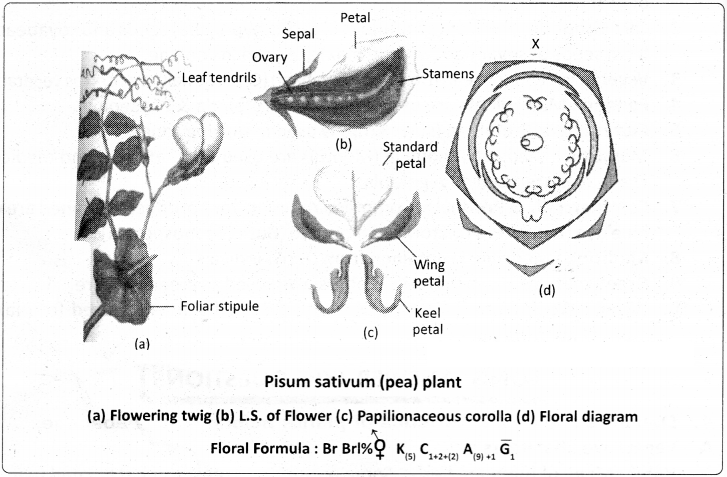
  2. In pea plant, there is marginal placentation. Ovules are borne on a ridge (placenta) along the yentral suture of the ovary. Hence, seeds are present in row in pea pod.
  3. In tomato, pariental placentation is present, the ovules develop on the inner wall of the ovary or on peripheral part. So seeds are scattered in juicy pulp formed from mesocarp and endocarp.

Question 7.


Justify the statement ‘Vegetative reproduction is also a type of asexual reproduction’. [May ’17]?


Answer:

  1. Reproduction not involving the fusion of male and female gametes is called asexual reproduction.
  2. In Algae, moulds and mushrooms, the plant body break into smaller portions (fragmentation) and each fragment thing is formed and develops into a mature plant. Gemmae of liver worts are also vegetative reproductive structures.
  3. In flowering plants runner, stolon, sucker, offset rhizome, corm, tuber, bulb, bulbil, reproductive leaves are also vegetative propagules.
  4. In vegetative reproduction, there is no involvement of two parents, male and female gametes are not formed and are not fused. Offspring produced vegetatively by a plant are identical to one another and are exact copies (clones) of their parent.
  5. Hence, vegetative reproduction is also a type of asexual reproduction.

Question 8.


Define (a) Juvenile phase. (b) Reproductive phase. [Mar. – 2020]?


Answer:


(a) Juvenile Phase :
All organisms have to reach a certain stage of growth and maturity in their life before they can reproduce sexually. This stage is known as Juvenile phase or Vegetative phase.

(b) Reproductive phase :
The end of juvenile phase is the beginning of reproductive phase. It can be seen easily in the higher plants when they come to flower.

Question 9.


Distinguish between asexual and sexual reproduction. Why is vegetative reproduction also considered as a type of asexual reproduction? [Mar. 15 – T.S.]?


Answer:

  1. When an offspring is produced by a single parent with or without the involvement of gamete formation it is called asexual reproduction.
  2. Sexual reproduction involves the formation of the male and female gametes, either by the same individual or by different individuals of the opposite sex.
  3. Vegetative reproduction does not involve two parents, hence it is also considered as a type of asexual reproduction.

Question 10.


Identify each part in a flowering plant and write whether it is haploid (n) or diploid (2n). [Mar. – 2018]
(a) Ovary _____ (b) Anther _____ (c) Egg _____ (d) Pollen _____ (e) Male gamete _____ (f) Zygote _____?


Answer:


a) Ovary – Diploid (2n)
b) Anther – Diploid (2n)
c) Egg – Haploid (n)
d) Pollen – Haploid (n)
e) Male gamete – Haploid (n)
f) Zygote – Diploid (2n)

Question 11.


Give a brief account on the phases of the life cycle of an angidsperm plant.?


Answer:

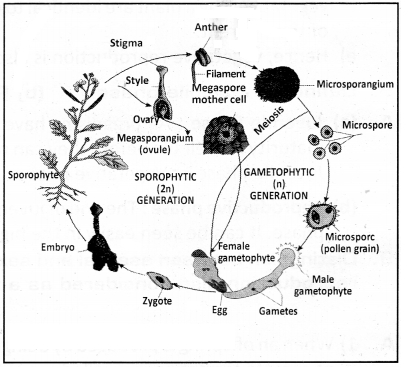
  1. The life cycle of an angiospermic plant has two alternating phases namely the sporophytic and gametophytic phases.
  2. In angiosperms the plant body belongs to diploid (2n) sporophytic phase. This dominant phase of life cycle bears reproductive organs (flowers).
  3. The haploid (n) gametophytic phase of angiospermic plant is dervied from microspores (n) and megaspores (n).
  4. Microspores (pollen grains) are the meiotic products of microspore mother cells that develop in an anther.
  5. Megaspores are the meiotic products of megaspore mother cell that develop from the nucellus of the ovule.
  6. Micro and megaspores produce male and female gametophytes respectively.
  7. Male and female gametes formed respectively from male and female gametophytes are fused to form diploid (2n) zygote.
  8. Zygote after undergoing repeated mitotic divisions produce embryo in the seed.
  9. The embryo (2n) develops into a sporophytic plant during seed germination.

Long Answer Type Questions

Question 1.


Enumerate the differences between asexual and sexual reproduction. Describe the types of asexual reproduction exhibited by unicellular organisms.?


Answer:


Differences between asexual and sexual reproduction :

Asexual ReproductionSexual Reproduction
1) Involves a single organism.1) Involves one or two organisms.
2) No production of gametes.2) Male and female gametes are formed.
3) No fusion of gametes.3) Involves fusion of male and female gametes.
4) Requires only mitotic divisions.4) Required meiotic followed by mitotic divisions.
5) Produces offspring that are identical to the parent.5) Offspring will have some characters from male parent and others from female parent. Some characters may not be present in either of the parents.
6) Chance of genetic variation is only through random mutation.6) More chance for genetic variation.
7) Not very useful for natural selection in evolution of species.7) Highly useful for natural selection in evolution of species.

Asexual reproduction by unicellular organisms :
It is by binary fission, budding and spore formation.

Binary fission :
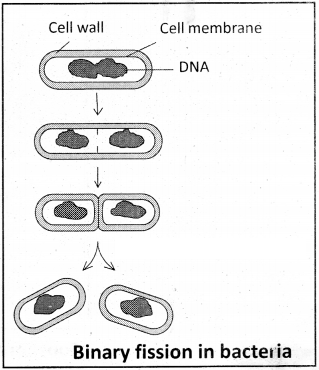
Many unicellular organisms reproduce by binary fission. In this the parent cell divides into two equal halves and each one grows into new individuals. Eg : Euglena, bacteria etc. It is common in Protista and Monera.

Budding :
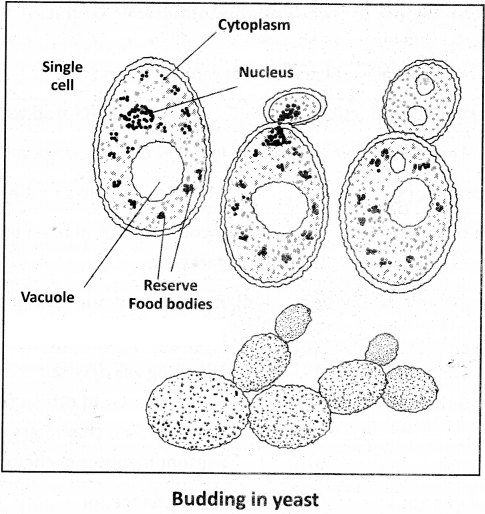
In yeast, asexual reproduction is done by budding. Small buds are produced that remain attached initially to the parent cell which eventually get separated and grows into new individual.

Spore :
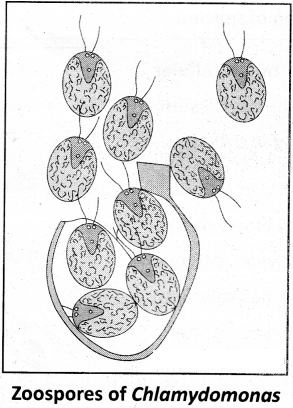
In unicellular algae like Chlamydomonas asexual reproduction is done by spores. These spores are motile, hence called zoospores.

Question 2.


Although sexual reproduction is Song drawn, energy intensive complex forms of reproduction, many groups of organisms in kingdom plantae prefer this mode of reproduction. Give atleast three reasons for this?


Answer:

  1. Sexual reproduction involves formation of the male and female gametes, either by the same individual or by different individuals of the opposite sex. These gametes fuse to form the zygote which develops to forms the new organism.
  2. It is an elaborate, complex and slow process as compared to asexual reproduction.
  3. Sexual reproduction results in offspring that are not identical to the parents or amongst themselves due to fusion of male and female gametes.
  4. Sexual reproduction follow a regular sequence, and is characterized by the fusion (or fertilization) of the male and female gametes, the formation of zygote and embryogenesis. These sequential events may be grouped into 3 distinct stages namely, the pre-fertilization, fertilization and post-fertilization events.

A) Pre-fertilization events:
These include two events namely gametogenesis and gamete transfer that occur prior to the fusion of gametes. Gametogenesis refers to formation of two types (male and female) of gametes (haploid cells).

i) In some algae (eg. Cladophore) the two types of gametes may be so similar in appearance (isogametes) or may be two morphologidly distinct types (heterogametes) as in majority of sexually reproducing organisms. In plants that produce heterogametes (i.e., Runaria, Pteris and Cycas), the male gamete is called the antherozoid or sperm and the female gamete is called the egg.

ii) In some cases male and female gametes may be produced by same plant (bisexual), that has both male and female reproductive structures. In some other cases the male and female reproductive structures develop of two different plants of same species (unisexual). Bisexual condition can be denoted by terms such as homothallic (Fungi) and monoecious (plants). Similarly unisexual condition is described as heterothallic (Fungi) and dioecious (plants).

iii) In flowering plants, unisexual male flower being only stamen is called staminate and female flower bearing only pistils is called pistillate. In that case both male and female flowers may he present on same plant (monoecious cucurbits) or on two separate plants (dioecious – papaya and date palm).

iv) Organisms belonging to monera, fungi, algae and bryophytes have haploid plant body, they produce gametes by mitotic division. Whereas ptesido- phytes, gymnosperms and angiosperms having diploid plant body produce gametes through meiosis in meiocytes (gamete mother cells).

v) After the formation, male and female gametes must be physically brought together to facilitate fusion (fertilization). In majority of organisms (with exception of few fungi and algae), male gamete is motile and female gamete is stationary. In algae, bryophytes and pteridophytes water is the medium through which gamete transfer takes place.

vi) In seed plants pollen grains are the carriers of male gametes and ovule has the egg. in bisexual and self pollinating plants (Eg. Pea) pollen grains produced from anthers are transferred to stigma of same flower. But in cross pollinating plants (including dioecious) pollen from a flower reaches stigma of another flower).

vii) Pollen grains germinate on the stigma and pollen tubes carying the male gametes reach the ovule and discharge male gametes near the egg.

B) Fertilization :
It is the process of fusion of gametes and it is the most vital event of sexual reproduction. This process is also called as syngamy and result in the formation of a diploid zygote.
i) In majority of algae, syngamy occurs in the external medium (water) and is called external fertilization. But in many fungi and majority of plants (Bryophytes; Ptesidophytes, Gymnosperms and Angiosperms) syngamy (internal fertilization) occurs inside the body of the organism.

C) Post-fertilizaton events :
Events that occur after the formation of zygote are called as post-fertilization events. The diploid zygote is formed in all sexually reproducing organisms.

  1. In fungi and algae with haplontic life cycle zygote develops a thick wall that is resistant to desication and damage, undergoes a period of rest before germination. In those organisms zygote divides by meiosis immediately after keryogamy to form haploid spores that grow into haploid individuals.
  2. Zygote is the vital link that ensures continuity of species between organisms of one generation and the next.
  3. Every sexually reproducing organisms begins life as a single called zygote.
  4. Embryogenesis refers to the process of development of embryo from the zygote.
  5. During embryogenesis, zygote undergoes cell divisions (mitosis) and cell differention (formation of tissues and organs) to form an organism.
  6. In flowering plants, the zygote is formed inside the ovule, which transforms into seed. In angiosperms, seeds are present inside the fruit that formed from ovary.

Significance of sexual reproduction :

  1. Sexual reproduction enables the organisms to survive during unfavourable con¬ditions by producing resistant structures (thick walled zygote, seeds), So, even Algae and Fungi that have predominance of asexual/vegetative reproduction in life cycle shift to sexual process just before the onset of adverse conditions.
  2. Sexual reproduction involves fusion of gametes from two parents of opposite sex and hence responsible for genetic variation in offspring.
  3. Seeds are useful to surpass unfavourable conditions. In viviporous Mangroves seeds germinate on mother plant itself. This is a strategy to lower the environmental stress and ensuring successful establishment of plant let.

Question 3.


Describe the post-fertilisation changes in a flower. [Mar. ’17 – A.P]?


Answer:


Changes taking place in the angiospermic flower after fertilization are called post-fertilization changes.

  1. Sepals, petals, stamens, styles and stigma fall off.
  2. In some members of Solanaceae, calyx remains persistent even after fertilisation and grows along with the fruit. In Asteraceae, persistent calyx, pappus helps in the fruits dispersal.
  3. After fertilization ovary develops into fruit. It stores food materials.
  4. Fertilized ovules develop into seeds.
  5. Part of ovule – Changes occurring after fertilization
    Funiculus – Stalk of the seed
    Outer integument – Testa (outer seed coat)
    Inner integument – Tegmen (inner seed coat)
    Micropyle – Seed pore
    Zygote – Embryo
    Synergids – Degenerate
    Antipodals – Degenerate
    Primary endosperm nucleus – Endosperm
    Scar of the ovule – Hilum (scar of the seed)


6) Endosperm is nutritive tissue useful for developing embryos. It is triploid in angiosperms and formed after fertilization.

Intext Question Answers

Question 1.


Why is reproduction essential for organisms?


Answer:


To ensure the continuity of species reproduction is essential. Reproduction will

  1. replace those species that die and
  2. allow an increase in total numbers of the species under suitable conditions.

Question 2.


Which is a better mode of reproduction sexual or asexual? Why?


Answer:


Sexual reproduction is the better mode of reproduction. It brings in diversity of characters in the new generation. It may give a better chance to adjust or adopt to changing environmental conditions, to tolerate diseases, to spread to new areas, to increase their population.

Question 3.


Why is the offspring formed by asexual reproduction referred to as clone?


Answer:


Offsprings formed by asexual method do not involve two parents. They are not only identical to one another but are also exact copies of their parent. Hence they are called clones.

Question 4.


How does the progeny formed from asexual reproduction differ from those formed by sexual reproduction?


Answer:


The progeny formed from asexual reproduction are genetically identical whereas those formed by sexual reproduction shows genetic variability.

Question 5.


What is vegetative propagation? Give two suitable examples.?


Answer:


When the body breaks or gets separated into smaller portions, each fragment can develop into individual body. Eg: Algae, mould, mushrooms, ginger, turmeric, etc.

Question 6.


Higher organisms have resorted to sexual reproduction in spite of its complexity. Why?


Answer:

  1. In sexual reproduction variants are found in the offspring and their survival rate was enhanced.
  2. It gives better chance to adjust to changing environment.

Question 7.


Explain why meiosis and gametogenesis are always interlinked?


Answer:


Gametes are formed from meiocytes only after meiosis. This is called gametogenesis. Thus meiosis leads to the formation of gametes.

Question 8.


Define external fertilisation. Mention its disadvantages?


Answer:


In most aquatic organisms, such as algae, syngamy occurs in the external medium i. e., outside the body of the organism. This type of gametic fusion is called external fertilisation. Its disadvantage is they have to release a large number of gametes into the surrounding water in order to enhance the chances of syngamy.

Question 9.


Differentiate between a zoospore and a zygote?


Answer:


Zoospore is.a motile asexual spore that uses a flagellum for locomotion, also called a swarmspore, these spores are created by some algae, bacteria and fungi to propagate themselves.

Zygote is diploid, formed during sexual reproduction, by the fusion of male and female gametes.

Activity

Question 10.


Examine a few flowers of any cucurbit plant and try to identify the staminate and pistillate flowers. Do you know any other plant that ears unisexual flowers?


Answer:


Cucurbit plant show unisexual flowers. It bears only stamens in male flowers and only carpels in female flowers.

In coconut, male and female flowers are present on the same plant.

In Borasus, male flowers are present in male plant and female flowers are present in female plant.

Question 11.


What is a bisexual flower? Collect five bisexual flowers from your neighboured and with the help of your teacher find out their common and scientific names?


Answer:


The flower which has both androecium and gynoecium is called a bisexual flower. Collect different flowers as you collect for the herbarium.

TS Inter 1st Year Botany Study Material Chapter 7 Sexual Reproduction in Flowering Plants

Very Short Answer Type Questions

Question 1.


Name the component cells of the “egg apparatus” in an embryo sac?


Answer:


1.Three cells grouped together at the micropylar end of an embryosac are called egg apparatus.
2.It consists of an egg cell and two synergids on either side of it.


Question 2.


Name the part of gynoecium that determines the compatible nature of pollen grain?


Answer:


Stigma of gynoecium determines the compatibility of pollen grains and promotes post pollination events that lead to fertilization.


Question 3.


Name the common functions that cotyledons and nucellus perform?


Answer:


1.Both are nutritive in function and stores food materials.
2.Cotyledons in seed provide nourishment for embryo, while nucellus of ovule nourishment for embryosac.


Question 4.


Name the parts of pistil which develop into fruit and seeds?


Answer:


1.Ovary of pistil develops into fruit after fertilization.
2.Ovules in the ovary of pistil transforms into seed during post-fertilization events.


Question 5.


In case of polyembryoxy, if an embryo develops from the synergid and another from the nucellus which is haploid and which is diploid?


Answer:


1.Synergid is a haploid cell present in embryo sac, so it gives haploid (n) embryo.
2.Nucellus is diploid tissue in ovule. So it produces diploid (2n) embryo.


Question 6.


Can an unfertilized, apomictic embryo sac give rise to a diploid embryo? If yes, then how?


Answer:


1.Apomixis is an asexual reproduction that mimics sexual process.
2.In some grasses and Asteraceae members, the diploid egg cell formed without reduction division develops into an embryo without fertilization.


Question 7.


Which are the three cells found in a pollen grain when it is shed at the three celled stage ?


Answer:


1.In about 40% of angiosperms, pollen grains are shed at 3 – celled stage.
2.In that pollen grain one vegetative cell and two male gametes (formed by mitiotic division in generative cell) are present.


Question 8.


What is self incompatibility?


Answer:


1.Self incompatibility (self.sterility) is a genetic mechanism that prevents self pollen from fertilizing the ovules by inhibiting pollen germination or pollen tube growth in the pistil. E.g : Abutilon.
2.This is a mechanism to promote cross pollination and to avoid self fertilization.


Question 9.


Name the type of pollination in self-incompatible plants?


Answer:


Gross pollination.


Question 10.


Draw a diagram of a mature embryo sac and show its 8 – nucleate, 7-celled nature. Show the following parts : antipodals, synergids, egg, central cell, polar nuclei?


Answer:


Question 11.


Which is the triploid tissue in a fertilized ovule? How is the triploid condition achieved?


Answer:


1.Endosperm.
2.One of two male gamete released from pollen tube unites with secondary nucleus (formed by the union of two polar nuclei) to from triploid endosperm.


Question 12.


Are pollination and fertilisation necessary in apomixis? Give reasons?


Answer:


1.No, Apomixis is a form of asexual reproduction seen in some species of
Asteraceae and grasses. In those plants diploid egg cell is formed without – reduction division and develops into embryo without fertilization.
2.In many citrus and mango varieties, the nucellar cells surrounding the embryo sac start dividing, protrude into the embryosac and develop into the embryos.


Question 13.


How is pollination carried out in water plants?


Answer:


1) Epihydrophily :
Pollen grains reach the stigma of female flowers passively by water currents at the surface of water E.g: Vallisnaria.
2) Hypodrophily :
Pollen grains released inside the water reach the stigma of female flowers submerged in water, pollination occurs under water. E.g : Zoostera.


Question 14.


What is the function of the two male gametes produced by each pollen grain in angiosperms?


Answer:


1.One of the two male gametes released from pollen tube unites with egg cell to form zygote (2x).
2.Second male gamete released from the pollen tube unites with secondary nucleus to form endosperm (3x).


Question 15.


Name the parts of an angiosperm flower in which development of male and female gametophyte take place?


Answer:


1.Male gametophyte develops in the pollen grain that are formed in anthers of androecium.
2.Female gametophyte (embryosac) develops in nucellus of ovules formed in gynoecium (carpels).

Question 16.


What is meant by monosporic development of female gametophyte?


Answer:

  1. Monosporic development : Embryo sac develops from a single functional megaspore.
  2. Monosporic embryosac is 8 nucleate and 7 celled.

Question 17.


Mention two strategies evolved to prevent self-pollination in flowers?


Answer:


1. Dicliny :
Male and Female flowers : (unisexual flowers) are formed on same plant (Maize-monoecious) or on different plants (papaya-dioecious).

2. Heterostyly :
Styles in flowers of the same species are in different heights (Eg: Primula)

Question 18.


Why do you think the zygote is dormant for some time in a fertilized ovule?


Answer:

  1. Zygote divides after formation of certain amount of endosperm (nutritive tissue) from PEN is formed.
  2. This is an adaptation to provide assured nutrition to the developing embryo.

Question 19.


If one can induce parthenocarpy through the application of growth substances, which fruits would you select to induce?


Answer:

  1. Parthenocarpy refers to the fruit production without fertilization of the ovary. This phenomenon is used for commercial production of seedless fruits.
  2. Fleshy fruits (Grapes, Banana) in which seeds are not edible, can be selected for induction of parthenocarpy.

Question 20.


Explain the role of tapetum in the formations of pollen grain wall?


Answer:

  1. Tapetum is the inner most layer in anther wall. It nourishes the developing pollen grains.
  2. Tapetal cells secrete sporopollenin, a constituent in hard outer layer, (escine) . of pollen grain. Sporopollenin can withstand high temperatures, strong acids and alkali.

Question 21.


What is meant by scutellum? In which type of seeds is it present?


Answer:

  1. Cotyledon of monocots (Grass family) is called scutellum.
  2. In grass family, scutellum is situated towards one side (lateral) of the embryonal axis.

Question 22.


Define with examples endospermic and non-endospermic seeds?


Answer:

  1. Mature seeds of castor and coconut that consists of nutritive tissue for embryo (endosperm) are called endospermic seeds.
  2. In seeds of pea, groundnut, beans etc., endosperm may either be completely consumed by the developing embryo, before seed maturation, so they are called non-endospermic seeds.

Short Answer Type Questions

Question 1.


List three strategies that a bisexual chasmogamous flower can evolve to prevent self pollination (autogamy)?


Answer:


The three strategies that a bisexual chasmogamous flower can prevent self pollination are
1. Dichogamy :
Androecium and gynoecium of a bisexual flower mature at different times. This mechanism promote cross pollination by preventing self pollination in bisexual flowers. It is of 2 types.

a) Protandry :
Androecium matures earlier than gynoecium. The entire pollen fall off from the stamens, by the time gynoecium matures.
E.g: Helianthus, Gossypium.

b) Protogyny :
Gynoecium matures earlier than androecium. Thus, by the time the gynoecium matures, the stamens remain in immature condition.
E.g: Solanum, Scrophularia.

2. Herkogamy :
The arrangement of male and female reproductive organs at different levels in a bisexual flower. This contrivancy prevents self pollination, though both the reproductive organs mature at the same time.
E.g : (a) Stigmas project beyond stamens in Hibiscus, (b) Stigmas bend in opposite direction to stamens in Gloriosa superba.

3. Self sterility :
In some bisexual flowers, the pollen grains fail to germinate on the stigma of the same flower. But the same pollen grains germinate, when they fall on the stigma of other flowers of the same species.
E.g: Abutilon, Passiflora

Question 2.


Given below are the events that are observed in an artificial hybridization programme. Arrange them in the correct sequential order in which they are followed in the hybridization programme?
a) Rebagging b) Selection of parents c) Bagging d) Dusting the pollen on stigma e) Emasculation f) Collection of pollen from male.


Answer:


i) Selection of parents.
ii) Emasculation
iii) Bagging
iv) Collection of pollen from male
v) Dusting the pollen on stigma
vi) Rebagging

Question 3.


Vivipary automatically limits the number of offsprings in a litter. How?
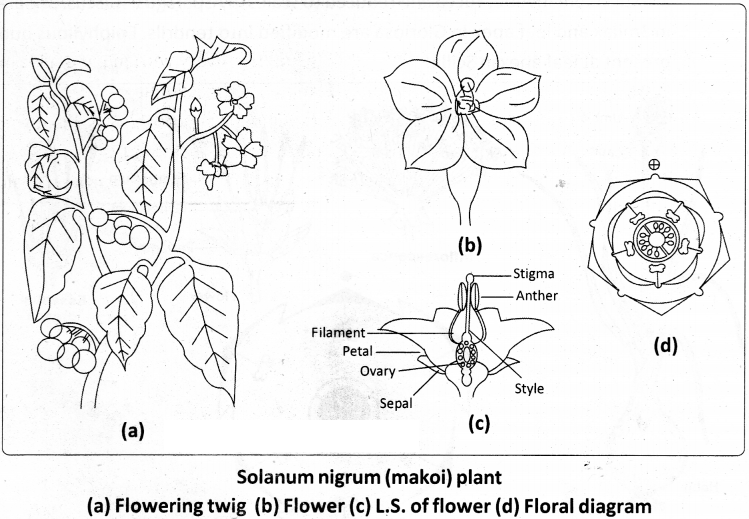

Answer:

  1. The plants which grow in Marshy places are called Mangrooves.
  2. These plants show Vivipary.
  3. Vivipary seeds germinate while they are still attached to the mother plant.
  4. Seeds when fall on Marshy places can not germinate because of high salinity and more water conditions. In these plants, seeds germinate when they are in mother plant.

So Vivipary automatically limits the number of offsprings in a litter.
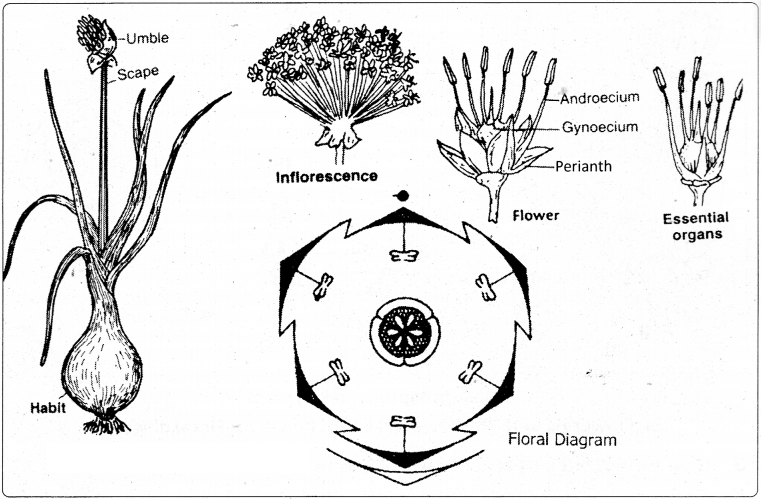
Question 4.


Does self incompatibility impose any restrictions on autogamy? Give reasons and suggest the method of pollination in such plants?


Answer:

  1. Yes, self incompatibility impose restrictions on autogamy.
  2. The reason is this is a genetic mechanism. When the pollen grain falls on the stigma of the same flower it will not germinate. But when the same pollen grain falls on other flower it will germinate.
  3. The method of pollination in such plants will be only cross-pollination.

Question 5.


What is polyembryony and how can it be commercially exploited?


Answer:

  1. Development of more than one embryo in the same seed is called polyembryony.
  2. It is helpful in developing new varieties such as citrus and mango.
  3. The plantlets obtained from these embryos are virus free and has more vigour.
  4. Nucellar polyembryony is of great significance in horticulture. These embryos provide uniform seedlings of the parent type as obtained through vegetative propagation.

Question 6.


Are parthenocarpy and apomixis different phenomena? Discuss their benefits?


Answer:


Yes, parthenocarpy and apomixis are different phenomena.

Parthenocarpy :
The fruit production without fertilization of the ovary is called parthenocarpy. This phenomenon is applied for the commercial production of seedless fruits. E.g.: Banana, Grapes. This is more useful to juice industries.

Apomixis :
The seed production without fertilization is called apomixis. Production of hybrid seeds is costly and hence the cost of hybrid seeds becomes too expensive for the farmers. If these hybrids are made into apomicts, there is no segregation of characters in the hybrid progeny. Then the farmer can keep on using the hybrid seeds to raise crop year after year and he does not have to buy hybrid seeds every year.

Question 7.


Why does the zygote begin to divide only after the division of Primary endosperm cell (PEC)?


Answer:

  1. Primary endosperm cell (PEC) divides repeatedly to form endosperm.
  2. Endosperm is nutritive tissue.
  3. Zygote divides only after certain amount of endosperm is formed.
  4. This is an adaptation to provide assured nutrition to the developing embryo.

Question 8.


The generative cell of two-celled pollen divides in the pollen tube but not in a three-celled pollen. Give reasons.?


Answer:


In over 60 per cent of angiosperms, the pollen grains are shed at two celled stage. They are vegetative cell and generative cell. After pollination, during germination, in the pollen tube the generative cell divides to give rise to two male gametes.

In the remaining 40 per cent of angiosperms, the pollen grains are shed at three celled stage. The reason is the generative cell divides to give rise to two male gametes before pollination.

Question 9.


Discuss various types of pollen tube entry into ovary with the help of diagrams?


Answer:


Entry of pollen tube into the ovule : It is of 3 types.


1. Porogamy :
The pollen tube enters into the ovule through the micropyle. It is the most common type in many plants. E.g : Ottelia, Hibiscus

2. Chalazogamy :
The pollen tube enters into the ovule through chalaza. It was discovered by Treub in Casuarina.

3. Mesogamy :
The pollen tube enters the ovule through funiculus or integuments. E.g: Cucurbita

Question 10.


Differentiate between microsporogenesis and megasporogenesis. Which type of cell division occurs during these events? Name the structures formed at the end of these two events?


Answer:

  1. Microsporogenesis is a process in which diploid microspore mother cells divide meiotically to form microspores.
  2. Megasporogenesis is a process in which diploid megaspore mother cell divides meiotically to form megaspores.
  3. Meiosis occurs during these events.
  4. Microspores and megaspores are formed at the end of these two events.

Question 11.


What is bagging technique? How is it useful in a plant breeding programme?


Answer:


Emasculated flowers are covered with a bag of suitable size. Generally made up of butter paper. This is called bagging. This is useful to prevent contamination of its stigma with unwanted pollen.

Question 12.


What is triple fusion? Where and how does it take place? Name the nuclei involved in triple fusion?


Answer:

  1. The second male gamete fuses with the secondary nucleus (formed by the fusion of two polar nuclei) of the embryo sac. This results in the formation of a triploid Primary endosperm nucleus (PEN). As this invovles the fusion of three haploid nuclei, it is termed triple fusion.
  2. Triple fusion occurs within the female gametophyte (embryo sac) of ovules.
  3. Nuclei involved in triple fusion are two polar nuclei of central cell and nuclei of male gamete.

Question 13.


Differentiate between?


a) Hypocotyl and Epicotyl
b) Coleoptile and Coleorhiza
c) Integument and Testa
d) Perisperm and Pericarp


Answer:

a) HypocotylEpicotyl
The cylindrical portion of embryonal axis below the level of cotyledons is called hypocotyl. It is between radical and cotyledonThe portion of embryonal axis above the level of cotyledons is called epicotyl. It is between plumule and cotyledons
b) ColeoptileColeorhiza
The epicotyl has a shoot apex and a few leaf primordia enclosed in a hollow foliar structure called coleoptile.The embryonal axis has the radicle and root cap is enclosed in an undifferentiated sheath called coleorhiza.
c) IntegumentTesta
Protective envelope around the ovule is called integument.After fertilisation, the outer integument of the ovule develops into testa
d) PerispermPericarp
Remnant nucellus present in the seed is called perisperm.The fruit wall is called pericarp

Question 14.


What is meant by emasculation? When and why does a plant breeder employ this technique?


Answer:


Removal of anthers from the bisexual flower bud before the anther dehisces is called emasculation. It is done by forceps during bud condition. This prevents contamination of its stigma with unwanted pollen.

Question 15.


What is apomixis? What is its importance?


Answer:

  1. Production of seeds without fertilisation is called apomixis. It is a form of asexual reproduction.
  2. Apomixis do not involve Meiosis. Hence seggregation and recombination of chromosomes do not occur. Thus Apomixis help in preserving desirable characters for indefinite periods.
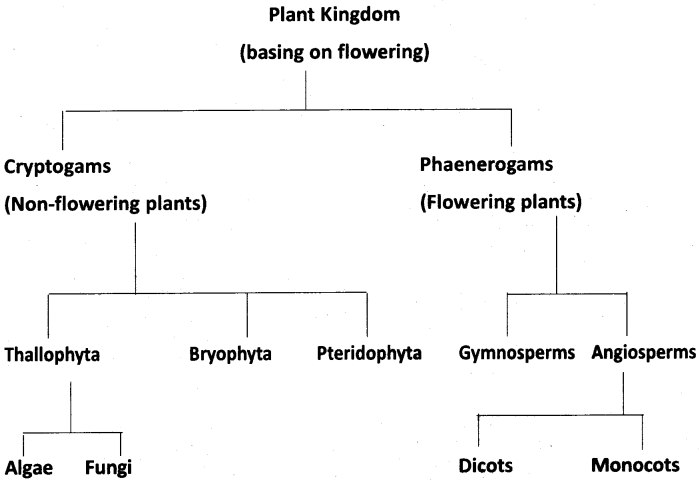
  3. Production for hybrid is costly. If these hybrids are made into apomixis, then the farmer can raise new crop year after year and he does not have to buy hybrid seeds every year.

Long Answer Type Questions

Question 1.


Starting with the zygote, draw the diagrams of the different stages of embryo development in a dicot?


Answer:


Question 2.


What are the possible types of pollinations in chasmogamous flowers? Give reasons?


Answer:


The flowers which open are called chasmogamous flowers. In these flowers self pollination or cross pollination may take place.

Self pollination –
The transfer of pollen grain from anther to stigma of same flower is called self pollination. The reason is the male reproductive organ (stamen) and female reproductive organs (carpels) mature at the same time. They lie side by side. This assures self pollination.

Cross pollination :
The transfer of pollen grain from anther to stigma of another flower is called cross pollination. It is 2 types.

i) Geitonogamy :
Cross pollination between two flowers of same plant is called geitonogamy. In this, there is no genetic variation, eg: Coeds nucifera (coconut)

ii) Xenogamy :
Cross pollination between two flowers of different plants belonging to the same species is called xenogamy. Eg : Borassus.

Continued self pollination results in inbreeding depression. So flowering plants have developed many devices or adoptations or contrivances to discourage self – pollination and encourage cross pollination.

Question 3.


With a neat, labeled diagram, describe the parts of a mature angiosperm embryo sac. Mention the role of synergids?


Answer:


In angiosperms female gametophyte is called embryo sac. Embryo sac consists of three parts i.e. Egg apparatus, Antipodals and Central cell.

Egg Apparatus :
The three cells towards the anterior side are together called Egg apparatus. The middle big cell is called egg cell which acts as a female gamete. The two cells present on either side of the egg cell are called synergids.

Role of Synergids :
Synergids contain finger like projections called filiform apparatus, which help in absorption and conduction of food materials from nucleus into the embryo sac. They also help in directing the movement of pollen tube towards the embryo sac.

Antipodals :
The three cells present towards posterior side are called antipodals.

Central cell :
Central cell is the largest cell with central vacuole and two polar nuclei.

Question 4.


Draw the diagram of a microsporangium and label its wall layers. Write briefly about the well layers?


Answer:


Anther wall consists of

  1. One cell thick outer protective layer, epidermis. The thin walled epidermal cells between two pollen sacs constitute stomium, which is useful for the dehiscence of pollen sacs.
  2. Endothecium, a layer of radially expanded cells present below the epidermis. These cells have hygroscopic fibrous thickenings of cellulose and help in the dehiscence of pollen sac.
  3. Middle layers present below the endothecium consists of 1 – 5 layers of thin walled cells.
  4. Tapetum is the innermost nutritive layer of anther wall, which encircles the sporogenous tissue. The cells in this layer are large, thin walled, bi – or multinucleate and nourish the developing sporogenous tissue.

Question 5.


Embryo sacs of some apomictic species appear normal but contain diploid cells. Suggest a suitable explanation for the condition?


Answer:

  1. Apomixis is a form of asexual reproduction that mimics sexual reproduction.
  2. In this method seeds are produced without fertilization.
  3. A few flowering plants such as some species of asteraceae and grasses have evolved a special mechanism to produce seeds through apomixis.
  4. In some species, the diploid egg cells is formed without reduction division. It develops into the embryo without fertilization.
  5. Apomictic method is an assured reproduction in the absence of pollinators, such as in extreme environments.
  6. Seeds produced by apomixis can be called as clones, because they are resulted from mitotic cell divisions and resemble the parent and also one another in all characters.
  7. In many citrus and mango varieties, some of the nucellar cells surrounding the embryo sac start dividing, protruds into the embryo sac and develop into the embryos. In such species each ovule contains many embryos. Occurrence of more than one embryo in a seed is referred to as polyembryony.
  8. Hybrid varieties of several of our food and vegetable crops are being extensively cultivated. This led to tremendous increase in productivity. But hybrid seeds are to produced every year, the progeny from hybridization may segregate and do not maintain characters. If the hybrids are made into apomictics, the farmer does not have to buy hybrid seeds every year.
  9. Because of the importance of apomixis in hybrid seed in dusty, active research is going on in many laboratories around the world to understand the genetics of apomixis and to transfer apomictic gene into hybrid varieties.

Question 6.


Describe the process of fertilisation in angiosperms?


Answer:


Fertilization :

  1. The fusion of male and female gametes is called fertilization.
  2. In angiosperms, female gamete is an egg cell and is present in embryo sac (female gametophyte).
  3. Embryo sac is embedded in the ovule which is present inside the ovary of gynoecium.
  4. Male gametophyte (pollen grain) produced in the anther reaches the stigma by pollination at 2 – celled stage.
  5. It germinates on the stigma and produces pollen tube, which grows into the style and reaches the ovule.
  6. In the pollen tube generative cell divides and produces two male gametes.

I. Entry of pollen tube into the ovule: It is of three types.
1. Porogamy :
The pollen tube enters into the ovule through the micropyle. It is the most common type in many plants. E.g: Ottelia, Hibiscus.

2. Chalazogamy :
The pollen tube enters into the ovule through chalaza. It was discovered by Treub in Casuarina.

3. Mesogamy :
The pollen tube enters the ovule through funiculus or integuments. E.g: Cucurbita.

II. Entry of pollen tube into Embryo sac:
After the entry of pollen tube into the ovule, it enters into the embryo sac only through the micropylar region, either passing in between egg cell and , synergid or penetrating through synergid cell. The entry of pollen is directed by filiform apparatus.

III. Discharge of male gametes (sperms)into embryo sac :
The male gametes are released into the embryo sac by (a) bursting of pollen tube tip or f b) degeneration of the tip or (c) by the formation of an apical pore. The pollen tube finally releases the intact male gametes (cells) and vegetative nucleus.

IV. Gametic fusion :
According to many scientists, only the nuclei of male gametes migate out of them. But recent evidences suggest that the male cytoplasm is also involved in fertilization.

V. Triple fusion and Double Fertilization :
Syngamy :

TS Inter 1st Year Botany Study Material Chapter 8 Taxonomy of Angiosperms

Very Short Answer Type Questions

Question 1.


What is Omega Taxonomy?


Answer:


Taxonomy based on information from other branches such as Embryology, Cytology, Palynology, Phytochemistry etc., in addition to morphological characters is called Omega Taxonomy


Question 2.


What is Natural system of plant classification? Name the scientists who followed it. [May 14]?


Answer:


1.The system in which plants are grouped on the basis of their natural relationships taking all possible morphological characters into consideration is known as Natural system of classification.
2.de Jussieu, de Candolle and Bentham and Hooker followed it.


Question 3.


Explain the scope and significance of “Numerical Taxonomy”?


Answer:


1.Numerical Taxonomy uses mathematical methods to evaluate observable differences and similarities between taxonomic groups. It is now easily carried out using the computers is based on all observable characters.
2.In this process no. and codes are assigned to all the characters and the data are then processed. Each character is given equal importance and at the same time hundreds of characters can be considered.


Question 4.


What is geocarpy? Name the plant which exhibits this phenomenon. [May 17, Mar. 17 – A.P ; Mar. 15 – T.S]


Answer:


Development of fruit inside the soil is known as geocarpy. Eg: Arachis hypogea (groundnut).


Question 5.


Name the type of pollination mechanism found in members of Fabaceae. [Mar. 14]


Answer:


1.Piston mechanism for cross pollination.
2.It is entomophilous, occurs with the help of insects.


Question 6.


Write the floral formula of solanum plant. [Mar 2020]?


Answer:


Question 7.


Give the technical description of ovary in solanum nigrum?


Answer:


1.Bicarpellary, syncarpous, bilocular, superior ovary.
2.Placentata swollen with many ovules on axile placentation. Style Carpels are arranged obliquely at 45°.


Question 8.


Give the technical description of anthers of Allium cepa?


Answer:


Anthers are dithecous, basifixed, introse and dehiscence is longitudinal.


Short Answer Type Questions


Question 1.


Write a brief note on semi technical description of a typical flowering plant. [Mar. – 2019]?


Answer:


The plant is described beginning with its habit, habitat, vegetative characters, floral characters followed by fruit. After describing various parts of a plant, a floral diagram and a floral formula are presented.


Floral formula indicates the number of free or united members of corresponding whorl as subscript of the respective symbols. It also shows cohesion and adhesion.
Floral diagram provides information about the no. of parts of a flower, their arrangement and their relation with one another.


Question 2.


Describe the non-essential floral parts of plants belonging to Fabaceae?


Answer:


The non-essential floral parts are calyx and corolla.
Calyx :
Sepals five in number, Gamosepalous (sepals united), valvate aestivation. The odd sepal is anterior in position.
Corolla :
Petals five in number, Polypetalous (Petals are free), descending imbricate aestivation. Corolla is Papilonaceous. The posterior petal is the largest and is called Vexillum or Standard Petal The two lateral petals are called Wings or Alae. The two boat shaped petals beneath the wings on the anterior side are called Keel or Carina. The keel petals are fused and enclose the essential organs.


Question 3.


Give an account of floral diagram?


Answer:


Floral diagram :
It provides information about the number of parts of a flower, their arrangement and the relation they have with one another. The mother axis represents the posterior side of the flower and is indicated as a dot or a circle at the top of the floral diagram. Successive whorls represent calyx, corolla, androecium and gynoecium. Gynoecium at the centre represents T.S. of ovary. The bract represents the anterior side of the ovary


Question 4.


Describe the essential floral parts of plants belonging to Liliaceae?


Answer:


The essential floral parts are Androecium and Gynoecium.
Androecium :
Stamens are six, arranged in two whorls of three each. They are free or epiphyllous, anthers are dithecous, basifixed, introrse and dehiscence is longitudinal.
In Allium, the stamens are inserted at the base of the tepals which are also fused at the base.
Gynoecium :
Overy is tricarpellary, syncarpous, superior, trilocular with numerous ovules on axile placentation. The style is terminal and stigma is trifid and capitate. The ovary has septal nectaries, one on each septum.


Question 5.


Write a brief account on the class of Dicotyledanae of Bentham and Hooker s classification?


Answer:


The class Dicotyledonae are characterised by tap root, reticulate venation, tetramerous or pentamerous flowers and two cotyledons in a seed. On the basis of the number of whorls in the Perianth and the condition of petals, the dicotyledons are divided into three sub-classes namely Polypetalae, Gamopetalae and Monochlamydae. Polypetalae was divided into three series namely 1) Thalamiflorae, 2) Disciflorae and, 3) Calyciflorae, Gamopetalae was divided into three series viz. 1. Inferae 2. Heteromerae and 3. Bicarpellatae. Monochlamydae was divided into eight series.


Question 6.


Explain Floral formula?


Answer:

  1. The floral formula is represented by some symbols of floral parts.
  2. In the floral formula :
    a. Br stands for bracteate; Ebr for ebracteate (Bracts absent)
    b. Brl stands for bracteolate; Ebrl for ebracteolate (Bracteoles absent)
    c. ⊕ stands for actinomorphic; % for zygomorphic
  1. e. K stands for calyx; C for corolla.
    f. A for androecium and G for gynoecium.
    g. G stands for superior ovary and G¯¯¯¯ for inferior ovary and G – for half inferior or half superior.
  2. Floral formula also indicates the number of free or united (within brackets) members of the corresponding whorl as subscript of the respective symbol.
  3. It also shows cohesion (union among similar members) and adhesion (union between dissimilar members).

Question 7

Give economic importance of plants belonging to Fabaceae. [May ’17, May 14 ; Mar. ’13]

Answer

  1. Pulses :
    Pulses like red gram, black gram, green gram, bengal gram are rich source of proteins.
  2. Oil :
    Groundnut oil from groundnut (Arachis hypogaea) seeds and soyabean oil from seeds of soyabean (Glycine max) are used in cooking.
  3. Vegetables :
    Pods of bean (Dolichos), soyabean (Glycine max) are used as vegetables.
  4. Fodder :
    Many plants are used as fodder (Crotalaria & Phaseolus).
  5. Fibres :
    from Crotalaria (sun-hemp) is used in making ropes.
  6. Medicine :
    Seeds of Trigonella (Menthi) are used as condiment and medicine. The leaves are used as vegetables.
  7. Commercially & Products :
    Commercially important products obtained are viz., blue dye (Indigofera tinctoria), yellow dye (Butea monosperma)
  8. Medicine :
    Medicine is obtained from Derris indica.
  9. Green manure :
    Sesbania and Tephrosia are used as green manure.
  10. Wood :
    Wood from (Pterocarpus santalinus) Red sanders is used for making musical instrument.

Long Answer Type Questions


Question 1.


Describe the characteristics of plants belonging to Fabaceae?


Answer:


Vegetative Characters:
Habit :
Many of them are herbs. Some are shrubs, trees, weak stemmed twinners or tendril climbers.
Root System :
Tap root system having root nodules. These nodules contain symbiotic nitrogen fixing bacteria – Rhizobium.
Stem :
Aerial, prostrate or erect, herbaceous or woody climbers.
Leaves :
Cauline, alternate, stipulate, base pulvinate, petiolate, simple or pinnately compound leaf, venation reticulate.
Floral Characters:
Inflorescence :
Axillary or terminal, raceme.
Flower :
Bracteate, bracteolate or ebracteolate, pedicillate, zygomorphic, complete, bisexual, pentamerous, perigynous cup-shaped thalamus.
Calyx :
Sepals five, gamosepalous, imbricate aestivation, odd sepal anterior.
Corolla :
Petals five, polypetalous, papilionaceous consisting of a large posterior petal (standard or vexillum), two laterals (wings or Alae) two anterior fused petals (keel or Carina) enclosing essential organs, vexillary / descendingly imbricate aestivation.
Androecium :
Stamens 10, usually diadelphous [(9) +1] as in Pisum or monadelphous as in Crotalaria, Arachis, anthers dithecous, introse.
Gynoecium :
Monocarpel I ary, unilocular half superior ovary with many ovules on marginal placentation; Style single, long, terminal; stigma simple.
Pollination :
Protandry in flowers prevent self pollination. But Lathyrus, Pisum are self pollinated. Pollination is entomophily and occurs by Piston mechanism.
Fruit :
Generally legume or pod. In Arachis the pods are indehiscent and geocarpic.


Question 2.

Write about the key characteristics of Solanaceae?

Answer


1.Mostly plants are herbs.
2.Presence of hairs on the plant
3.Bicollateral vascular bundles in the stem
4.Adnation of petioles and pedicels with the internode
5.Pentamerous, actinomrophic and hypogynous flowers
6.Presence of Persistant calyx
7.Epipetalous stamens
8.Bicarpellary, syncarpous, superior ovary with obliquely placed carpels
9.Presence of false septum in the ovary
10.Swollen axile placentation
11.Fruit is a berry or capsuie
12.Presence of curved embryos


Question 3.


Give an account of the family Liliaceae?


Answer:


Class- Monocotyledonae
Series- Coronariae
Family- Liliaceae
I. Vegetative characters:

  1. Habitat and habit :
    Mesophytes (Allium, Lilium) and also xerophytes (Asparagus, Ruscus, Aloe)are found in this family. Mostly perennial herbs, shrubs or trees are found in some species of Dracaena, Yucca and Aloe. Few are climbers (Gloriosa, Smilax).
  2. Root system :
    Adventitious root system. In Asparagus, fasciculated tuberous roots are present,
  3. Stem :
    Mostly perennial underground stems. It may be a bulb (Allium, Lilium, Scilla), rhizome (Gloriosa), or a corm (Colchicum). Gloriosa and Smilax are tendrillar climbers. Cladophylls are present in Ruscus and Asparagus.
  4. Leaf :
    The leaves are radical (Allium, Lilium) or cauline (Smilax, Gloriosa). Phyllotaxy is usually alternate (Gloriosa) or whorled (Trillium)Simple, petiolate, stipulate exstipulate, parallel venation (exceptionally reticulate in Smilax). Leaves are succulent in Aloe, Yucca and reduced to scales in Asparagus, Ruscus. Stipules in Smilax and leaf apex in Gloriosa are modified into tendrils. Epiphyllous buds present at leaf apex in Scilla.

II. Floral Characters:

  1. Inflorescence :
    Simple raceme (Asparagus) or panicle (Aloe) or umbel (Allium). Solitary, terminal (Lilium) or Solitary, axillary (Gloriosa).
  2. Flower :
    Bracteate, ebracteolate, pedicellate, actinomorphic, complete, bisexual,
    homochlamydeous, trimerous, and hypogynous.
    A) Perianth :
    Tepals 6 in two whorls, polyphyllous (Lilium) or gamophyllous (Aloe), petaloid. Odd tepal of outer whorl is anterior, Valvate aestivation.
    B) Androecium :
    Stamens 6 in two whorls of 3 each, free or epiphyllous. Anthers are dithecous, introrse, basifixed and dehisce longitudinally.
    C) Gynoecium :
    Tricarpellary and syncarpous. Ovary is superior and trilocular with several ovules on axile placentation. Style is terminal and stigma is trifid, capitate. The ovary has septal nectaries.
  1. Floral formula :
  1. Pollination :
    Flowers are protandrous (Allium) or protogynous (Colchicum) or Herkogamy (Gloriosa) to prevent self pollination. Cross pollination is by entomophily. Yucca has a symbiotic type of pollination by a specific moth, Pronuba yuccasella.
  2. Fruit :
    Berry or capsule. Seed is monocotyledonous.

III. Economic Importance :

  1. Edible :
    Allium cepa (bulb), Asparagus (roots), cloves of Allium sativum as spice.
  2. Medicinal plants :
    Allium cepa [bulb – bactericidal), Allium sativum (cloves – gastric and heart.)
  3. Colchicine :
    Colchicum, autumnale [mutagen obtained from corm]
  4. Fibre yielding plants :
    Leaves of Yucca and Dracaena.
  5. Ornamental plants :
    Gloriosa, Lilium, Asparagus, Dracaena.

Question 4.


Write the characteristics of plants that are necessary for classification. Describe them in brief?


Answer:


Depending upon flowering plants are divided into Non-flowering plants (cryptogamae) and Flowering plants (phaenerogamae)
Sub kingdom :
Cryptogamae (cryptogams): Cryptogams are flowerless and seedless spore plants. They never bear flowers, fruits and seeds. They reproduce asexually by spores and sexually by gametes.
Basing upon the plant body cryptogams are divided into three divisions.
(a) Thallophyta (b) Bryophyta (c) Pteridophyta.
Division Thallophyta :
These are simplest and most primitive plants. All of them have thallus, which is not differentiated into root, stem and leaves.
Division Thallophyta is divided into Algae & Fungi.
Sub division Algae :
Algae are green, photoautotrophic and usually aquatic thallophytes.
Sub division Fungi :
Fungi are non-green (achlorophyllous) heterotrophic . thallophytes.
Division Bryophyta :
Bryophytes are green, autotrophic, embryophytic, nonvascular cryptogams. They are first land plants. They are the amphibians of plant kingdom.
Division Pteridophyta :
Pteridophytes are green, autotrophic, embryophytic, vascular plants.
Sub kingdom Phanerogamae (Phanerogams) :
These are called flowering plants. They bear flowers or cones for reproduction. These phanerogams have one division Spermatophyta.
Division Spermatophyta :
There spermatophytes are seed plants without or with fruits. It is divide into two 1. Gymnospermae 2. Angiospermae.
Gymnospermae (Gymnosperms) :
These are seed plants without ovary and fruit. Seeds are naked without fruit wall.
Angiospermae (Angiosperms) :
These are seed plants with ovaries and fruits. The seeds are enclosed in the fruit wall (pericarp). These are fruit bearing flowering plants.
Depending upon the number of cotyledon in the seed angiosperms are divided into Dicotyledonae and Monocotyledonae.
Class :
Dicotyledonae (Dicot plants) :
Fruit bear seeds with two cotyledons. Tap root system, leaf with reticulate venation, tetra on pentamerous flowers are present.
Class :
Monocotyledonae (Monocot plants):
Fruit bear seeds with one cotyledons; Fibrous root system; leaf with parallel venation; trimerous flowers are present.

Question 5.


Describe a typical flowering plant in the taxonomic perspective?


Answer:


I. Vegetative characters :

  1. Habit –
    1.Herb / Shrub / Tree
    2.annual/biennial / perennial
  2. Habitat- Hydrophyte/Mesophyte/Xerophyte
  3. Root – Tap root system / Adventitious root system, special character like root modification
  4. Stem –
    1.Aerial/ underground / sub – aerial
    2.Erect / twiner procumbent / prostrate
    3.Herbaceous / woody
    4.Special characters and modification
  5. Leaf –
    1.Cauline / ramal / radical
    2.Phyllotaxy – Alternate / opposite / circular.
    3.Simple / compound leaf
    4.Stipulate / exstipulate
    5.Leaf base – adnate / pulvinate
    6.Petiolate, sessile
    7.Reticulate / parallel venation
    8.Any special characters or modification.
    II. Floral characters:
  6. Inflorescence :
    1.Axillary/terminal
    2.Racemose / cymose / special type
    3.Inflorescence type
  7. Flower in general
    1.Bracteate /Ebracteate
    2.Pedicillate / sessile
    3.Bracteolate / ebracteolate
    4.Actinomorphic / zygomorphic
    5.Complete / incomplete
    6.Bisexual / unisexual
    7.Pentamerous / tetramerous / trimerous
    8.Hypogynous / perigynous / epigynous
    9.Dichlamydeous /monochlamydeous
    10.Heterochlamydeous / homochlamydeous
    11.Cyclic / spiral
  8. Perianth:
    a) Calyx :
    1.No. of sepals
    2.United (poly) free (gamo)
    3.Aestivation – valvate / twisted / intricate
    4.Persistent / deciduous
    5.Odd sepal – anterior or posterior
    b) Corolla :
    1.No. of petals
    2.United (poly) / free (gamo)
    3.Shape : tubular / ligulate / papilionaceous/ funnel shape.
    4.Aestivation – valvate / twisted / imbricate
    c) Androecium :
    1.No. of stamens – definite / indefinite
    2.Arrangement – one whorl / two whorls
    3.Free / united (monoadelphous / diadelphous / polyadelphous / syngenicious)
    4.Length – didynamous / tetradynamous
    5.Epiphyllous/ epipetalpus
    6.Extrose / introse
    7.Fertile / sterile
    8.Anthers : dithecous / monothecous
    9.Basifixed / dorsifixed versatile.
    10.Dehiscence – longitudinal / transverse / porous
    Gynoecium :
    1.Mono / bi/ tri / tetra / penta / multicarpellary
    2.Carpels – United /free
    3.Mono / bi/ tri / tetra / penta / multilocular
    4.Superior / half superior / inferior ovary
    5.Placentation – Axile / central / basal/ marginal
    6.Style – terminal / basal / lateral
    7.Stigma – capitate / dumbel shaped / bifid
    Fruit :
    1.Simple / compound / Aggregate
    2.Fruit type

Question 6.


Give an account of Bentham and Hooker’s classification of plants?


Answer:


Bentham and Hooker classification is a natural system of classification. It was published in 3 volumes of Genera Plantarum.
They divided flowering plants into 3 classes – Dicotyledonae, Gymnospermae and Monocotyledonae.
Class :
Dicotyledonae :

  1. Tap root system 2. Reticulate venation. 3. Flowers tetramerous or pentamerous 4. Seed has two cotyledons Cl. Dicotyledons is divided into 3 sub classes – polypetalae, Gamopetalae and Monochlamydae.
  1. Subclass : Polypetalae :
  2. Perianth in two whorls.
  3. Petals are free.
    Sub cl: Polypetalae is divided into 3 series based on the nature of thalamus.
    A. Series Thalamiflorae :
    Thalamus is elongated, conical or convex.
    It has 5 cohorts.
    B. Series Disciflorae :
    Thalamus is disc shaped.
    It has 4 cohorts.
    C. Series Calyciflorae :
    Thalamus is cup shaped.
    It has 5 cohorts.
    Family Fabaeceae belongs to order Rosales.
  1. Subclass : Gamopetalae :
  2. Perianth in two whorls
  3. Petals are united.
  4. Stamens are epipetalous.
    S. Class :
    Gamopetalae is divided into 3 series based on the nature of ovary and merosity of flower
    A. Series Inferae :
    Ovary is inferior.
    It includes 3 cohorts.
    B. Series Heteromerae :
    Ovary is superior.
    Carpels are more than two.
    It has 3 cohorts.
    C. Series Bicarpellatae :
    Ovary is superior.
    No. of carpels are two.
    It has 4 cohorts.
    Family Solanaceae belongs to order Polemoniales.
  5. Subclass :
    Monochlamydeae :
    Perianth is not divisible into calyx and corolla. It has 8 series. No cohorts. Families are directly under series.
    Class: Gymnospermae :
    Seeds are naked. It is divided into 3 families – Cycadaceae, Coniferae & Gnetaceae.
    Class : Monocotyledonae :
  6. Adventitious root system, 2. Parallel venation, 3. Trimerous flowers and 4. Seed has one cotyledon. It has 7 series. No cohorts. Families are placed directly under the series.
    Thus flowering plants are grouped into 202 natural orders now called as families. Of these 165 natural orders belong to Dicotyledonae. 3 to Gymnosperms and 34 belong to Monocotyledonae.

Question 7.


What is taxonomy? Give a brief account of different types of plant classification?


Answer:


Classification of plants into groups based on their similarities and their relationships is called Taxonomy. It deals with characterization, identification, nomenclature and classification.
On the basis of criteria taken into account, classification systems are 3 types. They are

  1. Artificial system of classification :
    It is based on one or few comparable characters like morphology or natural habits.
    Eg: 1: Classification of plants on the basis of form into herbs, shrubs, trees etc., was done by Theophrastus.
    Eg: 2 : Sexual system of Linnaeus.
  2. Natural system of classification :
    Plants are grouped on the basis of their natural relationship taking into consideration all possible morphological characteristics.
    Eg : Classification of de Candolle
    Bentham and Hooker system
  3. Phylogenetic system of classification :
    These systems are proposed after the publication of “Origin of species” and the announcement of the “theory of evolution” by Charles Darwin. Hence they are also called post-Darwinism classifications. They reflect the genetic and evolutionary relationships among the taxa and show them in the form of a phylogenetic tree. Ex : Classification of Engler and Prantl in their “Die Naturlichen Plazenfamilien”. J. Hutchinson in his book “Families of Flowering Plants”. Latest phylogenetic classification is APG (Angiospermic Phylogenetic Group) system.
    Other Types:
  4. Numerical Taxonomy :
    Uses mathematical methods to evaluate observable differences and similarities between taxonomic groups. Numerical taxonomy which is now easily carried out using computers is based on all observable characteristics.
  5. Cytotaxonomy :
    A branch of taxonomy that uses cytological characters like chromosome number, and structure in solving taxonomic problems.
  6. Chemotaxonomy :
    A branch of taxonomy that uses phytochemical data to solve the problems of taxonomy.

TS Inter 1st Year Maths 1A Solutions Chapter 3 Matrices Ex 3(a)

TS Inter 1st Year Maths 1A Matrices Solutions Exercise 3(a)

Question 1.
Write the following as a single matrix.
(i) [2 1 3] + [0 0 0]
Answer:
[2 1 3] + [0 0 0] = [2 + 0 1 + 0 3 + 0]
= [2 1 3]

(ii) 011+110
Answer:
011+110 = 011+11+0 = 121

(iii) [319802]+[470124]

Answer:
TS-Inter-1st-Year-Maths-1A-Solutions-Chapter-3-Matrices-Ex-3a-1

(iv) 113221+012101
Answer:
TS-Inter-1st-Year-Maths-1A-Solutions-Chapter-3-Matrices-Ex-3a-2

Question 2.
If A = [1432], B = [2315], X = [x1x3x2x4] and A + B = X then find the values of x1, x2, x3 and x4.

Answer:
A + B = X
TS-Inter-1st-Year-Maths-1A-Solutions-Chapter-3-Matrices-Ex-3a-3
⇒ x1 = 1, x2 = 4, x3 = 7, x4 = – 3.

Question 3.
If A = 112221343 B = 101222523 and C = 212110221 then find A + B + C.

Answer:
A + B + C =
TS-Inter-1st-Year-Maths-1A-Solutions-Chapter-3-Matrices-Ex-3a-4

Question 4.
If A = 321223101, B = 324111032 and X = A + B then find X.

Answer:
X = A + B
TS-Inter-1st-Year-Maths-1A-Solutions-Chapter-3-Matrices-Ex-3a-5

Question 5.
If [x3z+22y86] = [522a4] then find the values of x, y, z and a. [May 2006, Mar. 14]

Answer:
Given [x3z+22y86] = [522a4]
We have x – 3 = 5, 2y – 8 = 2, z + 2 = – 2, a – 4 = 6
⇒ x = 8, y = 5, z = – 4, a = 10

II.
Question 1.
If x1012z105y7a5 = 101240370 then find the values x, y, z and a.
Answer:
Given x1012z105y7a5 = 101240370
we have x – 1 = 1, 5 – y = 3, z – 1 = 4,
a – 5 = 0
⇒ x = 2, y = 2, z = 5, a = 5

Question 2.
Find the trace of 121310551

Answer:
Trace of the given matrix
= 1 – 1 + 1 = sum of the diagonal elements
= 1

Question 3.
If A = 024135246 and B = 100210301 find A – B and 4A – 5B.

Answer:
TS-Inter-1st-Year-Maths-1A-Solutions-Chapter-3-Matrices-Ex-3a-6

Question 4.
If A = [132231] and B = [312213] find 3B – 2A.

Answer:
TS-Inter-1st-Year-Maths-1A-Solutions-Chapter-3-Matrices-Ex-3a-7

TS Inter 1st Year Maths 1A Solutions Chapter 3 Matrices Ex 3(b)

TS Inter 1st Year Maths 1A Matrices Solutions Exercise 3(b)

I.
Question 1.
Find the following products wherever possible.
i) [-1 4 2]513

Answer:
It is a product of 1 × 3 and 3 × 1 matrices and the resulting is an 1 × 1 matrix.
[-1 4 2]513
= [-1 × 5 + 4 × 1 + 2 × 3]1 × 1 = [5]1 × 1

ii) [261243]121
Answer:
It is a product of 2 × 3 and 3 × 1 matrices and the resulting is an 2 × 1 matrix.
TS Inter 1st Year Maths 1A Solutions Chapter 3 Matrices Ex 3(b) 1

iii) [3126][4215]
Answer:
Product of 2 × 2 and 2 × 2 matrices and the resulting is an 2 × 2 matrix.
TS Inter 1st Year Maths 1A Solutions Chapter 3 Matrices Ex 3(b) 2

iv) 212201122221322432
Answer:
Product of 3 × 3 and 3 × 3 matrices and the resulting is an 3 × 3 matrix.
TS Inter 1st Year Maths 1A Solutions Chapter 3 Matrices Ex 3(b) 3

v) 3024169512[1302401]
Answer:
Product of A3 × 3 and B2 × 3 matrices. Matrix multiplication is not confirmable since the number of columns of A ≠ number of rows of B.

vi) 121[261243]
Answer:
Product of A3 × 1 and B2 × 3 matrices. Matrix multiplication is not confirmable since the number of coloumn of A ≠ number of rows of B.

vii) [1111][1111]
Answer:
Product of 2 × 2 and 2 × 2 matrices and the resulting is an 2 × 2 matrix.
TS Inter 1st Year Maths 1A Solutions Chapter 3 Matrices Ex 3(b) 4

viii) 0cbc0aba0a2abacabb2bcacbcc2
Answer:
Product of 3 × 3 and 3 × 3 matrices and the resulting matrix is an 3 × 3 matrix.
TS Inter 1st Year Maths 1A Solutions Chapter 3 Matrices Ex 3(b) 5

Question 2.
If A = [142235] and B = 242351 do AB and BA exist ? If they exist find them. Do A and B commute with respect to
multiplication.

Answer:
Given A = [142235] and B = 242351
We have the product of A2×3 and B3×2 matrices and resulting AB is a product matrix of order 2 × 2. Similarly the product of B3×2 and A2×3 matrices results a product matrix BA of order 3 × 3.
TS Inter 1st Year Maths 1A Solutions Chapter 3 Matrices Ex 3(b) 6
Since AB ≠ BA, we have A and B are not com¬mutative with respect to multiplication of matrices.

Question 3.
Find A2 where A = [4121]

Answer:
TS Inter 1st Year Maths 1A Solutions Chapter 3 Matrices Ex 3(b) 7

Question 4.
If A = [i00i] find A2.

Answer:
TS Inter 1st Year Maths 1A Solutions Chapter 3 Matrices Ex 3(b) 8

Question 5.
If A = [i00i]; B = [0110] and C = [0ii0] and I is the unit matrix of order 2, then show that
i) A2 = B2 = C2 = – I

Answer:
TS Inter 1st Year Maths 1A Solutions Chapter 3 Matrices Ex 3(b) 9

ii) AB = – BA = – C (March 2008)
Answer:
TS Inter 1st Year Maths 1A Solutions Chapter 3 Matrices Ex 3(b) 10

Question 6.
If A = [2113] and B = [312004] find AB. Find BA if it exists.
Answer:
Given A = [2113] and B = [312004] are matrices of 2 × 2 and 2 × 3. The resulting matrix AB is of the form 2 × 3.
TS Inter 1st Year Maths 1A Solutions Chapter 3 Matrices Ex 3(b) 11

Question 7.
If A = [214K] and A2 = 0 then find the value of K. (May 2011, Mar. ’14, ’05)

Answer:
TS Inter 1st Year Maths 1A Solutions Chapter 3 Matrices Ex 3(b) 12

II.
Question 1.
If A = 300030003 there find A4.

Answer:
TS Inter 1st Year Maths 1A Solutions Chapter 3 Matrices Ex 3(b) 13

Question 2.
If A = 152121363 then Find A3.

Answer:
TS Inter 1st Year Maths 1A Solutions Chapter 3 Matrices Ex 3(b) 14

Question 3.
If A = 103211111 then find A3 – 3A2 – A – 3I, where I is a unit matrix of order 3. (March 2011)

Answer:
TS Inter 1st Year Maths 1A Solutions Chapter 3 Matrices Ex 3(b) 15

Question 4.
If I = [1001] and E = [0010] show that (aI + bE) = a3I + 3a2bE, where I is a unit matrix of order 2. (Mar. 2015-A.P)(May ’05)|

Answer:
TS Inter 1st Year Maths 1A Solutions Chapter 3 Matrices Ex 3(b) 16

III.
Question 1.
If A = diag[a1 a2 a3] then for any Integer n ≥ 1 show that An = diag[an1,an2,an3]

Answer:
TS Inter 1st Year Maths 1A Solutions Chapter 3 Matrices Ex 3(b) 17
We prove this result by using mathematical induction suppose n = 1 then
A’ = a1000a2000a3 = A
The result is true for n = 1.
Suppose the result for n = k then
TS Inter 1st Year Maths 1A Solutions Chapter 3 Matrices Ex 3(b) 18
The result is true for n = k + 1.
So by the principle of mathematical induc-tion the statement is true ∀ n ∈ N.

Question 2.
If θ – Φ = π2, then show that [cos2θcosθsinθcosθsinθsin2θ][cos2ϕcosϕsinϕcosϕsinϕsin2ϕ] = 0

Answer:
TS Inter 1st Year Maths 1A Solutions Chapter 3 Matrices Ex 3(b) 19

Question 3.
If A = [3141], then show that An = [1+2nn4n12n] for any integer n ≥ 1, by using mathematical induction.

Answer:
We shall prove the result by mathematical induction.
TS Inter 1st Year Maths 1A Solutions Chapter 3 Matrices Ex 3(b) 20


∴ The given result is true for n = k + 1
∴ By Mathematical induction the given result is true for all positive integral values of n.

Question 4.
Given examples of two square matrices A and B of the same order for which AB = 0 but BA ≠ 0.

Answer:
TS Inter 1st Year Maths 1A Solutions Chapter 3 Matrices Ex 3(b) 21

Question 5.
A trust fund has to invest Rs. 30,000 in two different types of bonds. The first bond pays 5% interest per year, and the second bond pays 7% interest per year. Using matrix multiplication determine how to divide Rs. 30,000 among the two types of bonds, if the trust fund must obtain an annual total interest of (a) Rs. 1800 and (b) Rs. 2,000.

Answer:
Let the first bond be ‘x’, then the second bond will be 30,000 – x.
Rate of interest are 5% and 7% means 0.05 and 0.07.
a) [x 30,000 – x][0.050.07] = [1800]
⇒ 0.05x + 0.07 (30,000 – x) = 1800
⇒ – 0.02x + 0.07 (30,000) = 1800
⇒ – 0.02x + 2100 = 1800
⇒ – 0.02x = – 300
⇒ x = 3000.02 = 300 × 1002 = 15, 000
First bond = 15, 000
Second bond = 30,000 – x
= 30,000 – 15,000 = 15,000

(b) [x 30,000 – x][0.050.07] = [2000]
⇒ 0.05x + 0.07 (30,000 – x) = 2000
⇒ – 0.02x + 0.07 (30,000) = 2000
⇒ – 0.02x + 2100 = 2000
⇒ x = 1000.02 = 5, 000
∴ Second bond = 30,000 – x
= 30,000 – 5,000
= 25,000

TS Inter 1st Year Maths 1A Matrices Solutions Exercise 3(d)

I.
Question 1.
Find the determinants of the following matrices.

(i) [2115]

Answer:
Let A = [2115] then determinant A
= det A = |A| = 2(-5) – 1(1)
= -10 – 1
= -11

(ii) [4652]

Answer:
Let A = [4652] then
det A = 4(2) – 5(-6)
= 8 + 30 = 38

(iii) [i00i]
Answer:
Let A = [i00i] then
det A = i(-1) – 0 = -i2 = 1 (∵ i2 = -1)

(iv) 011101110
Answer:
TS Inter 1st Year Maths 1A Solutions Chapter 3 Matrices Ex 3(d) 1

(v) 123417246
Answer:
Let A = 123417246
Then det A = 11746 – 42346 + 22317
= 1(-6 – 28) – 4(12 + 12)+ 2(14 – 3)
= 1 (- 34) – 4(24) + 2(11)
= -34 – 96 + 22
= -108

(vi) 241132411
Answer:
Let A = 241132411
Then det A = 23211 + 14111 + 44132
= 2(- 3 – 2)+ 1(4 – 1) + 4(8 + 3)
= 2(-5) + 3 + 4(11)
= – 10 + 3 + 44
= 37

(vii) 142214376
Answer:
Let A = 142214376
Then det A = 11476 – 24276 – 34214
= 1(6 – 28) – 2(- 24 – 14) – 3(16 + 2)
= -22 + 76 – 54 = 0
[Note : Since R1 and R2 are proportional, we have det A = 0.]

(viii) ahghbfgfc
Answer:
Let A = ahghbfgfc
Then det A = abffc – hhgfc – ghgbf
= a(bc – f2) – h(ch – fg) + g(fh – bg)
= abc – af2 – ch2 + fgh + fgh – bg2
= abc + 2fgh – af2 – bg2 – ch2

(x) 122232223242324252
Answer:
Let A = 122232223242324252=149491691625
Then det A = 1(225 – 256) – 4(100 – 144) + 9(64 – 81)
= -31 + 176 – 153 = -8

Question 2.
If A = 12503604x and det A = 45 then find x.

Answer:
det A = 45
12503604x = 45
⇒ 1(3x + 24) = 45
⇒ 3x = 21
⇒ x = 7

II.
Question 1.
Show that bccaabb+cc+aa+b111 = (a – b)(b – c)(c – a).

Answer:
Operating R2 – R1, R3 – R1, on the given determinant
LHS = bcc(ab)b(ac)b+cabac100
= (a – b)(a – c)bccbb+c11100
= (a – b)(a – c)(1)(c – b)
= (a – b)(b – c)(c – a) (exponding on 3rd column)
= RHS

Question 2.
Show that b+ca+bac+ab+cba+bc+ac = a2 + b2 + c2 – 3abc (Mar. 2008; May 2007)

Answer:
TS Inter 1st Year Maths 1A Solutions Chapter 3 Matrices Ex 3(d) 2
= (a + b + c) [(c – b) (c – a) – (a – b) (b – a)]
= (a + b + c) [c2 – bc – ac + ab + a2 – 2ab + b2]
= (a + b + c) [a2 + b2 + c2 – ab – bc – ca]
= a2 + b2 + c2 – 3abc

Question 3.
Show that y+zyzxz+xzxyx+y = 4xyz.
Answer:
R1 – (R2 + R3) on the given determinant gives
TS Inter 1st Year Maths 1A Solutions Chapter 3 Matrices Ex 3(d) 3
= 2[z(xy) – y(-xz)]
= 2[2xyz] = 4xyz = RHS

Question 4.
If abca2b2c21+a31+b31+c3 = 0 and abca2b2c2111 ≠ 0, then show that abc = -1. (Mar. ’14)

Answer:
TS Inter 1st Year Maths 1A Solutions Chapter 3 Matrices Ex 3(d) 4
⇒ abc + 1 = 0
⇒ abc = -1

Question 5.
Without expanding the determinant, prove that
(i) abca2b2c2bccaab=111a2b2c2a3b3c3

Answer:
TS Inter 1st Year Maths 1A Solutions Chapter 3 Matrices Ex 3(d) 5

(ii) axx21byy21czz21=axyzbyzxczxy
Answer:
TS Inter 1st Year Maths 1A Solutions Chapter 3 Matrices Ex 3(d) 6

(iii) 111bccaabb+cc+aa+b=111abca2b2c2 (Board Model Paper)
Answer:
TS Inter 1st Year Maths 1A Solutions Chapter 3 Matrices Ex 3(d) 7
(∵ R2 – R1; R3 – R1)
= (b – a) (c2 – a2) – (c – a) (b2 – a2)
= (b – a) (c – a) (c + a) – (c – a) (b – a) (b + a)
= (b – a) (c – a) (c + a – b – a)
= (b – a) (c – a) (c – b)
= (a – b) (b – c) (c – a)
LHS = RHS

Question 6.
If Δ1 = a21+b1+c1b1b2+c1c3c1a1a2+b2+c2b22+c2c3c2a1a3+b3+c3b2b3+c3c23 and Δ2 = a1a2a3b1b2b3c1c2c3, then find the value of Δ1Δ2.

Answer:
TS Inter 1st Year Maths 1A Solutions Chapter 3 Matrices Ex 3(d) 8

Question 7.
If Δ1 = 1cosαcosβcosα1cosγcosβcosγ1 and Δ2 = 0cosαcosβcosα0cosγcosβcosγ0 and Δ1 = Δ2 then show that cos2α + cos2β + cos2γ = 1.

Answer:
Given 1cosαcosβcosα1cosγcosβcosγ1
= (1 – cos2γ) – cos α (cos α – cos β cos γ) + cos β (cos α cos γ – cos β)
= 1 – cos2γ – cos2α + cos β cos α cos γ + cos α cos β cos γ – cos2β
= 1 – (cos2α + cos2β + cos2γ) + 2 cos α cos β cos γ

Δ2 = 0cosαcosβcosα0cosγcosβcosγ0
= – cos α (0 – cos γ cos β) + cos β (cos α cos γ)
= cos α cos β cos γ + cos α cos β cos γ
= 2cos α cos β cos γ
Also given Δ1 = Δ2
⇒ 1 – (cos2α + cos2β + cos2γ) + 2 cos α cos β cos γ
= 2 cos α cos β cos γ
⇒ 1 – (cos2α + cos2β + cos2γ) = 0
∴ cos2α + cos2β + cos2γ = 1

III.
Question 1.
Show that
a+b+2cccab+c+2aabbc+a+2b = 2(a + b + c)3

Answer:
TS Inter 1st Year Maths 1A Solutions Chapter 3 Matrices Ex 3(d) 9

Question 2.
Show that abcbcacab2 = 2bca2c2b2c22acb2a2b2a22abc2 = (a3 + b3 + c3 – 3abc)2. (May 2014, Mar. 01′)

Answer:
Let Δ = abcbcacab = a(bc – a2) – b(b2 – ac) + c(ab – c2)
= abc – a3 – b3 + abc + abc – c3
= – (a3 + b3 + c3 – 3abc)
⇒ Δ2 = (a3 + b3 + c3 – 3abc)2 …………..(1)
TS Inter 1st Year Maths 1A Solutions Chapter 3 Matrices Ex 3(d) 10
From (1) and (2) the result is proved.

Question 3.
Show that a2+2a2a+132a+1a+23111 = (a – 1)3. (March 2007)

Answer:
Apply operations R1 – R2 and R2 – R3 we get
TS Inter 1st Year Maths 1A Solutions Chapter 3 Matrices Ex 3(d) 11

Question 4.
Show that aa2a3bb2b3cc2c3 = abc(a – b)(b – c)(c – a)

Answer:
LHS = abc1aa21bb21cc2
= abc0aba2b20bcb2c21cc2 (Use operations C1 – C2, C2 – C3)
= abc [(a – b) (b2 – c2) – (b – c) (a2 – b2)]
= abc [(a – b) (b – c) (b + c) – (b – c) (a – b) (a + b)]
= abc (a – b) (b – c) [b + c – a – b]
= abc (a – b) (b – c) (c – a)

Question 5.
Show that 2aa+bc+aa+b2bc+bc+ab+c2c = 4(a + b)(b + c)(c + a)

Answer:
TS Inter 1st Year Maths 1A Solutions Chapter 3 Matrices Ex 3(d) 12
= 0 (∵ R1 & R3 are similar)
∴ (a + b) is a factor of Δ.
Similarly putting b + c = 0 and c + a = 0 we shall find that b + c and c + a are also factors of Δ.
∵ Δ is a 3rd degree expression in a, b, c.

Let Δ = k (a + b) (b + c) (c + a)
Where k ≠ 0 is a scalar.
Put a = 1, b = 1, c = 1 then
= k(1 + 1) (1 + 1) (1 + 1)
= 8k -2(4 – 4) – 2(-4 – 4) + 2(4 + 4)
= 8k
⇒ -16 + 16 = 8k ⇒ k = 4
Δ = 4(a + b) (b + c) (c + a)
Here 2aa+bc+aa+b2bc+bc+ab+c2c = 4(a + b)(b + c)(c + a)

Question 6.
Show that abbccabccaabcaabbc = 0
Answer:
R1 + (R2 + R3) given
0bcca0caab0abbc
= 0 (∵ If one row or column elements of a square matrix are zeroes then the value of the determinant of that matrix is equal to zero)
= RHS.

Question 7.
Show that 111abca2bcb2cac2ab = 0

Answer:
Make operations R2 – R1, R3 – R1 then the given determinant.
TS Inter 1st Year Maths 1A Solutions Chapter 3 Matrices Ex 3(d) 13

Question 8.
Show that xaaaxaaax = (x + 2a)(x – a)2.

Answer:
TS Inter 1st Year Maths 1A Solutions Chapter 3 Matrices Ex 3(d) 14