AP 9th Class English Beehive 8th Lesson Kathmandu Questions and Answers
Thinking About the Text :
Activity :
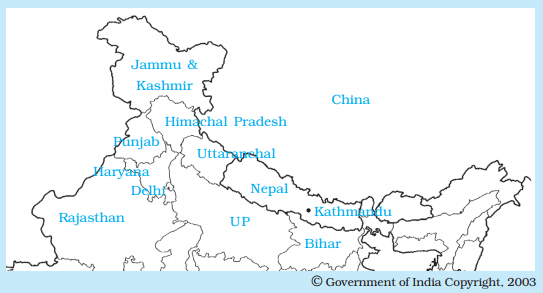
Question1.
On the following map mark out the route, which the author thought of but did not take, to Delhi
Find out the possible routes (by rail, road or air) from Kathmandu to New Delhi/ Mumbai/Kolkata/Chennai?
Answer:
The route the author had thought of but did not take is given below : Kathmandu ? Bihar (Patna) ? Uttar Pradesh (Benares ? Allahabad ? Agra) ? Delhi
I. Answer these Questions in one or two words or in short phrases
Question 1.
Name the two temples the author visited in Kathmandu?
Answer:
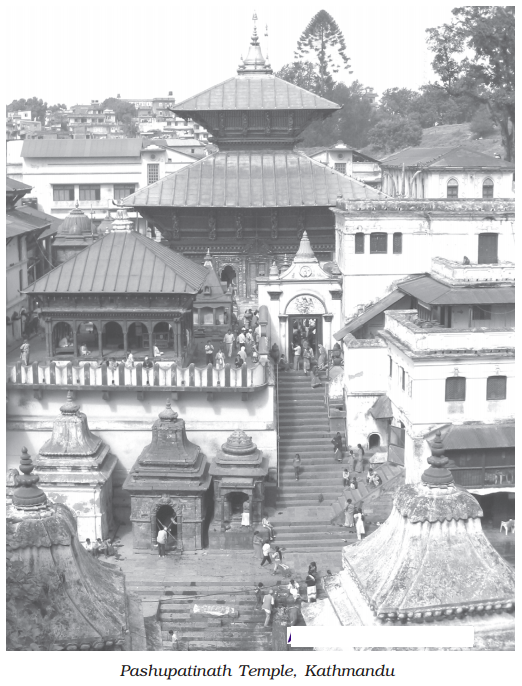
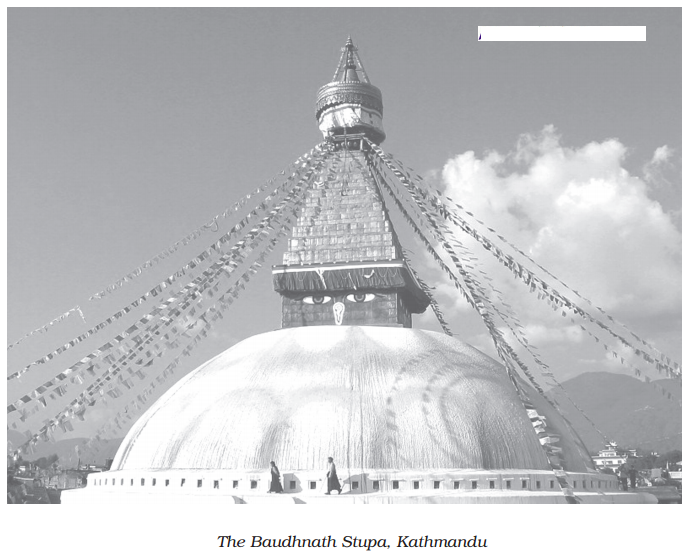
The two temples the author visited in Kathmandu were the Pashupatinath and the Baudhnath temples
Question 2.
The writer says, "All this I wash down with Coca Col
Answer:" What does all this refer to ?
Answer:
All this refers to all the food items - the marzipan bar and the corn on the cob
Question 3.
What does Vikram Seth compare to the quills of a porcupine?
Answer:
Vikram Seth compares the flutes tied on the top of the flute sellers pole to the quills of a porcupine
Question 4.
Name five kinds of flutes?
Answer:
The five kinds of flutes are the reed neh, the recorder, the Japanese shakuhachi, the deep bansuri of Hindustani, the breathy flutes of South America, the high pitched Chinese flutes
II. Answer each Question in a short paragraph
Question 1.
What difference does the author note between the flute seller and the other hawkers?
Answer:
The author noticed that the hawkers screamed to sell their wares but the flute seller was calm and quiet
Question 2.
What is the belief at Pashupatinath about the end of Kaliyug ?
Answer:
When the small shrine of the temple will come out and extend completely, the goddess will emerge but of it. The goddess will bring an end to the evil period of Kaliyug. This is the belief at the Pashupatinath temple about the end of Kaliyug
Question 3.
The author has drawn powerful images and pictures. Pick out three examples each of?
- the atmosphere of febrile confusion outside the temple of Pashupatinath (for example: some people trying to get the priests attention are elbowed aside.)
- the things he sees
- the sounds he hears
Answer:
- the atmosphere of febrile confusion outside the temple of Pashupatinath
- There are so many worshippers that some people trying to get the priests attention are elbowed aside by others
- By the main gate, a party of saffron-clad Westerners struggle for permission to enter
- A fight breaks out between two monkeys
- the things he sees
- a princess of the Nepalese royal house
- fruit sellers
- flute sellers
- hawkers of postcards
- silver jewellery
- felt bags
- the sounds he hears
- film songs from the radios
- car horns
- bicycle bells
- vendors shout out their wares
- flute sounds
III. Answer the following Questions in not more than 100-150 words each
Question 1.
Compare and contrast the atmosphere in and around the Baudhnath shrine with the Pashupatinath temple?
Answer:
An atmosphere of febrile confusion is seen at Pashupàtinath temple. Priests, devotees, tourists, hawkers, cows, monkeys, pigeons and dogs roam and create chaos. There was a crowd of worshippers. At the Baudhnath Stupa, the Buddhist shrine of Kathmandu, the author noticed everything is calm. Small shops stand on its outer edge. Most of the shops are owned by Tibetan immigrants. There are no crowds and this seemed to be a haven of peace in the busy streets around
Question 2.
How does the author describe Kathmandus busiest streets?
Answer:
The author says that the streets in Kathmandu are very busy. They are very narrow. The streets are full of different kinds of people. The people are mercenary and religious. There are small shrines to flower-adorned deities along the narrowest and busiest streets. There are fruit sellers, flute sellers, hawkers of postcards, shops selling western cosmetics, film rolls and chocolates or copper utensils
Nepalese antiques are also available. Different sounds are heard ie, the sounds of film songs from the radios, car horns, bicycle bells, stray cows, vendors shouting are heard. The author buys a cornon- the-cob roasted in a charcoal brazier on the pavement. He also buys Coca Cola and orange drink
Question 3.
"To hear any flute is to be drawn into the commonality of all mankind." Why does" the author say this?
Answer:
The author says this because when he hears the sound of any flute, he becomes an ordinary man. He forgets himself. He stresses of the fact that music appeals to senses and gives pleasure. The flute seller sells various types of flutes that represent different customs and culture. The flute seller is a wise sales person. He plays melodious tunes to attract customers. According to the author, music soothes everyones heart irrespective of their differences
Thinking About Language :
QuestionI.
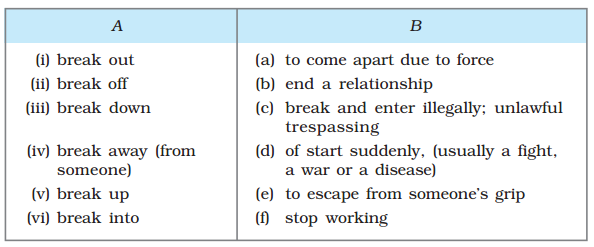
Read the following sentences carefully to understand the meaning of the italicised phrases. Then match the phrasal verbs in Column A with their meanings in Column B?
- A communal war broke out when the princess was abducted by the neighbouring prince
- The cockpit broke off from the plane during the plane crash
- The car broke down on the way and we were left stranded in the jungle
- The dacoit broke away from the police as they took him to court
- The brothers broke up after the death of the father
- The thief broke into our house when we were away
Answer :
| A |
B |
| (i) break out |
(a) to come apart due to force |
| (ii) break off |
(b) end a relationship |
| (iii) break down |
c) break and enter illegally; unlawful trespassinng |
| (iv) break away (from someone) |
(d) of start suddenly, (usually a fight, a war or a disease) |
| v) break up |
(e) to escape from someones grip |
| (vi) break into |
(f) stop working |
QuestionII.
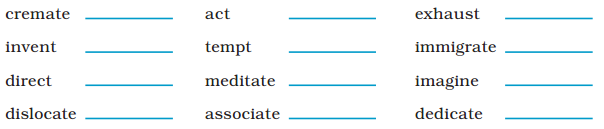
Use the suffixes -ion or -tion to form nouns from the following verbs. Make the necessary changes in the spellings of the words.
Example : proclaim - proclamation?
Answer :
Verb - Noun
cremate - cremation
invent - invention
direct - direction
dislocate - dislocation
act - action
tempt - temptation
meditate - meditation
associate - association
exhaust - exhaustion
immigrate - immigration
imagine - imagination
dedicate - dedication
Question2.
Now fill in the blanks with suitable words from the ones that you have formed?
- Mass literacy was possible only after the of the printing machine
- Ramesh is unable to tackle the situation as he lacks __________ __________
- I could not resist the _______________ to open the letter
- Hard work and ___________ are the main keys to success
- The children were almost fainting with ___________ sun. after being made to stand in the
Answer :
- invention
- action / imagination
- temptation
- dedication
- exhaustion
QuestionIII.
Punctuation
Use capital letters, full stops, Question marks, commas and inverted commas wherever necessary in the following paragraph.
an arrogant lion was wandering through the jungle one day he asked the tiger who is stronger than you you O lion replied the tiger who is more fierce than a leopard asked
the lion you sir replied the leopard he marched up to an elephant and asked the same Question the elephant picked him up. in his trunk swung him in the air and threw him down look said the lion there is no need to get mad just because you dont know the answer?
Answer:
An arrogant lion was wandering through the jungle. One day, he asked the tiger. "Who is stronger than you ?" "You, O lion !" replied the tiger. "Who is more fierce than a leopard ?" asked the lion. "You sir," replied the leopard. He marched up to an elephant and asked the same
Question. The elephant picked him up in his trunk, swung him in the air, and threw him down. "Look," said the lion, "there is no need to get mad just because you dont know the answer."
IV. Simple Present Tense
Study these sentences from the lesson
- A fight breaks out between two monkeys
- Film songs blare out from the radios
- I wash it down with Coca-ColAnswer
The italicised verbs are in the simple present tense. The writer is here describing what he saw and heard but he uses the present tense instead of the past tense. A narration or a story can be made more dramatic or immediate by using the present tense in this way
Now look at the following sentences.
- A small shrine half protrudes from the stone platform on the riverbank
- Small shops stand on the outer edge of the StupAnswer
We use the simple present tense to speak about what is usually or generally true. The sentences above describe facts. We also use the simple present tense in sentences depicting universal truths. For example:
- The sun rises in the east
- The earth revolves round the sun
We can also refer to habitual actions using the simple present tense
- He usually takes a train instead of a bus to work
- We often get fine drizzles in winter
In these sentences words like every day, often, seldom, never, every month. generally, usually, etc. may be used.
1. Fill in the blanks with the correct form of the verb in brackets
Questioni).
The heart is a pump that ?
_______________ - (send) the blood circulating through our body. The pumping action _______________
- (take place) when the left ventricle of the heart _______________
- (contract). This _______________
- (force) the blood out into the arteries, which _______________
- (expand) to receive the oncoming blood
Answers :
- sends
- takes place
- contracts
- forces
- expand
Questionii).
The African lungfish can live without water for up to four years. During a drought it?
- _______________ (dig) a pit and _______________
- (enclose) leaving a tiny opening for air. The capsule _______________
- (dry) and _______________
- but when rain _______________
- (come), the mud _______________
- (dissolve) and the lungfish _______________
- (swim) away
Answers :
- digs
- encloses
- dries
- hardens
- comes
- dissolves
- swims
Questioniii).
MAHESH : We have to organise a class party for our teacher?
- (Do) anyone play an instrument?
VIPUL : Rohit _______________
- (play) the flute.
MAHESH : _______________
- (Do) he also act?
VIPUL : No, he _______________
- (compose) music.
MAHESH : Thats wonderful !
Answers :
- Does
- plays
- Does
- composes
Speaking :
Question 1.
Discuss in class the shrines you have visited or know about. Speak about one of them?
Answer:
Last year I visited the shrine, Yaganti in Andhra Pradesh. It is one of the most popular shrines in the state. At a distance of 55 km from Nandyal, 80 km from Kurnool, 308 km from Hyderabad, 359 km from Vijayawada and 11 km from Banaganapalle, Yaganti in Kurnool district of Andhra Pradesh is famous for Sri Una Maheshwara Swamy dedicated to Lord Shiva
Yaganti is one of the most famous Shiva Temples in Andhra Pradesh and also one of the most popular places to experience AP Tourism. The temple dates back to 5 th and 6 th centuries with contributions from Pallavas, Cholas, Chalukyas and Vijayanagar rulers. The temple received significant contribution from Vijayanagara Kings Harihara and Bukka Rayalu, who finished the construction of several structures in and around the temple
The Una Maheshwara Temple at Yaganti houses the idol of Shiva and Parvathi (Ardhanareeswara) carved out of a single stone. This is probably the only place where Lord Shiva is worshipped in an idol form instead of Shiva Lingo. It is believed that Sage Agastya performed penance for Lord Shiva at this place and requested Shiva to appear in Ardhanareeswara form which is worshipped here. Another unique feature of the temple is Nandi statue which has been growing in the size
Yaganti is located in Yerramala hills that offer immense natural beauty and unique setting to the locality. There are a several natural caves in the hills around the temple which were home for several saints throughout the ages, including that of Great Telugu saint and astrologer Potuluri Veer Brahman Garu
An amazing feature of this temple is its Pushkarini with very pure water. No one knows how the water flows into Pusbkarini in all the seasons. Devotees consider that a bath in the holy Pushkarini before visiting Shiva is highly beneficial
As per a legend, crows do not fly in Yaganti. When Sage Agastya was meditating here, Kakasura, king of crows disturbed him from his meditation so, he cursed the crows not to enter the premises. Thus, Shani also cant enter this place as crow is the vehicle of Shani
Private accommodation is also available for those who want to stay here. There are several shops available that sell water and snacks, but there are no restaurants available here. Shivarathri is celebrated and a large number of devotees visit the temple from all over the state. Free lunch and dinner are provided bythe temple in a large dining hall and the food quality is good
The best time to visit Yaganti is from October to March while the Peak Season is from February to March. Usually it takes half day to visit all places in Yaganti
Question2.
Imagine you are giving an eyewitness account or a running commentary of one of the following?
- a game of football, cricket or hockey, or some sports event
- a parade (e.g. Republic Day) or some other national event
Speak a few sentences narrating what you see and hear. Use the simple present and the present continuous tenses. For example:
He passes the ball but Ben gets in the way.
These brave soldiers guard our frontiers. They display their skills here .
Answer :
Cricket Match
ZPHS, Ongole Vs ZPHS, Kandukur 20xx, T20, at the College Ground, Kandukur. ZPHS, Ongole won the toss and elected to bat fast
Ready for the first ball of the match! Mr. Hari is ready to bowl and the opening batsman, Mr. Shiva is ready to face. He hits the first ball hard. The bewildered fielders are trying their best to stop the ball. Its a four. ZPHS, Ongole scores four runs on the first ball of the match. The bowler delivers the next ball, which just misses the wicket. The batsman survives. The crowd breathes a sign of relief. Now the bowler takes round the wicket
He delivers. Ooo! He hits the ball out of the ground. It is huge six. What a wonderful player! Great shot!. The bowler is disappointed. Now the fourth ball. This time the ball is in the air. Ooo! He has dropped. Now the bowler is running to deliver his fifth ball of the over. The ball goes touching the pads of the batsman this time. The bowler appeals for the Lbw
Writing:
Diary entry for a travelogue
QuestionI.
The text you read is a travelogue where the author, Vikram Seth, talks about his visit to two sacred places in Kathmandu.
Imagine that you were with Vikram Seth on his visit to Pashupatinath temple, and you were noting down all that you saw and did there, so that you could write a travelogue later.
Record in point form?
- what you see when you reach the Pashupatinath temple
- what you see happening inside the temple
- what you do when inside the temple
- what you see outside the temple
- what your impressions are about the place
Answer :
26 August 20xx
9 p.m
Dear Diary,
This is the first day in our trip. I have just come to visit the Pashupatinath temple with my friend, Vikram Seth. It is a very beautiful place. I find a large crowd here to have the darshan of the god. I notice a completely chaotic scenario. The priests, hawkers, devotees, tourists, cows, monkeys, pigeons and dogs are roaming through the grounds
The temple is crowded with huge number of devotees rushing to worship the deity. People are even pushing to enter the main place. Inside the temple, we worship and offer a few flowers to the deity. We heard devotees chanting the name of Lord Shiv
Answer: Outside the temple, a signboard declared that only Hindus could enter the premises of the temple. But some people from Western countries are trying to enter the temple. On the whole, the place is full of noise and chaos, like most holy places in India.
Satwik
QuestionII.
Here is your diary entry when you visited Agr
Answer: Read the points and try to write a travelogue describing your visit to Agra and the Taj Mahal. You may add more details.
January 2003 - rise before dawn - take the Shatabdi Express at 6.15
Answer:m. from Delhi - meet a newly-married couple on train - talk about Himachal Pradesh - get off the train - enter the once-grand city, Agra - twisted alleys - traffic dense - rickshaws, cars, people - vendors selling religious artifacts, plastic toys, spices and sweets - go . to the Taj Mahal - constructed entirely of white marble - magical quality - colour changes with varying of light and shadow - marble with gemstones inside - reflection of the Taj Mahal in the pond - school-children, tourists - tourist guides following people?
Answer:
It was a memorable day for me. It was January 18th, 2003. Before dawn we all got up and ready. We took the Shatabdi Express at 6.15 am . from Delhi in excitement. On the train, we met a newly-married couple from Hyderabad. We talked about Himachal Pradesh and knew many interesting things about Himachal Pradesh. There we got off the train and entered the once-grand city, Agra.
We saw twisted alleys, dense traffic, rickshaws, cars, people, vendors selling religious artifacts, plastic toys, spices and sweets. We went to the Taj Mahal. It was constructed entirely of white marble of magical quality. The colour of the marble changes with varying of light and shadow
The marble with gemstones inside looked gracious. We saw the reflection of the Taj Mahal in the pond. We saw many school-children and tourists visiting the place. Tourist guides were following people who came to visit the place
Kathmandu Summary in English
Vikram Seth wrote about his visit to Kathmandu; the capital of Nepal in his book Heayen Lake. He talked about two temples he visited and noticed how different they were One temple, ealled Pashupatinath, was a Hindu pitgrimage site. The other temple, called Baudhnath, was for Buddhists. He observed that only Hindus were allowed inside the Pashupatinath temple, which created claos among tourists, priests, and pilgrims. He also saw people polluting the Bagmati River by washing clothes, bathing, and throwing dry flowers into it.
Next, he went to the Baudhnath temple and found it to be completely different from the Pashupatinath temple. This Buddhist temple had a large white dome and had a peaceful and serene atmosphere Outside the temple, there was a Tibetan market where people were selling bags, clothes, and ornaments
Vikram Seth noticed that Kathmandu had a lot to offer, including religious sites and tourist destindtions. There were also yarious shops selling antiques, cameras, cosmeties, chocolates, and more, However, the city was also noisy with car horns, music, and street vendors. He enjoyect eatimg a marzipan bar, corn, and drinking CocaCola in the city He also spent time reading lovestories, comics, and books from Readers Digest
When he returned to Delhi, he considered taking an adventurous route back, involving a bus or train journey followed by a bóat ride. However, he decided against it because it would have been too tiring Instead, he booked a flight. Outside his hotel, he saw an interesting flute seller who had a pole with many flutes on it, resembling a porcupines body
The flute seller played his flutes in different tuines and attracted the authors attention because he played them thoughtfully instead of shouting to attract customers. This made. Vikram Seth reflect on how the flute is a common instrument everywhere. He compared it to the human voice and realized how he was now paying attention to even the smallest details
Kathmandu Summary in Telugu
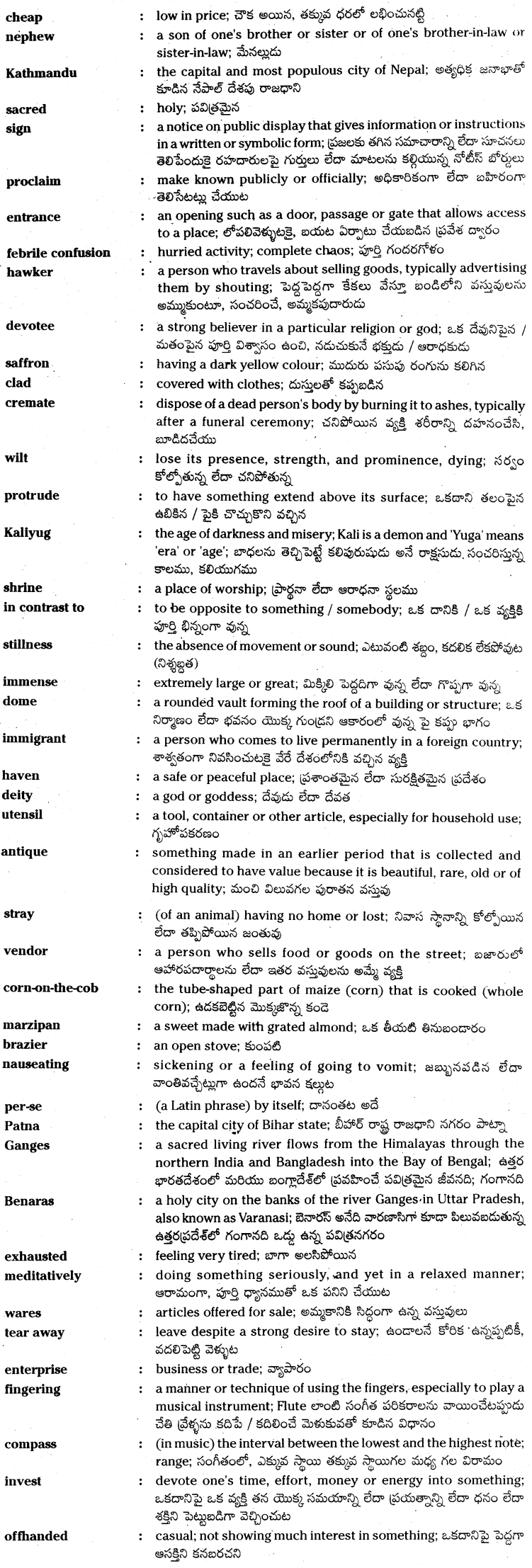
 Glossary: