AP 9th Class English Beehive 6th Lesson My Childhood Questions and Answers
Thinking About the Text :
Activity :
Question.
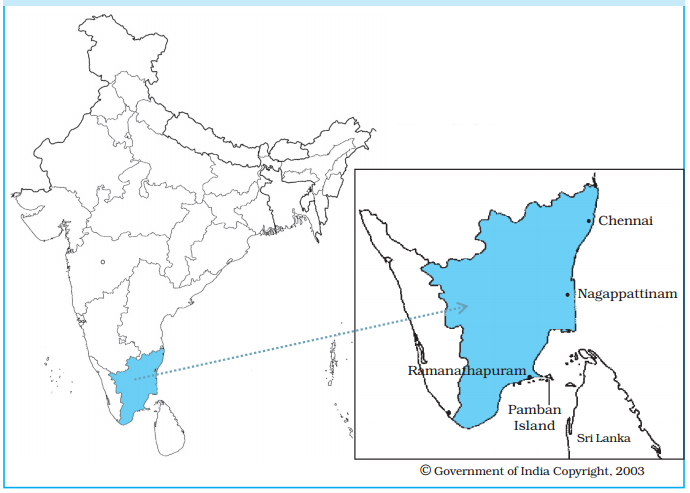
Find Dhanuskodi and Rameswaram on the map. What language(s) do you think are spoken there? What languages do you think the author, his family, his friends and his teachers spoke with one another?
Answer:
Tamil and some other local languages are spoken there. I think the author, his family, his friends an his teachers spoke Tamil with one another
I. Answer these Questions in one or two sentences each
Question 1.
Where was Abdul Kalams house?
Answer:
Abdul Kalams house was on the Mosque Street in Rameswaram
Question 2.
What do you think Dinamani is the name of? Give a reason for your answer?
Answer:
I think Dinamani is the name of a newspaper. The reason is Kalam says that when his brother-in-law would tell the stories of the War, he would later try to find the news in the headlines of Dinamani. Basing on these details, we can say that Dinamani would have been a newspaper
Question 3.
Who were Abdul Kalams school friends? What did they later become?
Answer:
Ramanadha Sastry, Aravindan and Sivaprakasan were Abdul Kalams friends at school. Ramanadha Sastry became a priest of the Rameswaram temple. Aravindan entered the business of arranging transport for visiting pilgrims. Sivaprakasan became a catering contractor for the Southern Railways
Question 4.
How did Abdul Kalam earn his first wages?
Answer:
Abdul Kalam earned his first wages during the Second World War by catching bundles of newspapers thrown out from the moving train on the Rameswaram Road between Rameswaram and Dhanuskodi and distributing them
Question 5.
Had he earned any money before that? In what way?
Answer:
Yes, he had earned money earlier. There was a sudden rise of demand for tamarind seeds. Then, he used to collect tamarind seeds and sell them to a provision shop on Mosque Street. A days collection would fetch him one an
II. Answer each of these Questions in a short paragraph (about 30 words)
Question 1.
How does the author describe: (i) his father, (ii) his mother, (iii) himself?
Answer:
In this lesson Kalam describes his father, his mother and himself as the following: His father: His fathers name was Jainulabdeen. He had no neither wealth nor formal education. But he had innate wisdom. He was an honest and generous man. He was a man of simple living with great thoughts. He lived away from comforts and luxuries.
His mother: According to Kalam, his mothers name was Ashiamm
Answer: She was an ideal helpmate of his father. Many people were fed by her mother at their home daily
Himself : Kalam described himself as a short boy with undistinguished looks. He inherited honesty from his parents. His childhood was secured because of his father. He had honest and generous parents
Question 2.
What characteristics does he say he inherited from his parents?
Answer:
Kalay said that he inherited honesty and self-discipline from his father. From his mother. he inherited faith in goodness and deep kindness
III. Discuss these Questions in class with your teacher and then write down your answers in two or three paragraphs each
Question 1.
"On the whole, the small society of Rameswaram was very rigid in terms of the segregation of different social groups," says the author?
Questioni).
Which social groups does he mention? Were these groups easily identifiable (for example, by the way they dressed)?
Answer:
The social groups mentioned by Kalam are the Hindus and the Muslims. Yes, these groups were easily identifiable by their dressing, tradition, culture, rituals etc. For instance, Kalam used to wear a cap on his head which shows him as a Muslim. Ramanadha Sastry wore a sacred thread that presents him as a brahmin
Questionii).
Were they aware only of their differences or did they also naturally share friendships and experiences? (Think of the bedtime stories in Kalams house; of who his friends were; and of what used to take place in the pond near his house.)?
Answer:
They were not aware only of their differences. They also naturally share friendship and experiences. Kalams mother and grandmother would tell events from the Ramayana and from the life of the Prophet as bedtime stories
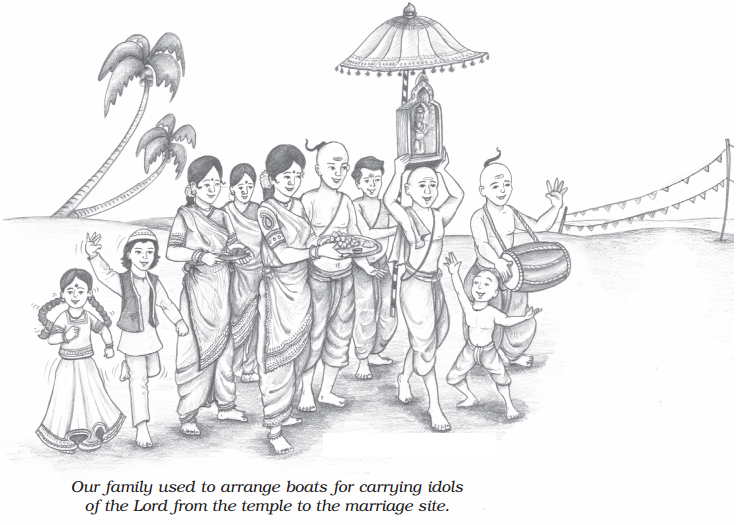
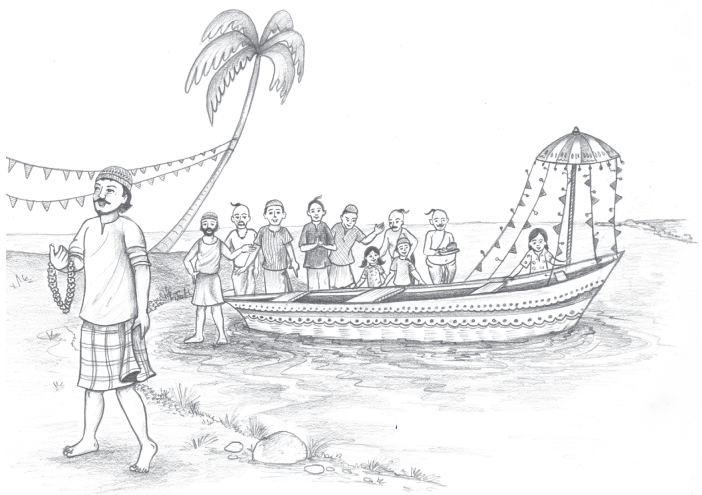
All his friends belonged to orthodox Hindu families. During the annual Sita Rama Kalyanam Ceremony, Kalams family would arrange boats with a special platform for carrying idols of the Lord from the temple to the marriage site. It seems that they lived harmoniously
Questioniii).
The author speaks both of people who were very aware of the differences among them and those who tried to bridge these differences. Can you identify such people in the text?
Answer:
Yes, we can identify the people who were very aware of the differences ainong them and the people who tried to bridge these differences. The new school teacher and Sivasubramania lyers wife encouraged communal differences. But Sivasubramania lyer and Lakshamana Sastry tried to bridge these differences
Questioniv).
Narrate two incidents that show how differences can be created, and also how they can be resolved. How can people change their attitudes?
Answer:
When Lakshamana Sastry was told about the new school teacher who had made Kalam sit on the back bench because he was a Muslim, he called the teacher and demanded him to apologize or quit the school. Lakshamana Sastrys strong sense of conviction changed his behaviour and attitude
When Kalams science teacher, Sivasubramania Iyer, asked Kalam to come to his house for a meal, his wife was horrified at the idea of a Muslim boy being invited to her pure kitchen. Sivasubramania lyer served Kalam food with his own hands and sat down beside him to eat his meal. The next time Sivasubramania Iyers wife realised her mistake and served Kalam food with her own hands inside the kitchen
Question 2.?
Questioni).
Why did Abdul Kalam want to leave Rameswaram?
Answer:
Kalam wanted to continue his education after his schooling at Rameswaram. So he wanted to leave Rameswaram and go to Ramanathapuram
Questionii).
What did his father say to this?
Answer:
His father said that he knew he knew he had to go away to grow. He gave the example of a seagull and said that a seagull could fly across the sun alone and build a nest
Questioniii).
What do you think his words mean? Why do you think he spoke those words?
Answer:
His words reveal his viewpoint of life. His viewpoint is, just like a seagull flies away alone and finds its own food and nest, children will leave their parents to make their own life and family. Parents can bring up their children with love. They cannot give them their thoughts. The children have their own thoughts and beliefs
Kalams mother hesitated to let kalam leave Rameswaram. So he spoke these words to comfort Kalams mother
Thinking About Language :
QuestionI.
Find the sentences in the text where these words occur
 Look these words up in a dictionary which gives examples of how they are used?
Answer:
Erupt : "For reasons I have never been able to understand, a sudden demand for tamarind seeds erupted in the market."
Surge : "Half a century later, I can still feel the surge of pride in earning my own money for the first time."
Trace : "My brother-in-law Jallaluddin would tell me stories about the War which I would later attempt to trace in the headlines in Dinamani."
Undistinguished: "I was one of many children - a short boy with rather undistinguished looks, born to tall and handsome parents."
Casualty : "The first casualty came in the form of the suspension of the train halt at Rameswaram station."
Dictionary information of the words :
Erupt
Part of speech : verb
Example Sentences :
The volcano could erupt at any time.
Ash began to erupt from the crater.
An immense volume of rocks and molten lava was erupted.
Violence erupted outside the embassy gates.
The unrest erupted into revolution.
When Davis scored for the third time the crowd erupted.
My father just erupted into fury.
The room erupted with laughter.
A rash had erupted all over his chest.
surge
Part of speech : noun
Example Sentences :
She felt a sudden surge of anger.
We are having trouble keeping up with the recent surge in demand.
A last-minute surge in ticket sales saved the show from closure.
A surge of people poured through the gates.
Police struggles to control the sudden surge forward by the demonstrators.
An electrical surge damaged the eomputers disk drive.
trace
Part of speech : verb
Example Sentences :
We finally traced him to an address in Chicago.
I have been unable to trace the letter you mentioned.
She could trace her family tree back to the 16 th century.
The leak was eventually traced to a broken seal.
Her book traces the towns history from Saxon times to the present day.
He traced the route on the map.
A tear traced a path down her cheek.
She lightly traced the outline of his face with her finger.
undistinguished
Part of speech : adjective
Example Sentences :
It was a return, however, that was generally undistinguished and short-lived.
It had done so in previous centuries, with very undistinguished results.
Now remove,the undistinguished corners.
The highlights of their policy have been remarkably undistinguished.
Both of them are not undistinguished in the trade union world.
My. party has not played an undistinguished part during the war.
I am not even an undistinguished lawyer but a mere merchant banker.
We cannot pretend that in terms of architectural merit or natural beauty it is anything but undistinguished.
casualty
Part of speech : noun
Example Sentences :
Our primary objective is reducing road casualties.
Both sides had suffered heavy casualties.
She became a casualty of the reduction in part-time work.
Small shops have been a casualty of the recession.
The victims were rushed to casualty.
We waited in casualty until a doctor could see us.
He works as a doctor in casualty
Now answer the following
Questions
Question 1.
What are the things that can erupt? Use examples to explain the various meanings of erupt. Now do the same for the word surge. What things can surge?
Answer:
Things that can erupt are: violence, volcano, ash, volume, unrest etc.
Thinks that can surge: anger, demand, people etc
Question 2.
What are the meanings of the word trace and which of the meanings is closest to the word in the text?
Answer:
Meanings of the word trace
- to find someone or something that was lost
- to find the origin of something
- to discover the causes or origins of something by examining the way in which it has developed
- to draw a shape by showing the main or outer lines :
The meaning that is closest to the word in the text is finding out
Question 3.
Can you find the word undistinguished in your dictionary? (If not, look up the word distinguished and say what undistinguished inust mean.)?
Answer:
Yes, I can find the word undistinguished in my dictionary. The meaning of the word is not interesting.
Question 1.
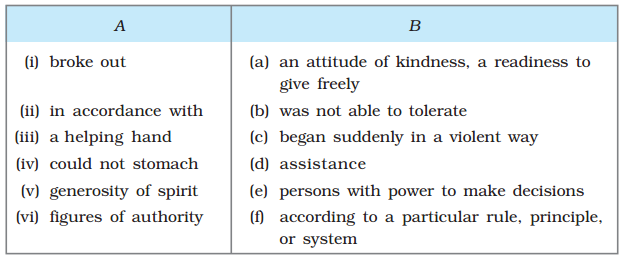
Match the phrases in Column A with their meanings in Column B?
Answer:
| A |
B |
| (i) broke out |
(c) began suddenly in a violent way |
| (ii) in accordance with |
(f) according to a particular rule, principle, or system |
| (iii) a helping hand |
(d) assistance |
| (iv) could not stomach |
(b) was not able to tolerate |
| v) generosity of spirit |
(a) an attitude of kindness, a readiness to give freely |
| (vi) figures of authority |
(e) persons with power to make decisions |
Question 2.
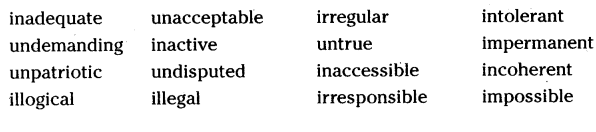
Study the words in italics in the sentences below. They are formed by prefixing un - or in - to their antonyms (words opposite in meaning)?
- I was a short boy with rather undistinguished looks. (un + distinguished)
- My austere father used to avoid all inessential comforts.(in + essential)
- The area was completely unaffected by the war.(un + affected)
- He should not spread the poison of social inequality and communal intolerance.
(in + equality, in + tolerance)
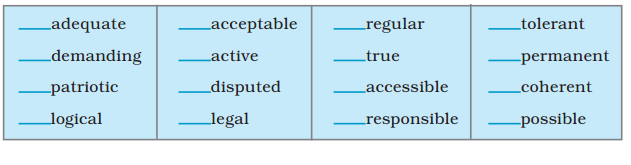
Now form the opposites of the words below by prefixing un-or in- The prefix incan also have the forms il, ir, or im- (for example : illiterate-il + literate, impractical -im + practical, irrational -ir + rational). You may consult a dictionary if you wish
Answer:
III. Passive Voice
Study these sentences :
My parents were regarded as an ideal couple.
I was asked to go and sit on the back bench.
Such problems have to be confronted.
The italicised verbs in these sentences are made up of a form of the verb and a past participle. (For example : were + regarded, was + asked, be + confronted)
These sentences focus on what happens, rather than who does what. Notice that the doer of the action is not included in the sentences.
If necessary, we can mention the doer of the action in a by-phrase. For example :
The tree was struck by lightning.
The flag was unfurled by the Chief Guest
IV. Rewrite the sentences below, changing the verbs in brackets into the passive form
Question 1.
In yesterdays competition the prizes (give away) by the Principal?
Answer:
In yesterdays competition, prizes were given away by the Principal
Question 2.
In spite of financial difficulties, the labourers (pay) on time?
Answer:
In spite of financial difficulties, the labourers were paid on time
Question 3.
On Republic Day, vehicles (not allow) beyond this point?
Answer:
On Republic Day, vehicles are not allowed beyond this point
Question 4.
Second-hand books (buy and sell) on the pavement every Saturday?
Answer:
Second-hand books are bought and sold on the pavement every Saturday
Question 5.
Elections to the Lok Sabha (hold) every five years?
Answer:
Elections to the Lok Sabha are held every five years
Question 6.
Our National Anthem (compose) Rabindranath Tagore?
Answer:
Our National Anthem was composed by Rabindranath Tagore
V. Rewrite the paragraphs below, using the correct form of the verb given in brackets
Question1.
How Heimets Came to Be Used in Cricket
Nari Contractor was the Captain and an opening batsman for India in the 1960s. The Indian cricket team went on a tour to the West Indies in 1962. In a match against Barbados in Bridgetown, Nari Contractor (seriously injure and collapse). In those days helmets (not wear). Contractor (hit) on the head by a bouncer from Charlie Griffith. Contractors skull (fracture)?
The entire team (deeply concern). The West Indies players (worry). Contractor (rush) to hospital. He (accompany) by Frank Worrell, the Captain of the West Indies team. Blood (donate) by the West Indies players. Thanks to the timely help, Contractor (save). Nowadays helmets (routinely use) against bowlers
Answer:
Nari Contractor was the Captain and an opening batsman for India in the 1960s. The Indian cricket team went on a totir to the West Indies in 1962. In a match against Barbados in Bridgetown, Nari Contractor was seriously injured and collapsed
In those days helmets were not worn. Eontractor was hit on the head by a bouncer from Charlie Griffith. Contractors skull was fractured. The entire team was deeply concerned. The West Indies players were worried
Contractor was rushed to hospital. He was accompanied by Frank Worrell, the Captain of the West Indies team. Blood was donated by the West Indies players. Thanks to the timely help, Contractor was saved. Nowadays helmets are routinely used against bowlers
Question2.
Oil from Seeds
Vegetable oils (make) from seeds and fruits of many plants growing all over the world, from tiny sesame seeds to big, juicy coconuts. Oil (produce) from cotton seeds, groundnuts, soya beans and sunflower seeds. Olive oil (use) for cooking, salad dressing etc. Olives (shake) from the trees and (gather) up, usually by hand. The olives (ground) to a thick paste which is spread onto special mats. Then the mats (layer) up on the pressing machine which will gently squeeze them to produce olive oil?
Answers :
Oil from Seeds
Vegetablo oils are made from seeds and fruits of many plants growing all over the world, from tiny sesame seeds to big, juicy coconuts. Oil is produced from cotton seeds, groundnuts, soya beans and sunflower seeds. Olive oil is used for cooking, salad dressing, etc. Olives are shaken from the trees and gathered up, usually by hand. The olives are ground to a thick paste which is spread onto special mats. Then the mats are layered up on the pressing machine which will gently squeeze them to produce olive oil
Dictation :
Question.
Let the class divide itself into three groups. Let each group take down one passage that the teacher dictates. Then put the passages together in the right order?
To Sir, with Love
- From Rameswaram to the Rashtrapati Bhavan, its been a long journey. Talking to Nona Walia on the eve of Teachers Day, President Dr
Answer:P.J. Abdul Kalam talks about lifes toughest lessons learnt and his mission - being a teacher to the Indian youth. "A proper education would help nurture a sense of dignity and self-respect among our youth," says President Kalam
- Theres still a child in him though, and hes still curious about learning new things. Lifes a mission for President Kalam
- Nonetheless, he remembers his first lesson in life and how it changed his destiny. "I was studying in Standard V, and must have been all of 10 . My teacher, Sri Sivasubramania lyer was telling us thow birds fly. He drew a diagram of a bird on the blackboard, depicting the wings, tail and the body with the head and then explained how birds soar to the sky. At the end of the class, I said I didnt understand. Then he asked the other students if they had understood, but nobody had understood how birds fly," he recalls
- "That evening, the entire class was taken to Rameswarm shore," the President continues. "My teacher showed us sea birds. We saw marvellous formations of them flying and how their wings flapped. Then my teacher asked us, Where is the birds engine and how is it powered? I knew then that birds are powered by their own life and motivation. I understood all about birds dynamics. This was real teaching - a theoretical lesson coupled with a live practical example. Sri Sivasubramania lyer was a great teacher." That day, my future was decided. My destiny was changed. I knew my future had to be about flight and flight systems
Answer:
For attempt at class level. Paragraphs are put together as given below.
To Sir, with Love
From Rameswarm to the Rashtrapathi Bhavan, its been a long journey. Talking to Nona Walia of the eve of Teachers Day, President Dr. A.P.J. Abdul Kalam talks about lifes toughest lessons learnt, and his mission - being a teacher to the Indian youth.
"A proper education would help nurture a sense of dignity and self-respect among our youth," says President Kalam. Theres still a child in him though, and hes still curious about learning new things. Lifes a mission for President Kalam
Nonetheless, he remembers his first lesson in life and how it changed his destiny. "I was studying in Standard V, and must have been all of 10. My teacher, Sri Sivasubramania lyer was telling us how birds fly. He drew a diagram of a bird on the blackboard, depicting the wings, tail and the body with the head and then explained how birds soar to the sky
At the end of the class, I said I did not understand. Then he asked the other students if they had understood, but nobody had understood how birds fly," he recalls. "That evening, the entire class was taken to Rameswaram shore," the President continues
"My teacher showed us sea birds. We saw marvellous formations of them flying and how their wings flapped. Then my teacher asked us, "Where is the birds engine and how is it powered ?" I knew then that birds are powered by their own life and motivation. I understood all about birds dynamics
This was real teaching - a theoretical lesson coupled with a live practical example. Sri Sivasubramaniya lyer was a great teacher." That day, my future was decided. My destiny was changed. I knew my future had to be about flight and flight systems
Speaking :
Here is a topic for you to
- think about
- give your opinion on
Find out what other people think about it. Ask your friends/seniors/parents to give you their opinion.
Career Building Is the Only Goal of Education.
or
Getting a Good Job Is More Important than Being a_Good Human Being..
You can use the following phrases
- while giving your opinion :
- I think that .
- In my opinion .
- It seems to me that .
- I am of the view that .
- As far as I know .
- If you ask me .
- saying what other people think :
- According to some .
- Quite a few think .
- Some others favour .
- Thirty per cent of the people disagree .
- Fifty per cent of them strongly feel .
- asking for others opinions :
- What do you think about .
- What do you think of .
- What is your opinion about .
- Do you agree .
- oes this make you believe .
Answer :
Career Building is the Only Goal of Education
Some people alsways think the ultimate aim of education is building career. I think it is quite wrong. Only few realize that career building is not the only goal of education. The main aim of education is to prepare us to face physical, social and spiritual challenges in life. It makes us know what is right and what is wrong
Building career is an essential thing in everybodys life. Education helps you build your career. Education does not limit you to your career only. It helps you in many ways. It makes you perfect in every aspect. Above all, it makes you a good human being.
OR
Getting a Good Job Is More Important than Being a Good Human Being.
I think being a good human being is more important than getting a good job in life. Some people think that getting a good job solves all problems in life. Being a man of virtue is the first step to success in social life. The moral excellence of a person is essential to become a successful man. It is not your education that makes you a great person
It is your honesty, sympathy, goodwill, helpfulness, generosity, etc. that make you a great man. You can be successful in your job with good personality. A good job without good personality is useless. If you do not have good personality, you cannot sustain in your job
Writing :
Question.
Think and write a short account of what life in Rameswaram in the 1940 s must have been like. (Were people rich or poor? Hard-working or lazy? Hopeful of change, or resistant to it?)?
Answer :
According to Kalams childhood account, in the 1940s, the life people in Rameswaram might reflect the unity in diversity. Those days people had no formal education and wealth. Their life was simple. They did not have comforts and luxuries
Religious based segregation was existed but people lived in harmony with one another. Yet there were people who did not like different social groups to intermingle. The religions were identified by the clothes they wore or the area where they lived. Orthodox Hindu Brahmin families were more rigid
People who had good education like Siva Subrahmanya lyer were against religious segregation. People were hard-working. They were not lazy. The people of the town might have been hard-working, as the author mentions how his cousin used to collect bundles of newspaper for distribution
Kalams family arranged for boats for the visiting pilgrims. Also, the author himself started earning at the tender age of eight years by collecting tamarind seeds. People of those days were very hopeful. They waited optimistically for independence
My Childhood Summary in English
This is a biographical account of Abdul Kalam. Kalam was born in a middleclass Muslim family in Rameshwaram. He had three brothers and one sister. His father was a kind and wise man, and his mother was hospitable. They lived in their ancestral house on Mosque Street. Although his parents were not highly educated or wealthy, they were generous and kind. Many people from outside would eat with their family every day. Kalam learned honesty and self-discipline from his parents. He learned about the importance of goodness and Kindness from them
When Kalam was just 8 years old, the Second World War started in 1939. At that time, there was a high demand for tamarind seeds. Kalam used to collect these seeds and sell them in the market. His cousin Shamsuddin distributed newspapers and gave Kalam a job as a helper. This was how he earned his first wages
Kalams family respected all religions and took part in Hindu festivals. His mother and grandmother would tell stories from the Ramayana and the life of the Prophet to the children at bedtime. Kalam had three friends named Ramanandha Sastry, Aravindam, and Sivaprakasan. They came from different religious backgrounds and had different upbringings, but they never felt any difference between them. When they grew up, they chose different professions
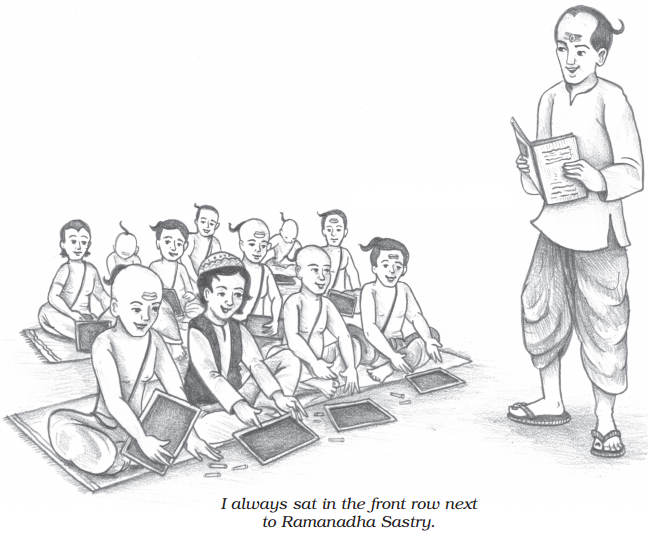
One day, when Kalam was in the 5th grade at Rameshwaram Elementary School, a new teacher joined their class. He wore a cap that showed he was a Muslim. Kalam always sat in the front row next to Ramanandha Sastry, but the teacher didnt like a Hindu priests son sitting with a Muslim boy. Kalam was asked to move to the back bench. Both friends felt very sad and told their parents about what happened after school. Ramanandhas father called the teacher and told him not to spread hatred and inequality among innocent children. He told the teacher to apologize or leave the school and the city. The teacher apologized and changed his ways
Once, Kalams science teacher invited him to have dinner at his home. However, the teachers wife refused to serve Kalam in her kitchen because of religious differences. The teacher himself served Kalam food and sat beside him to eat his own meal. The wife secretly watched from behind the door and did not find any change in Kalams behavior. After dinner, the teacher invited Kalam again for the next weekend. This time, the wife served food in the kitchen with her own hands
After the Second World War ended, Kalam asked his father for permission to go to Ramanathapuram to study His father knew that Kalam had to go away to grow up, so he gave his permission. He told his hesitant wife that they should give their children love but not force their thoughts on them
My Childhood Summary in Telugu
 Glossary: