He began by tuning two drums to different notes arid asked her to sense the sound. She realized she could feel the higher drum from the waist up and the lower one from the waist down. Forbes repeated the exercise again and again and soon Evelyn discovered that she could sense certain notes in different parts of her body
When she played on the xylophone, she could sense the sound passing up the stick into her fingertips. By leaning against the drums, she could feel the resonances flowing into her body. On the wooden floor she used to remove her shoes so that the vibrations might pass through her bare feet and up her legs
- He refused to start a Shehnai School in the U.S.A because he had to be away from his country
- He refused to move to Pakistan at the time of partition of the country and he loved to stay in Benaras
Thinking About Language :
I. Look at these sentences
Question.
Evelyn was determined to live a normal life.
Evelyn managed to conceal her growing deafness from friends and teachers. The italicised parts answer the Questions: "What was Evelyn determined to do?"and "What did Evelyn manage to do?" They begin with a to-verb (to live, to conceal). Complete the following sentences. Beginning with a to-verb, try to answer the Questions in brackets?
- The school sports team hopes __________ (What does it hope to do?)
- We all want __________ (What do we all want to do?)
- They advised the hearing-impaired childs mother __________ (What did they advise her to do?)
- The authorities permitted us to __________ (What did the authorities permit us to do?)
- A musician decided to __________ (What did the musician decide to do?)
Answer:
- The school sports team hopes to beat the enemies / to win the match
- We all want to succeed in our lives / to earn a lot of money/to make good friends in our lives
- They advised the hearing-impaired childs mother to take care of the child/ to provide the child with advanced aids of hearing
- The authorities permitted us to play cricket in the stadium/to enter the stadium without tickets
- A musician decided to play the music in front of an audience
QuestionII.
From the text on Bismillah Khan, find the words and phrases that match these definitions and write them down. The number of the paragraph where you will find the words/phrases has been given for you in brackets?
- the home of royal people (1) __________
- the state of being alone (5) __________
- a part which is absolutely necessary (2) __________
- to do something not done before (5) __________
- without much effort (13) __________
- quickly and in large quantities (9) __________ and __________
Answer:
- the royal residence
- solitude
- indispensable
- invent
- effortlessly
- thick and fast
QuestionIII.
Tick the right answer?
- When something is revived, it (remains dead/lives again)
- When a government bans something, it wants it (stopped/started)
- When something is considered auspicious, (welcome it/avoid it)
- When we take to something, we find it (boring/interesting)
- When you appreciate something, you (find it good and useful/find it of no use)
- When you replicate something, you do it (for the first time/for the second time)
- When we come to terms with something, it is (still upsetting/no longer upsetting)
Answer:
- lives again (?)
- stopped (?)
- welcome it (?)
- find it good and useful (?)
- interesting (?)
- for the second time (?)
- no longer upsetting (?)
IV. Dictionary work
Question.
The sound of the shehnai is auspicious.
The auspicious sound of the shehnai is usually heard at marriages.
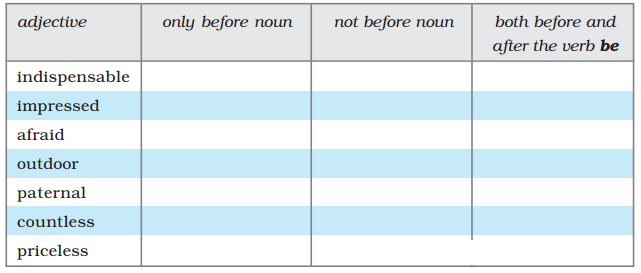
The adjective auspicious can occur after the verb be as in the first sentence, or before a noun as in the second. But there are some adjectives which can be used after the verb be and not before a noun. For example :
Ustad Faiyaz Khan was overjoyed.
We cannot say: *the overjoyed man.
Look at these entries from the Oxford Advanced Learners Dictionary (2005).
elder adi, noun
adjective 1 Ionly before noun] (of people, especially two members of the same family) older: my elder brother $cdot$ his elder sister 2 (the elder) used without a noun immediately after it to show who is the older of two people: the elder of their two sons 3 (the elder) (formal) used before or after sbs name to show that they are the older of two people who have the same name: the elder Pitt $cdot$ Pitt, the elder.
awake adj, verb
adjective (not before noun] not asleep (especially immediately before or after sleeping): to be half/fully awake; to be wide awake. I was still dwake when he came to bed.
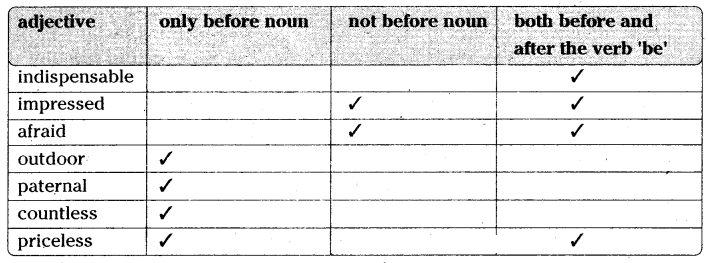
Consult your dictionary and complete the following table. The first one has been done for you?
Answer:
Question 3.
Use these words in phrases or sentences of your own?
Answer:
indispensable : Raghu is an indispensable member of the staff in our school.
impressed : I was very impressed with her dance performance.
afraid : Mohan is afraid of snakes.
outdoor : llike to play outdoor games.
paternal : Sravani is my paternal aunt.
countless : He makes countless mistakes.
priceless : My father gave me a priceless work of art on my birthday
Speaking :
I. Imagine the famous singer Kishori Amonkar is going to visit your school. You have been asked to introduce her to the audience before her performance. How would you introduce her?
Here is some information about Kishori Amonkar you can find on the Internet
Read the passage and make notes of the main points about:
- her parentage
- the school of music she belongs to
- her achievements
- her inspiration
- Awards
Padma Bhushan Kishori Amonkar, widely considered the finest female vocalist of her generation, was born in 1931, daughter of another great artist, Smt. Mogubai Kurdikar. In her early years she absorbed the approach and repertoire of her distinguished mothers teacher Ustad Alladiya Khan
As her own style developed, however, she moved away from Alladiya Khans Jaipur- Atrauli gharana style in some respects, and as a mature artist her approach is usually regarded as an individual, if not unique, variant of the Jaipur model
Kishori Amonkar is a thinker, besotted by what she calls the mysterious world of her raagas. She dissects them with the precision of a perfectionist, almost like a scientist, until the most subtle of shades and emotions emerge and re-emerge
She is very/much inspired by the teachings of the ancient Vedic sages, written at a time when vocal music was highly devotional in character. This soul searching quality of her music, coupled with a very intellectual approach to raaga performance has gained her quite a following in India and has helped to revive the study of khayal
Significant awards bestowed on this artist include the Sangeet Natak Akademi Award (1985), the Padma Bhushan (1987), and the highly coveted Sangeet Samradhini Award (considered one of the most prestigious awards in Indian Classical Music) in 1997
Sample Notes :
Her parentage : Daughter of Smt. Mogubai Kurdikar
The school of music she belongs to : Variant of the Jaipur model
Her achievements : She dissects Raagas with the precision of a perfectionist, almost like a scientist, until the most subtle of shades and emotions emerge and re-emerge.
Her inspiration : The teachings of the ancient Vedic sages
Awards : The Sangeet Natak Akademi Award (1985),
The Padma Bhushan (1987);
Sangeet Samradhini Award in 1997
Question II.
Use your notes on Kishori Amonkar to introduce her to an imaginary audience. You may use one of the following phrases to introduce a guest :
I am honoured to introduce./I feel privileged to introduce./We welcome you.?
Answer:
I feel privileged to introduce a great person to you today from this dais. She is a famous female singer. She was born in 1931 to the great artist Smt. Mogubai Kurdikar
She is a thinker who dissects the raagas with the precision of a perfectionist so that the raagas can be inspirational for the common masses. She is greatly inspired by the teachings of the ancient Vedic sages"
She is conferred with the significant awards viz., the Sangeet Natak Akademi Award (1985), the Padma Bhushan (1987) and the highly coveted Sangeet Samradhini Award in 1997. She is none other than Kishori Amonkar, the finest female vocalist of her generation,
Writing :
Question .
"If you work hard and know where youre going, youll get there," says Evelyn Glennie.
You have now read about two musicians, Evelyn Glennie and Ustad Bismillah Khan. Do you think that they both worked hard? Where did they want to go ?
Answer these Questions in two paragraphs, one on each of the two musicians?
Answer:
Yes, Evelyn Glennie and Ustad Bismillah Khan worked hard. They both wanted to pursue music as their career and achieved a lot
Evelyn Glennie became profoundly deaf by the time she was eleven years old. But, she did not let her deafness become a hurdle in pursuing her career in music. She has been an inspiration to many
Evelyn Glennie was a hardworking and well-determined girl. She faced many difficulties since her childhood. She was 11 years old when she gradually started losing hearing capability
In spite of being handicapped, she never gave up, she has taught herself to play instruments, not by listening to them, but by feeling the vjbrations through her feet and body. Her teachers discouraged her but she was mótivated and guided by percussionist Ron Forbes
She joined the Royal Academy of Music in London and captured most of the top awards there. She became the worlds most renowned multi-percussionist, who can play thousands of instruments to perfection. She is a shining example of determination.
Ustad Bismillah Khan came from a family of professional musicians. He was one of the best shehnai players in the world. He brought the shehnai to the classical stage and elevated its status. He learned to play the shehnai from his ancestors
He practised for hours and worked very hard to attain perfection. On 15th August 1947, the day when India got independence, he played the shehnai before the Prime Minister of India, Pandit Jawahar Lal Nehru and greeted the independence with his melodious music. He created many new ragas and won many prestigious awards
He was a true patriot who declined many offers to settle abroad. He was a true artist but a simple man. He had great regards for Hindustani Classical Music. He was strongly bonded to Benaras and the holy Ganga. He was awarded Indias highest civilian award - the Bharat Ratna. He has been an icon of creativity
The Sound of Music Summary in English
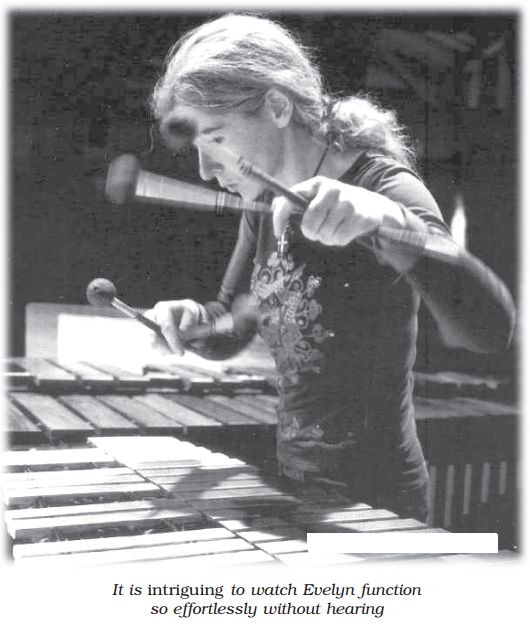
The first part of the lesson isabout a seventeen-year-old girl who was very nervous about her first day at the famous Royal Academy of Music in London. She was deaf, which made her life very challenging. Her name was Evelyn Glennie, and she came from Scotland. When she was eight years old, her mother noticed that her hearing was getting weaker. She kept this a secret from her friends and teachers
By the time Evelyn turned eleven, it became clear to everyone that she had a disability. The headmistress of her school asked her mother to take her to a specialist. The specialist explained that Evelyns hearing loss was due to gradual nerve damage and recommended that she should wear a hearing aid
Despite her disability, Evelyn was determined to live a normal life and pursue her love for music. One day, she saw a girl playing the xylophone and felt inspired to learn to play it too. Ron Forbes, a percussionist, noticed her talent and gave her some advice. He told her not to rely on her ears to listen to the music but to feel it through her other senses. In that moment, Evelyn realized that she could feel the higher drum from her waist up and the lower drums from her waist down
She learned to open her mind and body to different sounds and never looked back. She traveled all over the United Kingdom with a youth orchestra and was determined to make music her life. When she auditioned for the Royal Academy of Music in London, she played thexylophone and achieved the highest grades in the history of the academy. She transitioned from playing in an orchestra to performing solo
After completing her three-year course, she received many top awards. However, Evelyn didnt feel proud of her achievements. Instead, she believed that if you know your goal, you can achieve it. She became the worlds leading multi-percussionist, mastering over a thousand instruments
Music flowed through every part of Evelyns body. She could feel the sound of the xylophone in her fingertips as she played. She sensed the beat of the drums by leaning on them. To feel the vibrations in her body, she would take off her shoes when standing on a wooden platform
In 1991, she received the prestigious Soloist Award from the Royal Philharmonic Society. She worked tirelessly and performed at numerous concerts, including in prisons and hospitals. Evelyn became an inspiration for many disabled people
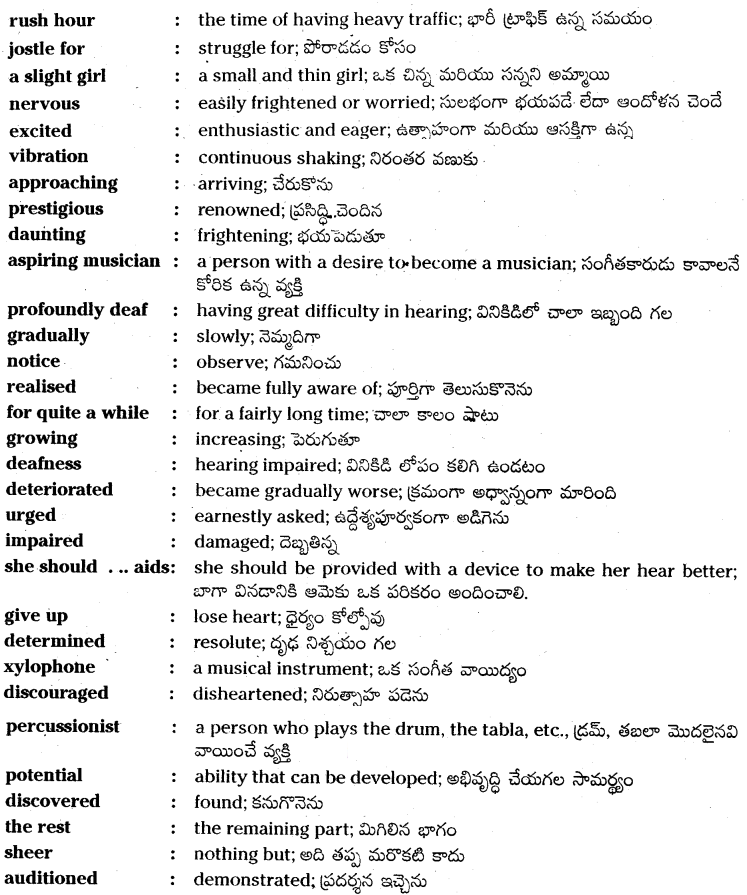
Glossary:
The Shehnai of Bismillah Khan Summary in English

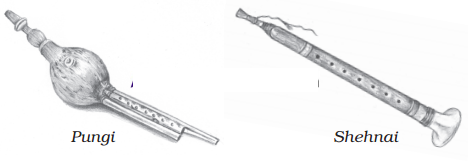
The second part of the lesson is about the journey of Bismillah Khan, who was a master in playing the musical instrument called Shehnai. In the past, Emperor Aurangzeb had banned the playing of another instrument called Pungi because it made an unpleasant sound
However, a barber came up with a new version of the instrument. He took a pipe with a hollow stem and added seven holes to it. By opening and closing these holes, he could play different notes and create a melodious sound. The emperor liked this new instrument and named it Shehnai. It became popular for its auspicious sound and was played at temples and weddings. Bismillah Khan later brought the shehnai to the classical music stage
Bismillah Khan was born on March 21, 1916, in a family of musicians in Bihar. His grandfather, Rasool Bux Khan, played the shehnai in the court of the Bhojpur king. His father, Paigambar Bux, and other ancestors were also skilled shehnai players. When Bismillah Khan was three years old, he was inspired by his uncles practice of the shehnai,
He began learning to play the shehnai and practiced at various places, including the Vishnu temple in Banaras and the banks of the Ganges. When he was fourteen, he accompanied his uncle to the Allahabad Music conference. His big breakthrough came when he started playing the shehnai on the All-India Radio in Lucknow in 1938. He became famous for being the first Indian musician to play the shehnai and celebrate Indias independence on August 15, 1947, from the Red Fort
Bismillah Khan performed in many countries and achieved great success. He even composed music for two movies that became very popular. He was the first Indian musician to be invited to perform at the Lincoln Centre Hall in the USA. He participated in numerous art festivals and trade fairs around the world. An auditorium in Teheran was named after him to honor his contributions
He received several national awards, including the Padma Bhushan and Padma Vibhushan. In 2001, he was awarded Indias highest civilian award, the Bharat Ratna. Bismillah Khan always emphasized the importance of teaching music to children, as it is one of Indias rich traditions
Although Bismillah Khan traveled extensively, he always cherished his Indian roots and celebrated the countrys cultural heritage. He serves as an excellent example of an Indian who deeply appreciated and promoted Indian music
The moral of the story is that both Evelyn Glennie and Bismillah Khan, two great music maestros, have shown the world that hard work and extraordinary efforts are rewarded with success. Evelyn Glennie, despite being deaf, dedicated herself to percussion and achieved international fame through her perseverance and determination. Bismillah Khan, similarly dedicated to his art, worked hard to elevate the shehnai as a classical instrument and received recognition and awards for his achievements. Their lives exemplify how hard work and dedication can lead to great success