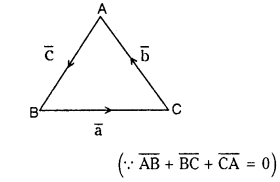
TS Inter 1st Year Maths 1A Solutions Chapter 4 Addition of Vectors Ex 4(a)
TS Inter 1st Year Maths 1A Addition of Vectors Solutions Exercise 4(a)
I.
Question 1.
ABCD is a parallelogram. If L and M are the middle points of BC CD respectively then find
i) AL and AM in terms of AB and AD
ii) λ, if AM = λ AC−AL(V.S.A)
Answer:
ABCD is a parallelogram and hence AB=DC and BC=AD
We have BC = 12BC
(∵ L is the mid point of BC)
= 1/2 AD (∵ BC = AD)
Question 2.
In AABC, P, Q and R are the mid points of the sides AB, BC and CA respectively. If D is any point
i) Then express DA+DB+DC in terms of DP,DQ and DR.
ii) If PA+QB+RC=α, then find a.(V.S.A)
Answer:
Let D be the origin.
and DA¯=a , DB=b and DC=c
P.V. of P is mid point of AB=DP=a+b/2
P.V. of Q is mid point of BC=DQ¯=b+c/2
P.V. of R is mid point of AC=DR¯=c+a/2
Question 3.
Let a̅ = i̅ + 2 j̅ + 3k̅ and b̅ = 3 i̅ + j̅. Find the unit vector in the direction of a+b. (V.S.A)
Answer:
Unit vector in the direction of a+b is
Question 4.
If the vectors -3i̅ + 4j̅ + λk̅ and μi̅ + 8j̅ + 6k̅ are collinear vectors then find λ and μ. (May 2014, ’12, Mar. ’14)
Answer:
If the vectors a1 i̅ + b1 j̅ + c1k̅ and a2 i̅ + b2 j̅ + c2k̅ are collinear then
Question 5.
ABCDE is a pentagon. If the sum of the vectors AB,AE,BC,DC,ED and AC is λ AC , then find the value of λ. (S.A)
Answer:
Given ABCDE is a pentagon and
Question 6.
If the position vectors of the points A, B and C are -2i̅ + j̅ – k̅, -4i̅ + 2j̅ + 2k̅ and 6i̅ – 3j̅ – 13k̅ respectively and AB = λAC then find the value of λ. (March 2011) (S.A)
Answer:
Let O be the origin and given
Question 7.
If OA¯=i¯+j¯+k; AB=3i¯−2j¯+k, BC=i¯+2j¯−2k and CD=2i¯+j¯+3k then find the vector OD¯. (March 2013) (V.S.A)
Question 8.
If a̅ = 2i̅ + 5j̅ + k̅ and b̅ = 4i̅ + mj̅ + nk̅ are collinear vectors then find m and n. (May 2011) (V.S.A)
Answer:
Since a̅ = 2i̅ + 5j̅ + k̅ and
b̅ = 4i̅ + mj̅ + nk̅ are collinear
⇒ 2/4=5/m=1/n
⇒ 1/2=5/m and 1/2=1/n ⇒ m = 10 and n = 2
Question 9.
Let a̅ = 2i̅ + 4j̅ – 5k̅, b̅ = i̅ + j̅ + k̅ and c̅ = i̅ + 2k̅. Find the unit vector in the opposite direction of a̅ + b̅ + c̅. (March 2015-A.P)(May 2012; Mar. ’04, ’12; Board Model Paper) (V.S.A)
Answer:
Question 10.
Is the triangle formed by the vectors 3i̅ + 5j̅ + 2k̅, 2i̅ – 3j̅ – 5k̅ and -5i̅ – 2 j̅ + 3k̅ equilateral ? (V.S.A)
Answer:
Let ABC be the triangle with AB = 3i̅ + 5 j̅ + 2k̅
BC = 2i̅ – 3 j̅ – 5k̅
CA = -5i̅ – 2j̅ + 3k̅
∴ The given vectors formed on equilateral triangle.
Question 11.
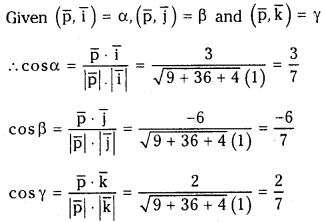
If α, β and γ are the angles made by the vector 3i̅ – 6j̅ + 2k̅ with the positive directions of the coordinate axes then find cos α, cos β, cos γ. (S.A)
Answer:
Unit vectors along the coordinate axes are respectively i̅, j̅, k̅
Let p̅ = 3i̅ – 6j̅ + 2k̅
Question 12.
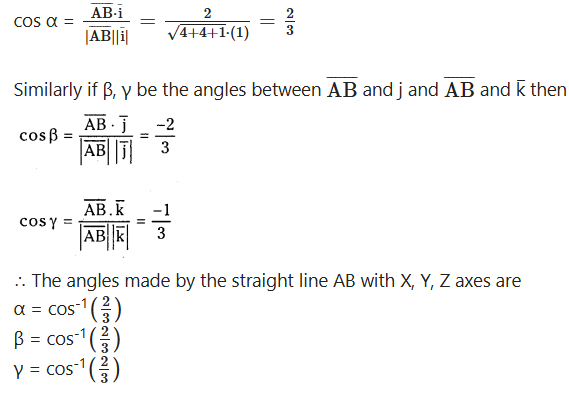
Find the angles made by the straight line passing through the points (1, -3, 2) and (3, -5, 1) with the coordinate axes. (S.A)
Answer:
Let the vectors along the coordinate axes be i̅, j̅, k̅ respectively. Let O be the origin and the points A(1, -3, 2) and B(3, -5, 1).
i. e. OA = i̅ – 3 j̅ + 2k̅, OB¯ = 3 i̅ – 5 j̅ + k̅
AB¯=OB¯−OA = (3i̅ – 5j̅ + k̅) – (i̅ – 3j̅ + 2k̅) = 2i̅ – 2j̅ – k̅
Let α be the angle between AB¯ and i̅ then
II.
Question 1.
If a̅ + b̅ + c̅ = αd̅, b̅ + c̅ + d̅ = βa̅ and a̅, b̅, c̅ are non-coplanar vectors, then show that a̅ + b̅ + c̅ + d̅ = 0̅. (S.A)
Question 2.
a̅, b̅, c̅ are non coplanar vectors. Prove that the following four points are coplanar.
i) -a̅ + 4b̅ – 3c̅, 3a̅ + 2b̅ – 5c̅ (May,’14,’12)
-3a̅ + 8b̅ – 5c̅, – 3a̅ + 2b̅ + c̅
Answer:
Let 0 be the origin and A, B, C, D are the four points given by
OA = -a̅ + 4b̅ – 3c̅, OB = 3a̅ + 2b̅ – 5c̅
OC = -3a̅ + 8b̅ – 5c̅, OD = -3a̅ + 2b̅ + c̅
AB¯=OB¯−OA = (3a̅ + 2b̅ – 5c̅) – (-a̅ + 4b̅ – 3c̅)
= 4a̅ – 2b̅ – 2c̅
AB¯=OB¯−OA = (-3a̅ + 2b̅ – 5c̅) – (3a̅ + 2b̅ – 5c̅)
= -6a̅ – 4b̅ + 3c̅
AC¯=OC−OA = (-3a̅ + 8b̅ – 5c̅) – (-a̅ + 4b̅ – 3c̅) = -2a̅ + 4b̅ – 2c̅
AD=OD−OA = (3a̅ + 2b̅ + c̅) – (-a̅ + 4b̅ – 3c̅) = -2a̅ – 2b̅ + 4c̅
Let a vector be expressed as a linear combination of other two.
Suppose AB¯ = x(AC¯) + y (AD) where x, y are scalars.
∴ 4a̅ – 2b̅ – 2c̅ = x (-2a̅ + 4b̅ – 2c̅) + y(-2a̅ – 2b̅ + 4c̅) Comparing coefficients of a̅, b̅, c̅ we get
(∵ a̅, b̅, c̅ are non coplanar vectors)
-2x – 2y = 4 ……………(1)
4x – 2y = -2 ……………(2)
-2x + 4y = -2 ………….(3)
Solving (1) and (2) we get 2x + 2y = – 4 and 4x – 2y = – 2
6x = – 6 ⇒ x = -1
x + y = -2 ⇒ y = -1
x = – 1 and y = -1 satisfy equation (3).
⇒ A, B, C, D are coplanar and
AB¯,AC¯,AD are coplanar.
and AB¯,AC¯,AD are coplanar.
∴ The given points A, B, C, D are coplanar. ii) 6a̅ + 2b̅ – c̅, 2a̅ – b̅ + 3c̅, -a̅ + 2b̅ – 4c̅, -12a̅ – b̅ – 3c̅
Answer:
Let O be the origin and A, B, C, D be the given points.
OA = 6a̅ + 2b̅ – c̅, OB¯ = 2a̅ – b̅ + 3c̅
OC = -a̅ + 2b̅ – 4c̅, OD = -12a̅ – b̅ – 3c̅
∴ AB¯=OB¯−OA
= (2a̅ – b̅ + 3c̅) – (6a̅ + 2b̅ – c̅)
= – 4a̅ – 3b̅ + 4c̅
AC¯=OC−OA = (-a̅ + 2b̅ – 4c̅) – (6a̅ + 2b̅ – c̅) = -7a̅ – 3c̅
AD=OD−OA = (-12a̅ – b̅ – 3c̅) – (6a̅ + 2b̅ – c̅)= -18a̅ – 3b̅ – 2c̅
∴ Let a vector be expressed as a linear combination of other two.
Suppose AB¯ = xAC¯ + yAD
⇒ -4a̅ – 3b̅ + 4c̅ = x(-7a̅ – 3c̅) + y(-18a̅ – 3b̅ – 2c̅)
Comparing coefficients of a̅, b̅, c̅ since a̅, b̅, c̅ are non coplanar,
-7x – 18y = – 4 …………(1)
-3y = -3 ⇒ y = 1 ……….(2)
∴ -7x – 18 = – 4 ⇒ – 7x = 14 ⇒ x = -2
Comparing coefficient of c,
-3x – 2y = 4 ………..(3)
x = – 2 and y = 1 satisfy equation (3)
and hence A, B, C, D are coplanar.
Alternate Method For Above Problem : Use scalar triple product of vectors AB¯¯¯¯¯¯¯,AC¯¯¯¯¯¯¯ and AD¯¯¯¯¯¯¯¯ show that this AB¯¯¯¯¯¯¯⋅(AC¯¯¯¯¯¯¯×AD¯¯¯¯¯¯¯¯) = 0 [AB¯¯¯¯¯¯¯AC¯¯¯¯¯¯¯AD¯¯¯¯¯¯¯¯]=∣∣∣∣−4−7−18−30−34−3−2∣∣∣∣ = -4 (-9) + 3 (14 – 54) + 4 (21) = 36- 120 + 84 = 0 ∴ Vectors AB, AC, AD are coplanar ⇒ The given points A, B, C, D are coplanar.
Question 3. If i̅, j̅, k̅ are unit vectors along the positive directions of the co-ordinate axes, then show that the four points 4i̅ + 5j̅ + k̅, – j̅ – k̅ , 3i̅ + 9j̅ + 4k̅ and -4i̅ +4j̅ +4k̅ are coplanar. (Mar. ’14)
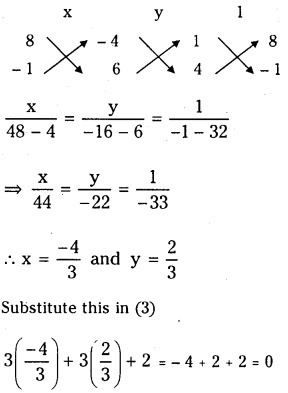
Answer: Let O be the origin and let A, B, C, D be the given points. Then OA¯¯¯¯¯¯¯¯ = 4i̅ + 5j̅ + k̅, OB¯¯¯¯¯¯¯ = – j̅ – k̅, OC¯¯¯¯¯¯¯¯ = 3i̅ + 9 j̅ + 4k̅, OD¯¯¯¯¯¯¯¯ = -4 i̅, + 4 j̅, + 4k̅, Now AB = OB — OA = (-j̅ – k̅) – (4i̅ + 5j̅ + k̅) – 4i̅ – 6j̅ – 2k̅ AC = OC – OD = -i̅ + 4j̅ + 3k̅, AD = OD – OA = -8i̅ – j̅ + 3k̅ Let AB¯¯¯¯¯¯¯ = x(AC¯¯¯¯¯¯¯) + y(AD¯¯¯¯¯¯¯¯) for some values of x and y ⇒ – 4i̅ – 6j̅ – 2k̅ = x(- i̅ + 4j̅ + 3k̅) + y(-8i̅ – j̅ + 3k̅) ⇒ (x + 8y – 4) i̅ + (-4x + y – 6)j̅ + (-3x – 3y – 2)k̅ = 0 ∴ i̅, j̅, k̅ are non coplanar x + 8y – 4 = 0 …………..(1) 4x – y + 6 = 0 …………..(2) 3x + 3y + 2 = 0 ………….(3) Solving (1) and (2) we get
Hence the vectors AB, AC and AD are coplanar ⇒ The given points A, B, C, D are coplanar.
Second method : [AB¯¯¯¯¯¯¯AC¯¯¯¯¯¯¯AD¯¯¯¯¯¯¯¯]=∣∣∣∣−4−1−8−64−1−233∣∣∣∣ = – 4 (12 + 3) + 6 (- 3 + 24) – 2 (1 + 32) = – 60 + 126 – 66 = 0 The vectors AB¯¯¯¯¯¯¯,AC¯¯¯¯¯¯¯,AD¯¯¯¯¯¯¯¯ are coplanar. ⇒ The given points A, B, C, D are coplanar.
Question 4. If a̅, b̅, c̅ are non coplanar vectors, then test for the collinearity of the following points whose position vectors are given by (i) a̅ – 2b̅ + 3c̅, 2a̅ + 3b̅ – 4c̅, – 7b̅ + 10c̅ (S.A)
Answer: Given a, b, c are the non coplanar vectors Let OA¯¯¯¯¯¯¯¯ = a̅ – 2b̅ + 3c̅. OB¯¯¯¯¯¯¯ = 2a̅ + 3b̅ – 4c̅ and OC¯¯¯¯¯¯¯¯ = -7b̅ + 10c̅ be the points with respect to specific origin O’. Then AB¯¯¯¯¯¯¯=OB¯¯¯¯¯¯¯−OA¯¯¯¯¯¯¯¯ = a̅ + 5b̅ – 7c̅ AB¯¯¯¯¯¯¯=OB¯¯¯¯¯¯¯−OA¯¯¯¯¯¯¯¯ = -2a̅ – 10b̅ + 14c̅ and AC¯¯¯¯¯¯¯=OC¯¯¯¯¯¯¯¯−OA¯¯¯¯¯¯¯¯ = -a̅ – 5b̅ + 7c̅ ∴ BC¯¯¯¯¯¯¯=−2(AB¯¯¯¯¯¯¯)⇒BC¯¯¯¯¯¯¯=2BA¯¯¯¯¯¯¯ ∴ The points A, B, C are collinear. (∵ BC¯¯¯¯¯¯¯=λBA¯¯¯¯¯¯¯ where λ = 2)
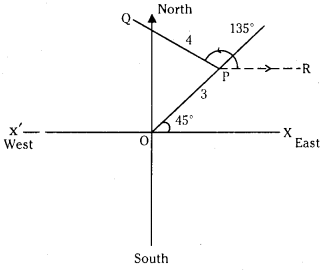
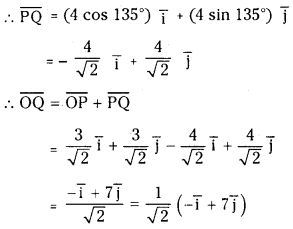
III. Question 1. In the cartesian plane, O is the origin of the coordinate axes. A person starts at O and walks a distance of 3 units in the North-East direction and reaches the point P. From P he walks 4 units of distance parallel to North-West direction and reaches the point Q. Express the vector OQ¯¯¯¯¯¯¯¯ in terms of i̅ and j̅ (observe that (∠XOP=45°) (S.A)
Answer: O is the origin and ∠XOP = 45° The person starts at 0 and walks a distance of 3 units in North-East direction. ∴ OP¯¯¯¯¯¯¯ = (3cos45°) i̅ + (3sin45°) j̅ = 32√i̅ + 32√j̅ PQ = 4 units and pp is parallel to X axis ∴ ∠RPQ = 135° PQ is parallel to North-West direction
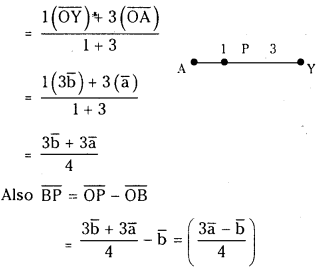
Question 2. The points O, A, B, X and Y are such that OA¯¯¯¯¯¯¯¯ = a̅, OB¯¯¯¯¯¯¯ = b̅, OX¯¯¯¯¯¯¯¯ = 3a̅ and OY¯¯¯¯¯¯¯¯ = 3b̅. Find BX¯¯¯¯¯¯¯ and AY¯¯¯¯¯¯¯¯ interms of a and 5. Further, if the point P divides AY in the ratio 1 : 3, then express BP¯¯¯¯¯¯¯ in terms of a and b. (S.A)
Answer: Given OA¯¯¯¯¯¯¯¯ = a̅, OB¯¯¯¯¯¯¯ = b̅, OX¯¯¯¯¯¯¯¯ = 3a̅ OY¯¯¯¯¯¯¯¯ = 3b̅ BX¯¯¯¯¯¯¯=OX¯¯¯¯¯¯¯¯−OB¯¯¯¯¯¯¯ = 3a̅ – b̅ AY¯¯¯¯¯¯¯¯=OY¯¯¯¯¯¯¯¯−OA¯¯¯¯¯¯¯¯ = 3b̅ – a̅ If P divides AY¯¯¯¯¯¯¯¯ in the ratio 1 : 3 then the position vector of P is OP¯¯¯¯¯¯¯
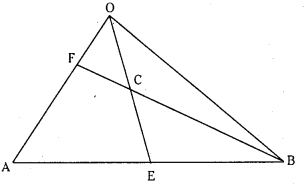
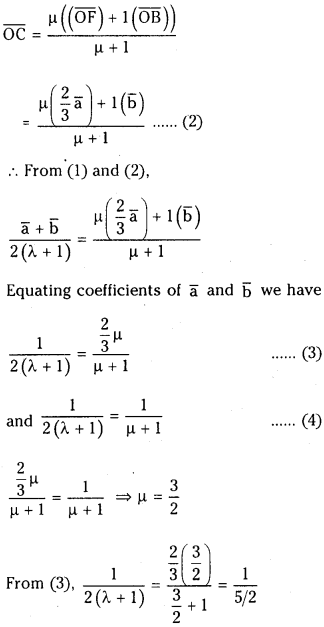
Question 3. In ΔOAB, E is the midpoint of AB and F Is a point on OA such that OF = 2 FA. If C Is the point of intersection of OE¯¯¯¯¯¯¯ and BF¯¯¯¯¯¯¯ then find the ratios OC : CE and BC : CF. (S.A)
Answer: Let O be the origin and OA¯¯¯¯¯¯¯¯ = a̅, OB¯¯¯¯¯¯¯ = b̅ Since E is the midpoint of AB, OE¯¯¯¯¯¯¯ = a¯¯¯+b¯¯¯2
and OF = 2 FA ⇒ F divides OA in the ratio 2 : 1 OF¯¯¯¯¯¯¯ = 2a¯+1(0)2+1=23a¯
Let C divides BF¯¯¯¯¯¯¯ in the ratio μ : 1 then the position vector of C is ⇒ 4(λ + 1) = 5 ⇒ 4λ = 1 ⇒ λ = 14
Let C divides BF¯¯¯¯¯¯¯ in the ratio μ : 1 then the position vector of C is
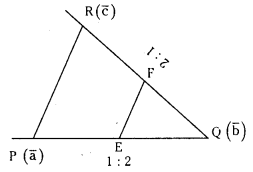
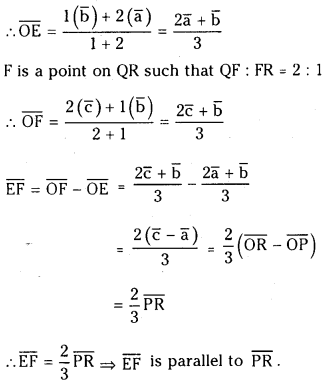
Question 4. The point E divides the segment PQ internally in the ratio 1 : 2 and R is any point not on the line PQ. If F is a point on QR such that QF: FR = 2 : 1, then show that EF is parallel to PR. (S.A)
Answer: Let O be the origin and OP¯¯¯¯¯¯¯=a¯¯¯,OQ¯¯¯¯¯¯¯¯=b¯¯¯ and OP¯¯¯¯¯¯¯=a¯¯¯,OQ¯¯¯¯¯¯¯¯=b¯¯¯ E divides PQ in the ratio 1: 2
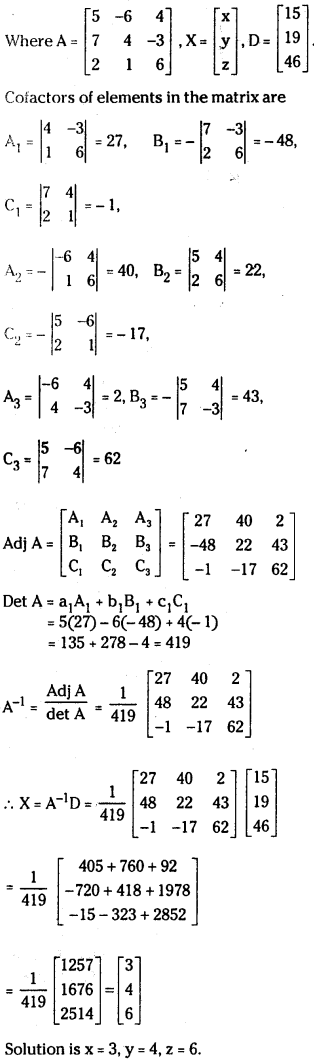
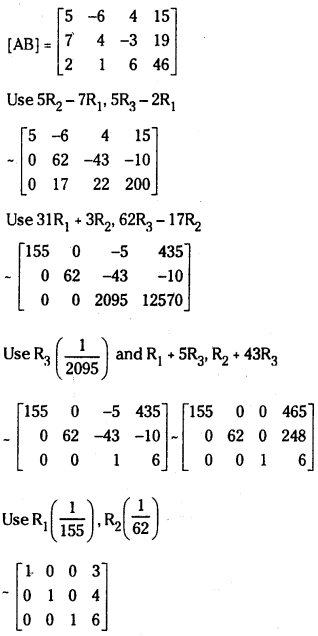
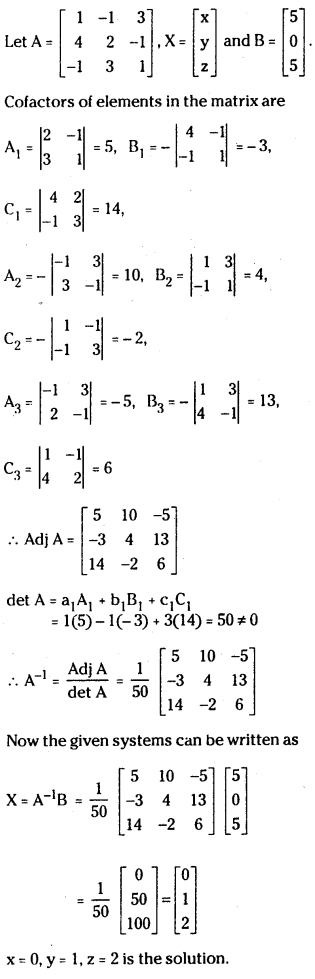
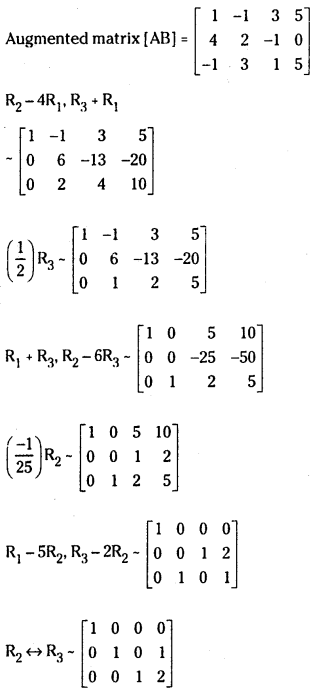
Question 1. Solve the following systems of equations. (i) By using Cramer’s rule and Matrix inversion method, when the coefficient matrix is non-singular. (ii) By using Gauss Jordan Method. Also deter-mine whether the system has a unique solution or infinite number of solutions or no solution and find the solutions if exist. I) 5x – 6y + 4z = 15 7x + 4y-3z = 17 2x + y + 6z = 46
∴ x = Δ1Δ = 0 y = Δ2Δ=5050 = 1 z = Δ3Δ=10050 = 2 ∴ x = 0, y = 1 and z = 2.
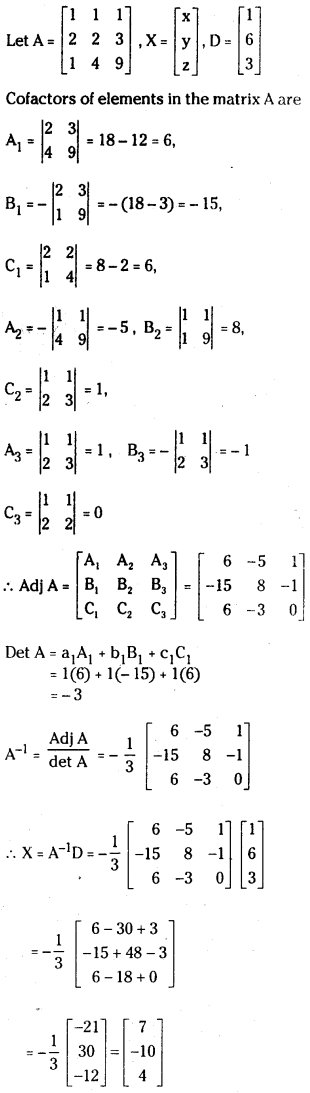
ii) Matrix Inversion Method:
iii) Gauss Jordan Method: The given system of equations is consistent since ρ(A) = ρ(AB) = 3 and the system has a unique solution. x = 0, y = 1, z = 2.
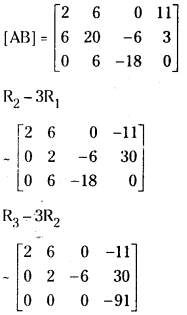
Answer: Δ = ∣∣∣∣26062060−6−18∣∣∣∣ = 2(- 360 + 36) – 6(-108-0) + 0(36) = -648 + 648 = 0 Cramer’s and matrix inversion methods are not applicable.
Gauss Jordan Process: The augmented matrix of the given system is Since ρ(A) = 2 and ρ(AB) = 3, the given system is not consistent and has no solution.
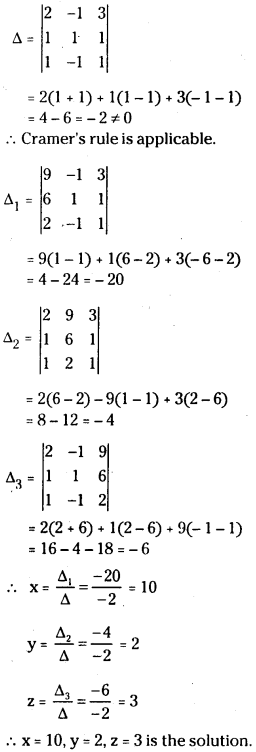
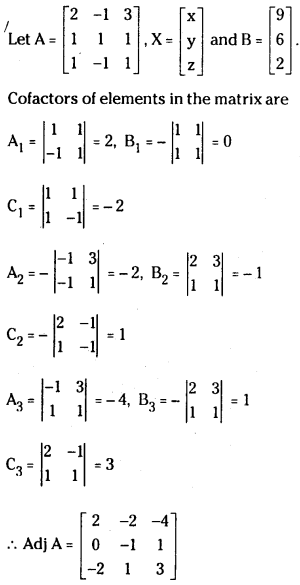
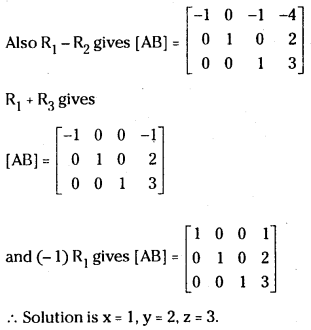
Question 5. 2x – y + 3z = 9 x + y + z = 6 x – y + z = 2 (May 2014, Mar. ’14, ’05, ’02) Answer: i) Cramer’s rule :
ii) Martix Inversion Method: det A = 2(2) + 1(0) + 3(- 2) = 4 -6 = -2 ≠ 0 ∴ A-1 exists and A-1 = AdjAdetA ∴ x = 1, y = 2, z = 3 is the solution.
iii) Gauss Jordan Method: Augmented matrix of the system Since ρ(A) = ρ(AB) = 3; the system is consistent and has a unique solution given by x = 1, y = 2, z = 3.
Question 6. 2x- y + 8z = 13 3x + 4y + 5z = 18 5x – 2y + 7z = 20 (March 2004, 03, ’01) (Board New Model Paper)
Answer: i) Cramer’s rule :
ii) Matrix Inversion Method: ∴ Solution is x = 3, y = 1 and z = 1
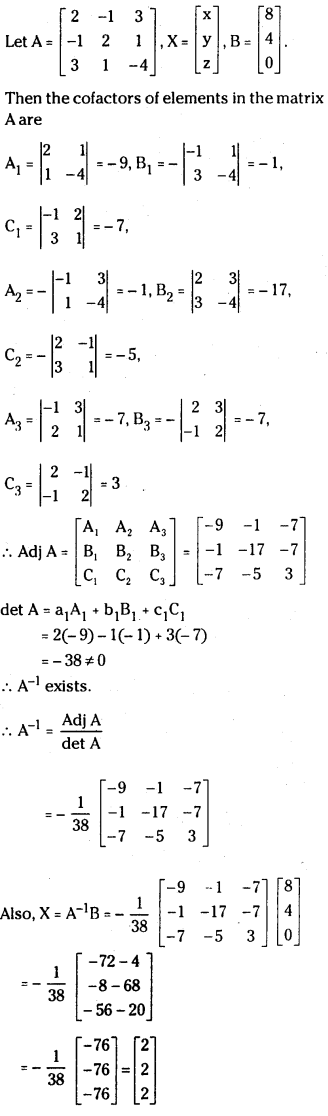
iii) Gauss Jordan Method: Augmented matrix of the system Since ρ(A) = ρ(AB) = 3, the system is consistent and has a unique solution given by x = 3, y = 1 and z = 1. Then the cofactors of elements in the matrix A are
Question 7. 2x – y + 3z = 8 -x + 2y + z = 4 3x + y – 4z = 0
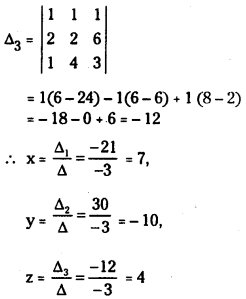
Δ3 = ∣∣∣∣2−13−121840∣∣∣∣ = 2(0 – 4) + 1(0 – 12) + 8(-1 – 6) = -8 – 12 – 56 = -76 ∴ x = Δ1Δ=−76−38 = 2 y = Δ2Δ=−76−38 = 2 z = Δ3Δ=−76−38 = 2 ∴ Solution is x = 2, y =2, z = 2.
Matrix Inversion Method: ∴ Solution is x = 2, y = 2 and z = 2
iii) Gauss Jordan Method: The augmented matrix of the system is ∴ ρ(A) = ρ(AB) = 3 ; the system is consistent and has a unique solution, x = 2, y = 2 and z = 2.
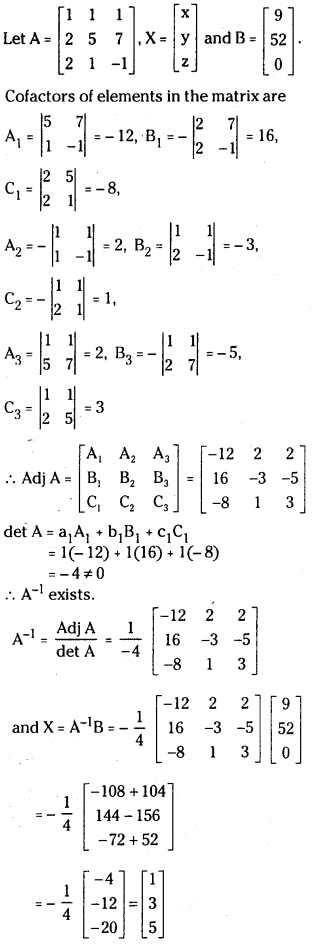
Question 8. x + y + z = 9 2x + 5y + 7z = 52 2x + y-z = 0 (May 2011)
Δ3 = ∣∣∣∣1221519520∣∣∣∣ = 1(0 – 52) -1(0 – 104) + 9(2 – 10) = -52 + 104 – 72 = -20 ∴ x = Δ1Δ=−4−4 = 1 y = Δ2Δ=−12−4 = 3 z = Δ3Δ=−20−4 = 5 x = 1, y = 3, z = 5 is a solution.
ii) Matrix Inversion Method: ∴ x = 1, y = 3, z = 5 is the solution.
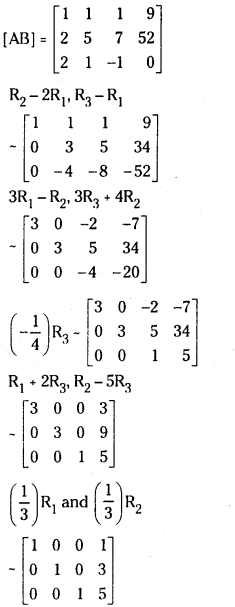
iii) Gauss Jordan Method: Augmented matrix ρ(A) = ρ(AB) = 3 and the system is consistent. The system has a unique solution given by x = 1, y = 3 and z = 5.
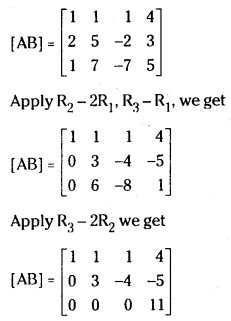
I. Examine whether the following systems of equations are consistent or inconsistent and if consistent find the complete solutions, Question 1. x + y + z = 4 2x + 5y – 2z = 3 x + 7y – 7z = 5
Answer: Augmented matrix of the above system is Rank of the matrix ρ(A) = 2 and ρ(AB) = 3. Since ρ(A) ≠ ρ(AB), the given system of equa¬tions are inconsistent.
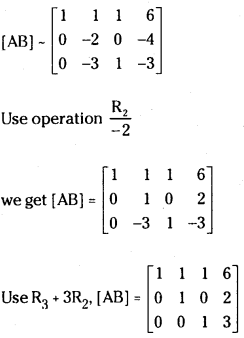
Question 2. x + y + z = 6 x – y + z = 2 2x – y + 3z = 9
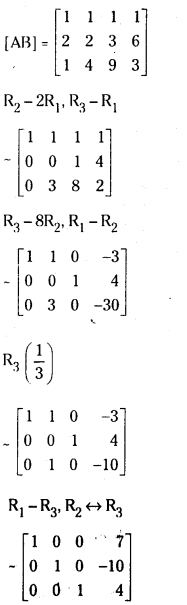
Answer: Augmented matrix [AB] = ⎡⎣⎢1121−1−1113629⎤⎦⎥ Apply operations R2 – R1, R3 – 2R1, we get Here ρ(A) = 3 and ρ(AB) = 3 Since ρ(A) = ρ(AB), the given system is consistent and has a unique solution.
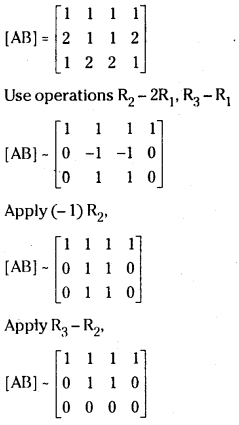
Question 3. x + y + z = 1 2x + y + z = 2 x + 2y + 2z = 1 (March 2015-T.S)
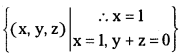
Answer: Augmented matrix of the system is ρ(AB) = 2 and ρ(A) = 2 and ρ(A) = ρ(AB) < 3 The given system of equations is consis¬tent and has infinitely many solutions. The given system is equivalent to x + y + z = 1 and y + z = 0. Solution set is
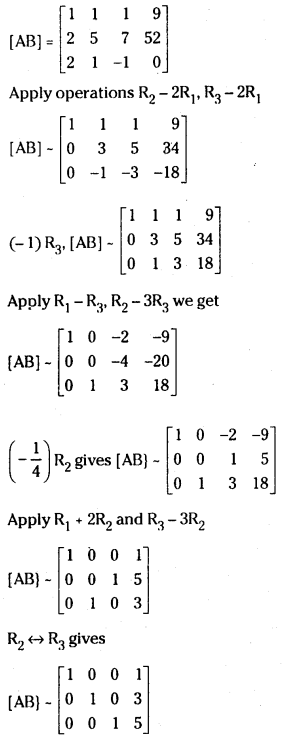
Question 4. x + y + z = 9 2x + 5y + 7z = 52 2x + y – z = 0
Answer: Augmented matrix of the system Here ρ(A) = ρ(AB) = 3; and the system of given equations is consistent; and has a unique solution. Also x = 1, y = 3, z = 5 form the solution.
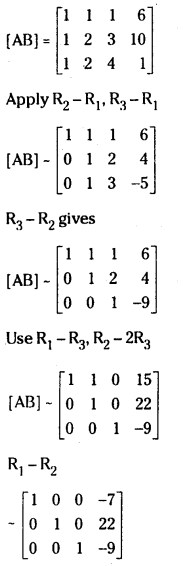
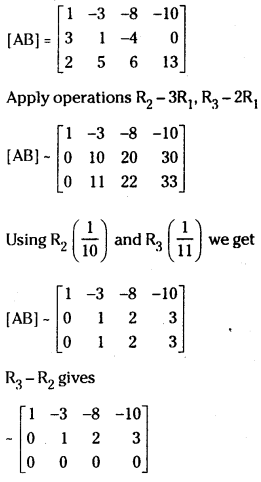
Question 5. x + y + z = 6 x + 2y + 3z = 10 x + 2y + 4z = 1
Answer: The augmented matrix of the above system is Since ρ(A) = 2 = ρ(AB) < 3, given system of equations is consistent with infinitely many solutions. The given system is equivalent to x – 3y – 8z = – 10, y + 2z = 3 Put z = t then y = 3 – 2t ∴ x = – 10 + 3(3 – 2t) + 8t = -10 + 9 – 6t + 8t = 2t – 1 Hence the solutions are given by x = 2t – 1, y = 3 – 2t and z = t Where t is any scalar.
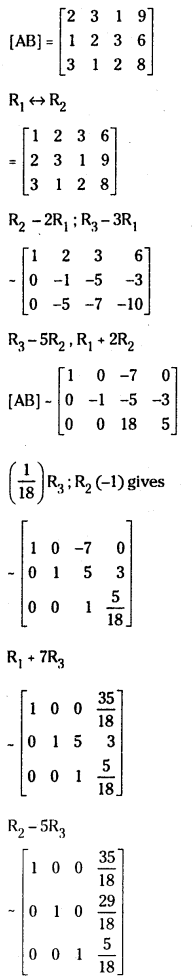
Question 7. 2x + 3y + z = 9 x + 2y + 3z = 6 3x + y + 2z = 8
Answer: Augmented matrix of the above system is ρ(A) = ρ(AB) = 3; system is consistent and has a unique solution given by x = 3518, y = 2918, z = 518
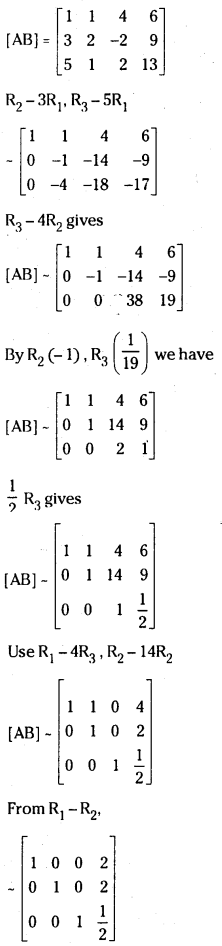
Question 8. x + y + 4z = 6 3x + 2y – 2z = 9 5x + y + 2z = 13
Answer: Augmented matrix of the system ρ(A) = ρ(AB) = 3; Hence the system is consistent and has a unique solution given by x = 2, y = 2, z = 12.
TS Inter 1st Year Maths 1A Matrices Solutions Exercise 3(i)
Question 1. 2x + 3y – z = 0, x – y – 2z = 0, 3x + y + 3z = 0
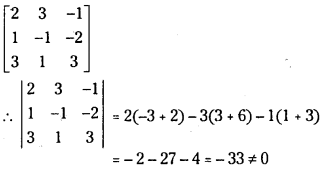
Answer: The coefficient matrix obtained from the given equations is Since the determinant of the coefficient matrix ≠ 0 the system has a trivial solution, x = y = z = 0 and ρ(A) = 3.
Question 3. x + y – 2z = 0, 2x + y – 3z = 0, 5x + 4y – 9z = 0
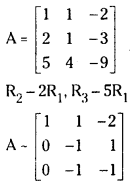
Answer: The coefficient matrix is A = ⎡⎣⎢125114−2−3−9⎤⎦⎥ and ∣∣∣∣125114−2−3−9∣∣∣∣ = 1(-9 + 12) – 1(-18 + 15) – 2 = 3 + 3 – 6 = 0 If [1211] is any submatrix of order 2 x 2 and ∣∣∣1211∣∣∣ = 1 – 2 = -1 ≠ 0, ρ(A) < 3. Hence the system has a nontrival solution. ∴ System of equations is equivalent to x + y – 2z = 0 and y – z = 0 Let z = k then y = k and x = k ∴ x = y = z = k for a real number k.
Question 4. x + y – z= 0 x – 2y + z = 0 3x + 6y – 5z = 0
∴ If [111−2] is a submatrix of order 2 and ∣∣∣111−2∣∣∣ = -3 ≠ 0, ρ(A) = 2. System has a non-trivial solution ρ(A) < 3. A = ⎡⎣⎢1131−26−11−5⎤⎦⎥ Use R2 – R1 and R3 – 3R1 A – ⎡⎣⎢1001−33−12−2⎤⎦⎥ System of equations is equivalent to x + y – z = 0 3y – 2z = 0 Let z = k, then 3y = 2k ⇒ y = 2k3 x = -y + z = –2k3 + k = k3 x = k3, y = 2k3, z = k for any real number of k.
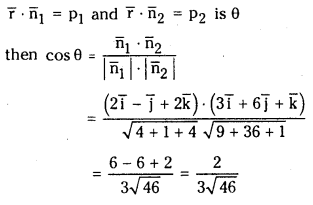
Question 5. Find the angle between the planes r̅ . (2i̅ – j̅ + 2k̅) = 3 and r̅ .(3i̅ + 6j̅ + k̅) =4 (March 2015-T.S)
Answer: If the angle between planes
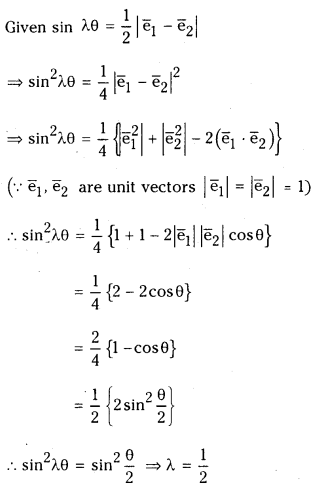
Question 6. Let e¯¯1 and e¯¯2 be unit vectors making angle θ. If 12|e¯¯1−e¯¯2| = sin λθ, then find λ.
Answer:
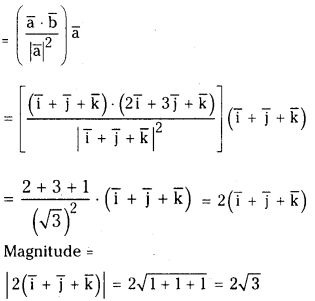
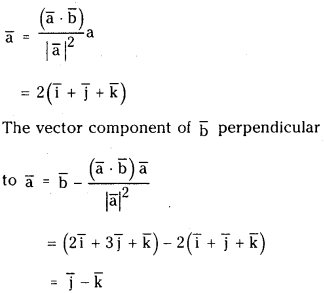
Question 7. Let a̅ = i̅ + j̅ + k̅ and b̅ = 2 i̅ + 3j̅ + k̅. Find (i) the projection vector of bona and its magnitude (ii) The vector components of b̅ in the direction of a̅ and perpendicular to a̅. [May 2006]
Answer: Orthogonal projection of a vector b̅ on a̅ is
(ii) The component vector b in the direction of –
Question 8. Find the equation of the plane through the point (3, – 2, 1) and perpendicular to the vector (4, 7, – 4).
Answer: The equation of the plane passing through a̅ and perpendicular to the vector n̅ is r̅. n̅ = a̅. n̅ Given n̅ = 4i̅ + 7j̅ – 4k̅ and a̅ = 3i̅ – 2j̅ + k̅ r̅ . (4i̅ + 7j̅ – 4k̅) – (3i̅ – 2j̅ + k̅) . (4i̅ + 7j̅ – 4k̅) r . (4i̅ + 7j̅ – 4k̅) = 12 – 14 – 4 = – 6 ⇒ r̅ . (-4i̅ – 7j̅ + 4k̅) = 6
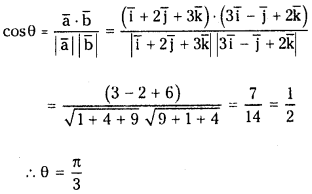
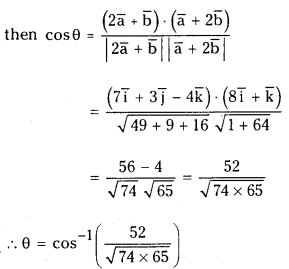
Question 9. If a̅ = 2i̅ + 2j̅ – 3k̅, b = 3i̅ – j̅ + 2k̅, then find the euigle between 2a̅ + b̅ and a̅ + 2b̅.
Answer: Given a̅ = 2i̅ + 2j̅ – 3k̅ and b̅ = 3i̅ – j̅ + 2k̅ We have 2a̅ + b = 4i + 4j̅ – 6k̅ + 3i̅ – j̅ + 2k̅ = 7i̅ + 3j̅ – 4k̅ and a̅ + 2b̅ = (2i̅ + 2 j̅ – 3k̅) + 2(31-7 + 2k) = 8i̅ + k̅ Let ‘θ’ be the angle between the vectors 2a̅ + b̅ and a̅ + 2b̅
II. Question 1. Find the unit vector parallel to the XOY plane and perpendicular to the vector 4i̅ – 3j̅ + k̅.
Answer: Any vector parallel to XOY plane will be of the form xi̅ + yj̅. The vector parallel to the XOY plane and perpendicular to the vector 4i̅ – 3j̅ + k̅ is 3i̅ + 4j̅ Its magnitudes |3i̅ + 4j̅| = 9+16−−−−−√ = 5 Unit vector parallel to XOY plane and perpendicular to the vector 4i̅ – 3j̅ + k̅ is ±(3i¯+4j¯9+16√)=±(3i¯+4j¯5)
Question 2. If a̅ + b̅ + c̅ = 0, |a̅I|= 3, |b̅| = 5 and |c̅| = 5 then find the angle between a̅ and b̅.
Question 3. If |a̅| = 2, |b̅| = 3 and |c̅| = 4 juid each of a̅, b̅, c̅ is perpendicular to the sum of the other two vectors, then find the magnitude of a̅ + b̅ + c̅.
Answer: Given |a̅| = 2, |b̅| = 3 and |c̅| = 4 Since each of a̅, b̅, c̅ is perpendicular to the sum of other two vectors i.e., a̅ is perpendicular to b̅ + c̅ a̅ . (b̅ + c̅) = 0 ⇒ a̅ . b̅ + a̅ . c̅ = 0 Similarly b̅.(c̅ + a̅) = 0 ⇒ b̅.c̅ + b̅.a̅ = 0 and c-(a + b) = 0 ⇒ c̅. a̅ + c̅. b̅ = 0 Adding we get 2 [(a̅ . b̅) + (b̅ . c̅) + (c̅ . a̅)] = 0 …….(1) Also (a̅ + b̅ + c̅) = |a̅|2 + |b̅|2 + |c̅|2 + 2(a̅.b̅ + b̅.c̅ + c̅.a̅) = 4 + 9 + 16 + 2(a̅.b̅ + b̅. c̅ + c̅.a̅) = 4 + 9 + 16 + 2 (0) = 29 ∴ |a̅ + b̅ + c̅| = 29−−√
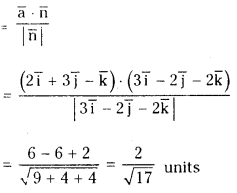
Question 4. Find the equation of the plane passing through the point a̅ = 2i̅ + 3j̅ – k̅ and perpendicular to the vector 3i̅ – 2j̅ – 2k̅ and the distance of this plane from the origin.
Answer: Equation of the plane passing through the point a, and perpendicular to the vector n̅ is (r̅ – a̅) . n̅ = 0 ⇒ 7 . n̅ = a̅ . n̅ (liven a̅ = 2i̅ + 3 j̅ – k̅ and n̅ = 3i̅ – 2j̅ – 2k̅ We have r̅ . (3 i̅ – 2 j̅ – 2k̅) = (2i̅ + 3j̅ – k̅) . (3i̅ – 2j̅ – 2k̅) = 6 – 6 + 2 = 2 ⇒ r̅ . (3i̅ – 2j̅ – 2k̅) = 2 The distance from origin to this plane is
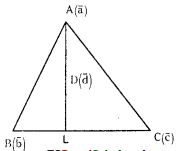
Question 5. a̅, b̅, c̅ and d̅ are the position vectors of four coplanar points such that (a̅ – d̅) . (b̅ – c̅) = (b̅ – d̅) . (c̅ – a̅) = 0. Show that the point d represents the orthocentre of the triangle with a̅, b̅ and c̅ as its vertices.
Answer: Position vectors of A, B, C, D are a̅, b̅, c̅, d̅ respectively. DA¯¯¯¯¯¯¯¯=OA¯¯¯¯¯¯¯¯−OD¯¯¯¯¯¯¯¯ = a̅ – d̅ CB¯¯¯¯¯¯¯=OB¯¯¯¯¯¯¯−OC¯¯¯¯¯¯¯¯ = b̅ – c̅ DB¯¯¯¯¯¯¯=OB¯¯¯¯¯¯¯−OD¯¯¯¯¯¯¯¯ = b̅ – d̅ AC¯¯¯¯¯¯¯=OC¯¯¯¯¯¯¯¯−OA¯¯¯¯¯¯¯¯ = c̅ – a̅ Given (a̅ – d̅) . (b̅ – c̅) = 0 ⇒ DA¯¯¯¯¯¯¯¯⋅CB¯¯¯¯¯¯¯ = 0 ⇒ DA¯¯¯¯¯¯¯¯ is perpendicular to BC¯¯¯¯¯¯¯ ∴ AD¯¯¯¯¯¯¯¯ is an altitude of ΔABC and (b̅ – d̅) . (c̅ – a̅) = 0 ⇒ DB¯¯¯¯¯¯¯⋅AC¯¯¯¯¯¯¯ = 0 ⇒ DB¯¯¯¯¯¯¯ is perpendicular to AC¯¯¯¯¯¯¯ DB¯¯¯¯¯¯¯ another altitude ΔABC Altitudes AD and BD intersect at D D(d) is the orthocentre of ΔABC.
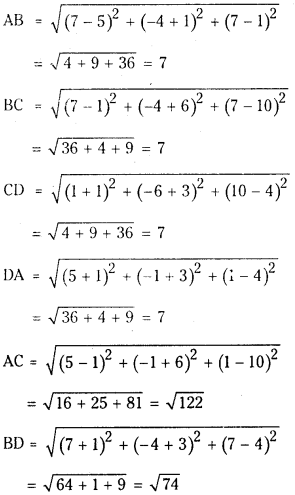
III. Question 1. Show that the points (5, – 1, 1), (7, – 4, 7), (1,-6, 10) and (- 1, – 3, 4) are the vertices of a rhombus. (March 2013)
Answer: Let A (5,-1, 1), B (7,-4, 7), C (1,-6, 10) and D (- 1, – 3, 4) are the given points. ∴ AB = BC = CD = DA = 7 units and AC ≠ BD ∴ A, B, C, D are the points which are the vertices of a rhombus.
Question 2. Let a̅ = 4i̅ + 5j̅ – k̅, b̅ = i̅ – 4j̅ + 5k̅ and c̅ = 3i̅ + j̅ – k̅. Find the vector which is perpendicular to both a and b and whose magnitude is twenty one times the magnitude of c̅.
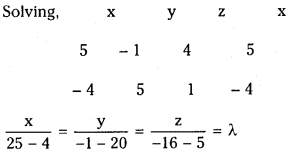
Answer: Given a̅ = 4 i̅ + 5 j̅ – k̅ b̅ = i̅ – 4 j̅ + 5k̅ and c̅ = 3 i̅ + j̅ – k̅ Let r̅ = xi̅ + yj̅ + zk̅ be the vector which is perpendicular to both a and b. Then r̅. a̅ = 0 and r̅.b̅ = 0 ⇒ 4x + 5y – z = 0 …………..(1) and x – 4y + 5z = 0 ……….(2) ⇒ x = λ, y = -λ, z = -λ ∴ The vector which is perpendicular to both a̅ and b̅ is r̅ = λ(i̅ – j̅ – k̅) Magnitude of c = 9+1+1−−−−−−−−√=11−−√ ∴ The vector which is perpendicular to both a̅ and b̅ whose magnitude is 21 times the magnitude of c̅ is = ± 2111√(i¯−j¯−k¯)|i¯−j¯−k¯| = ± 733−−√ (i̅ – j̅ – k̅)
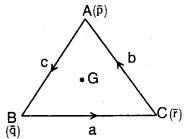
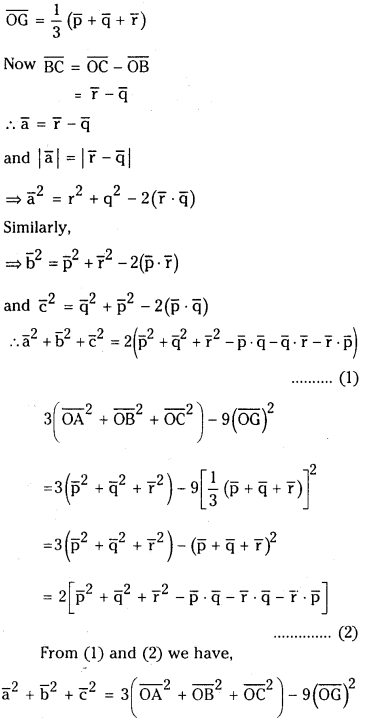
Question 3. G is the centroid of ΔABC and a̅, b̅, c̅ are the lengths of the sides BC¯¯¯¯¯¯¯,CA¯¯¯¯¯¯¯ and AB¯¯¯¯¯¯¯ respectively. Prove that a¯2+b¯2+c¯2=3(OA¯¯¯¯¯¯¯¯2+OB¯¯¯¯¯¯¯2+OC¯¯¯¯¯¯¯¯2)−9(OG¯¯¯¯¯¯¯¯)2. where ‘O’ is any point.
Answer: Given that BC¯¯¯¯¯¯¯=a¯¯¯,CA¯¯¯¯¯¯¯=b¯¯¯ and AB¯¯¯¯¯¯¯=c¯¯. Let O’ be the origin and let p.q.r be the position vectors of A, B, C then OA¯¯¯¯¯¯¯¯=p¯¯¯, OB¯¯¯¯¯¯¯=q¯¯¯,OC¯¯¯¯¯¯¯¯=r¯ respectively. Then the position vector of centroid
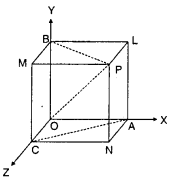
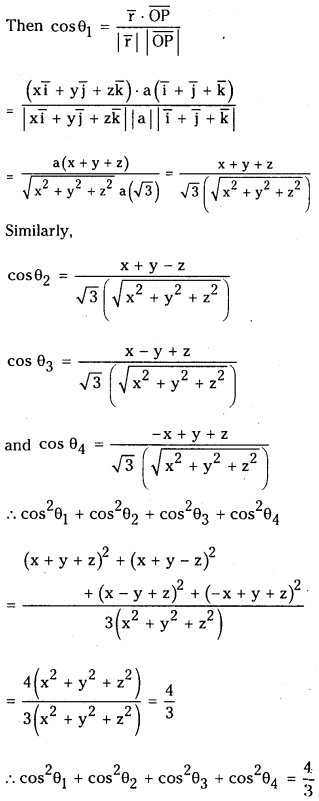
Question 4. A line makes angles θ1, θ2, θ3, and θ4 with the diagonals of a cube. Show that cos2θ1 + cos2θ2 + cos2θ3 + cos2θ4 = 43.
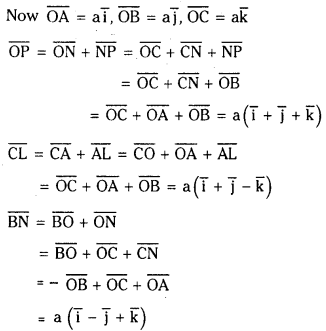
Answer: Let ‘O’ be the origin and ‘a’ be the length of the side of a cube. i̅, j̅, k̅ are unit vectors along X, Y and Z axes respectively. Let r̅ = xi̅ + yj̅ + zk̅ be the line makes angles θ1, θ2, θ3, θ4 with diagonals of a cube
Climax stage is achieved quickly in secondary succession as compared to primary succession. Why? [May ’14]
Answer:
1.Secondary succession begins in areas where natural communities have destroyed. 2.It is achieved quickly than primary succession, it occurs in abandoned farm lands burned or cut forests with some soil or sediment.
Question 2.
Among bryophytes, lichens and ferns which one is a pioneer species in a xeric succession?
Answer:
1.Lichens are pioneer species that growth on rocks in rocks in xeric succession. 2.They lead to soil formation through weathering of rocks by secreating acids.
Question 3.
Give any two examples of xerarch succession.
Answer:
1.Xerach succession takes place is dry areas and series progress from xeric to mesic conditions. 2.Formation of plant communities on dry rocks, on cooled and hardened lava from volcanoes.
Question 4.
Name the type of land plants that can tolerate the salinities of the sea. [Mar. ’14]
Answer:
1.Halophytes 2.Ex : Rhizophora
Question 5.
Define heliophytes and sciophytes. Name a plant from your locality that is either heliophyte or sciophyte.
Answer:
1.Plants which grow in direct sunlight are called heliophytes Ex : Tridax, grass plants 2.Plants which grow in shady places are called sciophytes Ex : Ferns, Mosses
Question 6.
Define population and community. [Mar. – 2019, May ’17, Mar. ’15 – T.S. ; Mar. ’13]
Answer:
Population : It is a group of similar individuals belonging to the same species found in an area. Community : It is an assemblage of all the populations (belonging to different species) occurring in an area.
Question 7.
Define communities. Who classified plant communities into hydrophytes, mesophytes and xerophytes?
Answer:
1.Community : An assemblage of all populations (belonging to different species) occurring in an area is called community. 2.Warming classified plant communities into hydrophytes, mesopytes and xerophytes.
Question 8.
Hydrophytes show reduced Xylem. Why? [Mar. ’20, ’18, ’17, ’15]
Answer:
In hydrophytes, the absorption of water takes place through all over the surface of the plant body. So xylem is reduced.
Short Answer Type Questions
Question 1.
What are hydrophytes ? Briefly discuss the different kinds of hydrophytes with examples. [Mar. ’15 – T.S.]
Answer:
Plants growing in water or in very wet conditions are called hydrophytes. Hydrophytes are 5 types based on the way of developing in water.
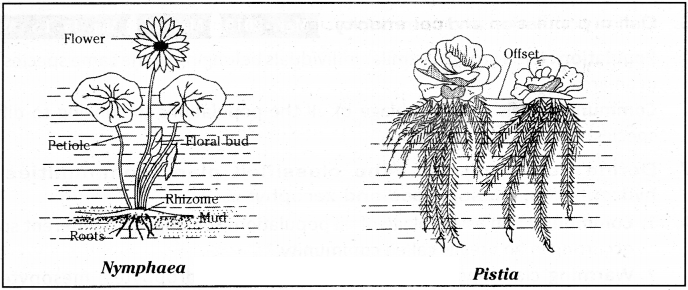
Free floating hydrophytes : They float freely on water. They have no contact with soil. Ex : Pistia, Eichhornia.
Rooted hydrophytes with floating leaves : Roots of these plants are fixed in mud. Leaves have long petioles and float on water surface. Ex : Nelumbo, Nymphaea.
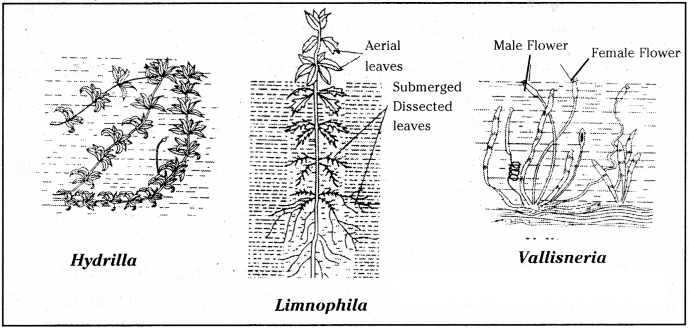
Submerged suspended hydrophytes : These are not rooted. But they are completely submerged and suspended in water. Ex : Hydrilla, Ceratophyllum,
Submerged rooted hydrophytes : They are rooted at the bottom of the pond and remain submerged in water. Ex : Vallisneria, Potamogeton
Amphibious plants : They live partly in air and partly in water. Ex : Ranunculus, Limnophila Some plants growing around the water bodies are occasionally touched by water currents. They also survive in dry periods. Ex : Cyperus, Typha.
Question 2.
Enumerate the morphological adaptations of hydrophytes. [Mar. – 2018]
Answer:
Morphological adaptations in hydrophytes : 1.Roots may be absent or poorty developed. In some plants submerged leaves compensate for roots. 2.Root caps are usually absent. However in some amphibious plants which grow in mud, roots are well developed with distinct root caps. In some plants, root caps are replaced by root pockets. 3.Roots, if present, are generally fibrous, adventitious, reduced in length, unbranched or poorly branched. 4.Stem is long, slender and flexible. 5.Leaves are thin, and either long and ribbon-shaped or long and linear or finely dissected. Floating leaves are large and flat with their upper surfaces coated with wax.
Question 3.
List out the anatomical adaptations of hydrophytes. [Mar. ’14, ’13]
Answer:
Anatomical Adaptations: 1.Cuticle is totally absent in the submerged parts of the plants. It may be present as very fine fiim on the surface of parts that are exposed to atmosphere. 2.Thin walled epidermal cells help in absorption and assimilation by having chloroplasts. 3.Stomata are totally absent in submerged forms or non-functional as in Potamogeton. The floating leaves of Nelumbo possess stomata only on the upper surface (epistomatous). 4.Mechanical tissues like collenchyma and sclerenchyma are absent, because the plants are not exposed to stress and strain. 5.Water is absorbed through all over the surface of plant body, so the xylem is poorly developed. But phloem is relatively better developed. 6.Aerenchyma present in all parts of all hydrophytes, provides buoyancy.
Question 4.
Write a brief account on classification of Xerophytes. [Mar. ’20, ’17; May. ’17, ’14]
Answer:
Plants growing in water deficient or physiologically dry habitats are called xerophytes. Xerophytes are 3 types based on their morphology, physiology and life cycle pattern.
Ephemerals : These are annuals which complete their life cycle within 6 – 8 weeks. They are also called drought evaders or drought escapers. Eg : Tribulus.
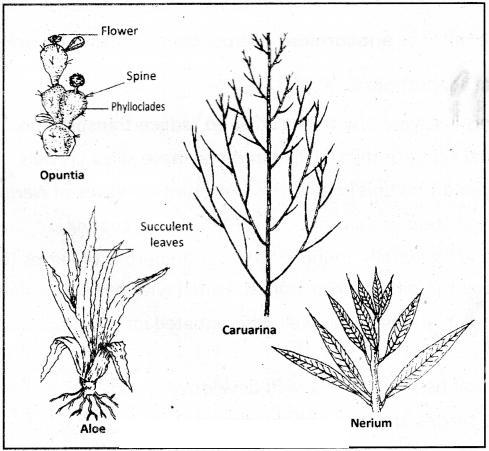
Succulents : These are drought avoiding plants. They absorb large amounts of water during rainy season and store in their parts in the form of mucilage. Those parts become fleshy and succulent. Stored water is used during dry periods. Eg : (a) Root succulents – Ceiba parvifiora, Asparagus; (b) Stem succulents – Opuntia; (c) Leaf succulents – Bryophyllum, Aloe
Non succulents – These are true xerophytes. These are perennial and withstand prolonged period of drought. Eg : Casuarina, Nerium.
Question 5.
Enumerate the morphological adaptations of xerophytes. [Mar. – 2019]
Answer:
Morphological adaptations in xerophytes : 1.Roots are long with extensive branching spread over wide areas. 2.Root hairs and root caps are very well developed. 3.Stems are stunted, woody, hard and covered with thick bark. 4.Stems are usually covered by hairs and or waxy coatings. 5.Leaves are very much reduced, small, scale like and sometimes modified into spines to reduce the rate of transpiration.
Question 6.
Give in detail the anatomical adaptations shown by xerophytes. [Mar. ’15 – A.P]
Answer:
Anatomical adaptations : 1.Epidermis is covered by thick cuticle to reduce transpiration. 2.Epidermal cells are thick walled and may have silica crystals. 3.Multilayered (multiple) epidermis is present as leaves of Nerium. 4.Leaves and stem of Calotropis consists of waxy coating. 5.Stomata are generally confined to lower epidermis of leaves (hypostomatous) and present in pits (sunken stomata) lined with hairs. Eg : Nerium. 6.Mesophyll in leaves is very well differentiated into palisade and spongy paren¬chyma. 7.Mechanical tissues are very well developed. 8.Vascular tissues are very well developed.
Question 7.
Define Plant succession. Differentiate primary and secondary successions.
Answer:
The gradual change in structure and composition of all communities constantly in response to the changing environment till it reaches equilibrium is called plant succession.
Primary succession
Secondary succession
1. Succession that starts where no living organisms ever existed is called Primary succession. Ex : Bare rocks
1. Succession that starts in the areas where somehow all living organisms that existed are lost is called secondary succession. Ex: Abandoned farmlands, burned forests
2. It occurs in biologically sterile area.
2. It occurs in biologically fertile area.
3. It takes long time to reach the climax stage.
3. It occurs faster than primary succession because of the presence of soil.
Question 8.
Define ecosystem/ecological services. Explain in brief with regard to pollination.
Answer:
1.Natural ecosystem performs fundamental life support services called ecosystem services or ecological services. 2.Transfer of pollen grain from anther to stigma is called pollination. 3.Most flowering plants require help from pollinators to produce fruits and seeds. So Pollinators play a significant role in the production of more food crops in the world. 4.The most important pollinators for agricultural purpose is the honey bee. 5.Predicting the effects of the loss of a particular pollinator is extremely difficult, but it is important to remember that no species exists in isolation. 6.Each is part of an ecological web, and as we lose more and more pieces of that web, the remaining structure must eventually collapse. 7.If pollination services are lost due to the loss of some species, then those remaining are unable to compensate the loss. 8.Decline in pollinator activity disturbs the entire ecological system.
Question 9.
Write about the measures to be taken to sustain ecological functions.
Answer:
1.Choose products produced with methods that conserve resources, minimize waste and reduce or eliminate environmental damage. 2.Prefer products made with methods that reduce or eliminate the use of pesticides and artificial fertilizers. 3.Reduce consumption and waste production. 4.Support usage of renewable energy alternatives. 5.Use public transit, cycle or walk to conserve natural resources and to reduce pollution and enjoy the health benefits. 6.Participate in developing community garden and tree plantation programmes. 7.Avoid the usage of pesticides and follow methods of natural pest control. 8.Use native plants in the garden and provide habitat for wild life.
Question 10.
What measures do you suggest to protect the pollinators?
Answer:
1.Creating own pollinator – frendly garden using a wide variety of native flowering plants. Encourage the planting of native flowers in open spaces and outside public buildings. 2.Reducing the level of pesticides used in and around your home. 3.Encouraging local clubs or school groups to build artificial habitats such as butterfly gardens, bee boards and bee boxes. 4.Supporting agriculture enterprises with pollinator-friendly practices such as forms that avoid or minimize pesticide use. 5.Encouraging government agencies to take into account the full economic benefits of wild pollinators when formulating policies for agriculture and other land uses. 6.Stress the need to develop techniques for cultivating native pollinator species for crop pollination.
Long Answer Type Questions
Question 1.
Give an account of ecosystem services with reference to carbon fixation and oxygen release.
Answer:
Ecosystem Service – Carbon Fixation : Trees are essential to all living organisms. Exchange of CO2 and O2 is done by photosynthesis. Forests provide a vast bank for CO2 and a huge amount of CO2 is deposited in its timber. This cuts down the CO2 concentration in atmosphere and plays an essential role in maintaining a dynamic balance between CO2 and O2 in atmosphere. So CO2 fixation has an obvious indirect economic value that can be estimated by taking account alternative methods of fixing CO2. According to photosynthesis equation, to produce 180 g glucose and 193 g O2, plant will absorb 264 g CO2 and 108 gm water and consume 677.2 k.cal of solar energy. Then 180 g glucose can be transformed to 162 g polysaccharide inside the plant. Therefore, whenever plant produces 162 gm of dry organic water, 264 g CO2 will be fixed, i.e., production of every 1 gm dry organic matter can fix 1.63 g CO2. The economic value of CO2 fixation can be estimated by the total fixed CO2 amount multiplied by a standard opportunity cost for per unit CO2 fixation. Natural ecosystems may have helped to stabilize climate and prevent overheating of the Earth by removing more of the greenhouse gas, CO2 from the atmosphere. Ecosystem service-Oxygen release : Plants take CO2 and give CL during photosynthesis. The amount of O2 produced by a tree depends upon its age, health and also on the tree’s surroundings. According to Research findings, “a mature leafy tree produces as much as oxygen in a season as 10 people inhale in a year”. Another quotes “A single mature tree can absorb CO2 at a rate of 48 lbs / year and release enough oxygen back into the atmosphere to support 2 human beings.” Other quote “One acre of trees annually consumes the amount of carbon dioxide equivalent to that produced by driving an average car for 26000 miles. That same acre of trees also produces O2 for 18 people to breathe for a year.” Submerged water plants release O2 and enrich dissolved oxygen in water. Plants and Planktons are described as “the lungs of the world”. Micro-organisms also produce O2 directly or indirectly. Cyanobacteria produce O2 directly; some bacteria indirectly. For example, the degradation of organic compounds by bacteria can make the compounds capable of being used as a food source by another organism. This subsequent utilization can both consume and produce oxygen at various stages of the digestive process.
Intext Question Answers
Question 1.
Categorise the following plants into hydrophytes, halophytes, mesophytes and xerophytes and give reasons. a) Salvinia b) Opuntia C) Rhizophora d) Mangifera
Answer:
a) Salvinia is a hydrophyte, it grows on the surface of water. b) Opuntia is a xerophyte, grows in dry areas. c) Rhizophora is a halophyte, it tolerates the salinities of the sea. d) Mangifera is a mesophyte, it grows in habitats where water availability is normal.
Question 2.
In a pond, we see plants which are free-floating ; rooted-submerged ; rooted emergent ; rooted with floating leaves. Write the type of plants against each of them.
Answer:
Plant name
Type
a) Hydrilla
Submerged suspended hydrophyte
b) Typha
Amphibious plant
c) Nymphaea
Rooted with floating leaves
d) Lemna
Free floating hydrophytes
e) Vallisnaria
Submerged rooted hydrophyte
Question 3.
Undertake the following a part of learning process : a) Identify and assess ecological services found in your area. b) Think of measures or means to sustain such ecological services. c) Observe the type of plants or crops grown in your area. d) Enumerate ecological services of your area. e) Find out the ecological goods of natural forests commonly used in your area. f) Observe the biotic agents of pollination for ornamental flowering plants and or agricultural crops in your locality.
Answer:
a) Ecological services : 1.Purification of air and water 2.Decomposition of water 3.Detoxification of water b) Measures to sustain Ecological services : 1.Reduce consumption and waste production 2.Avoid the usage of pesticides c) Crops grown in our area : 1.Paddy 2.Maize 3.Vegetables 4.Blackgram d) Ecological services: 1.Purification of air and water 2.Decomposition of wastes e) Ecological goods: 1.Clean air 2.Fresh air 3.Fibre 4.Timber 5.Medicines f) Biotic agents of pollination : 1.Insects 2.Birds 3.Animals like bats, snails, etc.
The transverse section of a plant material shows the following anatomical features? a) the vascular bundles are conjoint, scattered and surrounded by a sclerenchymatous bundle sheaths. b) phloem parenchyma is absent. What will you identify it as
Answer:
Monocotyledonous stem with closed vascular bundles.
Question 2.
Why are xylem and phloem called complex tissues?
Answer:
1.Complex tissues is made of more than one type of cells that work together as a unit. 2.Xylem and phloem are made of more than one type of cells i.e., parenchyma, fibers etc.
Question 3.
How is the study of plant anatomy useful to us?
Answer:
1.Anatomy is useful to known the internal structure of the plant. It is useful in classification of plants based on natural relations. 2.It is useful to understand the plant functions, habitat of the plant and evolution of plants.
Question 4.
Protoxylem is the first formed xylem. If the protoxylem lies radially next to phloem, what kind of arrangement of xylem would you call it? Where do you find it?
Answer:
1.Radial arrangement 2.They are found in roots.
Question 5.
What is the function of phloem parenchyma?
Answer:
Phloem parenchyma stores food materials and other substances like resins, latex and mucilage.
Question 6.
a) What is present on the surface of the leaves which helps the plant to prevent loss of water but is absent in roots? b) What is the epidermal cell modification in plants which prevents water loss?
Answer:
a) Cuticle b) Bulliform cells is Isobilateral (monocotyledonous) leaf.
Question 7.
Which part of the plant would show the following? a) Radial vascular bundle b) Polyarch xylem c) Well developed pith d) Exarch xylem
Answer:
a) Radid vascular bundle – Root b) Polyarch xylem – Monocot root c) Well developed pith – Monocot root d) Exarch xylem – Root
Question 8.
What are the cells that make the leaves cur! in plants during water stress? Give an example.
1.Intrafascicular cambium and interfasicular cambium. 2.Cambial ring is formed in dicot stem during secondary growth.
Question 10.
Give one basic functional difference between phellogen and phelloderm.
Answer:
1.Phellogen (cork cambium) is a meristematic tissue, formed from primary cortex. 2.Phelloderm (secondary cortex) is a permanent tissue formed by inner cells that cuts off from phellogen.
Question 11.
If one debarks a tree, what parts of the plant are removed?
Answer:
1.Periderm and secondary phloem are removed. 2.All those tissues exterior to the vascular cambium.
Short Answer Type Questions
Question 1.
State the location and function of different types of Meristems. [Mar. ’20, ’17, ’15, ’13]
Answer:
Based on location. Meristems are three types.
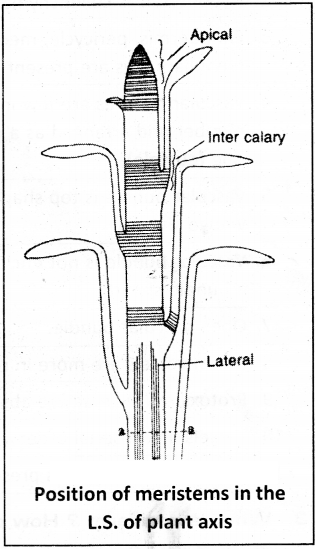
Apical meristems : They are present at the growing tips of roots, stem,, branches etc., They help in the linear growth of the plant body. These are primary meristems because they appear early in life and contribute to the formation of primary plant body.
Intercalary meristem : They are found in between permanent tissues. This meristem is separated from the apical meristems during the course of plant growth. They help in linear growth of the stem and leaves. Growth of flowers and fruits after their initiation at the apex also occurs due to this meristems. They are active only for a short period. These are also primary meristems. Eg : Meristems seen at the base of internodes and leaf bases of monocotyledons (particularly grasses).
Lateral meristems : They are found at the lateral sides of the plant body. The cells divide periclinally and increase the thickness of the organs like stem and root. These are secondary meristems. Eg : Vascular cambium that help in secondary growth by producing secondary xylem and secondary phloem; phellogen (cork cambium) that helps in the formation of periderm.
Question 2.
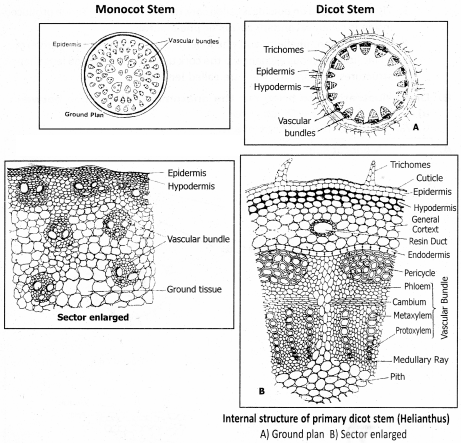
Cut a transverse section of young stem of a plant from your garden and observe it under the microscope. How would you ascertain whether it is a monocot stem or a dicot stem ? Give reasons.
Answer:
Dicot Stem
Monocot Stem
1. In Epidermis, multicellular hairs trichomes are present.
1. Trichomes are absent.
2. Hypodermis is collenchymatous
2. Hypodermis is sclerenchymatous.
3. Endodermis, pericycle, medulla medullary rays are present.
3. Endodermis, pericycle, medulla, medullary rays are absent
4. Vascular bundles are few in number and arranged as a circular ring (eustele).
4. Vascular bundles are numerous and arranged in a scattered manner (atactostele).
5. Vascular bundle is top shaped or wedge shaped.
5. Vascular bundle is oval in shape.
6. Vascular bundle is not enclosed by a bundle sheath.
6. Vascular bundle is enclosed by fibrous sheath, (fibrovascular bundle)
7. Open vascular bundle
7. Closed vascular bundle.
8. Xylem vessels are more in number.
8. Xylem vessels are few in number.
9. Protoxylem lacunae are absent
9. Protoxylem lacunae are present.
10. Vessels are in serial order.
10. Vessels are in Y shape.
11. Phloem parenchyma is present
11. Phloem parenchyma is absent.
Question 3.
What is periderm? How does periderm formation take place in the dicot stems? [Mar. – 2018]
Answer:
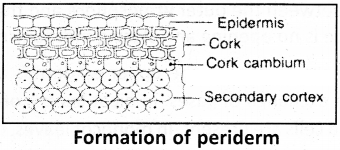
Phellogen, Phellem and Phelloderm are collectively known as periderm. 1.Due to the formation of more secondary vascular tissues a pressure is exerted on the epidermis causing its rupture. So a secondary protective layer (periderm) is formed. 2.Parenchyma cells in middle or inner cortex dedifferentiate into a ring of secondary meristem. This is called cork cambium or phellogen. It cuts off new cells on both sides. 3.Tissue produced on outside is called cork tissue or phellem. Tissue produced inside is called secondary cortex or phelloderm. 4.The phellogen, phellem, and phelloderm together constitute periderm.
5.To facilitate gaseous exchange in the cork tissue certain bulged lens shaped structures are formed. They are called lenticels.
Question 4.
A transverse section of the trunk of a tree shows concentric rings which are known as annual rings. How are these rings formed? What is the significance of these rings?
Answer:
1.In temperate and cold regions, the activity of cambium is influenced by seasonal variations.
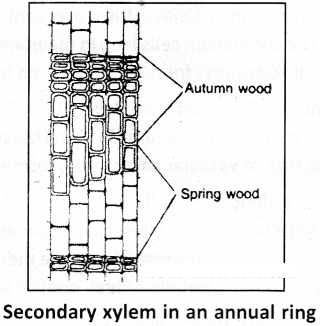
2.In favourable conditions growth will be active. So plants require large amounts of water and minerals. During unfavourable conditions plants are less active. 3.In spring, wood formed shows more number of xylem vessels having wide lumens. This is called spring wood or early wood. 4.During autumn, wood formed shows less number of xylem vessels with narrow lumens. This is called autumn wood or late wood. 5.Spring wood and autumn wood appear alternately in the form of circles in the T.S. of a tree trunk. These are called Growth rings or annual rings. 6.By counting the number of annual rings the age of tree can be estimated approximately.
Question 5.
What is the difference between lenticels and stomata? [Mar. – 2019, ’15, May ’17]
Answer:
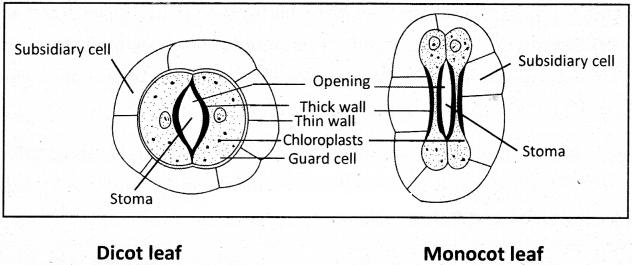
Lenticels : Lens shaped openings in the cork of woody trees are called lenticels. They show closely arranged parenchymatous cells. The lenticels permit the exchange of gases between the outer atmosphere and the internal tissues of the woody organs. There is no opening and closing mechanism. Stomata : Stomata are present in the upper epidermis and lower epidermis of leaves. They help in exchange of gases. In dicot leaves, on either side of stomata kidney shaped guard cells are present. In monocot leaves, dumb bell shaped guard cells are present. Guard cell contains chloroplast. They help in opening and closing of stomata. Stomata helps in the gaseous exchange and also promote transpiration.
Question 6.
Write the precise function of a) Sieve tube b) Interfasicular cambium c) Collenchyma d) Sclerenchyma
Answer:
a) Sieve tube : The functions of sieve tube are controlled by the nucleus of companion cells. The companion cells help in maintaining the pressure gradient in the seive tubes. It transports food materials from leaves to other parts. b) Interfasicular cambium : The cells of medullary cells adjoining the intrafascicular cambium becomes meristematic and forms interfasicular cambium. Thus a continuous ring of vascular cambium is formed. c) Collenchyma : The collenchyma cells which contain chloroplast are green in colour. Photosynthetic in function. Intercellular spaces are absent as the corners are thickened with pectin. So they provide tensile mechanical strength. It helps in movement of young stem, petiole of leaf, pedicel of flower. d) Sclerenchyma : They are dead cells. Cell walls are thickened with legnin. Intercellular spaces are absent. So they, give mechanical strength to organs.
Question 7.
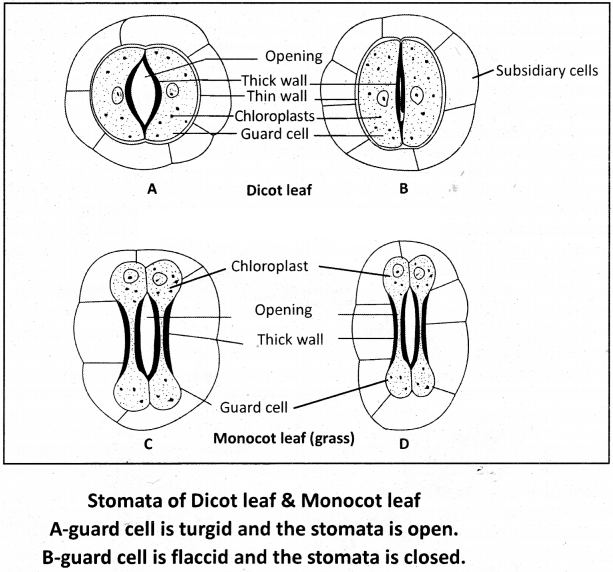
The stomatal pore is guarded by two kidney shaped guard cells. Name the epidermal cells surrounding the guard cells. How does a guard cell differ from an epidermal cell? Use a diagram to illustrate your answer.
Answer:
The epidermal cells surrounding the guard cells are called subsidary cells or accessory cells. The stoma is bounded by two kidney shaped guard cells in dicots and dumbbell-shaped guard cells in monocots. Unlike that of other epidermal cells, guard cells posses chloroplast. The wall of the guard cells towards the stomatal pore is thick, while the outer wall is thin. The stoma, guard cell and subsidiary cells together constitutes stomatal complex.
Question 8.
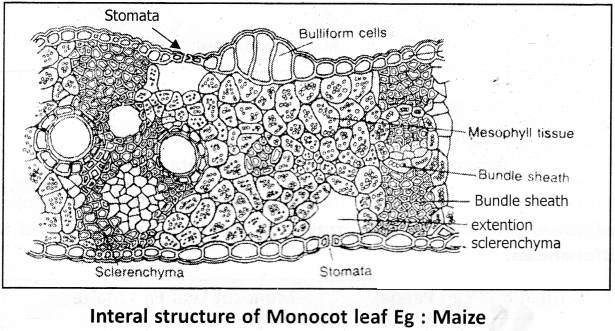
Point out the differences in the anatomy of leaf of peepal [Ficus religiosa] and maize [Zea mays]. Draw the diagrams and label the differences.
Answer:
Dicot leaf Eg : Peepal
Monocot Leaf Eg : Maize
1. Stomata are more on the lower epidermis.
1. Stomata are in equal numbers on both sides.
2. Bulliform cells are absent
2. Bulliform cells are present on upper epidermis.
3. Mesophyll is differentiated into palisade and spongy tissues
3. Mesophyll is undifferentiated.
4. Bundle sheath extensions are generally parenchymatous
4. Bundle sheath extensions are sclerenchymatous.
Question 9.
Cork cambium forms tissues that form the cork. Do you agree with this statement? Explain.
Answer:
Yes, Cork cambium or phellogen is a secondary meristematic tissue. It has the capability to divide. It divides and forms new cells on both sides. The tissue produced outside is called cork tissue or phellem. The tissue produced towards in innerside in secondary cortex or phelloderm.
Question 10.
Name the three basic tissue systems in the flowering plants. Give the tissue names under each system.
Answer:
The three basic tissue systems in the flowering plants are 1.Epidermal tissue sytem 2.The ground or fundamental tissue system 3.The vascular or conducting tissue system.
Epidermal tissue system consists of parenchymatous tissue. They are epidermis, stomata and out growths.
The ground or fundamental tissue system consists of simple tissues such as parenchyma, collenchyma and sclerenchyma.
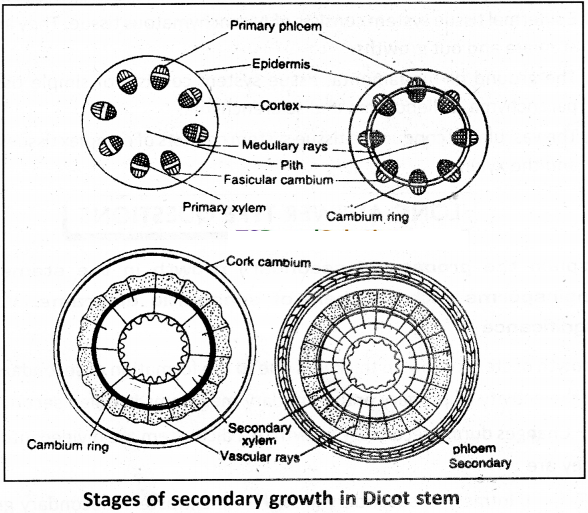
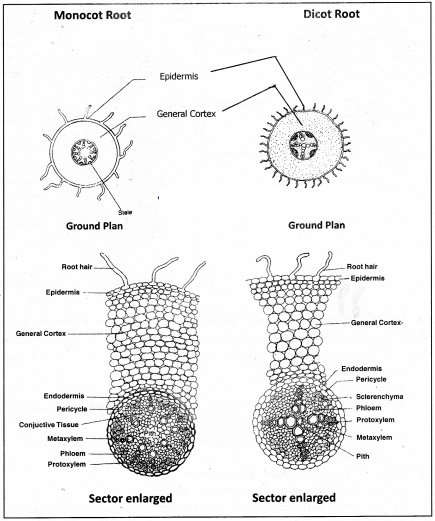
The vascular or conducting tissue system consists of complex tissues, the phloem and the xylem. Long Answer Type Questions Question 1. Explain the process of secondary growth in the stems of woody angiosperms with the help of schematic diagrams. What is its significance? Answer: Growth of stem or root in thickness due to the formation of secondary tissues due to the activity of primary and secondary meristems is called secondary growth. Changes during secondary growth of a dicot stem are divided into two groups. They are I. Intrastelar secondary growth. II. Extrastelar secondary growth. I. Intrastelar secondary growth : The changes that occur inside the stele are called Intrastelar secondary growth. They are A) Formation of vascular cambial ring :
Indicot stem, vascular bundles are in a circular ring. They are open type with fascicular cambiam.
Parenchyma in medullary rays dedifferentiate into secondary meristem connecting fascicular cambiam. These are called interfascicular cambiam.
Fascicular and interfascicular cambia fuse to form vascular cambial ring. B) Activity of vascular cambium :
Vascular cambium has 2 types of initials. a) Fusiform initials : They give rise to secondary xylem towards centre and secondary phloem to outside. b) Ray initials : They produce phloem rays towards outside and xylem rays towards inside.
More secondary xylem is formed than secondary phloem.
Secondary xylem is called wood and secondary phloem bast.
As stem increases in thickness primary phloem and primary xylem are crushed and removed.
Secondary xylem has vessels, fibres and xylem perenchyma. Vessels are pitted.
Secondary phloem has sieve tubes, companion cells, fibres and phloem parenchyma.
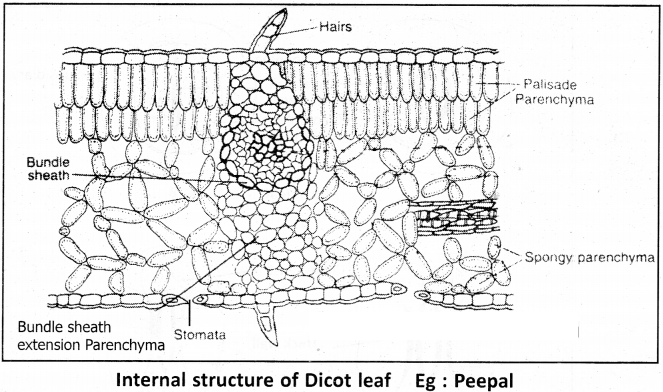
Xylem ray and phloem ray are also called vascular rays. They are helpful in lateral conduction and storage. II. Extrastelar secondary growth : The changes which occur outside the stele are called Extrastelar secondary growth. 1.Due to the formation of more secondary vascular tissues a pressure is exerted on the epidermis causing its rupture. So a secondary protective layer (periderm) is formed. 2.Parenchyma cells in middle or inner cortex dedifferentiate into a ring of secondary meristem. This is called cork cambium or phellogen. It cuts off new cells on both sides. 3.Tissue produced on outside is called cork tissue or phellem. Tissue produced inside is called secondary cortex or phelloderm. 4.The pheilogen, phellem, and phelloderm together constitute periderm. 5.To facilitate gaseous exchange in the cork tissue certain bulged lens shaped structures are formed. They are called lenticels. Question 2. Draw illustrations to bring out the anatomical differences between a) Monocot root and Dioofc mot b) Monocot stem and Dirot stem Answer Question 3. What are simple tissues? Describe various types of simple tissues. Answer: The tissues which are made of only one type of cells are called simple tissues. The various types of simple tissues are parenchyma, collenchyma and sclerenchyma. Parenchyma : 1.The Parenchyma is a living tissue. It occupies a major part of the plant body. So it is known as fundamental tissue or ground tissue. 2.The cells are isodiamtetric. They may be spherical, oval round, polygonal or elongated in shape. 3.Cell walls are thin, made up of cellulose. 4.Intercellular spaces may be present or absent. 5.Parenchyma performs functions like photosynthesis, storage, and secretion. Collenchyma : 1.Collenchyma is a living mechanical tissue. 2.It is present below the epidermis in dicot plants. 3.It is present as a continuous hypodermal ring (Eg : Helianthus annus) or as a discontinuous ring (cucurbita) 4.Corners are thickened due to cellulose, hemicellulose and pectin. 5.Intercellular spaces are absent. 6.It provides mechanical support to the growing parts of the plant parts such as young stem, petiole, pedicle etc. 7.In the cytoplasm, if chloroplast is present, photosynthetic in function. Scelerenchyma : 1.Sclerenchyma is a dead mechanical tissue. 2.Cells are long and narrow. 3.Cell walls are thickened with legnin with pits. 4.They are dead cells. Protoplast is absent. 5.Basing upon the structure, origin and development sclerenchyma are two types – fibres, sclereids. 6.Fibres are thick walled, elongated and pointed cells. 7.Sclereids (stone cells) are spherical, oval or cylindrical shape. 8.Cell walls are highly thickened, lumen is very narrow. 9.Sclereides are found in fleshy fruits like guava, pear and sapota. Seed coat of legumes, leaves of tea, fruit wall of nuts etc. 10.Their main function is to give mechanical support. Question 4. What are complex tissues? Describe various types of complex tissues. Answer: Tissues which are made up of more than one type of cells and work together as a unit are called complex tissues. Xylem and phloem are complex tissues. Xylem : The main function of xylem is conducting water and minerals from roots to the stem and leaves. Xylem also provides mechanical strength to plant parts. Xylem consists of (1) Tracheids (2) Vessels (3) Xylem fibres (4) Xylem Parenchyma. Tracheids : Tracheids are elongated or tube like cells with thick and lignified walls and tapering ends. These are dead cells without protoplasm. Its main function is water transport. Vessels : Presence of vessels is an important character found in angiosperms. Vessels are absent in Gymnosperms. Vessels are dead cells without protoplasm. The cells are elongated or tube like cell thickened with lignin. Its main function is water transport. Xylem fibres : These are highly thickened with legnin with narrow central lumen. They may be septate or aseptate. Xylem Parenchyma : These are living cells. Cell walls are thickened with cellulose. They store food materials like starch, fats, and tannins. The ray parenchyma cell helps in radial conduction of water. Primary xylem is of two types – protoxylem and metaxylem. The first formed primary xylem elementsare called protoxylem. The laterformed primary xylem are called metaxylem. In stems, protoxylem is towards centre and metaxylem is towards periphery. It is called endarch. In roots, protoxylem is towards periphery and metaxylem is towards centre. It is called exarch. Phloem : The main function of phloem transports food materials usually from leaves to the other parts of the plant body. Phloem contains (1) Sieve tube elements (2) Companion cells (3) Phloem parenchyma (4) Phloem fibres. Sieve tube elements : These are long, tube like structures arranged longitudinally and are associated with companion cells. Their end walls are perforated in sievelike manner to form sieve plates. A mature sieve tube element possesses a peripheral cytoplasm and a large vacuole but lacks a nucleus. The function of sieve tubes are controlled by the nucleus of companion cells. Companion cells : These are specialized parenchymatous cells which are closely associated with sieve tube elements. Both are connected by pit fields present between their common longitudinal walls. Phloem parenchyma : These are parenchyma cells in phloem with tapering cylindrical cells which have dense cytoplasm and nucleus. They store food materials and other substances like resin, latex etc. Phloem fibres (bast fibres) : These are sclerenchymatous cells. The cell wall is thick. At maturity they lose their protoplasm and become dead. Question 5. Describe the internal structure of dorsiventral leaf with the help of labelled diagram. Answer: Transverse section of a dicot leaf or dorsiventral leaf shows three parts – epidermis, mesophyll and vascular bundles. I. Epidermis : 1) It is the outermost layer of leaf with one cell thickness. Cells are barrel shaped. They are arranged compactly without intercellular spaces. 2) Epidermis present on upper (adaxial) side is called upper epidermis. Epidermis on lower (abaxial) side is called lower epidermis. img10 3) The outer surface of epidermis is covered by a waxy layer called Cuticle. 4) Epidermis shows multicellular hairs. 5) Stomata are present. They are more on lower surface than upper surface. 6) Epidermis gives protection to the inner tissues. Cuticle regulates transpiration. Stomata help in exchange of gases.
II. Mesophyll : 1.Ground tissue present in between the two epidermal layers is called Mesophyll. It is Chlorenchymatous. 2.In dorsiventral leaf, mesophyll is differentiated into two parts – palisade parenchyma and spongy parenchyma. 3.Palisade parenchyma is found beneath the upper epidermis. Elongated and columnar cells are arranged in 1 – 3 rows. Intercellular spaces are narrow. Cells have large number of chloroplasts nearer to the cell wall. (So upper side of leaf is dark green in colour). Palisade tissue is mainly concerned with assimilation of carbohydrates. 4.Spongy parenchyma is found towards the lower epidermis. It has 3-5 rows of irregularly shaped and loosely arranged cells. Intercellular spaces are large. Air cavities are found below the stomata. Cells have less number of chloroplasts. (So lower side of leaf is pale green in colour) Spongy Parenchyma facilitates gaseous exchange. They also help in the synthesis of food materials. III. Vascular Bundle : 1.Vascular bundles are extended in the mesophyl! in the form of veins. 2.Vascular bundles are bigger at the base of the leaf blade and gradually becomes smaller towards margins and apex. 3.Vascular bundles are conjoint, collateral and closed. Xylem is present towards upper side and phloem towards lower side. 4.Vascular bundles help in conduction of water, mineral salts and food materials. 5.They also provide mechanical strength to the leaf. 6.Each vascular bundle is enclosed by a layer of special mesophyll cells arranged compactly. This layer is called Bundle sheath or Border parenchyma. 7.Ceils of bundle sheath divide and extend towards both epidermal layers. These are called bundle sheath extensions. They help in the conduction of food materials from mesophyll cells to vascular bundles.
Question 6.
Describe the internal structure of an isobilateral leaf with the help of labelled diagram.
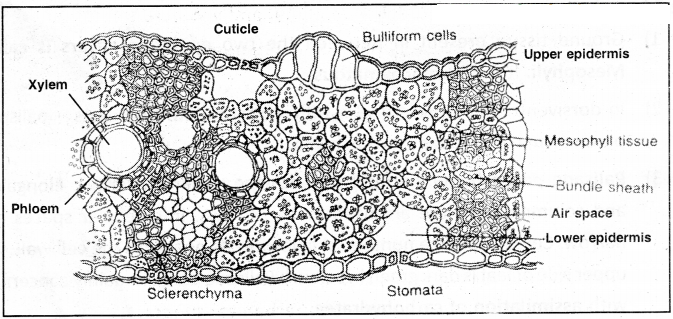
Answer:
Transverse section of monocot or isobilateal leaf shows three parts – epidermis, mesophyll and vascular bundles.
I. Epidermis : 1.This is the outermost layer on both sides of the leaf. Cells are one cell in thickness. They are barrel shaped and closely packed without intercellular spaces. 2.It is covered by a waxy layer called cuticle. 3.Epidermis on adaxial (upper) surface is called upper epidermis. Epidermis on abaxial (lower) surface is called lower epidermis. 4.Hairs are absent. Stomata are present on both sides in equal numbers. 5.In grasses specialised cells are present in upper epidermis. They are called bulliform cells or motor cells. They are thin walled and filled with water. They help in rolling and unrolling of the leaf. 6.Epidermis gives protection to inner tissues. Cuticle regulates transpiration. Stomata help in exchange of gases. II. Mesophyll : 1.Ground tissue present between two epidermal layers is called mesophyll. It is chlorenchymatous. 2.Mesophyll is undifferentiated. 3.Cells have chloroplasts and perform assimilation of carbohydrates. 4.Sometimes patches of sclerenchyma are found beneath the epidermis. They provide mechanical strength. III. Vascular Bundies : 1.Vascular bundles are present in the mesophyll in the form of veins. 2.Vascular bundles are conjoint, collateral and endarch. 3.Xylem is present on the upper side and phloem is present on the lower side. 4.Veins help in conduction of water, mineral salts and food materials. They also provide mechanical strength. 5.Each vascular bundle is enclosed by a layer of special mesophyll cells called bundle sheath or border parenchyma. 6.Cells present on eitherside of vascular bundles towards upper and lower epidermis are called bundle sheath extensions. In many monocots, they are sclerenchymatous and provide mechanical support.
Question 7.
Distinguish between the following : a) Exarch and endarch condition of protoxylem b) Stele and vascular bundle, c) Protoxylem and metaxylem d) Interfasicuiar cambium and intrafasicular cambium e) Open and closed vascular bundles f) Stem hair and root hair g) Heart wood and sap wood, h) Spring wood and autumn wood.
Answer:
a) In roots, the protoxylem lies towards periphery and metaxylem lies towards the centre. Such type of protoxylem is called Exarch, In stems, the protoxylem lies towards the centre (pitch) and the metaxylem lies towards the periphery of the organ. Such type of protoxylem is called Endarch. b) Stele : Stele is the central conducting cylinder. Generally it may have pericycle, vascular bundle, medulla and conjunctive tissue or medullary rays. Vascular bundles : Xylem and phloem are present in vascular bundles. Xylem conducts water and phloem conducts food materials. c) Protoxylem : The first formed primary xylem elements are called protoxylem. Metaxylem : Later formed primary xylem elements are called metaxylem. d) Intrafasicular cambium : Cambium present between primary xylem and primary phloem is called Intrafasicular cambium. It is present inside vascular bundle (Intra = Inside; fasicular = vascular bundle) Interfasicuiar cambium : The cells in medullary rays become meristematic and forms interfasicuiar cambium (Inter = in between; fasicular = vascular bundle) e) Open vascular bundle : The vascular bundle which have cambium betwen xylem and phloem are called open vascular bundle. Closed vascular bundle : In these vascular bundles cambium is absent between xylem and phloem. f) Stem hair and root hair : Stem hair : Multicellular hairs present on the stem are stem hair or trichomes. Their main function is to prevent the entry of pathogens. Root hair : Unicellular hairs present on the root are root hair. Their main function is absorption of water. g) Heart wood and sap wood : Heart wood : The dark brown coloured central part of secondary xylem comprising of dead elements with highly lignified walls is called heart wood. It is infiltrated with various organic compounds like tannins, resins, oils, gums, aromatic substances and essential oils. The heart wood does not conduct water but it gives mechanical support to the stem. Sap wood : The peripheral region of the secondary xylem is lighter in colour and is known as the sap wood. It conducts water and minerals from root to leaf.
h) Spring wood and Autumn wood :
Spring wood
Autumn wood
1. It is produced during spring (favourable) season.
1 It is produced during autumn (unfavourable) season.
2. Xylem vessels have wide lumens.
2. Xylem vessels have narrow lumens.
3. More number of xylem vessels are produced.
3. Less number of xylem vessels are produced.
Question 8.
What is stomata! apparatus? Describe the structure of stomata with a labelled diagram.?
Answer:
Structure of stomata : 1.Tiny pores in the epidermis of young aerial parts of the plant are called stomata. Stomata are more abundant in the leaf epidermis. 2.The stoma is bounded by two kidney shaped guard cells in dicots and dumbbellshaped guard cells in monocots. (Eg : grasses). 3.Unlike that of other epidermal ceils, guard cells posses chloroplasts. The wall of the guard cell towards the stomata! pore is thick, while the outer wall is thin. 4.Epidermal cells surrounding guard cells are called subsidiary or accessory cells. They differ from other epidermal cells in their shape and position. 5.The stoma is followed by an air cavity called substomatal cavity in the mesophyll. 6.The stoma, guard cells and subsidiary cells together constitutes stomatal apparatus.
Question 9.
Describe the T.S of a dicot stem. [Mar. ’17 – A.P. ; Mar. ’15 – T.S ; Mar. ’13]
Answer:
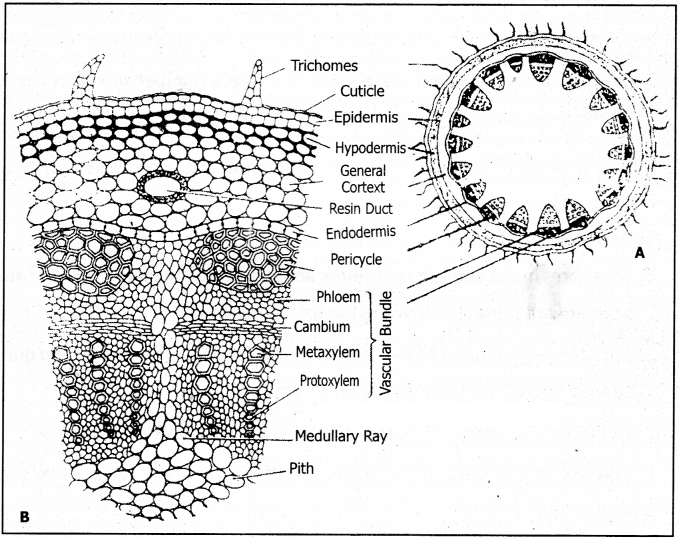
Internal structure of primary dicot stem (Helianthus) A) Ground plan B) Sector enlarged Internal structure of young dicot stem – Ex : Helianthus annuus Transverse section of a dicot stem shows three distinct zones – epidermis, cortex and stele. I. Epidermis : 1.The outermost layer in young dicot stem is called epidermis. It is one cell in thickness. 2.Cells are tubular or rectangular. They are arranged compactly without intercellular spaces. 3.Outer surface of epidermis is covered by a waxy subtance called cutin. This layer is called cuticle. 4.Minute pores found in the epidermis are called stomata. 5.Multicellular hairs developing on the epidermis are called trichomes. 6.Epidermis gives protection to the inner tissues. 7.Stomata facilitates exchange of gases and promotes transpiration. 8.Cuticle and trichomes check transpiration. They also protect the stem from high temperature. 9.Trichomes also help in preventing the entry of pathogenic micro-organisms. II. Cortex : It is extrastelar ground tissue. It shows three subzones – hypodermis, general cortex and endodermis. A) Hypodermis : 1.The layer present below the epidermis is called hypodermis. 2.It consists of 3 – 6 layers of Collenchyma. 3.Cells are arranged compactly without intercellular spaces. They show excessively thickened corners. 4.Hypodermis helps in providing tensile strength to the stem. 5.Hypodermis also helps in production of food materials by having chloroplasts. B) General Cortex : 1.It is found below the hypodermis. 2.It consists of 5-10 rows of parenchyma. 3.Cells are isodiametric or oval or spherical. 4.Resin or latex ducts may be present in it. 5.Outer layers of cells have chloroplasts and perform assimilation of food materials. 6.Inner layers are concerned with storage of food. C) Endodermis : 1.It is the innermost layer of cortex. 2.It is in one layer with barrel shaped, compactly arranged cells. 3.Radial and transverse walls show casparian bands. 4.Endodermal cells store starch grains. So it is known as starch sheath. III. Stele : Central conducting cylinder is called stele. It occupies major portion of stem. It shows four parts. A) Pericycle : 1.It is the outermost layer of stele. 2.It lies between endodermis and vascular bundles. 3.It has alternate patches of sclerenchyma and parenchyma. B) Vascular Bundles : 1.Each vascular bundle is wedge or top shaped. 2.Limited number of vascular bundles are arranged in the shape of a circular ring. Such arrangement is called Eustele. 3.In each vascular bundle the phloem is present outside and xylem towards inside on the same radius. So vascular bundle is conjoint and collateral. 4.Meristematic tissue is present in between xylem and phloem. It is called fascicular cambium. Vascular bundle with cambium is called open type. 5.Xylem is endarch (protoxylem towards centre). 6.Xylem has vessels and xylem parenchyma. Tracheids and fibres are also present. Xylem conducts water and salts. 7.Phloem has sieve tubes, companion cells, phloem parenchyma and fibres. It conducts food materials. C) Medulla : Central part of stele is called medulla. It is filled with parenchyma. It is well developed and extensive. It stores food materials. D) Medullary rays : Medulla extends to the periphery in between the vascular bundles forming medullary rays. Parenchymatous cells are living, thin walled and elongate radially. Medullary rays connect stele and cortex. They hlep in lateral conduction.
Question 10.
Describe the T.S of monocot stem. [Mar. ’15 – A.P.]
Answer:
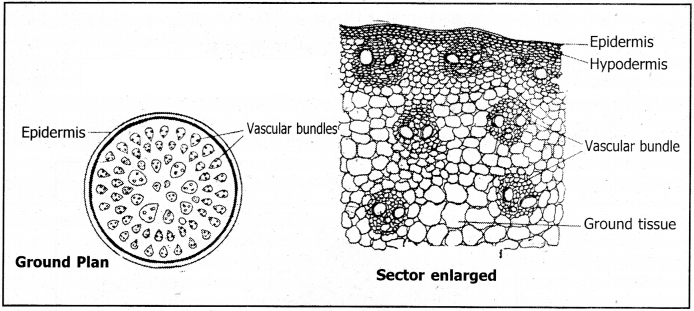
Internal structure of Monocot Stem : The anatomy of Monocot stem shows four distinct parts – Epidermis, hypodermis, ground tissue, vascular bundles. A distinct cortex is absent. Endodermis, pericycle, medulla, medullary rays are absent. I. Epidermis : 1.The outermost layer is called epidermis. It is made up of living, rectangular or tabular cells. They are arranged compactly without intercellular spaces. 2.A waxy layer is deposited on the outer surface of epidermis. This is called cuticle. 3.Trichomes are absent. Numerous stomata are found in the epidermis. 4.Epidermis gives protection to inner tissues. Stomata help in exchange of gases. Cuticle prevents evaporation of water.
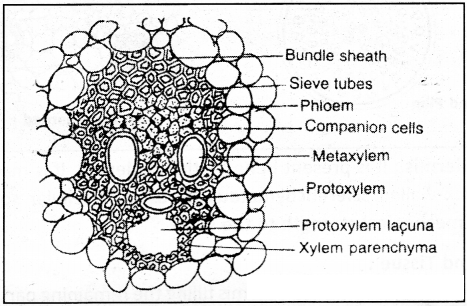
II. Hypodermis : It is present beneath the epidermis. It is made up of 1 – 4 rows of thick walled sclerenchymatous fibres. Intercellular spaces are absent. It gives mechanical strength to the stem. III. Ground Tissue : 1.Tissue next to the hypodermis filling the remaining part of the stem (except vascular bundles) is called ground tissue. 2.It is parenchymatous. 3.Cells are thin walled with or without chloroplasts. They are loosely packed with intercellular spaces. 4.It is mainly concerned with synthesis and storage of food materials. IV. Vascular Bundles : 1.Numerous bundles are irregularly scattered in the ground tissue. Such an arrangement is called Atactostele. 2.Inner bundles are bigger. Peripheral bundles are small in size. They are oval in shape. 3.Each vascular bundle is enclosed by a sclerenchymatous sheath. So it is called fibro vascular bundle. 4.Each bundle has phloem towards outside and xylem towards inside of the bundle on the same radius. So it is described as conjoint and collateral. 5.Vascular bundles are concerned with conduction of water, salts and food materials. 6.Cambium is absent between xylem and phloem. So the vascular bundle is closed type. 7.Xylem is endarch (protoxylem towards centre). Xylem consists of tracheids, vessels, fibres and xylem parenchyma. 8.Xylem is arranged in the shape of Y. Out of four xylem vessels, two are metaxylem and two are protoxylem vessels. 9.One or two protoxylem vessels are crushed forming lysigenous cavity. It is called protoxylem lacuna. It stores water. 10.Phloem has sieve tubes and companion cells. Phloem parenchyma is absent.
Question 11.
Describe the internal structure of a dicot root. [Mar. – 2018, May ’14]
Answer:
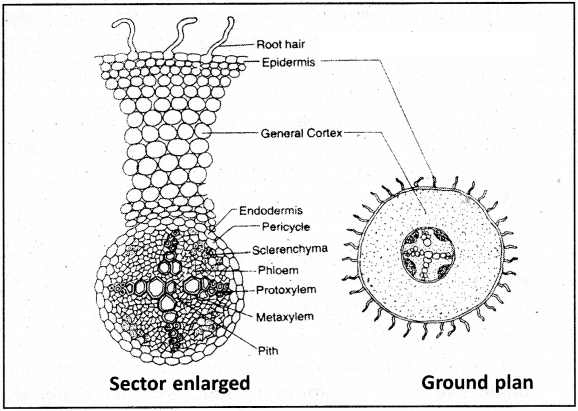
Internal structure of primary dicot root has three zones- epidermis, cortex, stele. Cortex is bigger than stele. I. Epidermis : 1.It is the outermost layer of thin walled rectangular living cells arranged compactly without intercellular spaces. 2.Cuticle and stomata are absent. 3.Some epidermal cells (trichoblasts) produce tubular extensions called root hairs. Cells giving rise to root hairs are smaller than other epidermal cells. Epidermis of root is called rhizodermis or piliferous layer or epiblema due to the presence of root hairs. 4.Root hairs absorb capillary water. The epidermis gives protection to the inner tissues.
II. Cortex : Ground tissue system extending from epidermis to stele is called cortex. It is differentiated into three parts. A) Exodermis : 1.The outermost layer of cortex with 2 or 3 rows of suberised thick walled cells is called exodermis. 2.It acts as a protective layer when epidermis is removed. 3.It prevents the exit of water from cortex. B) General cortex : 1.It is present beneath the exodermis. 2.It has several layers of loosely arranged thin walled parenchyma. Intercellular spaces are present. 3.Cells store food materials. 4.General cortex helps in the lateral conduction of water from epidermis to xylem vessels. C) Endodermis : 1.It is the innermost layer of cortex. 2.It is made up of single layer of barrel shaped cells.- 3.Radial and transverse walls of endodermal cells show thickenings due to deposition of lignin and suberin. These are called casparian thickenings. It is characteristic feature of endodermis. 4.Endodermal cells present opposite to protoxylem are thin walled without casparian strips. These cells are called passage cells. 5.Passage cells help in the entry of water and salts from cortex into stele. III. Stele : The central conducting cylinder is called stele. It shows three parts. A) Pericycle : It is the outer layer of the stele. It is uniseriate with thin walled rectangular parenchymatous cells. Pericycle gives rise to lateral roots. It also helps in secondary growth. B) Vascular bundles : 1.Xylem and phloem are arranged alternately on separate radii. So vascular bundles are separate or radial. Xylem and phloem conduct water and food materials respectively. 2.Protoxylem is towards pericycle and metaxylem towards centre. So xylem is exarch. 3.Xylem is variable from monarch to octarch (xylem groups 1-8) usually tetrarch (4 xylem groups alternating with 4 phloem bundles). Monarch – Trapa, Tetrarch – Gossypium. Octarch – Castanea. 4.Cambium is absent. 5.Parenchyma tissue extending between xylem and phloem strands is called conjunctive tissue. It helps in the storage of food materials. C) Pith or Medulla : The central portion of stele is called medulla or pith. It may be completely absent in dicot root. When it is present, it is parenchymatous. It helps in the storage of food and water.
Question 12
Describe the internal structure of a monocot root. [Mar. ’20, May. ’17]
Answer:
Internal structure of monocot root is differentiated into three zones – epidermis, cortex and stele. I. Epidermis: 1.The outermost layer is called epidermis. Cells are living, rectangular, thin walled. They are compactly arranged without intercellular spaces. 2.Cuticle and stomata are absent. 3.Some cells (trichoblasts) show tubular extensions – root hairs. Epidermis of root having root hairs is called epibiema or piliferous layer or rhizodermis. 4.Root hairs help in the absorption of capillary water form the soil. Epidermis gives protection to the inner tissues. II. Cortex : This is the ground tissue system extending from epidermis to stele. It is differentiated into three parts. A) Exodermis : 1.It is the outermost layer of the cortex with 2 or 3 rows of cells. Cell walls are thick and suberised. 2.It acts as a protective layer when epidermis is removed. 3.It prevents the exit of water from cortex. B) General cortex : 1.It is present beneath the exodermis. 2.It has several layers of loosely arranged thin walled parenchyma. Intercellular spaces are present, 3.Cells store food materials. 4.General cortex helps in the lateral conduction of water from epidermis to xylem vessels. C) Endodermis : 1.It is the innermost layer of the cortex. 2.It is made up of a single layer of barrel shaped cells. 3.Radial and transverse walls of endodermal cells show thickenings due to the deposition of lignin and suherin. These are called Casparian thickenings. 4.Endodermal cells present opposite to protoxylem are thin walled without casparian strips. These cells are called passage cells. 5.Passage cells help in the entry of water and salts from cortex into stele. III. Stele : The central conducting cylinder is called stele. It is very prominent and bigger in size. It shows three parts, A) Pericycle : 1.It is the outermost layer of the stele. It is uniseriate with thin walled parenchymatous cells. 2.Pericycle gives rise to lateral roots. 3.In old roots it becomes sclerenchymatous and gives mechanical strength. B) Vascular bundles : 1.Xylem and phloem are arranged alternately on separate radii. So vascular bundles are radial or separate. 2.Protoxylem is towards pericycle and metaxylem towards centre. So xylem is exarch. 3.Xylem is polyarch (numerous xylem groups). 4.Cambium is absent. 5.Xylem is concerned with conduction of water and salts. Phloem conducts organic solutes. 6.Parenchyma tissue extending between xylem and phloem strands is called conjunctive tissue. Cells are rarely thick walled. It is helpful in storage of food and provides mechanical strength. C) Medulla or pith – The central part of stele is called medulla or pith. It is conspicuous. It is parenchymatous. It helps in storage of food. In some plants cell walls are lignified providing mechanical strength.
Intext Question Answers
Question 1.
Name the various kinds of cell layers which constitute the bark?
Answer:
Periderm and secondary phloem.
Question 2.
Every 50 years, for 200 years, a nail was drilled into a tree to the same depth and at exactly 1m above the sail surface (assuing the ground level has not changed). What will be the pattern of the four nails on the tree ? Do you know the reason for your answer ? If yes give the reason.
Answer:
1.The heads of all the four nails are at same level. 2.Stem of plant undergoes later growth due to cambial activity. Hence, growth (circumference) of stem increases. 3.All the four nails will be seen in the xylem portion of the stem. 4.There will not be change in nail position with respect to vertical position from ground level. Because the vertical growth is reduced after some period and lateral growth is promoted in plant.
Question 3.
Why is wood made of xylme and not a phloem?
Answer:
1.Cambial ring produces more xylmen than phloem during secondary growth. 2.Xylem with the exception of parenchyma, consists of dead tissues i.e., tracheids, vessels and fibres. 3.Phloem is living complex tissue, with the exception of fibres (bast). 4.Hence wood is made of xylem.
Question 4.
A student estimated the age of a tree to he about 300 years. How did he anatomically estimate the age of this tree?
Answer:
The age of a plant can be estimated by counting the number of annual rings.
Question 5.
Assume that you have removed the duramen part of a tree. Will the tree survive or die?
Answer:
The plant survives because of the presence of sapwood which is meant for the conduction of water and minerals. Duramen is not useful for conduction.
The Telangana government has once again extended the exemption from compulsory Telugu for non-Telugu-speaking students, postponing its implementation for higher classes.
Hyderabad: The State government has provided further relief to students who do not speak Telugu as their mother tongue by extending the exemption from studying Telugu as a mandatory subject.
Telangana: Telugu Not Mandatory for Class X in 2026–27
According to a new memo issued by the School Education Department, the compulsory Telugu rule will not be implemented for Class X in the academic year 2026–27. Currently, this rule is also not applicable to Class IX students in 2025–26.
However, students who are currently in Class VIII (2025–26) must study Telugu when they move to Class IX in 2026–27, as the exemption will not apply to them.
The memo, signed by Education Department Secretary Yogita Rana, states: “The government hereby extends the time period for implementation of Telugu as a compulsory subject for students studying Class IX during the academic year 2025–26 and Class X during the academic year 2026–27 in all schools across the State.”
Telugu Not Compulsory for Class 10 Students | Telangana Latest Update
Officials explained that the decision was taken following representations and petitions filed by non-Telugu-speaking students in the High Court seeking exemption from the compulsory Telugu requirement.
The State had earlier granted similar exemptions for the academic years 2024–25 and 2025–26.
Following the government’s announcement, the School Education Department instructed all regional joint directors and district educational officers to inform schools about the revised guidelines and submit a compliance report.
Between a prokaryote and a eukaryote, which cell has a shorter cell division time?
Answer:
1.Prokaryotic cell, has a shorter cell division time due to shorter cell cycle. 2.For instance, bacterial cell cycle is 20 minutes as compared to 90 minutes of cell cycle in yeast.
Question 2.
Among prokaryotes and eukaryotes, which one has a shorter duration of cell cycle?
Answer:
1.Prokaryotes 2.Bacteria (prokaryote) cell cycle is 20 minutes and in human cells (Eukaryote) it is 24 hours.
Question 3.
Which of the phases of cell cycle is of longest duration?
Answer:
1.Interphase 2.In human cell cycle of 24 hours interphase lasts for 23 hours (about 95% of total duration).
Question 4.
Which tissue of animals and plants exhibits meiosis?
Answer:
1.Reproductive tissue – Gamete mother cells. 2.Diploid cells undergo meiosis to produce haploid sex cells.
Question 5.
Given that the average duplication time of E.coli is 20 minutes. How much time will two E.coli cells take to become 32 cells?
Answer:
1.80 minutes. 2.It takes 4 cell divisions to form 32 cells from initial 2 cells.
Question 6.
Which part of the human body should one use to demonstrate stages in mitosis?
Answer:
1.The cells of the upper layer of epidermis, cells of the lining of the gut and blood cells (bone marrow). 2.The above cells of human body are being constantly replaced.
Question 7.
What attributes does a chromatid require to be classifed as a chromosome?
Answer:
Two chromatids attached at the centromere.
Question 8.
Which of the four chromatids of a bivalent at prophase -1 of meiosis can involve in cross over? [March – 2019]
Answer:
1.Non sister chromatids of the homologous chromosomes (a bivalent). 2.Crossing over occurs of pachytene stage of Prophase -1 in Meiosis.
Question 9.
If a tissue has at a given time 1024 cells, how many cycles of mitosis had the original parental single cell undergone? [Mar. ’20, May & mar. ’14]
Answer:
1.10 cycles of mitosis. 2.Mitosis is equatorial cell division and doubling of cell number occur per each cell division.
Question 10.
An anther has 1200 pollen grains. How many pollen mother cells must have been there to produce them? [May ’17, Mar. ’17 A.P & T.S ; Mar. ’15 – A.P ; Mar. ’13]
Answer:
1.300 pollen mother cells. 2.Due to meiosis each PMC produces 4 pollen grains.
Question 11.
At what stage of cell cycle does DNA synthesis occur? [Mar. – 2018]
Answer:
1.S or Synthetic phase of Interphase. 2.During S phase 2C DNA increases to 4C DNA.
Question 12.
It is said that one cycle of cell division in human cells (eukaryotic cells) take 24 hours. Which phase of the cycle, do you think occupies the maximum part of cell cycle?
Answer:
1.Interphase occupies the maximum time i.e., 23 hours. 2.It is about 95% of the total duration of cell cycle is human cells.
Question 13.
It is observed that heart cells do not exhibit cell division. Such cells do not divide further and exit phase to enter an inactive stage called of cell cycle. Fill in the blanks.
Answer:
1.G phase 2.Quiescent stage (Go)
Question 14.
Identify the substages of prophase – I in Meiosis in which synapsis and desynapsis are formed?
Answer:
1.Synapsis (pairing of homologous chromosomes) occur in zygotene substage of prophase -1 in meiosis. 2.Desynapsis (separation of homologous chromosomes) occur in Diplotene substage of prophase -1 in meiosis.
Question 15.
Name the stage of meiosis in which actual reduction in chromosome number occurs. [Mar. ’15 – T.S]
Answer:
1.Anaphase – I in Meiosis I 2.During this stage homologous chromosome migrate to opposite poles.
Question 16.
Mitochondria and plastids have their own DNA (genetic material). What is their fate during nuclear division like mitosis?
Answer:
1.Mitochondria and plastids have no role during the nuclear division of mitosis. 2.At the time of cytoplasmic division, mitochondria and plastids get distributed between the two daughter cells.
Question 17.
A cell has 32 chromosomes. It undergoes mitotic division. What will be the chromosome number during metaphase? What would be the DNA content (C) during anaphase?
Answer:
1.The chromosome number in the cell at metaphase of mitosis is 32 only. But each chromosome consists of 2 sister chromatids. 2.In anaphase, two sister (daughter) chromatids of a chromosome are separated and move to opposite poles. Each of the separated chromatid consists of 2C DNA.
Question 18.
While examining the mitotic stage in a tissue, one finds some cells with 16 chromosomes and some with 32 chromosomes. What possible reasons could you give to this difference in chromosome number? Do you think cells with 16 chromosomes could have arisen from cells with 32 chromosomes or vice versa?
Answer:
1.In mitosis cells at prophase and metaphase consists of basic sets of chromosomes, i.e., in this case 2m = 16. 2.But at anaphase splitting of two sister (daughter) chromatids of a chromosome leads to doubling of number i.e., 32 that distribute equally (16 each) among two daughter cells formed from a mother cell.
Question 19.
The following events occurs during the various phases of the cell cycle. Fill the blanks with suitable answer against each. a) Disintigration of nuclear membrane ……………… b) Appearance of nucleolus ……………… c) Division of centromere ……………… d) Replication of DNA ………………
Answer:
a) Prophase b) Telophase and Interphase. c) Anaphase d) S (Synthesis) phase in Interphase.
Question 20.
Two key events take place during s-phase in animal cells – DNA replication and duplication of centriole. In which parts of the cell do thesfe events occur?
Answer:
1.DNA replication occurs in chromosomes present in nucleus during s-phase of Interphase. 2.Centriole duplication occurs in the cytoplasm.
Question 21.
Name a cell that is found arrested in diplotene stage for monthly and years. Comment in two or three sentences, how it completes cell cycle.
Answer:
1.Oocytes of some vertebrates, diplotene can last for months ‘or years. 2.Terminalization of chiasmata occurs in diakinesis and homologous chromosomes separated. Subsequently cell enters into other stages of Meiosis I for reduction of chromosome number. 3.Meiosis II results in formation of 4 daughter cells each with haploid chromosomes set. Short Answer Questions
Question 1.
In which phase of meiosis are the following formed? Choose the answers from hint points given below. a) Synaptonemal complex ……………… b) Recombination nodules ……………… c) Appearance / activation of ……………… Enzyme recombinase d) Termination of chiasmata ……………… e) Interkinesis ……………… f) Formation, of dyad of cells ……………… Hints : 1) Zygotene, 2) Pachytene, 3) Pachytene, 4) Diakinesis, 5) After Telophase – I / Before Meiosis – II, 6) Telophase – I / After Meiosis – I
Answer:
a) Synaptonemal complex Zygotene b) Recombination nodules Pachytene c) Appearance / activation of Pachytene Enzyme recombinase d) Termination of chiasmata Diakinesis e) Interkinesis After Telophase – I / Before Meiosis – II f) Formation of dyad of cells Telophase – I / After Meiosis – I
Question 2.
Mitosis results in producing two cells which are similar to each other. What would be the consequence if each of the following irregularities occurs during mitosis? a) Nuclear membrane fails to disintegrate. b) Duplication of DNA does not occur. c) Centromeres do not divide. d) Cytokinesis does not occur.
Answer:
a) If nuclear membrane fails to disintegrate chromosome cannot spread through the cytoplasm of the cell. Metaphase cannot take place. b) If Duplication of DNA does not occur equal number of chromosomes cannot enter into daughter cells, results in variable number of chromosomes. c) If centromeres do not divide chromatid cannot move to opposite poles, then daughter cells have same chromosome number with two chromatids. d) If cytokinesis does not occur then after cell division each cell contains two nucleus. Resulting multinucleate condition.
Question 3.
Comment on the statement “Meiosis enables the conservation of specific chromosome number of each species even though the process per second, results in reduction of chromosome number.
Answer:
1.Meiosis is the mechanism, by which chromosome number is reduced to half in sexually reproducing organisms. 2.Meiosis produces 4 haploid daughter cells (sex cells or gametes) from a diploid mother cell. 3.Fertilization or union of sex cells again gives rise to diploid (2n) organism. 4.So, Meiosis is the mechanism, by which conservation of specific chromosome number of each species is achieved across generations. 5.It also increases the genetic variability in the population of organisms from one generation to the next, that leads to the evolution.
Question 4.
How does cytokinesis in plant cells differ from that in animal cells?
Answer:
1.Cytokinesis refers to division of a mother cell into 2 daughter cells. This occurs after the Karyokinesis, the division of a mother nucleus into 2 daughter nuclei. 2.In an animal cell, cytokinesis is achieved by the appearance of a furrow in the plasma membrane. The furrow gradually deepens and ultimately joins in the center, dividing the cell cytoplasm into two. 3.Plant cells are enclosed by a relatively in extensible (rigid) cell wall. So in those cells, wall formation starts in the centre of the cell and grows outward to meet the existing lateral walls.
Question 5.
Which division is necessary to maintain constant chromosome number in all body cells of multicellular organism and why? [May. ’14]
Answer:
1.Cell division Meiosis is necessary to maintain constant chromosome number in all body cells of multicellular organisms. 2.The reason is mitosis divide and forms two daughter cells which are similar to parent cell. 3.The chromosome number remains constant in all the cells. 4.Growth occurs due to mitosis. 5.Mitosis also helps in cell repair and growth.
Question 6.
Though redundantly described as a resting phase, interphase does not really involve rest. Comment. [Mar. ’20, ’19, ’18, ’17, ’15, ’13; May ’17]
Answer:
1.In cell cycle, the stage at which the nucleus is not in a state of division is called interphase. It occurs between two successive divisions. 2.During interphase, cell prepares for division by undergoing growth as well as DNA replication in an orderly manner, though considered as resting phase. 3.On the basis of biochemical studies, interphase is subdivided into 3 stages : G1 phase, S phase and G2 phase.
G1 phase : Cell increases in size. RNA and proteins are synthesised in large quantity. S phase : DNA replication occurs and its content increases to 4c from 2c. G2 phase : Synthesis of proteins and RNA is continued. Various cell organelles are newly synthesised. The proteins and energy pools associated with the structure and movement of chromosomes are established.
Long Answer Type Questions
Question 1.
Discuss on the statement – Telophase is reverse of prophase?
Answer:
The changes occurring in telophase are almost reverse to those which take place in prophase. The daughter chromosomes reach opposite poles. These daughter chromosomes lengthen and their visibility decreases due to decondensation of chromatin. The kinetochore fibres disappear. The nuclear membrane reappears. Nucleolus, golgi complex and ER reform. Thus at the end of telophase, two independent daughter nuclei are organised in the same mother cell.
Question 2.
What are the various stages of meiotic prophase – I? Enumerate the chromosomal events during each stage?
Answer:
Meiotic prophase I is longer and more complex when compared to prophase of mitosis. Prophase I is divided into 5 substages. They are – 1.Leptotene 2.Zygotene 3.Pachytene 4.Diplotene 5.Diakinesis. 1) Leptotene : Nucleus enlarge in size. Chromosomes are visible. They are long and slender. 2) Zygotene : 1.Homologous chromosomes attract each other and form pairs. These are called bivalents. 2.The process of pairing is called synapsis. 3.Electron micrographs of this stage indicate that chromosome synapsis is accompanied by the formation of complex structure called synaptonemal complex 3) Pachytene : It is most significant substage of Meiosis I. 1.Each chromosome divides into two chromatids. Thus in each bivalent, 4 chromatids can be seen. These are called pachytene tetrads. 2.In a bivalent, chromatids of the same chromosome are called sister chromatids and those of two different chromosomes are called non-sister chromatids. 3.Pachytene stage is characterised by the appearance of recombination nodules, the sites at which crossing over occurs between non-sister chromatids. 4.The non-sister chromatids exchange their parts mutually at one or two or more places. Such points where the non-sister chromatids physically contact each other are called chiasmata. Chiasmata appear as X – shaped structures. 5.Crossing over is also an enzyme mediated process and the enzyme involved is called recombinase. 6.By the end of pachytene, recombination between homlogous chromosomes is completed leaving the chromosome linked at the side of crossing one. 4) Diplotene : The beginning of diplotene in recognised by the dissolution of the synaptonemal complex and the tendency of the homologous chromosomes of the bivalent separate from each other except at the site of chaismata. 5) Diakinesis: 1.Chaismata move towards the ends of chromosomes. This is called terminalisation. 2.Bivalents become very thick and short. 3.Nucleolus begins to disappear. 4.Nuclear membrane disappears. 5.Chromosomes are released into cytoplasm.
Question 3.
Differentiate between the events of mitosis and meiosis.
Answer:
Mitosis Meiosis
Mitosis
Meiosis
1. In mitosis, chromosome doubling is followed by separation of daughter chromosomes. The cell divides only once
in meiosis, there is doubling of chromosomes once but it is followed by two nuclear divisions. The cell divides twice
2.In mitosis, nucleui divides first called Karyokinesis followed by division of cytoplasm called cytokinesis. It is completed in one sequence of stages. It is divided into following stages.
In meiosis it is divided into two major stages. They are Meiosis 1 and Meiosis II. Meiosis 1 has karyokinesis 1 followed by cytokinesis. Meiosis II has karyokinesis II followed by cytokinesis. It is divided into following stages.
Prophase: 3.Prophase of mitosis is of short duration and is without sub-stages
3.Prophase 1 is of longer duration and completed in five substages : Leptotene, zygotene, pachytene, diplotene and diakinesis.
4.The homologous chromosome do not pair with each i.e., synapsis is absent
4.In meiosis i, the homologous chromosomes which are in single state form pairs.
5.Duplication of chromosomes takes place in early prophase
5.Duplication of chromosomes takes place in pachytene substage of Meiosis l.
6.Generally no chiasmata formation takes place. No crossing over takes place
6.Chiasmata formation due to crossing over takes place in meiosis.
Metaphase: 7.Chromosome appears two stranded
7.Chromosome appears in tetrad stage.
8.The centromere of each chromosome divides into two and thus the two chromatids of the chromosome become free from each other.
8.Centromere of the homologous chromosomes divides, thus their chromatids do not become free in Metaphase I
Anaphase: 9.The two chromatids of each chromosome move towards the opposite poles of the spindle
9.In meiosis, the two homologous chromosomes of each pair separate and move towards opposite poles of spindie during anaphase stage.
10. The chromosomes are long and thin.
10. The chromosomes are short and thick.
Question 4.
Write brief note on the following : a) Synaptonemal complex b) Metaphase plate
Answer:
a) Synaptonemal complex : During the heptotene of prophase I, chromosome start pairing together and this process of association is called synapsis, 1.Such paired chromosomes are called homologous chromosome. 2.Electron micrographs of this stage indicate that chromosome synapsis is accompanied by the formation of complex structure called synoptonemal complex. 3.The complex formed by a pair of homologous synapsed homologous chromosomes is called a bivalent or a tetrad of chromatids. b) Metaphase plate : In Metaphase two important changes take place. 1.Formation of bipolar spindle fibres and attach the same to the kinetochores of chromosomes, 2.All the chromosomes lie at the equator. 3.The plane of alignment of the chromosomes at metaphase is referred to as the metaphase plate or equatorial plate.
Question 5.
Write briefly the significance of mitosis and meiosis in multicellular organism?
Answer:
Significance of mitosis : 1.Growth in organism is caused by mitosis and it restores the surface or volume ratio of the cell. 2.The daughter ceils formed by mitosis are identical with the mother cell. Hence it is important in conserving the genetic integrity of the organism. 3.In unicellular organisms, mitosis helps in reproduction. 4.Mitosis helps in wound healing and regeneration of lost plant parts. 5.Mitosis helps for grafting in vegetative reproduction. 6.It maintains a constant number of chromosomes in all the cells of the body. Significance of meiosis: 1.It helps in the maintenance of a constant chromosome number from one generation to the next. 2.Due to crossing over, genetic recombinations are caused which help in genetic variation and origin of new species and leads to evolution.
Intext Question Answers
Question 1.
Name a stain commonly used to colour chromosome.?
Answer:
Acetocarmine
Question 2.
Name the pathological condition when uncontrolled cell division occurs?
Answer:
Cancer
Question 3.
An organism has two pairs of chromosomes (i.e., chromosome number = 4). Diagrammatically represent the chromosomal arrangement during different phases of meiosis – II.
Answer:
Question 4.
Meiosis has events that lead to both gene recombinations as well as Mendelian recombinations. Discuss.
Answer:
Both chiasmata and crossing over occur between non-sister chromatids. Due to crossing over, genetic recombinations are caused. During Anaphase – I of meiosis – I Mendelian recombination takes place.
Question 5.
Both unicellular and multicellular organisms undergo mitosis. What are the differences, if any, observed between the two processes?
Answer:
In unicellular organisms, a cell divides into two halves by binary fission. Stages like Prophase, Metaphase, Anaphase, and Telophase are present in multicellular organisms. It’s not present in unicellular organisms.





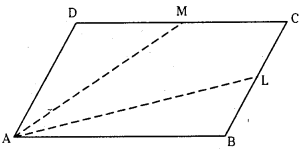 ABCD is a parallelogram and hence AB=DC and BC=AD
We have BC = 12BC
(∵ L is the mid point of BC)
= 1/2 AD (∵ BC = AD)
ABCD is a parallelogram and hence AB=DC and BC=AD
We have BC = 12BC
(∵ L is the mid point of BC)
= 1/2 AD (∵ BC = AD)
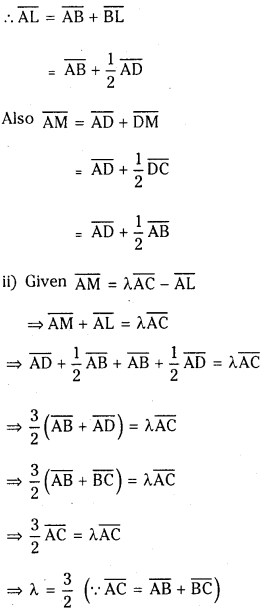
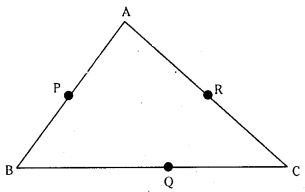 and DA¯=a , DB=b and DC=c
P.V. of P is mid point of AB=DP=a+b/2
P.V. of Q is mid point of BC=DQ¯=b+c/2
P.V. of R is mid point of AC=DR¯=c+a/2
and DA¯=a , DB=b and DC=c
P.V. of P is mid point of AB=DP=a+b/2
P.V. of Q is mid point of BC=DQ¯=b+c/2
P.V. of R is mid point of AC=DR¯=c+a/2
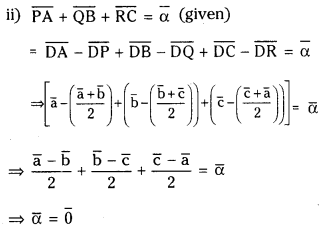
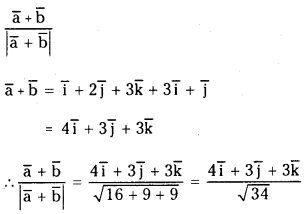
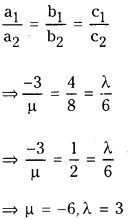
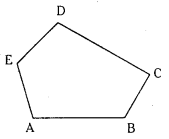 Given ABCDE is a pentagon and
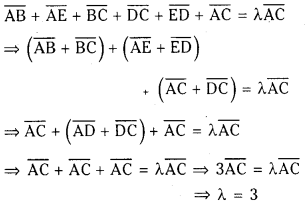
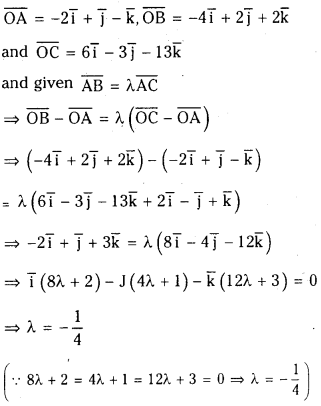
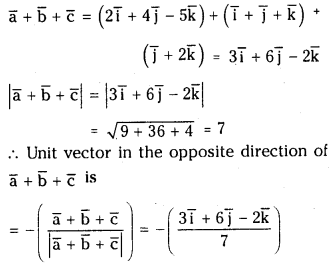
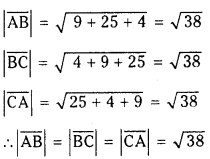 ∴ The given vectors formed on equilateral triangle.