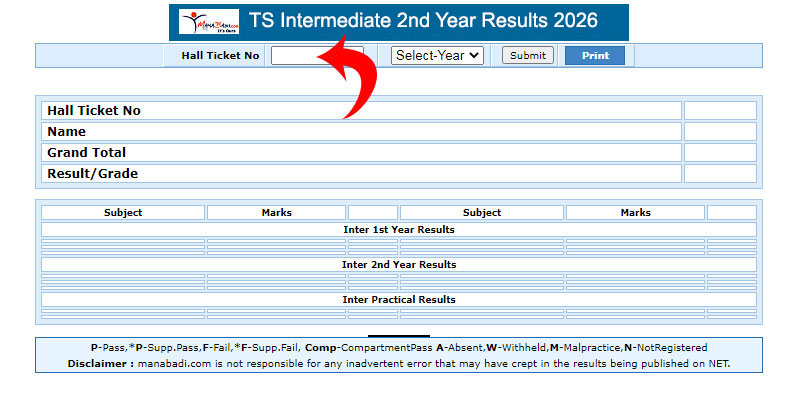
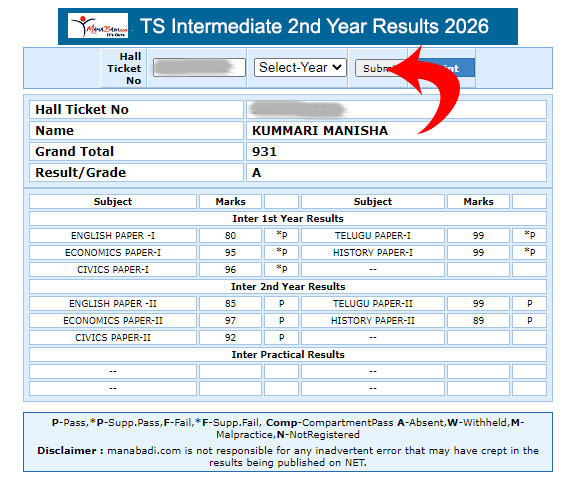
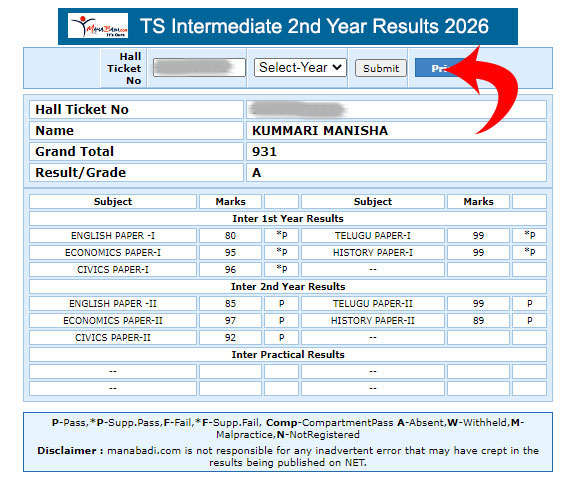
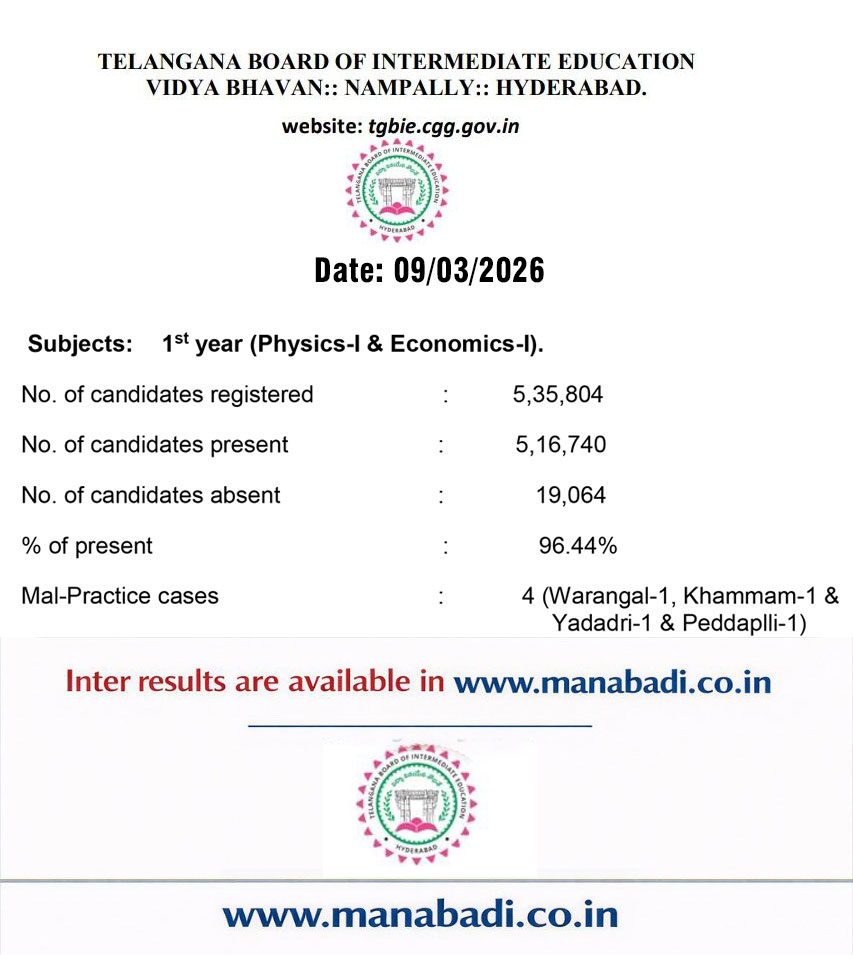
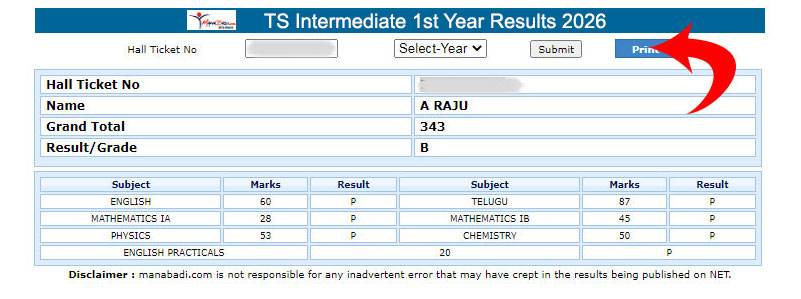
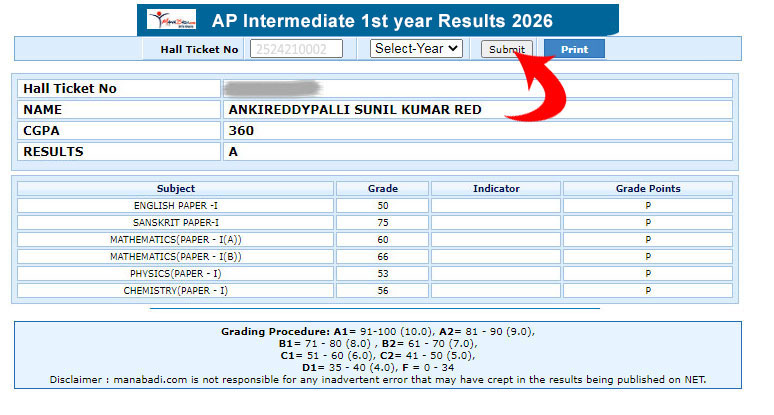
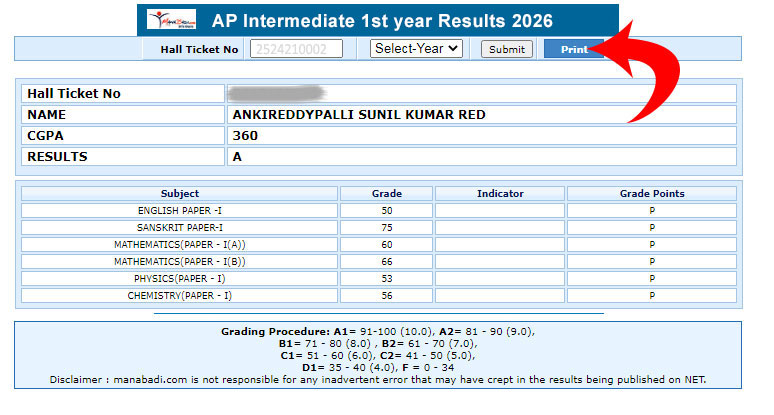
The TG Inter 1st and 2nd Year Results 2026 are out and are available at Manabadi.co.in and at Telangana intermediate Public Examinations (TGBIE) website. Students who appeared for the Telangana Intermediate Public Examinations (IPE) March 2026 will be able to check their results online using their Hall Ticket Number.
Every year, lakhs of candidates who appear for the Telangana Intermediate Public Examinations (IPE) 2026 eagerly wait for the announcement of their TS Inter 1st Year Results 2026 and TS Inter 2nd Year Results 2026. These results, declared by the Telangana State Board of Intermediate Education (TSBIE), are very important for higher education admissions, competitive exams, and future career opportunities. The Intermediate Marks Memo 2026 will serve as an essential document for students seeking admission into degree and professional courses.
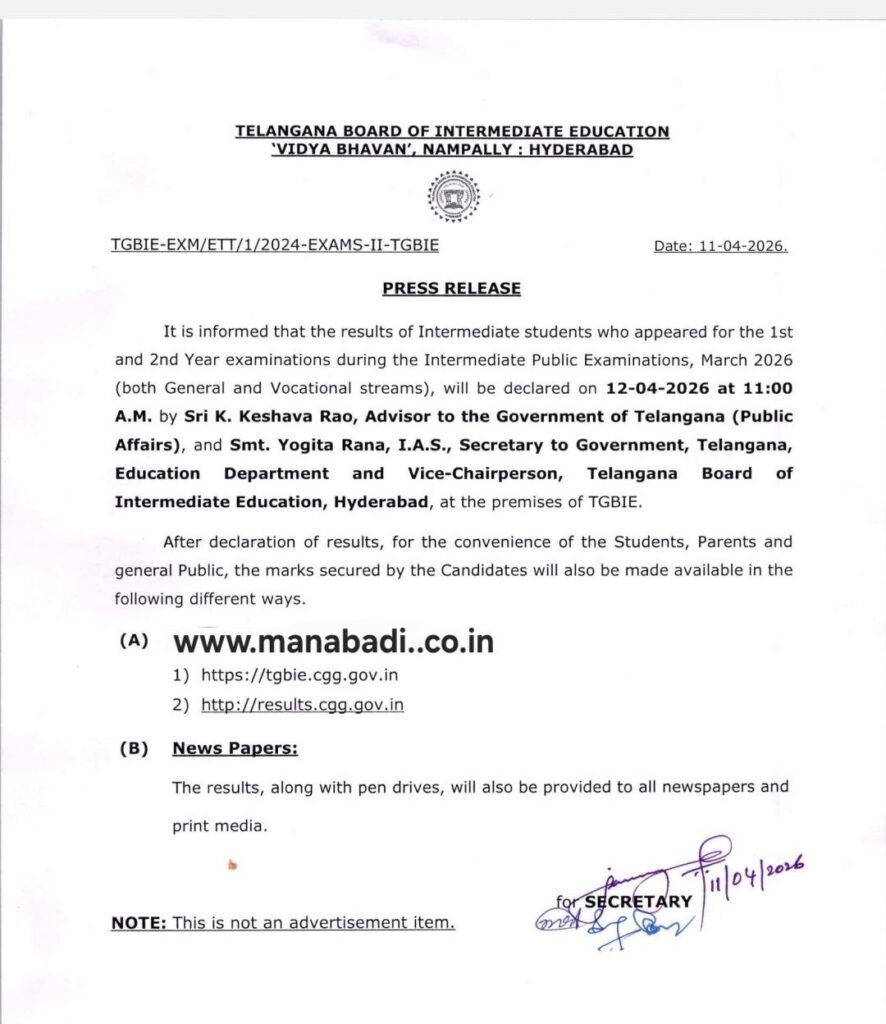
The TG Intermediate Results 2026 have been announced today, April 12, 2026, at 11:00 a.m. Students can check their results online through the official website as well as trusted portals like Manabadi.co.in, which is a popular platform for accessing TSBIE Intermediate results. By entering their hall ticket number, students will be able to view their results instantly and download their digital marks memo.
The Intermediate examinations commenced on February 25, 2026, and the evaluation of answer scripts began on March 4, 2026. The board is actively working to complete the valuation process on schedule to ensure timely declaration of results.
The Telangana Intermediate Board is focusing on completing the evaluation and finalizing the result data to ensure a smooth and timely release of the TS Intermediate 1st & 2nd 2026 Results. Once the results are officially announced, students can check their pass status, verify their scores, and apply for revaluation, recounting, or supplementary examinations if needed. It is advised that students regularly visit reliable sources and stay updated with the latest Inter Results 2026 Notifications to get accurate information about the official result date and related announcements.
Note-2
Post-Valuation Process
After the valuation is completed, the Board will:
Carry out tabulation (data consolidation) for about 3 days
Randomly verify answer sheets of students who failed in a single subject
Indications on Result Release
Once the computerization process is completed, results are expected to be released in April
The Board has tentatively proposed the dates: April 12th, 2026
Why April 12 is Important?
The ongoing JEE Main 2026 exams will continue until April
Therefore, there is a high possibility that results may be declared on April 12, after the exams conclude
How to Download TS Inter Marks Memo 2026
Students should keep their Hall Ticket Number ready to check results.
Results will be available on:
Official Website: tsbie.cgg.gov.in official portal
Or through TS Intermediate Results 2026 links on platforms like Manabadi
వాల్యుయేషన్ తర్వాత ప్రక్రియ
వాల్యుయేషన్ పూర్తయిన బోర్డు తర్వాత:
3 రోజుల పాటు క్రోడీకరించడం (ట్యాబ్యులేషన్) చేపడుతుంది
సింగిల్ సబ్జెక్టులో ఫెయిలైన విద్యార్థుల ఆన్సర్ షీట్లను ర్యాండమ్గా చూస్తున్నారు
ఫలితాలవిడుదలకుసూచనలు
కంప్యూటరీకరణ ప్రక్రియ పూర్తయ్యాక ఏప్రిల్లోనే ఫలితాలు విడుదలయ్యాయి
ఈ మేరకు బోర్డు ఏప్రిల్ 8, 10, 12 తేదీలను ప్రతిపాదించింది
ఏప్రిల్ 12 ఎందుకుకీలకం?
ప్రస్తుతం జరుగుతున్న JEE Main 2026 పరీక్షలు ఏప్రిల్ 8 వరకు కొనసాగుతున్నాయి.
అందువల్ల వాటి తర్వాత ఏప్రిల్ 12న ఫలితాలు ప్రకటించే అవకాశం ఎక్కువగా ఉంది.
TS ఇంటర్ మార్క్స్ మెమో 2026 డౌన్లోడ్ చేసే విధానం
ఫలితాలను చెక్ చేసేందుకు విద్యార్థులు తమ హాల్ టికెట్ నంబర్ సిద్ధంగా ఉంచుకోవాలి.
ఈసైట్లలోఅందుబాటులోఉంటాయి:
అధికారిక వెబ్సైట్: tsbie.cgg.gov.in
లేదా మనబడి వంటి TS Intermediate Results 2026 లింక్లను క్లిక్ చేయండి
Intermediate Exam Results Expected April 12
Note-1: Hyderabad: The Intermediate examination results are expected to be released before April 10. The Board of Intermediate Education is planning to announce the results on April 6. The Education Department has clarified that junior colleges will reopen from June 1. The valuation process is likely to be completed by March 31. Evaluation has already started across the state from the 15th of this month. Earlier, valuation was conducted from 10 AM to 5 PM. Now, officials have ordered that it be conducted from 9 AM to 6 PM.
TG Inter Results 2026 Overview
The Telangana Intermediate examinations are conducted annually by the Telangana State Board of Intermediate Education for students enrolled in Intermediate 1st Year and 2nd Year courses. These exams are conducted for various streams such as MPC, BiPC, CEC, HEC, MEC, and Vocational courses.
Once the evaluation process is completed, the board will announce the TG Inter Results 2026 in online mode. Students must keep their Hall Ticket Number ready to check their results without any delay.
TG Inter 1st & 2nd Year Results 2026 – Important Details
Particulars
Details
Exam Name
Telangana Intermediate Public Examination 2026
Board Name
Telangana State Board of Intermediate Education
Classes
Intermediate 1st Year & 2nd Year
Streams
MPC, BiPC, CEC, HEC, MEC, Vocational
Result Mode
Online
Expected Result Date
April 12th, 2026
Official Websites
tgbie.cgg.gov.in, manabadi.co.in
How to Download TG Inter Results 2026 Online?
Students can follow the simple step-by-step process below to check and download their TS Inter 1st Year & 2nd Year Results 2026:
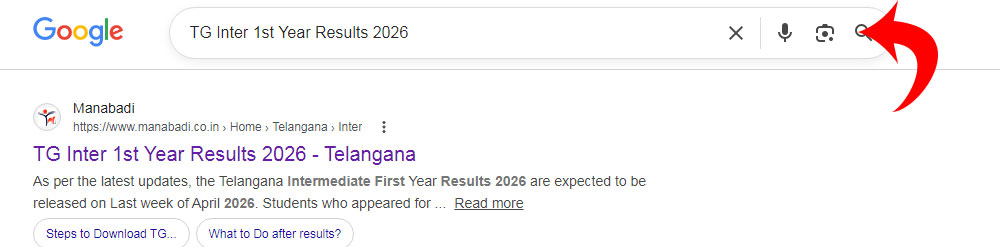
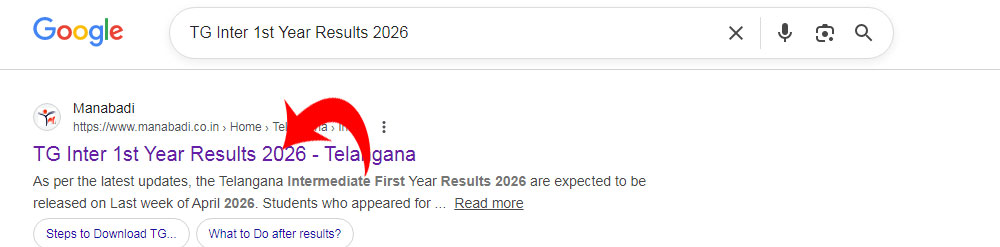
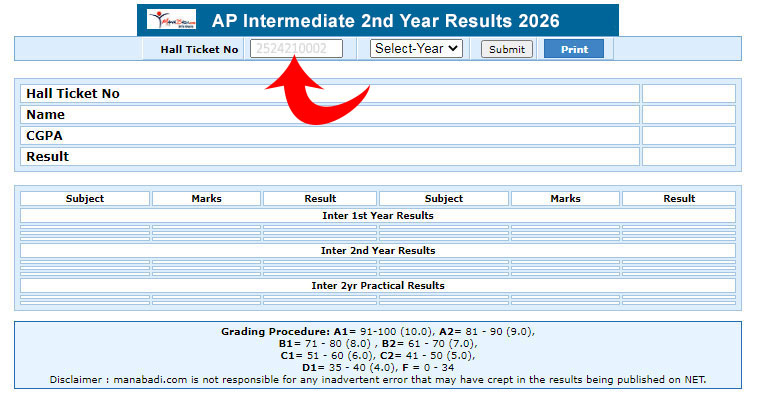
Visit the official website manabadi.co.in or the TGBIE portal.
Click on the link labeled “TG Inter Results 2026”.
Select 1st Year or 2nd Year based on your class.
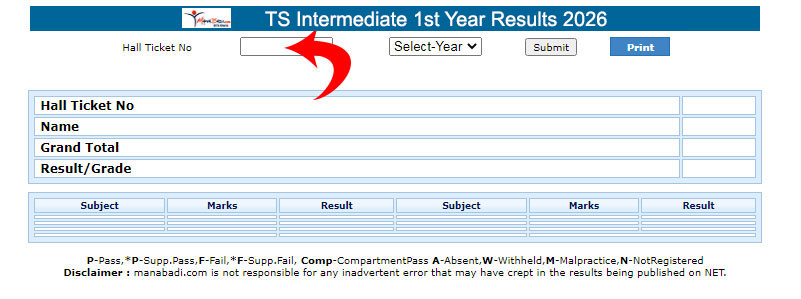
Enter your Hall Ticket Number correctly.
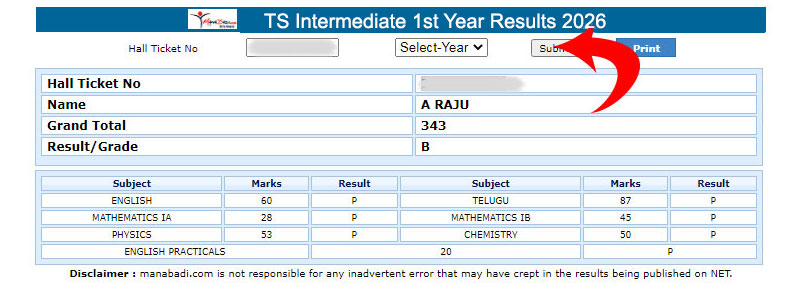
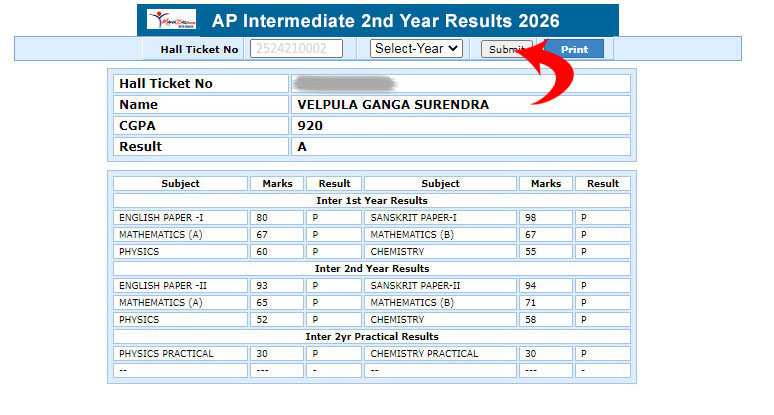
Click on the Submit button.
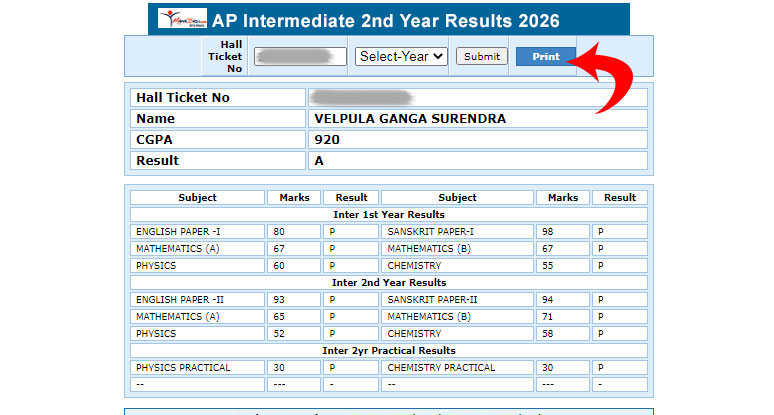
Your result will appear on the screen.
Download and take a printout of the marks memo for future use.
Details Mentioned on TG Inter Marks Memo 2026
After downloading the result, students should carefully verify the following details printed on the marks memo:
Student Name
Hall Ticket Number
College Name
Group / Stream
Subject-wise Marks
Total Marks
Grade / Result Status (Pass/Fail)
In case of any discrepancy, students must immediately contact their respective college authorities or the board.
TG Inter Results 2026 Grading System
The Telangana Intermediate Board follows a grade-based evaluation system. The grading structure is as follows:
Marks Range
Grade
Grade Points
750 and above
A
10
600 – 749
B
8
500 – 599
C
6
350 – 499
D
4
Below 350
F
Fail
Revaluation & Recounting Process for TG Inter Results 2026
Students who are not satisfied with their marks can apply for revaluation or recounting.
Recounting: Only marks are re-checked for totaling errors.
Revaluation: Answer scripts are re-evaluated by examiners.
Applications for revaluation and recounting must be submitted online within the prescribed dates, along with the applicable fee.
Frequently Asked Questions (FAQs) – Telangana Inter 1st and 2nd Year Results 2026
1. When will Telangana Inter 1st & 2nd Year results be released? The Telangana Inter 1st and 2nd Year results are expected to be released today, April 12, 2026, at 11:00 a.m.. Students are advised to stay updated on Manabadi for the fastest result access.
2. Where can I check Telangana Inter results 2026? Students can check their results on Manabadi.co.in, which is one of the most reliable and fastest platforms to access Telangana Inter results without delays.
3. What is the official website to check TS Inter results? Apart from official board websites, students can directly check their results on Manabadi.co.in, which provides quick and easy access during heavy traffic.
4. How to check Telangana Inter results on Manabadi.co.in?
Visit Manabadi.co.in
Click on “TS Inter 1st Year Results 2026” or “TS Inter 2nd Year Results 2026”
Enter your Hall Ticket Number
Click on Submit to view your result instantly
5. Can I check TS Inter results via mobile phone? Yes, students can easily check their results on mobile using Manabadi.co.in, which is mobile-friendly and loads quickly even during peak traffic.
6. What details are required to check Inter 1st or 2nd-year results? You only need your Hall Ticket Number to check your Telangana Inter results on Manabadi.co.in.
7. Can I download my Telangana Inter marks memo? Yes, you can download and take a printout of your marks memo directly from Manabadi after checking your result.
The TG Inter 2nd Year Results 2026 are out and are available at Manabadi.co.in and at Telangana intermediate Public Examinations (TGBIE) website. Students who appeared for the Telangana Intermediate Public Examinations (IPE) March 2026 will be able to check their results online using their Hall Ticket Number.
Students who appeared for the examinations can check their results on the official websites tgbie.cgg.gov.in, results.cgg.gov.in, and popular education portal Manabadi.co.in. To view the result and download the marks memo, candidates must log in using their hall ticket number and other required credentials. The results have been announced by the Telangana State Board of Intermediate Education (TGBIE), ending the wait for lakhs of Intermediate students across Telangana.
Meanwhile, the TS Inter 2nd Year Result 2026 is one of the most anticipated academic announcements of the year, as it plays a crucial role in shaping students’ higher education and career paths. The TG Inter 2nd Year Results 2026 has been released today, April 12th, 2026. The Intermediate Public Examinations were conducted successfully across the state, and following the completion of the evaluation process, the board is now fully prepared to release the results online.
Once declared, students can easily access their TS Inter 2nd Year Results 2026 through manabadi.co.in for quick and reliable result updates. These marks are extremely important for admissions into degree colleges, engineering and medical courses, and other professional programs. Students are advised to download and keep a copy of their marks memo for future reference and regularly check official portals for updates related to re-verification, recounting, and supplementary examinations.
The TG Inter Second Year VOC Result 2026 is expected to be announced on April 12th, 2026 by the Telangana State Board of Intermediate Education (TSBIE). Students who appeared for the Intermediate 2nd Year Regular and Vocational examinations can check their results online through the official websites tgbie.cgg.gov.in and the popular education portal manabadi.co.in. Candidates need to enter their Hall Ticket Number to view and download the TG Inter 2nd Year Vocational Result 2026, which includes subject-wise marks, grades, and pass status.
Note-2
Post-Valuation Process
After the valuation is completed, the Board will:
Carry out tabulation (data consolidation) for about 3 days
Randomly verify answer sheets of students who failed in a single subject
Indications on Result Release
Once the computerization process is completed, results are expected to be released in April
The Board will be proposed the dates: April 12
Why April 12 is Important?
The ongoing JEE Main 2026 exams will continue until April
Therefore, there is a high possibility that results may be declared on April 12, after the exams conclude
How to Download TS Inter Marks Memo 2026
Students should keep their Hall Ticket Number ready to check results.
Results will be available on:
Official Website: tsbie.cgg.gov.in
Or through TS Intermediate Results 2026 links on platforms like Manabadi
వాల్యుయేషన్ తర్వాత ప్రక్రియ
వాల్యుయేషన్ పూర్తయిన బోర్డు తర్వాత:
3 రోజుల పాటు క్రోడీకరించడం (ట్యాబ్యులేషన్) చేపడుతుంది
సింగిల్ సబ్జెక్టులో ఫెయిలైన విద్యార్థుల ఆన్సర్ షీట్లను ర్యాండమ్గా చూస్తున్నారు
ఫలితాలవిడుదలకుసూచనలు
కంప్యూటరీకరణ ప్రక్రియ పూర్తయ్యాక ఏప్రిల్లోనే ఫలితాలు విడుదలయ్యాయి
ఈ మేరకు బోర్డు ఏప్రిల్ 8 2026 తేదీలను ప్రతిపాదించింది
ఏప్రిల్ 12 ఎందుకుకీలకం?
ప్రస్తుతం జరుగుతున్న JEE Main 2026 పరీక్షలు ఏప్రిల్ 8 వరకు కొనసాగుతున్నాయి.
అందువల్ల వాటి తర్వాత ఏప్రిల్ 12న ఫలితాలు ప్రకటించే అవకాశం ఎక్కువగా ఉంది.
TS ఇంటర్ మార్క్స్ మెమో 2026 డౌన్లోడ్ చేసే విధానం
ఫలితాలను చెక్ చేసేందుకు విద్యార్థులు తమ హాల్ టికెట్ నంబర్ సిద్ధంగా ఉంచుకోవాలి.
ఈసైట్లలోఅందుబాటులోఉంటాయి:
అధికారిక వెబ్సైట్: tsbie.cgg.gov.in
లేదా మనబడి వంటి TS Intermediate Results 2026 లింక్లను క్లిక్ చేయండి
Intermediate Exam Results Expected April 12
Note-1: Hyderabad: The Intermediate examination results are expected to be released before April 10. The Board of Intermediate Education is planning to announce the results on April 6. The Education Department has clarified that junior colleges will reopen from June 1. The valuation process is likely to be completed by March 31. Evaluation has already started across the state from the 15th of this month. Earlier, valuation was conducted from 10 AM to 5 PM. Now, officials have ordered that it be conducted from 9 AM to 6 PM
What to Do After TS Inter 2nd Year? Best Courses & Career Options
After completing Telangana Intermediate Public Examination conducted by the Telangana State Board of Intermediate Education (TSBIE), students have several higher-education and career options. The right path usually depends on the group studied in Intermediate such as MPC, BiPC, CEC, or MEC. Choosing the correct course can help students build a strong academic and professional future.
1. Courses After MPC (Maths, Physics, Chemistry)
Students who studied MPC generally choose technical or science-related courses.
Popular options:
B.Tech / B.E (Engineering)
B.Sc (Mathematics, Physics, Computer Science)
B.Arch (Architecture)
BCA (Bachelor of Computer Applications)
Commercial Pilot Training
Many students appear for entrance exams like Telangana State Engineering, Agriculture and Pharmacy Common Entrance Test (TS EAPCET) or Joint Entrance Examination (Main) (JEE Main) to get admission into engineering colleges.
2. Courses After BiPC (Biology, Physics, Chemistry)
BiPC students usually prefer medical and life science fields.
Top courses include:
MBBS
BDS (Dental)
B.Pharmacy
B.Sc Nursing
B.Sc Agriculture / Biotechnology
Physiotherapy (BPT)
Admission to medical courses requires qualifying the National Eligibility cum Entrance Test (Undergraduate) (NEET-UG).
3. Courses After CEC / MEC
Commerce students have many options in business, finance, and management.
Best choices:
B.Com (General / Computers / Honors)
BBA (Bachelor of Business Administration)
BA Economics
CA (Chartered Accountant)
CS (Company Secretary)
CMA (Cost & Management Accountant)
These courses open career opportunities in banking, finance, business management, and corporate sectors.
4. Government Job Preparation
Some students start preparing early for government jobs while pursuing a degree. Competitive exams conducted by organizations like Union Public Service Commission (UPSC) or Telangana State Public Service Commission (TSPSC) are popular options for long-term career goals.
5. Skill-Based & Professional Courses
Students can also choose skill-oriented programs such as:
Animation & Multimedia
Digital Marketing
Hotel Management
Fashion Designing
Aviation & Hospitality
Telangana Inter Results Update:
Note -1
Board sources have indicated that the Telangana Intermediate results are expected to be released before April 10. Officials are currently planning to announce the results on April 4 or April 5. However, if the valuation process gets delayed, the result date may be postponed by another 2–3 days.
The Intermediate examinations in the state began on February 25 and are scheduled to conclude on March 18. Meanwhile, the valuation process started on March 4, and the board is making efforts to complete the evaluation quickly to release the results as early as possible.
Date: 18-03-2026
Telangana Board of Intermediate Education – IPE March 2026 (2nd Year) Details TG Inter 2nd year (Modern Language-II & Geography-II) Exam written Students report
No. of candidates registered
310
No. of candidates present
309
No. of candidates absent
1
% of present
99.67%
Mal-Practice cases
Nil
SET
” A “
Date: 16-03-2026
Telangana Board of Intermediate Education – IPE March 2026 (2nd Year) Details TG Inter 2nd year Public Administration Paper-II & Bridge Course Mathematics-II for Bi.P.C. students Exam written Students report
Date
16-03-2026
Exam Conducted
IPE March, 2026
Exam Date
16-03-2026
Students
2nd Year students
Subjects
Public Administration Paper-II & Bridge Course Mathematics-II for Bi.P.C. students
No. of candidates registered
33,334
No. of candidates present
31,061
No. of candidates absent
2,273
% of present
93.18%
Mal-Practice cases
Nil
SET
“A”
Conducting of Examination
Examinations are conducted smoothly and peacefully, without any untoward incidents.
Issued By
Secretary
Note
THIS IS NOT AN ADVERTISEMENT ITEM.
Date: 10-03-2026
Telangana Board of Intermediate Education – IPE March 2026 (2nd Year) Details TG Inter 2nd year Physics-II & Economics-II) Exam written Students report
Subjects
2nd Year (Physics-II & Economics-II)
No. of Candidates Registered
4,70,115
No. of Candidates Present
4,57,395
No. of Candidates Absent
12,720
Percentage of Present
97.29%
Malpractice Cases
9 (Nirmal-3, Karimnagar-1 & Warangal-5)
SET
“A”
Date: 06-03-2026
Telangana Board of Intermediate Education – IPE March 2026 (2nd Year) Details TG Inter 2nd year (Mathematics-IIB, Zoology-II & History-II) Exam written Students report
Subjects
2nd Year (Mathematics-IIB, Zoology-II & History-II)
No. of Candidates Registered
3,85,062
No. of Candidates Present
3,77,201
No. of Candidates Absent
7,861
Percentage of Present
97.95%
Mal-Practice Cases
8 (Hanamkonda-1, Karimnagar-1 & Rangareddy-6)
Question Paper Set
B
Date: 04-03-2026
Telangana Board of Intermediate Education – IPE March 2026 (2nd Year) Details TG Inter 2nd year (Mathematics-IIA, Botany-II & Political Science-II) Exam written Students report
Subjects
2nd Year (Mathematics-IIA, Botany-II & Political Science-II)
No. of Candidates Registered
4,72,872
No. of Candidates Present
4,59,835
No. of Candidates Absent
13,037
Percentage of Present
97.24%
Malpractice Cases
13 (Hanamkonda – 10, Warangal – 3)
Question Paper Set
C
Date: 28-02-2026
Telangana Board of Intermediate Education – IPE March 2026 (2nd Year) Details TG Inter 2nd year English Paper-II Exam written Students report
Date
28-02-2026
Subject
2nd Year English Paper-II
No. of candidates registered
4,56,458
No. of candidates present
4,46,457
No. of candidates absent
10,001
% of present
97.80%
Mal-Practice cases
2 (Karimnagar-1 & Siddipet-1)
SET
C
Date: 26-02-2026
Telangana Board of Intermediate Education – IPE March 2026 (2nd Year) Details TG Inter 2nd Year Exam written Students report
Dated
26-02-2026
Exam / Session
IPE March, 2026
Class
2nd Year
Subject
Second Language Paper-II
No. of candidates registered
4,63,354
No. of candidates present
4,52,980
No. of candidates absent
10,374
% of present
97.76%
Mal-Practice cases
4 (Warangal-3 & Rangareddy-1)
SET
B
TG Inter 2nd Year Results 2026 – Highlights
Exam name
Telangana Intermediate Public Examinations (IPE)
Board name
Telangana State Board of Intermediate Education (TGBIE)
Inter Exam Date
26th February to 18th March, 2026
Result Name
TG Inter 2nd Year Results 2026
Result Date
April 12th, 2026
official website
tgbie.cgg.gov.in
Telangana Inter 2nd Year Result 2026 Date
TG Inter 2nd year Result will be announced on the official website in month of April, 2026. Candidates can check here the tentative schedule for the announcement of Telangana Inter 2nd year results.
Steps to Download TG Inter 2nd Year Results 2026
The Telangana Board of Intermediate Education (TGBIE) is expected to release the TG Intermediate (Inter) Results 2026 for both 1st and 2nd-year students in April 2026. To access your results online, please follow these steps:
1 Search TS Inter 2nd year Results Manabadi
2 Visit the Official Website: Navigate to the MANABADI official results portal: manabadi.co.in
3 Locate the Results Link: On the homepage, find and click on the link labeled ‘Inter Result 2026’.
4 Enter Your Details: Input your Hall Ticket Number and Date of Birth in the designated fields.
5 Enter submit: Output then show data.
6 Download and Print: It’s advisable to download and print a copy of your results for future reference.
How to Check TG Inter 2nd Year Results 2026 on manabadi.co.in
Students can follow these simple steps to check their Telangana Intermediate Second Year Result 2026 online:
Visit manabadi.co.in
Look for the link titled “TG Inter 2nd Year Results 2026” on the homepage
Click on the relevant result link
Enter your Hall Ticket Number
Submit the details
Your result will appear on the screen
Download or print the marks memo for future reference
Details Mentioned on TG Inter 2nd Year Marks Memo
The online marks memo of TG Inter 2nd Year Results 2026 will include the following information:
Student Name
Hall Ticket Number
Group/Stream (MPC, BiPC, etc.)
Subject-wise Marks
Practical Marks (if applicable)
Total Marks
Grade / Result Status
Students are advised to carefully verify all details. In case of discrepancies, they should immediately contact their college authorities or the Telangana Intermediate Board.
TG Inter 2nd Year Grading System 2026
The Telangana Intermediate Board follows a standardized grading system for evaluating student performance.
After getting your TG Inter results, it’s time to consider what you want to do next based on your performance, interests, and future goals. Here’s a straightforward guide for your next steps:
1. Review Your Results
– Happy with Your Scores?: Take a moment to celebrate your success and start mapping out your next steps with confidence.
– Not Satisfied?: Keep your spirits up. Reflect on areas for improvement and check out options like re-evaluation or different paths ahead.
2. Apply for Higher Education
– Undergraduate Degrees: Use your 2nd-year results to apply for degree programs such as B.Sc, B.Com, B.A., or professional fields (B.Tech, MBBS, etc.) at various colleges and universities.
– Remember to check the admission deadlines and requirements, which may include entrance exams or merit-based selection.
– Entrance Exams: If you’re targeting competitive fields like engineering, medicine, or law, make sure to register for exams like JEE, NEET, CLAT, or relevant state-level assessments if you haven’t done so already.
– Vocational Training: If you studied vocational subjects, consider enrolling in diploma courses or earning certifications in areas like agriculture, IT, or healthcare.
3. Consider Re-evaluation or Supplementary Exams
– Re-evaluation: If you feel that your marks don’t truly reflect your abilities, consider applying for re-evaluation or recounting through the BIETS website, typically allowed shortly after results are released.
– Supplementary Exams: If you didn’t pass any subjects, sign up for supplementary exams, usually offered a few months later, to clear those courses and prevent a gap year.
4. Explore Job Options
– Immediate Employment: If you’re not planning on continuing your studies, seek entry-level jobs or vocational training programs. Many sectors like retail,hospitality, and technical trades value intermediate qualifications.
– Skill Building: Consider enrolling in short-term courses (like coding, digital marketing, or graphic design) to enhance your skills while you decide on your next steps.
5. Financial Planning
– Scholarships: Look into government or private scholarships if your grades meet the criteria (e.g., Andhra Pradesh ePASS).
– Education Loans: If you’re aiming for expensive courses like engineering or medicine, research available education loan options.
6. Seek Advice
– Consult with teachers, parents, or career counselors to align your results with your interests and strengths.
– Attend college fairs or webinars to gather information about courses and institutions.
7. Take a Break (If Necessary)
– Should you feel uncertain about your next steps, take a break to reflect, while setting a deadline for yourself to avoid falling into procrastination. Use this time to research options or improve your skills.
8. Gather Your Official Documents
– Once you receive your official marksheet and passing certificate from TSBIE, be sure to collect them from your college or download them online (if available).
These documents are crucial for admissions and future use.
How the TG Inter results are important?
The results of the Telangana Intermediate Examination, commonly known as TG Inter results, hold great importance for students in Telangana, India. These results, released by the Board of Intermediate Education, Telangana (TGBIE), relate to exams taken by 1st and 2nd-year intermediate students—equivalent to 11th and 12th grades. Here’s why these results matter so much:
Academic Advancement: The TG Inter results are crucial for students seeking to further their education. For those in their 1st year, passing these exams is essential to progress to the 2nd year.
Career Prospects: Scores achieved in the 1st & 2nd-year exams often play a significant role in eligibility for competitive entrance exams, such as JEE for engineering and NEET for medical studies, as well as various state-level entrance tests. Strong performances can lead to opportunities at prestigious institutions and diverse career paths.
Scholarship Chances: Students who excel in these exams may qualify for scholarships or financial aid from either governmental or private organizations, making their intermediate results even more significant.
Pride and Aspirations: For many families, succeeding in these exams is a source of pride and represents a step towards improving their socio-economic standing, especially within a highly competitive educational environment.
Vocational Opportunities: Students pursuing vocational courses alongside their intermediate studies will find that their results can impact certification and job prospects in areas like agriculture, technical fields, or commerce.
Usually, the TG Inter results are announced around April or May each year. As of today, May 30, 2025, students are eagerly awaiting the results for 2025. These outcomes will significantly influence their academic and professional journeys, making this a crucial moment for them.
What to do with Inter results printout?
Once you receive your TS Inter results printout, it can be quite useful in various ways. Here’s what you can do with it:
Temporary Record: Keep the printout handy as it serves as evidence of your performance until you get the official marksheet or certificate from the Board of Intermediate Education, Telangana (BIETG). Make sure to store it safely for easy reference.
College Applications: This printout can come in handy when applying for undergraduate programs. Many institutions accept it during the initial application stage, although they might subsequently request the official marksheet.
Competitive Exams: Planning to take exams like JEE, NEET, or other state-level tests? You can use this printout to include your intermediate marks when registering. Some exam websites may ask you to upload a scanned copy too.
Scholarship Applications: When applying for scholarships or financial aid, submit the printout as proof of your academic achievements. Just check the specific requirements, as some may ask for additional documents.
Digital Backup: It’s a good idea to scan and save a digital version of the printout on your phone, computer, or cloud storage. This way, you have a backup if anything happens to the physical copy.
Just a reminder: The printout isn’t a permanent replacement for the official marksheet or passing certificate issued by TSBIE. Once those are received, they take priority for official matters. Until then, consider the printout a handy temporary resource!
The TG Inter 1st Year Results 2026 are out and are available at Manabadi.co.in and at Telangana intermediate Public Examinations (TGBIE) website. Students who appeared for the Telangana Intermediate Public Examinations (IPE) March 2026 will be able to check their results online using their Hall Ticket Number.
After the official announcement, students can access their TG Inter First Year 2026 Results through the official website tgbie.cgg.gov.in. The results will be available for both General & Vocational streams. In addition to the official portal, students can also check their results on educational website: manabadi.co.in, which provides quick access links to download the Telangana Inter 1st Year Marks Memo 2026. Students are advised to keep their hall ticket number ready (Admit Card) to check their results without delay once the results are declared.
Note-2
Post-Valuation Process
After the valuation is completed, the Board will:
Carry out tabulation (data consolidation) for about 3 days
Randomly verify answer sheets of students who failed in a single subject
Indications on Result Release
Once the computerization process is completed, results are expected to be released in April
The Board has tentatively proposed the dates: April 12th, 2026
Why April 12 is Important?
The ongoing JEE Main 2026 exams will continue until April
Therefore, there is a high possibility that results may be declared on April 12, after the exams conclude
How to Download TS Inter Marks Memo 2026
Students should keep their Hall Ticket Number ready to check results.
Results will be available on:
Official Website: tsbie.cgg.gov.in official portal
Or through TS Intermediate Results 2026 links on platforms like Manabadi
వాల్యుయేషన్ తర్వాత ప్రక్రియ
వాల్యుయేషన్ పూర్తయిన బోర్డు తర్వాత:
3 రోజుల పాటు క్రోడీకరించడం (ట్యాబ్యులేషన్) చేపడుతుంది
సింగిల్ సబ్జెక్టులో ఫెయిలైన విద్యార్థుల ఆన్సర్ షీట్లను ర్యాండమ్గా చూస్తున్నారు
ఫలితాలవిడుదలకుసూచనలు
కంప్యూటరీకరణ ప్రక్రియ పూర్తయ్యాక ఏప్రిల్లోనే ఫలితాలు విడుదలయ్యాయి
ఈ మేరకు బోర్డు ఏప్రిల్ 8, 10, 12 తేదీలను ప్రతిపాదించింది
ఏప్రిల్ 12 ఎందుకుకీలకం?
ప్రస్తుతం జరుగుతున్న JEE Main 2026 పరీక్షలు ఏప్రిల్ 8 వరకు కొనసాగుతున్నాయి.
అందువల్ల వాటి తర్వాత ఏప్రిల్ 12న ఫలితాలు ప్రకటించే అవకాశం ఎక్కువగా ఉంది.
TS ఇంటర్ మార్క్స్ మెమో 2026 డౌన్లోడ్ చేసే విధానం
ఫలితాలను చెక్ చేసేందుకు విద్యార్థులు తమ హాల్ టికెట్ నంబర్ సిద్ధంగా ఉంచుకోవాలి.
ఈసైట్లలోఅందుబాటులోఉంటాయి:
అధికారిక వెబ్సైట్: tsbie.cgg.gov.in
లేదా మనబడి వంటి TS Intermediate Results 2026 లింక్లను క్లిక్ చేయండి
Intermediate Exam Results Expected April 12
Note-1: Hyderabad: The Intermediate examination results are expected to be released before April 10. The Board of Intermediate Education is planning to announce the results on April 6. The Education Department has clarified that junior colleges will reopen from June 1. The valuation process is likely to be completed by March 31. Evaluation has already started across the state from the 15th of this month. Earlier, valuation was conducted from 10 AM to 5 PM. Now, officials have ordered that it be conducted from 9 AM to 6 PM
What After TS Inter 1st Year Pass – Complete Guide
After passing the TS Inter 1st Year, students move to the 2nd year of Intermediate, which is the most important stage for deciding their future career. This year helps students prepare for higher education, entrance exams, and professional courses.
1. Focus on Inter 2nd Year Studies
The first step is to concentrate on Inter 2nd Year subjects because the marks will play a key role in college admissions and competitive exams.
2. Prepare for Entrance Exams
Students can start preparing for entrance exams related to their stream such as:
EAMCET – For engineering, agriculture, and pharmacy courses.
JEE Main – For engineering admissions across India.
NEET – For medical courses like MBBS and BDS.
3. Choose Career Goals
Students should start thinking about their future career paths such as Engineering, Medicine, Degree courses, Law, Management, or Government jobs.
4. Improve Skills
This is also the right time to develop communication skills, computer knowledge, and general awareness which are useful for higher studies and jobs.
5. Plan for Higher Education
Based on the stream (MPC, BiPC, CEC, MEC, HEC), students can plan courses like B.Tech, MBBS, B.Sc, B.Com, BBA, BA, etc.
Telangana Inter Results Update:
Note -1
Board sources have indicated that the Telangana Intermediate results are expected to be released before April 10. Officials are currently planning to announce the results on April 4 or April 5. However, if the valuation process gets delayed, the result date may be postponed by another 2–3 days.
The Intermediate examinations in the state began on February 25 and are scheduled to conclude on March 18. Meanwhile, the valuation process started on March 4, and the board is making efforts to complete the evaluation quickly to release the results as early as possible.
Date: 14-03-2026
Telangana Board of Intermediate Education – IPE March 2026 (1st Year) Details TG Inter 1st Year Public Administration Paper-I & Bridge Course Mathematics-I (Bi.P.C.) Exam written Students report
Subject
Public Administration Paper-I & Bridge Course Mathematics-I (Bi.P.C.)
No. of Candidates Registered
37,915
No. of Candidates Present
33,878
No. of Candidates Absent
4,037
Percentage of Attendance
89.35%
Malpractice Cases
Nil
Question Paper Set
A
Date: 12-03-2026
Telangana Board of Intermediate Education – IPE March 2026 (1st Year) Details TG Inter 1st Year (Chemistry-I & Commerce-I) Exam written Students report
Subject
1st Year (Chemistry-I & Commerce-I)
No. of Candidates Registered
5,13,861
No. of Candidates Present
4,94,252
No. of Candidates Absent
19,609
Percentage of Attendance
96.18%
Malpractice Cases
3 (Warangal – 3)
Question Paper Set
B
Date: 09-03-2026
Telangana Board of Intermediate Education – IPE March 2026 (1st Year) Details TG Inter 1st Year (Physics-I & Economics-I) Exam written Students report
Telangana Board of Intermediate Education – IPE March 2026 (1st Year) Details TG Inter 1st Year (Mathematics-IB, Zoology-I & History-I) Exam written Students report
Board
Telangana Board of Intermediate Education (TGBIE)
Exam
IPE March 2026
Date of Examination
05-03-2026
Subjects
1st Year (Mathematics-IB, Zoology-I & History-I)
No. of Candidates Registered
4,29,600
No. of Candidates Present
4,17,656
No. of Candidates Absent
11,944
Percentage of Present
97.21%
Malpractice Cases
3 (Peddapalli – 1, Nizamabad – 1, Rangareddy – 1)
SET
A
Date: 02-03-2026
Telangana Board of Intermediate Education – IPE March 2026 (1st Year) Details TG Inter 1st Year (Mathematics-IA, Botany-I & Political Science-I) Exam written Students report
Date
02/03/2026
Subjects
1st year (Mathematics-IA, Botany-I & Political Science-I)
No. of candidates registered
5,50,563
No. of candidates present
5,31,782
No. of candidates absent
18,781
% of present
96.54%
Mal-Practice cases
1 (Mahabubabad-1)
SET
B
Date: 25-02-2026
Telangana Board of Intermediate Education – IPE March 2026 (1st Year) Details TG Inter 1st Year Second Language Paper-I Exam written Students report
Dated
25-02-2026
Exam / Session
IPE March, 2026
Class
1st Year
Subject
Second Language Paper-I
No. of candidates registered
5,14,598
No. of candidates present
4,98,695
No. of candidates absent
15,903
% of present
96.90%
Mal-Practice cases
Nil
SET
B
TG Inter 1st Year Results 2026 – Highlights
Exam Name
Telangana Intermediate Public Examinations (IPE)
Board name
Telangana State Board of Intermediate Education (TGBIE)
Inter Exam Date
25th February to 17th March, 2026
Result Name
TS Inter 1st Year Results 2026
Result Date
April 12th, 2026
official website
tgbie.cgg.gov.in
Steps to Download TG Intermediate 1st Year Results 2026
The Telangana Board of Intermediate Education (TGBIE) is expected to release the TG Intermediate (Inter) Results 2026 for both 1st and 2nd-year students in April 2026. To access your results online, please follow these steps:
1 Search TS Inter 1st year Results Manabadi
2 Visit the Official Website: Navigate to the MANABADI official results portal: manabadi.co.in
3 Locate the Results Link: On the homepage, find and click on the link labeled ‘Inter Result 2026’.
4 Enter Your Details: Input your Hall Ticket Number and Date of Birth in the designated fields.
5 Enter submit: Output then show data.
6 Download and Print: It’s advisable to download and print a copy of your results for future reference.
Where to Check Telangana Inter 1st Year Results 2026?
Students can check and download their results through the following platforms:
Official Website: tsbie.cgg.gov.in
Result Portal: manabadi.co.in
Among these, manabadi.co.in is highly popular among students for its fast-loading servers, simple interface, and easy-to-understand presentation of marks.
How to Download TG Inter 1st Year Results 2026 at manabadi.co.in?
Follow the simple step-by-step process below to check your Telangana Intermediate First Year Result 2026 online:
Visit the official result portal manabadi.co.in
Click on the link “TG Inter 1st Year Results 2026”
Enter your Hall Ticket Number correctly
Click on the Submit / Get Results button
Your result will appear on the screen
Download and take a printout for future reference
Tip: Keep multiple copies of the result printout until you receive the original marks memo from your college.
Details Mentioned on TG Inter 1st Year Marks Memo
After downloading the result, students should carefully verify all the details mentioned on the marks memo. The online result will include:
Student Name
Hall Ticket Number
College Name & Code
Group (MPC/BiPC/CEC/MEC/HEC/Vocational)
Subject-wise Marks
Total Marks
Grade / Result Status (Pass / Fail)
If any discrepancy is found, students should immediately contact their respective junior college or the Telangana Intermediate Board.
TG Inter 1st Year Grading System 2026
The Telangana State Board of Intermediate Education follows a grade-based evaluation system along with marks. The grading pattern is as follows:
Marks Range
Grade
Grade Points
750 and Above
A
10
600 – 749
B
8
500 – 599
C
6
350 – 499
D
4
Below 350
F
Fail
Additionally, results will be send to whatsapp, Please fill this form. Results will be sent to your Mobile once released.
Telangana Inter results 2026 contains details such as the name of the student, total mark, marks obtained in each subject, grade & division and more. Students must note that the TG intermediate results 2026 that are released online is provisional. They are required to collect their original mark sheet from school.
What if your Inter Results are Wrong? If you have any grievances (such as errors in marks, missing data, or any discrepancies), do the following:
Contact the IVR portal at 9240205555
Or send an email with details to helpdesk-ie@telangana.gov.in
Make sure to include your Hall Ticket Number, Name, and description of the issue
What to Do after results?
After getting your TG Inter results, it’s time to consider what you want to do next based on your performance, interests, and future goals. Here’s a straightforward guide for your next steps:
1. Review Your Results
Happy with Your Scores?: Take a moment to celebrate your success and start mapping out your next steps with confidence.
Not Satisfied?: Keep your spirits up. Reflect on areas for improvement and check out options like re-evaluation or different paths ahead.
2. Apply for Higher Education
Undergraduate Degrees: Use your 2nd-year results to apply for degree programs such as B.Sc, B.Com, B.A., or professional fields (B.Tech, MBBS, etc.) at various colleges and universities.
Remember to check the admission deadlines and requirements, which may include entrance exams or merit-based selection.
Entrance Exams: If you’re targeting competitive fields like engineering, medicine, or law, make sure to register for exams like JEE, NEET, CLAT, or relevant state-level assessments if you haven’t done so already.
Vocational Training: If you studied vocational subjects, consider enrolling in diploma courses or earning certifications in areas like agriculture, IT, or healthcare.
3. Consider Re-evaluation or Supplementary Exams
Re-evaluation: If you feel that your marks don’t truly reflect your abilities, consider applying for re-evaluation or recounting through the BIETS website, typically allowed shortly after results are released.
Supplementary Exams: If you didn’t pass any subjects, sign up for supplementary exams, usually offered a few months later, to clear those courses and prevent a gap year.
4. Explore Job Options
Immediate Employment: If you’re not planning on continuing your studies, seek entry-level jobs or vocational training programs. Many sectors like retail,hospitality, and technical trades value intermediate qualifications.
Skill Building: Consider enrolling in short-term courses (like coding, digital marketing, or graphic design) to enhance your skills while you decide on your next steps.
5. Financial Planning
Scholarships: Look into government or private scholarships if your grades meet the criteria (e.g., Andhra Pradesh ePASS).
Education Loans: If you’re aiming for expensive courses like engineering or medicine, research available education loan options.
6. Seek Advice
Consult with teachers, parents, or career counselors to align your results with your interests and strengths.
Attend college fairs or webinars to gather information about courses and institutions.
7. Take a Break (If Necessary)
Should you feel uncertain about your next steps, take a break to reflect, while setting a deadline for yourself to avoid falling into procrastination. Use this time to research options or improve your skills.
8. Gather Your Official Documents
Once you receive your official marksheet and passing certificate from TSBIE, be sure to collect them from your college or download them online (if available).
These documents are crucial for admissions and future use.
How the TG Inter results are important?
The results of the Andhra Pradesh Intermediate Examination, commonly known as TG Inter results, hold great importance for students in Andhra Pradesh, India. These results, released by the Board of Intermediate Education, Telangana (TGBIE), relate to exams taken by 1st and 2nd-year intermediate students—equivalent to 11th and 12th grades. Here’s why these results matter so much:
Academic Advancement: The TS Inter results are crucial for students seeking to further their education. For those in their 1st year, passing these exams is essential to progress to the 2nd year.
Career Prospects: Scores achieved in the 1st & 2nd-year exams often play a significant role in eligibility for competitive entrance exams, such as JEE for engineering and NEET for medical studies, as well as various state-level entrance tests. Strong performances can lead to opportunities at prestigious institutions and diverse career paths.
Scholarship Chances: Students who excel in these exams may qualify for scholarships or financial aid from either governmental or private organizations, making their intermediate results even more significant.
Pride and Aspirations: For many families, succeeding in these exams is a source of pride and represents a step towards improving their socio-economic standing, especially within a highly competitive educational environment.
Vocational Opportunities: Students pursuing vocational courses alongside their intermediate studies will find that their results can impact certification and job prospects in areas like agriculture, technical fields, or commerce.
Usually, the TS Inter results are announced around April or May each year. As of today, May 30, 2026, students are eagerly awaiting the results for 2026. These outcomes will significantly influence their academic and professional journeys, making this a crucial moment for them.
What to do with Inter results printout?
Once you receive your TG Inter results printout, it can be quite useful in various ways. Here’s what you can do with it:
Temporary Record: Keep the printout handy as it serves as evidence of your performance until you get the official marksheet or certificate from the Board of Intermediate Education, Telangana (TGBIE). Make sure to store it safely for easy reference.
College Applications: This printout can come in handy when applying for undergraduate programs. Many institutions accept it during the initial application stage, although they might subsequently request the official marksheet.
Competitive Exams: Planning to take exams like JEE, NEET, or other state-level tests? You can use this printout to include your intermediate marks when registering. Some exam websites may ask you to upload a scanned copy too.
Scholarship Applications: When applying for scholarships or financial aid, submit the printout as proof of your academic achievements. Just check the specific requirements, as some may ask for additional documents.
Digital Backup: It’s a good idea to scan and save a digital version of the printout on your phone, computer, or cloud storage. This way, you have a backup if anything happens to the physical copy.
Just a reminder: The printout isn’t a permanent replacement for the official marksheet or passing certificate issued by TGBIE. Once those are received, they take priority for official matters. Until then, consider the printout a handy temporary resource!
Frequently Asked Questions (FAQs) – Telangana Inter 1st Year Results 2026
1. When will Telangana Inter 1st Year Results 2026 be released? The results are expected to be released tomorrow. Students are advised to regularly check Manabadi.co.in for the latest updates and direct result links.
2. Where can I check my Telangana Inter 1st Year Results? You can check your results quickly and reliably on Manabadi.co.in, which provides fast access even during heavy traffic.
3. What details are required to check the result? You need your Hall Ticket Number to check your result on Manabadi.co.in.
4. How to check TS Inter 1st Year Results on Manabadi?
Visit Manabadi.co.in
Click on “TS Inter 1st Year Results 2026”
Enter your Hall Ticket Number
Submit to view your result
5. Is Manabadi a reliable website to check results? Yes, Manabadi is one of the most trusted platforms for Telangana exam results and handles high traffic efficiently.
6. Can I check TS Inter Results through mobile? Yes, you can easily access your results on mobile via Manabadi.co.in, which is optimized for mobile users.
7. What is the passing criteria for TS Inter 1st Year? Students must secure at least 35% marks in each subject to pass.
8. What if I fail in one or more subjects? Students who fail can apply for supplementary exams. Updates and details will also be available on Manabadi.co.in.
9. When will supplementary exam dates be announced? Supplementary exam details will be released soon after results. Keep checking Manabadi for updates.
10. Can I apply for revaluation or recounting? Yes, students can apply for revaluation/recounting. Notification and application links will be available on Manabadi.
11. Is the online result final? The online result on Manabadi is provisional. The original marks memo will be issued by your college later.
12. What should I do after checking my result? Download and save a copy of your result from Manabadi for future reference.
13. What if there is an error in my result? Immediately contact your college authorities. You can also track updates and corrections info via Manabadi.co.in.
14. Are there alternative ways to check results? While official sites exist, students prefer Manabadi.co.in for faster and smoother access.
15. How to get instant updates about TS Inter Results? Bookmark Manabadi.co.in and keep refreshing the page for the latest result updates and direct links.
The AP Inter 1st Year Results 2026 are one of the most awaited announcements for Intermediate students across Andhra Pradesh. The Intermediate Public Examinations are conducted by the Board of Intermediate Education Andhra Pradesh (BIEAP), and the results play an important role in shaping students’ higher education and career opportunities. Students across the state are eagerly waiting for the AP Intermediate 1st Year Results 2026 and the official AP Inter 1st Year Results 2026 Date, which is expected to be announced soon.
According to the latest updates, the AP Inter 2026 Results are expected to be released in the last week of April 2026. Once the results are officially declared by the Board of Intermediate Education Andhra Pradesh, students can check the AP Inter 1st Year Results 2026 Check Online through the official websites bie.ap.gov.in and resultsbie.ap.gov.in. By entering their Hall Ticket Number (or) Roll Number and Date of Birth, students can view their AP Intermediate I Year Results 2026 AP and also proceed with the AP Inter 1st Year Marks Memo Download 2026 option.
Apart from the official websites, the AP Inter 1st Year Results 2026 will also be available on the trusted educational portal Manabadi.co.in. Students searching for AP Inter Results 2026 Manabadi, AP Inter First Year Results 2026, or AP Inter I Year Results 2026 can conveniently access their results through this platform.
After checking the results, students can also download their marks memo online for future reference. For the latest updates on bie.ap.gov.in Inter 1st Year Results 2026 and AP Intermediate Results 2026, students are advised to regularly visit the official website as well as reliable educational portals.
Intermediate Results Expected in Second Week of April
Note-1: The Secretary of the Board of Intermediate Education, Ranjith Basha, stated that efforts are underway to release the AP Intermediate Public Examination results in the second week of April. The main examinations concluded on Wednesday. The Secretary inspected the examination centers set up at Sarada and PB Siddhartha Junior Colleges in Vijayawada.
As the main exams have been completed, the evaluation of answer scripts will begin from the 21st of this month. Evaluation centers have been established across all district headquarters in the state. Each lecturer will be assigned 15 answer scripts in the morning and 15 in the afternoon for valuation.
What After AP Inter 1st Year Pass – Complete Guide
1. Promotion to Intermediate 2nd Year
Students who pass the AP Inter 1st Year exams will automatically be promoted to Intermediate 2nd Year (Class 12) in the same college. No separate admission process is required in most cases.
2. Continue the Same Group
Students generally continue with the Same Group/Stream they selected in 1st year (MPC, BiPC, MEC, CEC, HEC, etc.). Changing the group is usually not allowed unless permitted by the college and the board.
3. Start 2nd Year Classes
After results are announced, colleges begin Intermediate 2nd Year classes. Students should attend classes regularly because the 2nd year syllabus is crucial for final board exams and entrance exams like engineering, medical, or degree admissions.
4. Prepare for Competitive Exams
Many students begin preparing seriously for entrance exams such as engineering, medical, or other professional courses during the 2nd year.
5. Check Certificates and Marks Memo
Students should download or collect the 1st Year Marks Memo and verify:
Name spelling
Hall ticket number
Subject marks
If any mistake is found, they should contact the college or board immediately.
6. Focus on Final Intermediate Exams
The 2nd Year Public Exams are the final Intermediate board exams. Marks from these exams are important for degree admissions and entrance tests.
Date: 07-03-2026
Board of Intermediate Education, Andhra Pradesh –IPE March 2026 Details AP Inter 1st Year ECONOMICS-I, ECONOMICS-I (BACKLOG) Exam written Students report
Sl.No.
Category
TOTAL
PRESENT
ABSENT
MALPRACTICE
PRESENT %
1
GENERAL
98419
89952
8466
1
91.40
2
VOCATIONAL
34672
30425
4247
0
87.75
TOTAL
133091
120377
12713
1
90.45
Date: 02-03-2026
Board of Intermediate Education, Andhra Pradesh –IPE March 2026 Details AP Inter 1st Year MATHEMATICS-I Exam written Students report
Sl.No.
Category
Total
Present
Absent
Malpractice
Present %
1
GENERAL
329604
322306
7297
1
97.79
2
VOCATIONAL
47484
42429
5055
0
89.35
TOTAL
377088
364735
12352
1
96.72
Date: 25-02-2026
Board of Intermediate Education, Andhra Pradesh –IPE March 2026 Details AP Inter 1st Year English Paper-I Exam written Students report
Category
Total Students
Appeared
Absent
Malpractice Cases
General
5,06,694
4,90,805
15,889
01
Vocational
48,379
43,395
4,984
0
Total
5,55,073
5,34,200
20,873
01
AP Inter Results 2026 – Overview
Particulars
Details
Board Name
Board of Intermediate Education, Andhra Pradesh
Exam Name
AP Intermediate Examination 2026
Classes
1st Year 2026
Exam Dates
February 23 to March 24, 2026
Result Mode
Online
Expected Result Date
1st week of April 2026
Official Websites
bie.ap.gov.in, resultsbie.ap.gov.in
Login Credentials
Hall Ticket Number / Roll Number & Date of Birth
Steps to Download AP Inter 1st Year Results 2026
The Andhra Pradesh Board of Intermediate Education (BIEAP) is expected to release the AP Intermediate (Inter) Results 2026 for both 1st and 2nd-year students in April 2026. To access your results online, please follow these steps:
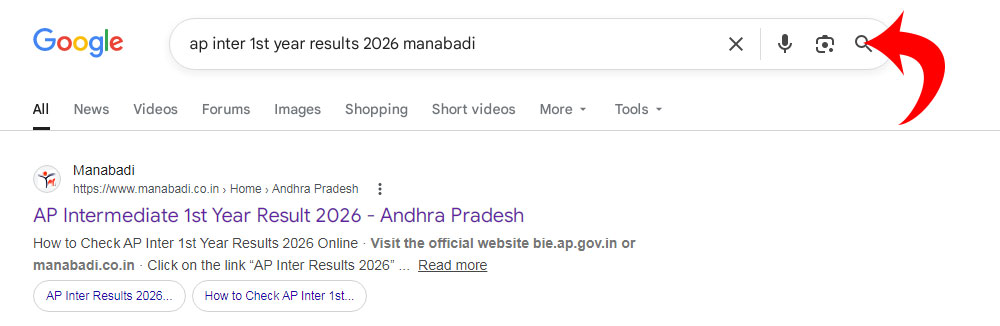
1 Search AP Inter 1st year Results Manabadi
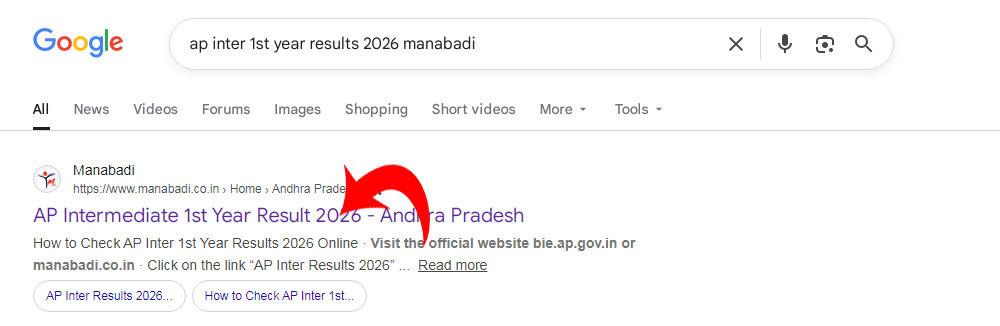
2 Visit the Official Website: Navigate to the MANABADI official results portal: manabadi.co.in
3 Locate the Results Link: On the homepage, find and click on the link labeled ‘Inter Result 2026’.
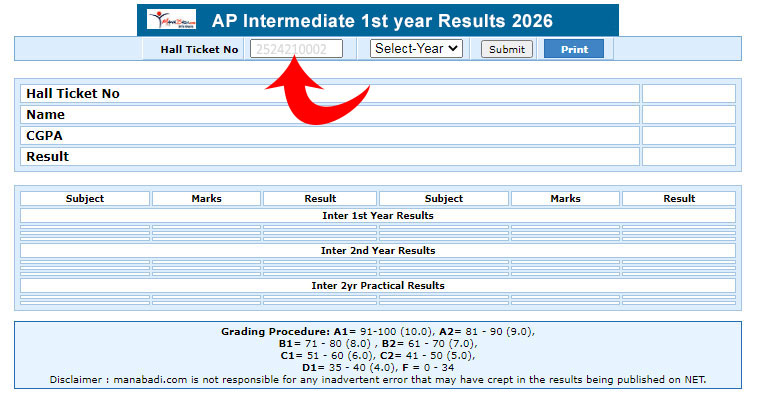
4 Enter Your Details: Input your Hall Ticket Number and Date of Birth in the designated fields.
5 Enter submit: Output then show data.
6 Download and Print: It’s advisable to download and print a copy of your results for future reference.
How to Download AP Inter 1st Year Results 2026
Follow these simple steps to download your AP Inter 1st & 2nd Year Results 2026:
Visit the official website manabadi.co.in
Click on the link “AP Inter Results 2026”
Select 1st Year 2026
Enter your Hall Ticket Number / Roll Number
Enter Date of Birth
Click on Submit
Your result will appear on the screen
Download and take a printout for future reference
Key Highlights of AP Inter 1st Year Results 2026:
Result Date:First week of April 2026
Results data entry status: 100% Completed
Results final verification Status: 100% Completed
Valuation Status: Results ready for declaration
Total Students Appeared: Over 10 lakh students across both years
Website to Check Results: manabadi.co.in
Andhra Pradesh 1st Year Intermediate Name Wise Result 2026
Students must have their roll number to know the Andhra Pradesh 1st Year Intermediate Exam Result 2026. It is possible to check the exam result by name. Because the board does not provide such a facility, students can check their exam result by name.
AP Inter 1st Year Result 2026, Check Manabadi
To download the marks memo, candidates need to enter their roll number and date of birth in the result login window. The AP Inter 11th Result marks memo will have the necessary details mentioned on it such as name, roll number, grade, and others. Last year, a total of 4,99,756 students appeared for AP Inter 1st year exam including 4,61,273 students for General and 38,483 for Vocational exams.
AP Intermediate Results 2026: Important Dates
AP Inter board table provided, you will find the key dates and corresponding events related to the Manabadi AP Intermediate 1st and 2nd Year Result 2026. Students are encouraged to review the table for important details.
AP Inter 1st year exam 2026
23-02-2026 to 24-03-2026
AP inter 1st year results 2026
Last week of April 2026
AP inter results for re-verification Fee Payment Date
May 2026
AP Intermediate 1st Year Supplementary Exam Date
May to June 2026
Recounting (RC) and Reverification (RV)
All efforts have been made for correct valuation of answer book in all aspects. However, there is a provision for 1st and 2nd Year Candidates to apply for Recounting (RC) and Supply of Scanned Copy cum Re-verification (RV) of valued answer scripts. The dates for applying for RC and RV are from
Supplementary Examinations
IPASE May 2026 Theory Examinations will be held from -in two sessions (09:00AM to 12:00 PM) & (02:30 PM to 05:30 PM).
Students can appear for failed Subjects and also for improvement of marks.
IPASE Practical Examinations will be conducted from — at District Headquarters only.
The Last date for payment of Examination fee for IPASE 2026 at college level are from
Details Mentioned in AP Inter 1st Year Result 2026
Candidate name
Class
Hall ticket number
Marks obtained
Practical marks
Total marks
Qualifying status
Overall qualifying status
Grade/ percentage secured
AP Inter 1st Year Results 2026 Manabadi: Grading System
Students must know about the Inter marking scheme for class 11 to self-evaluate their exam and be aware of their evaluation by the conducting body:
Percentage of marks
Grades
Above 75%
A
60% to 75%
B
50% to 60%
C
35% to 50%
D
Revised Marks Distribution
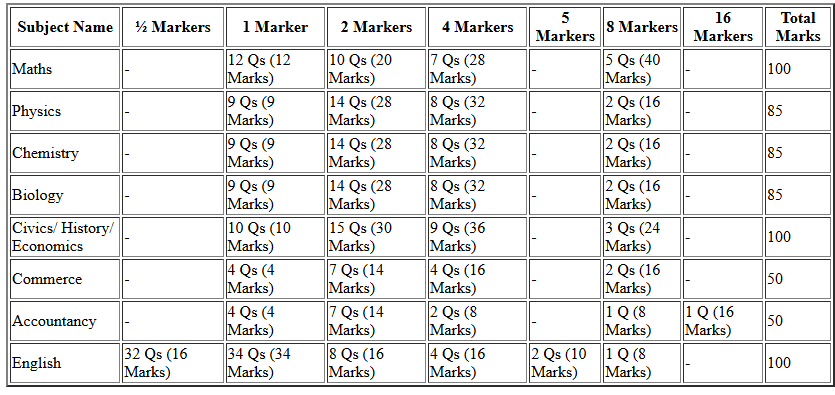
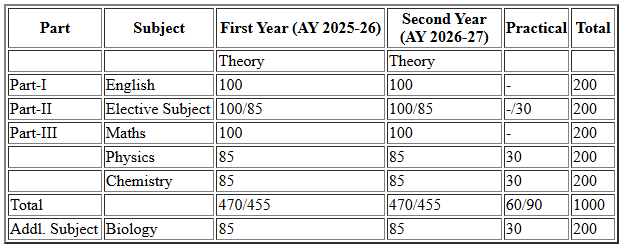
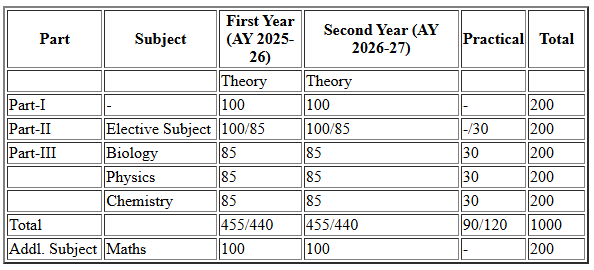
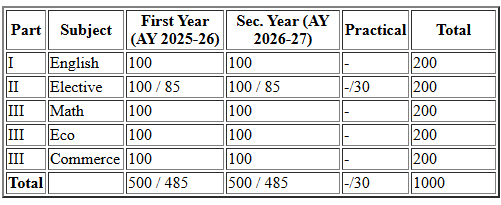
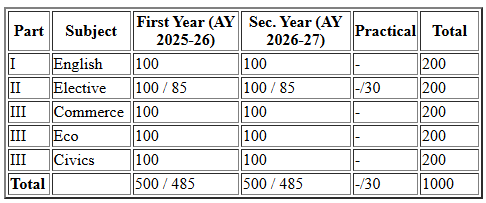
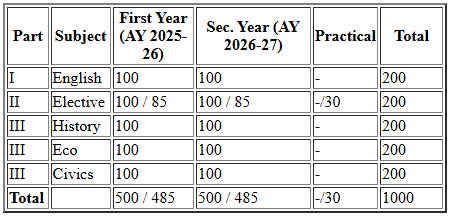
Most subjects now follow a balanced split: theory papers generally carry 85–100 marks per subject, with practicals/internal assessment contributing an additional 15–30 marks depending on the stream (BiPC, MPC, etc.).
For Biology, Botany and Zoology are split: Botany – 43 marks; Zoology – 42 marks. Practicals in science subjects have a separate weightage.
Internal assessment weightage is now 20 marks per subject, focusing on continuous evaluation.
Total score for each stream (MPC, BiPC, CEC, MEC, HEC) is either 500 or 485 marks in 1st year, with the remainder in 2nd year; practical marks are added separately where applicable.
Changed Question Paper Design
The blueprint introduces more application-based, analytical, and higher-order thinking (HOT) questions, reducing emphasis on rote memorization.
Objective-type questions (MCQs, fill in the blanks, true/false) are included for conceptual clarity, with specific weightage per section.
Descriptive questions (short and long answers) are retained for in-depth understanding.
One-mark questions will be present across all subjects to directly test conceptual knowledge.
AP Inter 1st Year Exams 2026 Changes in the Question Paper Design
Revised Distribution of Marks among Subjects
Comb.1 – M.P.C
Comb.2 – Bi.P.C
Comb.3 – M.E.C
Comb.4 – C.E.C
Comb.5 – H.E.C
The AP Intermediate Public Examination (IPE) 2026 for 1st year students has been released on 12th April, 2026 from 11 AM onwards. Students can check their results online at www.manabadi.co.in. Additionally, results will be send to whatsapp. Please fill this form. Results will be sent to your Mobile once released.
AP Inter 1st year Result 2026 : The Board of Intermediate Education, Andhra Pradesh (BIEAP) has been released 1st year results on April 12, 2026. Students who appeared in intermediate exams can check their results and download marks memo on the official websites: bie.ap.gov.in & manabadi.co.in using login credentials: hall ticket number and date of birth.
The Andhra Pradesh Inter result 2026 has been released. Students have to collect the AP Inter mark sheet from their schools. Has announced AP Intermediate results 2026 date and Time on this page. Students have to keep the AP Inter admit card handy to check the bieap result 2026. Around 9 lakh students appear for AP Intermediate exams every year. AP Inter results dates 2026 has released online.
How the AP Inter results are important?
The results of the Andhra Pradesh Intermediate Examination, commonly known as AP Inter results, hold great importance for students in Andhra Pradesh, India. These results, released by the Board of Intermediate Education, Andhra Pradesh (BIEAP), relate to exams taken by 1st and 2nd-year intermediate students—equivalent to 11th and 12th grades. Here’s why these results matter so much:
Academic Advancement: The AP Inter results are crucial for students seeking to further their education. For those in their 1st year, passing these exams is essential to progress to the 2nd year.
Career Prospects: Scores achieved in the 1st & 2nd-year exams often play a significant role in eligibility for competitive entrance exams, such as JEE for engineering and NEET for medical studies, as well as various state-level entrance tests. Strong performances can lead to opportunities at prestigious institutions and diverse career paths.
Scholarship Chances: Students who excel in these exams may qualify for scholarships or financial aid from either governmental or private organizations, making their intermediate results even more significant.
Pride and Aspirations: For many families, succeeding in these exams is a source of pride and represents a step towards improving their socio-economic standing, especially within a highly competitive educational environment.
Vocational Opportunities: Students pursuing vocational courses alongside their intermediate studies will find that their results can impact certification and job prospects in areas like agriculture, technical fields, or commerce.
Usually, the AP Inter results are announced around April or May each year. As of today, May 30, 2026, students are eagerly awaiting the results for 2026. These outcomes will significantly influence their academic and professional journeys, making this a crucial moment for them.
What to do with Inter results printout?
Once you receive your AP Inter results printout, it can be quite useful in various ways. Here’s what you can do with it:
Temporary Record: Keep the printout handy as it serves as evidence of your performance until you get the official marksheet or certificate from the Board of Intermediate Education, Andhra Pradesh (BIEAP). Make sure to store it safely for easy reference.
College Applications: This printout can come in handy when applying for undergraduate programs. Many institutions accept it during the initial application stage, although they might subsequently request the official marksheet.
Competitive Exams: Planning to take exams like JEE, NEET, or other state-level tests? You can use this printout to include your intermediate marks when registering. Some exam websites may ask you to upload a scanned copy too.
Scholarship Applications: When applying for scholarships or financial aid, submit the printout as proof of your academic achievements. Just check the specific requirements, as some may ask for additional documents.
Digital Backup: It’s a good idea to scan and save a digital version of the printout on your phone, computer, or cloud storage. This way, you have a backup if anything happens to the physical copy.
Just a reminder: The printout isn’t a permanent replacement for the official marksheet or passing certificate issued by BIEAP. Once those are received, they take priority for official matters. Until then, consider the printout a handy temporary resource!
The AP Inter 2nd Year Results 2026 are expected to be officially announced in the Last week of April 2026. Students who appeared for the AP Intermediate 2nd Year Public Examinations (IPE) March 2026 can check AP Inter 2nd Year Results online at manabadi.co.in. To access the result, candidates need to enter their Hall Ticket Number and Date of Birth. The results will be released for all streams, including MPC, BiPC, MEC, CEC, HEC, and Vocational courses, and are crucial for admission into UG, Degree Courses, professional programs, and competitive exams such as EAMCET 2026, NEET 2026, JEE 2026, and CA Foundation.
Students can also download AP Inter 2nd Year Marks Memo 2026 directly from manabadi.co.in, which provides a fast and reliable platform for checking AP Intermediate SecondYear Results 2026 online. The official website ensures that students can view and save their marks memo conveniently. Additionally, BIEAP may provide result notifications through SMS and WhatsApp services, making it easier for students to stay updated with their AP Inter 2nd Year Results 2026 without any technical delays.
After the announcement of results, students who wish to improve their performance can apply for recounting, re-Verification, or Regular, Supplementary examinations. These processes allow students to enhance their AP Inter 2nd Year Scores 2026 or correct any evaluation errors. By providing these options,BIEAP ensures that all students have the opportunity to continue their academic journey smoothly, preparing for higher education admissions and Competitive Exams like EAMCET 2026, NEET 2026, & JEE 2026.
Intermediate Results Expected in Second Week of April
Note-1: The Secretary of the Board of Intermediate Education, Ranjith Basha, stated that efforts are underway to release the AP Intermediate Public Examination results in the second week of April. The main examinations concluded on Wednesday. The Secretary inspected the examination centers set up at Sarada and PB Siddhartha Junior Colleges in Vijayawada.
As the main exams have been completed, the evaluation of answer scripts will begin from the 21st of this month. Evaluation centers have been established across all district headquarters in the state. Each lecturer will be assigned 15 answer scripts in the morning and 15 in the afternoon for valuation.
What to Do After AP Inter 2nd Year? Best Courses & Career Options
1. Apply for Undergraduate Degree Courses
Students can pursue 3-Year Degree Programs based on their intermediate stream:
MPC → B.Tech, B.Sc, BCA
BiPC → MBBS, BDS, B.Sc, B.Pharmacy, Nursing
CEC/MEC → B.Com, BBA, BA
HEC → BA and other humanities courses
2. Appear for Entrance Examinations
Many professional courses require entrance exams. Students can apply for exams like JEE Main, NEET UG, AP EAMCET, or CUET depending on the course they want to pursue.
3. Choose Professional Courses
Students interested in commerce or specialized careers can opt for professional programs such as CA Foundation or CS Executive Entrance Test.
4. Join Skill-Based or Diploma Courses
Some students prefer short-term diploma or certification courses in fields like IT, digital marketing, animation, hospitality, or paramedical sciences to gain job-ready skills.
5. Prepare for Competitive Exams
Students can also begin preparing for government job exams such as banking, defence, police, or SSC while pursuing a degree.
In summary, passing AP Intermediate 2nd Year opens many opportunities in higher education, professional studies, and skill development based on the student’s interests and career goals.
Date: 11-03-2026
Board of Intermediate Education, Andhra Pradesh –IPE March 2026 Details
COMMERCE-II, SOCIOLOGY-II, FINE ARTS, MUSIC-II 2nd YEAR Exam written Students report
Sl.No.
Category
TOTAL
PRESENT
ABSENT
MALPRACTICE
PRESENT %
1
GENERAL
61206
58071
3134
1
94.88
2
VOCATIONAL
23944
21893
2051
0
91.43
TOTAL
85150
79964
5185
1
93.91
Date: 9-03-2026
Board of Intermediate Education, Andhra Pradesh –IPE March 2026 Details
MATHEMATICS-IIB 2nd YEAR Exam written Students report
Sl.No.
Category
Total
Present
Absent
Malpractice
Present %
1
GENERAL
316002
311056
4937
9
98.43
2
VOCATIONAL
23823
21861
1962
0
91.76
TOTAL
339825
332917
6899
9
97.97
Date: 6-03-2026
Board of Intermediate Education, Andhra Pradesh –IPE March 2026 Details
ZOOLOGY PAPER-II, ECONOMICS-II 2nd YEAR Exam written Students report
Sl. No.
Category
Total
Present
Absent
Malpractice
Present %
1
GENERAL
158571
153005
5564
2
96.49
2
VOCATIONAL
38202
36409
1793
0
95.31
TOTAL
196773
189414
7357
2
96.26
Date: 4-03-2026
Board of Intermediate Education, Andhra Pradesh –IPE March 2026 Details
MATHEMATICS PAPER-IIA, CIVICS PAPER-II 2nd YEAR Exam written Students report
Sl.No.
Category
Total
Present
Absent
Malpractice
Present %
1
GENERAL
378836
371243
7589
4
98.00
2
VOCATIONAL
38495
36702
1793
0
95.34
TOTAL
417331
407945
9382
4
97.75
Date: 28-02-2026
Board of Intermediate Education, Andhra Pradesh –IPE March 2026 Details
BOTANY-II, HISTORY-II | 2nd YEAR Exam written Students report
Sl.No.
Category
TOTAL
PRESENT
ABSENT
MALPRACTICE
PRESENT %
1
GENERAL
97783
95355
2426
2
97.52
2
VOCATIONAL
38489
36749
1740
0
95.48
TOTAL
136272
132104
4166
2
96.94
Date: 26-02-2026
Board of Intermediate Education, Andhra Pradesh –IPE March 2026 Details AP Inter 2nd Year English Paper-II Exam written Students report
Category
Registered
Present
Absent
Malpractice Cases
Attendance %
General
460328
452075
8253
2
98.21%
Vocational
37844
36209
1635
0
95.68%
Total
498172
488284
9888
2
98.02%
Date: 24-02-2026
Board of Intermediate Education, Andhra Pradesh –IPE March 2026 Details AP Inter 2nd Year 2nd Language Paper-II Exam written Students report
Category
Registered
Appeared
Absent
Attendance %
General
461,617
453,250
8,367
98.19%
Vocational
37,875
36,208
1,667
95.60%
Total
499,492
489,458
10,034
97.99%
Key Highlights of AP Inter 2nd Year Results 2026:
Result Date:first week of April 2026
Results data entry status: 100% Completed
Results final verification Status: 100% Completed
Valuation Status: Results ready for declaration
Total Students Appeared: Over 10 lakh students across both years
Website to Check Results: manabadi.co.in
AP Inter 2nd Year Results 2026: Overview
Students who appear for the AP Intermediate 2nd year board exams can check the important details mentioned in the table below:
Particulars
Details
Board name
Board of Intermediate Education Andhra Pradesh (BIEAP)
Inter Exam Date
2nd Year: 24th February to 23rd March, 2026
Class
Intermediate Class 12th
Login details required to check the result
Roll number and Date of Birth
Official website
bie.ap.gov.in
Steps to Download AP Inter 2nd Year Results 2026
The Andhra Pradesh Board of Intermediate Education (BIEAP) is expected to release the AP Intermediate (Inter) Results 2026 for both 1st and 2nd-year students in April 2026. To access your results online, please follow these steps:
1 Search AP Inter 2nd year Results Manabadi
2 Visit the Official Website: Navigate to the MANABADI official results portal: manabadi.co.in
3 Locate the Results Link: On the homepage, find and click on the link labeled ‘Inter Result 2026’.
4 Enter Your Details: Input your Hall Ticket Number and Date of Birth in the designated fields.
5 Enter submit: Output then show data.
6 Download and Print: It’s advisable to download and print a copy of your results for future reference.
Andhra Pradesh 2nd Year Intermediate Name Wise Result 2026
Students must have their roll number to know the Andhra Pradesh 2nd Year Intermediate Exam Result 2026. It is possible to check the exam result by name. Because the board does not provide such a facility, students can check their exam result by name.
AP Inter 2nd Year Results 2026 Manabadi
The Andhra Pradesh second year Intermediate mark sheet will consist of details such as the students name and hall ticket number, marks scored in each subject, total marks obtained, result status, and grades. Once released, any discrepancies in the marks memo should be brought to the notice of the officials through the Principals within one month from the date of the result declaration. Any representations from candidates after one month of result declaration will not be entertained.
Students need to score at least 35% marks to clear the BIEAP 2nd year exam. Students who fail to secure the minimum passing marks can appear for the supplementary examination.
AP Intermediate Results 2026: Important Dates
AP Inter board table provided, you will find the key dates and corresponding events related to the Manabadi AP Intermediate 1st & 2nd Year Result 2026. Students are encouraged to review the table for important details.
AP Inter 2nd year exam 2026
February 23 – March 23, 2026
AP inter 2nd year results
last week of April 2026
AP inter results for re-verification Fee Payment Date
May 2026
AP Intermediate 2nd Year Supplementary Exam Date
May to June 2026
How to Check AP Inter 2nd Year Results 2026 Online
Follow these simple steps to download your AP Inter results:
Visit the website – manabadi.co.in
Click on the link “AP Inter 2nd Year Results 2026”
Enter your Hall Ticket Number / Roll Number
Enter your Date of Birth
Click on Submit
View and download your AP Intermediate Result 2026
Recounting (RC) and Reverification (RV)
All efforts have been made for correct valuation of answer book in all aspects. However, there is a provision for 1st and 2nd Year Candidates to apply for Recounting (RC) and Supply of Scanned Copy cum Re-verification (RV) of valued answer scripts. The dates for applying for RC and RV are from
Supplementary Examinations
IPASE May 2026 Theory Examinations will be held from — in two sessions (09:00AM to 12:00 PM) & (02:30 PM to 05:30 PM).
Students can appear for failed Subjects and also for improvement of marks.
IPASE Practical Examinations will be conducted from — at District Headquarters only.
The Last date for payment of Examination fee for IPASE 2026 at college level are from
AP Inter Results 2026: Details Mentioned
The AP Inter Results 2026 will comprise the following details-
Students Name
Hall Ticket number
Result/grade obtained
Marks obtained in each subject
Qualifying status
Grand Total
AP Intermediate Result 2026 via SMS
In case the official website is overwhelmed by traffic and students are unable to view their AP inter results for 2026, they can check via SMS. The Andhra Pradesh Board will send the AP intermediate results for 2026 directly to students mobile numbers if they SMS the board using this format:
SMS Format – APGEN<space>REGISTRATION NO
Send it to 56263
The AP inter result 2026 will be sent on the same number.
Impact of New AP Inter Reforms on 2026 Exam Timetable | AP Intermediate Updates
The Andhra Pradesh Intermediate Board’s recent changes to the examination pattern and evaluation system are expected to influence the structure and planning of the AP Inter 2026 timetable. With the implementation of NCERT syllabus in the first year and the introduction of one-mark questions for the first time, the board has significantly increased the number of questions and broadened the scope of each paper. These academic shifts will naturally reflect in the scheduling of examinations for 2026.
One major factor affecting the timetable is the introduction of 32-page answer booklets for key subjects such as Mathematics, Physics, Chemistry, Economics, History, Political Science, and Commerce. Longer booklets typically correspond to more descriptive answers and extended writing periods, pushing the board to create sufficient gaps between high-weightage subjects to prevent student fatigue. Likewise, Biology, which now requires separate Botany and Zoology booklets, may necessitate additional time allocation or thoughtful spacing of exam dates to ensure students can manage the dual-structured format comfortably.
The change in pass criteria—where students need only 30% in some subjects as long as the overall total meets the 35% requirement—may reduce academic pressure, but it does not lessen the board’s responsibility to frame a well-balanced exam calendar. Reduced pass thresholds could lead to improved student confidence, encouraging the board to cluster certain related subjects more closely without compromising preparation time.
Subjects like Geography, still conducted for 75 marks but evaluated for 85, also require appropriate scheduling. With varying exam durations and question formats, the AP Inter Board is expected to design the 2026 timetable to ensure fair preparation intervals, logical sequencing of subjects, and adequate rest days. Overall, the 2026 timetable will likely reflect a more student-friendly approach, aligning with the revised NCERT-based patterns and the new flexible evaluation system.
Revised Marks Distribution
Most subjects now follow a balanced split: theory papers generally carry 85–100 marks per subject, with practicals/internal assessment contributing an additional 15–30 marks depending on the stream (BiPC, MPC, etc.).
For Biology, Botany and Zoology are split: Botany – 43 marks; Zoology – 42 marks. Practicals in science subjects have a separate weightage.
Internal assessment weightage is now 20 marks per subject, focusing on continuous evaluation.
Total score for each stream (MPC, BiPC, CEC, MEC, HEC) is either 500 or 485 marks in 1st year, with the remainder in 2nd year; practical marks are added separately where applicable.
Changed Question Paper Design
The blueprint introduces more application-based, analytical, and higher-order thinking (HOT) questions, reducing emphasis on rote memorization.
Objective-type questions (MCQs, fill in the blanks, true/false) are included for conceptual clarity, with specific weightage per section.
Descriptive questions (short and long answers) are retained for in-depth understanding.
One-mark questions will be present across all subjects to directly test conceptual knowledge.
AP Inter 1st Year Exams 2026 Changes in the Question Paper Design
Revised Distribution of Marks among Subjects
Comb.1 – M.P.C
Comb.2 – Bi.P.C
Comb.3 – M.E.C
Comb.4 – C.E.C
Comb.5 – H.E.C
AP Inter 2nd Year Results 2026 Direct Link: The Board of Intermediate Education, Andhra Pradesh (BIEAP) announced the AP Intermediate Public Examination (IPE) results on April 12. Students who appeared for the AP Inter 2nd Year exams can check their results on the official website – bie.ap.gov.in.
The results for the AP Intermediate Public Examination (IPE) 2026 for 1st and 2nd-year students will be available on 12th April, 2026 from 11 AM onwards. Students can check their results online at www.manabadi.co.in. Additionally, results will be send to whatsapp. Please fill this form. Results will be sent to your Mobile once released.
AP Inter 2nd year Result 2026 Live Updates: The Board of Intermediate Education, Andhra Pradesh (BIEAP) has been released 1st, 2nd year results on April 12, 2026. Students who appeared in intermediate exams can check their results and download marks memo on the official websites: bie.ap.gov.in & manabadi.co.in using login credentials: hall ticket number and date of birth.
Andhra Pradesh Inter Results 2026: The board has conducted the AP Inter 2nd year exams from 23 February to 24 March 2026. Students who have appeared for the AP Intermediate 2nd year exam will be able to check their board result through the link available on the official website bie.ap.gov.in & manabadi.co.in.
How the AP Inter results are important?
The results of the Andhra Pradesh Intermediate Examination, commonly known as AP Inter results, hold great importance for students in Andhra Pradesh, India. These results, released by the Board of Intermediate Education, Andhra Pradesh (BIEAP), relate to exams taken by 1st and 2nd-year intermediate students—equivalent to 11th and 12th grades. Here’s why these results matter so much:
Academic Advancement: The AP Inter results are crucial for students seeking to further their education. For those in their 1st year, passing these exams is essential to progress to the 2nd year.
Career Prospects: Scores achieved in the 1st & 2nd-year exams often play a significant role in eligibility for competitive entrance exams, such as JEE for engineering and NEET for medical studies, as well as various state-level entrance tests. Strong performances can lead to opportunities at prestigious institutions and diverse career paths.
Scholarship Chances: Students who excel in these exams may qualify for scholarships or financial aid from either governmental or private organizations, making their intermediate results even more significant.
Pride and Aspirations: For many families, succeeding in these exams is a source of pride and represents a step towards improving their socio-economic standing, especially within a highly competitive educational environment.
Vocational Opportunities: Students pursuing vocational courses alongside their intermediate studies will find that their results can impact certification and job prospects in areas like agriculture, technical fields, or commerce.
Usually, the AP Inter results are announced around April or May each year. As of today, May 30, 2026, students are eagerly awaiting the results for 2026. These outcomes will significantly influence their academic and professional journeys, making this a crucial moment for them.
What to do with Inter results printout?
Once you receive your AP Inter results printout, it can be quite useful in various ways. Here’s what you can do with it:
Temporary Record: Keep the printout handy as it serves as evidence of your performance until you get the official marksheet or certificate from the Board of Intermediate Education, Andhra Pradesh (BIEAP). Make sure to store it safely for easy reference.
College Applications: This printout can come in handy when applying for undergraduate programs. Many institutions accept it during the initial application stage, although they might subsequently request the official marksheet.
Competitive Exams: Planning to take exams like JEE, NEET, or other state-level tests? You can use this printout to include your intermediate marks when registering. Some exam websites may ask you to upload a scanned copy too.
Scholarship Applications: When applying for scholarships or financial aid, submit the printout as proof of your academic achievements. Just check the specific requirements, as some may ask for additional documents.
Digital Backup: It’s a good idea to scan and save a digital version of the printout on your phone, computer, or cloud storage. This way, you have a backup if anything happens to the physical copy.
Just a reminder: The printout isn’t a permanent replacement for the official marksheet or passing certificate issued by BIEAP. Once those are received, they take priority for official matters. Until then, consider the printout a handy temporary resource!
The AP Inter Results 2026 are among the most anticipated academic announcements for students across Andhra Pradesh. Students who appeared for the AP Intermediate Public Examinations 2026 will soon be able to check their results online once they are officially released. Both AP Inter 1st Year Results 2026 and AP Inter 2nd Year Results 2026 will be announced by the Board of Intermediate Education Andhra Pradesh on its official website bie.ap.gov.in, along with popular education portals such as Manabadi.
Students can easily access their AP Intermediate 1st & 2nd Year Results 2026 by entering their Hall Ticket Number on the online result portals. According to previous year trends, the AP Inter Results 2026 Manabadi link is likely to be activated during the last week of April 2026, although the board has not yet confirmed the exact release date. Once the results are declared, candidates will be able to view their subject-wise marks and also download their AP Inter 2026 Marks Memo Download for future use.
Every year, nearly 9 Lakh Students appear for the AP Intermediate Examinations, making the result announcement a major milestone in the academic calendar. These results play an important role in determining students’ future education paths, including admissions into Engineering, Medical, UG, Degree, and other professional courses.
Therefore, students are advised to keep their Hall ticket Numbers ready and regularly check the official website and trusted education portals like Manabadi.co.in to stay updated with the latest information regarding AP Intermediate Results 2026.
Intermediate Results Expected in Second Week of April
Note-1: The Secretary of the Board of Intermediate Education, Ranjith Basha, stated that efforts are underway to release the AP Intermediate Public Examination results in the second week of April. The main examinations concluded on Wednesday. The Secretary inspected the examination centers set up at Sarada and PB Siddhartha Junior Colleges in Vijayawada.
As the main exams have been completed, the evaluation of answer scripts will begin from the 21st of this month. Evaluation centers have been established across all district headquarters in the state. Each lecturer will be assigned 15 answer scripts in the morning and 15 in the afternoon for valuation.
AP Intermediate Results 2026 – Overview
The Andhra Pradesh Intermediate Public Examinations (IPE) are conducted annually for students studying in General (MPC, BiPC, CEC, HEC, MEC) and Vocational streams. These exams play a crucial role in shaping students’ higher education opportunities, including admissions into degree courses, professional colleges, and competitive exams.
AP Inter Results 2026 – Key Highlights
Particulars
Details
Exam Name
AP Intermediate Public Examination (IPE) 2026
Board
Board of Intermediate Education Andhra Pradesh
Classes
1st Year & 2nd Year
Streams
General & Vocational
Exam Dates
February 23 to March 24, 2026
Result Mode
Online
Expected Result Date
Last week of April 2026
Official Websites
bie.ap.gov.in, manabadi.co.in
Credentials Required
Hall Ticket Number
AP Inter Results 2026 Date & Time
As per previous years’ trends, the AP Inter 1st Year & 2nd Year Results 2026 are expected to be announced in 1st week of April 2026. The Board will release the results through a press conference, where details such as pass percentage, district-wise performance, and gender-wise statistics will be shared.
After the official announcement, the result links will be activated immediately on Manabadi.co.in, allowing students to check their marks without server issues.
How to Download AP Inter First & Second Year Results 2026 from Manabadi
Follow the step-by-step instructions below to download your result easily:
Visit the official website manabadi.co.in
Click on the link “AP Inter Results 2026”
Select 1st Year or 2nd Year result link
Enter your Hall Ticket Number
Click on Submit / Get Results
Your AP Intermediate Marks Memo 2026 will appear on the screen
Download and take a printout for future use
Details Mentioned on AP Inter Marks Memo 2026
Students should carefully verify the information printed on their online marks memo:
Student Name
Hall Ticket Number
College Name & Code
Subject-wise Marks
Total Marks
Grade / Result Status
Pass / Fail Status
In case of any discrepancy, students must immediately contact their respective colleges or the Board authorities.
AP Inter Grading System 2026
The Board follows a grading system along with marks to evaluate student performance.
Marks Range
Grade
Grade Points
91 – 100
A1
10
81 – 90
A2
9
71 – 80
B1
8
61 – 70
B2
7
51 – 60
C1
6
41 – 50
C2
5
35 – 40
D
4
Below 35
F
Fail
AP Inter Revaluation & Recounting 2026
If students are not satisfied with their marks, they can apply for:
Recounting Re-verification Photocopy of Answer Script
Expected Revaluation Window: April 2026 Revaluation Results Expected: May 2026
Recounting fee and reverification fee will be notified by BIEAP.
AP Inter Supplementary Exams 2026
Students who fail in one or two subjects can appear for supplementary exams.
Expected Supplementary Exam Date: May 2026 Expected Supplementary Result Date: June/July 2026
This gives students a second chance without losing an academic year.
The Telangana SSC Results 2026 are expected to be released in April 2026 by the Directorate of Government Examinations (DGE), Telangana. Nearly 5 Lakh students appeared for the TS SSC Exams 2026 conducted from March 14 to April 16, 2026. As per previous trends, the TS 10th Class Results 2026 Date is likely around April 30, 2026. Students searching for TS SSC Results 2026 Manabadi, BSE Telangana SSC Results 2026, or TS SSC Results 2026 Link can check their results online through official websites and popular portals like manabadi.co.in.
To check the TG SSC 10th Class Results 2026, Students need to enter their TS SSC Hall Ticket Number 2026 in the result login window. The TS SSC Results 2026 with Marks Memo will display subject-wise marks, grades, and overall performance. Students can also access TS SSC Results 2026 Name Wise, TS 10th Results 2026 School Wise, and download their provisional marksheet online. For convenience, students often search for TS SSC 2026 Results Pdf Download Marks Memo and Telangana SSC 2026 Results Direct Link to quickly access their results.
Students must secure a minimum of 35% marks in each subject to pass the examination. Each subject carries 100 marks, including 80 marks for theory and 20 marks for formative assessment. Along with the result, the board will release the TS SSC Toppers List 2026, TS SSC Pass Percentage 2026, and district-wise performance data. Students are advised to regularly check updates on TS SSC Results 2026 Official Website, Manabadi TS SSC Results 2026, and other trusted education portals for the latest announcements.
Telangana 10th Results 2026 Date
The Board of School Education, Telangana (BSE) will declare the Telangana Class 10th results in online mode. Students need to enter their login details at the designated places to check their results. The board officials will release the Telangana 10th results declaration date on its website – manabadi.co.in before announcing the results.
TG SSC Result 2026 Highlights
Exam Name
Telangana State Secondary School Certificate (SSC) Exam
Conducting Authority
Board of Secondary Education, Telangana
Exam Dates
March 14 to April 16 2026
Result Date
April 2026
Official Website
bse.telangana.gov.in
Mode of Result
Online
Credentials Required
10th Class Hall Ticket Number
Estimated Candidates
5 Lakh
In order to check the result for TG SSC (10th Class) exams 2026, students will have to enter their exam year, subjects, and hall ticket number, in the result login window. Last year, the overall pass percentage for TG SSC exams were recorded at 91.31%. While 89.42% of boys and 93.23% of girls passed the class 10 exams.
Steps to Check TS SSC Results 2026 at manabadi.co.in
Click on TS SSC Results 2026 link on the homepage.
Enter your Hall Ticket Number in the given field.
Click on Submit / Get Result.
Your Telangana 10th Result 2026 will appear on the screen.
Download or take a printout for future use.
Important Tip: Students are advised to save a soft copy of the online marks memo until the original marks memo is provided by their school.
Key Dates for TG SSC Result 2026
TG 10th Board Exams: March 21st – April 4th 2026
Result Declaration: April 30th, 2026
Revaluation/Rechecking Result: June 2026
Supplementary Exam: June 2026
Supplementary Result: July 2026
Details Mentioned on TS SSC Results 2026 Marks Memo
Once you download the marks memo, verify the following details carefully:
Student Name
Roll Number / Hall Ticket Number
Father’s and Mother’s Name
School Name and School Code
Subject-wise Marks (Internal + External)
Total Marks Obtained
Grade and Grade Points
Result Status (Pass / Fail)
Division / Overall Grade
TS SSC Results 2026: Revaluation & Recounting
If a student is not satisfied with their marks, they can apply for:
Recounting of Marks
Revaluation of Answer Sheets
Photocopy of Answer Script
Application process will be available on bse.telangana.gov.in after the result announcement.
TS SSC Supplementary Exams 2026
Students who fail to clear one or more subjects can appear for the Supplementary Exams, usually conducted in June/July. This gives students another chance to improve their academic record without losing a year.
The AP SSC Results 2026 are expected to be released in the last week of April 2026 by the Board of Secondary Education, Andhra Pradesh (BSEAP). Students who appeared for the SSC Public Examinations can check their AP 10th Class Results 2026 online by entering their hall ticket number. Once officially announced, the result link for results.bse.ap.gov.in 10th results 2026 will be activated on the official website. Apart from the official portal, students also widely use trusted educational websites like manabadi.co.in to access the AP 10th CLass 2026 Results Manabadi link quickly, especially during the peak result announcement time when official websites experience heavy traffic.
Exam PostPoned: The Andhra Pradesh government has postponed the Class 10 English examination due to the Ramjan festival. Initially, the holiday was declared on the 20th, and the exam was scheduled for the 21st. However, based on the moon sighting, the festival date shifted to Saturday, prompting authorities to revise the exam schedule. Following this change, the School Education Department issued orders late at night to postpone the English exam. The exam will now be conducted on April 2. Officials clarified that all other examinations will continue as per the original timetable without any disruption. The decision was taken to ensure students can observe the festival without affecting their academic schedule.
The BSEAP SSC Results 2026 will display detailed information such as subject-wise marks, total marks, grade points, and the overall qualifying status of the student. The AP SSC examinations 2026 were conducted from March 16 to April 1, 2026, with more than 6.3 lakh ltudents appearing for the exams across Andhra Pradesh. After the results are announced, students can also complete the AP Class 10th Marks Memo 2026 Pdf Download from the official portal. The marks memo will contain detailed marks information that students can use for further academic admissions and verification purposes.
Students will be able to check their AP 10th Class Results 2026 through multiple platforms such as the official BSEAP website, SMS services, DigiLocker, and other digital platforms. Many students prefer checking the Manabadi AP SSC Results 2026 because it provides a faster and simplified result interface. To view their results, students must enter their hall ticket number on the results.bse.ap.gov.in 10th results 2026 page. The online result will be considered provisional, and students must collect their original marksheet from their respective schools after the official declaration of the AP Board SSC Results 2026.
The release of the AP SSC Results 2026 marks an important academic milestone for students completing their secondary education in Andhra Pradesh. After checking the BSEAP SSC 2026 Results, students gain clarity about their academic performance and can make informed decisions regarding their future education. Based on their marks and interests, students can choose various Intermediate streams such as MPC (Mathematics, Physics, Chemistry), BiPC (Biology, Physics, Chemistry), MEC (Mathematics, Economics, Commerce), or CEC (Civics, Economics, Commerce), HEC
Benefits of AP SSC Results 2026 for Students
Helps in Career Planning: Students can decide their future academic stream based on their performance in the AP 10th Results 2026.
Eligibility for Intermediate Admissions: The AP SSC Marks Memo 2026 Download is required for admission into junior colleges across Andhra Pradesh.
Opportunities for Polytechnic Courses: Students interested in technical education can apply for polytechnic diploma courses after SSC.
Access to Scholarships and Government Schemes: Many scholarships and educational schemes require the AP Board SSC Results 2026 marks memo for eligibility.
Academic Performance Evaluation: The results help students understand their strengths and areas for improvement for higher studies.
Overall, the AP SSC Results 2026 not only reflect students’ performance in the AP 10th Class Public Examinations but also open the gateway to higher education opportunities and career paths for lakhs of students across the state.
AP SSC (10th Class) Result 2026 Name Wise
The Andhra Pradesh Board of Secondary Education (BSEAP) will be announced on April 23rd. This result will mark a crucial milestone for lakhs of students who have appeared for the 10th Class board examinations across the state. The results can be accessed through various methods including name-wise, roll number-wise, and school-wise searches.
For students who have misplaced or forgotten their hall ticket number, the AP SSC Result 2026 Name Wise search is a helpful feature. Several third-party website – manabadi.co.in offer the facility to check results using the candidate’s name. This method is especially useful for parents or relatives looking to access results without having all the roll number details.
Andhra Pradesh Board officials will release the AP SSC Results in a press conference. Once released, students can download their marks memo at bse.ap.gov.in and manabadi.co.in. Students will have to enter their roll number in the login window to get their marks memo.
Andhra Pradesh 10th Result 2026
Students are required to score at least 35% marks in each subject to qualify for the AP SSC exam 2026. Those who fail to score the minimum passing marks in the Andhra Pradesh Class 10th exam will be considered as failed.
AP 10th Results 2026: Highlights:
AP board officials will be announcing the AP SSC examination will be conducted in March 2026. Candidates can check the details of the board exam here.
Exam name
Andhra Pradesh Intermediate School Certificate Examination 2026
Board
Board of Intermediate Education, Andhra Pradesh
Result Name
AP 10th class results 2026 Manabadi
Official website
bse.ap.gov.in
AP SSC Results 2026 Date
April 2026
Credentials for AP 10th results
Roll number
Steps to Check AP SSC Results 2026 at manabadi.co.in
Follow the steps below to download your marks memo:
Visit the official Manabadi website: manabadi.co.in
On the homepage, find the link “AP SSC Results 2026”.
Click on the link, and you will be redirected to the result page.
Enter your Hall Ticket Number.
Click on “Submit”.
Your subject-wise marks and grade will appear on the screen.
Download the Provisional Marks Memo and take a printout for future use.
Details Mentioned in AP SSC Results 2026 Marks Memo
After downloading the result, students will find the following information:
Student Name
Hall Ticket Number
School Name & Code
Subject-wise Marks / Grades
Total Marks & Grade
Division (Pass / Fail)
Internal Assessment Marks
Result Status
Board Seal & Authentication (Digital)
If any detail is incorrect, students must report to their school headmaster for correction.
AP SSC Revaluation / Recounting 2026
If a student feels that their marks are not correctly evaluated, they can apply for:
Re-totaling (Recounting)
Re-verification / Revaluation of Answer Sheets
How to Apply
Visit bse.ap.gov.in
Fill online application
Pay the required fee per subject
Submit scanned documents if needed
Application Fee (Expected)
Recounting Fee: Rs.500 per subject
Re-verification Fee: Rs.1,000 per subject
AP SSC Supplementary Exams 2026
Students who fail in one or more subjects can appear in the supplementary exams, usually conducted in June / July 2026.
Supplementary Exam Tips
Identify weak topics
Practice previous year question papers
Focus on textbook-based answers
Attend revision classes in school
Supplementary Results are expected to be released in August 2026.
The Telangana State Board of Technical Education and Training (TS SBTET) conducts Diploma, Polytechnic, and Pharmacy examinations every year for students studying in various government and private institutions across the state. As the academic year 2025–26 progresses, thousands of students are eagerly waiting for the TS SBTET Time Table 2026. The time table plays a crucial role in helping students plan their preparation, revise subjects, and appear confidently for the upcoming exams.
If you are searching for the TS SBTET Diploma Time Table 2026, this article provides complete information including release date, how to download, exam schedule details, branch-wise timetable, Manabadi links, and important instructions for students.
Overview: TS SBTET Time Table 2026
The TS SBTET releases the Diploma timetable for various schemes such as C18, C16, C21, and ER-91. The exams are conducted twice a year:
March/April (Summer Exams)
October/November (Winter Exams)
Highlights – TS SBTET Diploma Exam 2026
Feature
Details
Conducting Body
Telangana State Board of Technical Education & Training
Expected TS SBTET Time Table 2026 – Tentative Dates
While the official dates are yet to be announced, the expected schedule is as follows:
Summer Exams (March/April Session)
Semester
Expected Exam Month
1st Semester
April 2026
2nd Semester
March 2026
3rd Semester
April 2026
4th Semester
April 2026
5th Semester
March 2026
6th Semester
March/April 2026
Winter Exams (October/November Session)
Semester
Expected Exam Month
Odd Semesters
October–November 2026
Backlogs
October 2026
Note: Tentative dates help students plan preparation, but official timetable may vary.
TS SBTET Diploma 2026 Time Table – Courses Covered
The released TS SBTET Time Table PDF 2026 includes exam schedules for:
✔ Engineering Courses
Mechanical Engineering
Civil Engineering
Electronics & Communication Engineering
Electrical Engineering
Computer Engineering
Automobile Engineering
Mining Engineering
Instrumentation Engineering
✔ Non-engineering Courses
Commercial & Computer Practice (CCP)
Hotel Management
Garment Technology
Modern Office Practice
✔ Pharmacy Courses
ER-91 Diploma in Pharmacy (1st & 2nd Year)
✔ Other Schemes
C-18
C-21
C-23 (latest scheme)
Students from all these streams can download the timetable from Manabadi.co.in.
How to Download TS SBTET Time Table 2026 PDF from Manabadi.co.in
Follow these simple steps to download the timetable PDF:
Visit manabadi.co.in on your mobile or laptop.
Scroll to Latest Updates / Notifications.
Click on TS SBTET Diploma Time Table 2026 link.
Select your Scheme (C18/C21/C23) and Semester.
The PDF will open on the screen.
Download and save it for future reference.
Details Mentioned in TS SBTET 2026 Time Table
The released PDF includes:
Course & Scheme
Exam Type (Regular / Supply)
Semester
Subject Code & Subject Name
Exam Day & Date
Exam Timing
Practical Exam Dates
Important Instructions
Students must carefully read all details to avoid confusion during exams.
Important Instructions for TS SBTET 2026 Students
Students appearing for the Diploma exams must follow these guidelines:
✔ Bring Your Hall Ticket No student will be allowed to enter the exam hall without a TS SBTET 2026 Hall Ticket. ✔ Reach Examination Center Early Always reach 30 minutes before the exam start time. ✔ Check Exam Dates Carefully Different semesters have different schedules—check properly before attending. ✔ No Electronic Gadgets Mobile phones, smartwatches, Bluetooth devices, and calculators are prohibited. ✔ Follow OMR & Answer Sheet Instructions Fill the details correctly to avoid answer sheet cancellation. ✔ Practical Exam Attendance Is Mandatory Failing to attend practicals may result in disqualification for theory exams.
Tips to Prepare for TS SBTET Diploma Exams 2026
Here are some smart preparation strategies:
Follow the syllabus thoroughly Make sure you study according to the scheme (C18/C21).
Focus on previous year papers Most questions repeat in some form.
Revise class notes regularly Short notes help in quick revision.
Practice numerical problems Especially important for Mechanical, EEE, and Civil streams.
Manage time smartly Create a daily schedule based on the timetable.
The Andhra Pradesh State Board of Technical Education and Training (AP SBTET) conducts semester examinations every year for diploma, polytechnic, engineering, non-engineering, and short-term vocational courses. As 2026 approaches, thousands of students across Andhra Pradesh are eagerly waiting for the AP SBTET Time Table 2026 to plan their exam preparation effectively.
The time table plays a major role in helping students understand the exam dates, subject-wise schedule, exam duration, and shift timings. If you are searching for the AP SBTET Diploma Time Table 2026 PDF, this article gives you complete details along with the steps to download it from the official site and from Manabadi.co.in—one of the fastest portals for student updates.
Overview of AP SBTET Time Table 2026
Board Name
Andhra Pradesh State Board of Technical Education and Training (AP SBTET)
AP SBTET Diploma Courses Covered Under the 2026 Time Table
The timetable released by AP SBTET will cover the following programs:
Polytechnic/Diploma Engineering
Non-Engineering Courses
Pharmacy (ER91)
Hotel Management
Technical Diploma Vocational Courses
C16, C20, C23, ER91 & Other Schemes
How to Download AP SBTET Time Table 2026 PDF at Manabadi.co.in
Students prefer Manabadi because it provides fast updates and direct PDF links. Follow these simple steps:
Visit Manabadi.co.in
On the homepage, search for “AP SBTET Time Table 2026”
Click on the link for Diploma/Polytechnic Time Table
Choose your scheme (C16/C20/C23/ER91)
Click Download PDF
Save the timetable for future reference
You can also take a printout to make your study planning easier.
Details Mentioned in the AP SBTET Time Table 2026
Once you download the timetable, you will find the following details:
Polytechnic/Diploma course name
Scheme (C16/C20/C23/etc.)
Semester (1st, 3rd, 5th or 2nd, 4th, 6th)
Exam date and day
Subject codes
Subject names
Exam timings (morning/afternoon)
Practical exam dates
Instructions for students
These details help you prepare a study plan according to the paper sequence.
AP SBTET Time Table 2026 – Scheme Wise Information
1. AP SBTET C20 Time Table 2026
The majority of diploma students belong to the C20 scheme. The timetable will include exam dates for:
C20 1st Year
C20 3rd Semester
C20 5th Semester
Backlog examinations
2. AP SBTET C16 Time Table 2026
For students still appearing for C16 backlog exams, the timetable will specify:
Supplementary Exams
Bridge Course
Old scheme papers
3. AP SBTET C23 Time Table 2026
Introduced recently, C23 scheme students will get:
Regular exams
Supply exams
Lab and project schedule
4. AP SBTET ER91 Pharmacy Time Table 2026
ER91 timetable includes:
D.Pharmacy 1st & 2nd year
Theory and practical exam schedule
Instructions for Students Appearing in AP SBTET Exams 2026
Before appearing for the exams, students must follow these guidelines:
✔ Carry your hall ticket without fail ✔ Reach the exam hall 30 minutes early ✔ Use only black/blue ink ✔ Electronic gadgets are strictly prohibited ✔ Follow COVID / official safety instructions (if applicable) ✔ Check your seating arrangement beforehand
Tips to Prepare for AP SBTET Exams 2026
To score high marks in diploma exams, follow these preparation tips:
Follow the official syllabus Ensure you study the latest syllabus according to your scheme.
Practice previous year question papers This helps you understand the exam pattern and repeated questions.
Prepare a timetable Allocate time for each subject based on difficulty.
Revise multiple times The more you revise, the better your retention.
Focus on important units Some units carry higher weightage—study them thoroughly.
Join group discussions Study groups help in clearing doubts and sharing concepts.