 It's Ours
Contents
- 1 AIIMS Delhi Issues Comprehensive Social Media Guidelines 2026
- 2 Why Did AIIMS Issue These Guidelines?
- 3 Who Do These Guidelines Apply To?
- 4 The 6 Key Areas These Guidelines Cover
- 4.1 1. Use of AIIMS Name, Logo, and Branding
- 4.2 2. Patient Privacy – A Legal Requirement, Not Just a Rule
- 4.3 3. Academic Integrity – No Leaking Exam Questions or Answer Keys
- 4.4 4. Prohibited Content – Harassment, Hate Speech & Defamation
- 4.5 5. Rules for Official Social Media Accounts
- 4.6 6. Violations, Monitoring & Takedown – What Happens If You Break the Rules
- 5 Quick Reference: What You CAN and CANNOT Do
- 6 Key Laws That Back These Guidelines
- 7 What Makes This Policy Different from Previous Guidelines?
- 8 What Should You Do Right Now?
- 9 Quick Summary
- 10 Frequently Asked Questions (FAQs)
- 11 Final Word
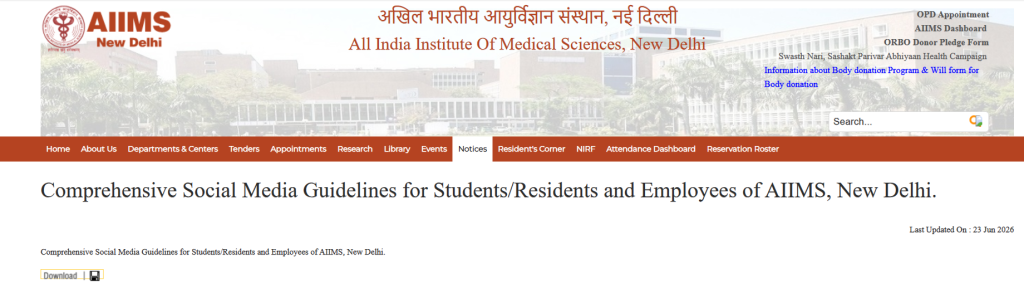
AIIMS Delhi Issues Comprehensive Social Media Guidelines 2026
Stay updated on all medical college notifications, exam results, and education news at Manabadi.co.in – India’s most trusted education portal, reaching over 5 million students every month.
Breaking: What Happened?
AIIMS New Delhi (All India Institute of Medical Sciences) issued an official Office Memorandum on June 22, 2026, releasing Comprehensive Social Media Guidelines for all students, residents, faculty, and employees.
These guidelines took effect immediately upon release.
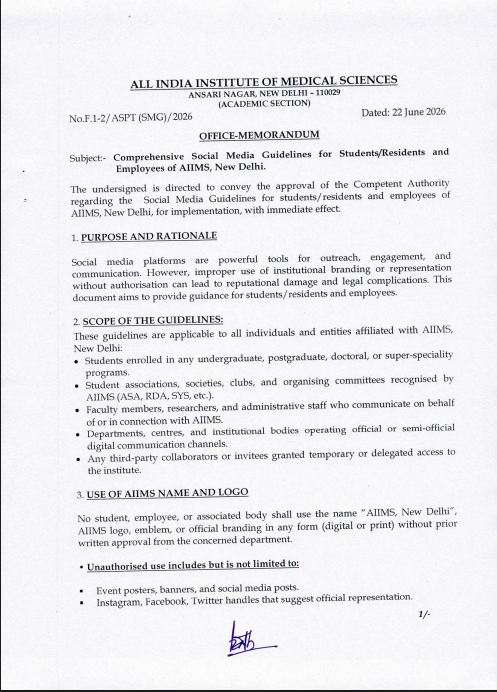
The memorandum, approved by the competent authority, covers everything from using the AIIMS name on Instagram to sharing patient case details on WhatsApp. So, whether you are an MBBS student, a resident doctor, or a staff member – this policy directly applies to you.
Why Did AIIMS Issue These Guidelines?
AIIMS clearly stated the reason in the memorandum itself.
Social media platforms have become powerful tools for communication, outreach, and engagement. However, the improper use of institutional branding or unauthorized representation without approval can cause reputational damage and legal complications for the institute.
Therefore, to protect its reputation and ensure legal compliance, AIIMS released these binding guidelines for everyone under its umbrella.
Who Do These Guidelines Apply To?
This policy casts a very wide net. Specifically, these guidelines apply to:
- All undergraduate, postgraduate, doctoral, and super-speciality students at AIIMS Delhi
- Recognised student associations, societies, clubs, and organising committees – including ASA, RDA, SYS, and others
- Faculty members, researchers, and administrative staff who communicate on behalf of or in connection with AIIMS
- Departments, centres, and institutional bodies operating official or semi-official digital channels
- Third-party collaborators or invitees given temporary or delegated access to the institute
So, in simple terms – if you study, work, or collaborate at AIIMS Delhi in any capacity, these rules bind you.
The 6 Key Areas These Guidelines Cover
AIIMS structured its policy around six major areas. Let us walk through each one in detail.
1. Use of AIIMS Name, Logo, and Branding
This is the central rule of the entire policy.
No one – not a student, not an employee, not a student body – can use the name “AIIMS, New Delhi”, its logo, emblem, or official branding in any digital or print format without prior written approval from the concerned department.
Unauthorized use explicitly includes:
- Event posters, banners, and social media posts
- Instagram, Facebook, or X (Twitter) handles that give the impression of official AIIMS representation
- Videos, reels, or blogs that use AIIMS branding for promotional purposes
- Any content where the AIIMS name or logo appears without prior clearance
Furthermore, even when approval is granted, all use must align with the official branding standards prescribed by AIIMS.
What this means for you: If you run a student club page and put “AIIMS Delhi” in the bio without written permission from your department, you risk violating this policy.
2. Patient Privacy – A Legal Requirement, Not Just a Rule
This is the most critical provision in the entire policy, and AIIMS makes it absolutely non-negotiable.
No student, doctor, or employee can post, share, or discuss:
- Patient information
- Patient photographs or images
- Patient case details
on social media – even if the patient’s identity is not revealed.
AIIMS grounds this requirement in two specific laws:
This means violating patient privacy on social media is not just an internal disciplinary matter – it can result in legal prosecution under Indian law.
A very important point: Even anonymized case discussions, screenshots of medical records, or sharing clinical photos in private WhatsApp groups could fall under this rule. The policy does not distinguish between public and private sharing.
3. Academic Integrity – No Leaking Exam Questions or Answer Keys
AIIMS has extended its academic integrity rules to the online space as well.
Under this section, students and staff must NOT:
- Engage in plagiarism or academic dishonesty on social media
- Share exam questions, answer keys, or other confidential academic material online
This provision clearly targets a growing trend where exam papers, internal assessment questions, or answer sheets get circulated on WhatsApp and Telegram groups.
Moreover, this applies not just to AIIMS internal exams but to any confidential academic material.
4. Prohibited Content – Harassment, Hate Speech & Defamation
The guidelines strictly ban the following categories of content:
- Content that is harassing, threatening, or discriminatory toward any individual
- Content that violates UGC Regulations on Curbing the Menace of Ragging in Higher Educational Institutions, 2009
- Obscene, defamatory, or hate speech content as per applicable Indian laws
- Content that targets individuals based on religion, caste, gender, or political views
Additionally, sharing copyrighted material without proper authorization or citation is explicitly prohibited.
5. Rules for Official Social Media Accounts
Student bodies and departments that run official or semi-official social media accounts now face additional compliance requirements.
Specifically, they must:
- Register official social media accounts with the concerned department
- Provide full details of admin team members — names, contact information, and institutional email IDs
- Appoint a Media Coordinator as the designated point of contact for content approval
- Clearly label all content as either student-generated or department-generated
- Avoid implying official AIIMS endorsement unless AIIMS has explicitly stated so
- Not disclose confidential, sensitive, or internal institutional information
- Avoid political, religious, or defamatory material on all platforms
- Maintain a respectful and professional tone aligned with AIIMS values
- Seek special clearance before entering into any sponsorships or brand collaborations with external entities
This effectively means every official student club page, department account, and society handle must go through a registration and compliance process immediately.
6. Violations, Monitoring & Takedown – What Happens If You Break the Rules
Monitoring
AIIMS has explicitly reserved the right to actively monitor social media platforms for compliance at any time. This is ongoing and proactive – not just reactive.
Takedown Notice
If AIIMS finds a violation, it issues a formal takedown notice. Once the notice is issued, the offending content must be removed within 12 hours – no exceptions.
Disciplinary Actions
Internal disciplinary action for violations may include:
| Violation Level | Disciplinary Action |
|---|---|
| Minor violations | Written warning |
| Repeat or serious violations | Suspension of association or access privileges |
| Severe misuse | Derecognition of the student body |
| Extreme violations | Ban from institutional events; denial of future permissions |
Legal Consequences
Beyond internal discipline, misuse of the AIIMS identity can attract legal consequences under applicable Indian laws. This is not a threat – it is a legal reality grounded in Indian data protection and defamation law.
Quick Reference: What You CAN and CANNOT Do
| Action | Allowed? |
|---|---|
| Post personal opinions on your personal social media | Yes, as long as you do not misrepresent yourself as speaking officially for AIIMS |
| Share patient case photos for “educational” purposes | No – strictly prohibited under IMC Regulations 2002 and DPDPA 2023 |
| Use “AIIMS Delhi” in your Instagram bio without approval | No – requires prior written departmental approval |
| Run an official club page without registering it | No – registration with department is mandatory |
| Share exam question papers on WhatsApp or Telegram | No – violates academic integrity provisions |
| Post a reel promoting your club using the AIIMS logo | No – branding use without written approval is prohibited |
| Collaborate with a brand on your student org account | Not without special clearance from AIIMS |
| Post political or religious content on a department page | Strictly prohibited |
| Share anonymized patient cases | No – even anonymized cases are prohibited |
| Remove content after a takedown notice | Must do – within 12 hours of notice |
Key Laws That Back These Guidelines
AIIMS did not create these guidelines in isolation. These rules connect directly to existing Indian law:
- Indian Medical Council Regulations, 2002 – governs patient confidentiality for medical professionals
- Digital Personal Data Protection Act, 2023 (DPDPA) – India’s landmark data protection legislation, which regulates how personal data of individuals (including patients) is handled
- UGC Regulations on Curbing the Menace of Ragging in Higher Educational Institutions, 2009 – applies to anti-ragging and anti-bullying conduct online
- Information Technology Act – governs defamatory, obscene, and threatening online content
- Copyright Act of India – restricts unauthorized sharing of copyrighted material
Unique Insight Not Found Elsewhere: The specific invocation of the Digital Personal Data Protection Act, 2023 is particularly significant. This Act became fully operational in 2024 and places enormous legal obligations on data fiduciaries and data processors. By citing it, AIIMS signals that sharing patient data on social media can make students and doctors personally liable as data processors under this law – which carries penalties of up to ₹250 crore for serious violations.
What Makes This Policy Different from Previous Guidelines?
Interestingly, AIIMS has had informal guidelines in the past, but this June 2026 memorandum marks a major shift in two respects:
1. It is now binding. The memorandum explicitly states: “These guidelines are binding on all students/residents, employees, and associations functioning under the AIIMS, New Delhi umbrella.”
2. It comes with enforcement mechanisms. The 12-hour takedown deadline, monitoring rights, and multi-level disciplinary framework mean AIIMS now has a formal enforcement structure – not just a list of suggestions.
3. It covers third-party collaborators. Even people who are not enrolled or employed at AIIMS but are temporarily present — such as event guests or external collaborators – fall under this policy during the period of their access.
What Should You Do Right Now?
If you are a student, resident, or employee at AIIMS Delhi, here is your immediate action checklist:
Step 1: Read the official guidelines at aiims.edu/index.php/en/notices/notices?id=24045
Step 2: Check every social media account — personal and official — for any content that uses AIIMS branding without written permission.
Step 3: If you manage a club, association, or department social media page, immediately register it with your concerned department and appoint a Media Coordinator.
Step 4: Remove any patient photos, case discussions, or anonymized clinical content from all platforms — public and private.
Step 5: Do not share exam-related content, answer keys, or confidential institutional information going forward.
Step 6: If your account has brand collaborations or sponsored content, pause them until you receive special clearance from AIIMS.
Quick Summary
| Detail | Information |
|---|---|
| Institution | AIIMS New Delhi (All India Institute of Medical Sciences) |
| Document | Comprehensive Social Media Guidelines |
| Date of Issue | June 22, 2026 |
| Effective From | Immediately (June 22, 2026) |
| Applies To | All students, residents, faculty, staff, student bodies, external collaborators |
| Key Restrictions | AIIMS branding use, patient privacy, academic content, hate speech, copyright |
| Official Accounts | Must register with department; appoint Media Coordinator |
| Monitoring | AIIMS reserves the right to monitor social media at any time |
| Takedown Timeline | Offending content must be removed within 12 hours of notice |
| Consequences | Written warning → Suspension → Derecognition → Legal action |
| Legal Basis | IMC Regulations 2002, DPDPA 2023, UGC Anti-Ragging Regulations 2009 |
| Official Notice Link | aiims.edu – Notice ID 24045 |
Frequently Asked Questions (FAQs)
Q1. What are the AIIMS Delhi Social Media Guidelines 2026?
These are comprehensive, binding rules issued by AIIMS New Delhi through an official memorandum on June 22, 2026. They govern how students, resident doctors, faculty, staff, and student associations use social media in connection with the institute. The guidelines cover branding, patient privacy, academic integrity, prohibited content, and official account management.
Q2. Who issued these guidelines and when?
AIIMS New Delhi issued these guidelines through an Office Memorandum dated June 22, 2026, approved by the competent authority. They came into effect immediately.
Q3. Does this policy apply to personal social media accounts of students?
Yes, partially. If a student uses AIIMS branding, shares patient information, or posts content that violates these guidelines — even on a personal account — the policy applies. However, personal opinions that do not involve AIIMS branding or institutional misrepresentation generally fall outside the scope.
Q4. Can I share an anonymized patient case on social media for educational purposes?
No. AIIMS explicitly prohibits sharing patient information, photographs, or case details on social media — even if the patient is not identified. This applies to anonymized cases as well. The Indian Medical Council Regulations, 2002, and the Digital Personal Data Protection Act, 2023, both mandate this prohibition.
Q5. Can I use the AIIMS Delhi name or logo in my club’s social media bio?
No, not without prior written approval from the concerned department. Using the name “AIIMS, New Delhi” or its logo, emblem, or any official branding without written departmental clearance is a direct violation of these guidelines.
Q6. What is the 12-hour rule?
If AIIMS identifies any content on social media that violates these guidelines, it will issue a formal takedown notice. Once this notice is issued, the person or body responsible must remove the content within 12 hours. Failure to comply escalates the disciplinary action.
Q7. What happens if I violate the guidelines?
Consequences depend on the severity of the violation. They include written warnings, suspension of association or access privileges, derecognition of student bodies, and bans from institutional events. Additionally, misuse of the AIIMS identity can result in legal action under Indian law.
Q8. Does AIIMS monitor social media accounts?
Yes. The guidelines explicitly state that the concerned department reserves the right to monitor social media platforms for compliance at any time. This monitoring is ongoing and proactive.
Q9. I run an official student club social media page. What do I need to do?
You must immediately: (1) register the account with your concerned department, (2) provide the names, contact details, and institutional email IDs of your admin team, and (3) appoint a Media Coordinator as the point of contact for content approvals. Going forward, all content must comply with the guidelines.
Q10. Can my student club collaborate with external brands?
Only with special clearance from AIIMS. Sponsored content or collaborations with external brands require prior approval. Entering into such arrangements without clearance constitutes a violation.
Q11. Can I share exam questions or previous year papers on WhatsApp groups?
No. Sharing exam questions, answer keys, or any confidential academic material on social media or messaging platforms is explicitly prohibited under the academic integrity provisions of these guidelines.
Q12. Are these guidelines applicable to departments running official social media pages?
Yes. Departments, centres, and institutional bodies operating official or semi-official digital communication channels are also covered. They must also register accounts, appoint a Media Coordinator, and follow all content guidelines.
Q13. What are the legal acts cited in these guidelines?
AIIMS cites three key legal instruments: the Indian Medical Council Regulations, 2002 (for patient confidentiality), the Digital Personal Data Protection Act, 2023 (for personal data protection), and the UGC Regulations on Curbing the Menace of Ragging in Higher Educational Institutions, 2009 (for anti-ragging and anti-bullying conduct online).
Q14. Does this policy apply to private WhatsApp or Telegram groups?
The policy refers to “social media” broadly and prohibits sharing patient information in any digital space. While private messaging apps may not always be explicitly monitored, sharing prohibited content — especially patient data or exam papers — in these groups can still constitute a violation and expose individuals to legal liability under the DPDPA 2023.
Q15. Can I post about AIIMS events on my personal account?
You can share information about public events, but you must NOT imply that your post is an official communication from AIIMS. Moreover, if you use AIIMS logos or branding in such posts, you need prior written departmental approval.
Q16. What counts as “AIIMS branding”?
AIIMS branding includes the name “AIIMS, New Delhi,” the official AIIMS logo, the AIIMS emblem, and any visual or textual element that creates the impression of official AIIMS representation — even if you slightly modify the official logo.
Q17. Are outside guests or event collaborators covered by this policy?
Yes. Third-party collaborators or invitees who receive temporary or delegated access to the institute — such as for events or workshops — are also covered during the period of their access.
Q18. Who is a “Media Coordinator” under these guidelines?
A Media Coordinator is a designated person responsible for reviewing and approving content before it goes live on an official student or departmental social media account. This person serves as the point of contact between the account and the department for all content-related approvals.
Q19. Where can I find the official AIIMS social media guidelines document?
You can access the official notice directly on the AIIMS Delhi website at: https://www.aiims.edu/index.php/en/notices/notices?id=24045
The guidelines are also available as a downloadable PDF from the same page.
Q20. How will AIIMS enforce these guidelines across departments?
The memorandum directed all Heads of Departments and Centres to circulate these guidelines among faculty members, residents, research staff, students, and administrative personnel for immediate compliance. Enforcement, therefore, flows through individual departments.
Q21. Will these guidelines affect how I use LinkedIn for professional networking?
LinkedIn is a professional platform, but if you use AIIMS branding on your LinkedIn profile without authorization, it can still constitute a violation. For example, claiming to “represent” AIIMS or using the AIIMS logo in your LinkedIn profile banner without written permission may fall under the prohibited uses listed in the guidelines.
Q22. Can a student body lose official recognition under these guidelines?
Yes. Derecognition of a student body is explicitly listed as one of the possible disciplinary actions. Furthermore, student bodies can also face a ban on participating in institutional events or denial of permission for future activities.
Q23. Is this policy unique to AIIMS Delhi, or do other medical colleges have similar rules?
AIIMS Delhi is among the first premier medical institutions in India to issue such a detailed and legally grounded comprehensive social media policy. While some other institutions have informal digital conduct guidelines, this memorandum’s explicit citation of the Digital Personal Data Protection Act, 2023 and its formal enforcement mechanisms — including the 12-hour takedown rule — make it notably more comprehensive than what most Indian medical colleges currently have in place.
Q24. What should I do if I receive a takedown notice from AIIMS?
Remove the flagged content immediately. You have 12 hours from the moment the notice is issued. After removing the content, contact the concerned department to acknowledge compliance and understand what further steps, if any, are required to avoid further disciplinary action.
Q25. Does this policy cover content posted before June 22, 2026?
The memorandum states that the guidelines are effective immediately from June 22, 2026. However, if pre-existing content on your accounts violates these guidelines, it is strongly advisable to proactively remove such content. AIIMS has the monitoring authority to flag any content it deems non-compliant, regardless of when it was posted.
Final Word
AIIMS Delhi’s Social Media Guidelines 2026 mark a turning point in how premier Indian medical institutions govern digital conduct.
These rules exist to protect patients, preserve the institute’s reputation, and maintain legal compliance. Consequently, every student, doctor, employee, and student association at AIIMS Delhi must treat these guidelines as binding — not optional.
If you have doubts about any specific content or account, always consult your department head or Media Coordinator before posting.
For the latest results, medical college notifications, exam dates, hall tickets, and education news across India – visit Manabadi.co.in daily. Over 5 million students trust Manabadi for fast, accurate, and reliable education updates.