





Contents
- 1 I. Question 1. Convert the following into simplest form (i) tan (θ – 14π)
- 2 Question 2. Find the values of each of the following (i) sin (-405°)
- 3 Question 3. Evaluate (i) cos2 45° + cos2 135° + cos2 225° + cos2 315°
- 4 (ii) sin22π3 + cos25π6 – tan23π4
- 5 Question 4. (i) If sin θ = –13 and 0 does not lie in the third 3 quadrant, find the values of (a) cos θ and (b) cot θ. (March 2013)
- 6 Question 5. (i) If sin α + cosec α= 2, find the value of sinn α + cosecn α; n ∈ Z.
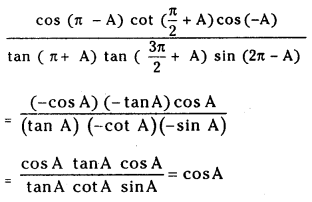
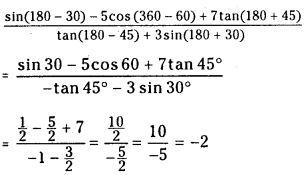
- 7 II. Question 1. Prove that (i) cos(π−A)cot(π2+A)cos(−A)tan(π+A)tan(3π2+A)sin(2π−A) = cos A
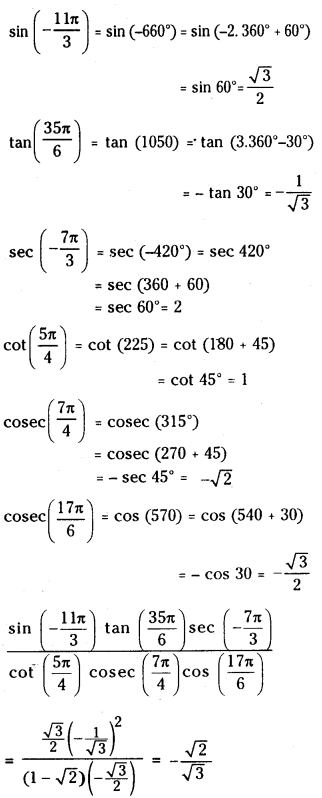
- 8 Question 2. (i) Simplify sin(−11π3)tan(35π6)sec(−7π3)cot(5π4)cosec(7π4)cos(17π6)
- 9 Question 3. (i) If cos A = cos B = – 12, A does not lie in the second quadrant and B does not lie in third quadrant, then find the value of 4sinB−3tanAtanB+sinA
I.
Question 1.
Convert the following into simplest form
(i) tan (θ – 14π)
Answer:
tan (θ – 14π) = tan [- (14π – θ)]
= – tan (14π – θ)
= – tan [ 2(7π) – θ)
= – tan (-θ) = tan θ
(ii) cot (
Answer:
cot (
= cot (
(iii) cosec (5π + θ)
Answer:
cosec (5π + θ) = cosec [4π + (π + θ)]
= cosec(π + θ) = – cosec θ
(iv) sec (4π – θ)
Answer:
sec (4π – θ) = sec [2(2π) – θ]
= sec (- θ) = sec θ
Question 2.
Find the values of each of the following
(i) sin (-405°)
Answer:
sin (-405°) = -sin 405° = -sin (360°+45°)
= – sin 45° =
(ii) cos
Answer:
cos
= cos (360 + 270°) = cos 270°
= cos (180 + 90) = -cos 90 = 0
(or) cos
(iii) sec (2100°)
Sol. sec (2100°) = sec [5 × 360° + 300°]
= sec 300° = sec (360° – 60°)
= sec 60° = 2
(iv) cot (-315°)
Answer:
cot (-315°) = – cot 315° = – cot (270 + 45°)
= cot 45° = 1
Question 3.
Evaluate
(i) cos2 45° + cos2 135° + cos2 225° + cos2 315°
Answer:
cos 45° =
= – cos 45° =
cos 225° = cos (180 + 45°)
= – cos 45° = –
cos 315° = cos(360 – 45°)
= cos 45° =
∴ cos2 45° + cos2 135° + cos2 225° + cos2 315°
=
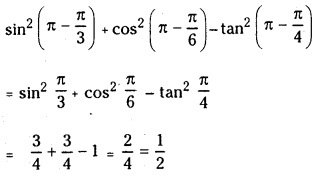
(ii) sin22π3 + cos25π6 – tan23π4
Answer:
(iii) cos 225° – sin 225° + tan 495° – cot 495°
Answer:
cot (180 + 45) – sIn (180 + 45) + tan (360 + 135) – cot (360 + 135)
= – cot 45° + sin 45° + tan 135 – cot 135°
= – cos 45° + sin 45° +tan(180 – 45) – cot(180 – 45)
= – cos 45° + sin 45° – tan 45° + cot 45°
=
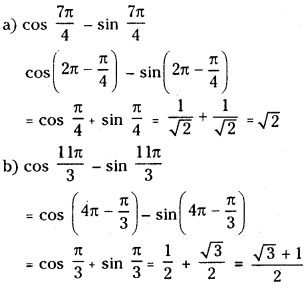
(iv) (cos θ – sin θ) if
(a) θ =
(b) θ =
Answer:
Question 4.
(i) If sin θ = –13 and 0 does not lie in the third 3 quadrant, find the values of (a) cos θ and (b) cot θ. (March 2013)
Answer:
sin θ = –
⇒ θ lies in fourth quadrant. In IVth quadrant cos θ is positive and cot θ is negative.
a) cos θ =
b) cot θ =
(ii) If cos θ = t (0 < t < 1) and θ does not lie in the first quadrant, find the values of a) sin θ b) tan θ
Answer:
cos θ = t, (0 < t < 1)
⇒ cos θ is positive and 0 does not lie in first quadrant
⇒ θ lies in IVth quadrant
a) sin θ =
b) tan θ =
(iii) Find the value of sin 330°. cos 120° + cos 210°. sin 300°
Answer:
sin 330° cos 120° + cos 210° sin 300°
= sin (360 – 30) cos (180 – 60) + cos ( 180 + 30) sin (360 – 60)
= (-sin 30°) (-cos 60°) + (-cos 30°) (- sin 60°)
= sin 30 cos 60 + cos 30 sin 60 = sin (30 + 60)
= sin 90° = 1
(iv) If cosec θ + cot θ =
Answer:
we have coses2θ – cot2 θ = 1
⇒ (cosec θ + cot θ) (cosec θ – cot θ) = 1
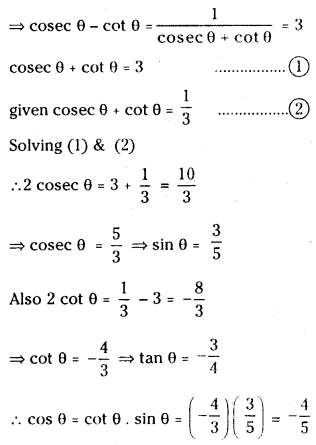
∴ sin θ is positive and cos θ is negative,
⇒ θ lies in IInd quadrant.
Question 5.
(i) If sin α + cosec α= 2, find the value of sinn α + cosecn α; n ∈ Z.
Answer:
Given sin α + cosec α = 2
Squaring both sides
sin2 α = cosec2 α + 2 = 4
⇒ sin α + cosec α = 2
cubing on both sides
sin3 α + cosec3 α + 3 sin α cosec α (sin α + cosec α) = 8
sin3 α + cosec3 α + 3 (2) = 8
⇒ sin3 α + cosec3 α = 2
In the same way sinn α + cosecn α = 2 (n ∈ z)
(ii) If sec θ + tan θ = 5, find the quadrant in which θ lies and find the value of sin θ
Answer:
We have sec2 θ – tan2 θ = 1
⇒ (sec θ + tan θ) (sec θ – tan θ) = 1
Also given sec θ + tan θ = 5 ………….(2)
Adding (1) and (2)
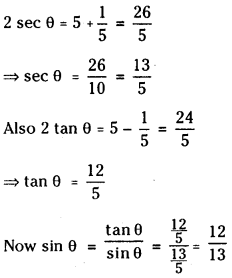
tan θ is +ve, sec θ is + ve
⇒ θ lies is first quadrant.
II.
Question 1.
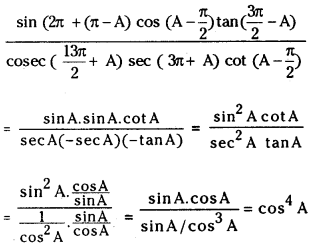
Prove that
(i) cos(π−A)cot(π2+A)cos(−A)tan(π+A)tan(3π2+A)sin(2π−A) = cos A
Answer:
(ii)
Answer:
(iii) sin 780°. sin 480° + cos 240°. cos 300° =
Answer:
sin [2 × 360 + 60] sin [360 + 120] + cos [180 + 60] cos [360-60]
= sin 60 sin 120 – cos 60 cos 60
= sin 60 sin 60 – cos 60. cos 60
=
(iv)
Answer:
(v) cot
Answer:
cot
= cot 9°. cot 27°. cot 45°. cot 63°. cot 81°
= cot 9°. cot 27°. 1.cot (90 – 27) . cot (90 -9)
= cot 9°. cot 27°. 1. tan 27°. tan 9°
= 1
Question 2.
(i) Simplify sin(−11π3)tan(35π6)sec(−7π3)cot(5π4)cosec(7π4)cos(17π6)
Answer:
(ii) If tan 20 ° = p, prove that
Answer:
Given that tan 20° = p then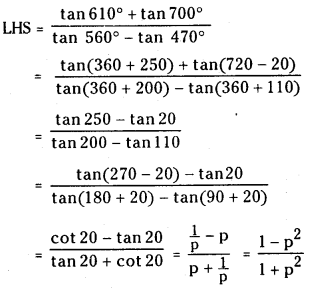
(iii) If α, β are complementary angles such that b sin α = a, then find the value of (sin α cos β – cos α sin β)
Answer:
Given α, β are complementary angles α + β = 90°
⇒ β = 90° – α
∴ sin α cos β – cos α sin β
= sin (α – β)
= sin[α – (90 – α)]
= sin [2α – 90°]
= -sin[90 – 2α]
= -cos 2α
= -(1 – 2sin2α) = -1 + 2sin2α
= -1 + 2
=
Question 3.
(i) If cos A = cos B = – 12 , A does not lie in the second quadrant and B does not lie in third quadrant, then find the value of 4sinB−3tanAtanB+sinA
Answer:
cos A = –
⇒ A lies in third quadrant
cos B = –
⇒ B lies in second quadrant
cos A = –
⇒ A = 240°
cos B = –
⇒ B = 120°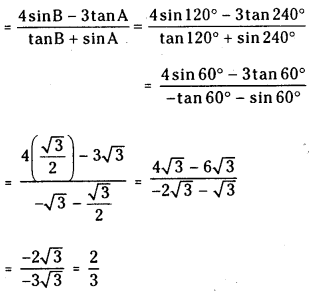
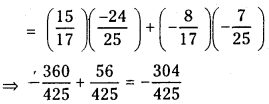
(ii) If 8 tan A = -15 and 25 sin B = -7 and neither A nor B is in the fourth quadrant, then show that sin A cos B + cos A sin B =
Answer:
8 tan A = -15 25 sin B = -7
⇒ tan A =
Given neither A nor B is in the fourth quadrant, clearly A is in second quadrant and B is in third quadrant,
sin A cos B + cos A sin B