



Home Blog Page 13

TS Inter 1st Year English Grammar Transformation of Sentences

0

Q. No. 13 (4 × 1 = 4)

A. VOICE

The term ‘voice’ in grammar refers to one aspect of the verb. If the verb group in a sentence has ‘be + pp of the verb’, that sentence is said to be in the passive voice. If any of or both the elements (be + V3) are missing in the structure of the verb, the sentence is said to be in the active voice. (వాక్యంలోని verb groupలో ‘be + V3 ఉంటే ఆ వాక్యాన్ని passive voice అని, be + V3 లలో ఏ ఒక్కటి లేకున్నా active voice అని అంటారు.)

If the verb is in the passive form, the subject of that sentence is just the ‘sufferer’ of the action indicated by the verb, (verb passive లో ఉంటే ఆ వాక్యంలోని subject, verb సూచించిన పని ఫలితాన్ని అనుభవిస్తుంది. అందుకనే ఈ రూపానికి ‘passive’ ‘సోమరిగా’, ‘పనిచేయకుండా’ అని పేరు.)

If the verb group is in the active voice, the subject of that sentence is the ‘doer’ of the action shown by the verb. (Verb Active voice లో ఉన్నప్పుడు, ఆ వాక్యం యొక్క subject, verb సూచించిన పనిని చేస్తుంది. అందుకే ఈ రూపానికి ‘Active చురుకుగా పనిచేస్తున్న’ అని పేరు)

If the doer of an action is either unimportant or unknown, the passive structure is natural. (పనిచేసినవారు ప్రధానం కాకున్నా, తెలియకున్నా, passive నిర్మాణాలు సహజంగా ఉంటాయి. )

Transformation of sentences from one voice to the other involves five steps.

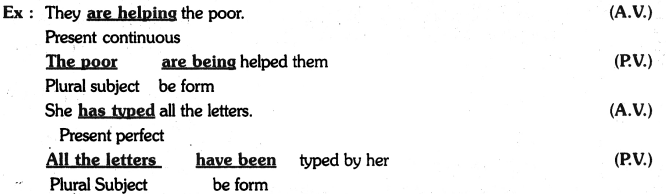
1. The object in the Active Voice sentence becomes the subject in the Passive Voice sentence.
Ex : They made (ten kites)Object (A.V)
(Ten kites) Subject were made by them. (P.V.)

If there are two objects in the A.V. sentence, either of them can be made the subject in the PV. sentence.
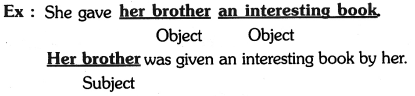
Active :

  1. I told them an interesting story.
  2.  I told an interesting story to them.

Passive:

  1. An interesting story was told to them.
  2. They were told an interesting story.

2. A suitable ‘be’ form is to be introduced. This is the most important step. Selection of the right be’ form is based on two factors : (a) the number and person of the subject in the passive voice and (b) the tense of the verb in the Active Voice.
The following table helps one select the right be form.

S. No.Subject in the Passive VoiceTense of the verb in Active Voice‘Be form to be used in the Passive Voice
1ISimple Presentam
2he, she, it singlar nounsSimple Presentis
3We, you, they plural nounsSimple Presentare
4I, he, she, it singular nounsSimple Pastwas
5We, you, they plural nounsSimple Pastwere
6IPresent Continuousam being
7he, she, it singular nounsPresent Continuousis being
8We, you, they plural subjectsPresent Continuousare being
91, he, she, it singular nounsPast Continuouswas being
10We, you, they plural subjectsPast Continuouswere being
11 ‘he, she, it Singular nounsPresent Perfecthas been
12I, we, you, they plural nounsPresent Perfecthave been
13Any subjectPast Perfecthad been
14Any subjectwill/shall/can/ may/would should/could/ might/ must, etc.will, etc. +be
15Any subjectwill etc + havewill, etc. + have been

3. The main verb in the Active Voice sentence is to be changed into its past participle form. One must know the correct past participle forms of irregular verbs.

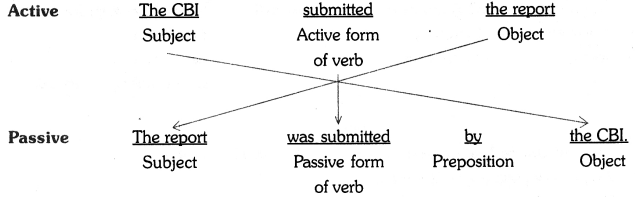
4. The preposition ‘by’ is used.

5. The subject in the Active voice sentence is made the object of the preposition ‘by’ in the passive voice sentence.
Ex : He broke the glass. (A.V.)
The glass was broken by him. (P.V.)
prep+object
If the subject in the A.V. sentence is either unimportant or a general one, ‘by + object’ may be dropped.
Ex : Someone removed the dead snake. (A.V.)
The dead snake was removed. (P-V.)
(by someone’ is dropped)
People call him ‘Babuji’. (A.V.)
He is called ‘Babuji’. (‘by people’ not necessary) (P.V.)

CHANGE IMPERATIVE SENTENCES INTO PASSIVE

We follow a slightly different method to change imperative sentences from the A.V. to the P.V. (Sentences with dropped subject and with V + object structure, conveying a request or an order are called imperative sentences.)
1. The passive voice sentence begins with ‘Let’.
Ex : Close the door. (A.V.) imperative
Let the door be closed. (P.V.)

2. The object in the A.V. sentence becomes the subject in the RV. sentence.
Answer this question. (A.V.)
Object
Let this question be answered. (P.V.)
Subject

3. The ‘be’ form ‘be’ is introduced.
(Whatever be the subject or the tense form, it is always ‘be’ in imperative sentences.)
Ex : Clean the room. (A.V.)
Let the room be cleaned. (P.V.)

4. The M.V. is changed into its Past Participle form.
Ex : Paint this chair. (A.V.)
M.V.
Let this chair be painted. (P.V.)
As the subject is not explicit in the imperative sentences, the need to use ‘by’ and its object doesn’t arise, while changing imperative sentences into the passive voice.

CHANGING QUESTIONS INTO PASSIVE

Study carefully the transformation of the interrogative sentences into the passive voice.
Ex : Who brought this book ? (A.V.)
By whom was this book brought ? (P.V.)
All the steps followed here are exactly like those we follow in changing the declarative sentences. But the word order is different.
By whom + be + Subject + M.V in PP + etc ?
Nbw, notice the transformation of Questions with other ‘wh’ words.
Ex : Where did you put my pen ? (A.V.)
Where was my pen put ? (P.V.)
‘Wh’ word + be + subject + MV in PP ?
Observe how ‘yes / no’ Questions are rewritten in the passive voice.
Have you solved the problem ? (A.V.)
Has the problem been solved ? (P.V.)
Helping Verb + Subject + be + MV in pp + etc. ?

EXAMPLES
1. Advertise the post. (A.V.)
Let the post be advertised. (P.V.)

2. America imports Indian tea. (A.V.)
Indian tea is imported by America. (P.V.)

3. The auditors are checking the accounts. (A.V.)
The accounts are being checked by the auditors. (P.V.)

4. They have sent the information. (A.V.)
The information has been sent. (P.V.)

5. Hurry can gain nothing. (A.V.)
Nothing can be gained by hurry. (P.V.)

6. Put the culprit in prison. (A.V)
Let the culprit be put in prison. (P.V.)

7. John teaches us English. (A.V.)
We are taught English by John. (P.V.)
English is taught to us by John. (P.V.)

8. The Manager sent a mail yesterday. (A.V)
A mail was sent by the manager yesterday. (P.V)

9. The conductor has issued tickets to all the passengers. (A.V.)
Tickets have been issued to all the passengers. (P.V.)
All the passengers have been issued tickets. (P.V.)

10. Narayana Murthy started Infosys. (A.V.)
Infosys was started by Narayana Murthy. (P.V.)
Look at the following sentence and observe the changes.
TenseActive VoicePassive Voice
Simple presentFloods cause a lot of damage.am/are/is+v3(past participle)
A lot of damage is caused by floods
Present continuousThe gardener is watering the plants.am/are/is+being+v3
The plants are being watered by the gardner.
Present perfectWe have organized a special programme for children.have/has+been+v3 A special programme has been organized for children (by us).
Simple pastRaghavendar Rao directed the film ‘Annamayya’.was/were + v3
The film Annamayya’ was directed by Raghavendar Rao.
Past continuousWhen they were shifting the patient to the ICU, he died.Was / were + being v3
When the patient was being shifted to the ICU, he died.
Past perfectThe driver had already alerted the passengers before the robbers entered the bus.had + been + v3
The passengers had already been alerted before the robbers entered the bus.
Simple futureI will conduct a spelling – contest tomorrow.shall/will + be + v3
A spelling – contest will be conducted tomorrow.
Future perfectThey will have decorated the hall by evening.shall / will + have + been + v3
The hall will have been decorated by evening.
The future of intention (be going to)Keeravani is going to compose music this song.is going to be + v3
Music is going to be composed by Keeravani for this song.
Modal veibs (should, must, ought to, can, etc.)I will type this letter tomorrow.should/would/must/tought/can + be + v3
ThisletowiBbetypedbyrnetorrKxrcw.
It is said (that) or subject+is said to beVillagers say that there is a ghost in the old building.It is said that there is a ghost in the old building.
ImperativeCheck the spelling.Let…. be + v3
Let the spelling be checked.

EXERCISES

QuestionI.

Change the following sentences into the passive voice?

1. We practise yoga every day in the morning.
2. He will make all the arrangements.
3. The judge declared the verdict.
4. They had already announced the results before we entered the hall.
5. Many students sacrificed their precious lives for Telangana.
6. The students borrowed some books from the library.
7. Nobody can save him.
8. How much loan amount has the Bank sanctioned ?
9. One should wear a helmet while riding a two-wheeler.
10. Money alone cannot solve all problems.
11. Switch off the lights.
12. Please maintain silence in the prayer hall.
13. We have to undergo many formalities for getting a visa.
14. The workers called off the strike.
15. The teacher is explaining the lesson.
16. The postman will deliver the letters at noon.


Answers:


1. Yoga is practised by us every day in the morning.
2. All the arrangements will be made by him.
3. The verdict was declared by the judge.
4. The results had already been announced before we entered the hall.
5. Their precious lives were sacrificed by many students for Telangana.
6. Some books were borrowed by the students from the library.
7. He cannot be saved.
8. How much loan amount has been sanctioned by the Bank ?
9. Helmet should be worn while riding a two-wheeler.
10. All problems cannot be solved by money.
11. Let the lights be switched off.
12. Let silence be maintained in the prayer hall.
13. Many formalities have to be undergone for getting a visa.
14. The strike was called off by the workers.
15. The lesson is being explained by the teacher.
16. The letters will be delivered by the postman at noon.

QuestionII.

Change the following sentences into the active voice?

1. The parcels will be delivered at any time (by the courier agents)
2. Surya was invited to tea by Chandra.
3. Traffic rules should be followed.
4. Vegetables are washed before cooking.
5. Let the following sentences be changed into the passive voice.
6. How many times were you reminded of the medicine ?
7. Let the dustbin be kept away from the eatables.
8. Hpve all your friends been invited to your birthday ?
9. Every sentence can’t be changed into the passive voice.
10. If the ointment isn’t applied to the wound, it will not heal.
11. My brother has never been beaten at chess by anyone in his school.
12. It is believed that Sammakka and Saralamma are the saviors of their lives in times of crisis by the villagers.


Answers:


1. The courier agents will deliver the parcels at any time.
2. Chandra invited Surya to tea.
3. One (We) should follow traffic rules.
4. We wash vegetables before cocking.
5. Change the following sentences into the passive voice.
6. How many times did I (we) remind you of the medicine ?
7. Keep the dustbin away from the eatables, (food)
8. Have you invited all your friends to your birthday party ?
9. One (We) can’t change every sentence into the passive voice.
10. If you don’t apply the ointment to the wound, it will not heal.
11. No one in his school has ever beaten my brother in chess.
12. The villagers believe that Sammakka and Saralamma are the saviours of their lives in times of crisis.

QuestionIII.

Change the following sentences into the passive voice?

1. Rainwater fills potholes on roads.
2. He is buying a TV set at the moment.
3. I have been growing plants since 1990.
4. They were reading the newspaper.
5. She had answered it already.
6. I will write an essay tonight.
7. You will have posted it by Monday.
8. Can she play the violin ?
9. They may not telecast it.
10. One must do one’s duty.
11. Gall in the doctor.
12. Close the door.
13. The Government has to do it.
14. Someone has already cast my vote.
15. Who could help him ?


Answers:


1. Potholes on roads are filled with (by) rainwater.
2. A TV set is being bought by him at the moment.
3. Plants have been being grown by me since 1990.
4. TKe newspaper was being read (రెడ్) by them.
5. It had already been answered by her.
6. An essay will be written by me tonight.
7. It will have been posted by you by Monday.
8. Can the violin be played by her ?
9. It may not be telecast, (by them)
10. One’s duty must be done, (by one)
11. Let the doctor be called in.
12. Let the door be closed.
13. It has to be done by the Government.
14. My vote has already been cast, (by someone)
15. By whom could he be helped ?

QuestionIV.

Change the following into Active Voice?

1. He was seen crossing the road.
2. You are advised to be careful.
3. Let the picture be seen by me.
4. Her purchases were paid for by me.
5. There are no shops to be let.
6. She has been selected their monitor (by the class)
7. It is said that the earth is round.
8. The road had been repaired.
9. I am surprised at this news.
10. It is hoped that I shall win.


Answers:


1. We saw him crossing the road.
2. We advise you to be careful.
3. Let me see the picture.
4. I paid for her purchases.
5. There are no shops to let (out).
6. The class has selected her their monitor.
7. People say that the earth is round.
8. They had repaired the road.
9. This news surprises me.
10. I hope that I shall win.

QuestionV.

Change the following sentences into the passive voice?

1. I have made a mistake.
2. Your students will respect you a great deal more for your frankness and honesty.
3. Call the attention of your near neighbour at the table to the excellence of the coffee.
4. Do you apply Pythagoras Theorem or Newton’s Law of Gravity ?
5. Rahul lost a quarter mark in English.
6. She planted trees; fenced, watered and guarded them.
7. Their hope and encouragement gave me greater strength.
8. Instantly remove that hatter.


Answers:


1. A mistake has been made by me.
2. You will be respected by your students a great deal more for your frankness and modesty.
3. Let the attention of your near neighbour at the table be called to the excellence of the coffee.
4. Is Pythagoras Theorem or Newtons Law of Gravity applied by you ?
5. A quarter mark in English was lost by Rahul.
6. Trees were planted, fenced, watered and guarded by her.
7. I was given greater strength by their hope and encouragement. (OR) Greater strength was given to me by their hope and encouragement.
8. Let that hatter be removed instantly.

B. DIRECT SPEECH AND INDIRECT SPEECH/REPORTED SPEECH

Sometimes it becomes necessary to report a person’s words. It can be done in two different ways. One -way is to reproduce the actual words of the speaker. The speaker’s actual words are shown in quotation marks in writing. This kind of reporting is called the ‘Direct Speech’.

The other kind is to express the idea of the speaker in the reporter’s words. This type is referred to as the ‘Indirect Speech’.
(ఒక వ్యక్తి అన్న మాటలకు అన్నట్లుగా తిరిగి చెబితే Direct Speech. కేవలం భావం మాత్రమే తిరిగి చెబితే Indirect Speech.)

The sentence in the Direct Speech has two parts. They are (a) the part outside the quotation marks (called the reporting part and (b) the part within the quatation marks (called the reported part).

1. The reporting part is to be written first. This is applicable only when the reporting part is either in the middle or at the end of the sentence.

Direct Speech :
“Ramu has solved all the problems.” said the teacher (Reporting part at the end)
Indirect Speech :
The teacher said that Ramu had solved all the problems. Reporting part begins the sentence.

2. The order of the words in the reporting part is arranged as “Subject + Verb.” This is applicable only when this order is not followed in the direct speech sentence.

3. The reporting verb is changed to words like ordered, requested, enquired, told, asked, ad-vised exclaimed, depending on the meaning of the reported part.
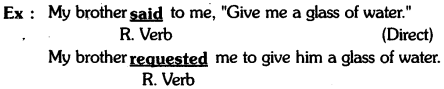
4. The quotation marks and the comma between the reporting and reported parts are removed in the indirect speech.
Ex : The boy said,” This plant has grown very tall.” (D.S.)
The boy said that plant had grown very tall. (I.S.)

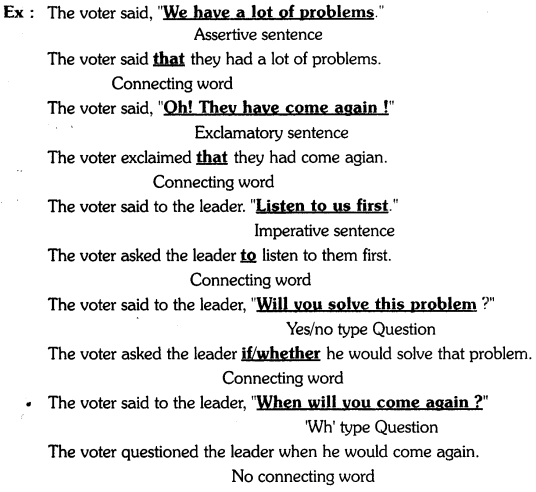
5. A suitable connecting word is used to connect the reporting and reported parts. The selection of the right connecting word needs careful observation.
The following table will help you to select the right word.

SI.No.Sentence in quotation marksConnecting word
1.Assertive or Exclamatorythat
2.Imperativeto
3.Yes/No type Questionif or whether
4.‘Wh’ type QuestionNo connecting word

6. The pronouns in the reported part are to be changed suitably. This depends on the first speaker, the speaker’s listener, the reporter and the reporter’s listener. One has to ensure that the original speaker’s intention is correctly reported. (Indirect speech లోకి మార్చేటప్పుడు, ఎవరు ఎవరితో అన్న మాటలను తిరిగి ఎవరు ఎవరికి చెబుతున్నారు అనే దానిని బట్టి pronouns మారతాయి. మొదట మాట్లాడిన వ్యక్తి ఉద్దేశ్యం మారకుండా సరిగ్గా చెప్పడం అవసరం.)

Now notice the following examples carefully :
a) The teacher said to you, ‘You are late again.” (D.S.)
The teacher told you that you were late again. (I.S.) ‘you’ not changed.

b) The teacher said to me, “You have improved your performance.” (D.S.)
The teacher told me that I had improved my performance.
You → 1 & Your → my

c) The teacher said to Geetha, “You have to submit your assignments tomorrow.” (D.S.)
The teacher told Geetha that she had to submit her assignments the following day. (I.S.)
You → she and you → her

d) The teacher said to Prudhvi, “When will you finish your computer course” ? (D.S.)
The teacher asked Prudhvi when he would finish his computer course. (I.S.)
You → he and your → his

e) The teacher said to the students, “You must consult your parents.” (D.S.)
The teacher told the students that they should consult their parents. (I.S.)
You → they and Your → their
As the examples a, b, c, d and e show you, pronouns change in accordance with the speaker’s reference to a person/persons.

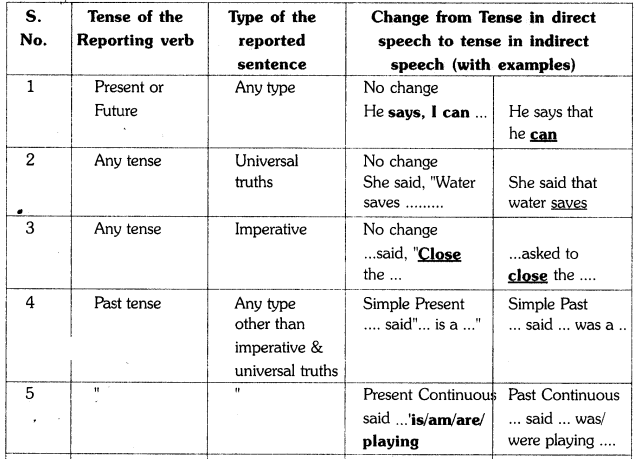
7. In changing sentences into the indirect speech, the tense form of the verbs in the reported part is to be changed. This is the most important part of the transformation. This is done in accor-dance with the concept popularly known as “the sequence of tenses.” (Reported part లోని verbs tenses మార్చడం అతి ప్రధాన భాగము దీనిని ‘Sequence of tenses’ అనే నియమానుసారంగా )
The following table clearly shows when and how to change the tense.
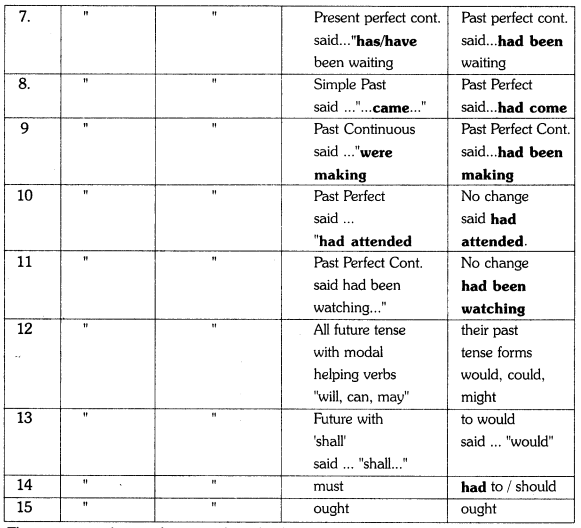
8. The next step in the transformation from the direct to the indirect is to change the adjectives or adverbs showing ‘nearness to those showing ‘distance as explained in the following table:

SI.Ajjective / AdverbAdjective or Adverb
No.in ‘direct speech’in ‘indirect speech’
1.thisthat
2.thesethose
3.herethere
4.nowthen
5.today/tonightthat day/that night
6.yesterdaythe previous day/ the day before
7.tomorrowthe next day/the following day
8.agobefore

9. The transformation from the direct to the indirect involves a change in the word order. This principle is applicable to interrogative and exclamatory sentences only. This is exemplified in the table given below.

SI. No.Word order in Direct Speech with examplesWord order in Indirect Speech with examples
1… Helping verb+subject+ Main verb
… said … “are you coming”…
subject-1-Helping verb+Main
verb
asked … you were / coming
2Helping verb 4- subject + Main verb
said … do you like …
subject +…… + Main verbasked … he …. liked
3‘wh’ word+adj/adv+ subject + verb said “How beautiful + the toy is …subject + verb + intensifier adj/adv exclaimed – the toy was very n beautiful.

Note that the ‘wh’ word in exclamatory sentences doesn’t have the meaning of a question. It just emphasises the adjective or adverb. Hence this ‘wh’ word in the direct speech becomes the intensifier ‘very’ in the indirect speech.

10. The last step in this kind of transformation is to change the ‘Question mark’ or the ‘exclamatory mark’ into a full stop in the indirect speech.

You must note that all the Ten steps detailed above are not necessary to follow in the case of all kinds of sentences. You carefully check which steps are necessary and which steps are not necessary to follow in changing a given sentence.

EXAMPLES

1. Direct speech:
Reporter : Are you a vegetarian or non-vegetarian?
Bernard Shaw : I don’t want to make my stomach a burial ground for dead animais.
Reporter : How wonderful your answer is!
Bernard Shaw : Thank you for your compliments.

Indirect speech :
A reporter asked the famous writer Bernard Shaw whether he was a vegetarian or a non-vegetarian. Bernard Shaw replied that he didn’t want to make his stomach a burial ground for dead animals. The reporter responded that it was a wonderful answer. Bernard Shaw thanked him for his compliments.

3. Gandhi said, “I respect all religions.” (D.S)
Gandhi said that he respected all religions. (I.S)

4. He said to me, “Who is your favourite politician ?” (D.S)
He asked me who my favourite politician was (I.S)

5. An American said, “How hard-working Indians are !” (D.S)
An American exclaimed that Indians were hard-working. (I.S)

6. A customer said to the manager, “Can you do me a favour ?” (D.S)
A customer requested the manager to do him/her a favour. (I.S)

7. Abdul Kalam said, “I have come from a poor background.” (D.S)
Abdul Kalam said that he had come from a poor background. (I.S)

8. The teacher said to a student, “Are you confident ?” . (D.S)
The teacher asked a student whether he / she was confident. (I.S)

9. Amulya says, “I am learning music”. (D.S)
Amulya says that she is learning music. (I.S)

10. The teacher said,’The sun rises in the east.” (D.S)
The teacher said that the sun rises in the east. (I.S)

11. Dr. Rahul said, “1 will try my best to save the patient.” (D.S)
Dr. Rahul said that he would try his best to save the patient. (I.S)

12. Yasoda said to Krishna, “You are mischievous and trouble me a lot. (D.S)
Yasoda told Krishna that he was mischievous and troubled her a lot.” (I.S)

13. They said, “The Minister has at last unveiled the statue today. It has not been unveiled for so many months for reasons unknown.” (D.S)
They said that the Minister had at last unveiled the statue that day and added (that) it had not been unveiled for so many months for reasons unknown. (I.S)

14. A North Indian friend of mine said, “Unlike in Delhi, the climate in Hyderabad is moderate.” (D.S)
A North Indian friend of mine remarked that unlike in Delhi, the climate in Hyderabad was moderate. (I.S)

15. “How is your health ?” said Dr. Charan to a patient. (D.S)
Dr. Charan asked a patient how his/her health was. (I.S)

16. A stranger said to me, “Where is Golconda ?”. (D.S)
A stranger asked me where Golconda was. (I.S)

17. “Dheeraj said to his friend, “Are you interested in teaching ?” (D.S)
Dheeraj asked his friend if/whether he was interested in teaching. (I.S)

18. I said my daughter, “Do you want to do B.Tech. or B.Sc ?” (D.S)
I asked my daughter whether she wanted to do B.Tech or B.Sc. (I.S)

II. Study the following examples and observe how statements are changed into the indirect speech.

Direct SpeechIndirect Speech
1. Simple present
He said, “I have many problems.”
1. Simple past
He said that he had many problems.
2. Present continuous
“I am reporting her words,” he said.
2. Past continuous
He said that he was reporting her words.
3. Present perfect
The cashier in the Bank said, “I have sent a report.”
3. Past perfect
The cashier in die Bank said that he had sent a report.
4. Present perfect continuous
A student said, “I have been trying to speak English for two years.”
4. Past perfect continuous
A student said that he had been trying to speak English for two years.
5. Simple past
‘I forgot my hall ticket,” a candidate said.
5. Simple pastíPast perfect
A candidate said that he / she had forgotten his hail ticket.
6. Past continuous
“I was watering the plants in the garden,” she said.
6. Past continuous / Past per.cont.
She said that she had been watering the plants in the garden.
7. Simple future
“We will move to Hyderabad next year, “Rajitha said.
7. Rajitha said that they would move to Hyderabad the following year.
8. The English teacher said to the class, “I will tell you the difference between the two sentences.”8. The English teacher told the class that he would tell them the difference between the two sentences.

III. Study the following examples and observe how questions are changed into indirect speech.
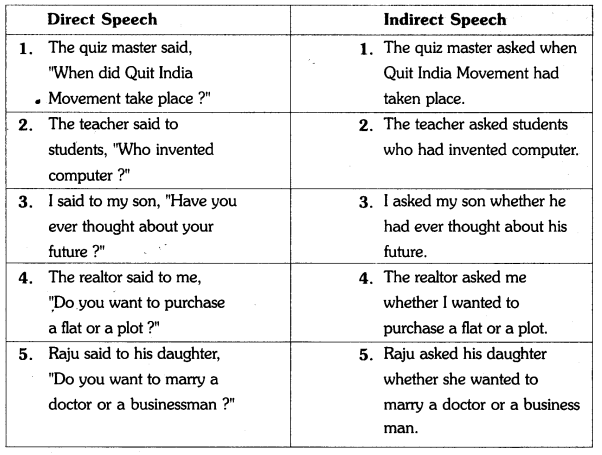
IV. All the verbs are changed into infinitives [to + verb (v1)] while reporting imperative sentences.

Direct SpeechIndirect Speech
1. Order/Command
The Site engineer said to his colleagues : “Don’t deviate from the plan.”
1. The Site engineer ordered his colleagues not to deviate from the plan.
2. Request
A student said to the teacher : “Can you, please, repeat the question, Madam ?”
2. A student requested the teacher to repeat the question.
3. Advice
Ahmad said to his son : “Don’t waste time and money.”
3. Ahmad advised his son not to waste time and money.
4. Instruction
The invigilator said to the candidates in the examination hall:”Write your hall ticket number on the question paper.”
4. The invigilator instructed the candidates in the examination hall to write their hall ticket number on the question paper.
5. Threat
A girl said to a boy : “I will complain to the police, if you tease me.”
5. A girl warned the boy that she would complain to the police if he teased her.
6. Offer
A volunteer said to me : “Can I help you ?”
6. A volunteer offered to help me.
7. Invitation
Praveena said to her friends : “Welcome to my home.”
7. Praveena invited her friends to her house.
8. Warning
Mother said to her son : “Don’t swim in the turbulent river.”
8. Mother warned her son not to swim in the turbulent river.
9. Promise
You said to your mother : Til be careful.”
9. You promised to your mother to be careful.
10. Apology
Raheem said to you :
“I am sorry I am unable to help you.”
10. Raheem apologized to you for not being able to help you.
Direct SpeechIndirect Speech
1. Keerthi said to us, “Let us have some snacks.”1. Keerthi suggested (invited) to us that we should have some snacks.
2. Dev said to us, “Shall we visit the Thousand-Pillar temple today ?”2. Dev proposed that we should visit the Thousand- Pillar temple that day.

Exclanations :

Direct SpeechIndirect Speech
1. “Oh ! They have lost the match,” he said.1. He expressed regret that they had lost the match.
2. “Hurrah ! We have won the match,” said the boys.2. The boys exdamed with delight that they had won the match.
3. My brothers said to me, “Better luck next time.”3. My brothers wished me better luck next time.

Some More Examples :
1. He said to me, ‘You are lucky.” (D.S)
He told me (that) I was lucky. (I.S)

2. He said, “My father went to Chennai.” (D.S)
He said (that) his father had gone to Chennai. (I.S)

3. He said, “The sun rises in the east”. (D.S)
He said that the sun rises in the east. (I.S)

4. He said, “Kutub Minar is in Delhi.” (D.S)
He said that Kutub Minar is in Delhi. (I.S)

5. He said, “1 always go to bed early.” (D.S)
He said he always goes to bed earlier (I.S)

6. He said to me, “Do you want coffee ?” (D.S)
He asked me if I wanted coffee. (I.S)

7. He said to me, “Where did you go ?” (D.S)
He asked me where I had gone. (I.S)

8. He said to his son, “Go out and play.” (D.S)
He told his son to go out and play. (I.S)

9. He said, “Don’t disturb me.” (D.S)
He instructed him not to disturb him. (I.S)

10. He said, “What a terrible storm it is !” (D.S)
He exclaimed that it was a terrible storm. (I.S)

11. He said to her, “How foolish of you !” (D.S)
He exclaimed that she was very foolish. (I.S)

12. He said, “Alas ! What a tragedy.” (D.S)
He exclaimed with sorrow that it was a great tragedy. (I.S)

EXERCISES

QuestionI.

Report the following statements?

1. Sunil said to his daughter, “I will take care of you.”
2. The M.L.A. said to villagers, ‘You have every right to question me.”
3. The Inspector said to the constable, “I am your boss.”
4. It is better for you to join M.PC.” said Bharath’s mother.
5. The principal said to the lecturers, You should maintain records.”
6. “I have been waiting here for you for one hour, “Vasundhara said to Vandana.
7. Kranthi said to the Inspector, “I met with an accident while taking a turn.”
8. He said, “I have lost my bag.”
9. The girl said, “I can change any given sentence into reported speech.”
10. “I am your fan,” said the boy to Allu Aijun.


Answers:


1. Sunil told his daughter that he would take care of her.
2. Tlje M.L.A told villagers that they had every right to question him.
3. The Inspector told the constable that he was his boss.
4. Bharath’s mother said that it would be better for him to join MPC.
5. The principal told the lecturers that they should maintain records.
6. Vasundhara told Vandana that she had been waiting there for her for an hour.
7. Kranthi informed the Inspector that he had met with an accident while taking a turn.
8. He said that he had lost his bag.
9. The girl said that she could change any given sentence into reported speech.
10. The boy told Allu Aijun that he was his fan.

QuestionII.

Match the reported clause of Set n A with each reported statement of the direct speech in Set n B and then change the sentence into the reported speech?
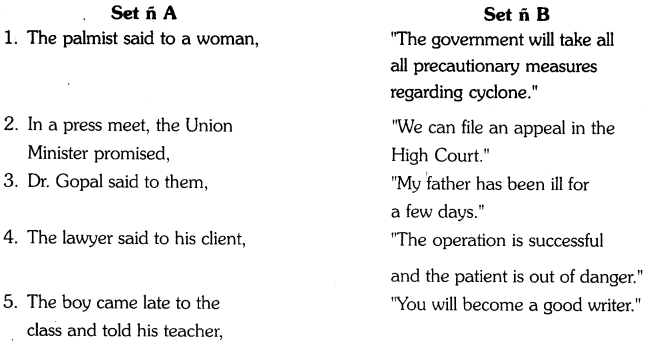


Answers:


1. The palmist told a woman that she would become a good writer.
2. In a press meet, the Union Minister promised that the government would take all precautionary measures regarding cyclone.
3. Dr. Gopal told them that the operation was successful and the patient was out of danger.
4. The lawyer told the client that they could file an appeal in the High Court.
5. The boy came late to the class and told his teacher that his father had been ill for a few days.

QuestionIII.

Report the following questions in indirect speech?

1. A visitor said to me, “Are there any places worth seeing in Warangal ?”
2. The mother said to her son, “When will you have your breakfast ?”
3. The shopkeeper said to the customer, “Shall I show you the latest model ?”
4. I said to the shop assistant, “What is the price of this dress ?”
5. A classmate said to me, “Is your father a businessman ?”
6. Harika said to her friend, “Will you come to my home tomorrow ?”
7. The passenger said to the driver, “Does the bus stop at the crossroads ?”
8. A girl said to the principal, “Do I need to be a postgraduate to become an IAS officer ?”
9. The father said to his daughter, “Who teaches you English, Anitha ?”
10. The teacher said to Kavitha, “What does the word ‘corruption’ mean ?”


Answers:


1. A visitor asked me if there were any worth seeing places in Warangal.
2. The mother asked her son when he would have his breakfast.
3. The shopkeeper asked the customer if he could show him the latest model.
4. I asked the shop assistant what the price of that dress was.
5. A classmate asked me if my father was a businessman.
6. Harika asked her friend if she would come to her home the following day.
7. The passenger asked the driver if the bus would stop at the crossroads.
8. A girl asked the principal if she needed to be a postgraduate to become an IAS officer.
9. The father asked his daughter Anita who would teach them English.
10. The teacher asked Kavitha what the word corruption meant.

QuestionIV.

Change the following imperatives into the indirect speech?

1. Hima said, “Get out from here.”
2. Neha said, “Mom, please give me your mobile.”
3. Hardik said to Annu, “Go and study.”
4. Nani said to me, “Exercise daily.”
5. Father said to Swetha, “Switch off the fan.


Answers:


1. Hima ordered him/them to get out from there.
2. Neha requested her mother to give her mobile.
3. Hardik asked Annu to go and study.
4. Nani advised me to exercise daily.
5. Father asked Swetha to switch off the fan

QuestionV.

Change the following exclamations into the indirect speech?

1. Nivya said to her sister, “How interesting the serial is !”
2. My friend said to me, “What a wonderful opportunity it is !”
3. “Oh ! he is dead,” the doctor said.
4. “Thank goodness ! I’ve passed my exams,” my son said.
5. “Hurray ! I’ve got first rank in the entrance examination !” my friend said.
6. “How awful! She has missed the chance,” Mahesh said.
7. A visitor said, “What sultry weather !”
8. “What a pity ! Many passengers died in the accident,” said an eye witness.
9. Akshay said to his partner, “Bad luck, never mind.”
10. “Oh ! What a beautiful place it is !” he said.


Answers:


1. Nivya exclaimed to her sister that the serial was very interesting.
2. My friend exclaimed to me that it was a wonderful opportunity.
3. The doctor declared sadly that he was dead.
4. My son happily said that he had passed his exams.
5. My friend cheerfully declared that he had got the first rank in the entrance examination.
6. Mahesh rather sadly exclaimed that she had missed the chance.
7. A visitor exclaimed that it was very sultry weather.
8. An eye witness exclaimed sadly that many passengers had died in the accident.
9. Akshay told his partner that it was their bad luck and said better not mind that.
10. He exclaimed that it was a very beautiful place.

QuestionVI.

Report the following sentences?

1. A father said to his son. “Ramu, concentrate on your studies now.”
2. “What a wonderful poem it is !” said the teacher.
3. The principal said to the student, “Vinay, can you spell this word ?”
4. “Is there any train to Mumbai now ?” I asked the enquiry clerk.
5. “How much time does a ray of the sun take to reach the earth ?” the quiz master asked the team.
6. “Alas ! India has lost a famous scientist,” said the Prime Minister on the death of Abdul Kalam.
7. “How would you help develop the company ?” the interview board member said to the can-didate.
8. “If I get a job, I will arrange a grand party,” said Spandana.
9. “Stand where you are,” the officer said to the cadets.
10. “Don’t make friends with bad boys,” said the mother to her son.
11. “Hearty welcome to our village !” Radha said to her friends.
12. “Hurrah ! We have defeated Pakistan in T 20 too,” said Kohli.
13. “Please be seated. My father is sleeping,” said the girl to the visitors.
14. “I am a pure vegetarian,” Gandhi said.
15. “How exciting it is to see Telangana as a separate state !” said a hundred-year old man.
16. “Remember, Man is mortal,” said the Swamiji.
17. He said, “We need not wait here for the bus.”
18. “While I was going to see Deepthi, it started raining,” Kiran said.
19. The doctor said, “Sorry, I cannot help it.”
20. “Nothing is in our hands,” said the priest.


Answers:


1. A father advised his son Ramu to concentrate on his studies then.
2. The teacher exclaimed that it was a very wonderful poem.
3. The principal asked Vinay if he could spell that word.
4. I asked the enquiry clerk if there was any train to Mumbai then.
5. The quiz master asked the team how much time a ray of the sun took to reach the earth.
6. The Prime Minister said on the death of Abdul Kalam that India had lost a famous scientist.
7. The interview board member asked the candidate how he would help the company develop.
8. Spandana said that if she got a job she would arrange a grand party.
9. The officer ordered the cadets to stand where they were.
10. The mother advised her son not to make friends with bad boys.
11. Radha extended hearty welcome to her friends to her village.
12. Kohli gladly said that they had defeated Pakistan in T20 too.
13. The girl requested the visitors to be seated and informed them that her father was sleeping.
14. Gandhi said that he was a pure vegetarian.
15. A hundred – year old man exclaimed that it was very exciting to see Telangana as a separate state.’
16. The Swamiji said emphatically that man is mortal.
17. He said that they needed not wait there for the bus.
18. Kiran said that while he was going to see Deepthi, it had started raining.
19. The doctor apologetically said that he couldnot help it.
20. The priest said that nothing was in their hands.

QuestionVII.

Change the following sentences into the indirect speech?

1. I said to her, “I had already applied for a job.”
2. You said to me, “She loves you.” * ‘
3. We said to him, “Can we use your phone ?”
4. The teacher said to her, ‘Why did you fail the exam ?”
5. She will say to me, “How do you solve the problem ?”
6. I said to them, “I don’t ever waste my time.”
7. You said to me, “I have not yet met them.”
8. The minister said, “The problem will surely be looked into.”
9. They said to rile, “Have you been working here since 2015 ?”
10. We said to them, ‘We were watching a movie.”
11. She said, “I went to the market yesterday.”
12. They said to us, “We will be waiting for you.”
13. John said to her, “1 will call a doctor for you.”
14. I said to her, “Alas, I am undone !”
15. She said to him, “Please complete the job.”
16. He shouted at them, “Shut up!”
17. The officer said to him, “Don’t repeat this mistake in the future.”
18. The teacher said, “Akbar died in 1605 AD.”
19. She said to her, “Knowledge is power.”
20. A soft voice said, “What a cold day !”


Answers:


1. I told her that I had already applied for a job.
2. You told me that she loved me.
3. We asked him if we could use his phone.
4. The teacher asked her why she had failed the exam.
5. She will ask me how I will solve the problem.
6. I told them that I never wasted my time. (OR) I told them that I never waste my time.
7. You told me that you had not yet met them.
8. The minister said that the problem would surely be looked into.
9. They asked me if I had been working there since 2015.
10. We told them that we had been watching a movie.
11. She said that she had gone to the market the previous day.
12. They told us that they would be waiting for us.
13. John told her that he would call a doctor for her.
14. I exclaimed with sorrow to her that I was undone.
15. She requested him politely to complete the job.
16. He ordered them loudly to shut up.
17. The officer warned him not to repeat that mistake in the future.
18. The teacher said that Akbar had died in 1605 AD.
19. She told her that knowledge is power.
20. A soft voice exclaimed that it was a very cold day.

QuestionVIII.

Change the following sentences into the other speech?

1. A good teacher will say frankly and clearly, “I don’t know, 1 cannot answer that question.”
2. I asked my Biology teacher what I should do to save it.
3. I asked my grandmother how she got to be so wise.
4. Thimmakka concludes, “Even one sapling each could make a better place for our children.”
5. Box : Stop ! Can you inform me who the individual is that I invariably encounter going downstairs when I’m coming up, and coming upstairs when I’m going down ?


Answers:


1. A good teacher will say frankly and clearly that he/she doesn’t know. He/She will add that he/ she cannot answer that question. (I.S)
2. I said to my Biology teacher, “What shuld I do to save it ?” (D.S)
3. I said to my grandmother, “How did you get to be so wise” ? (D.S)
4. Thimmakka concludes that even one sapling each could make a better place for our children. (I.S)
5. Box asked (her) to stop. He further asked her if she could inform him who that individual was that he invariably encountered going downstairs when he was coming up and coming upstairs when he was going down. (I.S)

C. DEGREES OF COMPARISON

Man craves for variety. He knows that variety is the spice of life. Hence he tries to express the same idea in various different ways. The result is the tradition of describing the quality, quantity size etc., of some thing or person in three different ways. Most adjectives and some adverbs have three different forms. They are positive, comparative and superlative. They are known as the three degrees of comparision.

(ఒక వ్యక్తి యొక్క వస్తున్న యొక్క గుణ, పరిమాణాలను మూడు భిన్న రూపాలలో వ్యక్తీకరించడం ఆనవాయితీ. ఈ రూపాలనే Degrees of comparison అని పిలుస్తారు)

When the comparison is among a minimum of three persons/things, that can be ex-pressed in all the three degrees. If the compared persons are two only, the superlative degree is not possible. When we talk of the quality, quantity of a single item, only positive degree is possible.

Interchange of Degrees of comparison :
Transforming one sentence from the Superlative Degree to Comparative Degree involves the following steps.

1. First, remove ‘the’ that is used before the superlative adjective, while changing it into the comparative.
2. Write the comparative form of the adjective.
3. Then, add ‘than any other’ after the adjective.
Ex : Praveen is the youngest boy in the class. (S.D.)
Praveen is younger than any other? boy in the class.

To change that sentence into the positive :

1. Begin the sentence with ‘No other’.
2. Secondly, place the phrase after the superlative adjective after ‘No other’.
3. Use ‘so + adj in positive Degree + as’ after the verb.
4. Place the subject in the S.D after ‘as’ in RD.
Ex : He is the richest man in our town. (S.D.)

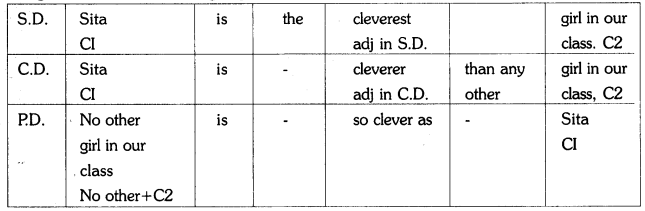
Sentences with ‘one of phrase in the Superlative degree follow a slightly different wording. This is as explained here under.
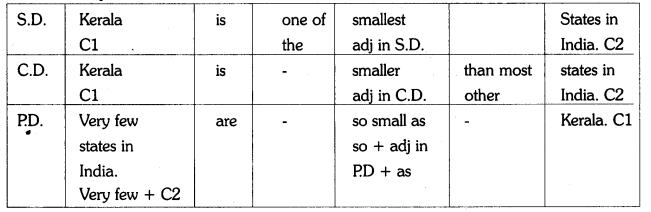
Some sentences show the comparison between only two things/persons. In such cases, the superlative is not possible. The interchange is made as shown here.

EXAMPLES

Change the following sentences into other degrees.

Question 1.


Bengaluru is as cool as Ooty. (P.D)?


Answer:


Ooty is not cooler than Bengaluru. (C.D)

Question 2.


Australia is the biggest island in the world. (S.D)?


Answer:


Australia is bigger than any other island in the world. (C.D)
No other island in the world is so big as Australia. (PD)

Question 3.


The moon is brighter than the stars. (C.D)?


Answer:


The stars are not so bright as the moon. (P.D)

Question 4.


There is no vice so bad as drink. (P.D)?


Answer:


Drink is worse than any other vice. (C.D)

Question 5.


Kashmir is the most beautiful place in India. (S.D)?


Answer:


No other place in India is so beautiful as Kashmir. (P.D)
Kashmir is more beautiful than any other place in India. (C.D)

Question 6.


Silver is not so precious as gold. (P.D)?


Answer:


Gold is more precious than silver. (C.D)

Question 7.


Kumble is one of the ablest bowlers. (S.D)?


Answer:


Very few bowlers are so able as Kumble. (P.D)
Kumble is abler them most other bowlers. (C.D)

Question 8.


The lion is more ferocious than any other animal. (C.D)?


Answer:


The lion is the most ferocious of all the animals. (S.D)
No other animal is so ferocious as the lion. (P.D)

Question 9.


The sword is not so mighty as the pen. (P.D)?


Answer:


The pen is mightier than the sword. (C.D).

Question 10.


Copper is more useful than most other metals. (C.D)?


Answer:


Copper is one of the most useful metals. (S.D)
Very few metals are so useful as copper. (P.D)

Question 11.


Mount Everest i.s higher than any other peak in the world. (C.D)?


Answer:


Mount Everest is the highest of all the peaks in the world. (S.D)
No other peak in the world is so high as Mount Everest. (P.D)

Question 12.


I like you better than him. (C.D)?


Answer:


I didn’t like him as well as I like you. (P.D)

Question 13.


A deer runs faster than a horse. (C.D)?


Answer:


A horse does not run so fast as a deer. (P.D)

Question 14.


Sangeetha is the tallest girl in the class. (S.D)?


Answer:


No other girl in the class is so tall as Sangeetha. (P.D)

Question 15.


This is one of the most powerful earthquakes that occurred. (S.D)?


Answer.

This is more powerful than most other earthquakes that occurred. (C.D)
Very few earthquakes that occurred are as powerful as this earthquake. (P.D)

More Examples :

1. For me, dancing is easier to learn than singing. (C.D)
For me, singing is not as easy to learn as dancing. (P.D)

2. Singing is the best of all art forms. (S.D)
Singing is better than any other art forms. (C.D)
No other art form is as good as singing. (P.D)

3. The sentence is more impressive than the earlier one. (C.D)
The earlier sentence is not so impressive as this one. (P.D)

4. A car, of course, is costlier than a bike. (C.D)
A bike, of course, is not as costly as a car. (P.D)

5. Uttar Pradesh is the largest state in India. (S.D)
Uttar Pradesh is larger than any other state in India. (C.D)
No other state in India is as large as Uttar Pradesh. (P.D)

6. Bill Gates is the wealthiest man in the world. (S.D)
Bill Gates is wealthier than any other man in the world. (C.D)
No other man in the world is as wealthy as Bill Gates. (P.D)

7. English is the most widely used language in the world. (S.D)
English is more widely used than any other language in the world. (C.D)
No other language in the world is as widely used as English. (P.D)

EXERCISES

QuestionI.

Change the following sentences into other Degrees?

1. LIC is one of the most popular insurance companies in India.
2. The custard apple is better for health than the apple.
3. A computer works faster than the human brain.
4. A Governor is sometimes more powerful than a Chief Minister.
5. The teaching profession is the best of all professions.
6. Laxmi Mittal is one of the most popular industrialists.
7: No other bank in India has as many branches as SBI.
8. Virus infects a person faster than bacteria.
9. Cancer is one of the most dangerous diseases.
10. No other boy in the class is as active as Surya Teja.
11. The Amazon is one of the longest rivers in the world.
12. No other animal lives as long as the turtle.
13. Jupiter is bigger than any other planet.
14. A rainbow is one of the most beautiful sights in nature.
15. Very few English poets are as great as John Keats.
16. The lotus is the most beautiful flower.

17. Mathematics is more difficult than most other subjects.
18. Shimla is cooler than Ooty.
19. He can’t run as fast as I.
20. Vinay is not as mischievous as some other boys in the college.
21. There are some vegetarian food as healthy as eggs.
22. Of all the Telugu singers S.R Balasubramanyam has the most melodious voice.
23. Health is more important than wealth.
24. I cannot speak as fast as you.
25. Very few TV channels are as popular as E TV.


Answers:


1. Very few insurance companies in India are as popular as LIC. (P.D)
LIC is more popular than many other insurance companies in India. (C.D)

2. The apple is not as good for health as the custard apple. (P.D)

3. The human brain does not work as fast as a computer. (P.D)

4. Sometimes a Chief Minister is not as powerful as a Governor. (P.D)

5. The teaching profession is better than any other profession. (C.D)
No other profession is as good as the teaching profession. (P.D)

6. Very few industrialists are as popular as Laxmi Mittal. (P.D)
Laxmi Mittal is more popular than many other industrialists. (C.D)

7. SBI has the most number of branches. (S.D)
SBI has more branches than any other bank in India. (C.D)

8. Bacteria does not infect a person as fast as virus. (P.D)

9. Cancer is more dangerous than many other diseases. (C.D)
Very few diseases are as dangerous as cancer. (P.D)

10. Surya Teja is more active than any other boy in the class. (C.D)
Surya Teja is the most active boy in the class. (S.D)

11. The Amazon is longer than many other rivers in the world. (C.D)
Very few rivers in the world are as long as the Amazon. (P.D)

12. The turtle lives longer than any other animal. (C.D)
The turtle lives the longest of all animals. (S.D)

13. No other planet is as big as Jupiter. (P.D)
Jupiter is the biggest planet. (S.D)

14. A rainbow is more beautiful than many other sights in nature. (C.D)
Very few sights in nature are as beautiful as a rainbow. (P.D)

15. John Keats is one of the greatest poets of English. (S.D)
John Keats is greater than many other poets of English. (C.D)

16. The lotus is more beautiful than any other flower. (C.D)
No other flower is as beautiful as the lotus. (P.D)

17. Mathematics is one of the most difficult subjects. (S.D)
Very few subjects are as difficult as Mathematics. (P.D)

18. Ooty is not as cool as Shimla. (P.D)

19. I can run faster than he. (C.D)

20. Vinay is one of the most mischievous boys in the college. (S.D)
Vinay is more mischievous than many other boys in the college. (C.D)

21. Eggs are not healthier than some vegetarian foods. (C.D)

22. No other Telugu singer has a voice as melodious as S.R Balu’s. (P.D)
S.R Balu’s voice is more melodious than that of any other Telugu singer. (C.D)

23. Wealth is not as important as health. (P.D)

24. You can speak faster than I. (C.D)

25. E TV is more popular than many other TV channels. (C.D)
E TV is one of the most popular TV channels (S.D)

QuestionII.

Rewrite the following comparisons as directed?

1. The taste of Pizza is more pleasing than that of Burger. (into the other degree)
2. Sheela is getting smarter and smarter than Neela. (into the other degree)
3. Raj is one of the bravest fighters. (into comparative)
4. Radha speaks more fluently than Sudha. (into the other degree)
5. ’ Riding a horse is not as easy as riding a motorbike. (into the other degree)
6. ‘Silence’ is the most potent weapon to win an argument. (into positive)
7. Rachana’s sister is taller than yours. (into the other degree)
8. Dogs don’t look as cute as rabbits. (into the other degree)
9. He is not the worst student in the class. (into comparative)
10. Very few heroes are as great as Gandhiji in the world history. (into superlative)


Answers:


1. The taste of Burger is not so pleasing as that of Pizza. (P.D)
2. Neela is not getting as smart as Sheela. (P.D)

3. Raj is braver than any other fighter. (C.D)
No other fighter is as brave as Raj. (P.D)

4. Sudha does not speak as fluently as Radha. (P.D)

5. Riding a motorbike is easier than riding a horse. (C.D)

6. No other weapon is so potent as silence to win an argument. (P.D)
Silence is more potent than any other weapon to win an argument. (C.D)

7. Your sister is not so tall as Rachana’s sister. (P.D)
8. Rabbits look cuter than dogs. (C.D)

9. He is not worse than most students in the class. (C.D)
Many students in the class are as bad as he. (P.D)

10. Gandhi is one of the greatest heroes in the world history. (S.D)
Gandhi is greater than many other heroes in the world history. (C.D)

QuestionIII.

Change the following sentences into other degrees of comparison?

1. Bus journey is not as comfortable as train journey.
2. Radhakrishnan is more highly respected than any other teacher.
3. Robert Frost is one of the best American poets.
4. No other road in the world is as long as the Pan American Highway.
5. Kashmir is one of the coolest places in India.
6. A foolish friend can be more dangerous than a wise enemy.
7. Money is not as important as character.
8. Modern culture is not as stable as Traditional culture.
9. For many Indians, cricket gives greater pleasure than football.
10. Natural flowers appeal more to our senses than artificial flowers.


Answers:


1. Train journey is more comfortable than bus journey. (C.D)

2. Radhakrishnan is the most highly respected teacher. (S.D)
No other teacher is so highly respected as Radhakrishnan. (P.D)

3. Robert Frost is better than many other American poets. (C.D)
Very few American poets are as good as Robert Frost. (P.D)

4. Pan American Highway is longer than any other road in the world. (C.D)
Pan American highway is the longest road in the world. (S.D)

5. Kashmir is cooler than many other places in India. (C.D)
Very few places in India are so cool as Kashmir. (P.D)

6. A wise enemy cannot be so dangerous as a foolish friend. (P.D)
7. Character is more important than money. (C.D)
8. Traditional culture is more stable than modern culture. (C.D)
9. For many Indians, football doesn’t give as much pleasure as cricket. (P.D)
10. Artificial flowers do not appeal to our senses as much as natural flowers. (P.D)

D. QUESTION TAGS

Question tags are short questions added to statements. They seek confirmation or agreement. (ఏకీభావాన్ని లేదా ద్రువీకరణను ఆశిస్తూ, ఒక వాక్యానికి అనుబంధంగా చేర్చబడే చిన్న ప్రశ్నలే Question tags.)

Question tags have a fixed structure. It is represented as : Helping verb + (n’t) + pronoun ? ((n’t) in brackets means it is optioned.)
e.g. She loves her children, doesn’t she?
(Q.T.) does (H.V.) n’t she (pronoun)

1. While constructing a tag, selecting the suitable helping verb is the first and the most important step. If the given sentence has a helping verb, then that helping verb is used in the tag too.
E.g : She has answered all the questions, hasn’t she?
has → Helping Verb in the sentence used in the tag too.

When the sentence doesn’t have a helping verb, the verb is either in the simple present Or in the simple past and in the affirmative. In case of the simple present, the suitable helping verb is “do/does”. If the verb in the sentence is in the simple past, then we must use ‘did’ in the tag.
Eg : a) She hates smokers, doesn’t she ? Simple present, hence ‘does’
b) They grow vegetables, do n’t they ? Simple present
c) He sold his car, didn’t he ? Simple past; hence ‘did’.

2. The second step is to decide whether to use ‘n’t’ or not. The guiding principle is quite simple. If the given sentence doesn’t have ‘rio/not’, use ‘n’t’ is the tag. If the given sentence has ‘no/not’ then the tag doesn’t have ‘n’t’.
Eg : a) He was sleeping in the class, was n’t he ?
‘not’ is not used n’t in the tag
b) They don’t grow paddy, do they?
‘n’t’ in sentence ‘n’t’ not used in tag
Remember to use the short form ‘n’t’ in the tag.

3. The last part of the tag as a pronoun. This corresponds to the subject of the given sentence. If the subject of the sentence is a pronoun, the same pronoun is used in the tag. If the subject is a noun, select a suitable pronoun as shown below.

SI.No.Subject in the sentencePronoun used in the tag
1.Name of a manhe
2.Name of a womanshe
3.Name of a single thingit
4.Name referring to, a group of persons, places, thingsthey

Eg : a) Gourav is a good cricketer, isn’t he? ?
b) Sania Mirza played well, didn’t she ?
c) Ooty is a beautiful hill station, isn’t it ?
d) Mangoes aren’t good this season, are they ?

4. Note that ‘amn’t’ is not used. Instead, aren’t is used.
Eg : lam rather slow, aren’t I ?

5. Imperative sentences take ‘will’ as the helping verb in the tags.
Eg : a) Close the door, Won’t you ? (Will + n’t = won’t)
b) Don’t leave the place, will you ?

6. Sentences expressing proposals with the help of “Let us ……………..” have for their tags “Shall we?”
Eg : Let us walk fast, shall we ?

EXAMPLES

1. Srinivasa Ramanujan is a famous mathematician, isn’t he ?
2. Normally players have a lot of practice, don’t they ?
3. Sania Mirza is not a cricketer, is she ?
4. She can speak English, can’t she ?
5. He should believe us, shouldn’t he ?
6. We must all learn English, mustn’t we ?
7. The Governor administers the oath of office to ministers, doesn’t she / he ?
8. He does not support any one, does he ?
9. Most of the villagers depend on agriculture, don’t they ?
10. They do not seem to lead a happy life, do they ?
11. Children love to play with toys, don’t they ?
12. On their picnic, the children did not have a chance to play in the garden, did they ?
13. The children are not yet back home, are they ?
14. Do me a favour, Raju, can you ?
15. Take a right decision, won’t you ?
16. Don’t waste time, will you ?
17. Let’s understand their problems, shall we ?
18. No one complained against us, did they ?
19. Everyone appreciated his performance, didn’t they ?
20. Someone should take the initiative, shouldn’t they ?
21. Nothing is impossible, is it ?
22. There will be problems in that case, won’t there ?
23. One can achieve anything by faith, can’t one ?
24. I am not disturbing you, am I ?
25. It is used for present actions, isn’t it ?
26. You understand the point, don’t you ?
27. You are attending a job interview tomorrow, aren’t you ?
28. It is clear to you now, isn’t it ?
29. They are ready, aren’t they ?
30. They are not ready, are they ?
31. He did not attend the class, did he ?
32. Oh, you got two prizes, did you ? (Special case. Positive statement, positive tag. Express reaction to a surprising news.)
33. I am going home, aren’t I ? (Note that ‘aren’t is used instead of ‘amn’t.)

EXERCISES

QuestionI.

Add an appropriate question tag to each one of the following statements?

1. Sandeep has attended all classes, ……………….. ?
2. We are lucky to be born in India, ………………..?
3. English is an interesting language, ……………….. ?
4. He was very busy yesterday, ……………….. ?
5. I am very happy now, ……………….. ?
6. I can face challenges, ……………….. ?
7. Ravi always thinks positively, ……………….. ?
8. He does not criticize, ……………….. ?
9. Some people always depend on others, ……………….. ?
10. Discipline must be maintained at any cost, ……………….. ?
11. Let us keep to the pavement, ……………….. ?
12. Don’t blame others for everything, ……………….. ?
13. One can do wonders with knowledge, ……………….. ?
14. Nothing is permanent except change, ……………….. ?
15. Students are our best judges, ……………….. ?


Answers:


1. hasn’t he ?
2. aren’t we ?
3. isn’t it ?
4. wasn’t he ?
5. aren’t I ?
6. can’t I ?
7. doesn’t he ?
8. does he ?
9. Don’t they
10. mustn’t it be ?
11. shall we ?
12. will you ?
13. can’t one ?
14. is it ?
15. aren’t they ?

QuestionII.

Add an appropriate question tag to each one of the following statements?

1. You don’t lime me, ……………….. ?
2. It is not raining, ……………….. ?
3. You have done your homework, ……………….. ?
4. I am not late, ……………….. ?
5. I am invited to your party, ………………..?
6. You like fast food, ……………….. ?
7. You will come to my party, ……………….. ?
8. You remembered to feed the cat, ……………….. ?
9. Let’s play tennis, ……………….. ?
10. There’s a problem here, ……………….. ?
11. He never says a word, ……………….. ?
12. Nobody came to your party, ……………….. ?
13. Don’t forget, ……………….. ?
14. You think you’re clever, ……………….. ?
15. So you think you’re clever, ……………….. ?
16. We don’t have to go to the party, ……………….. ?
17. It stopped raining, ……………….. ?
18. Have a seat, ……………….. ?
19. Help yourself to some cake, ……………….. ?
20. Children, be quiet, ……………….. ?


Answers:


1. do you
2. is it
3. haven’t you
4. am I (Note . possible tag-am ; negative tag are in the place of ami
5. aren’t I
6. don’t you
7. won’t you
8. didn’t you
9. shall we
10. isn’t there
11. does he (never = not; negative statement; hence positive tag)
12. did they
13. will you
14. don’t you (you think is the main clause)
15. do you (expressing sudden reaction)
16. do we
17. didn’t it
18. won’t you
19. will you
20. will you

QuestionIII.

Add an appropriate question tag to each one of the following statements?

1. I am unable to answer your question, ………………..?
2. Rahul’s first rank is at stake, ……………….. ?
3. The noise in my ears was that of the faithful Oxford crowd, ……………….. ?
4. The stop-watches held the answer, ……………….. ?
5. It belongs to both of you, ……………….. ?


Answers:


1. am I (unable = not able)
2. isn’t it
3. wasn’t it
4. didn’t they
5. doesn’t it ?
TS Inter 1st Year English Grammar Tenses

0

Q.No. 12 (4 × 1 = 4 Marks)

VERB :

A verb is a word that tells about an action, a state of being or existence, possession, or a change in state.
ఒక పనిని గురించి గాని, ఒక స్థితి గురించి గాని యాజమాన్యం గురించి గాని, స్థితిలో మార్పు గురించి గాని తెలిపేది verb.
e.g. : The boy cried, (action)
I have a watch, (possession)
She is a nurse, (a state of being)
He became weak, (change in state)
పై వాక్యాలలోని cried, have, is, became అను పదాలు పనిని గాని స్థితిని గాని తెలుపుతున్నాయి. అందుచే అవి verbs.

TENSE

Tense : Tense is the form of the verb. It shows the time of the action or event. There are three tenses. They are :

  1. Present Tense
  2. Past Tense
  3. Future Tense
TenseIndefinite Simple formContinuous formPerfectPerfect Continuous
Present Tense : Active
Passive
I call.
I am called.
I am calling.
I am being called.
I have called.
I have been called.
I have been calling. (No form)
Past Tense :
Active
Passive
I called.
I was called.
I was calling.
I was being called.
I had called.
I had been called.
I had been calling. (No form)
Future Tense :
Active
passive
I shall call.
I shall be called.
I shall be calling. (No form)I shall have called.
I shall have been called.
I shall have been calling. (No form)

THE USE OF THE TENSES

1. SIMPLE PRESENT OR PRESENT INDEFINITE TENSE :

  1. It is used to express what actually happens at the time of speaking,
    e.g. :
    1. Here comes John.
    1. Children do not sit quietly in one place.
  2. It is used to express habitual action :
    e.g. : I get up early in the morning.
  3. It is used to express general or universal truths :
    e.g. : The earth is round.
    Stars twinkle
    We grow paddy.
    Speed thrills but kills.
  4. It is used to express future action that has already been planned :
    e.g. : Our college reopens on 16th June.
    He sails for England next Monday.
  5. It is used to express historic present:
    e.g. :
    1. Sivaji now sees the danger and immediately kills Afzul Khan with his lion-claws,
    1. Birbal now seizes the chance and cracks a joke on his rivals.

2. PRESENT CONTINUOUS TENSE :

  1. It is used to express an action that is going on at the time of speaking :
    e.g. :She is dancing. They are writing.
  2. It is used to express an action that will happen in the future.
    e.g. : 1) I am going to Mysore tomorrow.
  3. It is used to show that some action is in the middle though it is not being done at that time.
    e.g. : I am reading a novel.

Note : The following verbs are not generally used in the Continuous Tense : (ఈ క్రింది verbs ను సామాన్యంగా continuous Tense లో ఉపయోగించరాదు )

Verbs of sense of perception :
hear, see, smell, notice, recognise, taste, feel.
Verbs of appearing : look, seem, appear.
Verbs of thinking :
Suppose, think, believe, realise, understand, know, imagine, mean, agree, consider, trust, remember, forget, expect, recall.
Verbs of emotions :
want, wish, desire, feel, like, love, hate, prefer, hope, refuse.
Miscellaneous :
own, possess, keep, concern, matter, owe etc.
e.g. : He is looking fine. (Wrong)
He looks fine. (Correct)
I am believing you. (Wrong)
I believe you. (Correct)
She is understanding me. (Wrong)
She understands me. (Correct)
I am hating you. (Wrong)
I hate you. (Correct)

3. PRESENT PERFECT TENSE :

i) It is used to denote an action that has just been completed.
e.g. : The train has arrived.
They have finished the work.

ii) It is used to express a past action the result of which continues :
e.g. : I have not seen Ravi for many months.
He has been ill since Monday.

iii) It is used to refer to a past action in a more general way :
e.g. : Have you ever been to Simla ?

iv) A few adverbs or adverbial phrases are used with the Present Perfect Tense :
just, never, ever, so far, till, yet, already, since, today, this week etc.
e.g. : I have just posted the letter.
So far he has not come.
He has not received the money yet.
This week there have been no rains.

4. PRESENT PERFECT CONTINUOUS TENSE :

It is used to refer to an action that begins in the past and continuous through a given period of time up to the present moment.
e.g. : I have been waiting here for Ramu for two hours.
I have been waiting here for Ramu since 3 p.m.

Note : ‘For’ denotes period of time.
‘Since’ denotes point of time.

Observe the following sentences :

  1. He has been painting the door for 2 p.m. (Wrong)
    He has been painting the door since 2 p.m. (Correct)
  2. The workers have been demanding more wages since ten days. (Wrong)
    The workers have been demanding more wages for ten days. (Correct)

5. SIMPLE PAST OR PAST INDEFINITE TENSE :

i) It is used to express the action completed in the past. Adverbs and adverbial phrases expressing Past time are often used with this tense.
(భూతకాలంలో పని పూర్తయినట్లయితే దానిని తెలుపుటకు Simple Past లేక Past Indefinite Tense ను వాడెదరు. భూతకాలాన్ని తెలిపే క్రియ విశేషణ పదాలు యీ tense లో ప్రయోగింపబడతాయి.)
e.g. : She met me yesterday.
The clerk did his work hurriedly.

ii) It is used to express a habitual action in the past.
(భూతకాలంలో అలవాటుగా చేసే పనులను విశదపరచుటకు Simple Past Tense వాడెదరు.)
e.g. : People performed child marriages in olden days. While I was in Chennai, I spoke to others in Tamil.

6. THE PAST CONTINUOUS TENSE :

It is used to express an action that was still going on in the past time.
(భూతకాలంలో పని కొనసాగింపును Past Continuous Tense తెలుపును.)
e.g. : I met Raghu while he was standing at the college gate.
We noticed some birds which were flying.

7. PAST PERFECT TENSE :

It is used to express an action which had been completed at some point in the past time before another action in the past. We use Past Perfect to refer to the earlier action and Simple Past to refer to the later action.
(భూతకాలంలో ముందు జరిగిన పనిని Past Perfect Tense లోను రెండవ పనిని Simple Past Tense లోను చెప్పాలి.)
e.g. : The train had left before they reached the station.
had finished my work when Alfred came in.
పై వాక్యాలలోని మొదటి దానిని ఉదాహరణగా తీసుకుందాం. ఇందులో గతంలో జరిగిన రెండు పనులు సూచింపబడ్డాయి. The train left. They reached the station. ఇందులో ముందు జరిగినది The train left. దీనిని Past Perfect Tense లో చెప్పాలి. అప్పుడు వాక్యం The train had left before they reached the station. అయింది.)

8. PAST PERFECT CONTINUOUS TENSE :

It is used to show an action that had begun in the past and continued till some point of time in the past.
(భూతకాలంలో ఒక పని ఎప్పుడో ప్రారంభమై, అదే పని కొంత కాలము వరకు కొనసాగుతున్నదని Past Perfect Continuous Tense లో తెలపాలి. )
e.g. : I had been watching TV for an hour when my uncle came to see me.
We had been playing hockey for three hours when it started to rain.
She had been passing the information to the rivals for a long time before she was caught.

9. SIMPLE FUTURE (OR) FUTURE INDEFINITE TENSE :

It is used to express an action that will take place in the future.
(భవిష్యత్తు కాలంలో జరగబోయే పనిని Simple Future తెలుపును. )
e.g.: I shall meet you tomorrow.

10. FUTURE CONTINUOUS TENSE :


It is used to express an action going on at some point in future.
(భవిష్యత్తు కాలంలో జరగబోయే పనిని Future Continuous తెలుపును.)
e.g. : She will be sleeping then.
We will be playing the match at this time tomorrow.
shall be writing a letter at this time on Monday.

11. FUTURE PERFECT TENSE :


It is used to express an action that will be completed at some point in the future :
(భవిష్యత్తులో ఒక నిర్ణీతకాలానికి పని పూర్తగునని Future Perfect Tense విశదపరచును.)
e.g. : I shall have done my work before you come.

12. FUTURE PERFECT CONTINUOUS TENSE :


It is used to refer to an action that will be in progress at a point in Future after continuing for a given period.
e.g. : I shall have been completing thirty years of service by next March.
shall have been writing the examination for two hours by this time on Monday.

TENSES IN CONDITIONAL CLAUSES :

Clauses that show conditions are called conditional clauses. Sentences with conditional clauses use fixed patterns of Tenses.
Conditions are of four types :

  1. Real conditions
  2. Unreal or improbable conditions
  3. Past unfulfilled conditions and
  4. Zero conditions.

The tense forms used in a sentence are determined by the type of the condition in that sentence.

Look at the following examples :

  1. If it rains, I will not come to your home.
    (Real condition-Simple present in the conditional clause and Simple Future in the main clause)
  2. If I were a bird, I would fly high in the sky. (Unreal condition – Simple Past (were-even with I) in the conditional clause and ‘would+V’ in the main clause)
  3. If he had worked hard, he would have passed the examination.
    (Past unfulfilled condition-Past Perfect in the conditional clause and would + have + Past Participle of verb in the main clause).
  4. If you heat metals, they expand.
    (Zero conditions : The action certainly leads to the second action. Simple present is used in both the clauses).

The information may easily be noted in the table form.

s. No.Type of conditionTense in conditional clauseTense in main clause
1RealSimple Present
Ex : If you come early.
Simple Future we will go to our friends house.
2UrealSimple Past If I were youwould + V
I wouldn’t do that.
3Past UnfulfilledPast Perfect
If she had started early
would + have +
pp of verb she would have
4Zero conditionSimple Present If you go highercaught the train. Simple Present you see better.

ADDITIONAL EXAMPLES

1. SIMPLE PRESENT TENSE :

  1. Indians love cricket.
  2. He looks awful.
  3. My father works in the USA.
  4. South Indians eat a lot of rice.
  5. We play in the field every week.
  6. The train leaves at 5 pm.
  7. The sun rises in the east.
  8. Water boils at 100 degrees Celsius.
  9. He practises yoga daily in the morning.
  10. Heat evaporates water.
  11. What goes up must come down.
  12. Do you go for a walk every day ?
  13. A cobra hisses when it is disturbed.
  14. Cocks crow every morning.
  15. He doesn’t wake up early in the morning.

Look at the following examples.

Which do you like more ? Tea or coffee ?
I like coffee.
What channel does your mother, watch usually ?
My mother watches ETV, mostly serials.
Do you read any English newspaper ?
Yes, I do / No, I don’t.
Does your father allow you to use a mobile ?
Yes, he does / No, he doesn’t.
Do your parents check your studies ?
Yes, they do / No, they don’t.

2. PRESENT CONTINUOUS TENSE :

  1. am reading an interesting novel.
  2. am also learning English.
  3. We are going home late this week.
  4. Ravi : Why are you mewing like a cat ?
    Sonu : I am trying to learn mimicry.
    Ravi : Are you undergoing training in mimicry ?
    Sonu : No, I am learning on my own with the help of my brother. In fact he is going to an institute.
  5. Notice the difference.
    Where do you come from ? refers to your home town.
    Where’ are you coming from ? refers to the immediate place from where you are coming.
    1. It is raining heavily. (Now actually happening) _
    1. She is going to the market.
    1. They are doing business.
    1. He is trying for a job.
UnacceptableAcceptable
1. I am knowing the address.I know the address.
2. She is resembling her mother.She resembles her mother.
3. Is anyone here having a flat ?Does anyone here have a flat ?
4. They are belonging to Kerala.They belong to Kerala.
5. I am hating loud noise.I hate loud noise.

3. PRESENT PERFECT TENSE :

i) He has just entered the room.
ii) I have seen the movie.
iii) Pussy cat, pussy cat where have you been ?
iv) I have been to London to see the queen.
v) I have been to Kashmir four times.
vi) The shop has been open for a month.
vii) He has just finished his homework.
viii) They have just gone out.
ix) He has painted die door. (It is still wet) 5
x) She has received the mail. (She is yet to read and respond)
xi) They have learnt dance for two weeks.
xii) My niece has lived in Delhi for two years.
(over this two year period extends till the present moment)
xiii) It has rained heavily this morning. (It is morning still)
xiv) My parents have been to the USA ten times.
xv) Have you ever met a film star or a sports star?
xvi) Has your teacher ever praised you ?
xvii) Have you ever seen a horse flying ?
xviii) When have you met a famous person ? (wrong)
When did you meet a famous person ? (right)
xix) 1 have met him last year, (wrong)
I met him last year, (right)
xx) We have lived in Warangal for years.
xxi) The players have arrived.
xxii) The beauty parloUr has been closed.
xxiii) They have noticed some printing mistakes in the book.
xxiv) I haye repaired the bike, (activity completed)

xxv) Some expressions used with the present perfect tense :
just, recently, lately, already, before, so far, still, ever / never, today, this morning, for weeks / years, since 2000, etc.

xxvi) Husband : Have you packed die luggage ?
Wife : Yes. I have.
Husband : Have you informed the neighbours about our trip ?
Wife : Yes. I have.
Husband : Have you phoned our daughter about our visit ?
Wife : No, I haven’t. Let’s give her a surprise.
Husband : Have you locked the door properly ?
Wife : Yes, 1 have.
Husband : Have you checked all the doors ?
Wife : Oh ! God ! I have forgotten to bolt the back door.
Husband : What!

4. PRESENT PERFECT CONTINUOUS TENSE

  1. Harika has been reading a novel since morning.
  2. The ladies have been playing Holi for two hours.
  3. I have been repairing the bike for the last two hours.
    (the continuation of an activity is stressed)
  4. have been repairing the bike for two hours. (How long have you been repairing it ?)
  5. We have been preparing seriously for the examination since 1st January.
  6. We have been living in Hyderabad since 2000/ for over twenty years.
  7. Keerthi : Hai Shravya ! So late ? I have been waiting here for an hour.
    Shravya : Oh ! Sorry Keerthi. But it has been raining for over an hour and my brother has been quarrelling with me for this umbrella. That’s why I am late.

Note :
Since refers to a point of time – since yesterday, since morning For refers to a period of time – for two days, for four weeks

5. SIMPLE PAST TENSE :

  1. We lived in Hyderabad for thirty years.
  2. Yesterday an accident took place near the railway station.
  3. walked a lot when I lived on campus.
  4. They settled in Hyderabad ten years ago.
  5. They didn’t eat anything yesterday.
  6. Where did you go last week ?
  7. Did he participate in the last week’s meeting ?
  8. My brother completed degree last year.
  9. India had a glorious past.
  10. The player relaxed for ten minutes.
    (over that period in the past)
  11. contacted the secretary this morning.
    (It is afternoon or evening)
  12. attended all classes last week.
  13. They lived here for a long time.
  14. We went to school every day.

6. PAST CONTINUOUS TENSE :

  1. It was raining at that time.
  2. People were running all over the platform; they were pushing each other.
  3. Two women were walking when the bus came from the opposite direction.
  4. When I reached my home at eight, my daughter was playing the guitar and my parrot was singing the tunes. My son was eating a chocolate and my wife was relaxing in a chair.
  5. You were doing home work at 6 p.m. yesterday, (a past point of time)
  6. The children were playing cricket all the day yesterday.
    (over a period of time in the past)
  7. was making tea when her friend came, (at the time of another past event)
  8. What were you doing when your father returned home ?
  9. What was your sister doing why your mother was reading a novel ?

7. PAST PERFECT TENSE :

  1. My friend had completed the homework by the time I went to his room.
  2. The bus had left before we reached the bus station.
  3. I had typed the letter before the officer came.
    (= First I typed the letter and then the officer came.)
  4. The chain snatcher had escaped before the police arrived.
    (= First the chain snatcher escaped and then the police arrived)
  5. We had already consulted a doctor before my father had an attack.
  6. He rushed to the station but the train had left.
  7. realized that my pocket had been picked.
  8. recognized the man as I had met him last week.
  9. Our trip was comfortable as we had made arrangements earlier.
  10. Reshma felt sleepy as she had stayed Up through the night.
  11. The student was punished as he had not done his homework.
  12. Srikanth had never seen skyscrapers before he went to New York.
  13. She did not see me till I had seen her.
    (= First I saw her and then she saw me)
  14. had received your letter yesterday. (NOT acceptable)
    received your letter yesterday. (When we talk about only ONE past action in a sentence, simple past is acceptable, Not past perfect.) (acceptable)

8. PAST PERFECT CONTINUOUS TENSE :

  1. He had been playing cricket since he was a boy but gave it up later when he took up a job.
  2. had been singing a song for five minutes when my friend came.
  3. Sureshan had been doing research for two years when his sister joined the university.
  4. The murderer had been holding the knife for five minutes when the police entered the room. (Both activities happened in the past.)

9. SIMPLE FUTURE TENSE :

  1. Srihan and Srihith will come from the US next August.
    They will stay here for three weeks.
  2. will conduct a quiz competition on spelling tomorrow.
  3. The President will stay in Hyderabad for a month.
  4. The Chief Minister will conduct a press meet.
  5. They will not start the road-work tomorrow.
  6. Will they plant the saplings ?
  7. When will you inform them ?
  8. Shall we have some coffee ?
  9. Shall we sit here ?

10. FUTURE CONTINUOUS TENSE :

  1. We will be spending our holidays in Shimla this summer.
  2. She will be sleeping when I reach home.
  3. Dinesh : Vijay, What’s your tomorrow’s programme ?
    Vijay : I will be washing my car at this time tomorrow.
    Dinesh : Don’t you have a driver ?
    Vijay : No, I myself do it every Sunday. What about you ?
    Dinesh : I will be spending my time in the library.
    Vijay, : Good. I like it.
  4. As tomorrow is a holiday they will be playing at this time.
  5. He will be meeting Venkat next week. (Perhaps, they are colleagues.)

11. FUTURE PERFECT TENSE :

  1. We will have cleared the entire loan amount in four years from now.
  2. She will have recovered from her illness by next week.
  3. Sloka : When are you going to start your medical practice ?
    Sneha : My medical course is not yet over.
    Sloka : Is it so ?
    Sneha : Yes, I will have completed the M.B.B.S. course by 2022.
    Sloka : Oh ! I will have put jn two years of experience in a software job by then.
    Sneha : Of course, but I want to serve the rural poor as a doctor.
    Sloka : Great! You are right. There are very few committed people like you.
    Sneha : In fact, my uncle serves as a doctor in a village in Karimnagar District. He will have served there for ten years by next year.
    Sloka : Great! A family of committed doctors !!
  4. We save Rs. 1000/- a month. We started saving in January last. We shall have saved Rs. 12,000/- by the end of the year.
  5. They boarded the train at 6 o’ clock in the evening. They will have reached Delhi tomorrow morning by 7.
  6. The teachers will have completed the lessons by the end of the acedemic year.

12. FUTURE PERFECT CONTINUOUS TENSE :

  1. They will have been travelling for 26 hours in the train when they reach Varanasi.
  2. I will have been teaching them grammar for five years when they leave school next year.
  3. He will have been staying in the USA for three years when I go there next month.

FUTURE TIME REPRESENTATION :
a) Using simple present tense :
The President visits Hyderabad tomorrow.
My examinations begin next week.
(These are events that are scheduled and are sure to happen. In such cases we use simple present to express a future action.)

b) Using present progressive tense : (Present continuous tense) We are planning an exhibition of paintings in December this year.
You are visiting Bali on your trip to Indonesia next month. (These are events that have been planned. Very likely these events will take place in the future, but there is a likelihood of these events being rescheduled. However, they are yet to happen.)

c) Using going to
I am going to buy a new car on the 1st of next month.
I am going to be a doctor in five years from now.
(The phrase going to is used to of talk actions that we intend to do or plan to achieve. To express a future possibility, this structure is used.)

d) Use of modal will / should :
will buy a gift when you pass the examination.
You will join a good engineering college if you get a first class.
You should join the army if you choose to serve the country.
We shall be in touch and discuss this matter.
(Will and Shall are modal verbs that help us to express our desire or propositions.

Exercises

QuestionI.

Fill in the blanks with the present simple or the present continuous of the verbs given in brackets?

1. Custard apple ………………….. (be) a tasty and healthy fruit.
2. The moon ………………….. (appear) at night.
3. I ………………….. (rain) now. We can’t go now.
4. A ray of the sun ………………….. (not, pass) through a wall.
5. Hyderabad ………………….. (be) the Capital of Telangana state.
6. All banks ………………….. (open) on the first and the third Saturday of the month.
7. People ………………….. (speak) Telugu all over AP and Telangana.
8. My English teacher usually ………………….. (speak) English in the classroom, but surprisingly she ………………….. (speak) Telugu now.
9. ………………….. North Indians ………………….. (eat) chapatis daily ?
10. ………………….. he ………………….. (do) any job at present ?
11. Usually I ………………….. (close) all doors before going to bed.
12. ………………….. you………………….. (believe) in ghosts ?
13. My father ………………….. (watch) a serial at the moment.
14. Water ………………….. (freeze) during winter in some parts of the Atlantic Ocean.


Answer:


1) is
2) appears
3) is raining
4) does not pass
5) is
6) open
7) speak
8) speaks, is speaking
9) Do, eat
10) Does do / is doing
11) close
12) Do, believe
13) is watching
14) freezes

QuestionII.

Fill in the blanks with the present perfect or the present perfect continuous of the verbs given in brackets?

1. Aarthi ………………….. (act) in films since her marriage with Raghu, a film director.
2. She ………………….. (appear) in about twenty films so far.
3. I ………………….. just ………………….. (receive) a call.
4. She ………………….. (not, pay) the exam fee yet.
5. How ………………….. you ………………….. (watch) this TV programme.


Answer:


1) has been acting
2) has appeared
3) have, received
4) has not paid
5) have, watched

QuestionIII.

Fill in the blanks with the Simple Past, the Past Continuous, the Past Perfect or Past Perfect Continuous forms of the verbs given in brackets?

1. The tsunami ………………….. (break) while the sailors ………………….. (row) the boats.
2. How ………………….. you ………………….. (spend) your childhood ?
3. I ………………….. (browse) the internet when he came to our house.
4. The audience ………………….. (occupy) their seats before the cinema began.
5. The farmers ………………….. (sow) seeds for two hours when the sun set.
6. There was a stampede when the pilgrims suddenly ………………….. (rush) into the temple.
7. I wish I ………………….. (have) a car.
8. When ………………….. (be) you born ?
9. How long ………………….. your brother ………………….. (stay) in the US when you went there for MS ?
10. Gandhi ………………….. (pass away) in 1948.


Answer:


1) broke, were rowing
2) did, spend
3) was browsing
4) had occupied
5) had been sowing
6) rushed
7) had
8) were
9) had, been staying
10) passed away

QuestionIV.

Fill in the blanks with the Simple Future, the Future Continuous, the Future Perfect or Future Perfect Continuous forms of the verbs given in brackets?

1. Telangana ………………….. (become) a developed state in two years.
2. The umpire ………………….. (resolve) the controversy within a few minutes.
3. At this point of time tomorrow the children ………………….. (watch) a cartoon film.
4 ………………….. you ………………….. (solve) all these problems by next week ?
5. If we follow A.RJ. Kalam’s advice, India ………………….. soon ………………….. (become) a superpower.
6. He ………………….. (do) the job for two years by next year.


Answer:


1) will become
2) will resolve
3) will be watching
4) will, have solved
5) will, become
6) will have been doing

QuestionV.

Fill in the blanks with appropriate forms of the verbs given in brackets?

1. Surya Namaskar ………………….. (consist) of twelve postures.
2. Gandhi ………………….. (influence) by the writings of Tolstoy.
3. Bandla Sirisha ………………….. (be) the first Telugu woman (third Indian origin woman) to go into the space on July 11, 2021.
4. Rohit Sharma ………………….. (bat) for two hours when rain interrupted the match.
5. The meeting ………………….. (start) by 10.00 a.m. tomorrow.
6. Usually my father ………………….. (take) rice for lunch, But now he ………………….. (take) chapatis.
7. People ………………….. (speak) Telugu in Telangana and Andhra Pradesh.
8. Mary ………………….. (eat) her supper by 7.00 p.m.
9. Don’t disturb ! The child ………………….. (sleep)
10. If I ………………….. (be) a bird, 1 would fly high in the sky to have a beautiful view of the earth.
11. It is time we ………………….. (start) working hard.
12. If I were you, I ………………….. (construct) an independent house.
13. Don’t get off the train till it ………………….. (stop).
14. Listen ! Somebody ………………….. (scream).
15. A parrot ………………….. (repeat) our voice as soon as it listens to it.
16. Vinay ………………….. (lose) the job last year because of his misbehaviour.
17. Dhirubai Ambani ………………….. (not, live) in a costly house even when he was a famous industrialist.
18. ………………….. he ………………….. (play) tennis dally ?
19. While I ………………….. (teach) grammar, a student raised a doubt.
20. A philanthropist ………………….. (think) about the welfare of others.
21. My nephew ………………….. (do) business in Hyderabad for the last ten years.
22. The moon ………………….. (wax) and ………………….. (wane) during the cycle of a month.
23. I ………………….. (know, not) the right answer right now.
24. We ………………….. (have) hot coffee one hour ago.
25. The birds ………………….. just ………………….. (fly) away.


Answer:


1) consists
2) was influnced
3) is
4) had been batting
5) will have started
6) takes … is taking
7) speak
8) will have eaten
9) is sleeping
10) were
11) started
12) would construct
13) stops
14) is screaming
15) repeats
16) lost
17) did not live
18) Does … play
19) was teaching
20) thinks
21) has been doing
22) waxes … wanes
23) do not know
24) had
25) have … flown

QuestionVI.

Rewrite the following sentences correcting the underlined parts?

1. He is doing homework since 8 o’ clock.
2. If they are going out, we will follow them.
3. If you will depend on others for everything, you will not learn anything.
4. If you have helped your mother, she would have felt happy.
5. He is trying for a job since last year.
6. Mukesh Ambani has constructed the world’s costliest house for his wife in Mumbai four years ago.
7. He has returned from Dubai a month ago.
8. He is not having any cash.
9. I am knowing them for the last many years.
10. Is he remembering our help ?
11. He has borrowed a thousand rupees from me yesterday.
12. Don’t disturb him. He reads.
13. Did you left for Hyderabad last year ?
14. Sangeetha joins us tomorrow.
15. Are you smelling anything bad ?


Answer:


1. He has been doing homework since 8 o’ clock.
2. If they go out, we will follow them.
3. If you depend on others for everything, you will not learn anything.
4. If you had helped your mother, she would have felt happy.
5. He has been trying for a job since last year.
6. Mukesh Ambani constructed the world’s costliest house for his wife in Mumbai four years ago.
7. He returned from Dubai a month ago.
8. He doesn’t have any cash.
9. I have known them for the last many years.
10. Does he remember our help ?
11. He borrowed a thousand rupees from me yesterday.
12. Don’t disturb him. He is reading.
13. Did you leave for Hyderabad last year ?
14. Sangeetha will join us tomorrow. (Sangetha is joining us tomorrow)
15. Do you smell anything bad ?

QuestionVII.

Fill in the blanks with suitable forms of the verbs given in brackets?

Two Sides of Life

Question 1.


There …………………… (be) quite a number of divisions into which life …………………… (be + divide)?


Answer:


are ……………………. can be divided

Question 2.


You …………………… …………………… (sometimes / find) two persons who …………………… (get up) in the morning, perhaps a morning that …………………… (be) overcast with shadows?


Answer:


will sometimes find … get up … is

Question 3.


A good teacher …………………… (say) frankly and dearly, “I …………………… (not know). I …………………… (not answer). that question.”?


Answer:


will say; don’t know, cannot answer

Question 4.


I …………………… (hear) those tales so manytimes that I …………………… (not want) to get into the atmosphere of the people who …………………… (tell) them?


Answer:


had heard; didn’t want; told

Question 5.


In nine cases out of ten, the person who …………………… (cultivate) the habit of looking on the dark side of life …………………… (be) the little person, the miserable person, the one who …………………… (be) weak in mind, heart and purpose?


Answer:


cultivates; is; is

Question 6.


No teacher …………………… (know) everything about every subject?


Answer:


knows

Question 7.


They …………………… (be) the people who never …………………… (go) forward?


Answer:


are; go

Question 8.


You …………………… (not, accomplish) the task we expect of you if you go with a moody, discouraged,
fault-finding disposition.


Answer:


will not accomplish

Father, Dear Father

Question 9.


This …………………… (be) in answer to your letter about my transgression?


Answer:


is

Question 10.


The operating word ‘think’ …………………… (make) me muse?


Answer:


did make

Question 11.


Father, we’ve never really been close, and I can’t rightly say you …………………… ……………………(be) my friend, philosopher, guide etc.?


Answer:


have been

Question 12.


…………………… you …………………… (apply) Pythagoras Theorem or Newton’s law of Gravity ?


Answer:


Do apply

Question 13.


My grandfather …………………… (speak) of a carefree and beautiful childhood?


Answer:


speaks

Question 14.


Father, …………………… he …………………… (fib) ?


Answer:


is… fibbing

Question 15.


She …………………… (be) at peace with her pots, pans and Bhagavad Geeta?


Answer:


is

Question 16.


…………………… it Adam arid Eve …………………… (eat) the Tree of knowledge, all over again ?


Answer:


is … eating

Question 17.


Last week my rose plant …………………… (die)?


Answer:


died

Question 18.


I …………………… (ask) my Biology teacher what I …………………… (do) to save it?


Answer:


asked; should do

Question 19.


If I …………………… (be) to meet Newton face to face, I …………………… (fail) to recognise him, so busy am I learning about him !?


Answer:


were; would fail

Question 20.


If he …………………… (say) George Bush is the president of India, it (have) to be so?


Answer:


says; will have

The Green Champion – Thimmakka

Question 21.


Every year, the count of these trees …………………… (keep) increasing?


Answer:


kept

Question 22.


Thimmakka (She) not only …………………… (plant) those trees but also …………………… (fence), …………………… (water) and …………………… (guard) them?


Answer:


planted; fenced; watered; guarded

Question 23.


Although Thimmakka …………………… (not receive) a formal education, her work …………………… (honour) with the National Citizen’s Award of India?


Answer:


did not receive; has been honoured

Question 24.


Saalumarada Thimmakka …………………… (be) an individual who …………………… (bring) worldwide recognition to the state of Karnataka through her incredible and massive environmental services?


Answer:


is … has brought

The First Four Minutes

Question 25.


If I …………………… (falter), there …………………… (be) no arms to hold me and the world …………………… (be) a cold, forbidding place, because I …………………… (be) so close?


Answer:


faltered; would be; would be; had been

Question 26.


Blood …………………… (surge) from my muscles and …………………… (seem) to fell me?


Answer:


surged; seemed

Question 27.


I …………………… (know) it would be some time before I …………………… (catch) up with myself?


Answer:


knew; caught

Question 28.


I felt that the moment of a lifetime …………………… (come)?


Answer:


had come

Question 29.


The air I breathed …………………… (fill) me with the spirit of the track where I had run my first race?


Answer:


filled

Question 30.


I felt suddenly and gloriously free of the burden of athletic ambition that I …………………… (carry) for years?


Answer:


had been carrying

Box and Cox

Question 31.


At present I …………………… (be) entirely of your opinion because I …………………… (have) not the most distant particle of an idea what you …………………… (mean).?


Answer:


am; have; mean

Question 32.


The gentleman who …………………… (get) the attic …………………… (be) hardly ever without a pipe in his mouth and there he …………………… (sit) with his feet upon the mantelpiece?


Answer:


has got; is; sits

Question 33.


I …………………… (be) so dreadfully puzzled to know what to say when Mr. Cox …………………… (speak) about it?


Answer:


was; spoke

Question 34.


Why …………………… (not) you …………………… (keep) your own side of the staircase, sir ?


Answer:


don’t; keep

Question 35.


She …………………… (think) to cook her breakfast while I …………………… (be) asleep with my coals?


Answer:


thought; was

TS Inter 1st Year English Grammar Prepositions

0

Q.No. 11 (8 × 1/2 = 4Marks)

PREPOSITION :


A preposition is placed before nouns, pronouns, noun equivalents, noun-phrases or noun clauses. It shows its relation to some other word or words in the sentence.

e.g. :

  1. She is fond of sweets.
  2. He jumped into the river.

USING PREPOSITIONS :

A) In :

1) To denote place : in Canada; in a village.
2) To indicate time : in the morning.
3] To indicate position : in intensive care, in a jovial mood.
4) To indicate dress : in blue frock, in uniform.
5) To indicate surroundings : in open space, in prison.

B) At :

1) To denote state : India and Pakistan were at war in the early sixties.
2) To indicate a point of time : I shall meet you at 5 p.m.
3) To denote degree or price : We bought these apples at forty rupees a dozen.
4) To denote a place : She was at school then.
5) To tell the sense of beingengaged : All the students are at play.
6) To denote aim : The hunter fired his gun at the bird.
7) With the names of small villages and towns : She lives at Kolanupaka.

C) By :

1) To show nearness : There is a house by the stream.
2) To mean ‘during’ . : By night or by day, he is a nuisance.
3) To mean ‘measure’ : He is taller by an inch.
4) To mean in the name of : I swore in the court by God.
5) To mean instrument : The Inspector caught the thief by the collar.
6) To mean ‘past’ : He goes by my house every morning.
7) To mean the cause : The house was destroyed by fire.

D) On :

1) Place : My pen is on the table.
2) Time : I was on time to the examination.
3) Position : Sarala is on probation.
4) Concern : This is a book on law.
5) Objective : I am bent on visiting Mysore this summer.

E) Of :

1) Relationship : The results of S.S.C. are published today.
2) Phrases : a man of principles, a story of adventure.
3) Division : He took one metre of this cloth.
4) Subjective relation : The love of mother can never be repaid.
5) Cause : He died of sunstroke.
6) Source : She comes of a rich family.
7) Quality : Shyiock was a man of cruel character.
8) Contents : I received a bag full of gifts.
9) Peculiar constructions : How nice of you !

F) For :

1) In place of : Dalda is used for ghee.
2) On account of : We entered slowly for the fear of disturbing the baby.
3) Purpose : Let us pray for peace.
4) Destination : I am leaving for Chennai.
5) Period of time : They have been working for the last three hours.

G) After :

1) Resemblance : Sivaji takes after his mother.
2) Next : The dog ran after the hare.
3) Time : I usually return home after 5 p.m.

DIFFERENCES IN USING PREPOSITIONS

1. At, in :a) At …. small villages She lives at Masaipet.b) At … inside or outside.
She is at the station.
In … cities and countries.
She lives in Warangai.
She lives in the U.K.In … inside only.
She is in the Cafeteria.
2. On, upon :
On denotes things at rest.
He sat on a chair.
Upon denotes things in motion.
The tiger jumped upon the deer.
3. Between; among :a) Between refers to two :
Choose between these two pens.b)  The two thieves divided the money between themselves.
Among refers to “more than two” Choose one among these ribbons.
The four thieves divided the money among themselves.
4. Beside; beside :Beside means next to, at the side of, near to
a) My house is beside the post office.
b) Ravikant sits beside me.
Besides means “in addition to”
I take bread besides biscuits.
She speaks Germar besides French.
5. For, since :‘For‘ denotes period of time.
a) We have been working for four hours.b) She has been staying here for six months.
Since‘ denotes point of time.
We have been workin since 8 a.m.
S ‘he has been staying her since April.

Prepositions, the ones like ‘on, at, of , for’ (mostly monosyllables), are called Simle Prepositions while those consisting of two or more words like search of, in front of are called Complex Prepositions (or Phrasal Prepositions )
Here is a list of prepositions that go with certain ver bs/adjectives, etc.

Exercise

QuestionI.

Fill in the blanks with suitable prepositions from the list given below?

(to, up, for, on, after, to, off, at, of, in)
1. We should not feel superior ………………….. others.
2. People usually put ………………….. new (dresses ………………….. festival days.
3. He is good ………………….. English, but Weak ………………….. Mathematics.
4. Don’t rely ………………….. others for everything.
5. If you give ………………….. the efforts, you don’t succeed.
6. I went to the airport to see ………………….. my son.
7. The minister left ………………….. Delhi yesterday.
8. We reached the station much ahead ………………….. the schedule time.
9. They have agreed ………………….. our proposal.
10. The government should look ………………….. the orphans.


Answer:


1) to
2) on, on
3) at, in
4) on
5) up
6) off
7) for
8) of
9) to

QuestionII.

Fill in the blanks with suitable phrasal prepositions from the list given below?

(adjacent to, believe in, put out, abide by, agree with, deal with, made of, adapt (oneself) to, interested in, front of)

1. Shloka is ………………….. music.
2. Are you …………………..reading novels ?
3. We must ………………….. the circumstances to lead a happy life.
4. Some poems ………………….. in imaginary situations.
5. These chairs are ………………….. plastic.
6. The members must ………………….. one another to come to an agreement.
7. If you don’t ………………….. the fire immediately, it will spread fast.
8. You must ………………….. the rules and regulations.
9. SBI is located ………………….. the new shopping mall.
10. We ddn’t ………………….. superstitions.


Answer:


1) fond of
2) interested in
3) adapt (ourselves) to
4) deal with
5) made of
6) agree with
7) “put out
8) abide by
9) adjacent to
10) believe in

Question III.

Fill in the blanks with correct prepositions?

1. We lived ………………….. (in / at) the U.S.A ………………….. (for / in) two years.
2. The office is open ………………….. (from / on) 10 a.m ………………….. (to / at) 5 p.m.
3. Abraham Lincoln came ………………….. (from / with) a poor family.
4. She has been suffering ………………….. (from / with) fever.
5. He prefers coffee ………………….. (with / to) tea.
6. He fell ………………….. (of / off) a bicycle.
7. There is a spider ………………….. (on / by) the wall.
8. We come to college ………………….. (by / in) bus.
9. The girl sat ………………….. (between / among) her parents.
10. We congratulated Ajay ………………….. (with / on) winning the award.
11. We cut fruits ………………….. (by / with) a knife.
12. Children are fond ………………….. (of / off) toys.
13. Gandhiji was born ………………….. (on / in) 1869.
14. All of us are afraid ………………….. (off / of) mad dogs.
15. The patient was shifted ………………….. (to / for) a hospital.


Answer:


1) in, for
2) from, to
3) from
4) from
5) to
6) off
7) on
8) by
9) between
10) on
11) with
12) of
13) in
14) of
15) to

Question IV.

Fill in the blanks with correct prepositions?

1. India got independence ………………….. 1947.
2. I have been reading this book ………………….. 2018.
3. Suresh goes to college ………………….. foot.
4. He served in the military ………………….. thirty years.
5. Very few people can swim ………………….. the river Ganga.
6. The martyr wrote his final testament ………………….. blood.
7. Many great people hail ………………….. rural areas of the country.
8. The snake crawled ………………….. its pit.
9. There is a cold war ………………….. these two countries.
10. There is a beautiful painting ………………….. the wall.
11. Yoga is good ………………….. health.
12. She spoke ………………….. her travel experiences.
13. Suman left ………………….. Australia.
14. Mohan is a student ………………….. Delhi University.
15. Are you aware ………………….. Corona precautions ?
16. There are many hills ………………….. the river.
17. Wealth is inferior ………………….. learning.
18. We open locks ………………….. keys.
19. He jumped ………………….. the well.
20. The issue is ………………….. you and me.


Answer:


1) in
2) since
3) on
4) for
5) across
6) in
7) from
8) into
9) between
10) on
11) for
12) about/of
13) for
14) of
15) of
16) along / near
17) to
18) with
19) into
20) between

Question V.

Fill in the blanks with suitable prepositions?

1. My grandson is fond ………………….. chocolates.
2. My friend lives ………………….. Delhi.
3. The apples cost ………………….. Rs. 100/- a Kg.
4. I agree ………………….. you, cent percent.
5. Can you translate this ………………….. English ………………….. Telugu ?
6. There is something extraordinary ………………….. Kohli.
7. Sheela is a nurse. She cares ………………….. the elderly.
8. Srikanth has gone away. He will be away ………………….. Monday.
9. The five thieves shared the stolen money ………………….. themselves.
10. The train started exactly ………………….. 6 o’ clock.
11. It rained ………………….. two days.
12. Switch ………………….. the light, please, it is quite dark here.
13. The trains are seldom ………………….. time.
14. We-five ………………….. the fifth floor.
15. She is familiar ………………….. computer hardware.
16. I have not slept properly ………………….. two days.
17. He trembled ………………….. fear when he was caught.
18. Looking forward ………………….. seeing you at the meeting.
19. Most foreigners dream ………………….. visiting India.
20. She insisted ………………….. joining us.


Answer:


1) of
2) in
3) X (no preposition)
4) with
5) from, to / into
6) about
7) for
8) till
9) among
10) at
11) for
12) on
13) on
14) on
15) with
16) for
17) with
18) to
19) of
20) on

Question VI.

Fill in the blanks with suitable prepositions.

The Sides of Life

Question 1.


I want you to go out _______(1)_________ this institution so trained and so developed that you will be constantly looking _______(2)_______ the bright, encouraging arid beautiful things _______(3)_______ life?


Answer:


1) from
2) for
3) in

Question 2.


When you go _______(1)_______ your classrooms, I repeat, try to forget and overlook any weak points that you may think you see. Remember, and dwell _______(2)_______ the consideration that has been given _______(3)_______ the lesson, the faithfulness _______(4)_______ which it was prepared, and the earnestness _______(5)_______ which it is presented?


Answer:


1) into
2) upon
3) to
4) with
5) with

Question 3.


Everything that comes _______(1)_______ their mouths is unpleasant, _______(2)_______ this thing and that thing, and they make the whole atmosphere _______(3)_______ them unpleasant _______(4)_______ themselves and _______(5)_______ everybody _______(6)_______ whom they come _______(7)_______ contact?


Answer:


1) from
2) about
3) around
4) for
5) for
6) with
7) into

Question 4.


They live simply _______ the negative side of life?


Answer:


on

Father, Dear Father

Question 5.


Yetshe is _______(1)_______ peace _______(2)_______ herpots, pans, her flowers and garden, her Bhagavad Geeta and scriptures. My mother, highly qualified, is highly strung, tense and nervy. Do you think, literacy is a harbinger _______(3)_______ restlessness, fear, frustration ? Is it Adam and Eve eating the Tree _______(4)_______ knowledge, all _______(5)_______ again ?


Answer:


1) at
2) with
3) of
4) of
5) over

Question 6.


My first rank is _______ stake, you see?


Answer:


at

Question 7.


I would like you to be aware _______ my musings?


Answer:


of

Question 8.


Papa, my grandfather, speaks _______(1)_______ a carefree and beautiful childhood.?


Answer:


of

The Green Champion Thimmakka

Question 9.


As the grew up, she was married _______(1)_______ Sri Bikkala Chikkayya _______(2)_______ Hulikal village _______(3)_______ whom she found a purpose to plant trees?


Answer:


1) to
2) of
3) with

Question 10.


Thimmakka and her husband used to carry four pails _______(1)_______ water _______(2)_______ a distance _______(3)_______ 4 km to water the saplings?


Answer:


1) of
2) for
3) of

Question 11.


Thimmakka continues her fight _______(1)_______ afforestation?


Answer:


for

The First Four Minutes

Question 12.


_______(1)_______ one and a half laps I was still worrying _______(2)_______ the pace. Advoice shouting ‘Relax’ penetrated _______(3)_______ me _______(4)_______ the noise _______(5)_______ the crowd?


Answer:


1) at
2) about
3) into
4) above
5) of

Question 13.


As we lined up _______(1)_______ the start I glanced _______(2)_______ the flag again. It fluttered more gently now, and the scene _______(3)_______ Shaw’s Saint Joan flashed _______(4)_______ my mind, how she, _______(5)_______ her desperate moment, waited _______(6)_______the wind to change?


Answer:


1) for
2) at
3) from
4) through
5) at
6) for

Box and Cox

Question 14.


_______(1)_______ the appearance _______(2)_______ his outward man, I should unhesitatingly set him _______(3)_______ as a gentleman connected _______(4)_______ the printing interest?


Answer:


1) from
2) of
3) down
4) with

Question 15.


He’s gone _______(1)_______ last! Really I was all _______(2)_______ a tremble _______(3)_______ fear Mr. Box would come in _______(4)_______ Mr. Cox went out?


Answer:


1) at
2) in
3) for
4) before

Question 16.


So it seems ! Far be it _______(1)_______ me, Bouncer, to hurry your movements, but I think it right to acquaint you _______(2)_______ my immediate intention _______(3)_______ divesting myself _______(4)_______ my garments, and going _______(5)_______ bed?


Answer:


1) from
2) with
3) of
4) of
5) to

TS SCERT 8th Maths Textbook 2026: PDF Download Telugu & English Medium at Manabadi

0

TS SCERT 8th Maths Textbook 2026 plays a vital role in building strong mathematical foundations for students studying in Telangana state schools. Designed as per the latest academic framework, this textbook helps Class 8 students understand mathematical concepts clearly through step-by-step explanations, illustrations, and real-life examples.

Students, teachers, and parents can now download the TS SCERT Class 8 Maths Textbook 2026 PDF in both Telugu Medium and English Medium from Manabadi, a trusted platform for educational updates and study materials.

Download TS SCERT 8th Maths Textbook 2026 PDF

Subject NameDownload Link
AP 8th Class Mathsclick here to download

About TS SCERT Class 8 Maths Textbook 2026

The Class 8 Mathematics textbook is published by Telangana SCERT (State Council of Educational Research and Training). It strictly follows the syllabus prescribed by the Telangana State Board for the academic year 2025–26.

This textbook is structured to enhance:

  • Logical thinking
  • Analytical ability
  • Problem-solving skills
  • Conceptual clarity

The content is age-appropriate and aligned with modern teaching methodologies, ensuring students grasp both theoretical and practical aspects of mathematics.

How to Download TS SCERT 8th Maths Textbook 2026 PDF from Manabadi

Follow these simple steps to download the textbook:

  1. Visit the official website of Manabadi
  2. Navigate to the TS SCERT Textbooks section
  3. Select Class 8
  4. Choose Mathematics subject
  5. Select Telugu Medium or English Medium
  6. Click on the PDF Download link

The file will open in PDF format and can be saved for offline use.

Importance of Class 8 Maths in Academic Growth

Class 8 Mathematics acts as a bridge between basic arithmetic and advanced mathematics taught in higher classes. Topics like algebra, mensuration, and geometry form the foundation for Class 9 and 10 syllabus.

A strong understanding of Class 8 Maths helps students in:

  • SSC (Class 10) preparation
  • Competitive exams like Olympiads
  • Logical reasoning development
  • Science and technology subjects

Hence, using the official TS SCERT textbook is highly recommended.

TS SCERT 8th Maths Textbook 2026 is an essential academic resource for Telangana Class 8 students. With a well-structured syllabus, clear explanations, and practical problem-solving approach, this textbook ensures strong mathematical fundamentals.

Students can download the TS SCERT Class 8 Maths Textbook PDF in Telugu & English Medium easily from Manabadi, making learning more accessible and flexible. Make the most of this free resource to strengthen your maths skills and excel in exams.

TS Inter 1st Year English Grammar Matching Meanings

0

Learning means skill that improves comprehension and communication fast.

While looking up the the word in a dictionary for its accurate meaning is the best possible way, doing so is not always possible.

It is sometimes possible to ‘guess’ the meaning of a new word from the context in which it *- is used and from its composition.

Going through glossaries helps to a great extent in mastering this aspect.

In the Intermediate Public Examinations words for this question are usually picked up from the prescribed pieces. Hence, noting down the meanings of important words from the prescribed lessons will help the student score maximum possible marks allotted for this question.

Improving Vocabulary (word power) can be done in innumerable ways. These many various ways are easy to practise and enjoyable as one follows them. Some of them are presented here with one or more examples each.

1) From your regular reading, (Textbooks or general books) select five words a day that you do not clearly understand. Note them in a book, find out the meanings, take tips to use them in your own sentences from a good dictionary and start using those words in your speech or writing. Following this technique every day is very useful.

2) Try to guess the meanings of words from the context. But be sure to check whether your guess is correct or not.
Ex :
a) I saw a woman carrying a pitcher on her head and when she reached her home, she put down the pitcher. I saw water to its brims in that pitcher.
pitcher = a pot, a vessel, a container ………….. you are right.

b) Likhitha noticed her ten-month-old daughter was not closing her eyes even when she applied soap on her face. So, Likhitha took her baby to an oculist, who declared that the baby lost her power of vision and she was blind.
Oculist: guess. Yes, absolutely right: an ophthalmologist, an eye-doctor.

3) Study words with the help of their roots, parts, prefixes, suffixes, etc.
theo = god; logy = a systematic study
theology = a systematic study of god
zoo = animals; l0gy = study; zoology = study of animals
phi! = love; biblio = books; bibliophile = one who loves books
cide = kill or killing agent; or killing
pest = minute creatures; pesticide = that which kills pests

4) Study words in groups like :
a) Synonyms : words with similar (NOT THE SAME) meanings and belonging to the same parts of speech.
i) beautiful, handsome, cute, charming, pretty, attractive
ii) intelligent, brilliant, sharp, smart, bright, clever

b) Antonyms : words that have meanings opposite to one another. Like synonyms, any two antonyms should belong to the same part of speech.
i) good × bad
ii) small × big
iii) active × inactive; passive
iv) encourage × discourage
v) bright × dark; dull
vi) slow × fast

c) Homonyms : words with the same spelling; the same pronunciation but with different meanings.

  1. book (n) = పుస్తకము
    book (v) = నమోదుచేయుట
    book (v) = కేటాయించుట
  2. bank (n) = నీధి
    bank (v) = ఆధారపడి
    bank (n) = నదీ తీరము
  3. rest = విశ్రాంతి
    rest = మిగిలిన, ఇతర
  4. point = చుక్క
    point = విషయము

d) Homophones : words with different spellings and meanings but with the same pronunciation :
1 – eye; son – sun; some – sum; sight – cite – site; see – sea; seen – scene

e) Homographs : words with the same spellings but with different pronunciation and meanings :
minute (మినిట్) = నిముషము
minute (మైన్యూట్) = అతి చిన్న
live (v) (లివ్) = నివసించు
live (adj) (లైవ్) = సజీవ; ప్రతక్ష్య
And there are many more play-way methods to enrich one’s vocabulary in an entertaining way.

Special Note : Make proper use of the sections WORD STUDY and WORD GAMES in the activities part, given after lessons.

Exercises

Question 1.


Match the following words in Column A with their meanings in Column B?Two sides of life?

Column AColumn B
i) accomplisha) read aloud
ii) overcastb) sadness, grief
iii) disconsolatec) character, nature, temperament
iv) unpalatabled) hard to accept, not tasting good
v) recitee) grab or catch hold of
vi) proportionf) nurture, foster, tend
vii) seizeg) a part or share of a whole
viii) woeh) cloudy, dark, gloomy
ix) cultivatei) achieve something
x) dispositionj) extremely sad, unhappy

Answer:


i) – i
ii) – h
iii) – j
iv) – d
v) – a
vi) – g
vii) – e
viii) – b
ix) – b
x) – c

Question 2.


Match the following words in Column A with their meanings in Column B?
Father, Dear Father?

Column AColumn B
i) musea) unyielding, inflexible
ii) ancillaryb) willing to obey, dutiful
iii) fibbingc) travel across
iv) topsy-turvyd) secondary, additional
v) crosse) great mental pain
vi) prattlef) telling a trivial lie
vii) traverseg) annoyed, angry
viii) obedienth) upside down
ix) adamanti) reflect, think over
x) anguishj) repeat meaninglessly

Answer:


i) – i
ii) – d
iii) – f
iv) – h
v) – g
vi) – j
vii) – c
viii) – b
ix) – a
x) – e

Question 3.


Match the following words in Column A with their meanings in Column B.
The Green Champion – Thimmakka?

Column AColumn B
i) saplingsa) buckets
ii) conferb) adopted son
iii) foster sonc) exceptionally large
iv) tendingd) without fail
v) massivee) a beginning
vi) conceivef) award a degree, title etc.
vii) invariablyg) a particular aspect
viii) pailsh) young plants
ix) onseti) to become pregnant
x) facetj) caring for

Answer:


i) – h
ii) – f
iii) – b
iv) – j
v) – c
vi) – i
vii) – d
viii) – a
ix) – e
x) – g

Question 4.


Match the following words in Column A with their meanings in Column B.
The Green Champion – Thimmakka?

Column AColumn B
i) tremendouslya) forcefully
ii) propelb) observable
iii) pacec) goal
iv) barelyd) disappearance, loss, death
v) perceptiblee) greatly, extremely
vi) penetratef) tire
vii) ambitiong) enter or pass through
viii) exhausth) speed
ix) extinctioni) move, push forward
x) compellinglyj) to a very limited extent

Answer:


i) – e
ii) – i
iii) – h
iv) – j
v) – b
vi) – g
vii) – c
viii) – f
ix) – d
x) – a

Question 5.


Match the following words in Column A with their meanings in Column B.
Box and Cox?

Column AColumn B
i) cropa) expressing anger, surprise, etc
ii) bolsterb) a narrow shell
iii) wobblec) deny; take away something from someone
iv) zoundsd) a type of small, oily fish
v) emulatinge) move unsteadily
vi) capitalf) a civil subdivision of a village
vii) ledgeg) a large round pillow
viii) parishh) limitating
ix) deprivei) cut
x) herringsj) excellent

Answer:


i) – i
ii) – g
iii) – e
iv) – a
v) – h
vi) – j
vii) – b
viii) – f
ix) – c
x) – d

Question 6.


Match the following words in Column A with their meanings in Column B.
Two Sides of Life; Revision Test – I?

Column AColumn B
i) dwell upona) repeatedly, all time
ii) considerationb) very unhappy or uncomfortable
iii) excellencec) depressed, nervous
iv) franknessd) the mixture of gases that surrounds the earth
v) charminge) the act of thinking process
vi) miserablef) slightly wet, often in a way that is unpleasant
vii) constantlyg) openness, truthfulness
viii) damph) to think or talk a lot about something
ix) atmospherei) very pleasant or attractive
x) moodyj) superiority, distinction

Answer:


i) – h
ii) – e
iii) – j
iv) – g
v) – i
vi) – b
viii) – f
ix) – d
x) – c

Question 7.


Match the following words in Column A with their meanings in Column B.
Father, Dear Father, Revision Test – II?

Column AColumn B
i) transgressiona) irritation, disappointment
ii) philosopherb) nervous, rude
iii) pluckingc) real meaning
iv) harbingerd) identify, be familiar with
v) essencee) pulling something out
vi) frustrationf) skill
vii) recognizeg) doing wrong, violation of a code
viii) nervyh) at risk to be lost
ix) crafti) truth-seeker, logician
x) at stakej) indication

Answer:


i) – g
ii) – i
iii) – e
iv) – j
v) – c
vi) – a
vii) – d
viii) – b
ix) – f
x) – h

Question 8.


Match the following words in Column A with their meanings in Column B.
The Green Champion-Thimmakka; Revision Test – III?

Column AColumn B
i) stretcha) understand
ii) monsoonb) eating grass by animals
iii) capturec) clearly
iv) cherishd) huge, enormous
v) realizee) humble
vi) evidentlyf) unbelievable
vii) modestg) rainy season
viii) grazeh) an area of land
ix) incrediblei) value
x) massivej) catch hold of something

Answer:


i) – h
ii) – g
iii) – j
iv) – i
v) – a
vi) – c
vii) – e
viii) – b
ix) – f
x) – d

Question 9.


Match the following words in Column A with their meanings in Column B.
The First Four Minutes; Revision Test – IV?

Column AColumn B
i) resistancea) silence
ii) pounceb) suffering, agony
iii) flutterc) surround, cover
iv) anguishd) natural, on the spot
v) havene) dared
vi) spontaneousf) refusal to obey; opposition
vii) lullg) confuse, puzzle
viii) venturedh) move lightly and quickly, tremble
ix) engulfi) safe place
x) bewilderj) jump, leap

Answer:


i) – f
ii) – j
iii) – h
iv) – b
v) – i
vi) – d
vii) – a
viii) – e
ix) – c
x) – g

Question 10.


Match the following words in Column A with their meanings in Column B.
Box and Cox; Revision Test – V?

Column AColumn B
i) acquainta) bottom parts of hats that stick out
ii) indignationb) flat, level
iii) confoundc) control, check
iv) loftd) revenge
v) frightfule) anger
vi) contemptiblef) confuse, surprise
vii) brimsg) a space, room just below the roof of a house
viii) vengeanceh) dreadful, awful
ix) curbi) inform, accustom
x) horizontalj) hate worthy, shameful

Answer:


i) – i
ii) – e
iii) – f
iv) – g
v) – h
vi) – j
vii) – a
viii) – d
ix) – c
x) – b

Question 11.


Match the following words in Column A with their meanings in Column B.
Model Question Paper?

Column AColumn B
i) appreciatea) convince
ii) bring aboutb) the quality of being kind, generous
iii) providec) beyond hope
iv) lightend) acceptance as true
v) chasme) dismiss, become free
vi) recognitionf) make something happen
vii) benevolenceg) gap, wide difference
viii) get rid ofh) give something to somebody
ix) persuadei) value something highly
x) desperatej) reduce the amount of worry

Answer:


i) – i
ii) – f
iii) – h
iv) – j
v) – g
vi) – d
vii) – b
viii) – e
ix) – a
k) – c

Note : Go through the section “MEANINGS AND EXPLANATIONS” given at the end of all the fifteen lessons. It helps you score 28 Marks in the Public Examination. That also helps in improving your language skills.

TS Inter 1st Year English Grammar Parts of Speech

0

Q.No. 9 (8 × 1/2 = 4 Marks)

In our conversation we use different words. Each word has a specific function. The words are divided into various classes, according to their use. All the words in English can be classified into eight classes which are called parts of speech. They are:

  1. Noun
  2. Pronoun
  3. Adjective
  4. Preposition
  5. Verb
  6. Adverb
  7. Conjunction
  8. Interjection.

1. NOUN

A noun is a naming word.
e.g. : boy, tree, king, Hyderabad, rose, happiness, etc.
Kinds of nouns : Nouns are divided into four kinds. They are :
1. Proper Nouns : A proper noun is the name of a particular person, place, river, country, mountain, etc.
Kumar (person), Delhi (place), Godavari (river), Sri Lanka (country), Vmdhyas (mountains)

2. Common Nouns : A common noun refers to a kind or class of things.
e g. : tiger, sugar, wall, bag, building, etc.
Common Nouns are again classified into countable nouns and uncountable nouns.
Countable Nouns : These can be counted.
Eg : boys (ten boys), flowers (three flowers, etc.)
Uncountable Nouns : These cannot be counted. They remain in mass, e.g. : Copper, rice, water.

3. Collective Nouns : They are the groups of the same class.
e.g. : crowd, herd, government, army, family, parliament, etc.

4. Abstract Nouns : They are the names of quality or state.
e.g. : Kindness, childhood, youth, fear, etc.

2. PRONOUN

A pronoun is a word used instead of a noun.
e.g. : he, she, it, we, mine, those, etc.
Personal pronouns : I, me, you, he him, etc.
Reflexive pronouns : myself, herself, himself, themselves, itself, etc.

3. ADJECTIVE

An adjective is a qualify defining word.
e.g. : beautiful (Mar. ’19), clever, neat, enough, red, pure, etc.
Kinds of Adjectives :

  1. Adjectives of Quality : honest, good, clever, etc.
  2. Adjectives of Quantity : little, some, all, no, half, etc.
  3. Adjectives of Number : five, few, second, most, etc.
  4. Demonstrative Adjectives : this, these, those, such, etc.
  5. Interrogative Adjectives : what, which, whose, etc.

4. PREPOSITIONS

A preposition is a word placed before a noun or a pronoun to show in what relation the person or thing denoted by it stands in regard to something else.
Kinds of Prepositions :

  1. Simple Prepositions : to, up, with, at, by, from, in, of (Mar. ’19)) off, etc.
  2. Compound Prepositions : across, above, beyond, underneath, without, etc.
  3. Phrase Prepositions : jn front of, by means of, with regard to, in favour of, etc.

5. VERB

A verb shows action, state, possession, change in state.
e.g. : laugh, say, sing, gather, kill, etc.
Kinds of verbs :

  1. Transitive Verb : It has an object.
    e.g. : The boys are playing football.
    I have done my homework.
  2. Intransitive Verb : It has no object.
    e.g. : She sleeps.
    The moon shines.
    Ants fight.

6. ADVERB

An Adverb modifies the meaning of a verb, an adjective or another adverb.
e.g. : She writes neatly.
Kinds of Adverbs :

  1. Adverbs of Time : before, now, yesterday, never, etc.
  2. Adverbs of Frequency : again, twice, always, seldom, etc.
  3. Adverbs of Place : out, near, here, there, etc.
  4. Adverbs of Manner : well, thus, sadly, so, etc.
  5. Adverbs of Degree : too, almost, better, clever, partly, fully, etc.
  6. Adverbs of Reason : hence, so, therefore, etc.

7. CONJUNCTION

A joining word is a conjunction.
e.g. : and; or; but; if
Kinds of Conjuctions :

  1. Correlative Conjunctions : both … and, not only … but also, either … or, neither … nor, etc.
  2. Compound Conjunctions : even if, so that, as well as, etc.
  3. Subordinating Conjunctions : after, because, if, unless, as, when, while, etc.

8. INTERJECTION

The words which express sudden feeling or emotion are Interjections.
e.g. : Oh ! Hurrah ! Alas ! Hello ! Ooch ! Hey !, etc.
Sing a song about the parts of speech in English.
A noun is the name of a thing.
As a school, a garden, a kite, or a king;
Adjectives tell the kind of noun,
As great, small, pretty, white, or brown;
Instead of nouns the pronouns stand,
He, she, it, I, you, we, they-all in hand;
Verbs tell us of something being done,
To read, count, laugh, cry, or run;
How things are done the adverbs tell,
As slowly, quickly, very, or well;
Conjunctions join the words together,
As men and women, wind and weather,
The preposition stands before Ac noun, as in near or through a door;
The interjection shows surprise,
As-Oh ! Ow ! Aha ! Ah ! How wise !
These are the eight parts of English speech,
Which reading, writing, speaking teach.

Remember that the part of speech of a given word is decided by the part that word plays in a sentence. The same word may function in various ways in different sentences. Look at the examples Carefully.

a. We water plants regularly, (water – verb – నీరు పోయుట)
water is precious, (water – noun – నీరు)

b. There is a man waiting for you. (man – noun)
Two persons man our gates round the clock, (man – కాపలకాయుట – v)

c. He is a fast bowler, (fast – adjective – వేగ)
She drives cars very fast. (fast – adverb వేగంగా )

d. Heat expand metals, (heat = $» – i5& – noun)
Don’t heat it. It gets damaged (heat = i§&i5cfto – verb)

e. Hard work always pays, (hard = కష్ట – adjective)
She works very hard. (hard = £కష్టపడి – adverb)

Exercises

I. Read the following passage and identify the part of speech of the each underlined word.

There was a farmer (1) who grew (2) superior (3) quality rice. Every year, his rice won prizes in the state competition (4). Once a newspaper reporter interviewed (5) him and discovered that the farmer shared his seed rice with his neighbours (6). “How can you afford to share your best seed rice with (7) your neighbors when they are entering their own produce (8) in competition with yours, each year ?” The reporter asked. The farmer replied, “Didn’t you know ? The wind (9) picks up pollen grains from (10) the ripening paddy and swirls (11) it from field to field. If my neighbors grow inferior, substandard and poor (12) quality rice, cross-pollination will steadily (13) degrade the quality (14) of my produce. If I have to grow good rice I must help (15) my neighbors to grow good rice.”


Answer:


1) farmer n noun
2) grew n verb
3) superior n adjective
4) competition n noun
5) interviewed n verb
6) neighbours n noun
7) with n preposition
8) produce n noun
9) wind n noun
10) from n preposition
11) swirls n verb
12) poor n adjective
13) steadily n adverb
14) quality n noun
15) help n verb

II. Identify the parts of speech of the underlined words.

1. Hyderabad is a historical city.
2. Children are a source of joy to the parents.
3. Honesty is the best policy.
4. We learn many firings through observation.
5. Since it was raining, he took an umbrella with him.
6. Alas ! Abdul Kalam is dead.
7. They themselves interfered in the dispute.
8. The boy ran into the park joyfully.
9. Music draws the attention of everyone.
10. Cricket match is watched by lakhs of people.


Answer:


1) adjective
2) noun
3) noun
4) verb
5) since n conjunction; with n preposition
6) interjection
7) pronoun
8) adverb
9) pronoun
10) noun

III. Identify the part of speech of the bold words in the following sentences.

1. Several writers wrote about education.
2. The hungry dogs are howling.
3. People eat vegetables across the world.
4. An idea can change a life.
5. Food is a necessity for life.
6. I invited him to the party.
7. She is interested in painting.
8. He completed the whole work successfully.
9. The woman beside David is my cousin.
10. She has two children.
11. Treatment heals wounds.
12. Ah ! don’t say you don’t agree with me.
13. Since he was tired, he went to bed early.
14. I love singing because it is interesting.
15. I can’t be at ease until I wash my face.
16. Eureka ! I got it.
17. I like salt and pepper. ,
18. Have you passed ? Congratulations !
19. Make hay while the sun shines.
20. Wake up early so that you can study.


Answer:


1) several – adjective ; about – preposition
2) hungry – adjective
3) vegetables – noun ; world – noun
4) an – adjective (article, determiner)
5) food – noun ; life – noun
6) him – pronoun
7) interested – adjective
8) whole – adjective
9) beside – preposition
10) two – adjective (numeral)
11) treatment – noun ; wounds – noun
12) Ah ! – interjection
13) since – conjunction
14) because – conjunction
15) until – conjunction
16) Eureka ! – interjection
17) and – conjunction
18) Congratulations ! – noun
19) while – conjunction
20) early – adverb

IV. Identify the part of speech of the following underlined words.

Two Sides of Life

Question 1.


It is a very (1) bad habit (2) to get into (3), that of being continually (4) moody (5) and discouraged, and (6) of (7) making the atmosphere (8) uncomfortable for everybody who comes (9) within ten (10) feet of you?


Answer:


1) very n adverb
2) habit n noun
3) into – preposition
4) continually – adverb
5) moody – adjective
6) and – conjunction
7) of – preposition
8) atmosphere – noun
9) comes – verb
10) ten – adjective (numeral)

Father, Dear Father

Question 2.


Do you (1) think, literacy (2) is a harbinger (3) of restlessness, fear (4), frustration ? Is it (5) Adam (6) and (7) Eve eating the Tree (8) of (9) knowledge, all (10) over again ?


Answer:


1) you – pronoun
2) literacy – noun
3) harbinger – noun
4) fear – noun
5) It – pronoun
6) Adam – noun
7) and – conjunction
8) tree – noun
9) of – preposition
10) all – adverb

Green Champion –

Question 3.


Although (1) Thimmakka did not receive (2) formal (3) education, her (4) work (5) has been honoured (6) with (7) the National (8) Citizen’s Award (9) of (10) India?


Answer:


1) although – conjunction
2) receive – verb
3) formal – adjective
4) her – possessive pronoun (adjective)
5) work – noun
6) honoured – verb
7) with – preposition
8) national – adjective
9) award – noun
10) of – preposition

The First Four Minutes

Question 4.


I had (1) a moment (2) of (3) mixed joy (4) and anguish, when (5) my mind (6) took over. It (7) faced well (8) ahead of mu body and (9) drew mu body compellingly (10) forward?


Answer:


1) had – verb
2) moment – noun
3) of – preposition
4) joy – noun
5) when – pronoun
6) mind – noun
7) it – pronoun
8) well – adverb
9) and – conjunction
10) compelling – adverb

Box and Cox

Question 5.


Box : Stop ! (1) Can you (2) inform (3) me who (4) the individual (5) is that I invariably (6) encounter (7) going downstairs when I’m coming up (8), and (9) coming upstairs (10) when I’m going down ?


Answer:


1) stop – verb
2) you – pronoun
3) inform – verb
4) who – pronoun
5) individual – noun
6) invariably – adverb
7) encounter – verb
8) up – adverb
9) and – conjunction
10) upstairs – adverb

Question 6.


Ah (1), then you (2) mean to say that this (3) gentleman’s smoke (4), instead of emulating the example of all (5) other sorts of (6) smoke, and (7) going up the chimney, thinks (8) proper to affect a singularity (9) by taking the contrary (10) direction?


Answer:


1) Ah – interjection
2) you – pronoun
3) this – adjective (determiner)
4) smoke – noun
5) all – adverb
6) of – preposition
7) and – conjunction
8) thinks – verb
9) singularity – noun
10) contrary – adjective

V. Identify the part of speech of the bold words in the following sentences.

1. What is the result of that kind of schooling ?
2. I cannot answer that question.
3. Each individual who wishes to succeed must get that kind of discipline.
4. Such persons are surely und esirable.
5. I asked my Biology teacher what I should do to save it.
6. From his talk it seems studies were an ancillary subject; and living and experiencing, the major subject.
7. And she was cross.
8. Papa, that’s what happens in my craft and drawing class.
9. Anyway, Papa, do you know where lost that quarter mark that brought about my fall ?
10. Thimmakka could not go to school due to poverty and lack of facilities.
11. The decision was mine alone.
12. The attempt was on.
13. My knowledge of pace deserted me
14. A voice shouting ‘Relax’ penetrated into me above the noise of the crowd.
15. There was no pain, only a great unity of movement and aim.
16. The world seemed to stand still or did not exist.
17. The noise in my ears was that of the faithful Oxford crowd.
18. There were only fifty yards more.
19. I felt like an exploded flashlight with no will to live.
20. Well wonders will never cease.


Answer:


1) schooling – noun
2) answer – verb
3) wishes – verb
4) purely – adverb
5) what – pronoun
6) talk – noun; ancillary – adjective
7) and – conjunction
8) what – pronoun fall – noun
9) where – adverb; quarter – noun;
10) lack – nou

11) alone – adverb
12) attempt – noun
13) deserted – verb
14) above – preposition
15) only – adjective
16) still – adjective
17) that – pronoun
18) more – pronoun – determiner
19) will – noun
20) well – interjection

TS Inter 1st Year English Grammar Articles

0

Q.No. 10 (8 × 16 = 4 Marks)

  • A, an and the ‘ are called articles.
    They are basically adjectives.
    ‘A/an’ is the ‘Indefinite Article’.
    The’ is the Definite Article.

A. THE USE OF THE INDEFINITE ARTICLE

The basic meaning of the Indefinite Article is ‘one’. Thererfore, it can be used only before the singular countable nouns The Definite Article, on the other hand, can be used before the singular or plural countable nouns and even before the uncountable nouns.

When to use ‘a’ or ‘an’ depends on the sound, not the letter that begins the following word. ‘An’ is used before words that begin with a vowel sound ‘A’ is used before words that begin with a consonant sound Pronunciation plays the key role in deciding the use of ‘a’ / ‘an’. Both of them are used with the same basic meaning, i.e. one.

Some examples of the use of ‘a’ and ‘an’ :

1. in the sense of ‘a certain’.
(ఏదో ఒక అనే అర్ధంతో )
A man came to see my dad.
There is an apple on the table.

2. to represent ‘a class’.
(ఒక వర్గాన్ని తెలుపుటకు)
’ peacock is a colourful bird.
An ant is a social animal.

3. in its basic sense of ‘one’.
Three feet make a yard.
She needs a one hundred rupee note.
(Note that ‘o’ in ‘one’ is a vowel letter but here sounds as a consonant. Hence ‘a’, not ‘an’.)

4. in the sense of ‘every, at the rate of, in the ratio of, etc.
(ప్రతి, ఈ లెక్కన, ఈ నిష్పత్తిలో అనే అర్థాలతో)
He pays as rent Rs. 3,000 a month.
The machine purifies 10 litres of water an hour. three times a month, ten rupees a piece, five kilometers a minute

5. before a proper noun to show that the speaker knows that man only by name.
(మాట్లాడేవారికి ఆ వ్యక్తి పేరు తప్ప ఇంక ఏమీ తెలియదనుటకు proper noun ముందు)
A Mr. Raghu is on phone. (చెబుతున్న వ్యక్తికి రఘు గురించి ఏమీ తెలియదు.)

6. in the sense of the same (ఒకటే అనే అర్థంతో)
Birds of a feather flock together.

7. before a proper noun used as a common noun. (ఒక proper noun లక్షణములు గల’ అనే అర్థంతో common noun గా వాడినప్పుడు.)
She thinks she is a Shakuntala Devi.
(Note : ఇదే అర్థంతో ‘time’, ‘space’ specifications ఉన్నట్లయితే అక్కడ ‘the’ వాడాలి. Indefinit article కాదు)
He feels he is a Sachin, (No ‘time’ or ‘space’ modification)
He is the Sachin of our college, (of – college – space specification. Hence the.

8. before the name of a profession, a trade, an occupation, a class, a religion. (వృత్తి, వ్యాపార, వ్యాపక, వర్గ, మత మొదలగువాని పేర్ల ముందు) a clerk, a lawyer, an actor, a farmer, a Hindu

9. in exclamations like (ఆశ్చర్యార్థకాలలో)
what a beautiful sight!

10. idiomatically
a little, a few (to make them mean positive)
many an accident, such a person

B. THE USE OF THE DEFINITE ARTICLE

The Definite Article is used before .
1. a noun whose identity is clear.
e.g. : The weather is fine.
What is the time ?

2. a singular noun representing the whole class.
(మొత్తం జాతిని సూచించే ఏకవచన నామవాచకాలకు ముందు)
e.g. : The cow is a useful animal.
The lion is the king of all animals.

3. a noun which is unique or one of its kind.
(ఒకే ఒకటిగా నున్న పేర్లముందు)
e.g. : the earth
the sky

4. the names of rivers.
(నదుల పేర్ల ముందు)
e.g. : the Godavari, the Nile, the Mississippi, etc.

5. the names of oceans and seas.
(మహాసముద్రాలు, సముద్రాల పేర్ల ముందు)
e.g. : the Arabian sea, the Indian ocean

6. the names of gulfs and canals.
(అగాధముల, కాలువల పేర్ల ముందు)
e.g. : the Persian gulf; the Panama canal

7. the names of mountain ranges.
(పర్వత వరుసల పేర్ల ముందు)
e.g. : the Alps, the Himalayas, the Vindhyas

8. the names of holy books.
(పవిత్ర గ్రంథాల పేర్ల ముందు)
e.g. : the Bible, the Ramayana, the Koran

9. the names of musical instruments.
(సంగీత వాయిద్యాల పేర్ల ముందు)
e.g. : the violin, the guitar, the drum, the harmonium.

10. a Proper Noun when it is qualified by an adjective.
(విశేషణముచే నిర్దేశింపబడిన నామవాచకాల ముందు)
e.g- : the great Shakespeare

11. the names of inventions, human body, articles of clothing.
(కనిపెట్టబడిన, మానవ శరీర అంగాల మరియు దుస్తుల ముందు)
e.g. : Who invented the microscope ?
He was hit on the head.
The shirt is blue in colour.

12. the names of groups of islands.
(దీవుల సముదాయాల పేర్లముందు)
e.g. : the Maldives, the Andamans

13. comparatives when they are used in a special way.
(ప్రతేక్యమైన Comparative degree లోని పదాల ముందు)
e.g : The higher you climb, the better is the view.

14. the superlative degree.
(Superlative degree లో)
e.g. : Sarala is the tallest girl in the class.

15. Comparative degree when one of the items is singled out.
(Comparative degree లో రెండు విషయాలలో ఒకదాని గురించి ప్రత్యేకంగా చెప్పేటప్పుడు)
e.g. : Of Bengaluru and Hyderabad, Bengaluru is the cooler.

16. nouns denoting units of measurement.
(తూనికల విషయంలో)
e.g. : Now we are buying water by the litre.

17. Adjectives used as Nouns.
(విశేషణాలను నామవాచకాలుగా వాడినప్పుడు)
e.g. : The brave deserve the praise.

18. abbreviations.
(సంకేతాక్షరాల ముందు)
e.g. : The C.B.I., the U.S.A.

19. the names of ships, public buildings, aeroplanes, hotels,
e.g. : Ships : the Viceroy, the Vikranth
Public buildings : the Secretariat,
the Parliament House
Hotels : the Oberio Sheraton, the Taj
Aeroplanes : the Kanishka, the Ashoka

20. words like middle, top, end, first, next, centre, etc.
e g. : the middle order the top floor
at the end the first child
the next train in the centre

C. WHERE NO ARTICLE IS USED

1. No article is used before the branches of knowledge.
(విద్య లేక జ్ఞాన సంబంధ విషయాలముందు ఎటువంటి article నుపయోగించరాదు)
e.g. : English (not the English)

2. No article is used before the names of days, months and seasons.
(దినముల, నెలల, ఋతువుల పేర్ల ముందు article నుపయోగించరాదు)
e.g. : Sunday is a holiday.'(Not the Sunday)
If winter comes, can spring be far behind ?

3. No article is used before nouns in certain phrases.
(కొన్ని phrases లోని నామవాచకాల ముందు article నుపయోగించరాదు)
e.g. by air (not by the air)
over hill and dale (not over the hill or the dale)

4. Don’t use any article before the names of games.
(ఆటల పేర్ల ముందు ఏ విధమైన article నుపయోగించరాదు)
e.g. I play hockey. (not the hockey)

5. No article is used before collective nouns.
(సామూహిక నామవాచకాల ముందు ఏ విధమైన article నుపయోగించరాదు.)
e.g. Mankind loves nature. (not the mankind)
We are members of society. (not the society)

6. No article is used before a Common Noun used in the vocative case.
(సంబోధనాత్మక నామవాచకాల ముందు ఎటువంటి article నుపయోగించరాదు. )
e.g. King Arthur … (not the King Arthur)
General Ajay… (not the General Ajay)

7. In certain phrases consisting of a preposition, no article is placed.
(కొన్ని phrases లో విభక్తి ప్రత్యయముల ముందు ఏ విధమైన article నుపయోగింపరాదు. )
e.g. on foot (not on the foot)
by train… (not by the train)

8. Don’t use any article before the names of substances.
(పదార్థాల పేర్ల ముందు ఏ విధమైన article నుపయోగింపరాదు)
e.g. Gold is a precious metal. (not the gold)

9. No article is used before nouns like school, college, hospital, prison when they are used for their primary purpose.
(school, college, hospital, prison మొదలగు పదాలు వాటి ఆశయాన్ని నిర్దేశిస్తుంటే ఏ విధమైన article ను ఆ పదాల ముందు వాడరాదు)
e.g. He likes to go to school. (not the school)
She went to hospital. (not the hospital)

10. Don’t use any article before the names of diseases.
(వ్యాధుల పేర్ల ముందు ఏ విధమైన article నుపయోగింపరాదు)
e.g. She has diabetes. (not the diabetes)

Study the following and notice die contrast.

  1. It took us an hour to reach a hospital.
  2. He is an M.L.A. and a man of principles.
  3. He is an honest man and hasn’t got a house of his own.
  4. We have to take an umbrella to go to a university in some countries.
  5. Interacting with an MP is a memorable experience.

MORE EXAMPLES

1. A surgeon should be very careful, during an operation.
2. An engineer supervises the construction of a building.
3. We can take a decision.
4. Ramu and Srinu are of a size.
5. Birds of a feather flock together.
6. Tomatoes cost Rs. 40/- a kilo.
7. The Rajdhani express runs at a speed of 140 km an hour.
8. They killed a snake there.
9. There is a swimming pool in our town.
10. a piece of paper, a cup of tea, a packet of salt, a bundle of grass, a cake of soap, an item of furniture, a piece of information, etc.
11. A rose is a beautiful flower.
12. An elephant is a big animal.
13. Prathibha is a doctor.
14. Sandeep is an architect.
15. Did you order a hundred chairs for our college ?

16. Ravali faced a lot of trouble to reach her home in the rain.
17. A Mr. Bharani has come to meet my father. (Bharani is ununknown to me)
18. A Miss. Sana is waiting outside.
19. a barracks, an innings.
20. A knowledge of history is always useful.
21. It took us an hour to reach a hospital.
22. He is an M.L.A. and a man of principles.
23. He is an honest man and hasn’t got a house of his own.
24. We have to take an umbrella to go to a university in some countries.
25. Interacting with an MP is a memorable experience.
26. the Sun, the Moon, the earth, the sea, the weather, the Pyramids, the North Pole, the Charminar, the Warangal Fort, the Church of South India, the silent film era, the film industry, the Victorian era.
27. the railway station, the Commissioner, the Mayor.
28. Lord Krishna played the flute.
29. A.R. Rahman has impressed everyone with his composition of music on the guitar.
30. The camel is the ship of the desert.
31. The lion is the king of the jungle.
32. The heart is a very important organ of our body.
33. The tongue decides the taste factor.
34. The blind are very active, (the blind = blind persons)
35. We have to help the poor, (the poor = poor persons

36. The minister is arriving in the morning.
37. We will go and meet them in the evening.
38. I met a girl and a boy at a railway station. The girl is about ten years old and the boy is about five years old.
39. The student whom I motivated became a doctor.
40. The novel I bought yesterday is interesting.
41. R.K. Naryan is one of the greatest Indian writers in English.
42. Honesty is the best policy.
43. Vishwanathan Anand is one of the most famous Chess players in the world.
44. Rakesh Sharma was the first Indian to go into the space.
45. The Padma Shri is the fourth highest civilian award in India.
46. My parents will celebrate the 25th wedding anniversary next year.
47. Vijay was the only student who raised a doubt about articles.
48. Abdul Kalam is the only President who was also a scientist.
49. the Pacific ocean, the Himalayas, the Andamans, the Niagara, the Kuntala Waterfalls, the Godavari, the Persian Gulf, the Kakatiya Canal.
50. the United States of America; the United Kingdom; the United Arab Emirates, the Republic of Germany, the Netherlands.
51. the Gita, the Bible, the Quran, the Guru Granth Sahib
52. the Mahabharata – but – Vyasa’s Mahabharata
53. The breakfast served at Taj Hotel is very tasty.
54. The more you concentrate, the more you understand.
55. The less you work, the less you get.

56. Kumar is the Sachin of their team.
57. High – Tech city is the Silicon Valley of Telangana State.
58. The English ruled India for more than two centuries.
59. The Birlas established Kesoram Cement Factory.
60. The Tatas are pioneers in Steel Industry.

Exercises

I. Fill in the blanks with ‘a’/an

1. ………………. ant is ………………. industrious creature.
2. We can’t live without ………………. fan nowadays.
3. ………………. apple ………………. day keeps the doctor away.
4. ………………. ATM is ………………. useful machine.
5. ………………. honest man is always respected.
6. Amitabh Bacchan is ………………. famous actor.
7. Are you ………………. vegetarian ?
8. It is ………………. absurd story indeed.
9. I don’t believe him. He is ………………. liar.
10. What ………………. lovely Villa !
11. It is ………………. one-man show !
12. I never witnessed such ………………. long queue for Covaxin.
13. He is ………………. United Nations exployee.
14. We have quite ………………. few books on Yoga.
15. I saw ………………. accident this morning.


Answer:


1) An, an
2) a
3) An, a
4) An, a
5) An
6) a
7) a
8) an
9) a
10) a
11) a
12) a
13) a
14) a
15) an

II. Fill in the blanks with a, an or the and laugh out loudly?

(1) ………………. vegetable seller’s wife gave birth to (2) ………………. son. (3) ………………. customer
who heard (4) ………………. good news, congratulated (5) ………………. vegetable seller and enquired about (6) ………………. state of (7) ………………. health of (8) ………………. newly-born child.
Then he said. “Sir, it’s very fresh.”


Answers:


1) A
2) a
3) A
4) the
5) the
6) the
7) the
8) the

III. Fill in the blanks with ‘a’, ‘an’ or ‘the’ and enjoy the joke.

In ………………. accident person who lost his legs was crying. At that time, ………………. man who came there said, “Why do you cry like ………………. child ?” and said, “See that man who lost his head and ………………. hand and still not crying.”


Answer:


In an accident a person who lost his legs was crying. At that time, a man who came there said, “Why do you cry like a child ?” and said, “See that man who lost his head and the/a hand and still not crying.”

IV. Fill in the blanks with ‘a’, ‘an’ or ‘the’ in the following riddle.

Q : ………………. truck driver is going in ………………. opposite direction in ………………. one-way street. ………………. police officer sees him but doesn’t stop him. Why doesn’t ………………. police officer stop him ?
A: ………………. truck driver is walking.


Answer:


Q : A truck driver is going in the opposite direction in a one-way street. A police officer sees him but doesn’t stop him. Why doesn’t the police officer stop him ?
A : The truck driver is walking.

V. Fill in the blanks with a, an or the.

1. I bought ………………. pair of new shoes.
2. I saw ………………. movie last night.
3. It’s raining. Do you need ………………. umbrella ?
4. Look at ………………. woman over there ! She is my mother.
5. ……………….night is quiet. Let’s take a walk.
6. ………………. spider has eight legs.
7. Peter is ………………. Italian.
8. I read ………………. amazing story last Sunday.
9. ………………. tiger is in danger of dying out.
10. She has got ……………….long hair.
11. blind, ………………. deaf and ………………. dumb lead ………………. miserable life.
12. My sister is married to ………………. farmer.
13. We spent ………………. whole week in Hawaii.
14. They met ………………. Minister yesterday.
15. It was ………………. hottest day ever.
16. I put ………………. unopened letters over there.
17. Is ………………. clock slow, or is it me ?
18. Keeravani is ………………. music composer and also ………………. singer.
19. I was moved by ………………. kindness that he showed.
20 I did not know that ………………. dictionary belonged to you.


Answer:


1) a
2) a
3) an
4) the
5) The
6) A/The
7) an
8) an
9) The
10) no article
11) The,The,the,a
12) a
13) the/a
14) the
15) the
16) the
17) the
18) a ; a
19) the
20) the

VI. Fill in the blanks with a, an or the.

1. I can’t play ………………. piano.
2. You are ………………. first person to arrive here.
3. Our swimming costumes were dry, but ………………. children’s weren’t.
4. They live in ………………. old house.
5. Rajesh is ………………. enterprising businessman.
6. Our plane was delayed. We had to wait at ………………. airport for three hours.
7. ………………. idea can change your life.
8. ………………. more you learn, ………………. more you benefit.
9. Mukesh Ambani is ………………. Bill Gates of India.
10. Is there ………………. AC theatre in your town ?
11. Panaji is ………………. capital of Goa state.
12. ………………. moon is ………………. symbol of pleasantness.
13. I have given ………………. one rupee coin to ………………. beggar.
14. ………………. rabbit runs very fast.
15. Is there ………………. bank near here ?
16. ……………….talent of ……………….writer can’t be underestimated.
17. ………………. simplicity which Gandhi followed is taken as ………………. example everywhere.
18. I interviewed ………………. M.R in ………………. evening.
19. Did you get married after leaving ………………. university ?
20. Would you like to be ………………. actor ?


Answer:


1) the
2) the
3) the
4) an
5) an
6) the
7) an
8) The, the
9) the
10) an
11) the
12) The, the
13) a, the (a)
14) The/A
15) a
16) The, a / the
17) The, an
18) an, the
19) the
20) an

VII. Fill in the blanks with a, an or the.

Two Sides of Life

Question 1.


There are quite __________(1)__________ number of divisions into which life can be divided, but for __________ (2)__________ purposes of this evening I am going to speak of two; __________ (3)__________ bright side of life and __________ (4)__________ dark side?


Answer:


1) a
2) the
3) the
4) the

Question 2.


You will not accomplish __________ (1) __________ task which we expect of you go with __________ (2) __________ moody, discouraged, fault-finding disposition.?


Answer:


1) the
2) a

Father, Dear, Father

Question 3.


Yes, my first rank slipped to __________ second?


Answer:


1) the

Question 4.


Do you think literacy is __________ harbinger of restlessness, fear, frustration ?


Answer:


1) a

Question 5.


From his talk, it seems studies were __________(1)__________ ancillary subject; and living and experiencing, __________(2)__________ major subject. Father, is he fibbing ? Or is it possible that __________(3)__________ world turned topsy-turvy in just about 70 years ?


Answer:


1) an
2) the
3) the

Question 6.


You know just like that boy, Vinu, in that award winning film. He prattles on __________(1)__________ Hibiscus is red __________ (2)__________ hundred times, but in his book, he colours it yellow. Are we missing out on __________(3)__________ essence of life ? Papa, that’s what happens in my craft and drawing class. My imagination wants to soar like __________(4)__________ rockets to Jupiter and Mars. To traverse new worlds, new fields?


Answer:


1) the
2) a
3) the
4) a

The Green Champion – Thimmakka

Question 7.


Thimmakka could not go to school due to poverty and lack of facilities. At __________(1)__________ early age, she had to take up grazing of sheep and cattle and also work as __________(2)__________ coolie?


Answer:


1) an
2) a

Question 8.


Thimmakka (she) has been recognized by __________(1)__________ Government of India and was recently conferred with __________(2)__________ Padma Shri award in 2019, which is __________(3)__________ fourth highest civilian award in __________(4)__________ Republic of India?


Answer:


1) the
2) the
3) the
4) the

The First Four Minutes

Question 9.


Failure is as exciting to watch as success, provided __________(1)__________ effort is absolutely genuine and complete. But __________(2)__________ spectators fail to understand – and how can they know __________(3)__________ mental agony through which __________(4)__________ athlete must pass before he can give his maximum effort?


Answer:


1) a
2) the
3) the
4) an

Question 10.


If I faltered, there would be no arms to hold me and __________(1) __________ world would be __________(2)__________ cold, forbidding place, because I had been so close. 1 leapt at __________(3 __________ tape like __________(4)__________ man taking his last spring to save himself from __________(5)__________ chasm that threatens to engulf him?


Answer:


1) the
2) a
3) the
4) a
5) the

Box and Cox

Question 11.


I can’t say I did, Mrs. B. I should feel obliged to you, if you could accommodate me with __________(1)__________ more protuberant bolster, Mrs. B. The one I’ve got now seems to me to have about __________(2)__________ handful and __________(3)__________ half of feathers at each end, and nothing what¬ever in (4) middle?


Answer:


1) a
2) a
3) a
4) the

Question 12.


It is not __________(1)__________ case only with __________(2)__________ coals, Mrs. Bouncer, but I’ve lately observed __________(3) __________ gradual and steady increase of evaporation among my candles, wood, sugar and matches?


Answer:


1) the
2) the
3) a

Question 13.


Why __________(1)__________ gentleman who has got __________(2)__________ attic is hardly ever without __________(3)__________ pipe in his mouth and there he sits with his feet upon __________(4)__________ mantelpiece. From __________(5)__________ appearance of his outward man, I should unhesitatingly set him down as __________(6)__________ gentleman connected with __________(7)__________ printing interest?


Answer:


1) the
2) the
3) a
4) the
5) the
6) a
7) the

TS SCERT 8th Physics Textbook 2026: PDF Download Telugu & English Medium at manabadi.co.in

0

TS SCERT 8th Class Physics Textbook 2026 PDF in Telugu and English medium, you’re in the right place. Telangana students, parents, and teachers often prefer SCERT textbooks because they are syllabus-aligned, written in a student-friendly style, and widely used for school exams as well as foundational competitive preparation. In this guide, you’ll learn how to download the TS SCERT Class 8 Physics textbook PDF (2026 edition) from manabadi.co.in, how to use it effectively, and why SCERT books remain the best resource for concept clarity.

TS SCERT 8th Physics Textbook 2026 – Telugu & English Medium

One of the biggest advantages for Telangana students is the availability of textbooks in both Telugu medium and English medium. This helps learners choose the language they are most comfortable with while still studying the same concepts.

Telugu Medium Benefits

  • Easier understanding for students studying in regional language schools
  • Helps in writing answers confidently in Telugu
  • Better grasp of scientific terms with familiar explanations

English Medium Benefits

  • Supports students who plan to shift to higher-level English learning
  • Useful for Olympiads, quizzes, and competitive exams later
  • Strengthens science vocabulary in English

Download TS SCERT 8th Physics Textbook 2026 PDF

Subject NameDownload Link
AP 8th Class Physics (EM) Sem_1click here to download

TS SCERT 8th Physics Textbook 2026 PDF Download at manabadi.co.in

Many students prefer manabadi.co.in because it offers education updates and quick access to textbook PDF links in one place. If you want the TS SCERT 8th Physics Textbook 2026 PDF download (Telugu/English medium), follow these general steps.

Step-by-Step Download Process (Manabadi)

  1. Visit manabadi.co.in
  2. Search for: “TS SCERT 8th Physics Textbook 2026 PDF”
  3. Choose your medium: Telugu or English
  4. Open the textbook page and click Download PDF
  5. Save the file to your mobile/computer for offline reading

How to Use TS SCERT 8th Physics Textbook PDF for Best Results

Downloading the PDF is only step one. To score better and truly understand Physics, use the book smartly.

1) Make a Chapter Plan

  • Divide chapters across weeks
  • Keep weekly targets: reading + notes + exercise questions

2) Learn Through Activities

SCERT books often include small experiments. Try them at home using safe materials. This makes you remember concepts naturally.

3) Write Short Notes After Each Topic

After every major topic, write:

  • Definition
  • Key points
  • Diagram (if any)
  • 3–5 important questions

4) Practice End Questions

Most exam questions come from textbook exercises. Do them twice:

  • First time to understand
  • Second time for accuracy and speed

5) Revise with a 3-Day Rule

  • Revise within 3 days of studying a chapter
    This reduces forgetting and improves exam performance.

Benefits of Studying from SCERT vs Other Guides

While guidebooks may provide shortcuts, SCERT offers strong fundamentals.

SCERT textbook advantages:

  • 100% aligned with state syllabus
  • Clear learning outcomes
  • Better for concept clarity
  • Reliable for exams

Guidebooks advantages:

  • Extra question banks
  • Quick revision points

Best approach: Use SCERT as the main book, and use guides only for extra practice.

Tips for Teachers: Using the 2026 Physics Book in Classroom

Teachers can use the TS SCERT 8th Physics book PDF to:

  • Create daily lesson plans
  • Assign activity tasks for groups
  • Prepare chapter-wise worksheets
  • Conduct diagram practice sessions
  • Use exercises for class tests

A great classroom method is to begin each chapter with:

  • A real-life question (hook)
  • One short activity
  • Concept explanation
  • Quick recap quiz (5 minutes)

TS SCERT 8th Social Textbook 2026: PDF Download Telugu & English Medium at manabadi.co.in

0

Telangana State Council of Educational Research and Training (TS SCERT) plays a key role in developing school textbooks that match the state syllabus, learning outcomes, and classroom requirements. For Class 8 students, the TS SCERT 8th Social Textbook 2026 is an important resource that supports Social Studies preparation across topics like history, geography, civics, and economics (as per the curriculum structure). If you are searching for the TS SCERT 8th Social Textbook 2026 PDF download in Telugu Medium and English Medium, many students and parents prefer trusted education portals like manabadi.co.in to access subject-wise textbook links in one place.

In this article, you’ll learn how to download the TS SCERT Class 8 Social Textbook 2026 PDF, what the book contains, who should use it, and how to study smartly using the SCERT textbook.

Download TS SCERT 8th Social Textbook 2026 PDF

Subject NameDownload Link
AP 8th Class Socialclick here to download

About TS SCERT 8th Social Textbook 2026

The TS SCERT 8th Social Textbook 2026 (Telugu & English medium) generally aims to build foundational knowledge in:

  • History: events, movements, and developments that shaped society
  • Geography: resources, climate, agriculture, maps, and human-environment interaction
  • Civics (Political Science): governance, rights, public services, constitution basics
  • Economics: livelihoods, production, markets, and development concepts

The textbook is structured in lesson-wise format, often supported with:

  • Key points / summaries
  • In-text questions
  • Project work / classroom activities
  • Map-based learning and diagrams

Students should always prefer the TS SCERT textbook first because it is the base for academic preparation.

How to Download TS SCERT 8th Social Textbook 2026 PDF from manabadi.co.in

Follow these easy steps to access the book online:

  1. Open manabadi.co.in in your browser
  2. Search for “TS SCERT 8th Social Textbook 2026 PDF”
  3. Choose the correct class and subject: Class 8 – Social Studies
  4. Select the medium: Telugu or English
  5. Click the PDF download link
  6. Save the file to your phone/laptop for offline reading

Benefits of Reading the Social Textbook in PDF Format

Downloading the TS SCERT Social textbook PDF can be very useful, especially for students who want to study anytime.

Key Advantages

  • Easy access on mobile, tablet, and laptop
  • No risk of losing pages like a printed book
  • Quick search for lesson names or keywords
  • Helpful for last-minute revision before tests
  • Can be used for online classes and homework

PDF reading is also useful when printed textbooks are not available immediately.

How to Study Class 8 Social Using TS SCERT Textbook (Smart Plan)

Social Studies becomes easy when you study in a structured way. Here is a simple, practical strategy:

1) Read the Lesson Like a Story

History and civics chapters often read like a narrative. First, read without worrying about memorizing.

2) Highlight Key Terms

Mark important words such as:

  • dates, places, personalities (History)
  • definitions (Economics)
  • government terms, rights, responsibilities (Civics)
  • map points and resources (Geography)

3) Learn Through Maps and Diagrams

Geography chapters become scoring when you practice:

  • map reading
  • labeling
  • understanding resources distribution

4) Write Short Notes After Every Lesson

Create a notebook section-wise:

  • 5–10 bullet points summary
  • 5 important Q&A
  • 5 key terms and meanings

5) Practice Textbook Questions

Many exam questions are based on:

  • in-text exercises
  • “think and discuss” points
  • lesson-end questions

6) Weekly Revision

Revise every Sunday:

  • 2 chapters quick recap
  • 1 map practice
  • 1 civics or economics chapter Q&A

TS SCERT 8th Social Textbook 2026 is a must-have study resource for Telangana Class 8 students. Whether you are studying in Telugu medium or English medium, having the Social textbook PDF helps you prepare efficiently for school exams, homework, and revision. If you want quick access to the PDF, students commonly use manabadi.co.in to find the TS SCERT Class 8 Social Textbook 2026 PDF download links in one place.

Study consistently, practice textbook questions, and revise maps and key terms regularly—Social Studies can become one of your highest-scoring subjects.

TS SCERT 8th Biology Textbook 2026: PDF Download Telugu & English Medium at manabadi.co.in

0

TS SCERT 8th Biology Textbook 2026 PDF is one of the easiest ways to stay prepared for school exams, class tests, and daily homework. Biology concepts at this level are the foundation for higher classes—so learning from the official SCERT book helps students understand topics clearly, improve diagrams practice, and write accurate answers in exams.

In this article, you’ll learn how to download the TS SCERT 8th Class Biology Textbook 2026 in Telugu Medium and English Medium from manabadi.co.in, along with benefits, usage tips, and answers to common student queries.

Download TS SCERT 8th Biology Textbook 2026 PDF

Subject NameDownload Link
AP 8th Class Biology (EM) Sem_1click here to download
AP 8th Class Biology (EM) Sem_2click here to download

Why TS SCERT 8th Biology Textbook 2026 is Important

The Telangana SCERT textbooks are designed as per the latest academic guidelines and classroom teaching methods. The 8th class Biology content usually focuses on building basic scientific thinking, observation skills, and understanding of living organisms.

Here’s why students and teachers prefer the TS SCERT Biology book:

  • Official syllabus-based content for Telangana schools
  • Easy-to-understand language with examples
  • Helpful illustrations, activities, and diagrams
  • Supports exam-oriented writing and conceptual learning
  • Suitable for both school learning and self-study

Whether you are a student, parent, or teacher, downloading the Biology textbook PDF makes it easier to revise anytime—at home, during travel, or right before exams.

Benefits of Downloading TS SCERT 8th Biology Textbook 2026 PDF

1) Study Anytime, Anywhere

Once the PDF is saved on your mobile or laptop, you don’t need internet repeatedly. It’s perfect for quick revision and last-minute preparation.

2) Useful for Exam Preparation

SCERT textbooks are the primary reference for school exams. Many questions are directly based on textbook lines, activities, and exercises.

3) Easy Note-Making

Students can read a chapter, highlight important points (using a PDF reader), and prepare short notes for revision.

4) Better Diagram Practice

Biology requires diagrams and labeling. The PDF version helps you zoom into images and practice neatly in your notebook.

5) Helpful for Teachers & Parents

Teachers can plan lesson-wise teaching, and parents can track what the child is learning in class.

How to Download TS SCERT 8th Biology Textbook 2026 PDF at manabadi.co.in

Follow these simple steps to download the Biology textbook PDF quickly:

  1. Open manabadi.co.in in your browser
  2. Search for “TS SCERT 8th Biology Textbook 2026 PDF”
  3. Open the relevant result for Telugu Medium or English Medium
  4. Click on the PDF Download link
  5. The PDF will open in a new tab
  6. Tap Download (or save icon) to store it on your device

Note: If the PDF opens but doesn’t download, use “Print” and select “Save as PDF” (on laptop/desktop).

TS SCERT 8th Biology Textbook 2026 – Study Tips for Students

  • Study Biology daily for 20–30 minutes instead of long hours once a week
  • Learn terms with real-life examples (plants, insects, human body observations)
  • Use charts/flashcards for difficult definitions
  • Revise one chapter every weekend
  • Write answers in your own words but keep key textbook terms