



Home Blog Page 6

TS Inter 1st Year Political Science Study Material Chapter 9 Secularism

Long Answer Questions


Question 1.Define Secularism and explain the conceptions of Secularism?


Answer:


Introduction :


Secularism is one of the characteristic feature of a Modem State. Secular State explains the relation between the State and Religion. The concept of secularism was popularised by the state authority to control the religion and religious authority over the state affairs.


Meaning :


The term “Secular” in Latin language means “Of this World”. It denotes the meaning “the opposite of Religion”.
Definitions:
1) E.S. Waterhouse :
Secularism is an ideology which provides a theory of life and conduct as against one provided in Religion”.
2) G.J. Holyoake :
“Secularism is an idea of promoting a social order as separate from religion without actively dismissing or criticising religious beliefs”.
Conceptions of Secularism :
Secularism has many conceptions. Some of them may be explained as below :

  1. Secularism a humanistic and atheistic philosophy :
    Secularism has several personal, cultural, political and social implications. It was humanistic in nature as it seeks the well being of human beings. It assigns importance to the saying that man is the measure of all things. It neither supports nor opposes religion. It allows individuals with the discretion of choosing and following their religion.
  2. Political and social dimension :
    Secularism has certain political and social dimensions. It stands for the achievement of autonomous political and social order having naturalistic and materialistic perspectives. It allows religious freedom in the matters of family, association and society.
  3. Liberty and democracy :
    Secularism serves as a beneficial element of liberty and democracy. It also acts as the basis of liberal democracy. It strongly opposes the existence, continuance and survival of authoritarian religious leaders and institutions. It advocated democracy and decentralisation of governmental powers.
  4. Opposition to religion :
    Secularism is vehemently opposed to the supporting of religion in public matters. It condemned the presence and dominance of eclesiastical authorities. It relegated religion to unimportant matters of life. It considered that people could follow their rituals without affecting the peace and order in society Individuals must carry on their religious activities without causing harm, hatred and ill-will among the followers of other religious denominations. They must consider the noble aims and aspirations of the makers of the constitution.

Question 2.Explain the merits of Secularism?


Answer:


Introduction :


Secularism is one of the characteristic feature of a Modem State. Secular State explains the relation between the State and Religion. The concept of secularism was popularised by the state authority to control the religion and religious authority over the state affairs.


Meaning :


The term “Secular” in Latin language means “Of this World”. It denotes the meaning “the opposite of religion”.


Definitions:


1) E.S. Waterhouse :
Secularism is an ideology which provides a theory of life and conduct as against one provided in Religion”.
2) G.J. Holyoake :
“Secularism is an idea of promoting a social order as separate from religion without actively dismissing or criticising religious beliefs”.
Merits of Secularism :
The following are some of the important merits of secularism.

  1. Equality :
    Secularism forms as the basis of equalitarian society. It treats the people belonging to all religious denominations as equal. It gives no recognition to the man made’ inequalities and. discriminations based on caste, colour, community, region, religion, language, race etc. People will have a strong favourable impression towards the nation.
  2. Religious freedom :
    Secularism enables the individuals to enjoy their religious freedom to their full extent. The state will not interfere in the religious affairs of individuals. The Constitution and various laws in a Secular State will provide individuals with complete freedom to embrance, profess, practice and propagate any religion as they like.
  3. Law and order :
    Now a days one can observe unhappy, miserable and pro-religious movements that are organized by different sections of government, state and other department. The maintenance of communal harmony became a challenging task for the state in pacifying the feelings the people belonging to various religious denominations. Secularism avoids communal clashes and religious bigotry and animosities in the society. This is due to the fact that secularism ultimately promotes religious harmony among the people.
  4. Rule of law :
    Secularism accords recognition to the concept of Rule of Law. A state following secularism will enact laws and implements them keeping in view the interest of not a particular religious denomination, the people belonging to all religious denomination. It will not take into account the religious dogmas while making laws. Similarly it makes no discrimination between the people on the ground of religion.
  5. Tolerance :
    Secularism preaches tolerance and kindness. It believes in universal brotherhood of man and fatherhood of God. It professes, propagates and practices the noble principles of charity, kindness, love, magnanimity, non-violence etc. As a result, Secularism is characterized by the peaceful co-existence of people and smooth working of the polity and social institutions in the state.
  6. National integration :
    Secularism serves as the best means for fostering national unity and integrity feelings among the people. It is also considered as the best device for achieving unity in diversity. It brings unity among the people of various religious beliefs and practices.
  7. Protection to the minorities :
    Secularism treats all alike. It makes no discrimination between the people of majority and other sections of society. At the same time it extends special facilities to the minority sections for preserving and promoting their interests against the dominance of majority religious group. It teaches the people about the significance of religious tolerance towards minority sections.
  8. Alround progress :
    The greatest merit of secularism relates to the achievement of alround progress of the people. This is possible due to the prevalence of rule of law, religious tolerance, neutral attitude of the government etc. Especially the government will make all efforts for the development of the people of all religious denominations in all spheres of welfare, social justice, protecting the interests of disadvantages sections etc.

Question 3.Write an essay on Secularism in Indian context?


Answer:


Indian way of using the word “Secularism” is different from the way it is used in Western countries. The cultural co-existence in India is historically a very important phenomena. It is present in India since longtime. It started from the invasions of Muslims in the early medieval period. The later part Of the enlightment period witnessed the British invasion on India. This introduced Christianity in India. Many Christian Missionaries came to India and set up many educational institutions and Churches. After independence the constitution of India provided for secularism as the basic philosophy underlying the organization and functioning of Indian Republic. Accordingly the Indian constitution declared India as a secular state.


The governments in India including the union, state and local adopted secularism in theory and practice. It should not practice religion in public affairs in the matters of legislation, execution and administration of the state. People of India are allowed complete religious freedom for professing, practicing and propogating their respective religious beliefs.


The Indian State will be neither irreligious nor anti-religious. Instead it adopts a neutral policy in religious matters. It is not entitled to impose taxes or collect them purely on religious grounds. Admission into the staff owned or state funding institutions are completely prohibited on religious grounds. Similarly, propagation or religious programmes in public institutions are banned. Hence secularism carries a lot of importance as per the constitutional provisions.

Short Answer Questions


Question 1.Write about the origin of Secularism?


Answer:


The ancient Roman emperors denied recognition to the Christian religion. In the medieval period social and religious reformers like Martin Luther and Calvin Zwingle challenged the spiritual monopoly of religious heads. They advocated that religion and spiritual matters are purely personal and private matters. Their speeches marked a break through in religious matters. In modem period, political thinkers like Machiavelli and Jean Bodin emphasized the need for the separation of religion from politics.


John Locke and other liberal thinkers advised the people to follow religious tolerance. In course of time, the writings of the above thinkers influenced the people who began to treat religion as a private and personal affair. In the United States, President Thomas Jafforson explained the real meaning of Secularism by stating that there exists a wall of separation between the State and the Religion.

Question 2.What is essence of Secularism?


Answer:


Secularism is essentially an advocacy in independent, separate or distinct ideologies separate from religion. It is a view of life based on the principle that morality, education and government should not be related to the religion. It contends that ethical standards of society and norms of governance should be determined exclusively on the basis of the present life and world, not of the divine. Secularism does not aim at repudiation of religion. It merely affirms that church and state are two separate entities. Secularism enables the individuals to enjoy their religious freedom to their full extent. The state will not interfere in the religious affairs of individuals. Secularism preaches tolerance and kindness. It believes in universal brotherhood of man. Secularism serves as the best means for fostering national units and integrity feelings among the people.


Question 3.Explain any four merits of Secularism?


Answer:


Merits of Secularism :
The following are some of the important merits of secularism.

  1. Equality :
    Secularism forms as the basis of equalitarian society. It treats the people belonging to all religious denominations as equal. It gives no recognition to the man made inequalities and discriminations based on caste, colour, community, region, religion, language, race etc. People will have a strong favourable impression towards the nation.
  2. Religious freedom :
    Secularism enables the individuals to enjoy their religious freedom to their full extent. The state will not interfere in the religious affairs of individuals. The Constitution and various laws in a Secular State will provide individuals with complete freedom to embrance, profess, practice and propagate any religion as they like.
  3. Law and order :
    Now a days one can observe unhappy, miserable and pro-religious movements that are organized by different sections of government, state and other department.
    The maintenance of communal harmony became a challenging task for the state in pacifying the feelings the people belonging to various religious denominations. Secularism avoids communal clashes and religious bigotry and animosities in the society. This is due to the fact that secularism ultimately promotes religious harmony among the people.
  4. Rule of law :
    Secularism accords recognition to the concept of Rule of Law. A state following secularism will enact laws and implements them keeping in view the interest of not a particular religious denomination, the people belonging to all religious denomination. It will not take into account the religious dogmas while making laws. Similarly it makes no discrimination between the people on the ground of religion.

Question 4.What is Indian Secularism?


Answer:


It is asserted that India is a secular state. The addition of the word secular to our constitution by 42nd amendment in 1976 proves this fact. Even from the beginning of the Indian constitution, India is a secular state. Several provisions of the Indian Constitution also prove this fact.

  1. According to Article 25, every Indian citizen enjoys the freedom to profess, practice and propagate the religion of his own choice. It also allow them to donate their properties for the religious purposes.
  2. Article 26 guarantees every person to :
    a) Establish and maintain religious and charitable institutions
    b) Manage his (or) her religious affairs
    c) Own and acquire movable and immovable properties and
    d) Maintain such properties in accordance with law.
  3. Article 27 states that state shall not impose any tax upon the individual for the development of religions. It also implies that state shall not impose taxes on the basis of the religious principles of individuals.
  4. Article 28 forbids the imparting of religious teachings in the educational institutions which are wholly or partly aided by the government. No religious prayers or discussions shall be conducted in educational institutions.

Question 5.What are the features of Secular State?


Answer:


Features of Secular State : Secular State comprises the following features.

  1. No place for religion :
    Secular States does not assign significance to any particular religion. It will not make laws or implement them on religious grounds.
  2. Equal status :
    Secular State accords equal status to its people. It makes no differentiation between individuals on the grounds of their caste, colour, community, religion, race, region, language etc. As a result, people will have satisfaction and extend co-operation to the govemtnent in the implementation of various policies and programmes. They live together with the fellow members of other religious denominations.
  3. No state religion :
    Secular state does not recognize any particular religion as the state religion. It adopts neutral policy in religious matters. It implements various laws and social welfare measures without basing on the religious feelings of the people. It will not assign special role to any particular religion in public activities. All public places like educational institutions, government offices and judicial organizations will carry on their activities without aligning to a particular religion.

Question 6.Describe the Secularism and Secular State?


Answer:


Secularism is one of the characteristic feature of a modem state. Secular state explains the relation between the state and religion. The concept of secularism was popularised by the state authority to control the religion and religious aurhority over the state affairs. Secularism is an important social and political phenomenon. Many states of the contemporary world have adopted secularism as their policy in public matters. Secularism is essentially an advocacy in independent, separate or distinct ideologies separate from religion.

Secular state is wholly non-religious in the sense that it has no official Religion of its own is totally indifferent to all the religions followed by its citizens in their private life. It grants every individual the freedom to follow any religion or non religion in his personal life. It does not compel him to promote any religion by paying taxes for its propagation or by any other means. The state will not have any religion of its own. i.e., it will promote any religion and at the same time it interfere with none.

Very Short Answer Questions


Question 1.Define Secularism?


Answer:


Meaning :
The term “Secular” in Latin language means “Of this World”. It denotes the meaning “the opposite of Religion”.
Definitions :
1) E.S. Waterhouse :
Secularism is an ideology which provides a theory of life and conduct as against one provided in Religion”.
2) G.J. Holyoake :
“Secularism is an idea of promoting a social order as separate from religion without actively dismissing or criticising religious beliefs”.

Question 2.What is Secularism?


Answer:


Secularism is one of the characteristic feature of a modern state. The concept of secularism was popularised by the state authority to control the religion and religious authority over the sate affairs. Secularism is an important social and political phenomenon. Secularism is essentially an advocacy in independent, separate or distinct ideologies separate from religion.


Question 3.What is Theocratic State?


Answer:


The state having an official religion is called a theocratic state. In such state all other religions or religious activities are either prohibited or discouraged by the state all the official and important offices of the state are either appointed or elected only those from the official religion. State officially participates in the religious affairs and rituals.


Question 4.In what ways does secularism enables religious freedom to individual?


Answer:


Secularism does not recognize any particular religion as the state religion. Secular state adopts neutral policy in religious matters. It implements various laws and social welfare measures without basing on the religious feelings of the people. :


Question 5.How does rule of law promotes Secularism?


Answer:


Secularism accords recognition to the concept of Rule of Law. A state following secularism will enact laws and implements them keeping in view the interest of not a particular religious denomination, the people belonging to all religious denominations. It will not take into account the religious dogmas while making laws. Similarly, it makes no discrimination between the people on the grounds of religion in the matters of legislation enforcement and adjudication of laws.


Question 6.Define Secular State?


Answer:


D.E. Smith defined Secular State as “None while guaranteeing individual and corporate freedom of religion, which deals with the individual as a citizen irrespective of his religion”.


Question 7.Write about any two features of Secular State?


Answer:


Features of Secular State : Secular State comprises the following features.

  1. No place for religion :
    Secular States does not assign significance to any particular religion. It will not make laws or implement them on religious grounds.
  2. Equal status :
    Secular state accords equal status to its people. It makes no differentiation between individuals on the grounds of their caste, colour, community, religion, race, region, language etc. As a result, people will have satisfaction and extend co-operation to the government in the implementation of various policies and programmes. They live together with the fellow members of other religious denominations.

Question 8.What is the meanivig of Secular State?


Answer:


The term ‘Secular’ in Latin language means “of this world”. It denotes the meaning “the opposite of religion”. The English word ‘Secular’ comes from the Latin “Saeculum” which means “An age” or “the spirit of an age”. According to E.S. Waterhouse, “Secularism is an ideology which provides a theory of life and conduct as against one provided in religion.
TS Inter 1st Year Maths 1A Trigonometric Ratios upto Transformations Solutions Exercise 6(c)

I.
Question 1.
Simplify the following
(i) cos 100° . cos 40° + sin 100° . sin 40°

Answer:
Use cos A. cos B + sin A sin B = cos (A – B)
∴ cos 100° . cos 40° + sin 100°.sin 40°
= cos (100° – 40°)
= cos 60°
= 12 = R.H.S

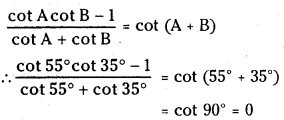
(ii) cot55cot351cot55+cot35

Answer:
TS Inter 1st Year Maths 1A Solutions Chapter 6 Trigonometric Ratios upto Transformations Ex 6(c) 1

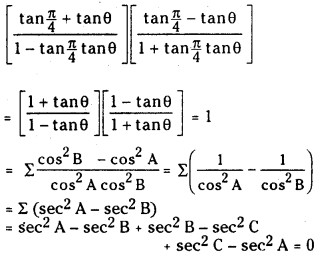
(iii) tan [π4 + θ]. tan[π4 – θ]
Answer:
TS Inter 1st Year Maths 1A Solutions Chapter 6 Trigonometric Ratios upto Transformations Ex 6(c) 2

(iv) Evaluate Σcos2 Bcos2 Acos2 Acos2 B if none of sin A, sin B, sin C is zero.
Answer:
Σcos2 Bcos2 Acos2 Acos2 B = Σ(sinCcosAcosCsinAsinCsinA)
= Σ (cot A – cot C)
= cot A – cot C + cot B – cot A + cot C – cot B = 0

Question 4.
(i) Prove that
cos 35° + cos 85° + cos 155° = 0

Answer:
cos 35° + cos 85° + cos 155°
= cos 35° + 2cos(85+1552)cos(851552)
= cos 35° + 2 cos 120° cos (-35°)
= cos 35° – cos 35° = 0

(ii) tan 72° = tan 18° + 2 tan 54°
Answer:
We have cot A – tan A = 1tanA – tan A
1tan2AtanA=2(1tan2A)2tanA = 2 cot 2A
∴ cot A – tan A = 2 cot 2A
⇒ cot A = tan A + 2 cot 2A°
Take A = 18°, then cot 18° = tan 18° + 2 cot 36°
⇒ cot(90 – 72) = tan 18° + 2 cot(90 – 54)
⇒ tan 72° = tan 18° + 2 tan 54°

(iii) sin 750° cos 480° + cos 120° cos 60° = –12
Answer:
L.H.S = sin [2.(360) + 30] cos[360 + 120] + cos 120 cos 60
= sin 30 cos 120 + cos 120 cos 60
= (12)(12)+(12)(12)=12

(iv) cos A + cos(4π3 – A) + cos(4π3 + A) = 0
Answer:
Use cos(A + B) + cos(A – B) = 2cos A cos B
L.H.S = cos A + 2cos4π3cos A
= cos A + 2 cos 240 cos A
= cos A + 2 cos ( 180 + 60) cos A
= cos A + 2 ( – cos 60) cos A
= cos A + 2(12)cos A = cos A – cos A = 0

(v) cos2θ + cos2(2π3 + θ) + cos2(2π3 – θ) = 32
Answer:
cos2θ + cos2( 120 + θ) + cos2( 120 – θ)
= cos2θ + cos2(120 + θ) + 1 – sin2(120 – θ)
= 1 + cos2θ + cos [ 120 + θ + 120 – θ] cos [ 120 + θ- 120 + θ]
= 1 + cos2θ + cos (240) cos 2θ
= 1 + cos2θ + cos (180 + 60) cos 2θ
[∵ Use cos2A – sin2B = cos (A + B) cos (A – B)]
= 1 + cos2θ – cos 60 ( 2 cos2θ – 1)
= 1 + cos2θ – 12 ( 2 cos2θ – 1)
= 1 + cos2θ – cos2 θ + 12=32

Question 5.
Evaluate
(i) sin28212 – sin22212

Answer:
sin28212 – sin22212
= sin[8212 + 2212]
∵ Use sin2A – sin2B = sin(A + B) sin(A – B)
= sin 105° . sin 60°
= sin 60° sin (60° + 45°)
= sin 60° [sin 60° cos 45° + cos 60° sin 45°]
= 32[322+122]=3(3+1)42=3+342

(ii) cos2 11212 – sin25212
Answer:
Use cos2 A – sin2 B = cos (A + B) cos (A – B)
cos211212 – sin2 5212
= cos [11212 + 5212]cos[11212 -5212]
= cos 165° . cos 60
= cos 60° cos (180 – 15)
= -cos 60°. cos 15°
= 12[3+122]=(3+1)42

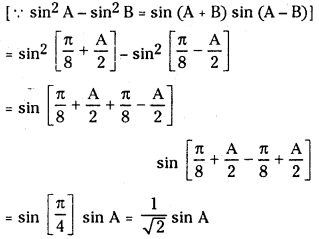
(iii) sin2[π8+A2] – sin2[π8A2]
Answer:
TS Inter 1st Year Maths 1A Solutions Chapter 6 Trigonometric Ratios upto Transformations Ex 6(c) 3

(iv) cos25212 – sin22212 (M’ 2010, 06 Jun 08)
Answer:
[∵ cos2A – sin2B = cos (A + B) cos (A – B)]
cos25212 – sin22212
= cos[5212 + 2212]cos[5212 – 2212]
= cos 75° cos 30°
= cos 30° cos(90 – 15)
= cos 30° sin 15°
= 32(3122)=3342

Question 6.
Find the minimum and maximum values of
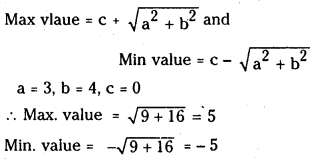
(i) 3 cos x + 4 sin x

Answer:
Recall for a cos x + b sin x + c
TS Inter 1st Year Maths 1A Solutions Chapter 6 Trigonometric Ratios upto Transformations Ex 6(c) 4

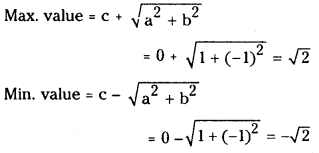
(ii) sin 2x – cos 2x
Answer:
a = 1, b = -1, c = 0
TS Inter 1st Year Maths 1A Solutions Chapter 6 Trigonometric Ratios upto Transformations Ex 6(c) 5

Question 7.
Find the range of
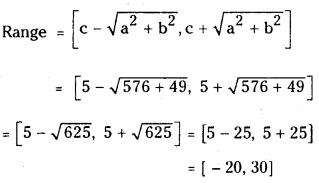
(i) 7 cos x – 24 sin x + 5

Answer:
a = -24, b = 7, c = 5
TS Inter 1st Year Maths 1A Solutions Chapter 6 Trigonometric Ratios upto Transformations Ex 6(c) 6

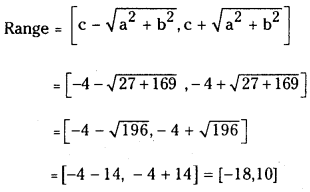
(ii) 13 cos x + 3√3 sin x – 4
Answer:
a = 3√3, b = 13, c = -4
TS Inter 1st Year Maths 1A Solutions Chapter 6 Trigonometric Ratios upto Transformations Ex 6(c) 7

II.
Question 1.
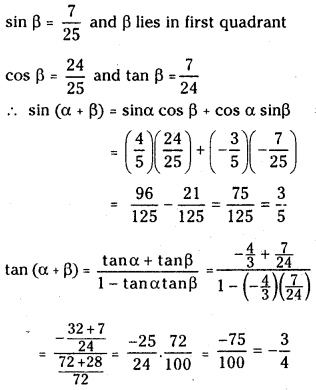
(i)If cos α = –35 and sin β = 725 where π2 < α < π and 0 < β < π2, then find the values of tan(α + β) and sin(α + β).

Answer:
cos α = –35, and α lies in second quadrant
sin α = 45 ∴ tan α = –45
TS Inter 1st Year Maths 1A Solutions Chapter 6 Trigonometric Ratios upto Transformations Ex 6(c) 8

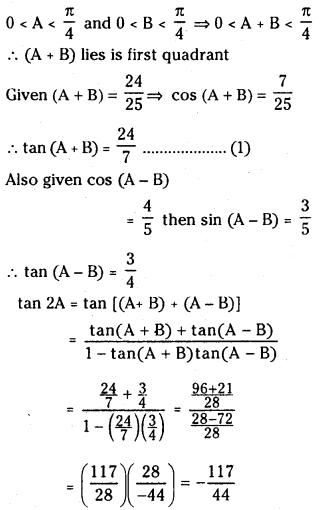
(ii) If 0 < A < B < π4 and sin(A + B) = 2425 and cos (A – B) = 45, then find the value of tan 2A. (March 2015-T.S)
Answer:
TS Inter 1st Year Maths 1A Solutions Chapter 6 Trigonometric Ratios upto Transformations Ex 6(c) 9

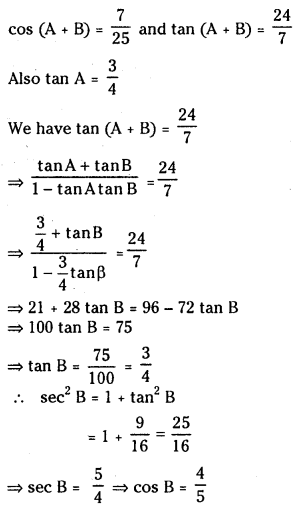
(iii) If A + B, A are acute angles such that sin (A + B) = 2425 and tan A = 35, then find the value of cos B.
Answer:
A + B, A are acute angles ⇒ B is also acute.
Given sin (A + B) = 2425, we have
TS Inter 1st Year Maths 1A Solutions Chapter 6 Trigonometric Ratios upto Transformations Ex 6(c) 10

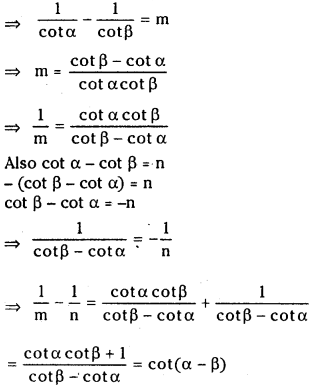
(iv) If tan α – tan β = m, and cot α – cot β = n then prove that cot(α – β) = 1 m1n.
Answer:
We have tan α – tan β = m
TS Inter 1st Year Maths 1A Solutions Chapter 6 Trigonometric Ratios upto Transformations Ex 6(c) 11

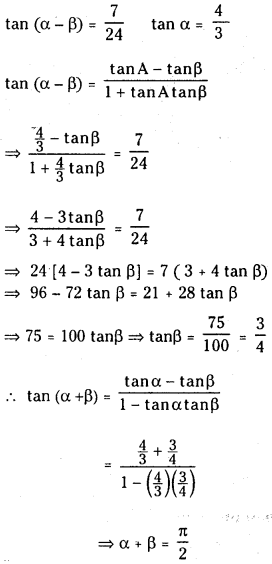
(v) If tan (α – β) = 724 and tan α = 43 where α and β are in the first quadrant prove that α + β = π/2.
Answer:
TS Inter 1st Year Maths 1A Solutions Chapter 6 Trigonometric Ratios upto Transformations Ex 6(c) 12

Question 2.
i) Find the expansion of sin (A + B – C).

Answer:
0 sin (A + B – C) = Sin [ (A + B) – C]
= sin (A + B) cos C – cos (A + B) sin C] – (sin A cos B + cos A sin B) cos C – (cos A cos B – sin A sin B] sin C
= sin A cos B cos C + cos A sin B cos C – cos A cos B sin C – sin A sin B sin C

ii) Find the expansion of cos (A – B – C).
Answer:
cos (A – B – C) = cos [(A – B) – C]
= cos (A – B) cos C + sin (A – B) sin C
= (cos A cos B + sin A sin B) cos C + (sin A cos B – cos A sin B] sin C
= cos A cos B cos C + sin A sin B cos C + sin A cos B sin C – cos A sin B sin C

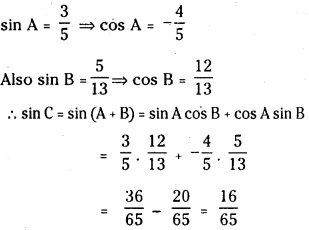
iii) In a ΔABC, A is obtuse. If sin A = 35 and sin B = 513, then show that sin C = 1665
Answer:
Given, A + B + C = 180°
⇒ A + B = 180° – C
∴ sin (A + B) = sin (180° – C)
= sin C ………………..(1)
∴ A is obtuse angle and A lies in II quadrant.
TS Inter 1st Year Maths 1A Solutions Chapter 6 Trigonometric Ratios upto Transformations Ex 6(c) 13

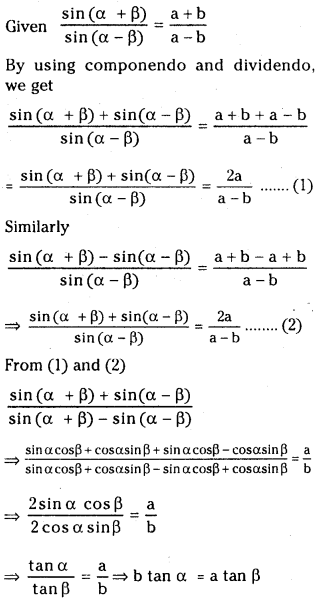
iv) If sin(α+β)sin(αβ)=a+bab then prove that a tan β = b tan α.
Answer:
TS Inter 1st Year Maths 1A Solutions Chapter 6 Trigonometric Ratios upto Transformations Ex 6(c) 14

TS Inter 1st Year Political Science Study Material Chapter 8 Democracy

Long Answer Questions


Question 1.Define Democracy and explain its features?


Answer:


Democracy is an important and most significant form of government. The term “Democracy” is derived from two Greek words namely ’Demos’ and “Kratio”. In greek language Demos means the people and Kratio means power. Hence Democracy means power of the people.


Definitions of Democracy:


Abraham Lincoln :
” Democracy is a government of the people, by the people and for the people”.
J.R. Seeley :
“Democracy is a government in which everyone has a share.”
Lord Bryce :
“Democracy is that form of government in which the ruling power of the •state is vested not in a particular class but in the members of the community as a whole”.
Features of Democracy :


1) Liberty :


Democratic government aims at securing maximum liberty for its citizens. It is built on the foundations of Liberty and Equality. Democracy is the only government which assures liberties to the people by incorporating them in the constitution.


2) Equality :


In the words of Prof. Seeley, democracy is “a government in which everyone has a share”. A democracy government gives opportunities to all for making them to take part in political matters. Every citizen has the right to vote and to contest in the election.


3) Independent Judiciary :


Independent Judiciary is important principle of Democracy. The higher courts in democratic states act as watchdog of the people’s freedoms. They issue several writs for preserving and upholding fundamental freedoms. They serve as the custodian of people’s rights.


4) Government of the people :


Democracy is government by the representatives of the people and these are elected by the adults, who are free to vote as they please without being coerced or pressurized by anyone. Democracy is the government by ballot not by bullet.


5) Majority Rule :


Democracy stands for a rule of the majority with adequate safeguards to the minorities. Every state has political parties. One of the political parties comes to power by capturing the majority of seats in the legislature. This means democracy is a system of government based on the principle of majority rule.


6) Follows constitution principles :


A democratic government functions strictly according to the principles of a constitution. Whether written or unwritten, this has been accepted by the people.


7) Against to violence and revolutions :


Democracy provides for a change in government according to constitutional principles and it is against any change by violent or revolutionary means.


8) Against to coercive methods :


Democracy opposed to coercive methods, even if they are for the social good. A government cannot be called democratic, if it uses illegitimate coercion in the name of social welfare.


9) Importance to Human Rights :


Democracy upholds the dignity of the human personality and gives various kinds of rights to the individual. Actually, to providing constitutional rights to the people is the fundamental principle of the democracy. The constitutions of India and U.S.A. had provided several rights to their people.


10) Right to speak :


Democracy allows all individuals the right to speak, criticize and disagree with others constructively.


11) Encouragement to Ideas :


Democracy allows plurality of ideas and ideologies and stands firmly on the principles of tolerance. In the legislature there is plenty of worth full discussions occurred among the public representatives related to public issues.


12) Against Imperialism and war :


Democracy in the international sphere stands for the principle of self determination and for the regulation of interstate relation on the basis of equality, justice and reason. Democracy is against aggressive nationalism, imperialism and war.
Besides the above, Democracy has some more principles like Rule of law, welfare mechanism, Decentralization of powers, Judicial review etc.

Question 2.What are the two types of Democracy?


Answer:


Democracy is an important and most significant form of government. The term Democracy is derived from two greek words namely Demos and Kratio. In greek language Demos means the people and Kratio means power. Hence Democracy means power of the people.


Definitions of Democracy:


Abraham Lincoln :
“Democracy is a government of the people, by the people and for the people”.
J.R. Seeley :
“Democracy is a government in which everyone has a share.”
Lord Bryce:
“Democracy is that form of government in which the ruling power of the state is vested not in a particular class but in the members of the community as a whole”.
Types of Democracy :
Democracy is mainly classified into two types, namely Direct Democracy and indirect Democracy. These two types are explained as below.


1) Direct Democracy :


When the people themselves directly express their will on public affairs, this type of government is called direct democracy. In direct democracy the citizens are the real makers of the state policy and programme of action. The will of the state is directly formulated by them and not through their elected delegates.
Some direct democratic checks such as referendum and initiative are in operation today Switzerland and in a few states of the United States. In some small Cantons of Switzerland adult citizens meet in any Sunday in April or May and by show of hands, elect their representative offices as also approve the measures they needed.


2) Indirect Democracy :


Indirect democracy is also known as representative democracy. In this type of democracy a clear distinction is made between the immediate sovereign and the ultimate sovereign. The legislature which consists of the elected representatives of the people formulates and expresses the will of the state. Hence, the legislature is the immediate sovereign authority.
In this type of democracy the people elect their representatives periodically and review their activities during their full term. If their activities are proved to be unsatisfactory, the people can with draw their trust in them and choose new representatives. Representative democracy thus combines efficient administration with popular sovereignty. In representative democracy the parties articulate and organize the will of the people and act as the transmission belt between the government and the governed. In a representative democracy the ultimate source of authority remains the people.

Question 3.What is Democracy? Explain its merits and Demerits?


Answer:


Democracy is an important and most significant form of government. The term “Democracy” is derived from two greek words namely ‘Demos’ and “Kratio”. In greek language Demos means the people and Kratio means power. Hence Democracy means power of the people.


Definitions of Democracy:


Abraham Lincoln :
“Democracy is a government of the people, by the people and for the people”.
J.R. Seeley :
“Democracy is a government in which everyone has a share.”
Merits of Democracy :
In modem world almost every state has choose the Democracy because of its merits. So, here we mentioned the merits of the Democracy.


1) Efficient form of Government :


In democracy, the representatives of the people will run the administration on efficient lines. As they are responsible and responsive to the people, they always make laws and implement them by consulting various administrative experts and eminent leaders. They also try to minimize the expenditure of the government by following simplicity and economy in administration. The administrative and executive personnel will be recruited on the basis of merit, efficiency, experience and their service will be utilized in implementing various public welfare programmes.


2) Upholds Individual Liberties :


It is only in democracy that the liberties of individuals can be guaranteed to a great extent. Citizens living in democracy enjoy a great amount of liberty. Their rights, liberties and freedoms are incorporated in and guaranteed by a written constitution. Any attempt made to take away or confiscate one’s liberties are forbidden. The various courts preserve, protect and promote individual liberties through their interpretation and analysis of different provisions of the constitution.


3) Importance to Equality :


Democracy gives preference to equality. Democracy provides equal rights and liberties to all citizens alike in political, economic and social matters. It opposes the practice of untouchability, bonded labour and discrimination on the grounds of religion, region, language, birth etc.


4) Political awareness :


Democracy is a large scale experiment in Public education or political awareness. Election campaigns give education to the masses. At the time of election, the canvassing through press and platform enlightens the mind of the electorate.


5) Promotes Patriotism :


Democracy promotes patriotic feelings among the people. People get several opportunities in selecting and electing their representatives to various bodies. They feel conscious and proud in participating in the working of the democratic institutions in a perfect manner. They show enthusiasm by extending their co-operation and support to the nation at the times of crisis. This is evident in the case of Indians during the Chinese and Pakistani invasions at the borders on several occasions.


6) Democracy serves as a school of citizenship :


One more advantage of democracy is that it serves as a training school of citizenship. In democracy right to vote, right to contest, right to criticize the government and other political rights make the citizens politically trained in citizenship and other matters.


7) Democracy inculcates moral values :


Democracy promotes a better and higher standard of natural character than any other government whatever. It teaches co-operation, responsibility, toleration and self-sacrifice. According to Lowell “the best government in the long run is the one that nurtures a people strong in moral fiber, in integrity, industry, self-reliance and courage”.


8) Democracy gives Preference to public opinion :


In fact, Democracy is the real representative of the Public opinion. According to Hearen Shaw, ‘Democracy ties a nerve to every individual; it makes a connection between him and the centre”.


9) It reduce the danger of revolution :


Democracy is a government by discussion and persuasion. Every other form of government rests on force. Democracy gives every individual and every group of people a chance to express their views on public matters, to demonstrate their dissatisfaction and resentment against governmental measures and to convert the masses to their own point of view. They have a right to change the government by their vote. So, there is no chance to people opt revolutionary methods.


10) Symbol of progress and welfare programmes :


Democracy is the only form of government which ensures always the progress and welfare of the people.


11) Support World Peace :


Democracy promotes world peace and opposed to war and violence. It seeks the change through evolutionary process with the purview of constitution. Democracy believes in peaceful co-existence and co-operation. According to Bums, “Democratic movements have always been movements for peace”.


Demerits of Democracy:


1) Expensive Government :


Democracy is the most expensive type of government. A lot of money is spent on election propaganda. Millions of money is spent on the sessions of the national and provincial legislatures. Carlyle said the parliament as a Talking shop’. Italian dictator Mussolini could, therefore, correctly say that democracy is not suited to a poor country.


2) Weak and instable Government :


Democracy is a weak and instable type of government. In those countries where there are multiple party systems, the coalitions fall frequently and bring instability in the government. For ex; In India 1977 to 79; 1989 to 1991; 1996 to 1999 coalition governments failed to rule the government with stable.


3) Government by the minority :


In practical Democracy does not represent majority opinion. Actually Democracy is said to be government by the majority. This claim on behalf of democracy is not sustainable. In every state a large number of people never exercise their vote. Besides, in most democratic states the first-past-the-post electoral system prevails (majority vote system). Under this system it often happens that the party securing a minority vote is returned to power. The number of votes secured by the party in power is less than those obtained by the opposition. Democracy thus ceases to be government by the majority.


4) Discouragement to culture, civilization and intellectual development :


Democracy is the government by masses and always have conservative outlook. They show no interest in the development of literature, art and architecture. In Democracy intellectuals always keeps distance from elections. So many examples are in history defeat of intellectuals in direct elections.


5) Slow decision making :


Democracy is slow decision making government. Because it takes lot of time to take decision. It delays the work. Legislature process, party system, opposition parties, coalition politics plays key role in decision making in Democratic governments.

Question 4.Discuss the essential conditions for the success of Democracy?


Answer:


The following conditions are essential for the success of democracy.


1) Sound system of Education :
The success of democracy requires adequate education for the citizens. Ignorance, innocence and under education prevent them from adopting right attitudes and large-scale reforms. Education sharpens the intellect of individuals. It develops a proper understanding of various things. It makes the citizens vigilant. Besides, this enables them to assess and criticise the policies of government.
2) Enlightened Citizenship :
Enlightened citizens are an asset to the democratic state. They can excise proper vigilance. They can actively participate in public affairs and help their fellow citizens in the exercise of their rights and discharge of their reproducibilities. They extend co-operation to the government in all its good work.
3) Independent Press :
An independent press is a prerequisite of democracy. It enables the people to receive accurate and unbiased information regarding the activities of the government. It not only keeps the people in touch with government activities but also ventilates their grievances. It strives to promote harmonious relationship between the people and the government.
4) Strong Opposition :
The success of parliamentary democracy depends to a great extent on the strong and effective opposition. Such an opposition will act as a check against the government by pointing out its lapses. In this regard, the role of opposition in some advanced states.
5) Decentralization of powers :
Decentralization of powers and establishment of democratic institutions at the grass roots level is indispensable for the healthy organisation of democratic institutions. The representative bodies at the grass roots level (as known as Panchayat Raj Institutions (PRIs) in India) will act as the mini legislatures. The residents of local areas will be able to know how to exercise their franchise.
6) Absence of economic disparities :
Democracy can not function smoothly when there are economic disparities in a country. When a country comprises a large number of poor people and a few wealthy persons, democracy could not work successfully.
7) Social Equality :
Social equality is another prerequisite of democracy. Caste, class and racial differences will impede the healthy working of democracy. Such elements encourage of democratic polity. To be successful, democracy must open its doors to everybody on equal basis by providing equal social opportunities to all in social sphere. Social equality must not only be proclaimed but also be practiced.
8) Faith in democracy :
Certain democratic beliefs and values like individual’s worth, need for tolerance of differences, decisions through discussions etc., should be inculcated among the people.
9) Sagacious Leadership :
Sagacious leadership is another essential condition of democracy. Sagacious leaders, by dint’ of their administrative acumen, political propriety, social commitment and economic perspective, will be able to lead the democratic state to greater heights of glory.
10) Honesty and transparency :
Honest persons belonging to various walks life, when entrusted with major responsibilities of the government, will strive for the success of democracy. Similarly transparency in administration also acts as a basic ingredient for the success of democracy.
11) Absence of militarism :
Democracy functions mostly in countries which are relatively free from militarism. In rules out the use of force and believes in the worth of individuals. It provides adequate opportunities to the people basing on worth, ability and dedication militarism, on the other hand, demands concentration of authority and favours despotism.

Short Answer Questions


Question 1.Define Democracy and mention its merits?


Answer:


Definitions :


1) Abraham Lincoln :
“Democracy is a government of the people, by the people and for the people”.
2) Lord Bryce :
“Democracy is that form of government in which the ruling power of the state is vested not in a particular class but in the members of the community as a whole”.
3) J.R. Seeley :
“Democracy is a government in which everyone has a share”.
Merits :
Democracy has the following merits.
a) Efficient government :
Prof. Garner described democracy as an efficient and effective government. The government in democracy carries all its activities efficiently and effectively both in normal times and emergencies.
b) Upholds individual liberties :
Democracy is the only government that upholds individual liberties. It guarantees certain civil rights to the people thereby providing an opportunity for them to become ideal and responsible citizens.
c) Assures equality :
Democracy assures equality of individuals in political and economic spheres. The people living in democratic nation enjoy all the political, civil and economic rights and privileges equally without any discrimination.
d) Educates the masses :
Democracy is described as a laboratory for a large scale experiments in public education. The masses in democracy are educated and enlightened through public meetings, election campaigns, distribution of pamphlets, etc.
e) Promotes patriotism :
The people in a democracy think that the country is their own property. When the country is in difficulties, they come forward to protect the interests of the nation. Therefore democracy develops patriotic spirit in the people.
f) Develops sense of responsibility :
J.S. Mill says that “democracy promotes a better and higher form of national character than any other policy whatever”. Since it is a rule by themselves, the people behave with a great sense of responsibility.
g) Training school for citizenship :
De Tocqueville, a French writer said that democracy serves as a training school for citizenship. Democracy promotes intellectual and moral qualities among the people.
h) A rational government :
Democracy is based on the principle that no man is infallible. It adopts a process of discussion and criticism which serves as necessary correctives to the abuse of power. Besides, they safeguard the rational nature of the political system.

Question 2.What is Democracy and mention its de-merits?


Answer:


Demerits :


Democracy has the following demerits.


1) Expensive Government :


Democracy is the most expensive type of government. A lot of money is spent on election propaganda. Millions of money is spent on the sessions of the national and provincial legislatures. Carlyle said the parliament as a ‘Talking shop’. Italian dictator Mussolini could, therefore, correctly say that democracy is not suited to a poor country.


2) Weak and instable Government :


Democracy is a weak and instable type of government. In those countries where there are multiple party systems, the coalitions fall frequently and bring instability in the government. For ex; In India 1977 to 79; 1989 to 1991; 1996 to 1999 coalition governments failed to rule the government with stable.


3) Government by the minority :


In practical Democracy does not represent majority opinion. Actually Democracy is said to be government by the majority. This claim on behalf of democracy is not sustainable. In every state a large number of people never exercise their vote. Besides, in most democratic states the first-past-the-post electoral system prevails (majority vote system). Under this system it often happens that the party securing a minority vote is returned to power. The number of votes secured by the party in power is less than those obtained by the opposition. Democracy thus ceases to be government by the majority.


4) Discouragement to culture, civilization and intellectual development :


Democracy is the government by masses and always have conservative outlook. They show no interest in the development of literature, art and architecture. In Democracy intellectuals always keeps distance from elections. So many examples are in history defeat of intellectuals in direct elections.


5) Slow decision making :


Democracy is slow decision making government. Because it takes lot of time to take decision. It delays the work. Legislature process, party system, opposition parties, coalition politics plays key role in decision making in Democratic governments.


Question 3.What is direct democracy and mention its devices?


Answer:


Devices Direct Democracy: There are four devices prescribed in direct democracies to enable the people to participate directly in the administrative activities of the State. Those are 1. Referendum 2. Initiative 3. Recall and 4. Plebiscite
These methods may be explained as follows.
1) Referendum :
It is one of the direct democratic devices. Literally it means, “must be referred to the people”. It is a device where by the electorate may veto a proposed legislation or a bill which the legislature has already passed. In other words, bills passed by the legislature are the voters for their approval or disapproval. If majority of the voters approve them, they become acts. But if they vote against them, they will be given up. Hence, referendum is known as “Popular Veto”. It is of two types – 1) Compulsory referendum : All the constitutional bills must be sent to the people. 2) Optional Referendum : An ordinary bill passed by the legislative may be or may not be sent to the people. However, even that ordinary bill must be sent to the people, if a definite number of people demand it. Ex: In Switzerland 30,000 people or eight cantons (States) can demand referendum on an ordinary bill.
2) Initiative :
It is another device of direct democracy. It is a method by means of which the people propose legislation i.e.; they can ask the legislature to pass a particular law. For instance, in Switzerland, if 50,000 voters request the legislature to pass a law, then the proposal is submitted to the consideration of the people. If majority of the people (30,000) approve it, then it becomes an act. Unlike referendum, initiative provides a chance to the people to start the making of law. It is of two types : (1) Formulative Initiative : People present a bill to the legislature (2) Unformulative Initiative : People present a demand to the legislature as king it to pass a bill.
3) Re Call :
It is another device of Direct Democracy. It means “Calling Back”. According to this method a specific number of voters may call back or dismiss an elected officer or a member of the legislature before the expiry of his term, if he is irresponsible. By means of this, the people can remove a representative or an officer from office when he fails to discharge his duties properly.
4) Plebiscite :
The term ‘Plebiscite” is derived from a French word “Plebiscitum”, which means “decree of the people”. It is used to obtain the opinion of the people on an important political issue or when there is a dispute regarding some territory. The question of accession or secession or territory is generally solved by means of plebiscite. It is not concerned with legislation. It is not apart of legal process. It is only a democratic method of ascertaining the opinion of the people on any political issue of public importance.


Question 4.What is the role of public opinion in Democracy?


Answer:


The term public opinion was coined by philosopher John Locke in the 17th century. In the middle ages, the saying Vox populi; Vox Dei which, means voice of the people is the voice of God gained prominence.


Definitions of Public Opinion :


1) Lord Bryce :
“Public opinion is commonly used to denote the aggregate of the views men hold regarding the community”.
2) R.G.Gettel :
“Public opinion is the opinion formed by a small group of leaders, which will be accepted by individuals as they have neither the knowledge nor the time nor the interest to enable them to form opinions of their own”.
Role of Public Opinion in Democracy :
The term ‘public opinion’ was coined by philosopher John Locke in the 17th century. However, the concept itself predates Locke. Vox Populi or voice of the people’ is a similar Latin concept. Today, public opinion is defined in the following way : collective evaluations expressed by people on political issues, policies, institutions and individuals.
Public opinion changes policy through passive observations that accumulate amongst citizens. Public opinion is important in a democracy because the people are the ultimate source of political power.


In theory, a government official has to take public opinion into account whilst deciding on a future course of action. Political parties must maintain a certain level of positive public opinion which is subject to a certain measure of manipulation through mass media and other sources and used to maintain the status quo. That is, however, not to say that public opinion, itself should be considered a ‘positive social function’.


It is important to understand the factors that shape public opinion as a whole. These include social class, education, region, age, gender and ethnic group. Society is not a homogeneous whole. It is made up of components. Each component faces different challenges in its functioning, therefore, members of each component view the world differently.
A state is built upon the consent of the members of society. A constitution is drafted by the collective will of the people. Just as the state and the constitution are vital organic constructs, so is the primary method of informing them: public opinion. Many governments, in one way or the other, try to influence the public by promoting its policies or actions through the mass media.

Question 5.Explain any four essential conditions for the success of Democracy?


Answer:


1) Sound system of Education :
The success of democracy requires adequate education for the citizens. Ignorance, innocence and under education prevent them from adopting right attitudes and large-scale reforms. Education sharpens the intellect of individuals. It develops a proper understanding of various things. It makes the citizens vigilant. Besides, this enables them to assess and criticise the policies of government.
2) Enlightened Citizenship :
Enlightened citizens are an asset to the democratic state. They can excise proper vigilance. They can actively participate in public affairs and help their fellow citizens in the exercise of their rights and discharge of their reponsibilities. They extend co-operation to the government in all its good work.
3) Independent Press :
An independent press is a prerequisite of democracy. It enables the people to receive accurate and unbiased information regarding the activities of the government: It not only keeps the people in touch with government activities but also ventilates their grievances. It strives to promote harmonious relationship between the people and the government.
4) Strong Opposition :
The success of parliamentary democracy depends to a great extent on the strong and effective opposition. Such an opposition will act as a check against the government by pointing out its lapses. In this regard, the role of opposition in some advanced states like Australia, Britan and United States is liable. In India to the opposition parties performed great role in many times.
5) Decentralization of powers :
Decentralization of powers and establishment of democratic institutions at the grass roots level is indispensable for the healthy organisation of democratic institutions. The representative bodies at the grass roots level (as known as Panchayat Raj Institutions (PRIs) in India) will act as the mini legislatures. The residents of local areas will be able to know how to exercise their franchise.
6) Absence of economic disparities :
Democracy can not function smoothly when there are economic disparities in a country. When a country comprises a large number of poor people and a few wealthy persons, democracy could not work successfully.
7) Social Equality :
Social equality is another pre-requisite of democracy. Caste, class and racial differences will impede the healthy working of democracy. Such elements encourage of democratic polity. To be successful, democracy must open its doors to everybody on equal basis by providing equal social opportunities to all in social sphere. Social equality must not only be proclaimed but also be practiced.
8) Faith in democracy :
Certain democratic beliefs and values like individual’s worth, need for tolerance of differences, decisions through discussions etc., should be inculcated among the people.
9) Sagacious Leadership :
Sagacious leadership is another essential condition of democracy. Sagacious leaders, by dint’ of their administrative acumen, political propriety, social commitment and economic perspective, will be able to lead the democratic state to greater heights of glory.
10) Honesty and transparency :
Honest persons belonging to various walks life, when entrusted with major responsibilities of the government, will strive for the success of democracy. Similarly transparency in administration also acts- as a basic ingredient for the success of democracy.
11) Absence of militarism :
Democracy functions mostly in countries which are relatively free from militarism. In rules out the use of force and ” wes in the worth of individuals. It provides adequate opportunities to the people basing on worth, ablility and dedication militarism, on the other hand, demands concentration f authority and favours despotism.

Very Short Answer Questions


Question 1.Define Democracy?


Answer:


Abraham Lincoln :
“Democracy is a government of the people, by the people and for the people”.
J.R. Seeley :
“Democracy is a government in which everyone has a share.”
Lord Bryce :
“Democracy is that form of government in which the ruling power of the state is vested not in a particular class but in the members of the community as a whole”.

Question 2.What is indirect Democracy?


Answer:


Indirect Democracy :
Indirect democracy is also known as representative democracy. In this type of democracy a clear distinction is made between the immediate sovereign and the ultimate sovereign. The legislature which consists of the elected representatives of the people formulates and expresses the will of the state. Hence, the legislature is the immediate sovereign authority.


In this type of democracy the people elect their representatives periodically and review their activities during their full term. If their activities are proved to be unsatisfactory, the people can with draw their trust in them and choose new representatives. Representative democracy thus combines efficient administration with popular sovereignty. In representative democracy the parties articulate and organize the will of the people and act as the transmission belt between the government and the governed. In a representative democracy the ultimate source of authority remains the people.


Question 3.What is direct Democracy?


Answer:


Direct democracy is a system of government in which people directly participate in the activities of the State and the Government. The people directly express their views on the government policies. Direct democratic methods are four. They are Referendum, Plebiscite, Initiative and Recall.


Question 4.What is recall?


Answer:


Recall means To call back. The representatives will be called back by the people in case they are inefficient. Hence, this method helps the representatives in discharging their responsibilities properly for fear of being called back on the grounds of inefficiency.


Question 5.What is plebiscite?


Answer:


Plebiscite means ascertaining public opinion on certain important issues. This is not applicable to the laws and the Constitution. People’s verdict is sought on certain public problems and policies of the government. This method was first used in 1804 by Napoleon in France.


Question 6.What are Referendum?


Answer:


Referendum means ‘Refer to’. This method is used to ascertain the public opinion on important legislation. In some regions, the public opinion is sought on the problems of constitutional law and ordinary law. This is called referendum. Referendum is of two types. They are i) Compulsory referendum ii) Optional referendum.


Question 7.What is initiative?


Answer:


Initiative is a request made by the people to the legislature in framing a law on certain national problem or policy as such. After making the law, the same shall be presented for referendum. In this aspect, people in a specified number present a petition in written form to the legislature proposing a legislation. It is also of two kinds. They are i) Formulative initiative ii) Non-formulative initiative.

Question 8.What is public opinion?


Answer:


Public opinion occupies an important place in democratic states. People express their opinion in times of elections or through the legislatures. They obey and follow those laws which are formulated in accordance with the public opinion. If the government acts against the wishes of people it has to face the consequences. Public opinion keeps the government responsible and responsive. It keeps the government alert and vigilant in its functioning.

TS Inter 1st Year Political Science Study Material Chapter 7 Citizenship

Long Answer Questions


Question 1.Define citizenship. Describe the methods of acquiring citizenship?


Answer:


Introduction :


Citizenship is a privilege of individual residing in democratic states. People fed that citizenship enables them to lead a happy, honourable and harmonious life in the state. Citizenship instills the feelings of patriotism, sacrifice, broad outlook etc., among the people.


Definitions :


Prof. Laski :
“Citizenship is one’s contribution of instructed judgement to the public good”.
T.H. Marshall :
“Citizenship is a status bestowed on those who are full members of a community. All who possess this status are equal with respect to the rights and duties with which the state is endowed”.
Methods of acquiring citizenship :
There are two methods of acquiring citizenship. They are : i) Natural ii) Naturalization. The two methods may be studied as follows.


i) Natural Citizenship :


Natural Citizenship is one which is acquired by the persons without specific application or request to the authorities. It comprises three elements. They are :
1.Blood relationship (Jus Sanguinis)
2.Soil (Jus Soli) and
3.Mixed principle.


i) Jus Sanguinis – (Kinship or Blood Relationship) :


This type of Citizenship denotes acquiring citizenship by kinship or blood relationship. Under this method birth within the territory of a state entitles a person to have citizenship. Every person is treated as a citizen of the state where he is born. According to Ju? Sanguinis, a child acquires the citizenship of the parents irrespective of its place of birth. Here blood relationship alone determines the Citizenship. Ex : A child born to the Indian parents will be treated as Indian citizen irrespective of its place of birth.


ii) Jus Soli (Land or Place of Birth) :


Jus Soli means acquisition of citizenship by the principle of place of birth. According to this method, citizenship is determined by the place of birth and not by parentage. It is the place of birth which determines citizenship. However this method is not more popular in modem times. It was popular in the Middle Ages when citizenship was associated with land. At present, however, this practice is observed exclusively in Argentina.


Mixed Principle :


Under this method citizenship is granted by following either of the two principles of Jus Sanguinis and Jus Soli. Many states adopted both these principles. Ex: In Britain, France and United States, the above two principles are employed simultaneously. In this context there may arise duplication of citizenship. Ex: A child bom to British parents in’ the United States becomes an american citizen according to the practice of Jus Soli. The same child becomes a citizen of Britain according to the principle of Jus Sanguinis. In such a case, the child is given option to choose one of its citizenship, after becoming a major.


ii) Naturalised Citizenship :


Citizenship may also be acquired through naturalization. According to this method, an alien will become a citizen after fulfilling certain conditions. These conditions vary from state to state. Some of them may be summed up as follows.


1) Residence :


An alien who resides in a state for a prescribed period automatically become its citizen. Residence in any part of the state is a must for an alien. The period of residence varies from state to state. For instance it is 5 years in Britain and United States and 10 years in France respectively.


2) Choice :


The children of alien parents could receive citizenship of the state according to their option and choice.


3) Application :


An alien in a state may apply for the citizenship of that state. Then the government of that state considers his application on its merits. It grants citizenship to him with or without some conditions. These prescribed conditions refer to a minimum period of residence, good moral character, financial capability aqd knowledge of one of the national languages. Besides, an alien must take an oath of allegiance before he assumes the citizenship of another state.


4) Fixed Assets :


An alien who buys some portion of land or acquires some fixed property can acquire citizenship in a state.


5) Service (Public or Private) :


An alien who serves in the government of a state or in a private recognised enterprise could become the citizen of that state. He is entitled for such citizenship if he serves in the public or private authorised departments. He may also be given Citizenship if the renders meritorious service in another state.


6) Marriage :


An alien woman acquires citizenship of a state when she marries the citizen of that state. In some countries when a person marries an alien, Citizenship of either of the husband or wife is acquired. For instance, a British lady will acquire Indian citizenship if she marries an Indian citizen. Japanese women do not lose their citizenship even if they marry persons of alien states. The alien person on the other hand, acquires the citizenship of Japan if he marries a Japanese lady.
In this context it may be noted that an alien who receives the citizenship of the new state, he will have to forego his native citizenship. In other words no one is allowed to have dual citizenships simultaneously.

Question 2.Explain the various qualities of a good Citizens?


Answer:


According to Aristotle good citizens make good state. This is due to the fact that good citizens imbibe many noble qualities. Lord Bryce cited three qualities of a good citizen, namely, conscience, intelligence and self control. On the whole, a good citizen will have the following qualities.


1) Good Character :


Good character is essential for a good citizen. A good citizen should be courageous, just, helpful, kind-hearted, sympathetic, truthful and virtuous in letter and spirit.


2) Sound health :


A good citizen should have good health and strength. Healthy citizens make the nation healthy. Only a sound body will have a sound mind. Sound body and mind of a citizen paves the way for the progress of the state in many spheres.


3) Intelligence and education :


Proper education is another quality of a citizen. The citizen should be well-enlightened, fully aware and informed of his rights and responsibilities. He must be intelligent enough to identify good and bad. He will not be emotional in examining the events. In this regard education enables him to play a proper role in the society. An intelligent citizen will be able to understand the problems of the state in a proper way.


4) Self control :


A good citizen will have moderate temperment. He will have self¬control in his public activities. Self control and confidence make him to lead a disciplined life. He will not indulge in inhuman activities.


5) Public spirit :


A good citizen should have broad and liberal outlook. He should be ready to take active part in public affairs. He should be intelligent in enjoying his rights and responsibilities. He should have active participation in the social activities. He should have public-spirit and ready to offer his services for the collective welfare of the society.


6) Self-sacrifice :


A good citizen must possess self sacrifice. He must subordinate his self-interest to the interests of the community. He must be imbibed by the spirit of service and devotion to the society, government and state.


7) Honest exercise of franchise :


Honest exercise of one’s franchise is another essential quality of a good citizen. Self interest or sectional interest in terms of class, religion or community act as a hurdle to good citizenship.


8) Sincere performance of obligations :


A good citizen performs his obligations sincerely and faithfully. He extends co-operation to the authorities in the discharge of their obligations. He pays his taxes to the various governmental organizations promptly and properly.


9) Right ordering of loyalties :


A good citizen brings about a right ordering of his loyalties to the family, class, caste, club, trade union, region and nation. He avoids conflicts between various associations by assigning priorities. He sacrifices his self interest for the sake of wider purposes. When there arises a conflict between the interests of the family and the locality, one must sacrifice the interests of the family for the sake of the locality.

Question 3.How many types of citizenship are there? Elucidate?


Answer:


There are three types of Citizenship. They are : (i) Single Citizenship (ii) Dual Citizenship and (iii) Global or Universal Citizenship.


i) Single Citizenship :


Single Citizenship implies possession of one type of citizenship, identical rights, privileges and immunities by the citizens. Citizens enjoy this type of citizenship without any discrimination. It is prevalent in many states in the modem period. For instance the constitution of India provided for single citizenship to every Indian citizen irrespective of his place of birth, residence etc.


ii) Dual Citizenship :


Dual citizenship means possession of two citizenships in two States. It is in vogue in some developed and developing countries. For instance, children bom to American citizens in other states acquire natural citizenship in both the states – one in their parent American State and another in the State where they are bom. However, persons having dual citizenship are not entitled to the special privileges. They are subject to the laws of both countries. Dual citizenship applies to the children until they attain adulthood. Later they have to choose citizenship of one of the two States.


iii) Global or Universal Citizenship :


Global or Universal Citizenship is the latest phenomena in the contemporary international and national politics. The dramatic events that took place after 1980s and 1990s created a great awareness among the people all over the world. The advancement in communications, science, technology and other spheres transformed human life in a miraculous way.


Short Answer Questions


Question 1.How is naturalised citizenship acquired?


Answer:


Naturalised Citizenship :
Citizenship may also be acquired through naturalization. According to this method, an alien will become a citizen after fulfilling certain conditions. These conditions vary from state to state. Some of them may be summed up as follows.


1) Residence :


An alien who resides in a state for a prescribed period automatically become its citizen. Residence in any part of the state is a must for an alien. The period of residence varies from state to state. For instance it is 5 years in Britain and United States and 10 years in France respectively.


2) Choice :


The children of alien parents could receive citizenship of the state according to their option and choice.


3) Application :


An alien in a state may apply for the citizenship of that state. Then the government of that state considers his application on its merits. It grants citizenship to him with or without some conditions. These prescribed conditions refer to a minimum period of residence, good moral character, financial capability and knowledge of one of the national languages. Besides, an alien must take an oath of allegiance before he assumes the citizenship of another state.


4) Fixed Assets :


An alien who buys some portion of land or acquires some fixed property can acquire citizenship in a state.


5) Service (Public or Private) :


An alien who serves in the government of a state or in a private recognised enterprise could become the citizen of that state. He is entitled for such citizenship if he serves in the public or private authorised departments. He may also be given Citizenship if the renders meritorious service in another state.


6) Marriage :


An alien woman acquires citizenship of a state when she marries the citizen of that state. In some countries when a person marries an alien, citizenship of either of the husband or wife is acquired. For instance, a British lady will acquire Indian citizenship if she marries an Indian citizen. Japanese women do not lose their citizenship even if they marry persons of alien states. The alien person on the other hand, acquires the citizenship of Japan if he marries a Japanese lady.

Question 2.How citizenship is lost?


Answer:


Citizens loose their citizenship under the following conditions :


1) Renunciation :


A person is deprived of his citizenship, if he wishes to become the citizen of another state. One will lose the citizenship of one’s parent state and may become the citizen of a foreign state by naturalization. In India, the Constitution prescribes that a person who voluntarily acquires citizenship of any other state will no longer be an Indian citizen.


2) Marriage :


Generally a woman lose her citizenship when she marries an alien. However some states allow retention of citizenship. For instance in Britain, there is an option to retain British citizenship who marries an alien.


3) Accepting Foreign Service :


A person may lose his citizenship when he enters into the service of another state. If a person accepts a permanent job in the government of a foreign state, he foregoes the citizenship of his native state.


4) Obliging Foreign Decorations or Titles :


When a citizen obliges to receive foreign decorations or titles, it may lead to the forfeiture of his Citizenship.


5) Prolonged Absence :


Prolonged absence in the native state beyond a certain period may lead to the loss of citizenship. In some states like France and Germany citizens who are absent themselves from their native country for more than ten years will loose their citizenship.


6) Treason or Crime :


Involvement of a citizen in a serious crime and subsequent proof of his action will also lead to the loss of citizenship. Especially those persons who directly or indirectly participate or extend assistance to anti-state, anti-social and anti-govemmental activities, will loose their citizenship by a special notification to that effect.


7) Desertion from Army :


Desertion from army thereby jeopardizing the security of a state leads to the forfeiture of citizenship.

Question 3.Explain any three conditions for securing naturalized citizenship?


Answer:


1) Residence :


An alien who resides in a state for a prescribed period automatically become its citizen. Residence in any part of the state is a must for an alien. The period of residence varies from state to state. For instance it is 5 years in Britain and United States and 10 years in France respectively.


2) Choice :


The children of alien parents could receive citizenship of the state according to their option and choice.


3) Application :


An alien in a state may apply for the citizenship of that state. Then the government of that state considers his application on its merits. It grants citizenship to him with or without some conditions. These prescribed conditions refer to a minimum period of residence, good moral character, financial capability and knowledge of one of the national languages. Besides, an alien must take an oath of allegiance before he assumes the citizenship of another state.


Very Short Answer Questions


Question 1.Define citizenship?


Answer:


1.Prof. Laski defines “Citizenship is one’s contribution of instructed judgement to the public good”.
2.T.H.Marshall defines “Citizenship is a status bestowed on those who are full members of a community. All who possess this status are equal with respect to the rights and duties with which the state is endowed”.

Question 2.What do you mean by Jus Sanguinis?


Answer:


Acquiring citizenship by kinship or blood relation is called Jus Sanguinis. According to Jus Sanguinis, a child acquires the citizenship of the parents irrespective of its place of birth. Blood relation alone determines the citizenship in Jus Sanguinis method.


Question 3.What does the terms Jus Soli mean?


Answer:


Jus Soli means acquisition of .citizenship by the principle of place of birth. According to this method, a child acquires the citizenship of a State, where it borns. It is the place of birth which determines citizenship. This method is not more popular in modem times. At present, this method is observed exclusively in Argentina.


Question 4.List out two conditions of loss of citizenship?


Answer:


i) Renunciation :


A person is deprived of his citizenship, if he wishes to become the citizen of any other State.


ii) Marriage :


Generally a woman lose her citizenship when she marries an alien.


Question 5.What is dual citizenship?


Answer:


Dual Citizenship means possession of two citizenships in two States. Ex : Children born to American citizens in other States acquire citizenship in both the States – one in their parent State and the other in the State, where there are born. Dual citizenship applies to the children until they attain adulthood. Later they have to choose citizenship of any one of the two states.

Question 6.Mention any two qualities of a good Citizen?


Answer:


i) Good Character :


Good character is essential for a good citizen. A good citizen should be courageous, just, helpful, kind-hearted, sympathetic, truthful, and virtuous in letter and spirit.


ii) Sound Health :


A good citizen should have good health and strength. Healthy citizens make the nation healthy and wealthy.

TS Inter 1st Year Political Science Study Material Chapter 6 Rights and Duties

Long Answer Questions

Question 1.Define Rights. Describe the Civil and Political Rights?


Answer:


Introduction :


Rights are essential conditions for the development of the personality of individuals. They are upheld by the laws of the state. They are regarded as a power or privilege that the law invests in a person. They are treated as the sum total of the opportunities meant for enhancing one’s personality. Individuals can not achieve progress in the absence of rights.


Definitions of Rights :
Political scientists have defined the term ‘Right’ in several ways. Some of their definitions are explained below :

  1. Earnest Barker :
    “Rights are the external conditions necessary for the development of the capacities of the personality of the individual.”
  2. Beni Prasad :
    “Rights are nothing more and nothing less than those social conditions which are necessary for the development of personality of individuals.”
  3. Bosanquet :
    “A right is a claim recognised by the society and enforced by the state.”
  4. T.H. Green :
    “Rights are those powers claimed and recognized as contributory to the common good.”
  5. H.J. Laski :
    “Rights are those conditions of social life without which no man can seek in general to be himself at his best.”
    Civil Rights :
    Civil rights aim at providing basic conditions for individuals to lead a happy and dignified social life. These rights are considered vital for a civilized society. Social life becomes impossible in their absence.
    Individuals in a civilized society enjoy the following Civil rights. These are
    1) Right to life :
    This is the most important civil right. T.H. Green considered it as the most fundamental civil right. This right provides security to the individual’s life. Individuals cannot lead their lives in the absence of this right. This right is based on the premise that the life of an individual is valuable not only to himself, but also to the society and the state as a whole. Hence it prescribes at large the state to extend protection to the life of individuals.
    However, it empowers the state to impose some reasonable restrictions upon the individuals. The state can insist any person to sacrifice his life for the sake of the nation. This right also includes the right of self-defence.
    2) Right to liberty :
    This right enables individuals to have freedom in various walks of life. It makes their lives worth living. It enables them to develop their personality in various spheres. It includes various freedoms such as freedom of movement, speech, expression, thought, residence etc.
    3) Right to equality :
    This right implies that individuals are equal before law. It forbids discrimination on the basis of one’s caste, colour, creed, education, region, race, religion, wealth etc. It enables equal treatment to all persons. It provides scope for uniform application of laws. It enables equal opportunities to all persons in social, economic and political fields.
    4) Right to property :
    This right enables every individual to acquire, enjoy, donate or inherit the property. It is essential to the individual for securing higher standards of living. This right is crucial for the growth of individual’s personality.
    5) Right to family :
    Family is a fundamental social institution. This right enables individuals to maintain family relations in society. Consequently, individuals will -have freedom to marry persons of their choice. They will have choice to procreate children and rear their offspring. However, the state can impose certain restrictions upon this right keeping in view the national interests. For example, until recent times China imposed severe restrictions against their citizens in the size of their families. Recently it has made some amendments in this regard.
    6) Right to religion :
    This right allows the individuals to have freedom to practice, propagate and profess any religion of their choice. Every individual is at liberty to preach or practice the religious doctrines as they like. The secular states provide religious freedoms to their citizens.
    7) Right to contract :
    This right provides freedom to every individual to enter into contract or legal arrangements with others regarding his life, property and work. It regulates the two parties in carrying their contracts in letter and spirit. The state recognizes only those contracts which are helpful to the common well being of the people.
    8) Right to education :
    In the modem era education is regarded as vital to every individual. Uneducated and innocent individuals cannot play an active role in public affairs. Similarly, illiterate persons cannot fully make use of their abilities. Education and literacy enable the people to understand the problems of the society and policies of the government. This right guarantees a minimum level of education to every citizen in democratic states.
    9) Right to‘form associations and unions :
    This right enables individuals to form associations and unions for releasing some specific objectives. Individuals may join, continue or keep away from the membership of associations according to their will and pleasure. The State is empowered to impose restrictions against those associations which ignore the welfare of the nation.
    10) Right to constitutional remedies :
    Civil rights are jneaningless in the absence of this right. This right is essential to every individual for safeguarding his rights. This right empowers a person (who was deprived of his liberty due to the intervention or manhandling by others including the government) to seek justice and relief from the concerned judicial organizations. The aft ei ed individuals are authorised to approach an appropriate court for correcting such imbalance. In this regard the higher judicial organizations issue several writs and effectively check such tendencies. These writs are in the form of Habeas Corpus, Mandamus, Prohibition, Quo-warranto and Certiorari etc.
    Political Rights :
    Political rights are those rights which enable the individuals to participate in the political affairs of the state.
    The following are the important political rights :
    1) Right to vote :
    Right to vote is the most important political right enjoyed by the citizens in modem atic states. It serves as a powerful weapon for adult citizens in choosing their representaives to various legislative bodies. It makes them as real sovereign. All the citizens are entitled to this right without any discrimination based on creed, colour, language, race, region, religion, sex etc. However, persons such as aliens and minors are deprived of this right.
    2) Right to contest in elections :
    This right empowers the citizens to contest as candidates to various legislative bodies in the state. Especially this right enables those, who have political sagacity, enthusiasm and dynamic nature, to actively participate in the political dynamics of the state. As a result, it increases political enthusiasm among the citizens. Such an element is con *dered as a base of democratic polity.
    3) Right to hold Public offices :
    This right provides opportunities to the citizens to hold various public offices for a definite period. It gives no scope for exclusion of citizens or conferring special privileges to some at the cost of others. This helps the citizens to exercise authority in a dignified manner.
    4) Right to petition :
    This right enables the citizens to forward petitions denoting their requirements or grievances. It is considered as a vital political right in the modem state. The citizens could be able to find solutions to their immediate or long pending issues by bringing them to the notice of the government through this right. It also helps the public authorities to know the grievances of the people and attend to them properly and promptly.
    5) Right to criticism :
    This right gives opportunity to the citizens to criticize the various public policies and programmes. It also enables them to highlight the omissions and commissions of the leaders, and administrative personnel at various levels. It also gives scope for the citizens to render positive and constructive criticism about the on goings in the government from time to time. Ultimately it keeps the administrative authorities and policy makers to be vigilant in discharging their obligations.

Question 2.Identify the safeguards of Rights?


Answer:


Introduction :


Rights are the essential conditions for the development of the personality of individuals. They are upheld by the laws of the state. Individuals cannot achieve progress in the absence of the Rights.


Definition:


1) T.H. Green :
“Rights are those powers claimed and recognized as contributory to the common good.”
2) H.J. Laski :
“Rights are those conditions of social life without which no man can seek in general to be himself at his best.”
Safeguards of Rights :
Individuals enjoy their rights only when they were fully protected or safeguarded by the State. In this regard, the following elements act as the safeguards of the rights.
1) Democratic Rule :
Democratic rule safeguards the rights of the people to a great extent. People can enjoy their rights perfectly in democratic states only. This system makes constitutional and legal provisions for safeguarding the right of the people.
2) Written and Rigid Constitution :
A written constitution clearly defines the powers and functions of the government. It also explains about the various limitations of governmental authority. Besides, a rigid constitution will guarantee the rights of the people by making it difficult for the rulers and legislators to make amendments on flimsy grounds.
3) Constitutional Incorporation :
Incorporation of fundamental rights in the constitution will prevent the encroachment of individual rights by the government. Such an arrangement protects the rights of the individuals to a great extent.
4) Separation of Powers :
The powers of the government should be separated among the three organs of the government. Such as measure would act as a check against other organ. Ultimately, it serves as a safeguard of individual liberty.
5) Decentralisation of Powers :
Individuals enjoy their rights, when powers are decentralised among the governmental institutions. This involves allocation of powers at various levels – national, provisional, local either on functional or territorial basis.
6) Rule of Law :
Rule of law implies equality before law. It also denotes equal application of laws to the citizens.-It gives no scope for discrimination between citizens on the grouhds of region, religion, caste, colour, community etc.
7) Independent and Impartial Judiciary :
Independent and impartial judiciary is another safeguard of rights. Judges in higher judicial bodies will deliver judgement with impartial and independent outlook. In the process of delivering justice, they issue certain writs for immediate protection of the rights.
8) Independent Press :
Independent and honest press is another essential safeguard of rights of individuals. Such agency will be able to disseminate news and views impartially and without fear or favour to anybody. In this regard the state should not try to threaten and silence the press. Then only individuals enjoy their rights to the maximum extent.
9) Social and Economic Equalities :
Social and economic equalities are necessary for enjoying one’s rights. People will be able to utilize their rights properly and positively when there are social and economic equalities in the state. These equalities include absence of casteism, communalism, linguism, wide spread economic inequalities, exploitation etc.
10) Eternal Vigilance :
Eternal vigilance is said to be the most important safeguard of rights of individuals. Individuals must be vigilant and cautious about the policies of the government. They should oppose the despotic tendencies of the government through democratic and constitutional methods. Under no circumstances they should allow the self seeking politicians to acquire power. Besides several other elements like judicial review, recall, strong opposition etc., are considered as the safeguards of rights.

Question 3.Write an essay on Human Rights?


Answer:


Introduction :


Human rights are the amenities required for the basic existence of human beings. They are available to all persons irrespective of caste, creed, community, religion, region, language etc. The constitutional and ordinary laws in democratic states recognize these rights. The various governments in democratic states will take appropriate steps for providing human rights to their people.


Definitions :


1.“Human Rights are freedom to all irrespective of place, sex, religion, language etc.” – United Nations Organization (U.N.O)
2.“The Rights which serve as the protective shield to the individuals whenever the state attempts to interfere with the civil liberties of individuals.”- Ronald Darwin
3.“Human Rights are the new standards of civilization.” – John Dowski
Origin and Growth of Human Rights :
1) The credit for showing interest on human rights and their application to human goes to Greek rulers. They recognised the need and importance of health and strength in the development of human personality.
2) Magna Carta sanctioned by King John of England in 1613 gave life to the Freedoms – and independence of the people.
3) The cultural renaissance which shook the various countries in Europe gave strength and succor to the Civil rights movements.
4) John Locke of England popularised the doctrine of natural rights as a part of his proposal for the spread of human rights.
5) Rousseu of Switzerland mentioned several times about the importance of human rights in his concept of social contract. He declared that “Man has born with free but every where he is in chains.”
6) John Stuart Mill, a prominent British political philosopher, propounded indivi¬dualism. He stated that every individual is sovereign over himself, his body and mind and all organizations including the state shall not interfere in the affairs of Individuals.
7) The writings of above philosophers profoundly influenced the people across the globe. Several freedom movements such as bloodless revolution in England (1688), American declaration of Independence (1776), French Revolution (1789), Russian Revolution (1917)..The Indian declaration of Independence (1947) etc., led to the creation of favourable atmosphere for the enjoyment of human rights.
8) After the establishment of United Nations Organization in 1945, the charter of U.N.O assigned priority and significance to the rights of human beings. The universal declaration of human rights came into force on December 10,1948. Since then, that day is celebrated as the universal human rights day.
As a result, several covenants like international economic, social and cultural rights, International civil and political rights (1966) came into being. The above covenants made obligatory for the international community to provide favourable conditions for enjoying the various human rights by the people of the world. All the member states of the United Nations gave assurance to have full faith in the human rights. They assured their cooperation for observing and promoting human rights.


Violation of Human Rights :


Today in almost all the countries pf the World, everywhere the violation of human rights is happening Poverty, Refugees, Separatist movements etc., are the main causes for violation of human rights.


Protection of Human Rights :


Every nation has the responsibility to protect the human rights. Governments as well as voluntary organizations play a key role in protection of human rights. Amnesty International and Asia watch are playing a prominent role in protecting the human rights.

Short Answer Questions


Question 1.What are the features of Rights?


Answer:


Rights are the essential conditions for the development of the personality of individuals. They are upheld by the laws of the state. Individuals cannot achieve progress in the absence of rights.


Definition :


“Rights are those conditions of social life without which no man can seek in general to be himself at his best.”
Features of Rights :
Rights comprise the following features.


1) Rights are possible only in society :


Rights originate in society. They denote human social behaviour. They do not exist outside of the society.


2) Rights are social in nature :


Rights are the claims of individuals. These claims can be established only when the society or the state recognises and maintains them. So they are social in nature.


3) Rights are inherent in nature :


Rights are inherent in the social nature of men. The social contractualists stated that rights are inherent in nature. Their views are accepted to some extent in modern times.


4) Rights are enforced and protected by the state :


Rights are enforced and protected by the state. The various judicial organisations act as the custodians of the rights of individuals. In other words, rights are protected by the courts of law. Individuals enjoy several rights fully only in a democratic state.


5) Rights are not absolute :


Rights are not absolute. Society and state impose some restrictions on the enjoyment of rights by the individuals. These restrictions are meant for maintaining peace and other in the society. Further, rights are meant for contributing social welfare and security.


6) Every right has a corresponding responsibility :


Rights and responsibilities are interdependent. Every right has a corresponding responsibility. It is the responsibility of every individual to.see that his neighbours alsd-enjoy the same rights. Rights without responsibilities or responsibilities without rights cannot exist. Both are essential for leading a peaceful social life.


7) Rights are universal :


lights are universal in nature: They are applicable to all. They are given to all without’ any discrimination.


8) Rights vary :


Rights vary from time to time according to the needs of the people. They also grow with the changes in time and conditions. Some rights which were not found in the past may exist now. The socio economic, political and cultural conditions will have an influence over the rights.


9) Rights precede the state :


Rights are the products of history. Rights originated in course of time. They were prevalent even before the origin of the state. However, they were guaranteed only after the origin of the state.


10) Rights are meant for common good :


Rights always exist and flourish as long as they are meant for common good. Only those rights which promote common good of the people are recognised by the society and the state. They are essential for leading a prosperous life by the individuals.

Question 2.Explain Political Rights?


Answer:


Political rights are those rights which enable the individuals to participate in the political affairs of the state.
The following are the important political rights :


1) Right to vote :


Right to vote is the most important political right enjoyed by the citizens in modem democratic states. It serves as a powerful weapon for adult citizens in choosing their representatives to various legislative bodies. It makes them as real sovereign. All the citizens are entitled to this right without any discrimination based on creed, colour, language, race, region, religion, sex etc. However, persons such as aliens, and minors are deprived of this right.


2) Right to contest in elections :


This right empowers the citizens to contest as candidates to various legislative bodies in the state. Especially this right enables those, who havepolitical sagacity, enthusiasm and dynamic nature, to actively participate in the political dynamics of the state. As a result, it increases political enthusiasm among the citizens. Such an element is considered as a base of democratic polity.


3) Right to hold public offices :


This right provides opportunities to the citizens to hold various public offices for a definite period. It gives no scope for exclusion of citizens or conferring special privileges to some at the cost of others. This helps the citizens to exercise authority in a dignified manner.


4) Right to petition :


This right enables the citizens to forward petitions denoting their requirements or grievances. It is considered as a vital political right in the modern state. The citizens could be able to find solutidns to their immediate or long pending issues by bringing them to the notice of the government through this right. It also helps the public authorities to know the grievances of the people and attend to them properly and promptly.


5) Right to criticism :


This right gives opportunity to the citizens to criticize the various public policies and programmes. It also enables them to highlight the omissions arid commissions of the leaders, and administrative personnel at various levels. It also gives scope for the citizens to render positive and constructive criticism about the on goings in1 the government from time to time. Ultimately it keeps the administrative authorities arid policy makers to be vigilant in discharging their obligations.

Question 3.


Explain the important Civil and Political Rights?


Answer:


Civil Rights :
Civil rights aim at providing basic conditions for individuals to lead a happy and dignified social life. These rights are considered vital for a civilized society’ Social life becomes impossible in their absence.
Individuals in a civilized society enjoy the following Civil rights. These are


1) Right to life :


This is the most important civil right. T.H. Green considered it as the most fundamental civil right. This right provides security to the individual’s life. Individuals cannot lead their lives in the absence of this right. This right is based on the premise that the life of an individual is valuable not only to himself, but also to the society and the state as a whole. Hence it prescribes at large the state to extend protection to the life of individuals. However, it empowers the state to impose some reasonable restrictions upon the individuals:’ The state can insist any person to sacrifice his life for the sake of the nation. This right also includes the right of self-defence.


2) Right to liberty :


This right enables individuals to have freedom in various walks of life. It makes their lives worth living. It enables them to develop their personality in various spheres. It includes various freedoms such as freedom of movement, speech, expression, thought, residence etc.


3) Right to equality :


This right implies that individuals are equal before law. It forbids discrimination on the basis of one’s caste, colour, creed, education, region, race, religion, wealth etc. It enables equal treatment to all persons. It provides scope for uniform application of laws. It enables equal opportunities to all persons in social, economic and political fields.
The following are the important political rights :


1) Right to vote :


Right to vote is the most important political right enjoyed by the citizens in modem democratic states. It serves as a powerful weapon for adult citizens in . choosing their representatives to various legislative bodies. It makes them as real sovereign. All the citizens are entitled to this right without any discrimination based on creed, colour, language, race, region, religion, sex etc. However, persons such as aliens and minors are deprived of this right.


2) Right to contest in elections :


This right empowers the citizens to contest as candidates to various legislative bodies in the state. Especially this right enables those, who have political sagacity, enthusiasm and dynamic nature, to actively participate in the political dynamics of the state. As a result, it increases political enthusiasm among the citizens. Such an element is considered as a base of democratic polity.


3) Right to hold public offices :


This right provides opportunities to the citizens to hold various public offices for a definite period. It gives no scope for exclusion of citizens or conferring special privileges to some at the cost of others. This helps the citizens to exercise authority in a dignified manner.

Question 4.


Write the objectives and classification of Human Rights.


Answer:


Definition of human rights :
“Human Rights are Freedom to all irrespective of place, sex, religion, language etc. -U.N.O.
Objectives of human rights :
The following are the various objectives of human rights.
1.Provision of independence to the people against discrimination.
2.Freedom from poverty.
3.Freedom for availing the latent abilities of individuals.
4.Freedom from fear.
5.Freedom of protection.
6.Freedom from injustice.
7.Freedom of speech and expression.
8.Freedom of protection.
9.Freedom of association.
10.Freedom for carrying one’s activities on dignified lines.
11.Freedom against exploitation.
The united nations general assembly declared 1995 – 2005 as the International decade of human rights. The ultimate objective of human rights relates to the provision of human rights to all people of the world.
Classification of human rights :
Human rights are broadly classified into two categories (i) Civil and Political Rights (ii) Economic, social and cultural rights. In the first category, civil rights occupy a prominent position. Civil rights include several rights like right to life, liberty and security of individuals, freedom from slavery and torture, equality before law, protection against arbitrary custody etc. They also assure the individual for a right to fair trial, right to own property, right to marriage etc. Besides they comprise several freedoms like freedom of speech, expression, association, assembly, movement, residence etc. Political rights include right to vote, right to contest as candidates in elections to .various offices, right to assume power, right to criticise, right to petition etc.
The second category of human rights include several economic, social and cultural • rights. Economic rights include right to work, right to equal payment of salaries to equal work, right to form and join in trade unions, right to adequate standard of living etc. Social rights include right to education, right to health, right to entertainment etc. Respecting the civilization, arts, culture etc., are included in the category of cultural rights.


Question 5.


Discuss the various types of Duties.


Answer:


Duty is an obligation of an individual towards other individuals residing in the society. It is regarded as an obligation or duly towards others. The term ’Duty’ denotes what one is bound to do. Every individual must abide by certain rules of behaviour in society for his own good and for the good of others. These include some do’s and don’ts. Duties are both positiVe and negative in nature. Everyone in society must perform these duties in the larger interests of society and state. Everyone must befiave in such a way that promotes common good and social welfare. Duties in turn contribute to the public good. They establish peace and order in society. Duties always procede rights.
Types of Duties :
Duties are broadly of two types : Moral and Legal.
i) Moral Duties :
Moral Duties are those which bound the individuals together on moral grounds. They may not be upheld and supported by the laws of the state. They are based on the moral beliefs of the people. They are sanctioned by the community basing on some customs, traditions and usages. Any violation of moral Duties does not lead to punishment. Helping the needy and the sick is regarded as an example of moral Duties.
ii) Legal Duties :
Legal Duties are implemented through the courts and with the support of the statutory laws. They carry statutory significance. They are very clear and precise. They are compulsory and coercive in nature. So those who violate these Duties will be punished. Obeying the laws of the state, paying taxes, assisting the administrators in the maintenance of law and order etc., are some of the important legal Duties of a citizen.
Legal Duties are further classified into positive and negative.
1) Positive Duties :
When a citizen exercises his Duties to strengthen the social progress and welfare, they are known as positive Duties. Obedience to the laws of the state, defending the country, paying taxes etc., are some of the examples for positive aspects of legal Duties. These Duties aim at extending co-operation to the government in realizing the objectives of the state. .
2) Negative Duties :
When a citizen abstains from doing an activity as prohibited by the laws, it is said to be an example of negative responsibility. Negative responsibilities keep the people from not doing certain activities. The government, on behalf of the state, makes several regulations in this regard.

Question 6.


What is the difference from Civil and Political Rights?


Answer:


Introduction :


Rights are the essential conditions for the development of the personality of individuals. They are upheld by the laws of the state. They are regarded as a power or privilege which the law invests in a person. They are treated as the sum total of the opportunities meant for enhancing one’s personality. Individuals can not achieve progress in the absence of the rights.


Definitions of Rights :


Political scientists have defined the term ‘Right’ in several ways. Some of their definitions are explained below :

  1. Earnest Barker :
    “Rights are the external conditions necessary for the development of the capacities of the personality of the individual.”
  2. Beni Prasad :
    “Rights are nothing more and nothing less than those social conditions which are necessary for the development of personality of individuals.”
  3. Bosanquet :
    “A right is a claim recognised by the society and enforced by the state.”
  4. T.H. Green :
    “Rights are those powers claimed and recognized as contributory to the common good.”
  5. H.J. Laski :
    “Rights are those conditions of social life without which no man can seek in general to be himself at his best.”
    Civil Rights :
    Civil rights aim at providing basic conditions for individuals to lead a happy and dignified social life. These rights are considered vital for a civilized society. Social life becomes impossible in their absence.
    Individuals in a civilized society enjoy the following Civil rights. These are
    1) Right to life :
    This is the most important civil right. T.H. Green considered it as the most fundamental civil right. This right provides security to the individual’s life. Individuals cannot lead their lives in the absence of this right. This right is based on the premise that the life of an individual is valuable not only to himself, but also to the society and the state as a whole. Hence it prescribes at large the state to extend protection to the life of individuals.
    However, it empowers the state to impose some reasonable restrictions upon the individuals. The state can insist any person to sacrifice his life for the sake of the nation. This right also includes the right of self-defence.
    2) Right to liberty :
    This right enables individuals to have freedom in various walks of life. It makes their lives worth living. It enables them to develop their personality in various spheres. It includes various freedoms such as freedom of movement, speech, expression, thought, residence etc.
    3) Right to equality :
    This right implies that individuals are equal before law. It forbids discrimination on the basis of one’s caste, colour, creed, education, region, race, religion, wealth etc. It enables equal treatment to all persons. It provides scope for uniform application of laws. It enables equal opportunities to all persons in social, economic and political fields.
    4) Right to property :
    This right enables every individual to acquire, enjoy, donate or inherit the property. It is essential to the individual for securing higher standards of living. This right is crucial for the growth of individual’s personality.
    5) Right to family :
    Family is a fundamental social institution. This right enables individuals to maintain family relations in society. Consequently, individuals will -have freedom to marry persons of their choice. They will have choice to procreate children and rear their offspring. However, the state can impose certain restrictions upon this right keeping in view the national interests. For example, until recent times China imposed severe restrictions against their citizens in the size of their families. Recently it has made some amendments in this regard.
    6) Right to religion :
    This right allows the individuals to have freedom to practice, propagate and profess any religion of their choice. Every individual is at liberty to preach or practice the religious doctrines as they like. The secular states provide religious freedoms to their citizens.
    7) Right to contract :
    This right provides freedom to every individual to enter into contract or legal arrangements with others regarding his life, property and work. It regulates the two parties in carrying their contracts in letter and spirit. The state recognizes only those contracts which are helpful to the common well being of the people.
    8) Right to education :
    In the modem era education is regarded as vital to every individual. Uneducated and innocent individuals cannot play an active role in public affairs. Similarly, illiterate persons cannot fully make use of their abilities. Education and literacy enable the people to understand the problems of the society and policies of the government. This right guarantees a minimum level of education to every citizen in democratic states.
    9) Right to‘form associations and unions :
    This right enables individuals to form associations and unions for releasing some specific objectives. Individuals may join, continue or keep away from the membership of associations according to their will and pleasure. The State is empowered to impose restrictions against those associations which ignore the welfare of the nation.
    10) Right to constitutional remedies :
    Civil rights are jneaningless in the absence of this right. This right is essential to every individual for safeguarding his rights. This right empowers a person (who was deprived of his liberty due to the intervention or manhandling by others including the government) to seek justice and relief from the concerned judicial organizations. The aft ei ed individuals are authorised to approach an appropriate court for correcting such imbalance. In this regard the higher judicial organizations issue several writs and effectively check such tendencies. These writs are in the form of Habeas Corpus, Mandamus, Prohibition, Quo-warranto and Certiorari etc.
    Political Rights :
    Political rights are those rights which enable the individuals to participate in the political affairs of the state.
    The following are the important political rights :
    1) Right to vote :
    Right to vote is the most important political right enjoyed by the citizens in modem atic states. It serves as a powerful weapon for adult citizens in choosing their representaives to various legislative bodies. It makes them as real sovereign. All the citizens are entitled to this right without any discrimination based on creed, colour, language, race, region, religion, sex etc. However, persons such as aliens and minors are deprived of this right.
    2) Right to contest in elections :
    This right empowers the citizens to contest as candidates to various legislative bodies in the state. Especially this right enables those, who have political sagacity, enthusiasm and dynamic nature, to actively participate in the political dynamics of the state. As a result, it increases political enthusiasm among the citizens. Such an element is con *dered as a base of democratic polity.
    3) Right to hold Public offices :
    This right provides opportunities to the citizens to hold various public offices for a definite period. It gives no scope for exclusion of citizens or conferring special privileges to some at the cost of others. This helps the citizens to exercise authority in a dignified manner.
    4) Right to petition :
    This right enables the citizens to forward petitions denoting their requirements or grievances. It is considered as a vital political right in the modem state. The citizens could be able to find solutions to their immediate or long pending issues by bringing them to the notice of the government through this right. It also helps the public authorities to know the grievances of the people and attend to them properly and promptly.
    5) Right to criticism :
    This right gives opportunity to the citizens to criticize the various public policies and programmes. It also enables them to highlight the omissions and commissions of the leaders, and administrative personnel at various levels. It also gives scope for the citizens to render positive and constructive criticism about the on goings in the government from time to time. Ultimately it keeps the administrative authorities and policy makers to be vigilant in discharging their obligations.

Question 7.


Relationship Between Rights and Duties.


Answer:


There is a close relationship between Rights and Duties. The two are considered as the two sides of a same coin. Rights are incomplete in the absence of Duties. Rights imply Duties and Duties are entitled to rights. The two are inseparable. If the state gives the right to life to citizen it also imposes an obligation on him to not to expose his life to dangers, as well as to respect the life of others. A right is not just a law that allows individuals or governing bodies to do or say anything they wish. The primary difference between rights and duties is that right is based on privilege granted to an individual, whereas duty is based on accountability of performing that duty by an individual.

RighteDuties
DefinitionIt is the privilege granted to the people by governing body.It is responsibilities or obligations of an individual, that are required to be done by the said individual.
LawIt can be defended or challenged by the court of law.The duties of a citizen cannot be challenged by the court.
BasisIt is based on privilege granted to an individual.It is based on accountability of performing duties by an individual.

Very Short Answer Questions


Question 1.Define Rights?


Answer:


1.“Rights are those powers claimed and recognized as contributory to the common good.” – T.H. Green
2.“Rights are those conditions of social life without which no man can seek in general to be himself at his best.” – H.J. Laski


Question 2.Classify Rights?


Answer:


Rights are broadly classified into three categories namely, (i) Natural rights (ii) Moral rights and (iii) Legal rights.
Legal Rights in turn classified into (i) Civil rights (ii) Political rights and (iii) Economic rights.


Question 3.What are Civil Rights?


Answer:


Civil rights aim at providing basic conditions for individuals to lead a happy and dignified social life. These rights are considered vital for a civilized society. Civil rights are described as the gift of democracy. Democracy flourishes when the citizens are provided these rights. Civil rights are those rights which provide opportunity to each person to lead a civilized social life. These fulfil basic needs of human life in society. Right to life, liberty and equality are civil rights. Civil rights are protected by the state.

Question 4.Natural Rights?


Answer:


Natural rights are those rights which are enjoyed by men by birth. Men enjoyed these rights even before the origin of civilized society. The society and the state recognized and respected these rights. John Locke, who propounded the theory of natural rights, claimed that rights are pre-social and pre-political in nature. He cited the right to life, right to liberty and right to property as the basic natural rights. The state cannot deprive men of these rights.


Question 5.Moral Rights?


Answer:


Moral rights denote claims based on the ‘moral’ code of the community. These rights are morally prescribed to men in the society. The ethical or moral principles in the society act as the basis of the moral rights. Customs, traditions and usages are regarded as the basic source of these rights. Men enjoy these rights in a civil society. These rights are based on the moral conscience of the people. They don’t have legal support. However, they are backed by the society. So violation of these rights is not considered as a crime. Individuals could be punished for their violation. Moral rights are indefinite and vague. But they are popular in nature. The State cannot ignore these rights for a long time.


Question 6.What are Political Rights?


Answer:


Political rights are those rights which enable the individuals to participate in the political affairs of the state. They help the citizens to manage the political affairs including the organization of the government. They empower the citizens in the political affairs of the state. Citizens can freely participate in the administration of the country. A unique feature of these rights is that they are enjoyed by the citizens only. Aliens do not possess these rights.
Right to vote, right to contest as candidates in elections, right to hold public offices, right to petition, right to criticize the government etc., are some examples of the political rights.


Question 7.What are the objectives of Human Rights?


Answer:


The following are the various objectives of human rights.
1.Provision of independence to the people against discrimination.
2.Freedom from poverty.
3.Freedom for availing the latent abilities of individuals.
4.Freedom from fear.
5.Freedom of protection.
6.Freedom from injustice.
7.Freedom of speech and expression.
8.Freedom of protection.
9.Freedom of association.
10.Freedom for carrying one’s activities on dignified lines.
11.Freedom against exploitation.


Question 8.How many types of Human Rights are there ?


Answer:


There are three generations of Human Rights.
First generation : Civil and Political Rights.
Second generation : Economic, Social and Cultural Rights.
Third generation : Solidarity Rights.


Question 9.Significance of Human Rights?


Answer:


The United Nations reaffirmed that the people and governments of every state must strive for respecting individual freedoms and human rights. The concerned authorities and agencies of the United Nations held several international conferences and invited inter¬nationally acclaimed intellectuals, jurists and heads of states for eliciting their valuable opinions on extending human rights to every section of human communities throughout the world.


Question 10.Classification of Duties?


Answer:


Duties are broadly classified into (i) Moral Duties (ii) Legal Duties. Legal Duties are further classified into (i) Positive Duties (ii) Negative Duties.

Question 11.Moral Duties?


Answer:


Moral Duties :
Moral Duties are those which bound the individuals together on moral grounds. They may not be upheld and supported by the laws of the state. They are based on the moral beliefs of the people. They are sanctioned by the community basing on some customs, traditions and usages. Any violation of moral Duties does not lead to punishment. Helping the needy and the sick is regarded as an example of moral Duties.


Question 12.Write some important Economic rights?


Answer:


Economic rights enable men to have a reasonable and legal source of livelihood. They provide economic security to the individual. They got prominence in the 21st century all over the world. Without the fulfillment of these no person can really enjoy his civil and political rights. It is therefore essential, that every person must get the right to work, right to adequate wages, right to leisure and rest, and right to social security in case of illness, physical disability and old age.

TS Inter 1st Year Political Science Study Material Chapter 5 Political Ideologies

Long Answer Questions

Question 1.What is Individualism? Explain it?


Answer:


Meaning :


Individualism means the state should leave the individual alone. This theory is also known as the Laissez Faire theory. Laissez Faire is a French term which means leave alone’. It regards the individual as the centre of social life. According to this theory, the individual freedom should be given maximum scope and the state interference should be reduced to the minimum.


Ethical Argument :


According to J.S.Mill, state interference goes against the development of the individual personality and character. When government interferes and takes upon its shoulders the responsibility of doing what the individual should do, the individual loses the sense of responsibility and self-reliance and his personality is destroyed. He even advocated against the tyranny of the majority over the individual.


Economic Argument :


Adam Smith put forth the economic argument in favour of individualism. Every individual tries to get the maximum and would do his work well in which he is personally interested. He spoke in terms of the enlightened self-interest of the individual. The state must not interfere in the economic activities of men like trade, commerce, and industry, etc. and with its interference, the individual loses all his incentive for economic activity. Free competition will lead to improvement in the quality of industrial output and will also result in lowering of prices.


Biological Argument :


Herbert Spencer put forth the biological argument to support individualism. According to him, just as in the animal world the fittest survives, in society also, the individual should struggle for himself and survive or perish. Survival of the fittest is the law of nature and the progress of the society depends upon the elimination of the unfit by the fit. The duty of the state is simply to allow the fullest scope in the struggle for existence. The state has no business to come forward to help the poor, the aged and the sick.


Empirical Argument :


Experience shows that wherever and whenever the state regulated and controlled industry, the result has been unnecessary delay, waste and inefficiency. It was argued that whenever the state had tried to control and regulate the social or economic life of the community, it had miserably failed in its attempts. Moreover, state management means routine, red-tapism, unnecessary delay, bad economy and corruption.


Criticism :


Individualists regarded the state as a necessary evil, but actual experience has shown that it is not. bad. The state has to interfere in the larger interest of society. It does exist for the sake of good life.
Individualists contend that laws restrict liberty. This is wrong contention. Laws do not curtail liberty, but maintain and promote it.
The argument of the survival of the fittest is misleading, cruel, in human, dangerous and unethical. According to this principle, the weak, the old and infirm have no right to live. Such view is observed. Hence, such a cruel philosophy is worth rejection.


Question 2.What is liberalism? Explain its basic Tenets?


Answer:


Meaning and definitions :
Liberalism in its classical sense stood for the liberty of the individual, democratic institution and free enterprise. Modern Liberalism stands for positive role of the state in securing a dignified life to the individuals.
Webster’s Unified Dictionary and Encyclopedia says that liberalism is a term indicating the tendency towards extending individual rights and liberties as against rigid political, economic and bureaucratic authority. Politically, the term was formerly used to denote a movement of progressive reform in government and has been applied at various times to parties agitating for the particular kind of liberty.
Basic Tenets:

  1. Man is a rational creature. He has immense potential to contribute to social progress as well as to his own good. Man is endowed with certain natural rights which cannot to be transgressed by any authority.
  2. There is no basic contradiction between an individual’s self-interest and common interest. In fact the common interest denotes a point of reconciliation between the diverse interests of different’ individuals.
  3. Civil society and the state are artificial institutions created by individuals to serve the common interest. They are entitled to demand obedience from individuals on the condition of fulfilling this function.
  4. It believes in the primacy of procedure over the end product. It means, if the procedure for arriving at a decision is right, the decision may be accepted to be right. Liberal view of freedom, equality, Justice and democracy is a search for right procedure in different spheres of social life.
  5. Liberalism promotes civil liberties of the individual, including freedom of thought and. expression, freedom of association and movement, personal freedom and strict compliance with legal and judicial procedure. Any restriction on individual freedom should be meant to ensure equal restriction of freedom for others.
  6. Liberalism upholds freedom of contracts. No individual can accept any obligation without his own consent and without consideration of mutual benefit. The state would function as umpire in the enforcement of contracts. However, a contract concluded under pressure, or the one which comprises dignity of the individual, shall be void.
  7. Liberalism holds that public policy should be the product of free bargainihg between groups of individuals formed to pursue their common interests.
    Ultimately, Liberalism treats market society as the model of social organization where role of the state should be confined to the protection of individuals’ life and property, enforcement of contracts, maintenance of minimum common services which would not be undertaken by private entrepreneurs. In liberal view, state is a necessary evil. Liberalism treats the state as the means and individual as the end. It rules out absolute authority of the state.

Question 3.What is Socialism? Examine its basic principles?


Answer:


Socialism is considered as the most important theory in political science. It was advocated and popularised to oppose the defects in individualism and capitalism.The term socialism is derived from the workd ’Socio’ which means society. It was used for the first time in 1833. It was first enunciated by Robert Owen and Saint Simon Later on it was developed by Reyband, Louis Blanc and Proudhon. It was explained on scientific basis by Karl Max in 1848.


Definitions :
The term socialism is defnined by many writers in many ways. Some of them are as follows.


1) Robert Bland :


“Socialism is a system which keeps all the factors of production and exchange in social control and sees that they belong to all equally”.


2) Bertrand Russel :


“Socialism is the adovcacy of common ownership of land and property”.


3) George Bernard Shah :


“Socialism means equality of incomes and nothing else”.
Main Principles :
The following are some of the main principles of socialism. ”


1) Importance to Society :


Socialism assigns greater importance to society rather than the individual. It emphasised that individuals interests are subordinate to those of society. It also gave importance to the production of those commodities which are essential for common people. It is not guided by the profit motive of a fe^wealthy persons. It considers production of luxurious commodities as waste and superfluous. Lastly, it assigns importance to cooperative services motto than profit motive in productive operations.


2) Organic unity of Society :


Socialism regards that labourers in capitalist society do not enjoy liberties and freedom. It suggests adequate opportunities to common men for encouraging them to involve in the process of production. It points out that only a few persons enjoyed more liberty in a society dominated by inequalities. It is not proper to keep the majority of the poor people without liberties and freedoms. Socialism stands for a society where there prevails no inhabitations on individuals and where every one is granted basic facilities.


3) Abolition of capitalism :


Socialism desires for the abolition of capitalism. The socialists felt that the labours are exploited in the capitalist society. The capitalists aim at acquiring more profits and more acquisition of capital. They do not favour the provision of salaries, allowances and other facilities as determined by law to the labourers. The state shows favour to the capitalist sections. This makes the position of the labourers miserable. Hence the socialists strongly believed that it is through the abolition of capitalism that the interests of labourers will be safeguarded. They pointed out that capitalist system should be dissolved for regulating the unproductive expenditure, for just distribution of the wealth and for promoting the interests of the labourers.


4) Abolition of competition :


Socialism advocates the abolition of competition in economic affairs that too especially in productive matters. It stands for co-operation in the place of competition. It states that competition leads to certain evils like corruption, monopolies, illegal acts, deterioration of values etc. It also results in excessive or under production thereby causing great sufferings to the common men. That is why the socialists felt that co-operation, instead of competition, should be encouraged at local, provincial and national levels in the economy.


5) Belief in Equality :


Socialism is based on the principle of equality. Eventhough it did not support absolute equality, it suggested for the prevalence of relative equality among individuals. It recognised the fact that certain elements like merit, outstanding efficiency, talent, skill etc. make differences among the individuals. It pointed out that the long standing excessive inequalities among men must be wiped out and a new society must be formed.


6) Opposition to private property :


Socialism opposes individual ownership and control over lands, buildings, factories and other productive means. It suggested that productive means should not be utilised for selfish personal needs and benefits. It enunciated that no person created land and other things and all are the gifts of nature and no one can change their quantity. The factors of production must be utilised for collective welfare. The socialists advocated for keeping all the factors of production under the control of the society.


7) Social ownership of material factors :


Socialism believes that all materialist factors must be kept under the control of the society. For that purpose it suggests for their nationalisation. It treats private property as the possession by thieves. In order to avoid the irregularities and flow of private property, Socialism strongly desired for social ownership of factories, industries, mines etc.,


8) Centralised Planning System :


Socialism considers that centralised planning system is essential for the progress of the nation. It suggests planning as the best means for achieving rapid economic development.

Question 4.Write an essay on basic Ideas of Gandhism?


Answer:


Gandhism – basic ideas :
Gandhi – A breif biography :
Mohandas karamchand Gandhi was bom at Porbandar in Gujarat in 1869. He was called the Mahatma. (The great soul) by Rabindranath Tagore.
He was the father of our nation. He applied age old ancient Indian ideals like Truth, Non-violence and Satgyagraha as political weapons and won the freedom not by late but by loving the enemy. He preached only whatever he practiced.
Basic ideas of Gandhism :


1) Meta Physical idealism :


The Upanishadic concepts like “The Divine”. The universal soul, manifested in all living and non living things of the entire universe, or “The Divine light illuminating everywhere” are the basis for the Gandhian Philosophy. His meta physical idealism was a unique combination of the values based on Non-violence, ethics* vedanta, Spiritual, Meta Physical, Jain, Buddhist and Vaishnava.


2) Ethical absolutism :


Gandhi believes the superiority of moral and ethical values. The roots of his ethical absolution can be traced in the “Rita” of the vedanta. This Rita is universal, omnipresent and ethical in values is ruling the Men and the Gods.


3) Doctrine of Non-Violence :


The literal meaning of-Non-violence is “not doing, vio-lence”. In a Nutshell it means “Not to kill”. “Not to do harm” is its wider meaning.
He applied nonviolence as a means and a weapon in politics.
Truth and fearlessness are the essential conditions of Non-violence. Gandhi regarded and equated non-violence on par with self torture of the Soul, Mercy, Love, Fearlessness, innocence, Soul force, kindness, Selflessness and non-idulgance.
Gandhi used non-violence as a potent weapon not only against the British colonial¬ism but also in the movements waged against all types of deeply entrenched evils of the society.


4) Doctrine of Satyagraha :


Gandhi explained Satyagraha not as a philosophical doctrine, but as a means to fight against the foreign rule and to achieve social and economic justice.
Gandhi formulated the word satyagraha when he was in South Africa. He called satyagraha as “Love Force” and “Soul Force”. Truth cannot tolerate violence. Even the guilty should not be punished with violence. A sin for one may not be to the other. At once, the search for truth must be only on non-violent means. We have to try to remove the holds on untruth and injustice from his ways by inflicting suffering upon himself. By satyagraha means, Gandhi said that inflicting suffering not on the evil doer but upon himself.

Short Answer Questions


Question 1.Discuss Individualism?


Answer:


Meaning :


Individualism means the state should leave the individual alone. This theory is also known as the Laissez Faire theory. Laissez Faire is a French term which means ‘leave alone’. It regards the individual as the centre of social life. According to this theory, the individual freedom should be given maximum scope and the state interference should be reduced to the minimum.


The individualists regard state as a ‘necessary evil’. It is necessary because it has to protect the individual from violence and fraud. It is an evil because its existence is a threat to individual freedom. So it is desirable to have state’s interference as little as possible. Lesser the functions performed by the state, the more is the liberty enjoyed by the individual.


The state should perform the following limited functions :
1.Protection of the individual and of the state from foreign aggression.
2.Protection of the individual against one another.
3.Protection of property from robbery and damage.
4.Protection of individual from false contracts and breach of contracts.


Question 2.Write a note on Socialism and its defects?


Answer:


Socialism is consideredas the most important theory in political science. It was advocated and popularized to oppose the defects in Individualism and capitalism.


Defects of Socialism :


1) Socialism destroys the initiative and creative instincts of individuals. As it considers the individuals insignificant in productive matters, there is a scope for the indifferent attitude of the individuals in economic enterprises.
2) The various socialist principles cannot be implemented. Some of the socialist ideals like elimination of economic inequalities, social taboos, substitution of collective ownership over individual properties etc. are very difficult to put into practice. The above ideals can be realised only through firm political leadership, sincerity, honest personnel, educated people etc.,
3) Socialism opposes individual liberties and freedoms. It is based on the principle that society is important and individuals are insignificant. It complete the people to act in subordination to the control and directives of the state. On the other side, socialism results in the exercise of absolute powers by the government unilaterally thereby causing harm to be liberties and freedoms of individuals through several laws.
4) Socialism advocated the intervention of the state in economic affairs. If such a proposal comes into vogue, there is every possibility of government acting with indifference and inefficiency.

Question 3.Write a brief note doctrine of Non-Violence?


Answer:


The literal meaning of Non-violence is “not doing violence”. In a Nutshell it means “Not to kill”. “Not to do harm” is its wider meaning.
He applied non-violence as a means and a weapon in politics.
Truth and fearlessness are the essential conditions of Non-violence. Gandhi regarded and equated non-violence on par with self torture of the Soul, Mercy, Love, Fearlessness, innocence, Soul force, kindness, Selflessness and non-idulgance.


Gandhi used non-violence as a potent weapon not only against the British colonialism but also in the movements waged against all types of deeply entrenched evils of the society.
In his opinion either Swaraja or Democracy can not be achieved through violence because we cannot completely defeat any one with violence. Individual freedom does not mean violence. Individual freedom is a reality only in the state of non-violence.


Gandhi observed four reasons for the existence of violence. They are :


1.Organized authority and power.
2.Civil-strife (internal conflicts).
3.Foreign invasions.
4.Family system.


Question 4.Explain the concept of Satyagraha?


Answer:


Gandhi explained Satyagraha not as a philosophical doctrine but as a means to fight against the foreign rule and to achieve social and economic justice.
Gandhi formulated the word satyagraha when he was in South Africa. He called satyagraha as “Love Force” and “Soul Force”. Truth cannot tolerate violence. Even the guilty should not be punished with violence. A sin for one may not be to the other At once, the search for truth must be only on non-violent means. We have to try to remove the holds on untruth and injustice from his ways by inflicting suffering upon himself. By satyagraha means, Gandhi said that inflicting suffering not on the evil doer but upon himself.


Political faith of Satyagraha :


Politically, Satyagraha depends upon three principles of faith :
1.Absolute faith in non-violence.
2.The basis of any Government is the consent of the people.
3.No country can develop without self suffering, self-sacrifice, trials and tribulations. This is like the labour pains a mother suffers to deliver a child.


Principle of a satyagrahi:


A true satyagrahi has to follow the following principle alone :
1.Truth means not to lie. It is divine. The evil-laws are to be disobeyed through non-violent means.
2.Non-violence means not to kill. The dynamic factor in it is “Love”. Its essence is to love the entire life on earth.
3.A satyagrahi has to observe complete celibacy (Brahmacharya) should not look any man or women with amorous looks.
4.Should no t eat more than necessary
5.Should nor steal. It does not mean stealing the things of others.
6.One has to live on his labour (Bread Labour).
7.Should not purchase or possess foreign goods. He has to purchase and use o/ily swadesi.
8.He should tread fearlessly. To love and to search for truth fearlessness is an esseritial.
9.Should not observe untouchability is not sufficient he has to fight against it.
10.Observe religious tolerance.


Forms of Satyagraha:


1.Civil-disobedience.
2.Non-co-operation.
3.Hunger-strike.
4.Hartal.
5.Hizrat.
These methods are to be used by a safygrahi according to the necessity to fight against foreign rule and all types -of injustice.
Satyagraha has many forms in practice. Non-co-operation to the evil-doer is a mild form of satyagraha. Civil disobedience is an intensive, potent and powerful weapon of influence. Civil disobedience may be of individual or of mass public. Non-co-operation. Hartal, Hizrat are other forms of satyagraha. The methods of satyagraha are also different. Hundger strike is one form of satyagraha. One should use hundger strike (non-eating) against those who intimately associate and love us.


Question 5.Gandhiji’s views on Religion and politics?


Answer:


The moral concepts of Gandhi can be founded in his ideas expressed very frequently. Politics without morals character create a degenerated state and Government in a human society indulged in material pleasures. All the political means are used only to gratify power. But Gandhi described the theory of authority. He says that both authority and ethics should become the focal points of politics. He mixed humanistic, political religious and- ethical values in politics. He opposed the segregation of religion from politics. In his opinion both of there are equally essential. Politics without religion is like a dead corpse, not useful to a country except to burn. He says that his search for truth pulled him into politics and his moral strength helped him to remain very firm in politics.
Even a political programme is intended for the social and ethical advancement of the people. We cannot segregate politics from life, most importantly from religion. Segregation means nurturing religious fundamentalism, bigotry and evil in politics.


Religion according Gandhi was not Rituels and blind faith but a co-ordinated moral values of all religious. A religion should not promote sectarianism. But Gandhi never supported a state religion. He wants to use the religion to oppose all types of evils in the society.


Very Short Answer Questions


Question 1.Individualism?


Answer:

Individualism is an important theory of state activity which advocates maximum individual freedom and minimum interference of the state in individual matters. This theory gained more significance during the last quarter of 18th century and the first quarter of 19* century. This theory was also known as Laissez-faire which means “Le alone”. It has been advocated by political writers like Adamsmith, Ricardo, Malthus, Herbert Spencer, J.S.Mill, Bentham and others.


Question 2.Neo-Liberalism?


Answer:


Neo-liberalism or libertarianism stands for contemporary version of classical liberalism which seeks to restore ‘Laissez Faire’ individualism. It denounces the welfare State; oppose state intervention and control of economic activities. Champions of neo-liberalism stand for ‘rolling back’ the, state which has immensely expanded its sphere of activities. The chief exponents of neo-liberalism include F.A. Fayek (1899 – 1992), an Australian thinker, Milton Freedman (1912 – 2006), an American economist and Robert Nozick (1938 – 2002), an American, philosopher.


Question 3.Laissez-Faire?


Answer:


Laissez Faire is a French term which means “Leave alone”. It regards the Individual as the centre of social life. According to this theory, the Individual freedom should be given maximum scope and the state interference should be reduced to the minimum.


Question 4.J.S. Mill?


Answer:


John Stuart Mill was the most prominent political thinker of 19th century. He was the most influential intellectual who propagated the Ideas of Liberty, Equality and Welfare State. He paved the way form the emergence and spread of individualism against the hitherto imperialist and despotic tendencies in European politics of Nineteenth century. He played a decisive role in propounding the theory of Individualism in Western political thought. He tried to disposed the misconception among the masses in regard to the validity and relevance of Bentham’s utilitarianism.


Question 5.Meaning of Socialism?


Answer:


Hughan regarded socialism as the political movement of the working class which aims to abolish exploitation by means of collective ownership and democratic management of the instruments of production and distribution. Some writers regarded socialism as a democratic movement meant for promoting justice and liberty and for managing the society bn efficient principles. ..


Question 6.Capitalism?


Answer:


Capitalism is an economic system based on the private ownership of the means of production and their operation for profit. Characteristics central to capitalism include private property, capital accumulation, wage labour, voluntary exchange, a price system and competitive markets. In a capitalist market economy, decision making and investments are determined by every owner of wealth, property or production ability in financial and capital markets.


Question 7.Marxism, (or) Communism (or) Scientific Socialism?


Answer:


The Marxis .is called as a ‘Scientific Socialism’ and it is also called as communism. Communism is propounded against the policy of Laissez faire. Karl Marx analysed this theory in his two books namely. ’DAS CAPITAL’ and ’COMMUNIST MANIFESTO ! V I. Lenin introduced this theory in Soviet Russia in 1917. Several countries are adopting the principles of communism in their political affairs.


Question 8.Non-Violence?


Answer:


The literal meaning of Non-violence is “Not doing Violence”. In a Nutshell it means “Not to Kill”, “Not to do harm” is its wider meaning. Mahatma Gandhi used Non-violence as a potent weapon not only against the British colonialism but also in the movements waged against all types of deeply entrenched evils of the society. Truth and fearlessness are the essential conditions of Non-Violence Gandhi regarded and equated non-violence on par with self torture of the soul, Mercy, Love, Fearlessness, Kindness and non-indulgence.


Question 9.Satyagraha?


Answer:


Gandhi explained Satyagraha not as a philosophical doctrine but as a means to fight against the foreign rule and to achieve social and economic justice. Gandhi formulated the word satyagraha when he was in South Africa. He called satyagraha as “Love Force” and “Soul Force”. By satyagraha means, Gandhi said that inflicting suffering not on the evil doer but upon himself.


Question 10.Trusteeship?


Answer:


The society of Gandhian dreams was like the State of Rama (Rama Rajya) in which the welfare of all (Sarvodaya) will bloom. In such society, the individuals treat their personal property, industry. Land and business as trusteeship. They received what they need and give the rest to the deserving is the fundamental principle of the concept of trusteeship of Gandhi. Gandhi proposed trusteeship theory as an alternative to the revolutionary communism.


Question 11.Non-co-operation – National Movement?


Answer:


This movement is a great event in the History of India’s Freedom Struggle. Gandhiji launched this movement between 1920 – 22 against the manss killing of innocent people in Jallian wallah Bagh in Punjab. This movement also supported the Indian Muslims and their Khilafat movement. The Indian National Congress presided over by Lala Lajapathi Rai extended its support to this movement. The congress has decided to undertakes !.


1.Boy cotting Foreign goods.
2.Renouncing the British titles and Honorary Offices.
3.Abstaining from the Government sponsored meetings.
4.Boy cotting British Courts.
5.Boy cotting the Elections to the Legislative councils and
6.Resigning from the membership of local bodies.


Question 12.Civil disobedience – National Movement?


Answer:


This movement is a landmark in the constitutional history Of India. The Indian National Congress Launched this movement on March 12, 1930, under the guidance of Gandhiji. Gandhiji started the civil disobedience movement by taking salt laws for violation. Along with 78 standards supporters, Gandhiji began to march towards Dandi, a remote village about 240 miles from Sabarmati Ashram on 12th March 1930 to 6th April 1930. Gandhiji Planned to violate the salt Laws of the British government by making salt. Hence this movement is also popularly known as the salt Satyagraha Movement.

TS Inter 1st Year Political Science Study Material Chapter 4 Political Concepts (page5)

5. Power and Authority

Long Answer Questions


Question 1.Define power and explain its different kinds of power?


Answer:


The concept of power has become a key concept covering all aspects of politics. If the politics is viewed as the process of resolution of the conflict, the distribution of power within a political communities determines how the conflict is to be resolved and whether the resolution is to be effectively accepted by all parties.


Definition of power:


1.H.VWiseman defined power as “the ability to get one’s wishes carried out despite resistance”.
2.Hans.J.Morgenthan defined power as “Man’s control over the minds and actions of other men”.
3.Edward A.Schills defined power as “the ability to influence the behaviour of others in accordance with one’s own ends”.
Different kinds (or) Forms of power :

  1. Political Power :
    Political power refers to the influence exercised by formal and informal organs of the state. Power, in politics, is always political power, power of the state, power of the government, and power of the laws through which’government operates. But these formal organs, in turn, are influenced by the informal organs which not only take the form of political parties in power and in opposition, but also large’ number of pressure groups, public opinion, popular movements, mass media etc. Therefore, the comprehensive analysis of power goes beyond formal organs of the state and includes informal organs of the state.
  2. Technological Power :
    Technology, in modem times, has become an important element in the exercise of power. In recent times, the down of intelligent machine in the form of Artificial intelligence (Al) revolution will have immense influence on man, society and politics. The computers, unintelligent machines, are already doing much of the work in contemporary democracies. Political parties rely on large automated data base to help run their campaigns. Governments increasingly utilize big data systems to manage and deliver health care and other public services. Our dependence on the technology leaves us ripe for exploitation. Its visible signs are fake news and the micro targeting of voters with machine-generated massages designed to trigger their individual prejudices so as to influence voting behavior. Therefore, whoever gains upper hand technologically will have decisive influence on politics.
  3. Economic Power :
    Economic power is the power derived from the possession of wealth, especially the major means of production and distribution. Economic power plays a vital role in decision making processes in liberal democracies. If a nation possesses abundant natural and other resources, it will have more economic power. The major newspapers and TV channels are owned by a handful big business houses who take full advantage of these media to promote opinion which suits their opinion. Consumer culture is promoted in a big way to suit their business interests.
  4. Ideological Power :
    Ideological power represents the manipulative power of the dominant or ruling classes which hold sway bn the thinking and emotions of the people and try to create an illusion of consent. Thus, the people are led to believe that they are governed with their approval while they are actually continued to be governed according to the designs of the ruling classes. This ideological domination by the ruling class through the consent of the ruled is conceptualized as ‘hegemony’ by the Italian Marxist, Antonia Gramsci (1891 – 1937). Thus, an outstanding feature of political ideology is that it provides legitimacy to the ruling classes and helps them maintain their strong hold on political power. When people are made to believe that a particular system of government is the best system, they will not be inclined to challenge the authority of the ruling classes.
  5. National Power :
    From the point of view of realist’s perspective, politics is a struggle for power’. ‘Whatever may be the ultimate aims of international politics, power is the immediate aim’. In the context of international relations, the national power implies a sovereign state (s) attempt to influence other sovereign state (s) in terms of achieving its own goals in international affairs. In this context, the terms like ‘unipolar’, ‘Bipolar’ and ‘multipolar’ world systems represent the world politics as dominated by one, two and many nations respectively. There are different methods of exercising national power through force, influence and authority. Force is the explicit threat or the use of military, economic and other instruments of coercion. Influence is the use of instruments of persuasion in order to alter the behavior of other nation. Authority is the compliance by one nation to the directives issued by another nation nurtured by the perception of respect, solidarity, affection, affinity, leadership, knowledge and expertise.

Question 2.What is Power? Explain different perspectives of power?


Answer:


The concept of power has become a key concept covering all aspects of politics. Power denotes the ability of a person to fulfill his desires or to achieve his objectives. Power is a relationship in which one person or group is able to determine the actions of another in the direction of the former’s ends.


Different perspectives of power :

  1. Elite Perspective :
    Elite perspective of power was developed in early twentieth century by three famous sociologists : Pareto, Mosca and Michels. This perspective regards competence and aptitude is responsible for the division of society into elites and masses. The elite exercises and influences political power. This theory believes in that the division becomes natural and functional and it will have little prospects of a thorough going change in such position.
  2. Group perspective :
    Group perspective on power corresponds to pluralist theory. This perspective was developed by Artur Bently, it believes in that power, divides the society into two broad categories – dominant and dependent groups. According to this theory, power in society is not concentrated in a single group, but it is dispersed amongst a wide variety of social groups. These groups are largely autonomous and almost independent centers of decision. Organization of workers, peasants, traders, industrialists, consumers etc. could be cited as examples of such groups in the contemporary society. They have their own share of power in their respective spheres of operation.
  3. Gender Perspective :
    In recent times gender perspective has become predominant in the study of power. It recognizes the division of society into two broad groups on the basis of gender : men and women. This division was created by nature for sustaining the human race and to enable human beings build up an excellent civilization and culture. But it is society which placed men and women in dominant and dependent positions respectively. Feminist theory demands a thorough going change in this arrangement and wish to liberate women from the undue dominance of men, which is manifested in the concept of ‘patriarchy’ implying the age-old and universal dominance of man over woman.
  4. Class Perspective :
    Class perspective on power was developed by Marx (1818-83) and Engels (1820-95) during nineteenth century. According to this theory, political power is the product of economic power which is vested in the ownership of means of social production. From the dawn of civilization society was divided into two antagonistic classes – ‘haves’ and ‘have-nots’ on the basis of ownership and non-ownership of the means of social production. Thus this theory recognized ‘class’ as the organizing category for exercising power in society. Those who owned the means of social production had become the ‘dominant class’ and the rest of the society had been reduced to ‘dependent class’. This theory believes in establishing class-less society through socialist revolution.
  5. Modem perspective :
    As against the conventional theories of power which primarily concerned with ‘power over’ that is, power (of the dominant) over (the dependent), modem perspective insists on the concept of ‘power to’ that is, ‘power’ (of the dependent) to (achieve a goal of his own choice). Empowerment of vulnerable sections like for example, empowerment of women and of the ordinary people, implies equipping them with ‘power to’ resist their oppressors and gain an opportunity and ability to utilize their capacities for self-development.

Short Answer Questions


Question 1.What is Power? What is its Significance?


Answer:


The concept of power has become a key concept covering all aspects of politics. Power denotes the ability of a person to fulfill his desires or to achieve his objectives. Power is a relationship in which one person or group is able to determine the actions of another in the direction of the former’s ends.


Significance of power :


What the concept of power for politics is the money to the subject of Economics. With the emergence of the concept of Power as focus of study, political science gained an independent status as against its earlier status of an appendage to the study of philosophy or history or law or ethics. “The exponents of the power view of politics focus on the study of the acquisition, maintenance and loss of power. Herald Lasswell and A.Kaplan defined political science as ‘the study of shaping and sharing of power’.


During the early phase of development of modem political science, it was felt that the proper scope of political science was not just the study of the state or any other formal institutions, but it was informal organs which have got lot of influence, that is power, in the state. With the inclusion of both the formal and the informal political organizations, political science has become a study of modern political dynamics and expanded its scope.
The traditional perspective of power maintained that the exercise of power divided the society into two broad categories – dominant and dependent groups. But in modern pluralist society, individuals may be divided into several competing groups according to their status and interests. These groups cannot be classified into dominant and dependent groups. They have their own share of power in their respective spheres of operation. In order to protect democracy, these groups should be allowed to exercise their influence on government in the process of policy formulation and government should also seek co¬operation of these groups in the process of decision-making. Thus, study of power in politics promotes the project of democracy.


Question 2.Explain any two perspectives of Power?


Answer:

  1. Group Perspective :
    Group perspective on power corresponds to pluralist theory. This perspective was developed by Artur Bently, it believes in that power divides the society into two broad categories – dominant and dependent groups. According to this theory, power in society is not concentrated in a single group, but it is dispersed amongst a wide variety of social groups. These groups are largely autonomous and almost independent centers of decision. Organization of workers, peasants, traders, industrialists, consumers etc., could be cited as examples of such groups in the contemporary society. They have their own share of power in their respective spheres of operation.
  2. Gender perspective :
    In recent times gender perspective has become predominant in the study of power. It recognizes the division of society into two broad groups on the basis of gender : men and women. This division was created by nature for sustaining the human race and to enable human beings build up an excellent civilization and culture. But it is society which placed men and women in dominant and dependent positions respectively. Feminist theory demands a thorough going change in this arrangement and wish to liberate women from the undue dominance of men, which is manifested in the concept of ‘patriarchy’ implying the age-old and universal dominance of man over woman.

Question 3.Explain three types of Authority?


Answer:


The sociologist and philosopher Max Weber distinguishes three types of Authority – namely i) Charismatic ii) Traditional and iii) Legal-rational.
Each of which corresponds to a brand of leadership that is operative in contemporary society.


i) Charismatic Authority :


The charismatic authority points to an individual who possesses certain traits that make a leader extraordinary. This type of leader is not only capable of but actually possesses the superior power of charisma to rally diverse and conflict-prone people behind him. His power comes from the massive trust and almost unbreakable faith people put in him.


ii) Traditional authority :


Traditional authority indicates the presence of a dominant personality. This leader is some one who depends on established tradition or order. While this leader is also a dominant personality, the prevailing order in society gives him the mandate to rule. This type of leadership, however is reflective of every day routine and conduct.


iii) Legal-rational authority :


Legal-rational authority is one that is grounded in clearly defined laws. The obedience of people is not based on the capacity of any leader but on the legitimacy and competence that procedures and laws bestow upon persons in authority. Contemporary society depends on this type of rationalization, as the complexities of its problems require the emergence of a bureaucracy that embodies order and systematization.


Question 4.What is the difference between Power and Authority?


Answer:


The main points of distinction between power and Authority are the following :


i) Authority is always legitimate whereas power’s both legitimate and illegitimate :


According to Robert Dahl, legitimate power’s called authority. In the words of Lasswell, power becomes authority when it is legalised. Capacity to issue orders is power. Whereas authority is that point where decisions are taken. Authority is based on popular support. It has legitimacy behind it. On the other hand, power may or may not be legitimate one can exercise power by sheer force,for example, a military dictator or autocratic king. Legitimate power acquires the character of Authority.


ii) Authority is based pn consent, whereas power is based on force :


Fredrick holds that “Authority is the capacity to justify by a process of reasoning what is desired from the viewpoint of man. “Power is an instrument of coercion and has a physical effect’, authority could as well be based on consent and yet be more effective. The authority of a teacher, a journalist or a social worker is not based on power, and is yet greatly respected.


iii) Authority is more democratic than power :


Authority is based on consent and people’s willingness to respect and obey it. It represents the will of the people through their representatives who possess such authority. Power, on the other hand, may be exercised through force in violation of the laws of the state and used by the ruler for his own self interests.


iv) Authority reflects the ability of man to get his proposals accepted but power is the capacity of man to change the behaviour of others:

According to Fredrick, authority is the capacity to justify by a process of reasoning what is desired from the point of view of man whereas power is the, capacity to control others so that they will do what they are wanted to do. Authority refers to one’s ability whereas power refers to his capacity.


v) Authority carries the element of reasoning:

whereas the power includes the element of force.

Very Short Answer Questions


Question 1.What is Power?


Answer:


Power denotes the ability of a person to fulfill his desires or to achieve his objectives, power is a relationship in which one person or group is able to determine the actions of another in the direction of the former’s ends. H.V. Wiseman defined power as “the ability to get one’s wishes carried out despite resistance”.


Question 2.What is Authority?


Answer:


The concept of authority is closely linked with the concept of power. Authority means legitimate power. Hamuel Arendt Portrays authority as power based on consent. Following are the definitions of authority.
1.“Authority is the capacity to justify by a process of reasoning what is desired from the point of view of man” – Fredrick
2.“Legitimate power is often called Authority”. – Robert.A.Dahl


Question 3.Whaf is Legitimacy?


Answer:


The word legitimacy has been derived from the Latin word ‘Legitimas’ which means lawful. According to Max Weber legitimacy is based in belief and gets obedience from the people power is effective only if it is legitimate. Undoubtedly, power has the right to use coercion but that is not its chief element power should be based on legitimacy, otherwise it would invite trouble.and may prove ineffective. J.C.Pleno and R.E.Riggs define legitimacy as “the quality of being justified or willingly accepted by subordinates that convert the exercise, of political power into rightful authority.


Question 4.What is uni-polar world?


Answer:


Unipolarity in international politics is a distribution of power in which one state exercises most of the cultural, economic and military influence unipolar systems possess only one great power and face no competition. The posteoid war international system is unipolar. The United States defence – spending is close to half of global military expenditures. The United States of America (USA) is playing a dominant role in the.affairs of the United . Nations Organisation (UNO) and even in the world affairs since the end of the cold war in 1991.


Question 5.What are the Formal organs of power in the state?


Answer:


These are three formal organs of power in the state. They are : i) Legislature ii) Executive and iii) Judiciary. Legislature prepares, Amends Laws and Repeals old laws. Executive implements the different laws prepared by the legislature and maintains law and order in the state. Judiciary interprets and analyses the prevailing laws and provides justice.
The will of the state is formulated, expressed and realised through these formal organs.


Question 6.What are the Informal organs of power in the state?


Answer:


These are eight main informal organs of power in the state. They are popularly known as agents of political socialisation. They are namely :
1.The family
2.The school
3.Peer groups (or) Reference groups
4.Employment experiences
5.Mass – media
6.Government and Party agencies
7.Symbols
8.Direct contact.


Question 7.Who propounded Elite Theory of Power?


Answer:


Elite theory of power was propounded by three famous sociologists namely Pareto, Mosca and Michels in early twentieth century. This theory regards competence and aptitude is responsible for the division of society into elites and masses. The elite exercises and influences political power. This theory believes in that the division, becomes natural and functional and it will have little prospects of a thorough going change in such position.

TS Inter 1st Year Political Science Study Material Chapter 4 Political Concepts (page4)

4. Justice

Long Answer Questions


Question 1.Define Justice and describe various types of Justice?


Answer:


Introduction :


Justice is a dynamic concept in the contemporary society. It has received the attention of several political philosophers, social reformers, economic thinkers and psychological experts. They have considered the basic instinct of individuals belonging to the various sections residing in several parts of the world. Besides, almost all states, irrespective of their political and economic doctrines, have been striving to achieve justice and to establish a society based on justice.


Meaning :


The word “Justice” is derived from a Latin word “Jus” which means “to bind”.
Definitions :
We may advance some of the definitions of Justice in the following lines.

  1. Plato :
    “Justice is giving to everyman his due. It is a combination of reason, courage, appetite and will in terms of the state.”
  2. Aristotle :
    “Justice is no other than each and every individual in society discharging his moral duties.”
  3. Caphalous :
    “Justice means speaking the truth and paying one’s debts.”
  4. Polymarchus :
    “Justice means to help friends and harm enemies.”
  5. Barker :
    “Justice means a combination and co-ordination of political values.” Types of Justice : There are different types of Justice. They relate to Natural, Social,
    Political and Legal spheres. Let us analyse these types of Justice.
  6. Natural Justice :
    Natural Justice is based on the notion that every person in the world possesses some rights for availing the natural resources. Natural resources provide support to the life of each and every creature on Earth. As the human beings are the only rational creatures, it is their responsibility to see that natural resources have to be judiciously exploited. Human beings must keep in mind the requirements of future generations In this regard.
  7. Social Justice :
    Social Justice envisages a balance between rights of individuals and social control. It facilitates the fulfillment of the legitimate expectations of the individuals under the existing laws. It ensures several benefits and extends protection to the individuals against the interference or encroachment from others in society. It is consistent with the unity and the integrity of the nation. It fulfills the needs of the society.
    Social Justice enforces the principle of equality before law. It also ensures eradication of social evils like poverty, unemployment, starvation, disease etc. It also extends protection to the downtrodden and weaker sections of society. Ultimately it provides those conditions essential for the all round development of individuals.
  8. Political Justice :
    Political Justice symbolises political equality. It implies provision of political rights to all the adult citizens in a state. It facilitates free and fair participation of the citizens in the governance of the country. It is manifested to the full extent in times of elections. It allows the citizens for their active participation in day-to-day administration. It is based on the premise that everyone is counted as one and none for more than one. It may be noted that political justice prevails in the State when the following conditions are prevalent
    1.Rule of law
    2.Independent Judiciary
    3.Popular elections to the representative bodies.
    4.Political parties.
    5.Freedom of press and assembly
    6.Democratic rule etc.
  9. Economic Justice :
    Economic Justice refers to the absence of economic discrimination between individuals on irrational and unnatural grounds. It stands for the equal treatment of individuals irrespective of differences in the income, money, wealth, property etc. In its positive aspect, it implies payment of adequate emoluments to the workers strongly abhorring disparities in the distribution of wealth and incomes. It does not allow exploitation of the weaker sections. It sees that nobody is deprived of the basic necessities of life. It hints out that everyone must be provided with adequate food, clothing, shelter and other minimum needs. It conceives just economic order in the society. It supports the principle “from each according to his ability, to each according to his needs.”
  10. Legal Justice :
    Legal Justice is manifested in the laws of the state. It is supplemented by customs of the society. It is embodied in the Constitution and legislative enactments in a state. It determines the legal contours of Justice. Legal Justice basically has two implications. Firstly, it implies that there is just application of the laws in society on the basis of rule of law. There will be no discrimination between individuals in the applications of laws. Secondly, laws are made in consonance with the principles of natural justice.

Question 2.What is Justice? Explain different Concepts of Justice?


Answer:


The concept of justice has been put forth and elaborated by different theories of justice. Broadly they are categorized into three :
1.Greeks, stoics and Roman Concepts of Justice,
2.Modem theory of Justice and
3.Contemporary theories of justice.

  1. Greeks, Stoics and Foman Concepts of Justice :
    Plato laid the foundation of justice. Virtue is the core value of Platonic justice. Virtue is consisted in the discharge of duty by every individual without interfering into other’s duties. For Aristotle, law abidingness is a complete virtue. Aristotle regards justice as complete virtue. According to Stoics, justice could be discovered by reason and was superior to positive law (law made by state). According to Romans justice is associated with law.
  2. Modern theory of Justice :
    Modem theory of justice emerged with social contact theories of Hobbes, Locke and Rousseau, after the movements of reformation, renaissance and industrial revolution. Hobbes identified justice with absolute sovereignty of the state. Locke identified justice with natural rights and Rousseau with ‘General will’.
  3. Contemporary theories of Justice :
    These theories focus on distinction between Substantial justice and Procedural justice. Procedural justice treats the rules of market economy as the modal rules of human behaviour. Freedom of contract is the main stay of procedural justice. It is the just procedure than its outcome which automatically is accepted as just. F.A. Hayek, Milton Friedman and Robert Nozick were its main exponents. Procedural Justice repudiates all discrimination and accepts equal dignity and moral worth of all human beings.
    The idea of substantive justice corresponds to the philosophy of socialism. It holds that test of justice in society consists in ascertaining whether poor and the underprivileged have adequate opportunity to improve their lot. The allocation and distribution is the primary issue and the procedural aspects are secondary. In a capitalist system that corresponds to procedural justice, the creative freedom of human beings is destroyed as his skills, talents and energies are forced to cater to the needs of the market place instead of allowing him to pursue his own self appointed goals. Equal dignity and moral worth of all human beings is a mirage in the capitalist economy.
  4. John Rawls theory of Justice :
    He discovered a method for making procedural justice an instrument of meeting the requirements of substantive justice. He insisted on the emancipation of the least advantaged on priority basis. He shows that society can be strengthened by strengthening its weakest parts successively. His Justice is based on three principles 1. Principle of equal liberty 2. Principle of faire equality of opportunity 3. Difference Principle which implies any deviation from the equal distribution of primary goods can be justified only it could be proved to bring greatest benefit to the least advantaged. Thus, he tries to combine the values of Socialism and capitalism.

Short Answer Questions


Question 1.Describe any three types of Justice?


Answer:

  1. Natural Justice :
    Natural Justice is based on the notion that every person in the world possesses some rights for availing the natural resources. Natural resources provide support to the life of each and every creature on Earth. As the human beings are the only rational creatures, it is their responsibility to see that natural resources have to be judiciously exploited. Human beings must keep in mind the requirements of future generations in this regard.
  2. Social Justice :
    Social Justice envisages a balance between rights of individuals and social control. It facilitates the fulfillment of the legitimate expectations of the individuals under the existing laws. It ensures several benefits and extends protection to the individuals against the interference or encroachment from others in society. It is consistent with the unity and the integrity of the nation. It fulfills the needs of the society.
    Social Justice enforces the principle of equality before law. It also ensures eradication of social evils like poverty, unemployment, starvation, disease etc. It also extends protection to the downtrodden and weaker sections of society. Ultimately it provides those conditions essential for the all round development of individuals.
  3. Political Justice :
    Political Justice symbolises political equality. It implies provision of political rights to all the adult citizens in a state. It facilitates free and fair participation of the citizens in the governance of the country. It is manifested to the full extent in times of elections. It allows the citizens for their active participation in day-to-day administration. It is based on the premise that everyone is counted as one and none for more than one. It may be noted that political justice prevails in the State when the following conditions are prevalent
    1.Rule of law
    2.Independent Judiciary
    3.Popular elections to the representative bodies.
    4.Political parties.
    5.Freedom of press and assembly
    6.Democratic rule etc.

Question 2.Point out any two concepts of Justice?


Answer:


Meaning :
The word “Justice” is derived from a Latin word “JUS” which means “to bind”.
Definition :
“Justice means speaking the truth and paying one’s detbs”. – Caphalous
Sources of Justice :
Earnest Barker gives four sources of Justice. They are mentioned as below.
1.Nature
2.Ethics
3.Religion
4.Economic elements

  1. Nature :
    The Greek stories perceived nature to be a source of Justice. Their perception of nature was a combination of moral philosophy and religious beliefs. For them nature, God and reason were inseparable entities. They pointed out that men who lived according to nature shared similar views of reason and God. They viewed that nature embodies three things. They are :
  2. Man should be free, 2. Man should be treated equally, 3. Man should be associated with his fellow beings by the common element of reason. These three things in turn have remained as a basis for liberty, equality and fraternity in society in course of time.
  3. Ethics :
    Idealist thinkers like plato, Emanuel Kant, Thomas Hilly Green, Earnest Barker and other propounded that justice originated from ethical practices. They pointed out that values accepted by the society over a period of time have intum become the impersonal source of positive Justice. The state enforced this positive justice in course of time.
  4. Religion :
    Religion is regarded as another source of Justice. This source has been in force since medieval age. The church authorities held the notion that it was God who propounded the notions of justice, right and wrong. God, through church, initiated the concept of justice as the rule of the theory of might. Thomas Acqinas a philosopher turned saint believed that the Church is the manifestation of religion. According to him, life based on laws is the best one. The king must lead the people in right directions. He must exercise his authority in compliance to the church authority.
  5. Economic elements :
    Economic elements are also treated as a source of justice. These elements attained significance with the advent of industrial revolution which led to glaring economic disparities between different sections-of society. Industrial revolution, inspite of its tremendous achievements, led to the growth of miseries, poverty and immorality in society. It forced the people to have a strong zeal of enterprise. Adam Smith, David Ricardo, Thomas Robert Malthus and other classical economists analysed justice in terms of economic factors. Later, revolutionary thinkers like Karl Marx and Frederich Engles strongly advocated the role of economic elements as a basis to the justice. These thinkers began to prove the deficiencies in capitalist society. They argued that justice prevails only when economic equality is achieved through a classless society.

Question 3.Social Justice and Indian Constitution?


Answer:


The term social justice implies a just social order. It seeks to eliminate all kinds of discrimination and abolition of privileges based on birth, race, caste, creed or sex. Therefore, Social Justice implies a reordering of social life in such a manner that the material and moral benefits of social effort are not cornered by a tiny privileged class, but accrues to the masses to ensure the uplift of the lower, weaker and underprivileged sections of the society. It ensures eradication of social evils like poverty, unemployment, starvation, disease etc.

Social justice includes economic justice and also to restore the dignity of human beings who have lost it due to lower economic, educational and cultural status. It Seeks to eradicate social discrimination at all levels. The concept of socialjustice usually applies to comprehend all the three aspects of justice – social, economic and political of these, the economic aspect is the most crucial because economic disparities and the resultant injustice are bound to erode the foundation of legal and political justice.

The Indian constitution which came into effect in 1950, particularly its Preamble and the IV part dealing with the Directive principles of state policy, is committed to the ideal of social justice – social, economics and political.

Very Short Answer Questions

Question 1.Define Justice?


Answer:


“Justice is giving to every man his due. It is a combination of reason, courage, appetite and will in terms of the stqte” – Plato

Question 2.What are the criteria of Justice?


Answer:


Economic elements are considered to be one of the important sources of Justice. These elements attained significance with the advent of industrial revolution which led to the vast economic disparities between different sections of the people.

Question 3.What do you mean by Political Justice?


Answer:


Political Justice symbolises political equality. It implies provision of political rights to all the adult citizens in a state. It facilitates free and fair participation of the citizens in the governance of the country. It is manifested to the full extent in times of elections. It allows the citizens for their active participation in day-to-day administration. It is based on the premise that everyone is counted as one and none for more than one. It may be noted that political justice prevails in the State when the following conditions are prevalent 1.’ Rule of law 2. Independent Judiciary 3. Popular elections to the representative bodies. 4. Political parties. 5. Freedom of press and assembly 6. Democratic rule etc.

Question 4.What do you know about Social Justice?


Answer:


Social Justice envisages a balance between rights of individuals and social control. It facilitates the fulfillment of the legitimate expectations of the individuals under the existing laws. It ensures several benefits and extends protection to the individuals against the interference or encroachment from others in society. It is consistent with the unity and the integrity of the nation. It fulfills the needs of the society.

Social Justice enforces the principle of equality before law. It also ensures eradication of social evils like poverty, unemployment starvation, disease etc. It also extends protection to the downtrodden and weaker sections of society. Ultimately it provides those conditions essential for the all round development of individuals.

Question 5.What are the implications of Legal Justice?


Answer:


Legal Justice has two implications :

  1. It implies that there is just application of the laws in the society on the basis of rule of law.
  2. Laws are made in accordance with the principle of Natural Justice.

Question 6.What are the views of John Rawls on Social Justice?


Answer:


John Rawls Admitted that:

  1. Social Justice implies equal access to the liberties, rights and opportunities to the deprived sections of the society.
  2. Social Justice is built around the idea of a social contract committed by the people for obeying certain rules.

Question 7.What are the views of Aristotle on Justice?


Answer:


Justice is no other thaa each and every individual in society discharging his moral duties. – Aristotle

Question 8.What are the views of Plato on Justice?


Answer:


Justice is giving to every man his due. It is a combination of reason, courage, appetite and, will in terms of the state.

Question 9.What do you mean by procedural Justice?


Answer:


Procedural justie. Procedural justice treats the rules of market economy as the modal rules of human bahavior. Freedom of contract is the main stay of procedural justice. It is the just procedure than its outcome which automatically is accepted as just. F.A.Hayek, Milton Friedman and Robert Nozick were its main exponents. Procedural Justice repudiates all discrimination and accepts equal dignity and moral worth of all human beings.

Question 10.What do you mean by substantitive Justice?


Answer:


Substantive justice corresponds to the philosophy of socialism. It holds that test of justice in society consists in ascertaining whether poor and the underprivileged have adequate opportunity to improve their lot. The allocation and distribution is the primary issue and the procedural aspects are secondary. In a capitalist system that corresponds to procedural justice.

TS Inter 1st Year Political Science Study Material Chapter 4 Political Concepts (page3)

3. Equality

Long Answer Questions


Question 1.Define the term Equality? Write about different kinds of Equality?


Answer:


Meaning and explanation of Equality :
The concept of Equality is of great significance in the study of political science. The term ‘Equality’ became an important slogan and inspired the people of France, America, Russia and India during their struggle for freedom and independence.
Ther term “Equality” implies absolute equality of treatment.
In Political science, the term ‘Equality’ refers to a state which grants its citizens equality before the law and equal opportunities to develop their personality. But it may be noted that individuals are not equal in many respects. While some of them are strong, some others may be weak. Similarly some are more intelligent than others. In this way, men differ in many respects. Hence, equality of treatment is not possible. In other words, it implies that state should grant to its citizens equality before law and equal protection by law.
Definitions :
1.“Equality means first of all the absence of special privilege. In the second place “It means that adequate opportunities are laid open to all”. – H.J. Laski
2.“Equality implies equal rights for all the people and abolition of special rights and privileges”. – Barker
Types of Equality :
There are many types of equality. They may be analysed in the following.

  1. Social Equality :
    Social equality stands for equality of status and absence of class distinctions and discrimination. It exists when no individual is made to suffer on account of his caste, class, colour, creed, race etc. For instance, the constitution of India does not recognize caste or class distinctions. In fact it has opposed the practice of untouchability. When all citizens enjoy social equality, there will be no discrimination against anyone on the grounds of caste, class, colour, creed, race and place of birth and legal rights. Social equality cannot be achieved only through laws. There must prevail a sentiment of equality among individuals. The following elements help in achieving and maintaining social equality.
    1.Special privileges should not be allowed by the state to any citizen.
    2.The government shall adopt and implement a uniform policy in the fields of education, employment, administration and legislation.
    3.People must have a broad outlook with the qualities of tolerance, sacrifice, honesty etc., in social and religious affairs.
    4.Citizens of a state should maintain harmonious relations with their fellow citizens.
    5.People should not use their name of the caste, sect or religion at the time of forwarding petitions.
    6.Inter caste marriages should be encouraged.
  2. Economic equality :
    This kind of equality is a precondition for the enjoyment of social and political equalities. Its absence leads to several social and political problems. Economic equality does not mean equal distribution of social wealth among all the people. It only means the elimination of inequalities in wealth, income and property. The basic needs like food, shelter and clothing must be available to all. In the opinion of Laski, “Economic equality means the abolition of unfettered and irresponsible will in the industrial world”. In Barker’s view, “Economic equality is partly a matter of status and partly a matter of property and income”.

Question 2.What is equality? Explain its characteristic features?


Answer:


Meaning and explanation of Equality: The concept of Equality is of great significance in the study of political science. The term ‘Equality1 became an important slogan and inspired the people of France, Ameri ca, Russia and India during their struggle for freedom and independence.
The term “Equality” implies absolute equality of treatment.


In Political science, the term .’Equality’ refers to a state which grants its citizens equality before the law and equal opportunities to develop their personality. But it may be noted that individuals are not equal in many respects. While some of them are strong, some others may be weak. Similarly some are more intelligent than others. In this way, men differ in many respects. Hence, equality of treatment is not possible. In other words, it implies that state should grant to its citizens equality before law and equal protection by law.
Essential Features of Equality:

  1. Equality as a Claim of Right :
    Equality is a prescriptive term, not a descriptive one. We argue that human beings must be treated as equal, not that they are in fact equal. Equality aims at in the base of social benefits lest these benefits are cornered by a small and vocal minority impoverishing the rest of the community.
  2. Equality as a Modem Idea :
    Large inequalities of wealth, prestige and power have always remained prominent and almost universal features of social structure throughout human history. With beginning of scientific age, men learned to control natural phenomenon by rational and empirical knowledge of nature. This paved the way for removing such social inequalities as were not reasonable and which were also removable by human effort.
  3. Equality as an Idea of Social Change :
    With advance of scientific knowledge and technology, more and tore areas of natural inequality are coming within the alterable sphere. We know that health and bodily strength can be improved by proper nutrition, mental-make-up can be considerably developed by proper education and training. But availability of these benefits to an individual is dependent on his socio-economic status.
  4. Essential for Social Justice and Liberty :
    Equality is essential for social justice. Equality is closely connected with liberty. This is due to the fact that without liberty people cannot have equality. Liberty remains insignificant in the absence of equality.
  5. Social distinctions can be based only upon public utility :
    Unequal treatment would not be resented in society unless the more gifted persons employ their natural qualities to exploit others. And also, so long as authority and division of labour are based on rational grounds, inequality of status and position does not become objectionable. Inequality is not an issue so long as authority is exercised in the general interest of the society.
  6. Equality does not imply literal Equality :
    It means equality of opportunities. Equality demands a progressive reduction of inequalities where they are thought to be unreasonable., It does not imply literal equalization. It implies giving equality of opportunities for the development of personal qualities and capacities. It does not mean ‘equality of outcome’.

Short Answer Questions


Question 1.Explain any three characteristic features of equality?


Answer:


Meaning and explanation of Equality: The concept of Equality is of great significance in the study of political science. The term ‘Equality1 became an important slogan and inspired the people of France, America, Russia and India during their struggle for freedom and independence.
The term “Equality” implies absolute equality of treatment.


In Political science, the term .’Equality’ refers to a state which grants its citizens equality before the law and equal opportunities to develop their personality. But it may be noted that individuals are not equal in many respects. While some of them are strong, some others may be weak. Similarly some are more intelligent than others. In this way, men differ in many respects. Hence, equality of treatment is not possible. In other words, it implies that state should grant to its citizens equality before law and equal protection by law.


Essential Features of Equality:

  1. Equality as a Claim of Right :
    Equality is a prescriptive term, not a descriptive one. We argue that human beings must be treated as equal, not that they are in fact equal. Equality aims at ig the base of social benefits lest these benefits are cornered by a small and vocal minority impoverishing the rest of the community.
  2. Equality as a Modem Idea :
    Large inequalities of wealth, prestige and power have always remained prominent and almost universal features of social structure throughout human history. With beginning of scientific age, men learned to control natural phenomenon by rational and empirical knowledge of nature. This paved the way for removing such social inequalities as were not reasonable and which were also removable by human effort.
  3. Equality as an Idea of Social Change :
    With advance of scientific knowledge and technology, more and tore areas of natural inequality are coming within the alterable sphere. We know that health and bodily strength can be improved by proper nutrition, mental-make-up can be considerably developed by proper education and training. But availability of these benefits to an individual is dependent on his socio-economic status.
  4. Essential for Social Justice and Liberty :
    Equality is essential for social justice. Equality is closely connected with liberty. This is due to the fact that without liberty people cannot have equality. Liberty remains insignificant in the absence of equality.
  5. Social distinctions can be based only upon public utility :
    Unequal treatment would not be resented in society unless the more gifted persons employ their natural qualities to exploit others. And also, so long as authority and division of labour are based on rational grounds, inequality of status and position does not become objectionable. Inequality is not an issue so long as authority is exercised in the general interest of the society.
  6. Equality does not imply literal Equality :
    It means equality of opportunities. Equality demands a progressive reduction of inequalities where they are thought to be unreasonable., It does not imply literal equalization. It implies giving equality of opportunities for the development of personal qualities and capacities. It does not mean ‘equality of outco

Question 2.Explain any three kinds of equality?


Answer:


Definitions :


1.“Equality means first of all the absence of special privilege. In the second place “It means that adequate opportunities are laid open to all”: – H.J.Laski
2.“Equality implies equal rights for all the people and abolition of special rights and privileges”. – Barker
Types of Equality :
There are many types of equality. They may be analysed in the following. ,.

  1. Natural equality :
    This kind of equality existed in the “State of Nature”. It is based on the principle that nature has created everyone as equal. But natural equality exists no where in the world. Nature has not created all people with the same qualities. So by natural equality we generally mean the provision of equal opportunities to all. It implies the abolition of man-made and artificial inequalities.
  2. Social equality :
    Social equality stands for equality of status and absence of class distinctions and discrimination. It exists when no individual is made to suffer on account of his caste, class, colour, creed, race etc. For instance, the constitution of India does not reconize caste or class distinctions. In fact it has opposed the practice of untouchability. When all citizens enjoy social equality, there will be no discrimination against anyone on the grounds of caste, class, colour, creed, race and place of birth and legal rights. Social equality cannot be achieved only through laws. There must prevail a sentiment of equality among individuals. The following elements help in achieving and maintaining social equality.
    1.Special privileges should not be allowed by the state to any citizen.
    2.The government shall adopt and implement a uniform policy in the fields of education, employment, administration and legislation.
    3.People must have a broad outlook with the qualities of tolerance, sacrifice, honesty etc., in social and religious affairs.
    4.Citizens of a state should maintain harmonious relations with their fellow citizens.
    5.People should not use their name of the caste, sector religion at the time of forwarding petitions.
    6.Inter caste marriages should be encouraged.
  3. Economic equality :
    This kind of equality is a precondition for the enjoyment of social and political equalities. Its absence leads to several social and political problems. Economic equality does not mean equal distribution of social wealth among all the people. It only means the elimination’ of inequalities in wealth, income and property. The basic needs like food, shelter and clothing must be available to all. In the opinion of Laski, “Economic equality means the abolition of unfettered and irresponsible will in the industrial world”. In Barker’s view, “Economic equality is partly a matter of status and partly a matter of property and income”.
  4. Political equality :
    Political equality is an important land of equality. It means that all citizens will have equal access to the avenues of authority. All of them possess the same political rights, an equal voice in government and equal right to hold public offices. It may be noted that political equality is enjoyed by the Citizens only. It is not given to aliens and foreign nationals living in a state. Citizens have to utilise the opportunities given by political equality with great case, farsighted outlook and broad-mindedness. Then only political equality brings the required fruits. Then only political equality brings the required fruits. Political equality prevails and flourishes when all citizens were provided with political rights like Right to vote, Right to contest elections, Right to make petitions and Right fb criticism. That means political equality flourishes only in democratic countries.
  5. International equality :
    International equality means that all the states are treated equally irrespective of their geographical, economic or military composition. According to this element all nations of the world are equal whether they are large or small. For instance, the United Nations have extended equal dignity and status to all the nations in its Charter. International Equality reflects the traits of humanism. It emphasizes the peaceful settlement of disputes between the nations. Some cautioned about the occurrence of Third World War in the absence of respect to international law. They expressed apprehensions thinking that human beings will go back to the stone ages.

Question 3.Explain origin and significance of Equality?


Answer:


Meaning and explanation of Equality :
The concept of Equality is of great significance in the study of political science. The term ‘Equality1 became an important slogan and inspired the people of France, Ameri ca, Russia and India during their struggle for freedom and independence.
The term “Equality” implies absolute equality of treatment.
In Political science, the term .’Equality’ refers to a state which grants its citizens equality before the law and equal opportunities to develop their personality. But it may be noted that individuals are not equal in many respects. While some of them are strong, some others may be weak. Similarly some are more intelligent than others. In this way, men differ in many respects. Hence, equality of treatment is not possible. In other words, it implies that state should grant to its citizens equality before law and equal protection by law.


Essential Features of Equality:

  1. Equality as a Claim of Right :
    Equality is a prescriptive term, not a descriptive one. We argue that human beings must be treated as equal, not that they are in fact equal. Equality aims at ig the base of social benefits lest these benefits are cornered by a small and vocal minor ity impoverishing the rest of the community.
  2. Equality as a Modem Idea :
    Large inequalities of wealth, prestige and power have always remained prominent and almost universal features of social structure throughout human history. With beginning of scientific age, men learned to control natural phenomenon by rational and empirical knowledge of nature. This paved the way for removing such social inequalities as were not reasonable and which were also removable by human effort.
  3. Equality as an Idea of Social Change :
    With advance of scientific knowledge and technology, more and tore areas of natural inequality are coming within the alterable sphere. We know that health and bodily strength can be improved by proper nutrition, mental-make-up can be considerably developed by proper education and training. But availability of these benefits to an individual is dependent on his socio-economic status.
  4. Essential for Social Justice and Liberty :
    Equality is essential for social justice. Equality is closely connected with liberty. This is due to the fact that without liberty people cannot have equality. Liberty remains insignificant in the absence of equality.
  5. Social distinctions can be based only upon public utility :
    Unequal treatment would not be resented in society unless the more gifted persons employ their natural qualities to exploit others. And also, so long as authority and division of labour are based on rational grounds, inequality of status and position does not become objectionable. Inequality is not an issue so long as authority is exercised in the general interest of the society.
  6. Equality does not imply literal Equality :
    It means equality of opportunities. Equality demands a progressive reduction of inequalities where they are thought to be unreasonable., It does not imply literal equalization. It implies giving equality of opportunities for the development of personal qualities and capacities. It does not mean ‘equality of outcome’.

Very Short Answer Questions


Question 1.What is legal Equality?


Answer:


Civil equality implies availability of civil rights without any discrimination on the basis of caste, colour, creed, place of birth, religion and sex. When all citizens are subject to the same law and when law neither confers special privileges on some nor makes any individual suffers owing to his social status, religious beliefs, political views, race or caste etc., there exists civil and legal equality. In a society civil equality is said to prevail when there is equality before law and equal protection of laws. This civil and legal equality emerged in modem times with adoption of democracy.

Question 2.What is Economic Equality?


Answer:


Economic equality :
This kind of equality is a precondition for the enjoyment of social and political equalities. Its absence leads to several social and political problems. Economic equality does not mean equal distribution of social wealth among all the people. It only means the elimination of inequalities in wealth, income and property. The basic needs like food, shelter and clothing must be available to all. In the opinion of Laski, “Economic equality means the abolition of unfettered and irresponsible will in the industrial world”. In Barker’s view, “Economic equality is partly a matter of status and partly a matter of property and income”.


Question 3.What is. Political Equality?


Answer:


Political equality :
Political equality is an important kind of equality. It means that all citizens will have equal access to the avenues of authority. All of them possess the same political rights, an equal voice in government and equal right to hold public offices. It may be noted that political equality is enjoyed by the citizens only. It is not given to aliens and foreign nationals living in a state. Citizens have to utilise the opportunities given by political equality with great case, farsighted outlook and broad-mindedness.
Then only political . equality brings the required fruits. Then only political equality brings the required fruits. Political equality prevails and flourishes when all citizens were provided with political rights like Right to vote, Right to contest elections, Right to make petitions and Right to criticism. That means political equality flourishes only in democratic countries.

Question 4.Equality and Social change?


Answer:


Equality as an idea of Social Change :
With advance of scientific knowledge and technology, more and more areas of natural inequality are coming tvithin the alterable sphere. We know that health and bodily strength can be improved by proper nutrition, mental-make-up can be considerably developed by proper education and training. But availability of these benefits to an individual is dependent on his socio-economic status.


Question 5.What is International Equality?


Answer:


International equality :


International equality means that all the states are treated equally irrespective of their geographical, economic or military composition. According to this element all nations of the world are equal whether they are large or small. For instance, the United Nations have extended equal dignity and status to all the nations in its charter. International Equality reflects the traits of humanism. It emphasizes the peaceful settlement of disputes between the nations. Some cautiofted about the occurrence of Third World War in the absence of respect to international law. They expressed apprehensions thinking that human beings will go back to the stone ages.


Question 6.What is Social Equality?


Answer:


Social equality :


Social equality stands for equality of status and absence of class distinctions and discrimination. It exists when no individual is made to .suffer on account of his caste, class, colour, creed, race etc. For instance, the constitution of India does not recognize caste or class distinctions. In fact it has opposed the practice of untouchability. When all citizens enjoy social equality, there will be no discrimination against anyone on the grounds of caste, class, colour, creed, race and place of birth and legal rights. Social equality cannot be achieved only through laws. There must prevail a sentiment of equality among individuals. The following elements help in achieving and maintaining.social equality.
1.Special privileges should not be allowed by the state to any citizen.
2.The government shall adopt and implement a uniform policy in the fields of education, employment, administration and legislation.
3.People must have a broad outlook with the qualities of tolerance, sacrifice, honesty etc., in social and religious affairs.
4.Citizens of a state should maintain harmonious relations With their fellow citizens.
5.People should not use their name of the caste, sect or religion at the time of forwarding petitions.
6.Inter caste marriages should be encouraged.


Question 7.How Equality is essential for Liberty?


Answer:


Equality is essential for Liberty: Equality does not mean identical treatment which is impossible in a civil society. It means equality under similar conditions. In a civil society, some persons may not have equal status with others. But it is necessary to provide some conditions and opportunities for the people to develop their status and personality. It may be said that when all people are equal, the fruits of liberty is available to all.
In this “way liberty and equality are complementary to each other. These two concepts are so inter related that they have common objective. If liberty disregards equality, it would lead to anarchy and dictatorship. In the same way, if equality keeps itself away from liberty, it would lead to slavery. Both the ideals are essential for the betterment of the individual and the society.


Question 8.How Liberty is essential for Equality?


Answer:


Liberty is essential for equality:
a) Liberty does not mean absolute freedom. It has some limitations. It is available to ‘ all for achieving social welfare under certain conditions.
b) Liberty cannot be treated as the monopoly of a person or a group of persons.
c) Enj oyment of liberty by a person does not affect the same of others. If one recognizes this principle, he has to respect the principle of equality. It means that the fruits of liberty are found in the branches of the tree of equality. So, liberty and equality are complementary to each other. When liberty is extended to all the people on the principles of equality, the goal of liberty could be fulfilled in the true sense.


Question 9.What is Equality of opportunity?


Answer:


The idea of equality refers to the equality of rights and opportunities.

  1. Harold Laski, in his book, ‘A Grammar of Politics’, mentioned that Equality implies fundamentally a leveling process.
  2. According to Barker, equality implies “Equal rights for all the people and abolition of all special rights and privileges”.

TS Inter 1st Year Political Science Study Material Chapter 4 Political Concepts (page2)

2. Liberty

Long Answer Questions


Question 1.Define Liberty and describe various types of Liberty?


Answer:


Introduction :


The concept of Liberty is of great significance in the study of political science. Liberty is an essential condition without which man cannot develop his personality. It became a source of inspiration to the millions of the people living all over the world.


Meaning :


The term liberty is derived from the Latin word “LIBER” which means free from restrictions.
Definitions :
Liberty is defined in many ways by different political thinkers. Some of them are cited below :
1.“Liberty means the absence of restraints”. – J.R. Seeley
2.“Liberty is the freedom of an individual to express without any external hindrance to his personality”. – G.D.H. Cole
3.“Liberty means the positive power of doing or enjoying something worth doing or enjoying”. – TH. Green
4.“Liberty is the eager maintenance of that atmosphere in which men have the opportunity to be at their best selves”. – H.J. Laski
Types of Liberty :
Liberty is of different types. Some of them may be described in the following :
1.Natural liberty
2.Civil liberty
3.Economic liberty
4.Political liberty
5.National liberty.

  1. Natural liberty :
    Natural liberty is understood as uncontrolled freedom or absolute freedom. It is believed that natural liberty existed in the pre-social and pre-state human life. According to this concept there were no rules and regulations except the laws of nature in the past. All persons were free to do anything according to their will arid capacity. But this type of liberty is not possible in civilised society, since liberty is a social condition. True liberty does not inconvenience others. Liberty is not a licence. Natural liberty is equal to anarchy. The weak cannot enjoy liberty without law. Some writers imagined that this kind of liberty existed before the origin of state.
  2. Civil liberty :
    Civil liberty is also known as personal liberty. It relates to the individual’s freedom in his life as a member of the social organisation. It is enjoyed by the individuals in the society. Civil liberty is the essential pre-requisite to the existence and survival of human beings. It enables them to lead happy, honorable and civilised life in the state. So it is a must to every one. The state recognises the various freedoms of individuals. In this regard Gettle said thus “Civil liberty is the group of rights recognised and implemented by the state”. The constitution of the America and the India have in corporated civil liberty in the form of fundamental rights. Civil liberty is manifested in several rights. These include A) Right to Life B) Right to Work C) Right to Property D) Right to Religion E) Right to Speech, Expression, Assembly, Movement and Residence etc.
  3. Economic liberty :
    Economic liberty means the right of everyone to earn his livelihood. Laski described economic liberty as the security and opportunity to find reasonable significance in earning one’s daily bread. Economic liberty ensures everyone freedom from want and fear, hunger and starvation, unemployment and insufficiency. Economic liberty denotes freedom from want or insecurity of economic nature. Without economic liberty democracy is meaningless. It will also be secured by adopting the following measures.
    1.Provision of minimum wages.
    2.Guarantee of the right to work.
    3.Protecting the workers from unemployment, sickness and other types of insecurity.
    4.Providing adequate leisure.
    5.Giving representation to the workers in the management of the industries.
  4. Political liberty :
    Political liberty facilitates the citizens to take part in the political affairs of the state. Laski regarded political liberty as the power to be-active in the affairs of the state. Gilchrist considered that political liberty is synonymous with democracy. Leacock described political liberty as constitutional liberty or liberty to choose one’s own government. Political liberty is confined to the citizens alone. It is positive in nature. Political liberty provides several rights in political matters. These include (i) right to vote, (ii) right to contest as candidates in elections, (iii) right to hold public office, (iv) right to criticism etc. Laski emphasised that political liberty becomes real when there prevails (i) education (ii) honest and impartial press etc. Political liberty will be realized only in a democratic system.
  5. National liberty :
    National liberty implies the freedom and independence of the state. It also denotes the sovereignty of the state. Every state enjoys this liberty and remains free from the political domination of other states. This liberty is essential for the progress of nation in all spheres. It was manifested in several countries since ancient period. Many countries made efforts for securing this type of liberty. The Greeks fought a war of independence against the Turks. Similarly the Indian masses under the leadership of Mahatma Gandhi waged a non-violent struggle to secure national freedom from the British rule. National liberty is very valuable. Great leaders like Thomas Jefferson emphasised the significance of national liberty.

Question 2.What do you mean by Liberty? What are the safeguards of Liberty?


Answer:


Introduction :


The concept of Liberty is of great significance in the study of political science. Liberty is an essential condition without which man cannot develop his personality. It became a source of inspiration to the millions of the people living all over the world.


Meaning :


The term liberty is derived from the Latin word ” LIBER” which means free from restrictions.
Definition :
1.“Liberty means the absence of restraints”. – J.R. Seeley
2.“Liberty means the positive power of doing or enjoying something worth doing or enjoying”. – T.H. Green
Safeguards of liberty :
Liberty is the most cherished ideal of human beings. Hence, it must be safeguarded in the larger interest of the society and state. In this context, the following safeguards of liberty are worth mentioning.

  1. Democratic rule :
    Democratic rule is considered as a heaven to liberty. Liberty flourishes only in a democratic state. The reason is that democratic state extends protection to individual’s liberties through various laws. It creates a conducive atmosphere for the individuals to enjoy their liberties freely and impartially. It makes the people to participate in the government process directly or indirectly. It makes the people to participate in the governmental process directly or indirectly. It makes the government answerable to the people. It allows the people the right to change the government through public opinion or ballot when the government acts improperly.
  2. Written and rigid constitution :
    A written and rigid constitution is considered the most important safeguard of individual liberty. Such a constitution incorporates the various freedoms of individuals in several provisions. It acts as a custodian of people’s rights and liberties. It demarcates the spheres of governmental activity. It mentions about the various measures to be taken in case of people’s freedoms are infringed or confiscated by others including governmental authorities. It also imposes restraints on the political parties by not allowing them to amend the constitutional provisions for furthering their partisan interests.
  3. Independent judiciary :
    An independent and impartial judiciary is another safeguard of individual liberty. The judiciary will uphold the constitution and keeps the government accountable to the people. It prescribes various safeguards for protecting the fundamental rights of citizens. The judges in higher courts will deliver justice to the people on fair, free and impartial manner. Prof. Laski, while recognizing this safeguard, stated that good governance depends upon the effective functioning of judiciary.
  4. Rule of law :
    Rule of law is another safeguard of liberty. It is prevalent in many states like Britan, India,‘United States etc. Rule of law safeguards individual liberties in three ways. Firstly, it treats all individuals as equal. Secondly, it makes arrangement for the application and enforcement of uniform laws throughout the state. Thirdly, it exercises restraints on the executive against the use of arbitrary powers.
  5. Fundamental rights :
    Provision of fundamental rights will safeguard rights to a great extent. Citizens enjoy their liberties without restraints when these rights are enshrined in the constitution. Fundamental rights enable the citizens to develop their talents and realise their personality in various walks of life.
  6. Economic equality :
    Economic equality too acts as an important safeguard of individual liberties. It implies provision of adequate conditions for the people to come out of the evil effects of hunger, poverty, and unemployment etc. Liberty becomes real when there exists economic equality Economic equality presupposes economic justice. It is guaranteed by the state. Absence of glaring inequalities is a pre-condition of safeguarding liberty.
  7. Decentralization of powers :
    Liberty will be better safeguard through decentralisa-tion of powers. Individuals could enjoy their liberties when the country is free from the centralization of governmental powers and authority. When the powers of the government are allocated among the union, state, and local governments, there arises no scope for despotism arid infringement of individual liberties.
  8. Freedom of press :
    Some regarded freedom of press as a safeguard of individual liberty. Individuals could enjoy their liberties when the various agencies of press and other- media have autonomy in their functioning. The press will be able to serve as an important agent for creating, consolidating and expressing public opinion. It, through its impartial editorials and honest presentation of news and views, will be able to safeguard individual liberties.
  9. Strong opposition :
    A strong opposition is a necessary condition for promoting individual liberty. The opposition will act as a watchdog of individual liberty. Whenever the party in power or persons at higher levels of government try to subvert or circumscribe the freedoms of individuals by their oppressive and despotic acts and activities through legislation and execution, the opposition will strongly resist such attempts. It, by moving a no-confidence motion in the last resort, will uphold the liberties of the individuals.
  10. Eternal vigilance :
    The best safeguard to liberty is the spirit of the people. It is rightly said, “Eternal vigilance is the price of liberty”. People must be ready to fight for their liberty. They should- have the courage even to rebel against the government whenever their liberty is curbed by it. In the words of Laski, “It is the proud spirit of the citizens, that is their most real safeguard”.

Question 3.Explain the relationship between Liberty and Law?


Answer:


Law and Liberty are the two fundamental concepts in political science. These two concepts are interdependent. There is no unanimity of opinion among political philosophers in regard to the relation between Law and Liberty.
There are two different schools which gave contradictory opinions. One school of thought believed that Law and Liberty are antithetical to each other. The other school of thought believed that Law and Liberty are inter-related to each other. Let us explain the two versions.


i) Law. and Liberty are Antithetical :


Individualists like J.S.Mill, Herbert Spencer, David Ricardo, Adam Smith believed that law always restricts the activities of human beings. The state is the principal agency which destroys individual’s liberties. It will not allow the citizens to take active part in the affairs of state and Government. Similarly, it becomes a hurdle in performing the economic activities of the nation. The recent liberalised economic policies in many countries changed the pace of their economies. These policies enabled the people to freely participate in economic activities. Therefore, individualists believed that state is a necessary evil institution. They stated that the government is the best which governs the least. Therefore, law and liberty are antithetical to each other.


ii) Law and Liberty are Complementary :


The socialists and communists believed that Law and Liberty are complementary to each other. They regarded the state as a Welfare agency. Law imposes restrictions essential for the social welfare. It is a fact that the capitalist class exploited the working class. The state shall eradicate the evils of exploitation by making necessary laws.
The idealists believed that state is a Moral Agency. The state represents the general will of the community. Individuals will be free when they obey the laws of the state. Moussolini gave a slogan “Nothing against the State”. Law always protects the interests of the people. Therefore, both the concepts of Law and Liberty are complementary to each other.


Short Answer Questions


Question 1.Define Liberty arid describe any three types of Liberty?


Answer:


Introduction :


The concept of Liberty is of great significance in the study of political science. Liberty is an essential condition without which man cannot develop his personality. It became a source of inspiration to the millions of the people living all over the world.


Meaning :


The term liberty is derived from the Latin word “LIBER” which means free from restrictions. .
Definitions :
Liberty is defined in many ways by different political thinker. Some of them are cited below :
1.“Liberty means the absence of restraints”. – J.R. Seeley
2.“Liberty is the freedofri of an individual to express without any external hindrance to his personality”. – G.D.H. Cole
3.“Liberty means the positive power of doing or enjoying something worth doing or enjoying”. – TH. Green
4.“Liberty is the eager maintenance of that atmosphere in which men have the opportunity to be at their best selves”. – HJ. Laski
Types of Liberty: Liberty is of different types. Some of them may be described in the following :
1.Natural liberty,
2.Civil liberty,
3.Economic liberty,
4.Political liberty
5.National liberty.

  1. Natural liberty :
    Natural liberty is understood as uncontrolled freedom or absolute freedom. It is believed that natural liberty existed in the pre-social and pre-state human life. According to this concept there were no rules and regulations except the laws of nature in the past. All persons were free to do anything according to their will and capacity. But this type of liberty is not possible in civilised society, since liberty is a social condition. True liberty does not inconvenience others. Liberty is not a licence. Natural liberty is equal to anarchy. The weak cannot enjoy liberty without law. Some writers imagined that this kind of liberty existed before the origin of state.
  2. Civil liberty :
    Civil liberty is also known as personal liberty. It relates to the individual’s freedom in his life as a member of the social organisation. It is enjoyed by the individuals in the society. Civil liberty is the- essential pre-requisite to the existence and survival of human beings. It enables them to lead happy, honourable and civilised life in the state. So it is a must to every one. The state recognises the various freedofns of individuals.
    In this regard Gettle said thus “Civil liberty is the group of rights recognised and implemented by the state”. The constitution of the America and the India have in corporated civil liberty in the form of fundamental rights. .Civil liberty is manifested in several rights. These include A) Right to Life B) Right to Work Q Right to Property D) Right, to Religion E) Right to 1 Speech, Expression, Assembly, Movement and Residence etc.
  3. Economic liberty :
    Economic liberty means the right of every one to’ earn his livelihood. Laski described economic liberty as the security and opportunity to find reasonable significance in earning one’s.daily bread. Economic liberty ensures everyone freedom from want and fear, hunger and starvation, unemployment and insufficiency. Economic liberty denotes freedom from want or insecurity of economic nature. Without economic liberty democracy is meaningless. It will.also be secured by adopting the following measures.
    1.Provision of minimum wages.
    2.Guarantee of the right to work.
    3.Protecting the workers from unemployment, sickness and other types of insecurity.
    4.Providing adequate leisure.
    5.Giving representation to, the workers in the management of the industries.

Question 2.Describe the evolution of the concept of Liberty?


Answer:


Introduction :


The concept of Liberty is of great significance in the study of political science. Liberty is an essential condition without which man cannot develop his personality. It became a source of inspiration to the millions of the people living all over the world.


Meaning :


The term liberty is derived from the Latin word “LIBER” which means free from restrictions.
Definitions :
Liberty is defined in many ways by different political thinkers. Some of them are cited below :
1.“Liberty means the absence of restraints”. – J.R. Seeley
2.“Liberty is the freedom of an individual to express without any external hindrance to his personality”. – G.D.H. Cole
3.“Liberty means the positive power of doing or enjoying something worth doing or enjoying”. – TH. Green
4.“Liberty is the eager maintenance of that atmosphere in which men have the opportunity to be at their best selves”. – H.J. Laski
Types of Liberty :
Liberty is of different types. Some of them may be described in the following :
1.Natural liberty
2.Civil liberty
3.Economic liberty
4.Political liberty
5.National liberty.

  1. Natural liberty :
    Natural liberty is understood as uncontrolled freedom or absolute freedom. It is believed that natural liberty existed in the pre-social and pre-state human life. According to this concept there were no rules and regulations except the laws of nature in the past. All persons were free to do anything according to their will arid capacity. But this type of liberty is not possible in civilised society, since liberty is a social condition. True liberty does not inconvenience others. Liberty is not a licence. Natural liberty is equal to anarchy. The weak cannot enjoy liberty without law. Some writers imagined that this kind of liberty existed before the origin of state.
  2. Civil liberty :
    Civil liberty is also known as personal liberty. It relates to the individual’s freedom in his life as a member of the social organisation. It is enjoyed by the individuals in the society. Civil liberty is the essential pre-requisite to the existence and survival of human beings. It enables them to lead happy, honourable and civilised life in the state. So it is a must to every one. The state recognises the various freedoms of individuals. In this regard Gettle said thus “Civil liberty is the group of rights recognised and implemented by the state”. The constitution of the America and the India have in corporated civil liberty in the form of fundamental rights. Civil liberty is manifested in several rights. These include A) Right to Life B) Right to Work C) Right to Property D) Right to Religion E) Right to Speech, Expression, Assembly, Movement and Residence etc.
  3. Economic liberty :
    Economic liberty means the right of everyone to earn his livelihood. Laski described economic liberty as the security and opportunity to find reasonable significance in earning one’s daily bread. Economic liberty ensures everyone freedom from want and fear, hunger and starvation, unemployment and insufficiency. Economic liberty denotes freedom from want or insecurity of economic nature. Without economic liberty democracy is meaningless. It will also be secured by adopting the following measures.
    1.Provision of minimum wages.
    2.Guarantee of the right to work.
    3.Protecting the workers from unemployment, sickness and other types of insecurity.
    4.Providing adequate leisure.
    5.Giving representation to the workers in the management of the industries.
  4. Political liberty :
    Political liberty facilitates the citizens to take part in the political affairs of the state. Laski regarded political liberty as the power to be-active in the affairs of the state. Gilchrist considered that political liberty is synonymous with democracy. Leacock described political liberty as constitutional liberty or liberty to choose one’s own government. Political liberty is confined to the citizens alone. It is positive in nature. Political liberty provides several rights in political matters. These include (i) right to vote, (ii) right to contest as candidates in elections, (iii) right to hold public office, (iv) right to criticism etc. Laski emphasised that political liberty becomes real when there prevails (i) education (ii) honest and impartial press etc. Political liberty will be realized only in a democratic system.
  5. National liberty :
    National liberty implies the freedom and independence of the state. It also denotes the sovereignty of the state. Every state enjoys this liberty and remains free from the political domination of other states. This liberty is essential for the progress of nation in all spheres. It was manifested in several countries since ancient period. Many countries made efforts for securing this type of liberty. The Greeks fought a war of independence against the Turks. Similarly the Indian masses under the leadership of Mahatma Gandhi waged a non-violent struggle to secure national freedom from the British rule. National liberty is very valuable. Great leaders like Thomas Jefferson emphasised the significance of national liberty.

Question 3.Explain about any three safeguards of Liberty?


Answer:


Introduction :


The concept of Liberty is of great significance in the study of political science. Liberty is an essential condition without which man cannot develop his personality.
It became a source of inspiration to the millions of the people living all over the world.
Meaning: The term liberty is derived from the Latin word” LIBER” which means free from restrictions. .
Definition :
1) “Liberty means the absence of restraints”. – J.R. Seely
2) “Liberty means the positive power of doing or enjoying something worth doing or enjoying”. -T.H. Green
Safeguards of liberty :
Liberty is the most cherished ideal of human beings. Hence, it must be safeguarded in the larger interest of the society and state. In this context, the following safeguards of liberty are worth mentioning.

  1. Democratic rule :
    Democratic rule is considered as a heaven to liberty. Liberty flourishes only in a democratic state. The reason is that democratic state extends protection to individual’s liberties through various laws.. It creates a conducive atmosphere for the individuals to enjoy their liberties freely and impartially. It makes the people to participate in the government process directly or indirectly. It makes the people to participate in the governmental process directly or indirectly. It makes the government answerable to the people. It allows the people the right to change the government through public opinion or ballot when the government acts improperly.
  2. Written and rigid constitution :
    A written and rigid constitution is considered the most important safeguard of individual liberty. Such a constitution incorporates the various freedoms of individuals in several provisions. It acts as a custodian of people’s rights and liberties. It demarcates the spheres of governmental activity. It mentions about the various measures to be taken in case of people’s freedoms are infringed or confiscated by others including governmental authorities. It also imposes restraints on the political parties by not allowing them to amend the constitutional provisions for furthering their partisan interests.
  3. Independent judiciary :
    An independent and impartial judiciary is another safeguard of individual liberty. The judiciary will uphold the constitution and keeps the government accountable to the people. It prescribes various safeguards for protecting the fundamental rights of citizens. The judges in higher courts will deliver justice to the people on fair, free and impartial manner. Pro. Laski, while recognizing this safeguard, stated that good governance depends upon the effective functioning of judiciary.

Question 4.What are the. characteristics of Liberty?


Answer:


Meaning :


The term Liberty is derived from the Latin word “LIBER” which means free from restraints.
Definition :
“Liberty means the absence of restraints”. – J.R. Seely
Characteristics of Liberty :
The. following are the important characteristics of Liberty.
1.Liberty is a dynamic concept. Its interpretation varies according to time, place and wishes of the people.
2.Liberty always opposes political subjugation, imprisonment and slavery.
3.It always aims at realizing the aspirations of the individuals.
4.Liberty always means absence of irrational restraints and presence of favourable conditions.
5.It is the product of rights.
6.It is essential for the realization of human personalities.
7.It is found only in democratic states.
8.It is manifest in the form of rights.
9.It does not mean license to do whatever a person wants. It is always subject to limitations.


Question 5.What do you mean by Civil Liberty?


Answer:


Civil liberty is also known as personal liberty. It relates to the individual’s freedom in his life as a member of the social organisation. It is enjoyed by the individuals in the society. Civil liberty is the essential pre-requisite to the existence and su human beings. It enables them to lead happy, honourable and civilised life in the sta;. Isa must to every one. The state recognises the various freedoms of individuals. In this regard Gettle said thus “Civil liberty is the group of rights recognised and implemented by the state”.


The constitution of the America and the India have in corporated civil liberty in the form of fundamental rights. Civil liberty is manifested in several rights. These include A) Right to Life B) Right to Work Q Right to Property D) Right to Religion E) Right to Speech, Expression, Assembly, Movement and Residence etc.


Very Short Answer Questions


Question 1.What is negative Liberty?


Answer:


Liberty means absence of restraints or constraints. It is callaed negative liberty.


Question 2.What is positive Liberty?


Answer:


It is understood as creating necessary conditions and removing all possible constraints for the development of human being by the intervention of the state. It is called as positive liberty.


Question 3.List out any four characteristics of Liberty?


Answer:


Characteristics of Liberty: The following are the important characteristics of Liberty.
1.Liberty is a dynamic concept. Its interpretation varies according to time, place and wishes of the people.
2.Liberty always opposes political subjugation, imprisonment and slavery.
3.It always aims at realizing the aspirations of the individuals.
4.Liberty always means absence of irrational restraints and presence of favourable conditions.
5.It is the product of rights.


Question 4.Mention the names of four types of liberty?


Answer:


Liberty is of in the following types namely :
1.Natural liberty
2.Civil liberty
3.Economic liberty
4.Political liberty and
5.National liberty.


Question 5.What do you mean by Civil Liberty?


Answer:


Civil liberty is also known as personal liberty. It is the essential pre-requisite to the existence and survival of* human beings. It enables them to lead happy, honourable and civilised life in the state. Civil liberty is manifested in several rights like A) Right to Life B) Right to Work C) Right to Property D) Right to Religion E) Right to Speech, Expression, Assembly, Movement and Residence etc.

Question 6.Write about Political Liberty?


Answer:


Political liberty facilitates the citizens to take part in the political affairs of the state. Political liberty is confined to the citizens alone. Political liberty provides several rights like
1.Right to vote
2.Right to contest as candidates in elections
3.Right to hold public offices
4.Right to criticism etc.


Question 7.Explain the measures for securing Economic Liberty?


Answer:


It is possible to achieve complete economic liberty if the following measures are taken.
1.Provision of minimum wages.
2.Guarantee of the right to work.
3.Protecting the workers from unemployment, sickness and other types of insecurity.
4.Giving representation to the workers in the management of the industries.


Question 8.What is Economic Liberty?


Answer:


Economic liberty means the right of every one to earn his livelihood. Economic liberty ensures everyone freedom from want and fear, hunger and starvation, unemployment and insufficiency. It will be secured by adopting the following measures.
1.Provision of minimum wages.
2.Guarantee of the right to work.
3.Protecting the workers from unemployment, sickness and other types of insecurity.
4.Providing adequate leisure etc.


Question 9.What do you know about National Liberty?


Answer:


National Liberty implies the Freedom and Independence of the state. It also denotes the sovereignty of the state. Every state enjoys this liberty and remains free from the political domination of other states. Ex: The Indian masses under the leadership of Mahatma Gandhi waged a non-violent struggle to secure National Freedom from the British Rule.


Question 10.Mention any four safeguards of Liberty?


Answer:


1.Democratic rule
2.Written and rigid constitution
3.Independent judiciary
4.Rule of law
5.Fundamental rights.


Question 11.Write about Independent Judiciary as a safeguard of Liberty?


Answer:


Independent judiciary :


An independent and impartial judiciary is another safeguard of individual liberty. The judiciary will uphold the constitution and keeps the government accountable to the people. It prescribes various safeguards for protecting the fundamental rights of citizens. The judges in higher courts will deliver justice to the people on fair, free and impartial manner. Prof. Laski, while recognizing this safeguard, stated that good governance depends upon the effective functioning of judiciary.